




Abstract
Existing research on welfare chauvinism, which involves preferences about the inclusion or exclusion of immigrants in welfare programmes, often overlooks individual preferences regarding immigration policy openness (the number of immigrants allowed into a country). This article posits that these two dimensions should be considered together. The reason is that the implications of including or excluding migrants in welfare programmes vary significantly depending on whether a country admits few or many immigrants. Utilizing data from two waves of the European Social Survey across 23 European countries, we develop a typology of individual stances that encapsulate attitudes towards both immigration policy openness and immigrant inclusion in the welfare state. Our analysis reveals that the distribution of these stances varies considerably across European nations. We further examine how the probability of endorsing one of these typologies correlates with individual socio-economic characteristics, especially education. We find that higher education levels are linked to a higher likelihood of supporting either a combination of openness and inclusion or, to a lesser extent, openness paired with welfare exclusion. Additionally, more exclusionary attitudes are observed in countries where welfare usage by migrants is higher.
Introduction
The cost of immigration for welfare states seems to be a widespread concern among European citizens. The belief that immigrants are a net burden on the welfare state is commonplace (Negash, 2022) even if empirical evidence indicates that ‘in all countries, immigrants contribute more in taxes and contributions than governments spend on their social protection, health and education’ (OECD, 2021: 111–112). Drawing on this widespread belief, the exclusion from social benefits and services of non-citizens who live permanently within a state, a policy usually defined as ‘welfare chauvinism’ (Eick and Larsen, 2022: 19), has gained significant traction in political debates, for instance in the agenda of populist radical right parties (Abts et al., 2021; Afonso and Rennwald, 2018).
Recent work has made significant advances in understanding the drivers of welfare chauvinism across countries (Abts et al., 2021; Careja and Harris, 2022; Mewes and Mau, 2013; Reeskens and Van der Meer, 2019; Reeskens and Van Oorschot, 2012; Van der Waal et al., 2010; Van Der Waal et al., 2013). However, this literature has tended to be disconnected from the broader literature on immigration policy, and especially the drivers of preferences over which and how many migrants should be allowed in a country (Boucher and Gest, 2018; Hainmueller and Hopkins, 2014; Ruhs, 2015). This is surprising, as these policies are interdependent. Indeed, supporting the broad inclusion of immigrants in the welfare state entails very different implications if many immigrants are allowed to enter a country, or if restrictive admission criteria only allow small immigration inflows. Immigration control and welfare chauvinism are two instruments whereby immigrants can be excluded: either from the welfare state, or from the country (Niskanen, 2006), and potentially entail different distributive implications.
There are many reasons to understand these two dimensions as distinct. For instance, free market economists such as Milton Friedman (1977) or William Niskanen have championed the free movement of labour across borders while arguing for the exclusion of immigrants from welfare programmes to prevent ‘welfare magnets’, thereby building ‘a wall around the welfare state, not around the country’ (Niskanen, 2006). At the other end of the spectrum, Swedish trade unions (Bucken-Knapp, 2009: 70 ff) or left-wing politicians such as Bernie Sanders in the United States (Klein, 2015) have championed positions defending restrictions on international labour immigration but inclusion and equal social rights for the immigrants already settled in the country. If we know that these positions exist and are voiced at the elite level, we do not however know how popular they are at the individual level.
From a political economy perspective, closure (from the country) and exclusion (from the welfare state) entail different distributive implications across social groups (Afonso et al., 2020). At the policy level, Ruhs (2015) has shown that countries that grant fewer (social) rights to low-skilled migrants also tend to accept more of them than those that grant them more rights. If restrictive admission policy limits competition especially at the bottom end of the labour market (notwithstanding its effect on irregular migration), it also limits the ability of higher income groups and employers to access a larger pool of labour. Exclusion from the welfare state, on the other hand, may limit the tax burden on higher incomes by rationing welfare benefits and limiting competition for them. However, in the absence of a safety net, it may also lead migrants to accept lower wages, thereby increasing competition at the bottom end of the labour market. Drawing on a rational choice model of preferences, we could expect higher income/higher educated groups to be more favourable to policy positions that combine openness with exclusion, while lower income groups may prefer policy mixes that include closure. Across countries, we could also expect different institutional characteristics to foster different stances on this mix: generous welfare states that may entail larger transfers to immigrants may lead individuals to prefer combinations of exclusion and restrictiveness, even if expectations are ambiguous, while high shares of immigrants may foster more inclusive and open stances.
In this article, we investigate the relationship between preferences for the welfare inclusion of immigrants and preferences for immigration control by building a typology of the inclusion–openness nexus inspired by existing work at the macro-level (Goodman and Pepinsky, 2021; Tichenor, 2002). We build a typology comprising cosmopolitans, free-market libertarians, exclusionists and egalitarian nationalists to capture how individuals position themselves on the inclusion/openness nexus, and show that European countries differ significantly in their distribution of these groups in their population. Next, we look at individual and contextual determinants using multilevel models, focusing on the role of education as the main driver of immigration preferences (Hainmueller and Hopkins, 2014: 228). We show that education is a significant individual driver of where people stand on the intersection of these two dimensions, and that ‘pure’ rational choice hypotheses have significant limitations.
The article is structured as follows. First, we build a typology of social rights/immigration openness positions combinations and discuss how these combinations relate to socio-economic positions and contextual factors. We then test some theoretical propositions with data from two rounds of the ESS and discuss some limits of the analysis, as well as some avenues for future research.
Welfare chauvinism and immigration preferences
The analysis of welfare chauvinism and migrants’ social rights has drawn increasing attention over the last few decades. While a significant share of this research has looked at the discourse and agendas of political parties (Abts et al., 2021; Schumacher et al., 2016), another strand has looked at the determinants of welfare chauvinist positions at the individual level, and how they may be shaped by self-interest, ideology or institutions (Eick and Larsen, 2022; Reeskens and Van Oorschot, 2012; Van der Waal et al., 2010). In this latter strand, Reeskens and Van Oorschot (2012) find, for instance, that people who champion welfare chauvinist positions tend to be those for whom need should be the driving principle of welfare entitlement. Other researchers have found a moderating impact of welfare regimes, showing that individuals in Scandinavian systems are less likely to want to restrict welfare benefits for immigrants (Crepaz, 2008; Van Der Waal et al., 2013).
In many respects, research on the drivers of welfare chauvinism has tended to link welfare chauvinism to institutional or attitudinal variables predominantly related to the sphere of welfare, such as welfare regimes or general solidarity principles. However, it has tended to develop separately from the burgeoning literature on immigration policy, investigating the drivers of preferences about how many and what type of immigrants should be admitted in a country (Bansak et al., 2016; Hainmueller and Hiscox, 2007; Hainmueller and Hopkins, 2014). This literature notably highlights the role of education and the limited impact of purely economic considerations. Surprisingly, these two literatures have developed separately from each other in spite of the proximity of the phenomenon they focus on. This is especially important because the implications of granting welfare rights to migrants or not is ultimately dependent on how many migrants are let in to a country.
For its part, the immigration policy literature has considered the relationship between admission and rights for a long time, even if it has rarely focused on welfare rights specifically. Immigration policy analysis has understood migrant rights, including rights of access to the welfare state (see, for example, Sainsbury, 2012), as one central dimension of immigration policies besides admission policy (Hammar, 1985). We can call these two dimensions inclusion (into a set of rights) and openness (to enter a country). In their overview of typologies of immigration regimes, Boucher and Gest (2018) highlight these two dimensions as structuring elements in most attempts to compare and analyse immigration policies (see for instance Helbling et al., 2017). While admission policy essentially relates to the criteria applied to allow immigrants into the country (for example, qualification or job requirements; numerical quotas), immigrant policy relates to the rights and obligations immigrants have once they reside in a country.
In the literature, scholars have highlighted potential trade-offs between these two dimensions. Martin Ruhs (2015) shows how granting more rights to immigrants may mean admitting fewer of them. The mechanisms underpinning this trade-off can be manifold. Immigration may be more politically acceptable to voters if the ability of immigrants to settle and claim (social) rights in the long term is restricted. This was for instance the implicit compromise underpinning the so-called ‘guest worker’ programmes that a number of European countries established in the post-war period (Ellermann, 2013, 2015; Goodman and Pepinsky, 2021): countries such as Germany allowed migrant workers on the condition that their right to permanent settlement was restricted. More recently, Helbling et al. (2023) have looked at the trade-offs between openness, selectivity and rights in immigration policy preferences, showing that individuals are ready to compromise on one dimension to obtain more on another.
Even if the relationship and trade-offs between admission and social rights is analysed at the macro-level, there is little research on how individuals may conceive of this trade-off at the individual level, and how immigration openness and welfare inclusion may interact. Reflecting the logic of past guest-worker models mentioned above, Milanovic (2019: 142) has argued that ‘the native population is more likely to accept migrants the less likely the migrants are to permanently remain in the country and use all the benefits of citizenship’. Assuming a rational economic perspective towards immigration, Milanovic argues that a positive relationship at the individual level between an expansion of migrant rights and greater openness to immigration is very unlikely. Even if ‘it is not impossible to believe that natives might be keen to integrate foreigners as much as possible […] it is […] quite unlikely that as natives fully granted rights to migrants they would want to let in even more of them’ (Milanovic, 2019: 142). In the next section, we construct a typology seeking to capture these two dimensions more in depth and their potential trade-offs.
A typology of positions on the inclusion–openness spectrum
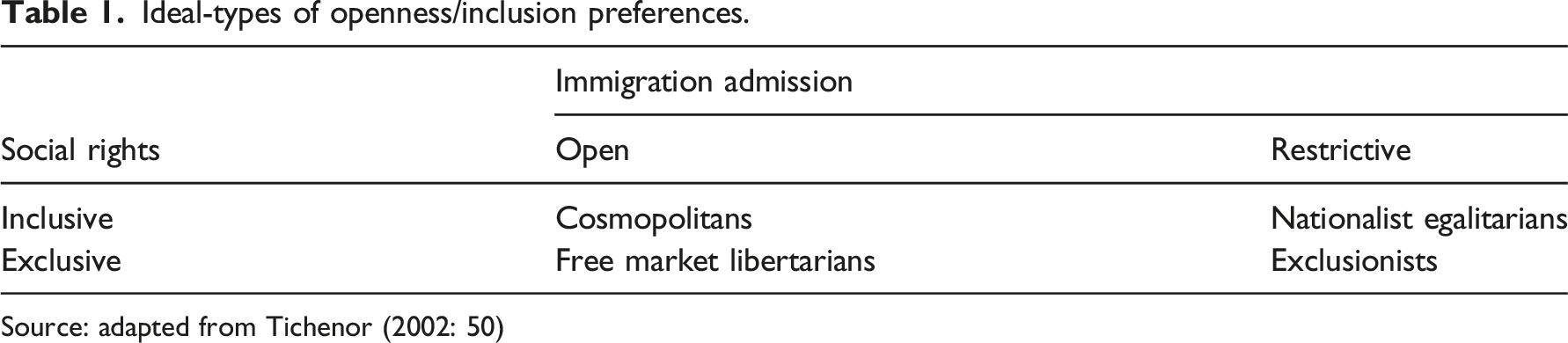
If we conceptualize closure and exclusion as two distinct but linked mechanisms of exclusion of immigrants – one from the national territory, the other from the welfare state – it is possible to construct a set of ideal-types where these two dimensions intersect. Similar ideal-types have been used by Tichenor (2002: 36) to capture elite policy positions in immigration policy, and more recently by Goodman and Pepinsky (2021: 418) to capture policy paradigms. Here we adapt these types to capture individual positions about the openness–social rights nexus.
Ideal-types of openness/inclusion preferences.
Source: adapted from Tichenor (2002: 50)
The second dimension, inclusiveness, captures the extent to which individuals are ready to grant immigrants the same range of social rights as national citizens. Again, this is a simplification as this measurement does not differentiate across welfare schemes, and the extension of similar rights can mean different things in generous or residual welfare states. However, in this way, we can build a two-by-two category to match existing typologies used at the policy level. We admit the limitations of such a conceptualisation, but it proves operational and applicable empirically.
Cosmopolitans support both relatively open admission policies and the full inclusion of immigrants in the range of social rights available to citizens. This policy position is premised on the idea that there is no trade-off between openness and inclusion.
Nationalist egalitarians support the broad extension of welfare rights to immigrants but combined with a rather restrictive admission policy: closed to the outside, equal inside. This position is premised on the idea that generous welfare rights for both migrants and natives are only sustainable with a restrictive immigration policy. In some way, this is the model adopted by a number of Scandinavian countries in the postwar period.
Free market libertarians support open admission policies but favour restricting immigrants’ entitlement to welfare benefits. Goodman and Pepinsky (2021: 419 ff) present this stance, which they term ‘exclusionary openness’, as the policy mix pursued in countries – Germany or Switzerland being typical cases – that established guest-worker programmes in the postwar period but severely restricted the rights of migrants in terms of access to the welfare state (see also Ellermann, 2013).
Finally, restrictionists support restrictive stances on both dimensions, namely on welfare rights and on admission. This is usually the type of position advocated by populist right-wing parties.
Correlates of preferences for openness and inclusion
This set of ideal-types is useful to capture variation in preferences around the inclusion/openness dimensions. But how are these different positions correlated with individual and contextual characteristics? In the following section we produce theoretical propositions on the possible correlates of the above positions, based on individual and national characteristics.
Individual correlates
We draw on a large body of literature highlighting education as the most important driver of immigration preferences (Hainmueller and Hiscox, 2007; Hainmueller and Hopkins, 2014), and therefore focus specifically on this factor. If education has been shown to be consistently related to immigration attitudes, the mechanisms that underpin this relationship are less clear. On the one hand, education is a correlate of income, sometimes used a proxy measure of it (Hanson et al., 2007). On the other hand, education is the site of acquisition of particular norms about cultural diversity, so that both rational-economic or socio-tropic mechanisms can be at play (Hainmueller and Hopkins, 2014). We focus on this factor as a central divide that shapes political and redistribution attitudes (Attewell, 2022).
From a rational choice perspective, we may expect people with higher education levels to be more favourable to open admission policies because their labour market position is less likely to be threatened by immigration. When attitudes about immigration in general are enquired about, people tend to think of low-skill migration (Alesina et al., 2022). People with higher education levels (and therefore higher incomes) under progressive taxation may be interested in minimizing their tax burden by favouring restrictive access to welfare benefits for low-skilled migrants (Hanson et al., 2007). Attewell (2022) recently found that those who are higher educated are less likely to support an expansive welfare state. Hence, if we assumed interest-based preferences, we should expect education to be positively associated with the likelihood to endorse a free market libertarian position: open immigration but restrictive welfare access for immigrants.
A now significant body of research has, however, shown that pure material interests only have limited explanatory power in explaining immigration preferences. Hainmueller and Hiscox (2007) notably show that education has an effect that goes beyond income and is associated with more favourable attitudes towards cultural diversity. This cannot be reduced to economics alone. Recent work by Attewell (2022), in the study cited above, shows that the higher-educated also have more positive views about the deservingness of welfare beneficiaries, even if they are less supportive of welfare. This is likely to feed into their propensity to endorse more inclusive views regarding immigrants’ access to social security. In this perspective, we should expect higher-educated individuals to favour both openness and inclusion as a matter of fairness, even if it may mean greater costs.
Finally, restricting welfare access for migrants may effectively mean lowering their reservation wages – because they have no alternative to wage labour – and thereby create even greater labour market competition: without a safety net, migrants may accept even lower wages, creating a pattern of dualisation (Afonso and Devitt, 2016; Piore, 1979). If this is the case, then lower-educated individuals may have an interest in a closed immigration policy, but relatively equal access for migrants to welfare programmes to avoid this segmentation (egalitarian nationalism). This is notably the reasoning that underpins the position of Swedish trade unions outlined above (see, notably, Watts, 2002). If this is true, education should be negatively correlated with the propensity to endorse an egalitarian nationalist position
Contextual correlates
Individual preferences on the openness–inclusiveness mix may not only be shaped by personal characteristics, but by contextual ones too. For instance, a number of authors have looked at the relationship between country-level institutional factors and the propensity for welfare chauvinist attitudes (Crepaz and Damron, 2009; Larsen, 2020). For practical reasons, we focus on three contextual factors at the national level, namely the generosity of the welfare system, the incidence of immigration, and the welfare use of immigrants.
A first strand of literature draws a relationship between the nature and logic of welfare institutions and the type of attitudes prevailing in the population about immigrants. Crepaz and Damron (2009) argue that the inclusiveness and universalism of welfare institutions tend to ‘spill over’ to attitudes towards migrants: citizens in countries with more inclusive welfare institutions – for example, in Scandinavia – are thus less likely to display welfare chauvinist attitudes. Larsen (2020) also finds a relatively close correspondence between the characteristics of the welfare system and attitudes towards the inclusion of immigrants in the welfare state. If we expect the idea of a correspondence between contextual factors and attitudes, we could expect individuals in generous welfare systems to be more likely to display cosmopolitan preferences in terms of both openness and inclusion.
At the same time, we could also envisage a mechanism whereby the generosity of welfare institutions could trigger more defensive attitudes towards both openness and inclusion. Hanson et al. (2007) take the example of California and Texas. In the former, the higher fiscal exposure of those who are higher educated was associated with greater political pressure to restrict access to welfare for immigrants, while this was less the case in low-tax Texas. Because more generous welfare institutions usually mean more generous benefits going to immigrants as well, welfare state generosity could foster attitudes in favour of limiting their access to the welfare state, either through immigration control, or through restrictions on welfare access. In contrast, less generous welfare states should be less likely to trigger this type of attitude because the potential transfers to migrants are smaller. In this configuration, welfare state generosity would foster classic restrictionist attitudes or egalitarian nationalist attitudes. This is because we know that many individuals are generally averse to redistributing to immigrants.
The other contextual factor that may have an impact on inclusion–openness attitudes may be the number of immigrants present in the country. Here, we draw on classic theories about immigration attitudes (Quillian, 1995; Schlueter and Scheepers, 2010; Semyonov et al., 2006). Feelings of threat and insecurity among ingroups vis-à-vis outgroups can increase when the outgroup’s size increases. This is because group size directly relates to their capacity to mobilize and engage in collective action and secure these benefits for themselves at the expense of the ingroup (Hjerm, 2009). We could expect citizens in countries with more immigrants to endorse more restrictionist positions (restrictionist or egalitarian nationalist) with respect to openness and inclusion.
Finally, it is not only the share of migrants but the extent to which migrants effectively rely on the welfare state that can shape attitudes. This expectation is premised on two arguments. First, social protection can be thought of as a scarce good, and individuals may rationally believe that immigrants consuming it reduces the availability of welfare for other citizens. A second reason may be that citizens might object to payer–recipient relationships, wherein citizens finance the welfare of immigrants but perceive themselves not to benefit from it. Besides, Burgoon (2014) has shown that not only the size of the migrant population but also the socio-economic integration of immigrants can shape attitudes towards redistribution. Here, higher levels of welfare dependency by migrants could foster exclusionist attitudes in terms of openness and inclusiveness.
What lies in the background of our expectations is the correspondence between preferences and context. On the one hand, a generous and open welfare context can trigger defensive reactions as citizens may be aware that it may mean greater transfers to migrants. On the other hand, an inclusive and open welfare state for immigrants may also reflect favourable preferences among the public towards immigrants.
Data and methods
Data and operationalization of variables
Dependent variable
In our analysis, we use data from rounds 4 (2008) and 8 (2016) of the European social survey covering 23 countries. 1 These two rounds contain a question measuring welfare chauvinism already used in existing research, namely ‘Thinking of people coming to live in [country] from other countries, when do you think they should obtain the same rights to social benefits and services as citizens already living here?’ Possible answers were (1) ‘Immediately on arrival’; (2) ‘After living in [country] for a year, whether or not they have worked’; (3) ‘Only after they have worked and paid taxes for at least a year’; (4) ‘Once they have become a [country] citizen’; (5) ‘They should never get the same rights’. To build our typology, we consider responses 1 to 3 to signal more inclusive stances on the inclusion of migrants into the welfare state, and responses 4 and 5 to signal more exclusive stances. Admittedly, this measure of welfare chauvinism is not without problems as positions 4 and 5 effectively mean the exclusion of non-citizens from welfare. Besides, the options do not really reflect real-world restrictions (for example, the export of benefits or vesting periods) and do not differentiate between welfare schemes (for a critique, see Eick and Larsen, 2022). However, they do capture general attitudes towards the inclusion or exclusion of immigrants from welfare.
For the openness dimension, we use the following question: ‘To what extent do you think your country should allow people from poorer countries outside Europe to come and live here?’ Possible responses were (1) ‘Allow many to come and live here’; (2) ‘Allow some’; (3) ‘Allow a few’; (4) ‘Allow none’. We consider responses 1 and 2 to signal open attitudes to immigration admission and stances 3 and 4 to signal closed attitudes. Again, this question does not capture more subtle nuances in immigration preferences, for instance in terms of skills or origin countries, but its mention of poorer countries outside Europe does lead respondents to think about potential welfare costs, which is useful for our purposes.
We use these two questions to build the 2 × 2 typology outlined above. Respondents are coded as ‘egalitarians nationalists’ if they support restrictive admission policies but expansive welfare rights for migrants, ‘cosmopolitans’ if they support inclusive welfare rights and open admission policies, ‘restrictionists’ if they support welfare restrictions for immigrants and restrictive immigration policies, and ‘libertarians’ if they support welfare exclusion but open policies. Again, the wording of the questions in the ESS has limitations, but for practical purposes it is operational.
Individual-level independent variables
We account for several variables that can affect openness/inclusion preferences. We opted for only using socio-economic variables and not attitudinal variables, as mechanisms are more difficult to ascertain, and we seek to refrain from explaining attitudes by attitudes. We use here the factors highlighted in the theory section, all coming from the European Social Survey. Education is coded in three categories: less than lower tier upper secondary (low); upper-tier secondary (high school) or vocational (medium); higher education (high). All our models also include variables that denote the respondents’ gender (dummy, 1 = female) and age. We also take the respondents’ main source of income into consideration, which controls whether they are active on the labour market or not. This is done using a three-point categorical variable (1 = pensions or social welfare benefits as main source, 2 = labour income, and 3 = other sources of income). We also include a measure of income using income deciles per country, and whether they are unemployed.
Contextual variables
For contextual variables, we use the share of foreign-born nationals in each country-year (OECD, 2019a). For welfare state generosity, it is well known that simply using social spending as a share of GDP to capture welfare generosity can be problematic. This is because an increase in overall spending levels could merely reflect a rising number of recipients, without necessarily indicating more generous benefits (Green-Pedersen, 2004). Available alternatives to measure welfare generosity, such as the Scruggs index, are not available for the Central and Eastern European countries in our sample. As a compromise, we opted to use the ratio of unemployment spending as share of GDP per percentage of unemployment to obtain a measure of welfare generosity.
To measure welfare dependence among immigrants, we focus on the likelihood that immigrant status predicts the use of non-contributory welfare among immigrants in a given country-year using the EU-SILC (Eurostat, 2020). Using the EU-SILC, we estimated bivariate probit regressions per country-year using immigrant status as a predictor of whether an individual receives non-contributory benefits (housing benefits, family benefits and social assistance). Immigrant status is operationalized as a dummy variable and captures whether the respondent is born outside of the country or does not possess citizenship in their country of residence. To obtain our measure, we use the Z-value for the effect of migrant status in these regressions. We chose the Z-value over the coefficient on the migrant dummy as this better reflects the uncertainty associated with the estimates. In essence, similar coefficients but with greater precision count for more using this approach, while less noisier estimates are shrunk towards zero (Burgoon, 2014; Negash, 2022). Last, all our models also control for the business cycle using the unemployment rate (OECD, 2019b).
Method
Our data are nested with individuals nested in country-years, further cross-classified in countries and years. Ignoring this nested structure would result in anti-conservative errors and incorrect test statistics (Hox et al., 2017). To account for this nested structure, we use multilevel multinomial logistic regressions to regress our four ideal types on several socio-economic variables to assess the likelihood of adhering to a particular set of attitudes given possible socio-economic characteristics. The exclusionist category is the reference category in all our models.
We estimate three-level multilevel models with country-year and country random intercepts. Our models also include a wave dummy (1 = 2016) as the two rounds took place in the middle of the 2008 financial crisis and 8 years later, in a substantially different economic and political context (in the wake of the so-called 2015 refugee crisis) (Schmidt-Catran and Fairbrother, 2016). We also grand mean centre our continuous independent variables. All our models also display the Akaike Information Criterion (AIC) and the log-likelihood as measures of model fit. Additionally, to correct for potential sampling bias, we make use of the ESS’ survey weights in our models.
Results
We first provide an overview of the distribution of individuals per ideal-type per country in Figure 1. We observe significant variations across countries, which could be more systematically investigated in further research. Sweden, for instance, has the largest proportion of respondents supporting a combination or openness and inclusion. At the other extreme, Hungary has the highest proportions of people supporting pure exclusionist positions combining closure and exclusion. We see some degree of clustering of central and eastern European countries at the top of the graph, where cosmopolitan attitudes are less prevalent. Overall, it appears that it makes sense to distinguish between the two dimensions, as they are not fully correlated. If this was the case, the cosmopolitan and the exclusionist categories would be much larger than the others, but this doesn’t appear to be the case. Instead, we see that the free-market libertarian category is the smallest, reflecting a broader pattern among western electorates whereby there is little demand for libertarian policies (Krugman, 2015). It is true, however, that individuals who favour open immigration policies are also more likely to support inclusive welfare access for migrants. But this is to be expected given that we know that the correlates of both immigration restriction and welfare chauvinism are similar. Distribution of each openness-inclusion type by country (%), post-stratification weights, both 2008 and 2016 waves combined. Source: Own elaboration based on ESS 2008 and 2016. Post-stratification weights used.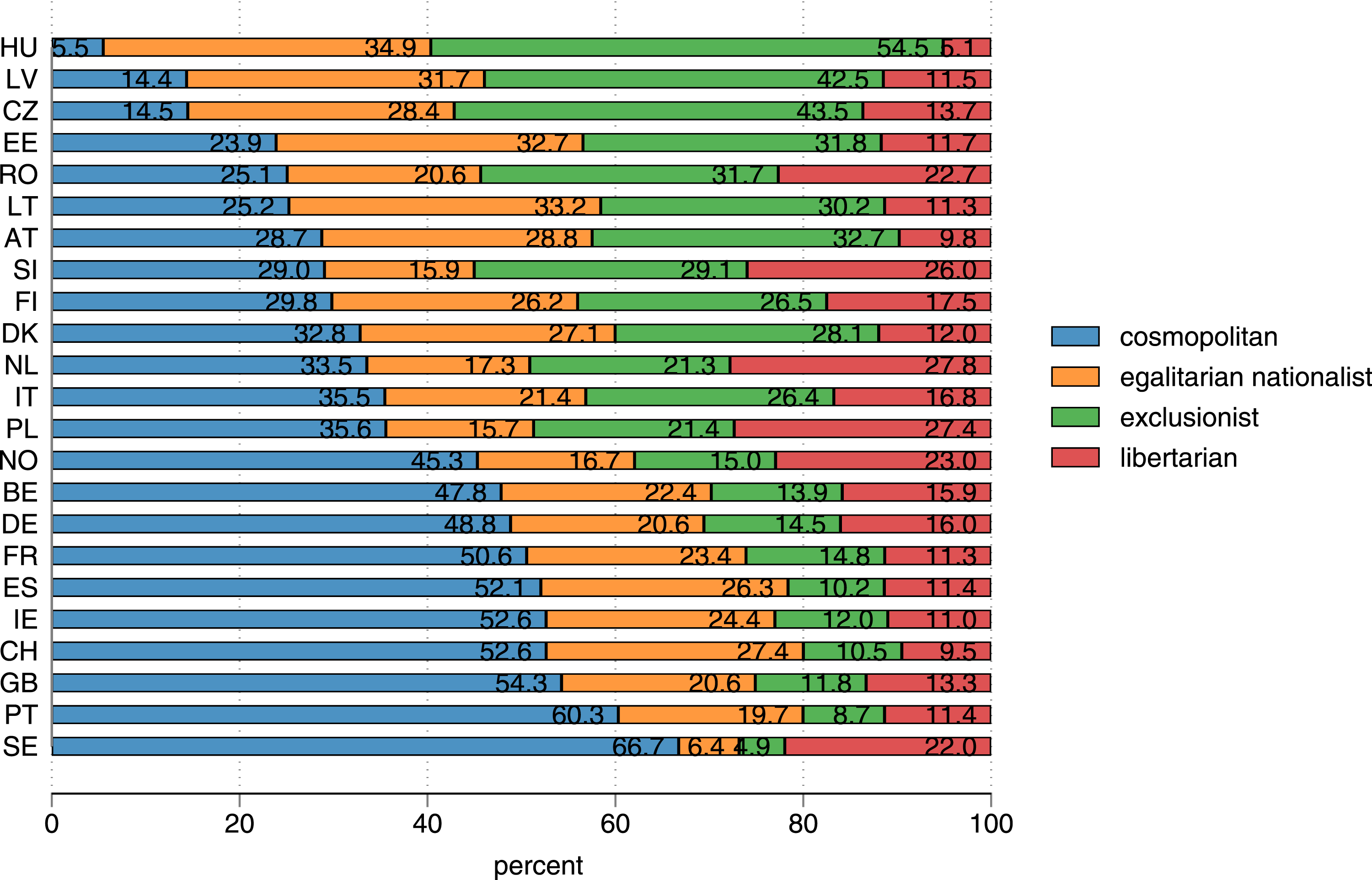
We start by examining how socio-economic variables affect the probability that an individual supports a particular combination of openness and inclusion. The results are shown in Figure 2 (underlying table in Appendix). The exclusionist type is the reference category, and we show log odds for the full model including both individuals and country-level determinants. Multilevel multinomial models examining socio-economic and contextual characteristics as predictors of openness–exclusion preferences. Note: References category: Exclusionist. Reference category for education: low. Reference category for main income source: social benefits or pensions.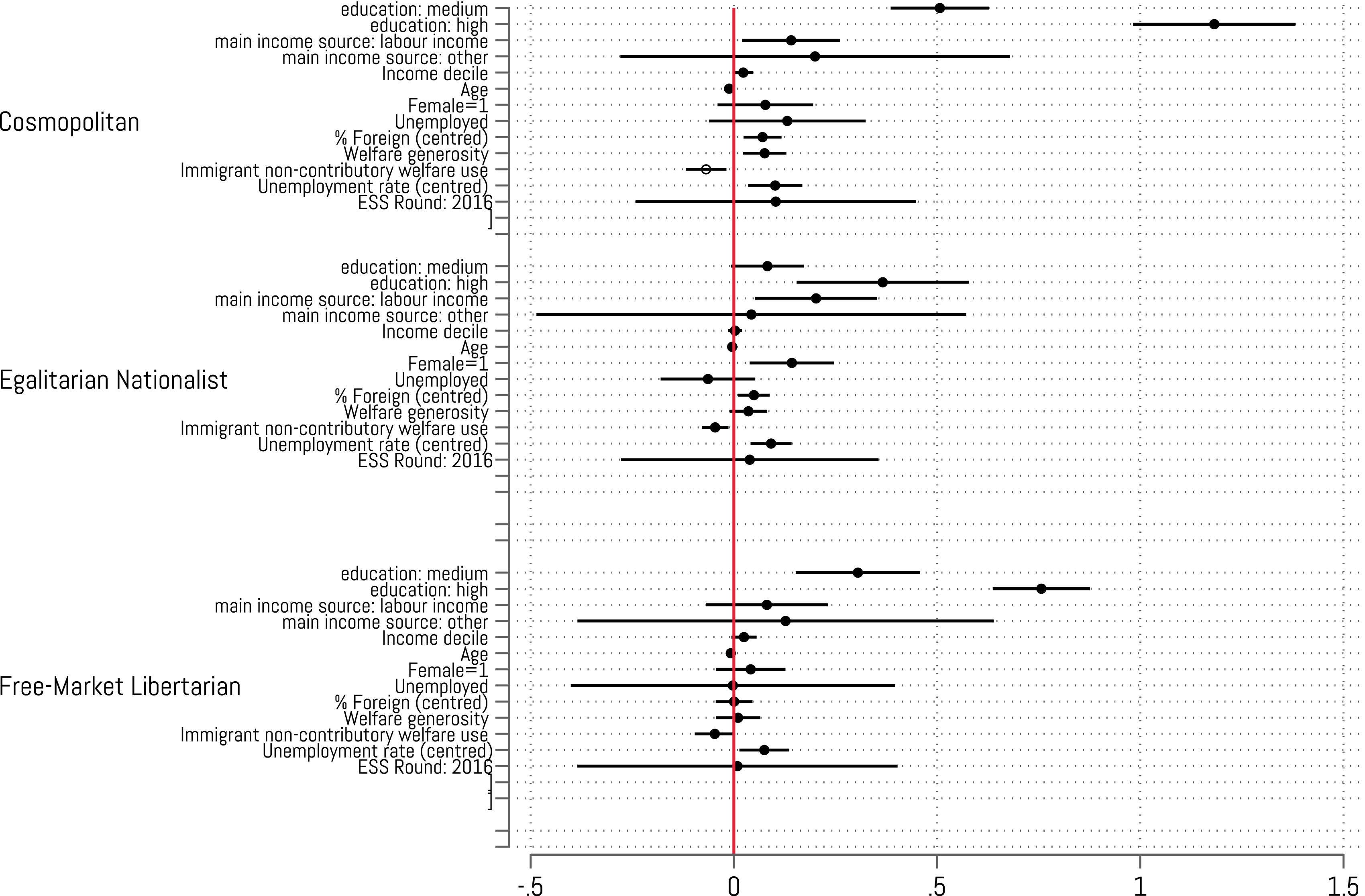
We find that education has a clear and positive association with the probability to endorse cosmopolitan positions. As expected, and in line with previous literature, education is highly significant in all models. It is important to mention that these log-odds relate to the exclusionist category, which low-educated individuals are more likely to endorse compared to people with higher levels of education. A clearer way perhaps to understand how our ideal types relate to education is by showing predicted probabilities to endorse each one of the positions in the typology for different levels of education, drawing on our full models with individual and country-level predictors, which we show in Figure 3. We can see that the probability to endorse a cosmopolitan dimension clearly increases with education, while the probability to endorse an exclusionist position clearly decreases. This is in line with previous research on immigration preferences. The results are certainly more interesting when it comes to the ‘intermediate’ types, namely free-market libertarian and egalitarian nationalist. The probability to endorse an egalitarian nationalist position also decreases with education. The idea that higher-educated individuals are more likely to endorse a free-market libertarian position is confirmed, but it is clearly the least popular type as a whole over the whole sample. Higher educated individuals are much more likely to endorse positions that are both open and inclusive (cosmopolitan), thereby undermining the idea that the drivers of such positions are purely interest-based. Figure 3 clearly shows that the cosmopolitan position is by far the most prevalent among individuals with tertiary education. This is also in line with previous literature on immigration preferences (Hainmueller and Hopkins, 2014). In contrast, factors such as income do not seem to have explanatory power once we control for education. The findings shown in Figure 3 should be nuanced when it comes to the role of education because of overlapping confidence intervals. Predicted probability to endorse each of the four ideal-types by education (Full model).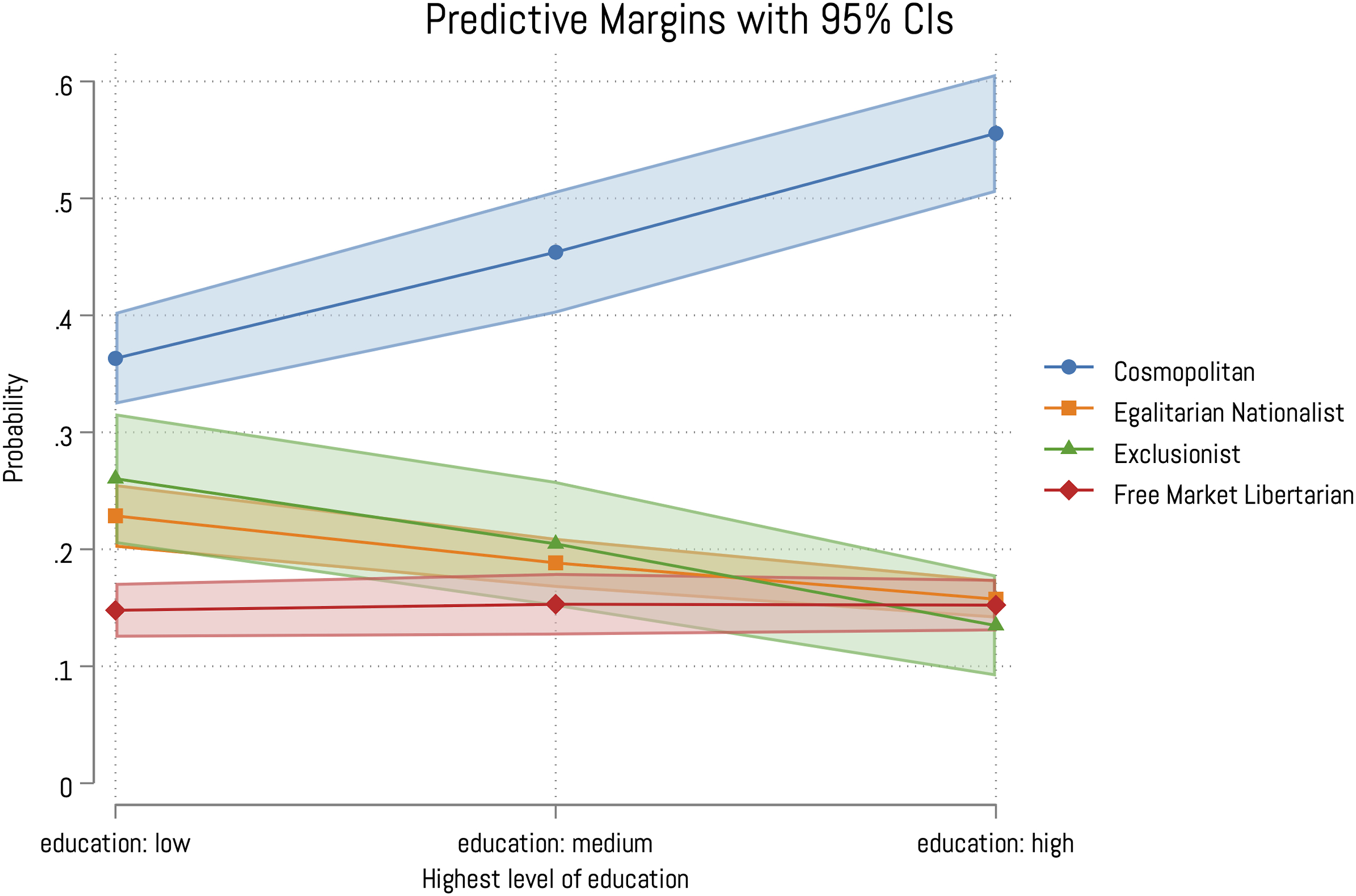
Turning to contextual factors, we find a positive relationship between the percentage of immigrants and the probability to endorse a cosmopolitan position, as well as between welfare generosity and the propensity to adopt cosmopolitan positions. A greater share of migrants in the population is associated with a greater probability to support positions that are both open and inclusive, and we therefore find more empirical support for the positive association between context and attitudes than for a backlash mechanism whereby greater shares of immigrants would be associated with more restrictionist attitudes. We find, however, some support for the idea that not only the number, but also the characteristics of migrants matter. Indeed, we find a small negative relationship between immigrant dependency on non-contributory benefits and the probability to adopt cosmopolitan positions. There may be different mechanisms at work here, namely that individuals are less likely to fully endorse an open and inclusive position when immigrants are particularly reliant on the welfare state. In turn, it may be that immigrants experience greater integration problems when natives display less inclusive attitudes, leading them to rely more on the welfare state. This is the only instance where we can find some possible backlash effect.
Robustness tests
We conducted a number of robustness checks to assess the validity of our results with different model specifications. Because we have a limited number of country-years available, disaggregating the sample made it more difficult to ascertain the impact of contextual variables with any level of certainty, but it could be useful to assess the robustness of our main individual predictors, namely education. First, we conducted our analysis separately for each wave of the ESS, to have some leeway as to whether observed effects may be time-dependent. Second, we conducted the analysis by excluding central and eastern European countries, which have a very different history of immigration. Our main result, namely the impact of education, stays robust across the different specifications. Other factors are significant in some years but not in others, so that we should stay careful especially about contextual factors.
Conclusion
In this article, we have built ideal-types trying to capture different policy mixes on the extent to which countries are open to immigration, and the extent to which their welfare states should be inclusive for migrants in the country. We find that education has a significant effect on the propensity to endorse different mixes of inclusion for migrants in the welfare state and openness to immigration. While unsurprisingly, higher-educated individuals are more likely to endorse open and inclusive positions while lower lower-educated individuals are more likely to endorse exclusionist positions, we find interesting relationships when it comes to the ‘intermediate’ types. Namely, while lower-educated individuals are more likely to be ‘egalitarian nationalists’ and adopt positions combining closure and inclusion, higher educated individuals are more likely than low-educated individuals to be ‘free market libertarians’ and defend positions combining open immigration policies but restrictive access to welfare for migrants.
One of the limitations of our analysis is that we are dependent on the survey items and measurements of the European Social Survey. As mentioned above, the measures of welfare inclusion of immigrants and admission policy are somewhat problematic in capturing the reality of both dimensions. On the one hand, the measure of welfare exclusion does not seem differentiated enough to capture the variety of ways in which immigrants can be excluded from, or disadvantaged in, welfare programmes. On the other hand, a measure of support for immigration openness that would capture the dimension of selectivity, rather than numbers alone, would probably be more informative and could be devised for further research. Arguably, the elaboration and measurement of a typology with a higher degree of validity would entail designing original questions rather than relying on those of the ESS.
Second, our analysis has focused on education and socio-economic variables as central correlates of openness and inclusion, but further analysis would be warranted to properly explain why some individuals endorse one or the other position. While we do not find any relationship between income and attitudes, Duman (2023) has recently found a positive relationship between feelings of subjective insecurity and welfare chauvinist attitudes. This article was a first attempt at drawing a typology and outlining correlations, but it is by no means a complete explanation of why some individuals prefer walls around the welfare state, while others prefer them around the country.
Finally, while we have focused on correlations and refrained from making causal claims, a proper examination of the causal relationships between inclusion and openness would certainly require an experimental setup. In an experimental setting, one could more accurately assess whether changes in welfare rights for immigrants impact the number of immigrants that citizens are willing to accept. Exploring this in future research could be valuable, though one should bear in mind the usual concerns regarding external validity.
Supplemental Material
Supplemental Material - Building a wall around the welfare state, or around the country? Preferences for immigrant welfare inclusion and immigration policy openness in Europe
Supplemental Material for Building a wall around the welfare state, or around the country? Preferences for immigrant welfare inclusion and immigration policy openness in Europe by Alexandre Afonso and Samir Negash in Journal of European Social Policy
Footnotes
Acknowledgments
The authors would like to thank the anonymous reviewers as well as the special issue editors Gianna Maria Eick and Benjamin Leruth. Previous versions have benefited from feedback by Femke Roosma, Rosan Haenraets and the participants of the workshop ‘Migration and the Welfare State in Historical and Comparative Perspective’ at the University of Lund, Sweden, 9–10 May 2022, and notably Gerda Hooijer, Adrian Shin, Frida Borang, Yotam Margalit, Maggie Peters, Elif Naz Kayran and Martin Ruhs.
Declaration of conflicting interests
The author(s) declared no potential conflicts of interest with respect to the research, authorship, and/or publication of this article.
Funding
The author(s) disclosed receipt of the following financial support for the research, authorship, and/or publication of this article: This work was supported by the Funding by the Dutch Science Organisation NWO, Grant 016. Vidi.185.159.

Supplemental Material
Supplemental material for this article is available online.
Note
References
Supplementary Material
Please find the following supplemental material available below.
For Open Access articles published under a Creative Commons License, all supplemental material carries the same license as the article it is associated with.
For non-Open Access articles published, all supplemental material carries a non-exclusive license, and permission requests for re-use of supplemental material or any part of supplemental material shall be sent directly to the copyright owner as specified in the copyright notice associated with the article.
