



Abstract
Welfare chauvinism and welfare populism as characteristic features of radical right parties’ welfare stances have become challenges to the welfare state. However, in order to understand how these claims may indeed affect welfare politics, it is essential to study whether welfare chauvinism and welfare populism attract voters beyond the radical right, especially among the mainstream right or even parts of the left. Results based on original public opinion data in eight Western European countries show that, contrary to widespread assumptions, welfare chauvinism and welfare populism divide the right more than the left. Electorates of not only green, but also most social democratic and radical left parties are consistently most opposed to discriminating welfare rights between natives and immigrants, although this opposition is weaker among left working-class voters than among left middle-class voters. Even voters of most mainstream right parties show only moderate support for welfare populism and welfare chauvinism, leaving the fervent support of radical right voters for welfare chauvinism and populism unmatched by any other electorate. These findings have important implications for the strategic situation of left parties and for understanding how welfare chauvinism and welfare populism may challenge welfare states.
Keywords
Introduction
Critiques of Western European welfare states nowadays take new forms, different from those of most of the post-war twentieth century. In a context marked by a predominant class cleavage, conflicts over the welfare state used to oppose the left, as the traditional ally of the working class, to the right, as the representative of capital. Welfare opposition was mainly carried by market-liberal and economically right-wing proponents based on fundamental concerns about generous welfare institutions and high levels of taxation. Under dramatically changed political circumstances, namely the strong politicization of a ‘second dimension’ cleavage dividing voters and political parties along liberal-universalist versus traditional-particularist policy preferences (Kriesi et al., 2008), as well as the concomitant rise of the radical right, which has established itself as a third pole in most Western European party systems (Oesch and Rennwald 2018), new forms of welfare opposition are challenging the very nature of inclusive welfare states (see the introduction of this special issue). First, there is welfare populism, that is, a critique of welfare provision and their administration not benefiting the ‘common people’, but allegedly serving corrupt elites and lazy segments of the society. Welfare populism (Abts et al., 2021; De Koster et al., 2013; Van Hootegem et al., 2021) or ‘economic populism’ (Derks, 2004) accuses contemporary welfare institutions of being ineffective in that they increase rather than reduce economic injustice by shifting resources from deserving ‘makers’ (hardworking producers and taxpayers) to lazy and undeserving ‘takers’ (Rathgeb, 2021). Welfare populists accuse the welfare state of wasting money on both well-paid civil servants and undeserving ‘welfare scroungers’, rather than helping those in need and deserving of support. Increasing levels of immigration and its salience have especially moved immigrants, often perceived as undeserving of welfare, to the centre stage of that criticism. As a result, a second form of particularistic welfare opposition has gained ground: welfare chauvinism, that is the perception that immigrants get more than their fair share of welfare and the demand to exclude non-citizens from social benefits and services (Eick and Larsen, 2022).
These two newer forms of welfare state critique, rooted in socially conservative, particularistic ideology, set themselves apart from conventional, market-liberal welfare opposition, in that they do not necessarily question key objectives of the welfare state such as redistribution or social security. It is partly for this reason that patterns of support for them might be more complex than a simple left–right divide. While welfare populism and welfare chauvinism are key appeals of radical right parties in the field of welfare policies (e.g. De Koster et al., 2013), they have the potential to appeal to broader social groups than the voters of these parties. Specifically, they have been shown to be particularly popular among working-class voters, who were long thought of as staunch defenders of the welfare state (Heizmann et al., 2018; Mewes and Mau, 2012; Van der Waal et al., 2010). As the working class has traditionally been a stronghold of left parties, these findings have sparked – so far unresolved – debates about whether and to what degree welfare chauvinism and welfare populism may divide left electorates and eventually left-wing parties. Similarly, it remains unclear whether the traditionally welfare-sceptic mainstream right party electorates also embrace these new forms of welfare opposition, which are based on socially conservative, particularistic motivations rather than on market-liberal grounds, or whether these lead to divides between electorates of radical and mainstream right parties. For this reason, we study in this article whether welfare populism and welfare chauvinism appeal beyond radical right voters and to which partisan groups specifically.
We go beyond previous literature in three ways. First, while the literature so far has primarily focused on the welfare chauvinist and populist preferences of radical right voters (exceptions are De Koster et al., 2013; Koning, 2017; Reeskens and Van der Meer, 2021, specifically for the Netherlands), we broaden our perspective and focus equally on the stances of other party electorates towards the immigration–welfare nexus and welfare populism. Second, and specifically with regard to welfare chauvinism, we argue that the differential treatment of immigrants and natives with regard to social rights can take different forms, depending on whether it emphasizes generous rights of natives or the exclusion of immigrants. In other words: the question of including or excluding immigrants interacts with voters’ positions regarding etatism and welfare generosity more generally. To take that into account we differentiate between two forms of welfare chauvinism, namely welfare protection (discriminating between immigrants and natives by protecting or expanding benefits for natives) – which might particularly appeal to the left – and welfare exclusion (discriminating between immigrants and natives by cutting back welfare benefits and services for immigrants) – which might particularly appeal to the mainstream right. We study the extent to which these two forms of welfare chauvinism and welfare populism have the potential to divide the left and the right. Third, we investigate how working- versus middle-class voter preferences shape the divides between party families as well as divides within party families.
We answer these questions based on original public opinion data in eight Western European countries (Germany, Netherlands, Denmark, Sweden, UK, Ireland, Italy, Spain), which allow us to measure the policy positions voters advocate. We descriptively map electorates’ support levels for welfare exclusion and welfare protection as well as for welfare populism. Furthermore, we check whether and how party families are internally divided between working and non-working classes, since left parties are generally expected to promote welfare protection, exclusion and welfare populism in response to working-class voter preferences.
We show that contrary to many assumptions in the public debate and literature, welfare chauvinism and welfare populism divide the right more than the left. Left-wing electorates on average clearly support welfare rights for immigrants and are most sceptical towards immigrant/native discrimination even if it comes in the form of welfare expansion exclusively for natives. Left party families face internal divisions between working-class and non-working-class voters but these are smaller than divides within the political right. While radical right voters support not only the exclusion of immigrants from welfare but also strong welfare protection for natives, moderate right electorates occupy a middle position between left and radical right electorates. Also, concerning support for welfare populism, we observe radical right electorates to constitute the clear welfare populist spearhead, with differences between other party family electorates being comparatively small.
Welfare populism and two types of welfare chauvinism
Welfare chauvinism tackles the key question entailed in the newly salient, socio-cultural cleavage between universalism and particularism head-on: how and under what conditions should the welfare state support all members of a society equally or differently? Should social rights be stratified according to immigrant status or not? Welfare chauvinism is usually understood as a unidimensional concept and the question becomes focused on the extent and intensity of support for this claim (e.g., Heizmann et al., 2018; Van der Waal et al., 2013). However, when looking more closely at the definitions of welfare chauvinism, we detect at least two manifestations of the concept with highly different implications in terms of policy design: on the one hand, welfare chauvinism is conceptualized as the combination of support for a big and generous welfare state, as well as support for prioritizing and privileging welfare provision for natives as opposed to immigrants. De Koster et al. (2013: 6), for example, explicitly label welfare chauvinism as implying ‘egalitarian views on the one hand, and restrictive views pertaining to the deservingness of immigrants on the other hand’. Most importantly, by focusing on the generous rights of natives, this conceptualization of welfare chauvinism emphasizes the ‘left-wing economic attitudes to redistribution’ (Schumacher and Van Kersbergen, 2016: 301) among welfare chauvinist voters, and the fact that welfare chauvinist parties occupy a ‘traditional social-democratic or left-wing ideological space on the socioeconomic dimension’ (Careja et al., 2016: 436). The novel aspect of welfare chauvinism in this conceptualization precisely refers to the combination of these pro-welfare positions with ‘anti-immigration right-wing positions on the socio-cultural dimension’ (Careja et al., 2016: 436). It is this statist, pro-welfare component of welfare chauvinism that suggests its potential appeal even among the traditional left.
However, there is a second, more sparse definition of welfare chauvinism, which focuses more explicitly on the exclusive aspect of the political stance, that is the partial or full exclusion of immigrants from the welfare state. As in the first formulation of the concept, this second conceptualization implies a differential, unequal treatment of natives and immigrants by the welfare state. However, its focus lies on the restrictive dimensions of welfare chauvinist reforms (Eick and Larsen, 2022; Heizmann et al., 2018; Van der Waal et al., 2013), that is, on welfare retrenchment based on the (deservingness) criterion of immigration or citizenship. Empirical studies on actual welfare chauvinist reforms tend to focus often on such reforms reducing benefits for immigrants (e.g. Chueri 2023). These reforms do not necessarily involve overall strong support for a generous welfare state.
We argue that if the goal – as in this article – is to assess whether discriminating against immigrants might be attractive to voters beyond the radical right, it is vital to analytically differentiate these two understandings or forms of welfare chauvinism, as we would expect that a fiscally expansive type of welfare chauvinism could resonate more with left voters, and a fiscally restrictive type of welfare chauvinism could resonate more with voters of the mainstream right.
We call welfare protection a strategy of expansive welfare chauvinism. The focus here is on protecting the welfare provision for native citizens rather than disentitling immigrants. If people believe that welfare for immigrants has opportunity costs, they might fear that a welfare state catering to a growing number of immigrants could exert pressure on welfare benefits and services for natives. This might lead some voters to promote the discrimination of immigrants in order to protect generous welfare for natives. Thereby, the motivation for welfare protection is not welfare opposition per se, but preserving and strengthening a generous system of social protection for native/national members of a community of solidarity that should be shielded from social risk and grievances. We contend that this form of welfare chauvinism might appeal beyond the radical right to parts of left-leaning voters, especially if they believe a generous welfare state to be incompatible with immigration, or if their left vote is motivated primarily by support for egotropic welfare preferences and they might view immigrants as rivals in the competition for welfare benefits (Schmitt and Teney, 2019). This latter argument has been suggested as a main reason why members of the working class – a traditional electoral constituency of the left – are particularly prone to support welfare chauvinism (Hooijer, 2021; Mewes and Mau, 2012).
In contrast, the focus of welfare exclusion is on the immigrants, but in a fiscally restrictive way. The underlying reform direction is one of welfare state retrenchment, notably at the expense of immigrants. Such reforms can happen, for example, by cutting social assistance benefits for refugees to a mere minimum, below the level of ‘regular’ social assistance. Motivations for welfare exclusion can be either the desire to punish immigrants, to decrease a country’s attractiveness for immigrants, or just support for welfare retrenchment – which is politically relatively easy to achieve at the expense of immigrants as a concentrated risk group. It is exactly this latter anti-welfare and anti-redistribution motivation that could also make welfare exclusion particularly appealing to voters of mainstream right parties (Römer et al., 2023: 1541).
Similar to both types of welfare chauvinism, welfare populism describes a particular critique of the welfare state that does not stem from a fundamental opposition to redistribution, to social insurance or to egalitarianism, but is based on the idea that the current administration of the welfare state does not benefit the ‘common people’, which are both deserving and in need of support. On the one hand, welfare populism is based on the perception that the actual design of welfare institutions is dysfunctional and unfair, because it wastes money on ‘lazy, undeserving welfare scroungers’. This welfare populist criticism deviates from the narrower concept of welfare chauvinism by differentiating not only between undeserving immigrants and deserving natives, but also by highlighting deservingness gaps within the native population. On the other hand, the concept of welfare populism emphasizes the critique of a ‘corrupt elite’ seemingly responsible for misdirecting and mismanaging welfare benefits. Abts et al. (2021: 25) define welfare populism as pertaining ‘to the attribution of blame to elites for the sub-optimal implementation of welfare arrangements’. According to this view, current welfare institutions might waste money not only on undeserving welfare recipients, but also on an ineffective, rent-seeking ‘welfare industry’ that primarily ensures ‘well-paid and comfortable jobs for self-interested civil servants’ (De Koster et al., 2013: 6).
Divides within the left, divides within the right
Our goal is to study the preferences of party electorates regarding welfare populism and welfare chauvinism to answer several questions: what are the key divides among and between the left and the right at the voter level? Is the radical right the only welfare populist and chauvinist constituency or is there potential for a broader welfare populist/chauvinist coalition? We discuss our expectations first with regard to the welfare chauvinist and then with regard to the welfare populist challenge to the welfare state.
Welfare chauvinist challenge to the welfare state
The literature on attitudes towards social policy and immigration has provided ample evidence that attitudes towards welfare inclusion versus exclusion of immigrants are strongly stratified along socio-economic status, education levels (Mewes and Mau, 2012; Reeskens and Van Oorschot, 2012; Van der Waal et al., 2010) as well as indicators of subjective relative deprivation, which is particularly prevalent in the skilled working class and lower middle class (Heizmann et al., 2018). This stratification along indicators of social class seems to suggest a divide within the broad electorate of the left, given that this electorate today consists of a large coalition of working- and educated middle-class voters (Gingrich and Häusermann, 2015). The expectation of a divide within the left electorate is amplified by findings of several studies that show just how prevalent anti-immigrant deservingness perceptions have become in the democracies of Western Europe, even beyond the lower social strata: Van Oorschot (2006) shows that immigrants are perceived to be the least deserving group when it comes to various dimensions of deservingness. In Norway, a majority of respondents indicated resentment regarding the amount of welfare benefits distributed to immigrants (Cappelen and Midtbø, 2016) and Marx and Naumann (2018) have shown widespread in-group favouritism during the German ‘refugee crisis’. Moreover, Reeskens and Van Oorschot (2012) have shown that those voters prioritizing welfare to benefit the poorest also have the most anti-immigrant distributive preferences. Based on all this evidence, the prevalence of resentment against social benefits for immigrants suggests that voters of left-wing parties may well be divided when it comes to the inclusion–exclusion dimension, especially since voters of left-libertarian and green parties are distinctively the most universalistically minded voters in the political spectrum.
Moreover, the literature on the ‘new liberal dilemma’ has argued that there is also an ‘objective/structural’ dilemma which the left confronts, because an open and heterogeneous society would be incompatible with a generous welfare state, for fiscal reasons on the one hand, and because multiculturalism and diversity would undermine the legitimacy of solidarity on the other hand (Breznau and Eger, 2016; Schmidt-Catran and Spies, 2016). Indeed, Schmitt and Teney (2019) as well as Harris and Römer (2023) show that immigrants tend to be excluded from welfare programmes more strongly in countries where left-wing/social democratic parties have been represented more strongly in government, suggesting that left-wing parties (and potentially also voters) indeed seem to feel compelled to choose between either immigrant inclusion or welfare generosity.
In light of this literature, it is not surprising that much of the scholarly debate and of the political discussion suggests that the inclusion–exclusion divide might cut right through the left, with green voters on one end, supporting immigrants’ welfare rights, and radical left voters on the other end, supporting welfare protection. The expected positioning of social democratic voters in this question is largely indeterminate.
Based on both attitudinal research and studies on the transformation of the mainstream right, one would expect a similarly divided field on the right. On the one hand, the combination of particularist working-class votes for the radical right, and small business owners and more highly skilled managers voting on the mainstream right (e.g., Häusermann and Kriesi, 2015) makes it clear that at the level of individual voters, attitudes are likely to spread widely between support for welfare exclusion, welfare protection, or even immigrant inclusion. While a national-conservative position would tend towards welfare exclusion, business milieus and market-liberal forces traditionally favoured labour-market based immigration as a means of expanding labour supply (Gidron and Ziblatt, 2019). Our expectations for the voter level are further bolstered by recent findings showing that the effect of government participation by radical versus mainstream right parties on immigrant welfare rights differs markedly (Römer et al., 2023).
Based on these considerations and existing studies, we arrive at the following two hypotheses:
Welfare chauvinism (especially welfare protection) divides the left between new left/green and traditional/radical left party electorates.
Welfare chauvinism (especially welfare protection) divides the right between radical right and mainstream right party electorates.
Welfare populist challenge to the welfare state
How could the preference configuration look like with regard to welfare populism? Previous research has demonstrated criticism of the negative and unintended moral and social consequences of the welfare state to be more prevalent among right-wing than among left-wing voters (Van Oorschot, 2010). Similarly, support for welfare conditionality is decidedly higher among people identifying as having a right rather than a left ideology (Van Oorschot, 2006).
What could lead us to expect divides on welfare populism not only between but also within ideological blocs? First, research on the socio-structural predictors of criticizing the workings of the welfare state have – similar to welfare chauvinism – shown socio-economically vulnerable groups to be particularly welfare populist (Van Oorschot, 2010; Van Oorschot et al., 2012). Van Hootegem et al. (2021) scrutinize this seemingly paradoxical relationship further and posit that ‘experiences of resentment’ triggered by relative deprivation, a perceived loss of social status and general social distrust lead socio-economically weaker groups to accuse the welfare state of being unjust and to feel discontent with how it operates. Subjective experiences of declining relative status are a strong predictor of voting for radical right parties (Gidron and Hall, 2020). Moreover, Burgoon et al. (2019) have shown positional deprivation, to increase the likelihood of not only radical right but also radical left voting.
Second, the socio-structural composition of different electorates might matter especially strongly on the left. As addressed above, the left electorate today consists of a coalition of both working- and new, educated middle-class voters with the latter especially having become the backbone of new left and green parties. A large part of this new, educated middle class are so-called socio-cultural professionals who often work in industries such as healthcare, education or welfare (Oesch and Rennwald, 2018). Thus, these are exactly the people who often work within the public sector or the welfare state and are criticized by welfare populists to be part of an ineffective system and to be part of the problem. We therefore expect the new middle-class electorate of the left to be less welfare populist than their working-class voters.
For these reasons, we expect divides concerning welfare populism to exist not only between but also within ideological blocs with voters of radical parties on the right and on the left to be more prone to be welfare populist than voters of mainstream right and especially left parties. These theoretical expectations are also largely in line with what De Koster et al. (2013) have found in the Netherlands.
Welfare populism divides the left between radical left and mainstream left party electorates.
Welfare populism divides the right between radical right and mainstream right party electorates.
Data and methods
To measure the preferences of party electorates, we rely on individual-level data gathered in the context of the welfarepriorities-project between October 2018 and February 2019 (Häusermann et al., 2020). This survey was conducted in eight Western European countries, namely Sweden, Denmark, Germany, the Netherlands, the United Kingdom, Ireland, Italy and Spain. Our country selection aims to cover a diverse range of Western European countries, both in terms of welfare regimes and party system characteristics. This allows us to observe whether patterns of partisan support for welfare exclusion, welfare protection and welfare populism are similar across Western Europe or depend on country-specific institutional and political factors. Robust preference patterns across widely varying contexts bolster our confidence in interpreting underlying structural preference alignments among voters of the left and the right. In cooperation with a professional survey institute (Bilendi), we fielded an online survey to about 1500 respondents per country, leaving us with a total number of 12,129 completed interviews. Respondents were recruited from Bilendi’s or their partners’ online panels. To achieve representativity of our sample to the target population (a country’s adult population), quotas for age and gender (crossed) as well as education were introduced. To mitigate concerns stemming from the fact that the data is not based on a random sample, we compared distributions of different political variables to the corresponding distributions in the European Social Survey. We found that our sample is only slightly more politically interested and nearly identical concerning left–right self-identification, redistribution preferences and cultural attitudes than ESS samples in the respective countries (see Appendix A1). To further alleviate any remaining biases, we weighted the data by gender, age, education and vote shares at the last election before data gathering. 1
While respondents in the survey were prompted to state their opinions on a wide range of social policy issues, in this article we use novel questions to capture how the public would like immigrants to be included or excluded from the welfare state and to capture welfare populist sentiments. Especially, these questions allow us to measure support for the two types of welfare chauvinism we conceptualize. To distinguish between welfare protection and welfare exclusion we use two questions asking respondents whether they agree that the ‘government should expand social assistance benefits for country nationals only’ (welfare protection) and whether they agree that the ‘government should reduce social assistance benefits only for non-nationals’ (welfare exclusion). Respondents could indicate whether they ‘agree strongly’, ‘agree’, ‘disagree’ or ‘disagree strongly’ with these exclusive reform proposals. 2
We measure support for welfare populism using a question stating that ‘some people say that the money that goes into the welfare state in [Country] is used efficiently, while others say that a lot of money is wasted’ and asking respondents what they think. Respondents could indicate their perception on a 10-point scale with the statements ‘a lot of money is wasted’ and ‘the money is used efficiently’ describing the extreme values. To make support for welfare populism comparable to support for welfare protection and exclusion, we transform all scales to range from 0 (strong opposition, money used efficiently) to 3 (strong support, a lot of money is wasted). Since this question might not fully capture the complexity of welfare populism, we try to deepen and differentiate our analyses with two additional survey items. They aim to discern for which party electorates welfare populism primarily reflects a belief that money is wasted on undeserving groups, and for which party electorates welfare populism reflects a dissatisfaction with how elites shape the welfare state (see Appendix A2).
To illustrate preferences of party electorates, we regress the dependent variables presented above on the party preference and control for age, gender and (in an aggregated analysis of party families) country dummies. For ease of illustration, we show results from OLS regressions but ensure the robustness of findings by employing ordered logit models (see Appendix A4). Since the main goal is to descriptively show where different party electorates position themselves rather than to test causal hypotheses about the relationship between party vote and preferences, we refrain from adding further control variables. 3 We show findings both by country as well as aggregated across all eight countries by showing average values for six party families. We differentiate three left (social democratic, green and radical left) and three right (radical right, conservative, liberal) party families (see Appendix A6). Of our 12,129 respondents, 8783 (72%) have indicated a party preference that could be classified into one of the six party families. The other respondents would either not take part in elections or vote for a minor or non-categorizable party.
Party political divides regarding welfare exclusion, welfare protection and welfare populism
For the discussion of the results, we start by showing party electorates’ predicted average preferences regarding welfare exclusion, welfare protection and welfare populism. To test the hypotheses, the central questions we want to answer are first, whether there indeed exist divides within the left or within the right. Second, we are interested in whether partisan preference configurations differ between the two forms of immigrant discrimination we differentiate as well as welfare populism. While we first conduct an analysis that aggregates all eight countries, we then also repeat the analyses by country to detect potential divides within party families.
Predictors of support for welfare exclusion, welfare protection and welfare populism (OLS regressions).
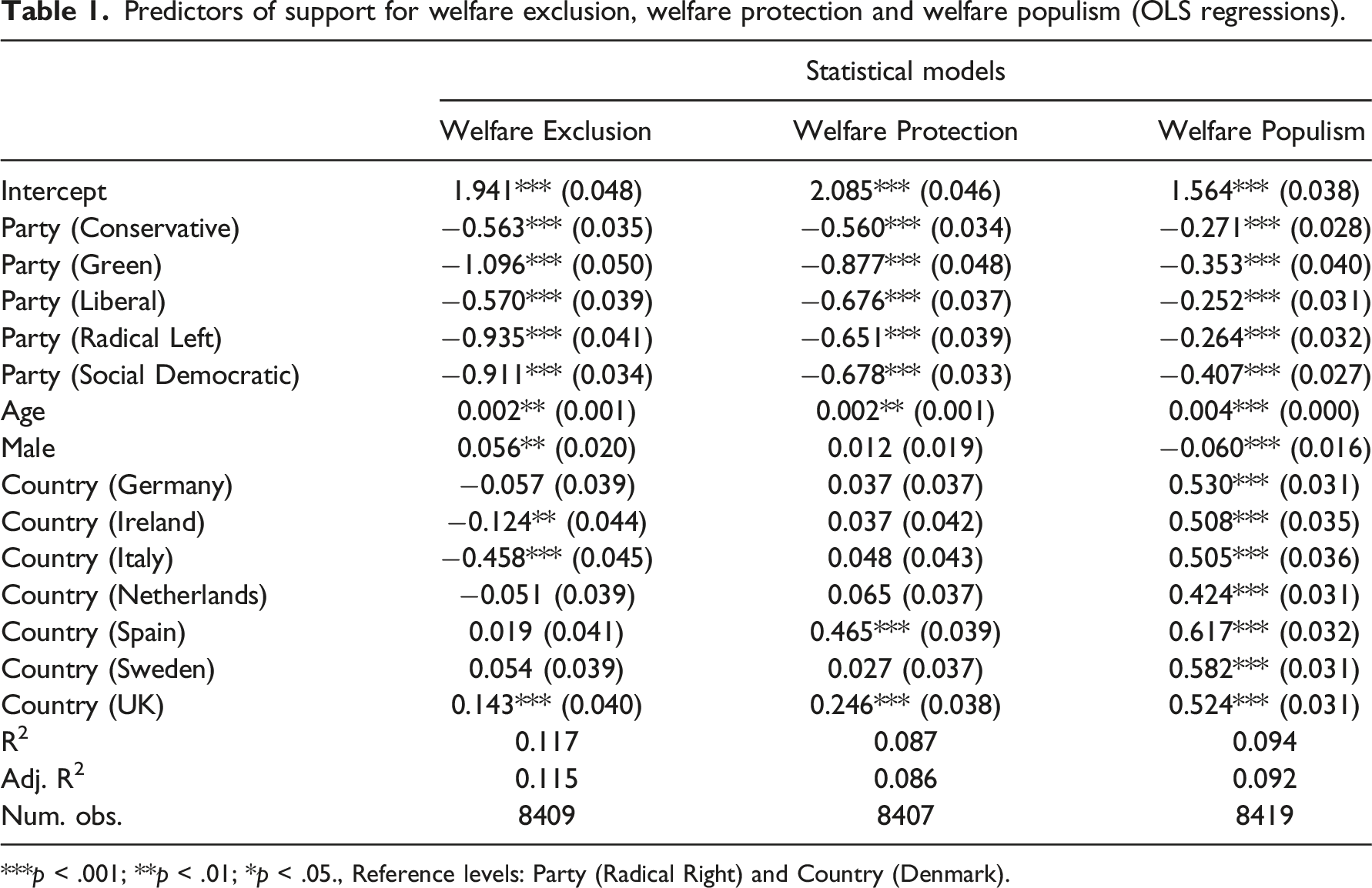
***p < .001; **p < .01; *p < .05., Reference levels: Party (Radical Right) and Country (Denmark).
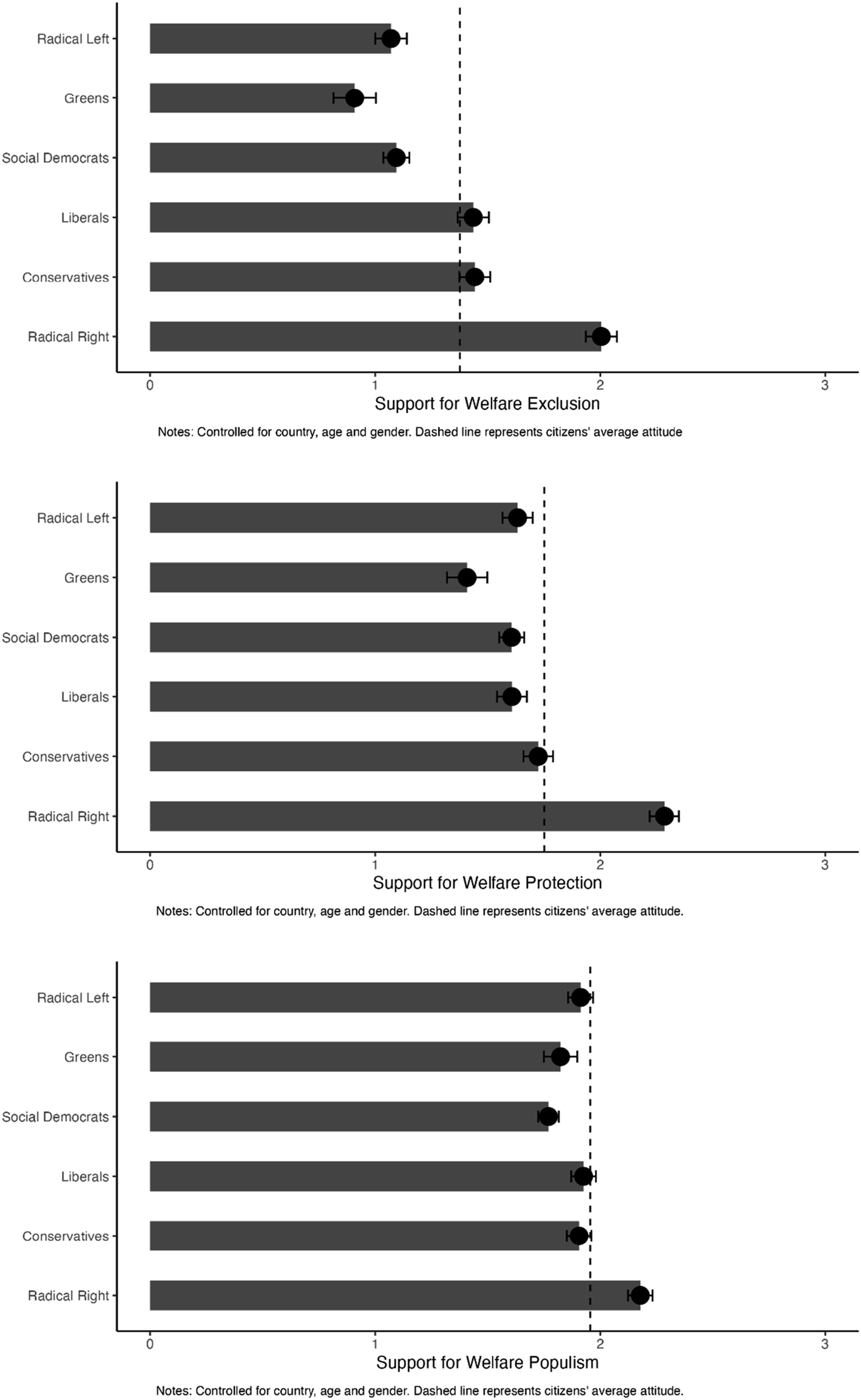
Predicted values of support for welfare exclusion, welfare protection and welfare populism by party family, pooled over all countries.
On the right, we find a clear divide between the electorates of radical right parties on the one hand and of the two traditional, mainstream right party families (liberals and conservatives) on the other hand. Radical right voters are clearly supportive of welfare exclusion (value of 1.9). In contrast, voters of both conservative and liberal parties are located in the middle of the scale (1.5, i.e., neither clearly tending towards support nor opposition toward welfare exclusion), they take a centre position and match the preferences of the average citizen.
How does the preference configuration change if discrimination would come in the form of additional welfare benefits for citizens (welfare protection)? First, we can discern that across the entire population and each party family, expanding welfare for natives is generally more popular than retrenching immigrants’ welfare rights. Looking at the configuration of party family electorates, Figure 1 shows that in line with welfare exclusion, welfare protection is primarily promoted by radical right voters. They strongly endorse expanding welfare for natives exclusively. Again, conservative electorates on average share the preference of average citizens, while liberal party voters are hardly enthusiastic supporters of welfare protection, thereby making the divide within the right even bigger for welfare protection than for welfare exclusion. Although the gap between the left and particularly the mainstream right is narrower in the case of welfare protection, voters of all three left party families remain significantly more opposed to welfare protection than the average citizen. This is remarkable and anything but obvious given that the statement used to operationalize support for welfare protection asks about welfare expansion for a large share of the population. Nevertheless, left party voters are no more supportive of such a reform than liberal voters and significantly more opposed than conservative voters. As in the case of welfare exclusion, it is green voters who are least tempted to discriminate against immigrants in order to get more welfare for natives, and thereby constitute the pole in opposition towards welfare protection. Although the different left electorates differ slightly in the degree of opposition, these findings unveil no real divide within the left. The narrative of the left being divided on the issue of immigrants’ welfare rights remains exaggerated in light of these findings. In contrast, we find a big divide between radical and mainstream right voters: while the former clearly endorse both welfare exclusion and welfare protection, the latter on average exhibit about average support for both forms of welfare chauvinism. These conclusions remain consistent when we examine a combined welfare chauvinism index, which amalgamates support for welfare protection and exclusion. This index permits us to observe preferences for immigrant discrimination, regardless of whether it is manifested through welfare expansion or retrenchment. Figure A7 illustrates a strongly divided right and only subtle differences within the left, where not only green but also social democratic and radical left electorates tend to support immigrant discrimination much less than average citizens.
Looking at country-variation, we observe relative – although not full – consistency across our eight countries regarding the main findings of an undivided left but a divided right (see Figures A8 and A9 in the Appendix). Looking toward the left, Ireland stands out as the most exceptional case where the voters of the radical left, Sinn Féin, occupy the welfare exclusionist pole and thereby stand in stark contrast to the other left party electorates in Ireland. Reasons for this divided left in Ireland could be both the absence of a radical right party and the issue of immigration so far being much less salient than in almost all other West European countries. Except in Ireland, we find no left party electorate embracing welfare exclusion. For some left electorates, the picture, however, changes if the discrimination of immigrants were to take place in the form of welfare expansion for natives. Although not indicating a strong divide, Danish left (especially social democratic) voters seem not too averse towards welfare protection. Some sympathy (close to that of the average country citizen) is also exhibited by voters of the Dutch radical left (SP), the German radical left (The Left), and the social democratic parties in Spain (PSOE) and the UK (Labour Party). A majority of left party electorates, however, clearly oppose both forms of welfare chauvinism.
On the right side of the political spectrum, we find a clear and strong divide regarding both welfare exclusion and welfare protection in at least five of our eight countries. In every country, where radical right parties have already played a substantial role at the time of our survey in 2018/2019, their voters occupy the pole in support of both forms of welfare chauvinism. Thus, in most countries the divide within the right plays out between radical right voters and voters of socially liberal mainstream right parties such as the Dutch D66, the Swedish Liberals, the Danish Liberal Alliance or the British Liberal Democrats. Worth mentioning is the high support for discrimination against immigrants (both in absolute and relative terms) by some mainstream right parties in Sweden (M, KD), Spain (PP, Cs) and the UK (Conservatives) which somewhat step out of line in their respective party families.
Let us now check whether the party political configuration with regard to welfare populism corresponds to what we observe for welfare protection and welfare exclusion. The lowest panel in Figure 1 shows predicted values of support for welfare populism by party family voters on a scale from 0 (‘money that goes into the welfare state is used efficiently’) to 3 (‘a lot of money that goes into the welfare state is wasted’). On the left, we find that welfare populism appeals slightly (but significantly) more strongly to radical left than to green and especially social democratic voters. Radical left voters agree with welfare populism about as much as mainstream right voters. Not surprisingly, the strongest opponents of welfare populism can be found among the mainstream left. It is electorates of social democratic parties which in five of our eight countries (see Figure A10 in the Appendix) build the backbone of support behind defending the working of current welfare institutions. However, it should be noted that the perception that a lot of money in the welfare state is wasted is relatively widespread – among supporters of all party families.
Despite small differences on the left, the real dividing line concerning welfare populism runs between voters of the radical right and all other party families, leading again primarily to a divided right. Radical right voters are far more welfare populist than voters of conservative or liberal parties and constitute the welfare populist pole in every country where they exist, except Denmark. In contrast, mainstream right electorates are only slightly more welfare populist than mainstream left parties. A clear left–right divide can only be observed in Sweden, whereas in many countries differences between the mainstream right and left are relatively small.
Based on previous definitions of welfare populism, we have established above that there are at least two types of welfare populist critiques, one focusing on welfare being wasted on ‘undeserving’ groups rather than the ‘deserving, common people’, whereas the other emphasizes the responsibility of elites for an alleged dysfunctionality of the welfare state. To understand which of the two welfare populist critiques might drive a wedge within political blocs, we replicate the analysis with two additional questions trying to capture these two types of welfare populist critique in Appendix A2. The analyses show that the divide within the right can be explained primarily by radical right voters being very critical towards the elites’ management of the welfare state, a position that is not shared by voters of the mainstream right. Conversely, mainstream and radical right voters concur in their much stronger preference for welfare spending towards groups generally perceived as deserving (e.g., pensioners, families) as opposed to groups perceived as undeserving (e.g., the unemployed). Thus, a welfare populist critique accusing the welfare state of wasting money on undeserving recipients might appeal to mainstream right voters too, whereas blame attribution to political elites resonates much less with mainstream right voters.
Class basis of left party electorates’ (non-)support for welfare exclusion, welfare protection and welfare populism
In accordance with our theory, we have found welfare exclusion, welfare protection and welfare populism to strongly divide the right of the political spectrum. Against theoretical expectations, they drive much less of a wedge between party families on the left. This is surprising because, as we spelled out in the theory section, previous literature has consistently shown working-class voters – who traditionally built the backbone of social democratic and radical left electorates – to be among the most fervent supporters of welfare chauvinism and populism.
We see three possible explanations for the absence of social democratic or radical left support for welfare protection or populism. First, the strong divide between the working class and the rest of the population concerning support for welfare chauvinism and welfare populism might just not exist, either because it has declined over the last years or because it is for some other reason absent in our sample. Second, research has shown that the share of working-class voters particularly in social democratic electorates has shrunk rapidly over the last decades as a result of, on the one hand, a diminishing size of the working class more generally and, on the other hand, a process of realignment of working-class voters from left to radical right parties (Gingrich und Häusermann, 2015). Therefore, it is possible that only so few workers remain in left electorates, that they carry next to no weight for the average preferences of these electorates. Third, it might be that left working-class voters are decidedly different from members of the working class voting for the radical right when it comes to support for socially conservative forms of welfare opposition.
In the remainder of this section we check which of these potential explanations receive empirical support. To do so, we first calculate regressions with occupational class as an additional predictor of welfare exclusion, protection and populism to check the existence of a working middle-class divide. Second, we check the class composition of different left electorates. Third, we add interactions between class and party vote to our regressions in order to detect whether a working middle-class divide plays out differently among electorates of different party families. We operationalize class using the Oesch class scheme, which differentiates eight classes according to a vertical, hierarchical dimension based on marketable income as well as a horizontal dimension based on work logic that would allow us to observe differences also within the working and middle classes (Oesch 2006). 6 This class scheme has been used extensively in research on electoral realignment and political preferences of party voters.
Occupational class as a predictor of support for welfare exclusion, welfare protection and welfare populism (OLS regressions).
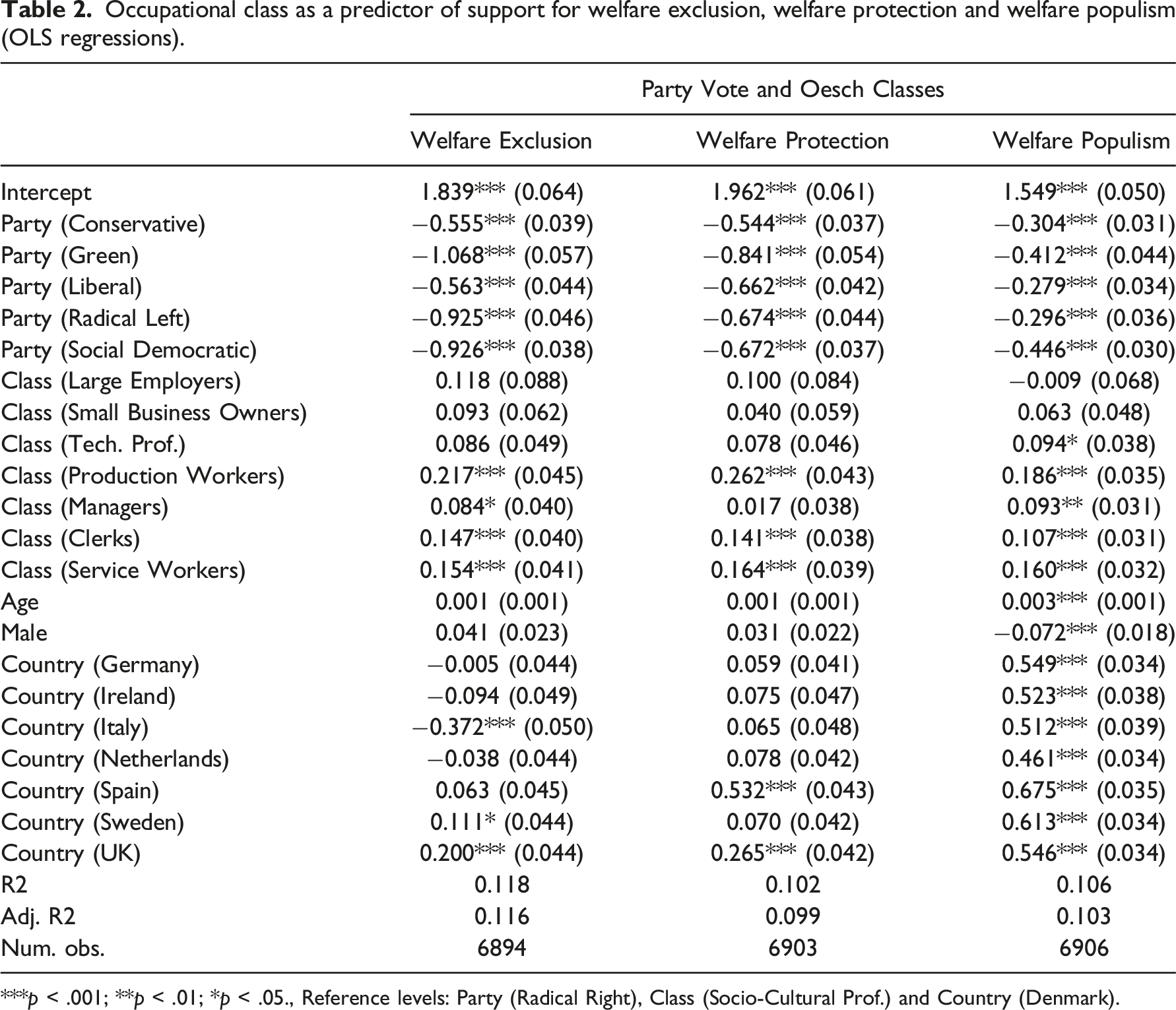
***p < .001; **p < .01; *p < .05., Reference levels: Party (Radical Right), Class (Socio-Cultural Prof.) and Country (Denmark).
Are electorates of social democratic and radical left parties relatively susceptible to welfare populism and welfare protection because they have become nearly exclusively middle class? This is not what seems to explain our findings, either. In line with findings by Rennwald (2020), which show that working-class representation in social democratic electorates has declined but remains substantial, we find that the share of production and service workers among social democratic voters lies with 34.8% above the average of the sample (31.0%) and not even dramatically below the share among radical right voters (38.5%). The radical left party family exhibits an even stronger entrenchment in the working class (40.0%) than in the radical right. In contrast, the working class constitutes a small minority among green voters (20.0%).
While neither the absence of a working class–middle class divide nor of a sizeable working-class vote among parts of the left prove true and can explain why most social democratic and radical left electorates are generally sceptical of welfare chauvinism, Figure 2 eventually sheds some light on this finding. It shows support for welfare exclusion, protection and populism by class and party family based on regressions that interact the belonging to the working or middle class
8
with party choice (see regression table in Appendix A11). Two findings are especially noteworthy. First, we observe within party family divides between working- and middle-class voters to be bigger within social democratic and to a lesser degree radical left than within other party electorates. This adds some nuance to our findings by showing that welfare protection, welfare exclusion and welfare populism are potential sources of internal differentiation within some left (especially social democratic) electorates (Harris and Enggist, 2023). Second, however, we find that the divide between radical right voters and the rest of the electorate in all three cases is bigger than the working class–middle class divide within parties, especially with regard to immigrant discrimination. Therefore, even the working-class constituency of the left is at most averagely supportive of these socially conservative critiques of the welfare state. Predicted values of support for welfare exclusion, welfare protection and welfare populism by party family and class (interacted), pooled over all countries.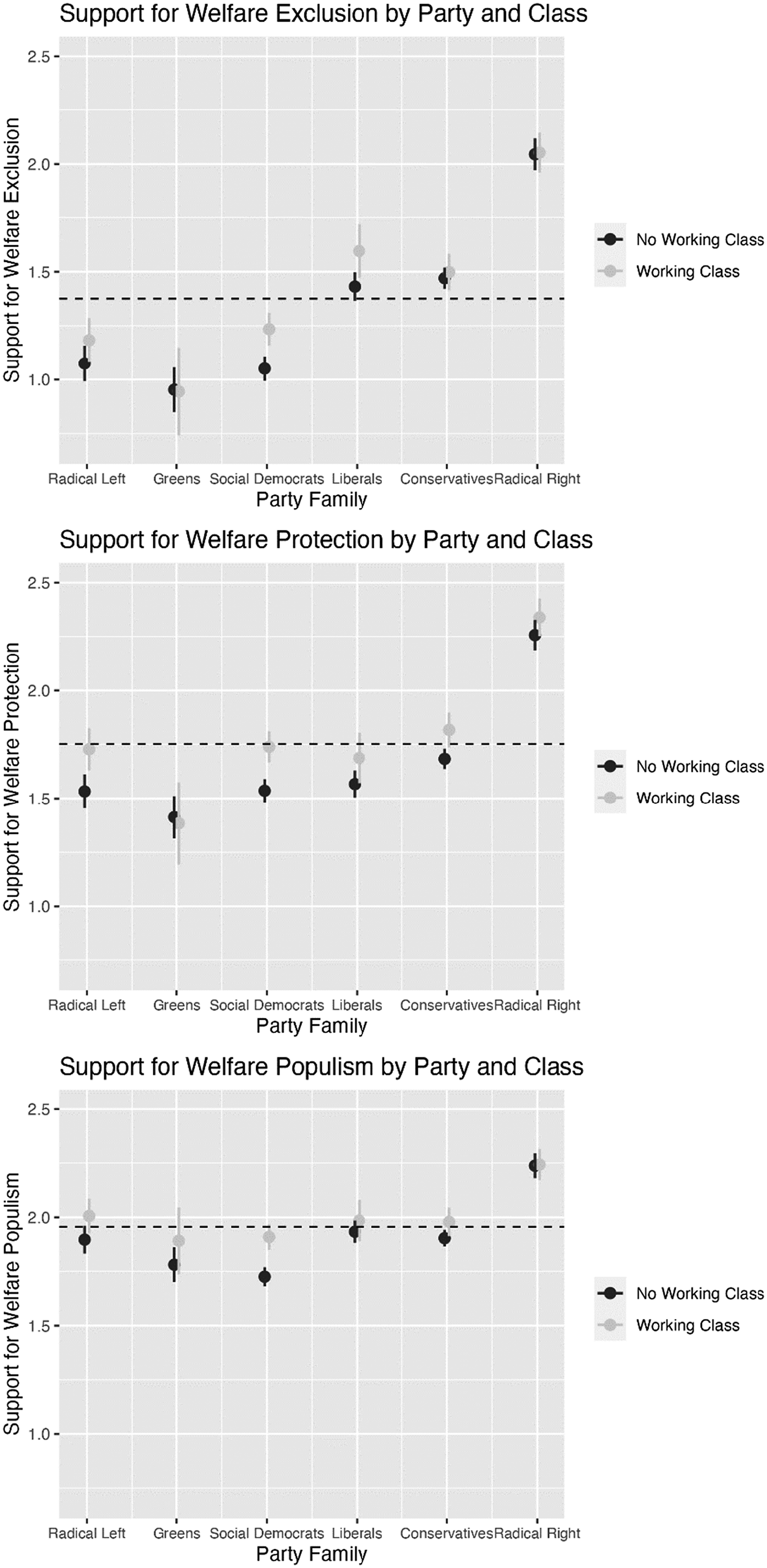
Discussion
The politicization of a divide between liberal-universalist and traditional-particularist preferences has increasingly also become relevant and salient in the realm of welfare politics, particularly in the form of two challenges to the welfare state: welfare populism and the politicization of an alleged influx of immigrants into Western European welfare states.
In this article, we have investigated how these two challenges to the welfare state are politicized with regard to partisanship. We find that not surprisingly, electorates of radical right parties are the strongest supporters of both forms of welfare chauvinism and of welfare populism. The radical right’s fervent support for these particularistic forms of welfare opposition is not matched by the other electorates, with only the voters of very few mainstream right parties clearly endorsing welfare exclusion of immigrants. As expected, we thus observe welfare exclusion, protection and populism to strongly differentiate voters of the radical and most mainstream right parties – with only some conservative party electorates such as the Swedish Moderates or the British Conservatives having adopted preferences similar to the radical right. In contrast to this divide among the right, we find, however, neither welfare populism nor the discrimination of immigrants to strongly divide left party voters. Voters of green parties show most aversion to discriminating between immigrants and natives, and mainstream left electorates are least susceptible to welfare populist criticisms of the welfare state. Although less pronounced, even voters of radical left parties have significantly fewer sympathies for these particularistic forms of welfare opposition than average citizens. Even welfare protection – the welfare chauvinist option that should appeal most strongly to the left – does not receive above average support by any of the left party family electorates. Thus, left voters of all party families on average prioritize their inclusive preferences regarding immigrant welfare over their general preference for welfare expansion.
While we find only few indications of divides between different partisan actors of the left, we indeed find some differences between working-class and non working-class voters within social democratic and radical left (but not green) parties. These differences might be a source of disagreement and factional disputes for some left parties concerning their stances, especially on welfare populism and welfare protection. Nevertheless, the fact that even left working-class constituencies are opposed to welfare exclusion and just averagely supportive of welfare protection and welfare populism while the non working-class left displays a remarkable dislike, implies that the strategic situation of most left parties at the immigration–welfare nexus today is less complicated than often perceived (and than it might have been in the past). To be congruent with their current electorates, left parties would take a stand for immigrants’ welfare rights. If anything, the positioning on welfare exclusion and welfare protection poses more strategic problems for some mainstream right parties whose electorates hold more ambiguous stances.
The existence of this particular partisan configuration has important implications for the politics of welfare chauvinism. Specifically, it contradicts claims that left and radical right parties are destined to coalesce to promote welfare protection. If welfare chauvinist reforms were to be viable, they would rather be the outcome of coalitions between radical right and some mainstream right parties, whose voters in some countries are quite supportive of welfare exclusion in particular. This more realistic coalitional potential implies that welfare exclusion might be the more viable of the two welfare chauvinist reform strategies.
Comparing preferences for welfare chauvinism and welfare populism, there exist similarities in the observable party political configurations: they most strongly divide radical right and mainstream left voters (in the case of welfare chauvinism especially green) electorates. This, however, does not necessarily imply that support for welfare chauvinism and welfare populism strongly overlap at the individual level. While preferences on welfare exclusion in particular are strongly polarized along party political lines, welfare populism is less divisive. Even among mainstream left electorates, which display the lowest level of welfare populist attitudes, a majority of voters perceive that a lot of money in the welfare state is wasted rather than used efficiently. This widespread perception would suggest that a particularistic critique of the welfare state that does not only appeal to nativism but questions the functionality and fairness of current welfare institutions more broadly might appeal to a wider segment of society and might spark less opposition from left-universalist voters than welfare chauvinist discourses. However this conclusion and comparison needs to be taken with a pinch of salt, as our measurement of welfare populism inquires about a general perception, while questions about welfare exclusion and protection capture preferences for more specific reform proposals. Our own follow-up analysis aimed at untangling different forms of welfare populist arguments (Appendix A2), indicates that arguments blaming the elites for the dysfunction of welfare states divide radical and mainstream right voters. Conversely, a welfare populist critique centred on the notion that welfare should predominantly benefit deserving groups rather than ‘undeserving welfare scroungers’ also strikes a chord with conservative and liberal voters. Further research is required to explore whether different, more specific aspects of welfare populism would yield similar conclusions, or which forms of welfare populism might appeal beyond the radical right.
Supplemental Material
Supplemental Material - Partisan preference divides regarding welfare chauvinism and welfare populism – Appealing only to radical right voters or beyond?
Supplemental Material for Partisan preference divides regarding welfare chauvinism and welfare populism – Appealing only to radical right voters or beyond? by Matthias Enggist and Silja Häusermann in Journal of European Social Policy
Footnotes
Acknowledgements
Previous versions of this project were presented at the ESPAnet conference 2021, the SPSA Annual Congress 2022 and a workshop of the special issue on ‘A Farewell to Solidarity? Causes and Consequences of Welfare State Opposition’, all held online. We are grateful for valuable input from participants at these events and especially for comments by Alexandre Afonso, Macarena Ares, Gianna Maria Eick, Benjamin Leruth, Michael Pinggera, Femke Roosma, Sven Schreurs, and the anonymous reviewers.
Declaration of conflicting interests
The author(s) declared no potential conflicts of interest with respect to the research, authorship, and/or publication of this article.
Funding
The author(s) disclosed receipt of the following financial support for the research, authorship, and/or publication of this article: This project has received funding from the European Research Council; ERC-project ‘WELFAREPRIORITIES’, PI Prof. Silja Häusermann, University of Zurich, Grant n° 716075.

Supplemental Material
Supplemental material for this article is available online.
Notes
References
Supplementary Material
Please find the following supplemental material available below.
For Open Access articles published under a Creative Commons License, all supplemental material carries the same license as the article it is associated with.
For non-Open Access articles published, all supplemental material carries a non-exclusive license, and permission requests for re-use of supplemental material or any part of supplemental material shall be sent directly to the copyright owner as specified in the copyright notice associated with the article.
