




Abstract
The drawbacks of crowded informal settlements stand in stark contrast to the theoretical promise that urban density is the key to building more productive, sustainable and resilient cities. African cities cannot be expected to prosper while the majority of residents live in sprawling informal settlements with no prospect of improvement beyond the provision of basic services. There is a strong case for governments to embrace a broader reconstruction agenda in order to harness the potential of density for all-round progress. The core proposition of the paper is that urban population growth would be accommodated more effectively by building upwards and not merely outwards. We consider the circumstances under which this is true and how the state and communities might refashion conditions in informal settlements despite their restricted resources. To expand upwards requires participatory planning, more tenure security, settlement redesign, and in-situ investments in public services and housing.
I. Introduction
Density is advocated as a crucial mechanism for promoting sustainability, resilience and prosperity in cities by many international development agencies.(1) For example, the New Urban Agenda commits signatories to promoting “adequate densities and compactness”, citing wide-ranging benefits for the environment, economy and society.(2) Proponents of density see the potential of concentrated population growth to cut the costs of service delivery through more confined infrastructure networks. They claim that density can also reduce carbon emissions through shorter travel distances, and foster economic growth through proximity, intense human interaction, social learning and other forces of agglomeration.(3)
Yet getting urban density to work is not straightforward in practice. There are tensions and trade-offs involved in increasing density because of the wide-ranging consequences of compact population growth, both positive and negative. Many cities in Africa are struggling to cope with large-scale urbanization and the associated negative externalities of congestion, contagion and pollution. It is arguable, therefore, that higher population densities may not translate into greater prosperity and wellbeing unless accompanied by an appropriate governance framework to mitigate these drawbacks. Investment in infrastructure and taller buildings may also be important to ensure that the positive potential of density is realized and the harms are minimized.
Rhetorical statements by international organizations about the contribution of density to progress deserve careful scrutiny because of their political salience. Thinking through what factors and forces determine whether expanding urban populations flourish or flounder is fundamental to building more productive, safe and inclusive cities. This is particularly important for informal settlements in sub-Saharan Africa, given the recent finding that more than three-quarters (78 per cent) of residential areas developed here between 1990 and 2014 were informal and unplanned.(4) Looking ahead, the urban population of this region is projected to triple in size by 2050.(5) Over the same period the physical footprint of African cities is expected to quadruple, thereby lowering population densities and adding to environmental risks.(6) Governments face daunting decisions in the face of these dramatic trends and projections. How can they finance and deliver sufficient essential services to keep pace with urbanization, and at the same time create functional urban environments that foster higher incomes and reduce people’s vulnerability to social and natural hazards?
A weakness of many “slum” upgrading programmes is their focus on basic services and their neglect of the internal layout of these settlements and their links to the rest of the city.(7) Informal settlements in Africa tend to be characterized by spontaneous clusters of single-storey shacks and other dwellings. Many lack sufficient space for people and vehicles to circulate, for infrastructure networks to be accommodated, for livelihood-generating enterprises to operate, and for schools, clinics and play areas to be established. Simply demolishing buildings and rebuilding multi-storey flats is socially destructive and unaffordable in most places. Realistic solutions arguably require adapting the urban form incrementally in conjunction with local communities. In well-located settlements, where people want to live, this is likely to require building vertically to make more efficient use of the land and to liberate ground-level space for more functional environments and improved connectivity.
This paper considers how dense informal settlements can be made to operate more effectively to enhance liveability and long-term prosperity. In Section II we discuss the concept of urban density and its relevance to settlement upgrading. We argue that density is an important foundational principle for improving socioeconomic conditions, subject to significant qualifications. In Section III we examine how the state and communities might realistically achieve the physical adaptations required, bearing in mind their limited resources and technical capabilities. In practical terms this means supporting incremental upgrades that expand settlements upwards more than outwards, and free up space for human interaction, connectivity and supporting activities, such as jobs and livelihoods. This is likely to require participatory planning, more tenure security, redesigned settlement layouts, and in-situ service and housing investments.
II. Dimensions of Density
Density is a more complex concept than often implied in urban policy and planning. The fundamental idea is that the physical dimensions of a city (especially the volume of useable space and activity within a geographical area) impact decisively upon its economic, environmental and social performance. Looked at more closely, however, density can vary greatly depending on the unit of analysis (households, firms, workers, buildings, resources), the spatial scale (plot, neighbourhood, precinct, city), the process of densification (horizontal, vertical, spontaneous, planned) and the type of impact (social, physical, environmental, economic). These variables sustain many permutations and outcomes that have sometimes led to contradictory claims.(8)
a. Residential density
Density is commonly measured by building density (such as the floor area ratio), population density (such as population per square kilometre) or a combination of the two (such as occupation density: persons per floor area).(9) A higher population can be accommodated in an area without increasing the occupation density if the building density is increased proportionately. In other words, more floor area is provided to retain the same amount of space per person and prevent overcrowding.
Higher building densities may also be associated with higher property prices and therefore lower affordability, although other factors can complicate the relationship. The inflexibility of housing markets means that supply is often slow to respond to demand, which puts upward pressure on prices. Ahlfeldt and Pietrostefani(10) find that a 10 per cent increase in population densities raises the cost of rentals by approximately 20 per cent. This elasticity was estimated for high-income countries, where density is more likely to take desirable forms and function as a kind of public good. Higher property prices deter poorer residents, such as first-time buyers or renters, although they can also result in people occupying less space. Where low-income groups are displaced to outlying locations, far from opportunities, this widens spatial disparities.
Rising population densities and higher property prices can reduce the living space per person and put pressure on shared facilities and services. High-rise buildings are often constructed when space constraints are intense, rental incomes are high and well-located property commands a premium. Generous plots get subdivided and converted into use for multiple housing units or replaced with apartment blocks. Taller buildings overcome space limitations by increasing available floor area, but they raise construction costs and can contribute to greater congestion and pressure on the existing infrastructure.(11)
A challenge for local governments is to manage the pressure on space without compromising quality of life. Cramped living spaces reduce people’s wellbeing through reducing privacy, increasing noise and other disturbances, facilitating the spread of disease and raising levels of anxiety.(12) Physical space constraints can be mitigated through careful building design, with natural lighting, greenery and higher-quality spaces incorporated into plans. Shared open spaces such as parks and squares are particularly important where people have little room for private gardens or recreation areas. The ideal vision for compact cities combines high population densities with more intensive use of public space in a way that does not feel crowded.
In most low-income countries, there is a serious mismatch between the housing stock available and the size of the population.(13) Informal settlements accommodate the majority of the population in many developing cities and consume a rising share of the total urban land area.(14) Well-located informal settlements in cities such as Nairobi, Mumbai and Karachi have reached population densities of 1,500 persons per hectare and more. This is comparable to high-rise Manhattan, New York.
The lack of “built-up” density in informal settlements indicates inefficient use of land. Intense crowding with poor access to clean water and well-managed sanitation also threatens public health, hastening the spread of water- and vector-borne diseases.(15) Poor ventilation in people’s homes can also spread diseases like tuberculosis.(16) The OECD(17) estimates that 10 per cent of the global burden of disease could be reduced by better access to basic services. This would lower healthcare costs and improve workforce productivity and wages. Informal structures themselves can be a public safety hazard where construction involves inferior materials or workmanship. The socioeconomic benefits of densification for low- and middle-income cities are far less clear than for better-off Northern cities because of underinvestment in the built environment.(18)
The relationship among property prices, density and informality is complex, multidirectional and under-researched. Put simply, it appears that advantageous forms of densification that generate more positive than negative externalities tend to attract demand and raise property prices, encouraging further investment. More problematic forms of density (e.g. that create congestion and public health problems) are likely to deter people and dampen property prices, which may discourage household improvement efforts. Growing informality can also induce negative reactions in surrounding formal neighbourhoods as homeowners fear the impact on their property values. Yet dense informal settlements would arguably never exist if formal housing were more affordable to poorer residents.
Local authorities face tough choices in promoting affordable housing with high densities, while raising building standards and functionality. Exacting bylaws and regulations on plot sizes, road widths, setbacks, building heights and land for public use tend to inflate development costs. Many African cities retain regulatory standards inherited from the colonial era that are unaffordable for most of the population.(19) For instance, in Nairobi, the minimum legal size for a plot is 250 square metres (between a tennis court and a basketball court in size).(20) Extensive informality in African cities reflects the failure of formal housing markets to deliver affordable accommodation for most people.(21) Tipple(22) reports that the cheapest formal housing units in Africa cost between US$ 10,000 and US$ 40,000, well beyond what most people can pay.
b. Density and circulation
Urban housing is about more than adequate accommodation. The benefits of city living stem from being part of an interconnected system where people, firms and public organizations feed off each other in dynamic ways. Physical proximity facilitates interactions between workers and employers, customers and suppliers, students and educators, and citizens and public authorities. Efficient modes of transportation to enable circulation and connectivity are vital as cities expand and population densities increase.(23) Indicators of connectivity include measures of street grid density, such as the length of street per square kilometre, or traffic density, such as the number of vehicles occupying a given length of highway.
The capacity for circulation within the urban system is a crucial determinant of its growth potential.(24) Larger populations and higher densities deepen labour and consumer markets, which in turn attract private investment and enable firms to specialize. This supports a virtuous circle of productivity growth, higher incomes, more jobs, further population growth and so on. This positive feedback loop is hampered or even reversed when congestion and bottlenecks reduce connectivity and deter investment. Policymakers face difficult balancing acts between retaining a compact urban form by improving internal circulation through increasingly sophisticated transport systems (such as subways) and increasing connectivity over ever-expanding distances (such as constructing highways to allow for suburbanization and polycentric development), at the risk of central city decline, depopulation and damage to surrounding ecosystems.(25)
Congestion is an escalating problem in African cities because of high population growth combined with underinvestment in transport infrastructure. Even road networks can be surprisingly limited. For instance, only 6 per cent of the land in Bangui (Central African Republic), 11.1 per cent in Accra (Ghana) and 12.3 per cent in Ouagadougou (Burkina Faso) is made up of streets, well below the 30–40 per cent benchmark recommended by UN-Habitat.(26) Similarly, African cities are often poorly connected to international markets, with inadequate national road and rail networks and poorly maintained seaports and airports.(27)
Circulation problems are acute in many informal settlements because of inadequate public space and the unplanned, irregular spatial arrangement of dwellings. Where roadways or footpaths exist, they are often narrow and encroached upon by adjacent structures. Heavily populated settlements can congeal into a maze of tightly packed structures accessible only on foot and with little defence against the spread of fire.(28) Inaccessibility can also enable higher levels of crime through poor visibility or by preventing policing and emergency services from entering.(29) Replacing rudimentary shacks with taller, more durable structures would increase the quantity and quality of living space, but could also lock in congestion unless the haphazard layout were also addressed.
c. Density and land use
Viable communities depend on a range of public and private goods and services for their wellbeing, provided by a myriad of private enterprises, nonprofit organizations and public bodies. Some are located within the vicinity for maximum convenience, others elsewhere in the city. Effective coordination of the investment decisions of these entities is important to ensure that their locations are compatible and do not cause conflicts (such as noise or pollution) or encroach onto environmentally sensitive areas. The effectiveness of this important objective of town planning depends on alignment with infrastructure spending decisions and the capacity of public authorities to ensure compliance. Land-use densities measure the intensity or spread of land consumption across different uses, whether residential, commercial, industrial or recreational.
Mixed-use zoning is an attempt by contemporary planning authorities to combine diverse activities into spaces where people can “live, work and play”. This contrasts with the traditional ethos of mono-functional districts where people have to travel between different parts of the city to work and for many other daily needs. Mixed-use developments seek to maximize the internal flows or self-containment of such places through careful selection of activities and design of their spatial arrangement to maximize accessibility and minimize congestion.(30)
Local authorities in many African cities lack the technical and political capacity for credible urban planning.(31) Land-use plans are widely prepared, but are rarely implemented because of the lack of enforcement powers and limited competencies among planners to mobilize support from public and private investors. Private developers conventionally look to public infrastructure investments to signal long-term commitment to an area, but such investments often contradict municipal spatial plans because national governments tend to control such decisions.(32) Heavy reliance on international consultants and foreign donors to design and manage infrastructure projects also inhibits local capacity-building.(33)
Informal settlements suffer from an absence of basic planning for mixed land uses. Self-interested household decisions prioritize living space over public space. Consequently, organically developed settlements often have meagre amounts of land for shared purposes, such as circulation, schools, clinics, recreational facilities and workplaces.(34) Some also occupy hazardous sites vulnerable to flooding, landslides or toxic waste. Lack of upfront planning inhibits their capacity to accommodate subsequent investments in infrastructure that would improve access to clean water, sanitation, electricity, schools, public transport, etc. Piecemeal, after-the-fact projects can offer some relief to poor living conditions, but tend not to address the internal organization of such settlements.
Rectifying troublesome aspects of the built environment in informal settlements is usually costly and/or complicated technically and socially. Collier et al.(35) estimate that retrofitting infrastructure costs up to three times as much as greenfield developments. Extra space for public facilities, recreation, amenities and livelihood generation also requires scarce land to be cleared and protected from reoccupation. As a result, many public authorities neglect informal settlements, even when their sizeable populations warrant investment in public services. Political uncertainty and legal insecurity surrounding the status of these areas also deter households from investing spare resources in their dwellings.
d. Density and the economy
Economists have discovered that higher densities of firms and workers raise productivity and innovation through “agglomeration economies”.(36) Intense human interactions foster creativity and learning through competition and collaboration. Concentrations of workers and firms generate large pools of critical resources, including scarce skills, choice of suppliers and shared infrastructure. Agglomeration encourages specialization, amplifying know-how and expertise. Proximity between clients and suppliers saves on transport costs and improves responsiveness. Clusters of related and supporting firms cooperate, compete, imitate and learn from each other, producing “knowledge spillovers”.
Economic density is often measured using population or employment size as a proxy. Most of the evidence is drawn from cities in the North,(37) although analogous processes of learning and specialization are at work in the informal economy of Southern cities.(38) However, bigger can also mean diseconomies of scale because of congestion, overloaded infrastructure and inflated property prices.(39) Planning and managing the spatial form of urban growth effectively and efficiently requires a capable state with resources to invest in connectivity.
Chronic underinvestment in basic infrastructure inhibits economic development in most African cities. The African Development Bank(40) estimates that US$ 130–170 billion needs to be spent each year on infrastructure projects – more than double the current level. Disruptions to transport and utilities are particularly harmful to business productivity. African countries are among the worst affected in terms of inconsistent electricity and water and transport delays, costing firms up to US$ 300 billion per year.(41) As a result, the cost of doing business in African cities is high in relation to their level of economic development.(42) The knock-on effects include urban residents having to pay a premium of up to 30 per cent on goods and services compared to other countries.(43)
The economic potential of informal settlements is often overlooked by policymakers because of the patent poverty and insecurity among residents. Observers focus on static assessments of economic and social problems, rather than household trajectories or emerging capabilities over a period of time. The likelihood that at least some informal settlements function as low-cost gateways to economic opportunities elsewhere in the city is often neglected.(44) Informal settlements may also operate as incubators of productive enterprise, where people acquire skills to generate livelihoods and build supportive networks to help them get ahead.
The conditions necessary for informal settlements to fulfil this economic potential have not been studied in any depth. The absence of infrastructure and public services hinders all kinds of productive and trading activities. Onerous municipal bylaws, trading permits and business licensing regulations make it very difficult for microenterprises to formalize because their buildings do not comply with official standards, or they lack title deeds to their properties or the wherewithal to follow burdensome approval procedures.(45) Informal enterprises also lack the legal status to operate legitimately and are prevented from accessing formal private sector loans, contracts from larger business customers or tenders from state entities.
Proximity to jobs elsewhere in the city is vital for informal settlements because of the high time and money costs of transportation. Competition from other jobseekers for well-located places means intense pressure on available land and consequent crowding. Vertical upgrading for more efficient use of this land is clearly part of the solution. Building upwards could also support small-scale enterprises by freeing up ground floor space for workshops and trading places. The local demand for convenience goods and services creates many opportunities for such entrepreneurs. Careful attention to the design of trading spaces could have spinoffs in creating safe “high street”-type environments that foster a vibrant mix of leisure, entertainment, consumption and creative activities.(46) Mortenbock and Mooshammer(47) provide many examples of simple improvements to marketplaces that foster this kind of vitality, open up local trading opportunities and even attract substantial consumer spending from outside the area.
III. Getting Urban Density to Work: What can be Done?
There is evidence that density is important to urban prosperity, although the impacts are complex, as a positive outcome in one domain can lead to negative outcomes in others.(48) A crucial gap in the international literature on densification is the significance of informal processes and forms. Informal settlements illustrate how high densities without complementary infrastructure and coordination tend to produce excessive harms such as crowding, congestion and environmental hazards.(49) Instead of population growth driving a virtuous circle of increasing investment, productivity and economic activity, additional households can disadvantage others through infrastructure bottlenecks and a kind of low-investment, low-income equilibrium. Of course, this is a sweeping generalization that ignores wide variations.
It is tempting for governments the world over to start afresh by relocating informally settled communities into state-subsidized housing schemes (or at least to promise this solution). No fewer than 41 out of 54 countries in Africa have announced large affordable housing construction programmes, often led by state-owned development agencies.(50) However, the scale of need in most cities is formidable considering levels of poverty, the scale of projected population growth and limited state resources. The South African government has made an exceptional commitment of more than US$ 30 billion to mass housing since 1994, yet the backlog continues to grow and more people live in shack settlements than ever.(51) Much greater attention is needed to refashioning informal settlements in ways that improve livelihoods as well as living conditions.
At the risk of overgeneralizing, there are essentially four options facing governments. The first is to do nothing. This may be motivated by a lack of resources or capabilities to engage with the realities of informality. Second, the state may relocate or evict households. This may be motivated by a perception of residents as illegal and undeserving squatters, or because governments have more lucrative plans to redevelop the area. Third, local authorities may provide very basic utilities. This is a fairly common positive response, implying an acceptance that informal settlements are here to stay. However, there is little real vision for a better future beyond alleviating hardship through improved facilities. The fourth possibility is a broader, bolder commitment to redesigning settlements, building neighbourhoods and managing densification, requiring a sustained developmental approach in conjunction with the local community.
Timescales often influence the choice of response. Physical adaptation and upgrading is a gradual, labour-intensive process requiring intensive engagement to build community trust and support. Getting households to concede some of their occupied land in return for some future benefit may require stable social and political conditions. Displacement through eviction addresses the political eyesore of informal settlements, but at the expense of fundamental human rights and social considerations. Offering improved basic services is often a compromise, perhaps reflecting a political settlement between different interests. However, this is unlikely to shift settlements to a more favourable long-term trajectory because the essential spatial structure is unchanged. A haphazard form is almost intrinsic to the way such settlements arise, despite considerable variation in the severity of the problems faced.
Research on urban density suggests that governments should go beyond delivering enhanced services. Addressing the unplanned layout of crowded informal settlements requires investments in the public realm, including the creation of streets and shared spaces for circulation and the allocation of land for productive activities, commercial services and public facilities. Bearing in mind the obvious resource constraints, not everything has to happen simultaneously. In fact, careful sequencing of actions could help build confidence and momentum among households, enterprises and state entities to sustain further improvements. Working together towards a shared plan or spatial framework to improve the structure of the settlement could also avoid the potential confusion and disarray of ad hoc projects. A common programme demonstrating commitment and consensus could guide and coordinate investments by different actors to ensure appropriate alignment and consistency.
A key proposition here is that necessary space for improved functionality and effective density in informal settlements could be created if expansion were upwards and not simply outwards. Multi-storey dwellings are not ends in themselves. High-rise “slums” can be as crowded and congested as low-rise “slums”. However, building upwards can progressively reshape the built environment of dense informal settlements if the liberated space at ground floor level is secured and protected for alternative uses. Vertical expansion is particularly attractive where informal settlements comprise single-storey structures located cheek by jowl. In principle, moving from one- to two-storey structures could release considerable land.
What follows are some high-level principles emerging from the literature to inform the task of reconfiguring dense informal settlements to make them more liveable and productive. To support upward expansion arguably requires a participatory approach from the state to generate support among households, enterprises and government entities for coordinated incremental investments. Enabling vertical in-situ upgrading requires a different mindset and procedures than just replacing shacks with formal high-rise apartments.
a. Community-based partnerships to co-produce solutions
Governments will find it very difficult to reform informal settlements if their approach is top-down. Centrally imposed solutions are unlikely to fit the local context and will lack the flexibility for compromise and consensus. Even well-meaning initiatives may have negative consequences for some households, resulting in resistance to change. Residents may become too suspicious of the motives to accept any disturbance or dislocation. They may object to new installations and refuse to contribute to the costs of providing new services. They will also withhold their own investment and energy if they are uncertain about the future of the neighbourhood. The capacity of municipalities to plan with local communities and engage in transparent decision-making is crucial. An important objective is to harness the knowledge and resourcefulness of residents and their leaders. Individual household aspirations need to be channelled according to shared rules of behaviour and standards of construction to avoid opportunism and ensure that everyone benefits from the restructuring process.
A technocratic process of vertical rebuilding cannot mobilize the grassroots support required for success. Community-based organizations are bound to play important roles as intermediaries to gain consent for the reconstruction proposals and to negotiate land swaps and other deals between groups of households and government entities. Residents may be asked to give up small pieces of land in return for a plot elsewhere or a small housing unit in a new development. Transparency and accountability encourage buy-in from different stakeholders and help to safeguard against narrow interests.(52) Of course, this is not straightforward because partners come to the table with unequal resources. Some organizations have technical skills, donors have vital funding to offer, municipalities have legal jurisdiction, and community members have the power to withhold their support, which influences how the process unfolds.(53)
International experience suggests that close collaboration among communities, governments and development agencies can have a decisive effect on the outcome.(54) The Baan Mankong programme in Thailand found that communities directly involved in upgrading were much more satisfied with the results than those that were not involved.(55) Government funds were channelled to community organizations to plan and manage a range of housing improvement projects. Local partnerships were institutionalized on an impressive scale, reaching 1,010 communities in 226 towns and cities.(56) In contrast, Massey(57) highlights the limitations of an insensitive, top-down approach to upgrading in two settlements in Cape Town. Inadequate community consultation stifled informal enterprise and resulted in valuable public space being neglected.
Densification intensifies the competition for scarce land and property, adds to pressures within communities and complicates social relationships. Building stable partnerships managed by committed leaders and getting agreement on a course of action is even more challenging in fragmented and transient communities where people come and go, with little intention to put down roots. Huchzermeyer(58) describes how partnerships can break down, with an example from Joe Slovo Village, Port Elizabeth, where a participatory incremental upgrading process was undermined by disagreements about priorities for the future of the area.
The ambitious principle of community involvement requires the political will among relevant partners to engage in the long-drawn-out process of informal settlement adaptation. This is not always forthcoming. However, the prospect of transforming local conditions and creating much more viable and desirable neighbourhoods can be a significant motivator.
b. Improving security of tenure
There is growing evidence that security of tenure is important for triggering household improvements to dwellings.(59) This is a potent issue in informal settlements because of the uncertainties surrounding land ownership and rights to occupation. Residents need some level of confidence about their future prospects in the area to invest scarce resources. They need reassurance that someone else will not be able to stake a claim to their property or that they will not face eviction. The upgrading process itself may also hold out the promise of greater tenure security to households that commit to land readjustment negotiations.
The opportunity costs of insecure occupation increase as settlements develop and become denser because the inherent value of the land appreciates. This raises the threat of eviction because of the value that can be unlocked by commercial redevelopment. However, rising land values may also make it easier to embark on a consensual process of land readjustment because of the resources that stand to be released in the process. The relationship between density and the price of property is admittedly complex. It can work in the opposite direction in situations where growing informality is perceived as problematic and drives down property values.
Insecure tenure tends to weaken the social contract and trust between local authorities and communities. Municipalities feel less accountable to residents in “illegal” settlements, and communities may feel less respectful of public property and less responsible for adhering to established codes of conduct and building norms and standards. There is also a loss of revenue if households occupying authorized land contribute nothing to municipal rates and service charges. Such contributions may initially be modest, but could increase over time if properties are registered, household incomes gradually rise and buildings are improved. Such revenues could be reinvested in the very same communities, thereby accelerating the virtuous circle of settlement upgrading. Paying local taxes also improves accountability between citizens and the state, and creates a foundation for more viable municipalities and sustainable urbanization.
An important issue is the sequencing of tenure rights to promote meaningful bargaining with communities over the priorities and process of improvement. If residents are granted secure tenure in advance of restructuring, this could reinforce the existing irregular layout and encourage dysfunctional forms of densification. Households are less likely to want to engage in land readjustment negotiations or accept different construction standards if they already feel secure and have no immediate incentive to alter their living arrangements.
There is some debate about whether improving security of tenure should extend to granting formal legal title.(60) The legal complications and burden of regulatory compliance can make formal property rights expensive and slow to confer in practice. Simpler procedures may be preferable to improve conditions more quickly and widely. Legal titles can also intensify market forces and speculation in land, which can raise rents, displace poorer residents and impose inappropriate liability for the costs of installing utilities. Public authorities will be wary of conferring formal rights in areas vulnerable to environmental hazards, or where the land may be required for an important public purpose in the future.
Creating a functional land register is a good first step to recognize the status quo, regularize property transactions, improve transparency, and discourage underhand and unscrupulous land deals. This may offer simple forms of protection to precarious communities in the short term, such as administrative recognition or special status as “incremental development zones”, while working towards more robust and sophisticated title. Group titling or community property rights (where property exchanges are controlled collectively) provide another option, offering more extensive legal protection to communities and helping to avoid commercial pressures and speculative land grabs.(61)
c. Decentralized and flexible funding instruments
Retrofitting infrastructure and remaking informal settlements are costly undertakings that require careful adaptation to each location. Most governments lack the financial resources and professional competencies to get involved in every community at the same time. Prioritization and phasing out of reconstruction efforts are therefore important. One criterion for selecting priority areas may be the extent of popular support for the process, given the importance of residents’ willingness to relinquish some of their land and contribute through their own savings and sweat equity. Recognition that communities are not automatically entitled to intensive state support could serve as an additional incentive to local cooperation.
Careful design of financing instruments affects the cost-effectiveness of restructuring programmes and perhaps even their prospects of becoming self-financing. Centralized funding mechanisms tend to lack the flexibility to respond to diverse local circumstances with adaptive solutions because of prescriptive criteria and fixed rules. Funding blockages and delays are also common when resources come from multiple sources and different parts of government, rather than being orchestrated by a particular institution. Yet project-based funding arrangements may be open to greater political interference and abuse than more systematic and programmatic approaches.(62)
Decentralized financial instruments have the benefit of facilitating community involvement. For many years, such organizations as Slum/Shack Dwellers International (SDI) have recognized the importance of savings collectives for mobilizing support for pro-poor urban reforms, as well as enhancing household access to credit.(63) Involving external stakeholders in fundraising can also improve accountability and promote shared responsibility. Experience from the Baan Mankong programme suggests that decentralized funding models promote responsive outcomes and greater value for money.(64) Yet the same scheme has also suffered from cash flow problems and sustainability concerns because loan capital can be tied up so long in housing schemes.(65) Viable urban development ultimately depends on local governments increasing their revenue streams by growing the local rates (property tax) base and charging user fees for services. This can only be achieved by creating better-off neighbourhoods with residents earning higher incomes and able to afford larger payments for public services.
d. Reforming informal settlements
It is easier to remodel informal settlements when dwellings are low to the ground and can more easily be dismantled and reassembled elsewhere. The task is more elaborate when households have invested substantial resources in solid buildings and fixtures. It is particularly complicated in crowded settlements with little room to widen walkways, construct new roads or install networked infrastructure. A process of participatory mapping can assist communities to understand the inadequacies of the current layout and envision a more efficient arrangement. This involves prioritizing, planning and negotiating a revised “master plan” for each precinct in the settlement.(66) Difficult choices and sacrifices are invariably required to create space for physical reorganization.
This was broadly the approach followed in the development of modern urban Japan, where land readjustment originated, although the context was different, involving the suburbanization of peri-urban and agricultural land.(67) The model followed in Japan and some other East Asian countries involved participating owners pooling and selling their fragmented land parcels to the government to fund formal property development. Once all the land in the area had been assembled and public infrastructure installed, they benefitted from slightly smaller but better serviced, more valuable plots. The government retained selected strategic land parcels that it sold to commercial developers to recover the cost of infrastructure investment. The process sometimes took decades of intensive planning and negotiation to implement.(68)
The scope for something similar in populous informal settlements is complicated by the sheer number of stakeholders and the very small plot sizes in many places. The prospects of selling off land for commercial purposes, such as neighbourhood shopping centres, to finance new infrastructure and public facilities, are also uncertain and need to be tested through local experimentation. There are interesting examples of well-located informal settlements that have used the value of their land to finance the construction of formal multi-storey apartments in Mumbai and Phnom Penh. However, there have also been concerns over the quality of design and construction in these cases, along with suggestions that some original neighbourhood residents were excluded from the land-sharing arrangements.(69)
A simpler form of land readjustment has been applied by SDI in the spatial remodelling of clusters of shacks, referred to as “blocking-out” or “reblocking” in South Africa.(70) This approach takes advantage of the impermanence of makeshift structures to reposition shacks to create passages for emergency vehicles, open up space for communal courtyards, prevent the spread of fires, and improve access to sanitation networks, clean water and other utilities.(71) Advances in technology have lowered the costs and technical barriers to collecting relevant settlement information through user-friendly GIS, mobile-based survey tools and drone mapping, for example.
Combining this adaptation process with realistic options for building upwards could transform the prospects for making significant structural improvements to congested settlements. There are already signs of this happening spontaneously (albeit imperfectly) in some well-located neighbourhoods. For instance, double-storey shacks have emerged a few years after reblocking projects in pressurized informal settlements in parts of Cape Town, such as Du Noon and Joe Slovo Park. Some of these structures seem unhealthy and unsafe because they lack ventilation and robust foundations. The households undertaking these investments would benefit from technical advice and guidance to enhance basic construction standards and reduce the risks of disaster.
Besides these ad hoc improvements, reblocking schemes have generally proved easiest to implement after devastating fires when structures are literally burnt to the ground over an extensive area – an opportunity to start from scratch at least in the sense of physical restructuring. Previous residents still make claims to the sites they occupied before the fire, although negotiating a layout redesign is bound to be simpler than when people’s homes are still in place. Orchestrating such agreements outside disaster situations may be particularly difficult in cities like Cape Town because of the high levels of suspicion and mistrust between poor communities and public authorities.(72) It is clearly preferable to organize the settlement readjustment process in less stressful circumstances and without the imperative to put a roof over people’s heads as quickly as possible.
e. Realistic norms and standards that allow for experimentation
There already exist many viable techniques, creative designs and innovative methods to support low-cost forms of vertical construction in crowded settlements. Cultivating the appetite and aptitude among communities, practitioners and advisors to implement such solutions within particular places is often more difficult because of social resistance, institutional inertia or bureaucratic impediments. Where households lack the capacity to undertake their own improvements, small-scale construction may offer microentrepreneurs potential business opportunities. Emerging local builder–developers may become agents of change, especially with some external support in the forms of training, competitively sourced building materials, technical know-how, and assistance with access to capital and equipment. NGOs can play an important role in stimulating new ideas and practices.
An enabling environment needs to be created without excessive regulatory and administrative hurdles. Legislation or bylaws creating “special zones” is one way of ensuring flexibility to permit unconventional building materials, less stringent building norms and standards, and incremental forms of tenure security.(73) The Huruma informal settlement in Nairobi was declared a “special planning area” to exempt residents from the normal bureaucratic procedures. Adegun and Akoth(74) describe how innovative low-cost vertical housing units were delivered through local partnerships. Flexible building standards enabled the design of housing units with a small footprint (4.5 by 4.5 metres) using a cheap pre-cast concrete technology introduced from India. The cost per square metre was only half that of conventional techniques in Kenya.
Table 1 describes several other examples from South Africa, which is generally better resourced with finance, expertise and institutional capacity than many other African countries. It illustrates a range of feasible options to support incremental vertical improvements, with no pretense of comprehensive coverage.
Examples of in-situ vertical building technologies in South Africa
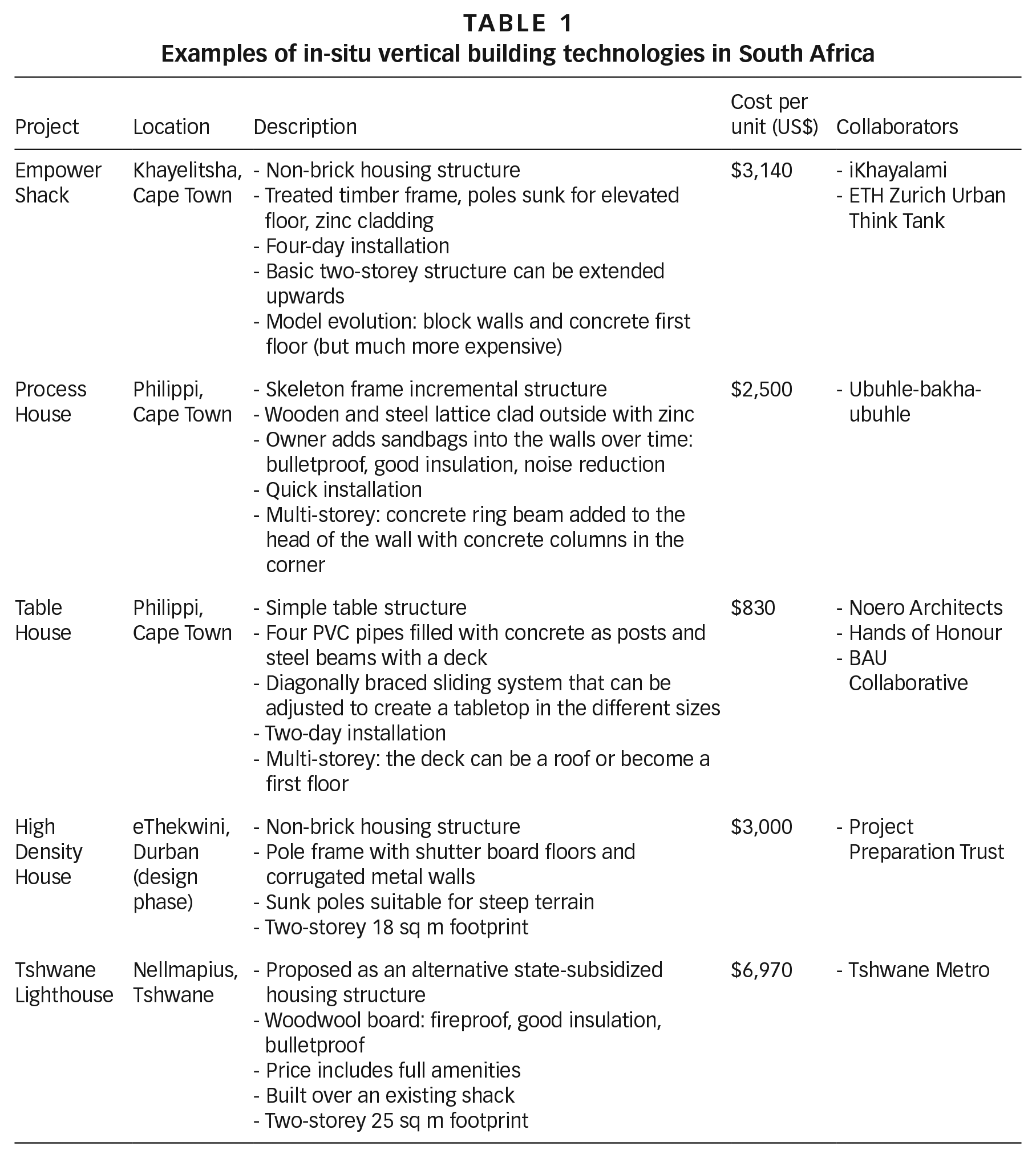
Some of these options are very cheap to install and allow residents to make gradual investments over time. Others offer more comprehensive (but unconventional) housing solutions. None costs even half that of the current state-subsidized alternative (approximately US$ 14,000 per unit).(75) Unit costs would fall significantly if projects were implemented at scale. Key obstacles include institutional rigidities, a lack of appetite for experimentation and adaptation within the state, and limited funding to allow successful demonstration projects to be scaled up significantly.
An additional challenge to housing reform appears to be some cultural aversion to multi-storey, apartment-style living. Practitioners working in informal settlements in South Africa often mention this obstacle. Reluctance may be less about vertical construction and more about the ownership or control of physical land on the ground floor. For instance, a multi-storey shack design in Philippi East, Cape Town, was initially created as separate apartments. However, it had to be adapted into a single housing structure with an indoor staircase because of household resistance.(76) Cultural preferences need to be factored into context-specific designs, although they may change over time in response to space constraints and social learning. The state could play a useful enabling role to better understand the objections, to raise awareness of the benefits of renting out space upstairs for income generation, and to craft joint solutions with other stakeholders.
The examples in Table 1, in the context of low-rise informal settlements in South Africa, involve refashioning makeshift structures into two- or three-storey walk-ups. Multi-storey informal dwellings are more common elsewhere in the world, including the favelas, comunas and barrios of Latin America, and even taller unauthorized buildings in many Indian cities.(77) Good practice appears to involve establishing a regular street grid for connectivity, investing in physical infrastructure and giving households security of tenure over small plots. Residents then construct their own homes incrementally and vertically using bricks and mortar funded through meagre savings and renting out to lodgers. International experience suggests the feasibility of vertical self-construction for African urban communities, although building upwards is not in itself a panacea for the problems of poverty. For instance, Huchzermeyer(78) documents the poor living standards associated with private landlordism in Nairobi, where unauthorized tenements reach eight storeys with extreme population densities of more than 5,500 people per hectare.
We envisage a different trajectory for dense informal settlements in African cities, where buildings of several storeys are constructed by households and community-based organizations specifically to alleviate pressure on space at the ground floor level and improve the way these places function. A critical question is how to establish an appropriate governance framework to enable and coordinate safe in-situ reconstruction where state capacity is generally lacking. The answer probably lies in fostering alliances involving state, community and civil society actors that work together to harness their collective powers and resources and hold each other to account.
IV. Conclusions
Informal settlements illustrate a mismatch between population density and building density, resulting in cramped living spaces, congested public spaces and restricted circulation. This is unsatisfactory in terms of liveability, functional efficiency and long-term prosperity. Upgrading initiatives to improve public utilities may neglect to put these places on a better foundation by adjusting their spatial form and enabling vertical improvements. Building upwards rather than outwards could create space to adapt layouts and enable investments in a range of municipal services and productive activities. This requires greater compromise, consensus and commitment among households, enterprises and state entities to coordinate their actions and investments. The process could be facilitated by government collaboration with communities to support settlement redesign, improve tenure security, decentralize financial arrangements and simplify the regulatory environment to enable pragmatic adaptation.
Several outstanding questions remain for future research. First, the fundamental propositions relating density to all-round progress need further interrogation. Is there an ideal form and level of dense development within informal settlements, and at what point do the negative effects outweigh the positive? What speed and magnitude of physical change can realistically be expected without a major injection of external resources? What are the priority measures to catalyse physical reconstruction and housing improvements? What could be done to better connect informal settlements to central cities and other economic sub-centres?
A second set of issues relates to the mechanisms for coordinating the actions of local authorities, communities and other actors in building upwards according to a shared plan for the future. How can these disparate interests reach agreement over a new settlement layout? Does security of tenure and the prospect of a better living environment provide a sufficient incentive for households to relinquish some of their land? What are the costs involved in refashioning shacks compared with building more durable structures? And what land values and financial revenues can be released by freeing up space in well-located areas for commercial development?
A final group of questions relates to the obstacles to vertical reconstruction. What are the available tools and techniques to promote cheap but safe upward expansion? How do the long-term costs compare between different building models and methods? Which technologies allow additional floors to be extended incrementally as resources become available? What is the most appropriate scale for reconfiguring plots, blocks and precincts within a settlement? And what can be done to overcome social resistance to multi-storey dwelling units?
