




Abstract
Government policy towards informal settlements in south africa reflects a tension between two approaches: recognizing the legitimacy of informal settlements and aggressively removing these so-called “slums”.(1) drawing on nationally representative household survey data and interviews with 25 individuals relocated from an informal settlement to a “transit camp”, this paper argues that more detailed attention should be paid to the changing connection between housing, household formation and work. Whereas cities in the apartheid era were marked by relatively stable industrial labour and racially segregated family housing, today the location and nature of informal dwellings are consistent with two important trends: demographic shifts, including towards smaller more numerous households, and employment shifts, including a move from permanent to casual and from formal to informal work. This study is therefore able to substantiate in more detail a longstanding insistence by informal settlement residents that they live where they do for reasons vital to their everyday survival. The paper also highlights the limitations of relocations not only to urban peripheries but also to other parts of cities, and it underscores the importance of upgrading informal settlements through in situ development.
I. Introduction and the Argument: Housing Policy and Informal Settlements in Perspective
In South Africa, the colloquial name for low-cost housing – RDP housing – is derived from the Reconstruction and Development Programme, an interventionist plan charted by civil society activists and trade unionists on the eve of democratic elections in 1994. More than any other social policy at the time, housing captured South Africans’ aspirations for social redistribution, desegregated cities, a dignified life and employment-generating forms of infrastructure development. Despite the controversial closure of the RDP office in 1996 – and the ANC-led government’s subsequent embracing of the market(2) – to this day RDP housing still remains a prominent term, retaining the symbolic connection between housing and social transformations.
Actual house building after apartheid was painfully slow at first, but projects accelerated in the 2000s and by 2010, 2.4 million houses had been built.(3) Yet housing policy attracted heightened criticism just as delivery spiked. In 2005, the shack dwellers movement Abahlali baseMjondolo burst onto the political scene in Durban, one of the largest cities in South Africa and located in the province of KwaZulu-Natal. Abahlali opposed corruption in housing projects and the state’s sometimes coercive attempts to remove informal/shack settlements from central parts of the city – a dynamic many people felt had been accelerated in the run-up to the country’s hosting of the 2010 World Cup. More specifically, tensions between two broad approaches towards in what is in dispute is not so much formal settlements became evident within government circles.(4)
The first approach is contained in the government’s 2004 “breaking new ground” policy, and is generally supported by social movements such as Abahlali baseMjondolo. It recognizes that shack settlements will be a feature of urban life for many years to come and favours in situ upgrading wherever possible. The second is symbolized in KwaZulu-Natal by the 2007 KwaZulu-Natal Elimination and Prevention of Re-emergence of Slums Act, whose legality Abahlali baseMjondolo successfully challenged in the constitutional court in 2009. The Act said that “slums” must and can be removed at any cost, premised on the view that development is always positive when people are relocated from an “informal” to a “formal” area.
In reality, of course, these are somewhat ideal distinctions, and they are certainly not incompatible. The Act was justified by the rhetoric that coercive powers were necessary
Despite differences, however, almost everyone discussing housing issues – including shack dwellers themselves who refuse to be relocated – agrees on the poor social conditions that exist in informal settlements. Contemporary studies show the limited provision of basic services, the associated health risks and a range of social issues.(6) Case study, or more regionally specific research also “points” to high rates of unemployment among those living in informal settlement areas, together with high levels of food insecurity and high rates of poverty.(7) To reiterate the point made above: what is in dispute is not so much the social conditions within informal settlements but the way in which these are framed (often by the state as inevitable conditions of “slums” that must be removed or, by shack dwellers, as evidence that informal settlements must be upgraded).
In this article, we argue that a strong impulse by the various levels of the state to remove/relocate informal settlements is unrealistic, likely to cause continued tensions with shack dwellers and be sure to undermine the livelihoods of some of the poorest South Africans. Of course, some efforts at rehousing are welcomed by shack dwellers, and in situ upgrading can lead to reduced housing densities and thus to some need for relocations. But we are concerned with the urge among some urban policy makers to define informal settlements as inherently unwanted “slums”. Our conclusion – that shack dwellers’ demands to stay where they are should be taken more seriously – is by no means original. Yet we sustain it by using household micro data that describe household and employment characteristics in the post-apartheid period, and a qualitative case study that underlines the place-based nature of modern urban livelihoods. Specifically, we combine a range of national household surveys conducted in the post-apartheid period(8) and interviews with 25 shack dwellers before and after their removal to a transit camp from an informal settlement in Durban. Taken together, these data help to show how informal settlements manifest both important spatial shifts in households (particularly towards smaller but more numerous households) and broad spatial shifts in the urban labour market (from permanent to casual work, and from formal to informal work). In the context of a very limited supply of affordable formal housing and high transport costs, it is the nature of employment and not simply the lack of employment, as well as far-reaching demographic trends, that underpin the growth of informal housing in the country.
A more historical perspective also yields support for the prioritization of in situ upgrading in the contemporary period. The post-1948 apartheid government instigated the violent bulldozing of urban informal settlements and the forced removal of many urban residents to rural areas or large townships on the periphery of towns. Strict influx controls sought to ensure that access to urban living was closely tied to the availability of urban work. At the time, forced removals from large informal settlements in Durban, such as Cato Manor in 1959, were not only brutal but undermined a myriad of informal and formal forms of subsistence.(9) Nevertheless, what is noteworthy is that two major social engineering projects went alongside this removal of informal settlements. The first was the massive building of formal townships, both to promote racial segregation and to develop a more stable “African” industrial working class; while relocation to these areas could sometimes harm urban livelihoods, townships could also be built relatively close to industrial areas (e.g. Umlazi in south Durban). The second was the state’s massive rural industrialization project, especially from the 1970s, which created a large amount of work in previously rural South Africa.(10) As a consequence of the growth of urban work and coercive state powers, it is notable that urban transit camps were in fact largely temporary at the time, since the state wanted to relocate dwellers into either townships or rural areas.
In the current “post-Fordist” era of precarious work, however, the city’s spatiality is very different. As is the case with Johannesburg, described by Crankshaw,(11) sharp spatial polarization by class is evident at the citywide scale, with areas in Durban’s north, such as Umhlanga, seeing a rapid growth in well-paying service industries and high-income neighbourhoods. Yet for the poor, arguably the need for a
II. A Note on Household Data
We draw on official estimates of the number of households living in informal settlements in South Africa, derived from data collected in nationally representative household surveys conducted by Statistics South Africa (StatsSA), the official statistical agency in South Africa. In this study, we investigate the characteristics and economic status of informal dwellers using these household survey data. In particular, data are analyzed from three rounds of the October Household Survey, two rounds of the semi-annual Labour Force Survey and from the General Household Survey.(12) These specific surveys were chosen because they collect comparable information on the demographic characteristics and employment status of individuals and also on the type of housing structures within which individuals live.(13) Moreover, by presenting the results of surveys from 1995 to 2006, the robustness of patterns at the cross-section can be assessed and possible trends can be identified.
The household surveys each sampled approximately 30,000 households, or more than 100,000 individuals. In all the surveys, detailed information was collected on the characteristics of individuals and on the composition of the household in which they lived; also, in most of the surveys comprehensive data were available on the nature of the individual’s employment. In addition, each survey asked respondents to identify the “…type of main dwelling … that the household occupies”,(14) with identical response options being provided across the surveys.(15) These responses are grouped to represent three main types of dwelling: informal (or shack) dwellings; traditional (or mud and thatch) dwellings;(16) and formal dwellings.
Although the size of informal settlements in South Africa is approximated typically by the number of households living in informal dwellings, the survey does not in fact allow a neat distinction between informal dwellings located in informal settlements specifically, and informal dwellings that are attached to formal dwellings. In the surveys, an informal dwelling is identified in two responses as an “informal dwelling/shack in backyard”, and an “informal dwelling/shack not in backyard”, for example in an informal settlement. Because backyard shacks can be attached both to informal dwellings in informal settlements and to formal dwellings, for example in townships,(17) the sub-set of shack dwellers located specifically in informal settlements cannot be distinguished.(18)
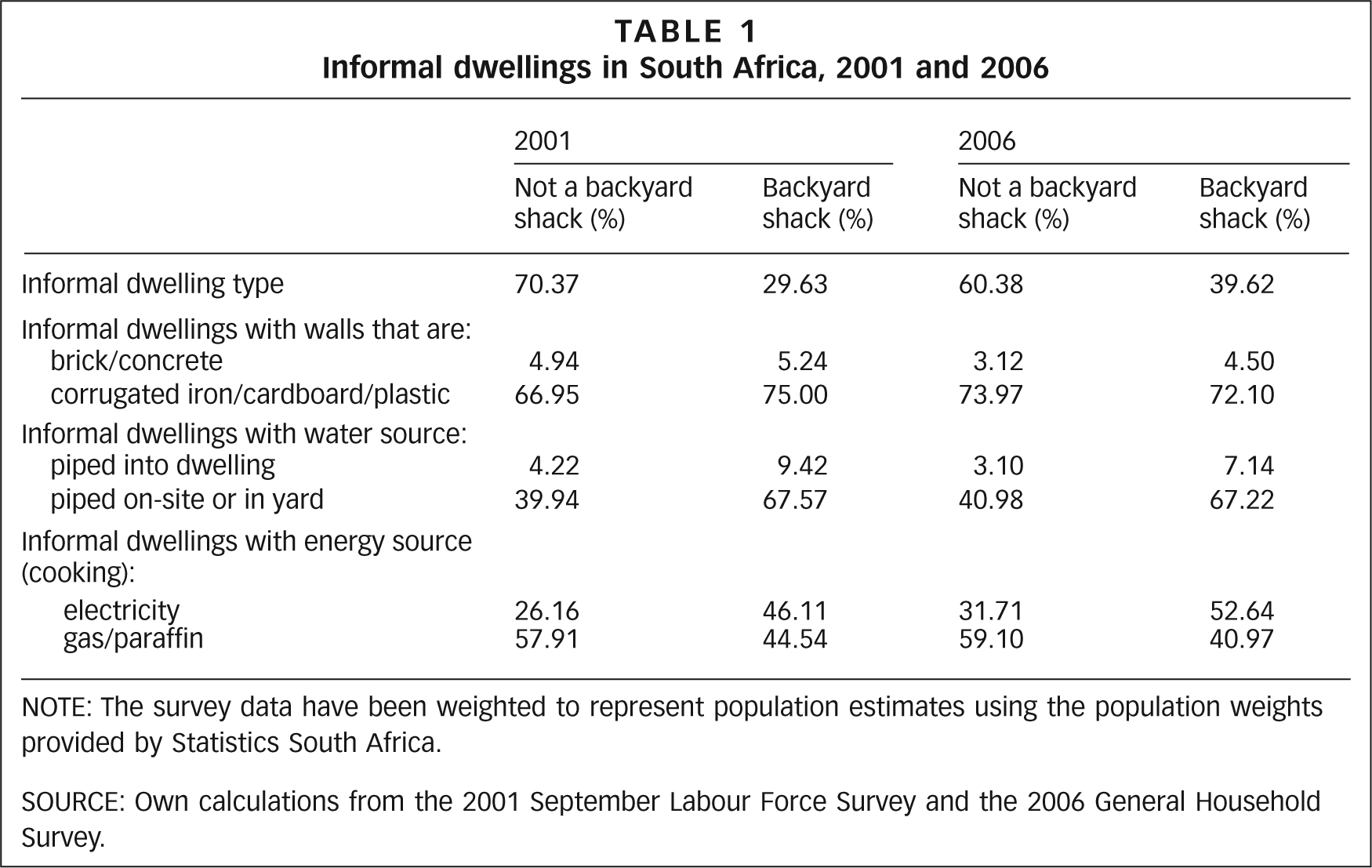
Table 1, however, shows that among all households in informal dwellings, between 60 and 70 per cent reported living in shacks not in a backyard, and which are likely to be located in informal settlements. The majority of informal dwellings are therefore clustered in informal settlements, and average characteristics of informal dwellers identified through these data will capture the average characteristics of informal settlement dwellers specifically. Indeed, with appropriate caution, it is possible to link these data to South Africa’s geography, by assuming that most informal dwellers live in informal settlements, most formal dwellers live in formal urban areas and most traditional dwellers live in rural areas.
Informal dwellings in South Africa, 2001 and 2006
NOTE: The survey data have been weighted to represent population estimates using the population weights provided by Statistics South Africa.
SOURCE: Own calculations from the 2001 September Labour Force Survey and the 2006 General Household Survey.
A final point to note – we consider here those people designated as “Africans” according to South Africa’s system of racial classification.(19) As a consequence of the enduring connection between race/class/location, virtually all informal and traditional dweller occupants are African. For comparative purposes, in most cases we also consider only Africans living in formal dwellings (largely in cities). We make this racial distinction to avoid comparing African people in informal areas with people of all races in formal (mostly urban) areas; this would, for instance, significantly increase the recorded number of people in formal urban areas who are in formal work. Such a method might be justified in years to come. However, since apartheid ended in 1994, only one year prior to the first dataset we analyzed, and since our main focus is on informal settlements that remain de facto racially segregated, there is some reason to consider only black Africans in this article.
III. Why Informal Settlements? So much more than Housing
Residents moving to informal settlements arrive from a variety of places: some travel from rural to informal areas at a young age; others grow up in urban townships and fail to access formal housing.(20) Settlements may be located on government land, private property or former tribal lands (that is land under the authority of chiefs). It is especially important to differentiate informal settlements from formal townships. The latter are segregated urban areas built mainly in the 1950s and 1960s to stabilize black labour during a boom in the industrial economy. Racially structured, these spaces were also formed through the patriarchal vision of planners; indeed, the four-roomed “family” houses that constitute the architectural backbone of townships were mainly allocated to married men with employment.
There is much truth in the common proposition that informal settlements result from a housing “backlog”. The post-1948 apartheid regime prioritized the violent removal of shacks to uphold strict racial segregation. Informal settlements returned in the 1970s, as urban apartheid faltered and formal housing projects had largely ended. After 1986, they exploded in cities following the ending of influx controls that had sought to restrict many black South Africans to rural areas.(21)
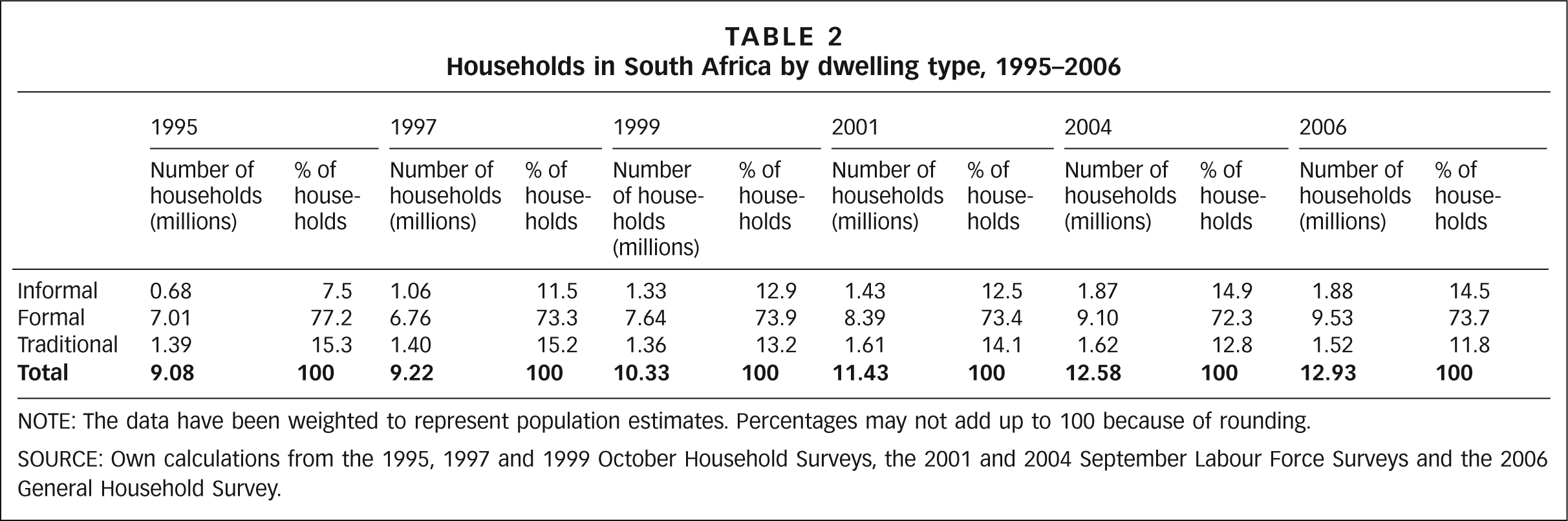
Yet what also needs explaining is why, when more than two million RDP houses have been built post-apartheid, the number of informal structures has still increased significantly (Table 2). Growing urbanization is one oft-stated reason. Another is the poor quality and small size of RDP houses, many of which measure only around 30 square metres compared to the apartheid-era “matchbox” houses that measured 51.2 square metres. A final reason is that because the subsidy provided by the state is very low, RDP houses are located on the outskirts of towns where land is cheaper.(22) All these explanations are valid, but we are particularly concerned here with how recent demographic and labour market shifts are consistent with the location and continued growth of informal settlements within
Households in South Africa by dwelling type, 1995–2006
NOTE: The data have been weighted to represent population estimates. Percentages may not add up to 100 because of rounding.
SOURCE: Own calculations from the 1995, 1997 and 1999 October Household Surveys, the 2001 and 2004 September Labour Force Surveys and the 2006 General Household Survey.
As shown in Table 2, the total number of households in South Africa increased significantly between 1995 and 2006, by almost four million, a 42 per cent increase. However, the relative increase in the number of households in informal dwellings was far larger than the relative increase in the number of households overall. Table 2 shows that the percentage of households in informal dwellings doubled from approximately 7.5 per cent of all households in 1995 to nearly 15 per cent in 2006.
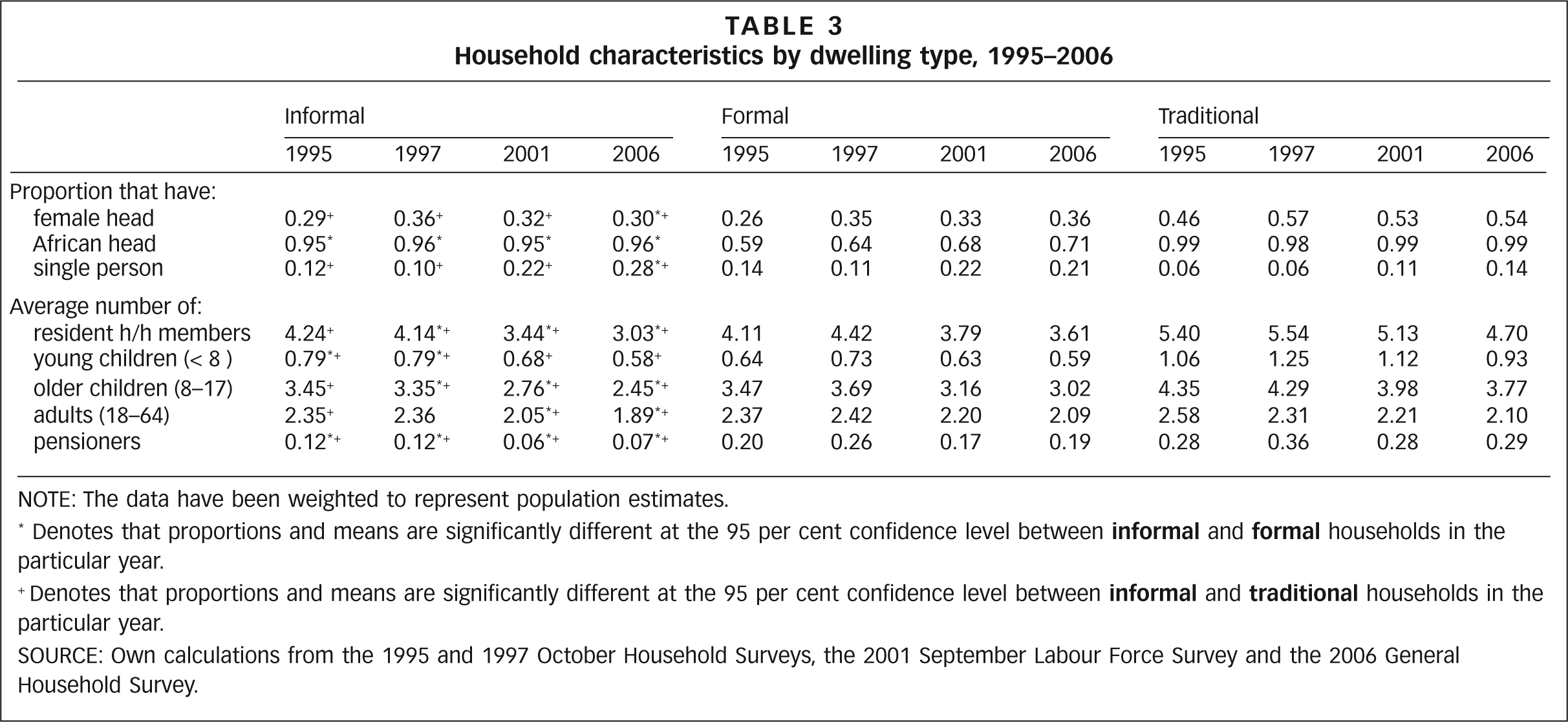
This large increase in the number of households coincided with a fall in household size. Table 3 describes the decline in the average number of household members, particularly in informal dwellings (from 4.24 in 1995 to 3.03 in 2006), and a corresponding increase in single person households (in informal dwellings from 12 per cent in 1995 to 28 per cent in 2006). Related to this, as shown in Table 4, while sharp reductions in marriage rates among Africans were evident across South Africa, the highest proportion of unmarried people and co-habiting couples lived in informal dwellings; here, only 20 per cent of adults were married in 2006, while 25 per cent of adults were co-habiting with a partner. The result is a picture of quite profound trends in households that can be summarized as follows:
there is an increasing number of smaller households where members are less likely to be married than in the past; and
these trends are geographical in that they help to produce – while also being a consequence of – a rising number of informal dwellings, the majority clustered in informal settlements.
Household characteristics by dwelling type, 1995–2006
NOTE: The data have been weighted to represent population estimates.
Denotes that proportions and means are significantly different at the 95 per cent confidence level between informal and formal households in the particular year.
Denotes that proportions and means are significantly different at the 95 per cent confidence level between informal and traditional households in the particular year.
SOURCE: Own calculations from the 1995 and 1997 October Household Surveys, the 2001 September Labour Force Survey and the 2006 General Household Survey.
Characteristics of African working-age adults by dwelling type, 1995–2006
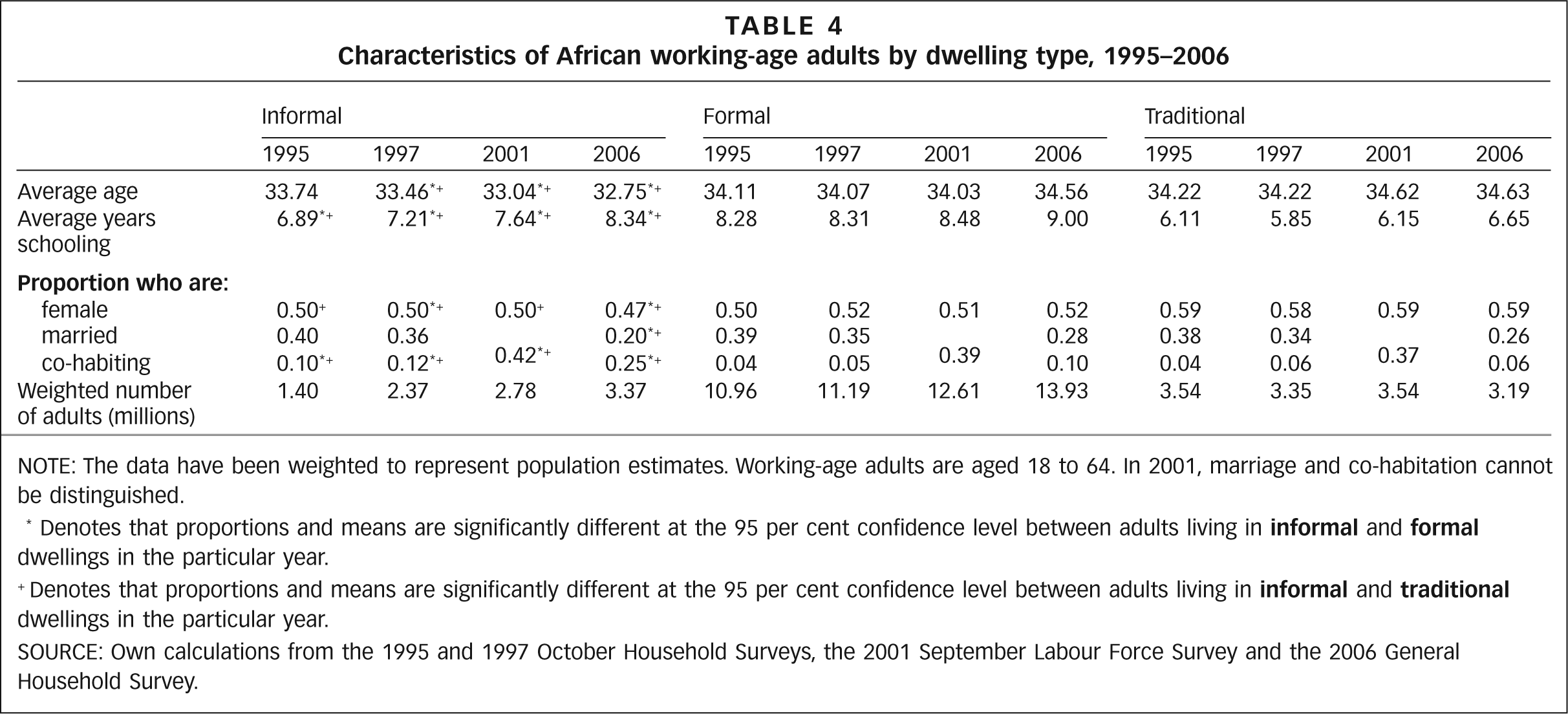
NOTE: The data have been weighted to represent population estimates. Working-age adults are aged 18 to 64. In 2001, marriage and co-habitation cannot be distinguished.
Denotes that proportions and means are significantly different at the 95 per cent confidence level between adults living in informal and formal dwellings in the particular year.
Denotes that proportions and means are significantly different at the 95 per cent confidence level between adults living in informal and traditional dwellings in the particular year.
SOURCE: Own calculations from the 1995 and 1997 October Household Surveys, the 2001 September Labour Force Survey and the 2006 General Household Survey.
To these two points, we can add strong evidence of women’s increased mobility from rural areas, itself linked to declining rural marriage rates.(23) Indeed, household data show that considerably more female migrants are unmarried than are married.(24)
Taken together, these demographic trends reveal a set of processes that are continuously generating new, generally small, households. It should be emphasized that these processes are dynamic and interrelated. For instance, the rising number of informal dwellings/settlements both facilitates and responds to falling marriage rates: informal settlements and rented backyard shacks have long been a place where an unmarried couple can co-habit, a practice frowned upon in rural areas without ilobolo (bridewealth) payments.(25) But to show in more detail why informal settlements are located in cities, and in particular parts of cities, we need to explore how informal dwellers survive in the world of work.
IV. Employment Data
In the years post-apartheid, growing numbers of individuals have entered the South African labour market, far in excess of the number of jobs created. Table 5 describes high and rising rates of unemployment across the country from 1995 to 2006. Broken down by type of dwelling, however, we see that in 2006 the broad unemployment rate was lower among labour force participants living in informal dwellings (43 per cent) than in formal (45 per cent) and traditional (62 per cent) dwellings. African adults in informal dwellings are significantly more likely than African adults living elsewhere to be employed and, over time, employment rates among informal dwellers have increased, whereas they have fallen among African adults in formal and traditional dwellings.(26)
Labour force status of African working-age adults by dwelling type, 1995–2006
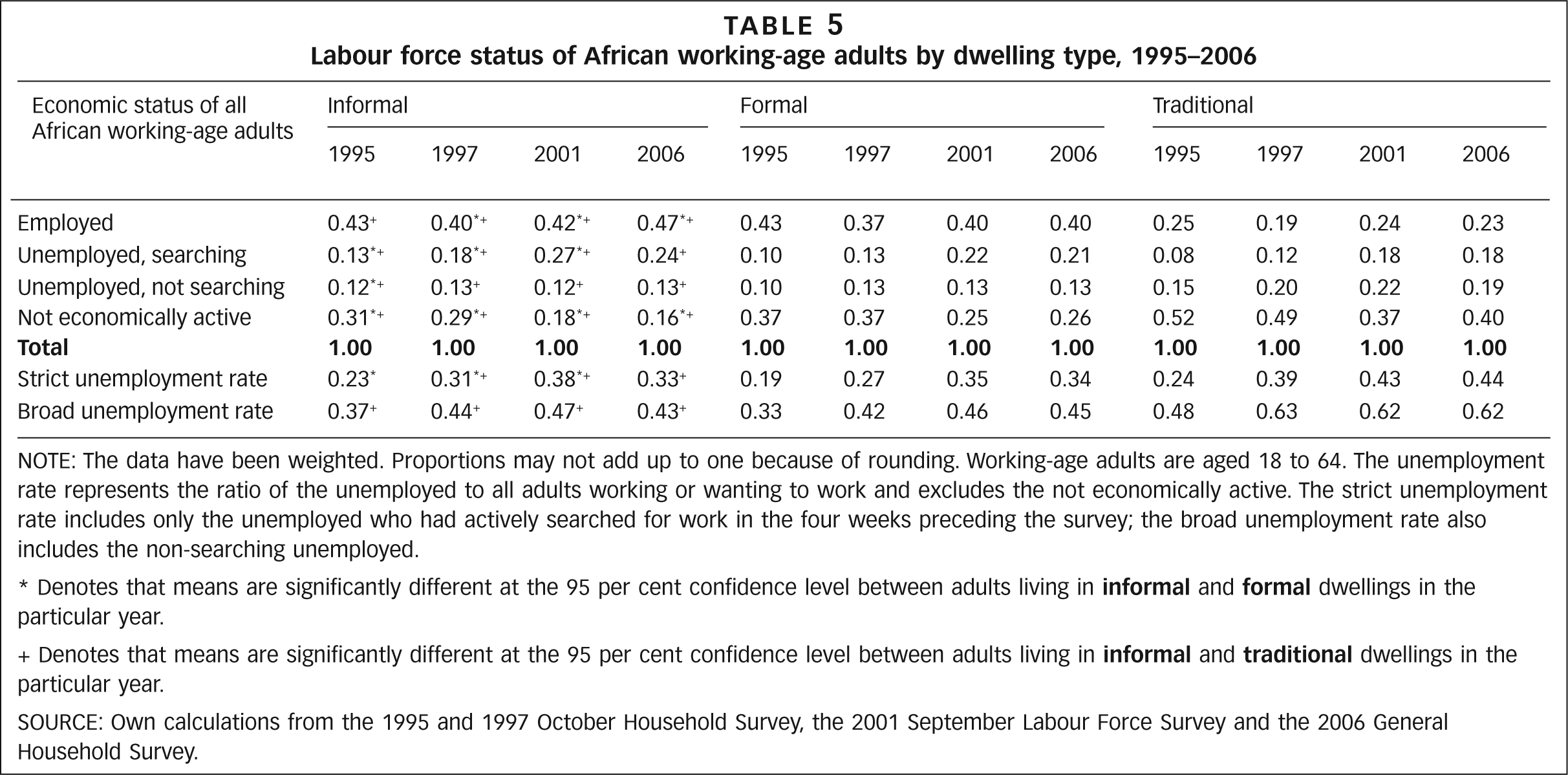
NOTE: The data have been weighted. Proportions may not add up to one because of rounding. Working-age adults are aged 18 to 64. The unemployment rate represents the ratio of the unemployed to all adults working or wanting to work and excludes the not economically active. The strict unemployment rate includes only the unemployed who had actively searched for work in the four weeks preceding the survey; the broad unemployment rate also includes the non-searching unemployed.
Denotes that means are significantly different at the 95 per cent confidence level between adults living in informal and formal dwellings in the particular year.
Denotes that means are significantly different at the 95 per cent confidence level between adults living in informal and traditional dwellings in the particular year.
SOURCE: Own calculations from the 1995 and 1997 October Household Survey, the 2001 September Labour Force Survey and the 2006 General Household Survey.
Table 6 describes the characteristics of employment.(27) Across all three dwelling types, there is a general shift towards informal (unregistered) work.(28) The share of Africans employed who are in informal work is highest among those living in traditional dwellings (55 per cent in 2004), in large part because not many formal enterprises are active in rural areas. At the same time, in 2004 the share was higher in informal dwellings (27 per cent) than in formal dwellings (23 per cent). Furthermore, a larger percentage of the employed in informal dwellings are domestic workers (14 per cent), compared to nine per cent of the employed in both formal dwellings and traditional dwellings. Workers in informal dwellings are also much more likely to be employed casually than workers in formal dwellings (35 per cent compared to 21 per cent in 2004). Informal and domestic work, as well as work that is casual or temporary, typically is low-paid work, and these employment characteristics help explain why average monthly earnings are lower among the employed in informal dwellings than in formal areas. As Table 7 shows, in 2006 informal dwellers earned R1,703 per month on average, formal dwellers, R2,945 and traditional dwellers, R1,121.(29)
Characteristics of employment among Africans by dwelling type, 1999–2004
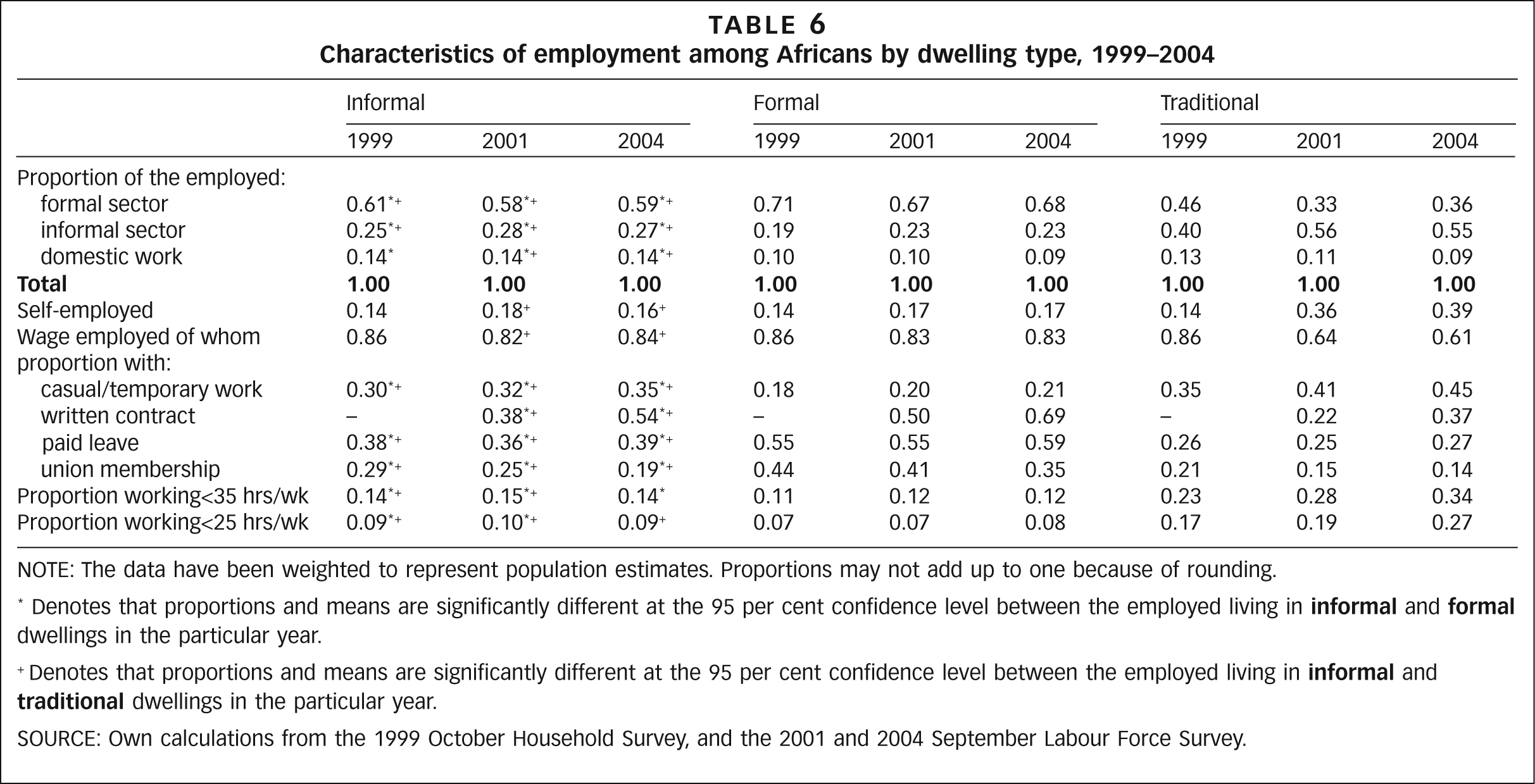
NOTE: The data have been weighted to represent population estimates. Proportions may not add up to one because of rounding.
Denotes that proportions and means are significantly different at the 95 per cent confidence level between the employed living in informal and formal dwellings in the particular year.
Denotes that proportions and means are significantly different at the 95 per cent confidence level between the employed living in informal and traditional dwellings in the particular year.
SOURCE: Own calculations from the 1999 October Household Survey, and the 2001 and 2004 September Labour Force Survey.
Monthly earnings (Rand 2006 prices) among employed Africans by dwelling type, 2001 and 2006
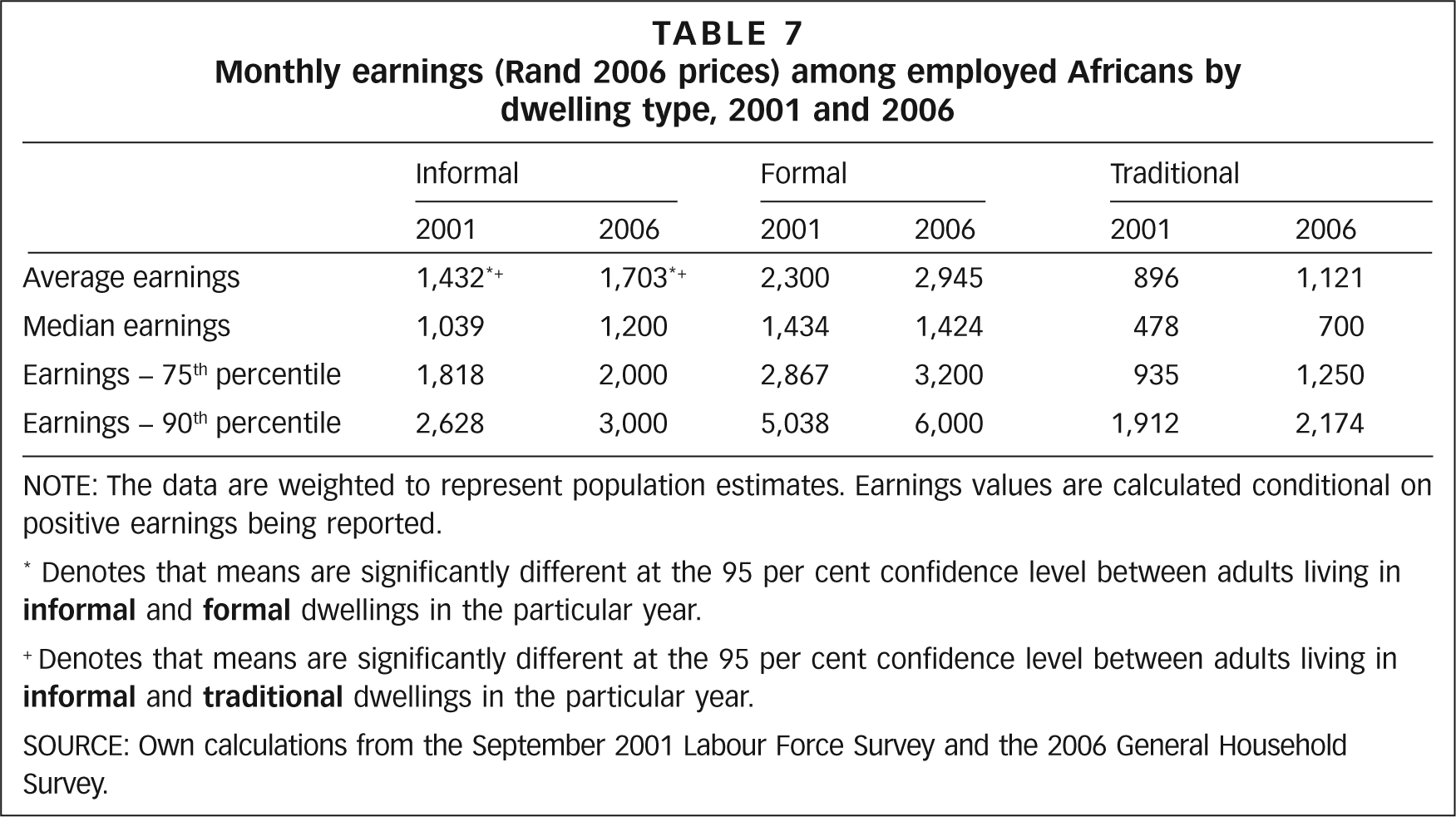
NOTE: The data are weighted to represent population estimates. Earnings values are calculated conditional on positive earnings being reported.
Denotes that means are significantly different at the 95 per cent confidence level between adults living in informal and formal dwellings in the particular year.
Denotes that means are significantly different at the 95 per cent confidence level between adults living in informal and traditional dwellings in the particular year.
SOURCE: Own calculations from the September 2001 Labour Force Survey and the 2006 General Household Survey.
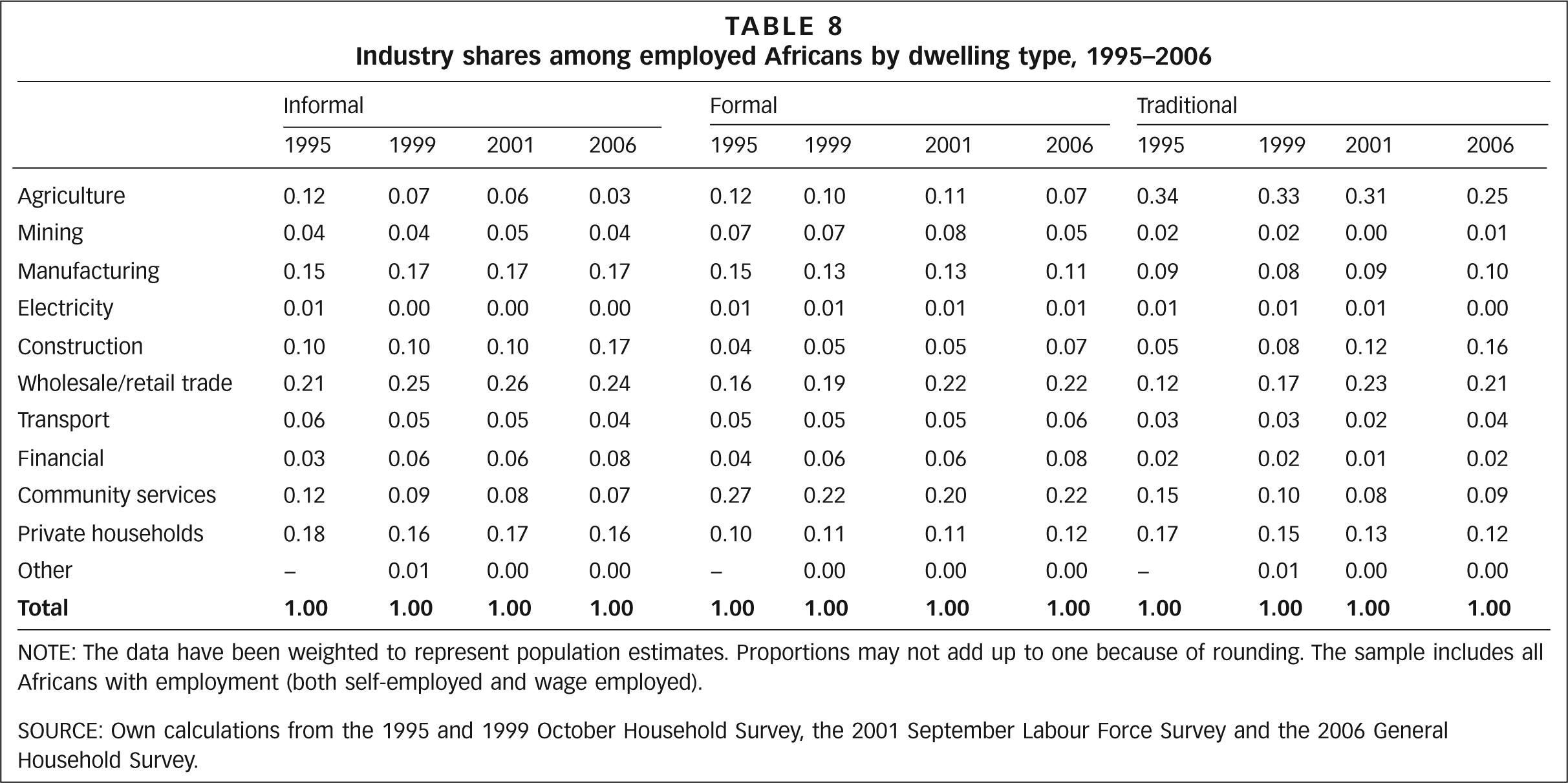
Table 8 shows that the importance of manufacturing employment to informal dwellers increased slightly (15 per cent in 1995 compared to 17 per cent in 2006), whereas it declined for formal dwellings. Across all three types of dwelling, the share of agricultural employment has declined significantly, while construction employment has increased. Wholesale/retail trade is the most significant employment sector and is on a general upward trend among the employed living in all three dwelling types.
Industry shares among employed Africans by dwelling type, 1995–2006
NOTE: The data have been weighted to represent population estimates. Proportions may not add up to one because of rounding. The sample includes all Africans with employment (both self-employed and wage employed).
SOURCE: Own calculations from the 1995 and 1999 October Household Survey, the 2001 September Labour Force Survey and the 2006 General Household Survey.
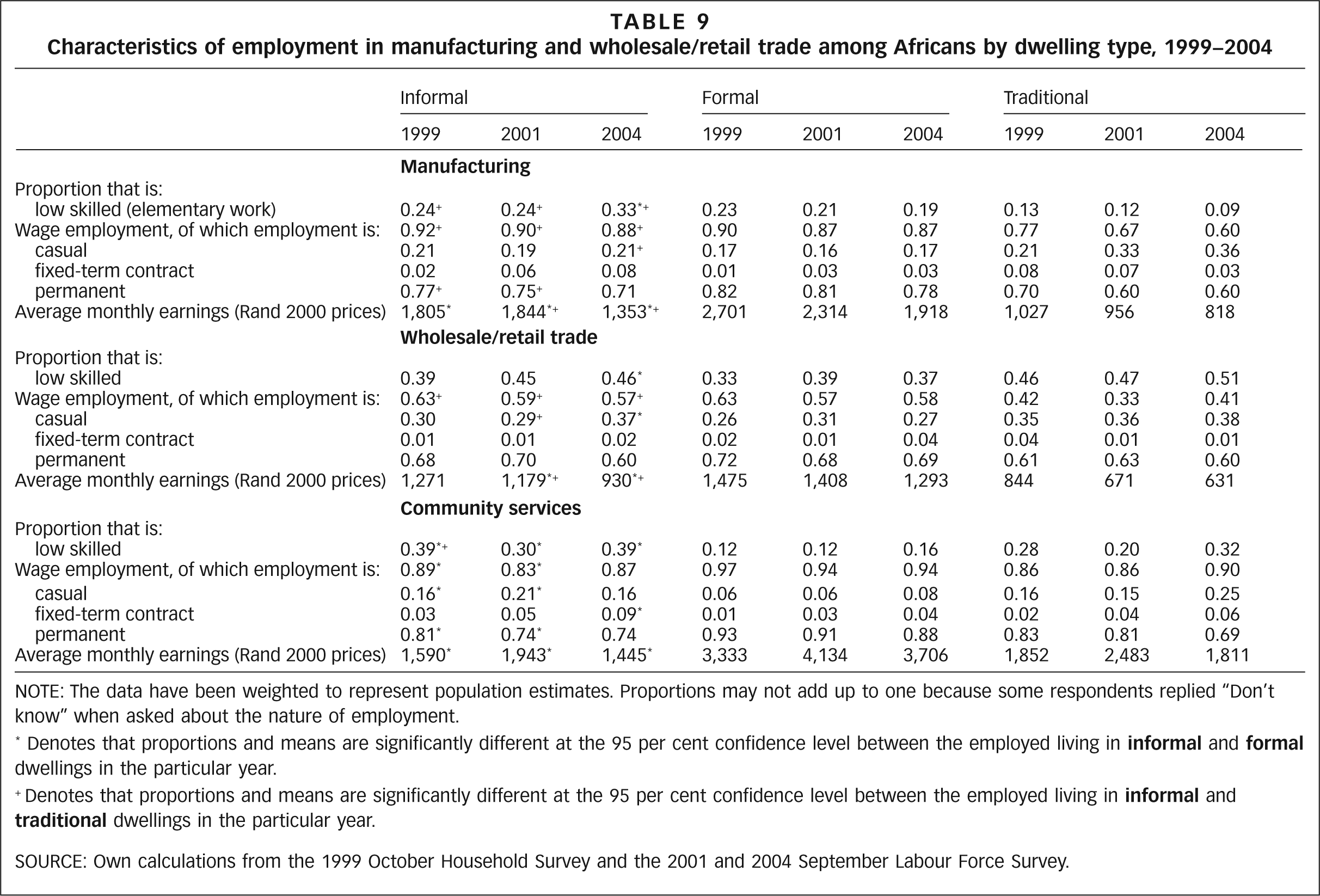
Table 9 describes the employment characteristics of informal dwellers who work in manufacturing, wholesale and retail trade and community services, the three modal industries that accounted for more than 50 per cent of total employment in 2004. In comparison to formal dwellers, informal dwellers are more likely to be employed in low-skilled or elementary occupations. This has also become considerably more pronounced over time in both manufacturing and wholesale and retail trade: the share of low-skilled work in manufacturing among informal dwellers rose from 24 per cent in 1999 to 33 per cent in 2004; and in trade, from 39 per cent to 46 per cent. The extent of non-permanent employment (both casual and fixed-term contract employment) also generally showed a greater increase among informal dwellers in all three industries. The table further shows that in comparison to the employed in formal dwellings, those in informal dwellings consistently earned less per month on average.
Characteristics of employment in manufacturing and wholesale/retail trade among Africans by dwelling type, 1999–2004
NOTE: The data have been weighted to represent population estimates. Proportions may not add up to one because some respondents replied “Don’t know” when asked about the nature of employment.
Denotes that proportions and means are significantly different at the 95 per cent confidence level between the employed living in informal and formal dwellings in the particular year.
Denotes that proportions and means are significantly different at the 95 per cent confidence level between the employed living in informal and traditional dwellings in the particular year.
SOURCE: Own calculations from the 1999 October Household Survey and the 2001 and 2004 September Labour Force Survey.
To these data we must add another factor that structures labour markets: the very significant increases in the cost of petrol, and therefore personal transport costs, over the last decade.(30) Taken together, we can summarize the following aspects of recent employment trends and features:
in the context of an overall increase in unemployment, informal dwellers are the only group of people more likely to be employed in 2006 than in 1995;
much of the work undertaken by informal dwellers is informal and low paid;
domestic work and work in the construction industry are more important to informal dwellers than to those living in other types of dwellings;
manufacturing work is becoming increasingly important to informal dwellers, especially in relation to formal dwellers; and
informal dwellers are more likely than formal dwellers to be in casual or temporary employment.
V. Durban Case Study
We have seen that demographic and employment data provide an optic into both why informal settlements persist, despite housing projects, and how they might be unfolding in relation to particular labour geographies. To provide a more textured approach, which shows quite clearly the spatially dependent nature of contemporary urban work, we now consider an informal community that was removed from an informal settlement in 2009. Specifically, the move was from King’s Rest, a place located close to a railway station, a dock and a relatively wealthy (formerly white) suburb at Durban’s Bluff. This group of 60 households was relocated south to Isipingo, an industrial area located within the boundaries of the municipality.
As one of South Africa’s largest cities, Durban is historically dependent on its large port and manufacturing sector. EThekwini municipality (which governs the city of Durban and its surrounding areas) built around 73,000 houses between 2001 and 2007 and has won awards for its housing policy.(31) Nevertheless, many shack dwellers insist that corruption riddles the RDP housing allocation and they contest claims that specific settlements have to be removed for health or other reasons. Also controversial is the municipality’s policy to limit informal settlements by granting each shack a number that, in theory, places them in line for an RDP house. This is because the numbers also serve to regulate the tolerated number of shacks in settlements.(32)
King’s Rest settlement was established in 2001 and grew as residents moved there from rural areas, hostels, other shack settlements and townships (where in 2009 the monthly rent for an informal dwelling adjacent to a family home could be R400). The settlement was dubbed “Emantombazaneni” (Place of Women) to commemorate its first settlers, five women. Residents were interviewed in May and June 2009 mainly for a project on schooling, although the study also included some questions on employment and residential history.(33)
In late 2009, with little warning, the settlement was relocated to Isipingo, a sprawling transit camp with more than 700 households. The transport parastatal Spoornet, on whose land the King’s Rest settlement was built, justified the move by saying that the land was needed to host a large fuel pipeline that linked Durban and Johannesburg. A subsequent visit in 2010, however, showed that not all of the land was being redeveloped; indeed, some of the shacks had been located on undisturbed land on the other side of a railway line to the pipeline. Moreover, press reports showed that officials were also arguing that it was safe to locate the pipeline close to residential areas, a position opposed by some residents in Durban when it passed close to their (formal) houses.(34) It is difficult therefore to escape the view that the technical reasons given for relocation were in part motivated by the overriding desire to relocate people from informal settlements to formal structures.
Dubbed amatins by some residents because they are frequently built from corrugated steel, transit camps have mushroomed across South Africa in recent years. The government argues that they are necessary as a temporary housing measure.(35) Critics, however, argue that transit camps are rarely simply short-term measures that result in decent housing.(36) Indeed, some transit camps have existed for more than 10 years and are therefore patently not short term. The King’s Rest residents were certainly not given a clear indication of when they would be moved to RDP houses nor where these might be located.
In June and July 2010, after their removal to the transit camp in Isipingo, the community members were re-interviewed. All were interviewed directly except for four people, whose details were given by other community members. We consider below only information relating to dwellers’ work; however, it should be noted that most residents criticized the poor conditions in the transit camp, especially the dirty communal toilets and the constant threat of flooding during the rainy season. In King’s Rest, for example, residents had been able to build and manage their own pit latrine toilets, whereas the transit camp provided only very dirty ablution blocks. Also important was the loss of autonomy, as residents from King’s Rest were spread out in the sprawling transit camp under the authority of an elected councillor who is affiliated with the ruling ANC party.(37)
The study did not involve a large sample or an extended amount of direct observation. Some economic activities might have been downplayed; for instance, some people mentioned informally that one or two members earned some income from selling dagga (marijuana), although this was not mentioned during the interviews. Also, the interviews did not include many details about the domestic situation of each household, although in general, people appeared to maintain similar living situations to those they had in the past (transit camps, however, offer less room for household expansion compared to informal settlements). Nevertheless, even allowing for these qualifications, the comments are so consistent as to merit attention.
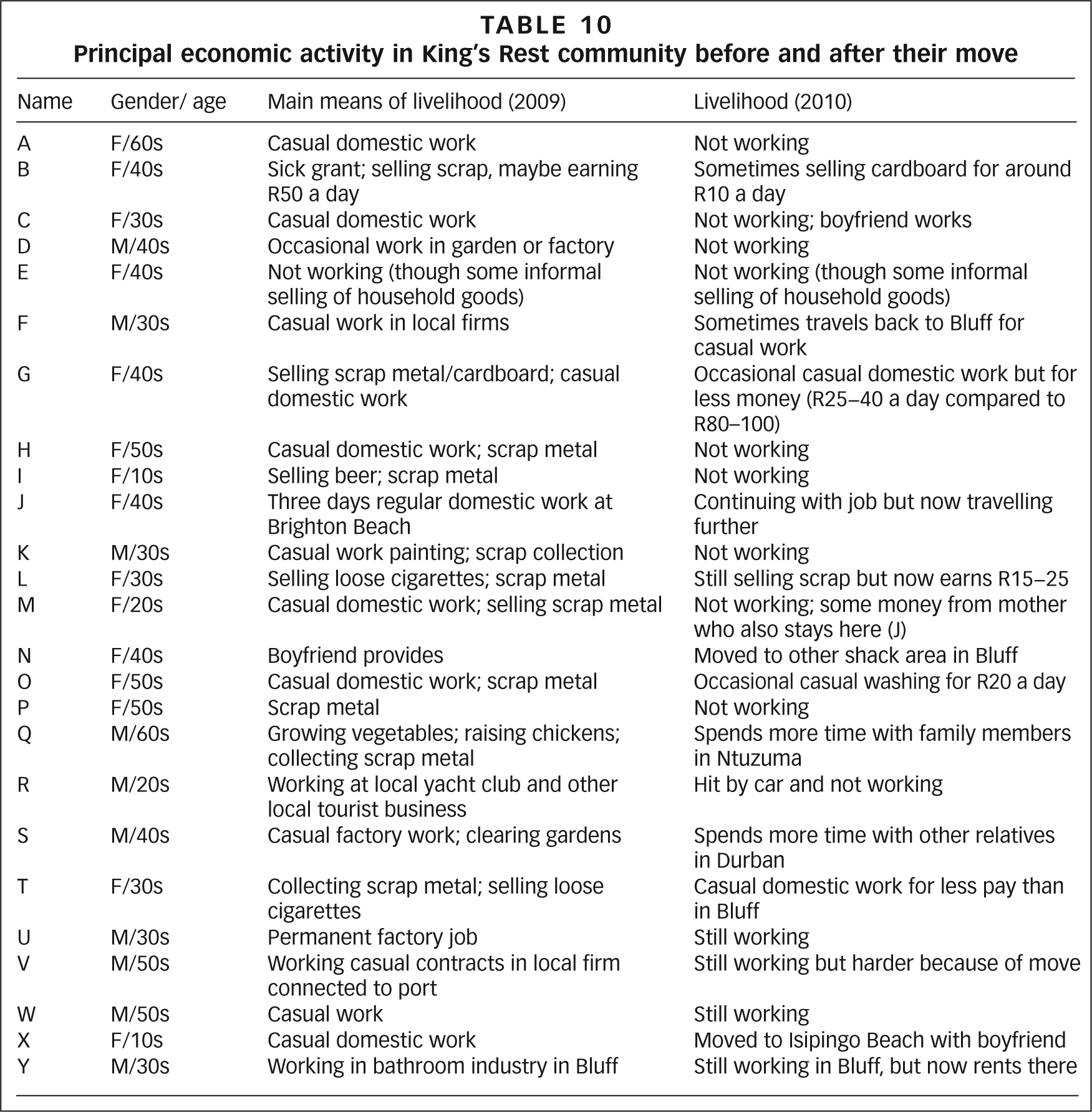
On the face of it, the move should not have adversely affected the community. Isipingo is an industrial area of Durban and not a rural peripheral location – the site of many new RDP housing settlements. However, the move clearly eroded a number of livelihood strategies. King’s Rest offered several main forms of survival, ones deeply embedded in the local geography and consistent with recent labour market changes. The first was collecting and selling scrap metal. Most King’s Rest residents, at some time, had walked from house to house in the nearby middle-class suburb asking residents for scrap, as well as collecting it from informal dumping areas at the Bluff. They then transported the scrap by train from King’s Rest station to Jacob’s station (which costs R3.50) and pushed it on a shopping cart to a scrap metal dealer. This gruelling work generated R50–80 per day.
Yet in Isipingo, the livelihood from scrap metal all but disappeared. Although a few people still occasionally made the journey to the Bluff, the cost of transport there and back (R10 return by train, R20 return by taxi) was simply too high for most. One person mentioned collecting cardboard in Isipingo but earned only R10 a day doing so.
For women especially, casual domestic work at the Bluff was a very important source of income, and daily wages ranged from R50–100. However, domestic work was much harder to find in Isipingo, and wages ranged from R20–35 a day, in part because of the large concentration of job seekers in the settlement. Industrial work was also harder to find. While a few men continued with their employment in Bluff factories, those relying on more casual work found it harder to commute. Finally, while a few residents had previously tended small gardens, and one person had raised chickens, this was not possible in the transit camp. Some comments on work are given below:
“At King’s Rest, before, we would raise chickens, I had my garden; here I am hungry; I used to take and sell.” “[Here], there is no casual work, there is nothing.” “Now there’s nothing; you can work for the whole day for R25, then they say come tomorrow but the boss is not there to pay you.”
Table 10 summarizes how the position of individuals has changed and gives details of the economic activities before and after the move. It could, of course, be argued that over time, residents in the transit camp will develop new local economic activities. However, what makes this unlikely to any significant degree is the large number of people living there, all competing for limited work opportunities. The transit camp is also located next to a poorer (former Indian) residential area and away from a railway station.
Principal economic activity in King’s Rest community before and after their move
VI. Conclusions: The Difference that Place Makes
Household data that describe the involvement of informal dwellers in low wage employment highlight the limitations of the redevelopment of informal settlements if this involves the relocation of communities to sites that are further away from urban centres, and they explain why informal dwellers may be willing to trade off upgraded housing facilities for proximity to employment opportunities. They also show that household size and marriage rates have fallen significantly and, in turn, the number of households has increased. Both of these trends challenge the common belief that there is a housing “backlog” that can be ended in the near future.
Bringing these data to life, interviews with residents from a single informal settlement show specifically how the geography of housing and demographic and workplace changes are connected. Before the community’s removal, domestic work was an important means of survival for women. Since this was often casual employment, workers needed to be situated locally to be able to move door to door looking for work or to respond to a rumour of possible work. For men, casual work in docks or factories was important, and this is consistent with a general rise in the importance of casual and low-skilled work. For both men and women, collecting and selling scrap metal was an enormously important livelihood strategy.
Urban policy is by no means monolithic, but this study challenges the strong impulse within some state institutions to remove “slums”. Arguments against the removal of informal settlements have been made many times in the past, because intuitively it makes sense that shack dwellers would not choose to live in such poor social conditions without good reason. We are able, however, to emphasize the following contemporary trends: the growing casual nature of work; rising transport costs; and the constantly rising number of small households as marriage rates reach an all-time low. These historical forces underline that, wherever possible, attempts at in situ upgrading must be followed, alongside creative ways to desegregate cities and innovative ways to consider housing and employment in a more integrated way.
Footnotes
1.
The term “slum” usually has derogatory connotations and can suggest that a settlement needs replacement or can legitimate the eviction of its residents. However, it is a difficult term to avoid for at least three reasons. First, some networks of neighbourhood organizations choose to identify themselves with a positive use of the term, partly to neutralize these negative connotations; one of the most successful is the National Slum Dwellers Federation in India. Second, the only global estimates for housing deficiencies, collected by the United Nations, are for what they term “slums”. And third, in some nations, there are advantages for residents of informal settlements if their settlement is recognized officially as a “slum”; indeed, the residents may lobby to get their settlement classified as a “notified slum”. Where the term is used in this journal, it refers to settlements characterized by at least some of the following features: a lack of formal recognition on the part of local government of the settlement and its residents; the absence of secure tenure for residents; inadequacies in provision for infrastructure and services; overcrowded and sub-standard dwellings; and location on land less than suitable for occupation. For a discussion of more precise ways to classify the range of housing sub-markets through which those with limited incomes buy, rent or build accommodation, see Environment and Urbanization Vol 1, No 2 available at  .
.
2.
Marais, H (2001), South Africa: Limits to Change: The Political Economy of Transformation, Zed Books, London, 338 pages.
3.
http://www.politicsweb.co.za/politicsweb/view/politicsweb/en/page71654?oid=204713&sn=Detail&pid=71654, accessed 8 September 2011.
4.
Charlton, S and C Kihato (2006), “Reaching the poor? An analysis of the influences of the evolution of South Africa’s housing programme”, in U Pillay, R Tomlinson and J du Toit (editors), Democracy and Delivery. Urban Policy in South Africa, HSRC Press, Cape Town, pages 252–282; also Huchzemeyer, M and A Karam (editors) (2006), Informal Settlements. A Perpetual Challenge, UCT Press, Capetown, 336 pages; Sisulu, L (2006), “Partnerships between government and slum/shack dwellers’ federations”, Environment and Urbanization Vol 18, No 2, October, pages 401–405; COHRE (2008), Business as Usual? Housing Rights and Slum Eradication in Durban, South Africa, COHRE, Geneva, 157 pages; and Del Mistro, R and D A Hensher (2009), “Upgrading informal settlements in South Africa: policy, rhetoric and what residents really value”, Housing Studies Vol 24, No 3, pages 333–354. e
6.
Bachmann, M, L London and P Barron (1996), “Infant mortality rate inequalities in the Western Cape Province of South Africa”, International Journal of Epidemiology Vol 25, No 5, pages 966–972; also Connolly, C, M Colvin, O Shishana and D Stoker (2004), “Epidemiology of HIV in South Africa – results of a national, community-based survey”, South African Medical Journal Vol 94, No 9, pages 776–781; see reference 4, Huchzemeyer and Karam (editors) (2006); and Richardson, R, B O’Leary and K Mutsonziwa (2006), “Measuring quality of life in informal settlements in South Africa”, Social Indicators Research Vol 81, pages 375–388.
7.
Wilkins, N and J Hofmeyr (1994), “Socioeconomic aspects of informal settlements”, in D Hindson and J McCarthy (editors), Here to Stay. Informal Settlements in KwaZulu-Natal, pages 107–122; also Rogerson, C M (1999), “Local economic development and urban poverty alleviation: the experience of post-apartheid South Africa”, Habitat International Vol 23, No 4, pages 511–534; Westaway, M S (2006), “A longitudinal investigation of satisfaction with personal and environmental quality of life in an informal housing settlement, Doornkop, Soweto”, Habitat International Vol 30, No 1, pages 175–189; and Hunter, M (2007), “The changing political economy of sex in South Africa: the significance of unemployment and inequalities to the scale of the AIDS pandemic”, Social Science and Medicine Vol 64, pages 689–700.
8.
9.
Edwards, I (1996), “Cato Manor, June 1959: men, women, crowds, violence, politics and history”, in P Maylan and I Edwards (editors), The People’s City. African Life in Twentieth Century Durban, University of Natal Press, Pietermaritzburg, pages 102–142.
10.
Platzky, L (1995), The Development Impact of South Africa’s Industrial Decentralization Policies: An Unforeseen Legacy, PhD thesis, Institute of Social Studies, The Hague.
11.
Crankshaw, O (2008), “Race, space and the post-Fordist spatial order of Johannesburg”, Urban Studies Vol 45, pages 1692–1711.
12.
See reference 8.
13.
After 2004, the Labour Force Surveys did not include any questions on the type of dwelling in which the individual lived.
14.
See questions 1.1, 9.2 and 6.1 in the October Household Surveys for 1995, 1997 and 1999, respectively; questions 6.1 and 7.1 in the semi-annual Labour Force Surveys for 2001:2 and 2004:2, respectively; and question 4.1 in the General Household Survey for 2006.
15.
The only difference across the surveys is that the October Household Survey for 1995 includes a smaller set of response options, although the main categories are identical.
16.
Traditional dwellings are huts or structures made of traditional materials (Response Option 2) as well as “other” dwelling types (Response Option 9 in the 1995 OHS and Option 11 in the subsequent surveys) located in rural areas and in which the main building material for the walls, identified in the subsequent question, is reported as “mud”.
17.
Hunter, M (2010), Love in the Time of AIDS: Inequality, Gender and Rights in South Africa, Indiana University Press, Bloomington, 324 pages.
18.
It is not possible to identify the type of dwelling to which a backyard shack is attached, as these two dwellings would be listed separately in the data.
19.
By the end of the apartheid era there were four widely used “racial” categories: African, white, Indian and coloured. We use “scare quotes” to suggest that we do not accept that these categories are natural ones but do so conservatively to improve the article’s readability.
20.
Crankshaw, O (1993), “Squatting, apartheid and urbanization on the southern Witwatersrand”, African Affairs Vol 92, No 366, pages 31–51; also Hindson, Doug and Jeff McCarthy (1994), Here to Stay: Informal Settlements in KwaZulu-Natal, Indicator, Dalbridge, 230 pages.
22.
Huchzemeyer, M (2003), “The legacy of control? The capital subsidy for housing and informal settlement in South Africa”, International Journal of Urban and Regional Planners Vol 27, pages 594–606.
23.
Posel, D and D Casale (2003), “What has been happening to internal labour migration in South Africa, 1993–1999?”, The South African Journal of Economics Vol 71, No 3, pages 455–479; also Posel, D (2006), “Moving on: patterns of labour migration in post-apartheid South Africa”, in Marta Tienda, Sally Findley and Stephen Tollman (editors), Africa on the Move: African Migration and Urbanization in Comparative Perspective, Witwatersrand University Press, Johannesburg pages 217–231; and see reference 17.
25.
See reference 17.
26.
Among informal dwellers specifically, the increase in employment of working-age African adults between 1995 and 2006 was both absolutely and relatively larger among those living in shacks not in backyards than among those living in backyard shacks (an increase of approximately 385,228 jobs or a 68 per cent rise, compared to 247,180 jobs or 61 per cent).
27.
The statistics presented in this table have been restricted to those years where comparable data on employment characteristics have been collected.
28.
From 1999 to 2004, total employment among Africans increased in both the formal sector (by about 460,000 jobs) and the informal sector (by about 600,000 jobs). The increase in informal sector employment was therefore greater than in formal sector employment, and as a result the share of all African employment in the formal sector declined. Similarly, across both informal and formal dwelling types, total formal sector employment increased but by relatively less than informal sector employment, and consequently the share of formal sector employment in total employment fell across informal and formal dwelling types.
29.
As of December 2010: UK£ 1 = 10.6 Rand or US$ 1 = 6.8 Rand.
32.
33.
Interviews were conducted by Mark Hunter between June and August 2009 and between June and August 2010. All interviews were conducted in isiZulu, although at times this was mixed with English. A draft version of the case study was translated into isiZulu and commented on by community members. The case study began as a project on households, livelihoods and schooling and there was no indication at the time that the group would subsequently be relocated. In many ways then, the framing of this work in this article’s themes is somewhat opportunistic, although this is not uncommon in qualitative work.
35.
See quotes in Meth, O (2010), “Transit camps no solution to city’s housing dilemma”, Mercury, 5 October, page 7.
37.
The move to a more “formal” settlement therefore was not associated with what most planners assume are the benefits of “formality”. The community also had a sense of togetherness and autonomy at King’s Rest, one that the name “Emantombazaneni” (Place of women) suggests was clearly feminized in important ways. In contrast, crime is said to be higher in Isipingo and the (male) councillor clearly is responsible for a much larger community. A church leader who had held regular services at King’s Rest complained that she was made to feel unwelcome in the transit camp. Finally, the small pre-fabricated buildings are made of thin materials, which encourages house-breaking; indeed, at night, thieves can literally unscrew the bolts that hold the buildings together in order to enter them.