




Abstract
The urban landscape in India is dotted with water and sanitation projects centred on the mantra of community participation and management. Yet there is much that remains to be learned about such projects, particularly in smaller urban centres where the pressures of urbanization are threatening to overwhelm local government efforts to provide basic services. Drawing on case studies of community-managed sewerage programmes in two cities in central India, this paper explores the status of sanitation in low-income, informal settlements and critically examines how such programmes unfold on the ground. The findings highlight lessons for future sanitation policy and programmes.
I. Introduction
Over half the world’s population now lives in urban areas, and by 2050 66 per cent is projected to be urban. Cities, particularly those in the global South, will be under pressure to accommodate the urban population growth over the next 30 years.(1) These statistics present a daunting task in terms of access to basic services for the urban poor given what has been accomplished so far. There has been steady progress in gaining access to water supply and sanitation facilities. For instance, in urban areas of South Asia, piped water on premises increased from 51 to 54 per cent and use of improved sanitation facilities from 55 to 64 per cent between 1990 and 2012. Over this period, India increased access to piped water on premises from 48 to 51 per cent and to improved sanitation facilities from 50 to 60 per cent, contributing to the regional increase. However, overall, sanitation coverage has been sluggish and the world is not on track to meet Goal 7, Target 10 of the Millennium Development Goals (MDGs) – to halve, by 2015, the proportion of people without sustainable access to safe drinking water and basic sanitation. 69 countries lagged behind in 2012. Of the 2.5 billion people who still lacked access to improved sanitation facilities, 40 per cent were in South Asia.(2)
In India alone, a staggering 792 million people lacked access to improved sanitation facilities in 2012. India has the highest number of people who practise open defecation (597 million).(3) Although urban areas have better coverage than rural areas, there are intra-urban disparities. For instance, those living in low-income, informal settlements generally lack access. Urban sanitation coverage in India presents a major hurdle due to space constraints and population density. Technological and financial roadblocks for the expansion of infrastructure and a general lack of awareness are also key challenges.(4) The most recent policy in the sector is the 2008 National Urban Sanitation Policy (NUSP) of the Ministry of Urban Development, which emphasizes decentralized services and calls for the preparation of state and city sanitation plans with the goal to “transform urban India into community-driven, totally sanitized, healthy and livable cities and towns”. The NUSP earmarks 20 per cent of sanitation funds to provide facilities for the urban poor.(5) Twenty-nine states and union territories have begun preparing state sanitation plans and 158 cities are currently developing city sanitation plans tailored to local contexts.(6) Although the NUSP is a huge step in the right direction, critics have pointed out that it has fallen short by not providing adequate financial support for the execution of the plans.(7) It is within this context that donors and external agencies have embarked on large-scale water and sanitation projects, adding to the potpourri of initiatives.
There is a growing literature on urban sanitation in India.(8) Most studies, however, focus on large cities and less is known about the status of sanitation in informal settlements in smaller urban centres. By 2030, India’s urban population is projected to be 590 million (40 per cent of the total population) and there will be 55 second-tier cities (population of 1–4 million).(9) The growing pressures of urbanization will result in surging demand for basic services in these cities, many of which are suffocated by overburdened infrastructure. Urban local bodies in these cities are unable to improve basic services because they lack, among other things, the capacity to raise the revenues needed for investment compared to larger municipalities. Efforts to meet the MDGs will, to a large extent, depend on improving and extending basic services in these cities.
Drawing on case studies in two such cities in Madhya Pradesh, India, this paper explores the status of sanitation in informal settlements and critically examines how community participation in the management of water and sewerage systems plays out on the ground. The paper begins with a brief review of the literature on decentralization and community-managed water and sanitation in developing countries. It then discusses the status of sanitation at the case study sites. This is followed by an analysis of efforts to improve sanitation facilities, highlighting key aspects of the institutional arrangement for planning, implementing and managing them. Despite widespread faith being placed in community-based sanitation programmes by their proponents, findings from this study indicate that the survival of partnerships between poor communities and the state hinges on their ability to weather contextual particularities and find champions within government agencies. The conclusions point to caveats for policymakers and planners.
II. Decentralization and Community-Managed Water and Sanitation Programmes
Much of the global South embraced decentralization in the 1990s, resulting in the transfer of responsibilities from the state to local institutions. In India, post-decentralization, the provision of basic services such as water and sanitation was assigned to local governments.(10) The rationale for this shift was that it would increase proximity between political representatives and citizens and enhance local governance by enabling better mobilization and efficient allocation of resources. It would also create institutions attuned to local needs and preferences and present opportunities for citizens to participate in decision-making, particularly for groups traditionally marginalized by local political processes.(11) With decentralization came a renewed focus on community participation in water supply and sanitation projects. Studies have shown that people’s participation in such projects resulted in a sense of ownership and promoted project sustainability.(12)
During this time, there was also a shift in the policy arena from a supply-side approach that dominated thinking in the sector to one that is demand-driven. In some cases, health education programmes delineated the public health benefits of having toilets to motivate change in sanitation behaviour. However, sustaining private behaviour changes for public benefits is difficult and efforts to “buy participation” in sanitation projects have mostly remained unsuccessful in terms of sustainability and scaling up.(13) At the same time, public funds are inadequate to close the sanitation gap and provide every household with a toilet.(14) The realization that there is a difference in perceived private and public benefits of sanitation is what heralded the change to a demand-driven approach. Alternatives for solving the sanitation problem have explored the marketing approach, which focuses on private provision of a range of sanitation products to suit the budgets, needs and lifestyles of different segments of the population, with access to information about the product.(15) Other approaches have also received attention in the literature. These include the following:
distributing the burden of sanitation demand between households and communities (front-end users) and users of treatment plant outputs (back-end users) by leveraging demand for the products of sanitation (treated wastewater, alternative fuel) to contribute to operations and maintenance (O&M) sustainability of sanitation systems;(16)
funding mechanisms that highlight the importance of public–private partnerships, including urban upgrading loans and micro-finance institutions, to help households overcome their financial constraints;(17) and
applying differentiated levels of service and tariffs that are favourable for the urban poor and address social and spatial disparities.(18)
However, critics have pointed out that efforts to address sanitation for the urban poor do not adequately account for the realities of urban poverty.(19) Sanitation needs are intricately linked to spatial and gender aspects that are often overlooked in sanitation policy and programmes, resulting in a mismatch between needs and interventions and, more importantly, in structural exclusions that could grossly undermine targets to rein in poverty and improve health.(20) Sanitation interventions adopt low-cost engineering techniques and adhere to public health concerns that are often far removed from the local realities that are defined by socio-cultural practices.(21) Furthermore, the legacy of the colonial city has exacerbated inequitable access to sanitation services and the post-colonial state has been partial to the middle class, which has monopolized sanitation services.(22) Others have argued that the sanitation problem persists because there is little understanding about the links among sanitation, health and hygiene.(23) The new approach focuses on using public funds to create household demand for sanitation while relying on households to invest in the infrastructure.(24) This is, however, based on the assumption that the urban poor have secure tenure that encourages investment in sanitation facilities.(25) It tends to exclude the homeless or those who lack the means to access such facilities and therefore resort to the lowest levels of basic sanitation. Without networking with the urban sewerage systems, piecemeal interventions, resulting from the expectation that users will provide and pay for their own sanitation services, are less likely to effect change at a larger scale.(26)
The massive void in the provision of basic sanitation has also seen the emergence of NGOs as key players in this sector. In some cases, NGOs working in conjunction with local governments in community-based sanitation programmes in low-income areas have managed to demonstrate the replicability of their approaches, opening up yet another avenue for addressing service provision.(27) The best-known example in this regard is the Orangi Pilot Project-Research and Training Institute (OPP-RTI) in Pakistan, which highlighted how communities can finance, manage and build internal sanitation (sanitary latrine, house connection, and sewage line in the lane) when they are organized and have the requisite technical and managerial support. They have also enjoyed success in scaling up through partnerships with many local governments throughout the country, demonstrating that their methodology, with financial support from users and ward councillors, can be cheaper than externally funded projects.(28) Such cases, although few and far between, do offer a modicum of hope.
III. Research Methodology
This study employed case studies to explore the issue of urban sanitation in informal settlements. The selection of cases was prompted by projects implemented in three cities –Gwalior, Indore and Jabalpur– in the state of Madhya Pradesh, India, as part of ongoing efforts to address Goal 7, Target 10 of the MDGs. The primary objective of the Community Managed Water Supply Scheme (CMWSS), a component of the Water for Asian Cities (WAC) Program,(29) was to promote participatory pro-poor urban governance that would give vulnerable groups, including women, a seat at the decision-making table. I purposely selected cases in two of the cities –Gwalior and Indore– where community-managed sewerage schemes were also implemented. Despite being located in the same state and having the same blueprint, the projects in these two cities differed considerably in how they unfolded on the ground.
Data were collected during fieldwork (2007–2008 and 2011). Using a snowball sampling technique, I conducted 36 in-depth interviews with representatives from government agencies, the external agency (UN-Habitat), and the user committees and residents in the project settlements, with follow-up interviews and focus group discussions in 2011. The interviews focused on key aspects of community participation in the projects. The focus group discussions (one in each city, with six–eight members) allowed for a more nuanced understanding of the interactions both within the user committees and between them and the concerned government agency. They were in the local language (Hindi) and typically lasted an hour. The qualitative study was supplemented by a household survey (n=422) that used stratified random sampling to obtain the socio-demographic characteristics of the households and shed light on existing sanitation facilities in informal settlements that had received the CMWSS and those that had not. My sampling frame had 11 informal settlements, of which eight had received the CMWSS. The survey, along with transect walks, photo-documentation and video recordings, helped corroborate my observations in the field and at community and committee meetings. During the time of fieldwork, the CMWSS was fully operational and the sewerage schemes were in the implementation stages.
IV. Sanitation in Madhya Pradesh, India
The status of sanitation in Madhya Pradesh is alarming. In urban areas, only 20 per cent of households are connected to a piped sewer system and 22 per cent resort to open defecation (fifth highest in the country). Most households are connected to septic tanks. While there has been a substantial increase in the percentage of urban households with water closets (from 41 per cent in 2001 to 71 per cent in 2011) and a decline in those with no latrines (from 32 per cent in 2001 to 26 per cent in 2011),(30) providing sanitation facilities in the rapidly proliferating informal and peri-urban settlements has been a challenge for cash-strapped municipal governments all across the country. In Madhya Pradesh, most cities do not have an extensive sewerage network and wastewater is often discharged untreated into rivers. Indore and Bhopal are currently installing wastewater treatment plants. Although they have septic tanks, only 11–13 per cent are in good working condition. Manual scavenging was only prohibited in 1993 when the state enacted the Employment of Manual Scavengers and Construction of Dry Latrines Act and efforts are ongoing to convert dry latrines into pour flush latrines.(31) Decentralization, in its true sense, has been lethargic and, in many cases, administrative decentralization has outpaced financial decentralization, leaving local governments overstretched. Examples of failed toilet blocks abound, mostly due to inadequate water supply and the astronomical costs of electricity for pumping water. Such settlements generally have on-site sanitation (for instance, pit latrines, septic tanks and so on) and municipal governments lack the resources for regularly cleaning such facilities.
In recent years, however, there have been concerted efforts to redeem the situation. For instance, under the WAC Program, there were two key pilot initiatives: the Slum Environmental Sanitation Initiative (SESI), a collaboration of UN-Habitat, WaterAid and its local NGO partners, and municipal corporations,(32) which was implemented in four cities of Madhya Pradesh –Bhopal, Gwalior, Indore, and Jabalpur– and the CMWSS, which was implemented in Gwalior, Indore and Jabalpur. The SESI aimed to extend improved sanitation facilities to 5,000 households in each city. The projects typically involved creating a sanitation fund for households with an alternate financing mechanism for loans to construct toilets and manage them. This was coupled with educational campaigns by local NGOs to initiate change in sanitation behaviour. The municipal corporation offered financial (free electricity for one year) and institutional support. The SESI projects created a momentum, following which the government of Madhya Pradesh decided to pilot a similar initiative in 80 informal settlements across the four cities.(33)
The CMWSS, on the other hand, sought to address the water supply-related target of the MDGs through a partnership between a democratically elected user committee(34) and the local government. The local government set up a revolving fund that was available to the user committee for implementation. The user committee had to repay the loan in instalments (typically within five years). Connection charges were replaced with service charges (capital costs and user charges) that could be paid in instalments based on a household’s ability to pay. The user committee was responsible for the planning, design, implementation, and O&M and was also expected to assist the local government with community mobilization. The local government provided bulk water at a subsidized rate and technical assistance when needed.(35) Settlements were selected to receive the projects on the basis of a poverty pocket situation analysis – a mapping exercise that prioritized slum settlements for interventions based on a matrix of poverty levels and environmental infrastructure deficiencies.(36)
This study focuses on efforts by the municipal corporations in Gwalior and Indore to implement the Community Managed Sewerage Scheme (CMSS), a follow-up project to the CMWSS, in the notified slums(37) that had received the CMWSS. The primary objective was promoting open defecation free slums by building low-cost individual household toilets, community-managed sanitation complexes and school sanitation complexes, while building community capacity to manage the projects.(38) Since water supply is a prerequisite for any sanitation system to function, the decision to implement sewerage projects in the notified slums that had received the CMWSS was well intentioned. However, the sewerage project in Gwalior was not as well received by the residents and the user committee as that in Indore, which raises an important question: what was different about how the projects unfolded on the ground? What insights can this offer? In the next section, I present a cross-case analysis of the two projects and distil key lessons for future sanitation policy and programmes.
V. Sanitation in Informal Settlements: Cases from Gwalior and Indore
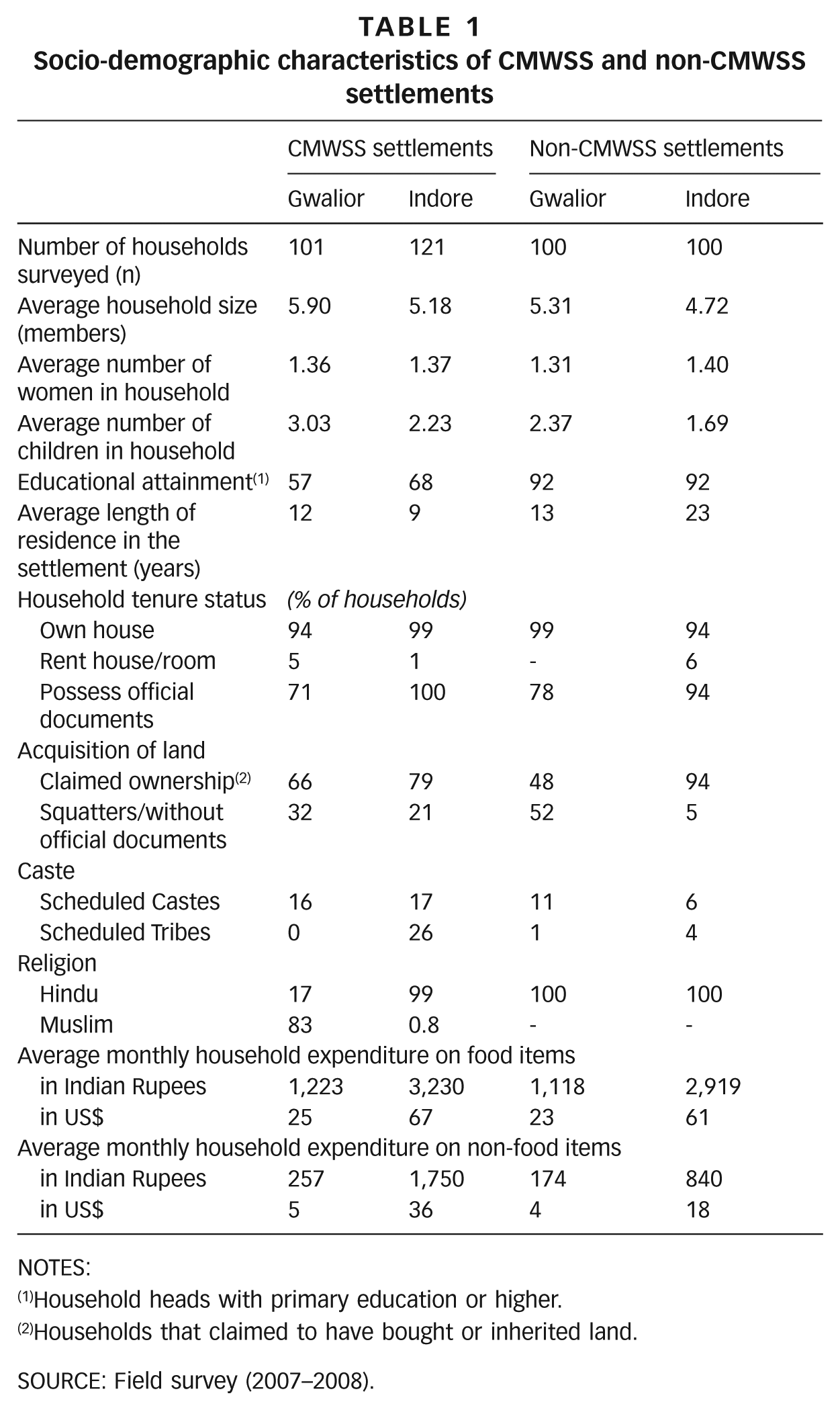
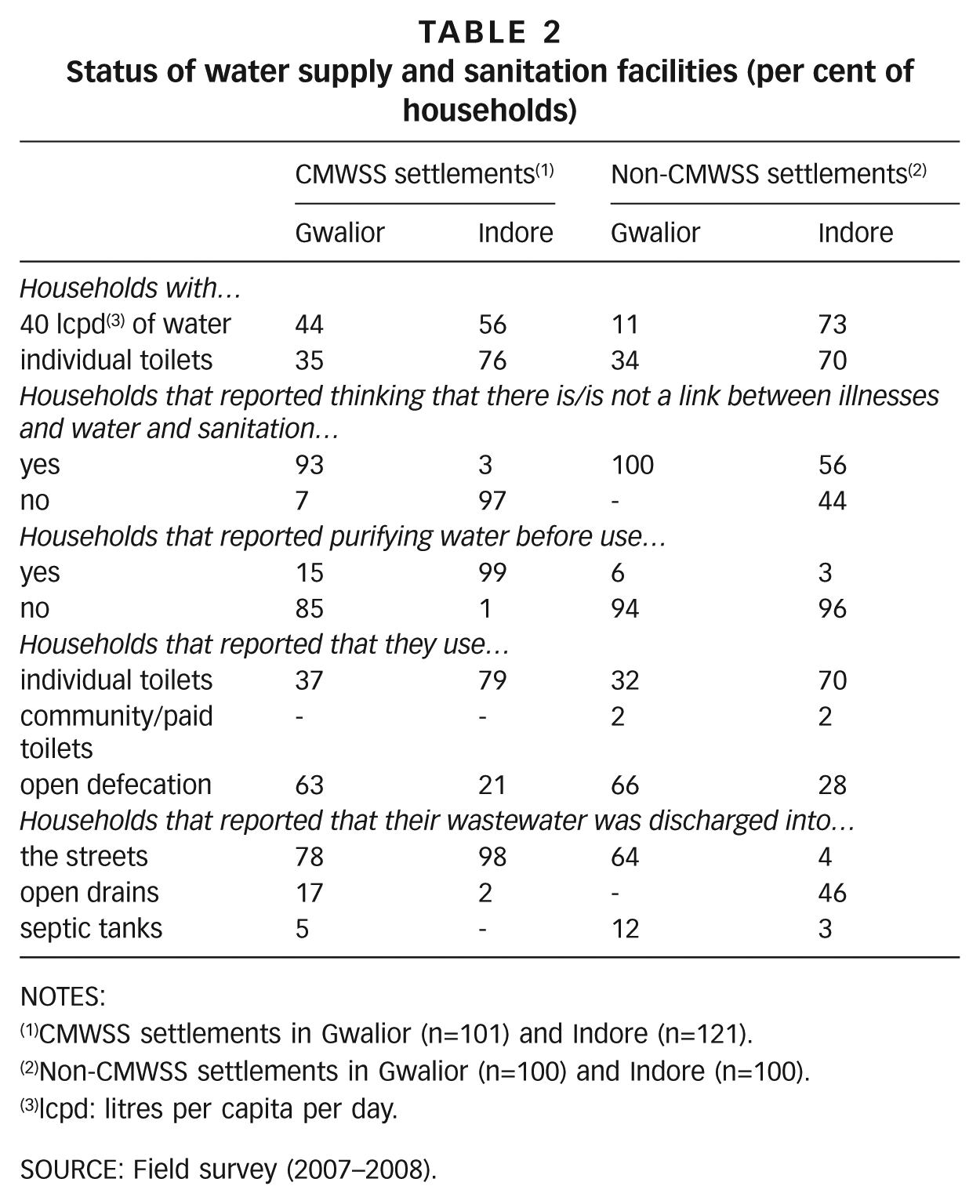
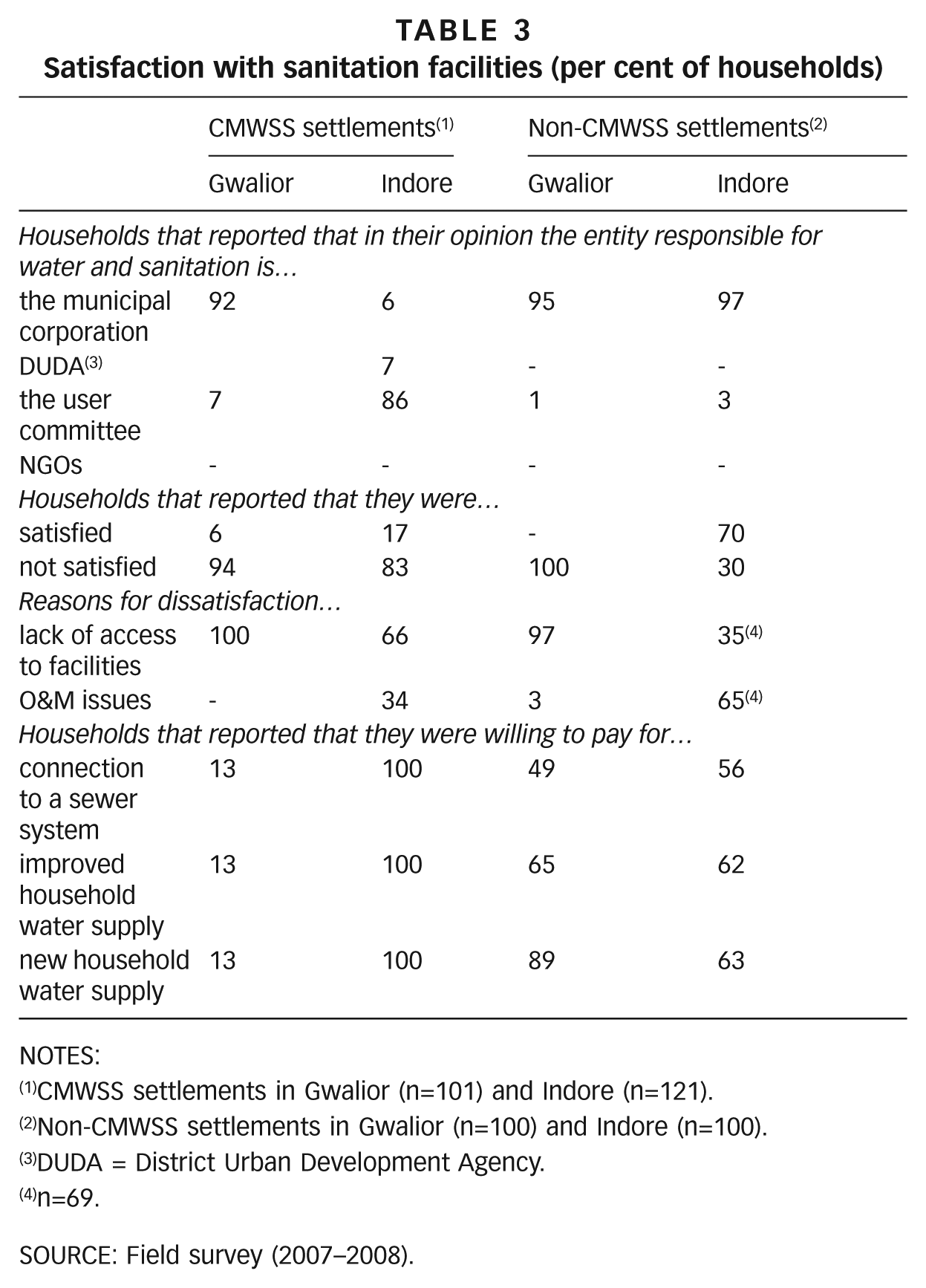
Gwalior is the fourth largest city in Madhya Pradesh, with a population of about 1 million.(39) In the late 1980s, its manufacturing sector gradually began to be replaced by commerce, which became its economic mainstay. The city is located close to tourist destinations such as Delhi, Agra, Orchha and Khajuraho, and tourism helps supports a growing service sector. Despite the availability of raw water, the city has a high rate of unaccounted-for water, resulting in erratic water supply. The three notified slums selected to receive the CMWSS and the CMSS were located in the hilly terrain of Gwalior about 5 kilometres from the city centre. Table 1 indicates that average household size in these settlements was 5.9 and average monthly household expenditure was approximately US$ 30.(40) Men mostly worked as daily wage labourers while women engaged in home-based work such as embroidery, tailoring, and making of incense sticks and toys, earning very low wages. 94 per cent of households reported residing in their own house, of which 66 per cent claimed to have bought or inherited the land, and 32 per cent were squatters with no official documents. Households reported an average length of residence of about 12 years. In recent years, however, there has been an influx of new residents who have settled on the hillside slopes. Prior to the project, households received water from public standpipes between 2 and 4 am. There were 6,000 households living below the poverty line,(41) of which about 1,500 were located on hillside slopes with no access to water sources. They reported purchasing water from households located at the bottom of the hill for Indian rupees (Rs.) 100 (US$ 1.61) per month. Sanitation and drainage were lacking. During a transect walk, women expressed concerns about the loss of dignity and being exposed to harassment and abuse when defecating in the open. Table 2 indicates that 63 per cent of the households surveyed in the Gwalior CMWSS settlements reported open defecation and only 37 per cent used individual household toilets. Municipal engineers pointed out that their location on rocky terrain did not support the provision of septic tanks or soak pits (soakaways) as a viable alternative to a sewer system. Similarly, household wastewater disposal posed a major problem in these settlements; 78 per cent of the households reported that wastewater from their homes flows directly into the streets. Overall, only 6 per cent of households reported being satisfied with the existing sanitation situation. The primary reason for their dissatisfaction was the lack of a proper sewerage system (Table 3).
Socio-demographic characteristics of CMWSS and non-CMWSS settlements
NOTES:
Household heads with primary education or higher.
Households that claimed to have bought or inherited land.
SOURCE: Field survey (2007–2008).
Status of water supply and sanitation facilities (per cent of households)
NOTES:
CMWSS settlements in Gwalior (n=101) and Indore (n=121).
Non-CMWSS settlements in Gwalior (n=100) and Indore (n=100).
lcpd: litres per capita per day.
SOURCE: Field survey (2007–2008).
Satisfaction with sanitation facilities (per cent of households)
NOTES:
CMWSS settlements in Gwalior (n=101) and Indore (n=121).
Non-CMWSS settlements in Gwalior (n=100) and Indore (n=100).
DUDA = District Urban Development Agency.
n=69.
SOURCE: Field survey (2007–2008).
Indore, with a population of about 2.1 million,(42) is one of the largest cities in Madhya Pradesh and among the fastest-growing cities in India. It is the commercial hub of the state and the presence of industries attracts migrants from across the country, contributing to its cultural and linguistic diversity. The flow of migrant workers into the city has, however, been accompanied by a proliferation of slum settlements. The city has a limited amount of available raw water. Its water supply involves transporting water from the Narmada River over 70 kilometres. The five notified slums selected to receive the CMWSS and later the CMSS sewerage project had about 1,200 households living below the poverty line. Table 1 indicates that average household size in these settlements was 5.18 and average monthly household expenditure was approximately US$ 103. Men mostly worked as daily wage labourers. Some men were employed in the public or private sector (clerks at the universities, security guards). Women were mostly unemployed. Some worked as vegetable vendors or as domestic help in neighbouring residential areas. 99 per cent of households surveyed reported residing in their own house, of which 79 per cent claimed to have bought or inherited the land, and 21 per cent were squatters with no official documents. Households reported an average length of residence of about nine years. They depended on private tube well owners for their water needs. Some reported collecting water from a shoe factory approximately 3 kilometres away. During the summer months, they purchased water from municipal tankers or private vendors. Table 2 indicates that 21 per cent of the households surveyed in the Indore CMWSS settlements reported open defecation and 79 per cent used their individual household toilets. 98 per cent reported that wastewater from their homes flowed directly into the streets (Photo 1 and Photo 2). Overall, only 17 per cent reported being satisfied with the existing sanitation situation. Reasons for their dissatisfaction were the lack of a sewerage system and O&M-related issues (Table 3).
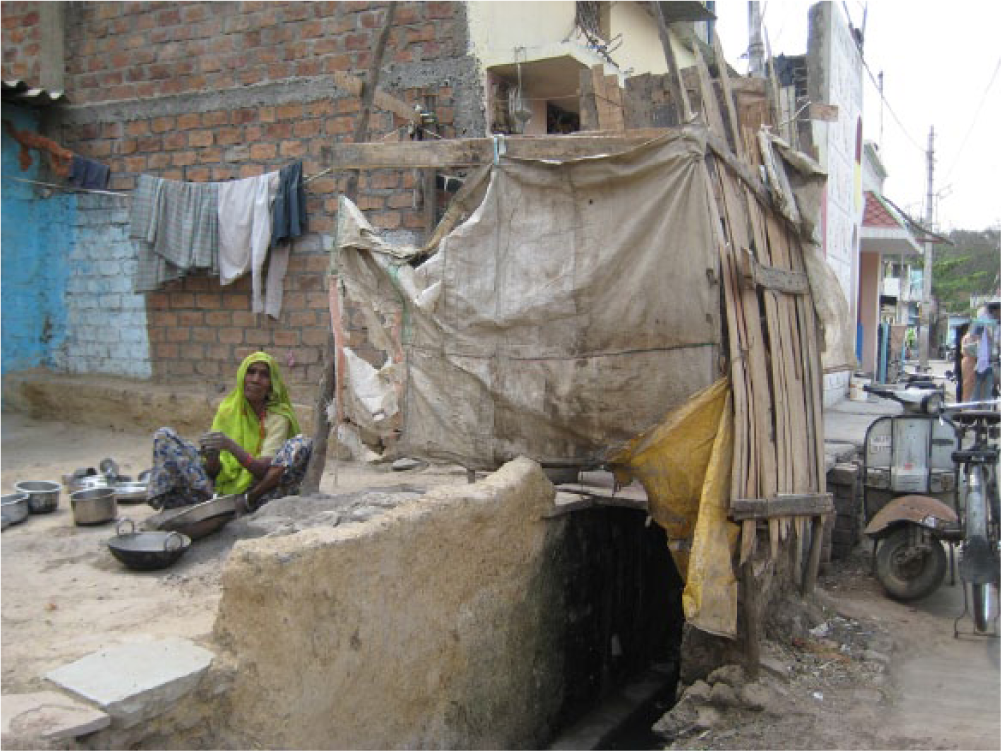
A makeshift toilet in a slum settlement in Sirpur, Indore
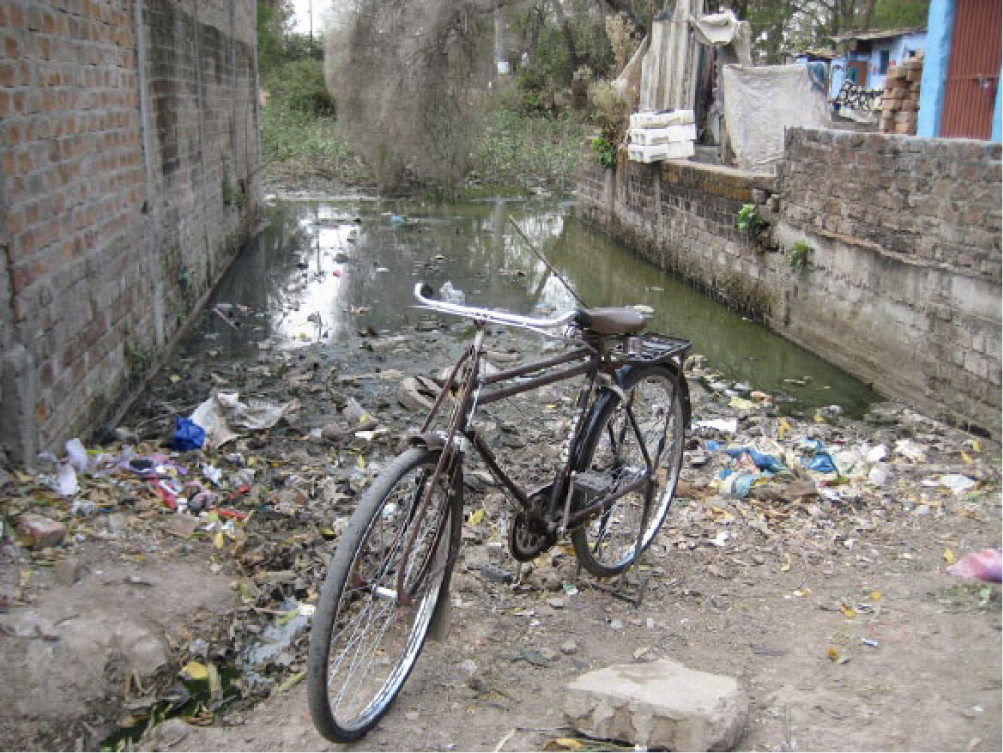
Stagnant water and garbage accumulation in a slum settlement in Sirpur, Indore
Survey data revealed that willingness to pay for basic services such as water and sanitation varied across the two cities. In Gwalior, 13 per cent of households surveyed in the CMWSS settlements reported that they were willing to pay for improved sanitation facilities as compared to 100 per cent in Indore (Table 3). Households in both cases reported that they were willing to pay between Rs. 25 and Rs. 100 (US$ 0.40–1.61) per month. Responses were similar in the two cities about willingness to pay for piped water supply. It is important to note, however, that the contingent valuation method to estimate willingness to pay for services in developing countries can be subject to biases that could affect reliability.(43) It is also interesting to note that in Gwalior, 93 per cent of households in the settlements that received the CMWSS reported that they believe there is a link between water and sanitation and illnesses as compared to only 3 per cent in Indore. A possible explanation for this difference could be that households in the Indore CMWSS settlements were referring to the relationship between illnesses and purified water since 99 per cent reported purifying water before use as compared to only 15 per cent in Gwalior (Table 2).
VI. The Community Managed Sewerage Scheme
a. Gwalior
In Gwalior, the CMSS aimed to connect 2,500 households to a sewerage system despite the challenging terrain. In some areas, sewer lines were laid along narrow alleys (only 2 metres wide in some cases) and then connected to the trunk (main) sewer of the city (Photo 3). The municipal corporation furnished technical assistance to the user committee for O&M. However, during fieldwork, it became evident that the user committee was already struggling to manage the water supply project when the municipal corporation began implementing the sewerage project, based on the same cost recovery model, without its consent. According to some committee members, they were assigned the responsibility of managing the sewerage system but had played no part in its planning or implementation. The municipal corporation had simply informed them about the project and pressured them to sign a memorandum of understanding according to which each household was expected to pay a connection charge of Rs. 500 (US$ 8.06 – in five monthly instalments of Rs. 100 [US$ 1.61]) and a monthly sewerage charge of Rs. 20 (US$ 0.32). The remaining funds for the system would come from the District Administration of the Government of Madhya Pradesh from the “participation scheme”. The upfront costs would be met with funds from UN-Habitat through a revolving sewer fund in partnership with the municipal corporation. As one committee member put it,
“We have no idea what is going on…the Nagar Nigam [municipal corporation] decided to put in the sewer lines and they brought in their own contractors. We were kept in the dark and…then…now we’re being dragged into it…now…the contractors are not ready to listen to us…” (Ramaji ka Pura, Gwalior, 2008)
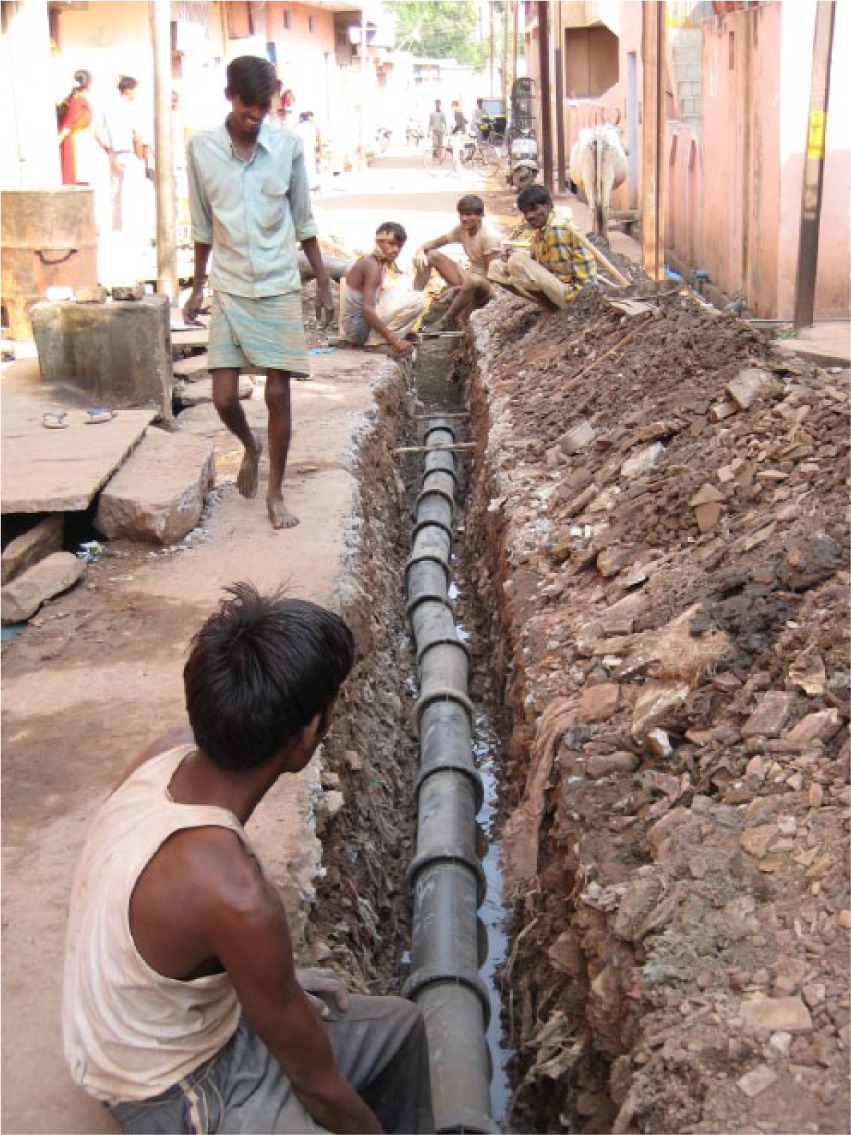
Laying of sewer pipe in Ramaji ka pura, Gwalior
Many of the households reported that they were unable to pay their monthly dues for water supply regularly. It was particularly difficult for them to make payments during festival season or family weddings when household expenses were higher than usual. They were, therefore, unsure about connecting to the proposed sewerage system given its upfront costs. This is not unexpected since they were of a low socioeconomic status. Most employed members of the households were daily wage labourers with fluctuating monthly incomes. Households reported that almost 83 per cent of their average monthly expenditure was on food, leaving them little flexibility to pay for basic services. At the same time, they pointed out that there were no connection or monthly user charges for the rest of the city, so they failed to understand why the municipal corporation was demanding payment from them for the same services. According to a committee member,
“Electricity bill is very high… so the monthly charges [for water supply] in Gwalior have been increased from Rs. 80 to Rs. 150 per month. For sewerage it is Rs. 500 for connection. Some households have taken a connection. There is no monthly charge yet. People are generally unwilling to take a connection…they are saying… that all over Gwalior… there is no connection charge…then why are you charging? But the sewer lines in those bastis [slum settlements] are government projects but this one is run by the committee…junta [the public] does not understand this…people are not educated…they are mostly labourers…” (Ramaji ka Pura, Gwalior, 2011)
Frequent disagreements among members of the user committee had pushed them to the verge of dissolution. Their differences were mostly related to financial compensation and time commitment to the project. Although serving on the committee was meant to be voluntary, some members demanded financial compensation because the opportunity costs for their participation in managing the projects was very high. Others, who relied on alternate means of employment, did not feel the need for compensation and considered it social service. Moreover, low cost recovery put the user committee under immense pressure as the paucity of funds for O&M made it impossible to keep the project running. Committee members generally lacked experience and the brief training that they had received from the municipal corporation did not appear to serve them well. During the initial phases of the CMWSS, a community development officer had been brought in by the Gwalior Municipal Corporation to help build its capacity to manage the project. However, after just two months, the officer quit on grounds of lack of resources and was never replaced. Relationships between the user committee and the local government were also frayed. When the user committee approached the municipal corporation for help, requesting it to disconnect households that were not paying for their existing municipal water supply so that they would take a CMWSS connection and become paying households, the municipal government declined. Instead, it transferred 300 of its existing connections to the user committee to manage along with the CMWSS connections. This not only left the user committee overwhelmed but also undermined its position in the partnership. Its role was reduced to that of cost recovery rather than decision-making. It was within this context that the community managed sewerage scheme was initiated.
Since the time of my visit in 2011, there have been new developments. The original committee had succumbed to micro-politics among some committee members who, instead of being motivated by the long-term benefits of the project, were lured by short-term financial gains. The committee had to be reconstituted as some members resigned. The newly formed committee was managing the water supply and sewerage projects with help from the municipal corporation. Households were now expected to pay a lump sum of Rs. 1,000 (US$ 16.11) to get their toilets built. The municipal corporation hired the contractors and bore the remaining cost of construction (Rs. 8,770 [US$ 141.28]). There were no monthly charges. According to a committee member, the committee had conducted a survey to assess demand three years prior to the project’s implementation. Only 200 households on the hillside slopes had been able to pay for toilets. The two main challenges they faced were affordability and an increase in the number of households. The capacity of the existing reservoir was no longer adequate to meet the new demand for water. Moreover, decreased rainfall had taken its toll on water supply and the committee received less bulk water from the municipal corporation, limiting household supply to once every other day. Consequently, households had begun complaining and harassing the committee, especially since their water tariff had increased from Rs. 80 to Rs. 150 (US$ 1.29 to 2.42) to meet O&M costs. The committee was under pressure and had requested the municipal government for permission to augment water supply by digging a bore well.
b. Indore
In Indore, the office bearers (president, secretary, treasurer) of the user committee had experience working on other externally funded projects. In the past, they had mobilized residents of their communities and taken them to the Collector’s office to demand services even prior to the CMWSS. They were, therefore, better positioned to manage the CMWSS and their success had boosted their confidence and kept them enthused.(44) When the municipal corporation proposed the sewerage project, they were ready to take on the added responsibility of managing it and became involved right from the start. They informed residents about the sewerage project at a meeting and conducted a door-to-door survey to assess demand for the project. They asked households if they were willing to pay for toilets. According to a committee member, almost all households connected to the CMWSS had agreed. There were a few exceptions but committee members were able to coax them to take connections. They had even waived sanctions for non-payment of water bills (Rs. 10 [US$ 0.16] for every month it is late) so that households had requisite funds to connect to the proposed sewerage project. A committee member described how connecting to the sewer system early could be beneficial for households:
“Just like for water…initially we collected Rs. 1000…sometimes in two instalments…but as the project progressed…we had to increase it [connection charges for water] and today a water connection is Rs. 2500 so it has doubled…so it will be a problem if they wait [to connect to the sewer system]…” (Shivnagar, Indore, 2011)
The committee’s success at cost recovery for the CMWSS had set a precedent and it had gradually strengthened its relationship with the local government. A committee member pointed out, “We will ask for one or two Nagar Nigam [municipal corporation] men to oversee the project…at least we will try and see what happens…the mahapour [mayor] is ours…all is good. We will keep Nagar Nigam employees…for cleaning…now no one comes here from the Nagar Nigam…we will ask the DUDA Collector sahib [sir] to help us figure out what to do…if they [Nagar Nigam] provide employees…we can pay their salaries from our collection money…if we take Rs. 10–15 from every household…” (Shivnagar, Indore, 2011)
The relatively higher socioeconomic status of the notified slums that had received the CMWSS played an important role in the project’s initial success in Indore. Cost recovery was high and the user committee was able to begin repaying its loan to the local government. Consequently, the local government took more interest in the committee and the committee, in turn, was able to demand more services (roads, lighting, sanitation and drainage). The user committee had also increased the connection charges for water supply from Rs. 1,000 to Rs. 2,500 (US$ 16.11 to 40.27) and the monthly charges from Rs. 60 to Rs. 70 (US$ 0.97 to 1.13) to help it meet O&M expenses and provide remuneration for the office bearers.(45) It was able to supply water every day instead of every other day, so most residents did not complain and reported being satisfied with the project. It is, therefore, not surprising that they were more willing to accept the sewerage project. My interviews with residents revealed a preference for individual toilets. A committee member corroborated this and stated,
“So far everyone has agreed to be connected. Some households that do not have space are even willing to get it [toilet] built on the upper floors…we are trying to convince households that it is better to get connected through this project…” (Shivnagar, Indore, 2011)
The user committee’s success with the CMWSS can also be attributed to the responsiveness of the District Urban Development Agency (DUDA),(46) which had stepped in for the municipal corporation. DUDA had assigned a community officer and staff to the project for necessary support. Frequent interactions with DUDA staff kept the user committee motivated. In the committee’s view, this was an opportunity for it to build a lasting relationship with those in higher decision-making structures so that it could leverage its demands for services. The presence of the community officer made up, to some extent, for the absence of an intermediary organization to mobilize the communities. The community officer acted as a champion, linking the user committee with the local government and providing the committee with information about government resources in the process – an asset that Gwalior lacked.
VII. The Way Forward: Lessons from the CMSS
Community management has become emblematic of water and sanitation projects for the urban poor in India. While it is well intentioned and some projects have achieved a decent measure of success, there are caveats. The most important one relates to the readiness of the urban poor to manage such projects. Table 3 indicates, for instance, that the project settlements in Gwalior continued to rely on the local government for basic services despite electing a user committee; 92 per cent of the households that benefitted from the project in Gwalior reported that the municipal corporation is responsible for resolving water and sanitation-related problems as compared to only 6 per cent in Indore, where a majority of households reported that the user committee is responsible. Overall, the cross-case analysis highlights important findings.
First, the socioeconomic status of households was closely associated with uptake and ability to pay for improved sanitation facilities. For instance, in Indore, households in the notified slums that had benefitted from the water supply project were better off economically,(47) allowing the user committee to garner support for the sewerage project. In Gwalior, by contrast, households were under constant pressure to secure their livelihoods and their weak socioeconomic status made it difficult for them to pay for basic services. Even committee members found it increasingly difficult to balance their responsibility for managing the project with that of generating income to support their households. Although community-based sanitation programmes such as Community-Led Total Sanitation (CLTS) have enjoyed success in rural settings, the complexities of urban areas are often not conducive to such programmes and call for a deeper understanding of the spatial and demographic makeup of informal settlements.(48) During the time of data collection, the sewerage projects were in their implementation stages. The benefits derived from improved sanitation facilities in the settlements in Indore remain to be seen and will be the basis for future research.
Second, in both cases, the user committee was responsible for mobilizing the communities and spurring a demand for the sewerage project, particularly in the absence of an intermediary organization (non-governmental or community-based). The capacity of the user committee and its relationship with the local government, therefore, played a key role. In Indore, the committee had tasted success in managing the CMWSS and appeared confident about taking on the sewerage project. It felt comfortable interacting with government officials and had, over the years, strengthened its relationship with them by demonstrating its capacity to manage the water supply project. This had allowed the local government to play the role of facilitator. In Gwalior, by contrast, the user committee’s contentious relationship with the local government had made it difficult for the committee to manage the CMWSS and it was not quite ready to take on more responsibilities. This is also tied to its weak socioeconomic status, which did not afford the committee members much time to volunteer in the user committee.
Third, the sewerage projects were premised on a cost recovery model similar to that of the CMWSS. In both cases, therefore, recovering costs became the defining criterion for success. Without the support of intermediary organizations, the user committee was generally ill equipped to ignite change in sanitation behaviour for long-term effects. It is quite well established in the literature that efforts to improve sanitation facilities are intricately linked to sanitation behaviour. In fact, this has become the basis for the success of the CLTS in rural areas.(49) In the Madyha Pradesh case, however, the focus was still on building individual toilets rather than considering a range of options tailored to households of different socioeconomic status. Despite being registered as the Community Water and Sanitation Committee (CWASC) under the Madhya Pradesh Society Act of 1973, the user committees’ training covered contracting procedures, supervision of works, accounting and bookkeeping, plumbing and engineering skills, and billing and collection mechanisms for the CMWSS. It did not encompass creating demand for sanitation (by discussing the associated benefits), which is a more difficult and time-consuming endeavour.
Finally, the demand-driven approach meant that the settlements selected to receive sewerage projects were not necessarily the ones that faced dire conditions but rather those where households could pay for services. Since households were already paying for water through the CMWSS, the assumption was that they would be willing to pay for sanitation facilities. From the technical standpoint, given the challenges of on-site sanitation in urban areas where there is a lack of space, the decision of the local government to connect the notified slums that had received the CMWSS to sewerage systems appears to be sound since water supply is a prerequisite for any sanitation facility. Yet it falls short by not taking into proper consideration the socio-demographic profiles of the populations being served. Although the selection of the notified slums that received the CMWSS was based on a citywide poverty pocket situation analysis, demand for water and sanitation can vary across poverty pockets and even within each settlement. Moreover, for sanitation improvements, unless all households are targeted, the outcomes might not be as effective, particularly in meeting the MDG target. Where cost recovery is the key driver for community-managed sanitation projects, the goal of universal service provision becomes elusive. For instance, if open defecation persists due to the inability of some households to pay for sewerage connections, it can undermine the long-term public benefits of improved sanitation.(50) At the same time, it raises questions about equity – what options would households that are less willing to pay, such as renters or newcomers, have?
VIII. Conclusions
In this study, I explored the status of sanitation in informal settlements in two cities in central India, with particular focus on community-managed sewerage projects. Three key insights emerged from the findings.
First, the findings provoke a re-examination of the efficacy of an instrumental understanding of community-managed water and sanitation and resonate with what others have pointed out about the importance of considering the complexities of urban poverty if sanitation needs are to be properly aligned with policy and programme interventions.(51) The user committees in Gwalior and Indore were consumed by efforts to recover costs to help them meet their O&M expenses. This meant that the ability of households to pay for access to water and sanitation services played a key role in these projects – without demand there could be no project. However, given the insecurities (tenure, income, employment and so on) associated with such households, demand can fluctuate. For instance, in Gwalior, the user committee had assessed demand for the sewerage project three years prior to the system becoming operational. Since then new residents had moved in, some households had already built their toilets, and demand for water supply had increased. On the other hand, other households that had been willing to pay were now unable to pay. The user committee did not have the capacity to handle such changes in demand. This clearly indicates that poor communities are far from homogeneous and not all might be willing and able to undertake the management of their water and sanitation services. The opportunity costs of managing such projects are very high for the urban poor, who struggle to secure livelihoods.(52) Moreover, although women stand to benefit immensely from improved sanitation facilities, their participation is often difficult given their domestic and productive workloads.(53) Implementing such projects, therefore, warrants a more thorough analysis of socioeconomic status, keeping in mind that demand for water supply might not always dovetail with demand for sanitation where affordability remains a thorny issue.
Second, the absence of NGOs to mobilize the communities and liaise between the user committee and the municipal corporation was conspicuous in both cases. The project’s success was contingent on the capacity of the user committee since the local government had retreated to the role of a facilitator. However, it is important to acknowledge the socio-political complexity within local communities, which could be prone to elite capture or undemocratic decision-making, underscoring the need for local governments to be more responsive. Moreover, without champions within government agencies, user committees become isolated, making it difficult for them to form linkages with larger decision-making structures to catalyse change in the broader context. The user committees in both cases focused largely on cost recovery and O&M. They appeared to be less concerned about who had access or how they could nudge households toward changing their sanitation behaviour. If behavioural change is to be the leitmotif, the role of NGOs merits closer scrutiny. There were local NGOs with expertise in this area that had been recruited by WaterAid in other externally funded projects in these cities. Their involvement in creating awareness about sanitation behaviour and the benefits (private and public) associated with improvements could have had more far-reaching effects. Many a successful project has benefited from support by intermediary organizations. For instance, NGOs like the OPP and the Indian Alliance provide an enabling environment so that communities can take charge of sanitary initiatives.(54) In this case, however, the role of the user committee, particularly in Gwalior, was reduced to “stretching” –acting as a contractor or extension agency that performs a service for a fee– as opposed to “deepening” –organizing citizens to act collectively in support of a particular project and mobilize resources.(55)
Third, the demand-driven approach tended to exclude households that were unable to pay connection and monthly charges, and yet these are precisely the households that need assistance. Differentiated levels of service and tariffs, including government assistance in the form of subsidies for the lowest income bracket (a “triage” approach with exemptions for those with severe resource constraints), could benefit poorer households, renters or newcomers to the settlements. They could gradually move up the sanitation ladder rather than being faced with outright exclusion based on socioeconomic status.(56) This is paramount if the goal is to close the gap in universal sanitation coverage and reap both the private and public benefits of improved sanitation. In urban areas, infrastructural investment will need to go hand in hand with behavioural change as poorer households cannot afford to build sanitation facilities without assistance due to the high costs and skills required, the scarcity of land, and the complex process of securing relevant permits.(57) Moreover, despite efforts to promote co-production between poor communities and the state, a cornerstone of participatory planning that can be particularly effective in the delivery of collective consumption goods such as sewer systems,(58) it is important to note that project outcomes can vary considerably based on the capacity of the user committee and of the state to engage directly with poor communities.(59) Overall, however, the road to the future is paved with good intentions, and policies such as the NUSP, which supports innovation not just with technology but also with institutional arrangements, could provide fertile territory for experiments to improve basic sanitation for the urban poor.
Footnotes
1.
United Nations, Department of Economic and Social Affairs, Population Division (2014), World Urbanization Prospects: The 2014 Revision, Highlights (ST/ESA/SER.A/352).
2.
 , Progress on Drinking Water and Sanitation – Special Focus on Sanitation, Joint Monitoring Programme for Water Supply and Sanitation, Geneva. In March 2013, the Deputy Secretary-General of the United Nations issued a Call to Action on Sanitation by improving hygiene, changing social norms, and eliminating the practice of open defecation by 2025.
3.
See reference 2, page 22.
4.
Elledge, Myles F and Marcella McClatchey (2013), India, Urban Sanitation, and the Toilet Challenge, Research Brief, RTI Press, 4 pages.
5.
Ministry of Urban Development, Government of India (2008), National Urban Sanitation Policy, page 7, accessed 12 January 2015 at .
7.
See reference 4, page 2.
8.
McFarlane, Colin, Renu Desai and Steve Graham (2014), “Informal urban sanitation: everyday life, poverty, and comparison”, Annals of the Association of American Geographers Vol 104, No 5, pages 989–1011; also Chaplin, Susan E (2011), “Indian cities, sanitation, and the state: the politics of the failure to provide”, Environment and Urbanization Vol 23, No 1, pages 57–70; McFarlane, Colin (2008), “Sanitation in Mumbai’s informal settlements: state, “slum,” and infrastructure”, Environment and Planning A Vol 40, pages 88–107; Burra, Sunder, Sheela Patel and Thomas Kerr (2003), “Community-designed, built and managed toilet blocks in Indian cities”, Environment and Urbanization Vol 15, No 2, pages 11–32; and Bapat, Meera and Indu Agarwal (2003), “Our needs, our priorities: women and men from the slums in Mumbai and Pune talk about their needs for water and sanitation”, Environment and Urbanization Vol 15, No 2, pages 71–86.
10.
The 74th Constitutional Amendment Act states that Urban Local Bodies (ULBs) are responsible for the operations and maintenance (O&M) of urban water supply for domestic, industrial, and commercial purposes and their functions are outlined in the Twelfth Schedule of the Constitution.
11.
Bardhan, Pranab (2002), “Decentralization of governance and development”, Journal of Economic Perspectives Vol 16, No 4, pages 185–205; also Crook, Richard and James Manor (1998), Enhancing Participation and Institutional Performance: Democratic Decentralization in South Asia and West Africa, Overseas Development Administration, London; and Rondinelli, Dennis (1999), “What is decentralization?”, in Litvack, Jenny and Jessica Seddon (editors), Decentralization Briefing Notes, World Bank Institute working paper, World Bank, Washington, DC.
12.
Marks, Sara and Jennifer Davis (2012), “Does user participation lead to sense of ownership of rural water systems? Evidence from Kenya”, World Development Vol 40, No 8, pages 1569–1576; also Nance, Earthea and Leonard Ortolano (2007), “Community participation in urban sanitation: Experiences in northeastern Brazil”, Journal of Planning Education and Research Vol 26, No 3, pages 284–302.
13.
Jenkins, Marion W and Steven Sugden (2006), Rethinking Sanitation: Lessons and Innovation For Sustainability and Success in the New Millennium, Human Development Report Office occasional paper, United Nations Development Programme, New York.
14.
Mehta, Meera and Andreas Knapp (2004), The Challenge of Financing Sanitation for Meeting the Millennium Development Goals, Paper commissioned by the Norwegian Ministry of the Environment, 32 pages.
15.
Cairncross, Sandy (2004), The Case for Marketing Sanitation, Water and Sanitation Program field note, World Bank, Nairobi, 12 pages; also Black, Maggie and Ben Fawcett (2008), The Last Taboo: Opening the Door on the Global Sanitation Crisis, Earthscan, London, 254 pages.
16.
Murray, Ashley and Isha Ray (2010), “Commentary: back-end users: the unrecognized stakeholders in demand-driven sanitation”, Journal of Planning Education and Research Vol 30, No 1, pages 94–102.
18.
Jaglin, Sylvy (2008), “Differentiating networked services in Cape Town: echoes of splintering urbanism?”, Geoforum Vol 39, pages 1897–1906.
19.
Joshi, Deepa, Ben Fawcett and Fouzia Mannan (2011), “Health, hygiene and appropriate sanitation: experiences and perceptions of the urban poor”, Environment and Urbanization Vol 23, No 1, pages 91–111; also Verhagen, Joep and Peter Ryan (2008), “Sanitation services for the urban poor”, Background paper for the Symposium on Sanitation for the Urban Poor – Partnerships and Governance, IRC, Delft, 19–21 November.
20.
see reference 19, Joshi et al. (2011); also Satterthwaite, David and Diana Mitlin (2014), Reducing Urban Poverty in the Global South, Routledge, New York, 301 pages.
21.
Mehta, Lyla, Fiona Marshall, Andy Stirling, Esha Shah, Adrian Smith, John Thompson and Synne Movik (2007), Liquid Dynamics: Challenges for Sustainability in Water and Sanitation, STEPS Working Paper 6, STEPS Centre, Brighton, 26 pages.
23.
24.
Evans, Barbara (2005), Securing Sanitation – The Compelling Case to Address the Crisis, Stockholm International Water Institute and World Health Organization, Stockholm, 40 pages.
26.
Bond, Patrick (2002), Unsustainable South Africa: Environment, Development and Social Protest, University of Natal Press, Scottsville, 449 pages.
27.
Sansom, Kevin (2011), “Complementary roles? NGO–government relations for community-based sanitation in South Asia”, Public Administration and Development Vol 31, No 4, pages 282–293.
28.
Hasan, Arif (2006), “Orangi Pilot Project: the expansion of work beyond Orangi and the mapping of informal settlements and infrastructure”, Environment and Urbanization Vol 18, No 2, pages 451–480; also Hasan, Arif (2008), “Financing the sanitation programme of the Orangi Pilot Project—Research and Training Institute in Pakistan”, Environment and Urbanization Vol 20, No 1, pages 109–119.
29.
The Water for Asian Cities Program promotes pro-poor governance, water demand management, increased attention to environmental sanitation, and income-generating opportunities for the poor through improved water supply and sanitation. It aims to bring the poor to the forefront of service provision by encouraging their participation. See , Proceedings of the Workshop on Pro-Poor Water and Sanitation Governance, 18–19 March, Bhopal.
30.
Government of India (2012), Office of the Registrar General & Census Commissioner, India, Availability and Type of Latrine Facility 2001-2011, Data Product No. 00-019-2011-Cen-Data Sheet (E), accessed 20 August 2014 at .
31.
WaterAid (2005), Drinking Water and Sanitation in Madhya Pradesh: A Profile of the State, Institutions, and Policy Environment, WaterAid India, New Delhi, page 42. On 6 September 2013, the Indian Parliament passed The Prohibition of Employment as Manual Scavengers and Their Rehabilitation Act, 2013. On 27 March 2014, the Indian Supreme Court held that India’s Constitution requires state intervention to end manual scavenging and “rehabilitate” all people engaged in the practice. However, a report by Human Rights Watch in March 2014 indicates that the practice continues despite legislative and policy efforts by the government of India. Human Rights Watch (2014), Cleaning Human Waste: Manual Scavenging, Caste and Discrimination in India, accessed 16 February 2015 at .
32.
A municipal corporation is a local government body typically operating in an Indian city with a population of 1 million.
33.
Pilot projects for the “open defecation free slums” were well received and one of the 16 selected slums was even nominated for the National Urban Water Awards in 2009. See Sadhukhan, Bedoshruti, Ritu Thakur and Soumya Chaturvedula (2012), “Access sanitation case study”, accessed 13 November 2014 at .
34.
The user committee called the Community Water and Sanitation Committee (CWASC) was registered under the 1973 Society Registration Act of Madhya Pradesh.
36.
Data for the poverty pocket situation analysis were gathered through interviews with key informants and group discussions in poverty pockets of selected cities and resulted in a Municipal Action Plan for Poverty Reduction. See , UN-Habitat Report on Poverty Mapping: A Situation Analysis of Poverty Zones in Gwalior and UN-Habitat Report on Poverty Mapping: A Situation Analysis of Poverty Zones in Indore.
37.
Notified slums refer to slums that have received notification from the concerned local government agency making them eligible for basic services such as water and sanitation. The term “slum” usually has derogatory connotations and can suggest that a settlement needs replacement or can legitimate the eviction of its residents. However, it is a difficult term to avoid for at least three reasons. First, some networks of neighbourhood organizations choose to identify themselves with a positive use of the term, partly to neutralize these negative connotations; one of the most successful is the National Slum Dwellers Federation in India. Second, the only global estimates for housing deficiencies, collected by the United Nations, are for what they term “slums”. And third, in some nations, there are advantages for residents of informal settlements if their settlement is recognized officially as a “slum”; indeed, the residents may lobby to get their settlement classified as a “notified slum”. Where the term is used in this journal, it refers to settlements characterized by at least some of the following features: a lack of formal recognition on the part of local government of the settlement and its residents; the absence of secure tenure for residents; inadequacies in provision for infrastructure and services; overcrowded and sub-standard dwellings; and location on land less than suitable for occupation. For a discussion of more precise ways to classify the range of housing sub-markets through which those with limited incomes buy, rent or build accommodation, see Environment and Urbanization Vol 1, No 2 (1989), available at .
38.
Gwalior Municipal Corporation (n.d.), “Community managed sewerage scheme in Gwalior”, accessed 12 January 2015 at http://mirror.unhabitat.org/pmss/getElectronicVersion.aspx?nr=3241&alt=1.
39.
40.
It is difficult to accurately measure income in slum settlements since most households do not have a steady income and depend on daily wages. Monthly household expenditure was, therefore, used as a proxy for household income and overall economic status. The total monthly expenditure for food and non-food items was calculated. Non-food items included clothing, medical care, educational supplies, utility bills, social and religious obligations, and interest on loans.
41.
Below Poverty Line (BPL) is a poverty threshold that is used in India. The Planning Commission recently revised the threshold to Rs. 858.60 (US$ 13.83 as of January 2015) monthly or Rs. 28.35 (US$ 0.46) daily for urban areas and Rs. 672.80 (US$ 10.83) monthly or Rs. 22.42 (US$ 0.36) daily for rural areas. Households that qualify as BPL households are eligible to receive government assistance through various programmes. See The Hindu (2012), “Now, Planning Commission lowers the poverty line” (n.d.), 20 March, accessed 8 October 2012 at .
42.
See reference 39.
43.
Studies have stated that contingent valuation surveys can yield valuable results when designed and administered well. See, for instance, Whittington, Dale, Marc Jeuland, Kate Barker and Yvonne Yuen (2012), “Setting priorities, targeting subsidies among water, sanitation, and preventive health interventions in developing countries”, World Development Vol 40, No 8, pages 1546–1568.
44.
Das, Priyam (2014), “Women’s participation in community-level water governance: the gap between motivation and ability”, World Development Vol 64, pages 206–218.
45.
The CWASC office bearers received between Rs. 1,500 and Rs. 2,000 (US$ 24.16–32.22) per month for managing the project. Although the project documents indicate that participation in the CWASC is voluntary, the committee in Indore provided remuneration to the office bearers.
46.
The DUDA facilitates the disbursement of funds from the state to the district or city level and monitors funding allocations. It also benefits from having in-house community officers who are assigned to work on various projects along with other staff.
47.
During my interviews, some households reported connecting to the CMWSS and retaining their previous supply as a backup since the project was new and, therefore, unreliable.
48.
See reference 8, all authors; also see reference 19, all authors; McGranahan, Gordon (2013), Community-Driven Sanitation Improvement in Deprived Urban Neighborhoods, SHARE research report, London School of Hygiene and Tropical Medicine; O’Reilly, Kathleen (2010), “Combining sanitation and women’s participation in water supply”, Development in Practice Vol 20, No 10, pages 45–56; and Das, Priyam and Lois M Takahashi (2014), “Non-participation of low-income households in community-managed water supply projects in India: the influence of economic and social status”, International Development Planning Review Vol 36, No 3, pages 265–291.
49.
Kar, Kamal and Robert Chambers (2008), Handbook on Community-led Total Sanitation, Institute of Development Studies at the University of Sussex and Plan UK, 51 pages. There are also drawbacks of CLTS such as over-reliance on targets, flawed reward systems, and exclusion of the poorest and marginalized segments of a community. See Mehta, Lyla (2010), “Introduction”, in L Mehta and S Movik (editors), Shit Matters: The Potential of Community-Led Total Sanitation, Practical Action.
50.
See reference 13.
53.
See reference 44.
54.
See reference 20, Satterthwaite and Mitlin (2014); also see reference 48, .
55.
Krishna, Anirudh (2003), “Partnerships between local governments and community-based organizations: exploring the scope for synergy”, Public Administration and Development Vol 23, pages 361–371.
56.
59.
Disadvantaged groups have faced eviction and resettlement and, in recent years, have had to compete with the burgeoning middle class for basic services. See Benjamin, Solomon (2000), “Governance, economic settings and poverty in Bangalore”, Environment and Urbanization Vol 12, No 1, pages 35–56; also Bhan, Gautam (2009), “‘This is no longer the city I knew’. Evictions, the urban poor and the right to the city in millennial Delhi”, Environment and Urbanization Vol 21, No 1, pages 127–142; and Ghertner, Asher (2008), “Analysis of new legal discourse behind Delhi’s slum demolitions”, Economic and Political Weekly Vol 43, No 20, pages 57–66.