




Abstract
This paper describes how lack of access to adequate sanitation facilities affects the lives of adolescent girls in urban poor India. It draws specifically on the experiences of four adolescent girls, each living in one of four settlements in Bengaluru, India, and conversations with a larger group of girls. Findings reveal that where sanitation facilities are sorely lacking, adolescent girls face many deprivations (education, free time, privacy and independent mobility) and risks (sexual harassment and assault, health risks, etc.), and that this inadequacy can be a structural pathway for cyclical gender-based disempowerment and injustice.
Keywords
I. Introduction
While urban sanitation is gaining ground, city governments are still faced with huge challenges when it comes to providing all their citizens with adequate sanitation facilities. The absence of services puts inhabitants at risk, and in particular women and children in urban poor families, who are most affected physically, psychologically, socially and economically. Many studies have highlighted the health and non-health impacts of sanitation on urban poor women,(1) but few have focused on the specific situation and needs of adolescent girls. This article describes the personal experiences of four girls, each living in one of four settlements in Bengaluru (earlier known as Bangalore) that are at various stages of the urban redevelopment trajectory. Their experience illustrates how lack of access to safe and well-maintained sanitation facilities can contribute to many deprivations (education, free time, privacy, independent mobility) and risks (sexual harassment, assault and health risks), which can be a structural pathway for cyclical gender-based disempowerment and injustice.
This paper draws from recent research conducted in the Indian cities of Mumbai and Bengaluru in collaboration with the Alliance, a partnership of three organizations (the National Slum Dwellers Federation, Mahila Milan, and the Society for Promotion of Area Resource Centers – SPARC). The Alliance has worked over the last 25 years in over 70 cities and towns to empower the urban poor to recognize, demand and gain their rights to the city.
II. Background
a. State of sanitation in urban India
Recent reports have shown that in India, 597 million people, or 48 per cent of the total population, practise open defecation.(2) While open defecation is more prevalent in rural areas, it is much more concentrated in urban areas, particularly in urban poor settlements where residents live in close quarters and sanitation facilities are severely lacking. In rural areas, underground sewers are almost nonexistent; urban areas are only marginally better. A recent report shows that only 6 per cent of India’s cities have a partial sewerage network, fewer than 20 per cent of roads have storm water drains,(3) and 86 per cent of waste water is left untreated and often ends up polluting natural resources and highly populated urban environments.(4)
In urban areas in the state of Karnataka, where Bengaluru is the capital city, 84.9 per cent are said to have access to improved sanitation,(5) 4.4 per cent of the population use public toilets, 10.7 per cent defecate in the open, and 2.9 per cent use unimproved sanitation facilities.(6) Less than a third of the Bengaluru metropolitan area is served with underground drains or sewerage networks; the existing system is a hundred years old and it leaks, causing groundwater contamination and polluting water pipelines.
In the settlements I visited, “improved sanitation” did not necessarily mean that residents were not exposed to human waste. For example, in one settlement with no drainage facilities, while half of the residents had private pit latrines, the pits often overflowed, exposing children and adults to foul-smelling dangerous faecal matter. In another redeveloped settlement where large sums had gone into planning and rebuilding, for almost four years residents had to deal with overflowing waste, as drainage pipes were unable to handle the volume of waste generated. In addition, all of the public toilets and community toilets I visited, in spite of being pay-and-use, were poorly maintained, had limited water supply, and often had faeces lying around.
In a newly redeveloped settlement, water shortages combined with multi-storey living meant women and adolescent girls had to carry pots of water up several flights of stairs to use the private toilets within homes. Some families living on upper floors preferred to use the public toilets close to their settlement. These examples show that sanitation facilities in any given settlement are in flux, heterogeneous and site specific, and the state of sanitation in most urban areas is likely to be more grim than census-level data will have us believe.
Access to municipal services in Indian cities is manipulated by the middle and upper classes of society. The poor are often left off the grid and have to resort to using their meagre resources to scrounge for water and sanitation facilities, often at a much higher cost than is faced by the rich.(7) The urban poor who do manage to secure some services often live in “recognized”(8) settlements whose leaders have some political clout. The most needy of the urban poor are usually the most invisible and live in “unrecognized” settlements where access to water and sanitation facilities is most severely lacking; these settlements are also most vulnerable to forced evictions.
The state has done little in terms of policy to reach out to those most in need, by developing and promoting sustainable low-cost sanitation options, or looking at innovative land tenure possibilities that could spur residents to invest in water and sanitation facilities. Instead, in schemes (such as JNNURM(9)) – where hundreds of millions of US dollars have been spent – sanitation facilities are bundled with urban housing redevelopment, where the dominant practice is to raze ground-level dwellings and build multilevel housing, often at great social and economic costs to the poor.(10)
Where settlement upgrading is concerned, the poor are often used as vote banks to gain political power and in return are promised access to facilities that either never materialize or are substandard in quality.(11)
Some success stories that have emerged and gone to scale are efforts by grassroots organizations like the Alliance. Through grounded methods and practices, members of the Alliance, in partnership with urban poor communities, have been able to plan, design and build toilets that work and to set precedents that influence urban policies at the state and national levels.(12)
Often sanitation facilities lie at the very core of the needs of women and adolescent girls for leading better lives. While women have gained some voice in these matters, the needs of adolescent girls remain largely in the shadows and are often extrapolated from the needs of women.
b. The adolescent girl
Adolescence is a challenging time for girls in any part of the world. In supportive environments where family and community provide girls with the social and psychological support they need to cope with the changes they experience within and around themselves, this phase of life is easily negotiated. However, in urban poor environments, living conditions are often crowded and unsanitary, social relations can be fraught with tension over making ends meet, and parents are often faced with the challenge of upholding cultural values and practices in the face of a rapidly changing social and economic environment. Here, adolescence, especially for girls, can be a difficult time.(13)
Adolescence in India is shaped by gender, caste, religion and class. As young girls enter this defining phase of their lives, they experience biological/physiological and psychological changes, and are subject to socio-cultural restrictions that define their outlook on life, behaviour, and how they perceive themselves. In many parts of India menarche is an event that labels girls as “grown up”; this usually means they are no longer treated as children, and are prepared to be wives and mothers. In contrast, boys have the freedom to remain “children” until they are young adults and are encouraged to explore social and economic opportunities.(14)
The advent of menstruation is a very significant event in both Hindu and Muslim cultures, marked by traditional and family-based rules and regulations that have a major influence on the independent mobility and behaviour of adolescent girls. While the event is shrouded in traditional dos and don’ts, the actual biological process is rarely explained to young girls. A “culture of silence” surrounds the event.(15) The restrictions placed on adolescent girls include “not going outside the house by themselves”, “not speaking to boys or men”, and “not wasting time chatting with friends”.
The disadvantages that girls face are evident in the statistics. In India, sex-selective abortions and gender discrimination practices have resulted in a child sex ratio of 914 girls per 1,000 boys. Girls are breastfed less often and for fewer years, are given less food, are often taken out of school to help with domestic chores, and soon take on the burdens of being a wife and a mother. One-third of all adolescent girls in India drop out of school. 56 per cent suffer from anaemia and 45 per cent are stunted.(16) As a result they are often unable to concentrate at school or at work, which reduces their capacity to learn or earn a living. These practices also increase the risk of maternal morbidity, and cause problems in reproductive and child health.(17)
The socialization of boys and girls is vastly different. Boys have access to pornography, sport a sexual slang vocabulary, and have knowledge of and experiment with premarital sex but will not accept a wife who is not a virgin. Girls, on the other hand, are shy to talk, blame themselves for the advances by boys even when they are harassment, and strongly believe in the ideals of “purity” and virginity.(18)
A study exploring adolescent girls’ perspectives on urban neighbourhoods as social spaces found they perceived the space outside their homes as imposing gendered constraints and, while accepting restrictions imposed by adults, they longed for more freedom and opportunities to voice their opinions.(19)
Given these discriminatory gender practices, it is vital to respond to some of the physiological changes that happen during adolescence in girls. Providing girls with additional nutrients at this time can take advantage of growth spurts to make up for childhood stunting,(20) and developing supportive social and physical environments can prevent their exposure to health and social threats that can have long-lasting impacts.
III. Research study
This article draws upon my dissertation research, which examined the role of common spaces(21) in the lives of families living in eight urban poor communities in Bengaluru and Mumbai. Data were collected through home-based interviews with families and walking tours with groups of women and children separately. Members of 12 families were interviewed in each settlement. The population data and data with regard to water and sanitation provision in each settlement were drawn from interviews with settlement leaders and from settlement surveys conducted by SPARC and Mahila Milan. With the help of base maps from settlement leaders and Google maps, each settlement was mapped and labelled and, along with the interviews, formed the starting point for critical analysis.
This paper draws from this research and focuses in particular on the experiences of adolescent girls in four settlements in various stages of the urban redevelopment process in Bengaluru. The four settlements are:
BE settlement – an existing unrecognized settlement not slated for redevelopment;
BEP settlement – an existing recognized settlement planning for redevelopment;
BIR3 settlement – a five-year-old in situ redevelopment consisting of four blocks of three-storey buildings; and
BIR4 settlement – a recently built four-storey in situ redevelopment.
The target families for the dissertation research in these four settlements included 16 adolescent girls. In most settlements adolescent girls rarely joined the group tours of the settlement because they were shy or their parents did not allow it. When I examined the data collected I felt their absence, and returned to India in part to speak with more adolescent girls. This time, I planned to use focus groups as I felt they would be a non-threatening platform where girls could voice shared fears and problems and perhaps even begin to think of ways to address their concerns. I was able to revisit three of the four Bengaluru settlements. In two of them, despite speaking to parents/caregivers and the girls and setting up a time and place to meet, none of the girls showed up. When I approached some parents to understand why the girls did not show up I was given hollow answers like “oh, we forgot” or “she has to help at home”. As I was stretched for time, it was not possible for me to schedule another focus group. While it left me frustrated, it also revealed the constrained nature of the lives led by girls. In one settlement, however, I was able to organize and facilitate a focus group discussion with 14 adolescent girls. The data for this paper draw on discussions in the focus group as well as on the 16 home interviews with adolescent girls. The four girls I have focused on in particular here were selected from this group because their experiences were representative of the lives led by girls their age in each of their respective settlements.
IV. The experiences of four girls in four different settlements
In both existing and redeveloped settlements, most adolescent girls stayed within the confines of their home. When I asked them about common spaces within their settlements the standard response was that they did not use or know about spaces other than their homes. Parents or caregivers often supported the girls’ responses with statements like “she is 16yr old now so she does not go anywhere as she is a big girl now. Only school and house. This is how it is everywhere.”
Case 1: Radha, living in the BE settlement
The BE settlement is a 60-year-old unrecognized slum occupying an acre of land and surrounded by three acres of open land under litigation; it has 200 houses that average 120 square feet in area, and is home to 1,300 people.
Around half the residents have a pit latrine connected to an underground pit. The pit is lined with cement rings and covered with large stones or cement covers, or in some cases paved over. The waste in these pits has to be emptied regularly to avoid overflow and backup. Some pits have to be emptied as often as every six months; others, deeper or less heavily used, last for 18 months. Some latrines were abandoned as the pit emptying can be an insurmountable task and professional removal is unaffordable. As a result, well over half the residents use the adjoining plots of empty land for their daily toileting. The settlement has no proper drainage and grey water is dumped outside the settlement or left in small puddles near homes. Rainwater follows the natural gradient and drains into surrounding open lands through a small opening in the settlement’s boundary wall. During heavy rains, however, houses at the back end of the settlement get flooded. There is no municipal provision for garbage collection; waste, both wet and dry, is discarded in the internal lanes, and in the back and front of the settlement. One water tap, with water available every two days for a few hours, serves the entire settlement.
Most of the residents, as noted, used the adjoining lands for toileting. Two years ago Radha’s family invested in a pit latrine but had to close it down in a year, when they could not pay to empty the pit.
During the focus group discussion, Radha and a few other girls talked about the various challenges they experienced. In recent years a nearby hospital had built a boundary wall around the settlement to stop further encroachment and to block the view of the settlement from the hospital premises. A portion of the wall at the back of the settlement was broken and heaps of garbage piled on either side so that people from the settlement could access the adjoining lands. Before the wall was built the girls could slip into the adjoining lands and back without being noticed, but after it was built, the girls felt much more exposed. They could easily be seen scaling the wall to reach the adjoining lands. Radha explained:
“We go around six or seven in the morning. Usually there are not many people there then. During the day we usually go by ourselves but sometimes in the evening or early morning when it is dark we take someone with us. It is hard for us to go whether there are trees or not. Now [during the monsoon when there is shrub cover] we have some cover but it is hard to see the snakes. In the summer it is hard to get good cover but we can spot the snakes quickly.”
It is particularly hard for the girls when they are menstruating as they have the additional challenge of disposing of their sanitary napkins or rags discreetly in garbage piles out in the open. Radha complained that she had been teased and verbally harassed by boys when caught in the act (Figure 1).
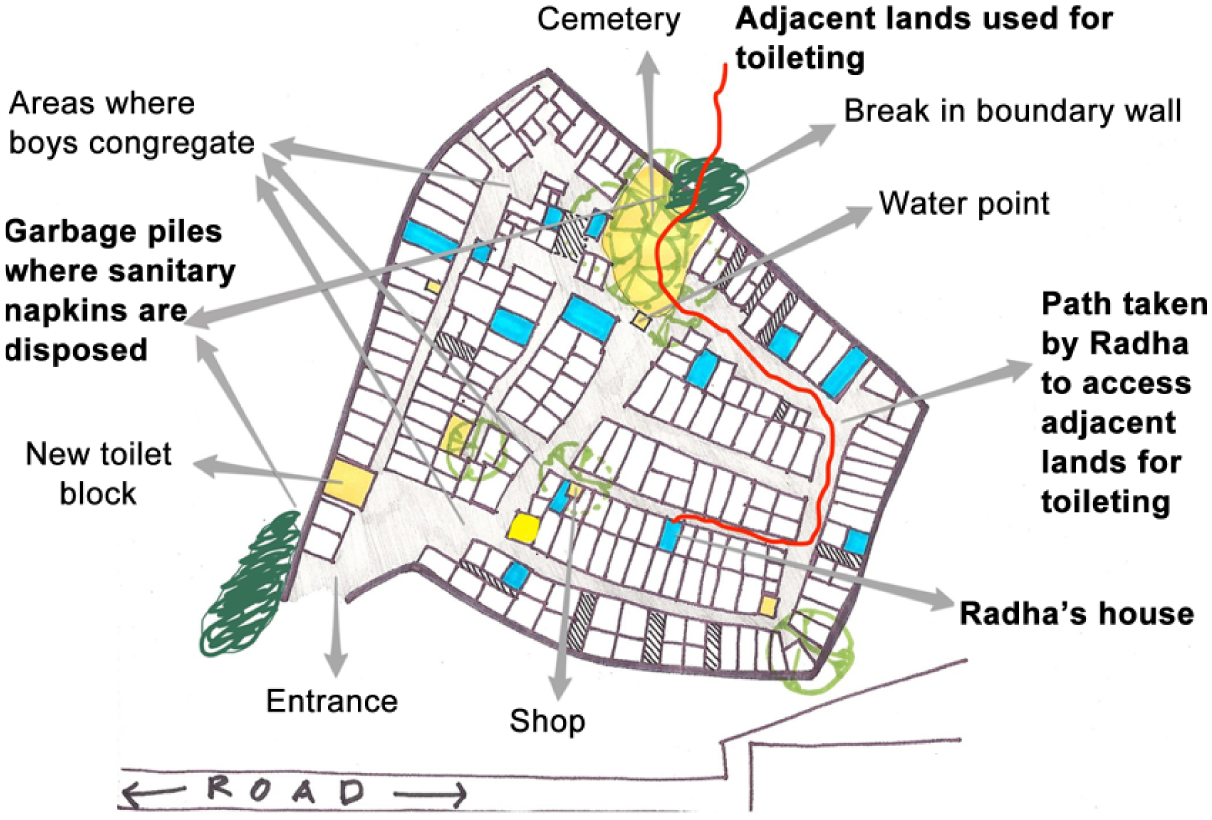
A sketch of the BE settlement showing participant homes and common areas as well as the path Radha takes to reach the adjoining lands for toileting
Other girls complained of men loitering around, and expressed feelings of shame and embarrassment. It was dangerous too – they described an incident where a pregnant woman from their settlement, while squatting, had been snatched and dragged off by a couple of men, but had luckily managed to escape. The girls feared going to this area, and as much as possible, those who attended school used the toilets there.
Girls attending school were far more outspoken. They complained of being teased by both older and younger boys about restrictions on their mobility and about having no say in matters regarding the settlement. One very frustrated girl said:
“If we tell our problems to anyone, no one cares. If our parents tell also nobody cares. If we had the guts to speak out would our area be like this? Our parents don’t let us speak out – even if we say we will complain – our parents say what do you know? You are small children. Just shut your mouths and sit at home. They shut us up like that. Our parents don’t say anything because they are scared that they will get into fights and they will be outcast – and they will not be helped by anyone here.”
All the girls and their mothers said what they needed most were safe, accessible toilets. Settlement leaders had negotiated for a common toilet block through vote-bank politics, but it was not operational – it had been built in a way that did not allow for a water supply connection, making basic hygiene and maintenance impossible. More funds were needed to make it functional, which the settlement residents were unable to provide.
Case 2: Yamini, living in the BEP settlement
The BEP settlement is a recognized slum on 1.5 acres of land and home to 2,000 people; its 460 houses, each around 80 square feet in area, are densely packed along narrow interior lanes. Most residents use one of two public toilet facilities; one is located at the extreme west of the settlement, and residents pay Indian rupees (Rs) 1 or 2 (US$ 2 cents) per use. It is one of many public toilet facilities built by the BBMP (Greater Bengaluru Municipality), with maintenance of the toilets contracted out to a private company. This strategy does not seem to be working well: several residents complained about poor maintenance. The second toilet block, at the opposite side of the settlement, does not consist of pay-per-use toilets, but is managed by local residents and requires families to pay Rs 10 per week. This one is also poorly maintained and it lacks water – residents have to carry their own.
Families with sufficient financial resources prefer to use the pay-per-use toilets. Women said they used these toilets once or twice a day; children as often as four or five times. Poorer families use the second toilet block. Most parents encourage their younger children to squat near the drains outside the settlement, a very common response to the needs of young children who, in any case, dislike the dark, smelly toilet blocks where they are often pushed aside by rushed adults. A few families who preferred to use the first toilet block said they did not have the money to use the toilets to urinate and therefore all their members (including women and adolescent girls) squatted near open drains or along boundary walls to urinate.
Yamini said she used the pay-per-use toilet block and complained that young boys often harassed her and her friends when they walked to and from the toilet block. She said she tried her best to make the most of the toilets in her school so she could avoid the toilets in the settlement, which were poorly maintained and cost money. Yamini was particularly distraught during our interview – for the past three nights she and her sister had been chased by stray dogs when they went to use the toilet at night, and were now terrified to use it after dark (Figure 2).
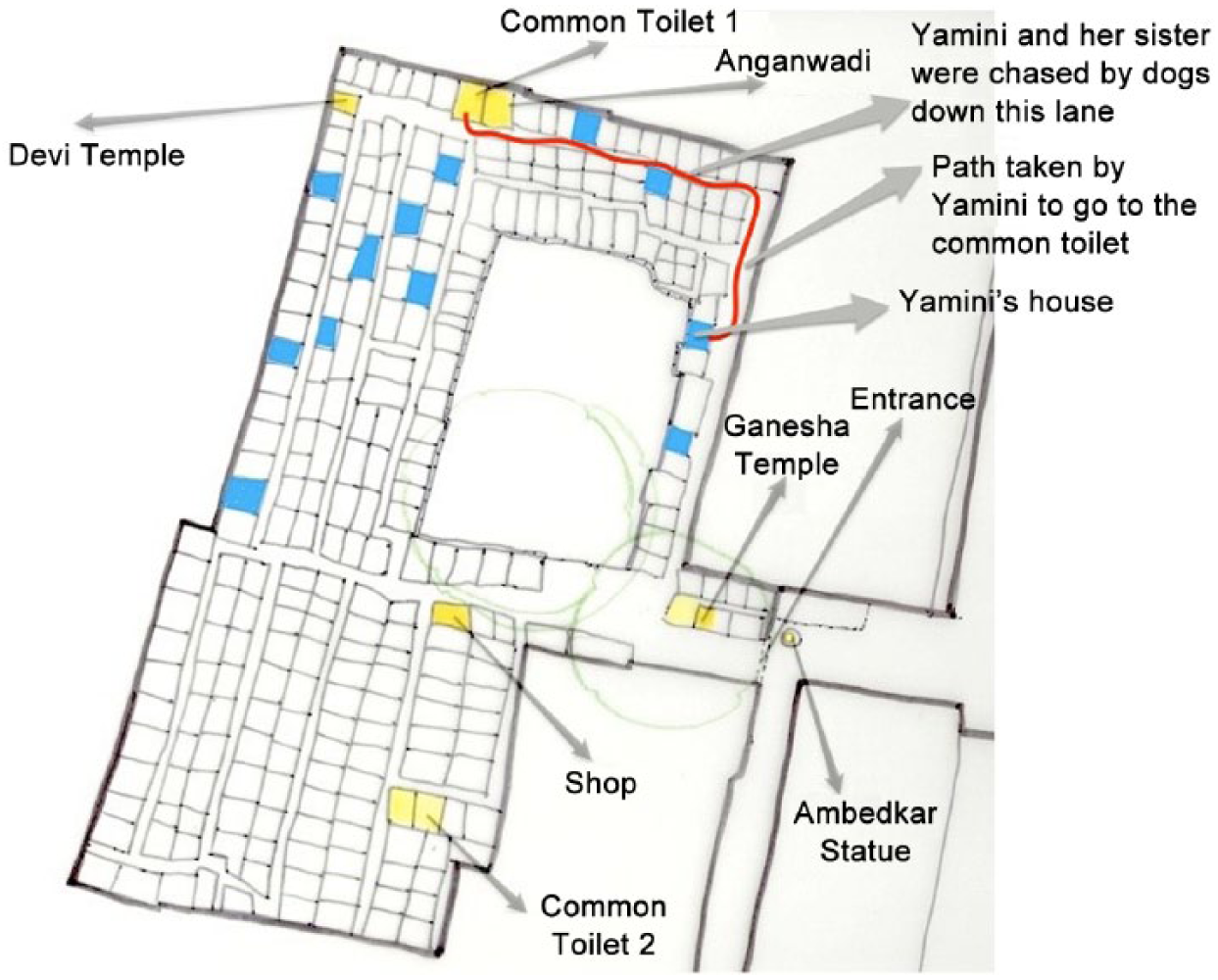
A sketch of the BEP settlement showing the path taken by Yamini to use the common toilet
Most residents bathe in the lanes outside their homes. While men, boys and young children bathe at any time that is convenient, women and girls wait for the cover of darkness. Because they found it embarrassing to bathe in the open, they resorted to bathing half-clothed or in the partial privacy of temporary screens made from sarees. Yamini’s mother explained that they had made a makeshift arrangement to convert their home into a bathroom (so that Yamini and her growing sisters could bathe in private), by drilling a hole in the wall so that water drains out into the lane outside their home. Their neighbours, however, were not too happy with this arrangement, and it had led to some disputes and strained social relations.
For Yamini, the most important requirement in her new home is a toilet and running water inside her home. Aside from this, she felt a common study space where she could meet with other girls her age, study together, and seek one another’s help would be very useful.
Case 3: Mariam, living in the BIR4 settlement
The BIR4 settlement is a recently built four-storey apartment building, home to 190 residents, with 32 apartments, each 270 square feet. Each apartment has a private bathroom and toilet, a kitchen area, a living area and a bedroom. During the summer months, however, when there are severe water shortages, many residents living on upper floors use the public toilets close to the settlement.
“They are older now right so they cannot do these things. It’s not like they fight over the task – you go get water! No you go get water! – everybody knows what has to be done and they do their work. The girls have been helping with the water and doing this for a long time so they get the water. My girls are very hardworking; they help a lot. The boys have become accustomed to not helping with this kind of thing. They expect us to do this. What to do? We have brought them up like this. It is the way it is here.”
Mariam said it was hard work carrying the water up two flights of steps but she added that it was a bearable ordeal given what she had faced in her old settlement. There, she said, her mother barely ate because she did not like using the overcrowded and poorly maintained public toilets. Mariam said waiting in long queues to use the toilets had often made her late for school, and when possible, they had gone to a relative’s house nearby to use the toilet.
Mariam remembered the monsoon season as the most traumatic of times. Nonexistent drainage facilities and unpaved streets in their old settlement had often led to flooding of their home. Her schoolbooks and other household possessions had been destroyed, and waterlogged streets had made it difficult for her to get to school. She would often be reprimanded by her teachers and teased by other students because of her muddied shoes and clothes.
Mariam said her family was much happier living in the new apartment and no longer embarrassed by where they lived. She was able to focus better on her studies and said “Now I just want to be able to study properly and do well and get a good name for my family.” She also added that after having moved to the new apartment her older sister was getting attractive marriage offers.
Case 4: Tasneen living in the BIR3 settlement
The BIR3 settlement, home to 455 residents, was redeveloped almost six years ago, and has four blocks of three-storey buildings with a total of 72 houses, each 215 square feet in area.
All residents share toilets close to their home. The waste is collected in an in situ septic tank. In the F block, the first to have been constructed, three or four households share each toilet. In subsequently built blocks, two households share a toilet. Earlier, the residents faced constant sewage overflow problems, as the drainage pipes were not able to handle the volume of waste generated. Last year the municipality replaced the pipes with wider ones and there have been no problems since. Water supply is scarce. While the infrastructure is in place, residents do not have piped water at home. A single tap with an intermittent supply serves the entire settlement and women have to wait their turn to fill water pots and then haul them to their homes.
Her only complaint was her chronic back and leg pain from hauling water up three flights every other day. She felt that having designated common washing and drying areas on the ground level would be very helpful – then she would not have to lug as much water up the stairs.
V. The role of sanitation in the lives of urban poor adolescent girls
a. Health
Prevalent gender discrimination practices lead to girls in poor settlements being malnourished and anaemic. As they reach puberty they are at a disadvantage at many levels when compared to their male peers, burdened with household chores, caring for their siblings, and fetching water for their family. Many girls like Tasneen complain about chronic leg and back aches from having to carry water to their homes. Toileting in the open also exposes girls to snake bites and small injuries from thorns and other rubble.
Some girls also complained of heavy bleeding and cramps during their periods. Research examining the menstrual hygiene of girls in urban poor areas shows that reproductive tract infections and urinary infections are commonly linked to lack of access to inadequate sanitation facilities.
Recent studies show, furthermore, that attention to the menstrual needs of women and girls is largely absent in existing WASH(22) efforts. Few agencies incorporate menstrual hygiene awareness and education, provision of low-cost sanitary napkins and infrastructure for their disposal, and the integration of these approaches into mainstream policies and programmes in their WASH efforts. Interventions tend to be short-term and technocratic in nature, rarely including women in the planning and execution phases, much less uncovering and addressing the cultural and religious practices that endanger the lives of women and girls.(23)
b. Education
More than half (55 per cent) of the girls who participated in the dissertation study had dropped out of school either to help out at home, or because secondary schools were far from their homes and their parents felt it was unsafe for their pubescent daughters to travel long distances. Some mothers felt a primary-level education was enough for their daughters; others felt education was the only pathway for them to break away from poverty. Girls like Radha and Yamini who went to secondary school took advantage of the toilets in their schools to make up for the lack of facilities in their home or neighbourhood. Several girls, however, like Tasneen, stopped going to school because there were either no girls’ toilets or no water. A study in South India shows that half of the girls are taken out of secondary school when they start menstruating, mostly to be married off.(24) Another study in Nepal shows that over half the girls remain absent from school during their menstrual days because of lack of privacy for cleaning and washing, lack of water supply and appropriate waste disposal systems, and fear of staining their clothes.(25) Flooding because of the lack of drainage facilities and paved roads can also result in the humiliation of school-going children (as in Mariam’s case) and in some cases destroy books and uniforms, which sets children back considerably.
When asked what they needed most to make their lives better, girls (a total of 18) in both the BE and BEP settlements(26) said access to safe toilets was their top priority. There was just one exception; in the BE settlement one girl said that a place to study and access to tuition help was most important. She felt there was nothing she could do about the current sanitation situation but with some tuition support she could aspire to a college education that would give her the chance for a better life.
c. Social risks
In existing settlements, lack of proper sanitation exposed adolescent girls to teasing, name-calling, and in some cases sexual assault. Women and adolescent girls usually wait until nightfall or wake up early to do their toileting. Some girls said they went in pairs and were always on the lookout, because there could be men from outside loitering about, and because they did not trust the men from their own settlement.
In the summer months when shrub cover was limited, girls were worried that they might be exposed, and in the months after the monsoons they worried about what lay hidden in the abundant shrub cover.
In Radha’s settlement, as noted, a pregnant woman had been assaulted by a couple of men while she was in the adjacent open land squatting, but had luckily managed to escape. A mother of three girls, close to tears, talked of her fears for her daughters:
“[…] the younger one is okay, she can go close by […] but with the older girls we are always scared that something will happen to them. I go with them sometimes, but sometimes they have to go by themselves. Who knows who will be hanging around outside. Till now nothing has happened, but these are bad times, and if something happens these girls’ lives will be ruined forever!”
It is a known fact that poor urban women have little time to spare; the daily demands of securing food and water and caring for their family take up most of their day and night, leaving little time and energy for them to chaperone their daughters. Losing family honour weighs heavily on their minds and it is one reason girls are pulled out of schools and married off as soon as they reach menarche.
Even though parents and caregivers are aware of their daughters’ needs and to an extent their problems, they are hesitant to speak out for them. While some parents said they had spoken with settlement leaders about their concerns others preferred to not voice their concerns. In both cases parents said they were afraid to push matters as they might risk alienation from the community.
d. Identity and shame
In poor settlements where basic facilities like toilets are outside homes, adolescent girls must inevitably leave their homes. While girls do step out to go to school in some cases, to use community toilets, or to fetch water or buy food when their mothers are overburdened, they do so minimally and with increasing anxiety and decreasing confidence.
The girls in the BE and BEP settlements described the humiliation they faced when boys on the street teased them, or when they were caught in the act of disposing of sanitary napkins. When children are shielded from common spaces through rules set by their parents, they are at the same time deprived of the chance to develop the ability to negotiate these spaces and the social relationships within them. So when their bodily needs push them into these spaces to carry out extremely private functions, they are at a loss with regard to confronting the teasing boys or chasing dogs and are often overcome with fear and humiliation.
Adolescent girls, as compared to other children, often described spaces outside their homes as “dirty”, “filthy” and “filled with men hanging out”, and used these as reasons for not stepping out of the house. These perceptions internalized and reinforced the code of behaviour set by their caregivers that controlled their access to spaces outside their homes.
Lack of sanitation, therefore, is not just an inconvenience for adolescent girls. It shapes their very identity and how they experience the world around them. In a sense, the lack of sanitation is a metaphor for their lives – a painful reflection and prediction of their own lack of value.
VI. Recommendations for policy, planning and design
Most redevelopment efforts in India are “dwelling”-dominated and for the most part driven and carried out by men. While women are beginning to have their voices heard, they are still a long way from having an equal say. Gender-sensitive planning would not only lead to more responsive and sustainable living environments but would allow women and adolescent girls a wider range of life choices. Access to safe toilets that ensure privacy, access to running water, and attention to waste management of sanitary cloths or napkins are critical places to start, and can be turning points in the lives of young girls.
It is clear from past efforts, however, that physical facilities alone are not enough.(27) Given the deeply rooted socio-cultural rules and practices that govern young girls’ lives, social programming is also essential. Education around sex and the physical and social aspects of menstruation could equip girls to better understand and protect their bodies and increase their confidence.(28) Getting girls together, as this study indicates, is not straightforward as the very issues that need to be discussed are those that keep girls away. Therefore, involving caregivers and men as well as young women in understanding and questioning the relevance of traditional rules and practices should be key to any effort to bring about meaningful and long-term change.
Among the girls who took part in the dissertation study, all those living in settlements without adequate sanitation facilities aspired above all for access to decent toilets. In redeveloped settlements where this need was satisfied, they began to speak more of the need for vocational training and for spaces where they could develop tailoring, needlework and computing skills. They even spoke of the need for social spaces for young girls where they did not feel threatened by males and educational spaces such as tuition classes and libraries where they could better focus on their studies. This shows that only when sanitation needs are taken care of, do other important opportunities for change come into focus as goals to aspire to. Ideally a full range of supportive policies to expand the life-space of girls and women is needed, but unless issues around sanitation (as they lie at very core of the everyday struggles faced by girls) are solved, other policies and interventions are unlikely to have the intended impact.
VII. Conclusions
Girls enter their adolescent years with a number of restrictions that limit their capacity to fend for themselves. Especially in poor settlements, the lack of attention to sanitation services can further compromise their lives by depriving them of education, self-confidence and a healthy life, in effect reinforcing and perpetuating their gendered exclusion.
Urie Bronfenbrenner,(29) in his bio-ecological approach to children’s development, posits a nested structure wherein the child is affected not just by her home and neighbourhood environments, but also by meso- and macro-level systems, like educational institutions or policy- making bodies, beyond her immediate realm. For adolescent girls, it is not just the attitudes of family and neighbours that shape their lives but also policies and institutions that govern urban housing, basic services, health and education. The needs of adolescent girls must be examined in each of these spheres and at the intersections of these spheres to see how innovative actions and policies can give girls the same chances as their male peers. Gender-sensitive toilets can be a start.
Footnotes
Acknowledgements
This paper is based on my dissertation research, which was conducted in urban poor settlements in Mumbai and Bengaluru. This research would not have been possible without the support and cooperation of SPARC and Mahila Milan. My deepest gratitude to all the members in these organizations. Many thanks also to all the women, children and men who participated in this research.
1.
Chant, Sylvia (2011), “Gender and the prosperity of cities”, Final draft of lead chapter prepared for UN-Habitat, State of Women in Cities 2012/13, UN-Habitat, Nairobi, 182 pages; also Chant, Sylvia (2013), “Cities through a ‘gender lens’: a golden ‘urban age’ for women in the global South?”, Environment and Urbanization Vol 25, No 1, pages 9–29; and Pearson, Joanna and Kate McPhedran (2008), “A Literature Review of the Non-Health Impacts of Sanitation”, Waterlines Vol 27, No 1, pages 48–61.
2.
WHO and UNICEF (2014), Progress on Drinking Water and Sanitation - 2014 Update, Joint Monitoring Programme, World Health Organization and United Nations Children’s Fund, Geneva, 78 pages, available at  .
.
4.
See Urban India 2011: Evidence, a report by the Indian Institute of Human Settlements (IIHS) for the India Urban Conference held in New Delhi in 2011, available at .
5.
According to the WHO/UNICEF Joint Monitoring Programme for Water Supply and Sanitation, “improved sanitation” is the method of safe and hygienic removal of human waste such that it does not come in contact with people. Improved sanitation facilities include pit latrines, dry latrines, and flush toilets connected to piped sewerage or septic tanks (for example, a composting toilet or a ventilated improved pit latrine). Shared toilets such as public toilets or community toilets are not included in this category.
6.
7.
Chaplin, Susan E (2011), “Indian cities, sanitation and the state: the politics of the failure to provide”, Environment and Urbanization Vol 23, No 1, pages 57–70.
8.
In India, political processes at the city and state levels determine whether a given settlement is a “recognized” slum. A “recognized” slum has access to municipal services and urban redevelopment schemes whereas “unrecognized” slums do not. The term “slum” usually has derogatory connotations and can suggest that a settlement needs replacement or can legitimate the eviction of its residents. However, it is a difficult term to avoid for at least three reasons. First, some networks of neighbourhood organizations choose to identify themselves with a positive use of the term, partly to neutralize these negative connotations; one of the most successful is the National Slum Dwellers Federation in India. Second, the only global estimates for housing deficiencies, collected by the United Nations, are for what they term “slums”. And third, in some nations, there are advantages for residents of informal settlements if their settlement is recognized officially as a “slum”; indeed, the residents may lobby to get their settlement classified as a “notified slum”. Where the term is used in this journal, it refers to settlements characterized by at least some of the following features: a lack of formal recognition on the part of local government of the settlement and its residents; the absence of secure tenure for residents; inadequacies in provision for infrastructure and services; overcrowded and sub-standard dwellings; and location on land less than suitable for occupation. For a discussion of more precise ways to classify the range of housing sub-markets through which those with limited incomes buy, rent or build accommodation, see Environment and Urbanization Vol 1, No 2 (1989), available at .
9.
The Jawaharlal Nehru National Urban Redevelopment Mission is a massive nationwide urban renewal scheme launched in 2004 and geared towards improving urban infrastructure and governance as well as basic services for the urban poor. About US$ 17 billion has been invested through this scheme.
10.
Hingorani, P (2011), Revisiting Low Income Housing: A Review of Policies and Perspectives, Paper presented at the India Urban Conference, Mysore, 17–20 November, 18 pages.
11.
Edelman, B and A Mitra (2006), “Slum Dwellers’ Access to Basic Amenities: The Role of Political Contact, Its Determinants and Adverse Effects”, Review of Urban & Regional Development Studies Vol 18, No 1, pages 25–40.
12.
Burra, S, S Patel and T Kerr (2003), “Community-designed, built and managed toilet blocks in Indian cities”, Environment and Urbanization Vol 15, No 2, pages 11–32; see also the article in this issue from Sheela Patel and the SPARC team.
13.
Verma, Suman and T S Saraswathi (2002), “Adolescence in India”, in B Bradford Brown, Reed W Larson and T S Saraswathi (editors), The World’s Youth: Adolescence in Eight Regions of the Globe, Cambridge University Press, Cambridge, pages 105–140; also Fatusi, Adesegun O and Michelle J Hindin (2010), “Adolescents and Youth in Developing Countries: Health and Development Issues in Context”, Journal of Adolescence Vol 33, No 4, pages 499–508.
14.
Abraham, Leena (2001), “Redrawing the Lakshman Rekha: Gender Differences and Cultural Constructions in Youth Sexuality in Urban India”, South Asia: Journal of South Asian Studies Vol 24, No 1, pages 133–56.
15.
Garg, Suneela, Nandini Sharma and Ragini Sahay (2001), “Socio-Cultural Aspects of Menstruation in an Urban Slum in Delhi, India”, Reproductive Health Matters Vol 9, No 17, pages 16–25.
16.
Uma, Saumya (2012), Rights of Adolescent Girls in India: A Critical Look at Laws and Policies, Vacha Publications, Mumbai, 200 pages, available at .
17.
Kumar, Anant (2001), “Poverty and Adolescent Girl Health”, Yojana Vol 45, pages 30–32, available at .
18.
See reference 11.
19.
Singh, Shweta (2010), “Neighborhood: the ‘outside’ space for girls in urban India”, International Journal of Social Welfare Vol 19, No 2, pages 206–14.
20.
Delisle, Hélène (2005), Nutrition in adolescence – Issues and Challenges for the Health Sector, Issues in Adolescent Health and Development, WHO, Geneva, 123 pages.
21.
Common spaces include communal areas like childcare and play facilities, religious and cultural establishments, shops, physical infrastructure like roads and sanitation, and informal spaces like courtyards, steps, lanes and corridors where women perform daily chores and interact and children play.
22.
WASH is an acronym usually used in international development programmes to refer to “Water, Sanitation and Hygiene”.
23.
Mahon, Thérèse and Maria Fernandes (2010), “Menstrual Hygiene in South Asia: A Neglected Issue for WASH (Water, Sanitation and Hygiene) Programmes”, Gender & Development Vol 18, No 1, pages 99–113.
25.
See reference 15.
26.
This includes the home interviews with four girls in each of the settlements and a focus group of 14 girls in the BE settlement, which also included the four girls from the home interviews.
27.
Garg, Rajesh, Shobha Goyal and Sanjeev Gupta (2012), “India Moves towards Menstrual Hygiene: Subsidized Sanitary Napkins for Rural Adolescent Girls—Issues and Challenges”, Maternal and Child Health Journal Vol 16, No 4, pages 767–774.
28.
Shahnaz, Rizwana and Raihana Karim (2008), Providing Microfinance and Social Space to Empower Adolescent Girls: An Evaluation of BRAC’s ELA Centres, BRAC Research & Evaluation Division, Dhaka, 42 pages, available at .
29.
Bronfenbrenner, Urie (2000), “Ecological systems theory”, in A E Kazdin (editor), Encyclopedia of Psychology Vol 3, pages 129–133.