




Abstract
With increasing product personalization and open innovation, the manufacturing paradigm has been transforming to a more decentralized and socialized one. Social manufacturing was proposed as a new paradigm for industry. It extends the crowdsourcing idea to the manufacturing area. By establishing cyber–physical–social connection via decentralized social media, various communities can be formed as complex, dynamic autonomous systems to co-create customized and personalized products and services. This article presents the concept and characteristics of social manufacturing including distributed, adaptive, and self-organization. It also addresses social intelligence in proactive decision-making for organization of socialized resources and producers in the life-cycle of product.
Keywords
Introduction
The implications of social media and the Internet may change the buyer–seller relationships in the manufacturing industry. In particular, one may observe the following four transitions:
Socialization in production. Small modular infrastructure 1 for production is burgeoning in defined market segments, driving big enterprises to ‘think small’ for operational flexibility benefits (e.g. flat organization structure in Haier). Many small- and medium-sized enterprises (SMEs) and individual entrepreneurs spring up and provide various services to consumers.
Shift of consumers’ role. The role of consumers is changing from buyers to prosumers (i.e. dual-role as producer and consumer). 2 They widely infiltrate into product life-cycle activities to obtain more personalized products and services (e.g. Quirky and Shapeways). This dual-role of prosumer is more obvious in a multi-level manufacturing outsourcing, in which they act as consumer-role to lower-level outsourcers, and meantime producer-role to upper-level outsourcers.
Driven force of product innovation. Emerging socialnomics has fundamentally changed how enterprises operate and interact with consumers. 3 Open architecture products 4 and open source in socialnomics are emerged as important ways to product innovation. For instance, many crowdsourcing-driven products and platforms (e.g. Rally Fighter automobile from Local Motors) focus on co-creative value development by encouraging its fans/consumers to participate in the product life-cycle, and other newly born companies (e.g. mobile phone company Xiaomi) succeed even without any production lines.
Virus-like information propagation in social media. Social media–based platforms such as Facebook, WeChat, and Kenandy’s Cloud ERP enable peer-to-peer decentralized interactions, and their ‘virus-like’ information propagation mechanism makes the demands and capabilities far more visible than ever before.
These transitions are enabling force changing the current manufacturing paradigm into a more decentralized and socialized one. The Economist argued these transitions amount to a third industrial revolution 5 and termed it as social manufacturing (SM) paradigm. Although the concept is still in its early stages, the academic world has shown interest in embodying the concept of SM from the computing and service perspective.6–9 Initially, the three-dimensional (3D) printing5,8 and apparel 7 industry are viewed as pioneer fields of SM. That is because that the apparel industry has always been highly individualized, while the 3D printing was viewed as the most promising technology to meet the customer’s personalized needs. Recently, some researchers have carried out studies on the key enabling techniques of SM, such as outsourcing coordination mechanism and enterprise relationship modelling issue.10,11 These studies either focused simply on the social innovation aspect in consumer products manufacturing or limited on the manufacturing phase of industrial products rather than the whole life-cycle. Also, a comprehensive clarification of SM paradigm in terms of their product architecture and manufacturing logic is typically absent from these studies. Our study responds to these shortcomings and makes a further clarification and discussion on SM paradigm.
Concept of SM
Clarification 1. SM is a paradigm with a cyber–physical–social space that allows the decentralized prosumers to co-create fully customized and personalized products and services. As depicted in Figures 1–4, it is a social and sustainable paradigm for mass individualization, by extending the crowdsourcing idea of ‘obtaining needed services or content by soliciting contributions from crowd of prosumers’ into the manufacturing area.6–9
Clarification 2. Cyber–physical–social space in SM paradigm involves human intelligences and social organizations (e.g. communities) to enable the social interactions among prosumers and the organic connections of socialized resources (e.g. machine tools, design software, measurement equipment, and sensors) to co-create products and services.
Clarification 3. Social interactions in SM paradigm are the processes by which prosumers act and react to each other and are usually characterized by requirements, preferences, situations, experiences, or feedbacks (e.g. one is safer, more effective, or more comfortable). It is clearly prerequisite and foundation for establishing and maintaining prosumer relationships.
Clarification 4. Prosumer relationship in SM paradigm is the interactive collaboration reality among prosumers resulting from the matchmaking between manufacturing demands and capabilities/supplies, and it includes various services (e.g. designing, machining, and product), outsourcing (i.e. individual-to-individual or individual-to-multiple specified prosumers), and crowdsourcing (i.e. individual-to-group prosumers).
Clarification 5. Social context in SM paradigm is considered both the medium and outcome of social interactions and manufacturing operations. Using proper analysis techniques, it is a source of community and participants’ growth, as well as a starting point for various manufacturing knowledge such as how to enhance product performance or productivity based on the findings from the context data. 12
Clarification 6. Community in SM paradigm is a dynamic unity of interrelated prosumers who are held together by the common interest or goal of making an individualized product to meet a certain functional requirement or performance experience. The community will evolve in the self-adaptive progress of prosumer relationships and finally achieve a self-organized eco-system.
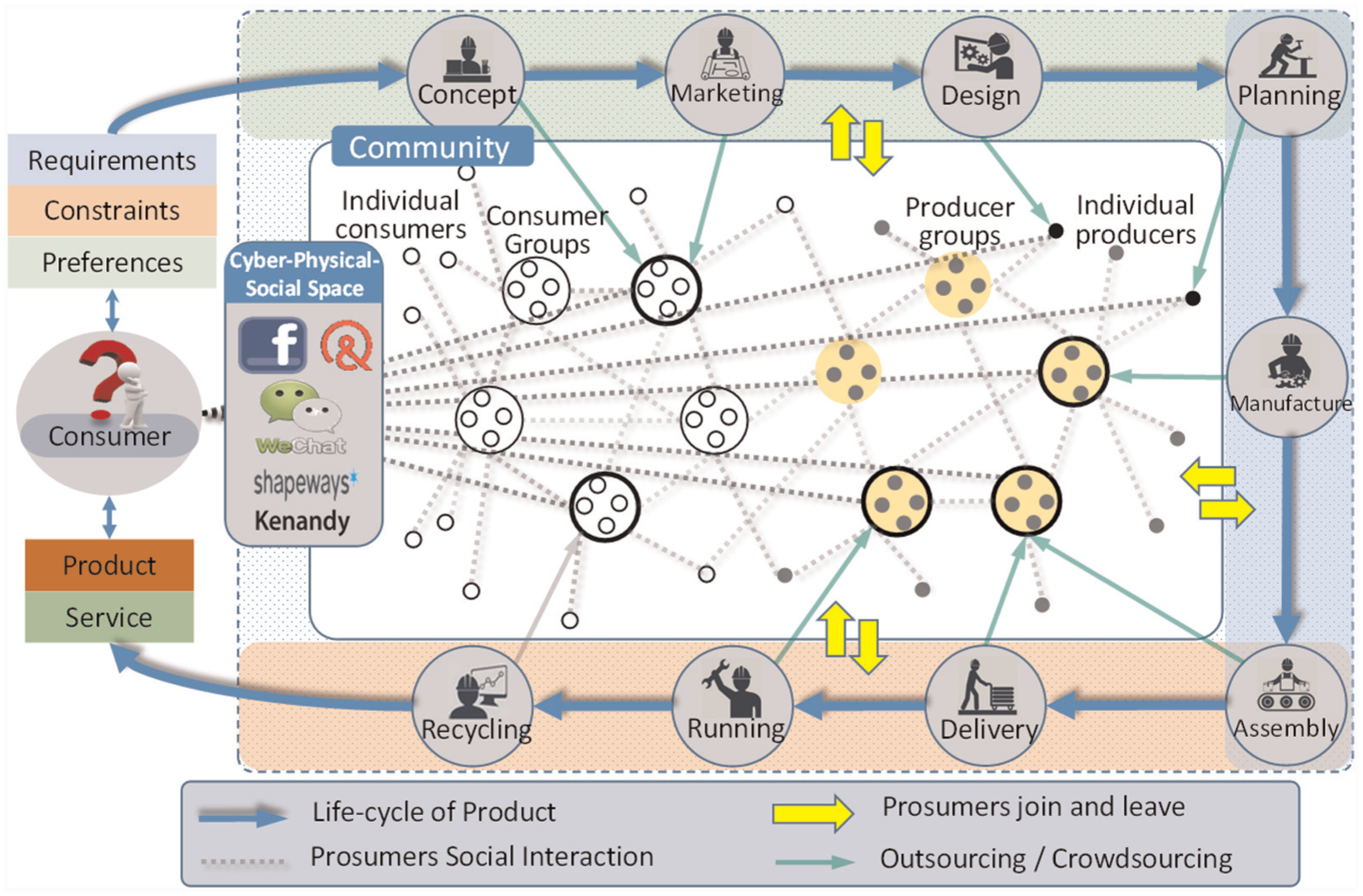
Full customization in the product life-cycle of SM.
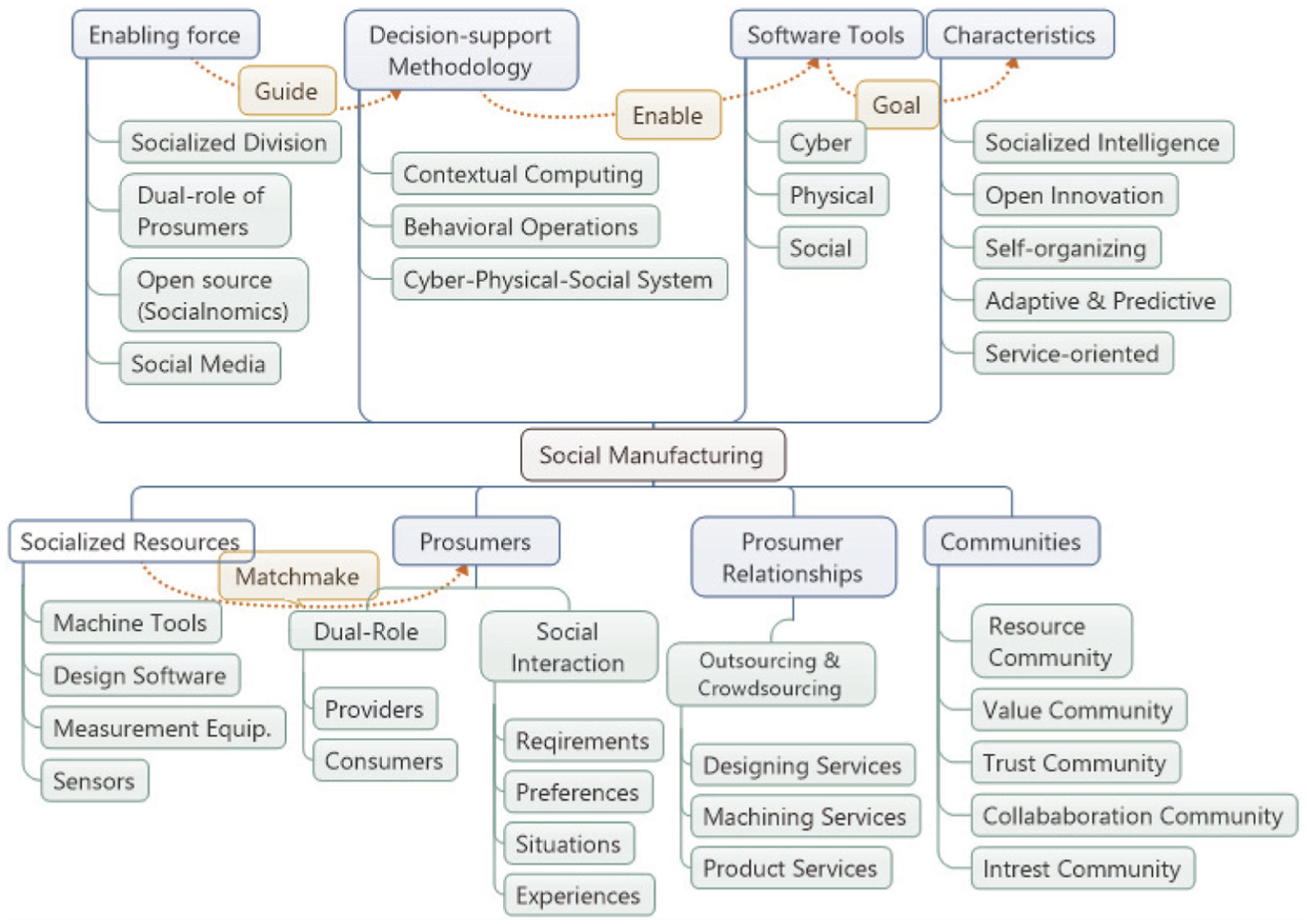
A concept map of SM.
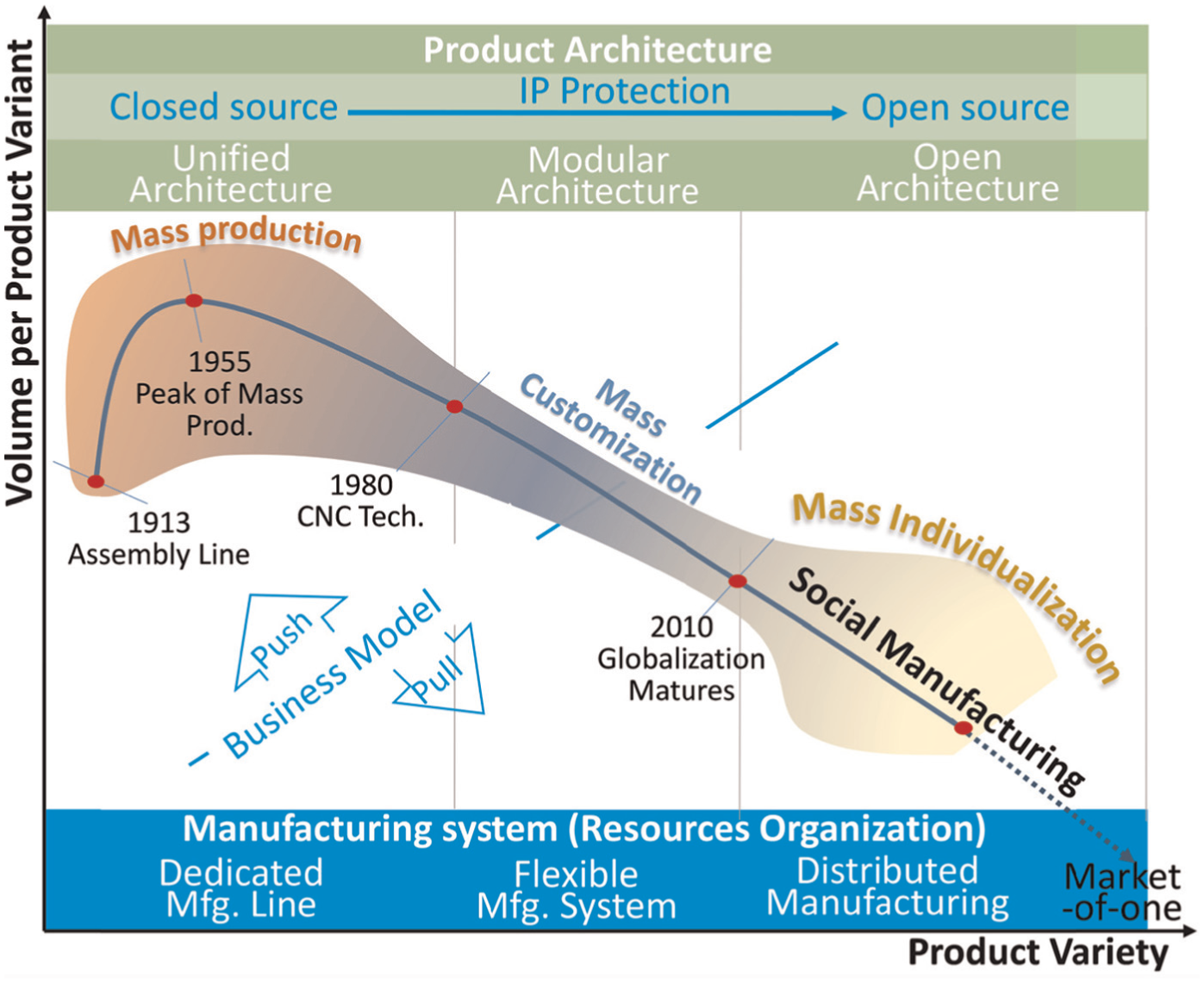
Transition of manufacturing paradigms. 4
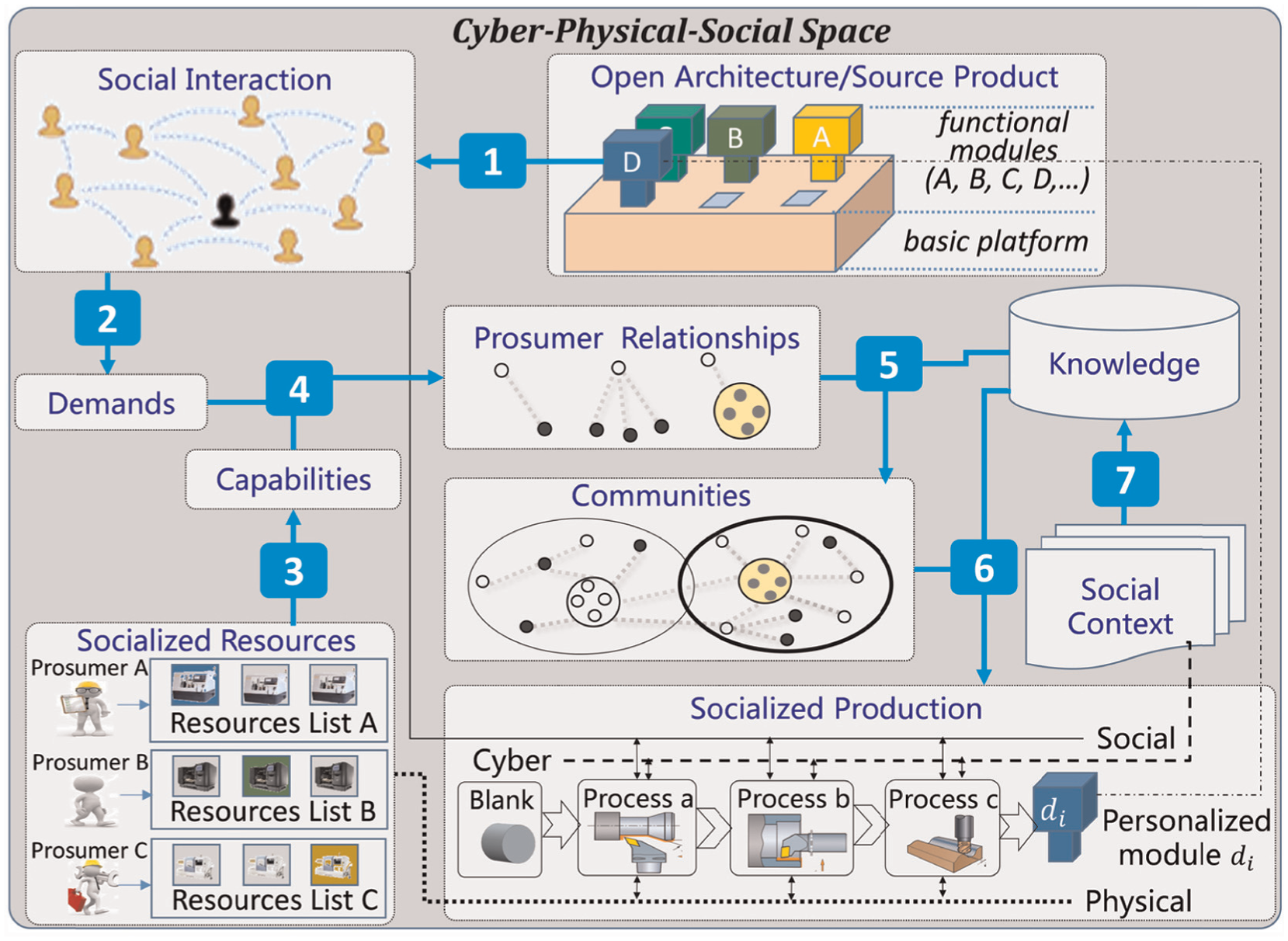
Resources organization and operations in SM paradigm. 1. Modules individualizing; 2. demands mining; 3. capabilities dynamic evaluation; 4. demand-capability matchmaking; 5. service coordination; 6. operations integration; and 7. context perceiving and learning.
Configuration and operations of SM
Each paradigm has its own product architecture, resource organization, and operations manner that enable to accomplish the paradigm goal. This section embodies the configuration and operations of SM from these two perspectives, respectively.
Product architecture in SM paradigm
The product in the SM paradigm is in open architecture 4 to meet the personalized design demands and majorly comprises two parts, namely, the basic platform and the functional modules. The core manufacturer designs the product platform and its architecture, and then defines the interfaces (including mechanical, electrical, and information/software) for potential modules, which may be produced by other prosumers. Then the prosumers are involved in the design of their final products by individualizing the modules and combination. The relationship between platform and modules is the same as smart phones contain all basic functions (e.g. calls and Internet) and their Apps only add specific functionalities needed by specific customers.
The sustainability, scalability, 13 and adaptability 14 can be achieved as the open architecture product can accommodate new requirements by adding, removing, and changing one or more reusable and recyclable modules. As the module design is opened to the wild imagination of prosumers, the offer of modules is huge, and product variety is increased tremendously. As depicted in Figure 3, eventually it may even reach a market-of-one, but the cost of SM products is tremendously lower, as it is manufactured in a mass-individualization way. 15
This paradigm shift, however, requires that the traditional manufacturers begin designing their products with an open architecture that allows adding modules designed by numerous module inventors or prosumers. In the future, the open architecture in SM paradigm will not be limited in the opening of module interfaces, but extends into a deeper open level, that is, open source. Temporarily, the traditional products such as machine tools may be suitable for the open architecture way due to the commercial needs of intellectual property (IP) protection, while the open source way usually happens in newly born products (e.g. 3D printer). Finally, new IP protection mechanisms will emerge in the future SM paradigm, in the context of which the product design and innovation will be distributed and open.
Resources organization and operations in SM paradigm
As depicted in Figure 4, the SM is a contextual approach that operates on highly interactive cyber–physical–social space through which prosumers share capabilities and co-create products. Resources organization and operations in SM paradigm shall comprise seven major steps, detailed as follows:
Step 1: Modules individualizing. The prosumers’ desires of individualizing products or modules (e.g. Module D in Figure 4) will drive the social interactions among like-minded prosumers and the emergence of communities.
Step 2: Demands mining. This step is to discover potential demands, preferences, and experiences about the product, by analysing the prosumers’ complex social interactions.
Step 3: Capabilities dynamic evaluation. Socialized resources owned by scattered prosumers are involved in various socialized production, and thus their status changes frequently over time. Therefore, this step may evaluate and predict their capabilities and status, so as to enable us to figure out whether and which kinds of manufacturing demands it can fulfil.
Step 4: Demand-capability matchmaking. This step is to identify potential socialized resources to match the demands (e.g. individualizing Module D in Figure 4), and therefore to support the generation of on-demand services. SM paradigm emphasizes on what and how to establish the matchmaking between individualized demands and capabilities of socialized resources 16 and maintain dynamic/temporary prosumer relationships.
Step 5: Service coordination. The SM paradigm subjects to the distributed product assembly and safety constraints of the design and also needs to be delivered exactly on time for final assembly. Therefore, this step is the self-organizing of collaborative manufacturing services into communities. By possessing aggregated capabilities, communities can replace large manufacturers in functions and surpass them in flexibility. 17
Step 6: Operations integration. Socialized production is distributed across the network. This step is the channelling of real-time industrial operations and interactions via cyber–physical–social space, so that scattered prosumers can get all-around data for decision, dynamic planning and scheduling, quality monitoring, logistics tracking, and so on. Finally, mass-individualized products (e.g. a personalized Module
Step 7: Context perceiving and learning. As operations are going, social context data grow big. This step emphasizes on extracting and reasoning about interactions and behaviours among prosumers, devices, and services, with the goal of driving and channelling knowledge to prosumers within the communities who need it to support the decisions across the resources organizing and operating process. Eventually, the SM can develop a social intelligence that is forward looking, global in scope, and capable of playing out in real-time. Social intelligence, in turn, radically alters the process of product innovation and manufacturing logic.
Examples of SM community and its products
Communities offering 3D printing and other additive manufacturing services 18 are already forming online. An example of SM product, that is, Reprap as shown in Figure 5, is presented below. It is an open source 3D printer project that prosumers can individualize according to their needs. In the product individualizing design phase, the prosumers join communities (e.g. Reprap.org) to co-design the platform architecture of the printer and also co-create a library of interior modules, such as Extruders. The library includes original basic platforms (e.g. RepRap 1.0 Darwin) designed and offered by the University of Bath, and mass personalized modules designed by many small companies and individuals. This library can be accessible for every prosumer. Finally, the prosumers can generate a personalized design of the 3D printer. In the product manufacturing phase, prosumers can manufacture it either by outsourcing to new collaborative services available in the communities or making self-replicating via their own 3D printers. After finishing the personalized product, the prosumers can put it online for sale via e-commerce platforms (e.g. Shapeways and taobao.com).
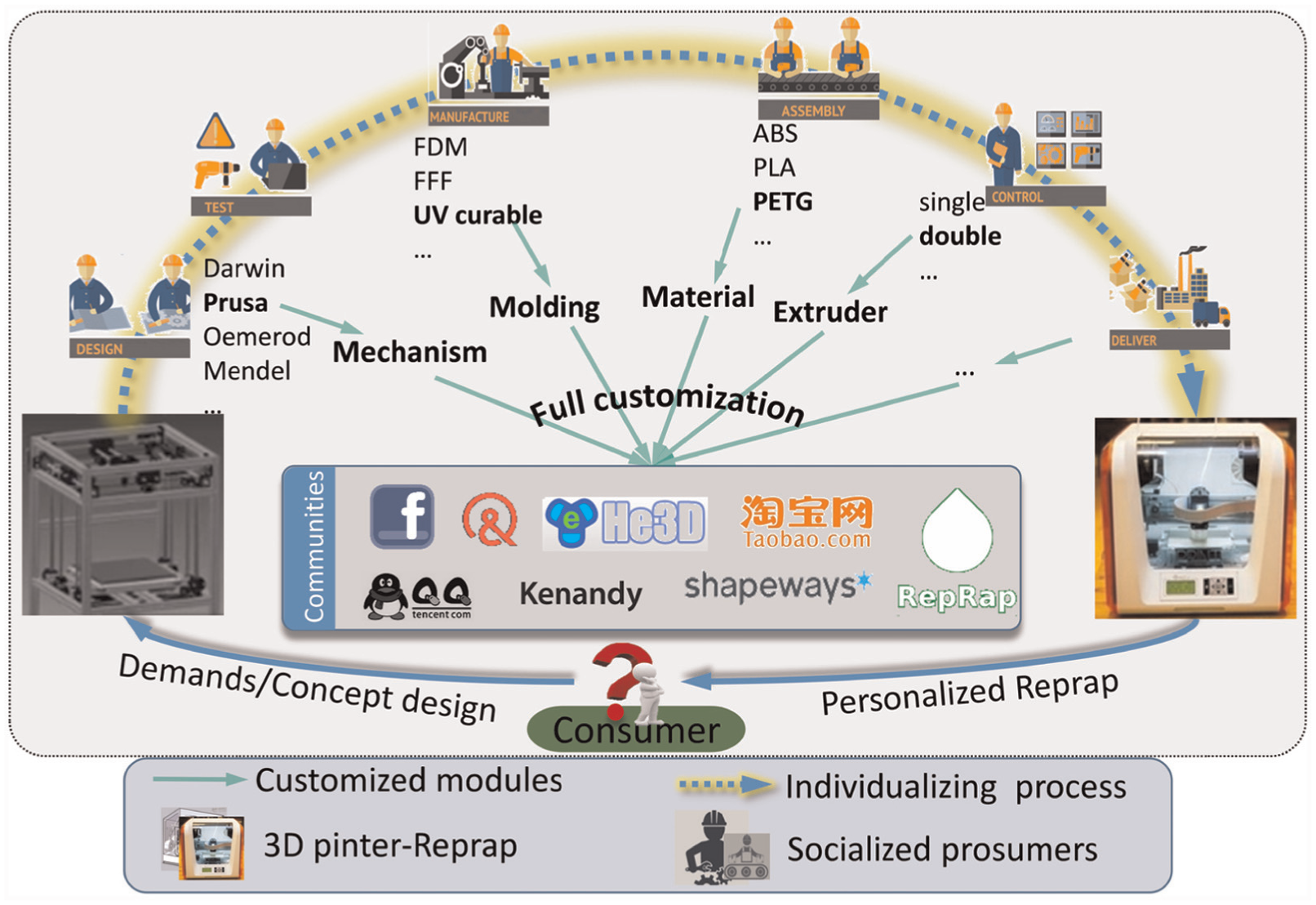
The individualization process of an SM product – Reprap.
Other open source products such as Dobot (www.dobot.cc) are also under realization. The SM paradigm extends the crowdsourcing idea of realizing product development through network of socialized prosumers into manufacturing area. The emergence of SM products with open source and open architecture is a promising start. Next, it can be anticipated that the paradigm change is applicable to more consumer products and industrial products.
The challenges concerning the paradigm shift to SM
SM paradigm is not yet practised on a large scale. Besides the marketing conditions and society’s desire, making the SM paradigm a reality requires many key enabling techniques in the product designs, IP protection, manufacturing operations, and cyber systems. One of the most challenging aspects is the proactive decision-making for organization of socialized resources and prosumers in the life-cycle of product. Figure 6 summarizes three challenges with potential methodologies for proactive decision-making, which are detailed as follows.
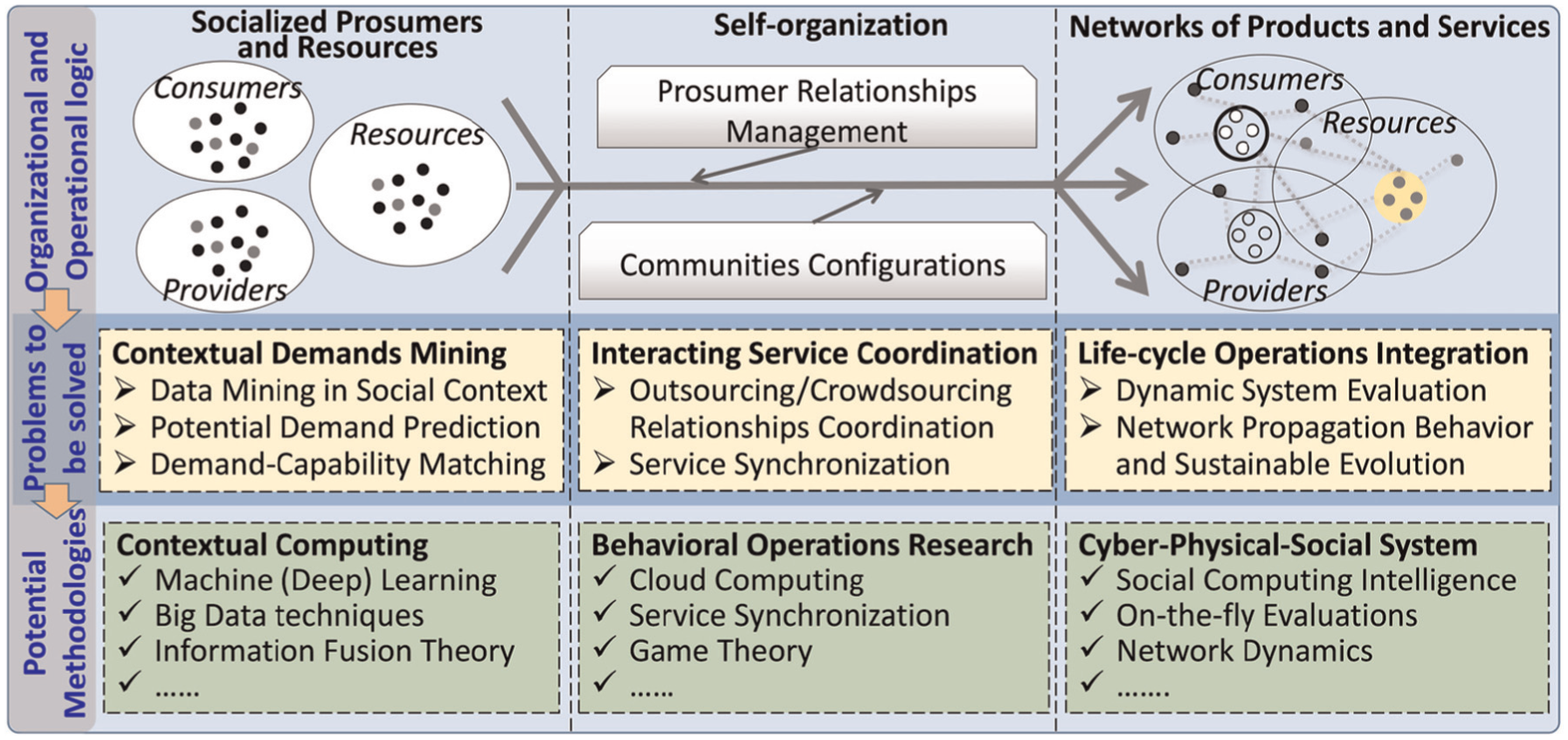
Future challenges and potential methodologies in SM.
Contextual computing methodologies for demands mining
Full customized solutions and services are being asked to satisfy prosumers’ demands. However, the demands and ideas are usually proposed in a non-professional or indirect way. SM incorporates knowledge of individual requirements and preferences hidden in vague expressions, day-to-day interactions, and behaviours, with the goal of bridging prosumers and services. Through the contextual awareness in combining social and operational aspects to characterize prosumers’ situations and potential demands, the intelligent matchmaking of demand-capability and generating of on-demand services can be achieved, thereby supporting the life-cycle decision for achieving the self-adaptive characteristics. This dimension includes contextual computing techniques such as big data mining, deep machine learning, and information fusion theories.
Behavioural operations research in service coordination
Prosumers join and leave the community dynamically, and their attributes and performances change frequently over time. Moreover, some sub-processes of the services would be subcontracted and coordinated to other prosumers to decrease the complexity and cost. By the sum of multiple subcontracts, this will form a dynamic and interactive system. How the life-cycle interactions and configuration behaviours can be captured, analysed, and predicted is a challenge. On the other hand, since the prosumers in communities are business entities that absolutely game for their maximal benefit, coordinating these services and enabling the self-organizing in communities is also critical to facilitate achievement of effective life-cycle operation. This dimension includes techniques such as outsourcing game mechanism and decentralized service synchronization.
Cyber–physical–social system for operations integration
The SM paradigm is more complex than previous paradigms, because personalized modules in product are produced by a large number of distributed prosumers, and the number of product variants that may be manufactured is enormous. The enabler that can handle this level of complexity is cyber–physical–social system (CPSS). Currently, the SM paradigm is in an early stage, and the interactions and operations of the manufacturing process happen in various existing social media and platforms (e.g. Quirky and Shapeways). In a more advanced phase, the decentralized managements are supposed to be supported by a specialized cyber–physical–social full-connected space instead.
The essence of CPSS in SM paradigm is to provide a social intelligence to build a bridge between countless demands and various capabilities, thus forming a closed loop of online to offline (O2O) service in the product life-cycle. Certainly, the timely coordination of various manufacturing operations to the final product can be supported by today’s advanced Internet of things technologies such as radio-frequency identification (RFID) and intelligent sensors. However, the generation of social intelligence and proactive decision-making should be handled within new operating logic. The SM paradigm needs new cyber-enabled tools, interfaces, tools, and methods to support the coordinated evolution (co-evolution) of products, processes, and production systems,19,20 while at the same time supporting the validation of bounded design space, reliability and quality, manufacturability, and product safety constraints. 21 Other advanced analytical techniques such as on-the-fly evaluations and augmented reality technologies will also be critical to the creation of realizable highly individualized and personalized products. On the basis of CPSS interconnection, the next step is to source more advanced social intelligent technologies to realize the self-adaptive characteristics.
Conclusion
This article has concentrated on the conceptual development in the paradigm shift towards SM and attempted to figure out the SM product architecture, manufacturing organizing and operating logic, and potential methodologies to tackle future challenges. Similar to Wikipedia, SM is a crowd open innovation and sustainable paradigm towards mass individualization. The social networking and open innovation can amplify the sharing process of socialized resources. Launching novel products in SM paradigm will also become easier and cheaper. The SM paradigm will not be confined to small and medium-sized firms and individual entrepreneurs, but extended to large manufacturers.
Footnotes
Declaration of conflicting interests
The author(s) declared no potential conflicts of interest with respect to the research, authorship, and/or publication of this article.
Funding
The author(s) disclosed receipt of the following financial support for the research, authorship, and/or publication of this article: The research work presented in this article was supported by the National Natural Science Foundation of China (NSFC) with grant nos 71571142 and 51275396.