




Abstract
In order to achieve nanometer accuracies, low vibration in air spindle is vital. Some parameters affecting air spindle vibration could be mentioned as rotational speed, inlet hole diameter, air pocket geometry, air gap pressure and so on. In this study, the air pocket geometry and depth plus rotational speed are experimentally investigated. Three levels of quantity are selected for each parameter. Vibration movements were considered as experiment output. Then, experimental results were analyzed by design of experiment method. The results showed that the air spindle with an air pocket of rectangular shape and 3 mm depth at low rotational speed has minimum vibrations.
Introduction
Air spindle and drive systems are important parts of ultra precision machines because the spindle motion error will have significant effects on the surface quality and accuracy of machined components. Spindles in ultra precision machine tools have high motion accuracy and rotational speed.1,2
Low-friction characteristic of aerostatic bearings provides high mechanical efficiency and minimizes bearing heat generation. It also gives rise to a noise-free and smooth running and does not add to sound and vibration levels of the machine in the way that high-speed ball bearings do. Before entering into air gap, the air goes through an air pocket that reduces instabilities such as air hammer.
Different researches have been conducted on the characteristics of air bearings and their effects on performance. In 1985, Boffey et al. 3 investigated air pocket depth variations on air bearing stiffness, load capacity and flow rate. In 2000, Stout and Barrans 4 presented a study in design of aerostatic bearings for application to nanometer resolution manufacturing machine systems. In 2002, Chen et al. 5 investigated an arc-type aerostatic bearing with axial straight and the circumference arc-type grooves. In 2009, Chen et al. 6 investigated the effect of air pockets on aerostatic rotor-bearing system’s stability. They studied the effects of feed holes and their number and position on aerostatic spindle’s stability by using nondimensional Reynolds equation, which was derived from Navier–Stokes and continuity equations. In 2012, Akhondzadeh and Vahdati 7 investigated the effect of size and number of rectangular air pockets on air spindle vibrations. In their research, air pockets with minimum number and size has shown minimum vibrations.
In the previous researches, except the study by Akhondzadeh and Vahdati, 7 the air pocket parameters have been selected for air bearing stiffness, load capacity and flow rate analysis, and air bearing vibrations were not investigated. In this study, the air pocket parameters and rotational speed are selected for investigating air spindle radial vibrations. In this work, air pocket shape and depth are considered as air pocket parameters for investigation.
Air bearing equations
For an aerostatic journal bearing, as shown in Figure 1(a), air is supplied from an externally pressurized source and passes through entries with orifice compensation as shown in Figure 1(b), which are located double-rows about asymmetric plane and evenly around the circumference of the bearing.
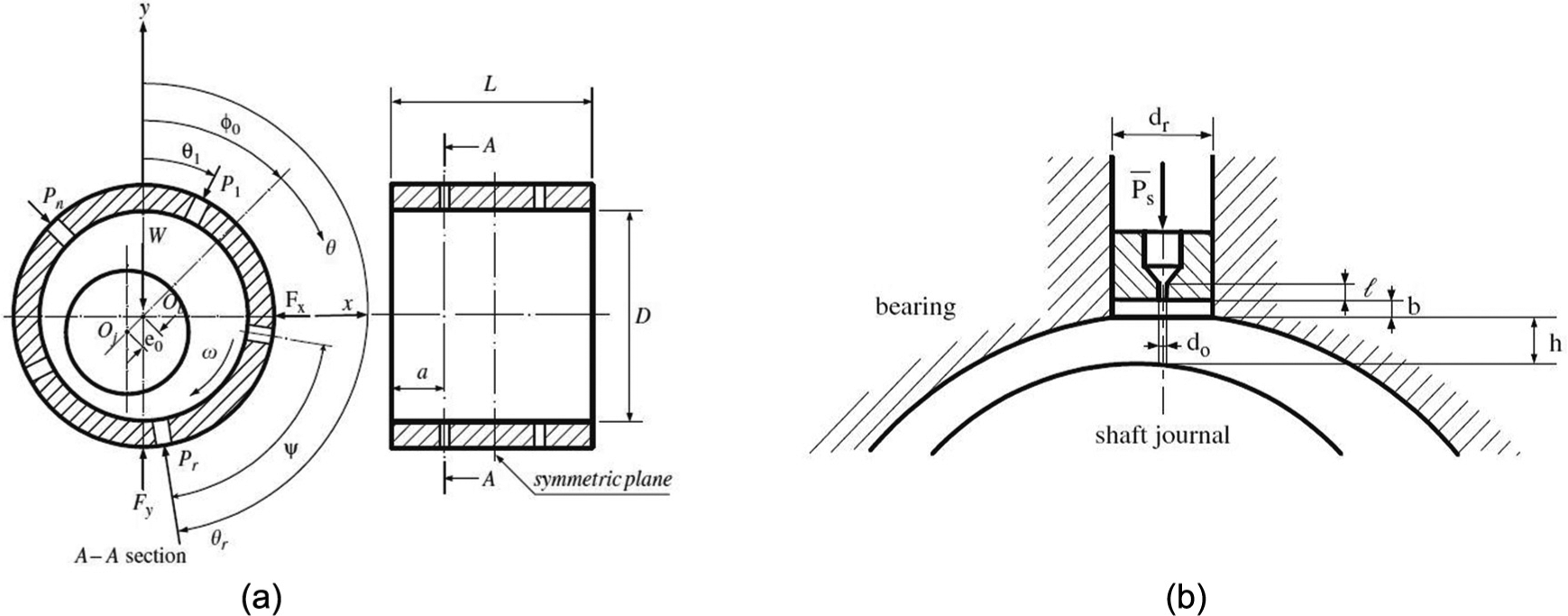
Configurations of (a) an aerostatic bearing with double-array entries compensated by (b) orifice restriction.
Assuming air at the bearing clearance as perfect gas that is compressible, isothermal and laminar flow, the nondimensional Reynolds equation could be derived from Navier–Stokes and continuity equations. In the two-dimensional Cartesian coordinate system, it may be shown as
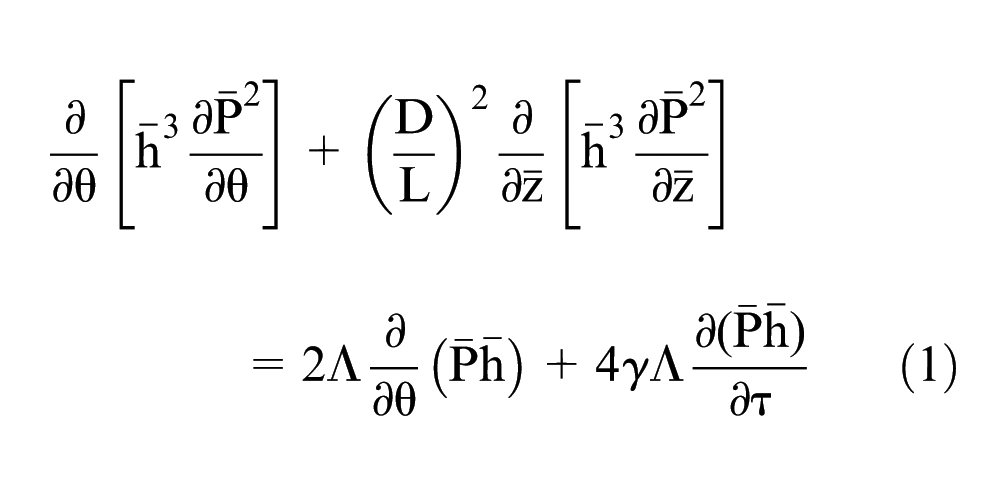
where D and L are the bearing diameter and length, P and h are the nondimensional pressure and thickness of the film, θ and z are the angular and axial coordinates of the bearing, respectively, τ is the nondimensional time, Λ is the bearing number and γ is the whirl ratio.
Design of air spindles
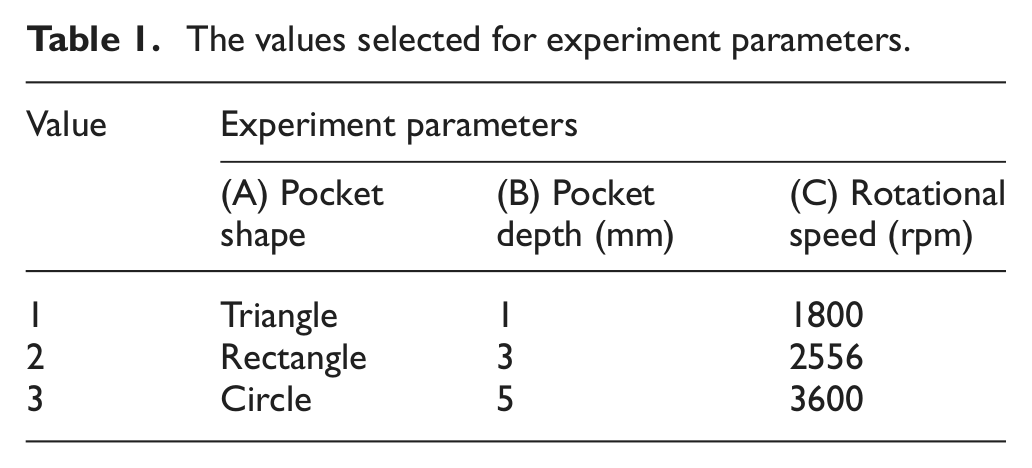
The air spindle vibrations are affected by some air pocket parameters such as air pocket shape, number, size and depth. In this study, air pocket shape and depth are investigated as air pocket parameters. Table 1 shows the values of each parameter used for the investigation. These values have been selected randomly and in accordance with manufacturing and experiment limits.
The values selected for experiment parameters.
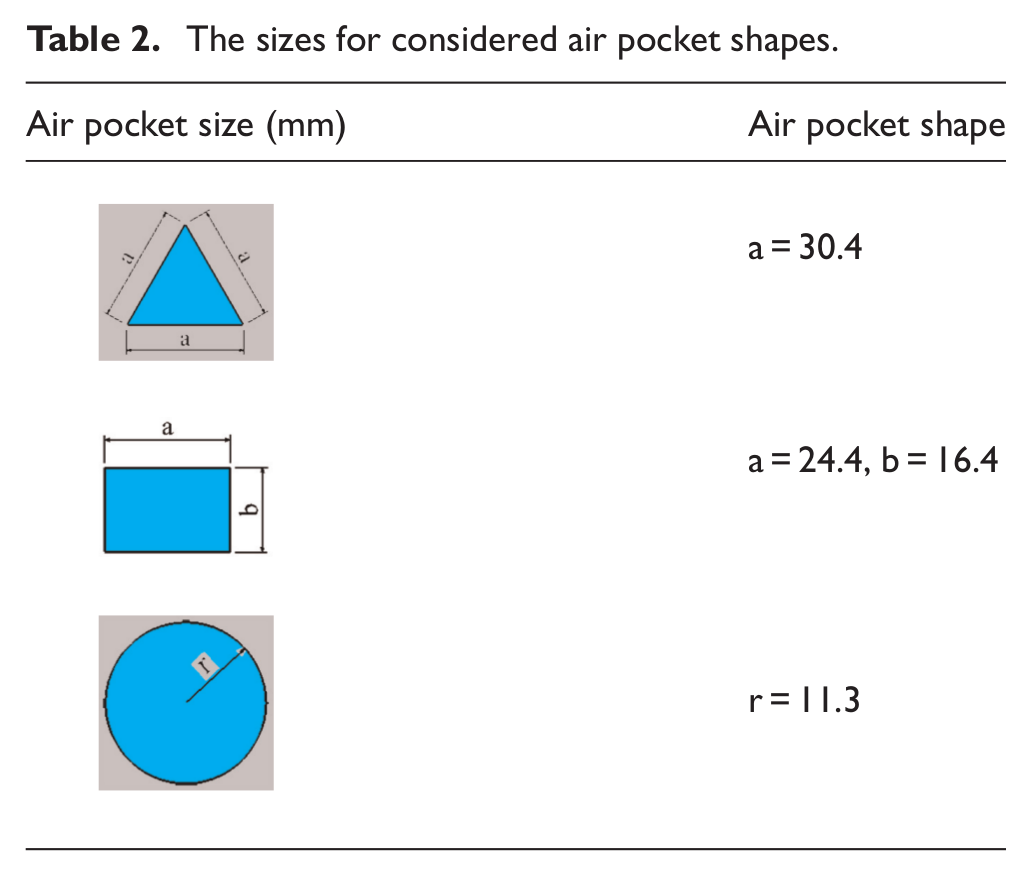
Sizes of air pockets for different shapes have been shown in Table 2. They have been designed in order to have the same air pocket area for all three cases. Stainless steel was selected for rotor and bush of stators material and brass for shaft of stator. The air gap between rotor and stator was selected as 25 µm.
The sizes for considered air pocket shapes.
For mounting the air spindle on the lathe cross slide, a base was designed and bolted on it. The number of air pockets on all stators was considered the same and located at equal angular positions around the stator. Figure 2 shows a set of manufactured stator and rotor.
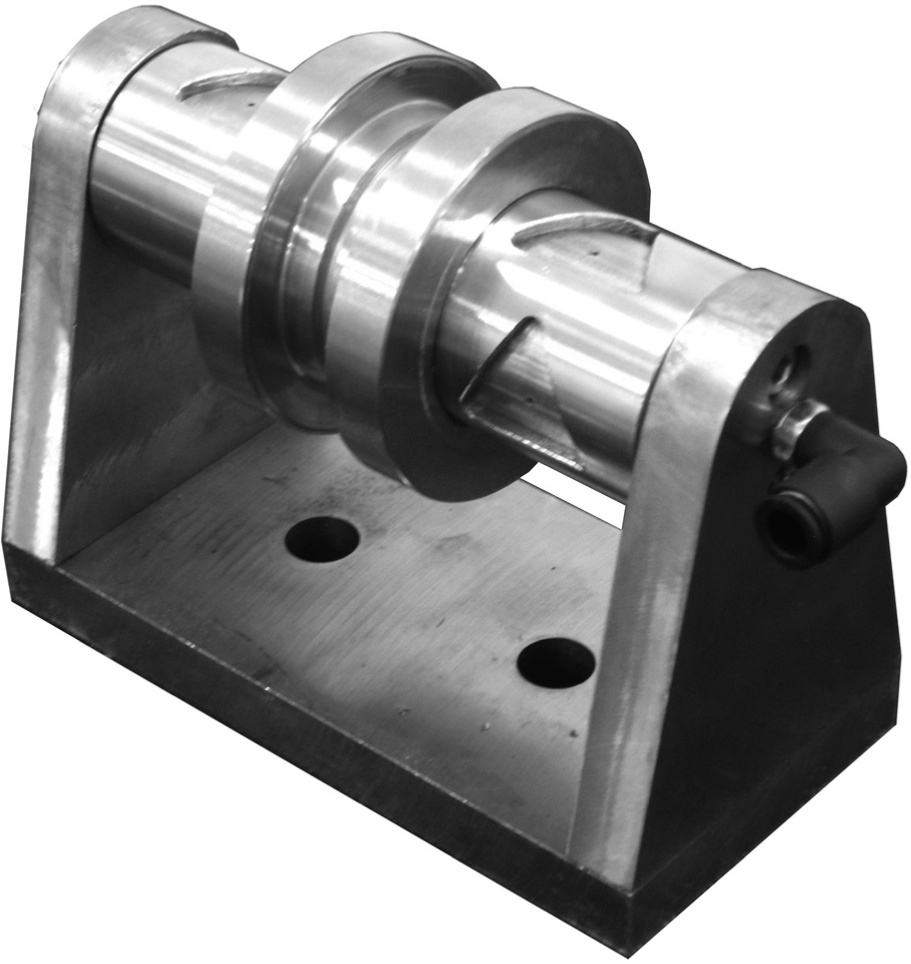
The manufactured spindle set.
Experimental setup
Figure 3 shows the experimental setup. Vibration measurement was set on VibroTest 60. Displacement sensor was an IN-085. Mounting magnet was set for sensor installation. A 1.5-mm-thick feeler was employed for set up of sensor with respect to the rotor surface. Rotational speeds on lathe machine have set on 500, 710, and 1000 rpm and therefore by 1:3.6 ratio of pulleys, the experimental rotational speeds are 1800, 2556, and 3600 rpm, respectively.
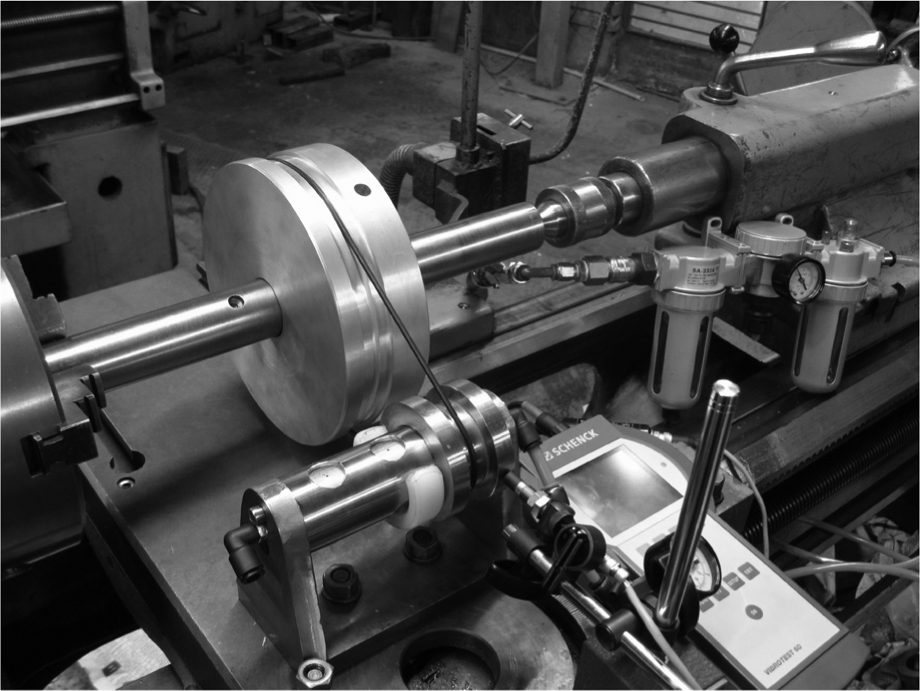
Experimental setup.
Results and discussion
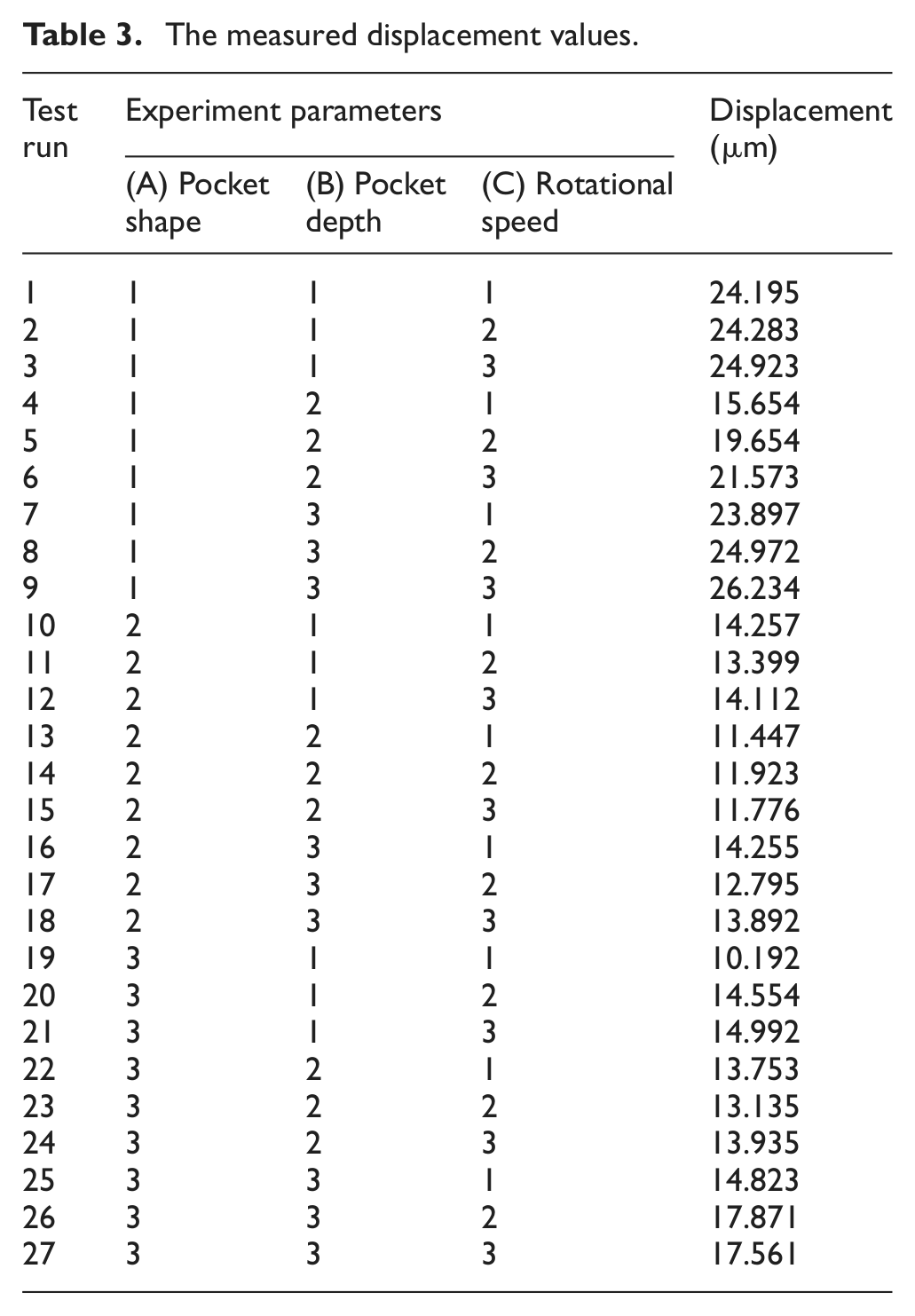
Measured displacement values for the place shown in Figure 3 are listed in Table 3. The accuracy of these results in Table 3 is 1 nm or 0.001 µm. For analyzing measured values, the design of experiments (DOE) method is employed. The analysis of variance (ANOVA) for these results is shown in Table 4.
The measured displacement values.
The analysis of variance of experiment results.
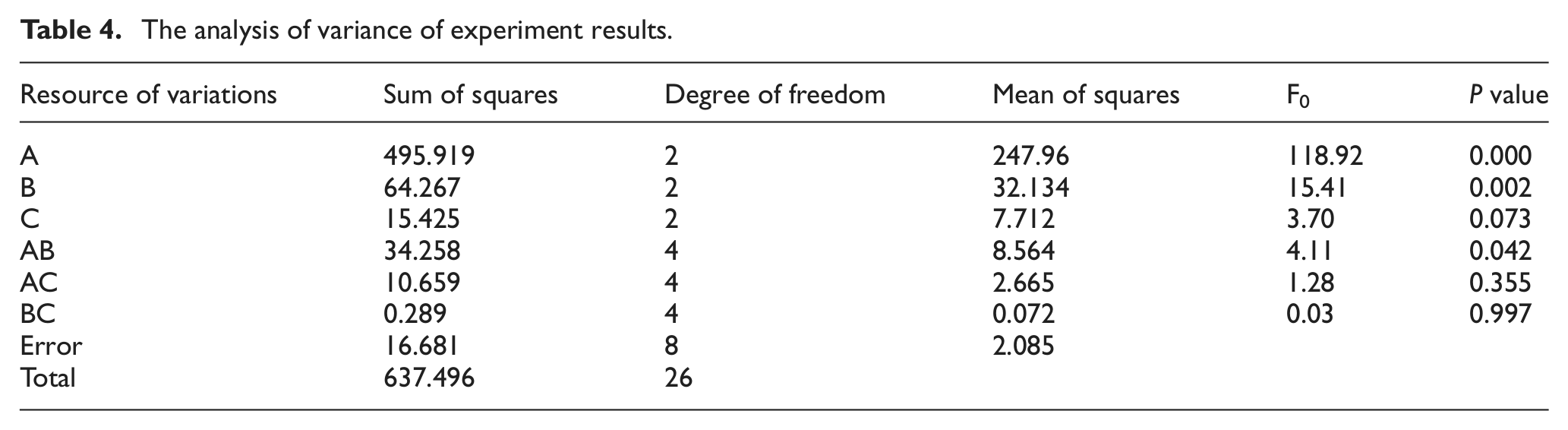
According to the ANOVA results, all studied parameters are significant in air spindle vibrations. In order to figure out the parameter levels in which air spindle vibration is minimized, the main effect and interaction plot of these parameters have been plotted.
The normal probability plot of the residuals for air spindle vibrations is shown in Figure 4. Figures 5–7 show plot of main effects in air pocket shape, air pocket depth and rotor rotational speed, respectively.
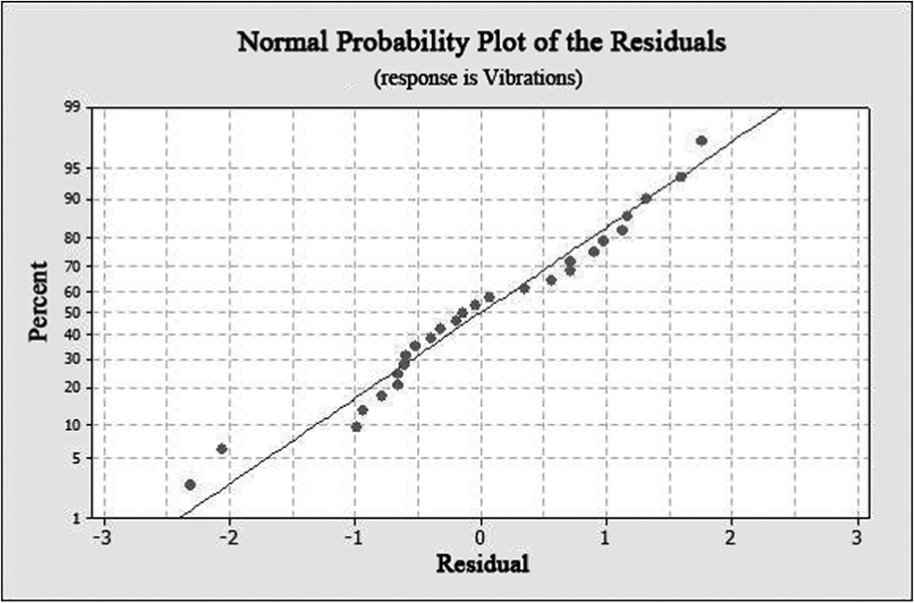
The normal probability plot of the residuals for air spindle vibrations.
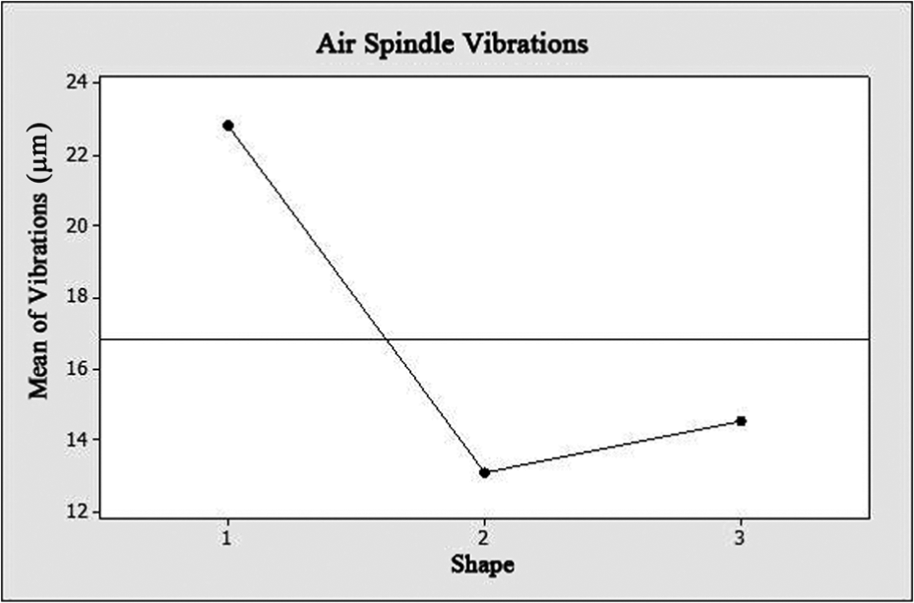
The main effect of air pocket shape on air spindle vibrations.
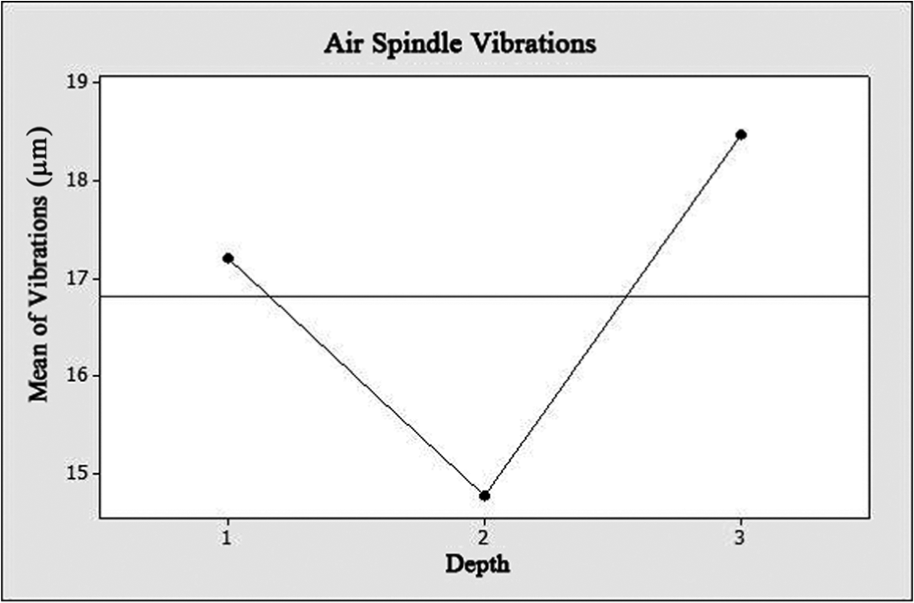
The main effect of air pocket depth on air spindle vibrations.
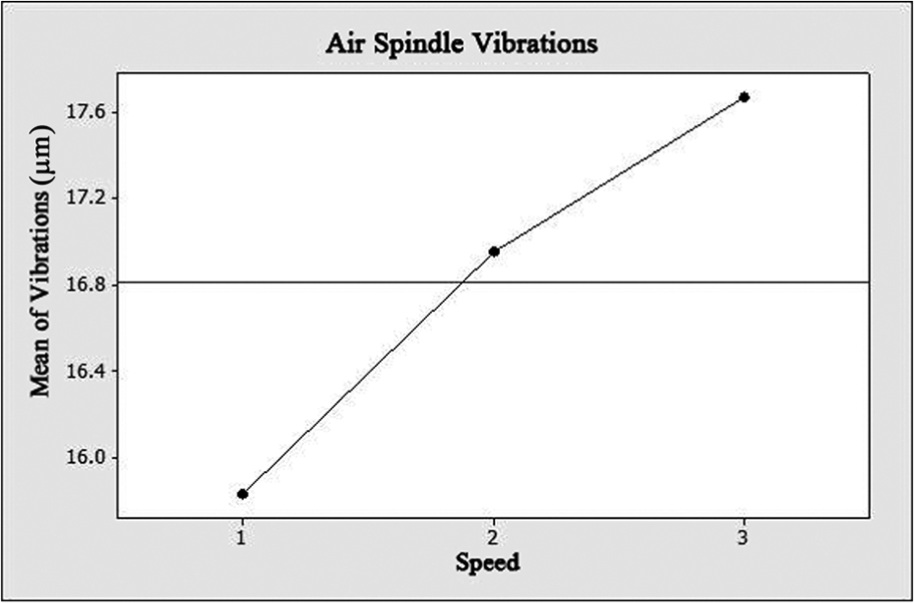
The main effect of rotor rotational speed on air spindle vibrations.
From Figure 4, the air spindle displacement values have normal distribution. From Figure 5, it can be seen that the air spindles with rectangular air pockets have minimum vibrations. From Figure 6, a value of 3 mm air pocket depth shows minimum vibration. Figure 7 shows that air spindles in lowest rotational speed have minimum vibration. The air spindle vibration increases with increasing rotational speed.
Figures 8–10 shows interaction effect plots of air pocket shape and depth, air pocket shape and rotational speed and air pocket depth and rotational speed on air spindle vibrations, respectively.
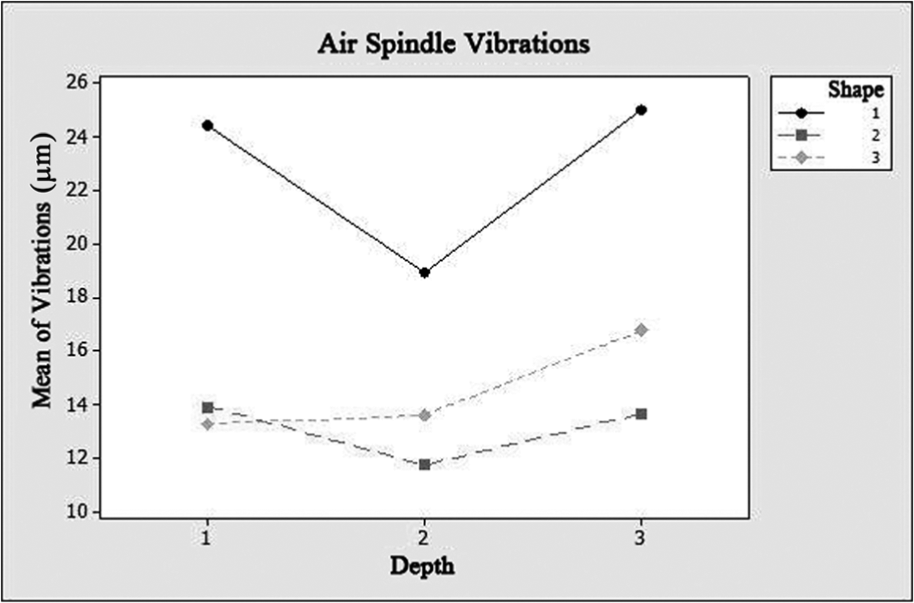
The interaction effect plot of air pocket shape and depth on air spindle vibrations.
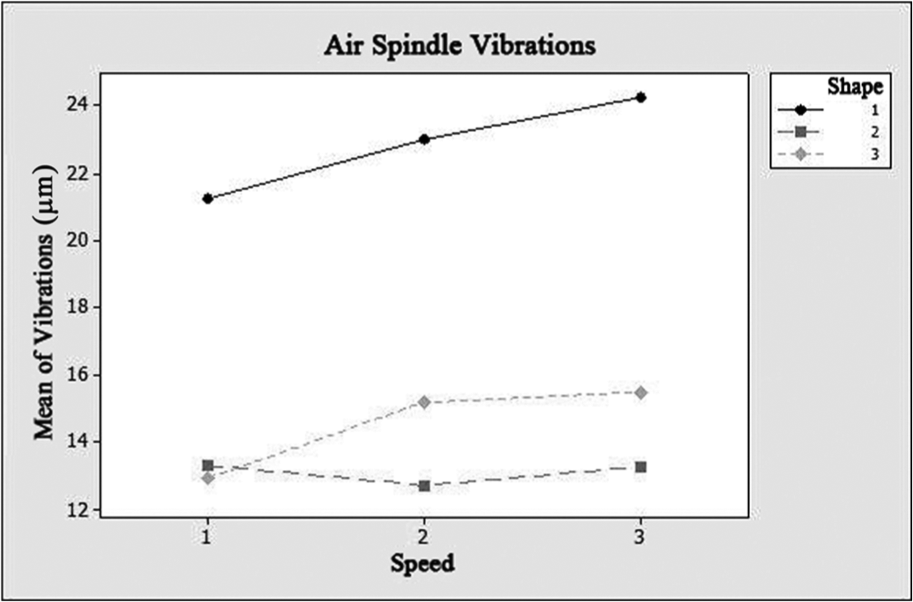
The interaction effect plot of air pocket shape and rotational speed on air spindle vibrations.
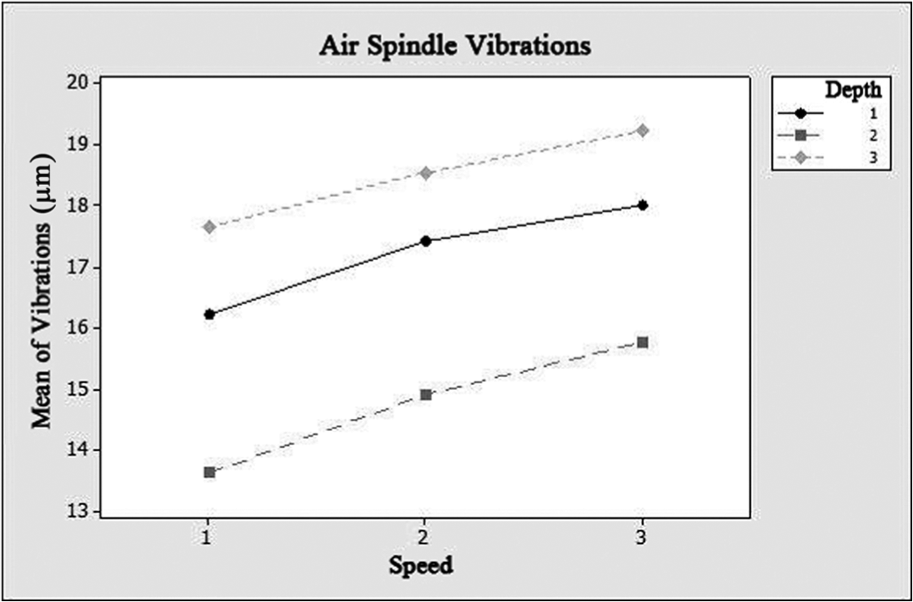
The interaction effect plot of air pocket depth and rotational speed on air spindle vibrations.
According to Figure 8, air spindle with air pocket of rectangular shape and 3 mm depth has minimum vibrations. From Figure 9, air spindle with air pocket of rectangular shape at 2556 rpm rotational speed shows minimum vibration. From Figure 10, it can be seen that the spindle with 3 mm air pocket depth at 1800 rpm rotational speed has minimum vibration. Also, from Figures 9 and 10, it can be seen that by increasing rotor rotational speed, the air spindle vibration increases.
From these results, it can be seen that because of best air distribution in air gap of rectangular and circular air pockets, these pockets have shown smaller vibrations in air spindle.
Conclusion
Air spindle vibrations have direct effects on machined surface roughness; for this reason, in order to achieve very smooth surfaces, with nanometer resolutions, studying on air spindle vibrations is very important.
From DOE, in air spindle vibrations, all estimated parameters are significant.
Air spindles with rectangular and 3-mm-depth air pockets at lowest rotational speed have minimum vibrations.
In higher rotational speeds also, the air spindles with rectangular and 3-mm-depth air pockets have minimum vibrations.
The air spindle with circular and 1-mm-depth air pockets at lowest rotational speed has minimum displacement.
The air spindle with triangular and 5-mm-depth air pockets at highest rotational speed has maximum displacement.
Footnotes
Appendix 1
Funding
This research received no specific grant from any funding agency in the public, commercial, or not-for-profit sectors.