




Abstract
The Creative and Cultural Industries (CCI) workforce is reportedly highly skilled yet lacking diversity, with higher education institutions playing a key role in developing graduates and their capacity to contribute to positive societal change. Consequently, this contribution explores how inclusivity is embedded and promoted via collaboration with businesses and communities in undergraduate and postgraduate CCI courses offered by UK business schools, where many of these courses are based. This is addressed via a qualitative content analysis of public-facing course materials commonly used by students when deciding on their course of study. Findings showcase how inclusive practices feature in curriculum design and delivery, assessment and feedback, engagement with businesses and the community, and employability support for graduates. These inform recommendations for higher education institutions on how to contribute to broadening inclusivity in the CCI labour market and beyond.
Problem statement
Cultural and Creative Industries (CCI), defined as “those industries which have their origin in individual creativity, skill and talent and which have a potential for wealth and job creation through the generation and exploitation of intellectual property” (DCMS, 2001: 5) are a rapidly growing sector in the UK. Over the past decade, employment in the creative industries has grown about five times the UK national average (Giles, 2021). The UK Government recently announced an ambitious plan to further support their sustainable growth (UK Government 2023), highlighting the importance of enabling participation for young “people from all backgrounds”. Indeed, lack of diversity in the CCI is a deep-rooted challenge. People from less privileged backgrounds are significantly less likely to be employed in the sector (Carey, O’Brien, and Gable, 2021) and women, people from ethnic minority groups, and people with disabilities are less likely to participate and advance in the workforce (DCMS, 2022). Nevertheless, a large proportion of the creative workforce are highly qualified, holding a degree/higher level qualification (DCMS, 2022), underscoring the importance of inclusion, and widening participation in CCI Higher Education (HE) (Eikhof, 2017).
The number of HE CCI courses, particularly at postgraduate level, has grown over the past decade (Flew, 2019). Several courses are offered by business schools, training the new generation of CCI managers, directors, and senior officials. Recent literature highlights that business schools have the capacity to embrace societal challenges and contribute to more equal and inclusive societies (Jaeck et al., 2023).
Purpose of the case study
In this case study, we analyse how inclusion is embedded and promoted in CCI courses offered by UK business schools and provide a list of recommendations for further advancements. Our recommendations guide course leaders and academics in improving their efforts to ensure equal opportunity and diversity and empower collective dynamics in the CCI via: (1) making their courses accessible to prospective students with identities constructed within various dimensions of cultural difference, such as ethnicity, race, class, gender, ability level, religion, nationality, and migration status (Galalae et al., 2023) and (2) creating bridges between students, communities and CCI businesses.
The lessons learned from this case study are particularly relevant in the current context, where severe funding cuts to HE CCI courses have been implemented and announced. The reprioritisation of CCI HE is based on a limited understanding of the value of HE for the CCI, informed by quantifiable indicators such as “graduate employment, progression and earnings” (Giles, 2021: 6). We suggest that HE CCI courses have the potential to enable regular dialogue between different CCI stakeholders that co-produce knowledge, programs, and experiences and to instil an inclusive mindset for future workers (Pettigrew and Starkey, 2016).
Theoretical underpinnings
Recent studies in areas such as business education (Gururaj et al., 2020; Thomas and Ambrosini, 2021), critical management (Fleming, 2019), and marketing (Kipnis et al., 2021) problematise the societal role of business schools, particularly their capacity to become inclusive organisations that “create open environments where every student can truly find their place and be empowered in a collective dynamic” (Jaeck et al., 2023: 1). Such studies draw on multiple perspectives on the concept of inclusion. At the individual level, inclusion is conceptualized as “the individual’s sense of being a part of the organisational system in both the formal processes, such as access to information and decision-making channels, and the informal processes” (Mor Barak, 2014: 155). At the organisational level, it entails the establishment of an organizational context in which everybody feels like an insider (Janssens and Zanoni, 2008). Furthermore, research on inclusion in business schools stresses their responsibility to enhance inclusion at a societal level by equipping future graduates with the knowledge and skills needed to leverage diversity and join efforts to tackle societal inequalities (Fotaki and Prasad, 2015; Gasparin et al., 2020).
Jaeck et al. (2023) propose a framework for guiding business schools’ efforts towards contributing to societal inclusion, placing the business school at the heart of the societal transition and student inclusion as a key prerequisite for this transformation. The framework is grounded on three pillars: student integration – entailing opening access to students from different backgrounds and enabling them to feel recognized and “develop a sense of belonging to the school”; student learning – comprising offering students opportunities “to develop in all their diversity through interactions with their peers and teachers” and student experience – involving the creation of “inclusive campus environments respectful of individualities while valuing common values and being open to various stakeholders both inside and outside the school” (Jaeck et al., 2023: 5). We use this framework to guide our case study analysis.
Methodology
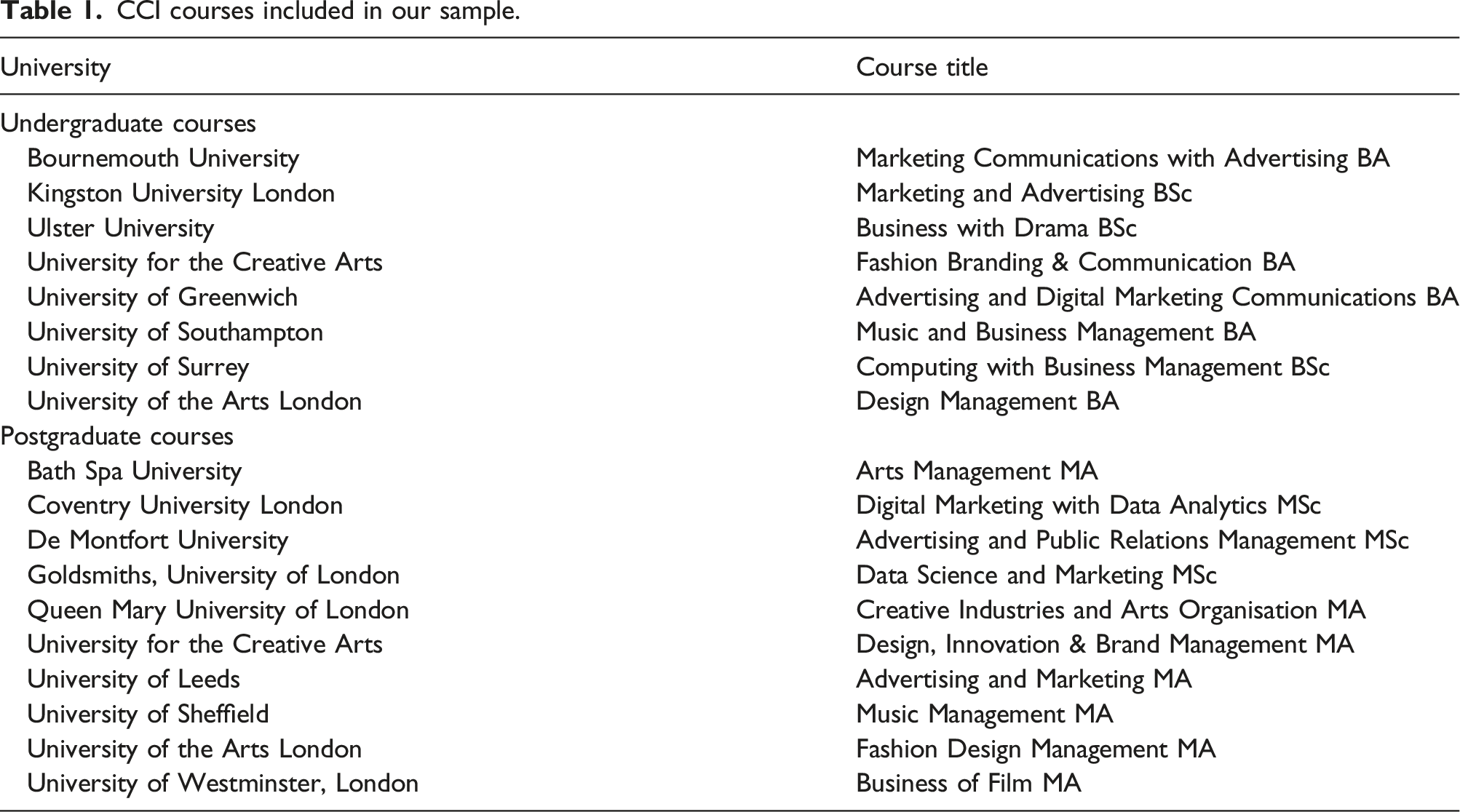
To understand how inclusion is embedded and promoted in HEI CCI courses offered by UK business schools, we review public-facing course descriptions and specifications. To select our sample, we used the Complete University Guide UK, which provides comprehensive course details from 151 universities across the UK. Our sampling procedure included three steps. First, we identified all undergraduate and postgraduate CCI courses with a business component that are topically aligned to the nine clusters of CCI industries and occupations listed in the most recent definition of CCI provided by the DCMS (Casey and O’Brien, 2020): advertising and marketing; architecture; crafts; design: product, graphic and fashion design; film, TV, video, radio and photography; IT, software and computer services; museums, galleries and libraries; music, performing and visual arts; publishing.
CCI courses included in our sample.
Findings and learnings
Course descriptions and specifications reflect institutional recognition of student integration and student experience (Jaeck et al., 2023). Specifically, most institutions in our sample highlight the multicultural and international composition of their student body, as well as the “diversity” of their communities within and, importantly, beyond the university. Less common are references to other cultural dimensions of difference, such as neurodiversity. Furthermore, several course descriptors indicate partnerships with organizations at local through to global levels: “Through case studies of seminal campaigns, programmes and artefacts, profiles of ground-breaking personalities, masterclasses from industry professionals, and guest talks from BU staff who have worked or currently work in marketing, PR, media production, journalism and communications, you will encounter and interact with diverse role models, career trajectories, and types of professional practice.” (Bournemouth University, Marketing Communications with Advertising BA).
Notably, one university webpage mentions engagement with creative and cultural stakeholders within “disadvantaged areas of east London”: “The university’s increasingly close connections with public authorities involved in arts and cultural provision (Arts Council England and Historic Royal Palaces) and in the creative industries and cultural sector in the disadvantaged areas of east London provide students with opportunities for contact with practitioners in creative industries and arts leadership both in guest contributions and in student group project work done for modules and placements.” (Queen Mary University London, Creative Industries and Arts Organisation MA).
This aligns with extended perspectives on inclusion, given that students would be exposed to a wide spectrum of talents during their enrolment on the course (Jaeck et al., 2023).
To fully realise the potential of diversity, business schools must not accept the presence of a diverse student body as an end, but channel it “to create value and enhance performance” (Jaeck et al., 2023). Our findings suggest that this direction is enacted through regular interaction with course directors, students, and module leaders, through to local and international collaborations in the form of: work-based experience (e.g., opportunities and/or support for students to undertake internships and placements); networking (e.g., the University for the Creative Arts’ “vibrant alumni community”, and Coventry University London’s “Enterprise Hub”, where students can collaborate with professionals); visits and field trips such as virtual museums and galleries on the MA Fashion Design Management at the University of the Arts London, and proximity to creative and cultural organisations and activities, such as Sheffield’s “thriving music and cultural scene”).
Turning to course design and content, which corresponds with student learning (Jaeck et al., 2023) and specifically the benefits of co-constructing programs (Pettigrew and Starkey 2016), our findings highlight collaborative course design and advisory input, as illustrated in the following excerpt: “Students can also access guest speakers, networking events, industry contacts, mentoring and placement opportunities through our industry partner, the BFI [the British Film Institute]. You will also have the chance to work in conjunction with Regent Street Cinema, gaining valuable experience on real-world film distribution projects.” (University of Westminster, Business of Film MA).
Moreover, diversity of teaching, learning and assessment is also emphasized. With regards to teaching, the professional backgrounds of educators is often referenced alongside industry speakers. Experiential learning is also evident in the sample through internships and placements, as well as simulations, consulting, and client-based projects. Finally, a range of assessment methods involving various stakeholders are listed, such as work-experience journals, reflective statements, and self-evaluation; presentations; written assessments including blogs, business reports, and case studies of international projects and organisations. “Authentic assessment” is explicitly stated in some instances, reinforcing connections to real-world practice. Further opportunities for practitioner engagement in assessments is also possible through choice of final term project as an alternative to completing a dissertation, including simulations, consulting, client-based projects, and internships.
While our findings foreground typical activities and best practices for promoting societal inclusion through undergraduate and postgraduate CCI courses, we also note the high degree of standardization of phrasing across the sample content. The Quality Assurance Agency for Higher Education (2011) acknowledges the range of purposes that programme specifications may serve, particularly in terms of informing student audiences, and quality assurance. While not all universities consider programme specifications as promotional material, they are frequently linked on course webpages and widely available to prospective students, so are likely to serve this function whether intended or not. With this in mind, we suggest that generalities may present a challenge for students seeking to distinguish between courses, and to identify a potential sense of belongingness which is fundamental to inclusion (Janssens and Zanoni, 2008; Mor Barak, 2014: 155).
Illustrative of this point are references to global citizenship within the sample. Global citizenship is a target of the United Nations’ Sustainable Development Goals (SDGs), precisely: SDG 4: “Ensure inclusive and equitable quality education and promote lifelong learning opportunities for all” and can be defined as: “the belief that individuals are members of multiple, diverse, local and non-local networks rather than single actors affecting isolated societies. Promoting global citizenship in sustainable development will allow individuals to embrace their social responsibility to act for the benefit of all societies, not just their own.” (United Nations, 2023).
In most cases, this terminology is mentioned as part of a broad mission or aim, although the following excerpt is more explanatory, connecting global graduates to engagement with various stakeholders from local through to international levels: “[DMU Global] is our innovative international experience programme which aims to enrich your studies and expand your cultural horizons – helping you to become a global graduate, equipped to meet the needs of employers across the world. Through DMU Global, we offer a wide range of opportunities including on-campus and UK activities, overseas study, internships, faculty-led field trips and volunteering, as well as Erasmus+ and international exchanges.” (De Montfort University, Advertising and Public Relations Management MSc).
While references to global citizenship suggest a commitment to society and common good (Gururaj et al., 2021), such phrasing may not translate meaningfully to prospective students, and such references are likely more indicative of conforming to university-wide strategies. Hence, universities may wish to consider how they employ language to communicate transparently with prospective students.
Conclusion: Opportunities and future pathways
Our findings foreground the range of practices currently employed for promoting societal inclusion through HE CCI courses and underscore several pathways for improvement. To make courses more representative of students’ cultural dimensions of difference, we suggest that course related materials could use language illustrative of the full spectrum of institutional diversity. This would help to move beyond a consumerist form of diversity (Scarritt, 2019), appealing to a wider range of prospective students, and reducing the risk of reproducing existing social inequalities. Furthermore, by referring explicitly to less privileged creative and cultural stakeholders, universities may inadvertently contribute to reinforcing extant structures of marginalisation through othering (Finkel et al., 2017). Conversely, to create bridges between students, communities and CCI businesses, business schools would do well to reflect on who they directly represent as creative stakeholders through their use of language, and who they exclude (Banks, 2007).
Footnotes
Declaration of conflicting interests
The author(s) declared no potential conflicts of interest with respect to the research, authorship, and/or publication of this article.
Funding
The author(s) received no financial support for the research, authorship, and/or publication of this article.
