




Abstract
This paper feeds into scholarly interest on place-based creative industrial development. It considers the creative-led economic development of two UK cities, Dundee and Chatham as emerging through a series of interdependent relationships between locally based higher education institutions (HEIs) and cultural and creative industries (CCIs) that are connected as part of a cultural and creative ecosystem (CCE). The discussion reflects on how interconnecting collaborations foster platforms and networks that support a sustainable CCE. Based on the research findings from qualitative investigations within each city, the paper applies the capability approach as a methodological tool to investigate how resources can be converted into tangible, accessible opportunities for local communities. The approach illustrates the need to focus on the resources that connect HEIs to CCIs within a geographical location for sustainable development. It concludes with a series of policy recommendations aimed at local governments to develop more integrated, ecological leadership models and policies to support sustainable CCEs.
Keywords
Introduction
The relationship between industry and higher education (HE) is a complicated but essential element of local and regional economic development (Charles, 2003). When we consider this relationship in relation to the local creative economy (Bakhshi et al., 2013), the scenario is even more complex (Gilmore and Comunian, 2016). There is ongoing debate on the terminology used to define the creative economy as a particular industrial domain (De Beukelaer & O’Connor 2016; Wilson 2022). Within that discussion it is acknowledged that whilst employment models vary considerably across the multiple sectors that contribute to both cultural and creative industries (CCIs), they are generally reliant on the presence of local, atypical workers (Dent et al., 2020). Connected to the discussion on terminology, (O’Connor, 2016) there has been a shift, within local governance models towards using creativity as a driver for local/regional economic development in terms of job creation and wider regeneration possibilities through the creation of local clusters (Courage and McKeown, 2019; Chapain and Sagot-Duvauroux 2020; Siepel et al., 2020). Both locally based higher education institutions (HEIs) and cultural and creative industries (CCIs) contribute economically to local and national economic growth through a combination of interconnected functions linked to the talent draw of students to the area as consumers of local cultural opportunities, and as conduits of future cultural and creative workers (hereafter CCWs) (Gilmore and Comunian, 2016). Both sectors are considered necessary for a sustainable creative economy (Bakhshi et al., 2013), however, there is little scholarly attention on the interconnecting relationships, collaborations and interdependencies between HEIs and CCIs within a particular geographical location.
This paper considers the resources necessary for developing sustainable creative economies operating within two small-sized cities, Chatham (England) and Dundee (Scotland). The paper purposefully applies the term cultural and creative ecosystems (CCEs) following De Bernard et al.’s (2021) expanded definition of creative activity, which challenges previous limited perspectives centred on economic growth, supply chains and geographical clusters to include a wider range of actors and relationships. Concentrating on the relationship between HEIs and CCIs within a specific geographic location enables a focus on local challenges within that ecosystem and creates an opportunity to consider targeted models of sustainability. In addition, the paper applies the capability approach (CA) (Sen, 1985) which argues for the need to shift away from narrow material dimensions of economic growth to include resources relating to freedom and agency in relation to individuals’ autonomous control of their own lives. We have applied this approach as a framework through which we can consider the various opportunities, resources and functions, aka capabilities, that are either available or absent within a local CCE for both HEIs and CCIs.
This paper is based on data derived from two independent research projects (as discussed in the methodology) both of which undertook qualitative research within the case study locations, Chatham and Dundee. It considers the role HEIs play in fostering capacity across the ecosystem and on the interdependency between HEIs and local CCIs for sustainability. Using the CA, the paper highlights differences across the CCE development strategies and trajectories in both cities but also reflects on shared challenges across both sites. It concludes with policy recommendations for more integrated and ecological leadership models and policies to support sustainable CCEs.
Higher education within cultural and creative ecosystems (CCEs)
In recent years there has been a turn in both the scholarly and local policy literature towards an understanding of the creative economy from an ecological perspective (De Bernard et al., 2021). This perspective draws on terminology appropriated from biological/environmental discourse and applies it to literature on social networks to consider the interdependent connections that operate across an economic system within a geographic scale. Gross and Wilson’s definition of a ‘cultural ecology’ (Gross and Wilson, 2020) refers to the interconnections between the profit-making creative industries, the publicly funded arts and everyday creativity. The concept has broadened to consider a range of actors and institutions, both physical and digital, operating across multiple economic, cultural and social domains. De Bernard et al. (2021) define, ‘cultural and creative ecology’ as the science of the study, and ‘cultural and creative ecosystem’ as the object being studied. In this paper we consider both Dundee and Chatham as specific geographical ecosystems, CCEs, which enable a broader understanding of a cultural ecology.
Universities play a key role in their local creative economies through multiple capacities including fostering networks and collaboration (Gilmore and Comunian, 2016) hosting hubs and platforms that foster local entrepreneurship (Cai and Ahmed 2023) and supporting community development access to arts and culture (Ashton and Comunian, 2019). The relationship between HEIs and local CCIs has previously been explored through frameworks including the triple helix (university–industry–government) and quadruple helix (university–industry–government–civil society) models (Comunian et al., 2014; Leydesdorff and Etzkowitz, 1998; Miller et al., 2018). The triple/quadruple helix model connects effectively with the broader shift to an ecological approach in understanding a creative economy within local CCEs and the dynamics of interaction, collaboration and/or disconnection across organisations, industries and individual actors to assess their development trajectories, resilience or struggles. Applying the CA to an understanding of the sustainability of the local CCEs provides a lens to consider both the available resources that connect HEIs to CCIs (and vice versa) and the freedoms and opportunities that agents have to access and make use of those connections. In addition, it enables a consideration of the robustness of resources in relation to external shocks. The impact of COVID-19, for example, can be understood as an external shock that tests the resilience of conversion factors in the relation to sustainable CCEs.
The capability approach (CA) in relation to sustainable CCEs
The CA emerged from the literature on economic growth for human development. Sen’s initial framework (1985) conceptualised a measurement system that would understand individuals as autonomous persons having the freedom to access that which they needed to live their own understanding of a ‘good life’. Sen argued for the need to shift away from narrow economic and material dimensions of growth to include factors that enabled an exploration of accessible substantive choices. The term ‘substantive’ is key; the CA considers the material and non-material resources to which individuals have access to alongside the opportunities and that enable them to convert a resource to a capability. Whilst the original emphasis was on the, conceptualisation of human wellbeing at the individual level, we argue, following Robeyns (Robeyns, 2017) that this approach can be applied at a policy level in relation to assessing a range of resources available to actors who operate within a specific geographical location. Local CCEs in smaller urban locations have been explored as offering a range of opportunities to CCWs, beyond the economic, including wellbeing and access to kinship/care networks (Alacovska et al., 2021). Paying attention to the conditions necessary for human flourishing not only enables an understanding of the need to foster local CCEs away from larger urban centres but also to ensure that the drive for economic growth surrounding urban creative development remains sustainable for those stakeholders on whom the CCE relies (Mould 2015). Following Villares-Varela et al., 2022, we consider the conversion factors that enable access to resources created within local CCEs that create opportunities for a number of individuals to participate within the creative economy. In our research, we find that both Dundee and Chatham have invested in local resources across both sectors for sustainable economic development. However, despite significant investment, both cities continue to experience significant economic inequality (discussed below). Following the CA, economic investment into creative and cultural capital spend is not being equally converted by all.
Methodology
DISCE interview sample.
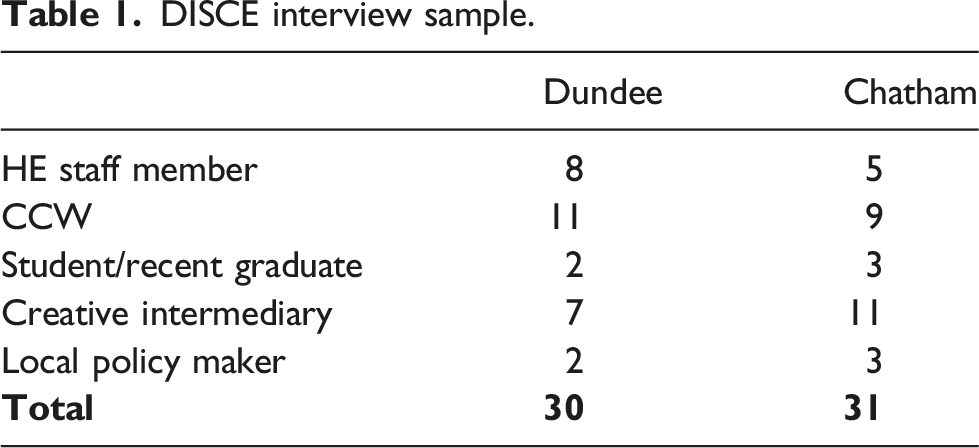
One interesting finding from the DISCE research was the number of participants who occupied multiple roles within the creative economy. Examples included creative HE workers who also worked as CCWs, or charity youth workers who contributed to creative HE. Table 1 represents the primary role that each participant identified as their main occupation. However, Comunian et al., (2022) address in further detail how CCWs operate across multiple functions within the creative economy.
The DCR project (England, 2021) aimed to generate insights into the impact of the pandemic on the organisations and individual cultural workers who make up Dundee’s cultural economy and the role of policy in supporting the city’s cultural recovery. The research built on the work of the Dundee Partnership Cultural Development Group (DPCDG) and was designed collaboratively with representatives from Leisure and Culture Dundee and Dundee City Council (Events team). It was supported by funding from the University of Dundee. The project included three online focus groups in June 2021 with representatives of creative organisations (n = 12), members of a strategic lead group for culture in Dundee (n = 7) and creative freelancers (n = 6). Additional online interviews were held with three stakeholders, including two senior HEI representatives. A total of 27 individuals took part.
Data from across both projects was analysed the matically (Clarke et al., 2015), with the CA applied as the guiding analytical framework. In analysing the data and presenting the case studies alongside each other, we were keen not to directly compare and contrast the trajectories of each city. The CA was, therefore, valuable as an analytical framing to acknowledge difference yet consider the affordances that enable particular trajectories of growth and decline.
Introducing two small-sized UK cities: Dundee and Chatham
Dundee (population 147,700) is a small city situated on the East Coast of Scotland on the banks of the River Tay. Chatham (population 76,983) is one of the five towns that make up the Medway, a unitary authority in Kent located in the South-East of England. Both Dundee and Chatham have histories of industrial decline, notably across sectors such as textiles and shipping, which have caused significant socio-economic inequality and widespread unemployment amongst local populations (Kim et al., 2022; Dent et al., 2022). Since the late 1990s, both cities have utilised local investment in HE and the Creative Economy as a specific policy drive for urban regeneration. Chatham hosts five HEI satellite campuses – the University of Greenwich (Chatham), University of Kent (Chatham), Canterbury Christ Church University (Medway campus) and University of the Creative Arts (UCA) (Rochester) – and a Further Education college – Mid-Kent College (Gillingham). In addition, significant investment has been placed in regenerating the Historic Dockyard, closed as a functioning dock in 1984, for both tourism and local creative and cultural business. Dundee’s local authority has taken a targeted culture-led approach to urban regeneration and tourism (Cult-Create INTERREG Europe, 2021) which included the development of the Cultural Quarter in the 1990s and culminated with the development of a major design museum, the V&A Dundee situated as part of the waterfront development in 2019. Dundee has a high student population and hosts two main universities, The University of Dundee, which includes the Duncan and Jordanstone College of Art and Design (DJCAD), and Abertay University, alongside the Duncan and Angus Further Education College.
Both Chatham and Dundee experience stark social and economic divisions. They both score highly on the relative English and Scottish Index of Multiple Deprivation (IMD/SIMD), with issues linked to unemployment, youth migration, high drug dependency and poverty levels. Dundee has been described as ‘a tale of two cities’ (Hamilton 2021) to signify the division between the celebratory culture-led growth concentrated around the Waterfront development and the increasing levels of deprivation in the wider communities on the periphery of the city. There have been multiple attempts to gain international recognition for its cultural offering; the city’s local authority put in an unsuccessful bid to become UK City of Culture in 2013 and was part of the unsuccessful Tay Cities 2025 bid, however, in 2014 it became the UK’s first (and still only) UK UNESCO City of Design. There is a cognitive recognition within some quarters of local government of the need to develop a more inclusive creative economy to address the wider social and economic issues for long term sustainable development. Chatham, according to official data, scores in the highest decimal on the English IMD 2 , with the neighbouring town of Rochester, also part of the Medway unitary authority, scoring in the lower deciles, indicating the stark locally situated inequality evident in a dense urban population. In 2019 Medway Council appointed a Head of Culture who implemented a series of policy initiatives in connection to regional development through the creative economy. This includes the Medway Cultural Strategy 2020–2030, which adopted a targeted consultative approach to engage as many local stakeholders as possible, and Medway’s unsuccessful bid to UK City of Culture (2025). Despite this new direction and the promise of local creative growth, the COVID-19 pandemic had a significant negative impact on local development specifically HE sustainability; UCA Rochester announced in May 2021 that Medway campus would close from 2023 (BBC News Online, 2021), with further plans to cut departments in other locally based HEIs.
Developing local CCEs between creative economy and HE: Chatham and Dundee
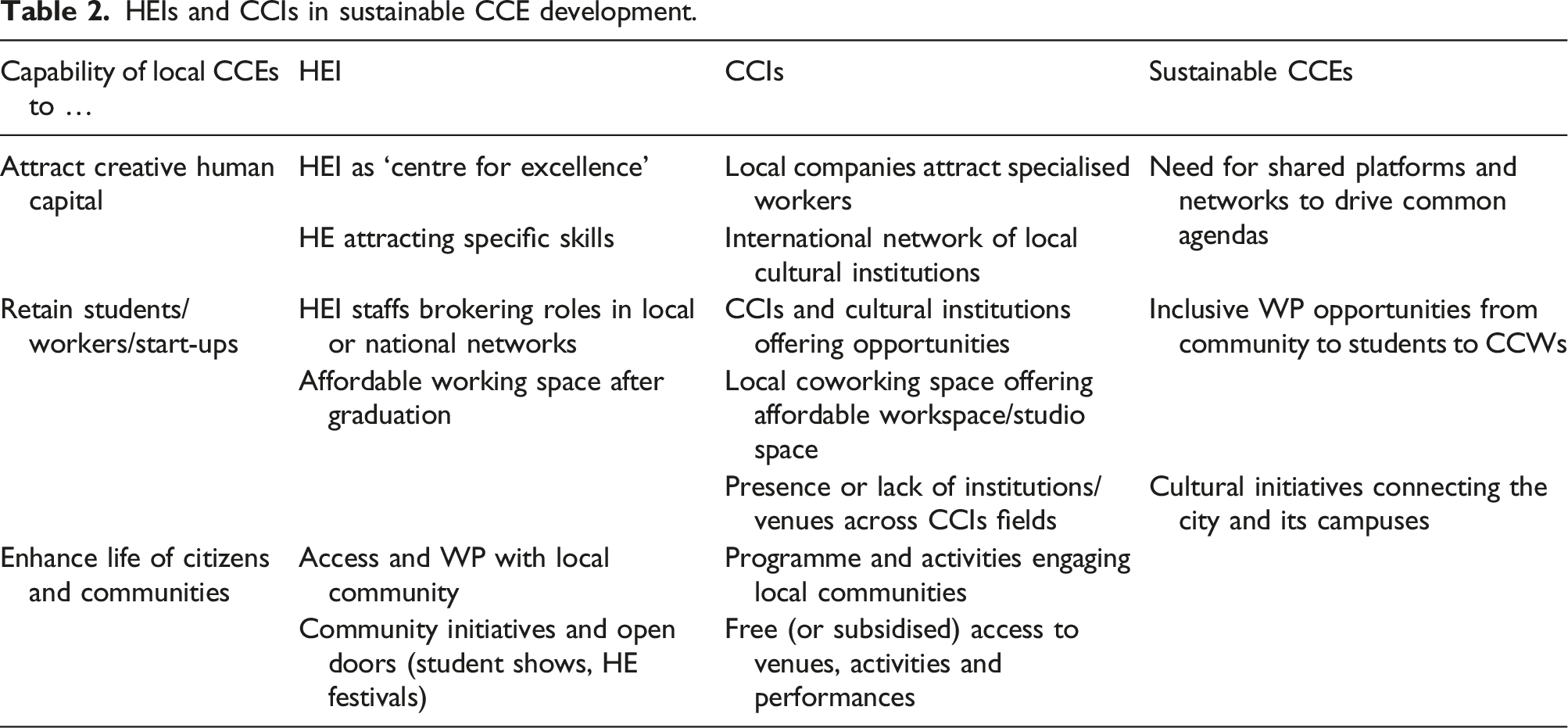
Our analysis has produced findings on the value of connected HEIs and CCIs, focusing on their capability to develop platforms and networks that contribute to sustainable development. We highlight three key (interconnected) capabilities of cities in relation to the creative economy: (1) attracting creative human capital; (2) retaining students/workers/start-ups and (3) enhancing the life of local citizens and communities. We consider here how these capabilities are dependent on conversion factors that enabled the resources available to operate as valuable functioning for individuals and organisations in the city. We consider how conversion factors are dependent on HEIs and its structure, resources and staff, but also CCIs and their local spaces, venues, knowledge and infrastructures. A key enabling factor is in the connectivity between HE and the local creative economy, as these enable sustainable CCEs to emerge. Using the CA, we highlight the mutual benefits/reciprocity of HE connections with their local CCE and discuss what happens when there is a lack of connection. This section first highlights the differences in the cultural development strategies and trajectories of our two case sites. We then discuss the shared challenges they face – the impact of COVID-19 on engagement and strategy development; implications of profit driven cultural development; and a lack of affordable space. This is followed by discussion on the need for HEIs to be part of an ecological leadership model for sustainable CCE/CCIs development and for the time taken to develop effective partnerships and strong connections/embedded HEI engagement to be recognised.
Attracting creative human capital
HEIs have potential to bring creative talent into the city, directly as employees but also through temporary events and projects/fellowships. Temporary employment opportunities and ‘visiting’ positions were seen as one way in which knowledge from outside of the university could be brought in and shared with the HEI and its students but also the wider creative community through engagement events. Meanwhile, the attraction of creative human capital longer term, through HEI recruitment (of teaching and research staff) was seen to generate benefits for the wider city, by attracting researchers and educators whose work and engagement activities would contribute to the local area. ‘it's been really interesting to see that recruitment drive with people coming from all over, and wanting to be here and actually pitching in, […] the people that we attract to Dundee who then invest in the city […]I think also, then generates a level of other stuff for the benefits of people’ – Creative HE leader, Dundee (DCR).
The reputation of the university as a ‘leader’ and ‘centre of excellence’ was seen to bolster student recruitment and ostensibly raise the profile of the city by association. It was also understood as key to being sought out for opportunities, some of which would be taken forward by the HEI (sometimes in collaboration with local creative partners) while others would be signposted to other local companies with capacity/specialist skills. HEIs in this position can, therefore, act as a distributor of creative opportunities and commissions that can be ‘filtered’ through to the wider CCE. ‘we get so many inquiries coming into the institution […] in terms of being, you know, a filter for that […] we can pass these opportunities on to, to local companies or to individuals and things and that's something that we've done forever’ – DCR, Creative HE leader.
In Chatham, despite our research uncovering significant creative-led economic investment (Kim et al., 2022), the lack of connected facilities has had a negative impact of on the local CCEs. Below, a local HE/Creative worker who lives in the area reflects on their support for the decision to move the campus to Canterbury, a more recognised regional cultural hub. ‘…we actually teach in the Dockyard itself, and that's a World Heritage Site. It is full of history. […] From a teaching perspective it's not connected with the rest of the world. Chatham and in fact, Medway is struggling. […] So we are moving it to Canterbury because there is more of a music scene, more of a cultural hub or perceived cultural hub, slightly better facilities in terms of a concert hall and a theatre that belongs to the university’ – DISCE 1 Creative HE provider, Chatham.
The DISCE research uncovered a clear desire from Creative HE practitioners in Chatham to develop opportunities in the local area for students, but the absence of accessible creative and cultural resources created a structural barrier in their capability to do so. It was noted that a lack of investment in performance spaces and campus infrastructure for student entertainment had a negative impact on student experience. Much of this was exacerbated by COVID-19. ‘…there's no live performance in Chatham. There's no opportunity for musicians in Chatham to make a living, let alone the students to even perform. So they're all sitting at home or they're sitting in, um, accommodation, university accommodation and they're trying to find things to do. And it's not comfortable. It's not good for them. It's not good for their mental health. And they're not performing even academically as well’ – DISCE 1 Creative HE provider, Chatham.
Here is it noted that while there are cultural infrastructure/HEI facilities in Chatham, with noted heritage, this was disconnected from the local area and there was a lack of wider cultural activity and infrastructure to foster and sustain a creative ecosystem. As discussed in the next section, this also has implications for the professional opportunities generated for students and graduates.
Creating opportunities for students and graduates
A significant benefit of HEI embeddedness within local CCEs is that it creates networks that generate opportunities for students and graduates. In both cities, there was interest at the local policy and HEI level in developing both local and international relationships, enhancing students’ wider engagement with CCIs and developing the HEIs’ international reputation/status. Interconnectedness between the local CCE and HE is also important in relation to attracting students to the area and offering them valuable creative and cultural opportunities and experiences, as discussed in the previous section. In Dundee, HEI representatives reflected on the role of HEIs as champions for CCIs and how that could contribute to students’ career development and graduate retention. Through this type of engagement, the HEIs have potential to develop wider networks and impact that can support the longer term development and sustainability of local CCIs that are also connected beyond the city. ‘the excellence, the international the global reputation, really matters […] it ripples out to everything, it's not elitism, it's actually about connectivity, and having that ecology of connection from the highest level of players […] our students are still invited to participate in the ongoing projects in Tokyo. And that came, simply from meeting someone at the V&A coming to see the art school […] those are all great opportunities for students that are also things that see all people wanting to stay in the city’ –DCR, Creative HE leader.
Graduates from Dundee’s universities highlighted the role of HE staff in facilitating engagement with industry. Creative HE staff are understood to be key network mediators for students (and graduates), supporting their professional development and understanding of different career paths by leveraging their connections (England, 2022). This also highlights the role of Creative HE staff as key contributors to the local CCE through their own professional practice and work with industry – independently or through research practices. ‘I'm still so thankful for this, my, the lead tutor for my media course was amazing. He was so wonderful. I'm still in touch with him now. […]. We had a lot of tutors who were in the industry, and that made such a significant difference. And they actually genuinely cared about young people's learning’ – DISCE 8 Local Charity Youth Worker, Dundee.
However, educators also supported student engagement with non-local networks. This was particularly prominent in Chatham where educators tended not to reside in the city and had therefore formed non-local connections, and where a lack of local opportunities/networks made this a necessity. ‘I have a lot of networks in London, and I've tried to encourage the students to come to those, but I suppose because I'm not based there in the centre, my existence is not based around Chatham if you like, I'm very much about spreading out networks outside of Chatham’ – DISCE 2 Creative HE provider, Chatham.
On leaving university, graduates in Dundee were noted as making use of local CCE infrastructure such as co-working and performance spaces and city networks. The space referenced in the following extract however had subsequently closed. As discussed further in the next section, this highlights the need for wider CCE infrastructure to sustain and foster graduate practices and ensure that they can develop their entrepreneurial and creative activities within the city. ‘I think one of the main things that gave me the confidence that that was possible, […] I found a place called Fleet Collective, which is a co-working space […] I just started to build up a small client base and picked up some work here and there […] trying to build myself up and starting to get to know people, obviously getting to know the people that are in the co-working space. And I think that network and being in that environment was sort of invaluable ‘ – DISCE 7 Local creative worker, Dundee.
As well as taking advantage of HEI-CCE connections during their degree (such as graduate support schemes/incubation programmes), graduates can also develop entrepreneurial activities and creative practices that benefit the city and its wider CCE. This highlights the reciprocal relationship and contribution of graduates to the local CCE.
One of the key recognised conversion factors for retaining creative HE graduates in the area was the accessibility of cheap studio space. A local fashion designer who had graduated from the University of the Creative Arts based in the area cited affordability as an enabling factor that supported career development: ‘I guess it was the access to space and for what it would cost outside of London at that same time, when my friends were setting up their studios up in London getting it a tiny fragment the size of what I’ve got here. So that was that was a big consideration’ – DISCE 3 Local Creative worker, Chatham.
While it was recognised that resources such as empty buildings/affordable space alongside the proximity and good transport links to London could provide opportunities for local creative HE students, graduates and practitioners, not enough was being done at the policy level to convert these resources to actual capabilities. That said, interviews with local creative practitioners recognised the potential for developing more spaces and opportunities for local creative HE students. ‘So what it means is more of what we do. So more low-cost space with good internet access to encourage people to set up creative business. Because we’ve got three universities, four universities nearby full of creative people and they leave and often take their creative talents to other places whereas we need the investment in facilities and in space to encourage people and come in, you know we have got our studios but that is not enough’. – DISCE 4 Local Creative Institution, Chatham.
In Dundee, both university-initiated and managed incubation spaces and graduate-run spaces were identified as key support infrastructure. ‘…we graduated June, started the business day after graduation. And then put our own computers and money into it and the university provided an incubator space for us, a small office, which really helped. And then we won a competition, an entrepreneurial competition at university for £1500 pounds. Then we just both kept our part time jobs, all living at home as well which helped’ – DISCE 9 Local creative HE provider Dundee. On Generator Arts: ‘It’s run by graduates. […] there’s a yearly intake of new people so that the committee is continually renewing from the graduate output. So they are putting on exhibitions, doing research, working with artists, working with us, working with the university, and some, some really great exhibitions. They have a membership so all their members could put in once a year of a membership show’ – DISCE 10 Local creative institution representative, Dundee.
However, it was noted that – in Dundee – a lack of affordable space, and the often-itinerant existence of urban creative organisations and creatives was connected to profit driven cultural development. This phenomenon is documented in literature critiquing creative city development (Mould 2015). ‘…we’re in discussion along with […] others with the council about how we better animate the city centre. So it’s like bringing the creatives […] we are the classic case of, of sort of regeneration and being ousted from our last property. And I’ve actually got on paper, you know, that the landlord said […] we did a great job to animate that, and now, you know, they’ve been able to fill that space. […] I can foresee a time that there will be a lot of us in the city centre, doing our thing, until they find another purpose. And that just feels not particularly strategic’ – DCR, Local creative organisation representative.
As highlighted above, while an individual actor can kick-start interesting project and opportunities to facilitate retention, their sustainability needs long-term CCEs thinking and policy.
Shared cultural opportunities and patterns of community exclusion
Beyond opportunities and professional exposure and employment, opportunities for cultural consumption can also be created. Here, HEI embeddedness/connections with the local creative economy provide opportunities for strategic relationships and collaborations with cultural institutions that can contribute to local/regional development. For example, The University of Dundee has been a founding partner in two of the city’s cultural institutions and HEI actors were seen as feeding into strategic vision for the city, acting as a key intermediary/broker. Here there was an emphasis on providing cultural access for everyone in the city, with strong connection to the social justice and cultural democracy agenda in Dundee’s cultural strategy. ‘I persuaded them to take on a business model that was based on the creative and cultural industries, because it was egalitarian, because even if it didn’t employ everybody, it would have something for everyone […]We built into our package to bring the V&A for its operational and societal processes but ensured that this building and this organization and this operation impacted as many as possible lives in the city positively’ – DISCE 11 Local creative HE, Dundee.
Chatham, as part of the broader Medway area, has also been included in a number of policy-driven interventions whose purpose is to foster partnerships between education, local businesses and government including the Thames Estuary Production Corridor (TEPC) – an ambitious programme aspiring to unite East London, the North Kent Coast and South Essex to create a major centre for creative and cultural production along the estuary and the Creative Estuary project based around the Medway River (Kim et al., 2022). The role of HEIs and the creation of opportunities for local students have been cited as key aspects towards the planned development of Chatham as a hub for both creative and digital activity. One proposal, the creation of a new creative digital hub, The Docking Station, which would be owned by the University of Kent and housed in one of the unused listed buildings in the Historic Dockyard of Chatham, has been developed as a result of the embeddedness of local HEI stakeholders within these larger policy consortiums who have pressed the need for further opportunities for Creative HE students in the local economy. ‘The ground floor, we will have the base for the Institute of Cultural and Creative Industries. We'll have a very nice café, that will not be done by the University of Kent, and teaching space and then the middle level is all studios and flexible spaces, kitted out with that technology and software to feed that space. And the top level, will be an accelerated space for our graduates, working alongside […] artists and other creative industries’ – DISCE 5 Local Creative HE provider, Chatham.
However, it was noted that despite the recognised potential of this development to create a diverse, sustainable CCE, it has not been realised. Instead, Chatham has invested in high-end housing as part of its waterfront development. What is lacking is a capability for students to access these opportunities, and a lack of investment in connectivity, which has resulted in the university studios becoming an isolated environment. As highlighted below, the disconnect with local audiences and inability to engage local communities can be challenging for HE and for local students trying to gain experiences and opportunities. ‘…they tried to […] drum up some engagement on the campus and the dockyard and trying to engage with the tourists. So we used to put on lunchtime concerts every Friday. Some evening concerts as well. […] the majority of the audience for those concerts were parents. I can't think of anyone from Chatham or Rochester who came in specifically to see the concert, they may have been about 10-15% of the audiences that were local people’ – DISCE 2 Creative HE provider, Chatham.
Local HE staff in Chatham, whilst recognising the strategic level of local planning, provided more grounded accounts of an absence of creative and cultural activity. It was recognised that money had been spent on capital projects, but not enough invested in local community arts and cultural activities and this had an impact on student opportunities in the area. ‘It's very frustrating trying to sell a creative course in an area that has no creative focus. I mean you can turn up to the campus but the campus has no creative focus either, it's a dockyard. It's beautiful, but apart from the studio nothing happens’ – DISCE 2 Creative HE provider, Chatham.
Connections and inclusions of the local population also have wider implications both for HE and CCIs. In relation to HEIs, specifically in regions and small city contexts, it is important to consider processes of widening participation (WP) that allow young (and older) people from the local communities – especially those from disadvantaged background – to have the possibility to access courses with their local HE institutions (Patiniotis and Holdsworth 2005). This also applies to local CCIs; while many products and services reach beyond the city in global digital markets, the support of local communities as customers, audiences and promoters is key to the success of CCIs working in the city.
Sustainable creative and cultural ecosystems: connecting HE and CCIs
In this section, we discuss the importance of considering beyond what HEIs and CCIs can bring to local development but how their sustainability depends on connecting them within CCEs. While a lot can be done by individual actors across institutions, organisations, businesses and venues, the capability to bring them together and create reinforcing mechanisms needs to be considered.
It is important to recognise the value of developing relationships between local HEIs, CCIs and the wider local community – including co-working spaces, charities and hospitality – in strengthening the sustainability of the wider local economy. It is also important to consider which platforms are put in place to bridge and connect institutions and agendas. Our research highlighted the importance of strong, well-maintained connections with local policy makers to obtain and sustain local ‘buy-in’. In Dundee, sustained engagement between policy makers, HEIs and CCIs was positioned as key to developing sustainable CCEs. It was noted that during the height of the COVID-19 pandemic the needs of creative and cultural organisations were not taken into account and that CCIs were expected to create their own opportunities (i.e. occupy high street spaces as meanwhile spaces to deliver creative interventions) without support from the local government. ‘I think, is not only important for the city and cultural sector in the city, but for the organisations and therefore the support they provide to the sector to have that local buy in […] if we’ve not got the kind of the backing of the city and we’ve not got the politicians involved, it’s really hard’ – DCR, City Council employee.
It is also important that truly diverse creative and cultural stakeholders engage in development discussions and that their voices are heard. In both Dundee and Chatham, there was reflection on the benefits that came from more inclusive engagement in developing their cultural strategy, including COVID-19 recovery strategy. In Dundee there was an emphasis on being more than a ‘sum of parts’. Importantly, this goes beyond gathering input from established institutional partners represented in industry/sector groups (such as the Dundee Cultural Partnership group) to gather truly inclusive and often more radical ideas for sustainable CCE development. ‘I think our shared ethos of the sector, and Dundee as a whole, which is a commitment to social justice and a commitment to equality and a commitment to working together in partnership to be absolutely more than the sum of our parts. […]those set of values and principles underpin everything that we do from the very first policy and strategy through to this particular one’ – DCR, Strategy Group Member.
It is important to consider how capabilities can change over time. Our research highlighted the evolution in the role of HEIs in both cities, but particularly Dundee. It was noted that the benefits of HEI-CCI co-location and integration described above – attraction of human capital, retention and creation and dissemination of opportunities and partnerships for communities – do not happen overnight. This is a key consideration for other cities, such as Chatham, where impacts may be expected to be measurable as a return on investment too soon, or where there is a lack of long-term strategy for sustainable CCE development. ‘I think it's an opportunity to work very hard to […] contribute to the cultural landscape of the city. […] So, it really took 20 years, […] that way of practising, that kind of way of engaging and working with others, is something that it's taken a little bit of time to grow in, in the institution, and our philosophy’ – DCR, Creative HE Leader 2. ‘But there's a move with the with Medway Council and the creative corridor to make Medway into creative hub. […] it would require a huge amount of investment, and that investment is never forthcoming. […] you can make things happen and it's very costly. But it eventually pays back over a much longer term, 10 to 20 years’ – DISCE 1 Creative HE provider, Chatham.
In considering the evolution of resources, it is of course necessary to reflect on the impact of the COVID-19 pandemic and associated economic crisis (Comunian and England, 2020). HEIs experienced a loss of resources (in finance and staffing) during the initial stages of the pandemic. This created an institutional (management) focus inwards and a shift towards core business which poses a risk to proper integration and collaboration with external partners in the immediate future and potentially longer term as HEIs are also (at the time of writing) contending with further market uncertainty and rising costs (inflation and energy).
While acknowledging the ramifications of such events on HEI capacity, it is important to note the relative robustness of HEIs compared to other parts of the CCIs sector, as noted below. This highlights the importance of considering differential capabilities within an ecosystem, as well as across different city ecosystems to understand how different dynamics and trajectories emerge. The following extract from an interview with an HE worker in Dundee demonstrates their cognisant relationship to the local creative sector and the value that an established institution can provide to locally based atypical workers; ‘…we're very old, we’re very well established, we’re very robust organisations and when times of crisis come along, particularly in the status where lots of people have very fragile livings, to protect that […]there's a real kind of strength in the, in the institutional-ness of universities that they can support in these times’ – DCR, Creative HE Leader 2.
HEIs and CCIs in sustainable CCE development.
Conclusions
This paper has explored the relationship between local HEIs with a particular focus on creative HE provision and CCIs within a specific geographic location to examine how the interconnections and interdependencies between these two sectors contribute to the sustainability of local creative economies. Applying the concept of an ‘ecosystem’ to the creative economy enables a clearer understanding of the importance of such relationships. Our two research case studies, Chatham and Dundee demonstrate a local policy recognition of the need to foster partnerships and collaborations and desire from both HEI and CCIs practitioners to strengthen the ties between them, but without sufficient investment not only towards capital spend, but on resources and opportunities that enable the development of the wider ecosystem, the local creative economy is vulnerable to external shocks. We can learn from the case of Chatham, that in order to generate benefits from graduate retention and local CCE engagement it is important to foster a foundation of CCE activity which the HEI can connect with. The case of Dundee also highlights the challenges of absent opportunities for employment and local CCE engagement and the need for mechanisms to enable graduate engagement with other local CCE actors once they have left the university.
Creative HE students contribute to a local economy as both consumers and producers of creative and cultural opportunities, but they cannot flourish within a HEI based in a geographic location which operates as a silo; the HEI needs to be embedded within the local creative and cultural ecology which builds on wider community access. The previous focus on creative placemaking/creative/cultural ‘megaevents’, planning and development around cultural tourism which drove much of local government cultural policy prior to the COVID-19 pandemic can in fact alienate both students and members of the wider local population through a lack of attention on sustaining an accessible creative/cultural scene and investment in strengthening the relationships between HE and the CCIs. Although not discussed in this research, there is also a need to consider how Brexit will impact UK HEIs and culture in the immediate future and longer term, particularly regarding the capabilities in attracting international human capital and accessing opportunities and funding from Europe.
Within the institutions considered for this paper, certain courses/individual HE workers tutors made a conscious effort to foster relationships with the local creative and cultural community. This was in part due to a high number occupying roles as both HEI practitioners and creative/cultural workers. However, local infrastructure was important to foster those connections; if it did not exist it was challenging for an individual to counter the lack of connectivity. We argue that interconnected CCEs and platforms for collaboration and shared leadership are key to bring together multiple stakeholders for sustainable cultural/creative development and benefit students, graduates and local communities.
Footnotes
Declaration of conflicting interests
The author(s) declared no potential conflicts of interest with respect to the research, authorship, and/or publication of this article.
Funding
The author(s) disclosed receipt of the following financial support for the research, authorship, and/or publication of this article: The Developing Inclusive and Sustainable Creative Economies (DISCE) research project received funding from the European Union’s Horizon 2020 research and innovation programme under grant agreement no. 822314. The Dundee Cultural Recovery (DCR) research project was funded by a University of Dundee Impact and Innovation Grant (2021).
