




Abstract
This article examines the role creative and cultural higher education plays in the top-down development of Astana – the new capital of Kazakhstan. Drawing on a mapping of higher education institutions in Kazakhstan’s old (Almaty) and new capital cities as well as qualitative interview data with creative and cultural practitioners, academics and policymakers, we explore the complex relationship between the development of higher education infrastructure and the broader development of the local creative and cultural ecosystem of the new capital. By exploring challenges and opportunities surrounding these developments within the new capital city, we draw some insight regarding the sustainable development of higher education and the creative and cultural ecosystem more broadly. We find that creative and cultural higher education plays an essential role in the development of the new capital city and its opportunity to lead as a creative and cultural capital. In turn, we argue that creative and cultural HE development cannot happen in isolation but needs to be planned and carried out as part of the more comprehensive creative and cultural ecosystem development, reinforcing the local creative and cultural economy and being shaped by it. It also needs to be seen as a long-term development strategy rather than a short-term solution to jump ahead in urban hierarchies. However, we warn that wider political influences may hinder the development of a genuinely independent creative and cultural higher education system.
Keywords
Introduction
The role of higher education (HE) in cities has been widely researched and acknowledged (Wiewel and Perry, 2015). In particular, there have been reflections on its role in relation to local and regional development (Shaw and Allison, 1999) but also on its importance in promoting innovation and industrial growth in nations and regions trying to reposition themselves on the global map. There is also a range of resources focusing more specifically on the role that creative and cultural HE plays and how it develops collaborative frameworks for the development of local creative and cultural industries (CCIs) and cities (Comunian and Gilmore, 2016). However, this research has tended to focus on the Global North and investigate long-term established synergies between the presence of established higher education institutions (HEIs) and their local economies. Research from peripheral regions and the Global South is much scarcer. There are two reasons for this. Firstly, the lack of attention towards creative and cultural economies research and policy in developing regions; secondly, the slow investment of peripheral regions in HE infrastructure towards arts and creative and cultural subjects, where preference towards STEM (Science, Technology, Engineering and Maths) has been an established framework instead (Comunian et al., 2020).
Therefore, despite the flourishing of research concerning HE and CCIs in the last decade, there are still important research gaps to address. Using the case study of Kazakhstan and drawing from extensive independent fieldwork there between 2016 and 2017, the paper provides a series of in-depth reflections on the complex interconnections between creative and cultural HEIs and capital cities.
The paper aims to make two contributions specifically. First, we aim to provide an insight into the creative and cultural HE infrastructure of Kazakhstan, a country that – despite its critical central position across Europe and East Asia – has struggled to find its voice and identity after the collapse of the USSR (Kim and Comunian, 2020). An instrumental project within Kazakhstan’s nation-building agenda is the construction of a new capital city – Astana (Anacker, 2004; Koch, 2012; Wolfel, 2002). Therefore, the second contribution of this paper is that it offers a unique opportunity to explore the role HE plays in the top-down development of a new political and cultural capital city but also what challenges these kinds of interventions can face. Due to the specific national and urban policy strategy of Kazakhstan, in the past 30 years, it is one of the few countries globally that have strategically moved its capital city and implemented policy and reforms – across economic, demographic, cultural and educational objectives – to shape a creative and cultural ecosystem (CCE) (De Bernard et al., 2021) within the new capital.
Creative and cultural HE and local development: understanding creative and cultural ecosystems (CCE)
There is extensive literature highlighting the role that HE can play in developing local economies (Wiewel and Perry, 2015) and even improving cities’ global ranking. Generally, it is acknowledged that HE can attract specialised human capital to a city or region (Storper and Scott, 2009) and that this creates further spillover effects such as innovation, start-ups and knowledge co-creation between industry, policy and HE, which can take place in the form of triple helix exchanges (Etzkowitz and Zhou, 2017).
In this paper, we focus more specifically on creative and cultural HE. We define creative and cultural HE – building on the creative human capital framework of Comunian et al. (2021) – as the tertiary-level educational infrastructure that includes subjects connected to the creative economy – “a set of knowledge-based activities focused on but not limited to the arts, potentially generating revenues from trade and intellectual property rights” (UNDP/UNCTAD, 2010 p.13). Therefore, we cover activities connected to CCIs across heritage, arts, media and functional creations. The key themes emerging in this area of research – and highly relevant to the potential development of Astana as a new capital city of Kazakhstan – are (1) the attraction and retention of creative human capital; (2) infrastructure and hubs development and (3) networks and CCE development.
Concerning the attraction and retention of human capital and, more specifically, creative human capital, there is a large body of research. Coming mainly from the Global North context, it highlights the role that HE and creative and cultural HE plays in shaping the urban environment of cities in relation to technology and innovation (Florida, 2002), art schools (Jacobi, 2020) and craft clusters (Comunian and England 2019). The research and teaching strength of specific institutions can create an agglomeration of talent and ideas but also provide highly-skilled creative and cultural workers for the local economy. As Comunian and Faggian (2014) demonstrate, this has a strong correlation with the development of creative cities and regions in the UK context, for example.
However, the attraction and retention of creative human capital connect with the broader development of the creative and cultural infrastructure and hubs in cities (Comunian and Ashton, 2019). In fact, the presence of academics, researchers and graduates and their concentration is often connected with the development of collaboration platforms and opportunities between academia and industry. According to Comunian and Ashton (2019), these can take a range of different forms, from temporary events to new studios or shared spaces. These hybrid platforms are essential for the development of new knowledge, skills and projects, so they have an impact on the potential economic and creative and cultural development of the city (Gill et al., 2019; Comunian and Faggian, 2014).
Finally, the presence of creative and cultural HE – as both specialised infrastructure and human capital – is by many considered pivotal for sustainable CCE. De Bernard et al. (2021) and Kim (2022) use the CCE framework to reflect the way CCIs and their localities develop as a complex system (Comunian, 2019) relying on networks, interactions, feedback and non-linearity to develop. HE is at the core, embedded within complex networks and relations with their CCE. The movement of people and ideas across scales (from individuals to institutions to regions and countries) allows for new emergent ideas, products/services, and institutions. It is essential, therefore, to consider reinforcing relationships between local HE and local CCE, including clusters and hubs. However, it is also important to consider the potential evolutionary nature of these ecosystems, which often remains non-linear, therefore, hard to predict or engineer (Comunian, 2019).
Research context
Kazakhstan: Nation building and creative and cultural economy
First, we offer a brief historical background to Kazakhstan’s national and urban development over the past 30 years (see also Kim and Comunian, 2020). Following the dissolution of the Soviet Union in 1991, Kazakhstan embarked on a nation- and identity-building journey through the unfamiliar waters of the market economy. Generally, Kazakhstan’s nation-building efforts rest on two – somewhat conflicting – ideological pillars: “Eurasianism” and “Kazakhification” (Koch, 2012). While the state has aspired to brand itself as the “Gateway to Eurasia” – a cosmopolitan country at the junction of Europe and Asia – it simultaneously pursued (ethnonationalist) policies that facilitate the processes of Kazakhification (Kim and Comunian, 2020). An instrumental project within this nation-building agenda of the state was the construction of a new capital city – Astana – which was envisioned to become the physical manifestation of Kazakhstan’s new identity (Anacker, 2004; Koch, 2012; Wolfel, 2002).
In 1994, Nursultan Nazarbayev – who served as president from 1990 until 2019 – announced that Kazakhstan would have a new capital city – Akmola (later renamed Astana 1 ). By the end of 1997, he would realise this ambition. At the time, Akmola was a small town. It had not experienced any major development until the mid-1950s when Nikita Khrushchev initiated the Virgin Lands campaign, which sought to transform the northern steppe of Kazakhstan into a major agricultural district of the Soviet Union.
Nazarbayev (2006) gave several practical reasons to justify his decisions, including the relative depopulation of the country’s northern territories and the fact that a capital should have a central location away from external borders. Although this fact is not listed as one of the official reasons, reclaiming Kazakhstan’s northern territories in the eyes of Russia is generally understood as a crucial geo-political motivation behind the capital relocation by academics (Koch, 2012) and the general public alike. In light of Russia’s invasion of Ukraine, in retrospect, this motivation gained a new level of legitimacy. In addition to more practical reasons, Nazarbayev (2006, 2010) also acknowledged the symbolic role of Astana for the entire nation. He writes, “I was certain that the movement of the capital city would play a big role in validating Kazakhstan as an independent state” (Nazarbayev, 2010: p. 25). Almaty – a capital city inherited from the Soviet Union – was far from an ideal capital city contender for independent Kazakhstan symbolically as its cityscape transcended its colonial and Soviet heritage – everything the state wanted to disconnect with.
After the relocation of the capital city, the CCE of Kazakhstan’s new and former capital cities have followed different developmental trajectories (Kim, 2022). After becoming the poster child for Kazakhstan’s new identity, Astana became subjected to the scrutiny of the national government, which took a very hands-on approach to managing the city’s life, including its culture. Consequently, Astana has gradually become a cradle of the so-called “official culture”, where classical and traditional/ethnic forms of creativity and culture are heavily supported and therefore proliferate (Kim, 2022). In contrast, Almaty, having handed over its official status as the capital, experienced a significant loosening of the state’s control, which possibly stimulated vibrancy in its independent creative and cultural development including underground and avant-garde creative and cultural forms. Whereas the development of the CCIs in Astana was largely top-down (orchestrated and supported by the state), in Almaty this development was unfolding in a more organic/bottom-up manner.
Kazakhstan education policies and reforms
The education system in the Republic of Kazakhstan is built on the principle of continuity and succession of general educational and educational programmes and includes seven levels: preschool education and training; primary education; basic secondary education; secondary education (general secondary education or technical and vocational education 2 ); post-secondary education; HE; and postgraduate education (Law “On Education,” Article 12, 2015). Compulsory education starts with primary education (at six-seven years of age) and ends with (general) secondary education (typically by 17 years of age). Tertiary education includes post-secondary education as well as undergraduate and postgraduate HE.
By 2015, across Kazakhstan, 131 institutions provided HE (MoES, 2016), 12 of which were in the capital city, Astana (of which 6 were privately owned), and 42 (of which 20 were private) were situated in Almaty (Ibid.). This number decreased to 128 universities in 2020 (IAC, 2020) as a result of the work of the Ministry of Education and Science (MoES) to improve the quality of HE by eliminating substandard private universities (Ibid.). Evidently, Almaty and Astana each benefit from more universities than any other city or region in Kazakhstan. By 2018, Almaty and Astana had accumulated 43 and 17 HEIs, respectively (IAC, 2019).
Out of all HEIs in Kazakhstan, 10 had a special status – National Organisation of Higher/Postgraduate Education (MoES, 2016). Initially, this status was designated to nine HEIs in 2001 as part of wider HE reforms to promote institutional autonomy (Hartley et al., 2016). HEIs with this status could now develop their own admission guidelines, issue their own diplomas and, more importantly, gain more authority over developing/designing their own curriculum. Additionally, these institutions could now offer better pay for academic staff and more generous scholarships for students (Ibid.). However, the institutional autonomy of other HEIs across Kazakhstan continues to be limited to this day, with MoES remaining the central body leading and regulating the sector (Hartley et al., 2016; Huisman, 2019; Monobayeva and Howard, 2015). This lack of autonomy among HEIs in Kazakhstan and the centralised nature of HE more broadly has been attributed to various legacies of the country’s Soviet past ranging from pre-existing structures/procedures within the sector, such as rigid funding mechanisms and administrative separateness between research and teaching to cultural norms (or “frame of mind” as Yergebekov and Temirbekova (2012) put it) of academic leaders (Hartley et al., 2016).
Kazakhstan’s leadership – the former autocrat Nazarbayev, in particular – has attached a lot of significance to the role of education in the country’s development (Hartley et al., 2016). Since the dawn of independence, the state has implemented various measures to reform its HE. For instance, Kazakhstan was one of the first Central Asian countries to sign the Lisbon Convention in 1999 and was involved in the OECD/World Bank (2007) review of its education system (Huisman, 2019). In 2010, Kazakhstan joined the Bologna Process, which has become a driving force as well as a symbol of the internationalisation of HE in Kazakhstan (Sparks et al., 2015). Key aims behind adopting Bologna included: increasing access to EU education, improving the quality of local education, and increasing academic mobility of staff and students by implementing comparable systems of degrees (Monobayeva and Howard, 2015). Additionally, in 2010, the MoES put forward the State Programme for Educational Development (SPED) 2011-2020, articulating new objectives aimed at improving the quality of education. In terms of HE, a particular emphasis is made on internationalisation, specifically on “integration into European higher education space” and on “integration of education, science and industry” by increasing the capacity of academic staff for facilitating industrial-innovative development of Kazakhstan (MoES, 2010 p.3). Despite the willingness for change, so far, Kazakhstan has struggled to make the reforms work, and as a result, the performance of local universities has remained low (Yembergenova et al., 2021).
Consequently, those who can afford to do so prefer foreign institutions to acquire their HE. The total number of mobile students abroad was estimated at 90,333 (including 265 students in Chinese universities) (UNESCO, 2023). Over the years, Russia has remained the most popular destination, hosting 59,295 students from Kazakhstan in 2015 (UNESCO, 2017) and 71,368 more recently (UNESCO, 2023). With a wide margin, other popular destinations to date are Turkey (2349 students), Kyrgyzstan (2178), Czechia (2027) USA (1994), UK (1288), Poland (1172) and Germany (1143) (Ibid.).
The citizens of Kazakhstan also have an opportunity to acquire a postgraduate education (MA or PhD) via Bolashak International Scholarship – a government programme established in 1993 that offers Kazakhstanis the possibility to pursue HE abroad. Bolashak is one of the first reforms within HE in independent Kazakhstan designed to “address the economic and state-building challenges that affected the country after the dissolution of the Soviet Union, such as the crisis of educational sector and severe brain drain, as well as the need to put the newly independent state on the world map” (Del Sordi, 2018 p.216).
Creative and Cultural Higher Education (Undergraduate and Postgraduate)
Four of the National Organisation of Higher/Postgraduate Education directly represent creative and cultural education and set the standards and agendas for national education in the creative and cultural fields, two of them are based in Almaty and two in Astana.
The Kazakh National Conservatory, named after Kurmangazy (KazNC) was founded in 1944 in Almaty, which makes it the first HEI to prepare creative and cultural cadres in Kazakhstan. The conservatory offers undergraduate as well as postgraduate degrees and is comprised of four faculties: Musicology and Management; Instrumental Performing; Vocal Art and Conducting; and Folk Music. Also in Almaty, founded in 1978, is the Kazakh National Academy of Arts named after T. Zhurgenov (KazNAA) (developed from a smaller drama faculty of KazNC that had existed since 1955). The academy is one of the most prestigious art schools in Kazakhstan, educating some of the most influential Kazakhstani artists. KazNAA operates as a college (a specialised boarding school for artistically gifted children) and a university. The HE division of KazNAA consists of six faculties, offering at least 21 creative and cultural specialisations in 2017: Faculty of Theatre Arts (including degrees in scenography, costume design, stage speech and callisthenics); Faculty of Cinema and TV; Art History (including separate degrees in history of cinema and theatre); Choreography (including degrees in directing and teaching); Painting, Sculpture and Design; and Musical art (including specialisations in traditional music).
Founded more recently (2009) in Astana is the Kazakh National University of Arts (KazNUA) building on the basis of the Kazakh National Academy of Music, which was founded in 1998 following the initiative of the president. The main reason behind the university’s establishment in Astana is to supply the new capital and the Northern part of Kazakhstan with highly qualified professional cadres, which in turn would “enrich domestic culture with new achievements in the field of arts” (KazNUA, 2017). The institution had initially only prepared music professionals, but gradually it has expanded. By 2017, the university offered undergraduate and postgraduate degrees across four faculties and 18 specialisations; this provision has expanded further. By 2022 the university incorporated eight faculties: Art; Cinema and Television; Musicology and Piano; Orchestra Performing; Social and Humanitarian Courses and Art Management; Theatrical Art and Art History; Folk/Traditional Musical Art; and Vocal-choral, Variety Art and Music Education.
Finally, one of the latest additions to Kazakhstan’s HE infrastructure (founded in 2015 in Astana) is the Kazakh National Academy of Choreography (KazNAC) – the first HEI in Central Asia that provides a full cycle of multilevel professional choreographic education (from primary to postgraduate levels of education). KazNAC offers HE degrees in the following specialisations: Choreographic Art Pedagogy, Pedagogy of Sports Ballroom Dance; Art Management; Art Studies; and Choreographic Dance.
Many other universities also supply creative and cultural HE via specialised faculties and departments. According to a UNESCO report, 48 institutions all over Kazakhstan provided higher professional training in “art specialities” [khudozhestvennyye spetsial'nosti] in 2010 (Isimbayeva, 2010). In 2017 we identified 31 institutions that provide one or more undergraduate and/or postgraduate programmes in creative and cultural subjects in Almaty (22) and Astana (9) alone.
Very few Kazakhstanis seem to pursue a creative and cultural degree. According to official statistics, in 2015, from all postgraduate students (32,170), only 499 (approx. 1.5%) were studying towards a degree in the arts [iskusstvo] (IAC, 2016). This is understandable, given the low income of creative and cultural workers and the small size of the local labour market. For example, in 2015, the average monthly nominal wages of workers across all sectors in Kazakhstan was KZT 126,021 (approx. £324 3 ), while wages of those employed within “the arts, entertainment and recreation” sectors received on average KZT 95,210 (approx. £244) (IAC, 2016). Furthermore, around 133,000 people were employed in the arts, entertainment and recreation, in 2017, representing about 1.6% of the total employed population (Ministry of National Economy, 2017).
In 2015, 2110 students were studying aboard via the Bolashak programme, but only 13 of them were pursuing a degree in the arts. The overwhelming majority were studying social sciences, economics and management (862), as well as technical sciences and technologies (677) (IAC, 2016). According to more recent statistics, more than half of the Bolashak scholarship holders studied humanities (from 2016 to 2019), and only one per cent of the grant recipients studied “culture and art” (IAC, 2019).
Methodology
This paper emerged from two research projects: a research project commissioned by the British Council Kazakhstan and independent fieldwork as part of a PhD project. Data from these two projects inform the present inquiry towards the formulation of these two specific research questions: What role does creative and cultural HE play in the development of Astana’s CCE? What challenges and opportunities surround the creative and cultural development of the new capital city?
First, a project titled “Skills Gaps and Shortages in the Cultural Sector in Kazakhstan”, aimed to provide the British Council with a contextual overview of Kazakhstan’s creative and cultural sector. It included data on the sector landscape (policy, funding, growth, etc.), creative and cultural education (availability of technical arts training, apprenticeships, etc.) and the socio-economic context to develop a greater understanding of the skills gaps and labour shortages affecting CCIs of Kazakhstan’s two major cities – Almaty and Astana. It aimed to inform the development of new educational programmes by the British Council Kazakhstan that would tackle the existing skills gaps and shortages (for a summary of the research see Kim and Goncharova, 2017). This project was carried out in 2017 (between January and June) and involved extensive desk-based research, which included a mapping of creative and cultural HE infrastructure in Almaty and Astana.
The present paper draws specifically on the mapping exercise, which involved a review of a wide range of relevant materials (both primary and secondary), ranging from city guides, governmental and educational institutions’ websites, as well as other digital and published sources such as key policy documents, national and local government reports, and official statistics. After collating a list of all HEIs in Astana and Almaty, we reviewed all the available, at the time, courses and built a database of creative and cultural HE courses available across both cities. To shortlist the so-called creative and cultural courses, we used a taxonomy put forward by UNCTAD (2004), which functionally classified CCIs into four groups and nine subgroups: heritage (cultural sites and traditional cultural expressions), arts (visual and performing), media (publishing and printed media, audiovisuals, new media) and functional creations (design and other creative services). We also included Art and Cultural management courses, which do not fit the typology. Cultural studies courses were categorised under the cultural sites subgroup.
As a result, we produced a list of 35 available institutions that provided the necessary (both higher and further/vocational) education to enter creative and cultural careers professionally in Almaty (26 institutions, four out of which provide vocational degrees only) and Astana (9 institutions). The results may be subject to omissions and inaccuracies. It proved challenging to produce a conclusive representation of the creative and cultural HE infrastructure of the two cities, due to the poor digital presence of many HEIs, at the time. Specifically, we found that (pre-pandemic) HEIs often did not offer up-to-date lists of available programmes online. The mapping has not been updated since 2017. Despite limitations, and due to the lack of comprehensive official statistics on creative and cultural HE infrastructure, this mapping is still valuable as it sheds light on how creative and cultural HE adapts following major (national and urban) policy shifts.
Second, this paper builds on the interview data collected as part of a PhD project, which investigated the impacts of the capital city relocation upon the subsequent creative and cultural development of Almaty and Astana. Overall, we conducted 48 face-to-face interviewees, 25 in Almaty and 23 in Astana. These include interviews with cultural policymakers both at regional and national levels, as well as creative and cultural practitioners. Some of the interviewees were also affiliated with different HEIs as academic staff in various creative and cultural disciplines, which enabled them to provide insight into the provision of HE. Stratified purposive sampling (Patton, 1990) proved to be the most appropriate technique for this largely qualitative inquiry. To identify research practitioners, we adopted the UNCTAD (2004) classification, introduced above. Within the UNCTAD taxonomy, we also differentiated between public, commercial, and non-profit/informal domains of culture 4 . As a result, our sample included respondents from four groups of CCIs: heritage, the arts, media and functional creations.
We applied thematic analysis to identify commonalities in the accounts of the interviewees (Braun and Clarke, 2006). Since the intention here is to focus specifically on the development of creative and cultural HE, for this paper, we draw more from HE-related discussions of our interviews. Coding followed a blended approach (Graebner et al., 2012) also known as abduction (Alvesson and Kärreman, 2007), combining inductive and deductive elements. Starting coding inductively first ensured ‘closeness’ to the data (Linneberg and Korsgaard, 2019) and allowed codes to emerge from the bottom up as no codebook or template of codes was developed a priori. The deductive element, on the other hand, ensured that the coding and analysis process stayed within the boundaries of our research question. In other words, the first round of coding remained ‘informant-centric’ and generated descriptive codes, while the second round was ‘researcher-centric’, generating sub-themes that were more analytical in nature and reflective of patterns in the data in relation to the research questions.
Developing a new creative and cultural HE ecosystem: Challenges and opportunities for Astana
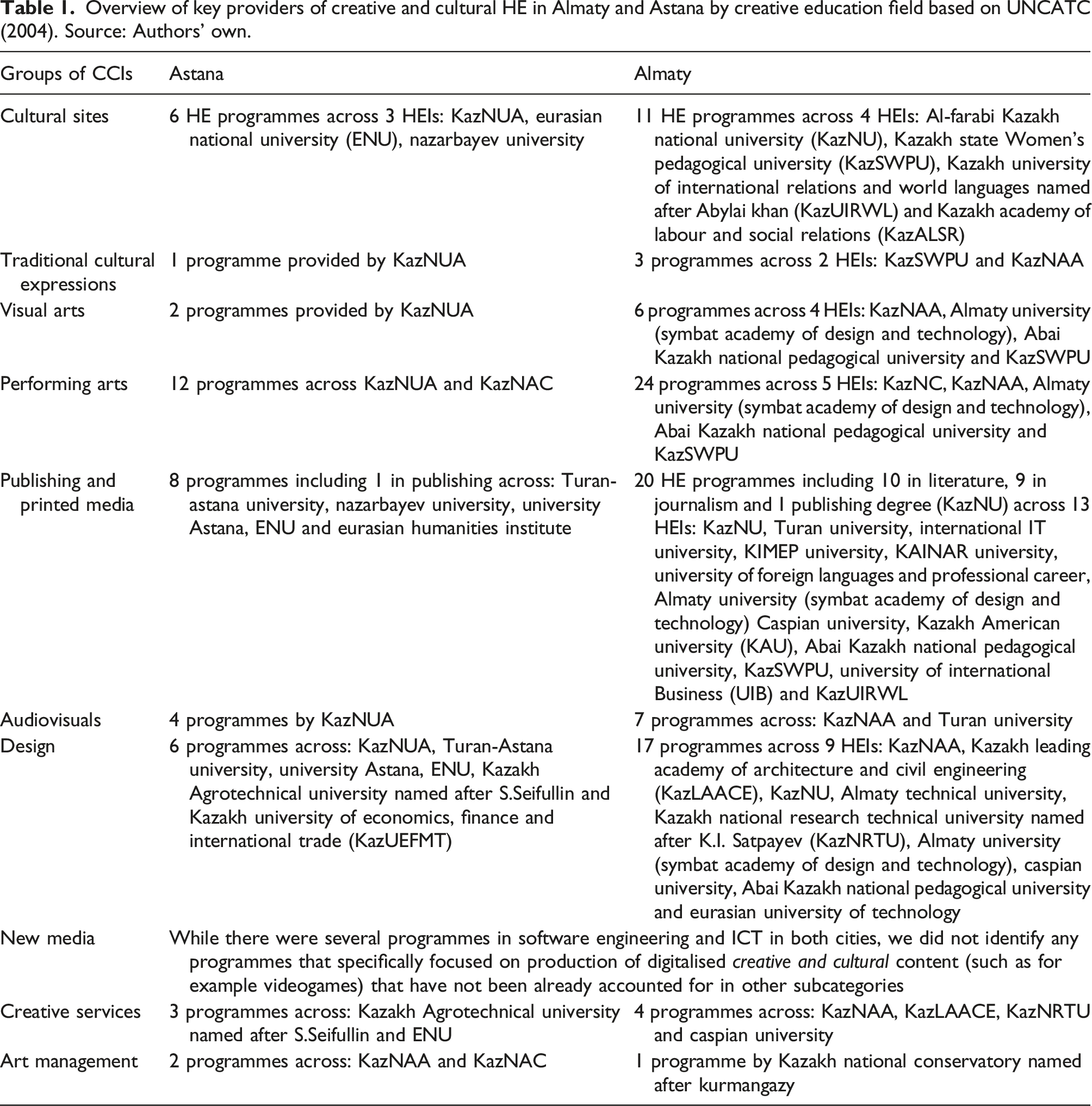
To understand the changes and development that have taken place in Astana, it is important to first map the Kazakh creative and cultural HE infrastructure, highlighting the shift in investment towards the establishment of a new creative and cultural HE ecosystem in the new capital. Building on this mapping and specifically the institutional and historical profile of the two cities of Almaty and Astana, the paper then considers the specific challenges and opportunities that the city of Astana had to face to become the designated capital. In particular, we look at how these challenges and opportunities are connected with three crucial themes in the literature: urban competition and ecosystem development; the role of migration and human capital accumulation; and the challenges of fulfilling knowledge gaps. Finally, we consider that overall, there are shared challenges for Astana and Almaty linked to broader creative and cultural policy changes needed in Kazakhstan.
Evolving HE and CCE: Comparing Almaty and Astana
Overview of key providers of creative and cultural HE in Almaty and Astana by creative education field based on UNCATC (2004). Source: Authors’ own.
Challenges of establishing an ecosystem and competition
Despite the heavy financial investment made by the government in developing Astana’s creative and cultural HE (Koch, 2014) as one worthy of a global capital city, Almaty’s HE remains seen as more prestigious because of its historical profile and strengths. Over the past two centuries, Almaty has managed to accumulate a great variety of creative and cultural HEIs, which play a vital role in the universal development of its CCE (Comunian and Faggian, 2014). In addition to simply building up more options for creative and cultural programmes in HEIs, over the years, certain Almaty-based institutions have also accumulated an established reputation and prestige that continues to benefit the entire ecosystem, which the brand-new ones in Astana are reportedly still lacking. This, allows the HEIs of the former capital to keep their admission standards high, which in turn acts as a point of attraction for “better” students (who eventually turn into high-skilled workers and who are more likely to settle in the city), as suggested by this experienced university worker from one of the leading creative and cultural HEIs in Almaty:
Alternatives arose in Astana in terms of education [...]. Nevertheless, competition is a good thing. Half of our teachers went to work there [a HEI in Astana], now we are competing with them, but so far, training at our school is much better. This is because we have existed for 50 years – half a century – and they for only 15. Plus, […] here we have the opportunity to choose from a large number of students. They come and we always have competition. There is no competition in Astana, there are simply fewer people living there, and everyone gets accepted.
Therefore, it is clear that for an emerging capital city, it is hard to break the accumulated cultural/symbolic capital (Townley et al., 2009) that Almaty displays and break the path dependency that this has created (Kim and Comunian, 2020). While it is clear that investing in the HE infrastructure is an important key ingredient towards establishing a sustainable creative city, this needs to be seen as a long-term investment, not as a short-term solution.
The role of migration and human capital accumulation
A unique aspect of Astana’s development is the tremendous speed at which the city’s CCE has been developing. This development required many cadres to appear in the city on relatively short notice. However, unlike the build-up of physical infrastructure that may occur relatively quickly, the accumulation (or repurposing) of local labour usually takes much longer (Comunian and England, 2018). Therefore, inbound migration from all over Kazakhstan and beyond has played an essential role in Astana’s development (Tatibekov et al., 2008). In addition to speedy career progression prospects, inbound migration was facilitated by various housing schemes, which provided specific categories of citizens – particularly the government and the public sector workers – with subsidised housing (Bissenova, 2012).
However, driven by the speed of the creative and cultural infrastructure development, various positions in Astana’s CCE occasionally were filled with professionals short on work experience, often attracted from Almaty itself. This is evident from the following interview account by a director of a public theatre in Astana:
In 1997, they hired me as a director. That year, we, graduates of the acting department [from an arts school in Almaty], were all hired here. The full course. When everyone received their diplomas, they were immediately taken here […] When the entire course arrived, they were able to assemble a whole corpus of 40 actors and began to stage plays. In 1997, 1998 and 1999, we took 3 courses here in a row, but not all of them stayed here [...]. The backbone of our theatre are these people – those students. This is the core of our theatre. They are not young anymore; they are mature now.
The government clearly anticipated these labour shortages as it founded several major HE institutions in Astana – (ENU in 1996 and KazNUA in 1998) – soon after independence. In an interview, a policymaker explained that the Kazakh National Academy of Music (now KazNUA), was deliberately founded to deal with the vacuum of talent that was anticipated immediately after the relocation: “The university opened up to fill the void by immediately preparing specialists in the sphere of culture”. However, these universities struggled to expand organically in such a short amount of time as another senior academic in Astana reports:
When the capital relocated here, we started inviting famous academics with their schools [departments] with their students! Because the university could not progress this fast in such a short period of time. So many moved with their schools, but not only from Almaty, they moved from Karaganda and other cities.
Therefore, migration and talent attraction were important not only in relation to creative and cultural workers but also the creative and cultural HE infrastructure development. In fact, many of our interviewees in Astana positioned within the public sphere the ecosystem (especially those affiliated with an HEI), had received subsidised housing through their workplace or the state housing programme:
The rector then said – stay here [...], I will give you the department [...] [to lead and] straight away I will give you a key to your new flat. I was like – Unbelievable! [...] Then I asked him to show me the flat. I checked it out; it was a decent two-bedroom flat. So, I promised to move in a couple of months.
Some of the Almaty-based interviewees also reported being offered appealing housing arrangements if they agreed to relocate to Astana to fill a specific position in the public sector. These offers, however, were not available to everyone. This is clear from the following account offered by an Almaty-based cultural studies lecturer reflecting on the importance of remaining within Almaty’s CCE as opposed to moving as an individual – even if it meant giving up the opportunity to enhance one’s economic capital:
I was offered a flat, so I was considering moving. But the rest of my school, my students were not offered anything. […] So, I didn’t want to go by myself and stayed here. One person in the field is not a warrior [Russian proverb similar to: there is safety is in numbers]. I don’t regret it. Even though I am from Astana originally, Almaty has become a home to me.
Whereas in Almaty, the capital swap resulted in a loss of human capital from its CCE, in Astana, the same event caused an accumulation of creative human capital. However, some of the interviews reflected on Astana with the connotation of “emptiness” to highlight that migration as a strategy could only work if enough critical mass was created to develop an ecosystem. Furthermore, despite the state's efforts, many Astana-based interviewees (11 out of 22), still felt a distinct shortage of academic staff affecting creative and cultural HE. Again, while the literature suggests that attracting human capital is very valuable and important to develop local CCE (Florida, 2002), the case study of Astana highlights that this is no easy policy as even with housing or other incentives, a city might not be able to attract the right level or kind of human capital without the correct CCE.
The knowledge gaps, experience and provision needs
Even if Astana managed to attract relevant professionals and academics, many research participants expressed that knowledge/skill gaps were still present. As mentioned above, often because people in key positions in Astana were young and lacked experience, forcing them to work on continuously educating themselves. In fact, in addition to social capital (the “emptiness” also previously mentioned), people often found themselves lacking certain professional skills and knowledge, as highlighted by this Astana-based media worker: “During this project, I realised that I did not have enough knowledge. Many things were done by intuition. […] So, I went to study abroad.” This lack of intellectual capital (Townley et al., 2009) appeared to include the lack of both codified and tacit knowledge, as pointed out by this senior museum worker from Astana, reflecting on the main challenges they encounter at the workplace: “The key challenge would be the lack of staff. […] Even when cadres come prepared [with education], they still need to be taught a lot.” Often for these gaps, they would also blame the locked-in HE system in Kazakhstan, as this art manager in Astana recalls:
I am not satisfied with the quality of my education ... The base remained from the Soviet period and, in fact, it is not bad. There are good bits that are useful ... But they don’t give a lot of history. […] There was nothing about contemporary art, absolutely nothing. Since I work more in management today, we didn’t have any subject that would teach us to write. Critical thinking was not there. We didn’t have anything that would require critical thinking in our programme compared to European education.
As a response to this situation, creative and cultural practitioners and organisations in Astana have taken recourse to self-organisation in the form of intensive training to develop themselves and their employees “from within” (Film and video producer; Astana). Reflecting on the lack of creative and cultural cadres and experts in Astana’s CCE, a media worker in Astana expressed a desire to open up an “academy” to address this gap in the future for the media industries. At the time of the interview, however, they were addressing this issue internally:
We always carry out advanced training in our team. I myself am now doing a screenwriting course [ ...] In the team, we are also constantly pumping/upgrading people up too. Recently, a guy came to us, he went through preparatory courses, and now he is our employee. In a few days, our operator/director will go to Moscow for short courses in the theory of light[…] we try to improve constantly.
These processes are equally present in public cultural organisations, as highlighted by this Astana-based public theatre worker:
Young people who previously could only dream about the status of a prime dancer, or get somewhere near the corps de ballet, which is also not limitless, finally managed to go here and perform in a worthy theatre. [...] Plus, we invited people, masters from all over the world. […] For our experienced dancers, designers and directors, it was also a great experience to work with such people. This, of course, favourably affected the growth of the professionalism of our domestic performers.
Overall, the ecosystem has continued to evolve around these skills gaps and input of knowledge and people, generating new tacit and codified knowledge that, in turn, translates into the enhanced quality of local production, as acknowledged by this Almaty-based TV producer:
When I was working [on a project] in Astana, we ordered a lot of production from Almaty. Back then, the quality of TV production was lame [in Astana]. But now they can film themselves. Production in Astana and Almaty can compete on equal footing now – in terms of technical support and creative resources.
People and organisations operating within Astana’s CCE are also developing the capacity to legitimise their cultural and artistic value (Townley et al., 2009). Although Almaty-based creative and cultural workers often expressed prejudice towards the quality and professionalism of Astana’s creative and cultural production and workers shortly after the relocation, a significant change in this attitude could also be sensed in relation to more recent times. In other words, Astana’s creative people and HE are gradually improving their reputation and becoming recognised by the wider creative and cultural community as a visual artist in Almaty puts it: “Astana has changed. Before we had this prejudice due to the prevalence of this official, art.” All this indicates further that investment in creative HE and creative human capital is a long-term strategy that requires a long-term vision and cannot solve structural gaps in knowledge or skills imminently for a city.
Ecosystem limitations in both Astana and Almaty
In both CCE, we found a range of limitations that, in many cases, hindered the development of HE across both cities. For many respondents, HE was still perceived as being “Soviet”, anchored to historical developments and lock-ins within the HE sector emerged quite strongly from the data (across 25 interviews out of 48), including in this account by an architect and urban activist from Almaty: “I noticed that many of our higher education institutions in architecture work according to the norms of the Soviet Union, just simply copy everything … I would say 80% of our norms are borrowed.”
This widespread belief about the outdated nature of HE across creative and cultural disciplines and beyond is supported by research. For example, Ahn et al. (2018) argue and demonstrate that Soviet legacies are still audible within the rigid administrative structure of HE in Kazakhstan (in terms of institutional accountability and reporting), as well as in pedagogical approaches to teaching, learning and curriculum. Isimbayeva (2010), assessing Kazakhstan’s education system specifically across creative and cultural disciplines, likewise, found educational curriculum and structure to continue various Soviet traditions, which occasionally fail to address the needs of the contemporary labour market (e.g., undersupplying creative and cultural workers whose speciality lies beyond academic styles and classical genres).
Interviewees (at least 5) from both cities emphasised a lack of managers in CCIs who would effectively support creative and cultural production in their respective fields. Generally, this gap in the context of the entirety of Kazakhstan could be explained by the fact that previously there was no need for such a profession, as this function was primarily performed by the state and its workers. Notably, Astana offers two programmes in art management compared to one in Almaty, perhaps indicating a more severe shortage of managerial skills in the capital. In the visual arts, while highlighting the shortage of art managers, several respondents also stressed a significant lack of specialists like art curators and critics or, as one interviewee categorised it, “the whole entourage around creators” (Art gallery manager; Astana). In other words, those whose attention is understood to create value for the art market (Plattner, 1998). In addition, there appears to be a lack of journalists specialising in covering creative and cultural affairs to its residents.
Finally, creative and cultural HE was perceived as not truly independent and particularly in Astana where the central political control is strongly perceived. As a lecturer expressed, to participate in Astana’s cultural scene, one needs to comply with a lot of (formal and informal) restrictions supporting the argument that ruling elites see HE projects as mechanisms of control (Koch, 2014; Del Sordi, 2018).
In Astana, you cannot talk about many things. [ …] Despite the fact that there is good funding here, it seems to me that academic freedom is absent, which of course spoils everything. You can get decent skills, but it is hardly possible to acquire freedom of thought. Especially in the arts and humanities.
Conclusions
The case study of Astana’s creative and cultural development as a new capital city has provided the unique opportunity to reflect on the way CCE develop and the role that creative and cultural HE can play within this development. We found that creative and cultural HE plays a central and essential role in the development of the new capital city and its opportunity to lead as a creative and cultural capital. We also found that strategic investment has to take place simultaneously on both fronts: (1) education and (2) creative and cultural infrastructure development. Furthermore, in relation to the fact that creative and cultural HE development cannot happen in isolation but need to be planned and carried out as part of the wider CCE development, reinforcing the local creative and cultural economy and being shaped by its development too, we found that migration plays a key role. It also needs to happen with a long-term strategy view and cannot act as a quick solution or option to disrupt creative cities' national or international hierarchies. Similarly, migration in itself cannot create a CCE as time remains necessary for a CCE to develop and grow.
In Almaty, the local creative and cultural HE infrastructure had developed organically over the decades when the city was the capital of Kazakhstan, enabling the development of the local workforce and connected CCIs. In Astana, the initial emphasis was on developing the creative and cultural infrastructure of the new capital (see Kim and Comunian, 2020). However, the sustainability of Astana’s CCE soon depended on attracting and retaining creative and cultural professionals as well as academics able to supply knowledge, skills and networks that facilitate professional development in the field. Even despite the significant investment to facilitate the inbound migration of creative and cultural practitioners and academics, the lack of networks has meant that the development of Astana as the cultural capital of Kazakhstan or a global creative city has lagged behind its formal political and institutional role as the capital city. In other words, despite the ambitious top-down development of infrastructure and pool of professionals, various gaps in provision and expertise remained. Our findings highlight the significance of self-organisation dynamics in gradually bridging these gaps from the bottom up and the need for time, networks and bottom-up development to interact with top-down initiatives to create an established CCE. Finally, in both cities, we found that the weight of previous cultural and political influences and the lack of freedom can hinder the development of a genuinely independent creative and cultural educational system; while Almaty has now become less connected with political agenda and influences as a former capital, Astana might find more obstacles in this creative and cultural development as a formal political and creative and cultural capital of Kazakhstan.
Footnotes
Declaration of conflicting interests
The author(s) declared no potential conflicts of interest with respect to the research, authorship, and/or publication of this article.
Funding
The author(s) received no financial support for the research, authorship, and/or publication of this article.
