




Abstract
Comparing three culinary movements with a distinct focus on sustainability the article explores how collective organizational actors interact with higher education institutions when promoting sustainable change in the culinary field. The article shows how the culinary movements collaborate with, emulate, and adopt practices from higher education institutions and scientific disciplines in their efforts to drive sustainable culinary change. We specify four types of interactions through which the culinary movements engage with higher education institutions: formal collaboration, imitative practices, enlisting academics, and emulating academic events. Our findings contribute to previous discussions in two ways. First, we show how collective organizational actors and higher education institutions collaborate and exchange knowledge and practices in a way that serves both parties’ quest for sustainable change and legitimacy. Moreover, we show how the presence of field-level goals (i.e., sustainability) encourages multidirectional interaction and translation of practices, as common field-level goals heightens focus on similarity rather than difference.
Introduction
Food sustainability and food security is considered as one of the ‘grand challenges’ that face humanity, as deforestation, draught, and dwindling biodiversity continue to constitute some of the most pressing issues for contemporary food production (Moser et al., 2021; SAPEA, 2020; Willett et al., 2019). While there is no quick fix to these problems, a wave of culinary movements has recently emerged in response to such challenges. These movements embrace an agenda firmly set on tackling sustainability 1 issues through reconnecting and reinventing local food cultures. The emergence of these movements raises the question of what role local institutions, such as higher education institutions (HEI), play in enabling or shaping these efforts. Higher education institutions have historically been key cultural and economic players in their local communities (Comunian et al., 2020; Madichie and Agu, 2023). Nevertheless, how higher education institutions interact with cultural actors aiming to address societal challenges is yet to be clearly defined as pointed out by Gilmore and Comunian (2016). Across educational disciplines, higher education institutions are increasingly acknowledging their responsibility and role in contributing to tackling sustainability issues by launching programs to educate and train students to become responsible leaders (Salvador and Comunian, 2022). Despite this awareness, the role of higher education institutions in shaping the culinary field has received scant attention in previous research.
Whereas the role of higher education institutions in relation to the culinary field remains underexplored, research on institutions and institutional processes has shown a keen interest towards the culinary field. Several studies have examined how institutional forces influence culinary movements by exploring how organizational actors, collectively or individually, change institutional conditions (e.g., Ferguson, 1998, 2004; Rao et al., 2003; Svejenova et al., 2007; Weijo et al., 2018). Previous studies have focused on the actions and mechanisms of creativity by highlighting theorization, reputation, and dissemination as effective practices when organizational actors try to alter their environments (Byrkjeflot et al., 2013; Svejenova et al., 2007). Despite this growing body of literature, little attention has so far been devoted to explore how collective institutional actors interact with higher education institutions in the culinary field. While higher education institutions play important roles in shaping field practices (DiMaggio and Powell, 1991) we know little about how such institutions interact with culinary movements when driving sustainable change. Taking an empirical point of departure in the culinary field and its organizational actors, this article aims to shed light on their interaction with higher education institutions by asking the question: How do culinary movements interact with higher education institutions when promoting sustainable change?
Comparing the similarities and differences between three culinary movements, this article will show how each movement addresses the sustainability challenge of food production in their local setting. Furthermore, we explore how three culinary movements – Slow Food, New Nordic Cuisine and New Anatolian Cuisine – relate to, interact, and collaborate with higher education institutions. These educational institutions include higher education institutions such as universities and professional colleges as well as institutionalized educational practices. We define culinary movements as groups of organizational actors working collectively to change culinary institutions.
Our findings show how organizational actors are inspired by (and inspire) higher education institutions as they work to address issues of food sustainability. More specifically, we find how culinary movements collaborate with, emulate, and adopt practices from scientific disciplines (e.g., anthropology, history, and biology) in their efforts to drive sustainable culinary change. As such, we identify four types of interactions through which the culinary movements engage with higher education institutions. These four types of interactions include ‘formal collaboration’, ‘imitative practices’, ‘enlisting academics’, and ‘emulating academic events’. Our findings contribute to previous discussions in two ways. First, following Gilmore and Comunian (2016) we capture the various ways in which higher education institutions and the cultural creative industries interact. We do so by showing how organizational actors and educational institutions collaborate and exchange knowledge and practices in a way that serves both parties quest for sustainable change and legitimacy. Moreover, we find how the presence of field-level goals (i.e., sustainability) encourages multidirectional interaction and translation of practices, as common field-level goals heightens focus on similarity rather than difference. Extending the work by Rojas (2012) we broaden current understandings of how movements and higher education institutions interact and influence each other.
The article is structured as follows. After outlining the theoretical framing in the following section, we describe the methodological underpinnings of the study. We then present each culinary movement separately, before comparing and analyzing how collective organizational actors across and within culinary movements interact with higher education institutions when promoting sustainable change.
Theoretical framing
The research interest in the study is on how change, in this case sustainability, comes about in the culinary field and how collective organizational actors interact with higher education institutions in this work. Our aim with this article is to explore what forms of connections exist between higher education institutions and culinary organizational actors and how concepts and practices are circulated between the culinary field and the educational field.
Previous research has shown the various ways in which higher education institutions interact and shape the local communities they reside in (Comunian et al., 2013; Madichie and Agu, 2023). Fostering innovation and technological development (Gunasekara, 2006), higher education has been cast as central cultural and economic players in their local communities (Åstebro and Bazzazian, 2011; Comunian et al., 2020). Whereas most of these studies focus on the role of higher education in relation to technological development (Lundvall, 2016; Mayer, 2007), a growing stream of research has made efforts to capture the various ways in which higher education and the cultural creative industries interact (Comunian and Gilmore, 2014; Gilmore and Comunian, 2016). For instance, Hauge et al. (2018) have outlined how cooperation between higher education institutions and cultural creative industries can lead to innovation and economic development at the regional level. Moreover, Carey and Naudin (2006) examined the role of HEI in developing future entrepreneurs in Birmingham, UK. While these studies are promising, insights on the forms and potential directions of interaction between HEI and the cultural creative industries are still scarce. Particularly, there is a paucity in research in how HEI interact with cultural actors aiming to address societal challenges (Gilmore and Comunian, 2016).
The tight link between higher education institutions and movements have been pinpointed by scholars before: “Nearly every significant movement in the past century has had a significant relationship with the university system” (Rojas, 2012: 256). This literature has grouped the interaction between movements and higher education in two streams. While one stream studies movements defined and organized by university actors (i.e., students or scholars) (e.g., Frickel and Gross, 2005), the other stream studies movements that target higher education (Meyer and Staggenborg, 1996). Both streams acknowledge how movements can affect higher education institutions or spill over into non-academic realms. Therefore, scholars have stressed the need to understand and study movements in terms of how they shape not only higher education institutions but also their surrounding environment (Rojas, 2012).
To study and explain how culinary movements engage with higher education institutions as the notion of sustainability is introduced to the field, we turn to institutional theory. A central idea in institutional theory is that ideas, concepts, and practices diffuse and circulate between organizations in organizational fields (Boxenbaum and Jonsson, 2017; DiMaggio and Powell, 1991). In such processes of diffusion, educational institutions and professions are central carriers of ideas and expert knowledge (Alvarez, 1998). Carriers introduce new ideas and practices, like sustainability, in a field, which over time results in homogeneity, as demonstrated in a series of diffusion studies (cf. DiMaggio and Powell, 1991; Greenwood et al., 2017). Building on these arguments, translation studies have theorized that the circulation of models may also lead to variations because ideas and concepts change as they spread (Czarniawska and Joerges, 1996; Sahlin-Andersson, 1996; Røvik, 2016; Wedlin and Sahlin, 2017). Central in driving processes of translation is the role of the carrier, which refers to the actor that spreads and carries the idea or concepts to new settings (Czarniawska and Sevón, 1996). Such actors bring about change in their settings by “extracting and universalizing locally specific knowledge, often codifying it into generalized concepts that they can commodify and transport to other organizations and industries where they unpack it” (Tyllström, 2021: 597).
As our study investigates the connection between higher education institutions and actors in the culinary field, we focus on the interaction between two different forms of institutional carriers, namely the interaction between the culinary movements’ actors (i.e., chefs, food activists, gastro-entrepreneurs etc.) and HEI (i.e., Universities, Business Schools, professional culinary schools etc).
Data and methods
The empirical focus is on culinary movements and their role in relation to sustainability when interacting with higher education institutions. We compare three culinary movements that explicitly have engaged with and addressed the sustainability agenda. They include Slow Food, New Nordic Cuisine, and New Anatolian Cuisine. Data is obtained from a wide range of sources, including prior studies, reports, websites, and first-hand, empirical investigations.
As our focus is on sustainability, we have made it our primary selection criteria for the three cases. This means that we have included only culinary movements that have a distinct sustainability focus and ambition at the core of their mission. We have identified the focus from the manifestos produced by the culinary movements. 2
Slow Food was chosen as the point of departure for the inquiry, as this movement marks the initial formation of a culinary movement that explicitly address the sustainability agenda. Slow Food furthermore is an inspirational source for the two other culinary movements included in the study, namely New Nordic Cuisine and New Anatolian Cuisine.
We retrieved manifestos and reports from websites curated and managed by members of the various movements. These manifestos provided us with a deeper understanding of how actors articulate goals and address sustainability. In addition to news media articles, research articles, books, manifestos, and webpage material, our study is also based on interviews and observational data gathered by the authors. This data covers the New Nordic movement and the New Anatolian movement and was collected from 2011 to 2016 and includes a total of 30 interviews. All interview material has been anonymized following the request of some of our informants. A comprehensive overview of our data material can be found in Appendix 1.
We approached our analysis by systematically reviewing the data material for each movement. Embarking on the analysis, we used interview transcripts and document statements (e.g., from the manifestos) to identify text segments that expressed examples of connection, interaction and collaboration between higher education institutions and culinary movements. We embarked on the analysis in an inductive way, reading through the interview transcripts, documents, and field notes (from visits at restaurants and culinary schools) multiple times to become deeply familiar with the data. We analyzed photos and film clips, along with text, in a triangulating manner, again focusing on identifying examples of interaction between higher education institutions and the culinary movements.
Moreover, supporting the analysis is a review of prior academic studies of culinary movements to provide the research with historical and contextual scaffolding (e.g., Andrews, 2008; Altuna et al., 2017; Byrkjeflot et al., 2013; Cappelen and Strandgaard Pedersen, 2021; Ferguson, 1998, 2004; Karaosmanglu, 2009; Simonetti, 2012; Rao et al., 2003; Svejenova et al., 2007; Slavich et al., 2020; Svejenova et al., 2022). These studies were used to gain additional insight into the gastronomic field and culinary movements. We engaged in a qualitative meta-analysis to review the field of study. This approach entailed “the aggregating of a group of studies for the purposes of (…) translating the results into a product that transforms the original results into a new conceptualization” (Schreiber et al., 1997: 314). When doing so, we focused particularly on instances of how the role of sustainability and higher education were portrayed. More specifically, we reviewed and thematically grouped the studies’ findings according to how issues of sustainability were expressed by the movements’ actors and the role that higher education played in relation to, but also independently of this topic (See Appendix 1. ‘Data Use’). In this way our aim was “to provide a concise and comprehensive picture of findings across qualitative studies” (Timulak, 2009: 591) that investigated our topic of interest.
We examined not only the expressed content of interaction, but also the explanations and justifications provided for the interaction. During this step it became clear that the sustainability approach of the New Nordic Cuisine and the New Anatolian Cuisine was heavily inspired by its predecessor Slow Food. Following this observation, we also observed how each movement was inspired by practices from higher education. We observed similar ways of interacting with higher education institutions across the movements. We therefore started looking for patterns across our cases. By tracing how sustainability was expressed and practiced across the movements, we discovered a pattern in the role that different carriers play in translating ideas of sustainability. Following an abductive approach, we turned to institutional and translation theory to interpret our emerging findings, which were subsequently refined and categorized into four distinct forms of interaction: formal collaboration, imitative practices, enlisting academics, and emulating academic events.
Culinary movements addressing sustainability
In the following section, we sequentially present each movement before identifying the four types of interaction that the movements and higher education institutions engage in when promoting sustainable change.
Slow Food
The Arcigola association, which later became the Slow Food movement, was initiated in Rome in 1986 as a reaction to two opposing trends. On one side, the pleasure of eating was still considered a catholic sin juxtaposed with gluttony. Indulging with food thus rarely took place outside of “gourmet clubs devoted to tasting luxury food and wines that were seen as exclusive intellectual circles similar to secret confraternities” (Altuna et al., 2017: 12), which was considered something reserved for the wealthy. At the same time, industrialization of food production and ‘McDonalization’ of culture (Ritzer, 2008) was on the rise, causing local communities to lose touch with traditional ways of cooking. Opposing the quickly diffusing values of fast food, Slow Food became a reference to living an unhurried, sustainable life (Slow Food, 2022a). The movement promotes the interconnected principles of good, clean, and fair food, which refers to taste, environmental sustainability, health, animal welfare and fair compensation of food producers. Slow Food claims a fundamental right to pleasure for everyone and consequently the responsibility to protect the heritage of food, together with the tradition and culture that make this pleasure possible. The movement is founded upon the concept of eco-gastronomy: the recognition of a strong connection between plate and planet, exemplified in their focus on the preservation of traditional and regional cuisine as well as local produce and ‘Zero kilometre principle’. Slow Food argues that the best place to preserve biological and cultural diversity is not in museums but rather on people’s plates, by finding new markets for precious-but-obscure foodstuffs (Pollan, 2003). The movement considers eating to be a political act and attempts to promote a view in which people regard themselves as co-producers of the food that they eat (Andrews, 2008). By becoming conscious consumers and actively supporting those who produce it, the movement promotes the view that people are a part of as well as a partner in the production process.
Slow Food International was officially founded when delegates from 15 countries endorsed its manifesto, written by founding members Carlo Petrini and Folco Portinari, on December 10, 1989 (Slow Food USA, 2022). Since its establishment, the movement has grown into a global, grassroots, non-profit organization with more than 100.000 official members in over 1.000 convivia - the local chapters – spread across 150 countries (Slow Food, 2022b). Slow Food is a member-supported organization that has developed many structural entities to help realize its goals of preservation of traditional and regional cuisine. By promoting artisan producers of quality products, the movement promotes and supports biodiversity. The Slow Food movement’s perhaps most innovative contribution has been its relentless efforts made towards cataloguing and listing culinary products. Created in 1996, the Ark of Taste is a growing catalogue of foods that have been forgotten or marginalized and are in danger of disappearing completely. The Ark lists more than 800 products (types of animals, fruit and vegetables, prepared foods, and particular dishes), and offers a resource for culinary actors concerned with sourcing and promoting quality foods (Local Harvest, 2015). In extension of the Ark of Taste, the Presidia initiative was created in 2000 to help artisan food producers more efficiently. The Presidia sustains quality production at risk of extinction, protects unique regions and ecosystems, recovers traditional processing methods, and safeguards native breeds and local plant varieties through small-scale projects. The presidia, which began with just two projects in Italy, now encompasses more than 500 projects and over 13,000 producers across the world (Slow Food Presidia, 2015). By helping small-scale producers find markets for their products, Slow Food engage in cultural preservation through ‘virtuous globalization’. With this notion, Slow Food argues how globalism’s power can also be utilized to promote sustainability by saving the regional cultures that are the most endangered by it.
Since 2004, Terra Madre has been a biannual gathering of food communities from all over the world, as well as a network among food producers, distributors, cooks, academics, and all those who work for responsible and sustainable food production. At the event, participants attend workshops and panel discussions devoted to issues such as biodynamics and genetic engineering of food. This initiative creates new networks among food producers all over the world. The movement also recognize the influential role of chefs in contemporary society and has established the project ‘Chefs Alliance’ – a network of chefs defending culinary biodiversity across the world. The network consists of more than 1.000 chefs, from restaurants, bistros, and street kitchens who support small producers by using products from Presidia projects and the Ark of Taste, as well as other local ingredients in their kitchens. The chefs are requested to add the names of the contributing producers to their menus, to give visibility to their work. Additionally, the Alliance chefs frequently travel to meet each other, participate in events, and cook together (Slow Food, 2015c).
The operational body of the protection of food diversity is appropriately called the Slow Food Foundation for Biodiversity. Its foundation, in 2003, marks the movement’s transition to a true global organization with a particular emphasis on defending agricultural biodiversity and gastronomic traditions in developing countries. This shift in focus has been helpful in fending off criticism and charges of elitism (Pollan, 2003; Simonetti, 2012). The movement has further increased its institutional legitimacy by establishing the University of Gastronomic Sciences in 2004, where they offer students a multidisciplinary academic program in the science and culture of food. By founding an educational institution, Slow Food has been able to combine the innovations and research of the academic and scientific world and the traditional knowledge of farmers and food producers (University of Gastronomic Sciences, 2015).
New Nordic Cuisine
With the ambition to change food culture in Denmark, the gastronomic entrepreneur Claus Meyer and chef René Redzepi – who had formerly worked at elBulli and French Laundry – opened the restaurant Noma in Copenhagen in 2003 (Byrkjeflot et al., 2013). In August 2003, three months prior to the opening of Noma, Meyer, Redzepi and Mads Refslund had set out on a 17-days explorative tour of the Nordic region, travelling to the Faroe Islands, Greenland, and Iceland to “absorb gastronomic inspiration and meet possible suppliers of raw materials and decor” (Skyum-Nielsen, 2010: 11) to enable the creation of a new culinary identity. Despite initial scepticism from local media, Noma quickly gained critical acclaim and recognition from international rankings, such as the Michelin Guide and the World’s 50 Best Restaurants list (number one in 2010), and soon became the symbol and flagship restaurant of New Nordic Cuisine.
With support from the Nordic Council of Ministers, Meyer and Redzepi further organized the New Nordic Cuisine Symposium, which brought together influential gastronomic personalities and chefs from across the Nordic region. The goal was to launch the New Nordic Cuisine as “a new gastronomic vision, a new possible ‘food ideology’, a new common project, and a new hope for even better foodstuffs in the Nordic countries” (Linddal, 2005). By including the Nordic countries and creating a new collective, culinary identity of an upgraded Nordic cuisine, using key terms like purity, freshness, and simplicity, the idea was that Nordic kitchen would be able to compete with the world’s leading cuisines. The symposium resulted in the formulation of the Manifesto of the New Nordic Cuisine movement, which was signed by all 12 participating chefs and gastro-experts. The movement was inspired by Slow Food’s concept of eco-gastronomy – the recognition of a strong connections between plate and planet, preservation of local and regional cuisines, and a focus on local produce (‘Zero kilometre principle’). Thus, the manifesto was an attempt to define the New Nordic kitchen in ten values. Its purpose was to capture local, original food culture by using local, seasonal ingredients from the Nordic terroir with a healthy, green, and environmentally friendly profile (Byrkjeflot et al., 2013). Innovation was characterized by foraging and the rediscovery of forgotten ingredients and techniques: “We would be working with the age-old Nordic principles of conserving foods: pickling, smoking, salting, and drying. But we would be aiming to improve the flavours rather than merely at prolonging their shelf life” (Redzepi and Meyer, 2006).
A considerable part of Redzepi’s creative and innovative effort has taken place in the Nordic Food Lab., which was established in 2006 as a workshop for inspiration and the creation of innovative dishes relevant to the Nordic region (Messeni Petruzzelli and Savino, 2012). The Nordic Food Lab. is a self-governed, open-source non-profit institution established to explore old and forgotten produce and techniques’ relevant for New Nordic Cuisine to develop new dishes and disseminate the results of this exploration. For almost 6 years the research took place on a houseboat docked outside of Noma and has since then been moved to Copenhagen University where they collaborate on research regarding “food diversity and deliciousness” (Nordic Food Lab., 2016). One of their main projects has evolved around the investigation of insect gastronomy where researchers focus on the environmental and nutritional benefits of entomophagy. Through the project ‘Discerning Taste: Deliciousness as an Argument for Entomophagy’ the movement has aimed to get rid of the long-lasting conceptions and stereotypes of what is edible and what is good, which is both socially and culturally defined. Other critical success factors have been the legitimizing approval of media, scientists (e.g., food historians, food nutritionists) and politicians, whom all provided the movement with support in various forms (Byrkjeflot et al., 2013). An example is the launch of ‘New Nordic Diet’, a research collaboration with food nutritionists from Life Science at Copenhagen University focusing on the health benefits from a Nordic diet (the OPUS project).The movement’s impact on the Nordic region can be observed way beyond culinary circles. Its influence is visible in other fields such as education, architecture, and design, which regularly refer to the New Nordic principles in their creative processes and conceptual developments. The movement further has spurred a ’trickle-down’ or so-called ‘Noma effect’ by which “the everyday food choices of many regional consumers have shifted towards consuming more local products, along with organic, bio-dynamic and environmentally sustainable produce” (Hermansen, 2012: 26).
To get inspiration and expand the movement’s influence, Redzepi has moved the entire team to London (summer 2012), Tokyo (winter 2015), Sydney (spring 2016), Tulum (spring 2017) and Kyoto (spring 2023), employing the New Nordic principles cooking with local produce. This is moreover a way to gather new knowledge and inspiration for culinary innovation. By the end of 2017 the team closed the restaurant and, in 2018, Noma 2.0 reopened as a self-sufficient, urban farm and restaurant in Copenhagen. In 2021, eleven years after Noma was voted number one on World’s 50 Best list, Noma 2.0 received its third Michelin star and was (again) voted number one on World’s 50 Best list.
New Anatolian Cuisine
The story of New Anatolian Cuisine begins with Mehmet Gürs. Gürs has earned the reputation of being “Turkey’s answer to Noma’s René Redzepi” (Cheshes, 2013) and is credited to be the one to have kicked off the contemporary restaurant scene in Istanbul. In addition to having had his own TV-series for three seasons, Gürs runs the gastronomic empire Istanbul Food and Beverage Group (Istanbul Yiyecek Icecek Grubu), which includes the fine dining restaurant Mikla. Like prior culinary movements, the New Anatolian Cuisine is guided by a manifesto. This script was published by Gürs in 2012, and explains the rationale of the movement, expressed through seven solicitations, which stresses the link between sustainability, innovation, and traditions. Despite Gürs’ pioneering role in the movement, its development has been dependent on the support and contributions of other culinary chefs and food activists in Istanbul. Collectively this group of actors constitute the emerging movement of New Anatolian Cuisine (Cappelen and Strandgaard Pedersen, 2021) and as of 2022, several of the restaurants associated with the movement, including Mikla, have earned their first Michelin star.
For the New Anatolian Cuisine, sustainability has both a social and an environmental dimension. The movement is anchored in a mutual agreement regarding the importance of protecting local heritage and cuisine with distinct reference to Slow Food’s goals on preservation of local and regional cuisines. For chefs in Istanbul, this translates into an increased emphasis on the role of the local, small-scale farmers, in line with the Slow Food movement and the principle of ‘Zero kilometre’. Threatened by rapid modernization and changes in lifestyle, the movement claims that the growing urban population of Turkey is losing touch with the cultural heritage of the region. Therefore, as ways of living change, traditions need to adapt accordingly. Because of this, the movement’s members consider innovation of tradition as one of the solutions to the deteriorating trend. Members of the movement address food sustainability through rediscovery and recreation of traditions from across the region. The traditional components used in this process ranges from unknown or neglected products, to reutilizing forgotten techniques.
A common practice among high-end chefs is their engagement in anthropological excursions, where chefs travel to find inspiration and gather material to create innovative dishes. Gürs’ findings are carefully documented and sampled by an anthropologist, before being brought back to the Mikla Lab. for further experimentation and development, where a team collaborates to innovate and create new culinary concepts and dishes (Cappelen and Strandgaard Pedersen, 2021). Thus, the members of the New Anatolian movement employ scientific tools and principles to preserve and renew regional traditions.
Although the movement’s actors share a mutual purpose and mission, two main groups of actors constitute the movement. For the first group, which is formed by chefs cooking at fine dining restaurants, one of the main objectives is to create novel gastronomic experiences by using the restaurant as a showroom for sustainable innovation. The second more recent, but equally important group, includes the non-profit organization Gastronomika, which operates independently of the fine dining chefs and establishments, however with a parallel agenda. The group is a grassroots organization and is characterized by a flat, organic structure, run by volunteers and is dependent on sponsorship funds. The movement’s dual form of structuring enables it to reach a wider audience on both a local and international scale, which helps the movement evade criticism of elitisms (Cappelen and Strandgaard Pedersen, 2021). Members of both groups have been or are currently involved in the local Slow Food chapter and are also in regular contact with leading members of the New Nordic Cuisine movement.
Gastronomika comprises an interdisciplinary project team of chefs, designers and historians who collaboratively work to revitalise and transform Anatolian cooking for modern palates. Their goal has been to change people’s perceptions of Turkish and Anatolian cuisine, while using a vast spectrum of traditional ingredients and cooking techniques to create contemporary, sustainable forms of local gastronomy. By constructing an open, bilingual, public archive called the KaraTahta (Blackboard), Gastronomika has attempted to democratise the culinary movement by inviting people to share recipes and knowledge, thereby collectively helping to create the New Anatolian Kitchen. Moreover, the local community is invited to take part in cooking sessions through the initiative #AçıkMutfak (Open Kitchen), in which Gastronomika’s chefs help community members to cook and explore recipes and techniques of the regional cuisine.
Establishing inter-organizational relationships and collaborating with influential NGOs and educational institutions, has further helped to increase the network building and diffusion of new ideas and practices. For example, Gastronomika has participated in a collaborative project together with a local culinary arts school where they, together with a local food anthropologist, have created a dictionary of the local food culture. Chefs collaborate also with local, culinary educational institutions on course development, which focus specifically on local culinary traditions. Until recently Turkish culinary education was passed on from one generation to the next, rather than through educational institutions. Thus, culinary programs offered by educational institutions is a fairly recent phenomenon and the content of those programs has been oriented towards European, specifically French, cooking traditions. Culinary students graduating from local institutions have thus lacked formal training in the traditional local cuisine. Chefs involved in the movement have strived to change this by participating in course development and by giving lectures and presentations to culinary students and aspiring chefs. These efforts have enabled the movement to enlist support from aspiring students and to influence the coming generation of new Turkish chefs.
Finally, the movement’s members participate in online conversations and field-configuring events, through which the members can communicate the movement’s purpose to some of the most influential actors in the global field. Such events have included organizing Yedi, a two-day food symposium with local and international presenters, as well as participating in international food conferences such as the Copenhagen MAD event.
Dimensions of culinary movements.
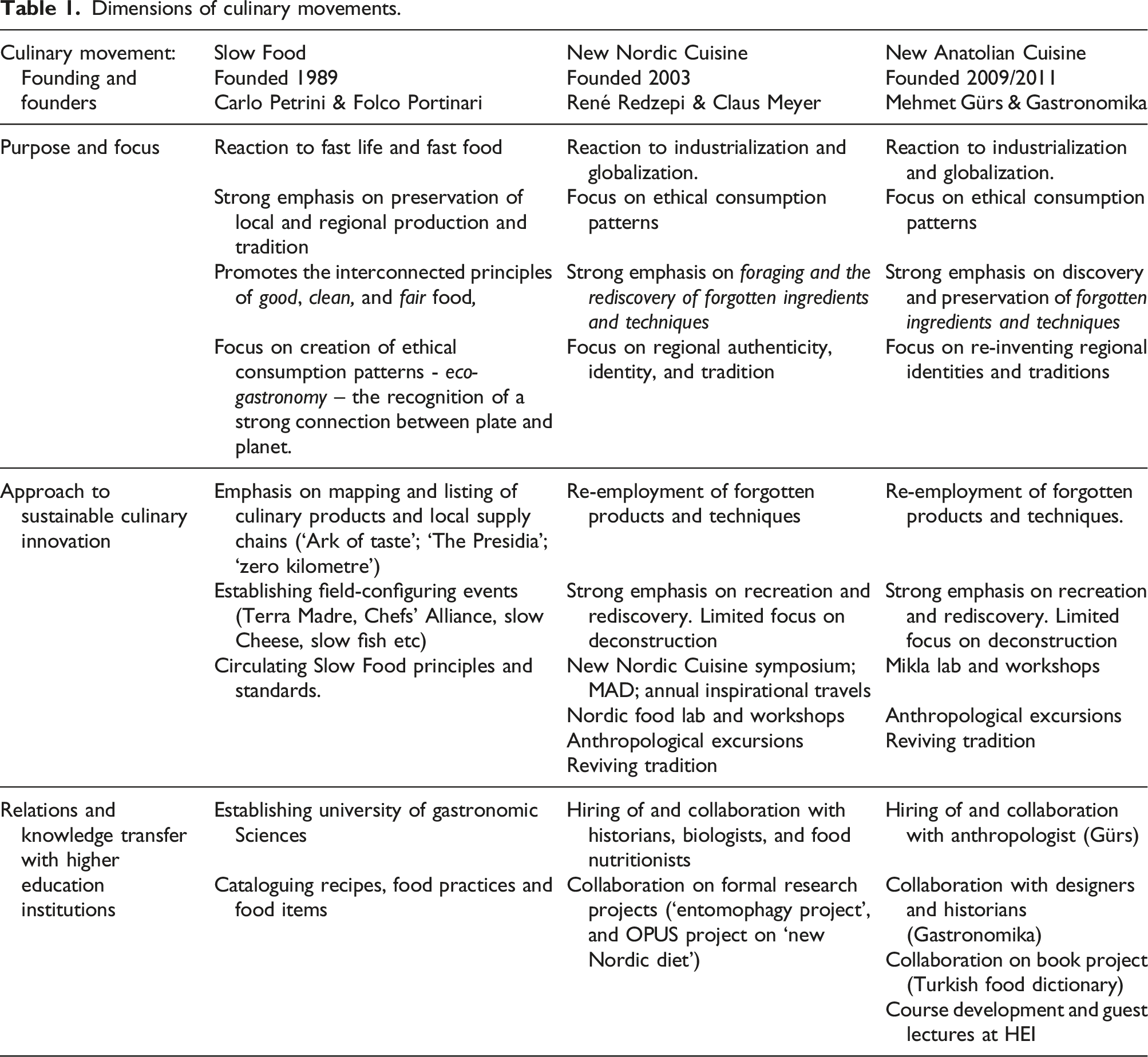
In sum, all three culinary movements work on the sustainability agenda, both in relation to the social and the environmental dimension of sustainability. In doing so they appear to be highly inspired by and interact with higher education institutions by borrowing practices from scientific disciplines, by collaborating with educational institutions, and by organizing and participating in field-configuring events. In the following section we outline four types of interaction that movements and higher education institutions engage in when promoting sustainable change.
Analysis of culinary movements
When comparing the three culinary movements and their approaches to sustainability, we identify several instances of imitation and translation of models and practices from higher education institutions, grouped into four types of interaction between higher education institutions and the culinary movements in the field: (1) Formal collaboration: Formal collaboration with higher education institutions on research projects (e.g., ‘Entomophagy project’, ‘OPUS Nutrition project’, ‘Turkish food dictionary’ with Universities and Culinary Art Schools) (2) Imitative practices: Imitative translations, emulating approaches, and models from higher education institutions (e.g., by using of the university, workshop, or laboratory format) (3) Enlisting academics: Hiring of (or collaborating with) academics (e.g., anthropologists, food historians, designers, food scientists) (4) Emulating academic events: Emulating the academic conference model (e.g., Terra Madre, MAD, New Nordic Cuisine Symposium, Yedi) to build networks and circulate ideas and concepts of sustainable food
We identified several instances of formal collaboration between culinary actors and higher education institutions. Such collaborations involve research projects (e.g., OPUS Nutrition project, ‘Food diversity and deliciousness project’, and ‘Entomophagy project’) in the case of New Nordic Cuisine. In the case of New Anatolian Cuisine we observe both knowledge production (Turkish food dictionary) and course development. These efforts are all examples of initiative aimed to promote the sustainability agenda. The movements emphasize and work on generating knowledge to be used by the movement members. For example, Slow Food work on mapping and listing of culinary products and local supply chains (‘Ark of taste’; ‘The Presidia’; ‘Zero kilometre’) whereas Gastronomika, the non-profit organization, who is part of New Anatolian Cuisine, work along similar lines mapping and establishing an open, bilingual, public archive, the KaraTahta (Blackboard).
The second form of interaction, imitative practices, allows culinary movements to approach sustainability through scientific models and practices. To create and develop culinary innovations, actors in the culinary field (gastro-entrepreneurs, chefs, restaurateurs, and culinary movements) depend on search and recombination (Messeni Petruzzelli and Savino 2012). This takes place as a type of cross-fertilization in which practices and process from other fields (e.g., art and design) and academic disciplines in higher education institutions (e.g., Anthropology, History and Biology) are searched for, identified, borrowed and made usable in combination with existing ideas and practices. In this process of culinary development, a scientification of the work practices is taking place, when the culinary movements imitate practices from higher education institutions and transfer them to their culinary work practices. The scientification includes searching for, identifying, analyzing, and borrowing practices and techniques from academic disciplines outside of the culinary field (e.g., anthropology, history, biology, science, design and art.). 3 Moreover, the Slow Food movement has established their own ‘University’, which is named and modelled after higher education institutions.
The third form of interaction, enlisting academics, involves how actors in the culinary field connect with academics and make use of these carriers of academic knowledge either in the form of formal hiring or collaboration with the academics. Examples of this form of interaction was found in the cases of both New Nordic Cuisine and New Anatolian Cuisine. Anthropologists are typically hired to travel through space, discovering forgotten ingredients, techniques, or recipes in the territory in question, whereas historians travel in time, as they search the past and discover written sources of forgotten ingredients, techniques, and recipes. The initiatives address the sustainability agenda by enlisting academics to preserve local heritage, that is meeting the needs of the present while preserving the past (and present) for the future. As regards biologists and food scientists, they are often activated to analyze and document the nutritional value of a newly discovered ingredient (e.g., seaweed or buckthorn) or of techniques (e.g., fermentation). The collaboration is, in some instances, organized as formal research projects (e.g., OPUS Nutrition project and Entomophagy project) and thus involves formal collaboration (interaction type 1). In other instances, it involves imitative translations (interaction type 2) when taking place in food labs of flagship restaurants (Noma and Mikla) where academics work practices are emulated and reproduced. The outcomes of this type of search, inspiration and experimentation is then applied to and combined with existing practices in the culinary field.
Finally, the movements also emulate higher education institutions and their models for interorganizational academic events, as a type of what has been termed field-configuring events (Lampel and Meyer, 2008). Being part of such events is both an arena where legitimacy can be gained as well as displayed. In the case of Slow Food, the movement has over the years established several field-configuring events like ‘Terra Madre’, ‘Chefs’ Alliance’, ‘Slow Cheese’, ‘Slow Fish’ to mention a few. New Nordic Cuisine called for ‘New Nordic Cuisine Symposium’ and ‘The Aarhus Declaration’, in their early founding years, and, later on, have established the food symposium ‘MAD’ and embarked on annual inspirational tours to other parts of the world (e.g., UK, Japan, Australia and Mexico). In relation to New Anatolian Cuisine, Gastronomika created local events inviting the local community to take part in cooking sessions through the initiative #AçıkMutfak (Open Kitchen), in which Gastronomika’s chefs help community members to cook and explore recipes and techniques of the regional cuisine. Moreover, the food symposium ‘Yedi' brings together local and international actors for a two-day conference on the regional cuisine. All these activities, emulating academic conferences and symposia, serve a dual purpose. On one hand they allow for community building and strengthening networks, and on the other hand they support the circulation and promotion of the movement’s ideas and approaches to sustainable food practices. Even though all three culinary movements are part of different cultures and gastronomic eco-systems, we find it interesting that all three movements engage, though in various ways, with higher education institutions in their attempt to promote sustainability.
Discussion and concluding remarks
As stated in the introduction, while we know that educational institutions play important roles in shaping field practices, we know little about how higher education institutions interact with organizational actors driving sustainable change through culinary movements. The aim of the study was to shed light on the interaction between collective organizational actors and higher educational institutions and we asked the question: How do culinary movements interact with higher education institutions when promoting sustainable change?
In answering this question, we have explored and identified four different forms of collaboration between higher education institutions and collective organizational actors within the culinary field. We have moreover showed how the notion of sustainability has been introduced, circulated, and moved from one culinary setting to another. While the relations between higher education institutions and a particular field or sector have been thought of either as a straight town-down or center-periphery relation, where the knowledge, ideas, and practices, would move from the top and downwards or from the center to the periphery (Boxenbaum and Jonsson, 2017; DiMaggio and Powell, 1991), our findings indicate that the relation is more complex and involves initiative and action on the part of the collective organizational actors. Whereas the relationship between higher education institutions and movements have previously been portrayed as a one-directional pathway of influence (Rojas, 2012), we find how influence and interaction between higher education institutions and surrounding actors may occur in multiple directions in a variety of forms at the same time. This finding aligns with Tyllström (2021) and Nielsen et al.’s (2022) conception of translation processes as multidirectional. We build on their findings by showing how heterogeneous institutional actors inspire and learn from each other as they engage in multidirectional translation. While participating actors experience different institutional demands and have distinct institutional goals, we show how processes of interaction and translation are aided by sharing an overarching goal of developing sustainable food practices. We therefore argue how the presence of field-level goals (i.e., sustainability) encourages multidirectional interaction and translation of practices, as common field-level goals heightens focus on similarity rather than difference.
Moreover, we find that organizational actors and higher education institutions collaborate and exchange knowledge and practices in a way that serves both parties ambition of promoting sustainable change. As such, higher education institutions play a role in relation to the sustainability agenda within the culinary field. But rather than finding that higher education institutions play a role as agenda setter, producer and diffusor of ideas, concepts, and practices for how to respond to the sustainability challenge, we found that their way of working (i.e., the academic practices and modes for knowledge production) were inspirational and imitated by the culinary actors. The circulation, adaptation and meaning of the notion of ‘sustainability’ seems to encompass a mix of homogenization and continuous variation when translated into various initiatives in local contexts. The organizational actors in the culinary field are thus active parts in such multi-directional translation processes.
Our findings build on previous research, which highlight the central role that higher education institutions play in developing local and regional economies (Comunian et al., 2020; Hauge et al., 2018) and add to the discussions that highlight the ways in which higher education institutions and the cultural creative industries interact (Comunian and Gilmore, 2014; Gilmore and Comunian, 2016). We extend this discussion by broadening current conceptions of what higher education institutions might look like and how they might change during interaction with surrounding environments. More specifically, we show how organizational actors freely adopt and combine institutionalized practices and models associated with higher education in their effort to promote sustainable change. In conclusion we find that our contribution is two-fold. First, we contribute to the field of sustainable development and transformation empirically by showing how collective organizational actors and higher education institutions interact, collaborate, and exchange knowledge and practices in a way that supports both parties’ goal of promoting sustainable change and legitimacy. We specify four forms of interaction between higher education institutions and culinary movements: (1) Formal collaboration; (2) Imitative practices; (3) Enlisting academics; and (4) Emulating academic events. Second, we contribute theoretically on how the presence of field-level goals (like sustainability) also encourages multidirectional interaction and translation of practices, as a common field-level goal (like sustainability) heightens focus on similarity rather than difference.
Footnotes
Acknowledgements
We would like to thank our two anonymous reviewers and the guest editors of this article: Elisa Salvador, Professor (PhD, HDR) of Innovation and Creativity at ESSCA School of Management, France, corresponding editor, Roberta Comunian, Reader in Creative Economy, Department of Culture, Media and Creative Industries, King’s College, London, UK.
Declaration of conflicting interests
The author(s) declared no potential conflicts of interest with respect to the research, authorship, and/or publication of this article.
Funding
The author(s) received no financial support for the research, authorship, and/or publication of this article.
