




Abstract
The purpose of this study is to provide insight into the discursive foundations of entrepreneurial identity for women in Canada by examining the social positions, representations and spaces they take in introductory business textbooks. We ask three questions: (1) What issues of power and discourses related to gender are subsumed in Canadian textbooks? (2) In what way is gender represented in texts of entrepreneurship in Canadian management education? (3) How are women portrayed in entrepreneurship texts? The data that we draw upon comes from 13 Canadian management textbooks that have been used in introductory business courses to teach students about the functions of business. By narrowing in on content in entrepreneurship education, we use poststructural feminism as a lens to interrogate gendered discourses that influence what and how students are taught about the ideals of entrepreneurship in undergraduate business programs in Canada. Our findings suggest that the entrepreneurship texts studied were overly gendered in masculine terms, serving to privilege the experience of male business while simultaneously marginalizing the representation of women entrepreneurs. We argue that marginalizing women in textbooks may form barriers to their interest and participation in entrepreneurial pursuits, and thereby call on scholars and practitioners to reconsider the importance of equality in materials used in the classroom.
Keywords
Educators, we have a problem. It has to do with how we are teaching in our classrooms. The way we are introducing entrepreneurship to our undergraduate students in introductory business courses may be negatively impacting their entrepreneurial identity with long-term ramifications for their entrepreneurial propensity (Hahn et al., 2020). The perception of entrepreneurs cast as independent, risk-taking men is perpetuated by the media, general conversation, and most of our teaching cases and classroom materials (Bird and Brush, 2002). Research shows that there may be a gap between how we as educators portray entrepreneurs in our classrooms and a female student’s vision for herself as a potential entrepreneur, thus creating an inner tension for female students struggling with not meeting the successful male entrepreneur stereotype she has been shown (Robinson, 2006). A student’s undergraduate experience is influenced by their interactions with faculty, staff and peers which, in turn, influence their learning and identity transformation (Abes et al., 2007; Baxter Magolda, 2009). Newman (1996) postulates that a student’s identity is socially constructed and reconstructed in a nonlinear fashion, and therefore the learning environment plays an influential role on a student’s entrepreneurial identity development. The manner in which we introduce and provide engagement with entrepreneurship can have a lasting impact on the long-term entrepreneurial propensity of women.
The Global Entrepreneurship Monitor (GEM) estimates that, as of 2016, 163 million women were starting or running new businesses in 74 economies around the world, and approximately 111 million were managing established businesses (Hughes, 2017). Overall female total early-stage entrepreneurial activity (TEA) rates increased by about 10 percent, entrepreneurial intentions among women increased by 16 percent, and the gender gap narrowed by 5 percent in the two-year period between 2014 and 2016. Specifically, in Canada, 18.2 percent of Canadians are engaged in TEA with female participation of 15.1 percent versus a rate of 21.4 percent for male TEA, which translates into a gender gap of 6.3 percent (GEM, 2020). These statistics demonstrate how significant an opportunity cost this gender gap has had on global economies. McKinsey (2015) estimates that the power of parity in advancing women’s equality and participation in entrepreneurship could add $12 trillion to global growth. Member states of the Group of Seven (G7) – the pre-eminent intergovernmental organization comprised of the world’s most advanced economies – recognize that women entrepreneurs can “contribute to innovation, job creation and social inclusion,” with women entrepreneurs creating new jobs for themselves and others, and “[…] can provide society with different perspectives and approaches to management, organisation and business issues” (OECD, 2016: 2). If the goal is to have more women starting businesses, then our work as researchers must shift toward revealing what barriers exist and understanding how these obstacles prevent an equal share of entrepreneurship activity among men and women. On this note, we return to the point in time when youth and young adults are introduced to entrepreneurship in business programs.
Universities have become a hotbed of entrepreneurial activity from both an educational and, more recently, an experiential perspective. Consider the following facts from Universities Canada and Start-Up Canada’s Joint Report (2017): Most Canadian entrepreneurs (58 percent) are university students or graduates. Canadian universities are home to more than 60 business incubators, accelerators and start-up programs. 40 percent of student/graduate entrepreneurs have taken a university entrepreneurship program or course.
Despite these promising statistics, GEM Canada (2016) found a gender gap for youth and young adult entrepreneurs between the ages of 18 and 39: 13.8 percent of young women are involved in TEA versus 23.7 percent of men, revealing a gap of almost 15 percent, larger than the national average of 6.3 percent. Further, female Canadian youth exhibit less confidence with their skills and experience and higher levels of fear of failure than their male counterparts. What factors might be working behind the scenes of an undergraduate’s business program experience to exacerbate this gender gap? Bird and Brush (2002) suggest that education plays a major role in explaining the disparity in venturing rates between women and men.
In the classrooms of business schools across the country, faculty work with students as they explore the tenets of entrepreneurship. We know that entrepreneurship education accelerates business startups (Brown, 1990; Kolvereid and Moen, 1997; Menzies and Paradi, 2002), builds necessary competencies (Thursby et al., 2009), increases the intention to start businesses (Sanchez, 2011; Zhao et al., 2005) and increases self-efficacy (Chen et al., 1998). Sophisticated technology products and practice-based curricula are emerging as the pedagogy of choice with an emphasis on high-growth, high-impact ventures. In our role as educators we wield power as gatekeepers of which topics deserve attention in the classroom, how they are presented, and what textbooks are chosen to support the curriculum. Nelson and Duffy (2010) note that, when an instructor adopts a book, they are adopting a point of view, a list of topics which forms the base component of student attention. Textbook authors are also making choices based on their experiences, insights and knowledge of a field. Indeed, scholarly research forms the core of the textbook that ideally reflects a state-of-the-art knowledge from the author’s point of view (Nelson and Duffy, 2010). Given the breadth of research produced on the gendering of entrepreneurship (we introduce this below in the review of literature section), one might imagine that this research would be reflected in the current offering of entrepreneurship texts in introductory business courses. As we shall see, this ideal does not provide a complete portrait; we must imagine ourselves as a female undergraduate student taking her first introduction to business course. She opens her textbook to read the chapter on entrepreneurship in preparation for class. What does she find?
The purpose of this study is to provide insight into the discursive foundations of identity for emerging young women entrepreneurs in Canada by examining the portrayal of gender in introduction-to-business textbooks. Given the breadth of research on the gendering of entrepreneurship we formed the following three research questions: (1) What issues of power and discourses related to gender are subsumed in Canadian textbooks? (2) In what way is gender represented in texts on entrepreneurship in Canadian management education? (3) Given the focus on increasing women’s participation in entrepreneurship, how are women portrayed in entrepreneurship texts in Canadian business schools?
To answer these questions, we begin by looking at the gendered nature of entrepreneurship theory and practice, especially from the perspective of marginalizing the representation of women in academic entrepreneurship education. We then position our poststructural feminist lens and lay out our methodological approach, drawing on a critical discourse analytic to examine gender through texts that are used in early exposure to entrepreneurship education: introductory business textbooks. 1 Our analysis is focused on unpacking the discourses that serve as part of subtle gendering processes in entrepreneurship, essentializing it as a professional domain exclusively gendered in masculine-type language. The contribution we offer is threefold. First, we hope to encourage a conversation that reflects a more transparent ethic of gender inclusivity in our pedagogical decisions as management educators. This builds on the proposition of Nelson and Duffy (2011: 6), who pondered “if the activity of entrepreneurship were explicitly disassociated from gender, would more young women decide to pursue it? If they did, how might this change the contours of the modern economy?” Second, we want this research to instigate a direct call-to-action for those among us who write textbooks for undergraduate business students to critically examine how our portrayal of women may further gender entrepreneurship as a profession for men only. Third, we are contributing to the growing corpus of gender in critical perspectives in entrepreneurship studies (Tedmanson et al., 2012). Let us dive into the background of our research and how it relates to extant literature.
A gendered look at entrepreneurship theory and practice
Interest in the study of female entrepreneurs is a growing trend partly motivated by early research conducted by Schwartz (1976) and Burr (1978). These researchers found that the role of the woman as homemaker was not satisfying women’s professional expectations and was neither highly regarded nor valued by society at large. As a double-bind, women’s need and desire to achieve job and/or personal satisfaction has been shown to increase over time (Carter et al., 2000). As women considered entrepreneurship as a viable career option in the latter half of the 20th century, they were met with structural discrimination related to business financing and access to training and professional development programs. Fast forward to the present, and entrepreneurship remains “stuck” insofar as gender is still a contributing factor of success (Sánchez-Escobedo et al., 2016). Even as the latest wave of inspirational feminism sweeps the business world with women of the ilk of Facebook’s Sheryl Sandberg and Yahoo’s Marissa Mayer, it would appear that progress behind the scenes has stalled. We now turn to the posture our research takes in exploring the structure of gender and how it is portrayed in text.
What’s all this fuss about women? A primer of our poststructural feminist ideals
An oft repeated dictum in the English language – “It’s not what you say, it’s how you say it” – reveals a lot more than its intended moral of care ethics in interpersonal communication. It is at its best somewhat incomplete especially in considering the power of language. Foucault (1977) described language in terms of the role it constitutes: the self and how it relates to the outside world through discursive and communicative practices such as talk, text and representation. We see these three practices as a good place to understand “how you say it”; how identities are first formed and then perpetuated.
Following Foucault, who saw identities and their representation not as independent of context but at the focal point of how power impacts the production of identities, as poststructural feminists we take on the widespread neglect of gender issues in organizational analysis (Hearn and Parkin, 1983) by focusing on entrepreneurship in business pedagogy. As theorists, we are concerned with the disciplinary character of entrepreneurship; how ideals of gender may be enacted in certain ways in accordance with those whose writing serves as a socializing mechanism for undergraduate students early on in business curricula. In our ethic as feminists, we take this study down the road of gender representation in praxis – where dominant, bio-based discourses (Phillips and Hardy, 2002) reinforce identity roles for men and women within the Canadian entrepreneurship ecosystem.
A central facet of the poststructural feminist approach we take in this paper is the processual nature of gender in entrepreneurship (or at least how we find entrepreneurship to be portrayed in gendered terms). This begs an answer to the question that is so often asked of feminists: are not sex and gender two sides of the same coin? For the most part, from atop management and organization studies (MOS), this question appears to evade any meaningful examination despite positivist interest in gender, culture and capitalism in the mainstream (Alvesson and Willmott, 2012; Williams and Mills, 2017). In our study we echo Oakley (1972), who argued that this distinction was not simply a matter of nuance – sex signifying binary categories of mutually exclusive biological differences between men and women and gender as representative of these culturally-specific distinctions – but more a way to understand why patterns of behavior differentiate our sense of the social roles associated with masculinity and femininity. Not only have aspects of gender been understudied; studies of women’s entrepreneurship have failed to include a focus on women and their businesses (Jennings and Brush, 2013). Applying our social constructivist feminist perspective implies that entrepreneurship and, specifically, entrepreneurs are understood as being gendered in both concept and practice (Ahl and Nelson, 2015).
A poststructural feminist lens is concerned with dominant discourses and the connections between language and social organization; power being both localized and discursive in how gendered practices are shaped and maintained (Weedon, 1997). Here we are interested in critiquing the field conditions that have shaped the ways entrepreneurship, as a study within MOS and, from this, a variant of management education vis-à-vis textbooks, has been overtly gendered within the privilege of male scholarship and practice.
Gender as a focus in entrepreneurship education
Gender studies in entrepreneurship, on the other hand, have followed a different trajectory than that of MOS writ large. For instance, more recent work analyzing differences between the attitudes and behaviors of male and female entrepreneurs has concluded that gender differences in the development of entrepreneurial activity can be attributed to gender characterization (Marlow, 2002; Rodríguez and Santos, 2009). Ahl (2006) conducted a discourse analysis of 81 research articles on gender and entrepreneurship to determine whether research practices tended to reproduce the idea of women entrepreneurs as being secondary to men. She found that women become a variable in the growth equation in which they are rendered inadequate and this contributes to the positioning of them as secondary to their male counterparts. Henry et al. (2016) conducted a systematic literature review of gender and entrepreneurship research published in 18 journals over a 30-year period and found a body of large-scale empirical studies focusing on male–female comparisons. They problematized the absence of a feminist perspective in the literature, and admonished scholars for not having developed a methodological repertoire to match emerging trends toward poststructural feminist approaches (Henry et al., 2016). This, along with the early calls of Betters-Reed and Moore (1995) and Catley and Hamilton (1998), informs the impetus of our current work.
Research has also recognized entrepreneurship education as having a positive impact on entrepreneurial activity. Peterman and Kennedy’s (2003) work on the impact of entrepreneurship education on the perceived desirability and feasibility of entrepreneurship found that students’ perception levels of entrepreneurship favorably increased after they had completed an entrepreneurship course. Post-secondary entrepreneurship education can raise awareness and interest in small business start-ups, and influence career choice while providing students with the skills and knowledge for venturing, intrapreneurialism or enterprising activities (Menzies and Tatroff, 2006). In terms of gender, they found that women were more likely to say that entrepreneurship did not fit their personality. Could it be that female entrepreneurship students are unconsciously unable to see themselves as entrepreneurs because textbooks used earlier in their studies are gendering entrepreneurship as a male activity? The potential negative impact of this cannot be overstated.
As the number of colleges and universities offering entrepreneurship as a program of study both in business schools and across other faculties continues to grow, the number of chapters and textbooks created to support these classrooms must plausibly follow suit. Neck and Greene (2011) posit that by understanding how entrepreneurship is currently being taught we can refine our pedagogical approach to best serve today’s entrepreneurial world, including the growing momentum of inclusive academic entrepreneurship education.
Method
To deal with the complexity of gendered discourses in entrepreneurship education – especially its representation in text – we turn to the theoretical grounding of postpositivism (Prasad, 2018) to help guide our qualitative study of textbooks. Our ethos in this article is that of research-as-problematization (Sandberg and Alvesson, 2011) as opposed to mainstream “science-as-ideology.” This means we are not content with mainstream scholarship that has quantified the problem with women in entrepreneurship; we dig deeper by questioning the embedded character of gender with regard to how it is represented in the entrepreneurship context of business studies, critiquing how small business venturing is constituted by value-laden language of exclusion.
Ahl and Nelson (2015) see language as a political tool shaping how the global project of “women in business” is received by the business community. From the vantage point of this study, we are particularly interested in exploring the oft-recited logic that “It’s not what you say – it’s how you say it.” Our research question asks “how” and allows the debate to move beyond the “what.” For example, from the plethora of work in feminist research we are coming to terms with “what” (that women are disadvantaged by their gender) – be it in leadership (Rhee and Sigler, 2015), graduate education (Allahar and Brathwaite, 2017) or entrepreneurial activity (Yadav and Unni, 2016), to name just a few exclusionary spaces. Asking the question of “how” builds on what we know and attempts to explore the structure of entrepreneurship as an area of education; that is to say, how entrepreneurship education shapes and is shaped by the gendering of entrepreneurship as practice, structured by male-centricism.
Entrepreneurship text as data
To answer the question of how women are portrayed in contexts of management education, particularly in entrepreneurship as a subset of management studies, 2 we turn to data that are closest to how entrepreneurship is legitimized to students in undergraduate studies: the textbook. Textbooks are powerful ideological tools written by authors who, invariably, influence what is read and how the story is told. McLaren et al. (2009: 389) stressed that “the textbook is normally a business student’s initial exposure to the study of management…[and] becomes the foundation on which they base their practice of management when they are in the workplace.” We take what students are asked to read in their coursework to be the instructor’s attempt to socialize them into business as a discipline of study and a profession to practice. To understand the constitution of entrepreneurship, then, it is prudent for us as scholars to look inwardly to see what is showcased and how it is portrayed to future practitioners.
This leads us to our data collection. Our interest in analyzing the social position of entrepreneurs as they are portrayed in management texts resulted in an extensive search from within a repository 3 of approximately 555 business textbooks with a range of focus and subject areas. Spanning nearly two decades, the collection, which began as a part of a much larger research collective studying North American textbooks from various disciplinary perspectives (e.g., agribusiness, sport management, and management history), has been used to contribute to important debates in MOS (e.g., Arseneault et al., 2019; Hartt, 2018; Weigand and Mills, 2015; Williams and Mills, 2019). The material spans every decade from the 1920s to the present and continues to be curated through solicited and unsolicited additions from publishers, discarded copies from colleagues’ office libraries and second-hand purchases from online bookstores. All the textbooks are written with the undergraduate business student market in mind.
About 10 years ago the collection took a “digital turn” as a team of researchers, research assistants and doctoral students scanned approximately 306 of the books, enabling the content to be fully searchable with Adobe Acrobat Reader. Since we are keen to examine the Canadian context in this research, we used this technology to narrow our sample frame to 67 books (12 percent) by searching for books that were either published in Canada or were explicitly Canadian editions of popular titles intended as introductions to business, organizational behavior and human resource management, to name a few of the many fields. Within these Canadian titles we began our work by reviewing the table of contents and index of each book to determine the level of content that was specific to entrepreneurship. Our sample eventually narrowed to 13 textbooks (19 percent of the Canadian texts included in the repository) written between 2005 and 2018 for introduction-to-business courses in undergraduate programs. Table 1 summarizes the texts under study in this research:
Summary of introductory textbooks in business analyzed in this study.
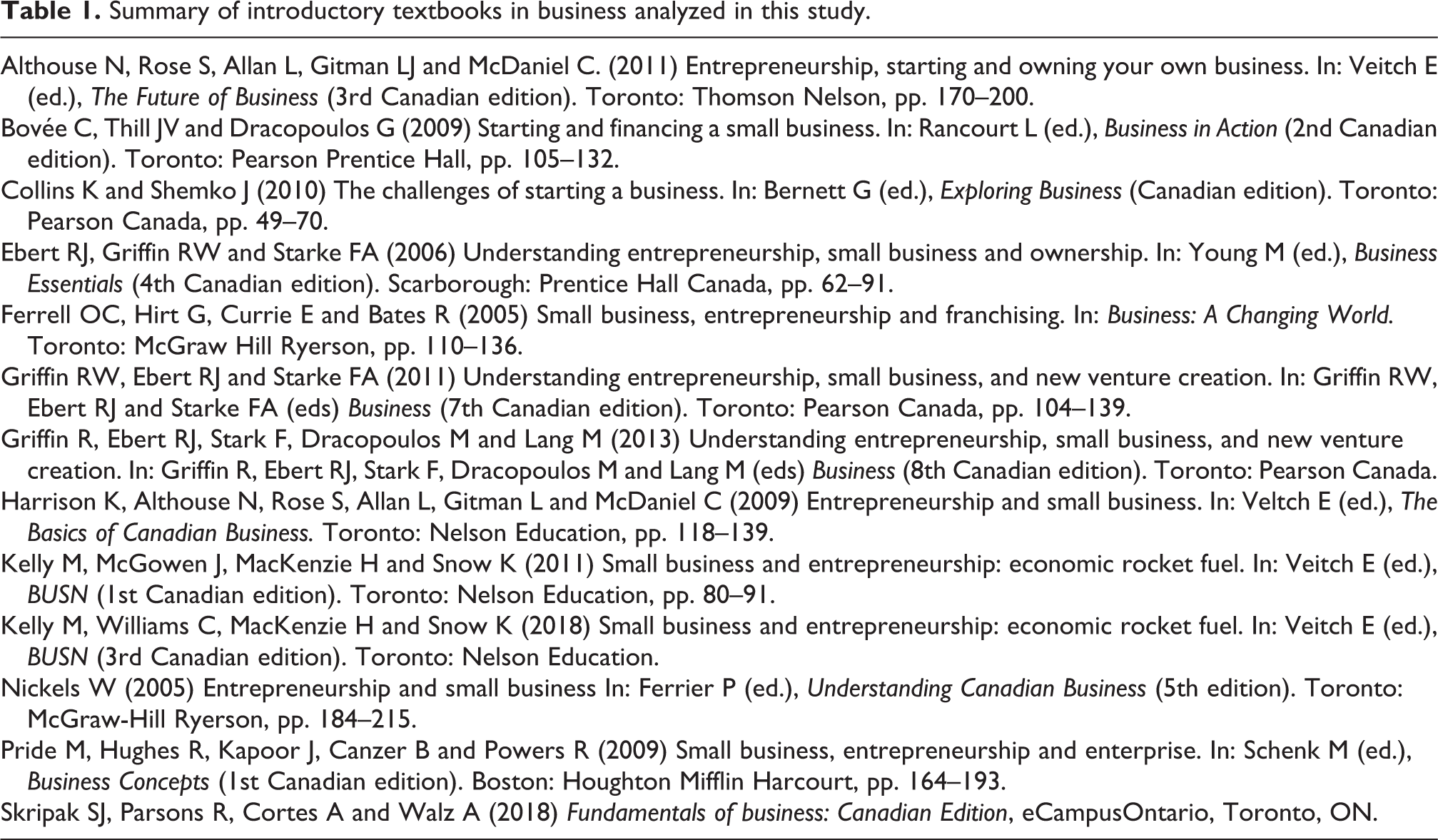
It became apparent to us early on in our efforts that introductory textbooks commonly used in first-year courses surveying business as a discipline were most appropriate for our study for two reasons. First, introduction-to-business courses are typically subscribed by undergraduate business students enrolled in the first year of their program. Textbooks used in these introductory courses are also introductory in nature; often each chapter is dedicated to a business function (e.g., management, marketing, finance). Second, previous work (Elliott et al., 2020) has surfaced the disturbing trend of women “opting out” of entrepreneurship as a focus of study in their business education. By choosing introductory business courses we are attempting to capture the moment just prior to when women exclude themselves, the earliest point of exposure to entrepreneurship in their university career. Together, these dynamics forge an initial exposure to, and shape the perceptions of, entrepreneurship early on in an undergraduate business student’s study.
Data analysis
Once we had narrowed our sample frame to 13 textbooks, we moved on to our preliminary read through each text independently. Using our poststructural feminist frame, we agreed that our first round of reading was for content by asking ourselves the following: How is entrepreneurship represented? Who are discussed as entrepreneurs? What role does gender play? We took note of these and compiled our initial impressions with each text. This process allowed us to approach our analysis with a healthy dose of reflexivity (Cunliffe, 2002). That is, we were sensitive to our own situatedness and privilege as researchers along with how our interaction with those embedded in the discourses we studied influenced our interpretation of entrepreneurship’s gendered character as a discipline and practice. In terms of discourses and our own position, we see our research as the outcome of broad ideas related to gender, capitalism and modernity. Since we are embedded in these discourses, they worked together to shape the form of our study; so, we recognize the dilemma we face in questioning our assumptions of how entrepreneurship is gendered and the many contexts in which it is produced in business classrooms across Canada.
The second step in our research process involved some loosely-bounded coding. What this means is that we conducted our own version of qualitative coding that did not involve the use of an application (e.g., NVivo). To do so, we felt, would be antithetical to our research which sought to analyze the practices and effects of assumed masculinity in entrepreneurship. In practical terms, we followed up our independent reading by taking a deeper dive into subtext. This had us conduct coding following an iterative process between our “close reading” (Deal et al., 2018) of context from within our initial impressions of the discourses at play and what we could generate after reading “against the grain” 4 of each textbook. This process generated an initial series of codes which included, for example: knowledge, training, experience, women in business and motherhood. Then, after each text had been thoroughly analyzed, capturing at least one code, we grouped the codes into higher-order codes. Table 2 offers a record of how we moved from text as data through codes to the critical discourses of our research.
Moving from text as data to codes to discourses.
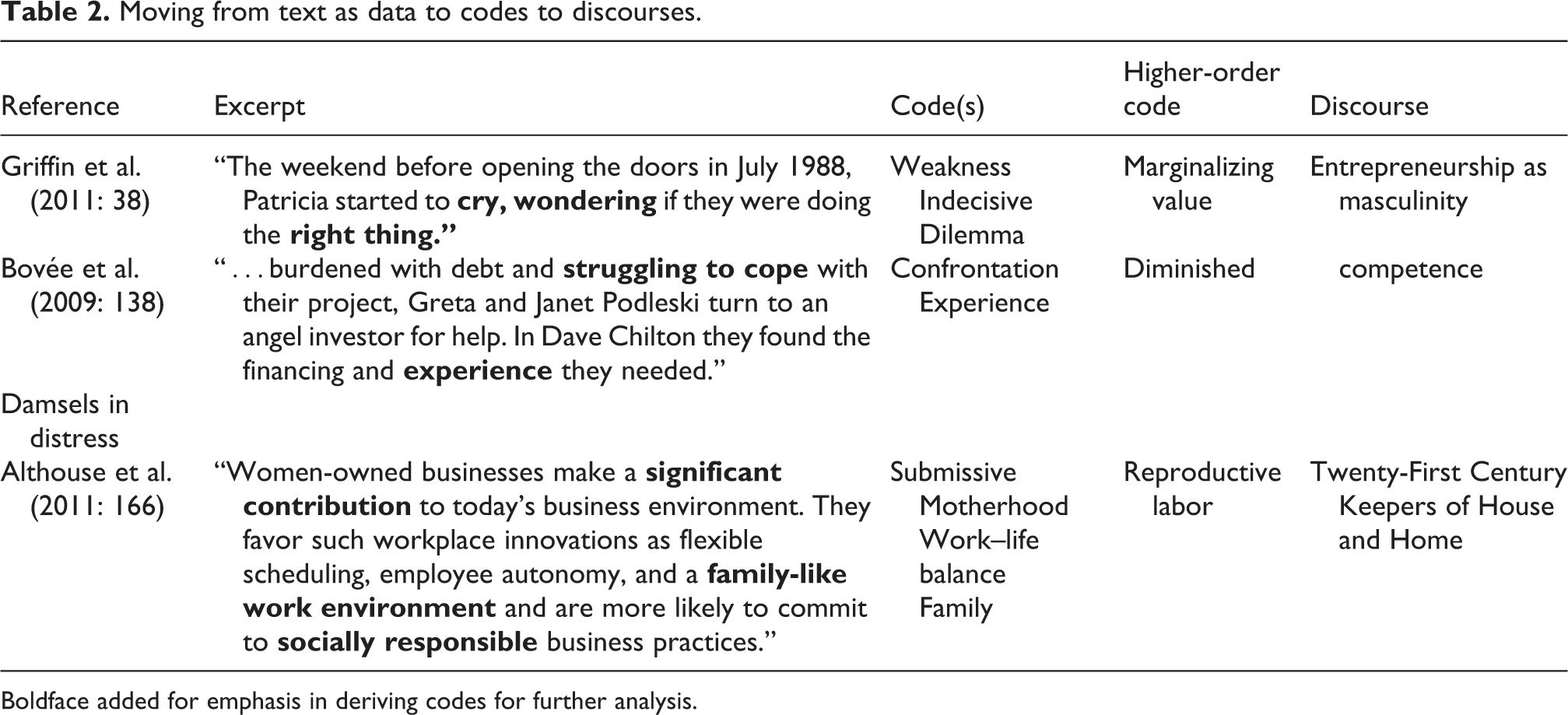
Boldface added for emphasis in deriving codes for further analysis.
Critical discourse analysis
Critical discourse analysis (CDA) is an approach commonly used by scholars to access embedded power-laden language. Not just a method per se, CDA can also be (and has been) utilized as a epistemology in critical scholarship so that we “see things that have been obscured by the repeated application of traditional methods…introducing new ideas, new concepts and new challenges” (Phillips and Hardy, 2002: 16). In the confines of our research it is not so much that we are looking for ways in which women are cast differently than their male entrepreneur counterparts: this has long been documented in previous work. We are, however, intent on examining the “new idea” that, at least in observing entrepreneurship and its role as an area of study in introductory business education, it is assumed that women are an exception to themes of masculine success.
CDA is quite novel in entrepreneurship work; Jennings and Brush (2013) postulate that gendered practices of entrepreneurship need to be scrutinized and we concur. Our attempt at CDA in this study, exploring specific language qualities in text and how they might reveal dynamics of male power, is intended to help shift scholarly focus to the social process of language constituting gender and entrepreneurship; to context(s) of the enactment of power relations and how this dynamic is reproduced and legitimated through talk (vis-à-vis textbooks) of dominant groups and institutions (van Dijk, 1996); and to tropes evidencing male privilege in the business school, entrepreneurship theory and its practice (Ahl and Marlow, 2012).
Findings
While we had a general sense of what we could expect, based on our previous research and professional activity in entrepreneurship, we were unprepared to see just how embedded gender remains in business textbooks – especially considering how much widespread interest there is in emphasizing women entrepreneurship in colleges and universities across Canada. In our findings, we saw how language is formed in such a way that the discourse of entrepreneurship, in the multiple contexts of entrepreneurship in business textbooks, renders a gendering process that lies exclusively in the domain of masculine activity. Even the notion of entrepreneurship was found to be linked to “career men” with images of “productive labor” (here emphasizing the demarcation of a labor binary in texts; “productive” versus “useless”) whereas women entrepreneurs – we recognize that our modification here of the term “entrepreneur” as a female unfortunately reproduces this gendered link – continue their association with images of mothering a new/small/growing venture.
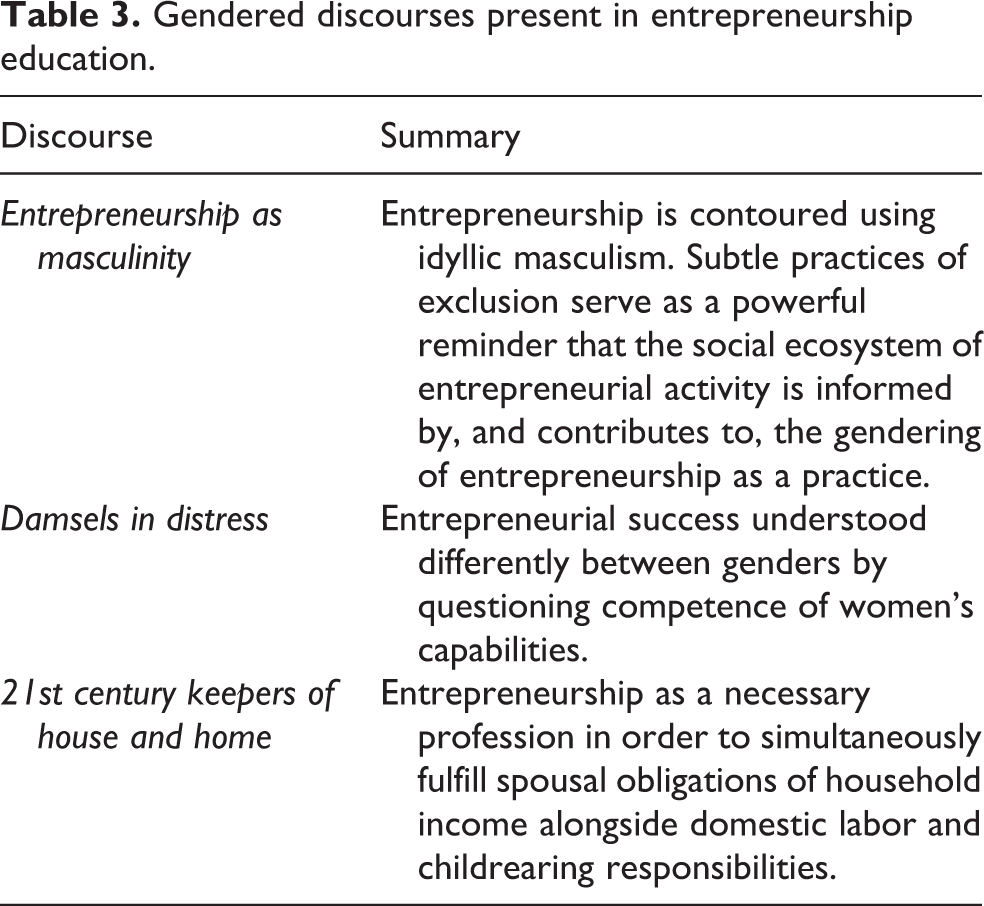
Three thematic discourses emerged from the texts concerning the gendered processes behind entrepreneurship in early post-secondary education contexts. A summary of these findings is provided in Table 3. We discuss each of these discourses in more depth below.
Gendered discourses present in entrepreneurship education.
Entrepreneurship as masculinity
There appears to be support for the idea that entrepreneurship is still very much positioned in a masculine domain simply from the dominant examples and mentions of men versus the lack of exposure women receive in introductory business textbooks. This was reinforced by a critical examination of the texts to see how women were positioned in relation to men. What we found was a discourse casting entrepreneurship as an activity contoured along gendered lines of masculinity. For example, in reference to male ownership, men’s names (both their first and last names) were referenced while their female counterparts were relegated to a gendered, familial reference as wife or as holding a subordinate position within a family business. Nickels (2005) open with five powerful examples of entrepreneurs who have reached the pinnacle of financial success with their business ideas; not one female entrepreneur is mentioned. This problematic – the exclusion of women in business – appears to be common. Take the following excerpt: The business was founded by J.D. Irving in 1881 when he bought a small sawmill in Boutouche, New Brunswick. His son, K.C. Irving, dramatically increased the scope of the company’s operations during the middle of the twenty-first century. K.C.’s sons – James, Arthur, and Jack – took over in the 1970s. Their sons – Jim, Jr., Robert and Kenneth are actively involved in the business and some of their children (the family’s fifth generation) have recently joined the company. (Ebert et al., 2006: 90)
Ebert et al. (2006) do provide some space for feminism, but mostly in a short blurb and image highlighting the importance of women in business. The authors go on to report that more women are starting and successfully operating their own small businesses, but delineate the difference between being a small business owner (cast as a female entrepreneur) and being an entrepreneur by stating, “That individual is clearly a small business person. With no plans to grow and expand, however, the person is not really an entrepreneur” (Ebert et al., 2006: 89).
Equally troubling is the positioning of the female entrepreneur in business cases. As an example, “Things began to change when Connie became less interested in the business and got more involved in other activities. Whereas Mark’s enthusiasm remained high, Connie’s time was increasingly consumed by travel, recreation and community service activities” (Ebert et al., 2006: 101). In Griffin et al. (2011: 38): Using personal savings, he and his wife, Patricia, bought a dilapidated Halifax building from which to launch a floor-covering business and took over the chain’s local flooring accounts, setting up shop under the Install-a-Floor name. The weekend before opening the doors in July 1988, Patricia started to cry, wondering if they were doing the right thing.
Damsels in distress
The second dominant recurring theme that emerged from the text was the idea that women need to undergo fixing and rescuing as a perquisite for success in entrepreneurship. About half the texts studied had sections dedicated to women in business, often including statistics on the status of women entrepreneurs in Canada. These texts placed this information with or adjacent to material on minority and ethnic entrepreneurship. None offered a feminist perspective of the many barriers women face in achieving the perceived success of male entrepreneurs (e.g., access to financing). Those textbooks featuring dedicated sections on women entrepreneurs all report that more women are becoming entrepreneurs, but preface this by contextualizing – “these women make up only one third of the total number of self-employed Canadians and men are still more likely to be running their own businesses across all age groups” (Pride et al., 2009: 7). The inclusion of a dedicated section specifically for women in business positions women as being othered, in stark contrast to their male counterparts. There were multiple reasons why women were cast as different in these texts: female-owned businesses are typically smaller and are often concentrated in the service sector; women become entrepreneurs because they have hit the glass ceiling in the corporate world; and women are looking for work–life balance because of family demands. Sadly, these perceived differences were not afforded contextualization, thus neglecting how they might be explained and what, if any, impact the perceived differences might have had on the success of the women’s entrepreneurial pursuit.
When women are cast as being entrepreneurial there is a subtle marginalization of their competence. Used as an example in Bovée et al. (2009: 138) of enduring business challenges, the plight of a lone women duo is described: “burdened with debt and struggling to cope with their project, Greta and Janet Podleski turn to an angel investor for help. In Dave Chilton they found the financing and experience they needed.” Alas, here is an instance where women are given voice, but negatively, in terms of struggle that can only be resolved when a man arrives to rescue the damsels in distress.
21st century keepers of house and home
This third emerging theme represents the most prevalent discourse found in our study. Here we find the disadvantage of women who, though now represented in both a corporate and an entrepreneurship context, still find themselves responsible for the majority of domestic labor and childrearing. We found women being depicted as entrepreneurs out of necessity in order to balance a meaningful career and raise a family simultaneously. The gendered term mompreneur has gained notoriety in the mainstream media over the last 20 years and is used in several of the textbooks as a way of justifying why women consider entrepreneurship. Women who run businesses from their homes are sometimes called mompreneurs. One such person is Crystal Dallner, who started a marketing business called Outright Communication soon after her first child was born. The Mompreneur Networking Group organizes seminars and publishes Mompreneur, a free magazine that helps women who want to start a business. (Griffin et al., 2013: 112) Women-owned businesses make a significant contribution to today’s business environment. They favor such workplace innovations as flexible scheduling, employee autonomy, and a family-like work environment and are more likely to commit to socially responsible business practices.
While the topic of ongoing research, there is some rationale that may justify the rise of female-driven ventures. One such explanation found in these texts is rationalization of a woman’s work–life balance: “A woman who earned her MBA and started a family and wanted a home-based business that she could run while raising her children” (Bovée et al., 2009: 124). Even more concerning are the unfounded generalizations textbooks make regarding gendered work arrangements of flexible hours or small business venturing to avoid the glass ceiling phenomenon, thus reinforcing female stigma. For example, Griffin et al. (2013) mentions a recent Vanier Institute survey that revealed 90 percent of Canadians think that, for two-parent families, it is ideal to have one stay-at-home parent as primary caregiver while the other pursues a career. They report that families often need more income than can be earned by just one parent, so the parent at home is often under pressure to generate income too: How can this be done? One answer is found in the increasing number of Canadian moms who have decided to be stay-at-home entrepreneurs. They are not trying to be supermoms who can do everything; rather, they want to use their skills to run a business and at the same time achieve a better work–life balance. (Griffin et al., 2013: 137)
Conclusion
Our purpose in this study was to reveal the ways women in business are portrayed in entrepreneurship texts. We provided this insight, especially into the discursive foundations of gender identity, by examining the early exposure of entrepreneurship to undergraduate business students. If the current practice of entrepreneurship is indeed supported by literature that suggests some progress in the way gender is represented in new business ventures (Gupta et al., 2019), then it would make sense that a feedback loop in the texts we use to teach it in business schools would also reflect this trend. That is not what we found in our study; in fact, the opposite was true: women are placed in social positions that are impossible to realize in practice and are shaped by text favoring masculine discourses of business success. Allow us to draw out these dynamics.
First, the feminist perspective we chose to take in this study was an attempt to problematize the overtly masculine character of entrepreneurship – both as theory and practice. For us, feminism extends our work by contributing to the “movement to end sexism, sexist exploitation, and oppression” (Hooks, 2000: 1 as cited in Harquail, 2020) through calling for political, social and economic equality among all people. In order to allow our students the best opportunity to flourish, we have a responsibility to inspire inclusivity in our classrooms and the content we teach. Current support tools such as textbooks, case studies and interactive business simulations seen as mainstays in business school classrooms perpetuate Schein et al.’s (1996) thesis of “think manager – think male”; in our study we brought this ethos under the criticism of our close reading and found that, at least with regard to how entrepreneurship is theorized to undergraduate business students, there has been little progress toward equitable representation of gender inclusivity. As a result, the gendered stereotype of entrepreneurship as masculine remains undisturbed.
Institutions of higher learning, especially universities, are seen as “identity workspaces” (Petriglieri and Petriglieri, 2010) where students have the opportunity to develop their own sense of identity (Chickering, 1969; Erikson, 1950; Marcia, 1966). It makes sense, then, that understanding gender and identity development is crucial in the creation of knowledge interventions for students. In terms of gender, men, or at least how they are represented in text, naturally connect their internal self-identity with an external masculine entrepreneur identity (Greene and Brush, 2018; Lewis, 2013). Women, on the other hand, are written into text in impossible positions that are far too often constrained by social identities ascribed to them through education, institutional policies or the political, social and economic contexts in which they are located. There is an obvious disconnect. So, what are we to do?
To start, Donnellon et al. (2014), in a similar logic to that of our study, propose that entrepreneurial identity is indeed an outcome of socialization and can be constructed through processes of higher education (e.g., acquiring the knowledge and skills to “act entrepreneurially”). By way of our examination of a typical undergraduate student’s first exposure to entrepreneurship and the link to the research conducted on gender and entrepreneurial identity, we call for a firm commitment from business schools to incorporate inclusive materials in our classrooms, especially in fostering an introductory look into entrepreneurship, so as to provide opportunities for students to see themselves in text. We see this as belonging to a project on a broad scale involving three important knowledge stakeholders: researchers (who can guide best practices in developing inclusive materials), publishers (who, through the editorial process, can ensure that ideals of inclusivity become normalized) and instructors (who ultimately serve as gatekeepers in their capacity to choose what materials are used in their classrooms). There are also resources like Orser and Elliot’s (2020) GEET+ framework – an innovative suite of strategies to evaluate equity, diversity and inclusion in business curricula – which provides action plans to address course-, program- and organization-level gaps. However, these types of solutions require the buy-in of key decision makers who have their own ideas and priorities for their institution. Suffice it to say, there are ways to remedy the image of a damsel in distress.
In conclusion, we return to the poststructural feminist perspective we took in this study. While we are disappointed in the ways women have been cast in entrepreneurship texts and the positions and spaces with which they have been associated in those texts, we hope that this study instigates thinking in higher education to remedy such easy gendering of knowledge. Through our critique of how texts are informed by prevailing discourses of masculinity, we get a glimpse into the gendering process of entrepreneurship education which, at least from our vantage point, contributes to the reproduction of male privilege in practice. While research on women’s entrepreneurship has already demonstrated a prevailing idealism of gender discourse, we are hopeful that our study demonstrates the role entrepreneurship education plays in the broader entrepreneurship ecosystem with regard to how women and anyone outside the masculine ideal can perceive themselves as worthy entrepreneurial aspirants vis-à-vis entrepreneurship texts. For us, it is not only important to problematize the gendered character of a field like entrepreneurship, we must also underscore how easy it is to reproduce these gender ideals and dynamics in our classroom through the texts that we choose to legitimate business knowledge.
Footnotes
Declaration of conflicting interests
The author(s) declared no potential conflicts of interest with respect to the research, authorship, and/or publication of this article.
Funding
The author(s) received no financial support for the research, authorship, and/or publication of this article.
