



Abstract
Mass protests in Spain that challenged the long-standing two-party system and austerity policies associated with both major parties (PP and PSOE) were followed by the emergence of challenger party Podemos. In the current conjuncture, however, Podemos faces an existential crisis. Supported by data gathered during interviews with key figures from Podemos, leftist parties and activists, this article disentangles why and how the outsider-to-insider party-building process culminated in a de-legitimized Podemos. The article argues that the electoral strategy of Podemos leaders in conjunction with opposition pressures encouraged a moderation of the party’s brand. To pursue such moderation required insulating the leadership clique from radical voices via degenerative factionalism and oligarchization processes. Moreover, weak popular sector organizations were unable to counter the moderation–factionalism–oligarchization process. The culmination of the party-building process saw a Podemos that lacked a coherent brand or any societal connections, leaving it vulnerable to replacement by a new challenger.
Introduction
In the aftermath of the 15-M wave of mass anti-austerity protests, and 10 years after its electoral breakthrough in 2014, support for Spain’s Podemos has collapsed, and it risks replacement by Sumar as the principal party to the left of the social democratic PSOE. This article seeks to shed light on why a party which burst onto the scene with promises to challenge the old way of doing politics by offering a new party form that would foster active participation in internal decision-making processes while simultaneously rejecting neoliberalism culminated in a scenario in which Podemos faces eradication while its potential replacement, Sumar, offers a moderate, leader-focused project happy to work alongside the PSOE. Indeed, in 2024, Sumar and Podemos were locked in a battle to remain as the reference point for the Spanish left, though both polled at very low levels indicating a major collapse in support for any alternative to the left of the PSOE. How can we explain such a rise, fall, and potential collapse of Podemos?
Summarizing the argument presented below to explain Podemos’ rise and fall, I argue that limits on radicalism set by pro-neoliberal actors in conjunction with an electoralist strategy built on appealing to as many potential voters as possible pressurized party leaders to dilute and moderate the party’s radical brand. Party leaders sought to bypass engagement with radical critics via monologic-verticalization and degenerative factionalism. As radical voices were excluded, the moderation process could advance more easily, which in turn fostered further verticalization and degenerative factionalism. The extensive presence of passive online members within the party’s membership base also encouraged the development of a top-down, leader-dominated party. Podemos’ moderation–verticalization–factionalism party-building process can be further contextualized by addressing the lack of popular counterpower to constrain the party leadership. Weak and fragmented movements could not offer the sort of organizational fulcrum for anti-neoliberalism that traditional unions had played for labor concerns. Lacking capacity to either engage in mass demonstrations in support of radicalism or to offer internal constraints on party leaders, moderation–verticalization–factionalism rapidly advanced. Podemos became a brand-diluted party that sought (but failed) to take the place of the traditional social democratic PSOE, headed by a leadership clique with no organic connections to society. Despite an initial electoral surge, its vote share quickly crashed along with membership numbers and legitimacy, leaving the party vulnerable to collapse and replacement.
Challenges to Leftist Party-Building: Brand Dilution, Oligarchy, Factionalism, Popular Counterpower
Levitsky et al. (2016) emphasize that periods of extraordinary conflict including sustained popular mobilization—as during anti-neoliberal protest waves—‘are most likely to generate the partisan attachments, territorial organization, and cohesion that enable new parties to take root (p. 3)’. While conflictual moments provide opportunities for party-building, as parties emerge and seek to compete for national office, they must develop and maintain a clear party brand, as well as a territorial organized presence on the ground (Levitsky et al., 2016: 3). Without connections to society via grassroots organizations, the parties may struggle to remain connected to on the ground concerns, disseminate their brand, or mobilize their voters. Lupu (2016) argues that to build a party brand, any new party must distinguish itself from other parties and its stance or behavior must be consistent over time. Where a party becomes indistinguishable from other parties or if it veers markedly from one election to the next—that is, where the brand is diluted—the party risks its own longer-term survival.
For a movement-linked anti-system outsider party (Hopkin, 2020) that presents itself as an alternative to mainstream parties and their associated neoliberal policy matrices, while also advocating for a new type of party that would foster inclusive links to popular sector organizations and movements that participate in contentious actions (Brown, 2020; della Porta et al., 2017), abandoning commitments to a clear break with neoliberalism or drifting from promises to build a horizontal and internally democratic party with linkages to popular organizations would represent a misstep in terms of party-building. That is, if outsider, anti-neoliberal, and movementist left parties become moderate and verticalist parties—reflecting the very parties they are supposed to challenge—they risk losing their novelty and usefulness. In such scenarios, the outsiders risk displacement from the party system.
We must address why a radical movement-linked outsider may become a moderate party dominated by a leadership clique—placing the party’s survival in jeopardy. Electoral strategies have been identified as one major reason for de-radicalization. Seeking to explain the failures of socialist parties in Western Europe to win electoral majorities, Przeworski and Sprague’s (1986) theory suggests such parties face key constraints. The authors argue that manual wage earners never became a majority and hence winning elections would entail recruiting allies from diverse classes, which would cost the party support among the proletariat if universalistic policies were advanced. As I will discuss in the Podemos case study below, such electoral strategies and trade-offs help us understand dilemmas facing leaders of new outsider left parties. As Hutter et al. (2018) state, where electoral interests of party leaders do not align with the concerns of their more radical core constituencies, leaders may abandon their representative role and shy away from a strong commitment to solutions promoted by their original membership base in order to advance their electoral gains.
While Przeworski and Sprague’s analysis helps us understand the issues of electoral strategies and moderation pressures on party leaders, there are a number of issues with their theory when it comes to analyzing contemporary movementist left parties. While the concept of an electoral trade-off is useful, the authors argue that where socialist parties were closely linked to workers’ unions, party leaders were restricted in pursuing more universalistic policies as they sought to broaden their electoral appeal. Hence, the authors argue (Przeworski and Sprague, 1986: 118–119) that this lack of political flexibility due to constraints coming from labor organizations meant that party leaders were ultimately held to a pro-worker party brand. While helping to shore up electoral support from labor, this meant the parties could not achieve an electoral majority. However, whereas Przeworski and Sprague suggest that nondilution of a radical brand due to the constraints placed on party leaders by mass popular organizations is a poor electoral strategy as it alienates more centrist/moderate voters, one may invert such framing.
For contemporary parties that emerge as a challenge to mainstream center-right and center-left parties, while diluting the brand to appeal to a wider electorate may witness an initial boost in vote share, such an approach is shortsighted. A ‘populist left’ approach that witnesses outsider party leaders dilute a party’s leftism as it seeks to appeal to all of the ‘people’ is an enormous gamble. Rapid brand dilution will cost the new party legitimacy among more radical sectors and movements; the radical outsider risks being seen as just another party that resembles the existing social democratic party, though lacking its long history and societal linkages (and guaranteed core support base) via existing unions. The outsider party thus risks becoming a moderate leadership clique that directs a brandless party with no organic linkages to society. For emergent parties, this is precisely the pathway that Lupu (2016) and Levitsky et al. (2016) demonstrate leads to party instability and likely disappearance.
Relatedly, Przeworski and Sprague argue that the constraints of union linkages on party leaders limited their electoral potential by holding the party to a more radical policy position. However, one may argue that a lack of linkages between an outsider left party and a popular organization capable of influencing party decision-making grants party leaders too much flexibility to pursue rapid band dilution in order to broaden the electoral appeal of the party—in turn placing its longer-term survival in doubt. While Przeworski and Sprague mention unions as a constraining factor on party leaders, for contemporary outsider left parties, linkages to mass labor unions are generally absent. Rather, these parties emerged from diverse social movement organization milieus. Moreover, while Przeworski and Sprague raise a key point regarding the relationships between party leaderships and organized popular sectors, they offer little in terms of discussing what actually grants power to popular organizers to hold party leaders to account. Conversely, the authors do not delineate how party leaders may bypass bottom-up oversight and engage in verticalist decision-making (allowing them to exclude more radical voices that seek to resist brand moderation). Hence, when appraising contemporary outsider left parties, we must bring in theories exploring elitism/oligarchization of parties and tether such analyses to emerging literatures examining movement parties and the nature of relationships between contentious and conventional politics.
Michels’ (1911) ‘Iron Law of Oligarchy’ is perhaps the most referred to explanation regarding the verticalization of parties. Michels argues that three factors foster an inevitable oligarchization. First, as an organization grows in size, hierarchies emerge. Mass parties will require experts with specialized skills to lead the organization. Due to the technical indispensability of leadership, a functional division between party leaders and members emerges. Second, Michels argues that rank-and-file members of the party accept such elitization as most party members lack the skills and resources to control the professional leadership. Utilizing a psychological argument, Michels claims that rank-and-file members of mass parties are inactive as they have an immense need for direction and guidance accompanied by a cult for the leaders. Third, Michels argues that since party elites and experts are uncontrolled by passive members, they may adopt preferences which go against those of ordinary members as, according to Michels, the desire to dominate is universal. Leaders may utilize their positions to manipulate ordinary members into accepting decisions even if this entails disregarding the interests of members.
While the first element of Michels’ theory, that parties witness elitization as they grow, is generally accepted, the second and third legs may be critiqued. The psychological premises underlying Michels’ iron law overstates the membership passivity/cult of the leader, especially when it comes to analyzing new left parties that emerge with links to social movements and popular organizations—spaces premised upon activity, internal democracy, and calls for leadership oversight. There may indeed by passive members who are willing to follow a leaders’ directions, especially where digital memberships allow leaders to present pre-determined agendas to online voting by a simple click, bypassing real internal democratic debate (Gerbaudo, 2019). However, for parties born out of social movement activities and with radical factions within the party, it cannot be presumed a priori that all members are passive sheep. Those members with close relationships to social movements and popular organizations with trajectories of participation in contentious politics are likely to demand a horizontal party, pushing back against elitism. The challenge, therefore, is to identify if and how such voices are actually capable of resisting elitism, or, alternatively, whether they lack any voice or veto capacity within the party.
We may also critique Michels’ argument that once leaders are separated from passive masses, they act against the interests of members. The psychological desire to dominate is not a sufficient explanation as to why party leaders ignore member concerns. However, what Michels does hint at, and what is useful for examining new radical outsider parties, is that it may be the case that some faction of the party leadership believe moderation is necessary to maximize vote share and boost membership numbers, thereby boosting the strength and survival chances of the new party. Such a position may go against the opinions and interests of more radical members and factions of the party. In such a scenario, the moderating faction of the leadership may attempt to bypass radical critiques. While one should not conflate oligarchy with conservatism, for radical left party leaders that do seek to moderate the brand to widen electoral appeal, they will be able to pursue such a strategy where they face little internal opposition. Hence, they may intentionally build oligarchic organizations and force out internal dissenters in order to adhere to electoral pressures and attract members. Indeed, it is possible that factionalism becomes degenerative as excessive fragmentation leads to irreconcilable cleavages between sub-groups—which in turn may lead to public rifts that cost the party support or may lead to wholesale splits of cadres/sub-groups from the party.
Offe and Wiesenthal’s (1980) sociological theory of opportunism is useful as it engages with the task of grasping why working-class organizations may become more moderate and reformist over time. Challenging the psychological underpinnings of Michels’ theory, the authors reject notions that leaders simply sell out to pursue their own desires or that passive masses devotedly follow leaders’ commands. Rather, Offe and Wiesenthal theorize dynamics that culminate in working-class organizations (trade unions being their principal focus) engaging in ‘opportunism’. Opportunism suggests that the maintenance of the organization becomes of greater importance than pursuing the goals of the organization. Short-term immediate gains are prioritized over future consequences, and there is an emphasis on getting as many people as possible into the organization rather than questioning who comes in, and how it is they will actually participate in the organization.
Offe and Wiesenthal argue that labor unions face a dilemma between the accumulation of power and the exercise of power. Accumulating power requires boosting membership numbers and financial resources, which in turn requires bureaucratic control over the resources to ensure they are utilized efficiently (echoing Michels’ first step). Exercising power, however, requires that the union can build solidarities among members. This depends upon whether or not the internal structure of the organization is underpinned by dialogic forms of communication—horizontal, participatory forms of inclusion that foster the collective identities which are critical where collective actions (such as strikes) may be called for by the leadership. However, Offe and Wiesenthal stress that accumulating power by increasing size fosters a monologic top-down form of decision-making by a centralized leadership—undermining the solidarity-building dialogic bottom-up form of participation required to exercise power.
Offe and Wiesenthal hint at the wider environment in which working-class organizations operate and argue that organizations may seek to boost external guarantees for their own survival (such as legal protection from the state), but that such protections are offered only if the union de-radicalizes. While maintaining the backing and solidarity of militant and radical members to be able to engage in collective action is key, the pressure to be seen as a responsible agent pressurizes the leadership to show they can control the organization and play by the rules of the game. The authors thus suggest that the leadership may adopt increasingly monologic organization building as it seeks to continue to boost its membership numbers, while also being able to demonstrate that it can control its militant members and that it can act responsibly. Over time, however, it is possible that such opportunism fosters schisms as factions split from the union and seek to re-engage in dialogic organization building and adherence to more radical demands.
While Offe and Wiesenthal focus on labor unions, components of their dialogic/monologic dilemma can be utilized to appraise contemporary outsider movementist parties. They highlight the pressures on unions to de-radicalize if they wish to be recognized as legitimate and to participate in the state. This echoes the wider pressures on contemporary outsider left party leaderships that demand an overhaul of the distribution of political and economic power by adhering to an anti-neoliberal brand. Such a stance would represent a direct challenge to the status quo—and dominant political and economic agents who benefit from it. It is precisely where (proposed) policies challenge the interests of pro-neoliberal sectors that one is likely to witness domestic and transnational threats of institutional and extra-institutional resistance to reforms, which may encourage left party leaders to moderate their position.
Offe and Wiesenthal cogently demonstrate how de-radicalization may be linked to monologic-verticalist decision-making processes and how abandoning radicalism and dialogic processes could foster degenerative factionalist splits—issues that directly relate to contemporary movement-linked parties that compete for moderate voters. The notion of monologic/dialogic processes is also useful to appraise the tensions within contemporary movement-linked parties that originate espousing ideas of horizontalism and the conjoining of contentious and conventional approaches to politics, but that simultaneously seek to boost membership numbers via online click participation. Where leaders feel pressurized to moderate, they may actively promote monologic connections to members via click-voting on pre-determined agendas set by the leadership, while intentionally eschewing dialogic processes that entail engaging with more radical factions.
Offe and Wiesenthal’s analysis also points to the importance of the relationship between constituent members and leaders, which raises the question of whether opportunism may be resisted. However, as with Przeworski and Sprague’s hinting at union capacity to constrain party leaders, there is scope for a clearer discussion of party-movement organization relations, asking under what circumstances movement organizations and radicals in the party may, or may not, resist moderation, monologic verticalism, and degenerative factionalism. Such discussions are all the more pertinent given that Michels, Przeworski and Sprague, and Offe and Wiesenthasal focused on mass parties and muscular labor organizations of the 20th century. The outsider left parties of the contemporary era do not share the same sorts of relations to mass popular organizations, but rather emerged with varying forms of connections to social movements in an era of fragmented and de-mobilized societies.
Theorists focusing on contemporary outsider movementist parties have suggested that it is possible, though challenging, for popular organizations to play a role in monitoring the actions of party leaderships (Anria, 2019; Brown, 2022; della Porta et al., 2017; Etchemendy, 2020). That is, one must consider the potential for popular movement organizations to interact with party leaderships and to influence processes of brand dilution/adherence to radicalism; monologic-verticalization/dialogic-horizontalism; and the ejection of radical blocs via degenerative factionalism/cooperative pluralism with radial voices included in decision-making (see Figure 1).
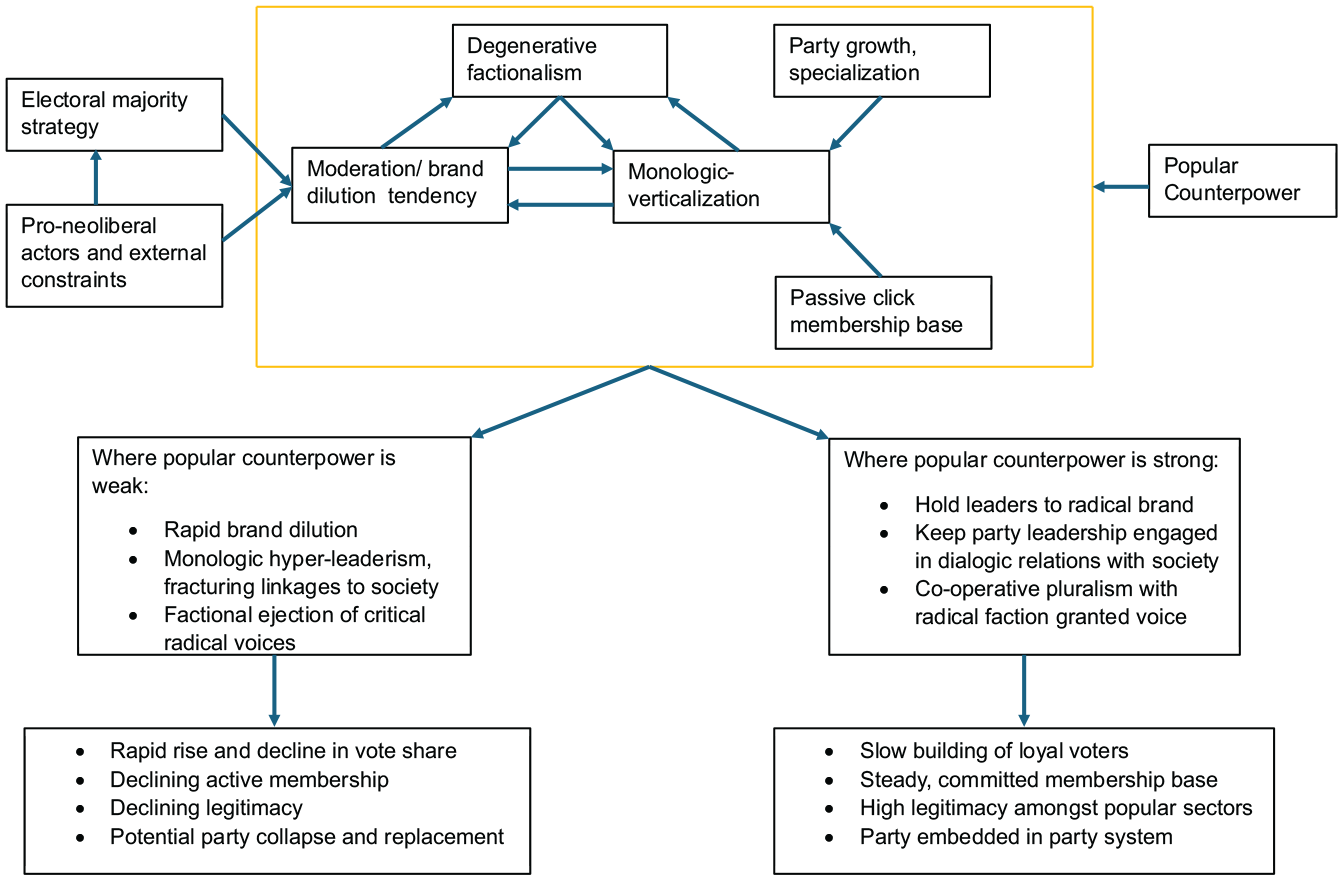
Trajectories and legacies of outsider party-building.
Anria (2024) argues that for new outsider parties that emerge with connections to social movements, the trajectory of party-building will be conditioned by a combination of historical factors relating to the strength and autonomous mobilization capacity of the movements. Organized popular sectors may seek to counterbalance the pressures to engage in moderation and monologic verticalism via organic, empowered linkages to the party. For party leaders
‘to be constrained by a party’s core constituency organizations, the latter should be autonomous. The autonomy of organizations implies that they have the capacity to set and communicate their preferences, regardless of the opinions of the party leaders. To constrain leaders, autonomous organizations also must hold significant clout within parties, regardless of their contingent electoral power’ (Anria et al., 2022: 386).
Moreover, there must be formal linkages or informal linkages between the party and these social organizations. Formal linkages include party statutes that institutionalize the participation of movement organizations in the party structure. Informal linkages refer to movement organization leaders and grassroots activists having dual memberships in the party and their constituent organization and/or popular organization leaders having strong informal ties to party leaders (Anria et al., 2022).
Popular organizations may also seek to pressurize party leaderships from outside. Contestatory mobilization refers to street demonstrations, road blocks, strikes, or any form of contentious action against brand dilution and/or oligarchization by popular organizations. At one end of a continuum, contestatory mobilization may be considered strong where there are large numbers of people from an array of popular sector organizations and movements engaging in sustained waves of contentious action with clearly framed demands that challenge top-down decision-making and/moderation. At the opposite end of the continuum, contestatory mobilization may be considered weak where small numbers of people from an individual organization focus on narrow demands and engage in one-off or sporadic contentious actions (Brown, 2022; Silva, 2018).
In sum, popular counterbalancing power is stronger where there are organic connections between party leaderships and popular organizations and where popular organizations are capable of engaging in mass contestatory mobilization. Conversely, counterpower is weaker where no organic connections exist and where organizations lack mobilizational capacity. Where counterpower is strong, movement organizations may push back against moderating tendencies of party leaders and the associated monologic-verticalization and degenerative factionalism. Dialogic relations between party and societal organizations are more likely, allowing organizations greater voice and veto power to demand that the party adhere to its more radical brand. Party leaderships are more likely to remain connected to movement organizations and build roots in society, to keep one foot in the institutions and one foot in the streets. Moreover, the existence of a dense movement field capable of engaging in mass contestatory actions may also impact upon degenerative factionalism. Where the radical faction of a party can point to a powerful movement field that has the potential to engage in mass mobilization—in support of radical policy proposals or against moderation—its voice is likely to be louder in internal party debates, and it is less likely to be squeezed from the party. In sum, popular counterpower may press party leaders to adhere to a radical brand and to maintain and build societal linkages—the two fundamental tasks facing emergent parties if they are to survive beyond an initial surge.
If popular counterpower is weak, then it is more likely that movement left party leaderships will capitulate to the moderating pressures described above, as well as promote the monologic verticalism and degenerative factionalism that allow such brand dilution to advance unopposed. Where counterpower is weak, there will be little capacity to influence the party leaders via internal channels and there will be no capacity to demonstrate via mass mobilizations that there is in fact widespread support for more radical policies. Radical factions inside the party will be easily ignored by moderating leaderships who label them as disconnected from the realities of trying to grow the party. Indeed, party-building processes for new outsider left parties that are not tethered to or influenced by popular counterpower may witness hyper-leaderism. Lacking any sort of organizational fulcrum (like organized labor played in the past), new party leaders may argue that building the party requires boosting membership numbers via online participation. While weak movement organizations and radicals inside the party may clamor for the building of a horizontal and anti-neoliberal party, party leaders may easily bypass their concerns and present moderate policy proposals for approval by members who participate via their computers—without ever engaging in internal party debates that foster political socialization and deep loyalty to the party.
The risks facing outsider left parties in the contemporary era are great. Brand-diluted parties headed by leadership cliques with weak connections to society are hardly a response to the very crisis of democracy in the neoliberal era that opened space for the emergence of the outsiders in the first place. While earlier mass parties could rely on the support of labor for survival even if they failed to become electoral majorities, the same is not true for emerging challenger parties which may cease to exist altogether. Excessive reliance on electoral gains and digital engagement ‘without laying foundations in society’ might witness outsider left parties being ‘little more than a flash in the pan’ (Jager and Borriello, 2023: 166). Moreover, it is possible that the party-building process and monologic de-radicalization absorb and disperse movement energies that were apparent at the moment of the party’s emergence, as well as the very belief that an alternative to the status quo may be achieved via electoral participation. In such scenarios, not only will the original outsider risk disappearance, but where a more radical faction splits from the outsider calling for a re-taking of anti-neoliberal positions, they will do so from a very challenging position.
Data Sources
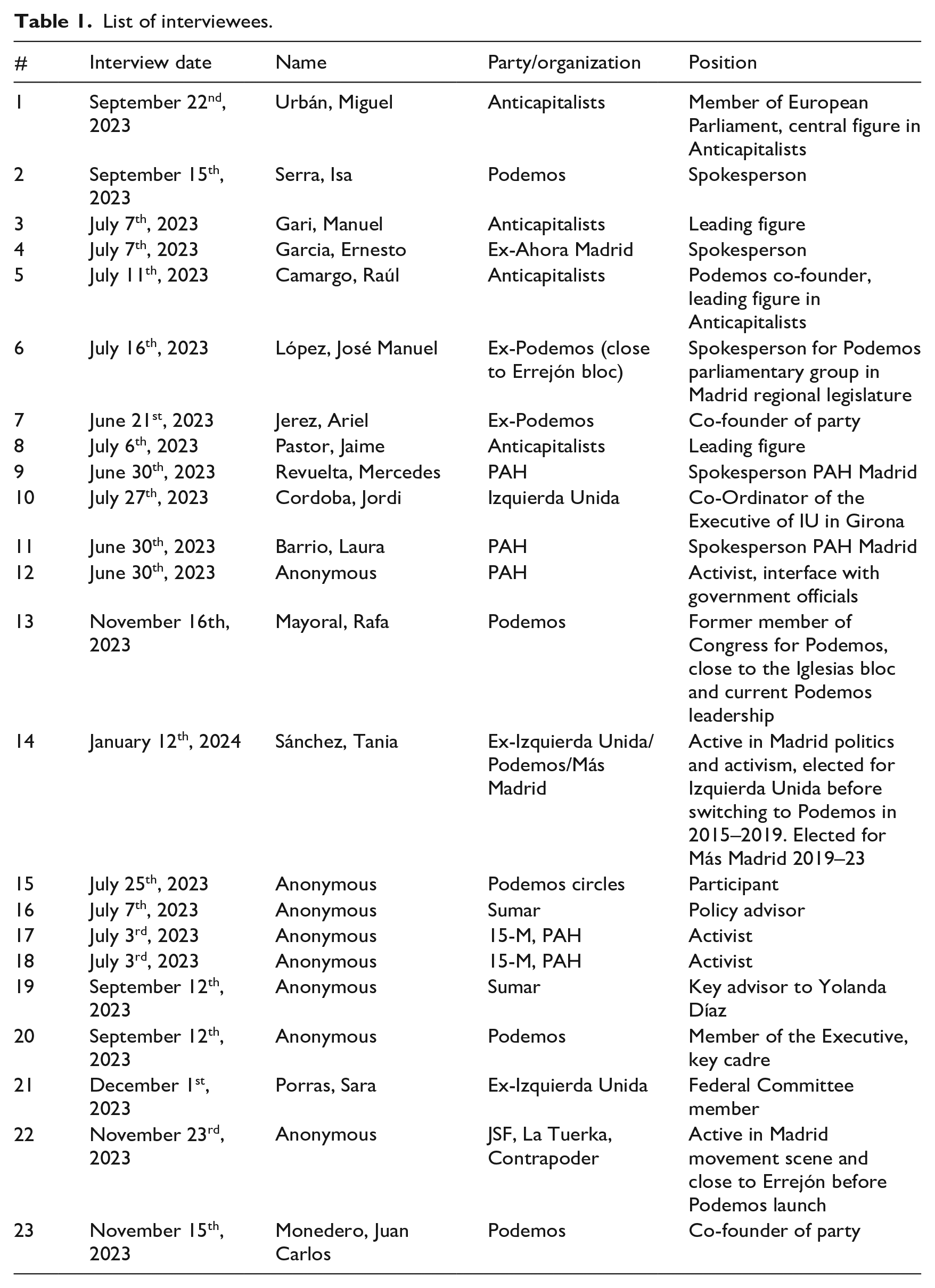
In addition to data gathered via analysis of newspaper reports, Twitter accounts, and elite-actor speeches, the case study analysis is underpinned by data collected via 23 semi-structured interviews conducted online and in-person in Spain between June 2023 and January 2024 (see Table 1). In the first five years of Podemos’ development, there were three distinct blocs in the party centered around Pablo Iglesias, Íñigo Errejón, and the Anticapitalists who were the most radical voices inside Podemos and who shared closer connections to societal movements and organizations via dual members as well as somewhat cordial relations. I interviewed cadres from each of these blocs as well as a number of the founders of Podemos. I also interviewed former politicians and activists linked to Izquierda Unida, the principal leftist party that pre-dated Podemos, and that worked as a partner with Podemos between 2016 and 2023 when the entity was known as Unidos Podemos and later Unidas Podemos. Errejón split from Podemos in 2019 and established Más Madrid. I spoke with figures that were close to Errejón and Más Madrid. Sumar, a coalition of 16 leftist parties (initially including Podemos), emerged in 2023. I interviewed key negotiators who came from Podemos and worked closely as advisors to Sumar leader Yolanda Díaz.
List of interviewees.
In addition to interviewing politicians, I met with activists and spokespeople for social movements such as the Platform of those Affected by the Mortgages and the feminist movement, as well as former activists who participated in key movements that preceded Podemos’ emergence such as Youth Without Future. I also visited the social center La Villana de Vallekas in Madrid where I had numerous informal conversations with an array of current and former activists to help contextualize interviews with party cadres. I spent time in informal settings with people who participated in Podemos circles 1 in Madrid to help develop my understanding of the complexities of the Madrid leftist and movementist scene.
Most of the politicians interviewed are from the national branch of the party, though some interviewees were from regional branches. Moreover, I interviewed activist/politicians from the local Madrid scene who were elected in the municipal elections of 2015, and who remain active in the city’s extra-parliamentary left scene. There is a focus on Madrid-based parties/politicians and activists as the capital and its political battles were at the heart of the debates and processes within Podemos and the Spanish left more broadly. The majority of Podemos cadres, its founders, and a good number of the activists and movements that nourished the party in its early days were based in Madrid. However, future research could broaden this study by examining other regions in Spain, in particular Catalunya and País Vasco where the ecosystems of the left are different from the rest of the country. Independenist-left movements and parties complicate the scenario in these regions and require a separate analysis from the one offered here.
The Rise and Decline of Spain’s Podemos
The convergence of Spain’s two principal parties (the PSOE and the PP) around neoliberal austerity measures in the 2010s opened space for a new challenger in the party system. The socio-economic impacts of austerity packages were deleterious, particularly on Spain’s youth (see Hopkin, 2020: Chapter 6). Labor market deregulation had intensified precarious employment. With cases of political corruption coming to light, Spain’s citizenry became increasingly critical of the two-party system and political elites. Following years of mass protest, in January 2014, a new political formation—Podemos—emerged and aided by his presence as a well-known political commentator on several TV debates, university political scientist Pablo Iglesias collected 50,000 signatures to lead a popular and open candidacy that would run in European elections.
Podemos was established by two main groups: a clique of left-wing activist scholars led by Iglesias, Iñigo Errejón, Juan Carlos Monedero, Ariel Jerez, and Carolina Bescansa, and the far-left party Izquierda Anticapitalista IA—Anticapitalist Left. Podemos initially sought to present itself as a new type of party that would respond to the twin political and socio-economic exclusion experienced by many citizens, seeking to build its brand as a challenger to neoliberalism and austerity and suggesting that it would offer a participatory model of connecting citizens to the party via empowered organic linkages. In 2014 European elections, Podemos unexpectedly won 1.3 million votes, before winning 5.2 million votes and 69 seats in the 2015 general elections. Since then, however, the party’s fortunes have been in constant decline. Following elections in 2019 in which the party won just 35 seats, Podemos entered as junior coalition partner with the PSOE. In national elections in 2023 as well as local elections in 2023 and 2024, support for the party plummeted.
Beyond declining electoral fortunes, active membership levels dropped. While in 2020–2021 there were 500,000 registered members indicating huge growth from the 370,000 in 2015, in terms of active membership (members whose online account had been used at least once in the previous year), in 2020, only 220,000 were active, while in 2021, the figure was 140,000 (Vittori, 2024: 86). Among the more radical left (parties, activists, movement organizations) in Spain, Podemos became de-legitimized. While the Anticapitalist bloc abandoned Podemos, a host of cadres and founding figures also split from the party. In the 2023 elections, Podemos ran as part of the Sumar alliance of leftist parties headed by Yolanda Díaz. However, feeling that Podemos was being disrespected and marginalized inside Sumar, the Podemos leadership opted to withdraw from the alliance. What factors contributed to this rise-decline-collapse arc?
Brand Moderation
Following its initial burst on to the scene with promises of shaking up Spanish politics by advocating an anti-neoliberal platform and a new party form, Podemos came to be seen as a ‘normal’ moderate party (interviews with activists, Anticapitalist politicians, ex-Podemos figures, and informal discussions in social centers in Madrid). Part of the explanation for such moderation relates to the fact Podemos leaders faced an array of domestic and transnational opposition which forced Podemos leaders to justify themselves as a responsible party capable of governing. Near constant attacks via mainstream media sought to delegitimize Podemos, including media smear campaigns against Podemos leaders, particularly Iglesias and his partner Irene Montero. Numerous legal cases were brought against Podemos officials—all of which were eventually thrown out. Podemos also faced economic and transnational opposition which pressured the party leaders to moderate the brand. For example, confronting the structural limits set by Brussels, the coalition between the PSOE and Unidas Podemos from 2019 to 2023 kept
‘public investment to a minimum, while deploying Next Generation EU funds for flashy “modernization” projects which do nothing to revive the country’s atrophied industrial base . . . Unidas Podemos has seen its main policy ambitions frustrated by a watered-down housing law that skirts any confrontation with real estate capital’ (Cancela and Rey-Araújo, 2022).
While opposition strictures and attacks sought to stifle the radicalness of Podemos, electoral tactics shed further light on the moderation. Podemos’ failure in the 2015 and 2016 elections to win over median voters triggered intense internal party debate over whether it should further moderate (its programmatic aims and its discourse) in an aim to convince PSOE voters that it was a responsible party capable of governing. Errejón advocated a populist approach, calling for Podemos to be a big-tent party that transcends left-right dichotomies, and to avoid collaboration with traditional left parties. Iglesias advocated a more traditional leftist approach while he was open to working with Izquierda Unida. While most analyses of Podemos focus on the populism-leftism debate supposedly represented by tensions between Errejón and Iglesias, it is important to stress that the leftist faction of the party was not the Iglesias bloc, but rather the Anticapitalists. Indeed, Iglesias was the prime driver of entering as junior coalition partner with the PSOE.
In an attempt to present themselves as a responsible party capable of governing, Podemos ceased to promote an anti-neoliberal solution to the problems facing vulnerable citizens. The Podemos brand on socio-economic issues that was initially developed in response to popular demonstrators’ concerns regarding a right to housing, critique of the financial market and the structure of the Spanish economy, progressive taxation and wealth taxes, defense of the welfare state and expansion of public services was diluted. Whether it was opposition attacks and pressures that cost the party scope and legitimacy to act as a more radical party, or if it was the efforts of party leaders (both Iglesias and Errejón) to win votes by presenting themselves as a ‘responsible’ party, the outcome was a moderation of the party’s once radical brand. With voters unable to distinguish what Podemos stood for as it came to resemble a slightly more progressive wing of the PSOE, its electoral fortunes dwindled. Furthermore, the debates over whether to dilute the brand fostered intense internal party tensions—not only between Iglesias and Errejón but also between Iglesias and the Anticapitalist wing of Podemos.
Degenerative Factionalism
Apart from Iglesias, all the original founders of Podemos would leave the party by 2020. Juan Carlos Monedero resigned, stating the party had come to resemble those it was trying to replace; Luis Alegre left claiming that the executive excluded anybody that was not part of their clique; Carolina Bescansa abandoned her parliamentary seat in 2019. In the January 2019 Madrid regional elections, Errejón dropped the Podemos brand and announced he would launch a new platform, Más Madrid. Further fighting between Errejón and Iglesias culminated with Errejón abandoning Podemos altogether, establishing his own party, Más País.
Beyond the Iglesias-Errejón tensions which came to light and damaged the public’s perception of Podemos, a less discussed though no less important rift developed between the Anticapitalist, movement-linked faction and the dominant faction of the party. In the lead up to elections in November 2019, PSOE leader Sánchez and Iglesias of Podemos wrangled over which ministries the junior partner should run in a potential coalition. Podemos had its worst election to date (13% and 35 seats), but its differences with Sánchez and the PSOE were quickly resolved as the party entered government. The Anticapitalists rejected the coalition arrangement from the outset and abandoned Podemos. Explaining the Anticapitalists’ logic, Miguel Urbán told me,
The founding approach of Podemos was based on non-subordination to social liberalism. By breaking that strategic hypothesis, it breaks the logic of Podemos as a channel of social contestation and political contestation against the Regime of ‘78 and against the austerity regime. Podemos always faced two great dangers; moderating and normalizing to become just another party. There is nothing that moderates and normalizes more than entering a minority government with the Socialist Party.
Iglesias rejects Urbán’s appraisal, stating to me that,
Urbán says that if you govern as a junior to the PSOE, they will normalize you and moderate you. But this was not the case. They did not normalize, they persecuted us. The police, the media, the judges. I know what it means to dig yourself in behind a discourse, but I believe that politics requires pushing beyond contradictions. Does this mean you must govern with the social democrats on all occasions? No, but politics must not be so secular that you are only willing to keep yourself in a place of comfort, which is a classic position of the extreme left, they keep themselves in a minoritarian position, with a radical discourse but they do not change anything.
Iglesias’ belief that the Anticapitalist position was too radical to allow them to ever actually govern was shared by Juan Carlos Monedero who told me that the
‘they are just a complaint group, they do not do politics, nor do they want to, that is why they never grow. We (Podemos) wanted to govern Spain, and that’s why many people voted for us. But to govern is to get your hands dirty, and here the Left always faces a contradiction’.
Iglesias’ and Monedero’s arguments regarding the need to ‘do politics’ suggests that a de-radicalization and/or engaging in strategic coalitions with moderate parties are necessary steps for a radical outsider left party to have any capacity to influence policy-making. Indeed, such positions support the arguments presented in this article that electoralism and opposition pressures encourage party brand dilution, which in turn is likely to trigger degenerative factionalism whereby the more radical left bloc of a party comes to be seen as an inconvenient annoyance. Where such processes occur and where the radical faction sees its opinions sidelined by the dominant faction—as in the case of Podemos—it is highly likely that the party will split from its left. While moderation and consequent degenerative factionalism culminating in splits may make it easier for the dominant faction to appeal to traditional social democratic party voters without having to listen to internal critique from its leftist faction, in the longer-run such party-building strategy is unlikely to be successful. Diluting the party’s brand and cutting ties to the more radical and social movement-linked left leaves the party untethered both electorally and socially; voters do not know what the party actually represents, while there is a risk that a party of cadres remains with no organic linkages to society via movements and popular organizations.
Monologic-Verticalization
Tensions emerged at Podemos’ first Constituent Assembly in October 2014 regarding the choice between promoting a more horizontal, democratic organization on the one hand (promoted by two MEPs, Pablo Echenique and Teresa Rodríguez of IA), and a more efficient and cohesive electoralist structure as advocated for by Iglesias (and Monedero, Errejón, Bescana, and Alegre). While the various proposals presented by the distinct blocs were opened to vote by digital means to all members, Iglesias’ proposals easily won out as he was by far the most well-known face in the party. As Miguel Urbán told me,
Pablo and Iñigo understood that IA’s strength was our territorial connections, our implantation in the militant base of the social organizations, which is something neither of them had. If only these people voted in Podemos elections, Pablo and Iñigo risked losing. So, they built a participation model where anyone who registered could vote. We had linkages with social movements, we were embedded territorially, but we did not have media speakers. They were the ones who had the media speakers. If you open a vote based on participation where the only thing that links the voter is that they have seen you on television, they win, we lose.
As Fominaya (2020: 256) notes, with Iglesias’ team’s proposals winning by a landslide despite the fact the opposing proposals were supported by many more working groups active at the base of the party, a first wave of disillusionment hit those supportive of a more horizontal style party. At the second Constituent Assembly, Iglesias and the Pablista faction won an absolute majority on issues regarding organization and politics. Critics from the Anticapitalist and activist bloc again noted the lack of debate, with Iglesias appealing directly to a base of supporters who voted from their computers by a simple click. Dialogic communication based upon horizontal or participatory forms of inclusion that would build collective identities and long-term loyalty to the party was eschewed in favor of top-down monologic decision-making by a centralized leadership. Interactions with critical radicals were bypassed allowing the moderating leadership to dominate the party, and steer it toward brand-diluted de-radicalization which they believed offered the best path for party survival.
Regarding issues of verticalization, Pablo Iglesias told me that ‘the moment somebody decides to organize as a party, a series of unavoidable dynamics begin’. Discussing the early development of Podemos as it focused on winning elections, Iglesias stated that in this moment ‘Pablo Iglesias’ speech worked. This did not respond to a process of democratic organization from below, but to an electoral initiative, a war machine of a very small group of militants’. Juan Carlos Monedero told me that ‘in organizational terms, the electoral war machine was very hierarchical, it was not very deliberative’. Errejón (2021) reflected on his role in fostering a party which slid in an oligarchic direction stating,
I founded. . . a very vertical political formation, which legitimizes its decisions through a very concentrated leadership, very focused on electoral competition and the charismatic power of the secretary-general . . . This provided the basis for Podemos’s ‘electoral war machine’—very agile, very fast, very concentrated, but difficult to self-reform.
Indeed, a senior Podemos official from the leadership-bloc
2
told me that
Our principal error has been our failure to construct a party rooted in society. The Blitzkrieg approach and the decision to go all for the institutions made it difficult to organize a party. This should have been overcome a year or two after the emergence of Podemos, but we never developed roots in any territory or with the social movements, which hindered the party’s stability.
According to Rommy Arce of the Anticapitalists, for the principal Podemos leaders the Anticapitalists ‘were just an annoying political space because we tried to challenge the leaders, to put the contradictions between their promises and actions on the table. But they did not value our opinions’. Discussing these issues, Juan Carlos Monedero told me that ‘for the leaders of a party, they are bothered by internal democracy. They see it like a stone in the shoe, a pain in the butt’. Tania Sánchez cogently captures some of the issues with such an approach to party-building, stating that the
‘construction of a party machine like a tank able to win in general elections without dwelling on the details of the road you are travelling on is a problem. . . It was not consensual, and nobody explained what the limits of this electorally focused period of exceptionality were.’
Juan Carlos Monedero outlined how the constant electoral focus of the party leadership added to the verticalization of the party while blocking the fostering of empowered societal connections. Ariel Jerez told me
At the beginning, we had a party that came out of nowhere. It had to have a recognizable face. I remember us celebrating the victory of the European elections in 2014, and us saying that in the general elections we had to put forward Pablo’s face, just when Pablo was appearing on TV. We had to close ranks behind that political capital and consolidate a political space, but obviously not turn that into a charismatic leadership. I thought this could be changed later. Initially the circles were full of people because there was impressive support and motivation to be there. The issue though, is why we didn’t give the circles more work over time, why we didn’t give them work to organize participation.
Discussing the circles at the base of the party, Monedero stated
‘look at the horizontal leg of the party, the circles, the leg most connected to the 15-M. This leg did not work, the electoral war machinery dominated it. The circles, which initially were democratic structures, they were converted into transmission belts of the needs of the leadership from above’.
Moderation–Factionalism–Verticalization
Monedero argues that to grasp why the party leaders sidelined both the circles and spaces for internal party debate, one must understand
‘that the logic of parliamentary democracy forces a type of behavior that does not leave much room for internal democracy. There is no time, there are so many elections, and elections are always guided by the short-term. . . The circles collapsed because we never cared for them, we never minded them because the machinery of the electoral war devoured the democratic part of the party’.
Beyond the electoral focus and issues of a lack of time, however, is the reality that the circles presented a headache for the party leaders. These spaces were filled with people demanding a radical anti-neoliberal project and a horizontal participatory party based on dialogic relations. The principal party leaders, however, felt that wooing more voters and members, presenting themselves as a responsible party capable of governing (in the face of near constant media scaremongering), and demonstrating to the PSOE they could be a coalition partner required moderation and de-radicalization. This in turn required building a party whose decision-making processes were isolated from the input of more radical voices—whether from below via the circles or internally from the Anticapitalists. The combined impacts of opposition constraints and electoral strategizing encouraged monologic-verticalization and degenerative factionalism to advance. Whether taking a critical perspective or justifying their own actions, there is general agreement with this analysis across a wide array of actors I interviewed. Certainly, there are differences in opinion as regards the rights or wrongs of the Podemos strategy. However, there is universal acceptance that Podemos leaders sought to moderate the party brand in the face of electoral and opposition pressures, and this fostered tensions with the more radical sectors whose influence needed to be controlled or isolated. Furthermore, to maintain the appearance that Podemos was a radically democratic party, online participation was encouraged. However, voting on pre-determined agendas can hardly be labeled dialogic participation. Furthermore, the decision to grant ‘voice’ to so many online members (who followed Iglesias’ prompts) weakened the influence of those who called for a re-building of the circles and connections to the social movements. Party leaders could point to high numbers of people voting online, while active participation levels in circles and in social movements more generally were in decline.
Weak Popular Counterpower
In the case of Podemos, empowered organic connections between movements and party did not exist, while contestatory mobilization capacity was weak. In turn, there was little counterpower to the moderating pressures that party leaders faced; the internal radical faction could be easily sidelined as the Anticapitalists could not point to a powerful street movement supporting their agenda; while monologic-verticalization advanced as party leaders faced little resistance from below. To grasp why counterpower was weak, it is necessary to look to the antecedent era to Podemos’ emergence.
A protest event organized by Democracia Real, Ya!—DRY Real Democracy Now! on May 15th, 2011, in Madrid acted as a spark to a new stage of protesting. 3 What began as a protest evolved into a camp, and from there the 15-M movement network (referring to May 15th) developed. The camp experience fueled the 15-M movement going forward by establishing the crisis of neoliberal democracy as a central problematic around which to frame the movement, while also consolidating a 15-M collective identity and movement network which would sustain the movement and allow it to expand and evolve (Fominaya, 2020: 123, 131).
From early 2012, more than 1000 new organizations—‘the 15-M’s offspring’ (Portos, 2019: 59)—were actively fighting austerity during a two-year cycle of street protest. New protests such as the mareas (tides) were established focusing on specific areas such as health and education while local assemblies proliferated bringing together activists, regular citizens, and collectives. The pre-existing Plataforma de Afectados por la Hipoteca—PAH (Platform of those Affected by the Mortgages) gained momentum as it struggled for decent social housing and against evictions (Portos and Carvalho, 2022). Carvalho (2022: 135–136) traces the evolution of the protest phase, noting the gradual demobilization as some activists began to look for ways to have an impact on institutions beyond protest.
It needs to be emphasized that 15-M was not a unified and coherent movement organization. Rather, 15-M became an umbrella term for an array of groups with a common aim of transforming society (Fernández Savater, 2012). Romanos et al. (2023) raise some critical points regarding the nature of the contentious cycle, stating that,
Between 2011 and 2013 a massive cycle of contention erupted, revolving around political-economic conflicts related to housing, finance and the welfare state. Mobilizations were fed by networks of activists with similar repertoires of action (occupation of public space, communication strategies, etc.) that mostly came from the Indignados movement. Still, despite their affinity, these mobilizations were unsustainable over time due, among other reasons, to a lack of coordination and an inability to forge a sustained and integrated challenge around a common charter of demands with a strong organizational basis (p. 444).
Jaime Pastor told me that ‘this is a historical issue. In over four decades we have often had sporadic movements, powerful explosions of protest, but without subsequent transformation into a permanent organization’. 15-M ‘was so autonomous, like crazy blooming atoms, all varied, all so diffuse’ (interview with 15-M participant and later activist in the PAH). Such accounts resonate with Rendueles and Sola (2019: 29–30) who note that ‘Spain is a highly politically mobilized country with relatively weak social movements’ whereby ‘mobilization in a specific moment does not crystallize into stable and lasting forms of organization, which prevents extended citizen participation over time and the creation of networks beyond activist nuclei’. The authors continue, emphasizing that 15-M was unable
‘to create stable organizational forms that offered channels of participation for those who filled the squares. The attempts to preserve, revitalize or replicate the insurrectional energy of 15-M have failed because, as has been proven in recent years, it is an explosive and intermittent mobilization model that reappears with some regularity but always in a relatively fleeting manner’.
Such fleeting popular mobilization and the lack of a sustained coherent organizational model meant Podemos leaders did not feel pressured to adhere to movement concerns. Rafa Mayoral, whose role in the Podemos executive was to try to foster connections between the party and popular social organizations, stated to me that Podemos had a wholly distinct relationship to these actors than any other Spanish party. However, Mayoral noted that ‘in Spain there is a structural weakness in terms of popular institutions. There are weak social organizations’. Moreover, it is important to emphasize that there is a strong autonomous culture in the Spanish movement scene, and for many individuals and organizations, interacting with Podemos was never an option. When I suggested to a long-term activist that movements lacked counterpower to hold the Podemos leadership to account, he responded that ‘you assume we wanted to influence Podemos. This is not the case, for me and many like me, we kept a clear distance from the party sphere’. Similarly, when I asked another long-term activist and dual member of the Anticapitalists about weak counterpower, they emphasized that ‘there is a strong tradition and culture of autonomy, a strong rejection of institutional politics’. Autonomous positions along with generally low organization levels generated weak mobilization capacity and impeded the building of organic party-movement linkages.
The weak counterpower of the movement sphere affected the capacity of movementist voices and the radical sector of Anticapitalists inside Podemos to counter brand dilution, degenerative factionalism and oligarchic tendencies. Jaime Pastor, Manuel Garí, and Raúl Camargo of the Anticapitalists all stated to me that the fact they lacked linkages to a powerful movement field capable of pressurizing the party leaders from the streets left their voices isolated inside the party debates. As Laura Barrio, the spokesperson for PAH Madrid told me,
‘It is a big mistake to think that movements have more power and influence than they actually have. Some people think we are still in the middle of 15-M when there was a mass of people on the streets. Now you are lucky to get 5,000 people. And what are you going to achieve with that?’
The pathway of the Podemos party-building process was influenced by the antecedent nature of popular sector organizing. In the absence of a pre-existing powerful and coherent popular movement organization capable of shaping the party-building process, Podemos leaders opted for an all-out electoral strategy, eschewing the more laborious and time-consuming process of building a party with connections to society. As Jager and Borriello (2023) argue,
‘it must be remembered that the very genesis of Podemos was the fading away of the Indignados movement. Podemos’s strategy, however, did not aim to lend a perennial afterlife to this wave of mobilization, but rather to harness its residual energy in order to build an electoral machine (p. 153)’.
The electoral strategy overpowered the calls from weak movement voices and Anticapitalists to build a radical and participatory party with an organized territorial presence.
Outcomes of the Podemos Party-Building Process
While the party-building process was justified by leaders as necessary to capture the electoral opportunity presented by the crisis of Spain’s long-standing two-party system, the failure to build a radical party brand or to foster a societally linked party would ultimately prove to be Podemos’ undoing. Diluting the brand and creating a normal, vertical party structure meant Podemos lost its relevance to the wider electorate, participation levels in the party plummeted, while the party lost legitimacy among the Spanish activist and leftist scene (multiple informal discussions in social centers and bars in Madrid with activists who participated actively in the 15-M cycle and Podemos circles). As the radical outsider became a moderate insider, Podemos lost its competitive edge. Lacking counterpower, popular movement organizations could not pressurize Podemos’ leaders who ceded to pressures to moderate, while radical voices from inside and below were easily sidelined via degenerative factionalism and monologic-verticalization processes. Crucially, the moderation–factionalism–verticalization party-building process meant Podemos failed to foster societal linkages as the circles were abandoned and social movement organizations and activists were pushed aside. Podemos became a clique of party leaders lacking a coherent brand or organic societal connections—two critical weaknesses for an emergent challenger party (Levitsky et al., 2016; Lupu, 2016).
In 2022, Iglesias’ anointed successor as Podemos leader, Yolanda Díaz, launched a new political project, Sumar. Sumar was a coalition of leftist parties, with Podemos one of the members. A key advisor to Díaz told me that Sumar’s leader sought to revive the political space of Podemos which had seen a decline since its entry into government. From a critical perspective regarding the confluence of the various leaders under the Sumar banner, Miguel Urbán described the project as
‘a Frankenstein. A combination of what had once been presented as part of the process of change and which won 5 million votes. Podemos was an expression of a cry of indignation, of discomfort. What Sumar expresses is an attempt to save the furniture from the shipwreck at the end of that process. To save the furniture, everybody comes together because nobody wants to become a castaway’.
Sumar was not an organic movement-linked party, and it had no organizational structure or rank-and-file membership. Sumar’s emergence was an even more technocratic and closed process than Podemos’, involving a small group of party elites—with Díaz’s personal brand at the center of the project—while teams of experts helped draft a manifesto and campaign program (discussions with several academics and policy specialists who worked on developing Sumar’s policy proposals).
As Díaz sought to build a progressive bloc around Sumar, snap general elections in 2023 called for by PSOE leader Sánchez left Podemos in an awkward position. Electoral law demanded that Sumar and Podemos (as well as other small parties participating on the Sumar ticket) had just 10 days to form a pact. However, disastrous results for Podemos in recent local elections left them in a weak bargaining position. Following an extraordinarily complex and drawn-out period, Díaz managed to agree to a coalition government with the PSOE (and rightist nationalist parties including Junts of Catalunya), with Podemos reluctantly remaining a constituent of Sumar.
Of the 31 seats won by Sumar in the general elections, just 5 were Podemos figures. Podemos were not granted any spokespeople in the coalition government. Podemos officials were angered by the diminished role they were offered and would soon split from Sumar and join the Mixed Group in parliament. Rafa Mayoral claims that Sumar was essentially ‘a concerted maneuver along with the PSOE to throw Podemos out of the government at the expense of the people’s interests’. The election results also meant that Podemos would lose almost 3.5 million euro per year in subventions, requiring a radical downsizing of the party’s offices and staff (Chouza and Galán, 2023).
In short, Podemos’ stability was placed in jeopardy as its space in the party system was challenged by a new political force, while a key source of funding (state subventions) was vastly reduced. The outsider-to-insider party-building process culminated with a fragile Podemos and the emergence of a new, top-down political vehicle claiming space on the left of the party system. Spokesperson for Podemos, Isa Serra, bluntly stated that there is no comparison between 2014 and Podemos’ emergence and that of Sumar, noting that,
The 15-M social movement had questioned everything and the left was on the offensive, and there was a generation of a political organization that emerged from below via the circles. . . Comparing that to today and Sumar. . . There is no social process below, just an invitation to join an empty shell.
While Serra’s appraisal may be accurate, one may also critique Podemos’ party-building strategy for fostering such an outcome. On the decline of Podemos and the emergence of Sumar, Miguel Urbán argues that the latter was the ‘logical evolution of the political culture that Podemos built. A culture of media leadership that is above collective processes and grassroots organizations’. Rommy Arce concurs, suggesting that Sumar represents the ‘triumph of the autonomy of political leaders, unconnected to anything at the grassroots’. The fact, however, that Sumar and Podemos could become such leader-centered parties relates to the weakness of popular sector organizations.
Where left parties compete for office, electoral strategies and opposition pressures will always exert pressures on party leaders to moderate and to dilute the influence of radical voices via degenerative factionalism and monologic-verticalization. The absence of powerful popular organizations to counterbalance such processes, to anchor party leaders to demands from below, is a key element that must be accounted for when evaluating the trajectory of Podemos (and Sumar or any other new left party). In the absence of such counterpower, party leaders may opt for a moderated position to compete for elections while encouraging digital voting on pre-determined matters to provide a veneer of internal democracy (while simultaneously eschewing real internal debate by bypassing critique from more radical voices). For outsider, anti-neoliberal parties to compete in the long run, they must build a radical brand and they must build societal connections across territories. Where powerful popular organizations do not exist, the pull on party leaders to moderate and excise radical voices will likely see anti-neoliberal outsider parties become moderate, top-down vehicles, placing the very survival of the party at risk.
Conclusion
Aspects of the Podemos case echo some of the challenges for mass socialist parties and working-class organizations identified by a previous generation of scholars such as Przeworski and Sprague, Michels, and Offe and Wiesenthal. While Przeworski and Sprague outlined the electoral dilemma facing socialist parties, discussions with key figures in Podemos support the contention that party leaders believed that seeking an electoral majority required de-radicalization. However, unlike the parties and societies analyzed by earlier scholars, Podemos was not tethered to a powerful labor union or any other popular organization capable of constraining leaders. The movementist outsider parties of today, such as Podemos, do not share such societal linkages. Popular sectors are more dispersed, and unions no longer play the same organizational role. For Podemos, weak popular counterpower from below allowed moderation of the brand to go almost unopposed.
Podemos did witness oligarchization, as Michels suggested, although as the case study here suggests, this was not underpinned by a psychological desire to dominate on the part of party leaders nor wholesale passivity of members. However, and echoing components of Offe and Wiesenthal’s sociological theory of opportunism, the Podemos case supports the contention that party leaders may moderate from original organizational goals in order to keep the organization stable going forward, and that this may entail leaders ignoring demands of factions of their membership. Moreover, while Michels’ notion of passive memberships supporting oligarchization may be critiqued, the Podemos case suggests that one must identify whether the majority of the membership is passive or, conversely, whether there are efforts from below to resist moderation and verticalization. In Podemos’ case, those active members and cadres who tried to push back against moderation and verticalization were outnumbered by passive online click members—the passive portion of membership that were appealed to directly by the moderating leaders to support their agenda.
Echoing Offe and Wiesenthal’s appraisal of trade unions, as the maintenance of the organization (understood by party leaders as requiring vote maximization and increasing membership numbers) came into conflict with adhering to the goals of the organization (adhering to a radical anti-neoliberal brand and the building of a horizontal democratic party), leaders sought to build a party around monologic-vertical leader-base relations that allowed leaders to act against the concerns of the more radical voices. This is not the same as saying leaders were simply bad, but rather that they believed the best path forward to guarantee the party’s survival was to adapt to electoral conditions. In the absence of a muscular societal organization representing demands for anti-neoliberal representation in the institutions, radical factions inside Podemos were easily ignored and branded as unrealistic. While Przeworski and Sprague suggested that powerful unions constrained socialist parties and prevented them from winning majorities, these parties did retain the backing of labor and continued to exist as institutionalized parties. The opposite occurred in Podemos’ case. Weak counterpower meant party leaders opted for wholesale moderation—and the accompanying monologic-verticalization and degenerative factionalism to bypass any critics—but this party-building strategy witnessed not the coherence of an embedded and institutionalized party, but rather its opposite.
Moreover, the Podemos case challenges Offe and Wiesenthal’s optimistic contention that when factions split from a moderating and monologic organization, they can regroup and start to re-organize around adherence to radicalism underpinned by dialogic decision-making. In Podemos’ case, while factionalism occurred, the radical Anticapitalists have struggled to build momentum. Indeed, a major challenge facing any leftist party in Spain following the 10 years of Podemos between 2014 and 2024 is the discontent within activist/radical circles regarding institutional politics. Echoing a sentiment I often heard in bars and social centers in Madrid, one dual activist-politician told me that
‘following the whole Podemos thing, people with radical political positions no longer want to know anything about political parties, anything with an electoral horizon. Many people have withdrawn from organizing and activism, and we were not lots to begin with’.
This is a fundamental issue facing the Spanish left going forward. As discussed throughout this article, one of the factors that attributed to the depth and scale of Podemos’ oligarchization and brand dilution was the weak counterpower to such processes. Such a party-building process furthered the belief that movement organizations and activists should retain wholesale autonomy from the party sphere, in turn weakening the potential counterpower to brand dilution and oligarchization processes in any future leftist party-building. As can be seen with the emergence of Sumar, failure to overcome this vicious circle and build a party with organic connections to society is likely to lead to a plebiscitary challenger party that utilizes social media to connect voters to a distant leadership.
Understanding the dilemmas, old and new, for radical outsider parties in an era of disorganized and de-mobilized popular sectors is critical. The challenges of winning an electoral majority will remain for the foreseeable future. Hence, if outsider, anti-neoliberal, movementist parties wish to become stable options in the party system in the longer term, it is essential that party leaders and strategists grasp the importance of fostering organic connections with popular organizations if they wish to avoid being seen as ‘just another party’. While adhering to a radical brand is tough when confronting the structural power of capital in a conservative regional setting and a hostile domestic environment, party leaderships can encourage empowered party-base connections. Those that do so are more likely to survive beyond their embryonic phase.
Following his experiences in launching Podemos, and discussing the advancement of a leftist project in Europe and beyond, Pablo Iglesias stated that,
People who regularly read a newspaper or watch a television channel normally assume the approaches of that media as their own approaches. That is a political task and a crucial militant task that goes beyond having people organized in circles or in party groups. The militants’ fight cannot only be the work in the neighborhood’s civil society. That’s fine, but it also has to be a job in the media and in the state. In that sense, I think that sometimes there is a mythologization of what the organization of the party itself implies, when in reality we must have a more organic, more Gramscian vision of what a party means as a political and cultural project.
Certainly, given the general weakness of the Spanish social movement organization scene, which reflects conditions in much of Europe, a cultural/hegemony-building strategy may be necessary to encourage citizens to participate in a popular organization or radical left party. While I do not disagree with Iglesias’ Gramscian reading of building/challenging hegemony, such efforts must aim to help foster an organized social base that can act as a counterpower to the inherent brand dilution and oligarchization pressures that come with office-seeking. A party which utilizes a hyper-mediatized and leader-focused strategy without an accompanying project of fostering organic connections to popular organizations is unlikely to remain stable in the longer term. Understanding such processes, and whether anti-neoliberal movementist parties offer long-term solutions to the current crises of democracy, or whether they are destined to absorb popular movement power before withering away is of critical importance in an age of democratic discontent in which far-right parties have gained the upper hand.
