




Abstract
The article engages critically with the literature on the relationship between social movements and political parties. It traces the representation crisis in Chile with a dual focus on the meso-institutional supply side of partisan politics and the microfoundational demand side of protest activity (2006–2019). I argue that the dialectical relationship between political parties’ programmatic dealignment and realignment and social actors’ framing politics determined the magnitude, intensity, and ideational content of protest mobilization. Social actors’ perception of their position in polity structure determined the content of their demands. Savvy actors started with a realignment frame in 2006 to push through socioeconomic reforms from within the parameters of the existing system. They, however, afforded an anti-establishment frame with the ‘social outbreak’ in 2019 to weed out the vestiges of Pinochet’s regime. Social forces pushed political parties to reposition their policy programs, reset agenda priorities, and recast their linkages to society. I draw on interview data, archival works, and Observatory of Conflicts–Cumulative Dataset to substantiate my argument.
Keywords
Introduction
The dismantling of the corporatist arrangements inherited from the Import Substitution Industrialization (ISI) period and the implementation of market-oriented policies throughout the 1980s marked a watershed in political development in Latin America. Policy switches pushed erstwhile labor-based parties to veer toward the right, break ties with labor unions, and delimit the policy space to mitigate distributional conflicts and demobilize active popular sectors. In much of the region, political parties lost their representative functions as electoral vehicles to articulate and aggregate social interests. At the turn of the 21st century, social actors broke with the long-running pattern of political quietness to voice opposition to market-oriented incumbents and halt some government market policies, such as the anti-privatization revolt in Arequipa (Peru), the ‘water-war’ in Cochabamba (Bolivia), and the popular revolt known as the Sacudón or Caracazo in Caracas (Venezuela). Against the backdrop of mounting popular pressures, well-established and traditional parties collapsed in Venezuela and Bolivia and gave way to populist leaders to articulate the interests of a wide gamut of disaffected social groups. In other countries, more pragmatic leftist forces assumed office, changed patterns of electoral competition, and recast their societal linkages along policy commitments, such as the Labor Party (PT) in Brazil and the Broad Front (FA) in Uruguay.
Unlike other countries in the region, Chile exhibited continuity with the main features of the party system since the return of democracy in 1990. Chile has long been known for its well-established party system that is rooted in social and ideological cleavages and stable electoral competition. The historical experience of ideological polarization that paved the way for the military coup in 1973 had long-term implications for ideological moderation and policy convergence among political rivals. The restoration of democratic rule, therefore, has been coupled with wholesale demobilization and deactivation of the popular sector. The center–left coalition—Concertación—comprising the Christian Democrats (DC), the Socialist Party (PS), and the Radical Party (PR) led the ‘No’ choice against Pinochet in the plebiscite of 1988, and developed dense networks that linked social constituents with policymaking agencies to demobilize active sectors, and ruled the country uninterruptedly for two decades until the center–right won the presidency in 2010.
The inherited constitution and electoral rules created conditions of elite collusion and increased the cost of organizing extra-institutional protests. The super-majority quorum required in Congress to pass any significant policy change limited the policy options and forced the center–left government to negotiate and moderate ideological positions with the right opposition. In addition, the binomial electoral system, before its amendment in 2015, discriminated against small parties that had no chance of garnering political influence over the decision-making process. The high threshold of winning conditions forced political parties into coalition-building and created a divided congress between the left and the right (Scully, 1995: 125).
The two ideological camps, therefore, monopolized the policy space, delimited the ideological range, closed off the institutional political arena to radical opposition, and made the emergence of ‘politically decisive countermovement’ to the existing political and economic structures, similar to those that emerged in Venezuela, Ecuador and Bolivia, highly unlikely (Silva, 2017).
According to the literature on Political Opportunity Structure (POS), Chile is the ‘least likely case’ for the eruption of massive protests with the presence of a closed polity structure and cohesive ruling elite (Eisinger, 1973; Moseley, 2018). In this line of reasoning, the first decade of the rule of the center–left coalition was coupled with the close association between political parties and their social bases through dense networks to articulate social demands through institutionalized channels. Surprisingly, however, the second decade of the Concertación’s rule coincided with the outbreak of massive protests with the rise of the student movement cascading the country in 2006 and attracting social support from labor confederations and popular organizations. The movement shaped political opportunities for protests amid the prevailing duopoly politics of ideological moderation between the left and the right. Students repoliticized social cleavages and articulated new sociopolitical issues, setting the stage for successive cycles of protests over the next decade.
From 2006 through the partisan dealignment with the center–left coalition in the 2011 elections to the popular uprising of 2019, it has become increasingly obvious that ‘there [has been] only a fuzzy and permeable boundary between institutionalized and non-institutionalized politics’ (Goldstone, 2003: 2). Ending the center–left monopoly over policymaking opened horizons for electoral uncertainty that went in tandem with escalating social protests. The interplay between political parties and social forces merits more investigation to show how the crisis of representation shaped social actors’ expectations about viable policies and competitive alignments and created opportunities for variegated levels of protest activity. How did social forces (re)constitute the ideational content of collective action ‘frames’ over the course of social interactions that started with demands for education reforms in 2006 and culminated into a call for a new constitution in 2019? And how did strategic choices of political elites of (re)formation of competitive alignments set off processes of interpretative frame-creation and goal adaptation?
Framing theorists (Gamson and Meyer, 1996; Snow and Benford, 2000) maintain that the claim-making process is predominantly strategic, which requires looking beyond particular actions to excavate the underlying beliefs about a society that orient social actors. Social actors are not, therefore, mere carriers of extant ideas, beliefs, and meanings conferred by structural arrangements. Rather, they are signifying agents who take part in contentious processes of meaning production (or preservation) for allies, opponents, and bystanders. Students broke with a long-established pattern of institutionalized politics and developed a ‘master frame’ that combined the prevailing neoliberal model with inequality and injustice and centered subsequent protests on these issue dimensions to force political parties to realign their programs along the new issues.
Argument and Methods
The dialectical relationship between the ideational realm and institutional arrangements constructs an understanding of the material world, and agency can change it through that construction. While the material world affects the resonance (i.e. the effectiveness) of ideational constructs, actors’ response to the material world, mediated through the ideational filter, purportedly poised them to reform and transform that construct.
The crisis of representation pushed both political parties to strategically articulate new interests and issues, and social actors to constantly engage in meaning construction. Parties’ programmatic dealignment and realignment and actors’ contentious frame determined the magnitude, intensity, and ideational content of protest activity and shaped the government’s policy agenda.
Social actors created new avenues of representation and carried out representative functions that subsequently pushed political parties to reposition their policy programs, reset agenda priorities, and recast their linkages to society (Hutter et al., 2018). When the center–left ruling coalition realigned its programmatic linkages to electorates under Bachelet’s first government, social actors endorsed a simultaneous realignment frame of contention to monitor the responsiveness and representation functions of the government. With the electoral dealignment of the center–left rule in 2011, students alongside other active sectors (most notably, trade unions and popular organizations) developed a concurrent dealignment frame with the conservative government and articulated new redistributive and political reform demands. Social protests continued unabated during Bachelet’s second government in 2014, but actors aimed primarily to propel Bachelet to materialize her electoral promises that corresponded to their claims in 2011 and/or to sustain single-issue mobilization to urge the government to offer more concessionary policies. Ultimately, when Piñera was voted back into office in 2018, the cumulative failure of the government to respond to actors’ demands exacerbated the crisis of representation and claimants endorsed an anti-establishment frame with the ‘social outbreak’ in 2019. Protestors clamored for weeding out the vestiges of Pinochet’s regime and undertaking far-reaching constitutional and social reforms.
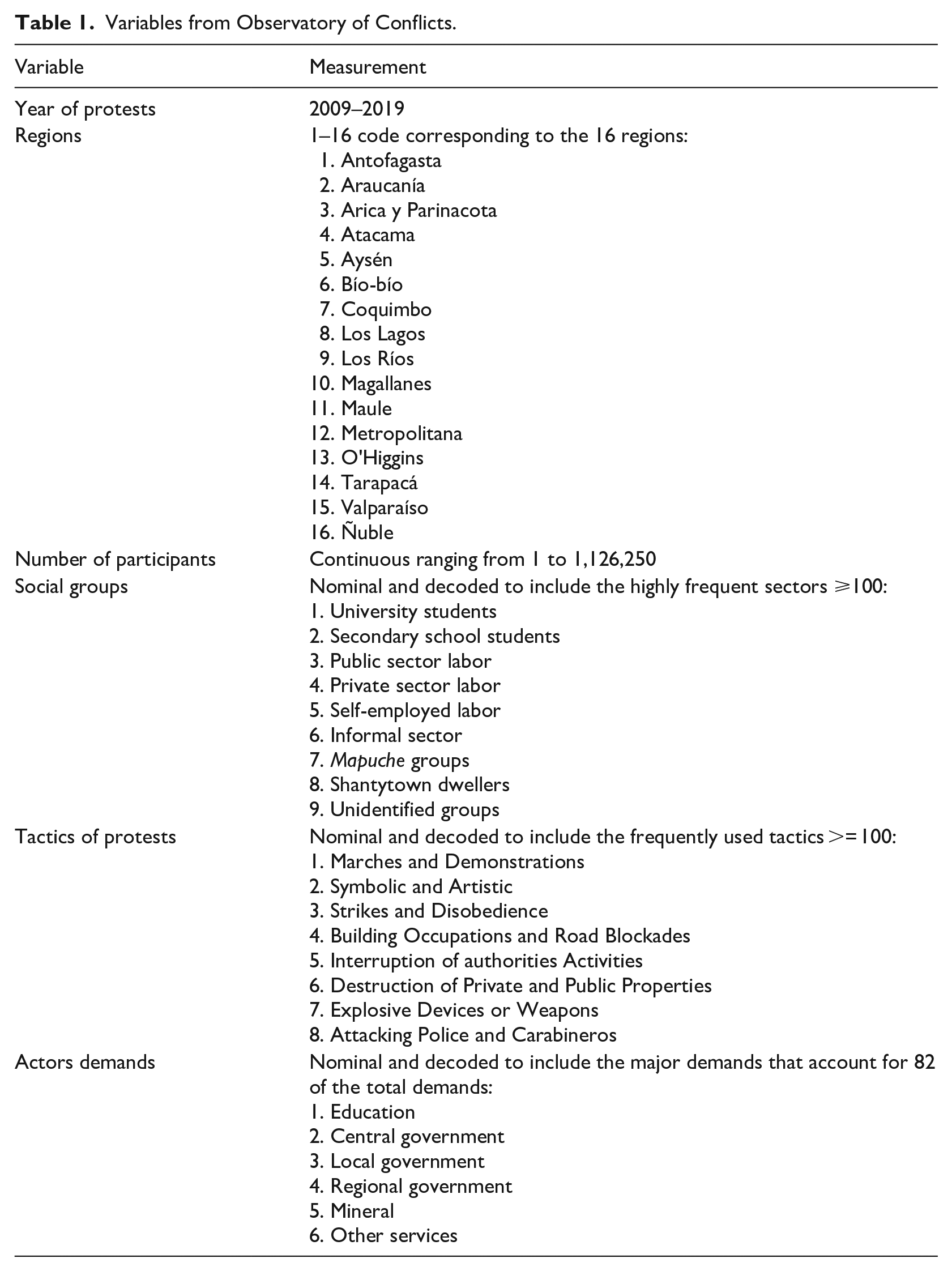
I examine the crisis of representation through an interactive lens between the meso-institutional supply side of partisan politics and the microfoundational demand side of actors’ cognition and motivation that shaped electoral programs and protest activity between 2006 and 2019. I rely on 17 semi-structured interviews with grassroots activists, social movement leaders, members of nongovernmental organizations (NGOs), and politicians conducted in Santiago in 2012 and then follow-up structured interviews conducted online in 2016–2017. I also count on secondary sources that interviewed movements’ leaders and politicians as well as nearly 180 documents from the Latin American Weekly Report (LAWR) archives that grapple with political and social actors’ reflections and motivations between 2006 and 2019. The operationalization of the three aspects of the protest dynamics (magnitude, intensity, and ideational) is gleaned from the Observatorio Social de América Latina (Observatory of Conflicts—OSLA hereafter) that codifies diverse forms of protests (peaceful and violent) based on various national and regional media outlets in Chile. The OSLA includes variables that measure the numbers of participants across the 16 administrative regions (indicating the size and massiveness of protests); identify social groups involved and their tactics (denoting intensity and scale of demands); and register the content of protestors’ demands (proxying possible framing politics) (Reproducible Research, Centre for Social Conflict and Cohesion Studies, 2020). The dataset, however, starts with 2009, leaving the 2006 Pingüinos’ upsurge unmeasured.
In the following section, I throw the theoretical discussions into focus and show the effect of the quality of parties’ representation on the magnitude, intensity, and ideational content of protest activity. Second, I start out with Bachelet’s first term (2006–2010) and the outburst of the student movement with a realignment frame of contention to monitor the responsiveness of the ruling coalition to its progressive social agenda. Third, the article examines actors’ dealignment frame that went in tandem with partisan dealignment after the rise of right-wing Piñera to power (2010–2014), to ask for political reforms and hold the government accountable for unjust socioeconomic policies. Fourth, I investigate the shift in Bachelet’s ruling coalition in her second term (2014–2018) and the persistence of mobilization with revitalizing frame to look out for the effective implementation of profound sociopolitical reform policies and/or to compel the government to offer more policy concessions. Fifth, the article dwells on the recent upsurge of full-scale protests that buffeted the country in October 2019 under Piñera’s second reign with an explicit anti-establishment frame that called for writing a new constitution, eradicating Pinochet’s relics, and enacting extensive social and redistributive policies. The conclusion highlights the implications of the historical trajectory of protest activity for the subject formation and movements’ strategic interaction with their institutional environment in Chile and other contexts.
Party De–Realignment and Scope of Protest Mobilization in Chile
The dialectical relationship between partisan (de-)realignment and social actors’ motivation and understanding of the surrounding environment has mutually constituted the boundaries of collective action and determined the magnitude, intensity, and ideational content of protest mobilization from 2006 through 2019.
Concepts of partisan realignment and dealignment pertain to changes in the representative relationship between political parties and voters, particularly in terms of shifts in party identification and programmatic connections. Shifts in the distribution of voters’ preferences over policy space and growing ideological gaps between parties and electoral constituents would push political parties to realign their policy platforms, by adopting new policy programs and repositioning themselves ideologically to give limited space for new parties or political figures to emerge and attract disillusioned voters. In a similar vein, erosion of grassroots networks and organizational ties between parties and electorates would result in low turnout and a decline in party membership that mark a dealigned relationship between parties and citizens (Kirchheimer, 1966). Although both the concepts relate more to the electoral domain, the processes of dealignment and realignment create possibilities of extra-systemic actions for disillusioned citizens to articulate new interests. Partisan dealignment or realignment offers a strategic context for savvy social forces to frame their claims by identifying the root causes of the social problems that curtailed bonds with the established parties, proposing alternative solutions and percolating new cognitive structure (schemata) in society that attribute existing faults to politicians of traditional parties. 1 As Snow and Benford (1992: 137) aptly note: Developing a collective action frame includes the formation of ‘cognitive schemata that simplifies the “world out there” by selectively punctuating and encoding objects, status, events, experience, and sequence of actions with one’s present and past environment’. Social agents thus engage in iterative processes of generating meaning for social activism and stances toward the political establishment. Therefore, collective action, political parties, and social agents are closely intertwined. Extricating the linkage between social challengers, political parties, and ideational underpinnings of collective behavior requires a dual focus on the mutually constitutive process between social players and political dynamics.
The dynamic processes of parties’ dealignment and realignment (2006–2019) (with Bachelet and Piñera taking turns in office) offered ‘strategically selected context’ for social forces to craft various collective action ‘frames’. The frames pinpointed unjust social order and articulated new issues to rectify unjust policies. They, however, varied in magnitude, intensity, and ideational content under the four consecutive administrations depending on actors’ cognitive perception of the quality of political representation and their position in polity structure (as insiders or outsiders).
The magnitude of collective action refers to the massiveness of protests that depends on the size of groups involved, frequency, and geographical concentration of the mobilization. The intensity of protests depends on the tactics social challengers deploy to sustain their activism and attract various social supporters. The ideational content of the collective action frame depends, by and large, on actors’ perception of their position in polity structure and their learning experience. That is, actors’ ‘insider–outsider’ position in relation to parties in office and iteration of protest action determine their diagnosis of social problems, attribution of political responsibilities, and cognitive understanding of the pace of possible policy changes (radical or gradual). The three aspects of protest dynamics are interrelated. The geographical concentration of protests and actors’ persistent activism would offer space for claimants to negotiate mobilization tactics to intensify their contentious action and entice diverse social sectors into their cause. In addition, intersubjective interactions between participants may hinge on their cognitive ability to develop a shared understanding of their structural position and viable policy solutions, and thereby modify or reshape the ideational content of their protest frame.
Based on the OSLA dataset, Figure 1 visualizes the relationship between party realignment and dealignment and the magnitude, intensity, and ideational content of extra-institutional protests, and Table 1 lists the OSLA variables and their measures.
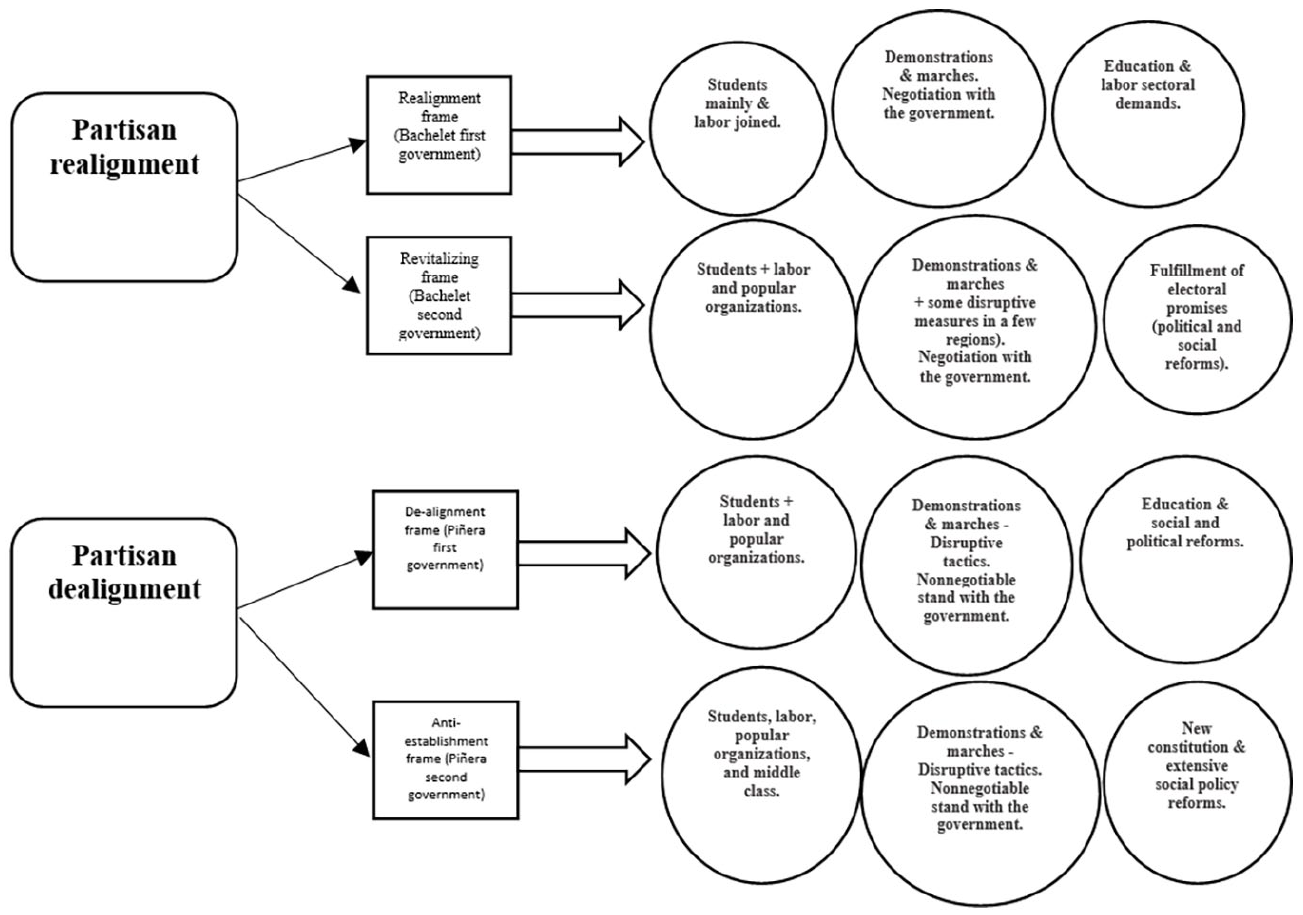
Partisan dealignment and realignment, and processes of frame development.
Variables from Observatory of Conflicts.
Protests Magnitude
A wide array of social groups (university and secondary school students, private and public sectors labors, Mapuche groups, and popular sector organizations) protested en masse in the decade that followed the Pingüino movement in 2006. The OSLA estimation of the size of protests (2009–2019) from ‘very small numbers’ through ‘thousands’ to ‘impossible to estimate’ increased in 2011 to 64%, and decreased in 2015–2016 to 17.6%, and spiked again in 2019 to 67.6%. Figure 2 shows the two peaks of the mean value of the number of participants in massive protests in 2011 and 2019. Protests’ size steadily decreased through the first year of Bachelet’s second government, and they rose again between 2015 and 2016, with students remaining the most active sector although with a lesser magnitude than the 2011 protests (as Figures 3 and 4 illustrate). Students’ protests attracted enormous actors to articulate their demands across different regions of the country.
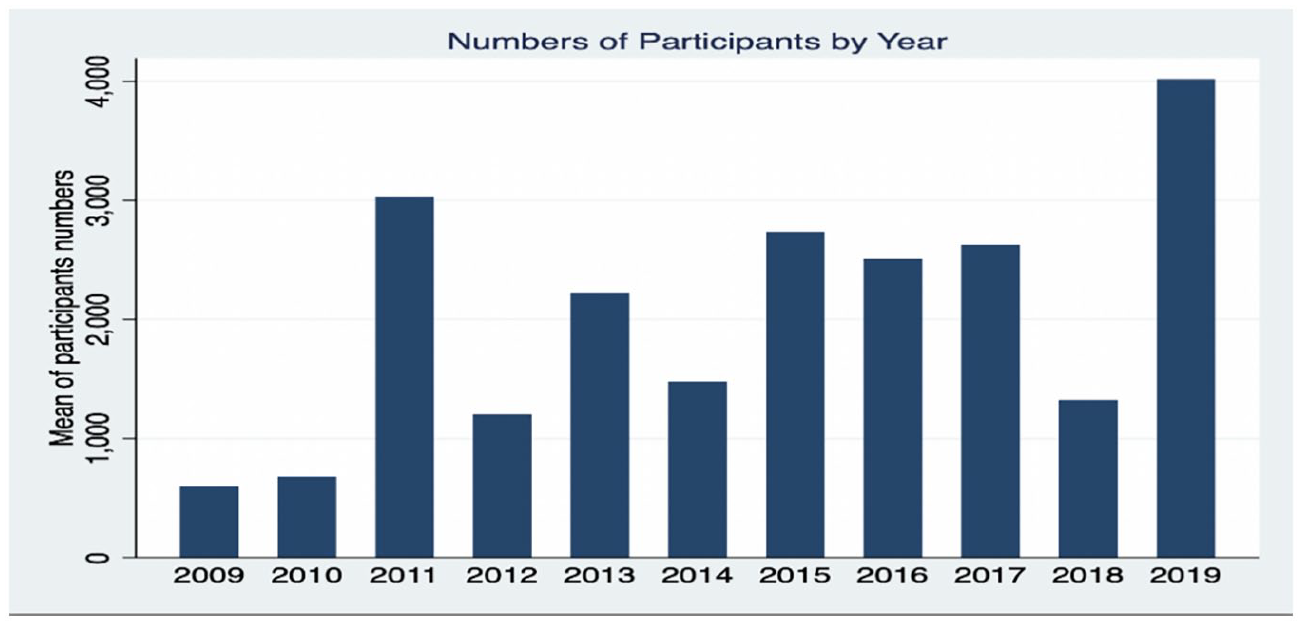
The mean value of the number of participants in protests (2009–2019).
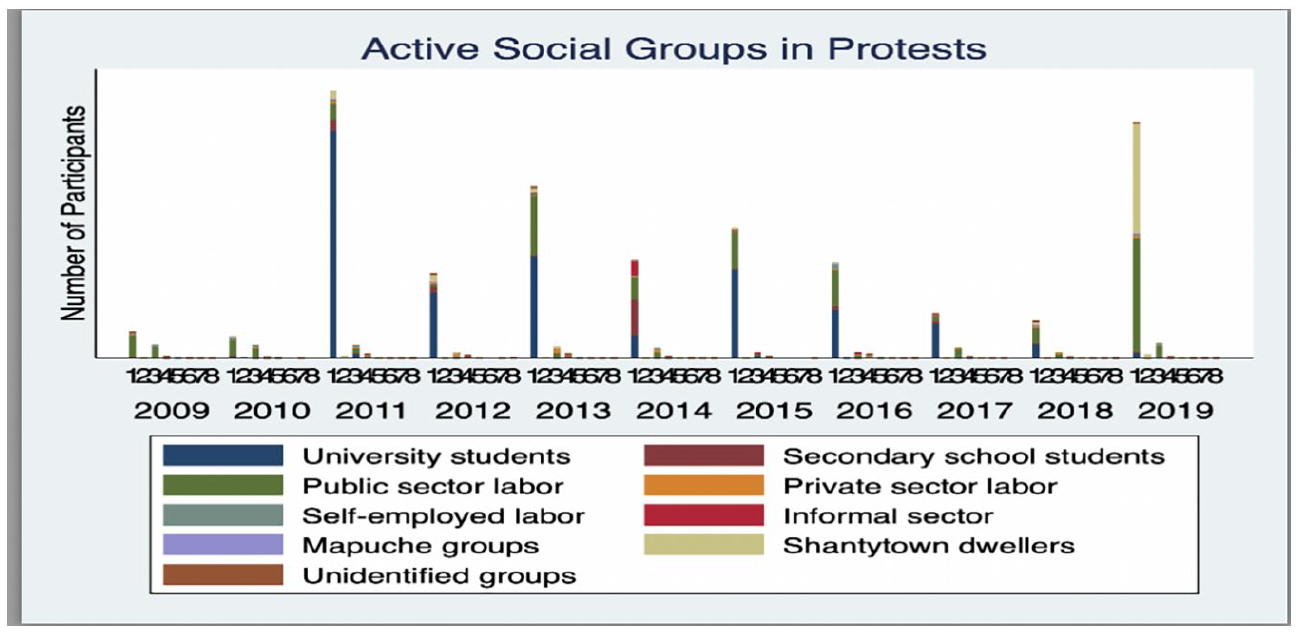
The frequency weights of the numbers of active social protestors.
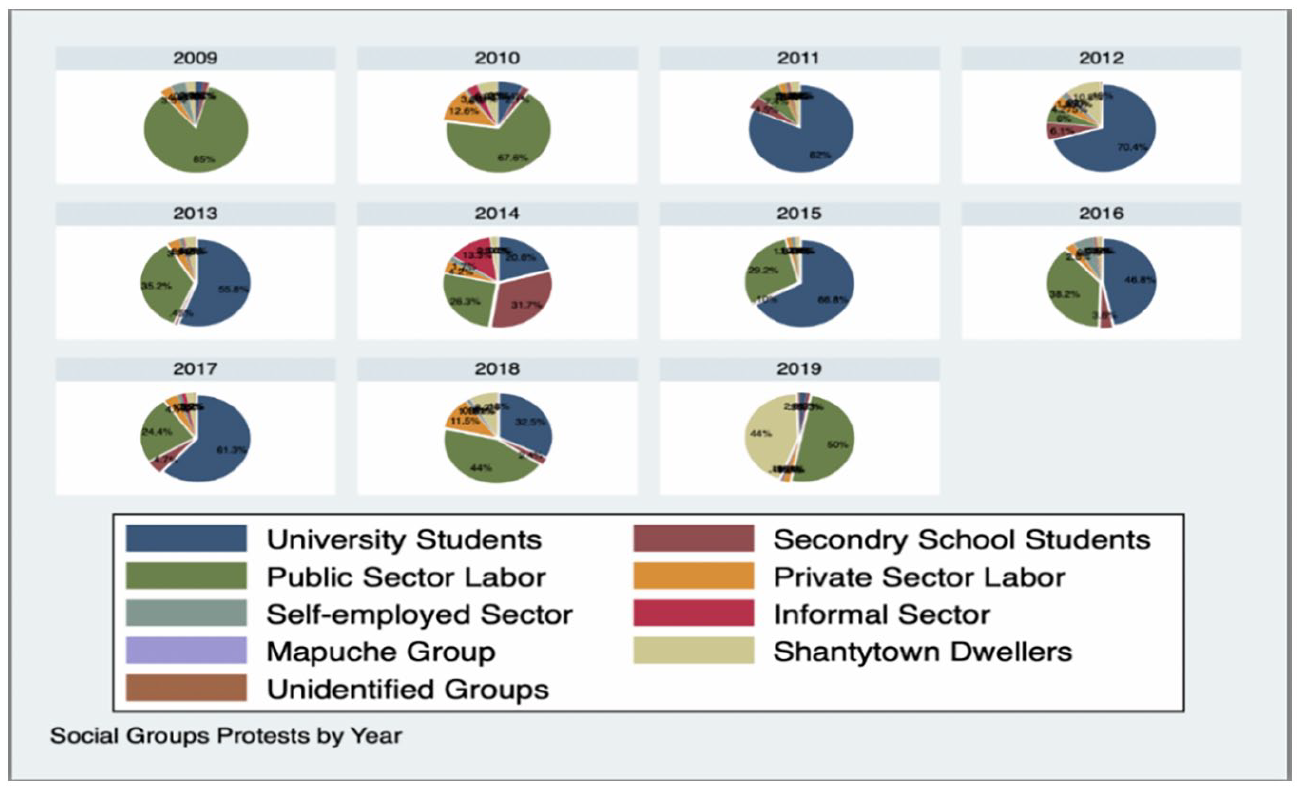
Group size in protests (2009–2019).
As Figure 5 shows, except for the Metropolitana and Valparaíso where students came to the fore of the protest campaigns in the past decade, popular organizations and shantytown dwellers led the highly frequent contentious action (from 40% to 80% of the frequency weights) in Ñuble, Arica y Parinacota, O'Higgins, Aysén, and Magallanes. In addition, public sector labors had a clear leading role in Antofagasta, Bío-bío, Coquimbo, Los Lagos, and Los Ríos.
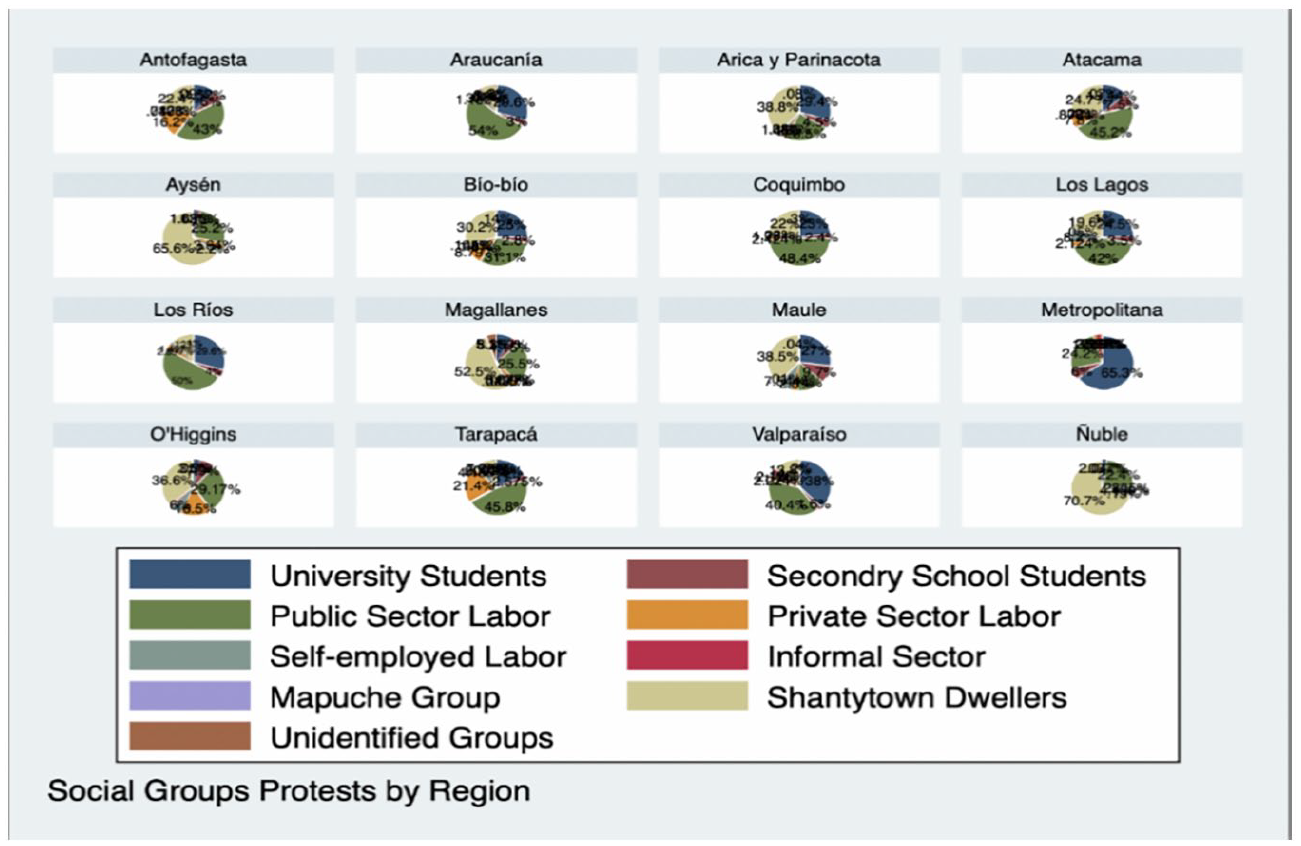
Group size in protests by region.
Protests Intensity
Active social sectors sustained episodes of protest events at nearly the same level of intensity from 2009 through 2019. Actors used diverse tactics that ranged from peaceful (marches, demonstrations, symbolic or artistic) through disruptive (building occupation and road blockades) to violent (weapons and assault on police and security forces) means. Protesters, however, have heavily relied on peaceful (marches and demonstrations) and disruptive (strikes, road blockades, and stoppage of business activities) tactics. Figure 6 shows that marches and demonstrations represented 44.8% of all the tactics used in 2009–2019, building occupation and road blockades accounted for 27.7%, and strikes and disobedience constituted 21.7% of all protests’ tactics.
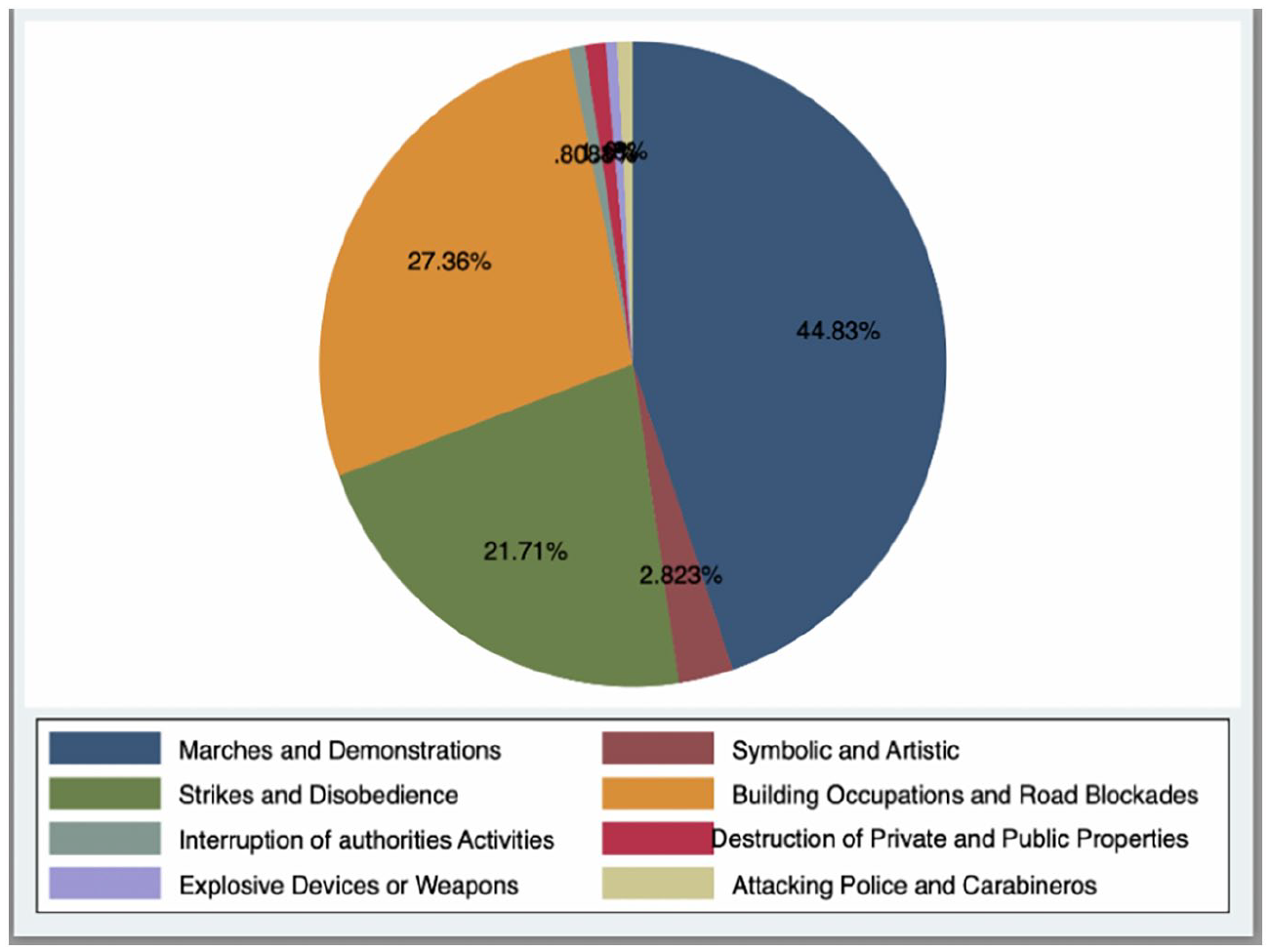
Percentage of tactics used in protests (2009–2019).
Figure 7 further shows the percentages of the usage of these diverse tactics over the 10 years, with the demonstration and marches accounting for nearly 50%, followed by labor strikes (15%–30%) and road blockades (reached 38% under Piñera’s rule in comparison with its highest level—26%—under Bachelet’s rule).
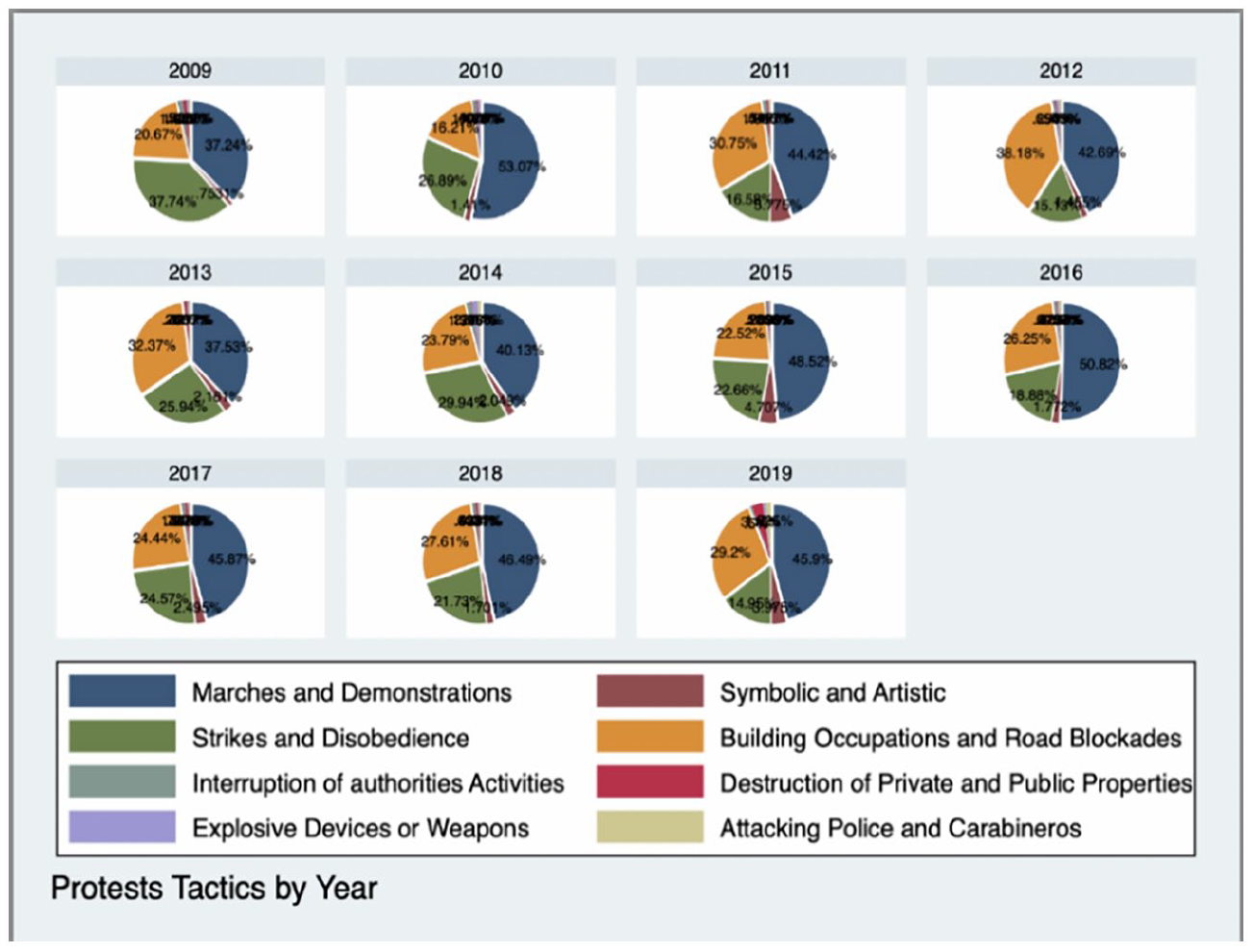
Percentage of tactics used in protests by year.
Protests Ideational Frame
Between 2009 and 2019, social claimants articulated demands that revolved primarily around six main areas: education, demands directed at central government, local or regional governments, the mineral sector, and other social services. In Figure 8, these six demands represented 88.5% of the total demands. Demands directed at the central government (the executive branch) accounted for 70% of the protestors’ demands over the contentious decade and across the 16 regions. The content of these demands, as I show below, served as a catalyst to frame social problems in a way that incited wide social sectors to jump on the bandwagon to pressure the national government to respond to their demands since the 2011 protests.
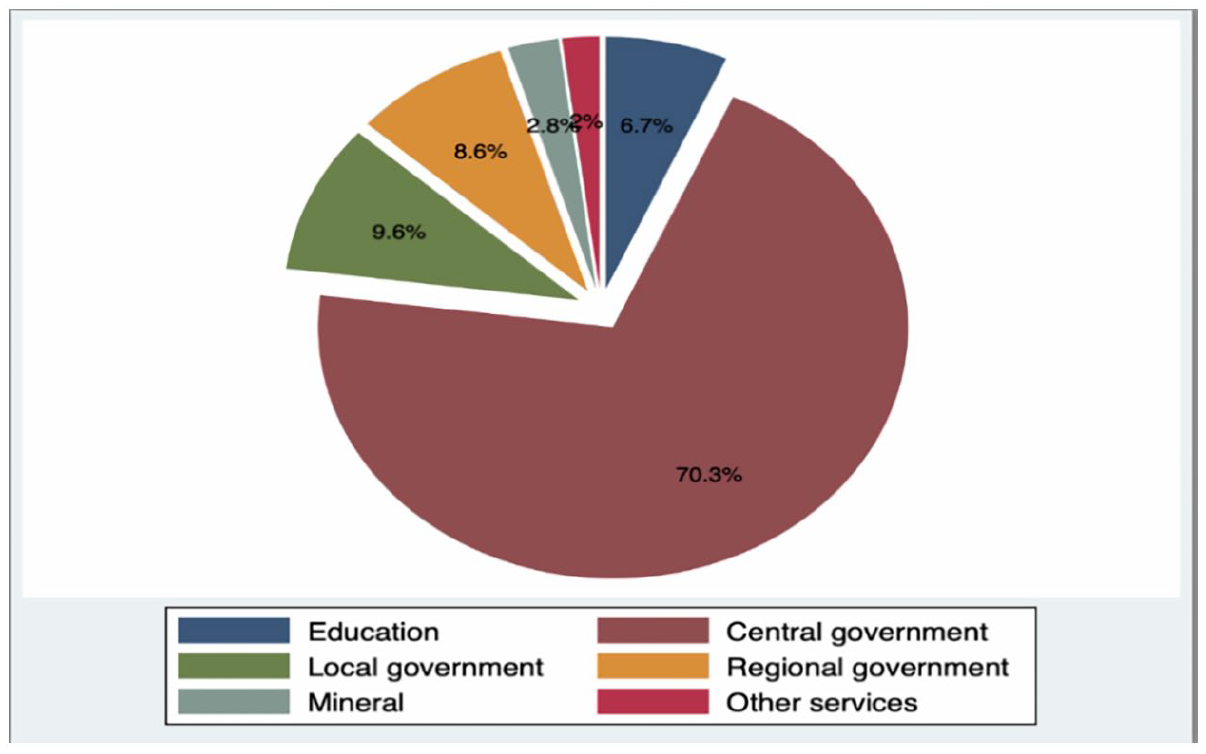
Demands articulated in protests (2009–2019).
The following four sections show the interplay between changing political contexts of partisan dealignment and realignment (that reflected degrees of representation crisis) and social actors’ signification politics (that determined the scope, level, and content of protests’ frames). Examining processes of actor formation in the social domain vis-a-vis the political dynamics depicts the strategic challenges that pertain to social movements’ links with their external environment and orientation to change, and probes how social actors engage strategically with their political–institutional environment to transform it (rather than being transformed by it).
Parallel Path of Realignment (2006–2010): Partisan Politics and Collective Action Frame
The Organic Constitutional Act of Teaching (Ley Orgánica Constitucional de Enseñanza—LOCE) enacted under the military regime in 1990 authorized the transfer of state subsidies to private and public schools. At the turn of the 21st century, secondary schools’ confederations started to pressure the government to rescind LOCE and redirect the public funds to public schools. Against the backdrop of rising demands for social reforms, Michelle Bachelet campaigned on a progressive platform in 2005, embraced the rhetoric of ‘government of citizen’—gobierno ciudadano, and asserted her commitment to public deliberation with social organizations. Bachelet aimed to recast the ruling coalition’s societal linkages along a progressive policy program and break with the long tradition of technocratic decision-making behind closed doors (Navia, 2010: 321).
In response to the rising calls for education reforms, Bachelet set up a dialogue with student movement leaders and invited civil society organizations to the president’s advisory committees. The center–left coalition, however, did not take the discourse of participatory democracy seriously in practice to advance radical reform agenda and appease disaffected sectors. The Concertación ostracized students’ confederations and shelved their reform proposal discussed with the outgoing government in 2005. Bachelet had to start the social dialogue from scratch, which stirred students’ anger and pushed them to press their claims through non-conventional tactics. Students organized into the Assembly of Secondary School Students of Santiago (Asamblea Coordinadora de Estudiantes Secundarios-ACES) and headed the massive Pingüinos protests in April 2006 (Donoso, 2013: 11–14). Students incisively challenged the government to put its rhetoric of the ‘government of citizens’ into practice and fulfill its electoral pledges of public policy reforms.
The movement developed a realignment frame of collective action that stressed the government reformist agenda and weaved their demands for ‘free education’ and the overhauling of the ‘profit-based education’ into it. Students eloquently expressed their cumulative grievances in their most succinct catchphrase everything for them, nothing for us (Donoso, 2013: 17) that explicitly constructed the ‘demarcating boundary’ between the claimants and the ruling elites (McAdam, Tarrow, Tilly, 2001). Students, however, were mindful of the existing institutional predicaments, defined by the inherited constitution and existing electoral rules that would inhibit the imminent implementation of far-reaching social reforms or deep transformation of power structures. Enrique Antileo (Author Interview, Santiago, 15 September 2012), a Mapuche student and a member of a Mapuche organization based in Santiago called Meliwentranmapu, reflected on the scope of student mobilization of 2006 in hindsight and pinpointed the obstacles that made Mapuche people’s claim to their ‘ancestral land’ and indigenous culture unfeasible in 2006: We, Mapuche people, are living in a colonial state because of the politics of the . . . state . . . that helped [the few to] accumulate much wealth at the expense of our territory and resources. Mapuche people lacked sufficient [institutional and partisan] representation due to legal [and systemic] barriers. We have drawn a path of struggle towards self-determination, [. . . ] regardless of how attainable [this goal] is. . . . Our organization contributes to a larger mobilization process wherein many actors are fighting [against] racism, poverty, and inferiority.
Students framed their demands as anti-neoliberal in nature that rejected outright the commodification of education rights and social class segregation. The movement stimulated other disaffected groups to articulate similar social grievances. The largest trade union—Central Unitaria de Trabajadores (CUT)—joined by teachers, students, pensioners, and Mapuche indigenous organizations went on a massive strike in September 2006, asking for more profound socioeconomic reforms. Arturo Martínez, the head of the CUT renounced the ‘savage neoliberalism . . . installed in [the] country that has no precedent in Chile’s history’ and emphasized the CUT’s determination to continue with the social struggle (LAWR, 2007). Moreover, Mapuche mobilization in Araucanía, in Southern Chile, joined the fray and imposed a serious security challenge on Bachelet’s government.
As protests persisted, the center–left coalition conceded to protestors and introduced an education reform bill, the General Education Law (Ley General de Educación—LGE). The cross-party negotiation in Congress, however, restricted the scope of the reform by maintaining the mix of private and public education in exchange for the Right approval of the bill. The LGE authorized the establishment of ‘a superintendence of education and a quality-control agency’ to scrutinize the quality standards of the subsidized private schools and to channel more funding to public schools. The legislature ratified the LGE in August 2008 and students depicted the new law as ‘a betrayal’ because it preserved the main pillars of LOCE of elitism and social stratification (between publicly subsidized schools, and the well-off classes at private free-paying schools) (LAWR, 2009).
The political collusion with the right further dissociated social movements from the center–left parties. A student leader commented on the collaboration between the presidents of the Concertación and the rightwing to promulgate the LGE: Hand in hand. . . the presidents of the right-wing and the Concertación political parties [celebrated the agreement] . . . This picture represented the answer of the political party system to [the] 2006 [protests], and it had a profound impact among students, conditioning the relationship that they would establish with the political system in the following years. (Cited in Von Bülow and Ponte, 2015: 187)
With soaring social unrest, the Bachelet administration seemed to reel from crisis to crisis. The government concessions and its commitment to social spending incentivized actors to scale-up protests to pressure the government to implement meaningful social reforms. Social actors, however, worked within existing political boundaries by creating links with the center–left politicians and participating in government consultative channels and advisory committees. As one student leader observed, working as a Concertación leader was very unpleasant because you really had a conviction as a student leader about the state of education in Chile, so you were in the middle because you had to respond to your bases, to other leaders who were critical of the government . . . but you couldn’t push too far in the opposite direction . . . [..] because in a way it was also your government. If I demonstrate all week long, I’ll harm the government. (Cited in Disi, 2018: 455)
Nevertheless, active social sectors reconstructed the boundaries between institutionalized and non-institutionalized politics and pulled the Concertación farther in the left direction. The center–left coalition reincorporated the Chilean Communist Party (PCCH) in the parliamentary elections of 2009 and engaged in internal heated debates over rejuvenating the coalition and restructuring its societal linkages along progressive policy programs. Neither elite strategic choice of expanding political coalition and reshaping policy agenda was ‘voluntaristic behavior’ (Roberts, 2008: 343), nor did the repoliticization of social actors come out of random processes that lacked ideational underpinning of actors’ contentious behavior. Elite choices were heavily conditioned by their reaction to the bottom-up mobilization that (re)shaped the opportunity structure of collective action and changed the distribution of policy preferences in society.
The Concertación faced internal splits over policy positions and was marred by corruption scandals. Mladen Yopo (Author Interview, Santiago, 10 September 2012), the former advisor and General Secretary of the Government on Conflict Resolution and Political Communication under Lagos’s rule, stressed the lack of mechanisms of ‘associative democracy’ needed to prioritize social issues and to recast the Concertación’s bonds to social bases along consistent policy commitments. As a result, the coalition started to unravel and lost its majority position in the chamber of deputies in 2009 for the first time after the return of democracy and lost the presidency to the right-wing Union for Chile (Alianza) 2 in 2010. The ascension of a right-wing figure to power triggered perceptive mechanisms that enhanced actors’ capacity and pushed activist forces to base their frame of contention on a non-negotiable stance with traditional parties, and to construct a new meaning of political allies and opponents to act incongruently with parties’ institutionalized boundaries.
The Right-Wing Alianza Government (2010–2014): Partisan Dealignment and Concurrent Dealignment Frame of Contention
Sebastian Piñera of the right-wing Alianza strategically campaigned on the centrist program, de-emphasized ‘ideological (class-based) appeals’, and used much of social democratic rhetoric to appeal to ‘non-core’ electoral constituencies (Luna, 2010: 329). Endorsing the ‘soft vote’ strategy to recast conservative parties’ linkages to broad social constituents and attract disenchanted and non-partisan electorates—especially from low-income strata—paid off and gave the Alianza a competitive edge over the Concertación in the presidential race of 2010 (Luna, 2010: 346). Voters’ dealignment with the Concertación, however, offered the impetus for contenders to concurrently develop a dealignment frame of contention that vigorously expressed actors’ alternative policy preferences and forcefully addressed the structural foundations of social inequality.
Social forces thus crafted their own frames of collective action to instill beliefs in society about the urgency and efficacy of disruptive tactics to press for extensive sociopolitical reforms (Somma and Medel, 2017). University students, socialized before into the Pingüino movement in 2006, remerged in full force and organized massive mobilization, in what became known as the ‘Chilean Winter of Discontent’ in June 2011. Protests persisted through October 2011 and claimants extended their demands to include high-quality education for all. In a clear disillusionment with the traditional political parties, protestors took to the streets expressing their dissatisfaction with the traditional political parties of all political stripes and chanting El pueblo, Unido, avanza sin partido, ‘The people, united, move [sic] forward without political parties’ (Von Bülow and Ponte, 2015: 188).
As protests unfolded, students stepped beyond the movement’s initial focus on educational policies and incorporated broader issues of social marginalization and exclusion to speak of the interests of wide segments of society. Students unequivocally denounced Pinochet’s legacy of social inequality, now represented by the right-wing government, and zealously asked for doing away with the neoliberal model that undergirded state public policies. They extended their demand frame to include political reforms amid increasing disassociation with the Concertación’s ideological rhetoric and policy orientations. Sue Reyos Vellarsol (Author Interview, Santiago, 14 September 2012), a college student and a member of Escuela Libre (Free School)—a neighborhood organization based in Santiago—maintained that The Concertación achieved economic stability at the cost of political participation . . . Now people woke up [to a different reality] . . . I think it has a lot to do with the rule of the current right-wing administration. My mum has never [been affiliated] with the right-wing parties but she voted for the right because she was tired of the Concertación; they made many promises and failed to keep them. So many people said let’s give the right-wing a try. . . . A right-wing government is always going to be a right-wing government without wearing any mask.
Having a government that they did not identify with, multiple social activists (on the left of the political spectrum) sustained a protest campaign from an ‘outsider’ position that challenged not only social and economic policies but also called for political system reform. Víctor La Rosa, the former vice-president of the Confederation of Chilean Students (Confederación de Estudiantes de Chile—CONFECH), explained how the rupture with the Concertación was a tipping point that produced significant changes in Chile. He maintained that the center–left coalition promised happiness is coming in 1990 but ‘happiness has never come’. The coalition implemented the economic policies of the right-wing which made it difficult for social actors to resist a government they once defended. The existence of rightist forces in power ‘woke people up’ to defend their rights in the face of a government that they ‘do not belong to’ (Author Interview, Santiago, 13 September 2012). 3
Ursula Schüler of CONFECH further underscored the differences between the center–left and right-wing administrations and illustrated how social movements’ dissociation with the right-wing parties radicalized the social landscape and pushed social actors to adopt an unequivocal non-negotiable stance with the Piñera government. She pointed out that the [political] right in Chile . . . does not even have a direct communication line with [students’] leaders. The Concertación did have that. [. . . .] If you were a militant of the Socialist Party, someone from the Socialist Party in the ministry [of Education] would call and say ‘hey, tell me about the CONFECH meeting’ . . . and [I] don’t exaggerate, it’s enough [to influence the movement’s strategic options]. (Cited in Von Bülow and Ponte, 2015: 189)
Federico Huneeus of the Federación de Estudiantes de la Universidad de Chile (FECH) also highlighted the effectiveness of the dealignment frame of the movement from an ‘outsider’ position to the right-wing government and how this was reflected in the parties’ political campaigns and composition of their policy programs. Huneeus maintained that the intransigent position of the movement placed the issue of education reform on the top of the policy agenda and pushed the left to base its electoral campaign in 2013 on the education reform issue: We accomplished a lot in terms of introducing demands, creating consciousness, establishing ourselves as a relevant actor, and shifting the discussion to the left [. . . ]. The fact that we did not negotiate allowed the debate to remain open, [and pushed] our demands to . . . . higher levels. (As cited in Donoso, 2017: 82)
The context of voters’ dealignment and social dissociation pushed the left to develop a firmer ideological opposition stance to the right and to strike a new political pact with far-leftist small parties, which added to the massiveness of street activism, its tactical persistence, and diffusion across the country from the Metropolitan region to Araucanía and Aysén in 2011 and 2012. Ignacio Walker, the president of DC, and Carolina Tohá, president of the PPD, called for a ‘new political pact’, including sweeping constitutional, political, social, and fiscal reform without which, Tohá argued, ‘whatever we say will be music, and the situation of decay between civil society and the political class will deepen’ (LAWR, 2011a).
With the persistence of the protests across the country, the ideational construct of the demand-making frame forced the government to introduce changes to the material world. The Piñera administration had to jettison the ‘wait-and-see’ strategy and introduced marginal changes to the education policies and issued the ‘Grand Agreement for Education’ (GANE). In August 2011, Piñera authorized the creation of the quality control agency, School Inspectorate (Superintendencia de Educación), to regulate public resources and ensure quality standards in subsidized private schools (Bellei et al., 2014; Cummings, 2015; Donoso, 2017: 87; Pavlic, 2018).
College students, side-by-side with high school students, however, continued to sustain their protests to push for large-scale social reforms. They strenuously rejected the tax reform law that aimed to channel funds to overhaul ‘the nation’s protest-hit school’. For them, the law neither addressed the root causes of structural inequality nor did it generate genuine systemic changes in the ‘for-profit’ education system. The students stubbornly emphasized their uncompromising demands for ‘free education’ and escalated their struggle for a constitutional amendment to enable a ‘public referendum’ not only on the issue of free education but also on tax laws to raise the tax rate of higher earners and foreign firms in the copper sector (Bellei et al., 2014; Somma, 2012).
Students’ struggle activated traditional popular sectors and pensioners to articulate their demands. The CUT organized a general strike in Santiago, piggy-backed by students, to push for profound tax and pension reforms. Piñera again conceded to the rising social pressures and declared an increase in public spending on education, employment, and pension schemes in the 2012 budget (LAWR, 2011b).
The ‘too little, too late’ approach to respond to actors’ demands increased levels of social distrust in traditional political elites and offered a space for social forces to reconstitute the ideational content of the collective action ‘frame’ to include constitutional reforms. Social actors believed that the inherited constitution has offered a legitimate basis for reproducing more of the same policies that deepened social inequality. Active forces offered a new diagnosis of the existing social problems that gave rise to new widespread interpretations and asserted new policy goals. As Giorgio Jackson, one of the student leaders in 2011 put it: ‘for us . . . it was evident, really tangible, that with each new demand we hit the walls of the Constitution’ (as cited in Donoso, 2017: 84). A member of a feminist organization called Marcha Mundial de Mujeres (Author Interview, Santiago, 14 September 2012) asserted that the real struggle against the conservative government has to be centered on calls for a new constitution: ‘There is no difference between right or left government . . . all political parties are in crisis and [they have never cared about people] in [their] policy formulation. [They just] converge on policies [that have perpetuated existing structure]’. Varinia Hermández (Author Interview, Santiago, 12 September 2012) of the Teachers Union (Sindicato de profesores) further noted that there has been something ‘inherently flawed’ in the state structure. And no reform program would be viable without ‘changing the neoliberal model [engrained] in the [ . . . ] constitution’.
Protestors, therefore, reconstituted their collective action frame to reflect their understanding of the constitutional basis of social inequality and devise new feasible policy goals. Actors negotiated new tactics to appeal to broader aggrieved sectors and attract potential followers. Schüler of the CONFECH pointed out the heated debates inside the movement between the maximalists who preferred insurrectional option that alienated potential adherence and the moderates who asserted nonviolent tactics (Author Interview, Santiago, 10 September 2012).
The 2011 mobilization marked a turning point in the trajectory of contentious politics and the relationship between social actors and traditional parties. With the new protest episodes, claimants transformed the ideational content of the collective action frame that extended beyond education reform and offered an antidotal interpretation of the official neoliberal economic policies and their constitutional legitimation. Claimants showed a deep understanding of the uncertain consequences of the struggle and the necessity of developing a determinant attitude to cajole wide stakeholders into the prolonged social struggle. Andrea Parada (Author Interview, Santiago, 14 September 2012), a member of a feminist organization called Assembly of Revolutionary Women (Asamblea de Mujeres Revolucionarias-Maipú), asserted the long path all the social forces had to go through to encourage ‘extensive social engagement’ and ‘commitment’ to the struggle for constitutional and structural transformations. Salvador Aguilar (Author Interview, Santiago, 14 September 2012), a member of the Public School of Music (Escuela Publica de Musica), further explained the necessity of developing a common vision among fragmented popular sectors to take mobilization to a different level and provide society with a feasible policy proposal arguing that [Marcos of the Zapatistas army in Chiapas in Mexico] was asked about his prospects for future, he said that the only thing we know is what is wrong, [but] what comes next must be constructed. So, I think that one has to work, in a constant and collective manner, on constructing something different.
The intense level of social mobilization and the salient politicization of social inequality not only attracted wide social sectors but pushed center–left forces to form a new coalition, the New Majority (la Nueva Mayoría 4 ) spanning leftist forces from across the political spectrum that brought Bachelet back to power in 2014. Electorates’ choice of the Nueva Mayoría showed that the previous vote for the conservative candidate reflected a swing in electorates’ mood rather than a durable partisan dealignment with the political left. Social actors, however, continued with the extra-institutional mobilization to revitalize a wide variety of groups and organizations to act in a consistent manner toward the common reform goals.
La Nueva Mayoría Government (2014–2018): Partisan Programmatic Realignment and Revitalizing Frame of Collective Action
Over again, the New Majority coalition realigned its policy program with the prevailing progressive policy preferences in society. Bachelet embarked on a progressive policy program centered on far-reaching social and institutional reforms in three substantive areas: the ‘for-profit’ education, the electoral system, and the constitution that corresponded to the demands of the 2011 protests. In her victory speech, Bachelet asserted her commitment to ‘deep reforms’ and called for elite cohesion within the winning coalition to deliver on the electoral pledges (Siavelis and Sehnbruch, 2013).
Bachelet proactively exhilarated active social forces to keep their demands alive and shaped their expectations about the pace and the scope of the reforms. Although protest events were tapered off from their peak in 2011, street activism remained remarkably high, albeit with lesser intensity and limited geographic diffusion (with the concentration of protests in the Metropolitan region, and to some extent in Araucanía) (Maillet et al., 2020: 46–52). A few days into the presidency, Bachelet addressed a crowd, gathered in front of La Moneda Palace to extoll her electoral victory, and expressed her determined will of change: ‘It’s time to take this road that we committed to through our government program; it’s time to launch these dreams toward a nation that is more just, developed, modern, tolerant and inclusive’ (LAWR, 2014a). Social actors, however, did not defer to the leftist government to respond to their ever-increasing reform demands. Active forces reconstituted their collective action and carried on with their street mobilization to boost up the government to move ahead with the promised sociopolitical transformations.
Only 2 weeks after Bachelet took office, 40 social organizations staged what they called a ‘march of marches’ in March 2014 calling on Bachelet to clarify ambiguities in her policy proposal and to offer a detailed action plan for the reform program. As one of the protestors maintained, the massive protests were not ‘a demonstration either for or against Bachelet, just a call to attention to the political class not to overlook or circumvent public demands’ (LAWR, 2014b).
However, the presence of the left in power and its representation of policy preferences of active social actors put aggrieved sectors on an ambivalent course of action and created disputes within their organizations over political tactics and strategic priorities. While the PCCH entered into the new ruling coalition and elected deputies into congress to affect policymaking from the ‘insider’ position, other leftist small parties founded by former leaders of the student movement of 2011, such as Revolución Democrática and La Izquierda Autónoma, elected deputies into the legislature to support the government’s reform agenda, but they refused to commit themselves to forming a political coalition and preferred to retain their ‘outsider’ position. For the radical left, the logic of coalitional politics would behoove their parties to consider policy convergence and delegitimize non-institutionalized politics outside the legislative arena. The attempts of Bachelet’s coalition, therefore, to deactivate street protests and recast institutional ties with active social organizations proved to be ‘ephemeral, instrumental and shaped by suspicion’ (Somma and Medel, 2017: 42).
The Bachelet administration had little influence on social movements’ organizations and weak connections with various movements’ leaders. All government links with active forces in the student movement were limited to the presence of the youth section of the PCCH in some student federations that lost contact with other student organizations that endorsed the maximalist position (Guzmán-Concha, 2017: 34, 35). The government, therefore, could not coopt or demobilize various social sectors to articulate their demands through institutionalized channels. In addition, by taking education demands to the legislative arena, other claim-making avenues (most notably labor unions and feminist organizations) started to outshine student movements in streets (Valenzuela, 2020: 24–26, 36; Paredes and Reyes-Housholder, 2020: 71). To be sure, dissociation between social actors and center–left parties does not mean that the relationships between Chilean social movements and polity members are inexistent. Because many of the changes that movements demand require legislative decisions and actions taken by political authorities, [social actors] must try to influence [the ruling parties], and this often requires engaging in negotiations.
Therefore, some of the mobilizable actors, especially laborers in public sectors, carved out a space for negotiation with the government and retained their alliance with the traditional center–left parties, yet their bonds with party members tended to be ‘instrumental, sporadic and shaped by mistrust’ (Somma and Medel, 2017: 44).
Overall, social actors engaged strategically with the changing political environment under Bachelet’s second term and resorted to confrontational tactics and extralegal strike activities from their ‘insider’ position to push for policy changes by bringing the government to the negotiation table (Osorio and Campusano, 2020: 851, 852, 858). Dina Olgun, the leader of the Asociación Nacional de Funcionarios de la Junta Nacional de Jardines Infantiles—Ajunji—brought out the strategic advantage of the coordination with traditional political parties to materialize rank-and-file demands, asserting that taking on mobilization ‘in independent form, [makes] it . . . impossible to negotiate [with the government]’ (cited in Quiroga et al., 2016: 142).
Disaffected actors (students, workers, and popular sectors), therefore, mobilized under Bachelet’s second reign from within the existing political bounds to push the government to respond to a specific set of demands related to free education, working conditions, security, and pension schemes, especially amid the internal and ideological infighting within the ruling coalition (between the centrist PDC and radical leftists) over the pace of socioeconomic reforms and the scope of social transformation (Many, 2019: 9; Medel, 2017: 7–15).
After a year in office, Bachelet pushed through several bills in Congress to respond to the pressing issue of education reform, but she also pointed out the difficulties of carrying out concurrent and ambitious reform programs: ‘We must acknowledge that the state administration was not ready to process [so many] structural changes simultaneously. It is part of the obstacles that we have inherited and perhaps underestimated’ (LAWR, 2015b).
The government issued streams of laws in 2015 that terminated ‘for-profit’ education, abolished selective admission, and expanded public education with the creation of two state-owned universities, in addition to 15 Centers of Technical Formation (CFTs) to provide vocational training. Congress also passed a law forcing subsidized private schools to stop charging fees and to end the selection policy of admission. In the same year, the congress issued a law replacing the binomial electoral system with a proportionate one. And, in 2017, congress passed a comprehensive regulatory framework that extended free education in public and private education ‘to students in the bottom 60 percent of the income distribution’ (Palacios-Valladares and Ondetti, 2019: 644, 645).
Nevertheless, students remained dissatisfied with the speed and substance of the reform measures. They believed that the government did not go far enough to guarantee ‘free education for all’—the main motto of the 2011 protests. Students portrayed the reforms as ‘the same model with some exceptions’, which widened the gap between them and the institutionalized politics (Kubal and Fisher, 2016: 243).
Activists became increasingly disillusioned with the Bachelet administration and her approval rating dipped to only 24% after only a year in office (LAWR, 2015c). Moreover, the involvement of Bachelet’s family members in corruption scandals of tax evasion tarnished the public image of the ruling coalition. In her state-of-the-nation speech in May 2015, Bachelet had to assuage rising public discontent and address the issue of constitutional reform, the third pillar of her electoral program along with anti-corruption measures. Bachelet broadly promised to draft a new constitution in September 2015. The president’s promise, however, fomented more discords among social supporters rather than staking up popularity. Camila Vallejo, former student leader and deputy of the PCCH, commented on Bachelet’s announcement saying that it added more ‘vagueness’ to her policies and asked her to clarify how she would proceed with the constitutional reform and whether she meant ‘to create the new constitution or to define the mechanism [for that]’ (LAWR, 2015a).
Toward the end of her mandate, Bachelet deferred it to congress to decide on the model of the constitutional convention. The Right Alianza in congress, however, fought tooth and nail to preclude the convening of the constituent assembly to overhaul the constitution. Its strong opposition postponed discussions on the constitutional reform and pushed to ultimately shelve the proposal.
Unable to fulfill its electoral promises of rapid structural transformation and constitutional reform, Bachelet’s second government incited infuriated sectors to stage a large campaign of street activism. The flare-up in violence in the southern Araucanía area against the Mapuche indigenous community stirred up popular outrage and triggered widespread condemnation of the government’s excessive use of force. Tens of thousands in Santiago staged the Día de la Raza protest march in October 2017 to denounce the ‘colonialization’ of the Araucanía by the Chilean state, and the government’s ‘political show’ of the wide arrest of the Mapuche community leaders (LAWR, 2017). The trajectory of political learning and shared experiences of structural inequality and disadvantageous position in society further pushed the ‘disillusioned generation’ to reconstitute their collective action frame that added gender-based violence against students and teachers to the issues of segregation and class discrimination. In May 2018, the Ni una menos (Not one (woman) less) and ‘Me Too’ movements spread across Chile and denounced all forms of sexist violence, sexual harassment, and discrimination between men and women in academic career and top management positions. Women’s marches attracted diverse disenchanted sectors in society and broke remnant ties with leftist parties in government (Brunner, 2021: 99, 100).
The turbulent period under the Nueva Mayoría’s rule brought the ‘representation crisis’ squarely to the forefront of political and social debates and widened the chasm between traditional parties and social actors (Roberts, 2017). According to the region-wide Latin American Public Opinion Project (LAPOP) survey data, the percentage of respondents who answered that they had ‘no confidence at all’ in political parties increased from nearly 21% during Bachelet’s first government to 29% at the beginning of her second term to 47% in 2016 (LAPOP, 2006–2016).
The wide disenchantment with the institutionalized politics pushed for further dealignment with the left. The electoral victory of the Right in the municipal election in October 2016 heralded the electoral defeat of the left and center–left forces in the presidential race in December 2017. The center–right Chile Vamos 5 tapped into the rising popular discontent and ensured Piñera’s victory in the 2017 elections.
Economic deprivation and social inequality reproduced new cleavages in society and reconstructed the traditional class conflict and left–right divisions, but the struggle has increasingly become detached from the traditional political parties. When push came to shove, the politicization of social and economic inequality under Piñera’s second term pushed aggrieved sectors to develop an anti-systemic demand frame. Social forces pressed fiercely for new constitution writing and far-reaching redistributive measures (Ahumada and De la Horra, 2021: 329, 334, 345).
Conservative Politicians: Partisan Dealignment and Anti-establishment Frame of Contentious Action (2018–2022)
Highlighting the shortcomings of the outgoing center–left government, Chile Vamos vowed to combat corruption, recover the economy, strengthen the state welfare programs, restore public order, and terminate violence in the Mapuche region that has continued to rise in a ceaseless spiral (LAWR, 2018).
Except for the Mapuche turmoil in Southern Chile and some skirmishes between police forces and a small number of students protested in July–August 2019 against ‘a lack of resources and crumbling infrastructure’, the rest of the country seemed to be stable. This, however, proved to be the calm before the storm. After a week of low-intensity protests in Santiago over fare increases on the Santiago underground system, massive protests erupted on 18 October 2019 with large-scale violence, looting, and sabotaging across the country (LAWR, 2019d). The massive protests originated in Santiago and rocked almost half of the country’s regions with the same magnitude: the Metropolitan, Valparaíso, Antofagasta, Atacama, Coquimbo, Araucanía, and Aysénand, with vast numbers of protestors chanting Chile Wake up to exhort potential supporters to join street activism (Vargas, 2021: 45, 46).
By the time Piñera took office in 2018, social activists had accumulated learning experience and a repertoire of contention that enabled them to endorse an unequivocal ‘outsider’ position to traditional parties. Large swathes of society took to the streets—in what became popularly known as the ‘Social Outbreak’—El Estallido Social—to express their dissociation with the established pattern of political authority and to push for comprehensive constitutional and social changes. There has been a common belief that the issue of the transportation fees was just the straw that broke the camel’s back. Aggrieved actors have been absorbed into a long-running struggle for quality education, health, and public service. It’s not 30 pesos, it’s 30 years, has been one of the widely used slogans in protests that succinctly interwove the fare increases that set off the crisis together with the 30 years of traditional parties’ rule after the end of the military rule (Durán, 2020: 5; Taub, 2019). The deep sense of social exclusion and under-representation ultimately pushed actors to craft an ‘anti-establishment’ frame of contention and afford an all-out confrontation with the state to eradicate the legal and constitutional roots that have reproduced social inequality and class disparities (Somma et al., 2021: 6).
More than a decade of street activism against the neoliberal model had created a collective experience of class struggle and retrieved historical memories of popular revolts with the leading role of the CUT and social organizations against harsh economic measures and public transport fare increases, most notably the huelga de la Chaucha of 1949 and the batalla de Santiago (or events of April 2) of 1957 (Vargas, 2021: 47; Ponce, 2021: 182).
Although protestors made some class references, rage motivated wide excluded sectors to protest and ask for a dignified life. Multiple forces depicted the uprising as a ‘struggle for dignity and recognition’, critiquing the endeavor of the left to homogenize the politicized subjects and subsume them under its project of the transformation of the exploitative global capitalist structures (Aránguiz, 2021: 150–154). A survey conducted by a research center linked to the CUT, at the Plaza Dignidad, asked protestors whether they considered themselves as part of the ‘working class’. A significant majority of respondents (82%) affirmatively answered that ‘exclusion’ and ‘abuse’ are the main causes of the revolt, describing the protests as the ‘awakening of the country’ through which ‘dignity’ is being rescued (Ponce, 2021: 185).
The social inequality and legitimacy crisis was even prevalent with the participation of the middle class in the uprising, which undermined the official narrative of the ‘modernization success’ (that reflected, to some extent, Pinochet’s effort of transforming the ‘country of proletarians’ into one of ‘owners’) (Ponce, 2021: 187). The neoliberal model accompanied by the prevalence of new forms of consumerist culture and expansion of credit resulted in three phenomena that decreased the real wages and eroded social protection of public sector employees: the consumption capacity that is dependent on access to credit created ‘spurious’ social mobility and gave way to large indebted sectors; the growth of precarious jobs and informal sector to afford living expenses and pay for debts; and the exclusion of the middle-class from most welfare benefits and social services (as social protection is generally means-targeted) (Castiglioni, 2021: 118).
With the persistence of protestors, the government abandoned its exclusive reliance on repression and offered policy concessions. Large segments of active forces, however, refused to back down and capitalized on the existing organizational umbrella to force the conservative government to introduce far-reaching structural reforms. The Mesa de Unidad Social incorporated more than 150 NGOs, came to the forefront, organized a series of contentious campaigns in November, and offered a platform for activists to sustain their campaign (Fuentes, 2021: 148; Somma et al., 2021: 2). The Unidad Social compiled multiple reform proposals from Teachers unions, feminist organizations, Mapuche, student confederations and other social organizations, and encouraged all social forces to adopt a non-reconciliatory stance with the government (Durán, 2020: 44; Sehnbruch and Donoso, 2020: 55, 56). The government was thus beset by vehement calls for radical political and social transformations, including a new constitution, tax reform policies, and extensive social welfare programs (Fuentes, 2021: 166, 167).
Using diverse contentious and disruptive tactics, claimants in sheer numbers sustained massive demonstrations with some deployment of violent tactics to root out the vestiges of the dictatorship. The new level of intense protest activity impelled traditional parties to reorganize their linkages to social bases along the widely desired policy preferences (Palacios-Valladares, 2020: 216). The leftist parties, therefore, joined the fray and fed into the growing social unrest by calling for a new constitution and all-encompassing social reforms. The PS, PPD, and PR preempted Chile Vamos’ attempts to bury the calls for a new constitution by reproducing the feckless discussions on the convening of the constituent assembly and pushed through holding a plebiscite to expedite the process (LAWR, 2019b).
Ultimately, the conservative government had to concede to the popular demands for writing a new constitution from scratch rather than overhauling the existing one. And all parties signed the ‘accord for peace and new constitution’ on 15 November 2019 to enable the creation of the constituent assembly and to put the matter to public referendum (Durán, 2020: 47). Deputies from the left: PPD, PCCH, PS, and Frente Amplio have been wracked with infighting over the signing of the accord with the right-wing government. Ratifying an agreement with the government conferred legitimacy on its heavy-handed strategy against protestors and nullified the opposition’s condemnation of its violation of human rights. Therefore, the political compromise between the government and leftist opposition parties agitated social forces that expressed their rejection of what they dubbed ‘the grand parliamentary accord’. Social actors described the accord as an elitist agreement aimed to ‘salvage [the] government’ and to perpetuate citizens’ exclusion from the decision-making process (Durán, 2020: 49–51).
Responding to the popular demand for the new constitution, therefore, was deemed insufficient to placate protestors. Social actors grounded their contentious behavior on a new understanding, reconstructed their interest in political matters and relations with traditional parties, and pressed for more extensive social reforms. Piñera had to offer more concessions to appease demonstrators and approved a 50% increase in pensions for elderly Chileans over the age of 80, but protestors continued to ask for a broader social agenda and thorough structural reform of the privately administered pension system (AFP) (LAWR, 2019a).
The political crisis had run so deep in society that all disaffected sectors rose up to push for their widely perceived rightful citizenship demands. Several trade unions joined the struggle and called for nationwide strikes that paralyzed the country’s economic activities and took a heavy toll on the state of the economy. The strike of the Chilean port workers (UPCH) accumulated losses of approximately US$4 million, according to Luis Knaak, the manager of Puerto San Antonio in Valparaíso. The UPCH alongside the Unidad Social grouping, Chile’s main umbrella trade union CUT, and the main teachers’ union, the Colegio de Profesores de Chile (CPC), continued to awaken a defiant mood and energize their bases to push for far-reaching socioeconomic changes. During a press conference ahead of the general strike, the CPC president, Mario Aguilar, called upon members to ‘strike with conviction’. Aguilar underscored the ‘profound change’ that Chileans have long asked for and portrayed the struggle as a ‘liberation from an economic model that forgets people and is only interested in [political] figures’ (LAWR, 2019c).
The Piñera regime was coming under severe economic pressures and the president could not afford protestors to carry on longer. For their part, protests continued unabated, and the government’s concessions seemed to have little effect on the street that had become increasingly angry at the government’s heavy-handed strategy. It was only the outbreak of COVID-19 and the imposition of the social distancing measures and a military-enforced curfew that offered a breathing space for the government to regain control throughout the events, albeit for a few months. As the plebiscite drew near, clashes between apruebo and rechazo camps escalated in the streets. Eventually, voters on 25 October 2020 emphatically approved the writing of a new constitution. The ‘I approve’ choice gained 78% of the votes, against 22% for ‘I reject’. Likewise, an equally clear majority—79% of voters—opted for an entirely elected convention composed of 155 elected representatives, instead, of a ‘mixed’ convention, half of which would be comprised of current members of congress, and half by specially elected representatives. Most of Chile’s political parties supported apruebo, except the ultra-conservative UDI (part of Piñera’s coalition), and Piñera remained neutral and called for a free vote (LAWR, 2020). Left and center–left parties, therefore, realigned themselves with middle- and working-class voters who opted for apruebo and reorganized their programmatic ties to appease wide disenchanted sectors. The public approval of the new constitution gave way to a 2-year transition period until the referendum on the new constitution is held in mid-to-late 2022.
Conclusion
The simmering anger in Chile proved that a deep representation crisis cannot be circumvented by parties’ rhetorical or lofty policy ideas during electoral cycles. Social forces in Chile accumulated a reservoir of contentious actions that transformed the prevailing understanding of society’s problems and altered political parties’ competitive alignments and their linkages to social bases.
Partisan re–dealignment further unleashed perceptive mechanisms that propelled savvy actors to develop oppositional identities, remold the content and the geographic reach of the demand framework, and sustain cycles of protests. Protesters, in turn, influenced traditional parties’ electoral programs, charting the policy course, and setting the agenda. Ultimately, the interplay between parties and social movements resulted in the transformation of the party system, creating opportunities for new political parties to emerge and represent disaffected sectors. Gabriel Boric—a former student activist who rose to prominence during the anti-government demonstrations in 2019—led a new far-left coalition (the Approve Dignity—Apruebo Dignidad—AD 6 ) and won the presidential elections in December 2021.
Over more than a decade, the structure of conflict had formed active political subjects with shared experience and collective identity. The interplay between social forces and political institutions in Chile has two implications for the social movements literature:
First, striking a balance between movement identity and political autonomy on one hand, and strategic action, on the other, is essential to keep the movement from either retreating to purely expressive activity of its identity (such as some indigenous or populist movements in Latin America) or losing vision toward change by becoming part of the government’s cooptation strategies. Maintaining this balance is even more difficult in authoritarian contexts when social movements aim at ‘growing by projecting themselves from the “civil society”’ to contribute to political democratization (Munck, 1995: 679). With limited associational space, restricted competitive politics, and the absence of cumulative political learning in authoritarian contexts, social movements even amid permissible political moments either retreat to internal/communal relations (as is the case with the nonviolent Islamist movements in the Middle East after the Arab uprisings of 2010–2011), or serve as a ‘transmission belt’ for state elites to ‘ensure the intra-elite cohesion’ (as it is the case with some non-Islamist groups in the Middle East) (Gerschewski, 2013: 22).
Second, the social uprising of 2019 not only manifested the persistence of a decade-long struggle, but it came with ‘historical sediments’ of similar popular revolts in the late 1940s and 1950s. Therefore, the legacy of protest activities seemed to be an integral part of the prevailing popular culture of a society (Vargas, 2021: 62). This begs the question of how social actors build abeyance structures and circulate and transmit history, both in the living memory of the mobilized subjects and in the historical memory of social organizations, to work collectively and relentlessly toward political and policy goals.
Footnotes
Acknowledgements
The author is thankful to the two reviewers and Kenneth Roberts for the insightful comments and careful read that improved the article.
Funding
The author(s) disclosed receipt of the following financial support for the research, authorship, and/or publication of this article: The author(s) received financial support from Essex University to conduct a fieldwork.
