An analytical investigation on the nonlinear stability of toroidal shell segment (TSS) made of carbon nanotube (CNT)-reinforced composite, surrounded by an elastic medium, exposed to elevated temperature and subjected to uniform torsion is presented in this paper. The properties of constituents are assumed to be temperature dependent and effective properties of composite are determined using an extended rule of mixture. CNTs are embedded into matrix phase according to functionally graded or uniform distributions. Basic equations in terms of deflection and stress function are established within the framework of classical shell theory including geometrical nonlinearity in von Kármán–Donnell sense and interactive pressure from surrounding elastic medium. Two boundary edges of the shell are assumed to be simply supported and tangentially restrained. Multi-term analytical solutions are assumed and Galerkin method is used to derive expressions of buckling load and nonlinear relation between torsional load and deflection. Parametric studies are carried out to analyze the effects of material and geometry properties, in-plane boundary condition, elevated temperature and surrounding elastic medium on the buckling resistance and postbuckling behavior of torsionally loaded TSS. Novel finding of this study is that tangential edge constraints have no and negative effects on critical torsional loads at room and elevated temperatures, respectively, and profoundly beneficial influences on postbuckling load capacity of TSSs.
Since closed shells are frequently exposed to torque, torsional instability is one of the most important problems of the behavior analysis of these shells. Theoretical and experimental studies on the buckling of circular cylindrical shell (CCS) made of isotropic homogeneous materials and subjected to torsion have been carried out by Nash1 and Ekstrom.2 Tabiei and Simitses3 used a higher order shear deformation theory (HSDT) to investigate the buckling of laminated composite CCSs under the action of torsional loads. The problem of buckling of orthotropic CCSs under torsion was dealt with by Kim et al.4 employing a three-dimensional elasticity solution. Zhang and Han5 utilized a classical shell theory (CST) along with a singular perturbation technique to study the buckling and postbuckling behaviors of isotropic CCSs with imperfection under torsional load. The buckling and postbuckling behaviors of CCSs made of functionally graded material (FGM) and subjected to torsion were investigated by Shen6 making use of the HSDT and a singular perturbation technique. Linear and nonlinear buckling analyses of FGM CCSs under torsional loads have been carried out in works of Huang and coworkers7,8 employing the CST and energy approach. The influences of surrounding elastic media on the torsional vibration and stability problems of functionally graded orthotropic CCSs and CCSs with FGM coatings were addressed in works of Sofiyev and collaborators9,10 employing analytical solutions and Galerkin method. The nonlinear stability problem of thin FGM CCSs with eccentric stiffeners under torsional loads was treated by Dung and Hoa11 adopting analytical solutions. Basing on an analytical approach and the CST, Nam et al.12 looked at the effects of spiral stiffeners on the torsional buckling and postbuckling of multilayer FGM CCSs embedded in an elastic medium.
Carbon nanotubes (CNTs) are demonstrated to possess many unprecedentedly extraordinary properties, namely, extremely high stiffness and strength along with very large aspect ratio.13,14 Due to these superior properties, CNTs are used as reinforcements into isotropic matrix to constitute carbon nanotube reinforced composite (CNTRC), an advanced class of nanocomposites. The concept of functionally graded carbon nanotube reinforced composite (FG-CNTRC) is suggested in work of Shen15 in which the volume fraction of CNTs is varied across the thickness direction according to functional rules. Motivated by this work, subsequent studies on the behavior of FG-CNTRC structures have been performed. Using a first order shear deformation theory (FSDT) and Ritz method, Kiani and coworkers16-19 dealt with the buckling and vibration problems of the FG-CNTRC beams, plates and conical panels. A bending analysis of CNTRC plates has been carried out by Mehar and Panda20 employing finite element method. Thermal buckling and postbuckling analyses of FG-CNTRC skew and rectangular plates were performed by Kiani21 and Tung and Trang,22 respectively. Basing on a numerical approach, Mehar and collaborators23-25 given the buckling and postbuckling predictions of nanocomposite shallow shell panels under thermal loads. Postbuckling analyses of geometrically imperfect FG-CNTRC CCSs under axial compression, lateral pressure and thermal loads have been carried out in works of Shen26-28 using a HSDT and asymptotic solutions. Hieu and Tung29 analyzed the influences of surrounding elastic media on the nonlinear stability of FG-CNTRC CCSs subjected to combined mechanical loads. The effects of tangential edge constraints on the postbuckling behavior of thin FG-CNTRC CCSs under thermal and thermomechanical loads have been addressed in works of Hieu and Tung30,31 employing the CST and analytical solutions. Buckling analyses of FG-CNTRC conical shells subjected to uniform temperature rise and lateral pressure were performed by Kiani and coauthors32,33 utilizing FSDT. Hajlaoui et al.34 used a modified FSDT and finite element method to analyze the buckling behavior of FG-CNTRC plates and CCSs under mechanical loads. Investigations on the postbuckling behavior of FG-CNTRC cylindrical panels resting on elastic foundations exposed to uniform and nonuniform in-plane temperatures were conducted in works.35-37 Trang and Tung38 used analytical solutions and FSDT to study the nonlinear stability of doubly curved FG-CNTRC panels with elastically restrained edges under external pressure in thermal environments. Employing the HSDT along with a perturbation technique, Shen39 presented results for postbuckling analysis of FG-CNTRC CCSs under torsion in a thermal environment. The effects of piezoelectric layers on the postbuckling behavior of FG-CNTRC CCSs embedded into an elastic medium and subjected to torque were examined by Ninh40 using the CST and an analytical solution. Linear and nonlinear stability analyses of FG-CNTRC sandwich beams, plates and curved panels subjected to uniform temperature rise and thermomechanical load have been carried out in works of Kiani and coauthor41,42 using Ritz method, Long and Tung43,44 utilizing Galerkin method and Mehar et al.45 employing finite element method.
Toroidal shell segment (TSS) is widely applied in many structures by virtue of advantages over CCS. Analytical studies of buckling and postbuckling behaviors of isotropic TSSs under mechanical loads have been carried in works of Stein and McElman46 and Hutchinson,47 respectively. Using an analytical approach and the CST, Ninh and Bich48 investigated the nonlinear buckling of FGM TSSs with eccentric stiffeners and elastic foundations under torsion in thermal environments. The linear buckling analyses of thick FGM TSSs with porosities and surrounding elastic media have been carried out in works of Long and Tung49,50 making use of HSDT. Using the CST and multi-term analytical solutions, Hieu and Tung51,52 analyzed the influences of elastic media and pre-existent temperatures on the nonlinear stability of thin FG-CNTRC TSSs under mechanical loading conditions. Two-term deflection, FSDT and Galerkin method are used in works of Hieu and Tung53,54 studying the linear buckling of moderately thick FG-CNTRC TSSs under mechanical and thermal loads. Very recently, the work of Long and Tung55 demonstrated that in-plane boundary condition dramatically influences the torsional postbuckling response of FGM CCSs with porosities.
Above review indicates that there is no investigation on the torsional buckling of FG-CNTRC TSSs. Furthermore, the effects of elasticity of in-plane boundary condition on the stability of nanocomposite shells under torsion have been not analyzed yet. In this paper, for the first time, the combined influences of tangential edge constraints, surrounding elastic media and elevated temperature on the nonlinear stability of thin FG-CNTRC TSSs subjected to torsional loads are analytically investigated. The properties of material constituents are assumed to be temperature dependent and effective properties of CNTRC are determined using an extended rule of mixture. CNTs are reinforced into matrix phase though uniform or functionally graded distributions. Interactive pressure between the TSS and surrounding elastic medium is represented according to Winkler– Pasternak foundation model. Mathematical formulations are derived based on the classical shell theory taking into consideration von Kármán–Donnell nonlinearity. Multi-term analytical solutions are assumed to satisfy simply supported boundary conditions and Galerkin method is used to obtain expressions of buckling loads and nonlinear load – deflection relation. Parametric studies are carried out to assess the effects of material and geometry properties, in-plane edge constraint, elastic foundations and thermal environments on the buckling resistance and postbuckling load capacity of torsionally loaded FG-CNTRC TSSs. The results reveal that tangential edge constraints have no and deteriorative effects on the buckling torsional loads at room and elevated temperatures, respectively, and beneficially influence the postbuckling load carrying capability of torsionally loaded FG-CNTRC TSSs.
Material and structural models
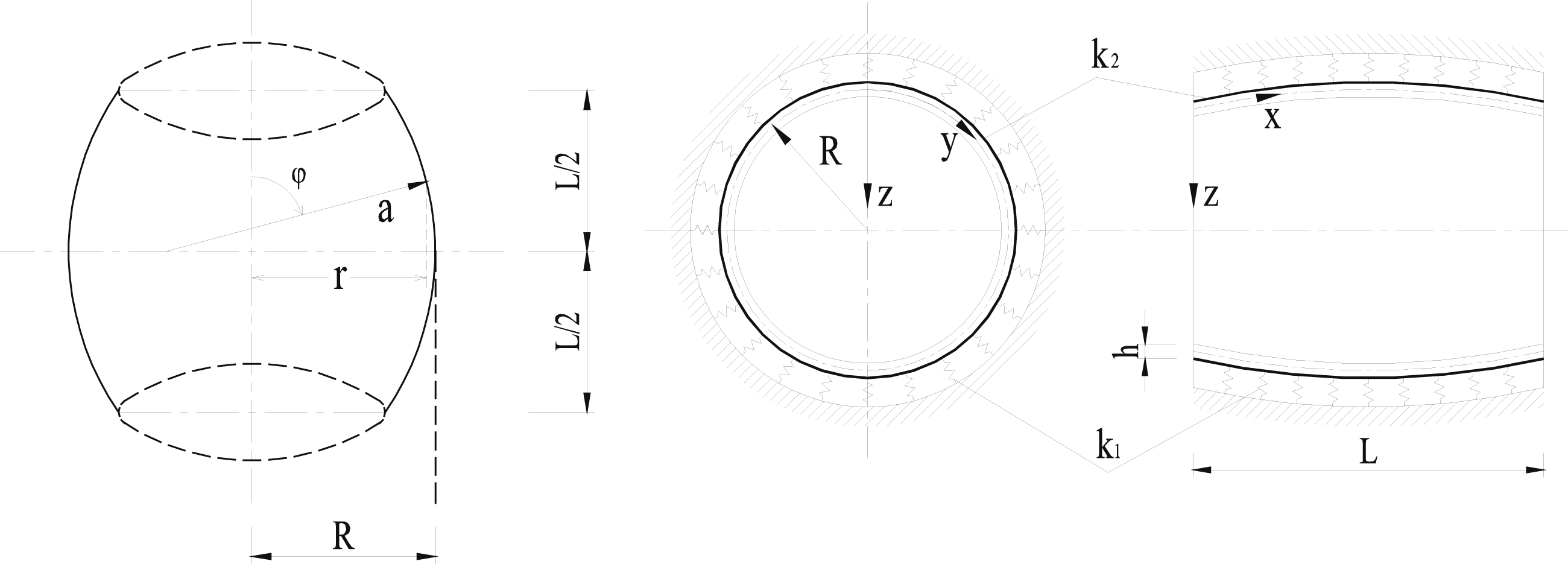
Structural model considered in this study is a toroidal shell segment (TSS) of thickness , length and curvature radii in the meridional and circumferential directions and , respectively, as shown in Figure 1. The TSS is surrounded by an elastic medium modelled as two–parameter foundation and defined in a coordinate system in which the origin is located in the middle surface at one end, and are meridional and circumferential coordinates, respectively, and is thickness coordinate with positive inward (). It is assumed that the TSS is very shallow in the meridional direction, specifically, is much smaller than (and thus, ratio is much smaller than unity). This class of TSSs can be seen as nearly cylindrical shells. Circular cylindrical shell (CCS) is received as a special case in which tends to infinity (i.e. ).
Configuration and coordinate system of a toroidal shell segment (TSS) surrounded by an elastic medium.
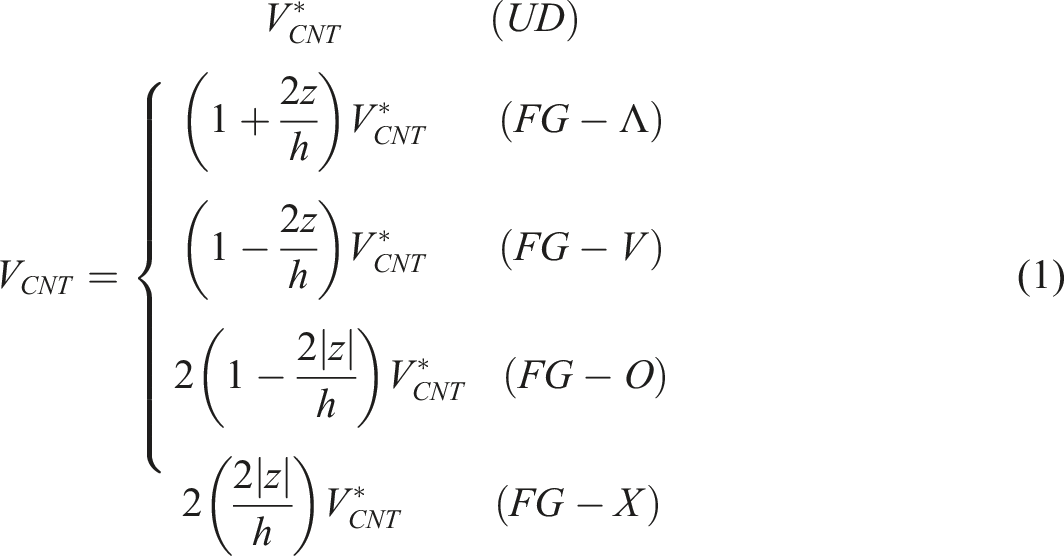
The TSS is made of carbon nanotube reinforced composite (CNTRC) in which CNTs are embedded into matrix in such a way that axis is the aligned direction of the CNTs and through uniform distribution (UD) or four different patterns of functionally graded (FG) distributions named , FG-V, FG-O and FG-X. The volume fraction of CNTs corresponding to these distribution patterns is expressed as linear functions of thickness variable as15,26-28
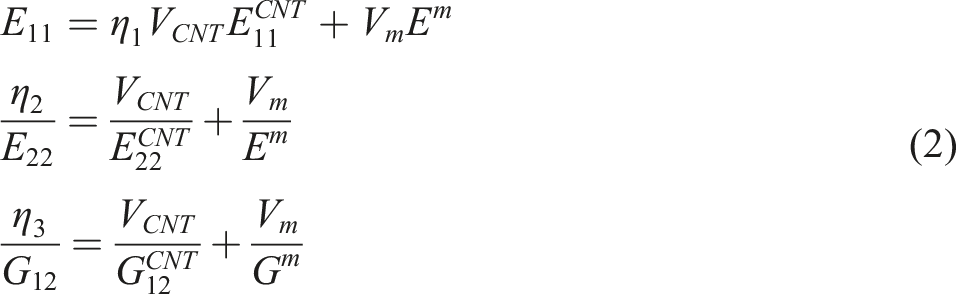
where is total volume fraction of CNTs. In this study, effective elastic moduli , and effective shear modulus of CNTRC are determined using an extended rule of mixture as15
in which is volume fraction of matrix material, , and are elastic moduli and shear modulus of CNTs, respectively, whereas and are elastic and shear moduli of isotropic homogeneous matrix, respectively. Furthermore, coefficients are called CNT efficiency parameters inserted into the equation (2) to capture size effects on the effective properties.
Due to weak dependence on temperature and position, effective Poisson’s ratio of CNTRC is assumed to be constant and evaluated using conventional rule of mixture as15
in which and are Poisson’s ratios of CNT and matrix, respectively. In this study, the effective coefficients of thermal expansion and in the longitudinal and transverse directions of CNTRC, respectively, are determined basing on Schapery model as28,35,39
where and are thermal expansion coefficients in axial and transverse directions of CNTs, respectively, whereas denotes the thermal expansion coefficient of matrix material.
Basic equations
In this study, TSS is assumed to be thin and geometrically perfect, and the classical shell theory (CST) is employed for deriving basic equations. Basing on the CST, strain components of the TSS are expressed as
where
in which and are displacement components in the and directions, respectively. The Green-Lagrange nonlinear strain gives more accurate predictions and is usually adopted in numerical approaches, for examples in works of Kar and Panda56 and Sahoo et al.57,58 Owing to less cumbersomeness and acceptable accuracy, von Kármán–Donnell nonlinear strain is widely used in many studies, e.g. works.8,11,35-40 In the present study, von Kármán–Donnell nonlinear terms are retained. Stress components are determined using constitutive relations as
where
and is uniform temperature rise from room temperature at which the TSS is assumed to be free from thermal stresses. Force and moment resultants are calculated through stresses as follows
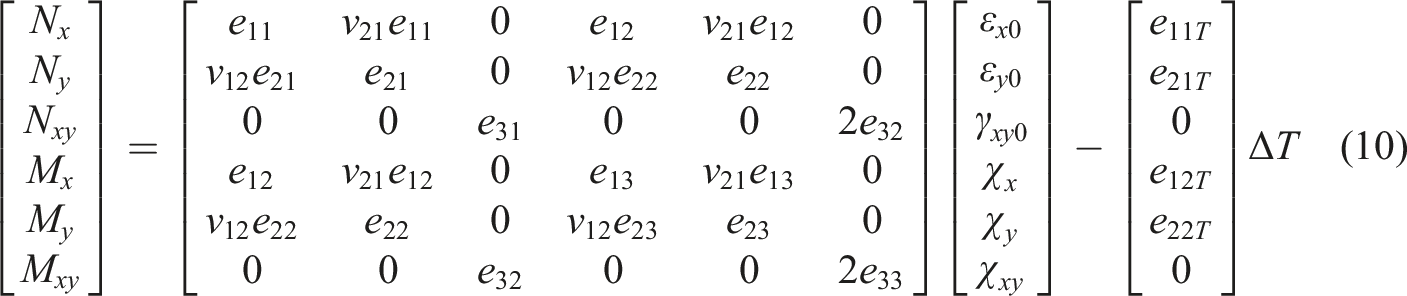
By introducing equations (5) and (7) into equation (9), force and moment resultants are expressed as
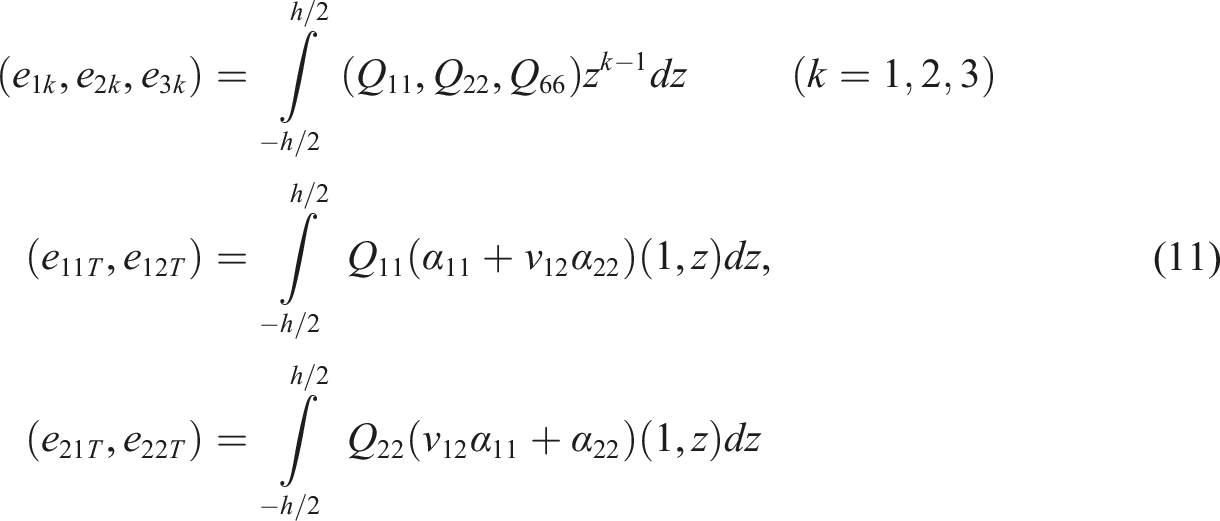
where
By introducing a stress function defined as , , and implementing mathematical transformations as described in previous work,51 nonlinear equilibrium equation of a CNTRC TSS under torsion is written in the form as
where and are stiffness parameters of elastic and shear layers of Winkler–Pasternak foundation, respectively, while coefficients ,…, are given in work.59
Strain compatibility equation of a CNTRC TSS can be derived as follows51
where coefficients ,…, can be found in the work.59 Equations (12) and (13) are basic equations governing the nonlinear stability problem of thin CNTRC TSSs surrounded by an elastic medium and subjected to torsional load.
This work considers CNTRC TSSs with simply supported and tangentially restrained edges. The associated boundary conditions are expressed as6,39
where is uniform shear stress and is fictitious axial force resultant related to average end–shortening displacement as the following expression50,51
in which is an average stiffness parameter of tangential edge constraints. More simply, is seen to be average stiffness of springs representing tangentially elastic constraints of two edges.50
TSS is a form of closed shell. The circumferentially closed condition of a TSS is fulfilled in an average sense as6,39
For a torsionally loaded TSS, load – rotation response is one of goals of postbuckling analysis. To this goal, the angle of twist is defined as11
From equations (6) and (10), the following expressions are obtained
Solution procedure
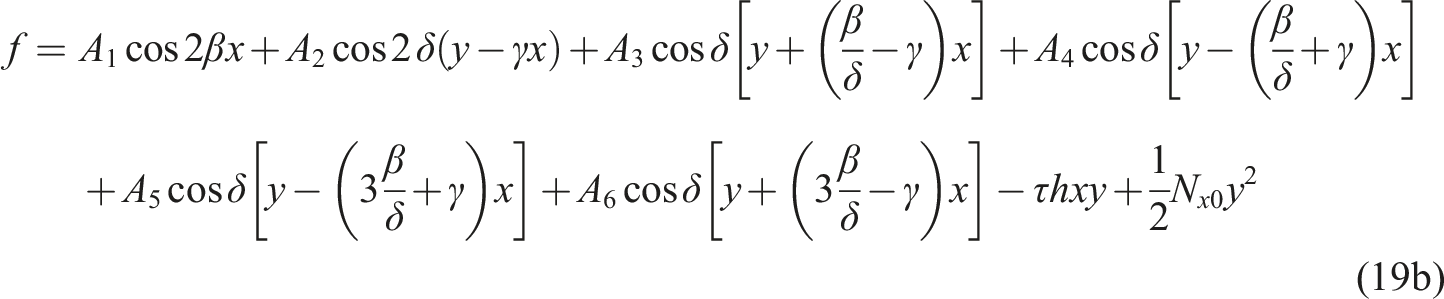
As mentioned in the work of Shen,6 it is difficult to model accurately the buckling mode of the shell under torsion. In the present work, to satisfy approximately boundary conditions (14), the following analytical solutions are assumed11,48
where , and are the amplitudes of deflection corresponding to prebuckling, linear buckling and nonlinear buckling states, respectively, whereas and with and are numbers of half and full waves in the meridional and circumferential directions, respectively. In addition, is the tangent of angle between the wave shape and the axis, while A1,…,A6 are coefficients to be determined. It is noted that previous works on the torsional buckling of FGM and FG-CNTRC CCSs8,11,12,40,48 considered a special case of in-plane boundary condition is that movable edges only and omitted the last term in the stress function, i.e. . The innovation of the present work in comparison with previous works is that considering elasticity of in-plane boundary condition and including the last term in the stress function.
By putting the solutions (19) into the compatibility equation (13), the coefficients A1,…,A6 can be determined as follows
where expressions of A11, A21, A12, A13, A23, A14, A24, A15, A16 are given in equation (A1) in Appendix and
By substituting the solutions (19) into the equilibrium equation (12) and applying Galerkin method on the whole region of the TSS (), we obtain
where coefficients g11,...,g51 and g02,...,g42 are displayed in equation (A3) in Appendix and
in which is value of calculated at room temperature . Non-dimensional stiffness parameters and will be used in parametric studies later.
Substituting the solutions (19) into the equations (18a) and (15) yields
where
Similarly, by placing the solutions (19) into the equations (18b) and (16), we obtain
where coefficients can be found in equation (A5) in Appendix. Introduction of equation (27) into the equation (22a) leads to
Substitution of equation (27) into the equation (22b) gives
where coefficients are given in equation (A6) in Appendix. Now, by putting from equation (29) into the equation (28), we receive
By setting , the buckling loads are obtained as
Critical buckling load is determined by means of minimizing the buckling loads with respect to buckling mode .
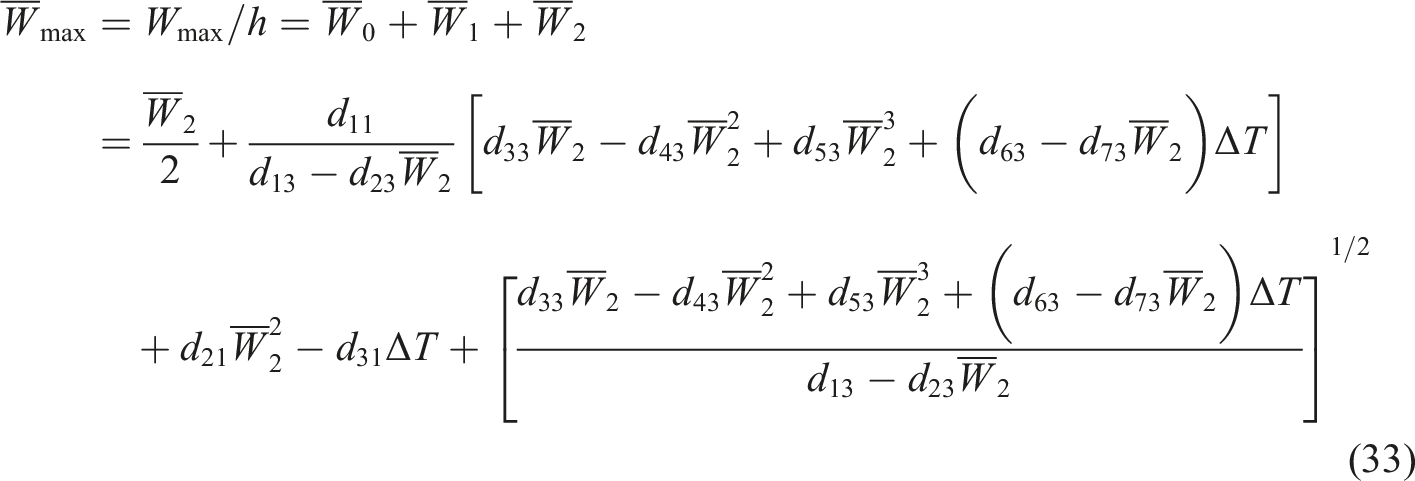
From the expression of deflection solution (19a), maximum deflection is expressed as
By using the equations (27a) and (29) into equation (32), the expression of non-dimensional maximum deflection is written in the form
Equations (30) and (33) are employed for tracing load–deflection paths in the postbuckling behavior analysis of torsionally loaded CNTRC TSSs. Now, using the solutions (19) into the equations (18c) and (17) deduces
By placing equation (29) into equation (34), we obtain
Equations (30) and (35) are used for depicting the load–rotation paths in the torsional postbuckling behavior analysis of CNTRC TSSs.
Results and discussion
This section presents parametric studies for the torsional buckling and postbuckling analyses of TSSs made of Poly (methyl methacrylate) matrix material, referred to as PMMA, and reinforced by (10,10) single-walled carbon nanotubes (SWCNTs). The temperature dependent properties of the PMMA and (10,10) SWCNTs have been given in many previous works, for examples,26-28 and are omitted here for the sake of brevity. In addition, CNT efficiency parameters are the same as those given in the works.26-28
Verification
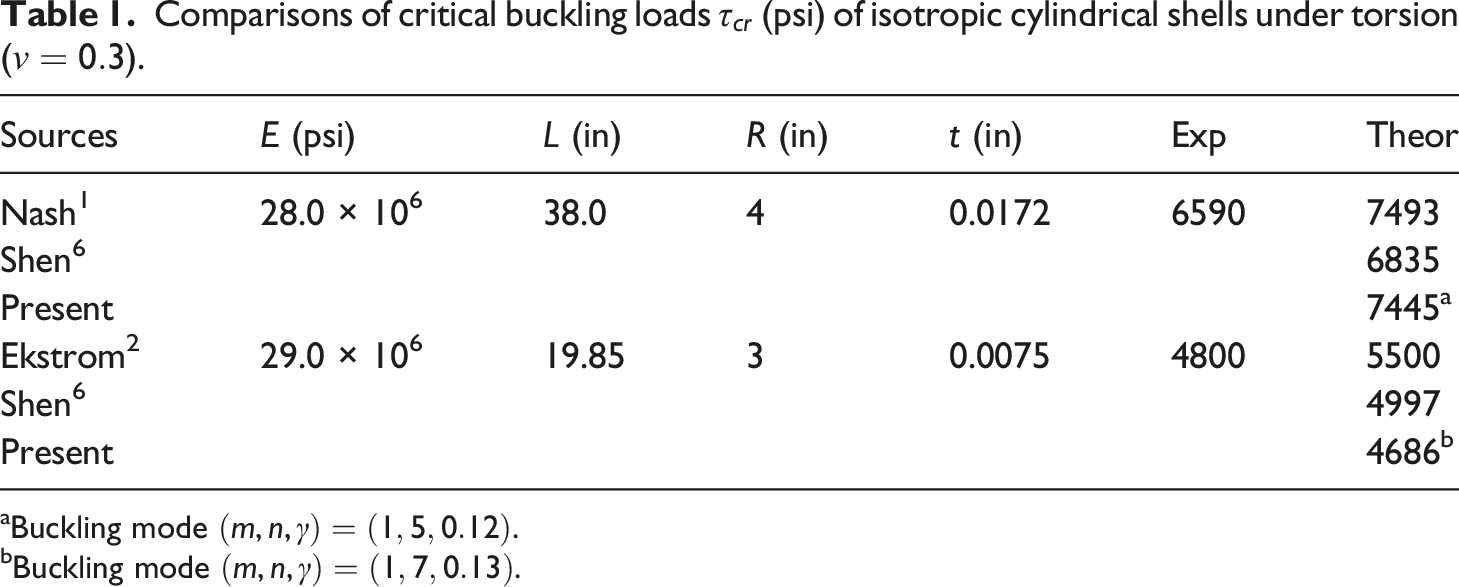
There is no investigation on the torsional stability of CNTRC TSSs with surrounding elastic media and elastically restrained edges in the literature. Therefore, comparative study is carried out for special cases of material, geometry and in-plane boundary condition. Specifically, the buckling behavior of isotropic homogeneous CCSs with simply supported and movable edges, without foundation interaction and subjected to uniform torsion is considered. This problem was theoretically and experimentally investigated by Nash1 and Ekstrom.2 Also, this problem was examined by Shen6 using asymptotic solutions along with a perturbation technique. Table 1 shows results calculated by equation (31) in comparison with results reported in previous works of Nash,1 Ekstrom2 and Shen.6 As can be seen, the results of the present work very well agree with both theoretical and experimental results of previous works.
Comparisons of critical buckling loads (psi) of isotropic cylindrical shells under torsion ().
In what follows, the buckling and postbuckling behaviors of CNTRC TSSs under torsional load will be analyzed. In numerical results, degree of tangential constraints of edges will be measured by a non-dimensional tangential stiffness parameter defined in equation (25). Basing on this definition, values of (i.e. ), (i.e. ) and (i.e. ) characterize the cases of movable, immovable and partially movable edges, respectively.
Buckling analysis
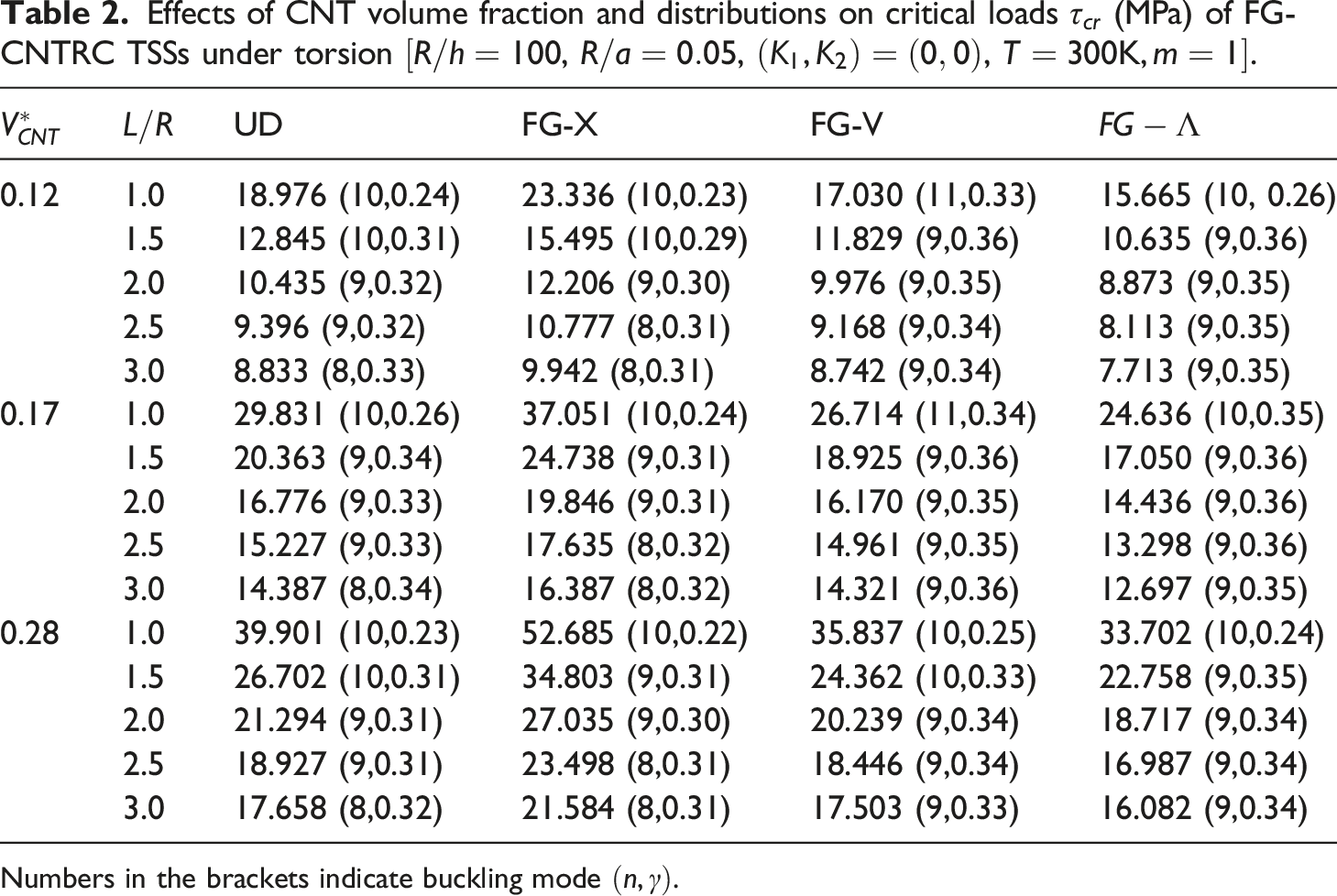
Various influences on the critical buckling loads of CNTRC TSSs under torsion are analyzed in this subsection. First, the effects of CNT volume fraction, distributions, and ratio of length to circumferential radius on the critical torsional loads of CNTRC TSSs are shown in Table 2. As can be seen, critical loads are obviously increased and decreased when total volume fraction of CNTs and ratio are enhanced, respectively. More specifically, the efficiency of CNT reinforcement is higher for larger values of ratio. For examples, for FG-X distribution, critical loads are increased 58.78 pc and 64.83 pc when is increased 5 pc (from to ) with and , respectively. Furthermore, torsional buckling occurs at smaller and larger values of and , respectively, when ratio becomes larger. It is also demonstrated from Table 2 that critical loads corresponding to FG-X type of CNT distribution are the highest, while uniform distribution (UD) yields intermediate values of critical loads of torsionally CNTRC TSSs.
Effects of CNT volume fraction and distributions on critical loads (MPa) of FG-CNTRC TSSs under torsion .
UD
FG-X
FG-V
0.12
1.0
18.976 (10,0.24)
23.336 (10,0.23)
17.030 (11,0.33)
15.665 (10, 0.26)
1.5
12.845 (10,0.31)
15.495 (10,0.29)
11.829 (9,0.36)
10.635 (9,0.36)
2.0
10.435 (9,0.32)
12.206 (9,0.30)
9.976 (9,0.35)
8.873 (9,0.35)
2.5
9.396 (9,0.32)
10.777 (8,0.31)
9.168 (9,0.34)
8.113 (9,0.35)
3.0
8.833 (8,0.33)
9.942 (8,0.31)
8.742 (9,0.34)
7.713 (9,0.35)
0.17
1.0
29.831 (10,0.26)
37.051 (10,0.24)
26.714 (11,0.34)
24.636 (10,0.35)
1.5
20.363 (9,0.34)
24.738 (9,0.31)
18.925 (9,0.36)
17.050 (9,0.36)
2.0
16.776 (9,0.33)
19.846 (9,0.31)
16.170 (9,0.35)
14.436 (9,0.36)
2.5
15.227 (9,0.33)
17.635 (8,0.32)
14.961 (9,0.35)
13.298 (9,0.36)
3.0
14.387 (8,0.34)
16.387 (8,0.32)
14.321 (9,0.36)
12.697 (9,0.35)
0.28
1.0
39.901 (10,0.23)
52.685 (10,0.22)
35.837 (10,0.25)
33.702 (10,0.24)
1.5
26.702 (10,0.31)
34.803 (9,0.31)
24.362 (10,0.33)
22.758 (9,0.35)
2.0
21.294 (9,0.31)
27.035 (9,0.30)
20.239 (9,0.34)
18.717 (9,0.34)
2.5
18.927 (9,0.31)
23.498 (8,0.31)
18.446 (9,0.34)
16.987 (9,0.34)
3.0
17.658 (8,0.32)
21.584 (8,0.31)
17.503 (9,0.33)
16.082 (9,0.34)
Numbers in the brackets indicate buckling mode .
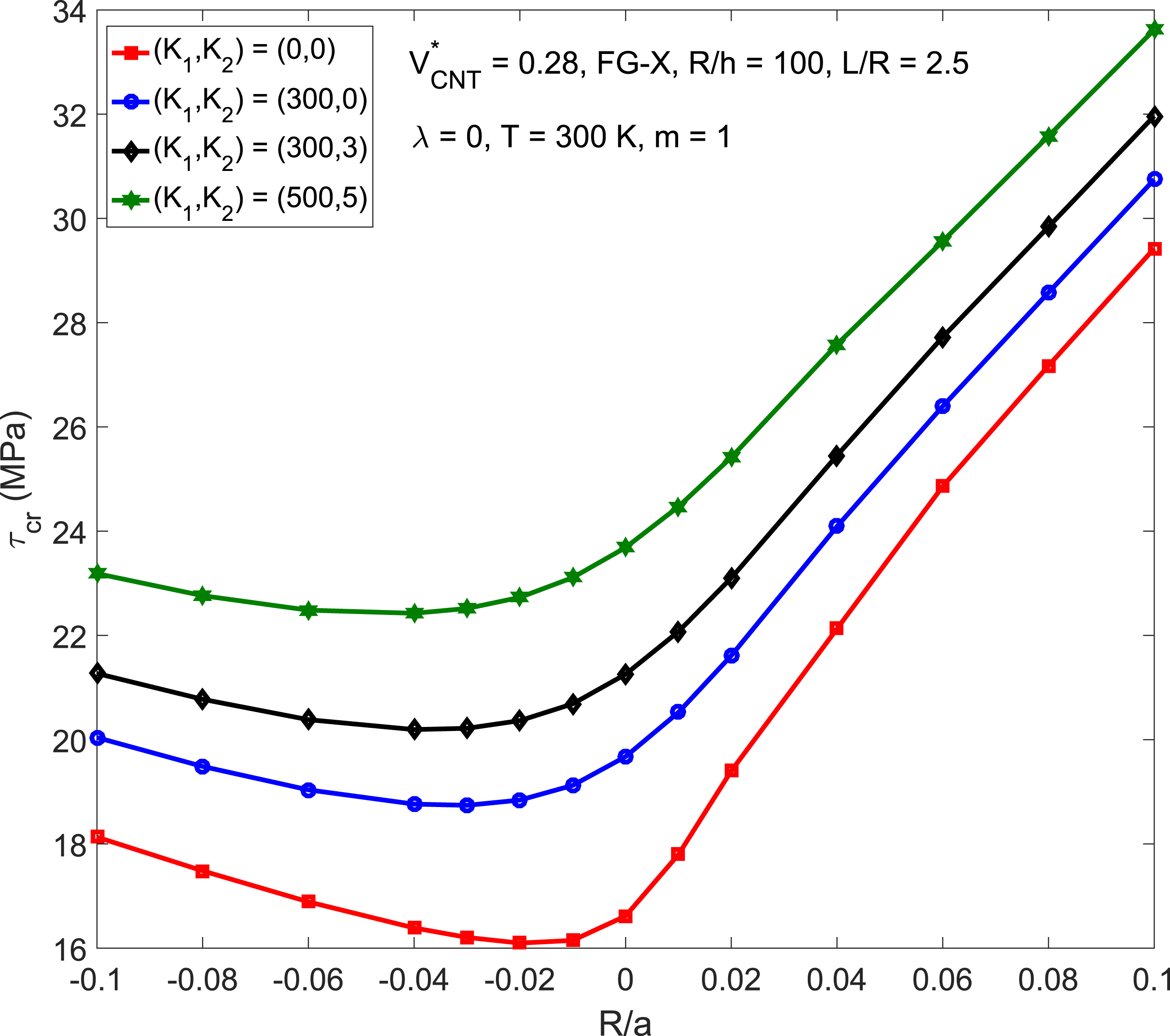
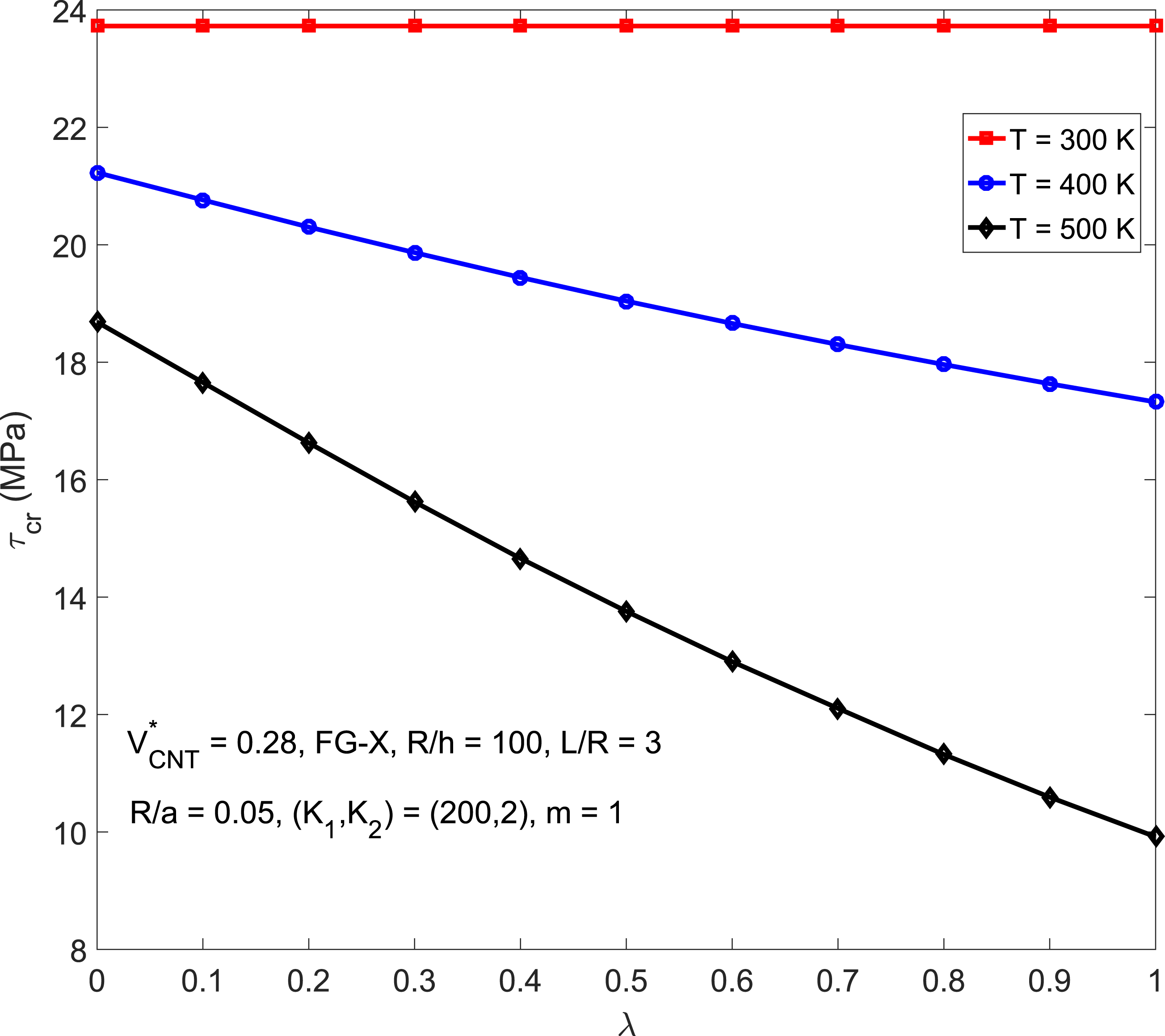
Next, the effects of Gauss curvature and surrounding elastic media on the critical loads of FG-X CNTRC TSSs under torsion are analyzed in Figure 2 plotted with various values of ratio () and four couples of values of non-dimensional stiffness parameters . Generally, the buckling resistance capacity of the TSS is significantly enhanced when ratio is increased and critical loads of convex TSSs () are much higher than those of concave TSSs () and CCS (). More concretely, in this example, critical loads are slightly decreased as increases from to a definite negative value (about for case of , ), and then are strongly increased when becomes larger. Figure 2 also indicates that the buckling resistance capability of TSSs is pronouncedly improved due to the presence of surrounding elastic media and, specifically, critical torsional loads are evidently increased when increasing the parameters . Additionally, it is found that beneficial influences of elastic media on the buckling resistance are more clear for concave TSSs. The ultimate numerical example for buckling analysis is illustrated in Figure 3 considering the effects of tangential edge constraints (i.e. parameter) and thermal environments on the critical loads of FG-CNTRC TSSs surrounded by a Winkler–Pasternak foundation under torsion. It is evident that in-plane constraint of edges has no effects on critical torsional loads at room temperature ( K). In contrast, critical loads are substantially reduced when parameter is increased at elevated temperature. In addition, the speed of reduction of is faster when temperature is more elevated.
Effects of Gauss curvature and surrounding elastic media on critical loads of FG-CNTRC TSSs with movable edges under torsion.
Effects of tangential edge constraints and thermal environments on critical loads of FG-CNTRC TSSs under torsion.
Postbuckling analysis
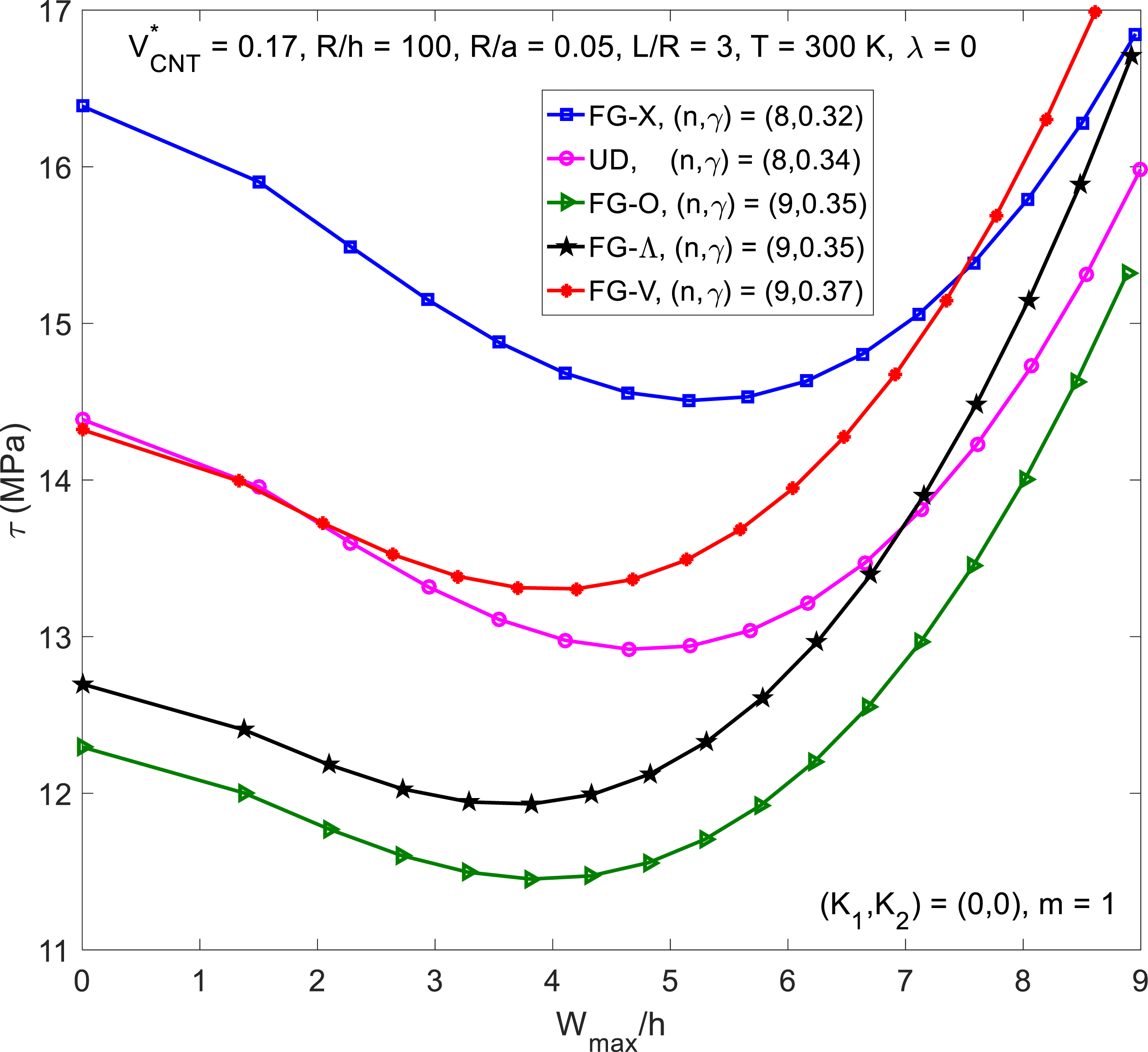
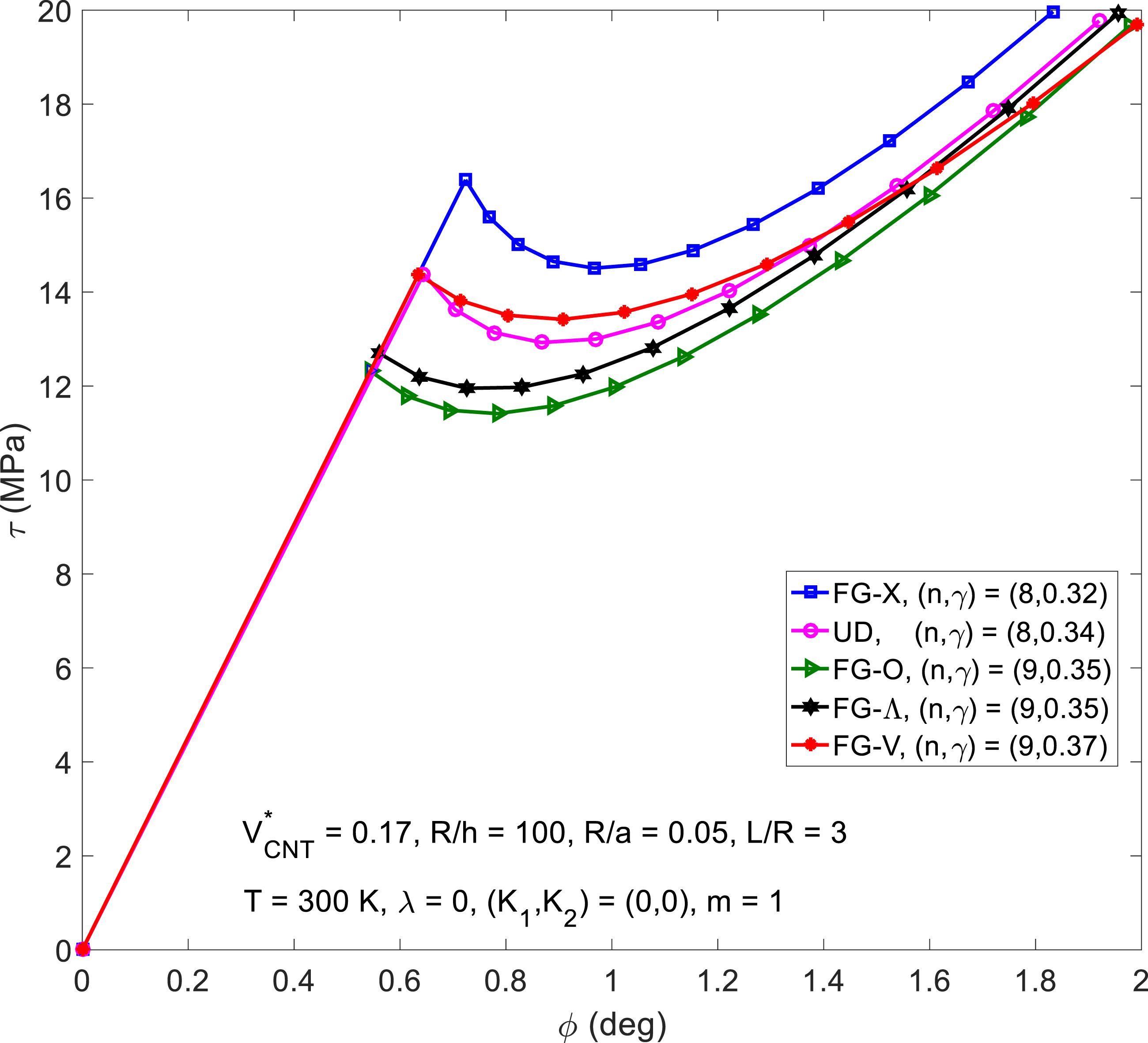
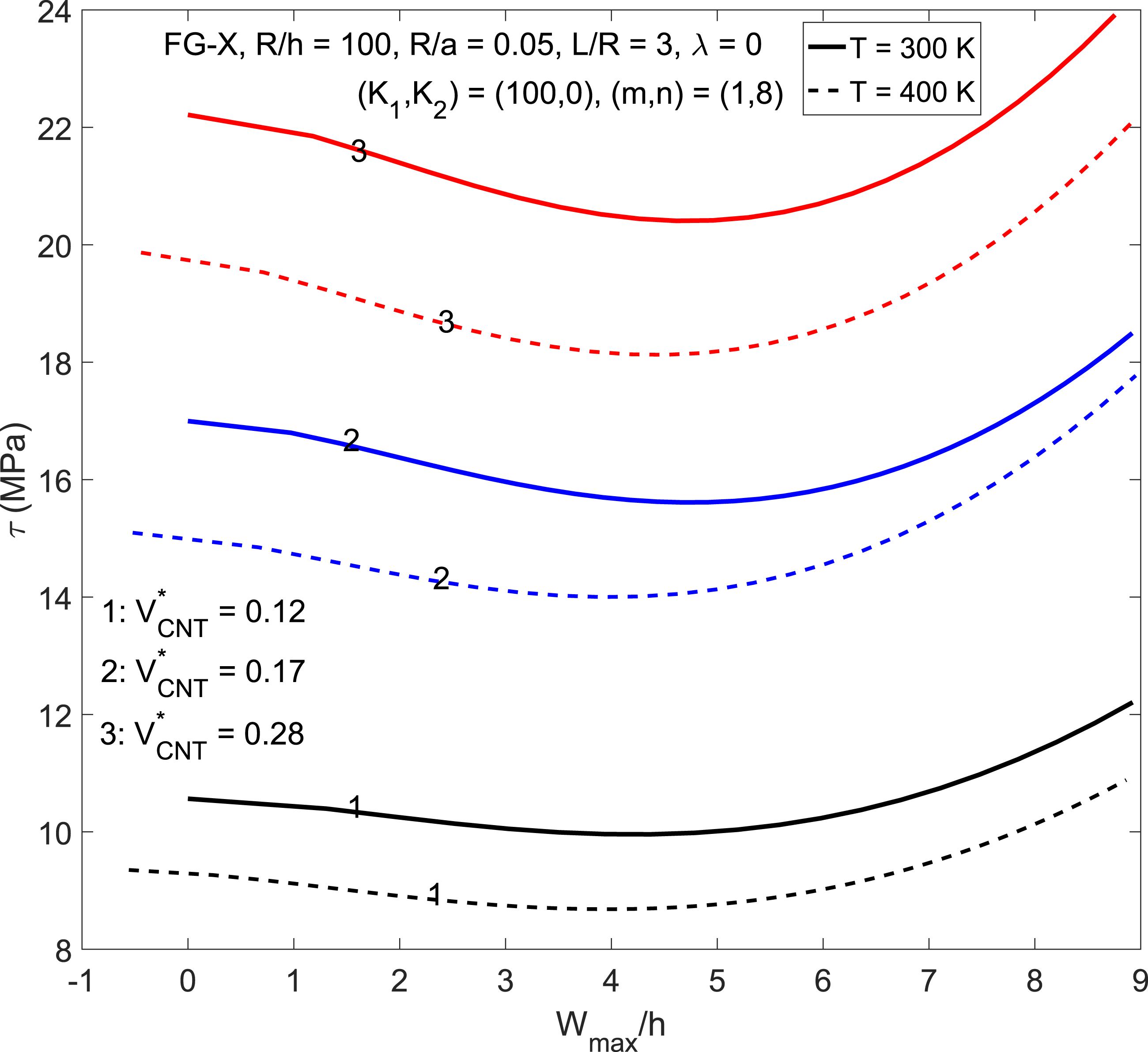
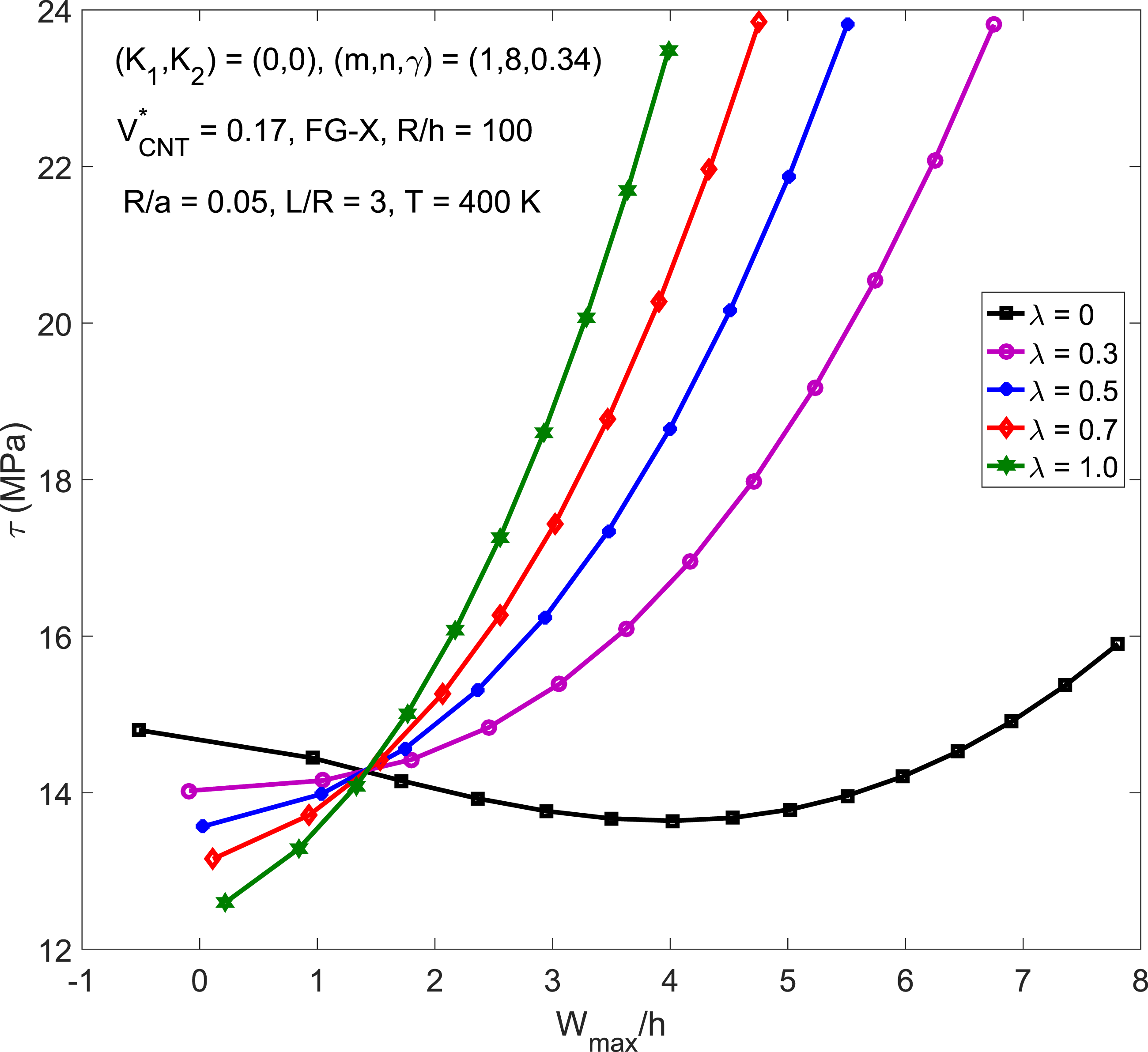
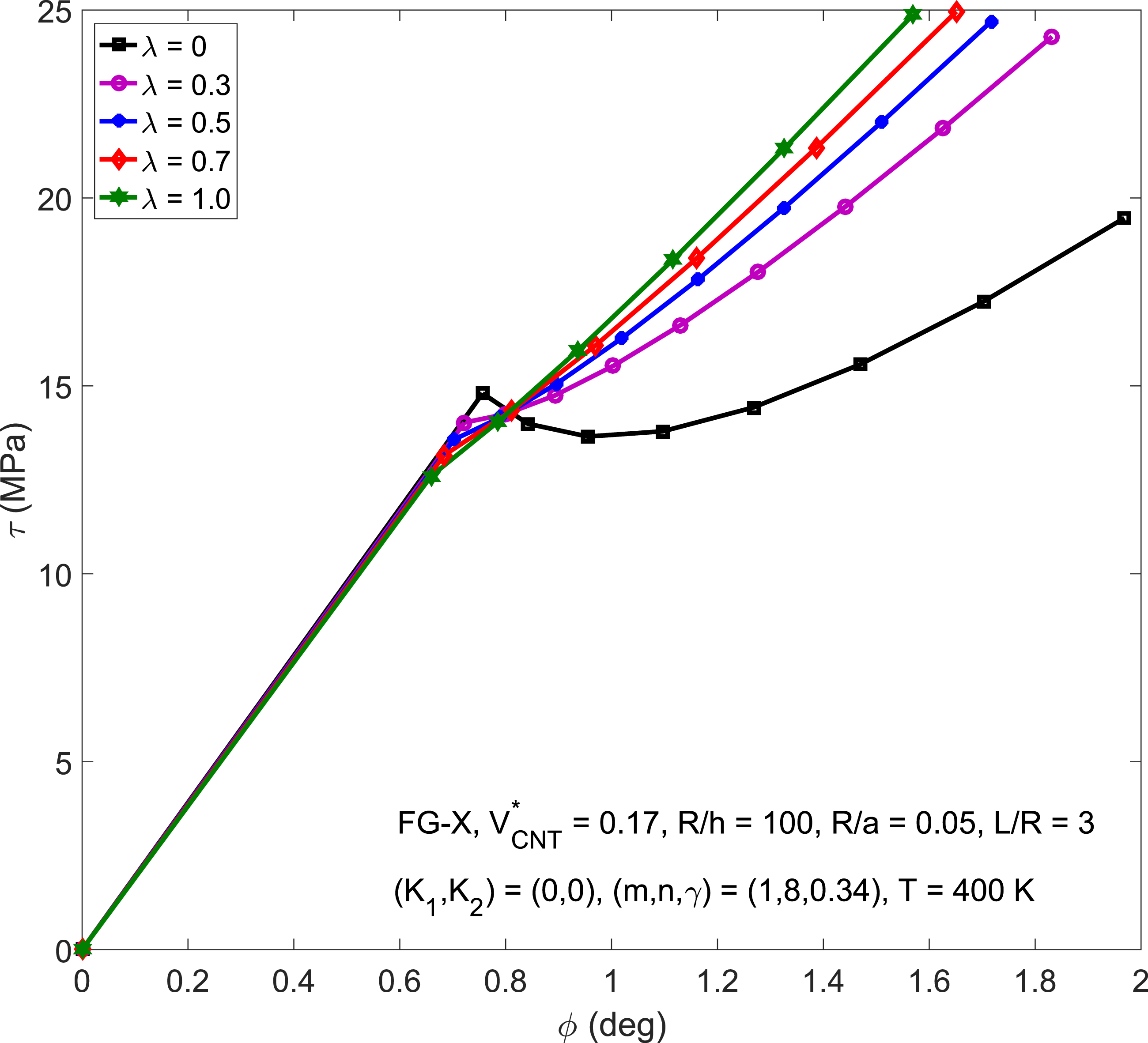
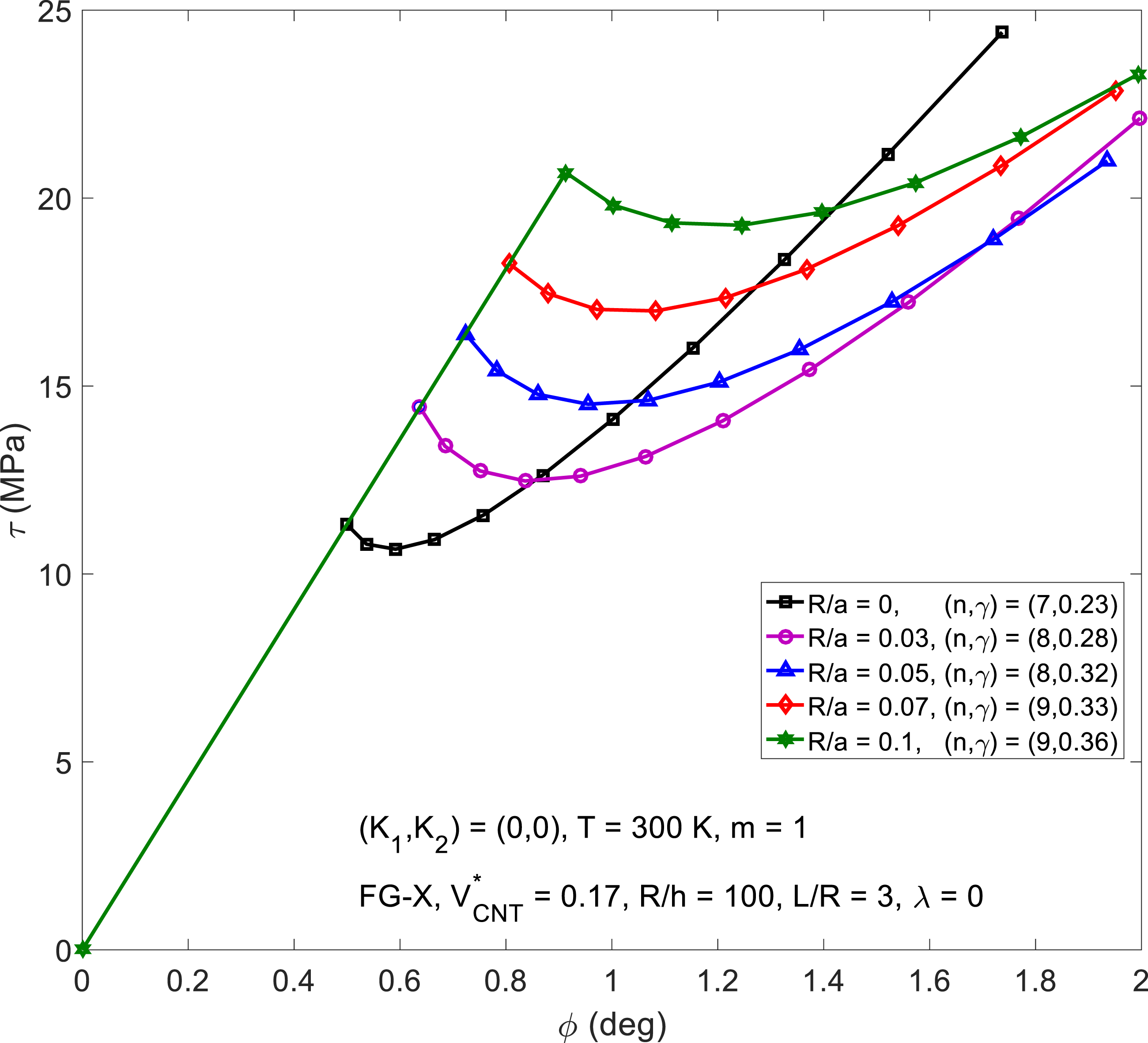
Numerous influences on the load–deflection and load–rotation responses in the postbuckling region of torsionally loaded FG-CNTRC TSSs are graphically analyzed in this subsection. First, the effects of CNT distribution patterns on the load–deflection and load–rotation responses of CNTRC TSSs with movable edges under torsion are analyzed in Figures 4 and 5, respectively. As can be observed, among five types of CNT distribution, FG-X and FG-O patterns bring to the smallest and largest values, respectively, of the deflection and angle of twist in the postbuckling region. Furthermore, although critical loads of FG-V and UD TSSs are almost the same, the postbuckling strength in the deep region of the deflection of FG-V TSS is evidently stronger. The remaining parametric studies are carried out for TSSs in which CNTs are distributed into the matrix according to FG-X pattern. Next, the effects of total volume fraction of CNTs on the postbuckling load – deflection paths of FG-CNTRC TSSs with movable edges, surrounded by an Winkler-type foundation and subjected to torsional load in thermal environments are indicated in Figure 6. It is clear that enhancements of CNT volume percentage and environment temperature lead to an increase and a decrease in critical torsional loads, respectively. More specifically, the negative influence of elevated temperature on critical loads is more pronounced at larger values of .
Effects of CNT distribution patterns on load–deflection response of FG-CNTRC TSSs with movable edges subjected to torsional load.
Effects of CNT distribution patterns on load–rotation response of FG-CNTRC TSSs with movable edges subjected to torsional load.
Effects of CNT volume fraction on postbuckling paths of FG-CNTRC TSSs with movable edges subjected to torsional load.
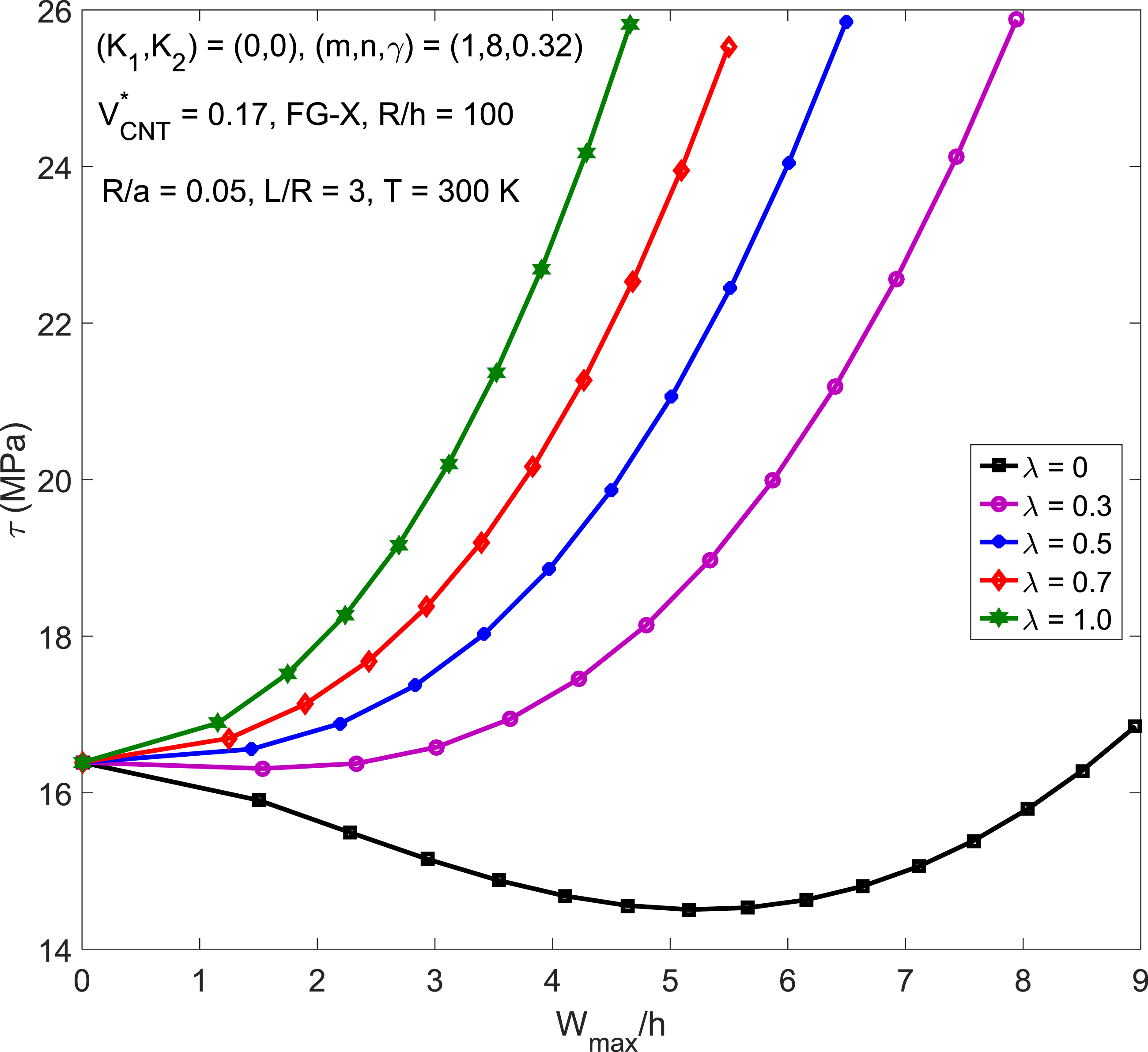
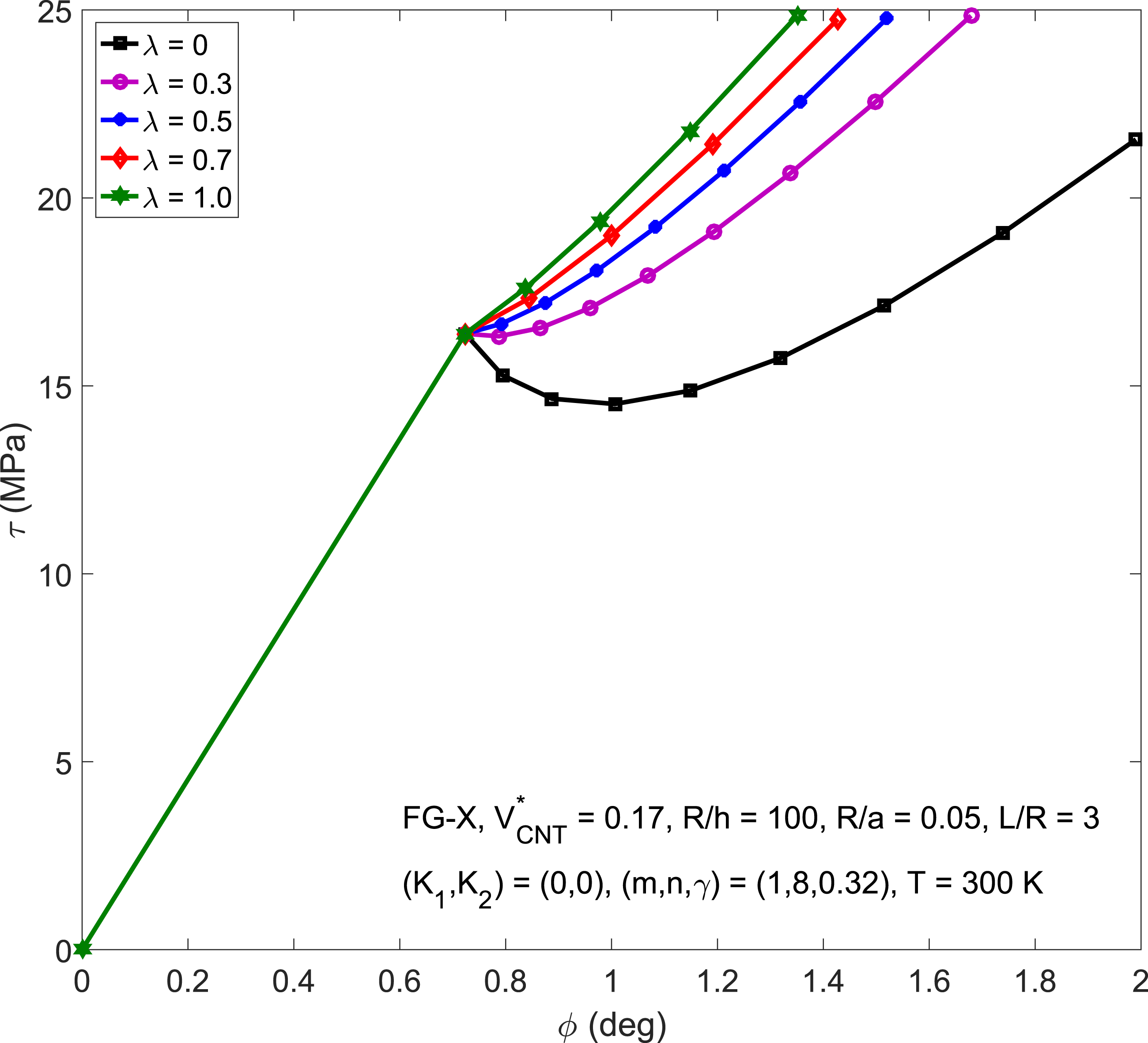
The effects of tangential edge constraints on the load–deflection and load–rotation responses of torsionally loaded FG-CNTRC TSSs at room temperature ( K) are examined in Figures 7 and 8, respectively, plotted with five different values of parameter. As shown, although the critical loads are unchanged, the postbuckling strength of TSSs under torsion at room temperature becomes very much stronger when parameter is larger. In other words, tangential edge constraints have very beneficial influences on the postbuckling behavior of torsionally loaded FG-CNTRC TSSs. Specifically, the deflection and angle of twist are remarkably lowered when edges are more rigorously restrained. More importantly, snap-through response can be alleviated or even eliminated when edges of the TSS are tangentially restrained. Subsequently, the effects of parameter on the postbuckling behavior of FG-CNTRC TSSs under torsion at elevated temperature ( K) are analyzed in Figures 9 and 10 sketching load–deflection and load–rotation responses, respectively. Unlike case of room temperature, critical torsional loads and initial postbuckling paths are dropped due to increase in parameter when the TSS is exposed to pre-exist elevated temperature. Nevertheless, in the region of larger deflection and angle of twist, load–deflection and load–rotation response paths are higher and more stable when parameter becomes larger.
Effects of tangential edge constraints on load–deflection response of FG-CNTRC TSSs subjected to torsion at room temperature.
Effects of tangential edge constraints on load–rotation response of FG-CNTRC TSSs subjected to torsion at room temperature.
Effects of tangential edge constraints on load–deflection response of FG-CNTRC TSSs subjected to torsion at elevated temperature.
Effects of tangential edge constraints on load–rotation response of FG-CNTRC TSSs subjected to torsion at elevated temperature.
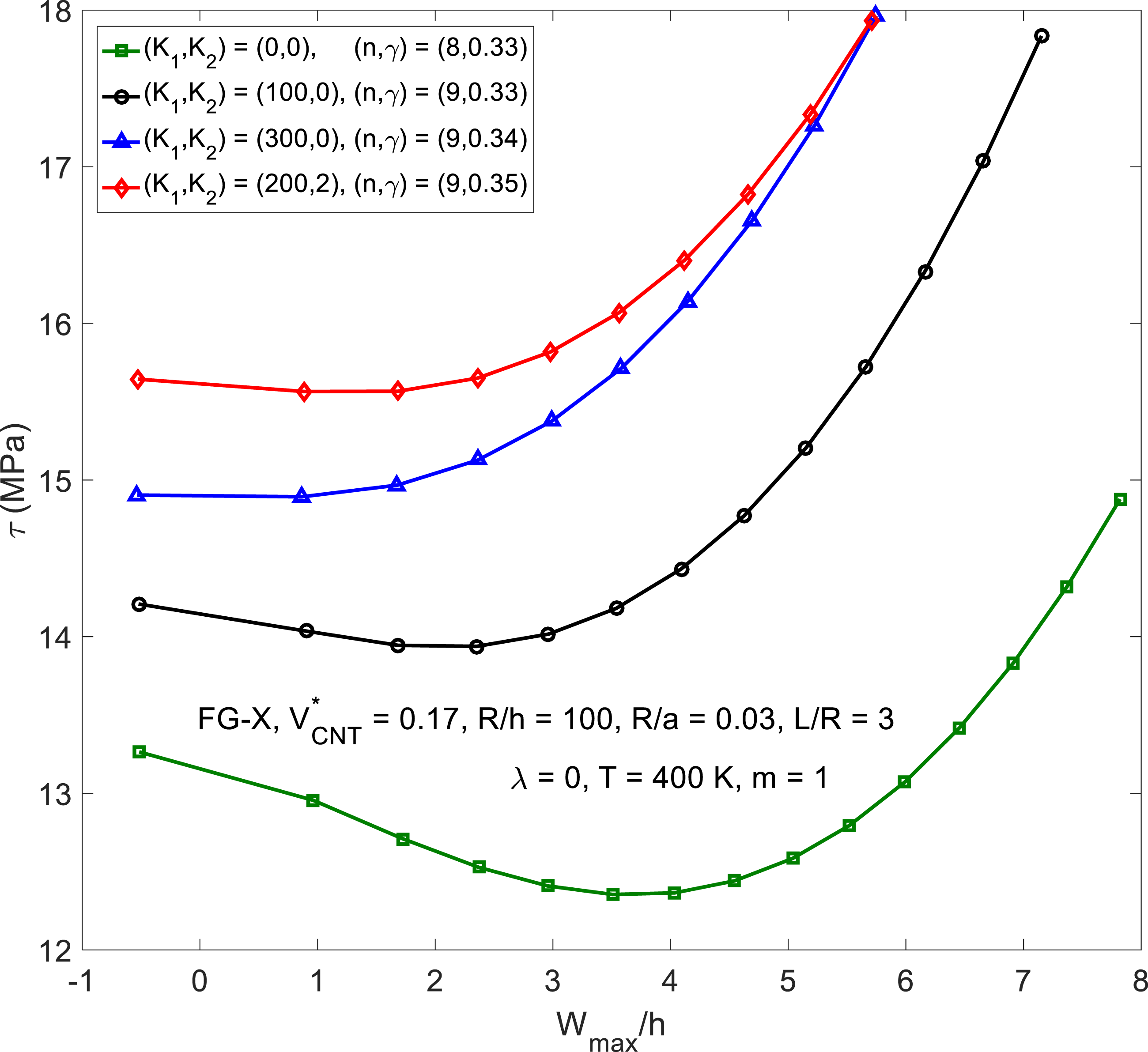
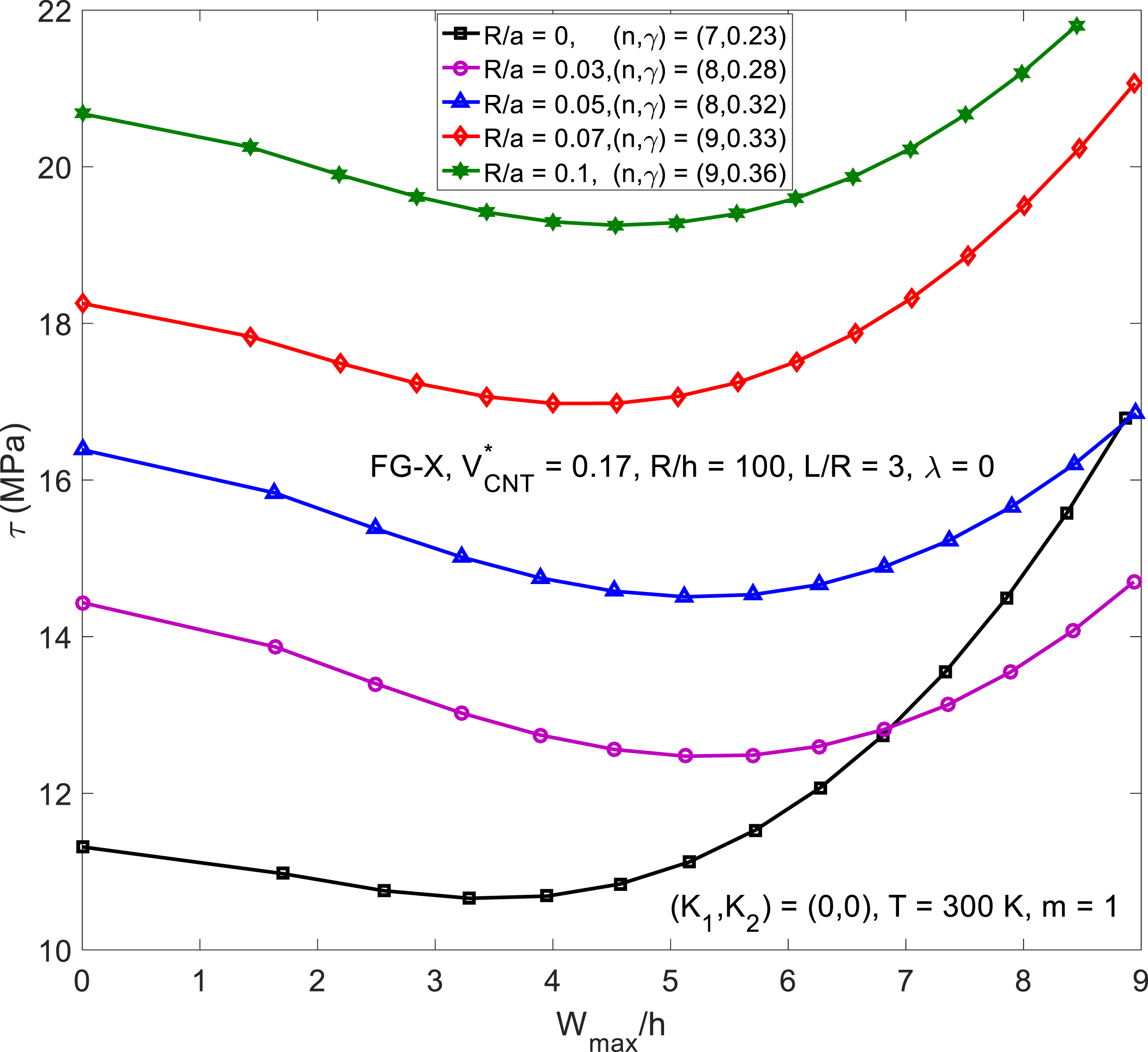
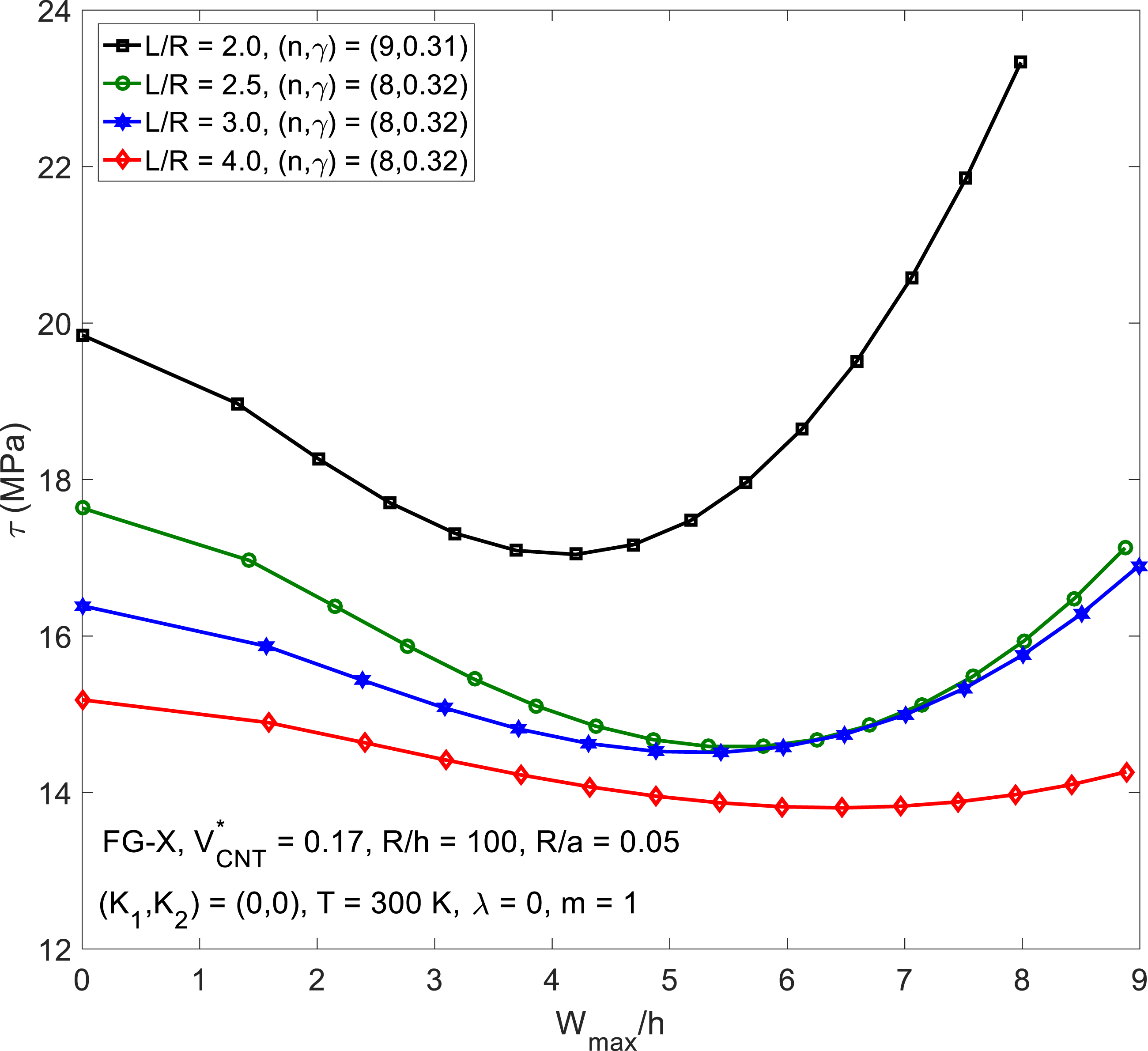
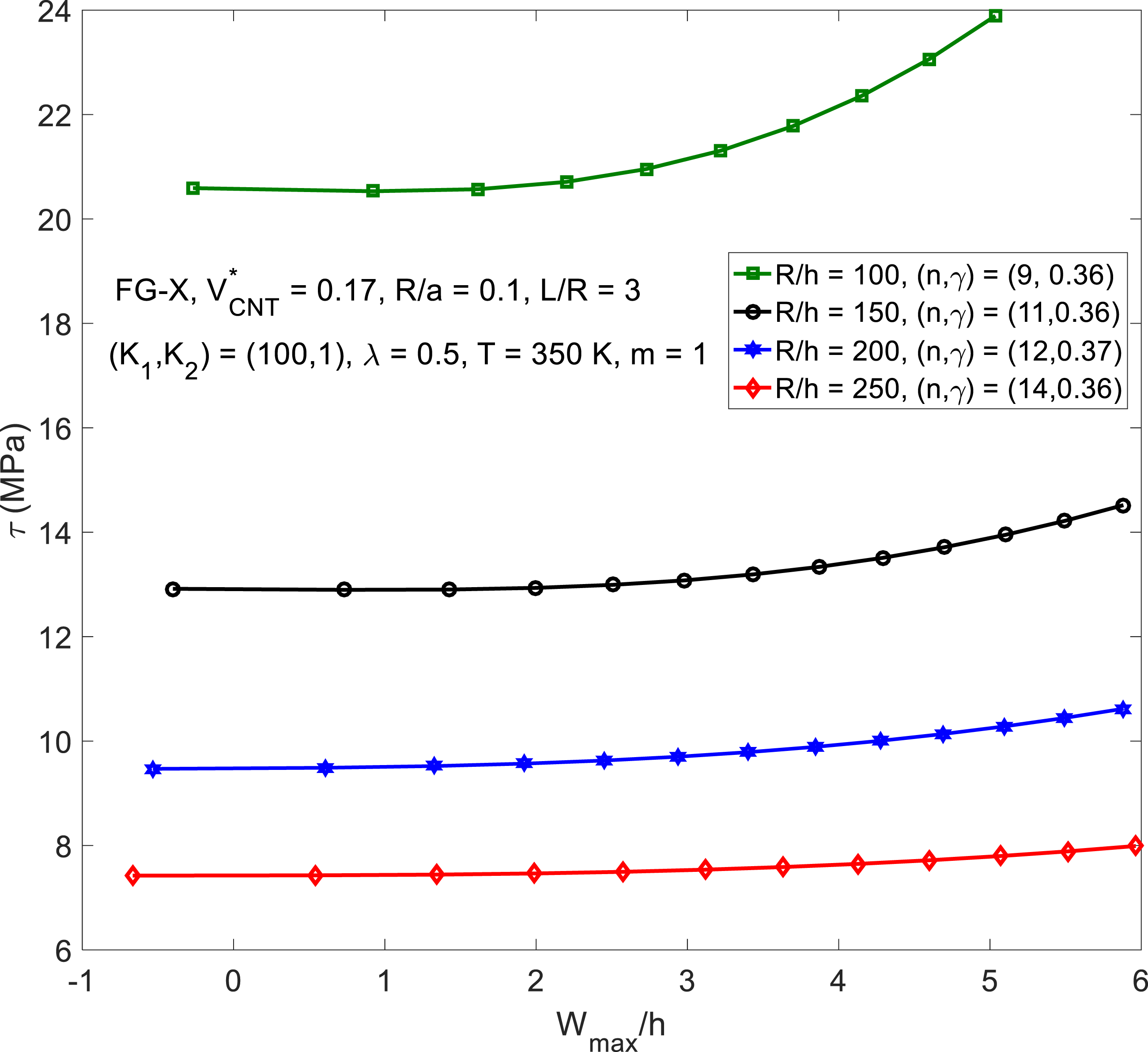
Next parametric study is carried out in Figure 11 plotted with four couples of non-dimensional stiffness parameters of surrounding elastic media. Overall, it is exhibited in Figure 11 that surrounding elastic media beneficially influence the nonlinear stability of torsionally loaded FG-CNTRC TSSs and load–deflection paths are considerably higher as parameters are enhanced. More particularly, it seems that parameter of Winkler elastic layer alleviates the intensity of snap-through response. The effects of Gauss curvature on the load–deflection and load–rotation responses of convex FG-CNTRC TSSs under torsional load are illustrated in Figures 12 and 13, respectively, traced with five values of ratio. It is clear that buckling loads and postbuckling curves are significantly enhanced when increasing ratio. This means the buckling resistance capacity and postbuckling strength of TSSs are obviously stronger than those of CCS under torsion. Moreover, it is found from Figures 12 and 13 that snap-through response becomes more intense and values of buckling mode () are larger when ratio is increased. Next, the effects of ratio of length to circumferential radius on the postbuckling load–deflection paths of FG-CNTRC TSSs under torsion are depicted in Figure 14. It is obvious that buckling loads and postbuckling curves are fundamentally reduced when ratio is larger. Finally, the influences of ratio of circumferential radius to thickness on the postbuckling paths of FG-CNTRC TSSs with partially movable edges () in a thermal environment are studied in Figure 15. It is realized that postbuckling paths are rapidly lowered as ratio is increased. Furthermore, equilibrium paths are more slowly and stably developed when ratio is larger.
Effects of surrounding elastic media on postbuckling paths of FG-CNTRC TSSs with movable edges subjected to torsional load in a thermal environment.
Effects of Gauss curvature on load–deflection response of FG-CNTRC TSSs with movable edges subjected to torsional load.
Effects of Gauss curvature on load–rotation response of FG-CNTRC TSSs with movable edges subjected to torsional load.
Effects of length-to-radius ratio on postbuckling paths of FG-CNTRC TSSs with movable edges subjected to torsional load.
Effects of radius-to-thickness ratio on postbuckling paths of FG-CNTRC TSSs with partially movable edges under torsion in a thermal environment.
Concluding remarks
An analytical investigation on the buckling and postbuckling of thin FG-CNTRC TSSs with tangentially restrained edges, surrounded by an elastic medium, exposed to a thermal environment and subjected to uniform torsion has been presented. The study reveals that tangential edge constraints have no and detrimental influences on torsional buckling resistance at room and elevated temperatures, respectively, and very beneficial influences on the postbuckling load carrying capability of torsionally loaded FG-CNTRC TSSs. The results also demonstrate that convex TSSs have considerable advantages over CCSs under torsional loads. Buckling resistance capacity is stronger and postbuckling response paths are higher and more stable due to the presence of surrounding elastic media. This study suggests that a convex TSS with FG-X type of CNT distribution, tangentially restrained edges and surrounding elastic media can be the most stable under torsional loads.
Footnotes
Declaration of conflicting interests
The author(s) declared no potential conflicts of interest with respect to the research, authorship, and/or publication of this article.
Funding
The author(s) received no financial support for the research, authorship, and/or publication of this article.
ORCID iD
Hoang Van Tung
Appendix
The details of expressions , , , , , , , , in the equation (20) are given as
in which
The details of the coefficients and in the equation (22) are the following
in which
The coefficients in the equation (27) are defined as follows
The coefficients in the equation (29) are given as the following
References
1.
NashWA. An experimental analysis of the buckling of thin initially imperfect cylindrical shells subject to torsion. Proc Soc Exp Stress Anal1959; 16(2): 55–68.
2.
EkstromRE. Buckling of cylindrical shells under combined torsion and hydrostatic pressure. Exp Mech1963; 3: 192–197.
3.
TabieiASimitsesGJ. Buckling of moderately thick, laminated cylindrical shells under torsion. AIAA J1994; 32(3): 639–647.
4.
KimYSKardomateasGAZureickA. Buckling of thick orthotropic cylindrical shells under torsion. J Appl Mech1999; 66(1): 41–50.
5.
ZhangXHanQ. Buckling and postbuckling behaviors of imperfect cylindrical shells subjected to torsion. Thin-Walled Structures2007; 45: 1035–1043.
6.
ShenHS. Torsional buckling and postbuckling of FGM cylindrical shells in thermal environments. Int J Non-Linear Mech2009; 44: 644–657.
7.
HuangHHanQFengN, et al.Buckling of functionally graded cylindrical shells under combined loads. Mech Adv Mater Structures2011; 18(5): 337–346.
8.
HuangHHanQ. Nonlinear buckling of torsion-loaded functionally graded cylindrical shells in thermal environments. Eur J Mech/A Sol2010; 29: 42–48.
9.
NajafovAMSofiyevAHKuruogluN. Torsional vibration and stability of functionally graded orthotropic cylindrical shells on elastic foundations. Meccanica2013; 48: 829–840.
10.
SofiyevAHKuruogluN. Torsional vibration and buckling of the cylindrical shell with functionally graded coatings surrounded by an elastic medium. Composites Part B2013; 45: 1133–1142.
11.
DungD VHoaLK. Research on nonlinear torsional buckling and post-buckling of eccentrically stiffened functionally graded thin circular cylindrical shells. Composites Part B2013; 51: 300–309.
12.
NamVHPhuongNTMinhKV, et al.Nonlinear thermo-mechanical buckling and post-buckling of multilayer FGM cylindrical shell reinforced by spiral stiffeners surrounded by elastic foundation subjected to torsional loads. Eur J Mech/A Sol2018; 72: 393–406.
13.
ThostensonETLiCChouTW. Nanocomposites in context. Composites Sci Techn2005; 65: 491–516.
14.
ColemanJNKhanUBlauWJ, et al.Small but strong: A review of the mechanical properties of carbon nanotube-polymer composites. Carbon2006; 44: 1624–1652.
15.
ShenHS. Nonlinear bending of functionally graded carbon nanotube-reinforced composite plates in thermal environments. Compos Structures2009; 91: 9–19.
16.
KhosraviSArvinHKianiY. Interactive thermal and inertial buckling of rotating temperature-dependent FG-CNT reinforced composite beams. Composites Part B: Eng2019; 175: 107178.
17.
KianiY. Free vibration of carbon nanotube reinforced composite plate on point supports using Lagrangian multipliers. Meccanica2017; 52: 1353–1367.
18.
KianiYMirzaeiM. Rectangular and skew shear buckling of FG-CNT reinforced composite skew plates using Ritz method. Aerospace Sci Techn2018; 77: 388–398.
19.
KianiY. Analysis of FG-CNT reinforced composite conical panel subjected to moving load using Ritz method. Thin-Walled Structures2017; 119: 47–57.
20.
MeharKPandaSK. Elastic bending and stress analysis of carbon nanotube-reinforced composite plate: Experimental, numerical, and simulation. Adv Polym Techn2018; 37(6): 1643–1657.
MeharKMishraPKPandaSK. Thermal post-buckling strength prediction and improvement of shape memory alloy bonded carbon nanotube-reinforced shallow shell panel: a nonlinear finite element micromechanical approach. J Press Vessel Techn2021; 143(6): 061301.
26.
ShenHS. Postbuckling of nanotube-reinforced composite cylindrical shells in thermal environments, Part I: Axially-loaded shells. Compos Structures2011; 93: 2096–2108.
27.
ShenHS. Postbuckling of nanotube-reinforced composite cylindrical shells in thermal environments, Part II: Pressure-loaded shells. Compos Structures2011; 93: 2496–2503.
28.
ShenHS. Thermal buckling and postbuckling behavior of functionally graded carbon nanotube reinforced composite cylindrical shells. Composites Part B: Eng2012; 43(3): 1030–1038.
29.
HieuPTTungHV. Postbuckling behavior of CNT-reinforced composite cylindrical shell surrounded by an elastic medium and subjected to combined mechanical loads in thermal environments. J Thermoplastic Compos Mater2019; 32(10): 1319–1346.
30.
HieuPTTungHV. Thermal buckling and postbuckling of CNT-reinforced composite cylindrical shell surrounded by an elastic medium with tangentially restrained edges. J Thermoplastic Compos Mater2021; 34(7): 861–883.
31.
HieuPTTungHV. Thermomechanical postbuckling of pressure-loaded CNT-reinforced composite cylindrical shells under tangential edge constraints and various temperature conditions. Polym Composites2020; 41(1): 244–257.
MirzaeiMKianiY. Thermal buckling of temperature dependent FG-CNT reinforced composite conical shells. Aerospace Sci Techn2015; 47: 42–53.
34.
HajlaouiAChebbiEDammakF. Buckling analysis of carbon nanotube reinforced FG shells using an efficient solid-shell element based on a modified FSDT. Thin-Walled Structures2019; 144: 106254.
35.
ShenHSXiangY. Thermal postbuckling of nanotube-reinforced composite cylindrical panels resting on elastic foundations. Compos Structures2015; 123: 383–392.
36.
TrangLTNTungHV. Thermally induced postbuckling of higher order shear deformable CNT-reinforced composite flat and cylindrical panels resting on elastic foundations with elastically restrained edges. Mech Based Des Structures Machines2022; 50(8): 2812–2835.
37.
TrangLTNTungHV. Thermoelastic stability of thin CNT-reinforced composite cylindrical panels with elastically restrained edges under nonuniform in-plane temperature distribution. J Thermoplastic Compos Mater2021; In press. DOI: 10.1177/08927057211038616.
38.
TrangLTNTungHV. Thermomechanical nonlinear stability of pressure-loaded functionally graded carbon nanotube-reinforced composite doubly curved panels with tangentially restrained edges. Proc Imeche Part C: J Mech Eng Sci2019; 233(16): 5848–5859.
39.
ShenHS. Torsional postbuckling of nanotube-reinforced composite cylindrical shells in thermal environments. Compos Structures2014; 116: 477–488.
40.
NinhDG. Nonlinear thermal torsional post-buckling of carbon nanotube-reinforced composite cylindrical shell with piezoelectric actuator layers surrounded by elastic medium. Thin-Walled Structures2018; 123: 528–538.
41.
MirzaeiMKianiY. Snap-through phenomenon in a thermally postbuckled temperature dependent sandwich beam with FG-CNTRC face sheets. Compos Structures2015; 134: 1004–1013.
42.
KianiY. Thermal post-buckling of temperature dependent sandwich plates with FG-CNTRC face sheets. J Therm Stresses2018; 41(7): 866–882.
43.
LongVTTungHV. Thermal postbuckling behavior of CNT-reinforced composite sandwich plate models resting on elastic foundations with tangentially restrained edges and temperature-dependent properties. J Thermoplastic Compos Mater2020; 33(10): 1396–1428.
44.
LongVTTungHV. Thermomechanical postbuckling behavior of CNT-reinforced composite sandwich plate models resting on elastic foundations with elastically restrained unloaded edges. J Therm Stresses2019; 42(5): 658–680.
45.
MeharKPandaSKDevarajanY, et al.Numerical buckling analysis of graded CNT-reinforced composite sandwich shell structure under thermal loading. Compos Structures2019; 216: 406–414.
46.
SteinMMcElmanJA. Buckling of segments of toroidal shells. AIAA J1965; 3: 1704–1709.
47.
HutchinsonJW. Initial postbuckling of toroidal shell segments. Int J Sol Structures1967; 3(1): 97–115.
48.
NinhDGBichDH. Nonlinear buckling of eccentrically stiffened functionally graded toroidal shell segments under torsional load surrounded by elastic foundation in thermal environment. Mech Res Commun2016; 72: 1–15.
49.
LongVTTungHV. Mechanical buckling analysis of thick FGM toroidal shell segments with porosities using Reddy’s higher order shear deformation theory. Mech Adv Mater Structures2021; In Press. DOI: 10.1080/15376494.2021.1969606.
50.
LongVTTungHV. Buckling behavior of thick porous functionally graded material toroidal shell segments under external pressure and elevated temperature including tangential edge restraint. J Press Vessel Techn2022; 144(5): 051310.
51.
HieuPTTungHV. Thermomechanical nonlinear buckling of pressure-loaded carbon nanotube reinforced composite toroidal shell segment surrounded by an elastic medium with tangentially restrained edges. Proc Inst Mech Eng Part C: J Mech Eng Sci2019; 233(9): 3193–3207.
52.
HieuPTTungHV. Postbuckling behavior of carbon nanotube reinforced composite toroidal shell segments subjected to thermomechanical loadings. AIAA J2020; 58(7): 3187–3198.
53.
HieuPTTungHV. Buckling of shear deformable FG-CNTRC cylindrical shells and toroidal shell segments under mechanical loads in thermal environments. ZAMM2020; 100(11): e201900243.
54.
HieuPTTungHV. Thermal and thermomechanical buckling of shear deformable FG-CNTRC cylindrical shells and toroidal shell segments with tangentially restrained edges. Archive Appl Mech2020; 90(7): 1529–1546.
55.
LongVTTungHV. Thermo-torsional buckling and postbuckling of thin FGM cylindrical shells with porosities and tangentially restrained edges. Mechanics Based Design of Structures and Machines, 2022. In press. DOI: 10.1080/15397734.2022.2084752.
56.
KarVRPandaSK. Post-buckling behavior of shear deformable functionally graded curved shell panel under edge compression. Int J Mech Sci2016; 115-116: 318–324.
57.
SahooBSahooBSharmaN, et al.Numerical buckling temperature prediction of graded sandwich panel using higher order shear deformation theory under variable temperature loading. Smart Structures Syst2020; 26(5): 641–656.
58.
SahooBMeharKSahooB, et al.Thermal post-buckling analysis of graded sandwich curved structures under variable thermal loadings. Eng Comput2021. In Press. DOI: 10.1007/s00366-021-01514-4.
59.
TungHVTrangLTN. Imperfection and tangential edge constraint sensitivities of thermomechanical nonlinearresponse of pressure-loaded carbon nanotube-reinforced composite cylindrical panels. Acta Mechanica2018; 229(5): 1949–1969.