Thermoelastic stability of thin CNT-reinforced composite cylindrical panels with elastically restrained edges under nonuniform in-plane temperature distribution
Free accessResearch articleFirst published online February, 2023
Thermoelastic stability of thin CNT-reinforced composite cylindrical panels with elastically restrained edges under nonuniform in-plane temperature distribution
In order to fill the evident lack of investigations on nonlinear response of nanocomposite curved panels under nonuniform temperature, this paper aims to analyze the nonlinear thermoelastic stability of cylindrical panels made of carbon nanotube (CNT) reinforced composite, rested on elastic foundations and subjected to sinusoidal-type in-plane temperature distribution. Reinforcement is carried out through functional rules of CNT volume fraction. An extended rule of mixture is adopted to estimate the effective properties of CNT-reinforced composite. Governing equations are derived based on classical shell theory accounting for von Kármán–Donnell nonlinearity, initial imperfection, interactive pressure from elastic foundation, and preexisting lateral pressure. In addition, the elasticity of in-plane constraints of boundary edges is included. Approximate analytical solutions are assumed to satisfy simply supported boundary conditions and Galerkin procedure is adopted to derive nonlinear closed-form relation between thermal load and deflection. Parametric studies are carried out and interesting remarks are obtained. The present study finds that, unlike case of uniform temperature rise, thermal instability of cylindrical panels under sinusoidal temperature distribution still occurs even though all edges are movable and load carrying capacity is the weakest for an intermediate value of CNT volume fraction. Under sinusoidal temperature distribution, the cylindrical panel may be deflected at the onset of loading and, for the most part, has no longer bifurcation-type buckling response. Furthermore, small values of preexisting external pressure have beneficial influences on the stability of nanocomposite cylindrical panels under nonuniform thermal loads.
Since structural components are frequently exposed to severe temperature conditions, thermally induced instability of these components is a problem of great importance. The linear and nonlinear stability problems of simply supported plates made of functionally graded material (FGM) and subjected to thermal loadings have been solved in works.1–4 Based on some shell theories and different approaches, thermal buckling and postbuckling responses of FGM cylindrical shells have been analyzed in works.5–9 Compared with studies on thermal stability of plates and shells, there are little studies of thermal instability of FGM curved panels. Some investigations on thermal postbuckling behavior of FGM cylindrical panels were conducted in works of Shen and Wang10 and Tung and coworker.11,12
Due to superior properties along with extremely large aspect ratio, carbon nanotubes (CNTs) are excellent fillers into isotropic matrix to form advanced composites.13–15 To optimize the efficiency of CNTs, Shen16 suggested the concept of functionally graded carbon nanotube reinforced composite (FG-CNTRC) in which the volume fraction of CNTs is varied in the thickness direction according to functional rules. Motivated by this proposal of Shen, investigations on static and dynamic responses of FG-CNTRC structures have been performed. Bending, vibration and buckling responses of CNT-reinforced composite beams and plates have been analyzed in works17–21 using some different theories and approaches. By adopting first order shear deformation theory (FSDT) and Chebyshev-Ritz method, Kiani and coauthor22–26 computed the critical buckling loads for FG-CNTRC rectangular and skew plates with various boundary conditions under shear and compressive mechanical loads and uniform temperature rise. Vibration and buckling analyses of FG-CNTRC plates under thermal loads have been carried out by Fazzolari27 employing the FSDT and Ritz method with trigonometric shape functions. Critical buckling temperatures of FG-CNTRC plates with different shapes are computed by Torabi et al.28 utilizing a higher order shear deformation theory (HSDT) and a numerical approach. Thermal postbuckling analyses of FG-CNTRC plates have been carried out by Shen and Zhang29 employing the TSDT and Kiani30 utilizing the FSDT. Studies on postbuckling behavior of sandwich beams and plates with FG-CNTRC face sheets under uniform temperature rise were performed by Kiani31,32 using the Chebyshev-Ritz method and the FSDT. The effects of tangential edge constraints and elastic foundations on thermally induced postbuckling of single-layer and sandwich FG-CNTRC plates have been analyzed in works of Tung and collaborators.33–35 Using the HSDT and asymptotic solutions, Shen and coworker36,37 presented the results of postbuckling analyses for thermally loaded FG-CNTRC cylindrical panels and shells. Based on some shell theories and analytical approaches, the buckling and postbuckling responses of FG-CNTRC cylindrical panels, circular cylindrical shells and toroidal shell segments with simply supported and tangentially restrained edges under thermal, mechanical and thermomechanical loads have been analyzed by Tung and collaborators.38–43 Recently, the static, vibration and stability analyses of nanocomposite disks and panels reinforced by graphene platelets have been addressed in works44–48 using generalized differential quadrature method.
Except for works29 and,42 most of aforementioned works only considered thermal buckling and postbuckling problems of FG-CNTRC plates and shells under uniform temperature rise. This is a theoretical condition of thermal loading in which temperature distribution at every point in the structure is uniform. This ideal assumption on temperature distribution makes thermal stability analysis simplified because thermally induced force and moment resultants are independent of position variables and, as a result, partial derivatives of these resultants with respect to coordinate variables are vanished. Nevertheless, in practical applications, it is possible that only some places of the structure are touched with heating source. As a sequence, temperature distribution in the structure may be nonuniform, as mentioned in previous studies of the stability of isotropic and laminated composite plates and shells.49–52 Recently, Trang and Tung53 investigated the thermal postbuckling of thin FG-CNTRC plates under two types of nonuniform in-plane temperature distribution. To the best of authors’ knowledge, there is no results on the stability of FG-CNTRC curved panels under nonuniform temperature. This lack may result from mathematical complexity of formulation and sensitive effects of curvature and in-plane boundary conditions on the response trend of nanocomposite curved panels with restrained edges under nonuniform temperature.
In practical applications, nanocomposite panels are usually exposed to nonuniform temperature conditions and the behavior tendency of these panels should be investigated. The present study aims to analyze the nonlinear stability of thin FG-CNTRC cylindrical panels with simply supported and tangentially restrained edges under sinusoidal in-plane temperature distribution. CNTs are reinforced into matrix phase through functionally graded distributions and the effective properties of CNTRC are determined using an extended rule of mixture. Basic equations are based on the classical shell theory taking into account the effects of von Kármán–Donnell nonlinearity, initial imperfection, preexisting lateral pressure and interactive pressure from elastic foundation. These equations are solved using approximate analytical solutions along with Galerkin method. Parametric studies are carried out and interesting remarks are given. It is revealed that, unlike case of uniform temperature rise, the cylindrical panels are deflected toward convex side under sinusoidal temperature distribution even though all edges or two straight edges are freely movable. Furthermore, preexisting lateral pressure has beneficial influence on the thermal stability of CNTRC cylindrical panels.
CNTRC cylindrical panels
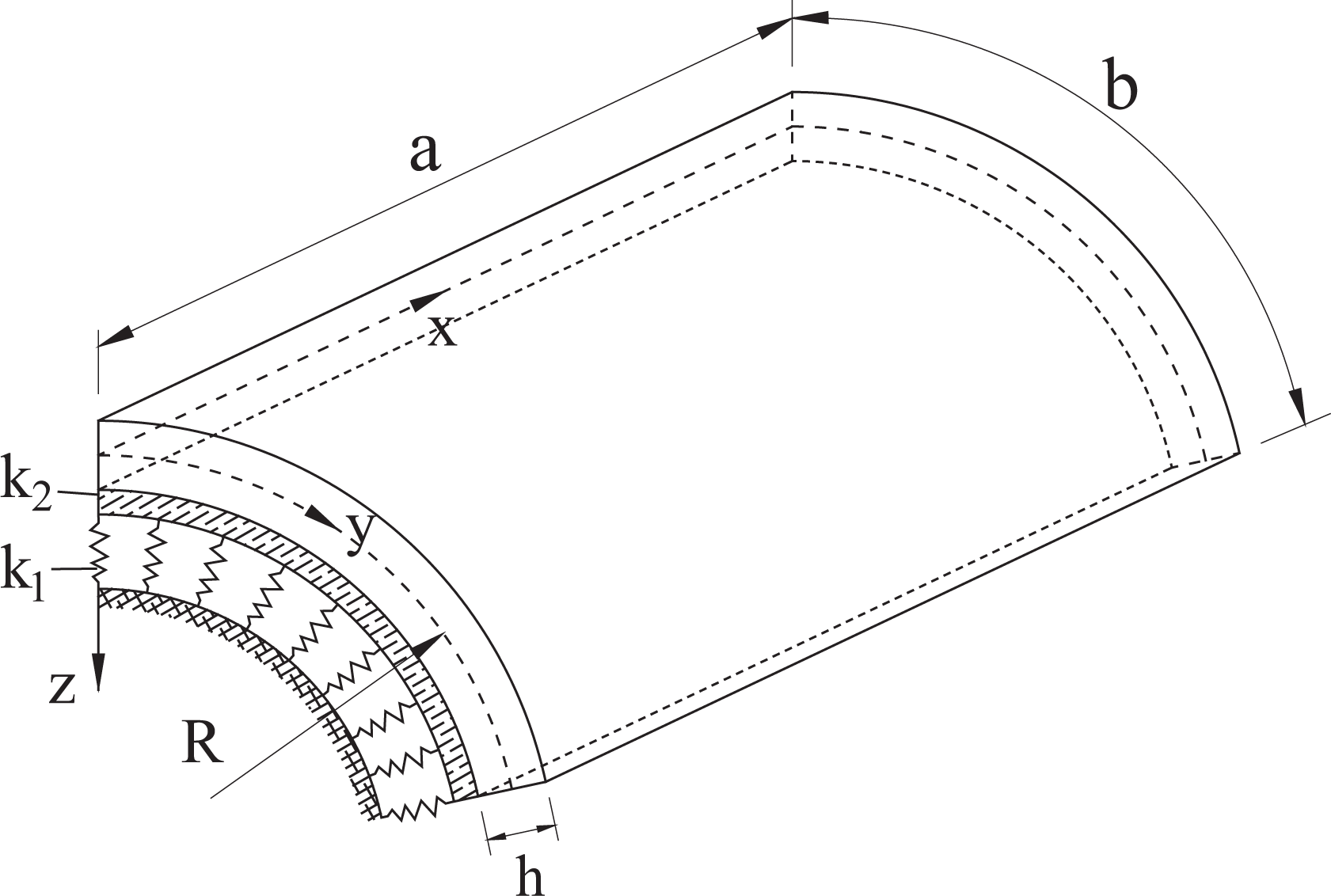
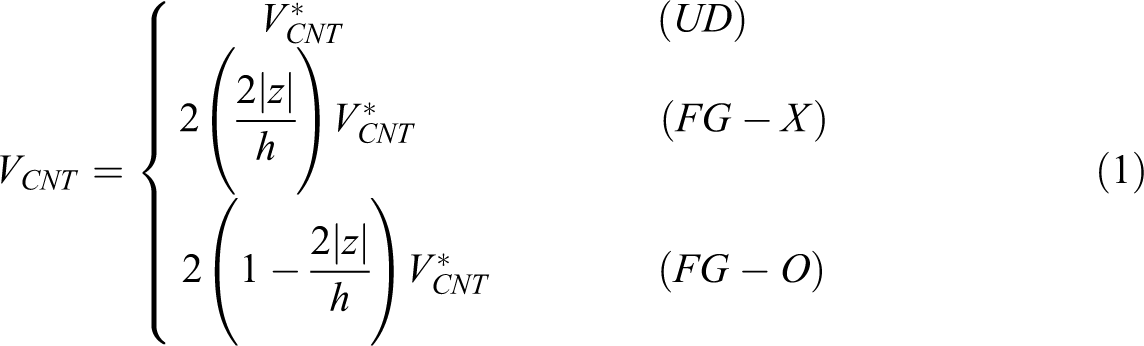
Structural model considered in this study is a cylindrical panel of length a, arc b, curvature radius R and uniform thickness h, as shown in Figure 1. The panel is rested on a two-parameter elastic foundation and defined in a coordinate system origin of which is located on the middle surface at one corner, x and y are axial and circumferential coordinates, respectively, and z is in the direction of inward normal to the middle surface (). The panel is made of carbon nanotube reinforced composite (CNTRC) in which CNTs are aligned according to axial direction x and reinforced into isotropic matrix through uniform distribution (UD) or functionally graded (FG) distributions named FG-X and FG-O. The volume fraction of CNTs, denoted by , corresponding to these mid-surface symmetric distribution patterns is defined as16,25
Configuration and coordinate system of a cylindrical panel resting on an elastic foundation.
where is known as the total volume fraction of CNTs.
In this study, the effective elastic moduli and effective shear modulus of CNTRC are determined using an extended rule of mixture as16
in which are CNT efficiency parameters accounting for the size effects of reinforcements, , , and are elastic moduli and shear modulus of CNTs, respectively, whereas Em,Gm and denote elastic modulus, shear modulus and volume fraction of matrix, respectively.
Owing to weak dependence on temperature and position, effective Poisson’s ratio is assumed to be constant and determined according to a conventional rule of mixture as16
where and are Poisson’s ratios of CNTs and matrix, respectively.
In this work, effective thermal expansion coefficients and in the longitudinal and transverse directions, respectively, are estimated according to Schapery model as25,36
in which and are the thermal expansion coefficients of CNTs and matrix, respectively.
Furthermore, the elastic foundation is modeled according to Pasternak type and interactive pressure from foundation is expressed as52
where k1 and k2 are the stiffness parameters of Winkler elastic and Pasternak shear layers, respectively, and w is the transverse displacement of the middle surface (i.e. deflection) of the cylindrical panel. Herein, subscript comma indicates the partial derivative with respect to the followed variable, e.g. .
Governing equations
In the present study, the CNTRC cylindrical panel is assumed to be thin and geometrically imperfect. The classical shell theory (CST) is used to derive the basic equations governing the nonlinear response of CNTRC cylindrical panels under nonuniform temperature. According to the CST, strain components at a distance z from the mid-surface are expressed as8
where are strains of a corresponding point on the mid-surface () and are changes of curvature the expressions of which are the following54
where are the in-plane displacements of the middle plane in the directions, respectively, and geometric nonlinear terms in von Kámán-Donnell sense are retained.
Stress components are computed by means of constitutive relations33
where
and is temperature rise from room temperature K at which the panel is assumed to be free from thermal stresses. In this study, temperature is distributed according to a sinusoidal function of in-plane variables as follows50,53
where Tu is initial uniform temperature rise, is temperature difference between central point and edges of the panel, and with are positive integers representing numbers of half waves in the directions, respectively. In the case of the distribution (10) is the same as that presented in the work of Haydl.50 Equation (10) describes a practical situation of structural application in which the panel is interacted with heating sources at central region of the panel. It is interesting to notice that temperature is maximum at the central point (,) of the panel and when and/or . This means that temperature distribution at all edges of the panel is uniform.
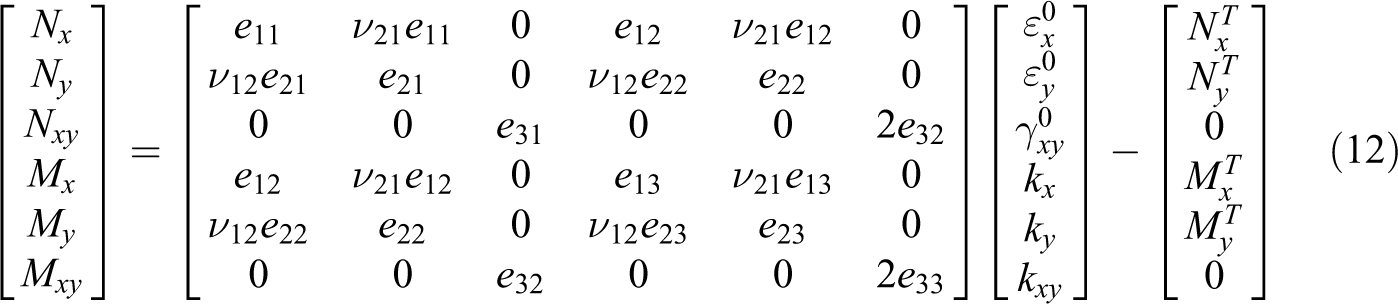
Force and moment resultants per a unit length are computed as follows54
By substituting equations (7), (8) into equation (11), these resultants are expressed in the form as
in which
and stiffness coefficients () and () are defined as in works.33,54 It is clear that, under sinusoidal nonuniform temperature, thermally induced force and moment resultants depend on in-plane coordinates .
Based on the CST, system of nonlinear equilibrium equations of the cylindrical panel includes three equations as written in works.11,54 By introducing a stress function defined as and taking into account the effects of initial geometrical imperfection and interactive pressure from elastic foundation, the nonlinear equilibrium equation of thin CNTRC cylindrical panels is written in the form as
where q is external lateral pressure uniformly distributed on the outer surface of the panel, is a known function representing initial geometrical imperfection and coefficients () can be found in the work.33
From kinematic relations (7), strain compatibility equation of a cylindrical panel has the form
By solving in terms of force resultants from the equation (12) and including initial imperfection, strain compatibility equation of a CNTRC cylindrical panel is rewritten in the form
where coefficients ( ) are the same as those given in the works.33,54 It is noticed that, unlike case of uniform temperature rise, the partial derivatives of thermally induced force and moment resultants in the equations (14) and (16) are not vanished.
In this work, all edges of the panel are assumed to be simply supported and tangentially restrained. The boundary conditions are expressed as follows54
where and are fictitious compressive force resultants at restrained edges and concerned with average end-shortening displacements of these edges as the following54
in which c1 and c2 are stiffness parameters of tangential constraints of edges and , respectively. The relations (18) cover all possible cases of in-plane boundary conditions. Indeed, values of and represent movable, immovable and partially movable edges , respectively. Similarly, cases of movable, immovable and partially movable edges are characterized by values of and , respectively.
Solution procedure
To satisfy simply supported edges conditions (17), the approximate analytical solutions are assumed as52
in which W and are the amplitude of the deflection and the size of imperfection, respectively, and are coefficients to be determined. By introducing the solutions (19) into the compatibility equation (16), these coefficients are determined as follows
It is deduced from equations (19) and (20) that prebuckling () force resultants induced by sinusoidal temperature distribution are predicted as
in which
It is found from equation (21) that prebuckling thermal force resultants are functions of in-plane coordinates when temperature is distributed in the panel plane according to sinusoidal functions. As a special case, and when . This implies that prebuckling thermal force resultants are constant in the case of uniform temperature rise, as expected. Furthermore, it is also found that at edges and at edges .
Subsequently, by substituting the solutions (19) into the equilibrium equation (14) and applying Galerkin method to the resulting equation, we obtain the following relation
where
in which
Next, fictitious compressive force resultants will be determined. From equations (7) and (12), the expressions of and can be derived. Afterwards, by substituting the solutions (19) into the expressions of and then placing the obtained expressions into the equation (18), we receive
where and coefficients and () are displayed in equation (A1) in Appendix A.
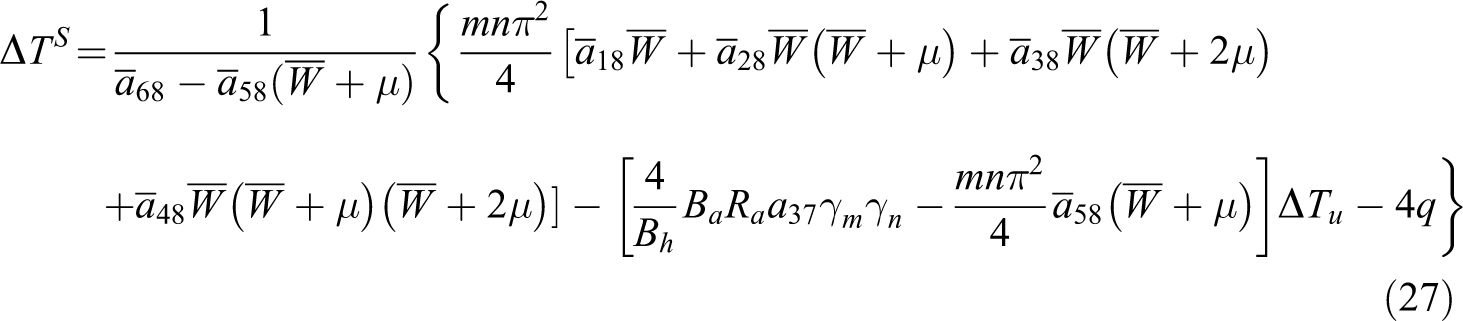
Now, introducing the equation (26) into the equation (23) yields the following nonlinear relation
in which coefficients () can be found in equation (A3) in Appendix A.
The closed-form relation (27) is used to analyze the nonlinear stability of CNTRC cylindrical panels under sinusoidal in-plane temperature distribution taking the effects of elastic foundations, preexisting uniform temperature rise and lateral pressure, and elasticity of tangential edge constraints into consideration. It is predicted from equation (27) that, unlike the response of thermally loaded plates, bifurcation-type buckling response may not occur for thermally loaded cylindrical panels. In addition, by specialization equation (27) for case of , the nonlinear load-deflection relation of CNTRC cylindrical panels under uniform temperature rise can be obtained readily. Such a relation, however, is omitted here for the sake of brevity.
Results and discussion
This section presents numerical results for the nonlinear stability analysis of thin CNTRC cylindrical panels made of Poly (methyl methacrylate), referred to as PMMA, as matrix material, and (10,10) single-walled carbon nanotubes (SWCNTs) as reinforcements. There are no reports of temperature-dependent properties of PMMA and SWCNT in case of nonuniform temperature in the literature. Furthermore, the cylindrical panel is assumed to be thin. Accordingly, in the present work, it is assumed that the properties of constitutive materials are temperature independent. Specifically, temperature independent properties computed at room temperature K are GPa, , for PMMA, and TPa, TPa, TPa, ,, for (10,10) SWCNTs.29 In numerical results, CNT efficiency parameters are chosen as those given the work of Shen and Zhang,29 specifically, for the case of , for the case of , and for the case of .
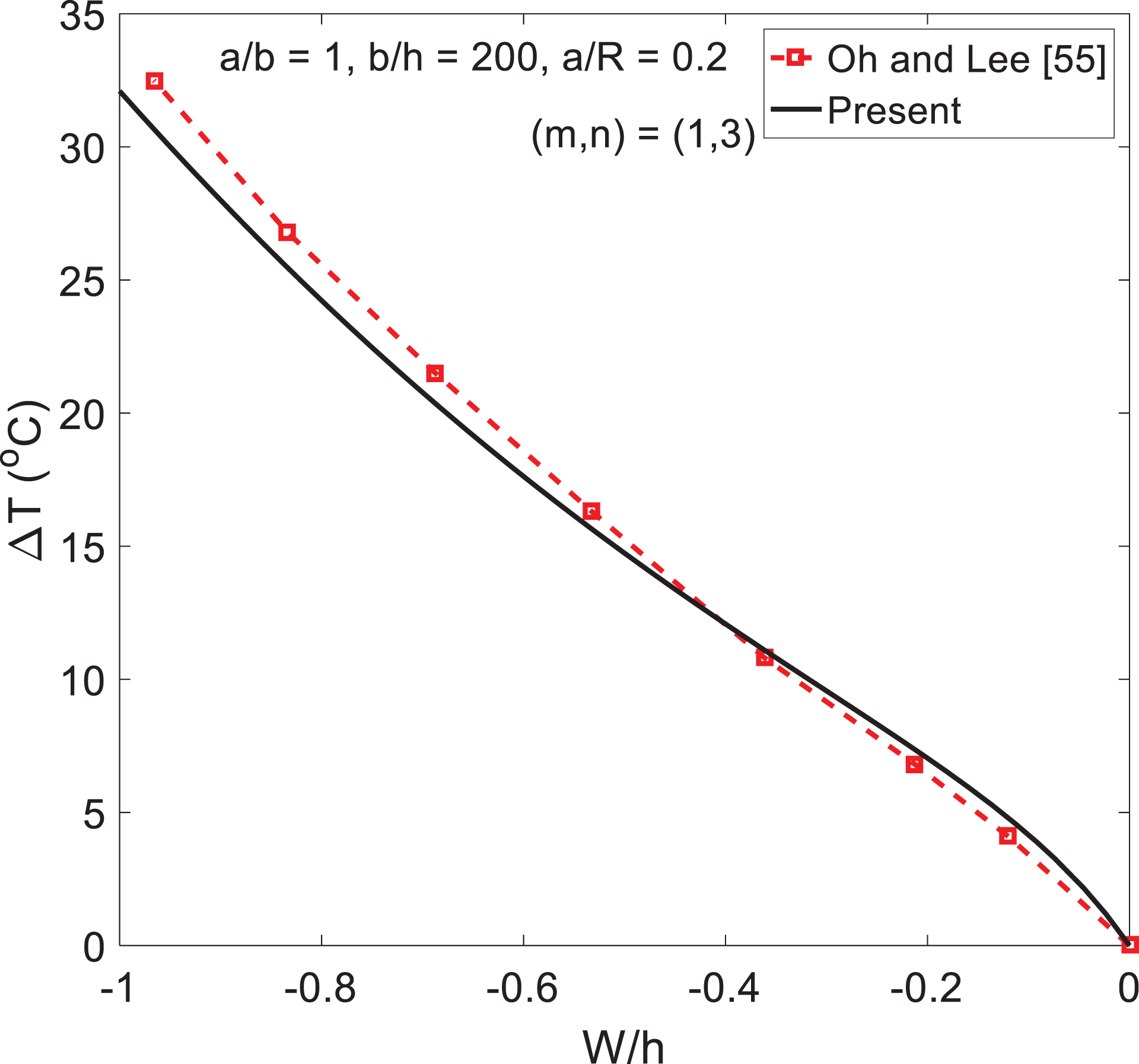
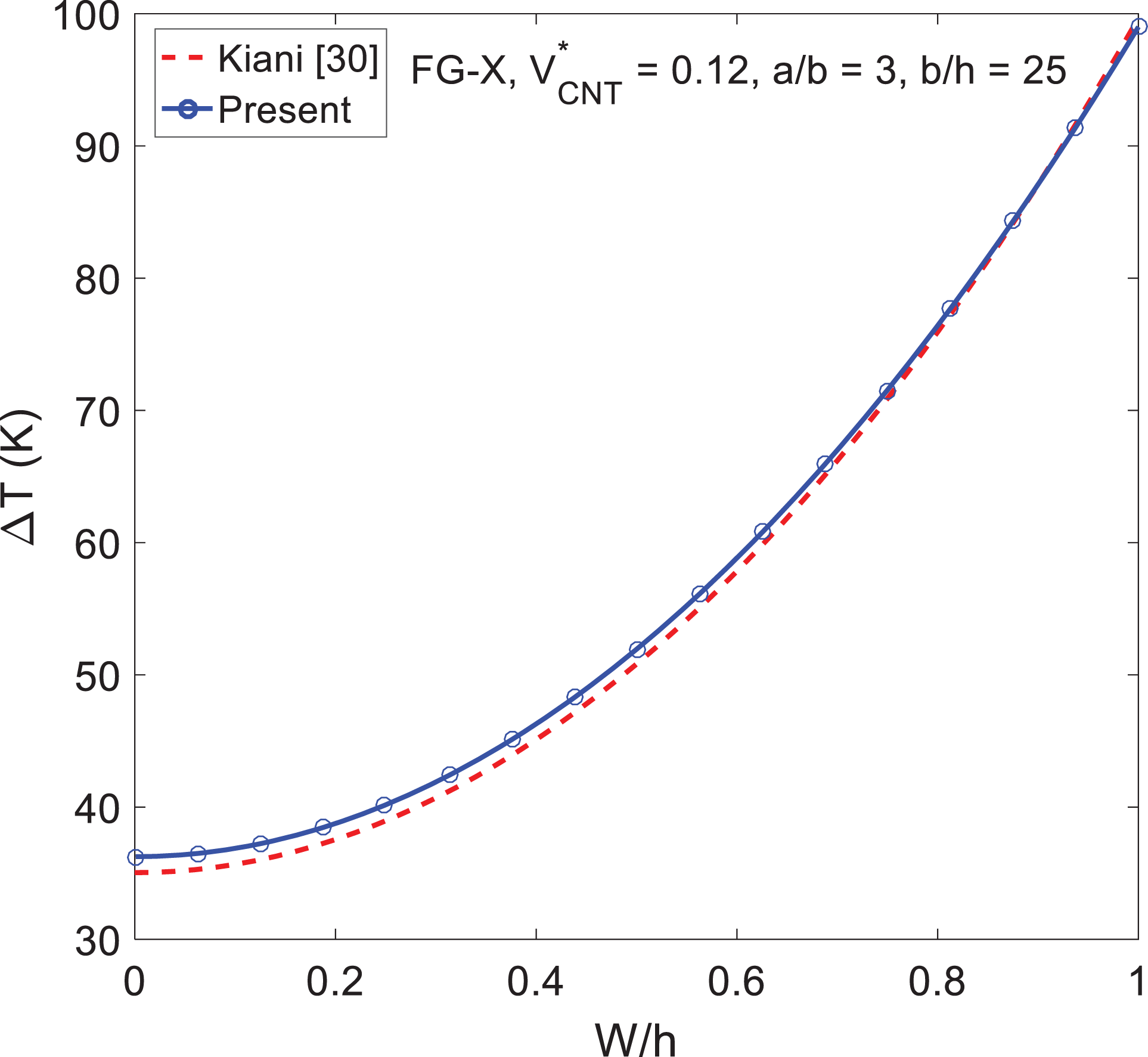
As above mentioned, there is no investigation on the nonlinear stability of CNTRC cylindrical panels under sinusoidal temperature distribution in the literature. Therefore, direct comparison is impossible. As part of verification, the nonlinear response of an orthotropic cylindrical panel with simply supported and immovable edges under uniform temperature rise is considered. In this comparison, the effects of elastic foundation and preexisting lateral pressure are ignored and temperature independent properties and geometry ratios of the orthotropic cylindrical panel are GPa, GPa, GPa, , , , , , . Temperature-deflection path of the orthotropic cylindrical panel is traced using the present formulation and is shown in Figure 2 in comparison with results of Oh and Lee55 employing layerwise theory and finite element method. As can be seen, a good agreement is achieved in this comparison. In addition, thermal postbuckling problem of a simply supported FG-CNTRC rectangular plate with immovable edges under uniform temperature rise is analyzed. Result of this problem obtained by specializing the present work for case of , , , , is compared in Figure 3 with result reported in the work of Kiani30 making use of Chebyshev-Ritz method. It is evident from the Figure 3 that a very good agreement is achieved in this comparison.
Comparison of load-deflection curve of an orthotropic cylindrical panel with immovable edges under uniform temperature rise.
Comparison of postbuckling curves of an FG-CNTRC plate with immovable edges under uniform temperature rise.
In what follows, the nonlinear stability of CNTRC cylindrical panels with square planform () under sinusoidal temperature will be graphically analyzed in form of temperature-deflection paths. In numerical results, the degree of tangential edge constraints will be measured using non-dimensional tangential stiffness parameters defined as follows
According to this definition, the values of (i.e. ), (i.e. ) and (i.e. ) represent movable, immovable and partially movable edges , respectively. Similarly, the cases of movable, immovable and partially movable edges are characterized by values of , and , respectively. It was indicated in previous works11,36,38,52 that the response of panel is the most significant with mode shape . Therefore, parametric studies in this section are carried out with . In addition, the cylindrical panel is assumed to be geometrically perfect () and without initial uniform temperature rise (), elastic foundation and preexisting lateral pressure (,), unless otherwise specified.
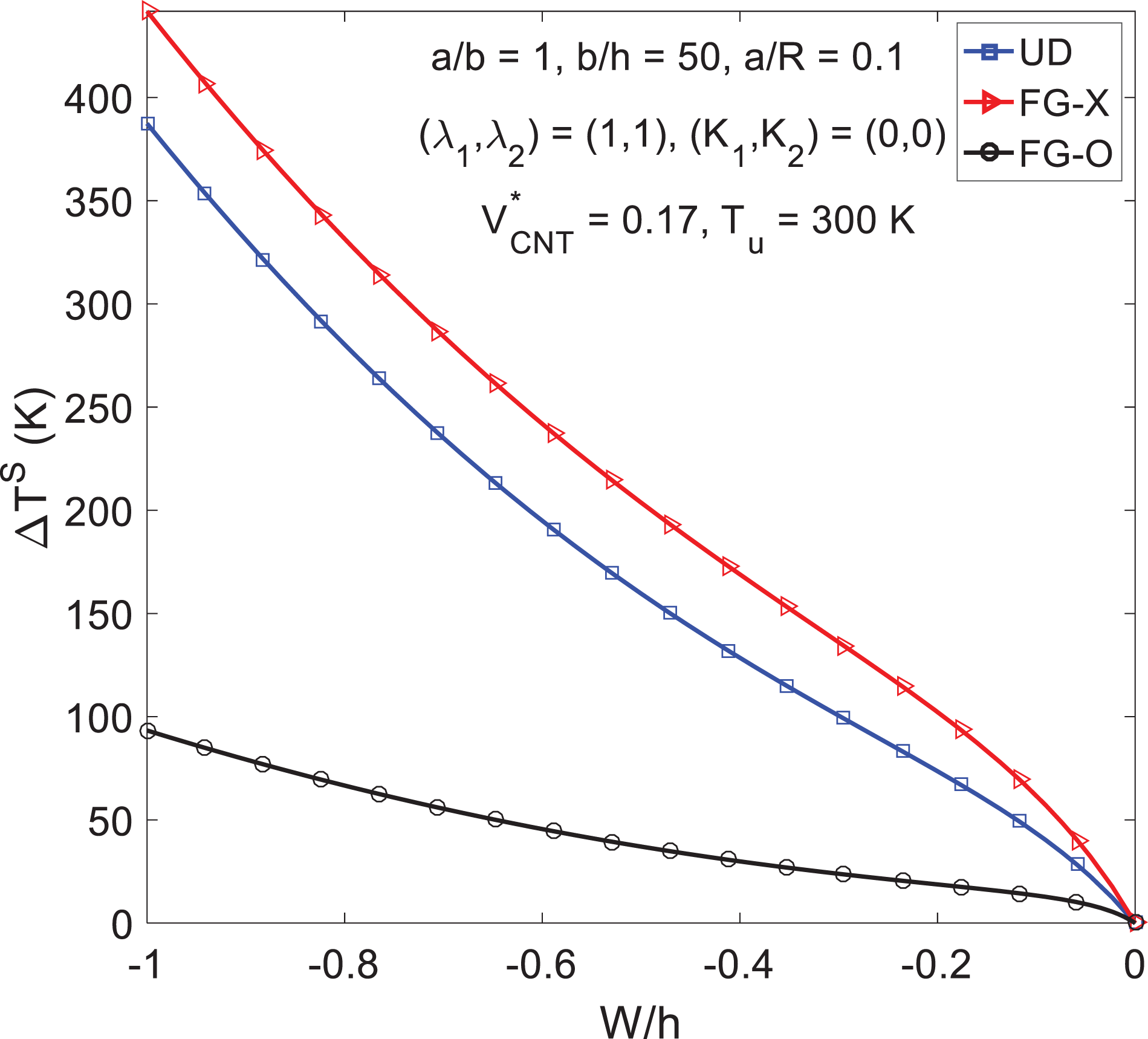
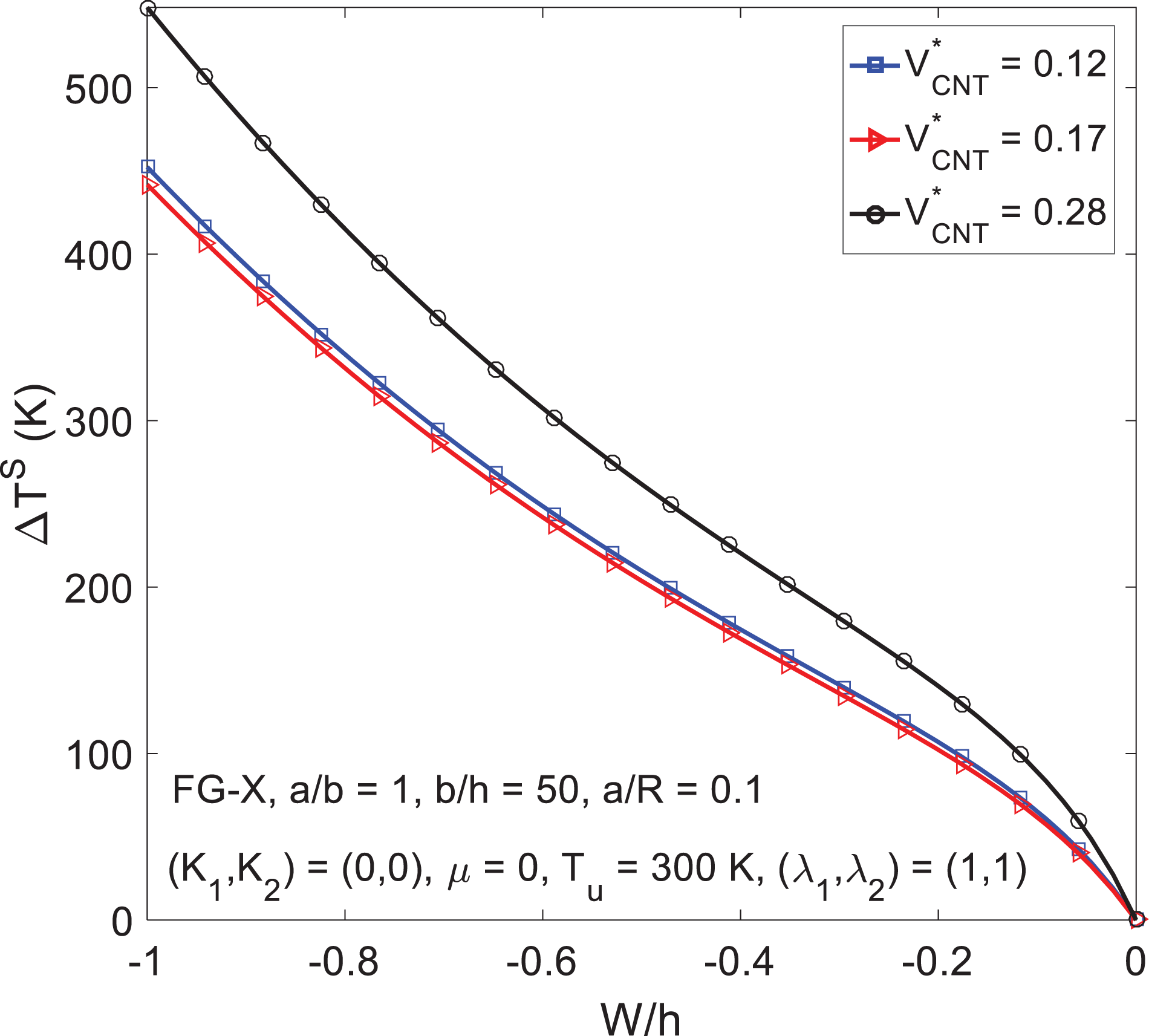
The effects of CNT distribution on the response of CNTRC cylindrical panels with immovable edges under sinusoidal temperature distribution are analyzed in Figure 4. It is evident that the CNTRC cylindrical panel is deflected towards convex side of the panel at the onset of undergoing nonuniform in-plane temperature. Among three types of CNT distribution, FG-X and FG-O panels have the strongest and weakest capacities of temperature withstanding. Unlike case of uniform temperature rise, temperature-deflection path of FG-X panel is much higher than that of UD and FG-O panels. Thus, the remaining analyses are carried out for CNTRC cylindrical panels with FG-X type of CNT distribution. Subsequently, the effects of CNT volume fraction on the load-deflection path of CNTRC cylindrical panels with immovable edges under sinusoidal temperature are assessed in Figure 5. It is worth to notice that temperature-deflection paths are the lowest and highest for values of and , respectively. This result is contrary to that reported in previous studies of thermal postbuckling of CNTRC plates under uniform temperature rise29,34 in which thermal load capacity corresponding to an intermediate value of CNT volume fraction (i.e. ) is the strongest. Due to nonuniform nature of temperature distribution within the panel, a high percentage of CNT volume can be appropriate for a better loading capacity. An analysis of the effects of geometrical imperfection on the nonlinear stability of CNTRC cylindrical panels under sinusoidal temperature is shown in Figure 6 in which positive and negative values of characterize the inward and outward perturbations of panel surfaces, respectively. As can be observed, temperature-deflection paths are enhanced and dropped when the value of is increased from to 0.2 in initial and deep regions of deflection, respectively. When the deflection is enough large, outward initial deviations of the panel surfaces () have beneficial influences on load carrying capability of the panel. It is also recognized from the Figure 6 that CNTRC cylindrical panel under sinusoidal temperature approaches a quasi-bifurcation response when approaches a definite positive value.
Effects of CNT distribution patterns on the load-deflection path of CNTRC cylindrical panels with immovable edges under sinusoidal temperature.
Effects of CNT volume fraction on the load-deflection path of CNTRC cylindrical panels with immovable edges under sinusoidal temperature.
Effects of initial imperfection on the load-deflection path of CNTRC cylindrical panels with immovable edges under sinusoidal temperature.
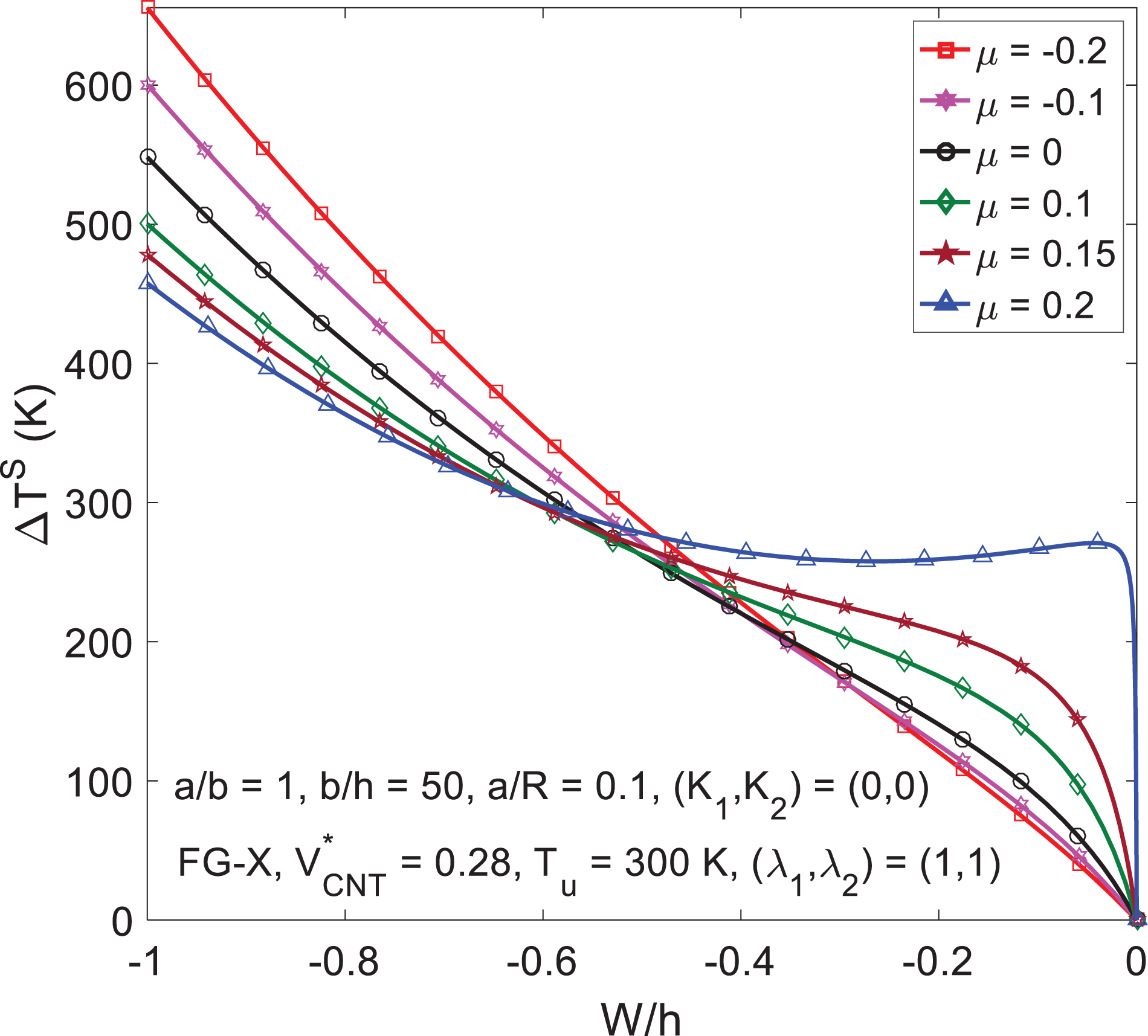
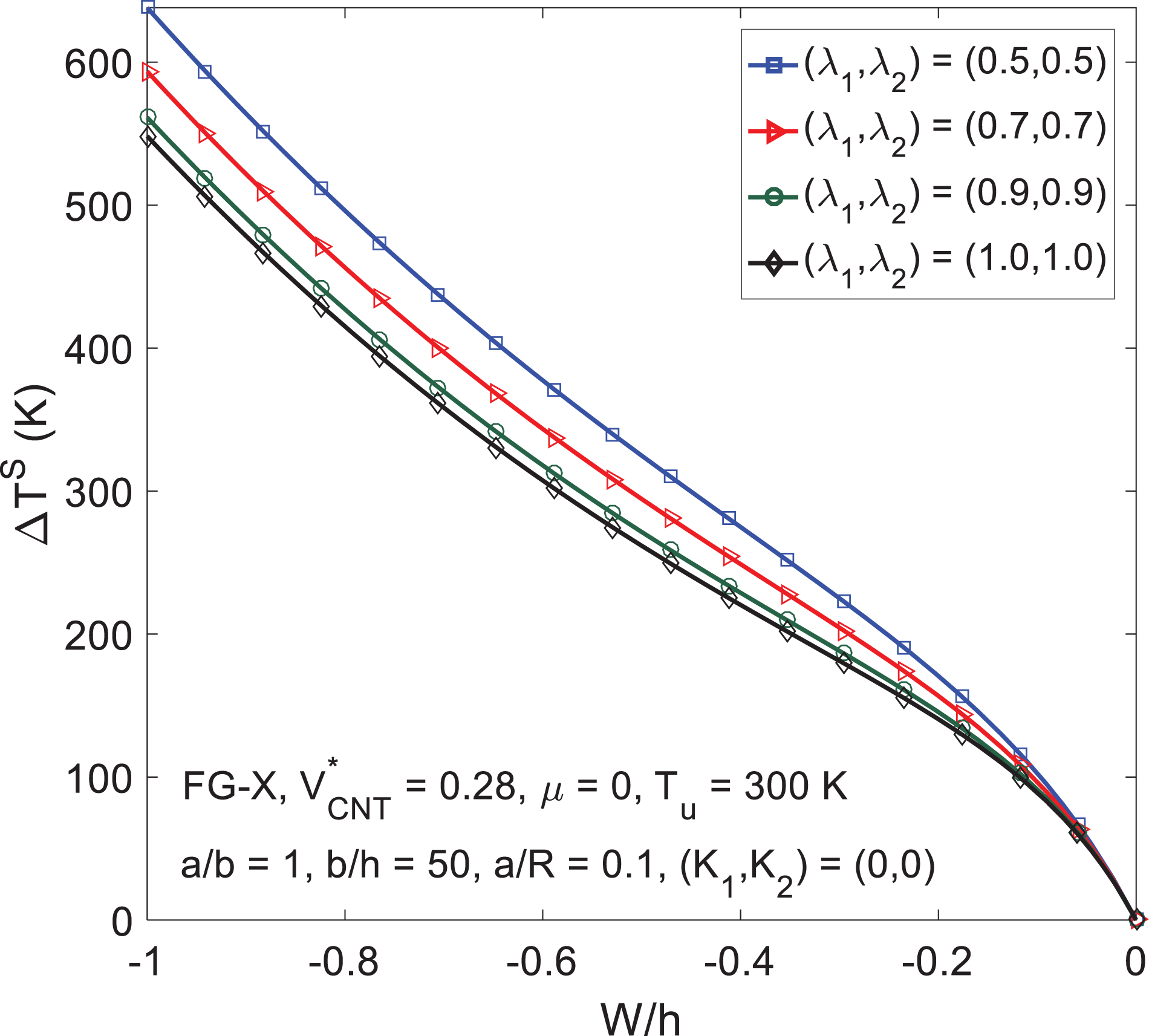
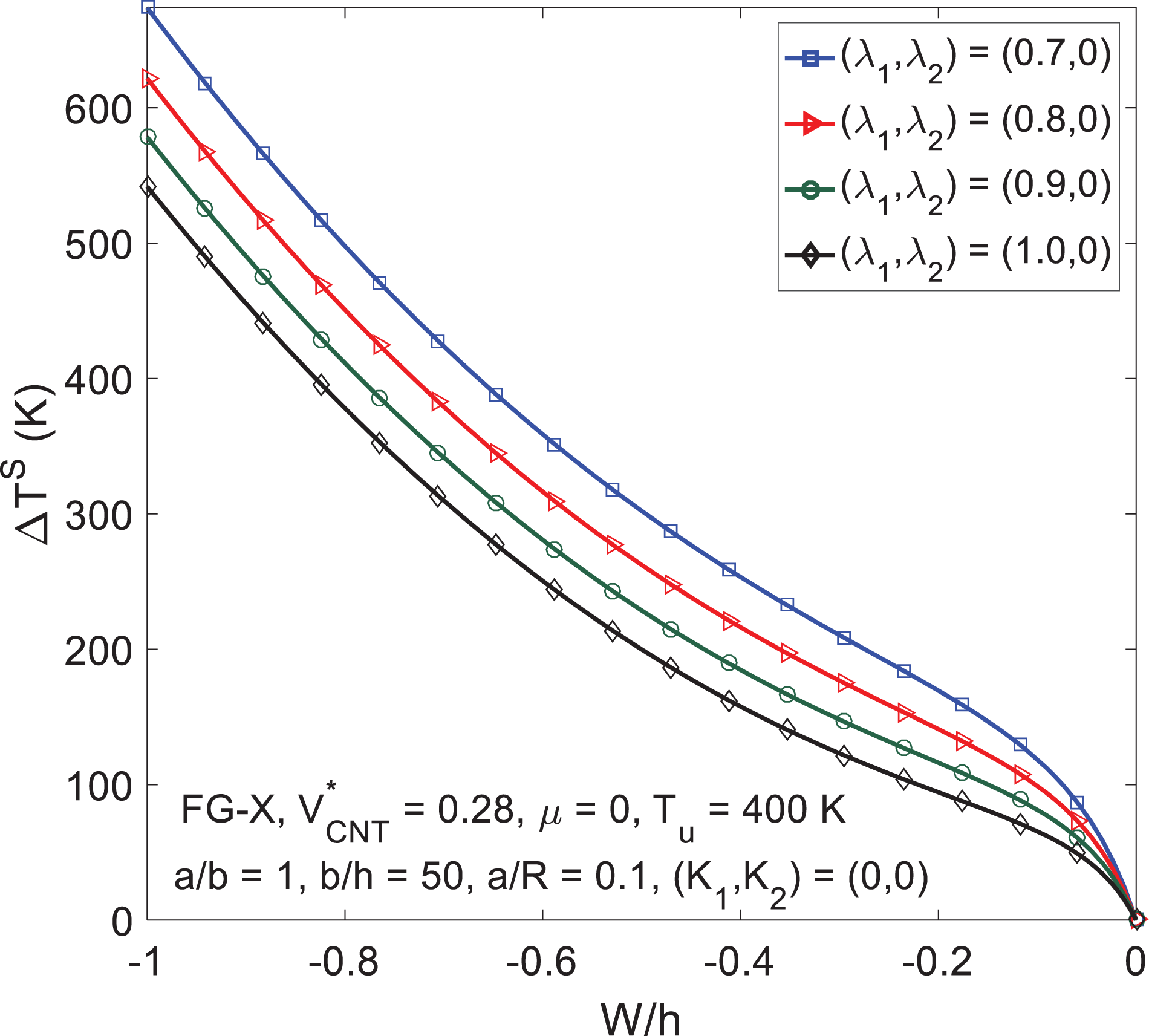
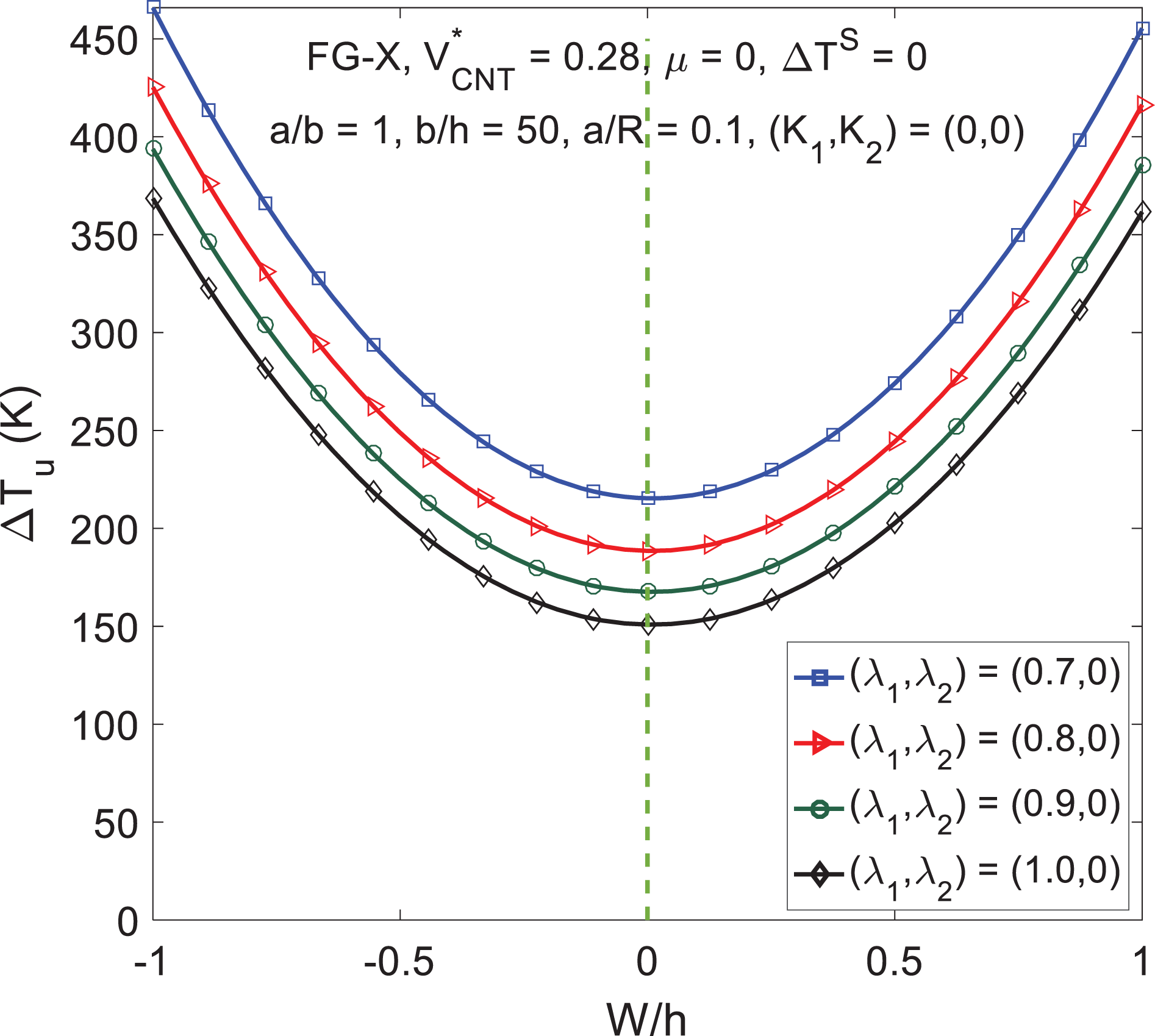
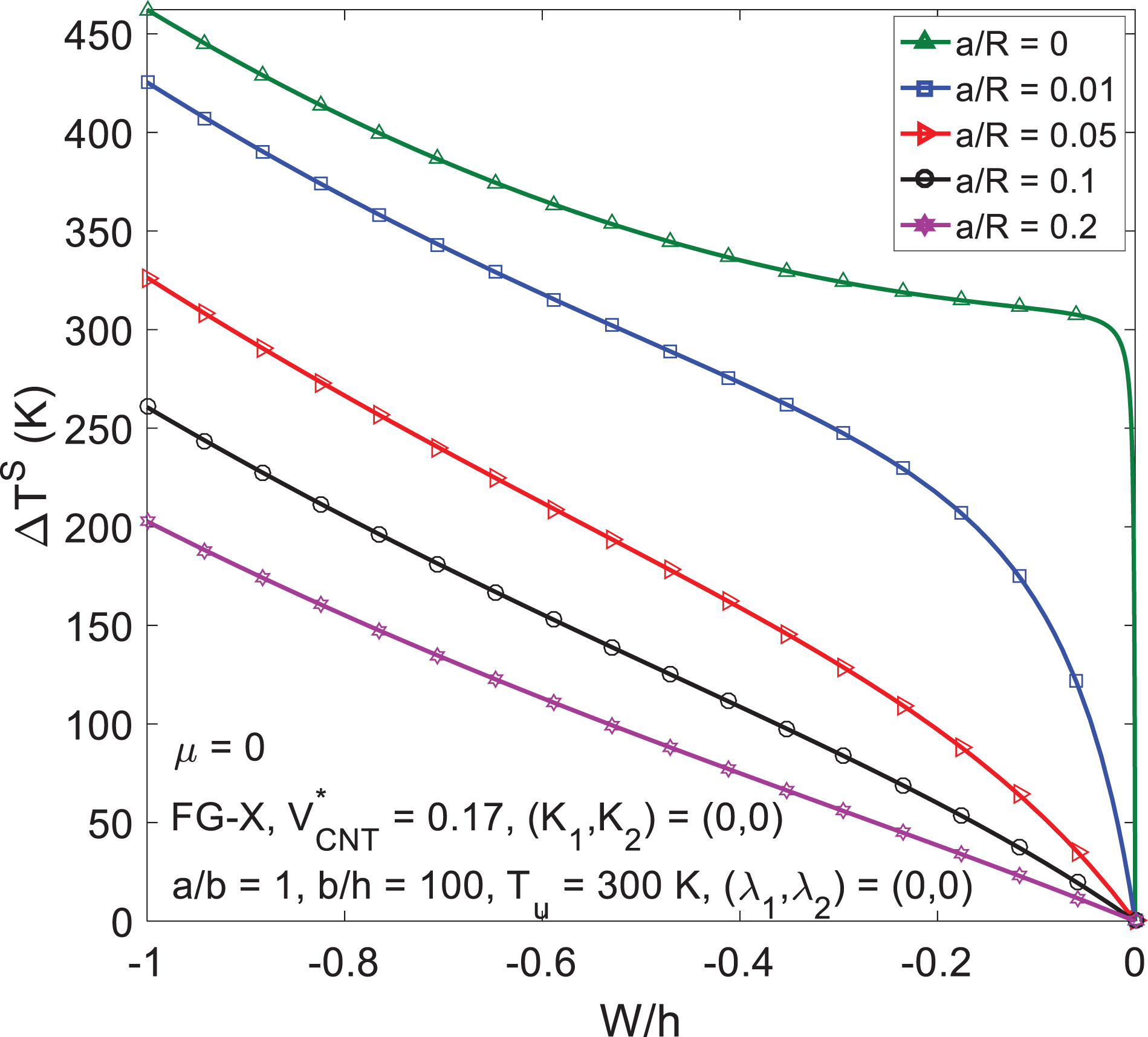
Subsequent parametric studies are shown in Figures 7 and 8 evaluating the effects of tangential constraints of boundary edges on the nonlinear stability of CNTRC cylindrical panels under sinusoidal temperature. The Figure 7, plotted with different four of non-zero value couples (), indicates that temperature-deflection equilibrium paths are significantly dropped when the degrees of tangential edge constraints are increased. Unlike case of CNTRC cylindrical panels under uniform temperature rise38 in which cylindrical panels with two movable straight edges () exhibit a bifurcation-type buckling response, CNTRC cylindrical panels under sinusoidal in-plane temperature still be bent (not buckled) towards convex side even two straight edges () are freely movable (), as demonstrated in the Figure 8. To highlight the behavior trend of CNTRC cylindrical panels under two types of thermal loading, Figure 9 analyzes the effects of tangential constraints of two curved edges on the nonlinear stability of CNTRC cylindrical panels with two movable straight edges () under uniform temperature rise. Unlike behavior trend shown in the Figure 8, CNTRC cylindrical panels with two movable straight edges experience bifurcation-type buckling behavior and asymmetric postbuckling response under uniform temperature rise. Furthermore, buckling temperature and postbuckling strength of the cylindrical panel are pronouncedly reduced when the curved edges are more severely restrained. As a subsequent illustration, Figure 10 considers the effects of curvature ratio on the load-deflection response of CNTRC cylindrical panels with immovable edges () resting on a Winkler foundation (,), exposed to preexisting uniform temperature rise ( K) and subjected to sinusoidal temperature. It is evident that initial uniform temperature rise causes an outward deflection prior to applying sinusoidal temperature and more curved panels (i.e. higher ) have deeper outward deflections. It seems that thermal compressive stresses developed at restrained edges are larger for higher values of ratio. These stresses induce bending moments at the onset of increasing temperature and make the cylindrical panel deflected towards the convex side. Next analysis is displayed in Figure 11 sketching the temperature-deflection response of thin CNTRC cylindrical panels () with all movable edges () under sinusoidal in-plane temperature. It is worth to notice that both flat plate () and cylindrical panel are deflected as soon as sinusoidal temperature is applied even though all edges are movable. Temperature withstanding capacity of the flat plate is better than that of the cylindrical panel and load-deflection equilibrium paths are more slow and monotonous for higher values of ratio. This response tendency is contrary to that of CNTRC plates and cylindrical panels under uniform temperature rise33,38 in which the deflection does not occur when all edges of the structure are movable. This analysis finds that there is no membrane stress state in the structures under sinusoidal in-plane temperature even initial configuration of the structure is perfectly flat. Physical meaning of this phenomenon is that nonuniform temperature causes nonuniform stresses within the panel and these thermal stresses induce bending moments at the onset of loading.
Effects of tangential constraints of edges on the load-deflection path of CNTRC cylindrical panels under sinusoidal temperature.
Effects of tangential constraints of two curved edges on the stability of CNTRC cylindrical panels with movable straight edges under sinusoidal temperature.
Effects of tangential constraints of two curved edges on the load-deflection paths of CNTRC cylindrical panels with movable straight edges under uniform temperature rise.
Effects of curvature ratio on the load-deflection path of CNTRC cylindrical panels resting on Winkler foundation under sinusoidal nonuniform temperature.
Effects of curvature ratio on the load-deflection path of CNTRC cylindrical panels with all movable edges under sinusoidal nonuniform temperature.
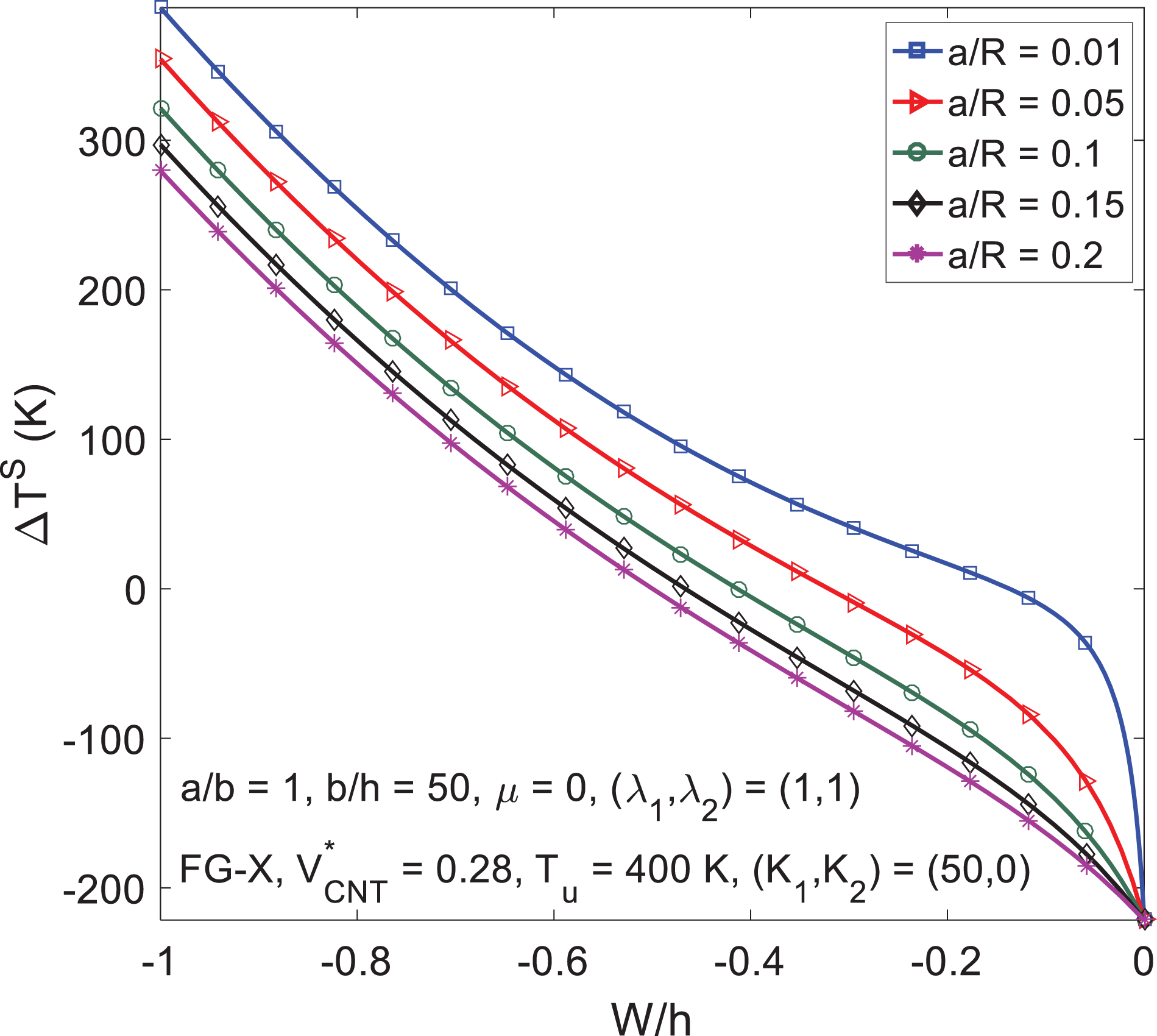
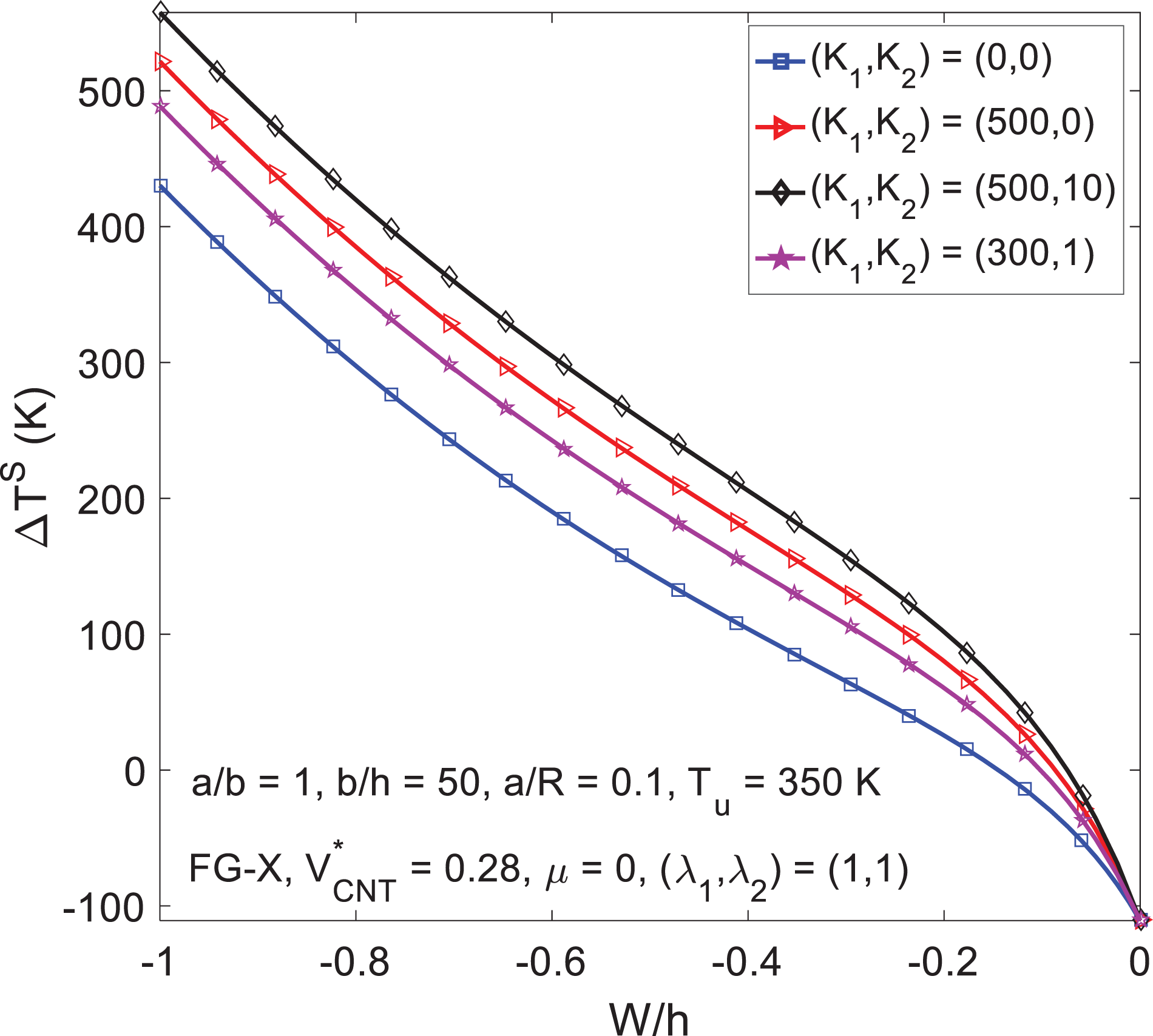
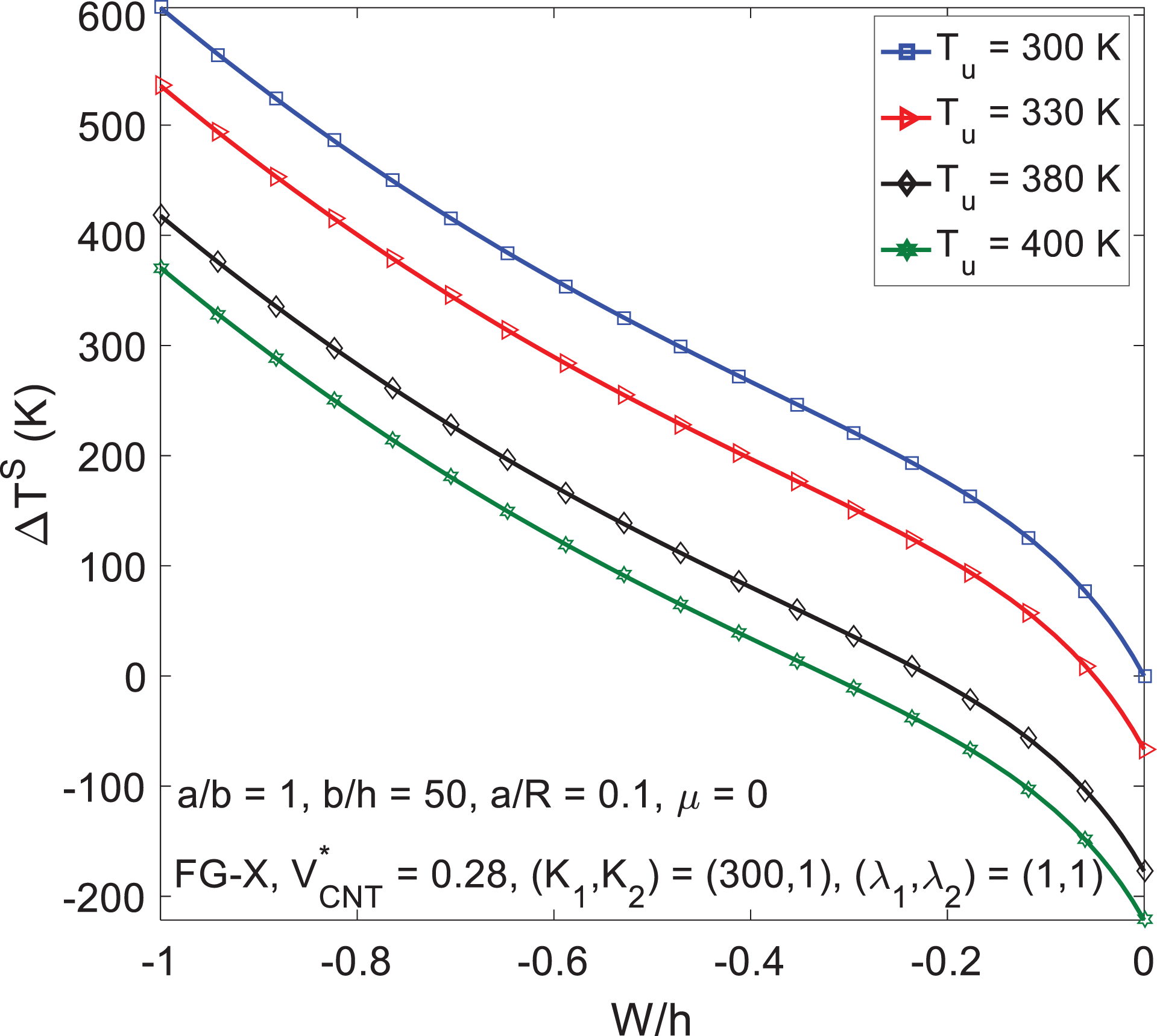
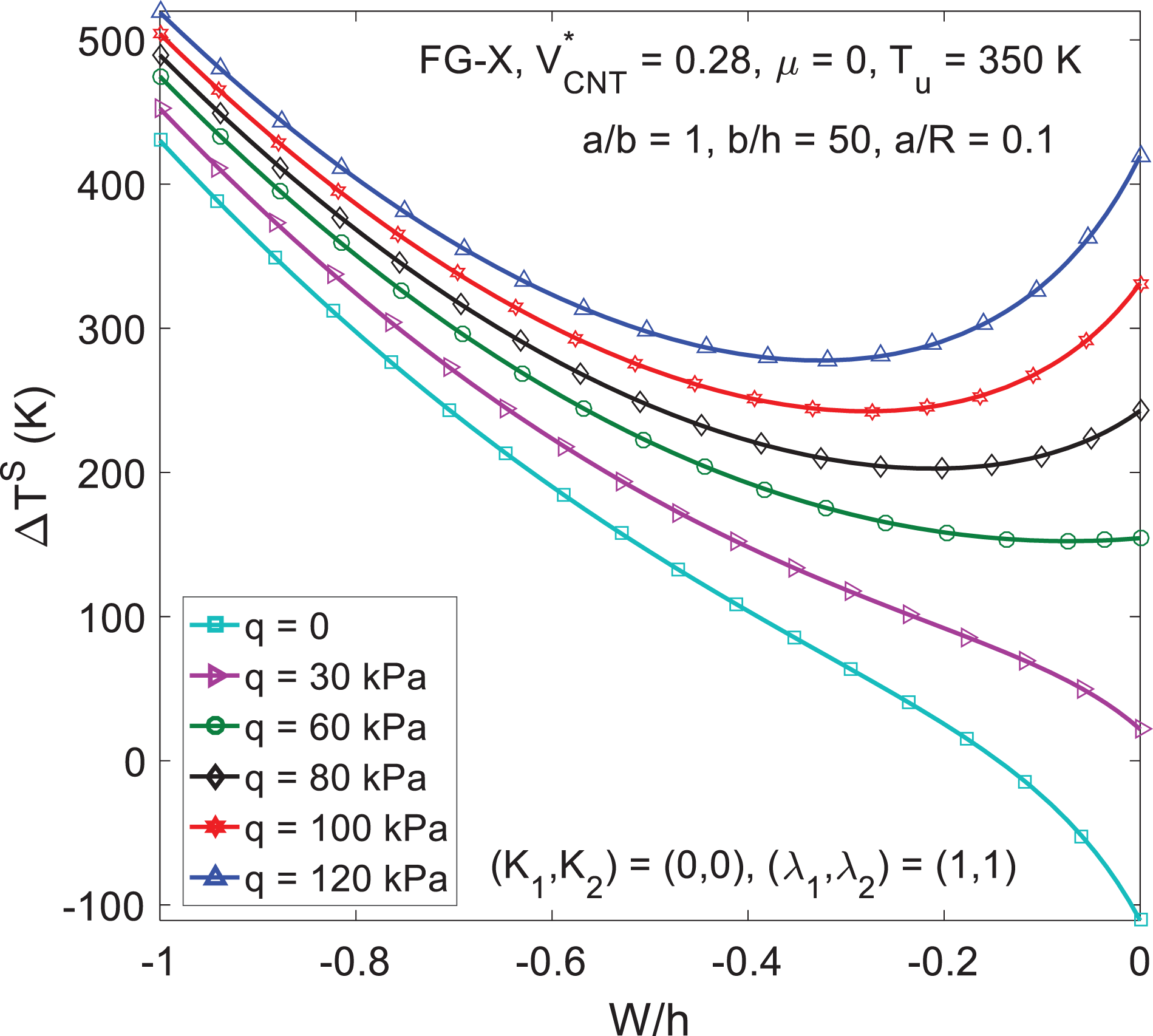
Next, the effects of elastic foundations on the nonlinear response of CNTRC cylindrical panels initially exposed to a thermal environment ( K) and then subjected to sinusoidal temperature are depicted in Figure 12. Obviously, temperature-deflection paths are higher when non-dimensional stiffness parameters are increased. This demonstrates that with the support of elastic foundations the outward deflection of thermally loaded cylindrical panel is clearly restricted. Subsequent example is illustrated in Figure 13 analyzing the effects of initial uniform temperature rise Tu on the nonlinear response of CNTRC cylindrical panels resting on a Pasternak foundation under sinusoidal temperature. Evidently, initial uniform temperature rise, induced by pre-existing elevated temperature environment, has remarkably harmful influences on the load carrying capability of CNTRC cylindrical panel under sinusoidal temperature distribution. Finally, the effects of pre-existing external lateral pressure q on the nonlinear stability of CNTRC cylindrical panels under sinusoidal temperature are analyzed in Figures 14 and 15. The Figure 14, plotted with different six values of q, indicates that preexisting external pressure beneficially influences on the stability of thermally loaded cylindrical panels. Specifically, the cylindrical panel exhibits a quasi-bifurcation response by virtue of preexisting external pressure and equilibrium path is higher for larger values of q. Actually, the sinusoidal temperature and external pressure cause opposite deflection trends, namely, outward and inward deflections, respectively. Consequently, the resulting outward deflection of the panel is restricted due to the presence of external pressure. The combined effects of initial imperfection and external pressure on the nonlinear response of CNTRC cylindrical panels under sinusoidal temperature are sketched in the Figure 15. As can be observed, owing to the combined effect of initial imperfection and external pressure, the cylindrical panel may experience a quasi-bifurcation buckling behavior and snapping-type postbuckling response. This phenomenon suggests that inward slight perturbation of panel surfaces and small values of external pressure can have beneficial influences on the loading capacity of CNTRC cylindrical panels under sinusoidal in-plane temperature. Regarding physical significance, bifurcation point corresponds to temperature value for which the panel surfaces return to initial configuration as before applying external pressure.
Effects of elastic foundations on the load-deflection paths of CNTRC cylindrical panels with immovable edges under sinusoidal temperature.
Effects of pre-existing uniform temperature rise on the load-deflection path of CNTRC cylindrical panels under sinusoidal temperature.
Effects of preexisting external pressure on the load-deflection paths of CNTRC cylindrical panels under sinusoidal temperature.
Effects of imperfection and preexisting external pressure on the load-deflection paths of CNTRC cylindrical panels under sinusoidal temperature.
Concluding remarks
An analytical investigation on thermally induced instability of thin CNTRC cylindrical panels under sinusoidal in-plane temperature distribution has been presented. Because CNTRC cylindrical panels may be partially heated, thermal instability of these structures under nonuniform temperature is a real possibility. From above analyses, the following remarks are reached
There is no membrane stress state in the panels under sinusoidal temperature and the panels are deflected at the onset of applying temperature for arbitrary degrees of tangential edge constraints, even though for case of all movable edges and initial geometry of the panel is flat.
In contrary to case of uniform temperature rise, an intermediate value of CNT volume fraction may lead to the weakest load capacity of CNTRC cylindrical panels under sinusoidal in-plane temperature.
Thermal stability of cylindrical panel under sinusoidal temperature is significantly lowered by virtue of increases in curvature and initial uniform temperature rise. In contrast, elastic foundation and preexisting external pressure have beneficial influences on the nonlinear stability of cylindrical panels under sinusoidal temperature.
This study is hoped to provide significant predictions for a better understanding of thermally induced instability of composite structure in general and CNTRC cylindrical panels in particular under sinusoidal in-plane temperature distribution. Closed-form results of this study have considerable significance for preliminary predictions and verification of numerical methods.
Footnotes
Funding
The author(s) received no financial support for the research, authorship, and/or publication of this article.
TungHVDucND. Nonlinear analysis of stability for functionally graded plates under mechanical and thermal loads. Compos Struct2010; 92: 1184–1191.
3.
DucNDTungHV. Mechanical and thermal postbuckling of higher order shear deformable functionally graded plates on elastic foundations. Compos Struct2011; 93: 2874–2881.
4.
TungHV. Thermal and thermomechanical postbuckling of FGM sandwich plates resting on elastic foundations with tangential edge constraints and temperature dependent properties. Compos Struct2015; 131: 1028–1039.
5.
ShenHS. Thermal postbuckling behavior of functionally graded cylindrical shells with temperature-dependent properties. Int J Solids Struct2004; 41(7): 1961–1974.
6.
KandasamyRDimitriRTornabeneF. Numerical study on the free vibration and thermal buckling behavior of moderately thick functionally graded structures in thermal environments. Compos Struct2016; 157: 207–221.
7.
TrabelsiSFrikhaAZghalA, et al.A modified FSDT-based four nodes finite shell element for thermal buckling analysis of functionally graded plates and cylindrical shells. Eng Struct2019; 178: 444–459.
8.
TungHV. Postbuckling of functionally graded cylindrical shells with tangential edge restraints and temperature-dependent properties. Acta Mech2014; 225: 1795–1808.
9.
HieuPTTungHV. Nonlinear buckling behavior of functionally graded material sandwich cylindrical shells with tangentially restrained edges subjected to external pressure and thermal loadings. J Sandwich Struct Mater2020. In Press. DOI: 10.1177/1099636220908855.
10.
ShenHSWangH. Thermal postbuckling of FGM cylindrical panels resting on elastic foundations. Aerosp Sci Technol2014; 38: 9–19.
11.
TungHV. Postbuckling behavior of functionally graded cylindrical panels with tangential edge constraints and resting on elastic foundations. Compos Struct2013; 100: 532–541.
12.
TungHVDucND. Nonlinear response of shear deformable FGM curved panels resting on elastic foundations and subjected to mechanical and thermal loading conditions. Appl Math Modell2014; 38: 2848–2866.
13.
ThostensonETLiCChouTW. Nanocomposites in context. Compos Sci Technol2005; 65: 491–516.
14.
ColemanJNKhanUBlauWJ, et al.Small but strong: a review of the mechanical properties of carbon nanotube-polymer composites. Carbon2006; 44: 1624–1652.
15.
FarshadHKeivanTMehrdadS, et al.On the mechanics of nanocomposites reinforced by wavy/defected/aggregated nanotubes. Steel Compos Struct2021; 38(5): 533–545.
16.
ShenHS. Nonlinear bending of functionally graded carbon nanotube-reinforced composite plates in thermal environments. Compos Struct2009; 91: 9–19.
17.
ZerroukiRKarasAZidourM, et al.Effect of nonlinear FG-CNT distribution on mechanical properties of functionally graded nano-composite beam. Struct Eng Mech2021; 78(2): 117–124.
18.
BendeniaNZidourMBousahlaAA, et al.Deflections, stresses and free vibration studies of FG-CNT reinforced sandwich plates resting on Pasternak elastic foundation. Comput Concr2020; 26(3): 213–226.
19.
BouradaFBousahlaAATounsiA, et al.Stability and dynamic analyses of SW-CNT reinforced concrete beam resting on elastic-foundation. Comput Concr2020; 25(6): 485–495.
20.
BousahlaAABouradaFMahmoudSR, et al.Buckling and dynamic behavior of the simply supported CNT-RC beams using an integral-first shear deformation theory. Comput Concr2020; 25(2): 155–166.
21.
MedaniMBenahmedAZidourM, et al.Static and dynamic behavior of (FG-CNT) reinforced porous sandwich plate using energy principle. Steel Compos Struct2019; 32(5): 595–610.
22.
KianiYMirzaeiM. Rectangular and skew shear buckling of FG-CNT reinforced composite skew plates using Ritz method. Aerosp Sci Technol2018; 77(1): 388–398.
23.
KianiY. Buckling of FG-CNT reinforced composite plates subjected to parabolic loading. Acta Mech2017; 228(4): 1303–1319.
24.
KianiY. Shear buckling of FG-CNT reinforced composite plates using Chebyshev-Ritz method. Compos B Eng2016; 105: 176–187.
25.
MirzaeiMKianiY. Thermal buckling of temperature dependent FG-CNT reinforced composite plates. Meccanica2016; 51(9): 2185–2201.
FazzolariFA. Thermoelastic vibration and stability of temperature-dependent carbon nanotube-reinforced composite plates. Compos Struct2018; 196: 199–214.
28.
TorabiJAnsariRHassaniR. Numerical study on the thermal buckling analysis of CNT-reinforced composite plates with different shapes based on the higher-order shear deformation theory. Eur J Mech A/Solids2019; 73: 144–160.
29.
ShenHSZhangCL. Thermal buckling and postbuckling behavior of functionally graded carbon nanotube-reinforced composite plates. Mater Des2010; 31: 3403–3411.
KianiY. Thermal postbuckling of temperature-dependent sandwich beams with carbon nanotube-reinforced face sheets. J Therm Stresses2016; 39(9): 1098–1110.
32.
KianiY. Thermal post-buckling of temperature dependent sandwich plates with FG-CNTRC face sheets. J Therm Stresses2018; 41(7): 866–882.
33.
TungHV. Thermal buckling and postbuckling behavior of functionally graded carbon nanotube-reinforced composite plates resting on elastic foundations with tangential-edge restraints. J Therm Stresses2017; 40(5): 641–663.
34.
TungHVTrangLTN. Thermal postbuckling of shear deformable CNT-reinforced composite plates with tangentially restrained edges and temperature dependent properties. J Thermoplast Compos Mater2020; 33(1): 97–124.
35.
LongVTTungHV. Thermal postbuckling behavior of CNT-reinforced composite sandwich plate models resting on elastic foundations with tangentially restrained edges and temperature-dependent properties. J Thermoplast Compos Mater2020; 33(10): 1396–1428.
36.
ShenHSXiangY. Thermal postbuckling of nanotube-reinforced composite cylindrical panels resting on elastic foundations. Compos Struct2015; 123: 383–392.
37.
ShenHS. Thermal buckling and postbuckling behavior of functionally graded carbon nanotube-reinforced composite cylindrical shells. Compos B Eng2012; 43: 1030–1038.
38.
TrangLTNTungHV. Thermally induced postbuckling of higher order shear deformable CNT-reinforced composite flat and cylindrical panels resting on elastic foundations with elastically restrained edges. Mechan Based Des Struct Mach2020. In Press, DOI: 10.1080/15397734.2020.1785312.
39.
TrangLTNTungHV. Nonlinear stability of CNT-reinforced composite cylindrical panels with elastically restrained straight edges under combined thermomechanical loading conditions. J Thermoplast Compos Mater2020; 33(2): 153–179.
40.
HieuPTTungHV. Postbuckling behavior of CNT-reinforced composite cylindrical shell surrounded by an elastic medium and subjected to combined mechanical loads in thermal environments. J Thermoplast Compos Mater2019; 32(10): 1319–1346.
41.
HieuPTTungHV. Thermal buckling and postbuckling of CNT-reinforced composite cylindrical shell surrounded by an elastic medium with tangentially restrained edges. J Thermoplast Compos Mater2021; 34(7): 861–883.
42.
HieuPTTungHV. Thermomechanical postbuckling of pressure-loaded CNT-reinforced composite cylindrical shells under tangential edge constraints and various temperature conditions. Polym Compos2020; 41: 244–257.
43.
HieuPTTungHV. Thermal and thermomechanical buckling of shear deformable FG-CNTRC cylindrical shells and toroidal shell segments with tangentially restrained edges. Arch Appl Mech2020; 90 (7): 1529–1546.
44.
ArshidEKhorasaniMZeinabSJ, et al.Porosity-dependent vibration analysis of FG microplates embedded by polymeric nanocomposite patches considering hygrothermal effect via an innovative plate theory. Eng Comput2021. In Press. DOI: 10.1007/s00366-021-01382-y.
45.
Al-FurjanMSHHabibiMGhabussiA, et al.Non-polynomial framework for stress and strain response of the FG-GPLRC disk using three-dimensional refined higher-order theory. Eng Struct2021; 228: 111496.
46.
Al-FurjanMSHHatamiAHabibiM, et al.On the vibrations of the imperfect sandwich higher-order disk with a lactic core using generalize differential quadrature method. Compos Struct2021; 257: 113150.
47.
Al-FurjanMSHHabibiMJungDW, et al.A computational framework for propagated waves in a sandwich doubly curved nanocomposite panel. Eng ComputIn Press. DOI: 10.1007/s00366-020-01130-8.
48.
Al-FurjanMSHSafarpourHHabibiM, et al.A comprehensive computational approach for nonlinear thermal instability of the electrically FG-GPLRC disk based on GDQ method. Eng Comput2020. In Press. DOI: 10.1007/s00366-020-01088-7.
49.
KlosnerJMForrayMJ. Buckling of simply supported plates under arbitrary symmetrical temperature distributions. J Aerosp Sci1958; 25(3): 181–184.
50.
HaydlHM. Elastic buckling of heated doubly curved thin shells. Nucl Eng Des1968; 7: 141–151.
LinWLibrescuL. Thermomechanical postbuckling of geometrically imperfect shear-deformable flat and curved panels on a nonlinear elastic foundation. Int J Eng Sci1998; 36(2): 189–206.
53.
TrangLTNTungHV. Thermally induced postbuckling of thin CNT-reinforced composite plates under nonuniform in-plane temperature distributions. J Thermoplast Compos Mater2020. In Press. DOI: 10.1177/0892705720962172.
54.
TungHVTrangLTN. Imperfection and tangential edge constraint sensitivities of thermomechanical nonlinear response of pressure-loaded carbon nanotube-reinforced composite cylindrical panels. Acta Mech2018; 229(5): 1949–1969.
55.
OhIKLeeI. Thermal snapping and vibration characteristics of cylindrical composite panels using layerwise theory. Compos Struct2001; 51: 49–61.