



Abstract
This article investigates the nonlinear stability of composite cylindrical panels (CPs) reinforced by carbon nanotubes (CNTs), resting on elastic foundations and subjected to combined thermomechanical loading conditions. CNTs are embedded into matrix phase through uniform distribution or functionally graded distribution. Material properties of constituents are assumed to be temperature dependent and effective elastic moduli of carbon nanotube–reinforced composite are estimated by the extended rule of mixture. Nonlinear governing equations of geometrically imperfect panels are based on first-order shear deformation theory accounting for elastic foundations and tangential constraint of straight edges. Analytical solutions are assumed to satisfy simply supported boundary conditions and closed-form expressions relating load and deflection are derived through Galerkin method. Numerical examples show the effects of preexisting nondestabilizing loads, distribution patterns, panel curvature, in-plane condition of unloaded edges, thermal environments, initial imperfection, and elastic foundations on the nonlinear stability of nanocomposite CPs under combined loading conditions.
Keywords
Introduction
Cylindrical panel (CP) is structural component widely used in aerospace engineering and civil applications. These panels are frequently exposed to complex loading conditions and their stability is significant problem attracting interest of many researchers. Chang and Librescu 1 and Librescu et al. 2 carried out studies on the nonlinear stability of laminated composite flat and curved panels under combined loading conditions and indicated that panel curvature, initial geometrical imperfection, and preexisting nondestabilizing loads substantially influence the nonlinear response of CPs. Librescu et al. 3 also indicated that tangential constraints of boundary edges and geometrical imperfection have significant and interactive effects on the thermomechanical postbuckling behavior of laminated composite CPs. Panda and coworkers 4 –13 used nonlinear finite element method to investigate nonlinear bending, vibration, buckling, and postbuckling behaviors of laminated composite flat and curved panels under thermal, mechanical, and thermomechanical loadings. Katariya et al. 14,15 and Panda and Singh 16,17 analyzed the effects of shape memory alloy fibers on the buckling and postbuckling behaviors of laminated sandwich shallow shell structures subjected to mechanical and thermal loads. Nonlinear stability of thin and thick CPs made of ceramic-metal functionally graded (FG) material and subjected to mechanical and thermal loading conditions has been investigated in works 18,19 basing on an analytical approach. Based on finite element approach, Kar and Panda 20 –22 examined the free vibration response, compressive postbuckling, and nonlinear thermomechanical behaviors of FG curved shell panels. Thermal buckling and postbuckling behaviors of shear deformable FG curved shell panels under different temperature conditions have been dealt with by Kar et al. 23,24 making use of a numerical approach.
Due to extraordinary characteristics and extremely large aspect ratio, carbon nanotubes (CNTs) have attracted huge attention of scientists since their appearance in 1991. There is no previous material displaying unprecedentedly excellent mechanical, thermal, and electrical properties as CNTs. 25 –27 CNTs are used as advanced fillers into matrix phase to form carbon nanotube–reinforced composite (CNTRC) having many current and expected applications in various fields. 28,29 Motivated by first work of Shen, 30 subsequent works relating to functionally graded carbon nanotube–reinforced composite (FG-CNTRC) structures have been performed. Using finite element method, Mehar and Panda 31,32 and Mehar et al. 33 –35 investigated nonlinear free vibration response and thermoelastic flexural behavior of FG-CNTRC single layer and sandwich curved panels. Based on a numerical approach and the first-order shear deformation theory (FSDT), linear buckling behavior of FG-CNTRC rectangular and skew plates under compressive loads has been investigated in works. 36 –38 Kiani and coworker 39 –41 used Ritz method to deal with linear buckling problem for FG-CNTRC rectangular and skew plates subjected to shear and thermal loads. Postbuckling behavior of FG-CNTRC plates under axial compression has been analyzed by Zhang and Liew 42 making use of an element-free approach. Using a two-step perturbation technique, Shen and Zhang 43 studied the buckling and postbuckling behaviors of higher order shear deformable FG-CNTRC plates under thermal loads. Shen and Zhu 44 also conducted results for postbuckling analysis of sandwich plates with FG-CNTRC face sheets. Employing Ritz method, Kiani 45,46 examined the postbuckling behaviors of FG-CNTRC plates and sandwich plates with FG-CNTRC face sheets under uniform temperature rise and various boundary conditions.
Linear buckling problem of axially loaded FG-CNTRC CPs with and without piezoelectric layers has been solved in works of Nasihatgozar et al. 47 and Garcia et al. 48 utilizing analytical and numerical methods, respectively. Liew et al. 49 made use of meshless method to analyze postbuckling behavior of axially loaded FG-CNTRC CPs. Based on an asymptotic perturbation technique, Shen and coworker have presented results of postbuckling analysis for thick FG-CNTRC CPs under axial compression, external pressure, thermal load, and combined mechanical loads 50 –53 taking into account effects of elastic foundation and temperature dependence of material properties. Similarly, postbuckling behaviors of FG-CNTRC circular cylindrical shells under axial compression, external pressure, and combined mechanical loads have been treated by Shen 54,55 and Shen and Xiang. 56 In aforementioned works, edges of plates and shells are assumed to be freely movable under compressive loads or immovable under thermal loads. However, plates and shells are used in conjunction with neighbor structural components and constraints of boundary edges may be elastic. Accordingly, elasticity of constraints of boundary edges should be considered for reasonable predictions. Based on a numerical approach and the FSDT, large deflection and mechanical postbuckling analyses for FG-CNTRC plates with elastically restrained edges have been addressed in works of Zhang et al. 57,58 Based on an analytical approach and classical theory, Tung and coworker have investigated the nonlinear stability of thin FG-CNTRC plates and CPs under thermal and thermomechanical loads 59 –62 taking the effects of tangential constraints of unloaded edges into consideration.
Basing on the FSDT and analytical solutions, this article deals with the nonlinear stability of moderately thick CNTRC CPs with elastically restrained straight edges exposed to thermal environments and subjected to combined action of lateral pressure and axial load. Distribution of CNTs into matrix is uniform or FG and the material properties of constituents are assumed to be temperature dependent. Numerical illustrations show that the behavior trend and load bearing capacity of nanocomposite CPs are sensitively and strongly influenced by tangential constraint of straight edges, preexisting loads, temperature conditions, and initial imperfection.
CNTRC CP resting on an elastic foundation
Consider a composite CP of axial length a, circumferential arc length b, uniform thickness h, and radius of curvature R as shown in Figure 1. The panel is reinforced by single-walled carbon nanotubes (SWCNTs) and rested on a two-parameter elastic foundation represented by Pasternak model. The panel is defined in a coordinate system xyz origin of which is located on the middle plane at a corner, x and y are axial and circumferential directions, respectively, and z is perpendicular to the middle plane with positive direction inward. CNTs are embedded into matrix phase through uniform distribution (UD) or three types of FG distribution named FG-V, FG-Λ, and FG-X and volume fractions of CNTs corresponding to these distribution types are defined as
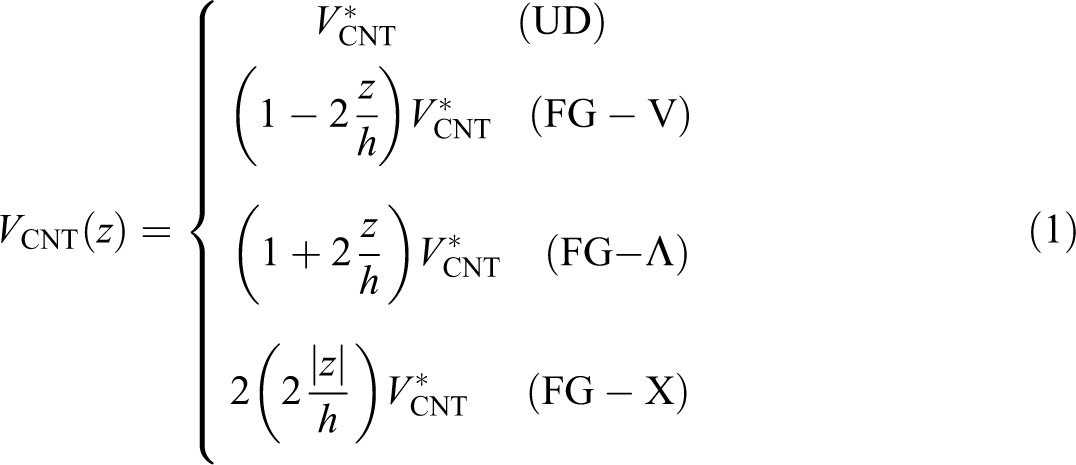
where
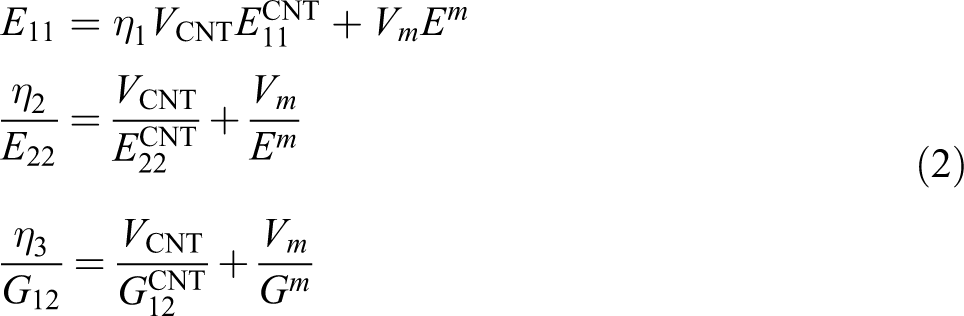
where
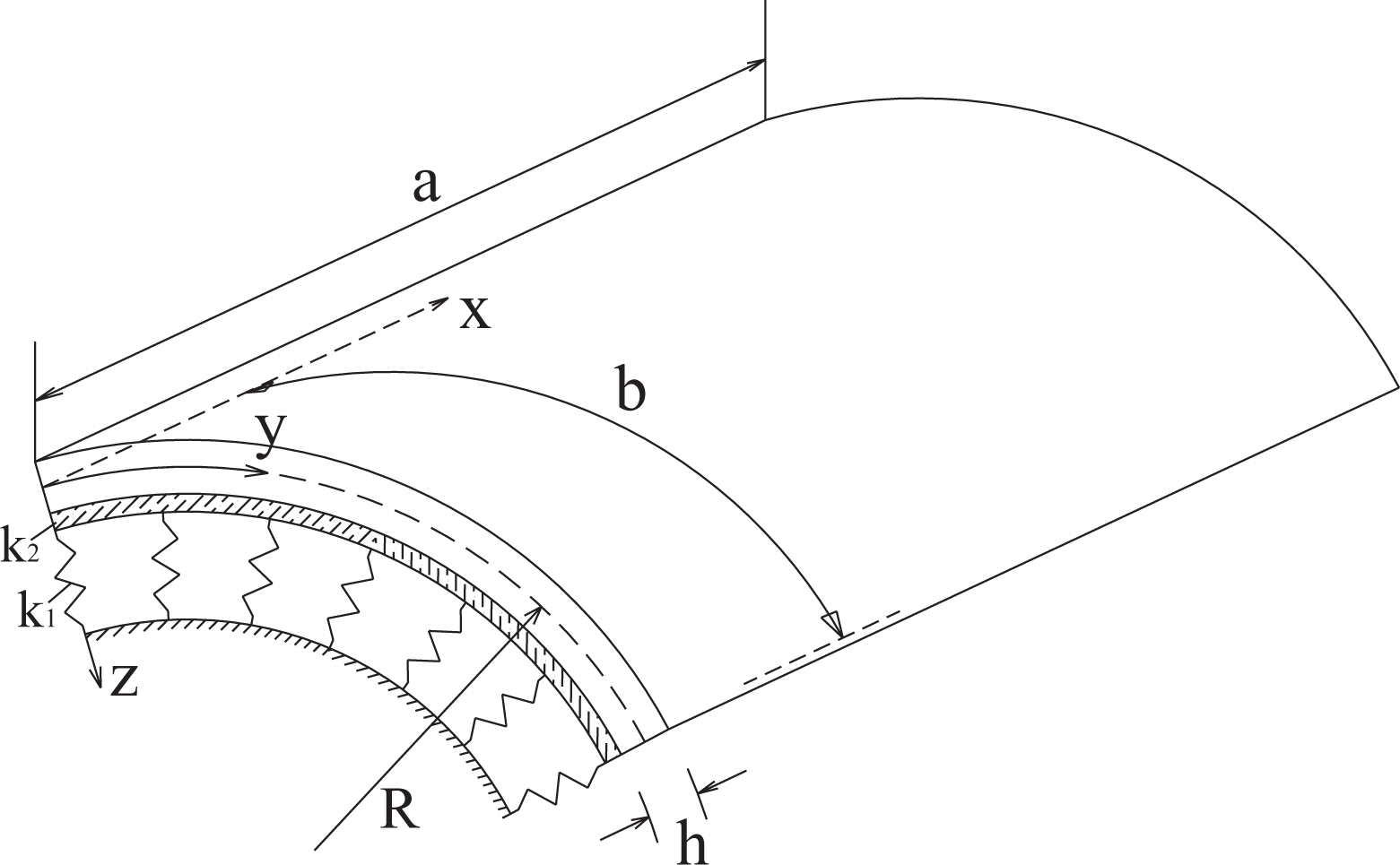
Configuration and coordinate system of a CP resting on an elastic foundation.
Effective Poisson ratio is assumed to be position and temperature independent and estimated as

where


where
Formulations
Although higher order shear deformation theories more accurately predict thick composite structures without shear correction coefficient required, a tremendous effort in formulations is needed for these theories. 19,21,31,33,50 –56 The FSDT was demonstrated to give good accuracy and reliable prediction for moderately thick composite and nanocomposite structures with less formulation and computation efforts. 36 –42,45,46,49 In the present study, the FSDT is used to investigate the nonlinear stability of moderately thick CNTRC CPs. Based on the FSDT, strain components are expressed as

where

where
Stress components in CNTRC CP are defined as

where

and ΔT = T − T0 is uniform temperature rise from initial temperature T 0 at which the CP is thermal stress free.
Based on the FSDT, force and moment resultants per unit length are expressed as follows

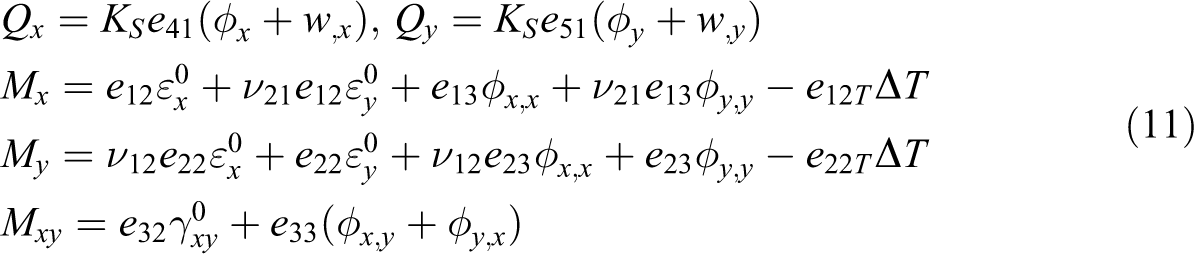
where
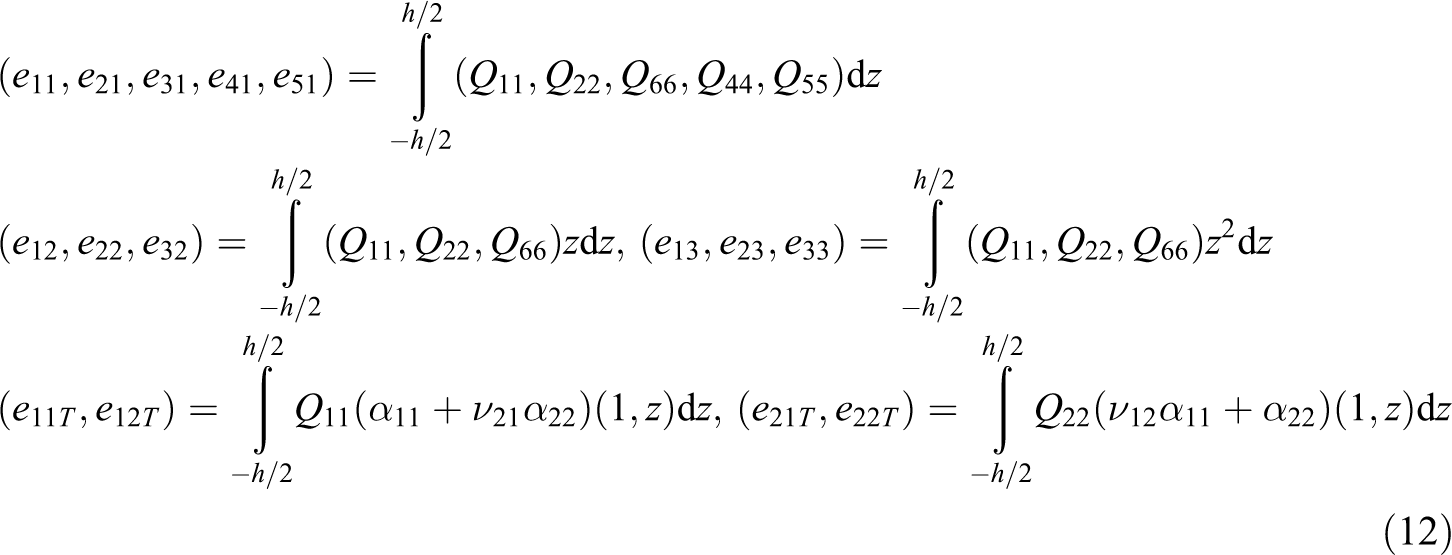
and KS is shear correction coefficient assumed as 63

The present study considers combined thermomechanical loading conditions as described in previous works. 2,3,18,19 For the general model of problem, CP is rested on an elastic foundation, exposed to a uniform through the thickness temperature field followed by combined mechanical loads. Based on the FSDT, nonlinear equilibrium equations of a CP resting on an elastic foundation are





where q is uniform lateral pressure receiving positive and negative values for external and internal pressures, respectively, and qf is interactive pressure from elastic foundation represented by Pasternak model as

in which k 1 and k 2 are elastic modulus of Winkler springs and stiffness of Pasternak shear layer, respectively, and Δ denotes Laplace operator.
By virtue of equations (7) and (10, 11) and taking into account initial geometrical imperfection, above equilibrium equations are written in a more compact form as

where f(x, y) is a stress function defined as

Next, strain compatibility equation of a geometrically imperfect CP is defined as 18,19

Expressing

where coefficients
In the present study, all edges of the CP are assumed to be simply supported, two curved edges x = 0, a are freely movable and subjected to uniform compressive pressure P, whereas two straight edges y = 0, b are unloaded and tangentially restrained. The associated boundary conditions are expressed as

where

in which c is average tangential stiffness parameter in the y direction on each opposite edge. The definition of the average end-shortening displacement is expressed as

To satisfy boundary conditions (24) approximately, the following solutions are assumed



where
Now, substitution of solutions (27–29) into equation (23) yields the following results
Subsequently, putting equations (7) and (10, 11) into the equations (17, 18), then substituting solutions (27–29) into the obtained relations give a system of two equations relating to coefficients

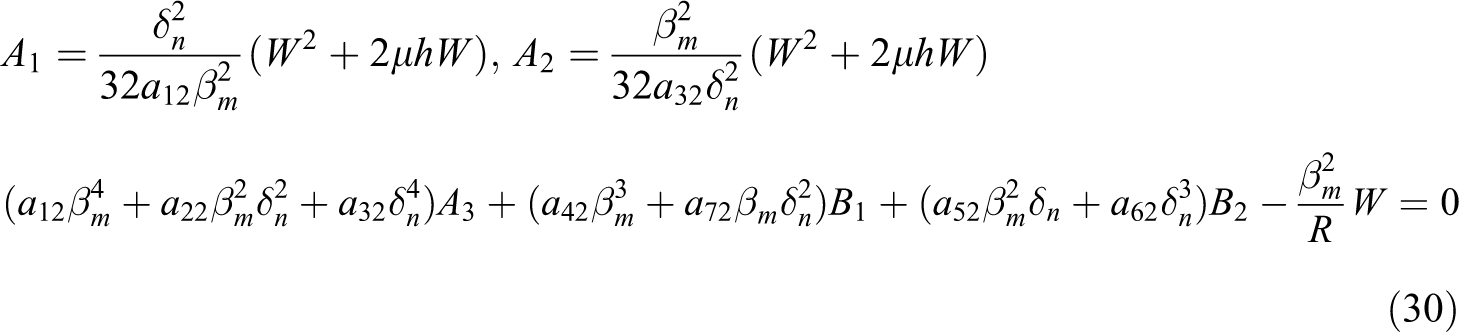
where coefficients
Next, the solutions (27–29) are substituted into equilibrium equation (20) and applying Galerkin method for the resulting equation gives

where
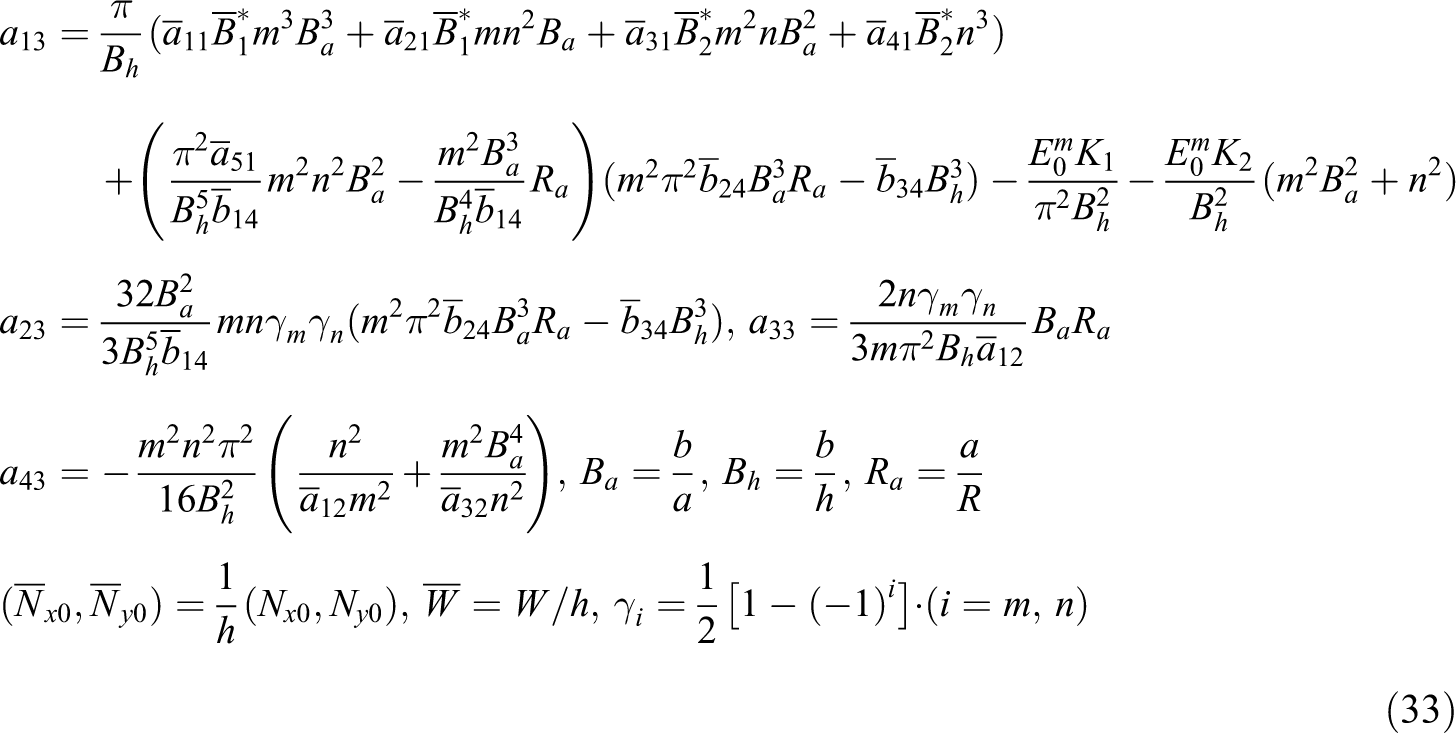
in which

and

where a82 is defined in equation (1B) of the Appendix 1.
Now, placing the solutions (27–29) into equation (35) and putting the resulting v, y into equation (26) yield the expression of the Δy, and a combination of this expression with equation (25) leads to the following result

where coefficients
Placing

where
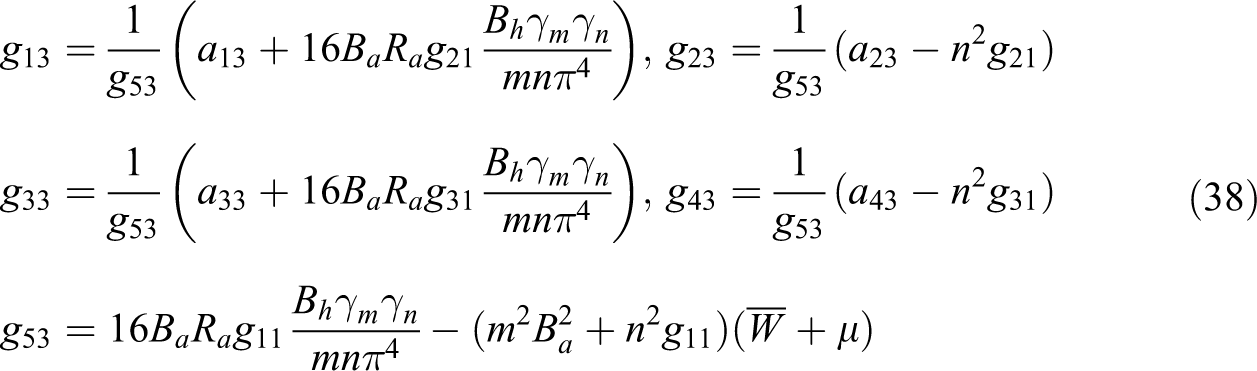
Equation (37) expresses the nonlinear load–deflection relation of CNTRC CPs under preexisting lateral pressure and subjected to uniform axial compression load in thermal environments. In general, as predicted from equations (37) and (38), bifurcation type buckling response does not occur when CNTRC CPs under combined loads and/or general cases of in-plane boundary conditions. In particular, CNTRC CPs may exhibit bifurcation type buckling response in special cases of panel geometry, loading, and in-plane boundary conditions. Specifically, when straight edges are freely movable (i.e. c = 0), geometrically perfect (μ = 0) CNTRC CPs subjected to axial compression only (i.e.

As CNTRC CPs are exposed to a uniform temperature field and subjected to preexisting nondestabilizing axial load followed by lateral pressure, equation (37) is rewritten as

where

It is predicted from equations (38) and (40) that axially precompressed CNTRC CPs under lateral pressure in a thermal environment may experience a bifurcation type buckling response with corresponding buckling pressures as

Equations (37) and (40) describe the nonlinear relations of load and deflection for CNTRC CPs under combined thermomechanical loadings.
Results and discussion
This section presents numerical examples for CPs made of poly(methyl methacrylate) as matrix material and are reinforced by (10,10) SWCNTs. The temperature-dependent properties of the matrix is assumed to be
Verification
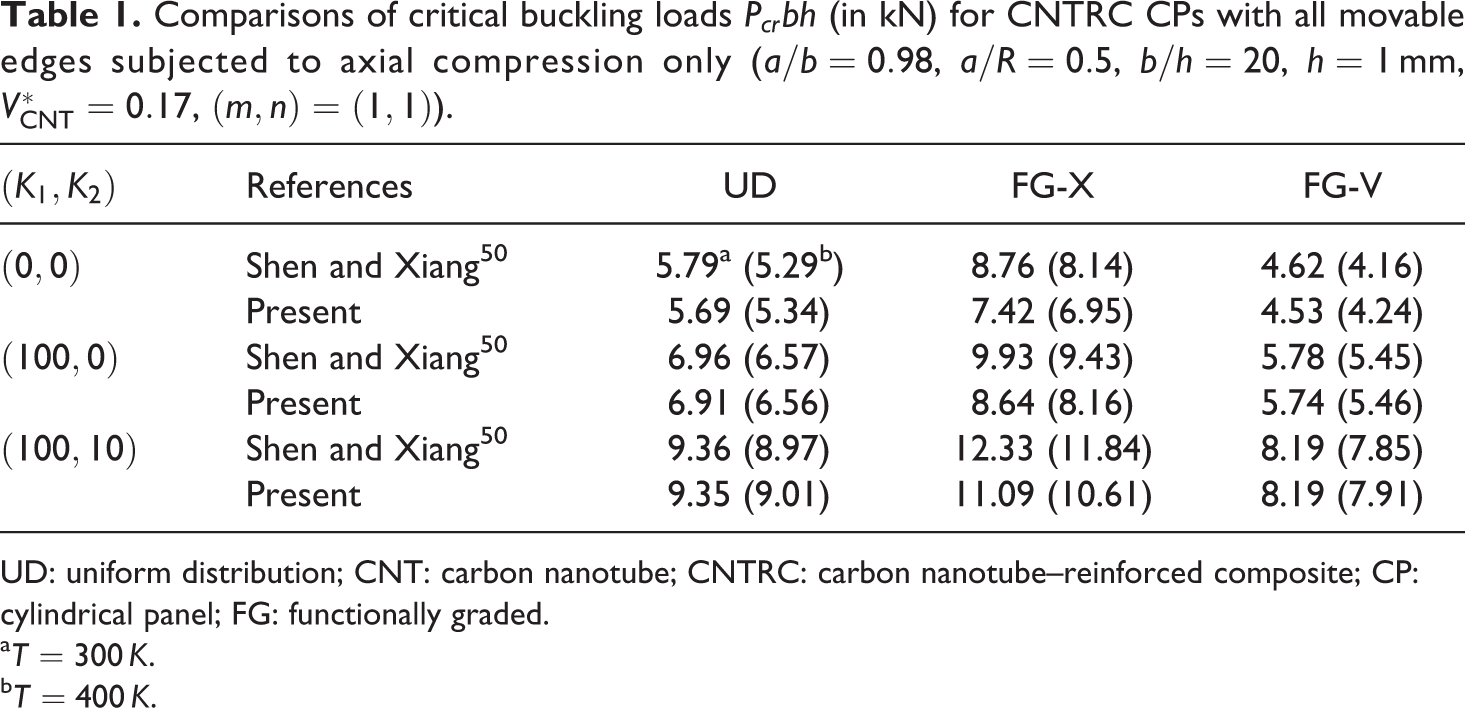
To verify the proposed approach, buckling response of simply supported CNTRC CPs with all movable edges under axial load alone in the thermal environments is considered. Critical buckling loads are calculated by equation (39) and given in Table 1 in comparison with results of Shen and Xiang 50 basing on asymptotic solutions and a perturbation technique. Next, the nonlinear response of CNTRC CPs with all movable edges under combined loads in a thermal environment is considered. Load–deflection curves are traced by equation (40) and displayed in Figure 2 in comparison with those obtained by Shen and Xiang 53 using asymptotic solutions and a perturbation technique. Table 1 and Figure 2 show that the present results well agree with those in the literature for special cases of loading and in-plane boundary condition.
Comparisons of critical buckling loads
UD: uniform distribution; CNT: carbon nanotube; CNTRC: carbon nanotube–reinforced composite; CP: cylindrical panel; FG: functionally graded.
a
b
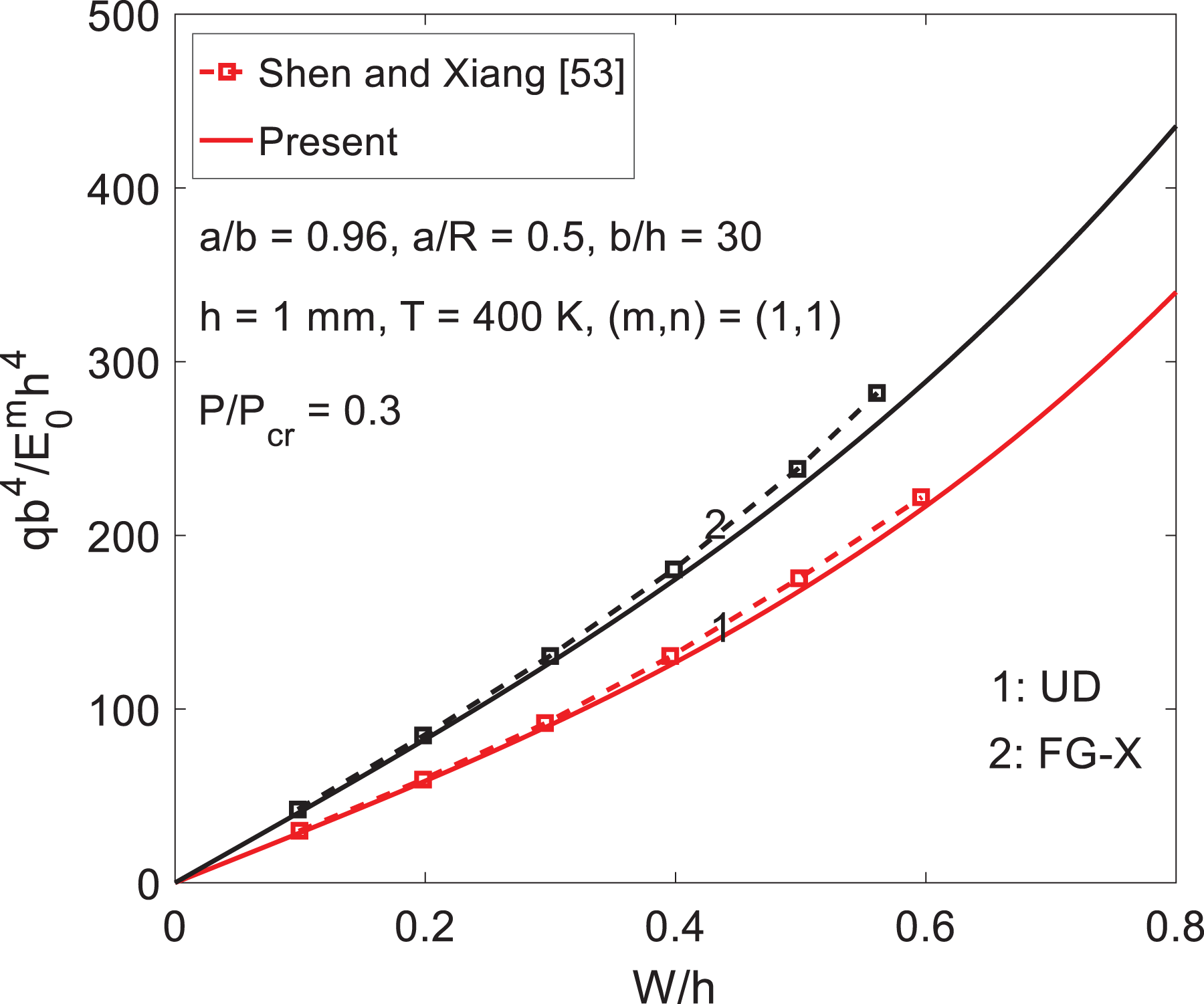
Comparison of load–deflection curves of CNTRC CPs subjected to external pressure combined with axial compression.
To measure the degree of tangential constraints of straight edges in a more convenient way, a dimensionless tangential stiffness parameter is defined as follows

Obviously, λ = 0 and λ = 1 represent movable and immovable cases of unloaded straight edges, respectively, and intermediate levels of tangential constraints of straight edges are defined by
In what follows, numerical results for CNTRC CPs with square planform (a = b) under combined loading conditions will be presented. For sake of brief expression, CNTRC CPs are assumed to be geometrically perfect
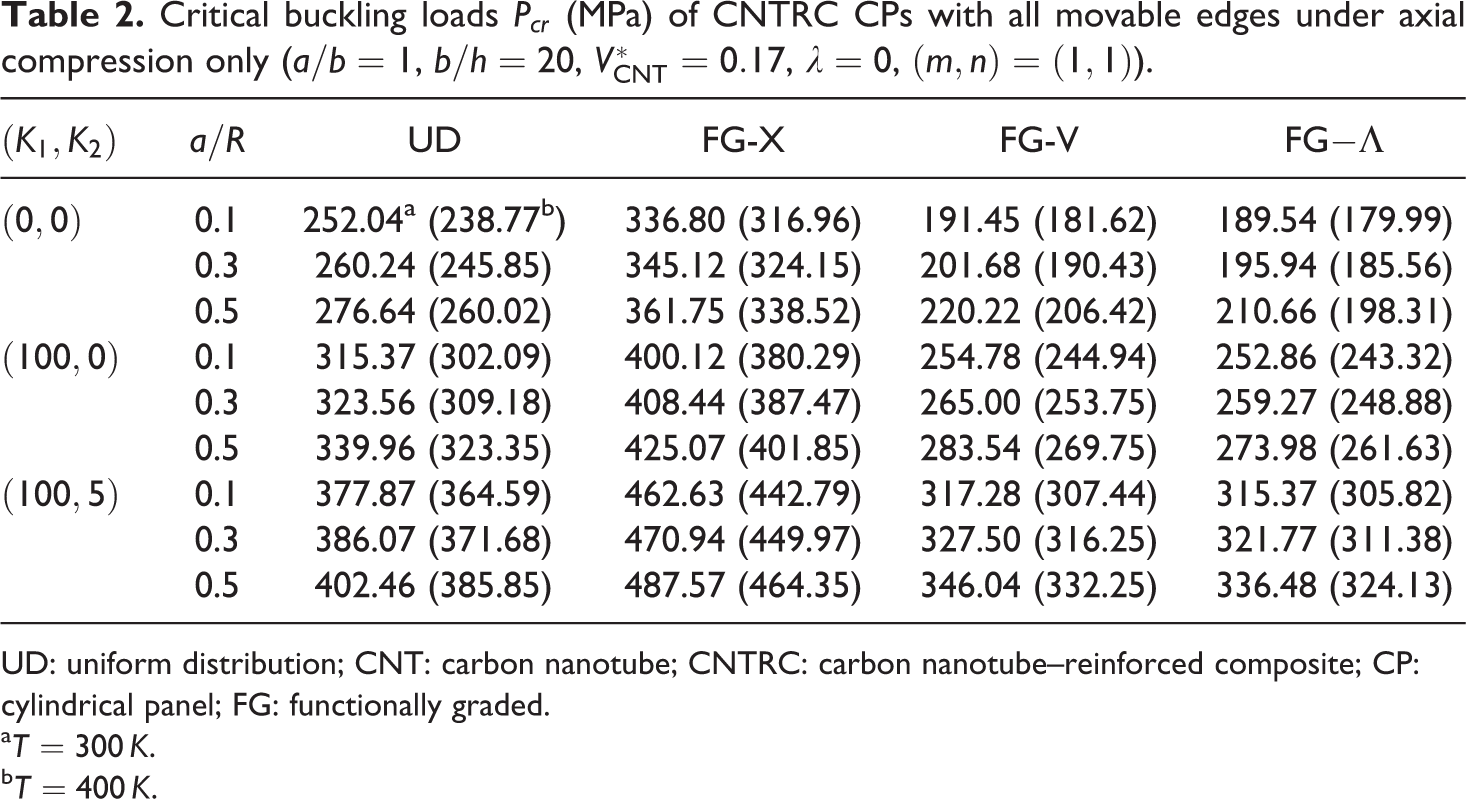
As mentioned, bifurcation buckling behavior of CNTRC CPs may occur for special cases, that is, geometrically perfect CPs with all movable edges under axial compression load only. The effects of CNT distribution types, a/R curvature ratio, elastic foundations, and thermal environments on critical buckling axial loads of such CPs are shown in Table 2. As can be seen, critical buckling loads are increased when a/R ratio and/or stiffness of elastic foundations are increased, and decreased as temperature is elevated. Among four types of CNT distribution, FG-X panels have the highest buckling loads, UD panels have higher buckling loads than the remaining two distribution patterns, and buckling loads of FG-V panels are slightly higher than those of FG-Λ panels.
Critical buckling loads
UD: uniform distribution; CNT: carbon nanotube; CNTRC: carbon nanotube–reinforced composite; CP: cylindrical panel; FG: functionally graded.
a
b
Axially precompressed CNTRC CP under external pressure
Numerical examples for CNTRC CPs under preexisting nondestabilizing axial load and subjected to uniform external pressure are presented in Figures 3
to 8. Figure 3 shows the effects of CNT distribution and preexisting axial load on the nonlinear response of CNTRC CPs with all movable edges subjected to external pressure. It is evident that FG-X type distribution of CNTs gives the best load carrying capability of nanocomposite CPs and pressure–deflection equilibrium paths are significantly dropped due to the presence of preexisting nondestabilizing axial load. Thus, only FG-X panels are considered in the remainder of this section. The effects of tangential constraint of unloaded straight edges on the nonlinear response of axially precompressed CNTRC CPs subjected to external pressure are examined in Figure 4. As can be observed, pressure–deflection paths of CPs with immovable straight edges
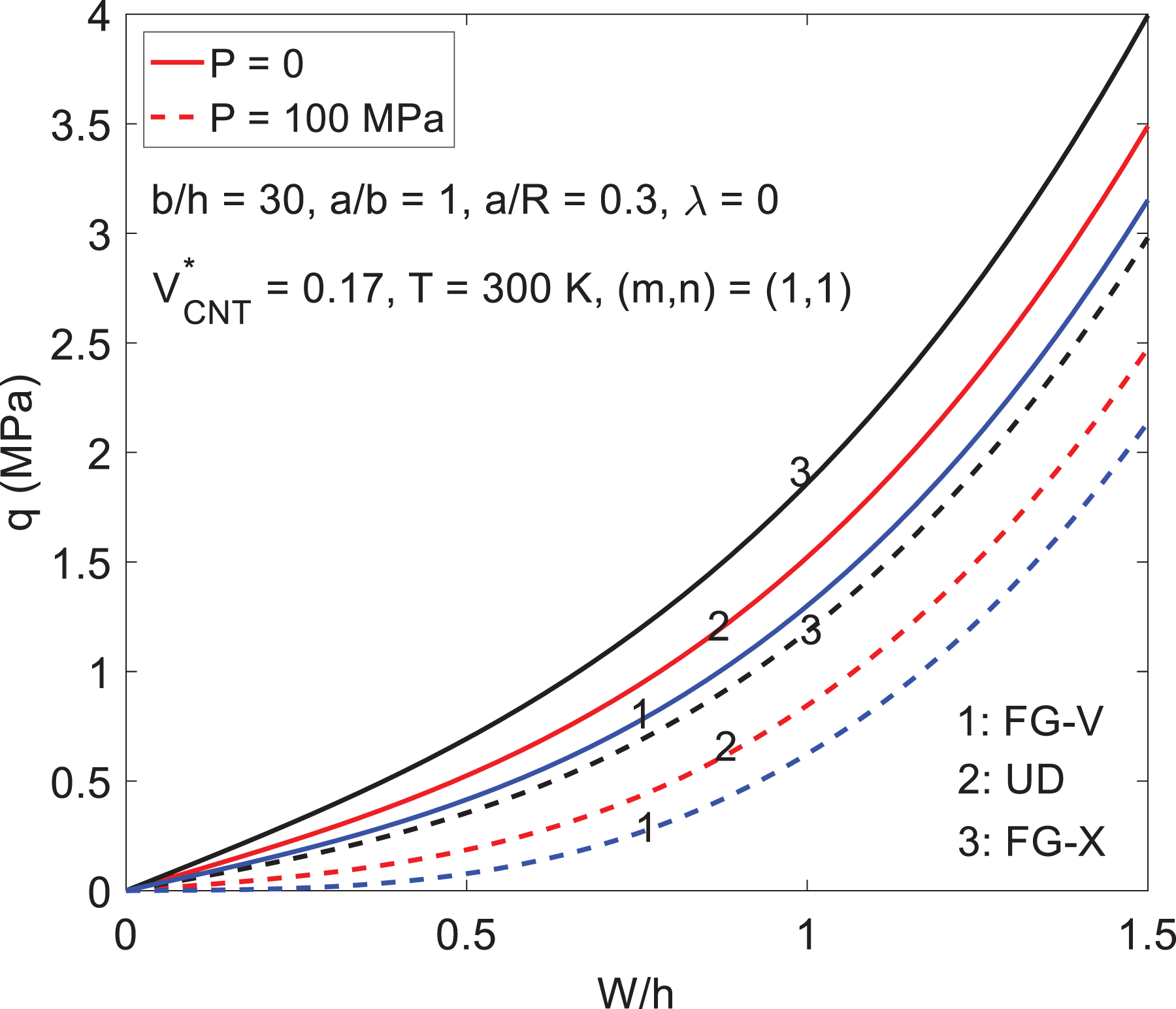
Effects of CNT distribution pattern and preexisting axial load on the nonlinear response of CNTRC CPs subjected to external pressure.
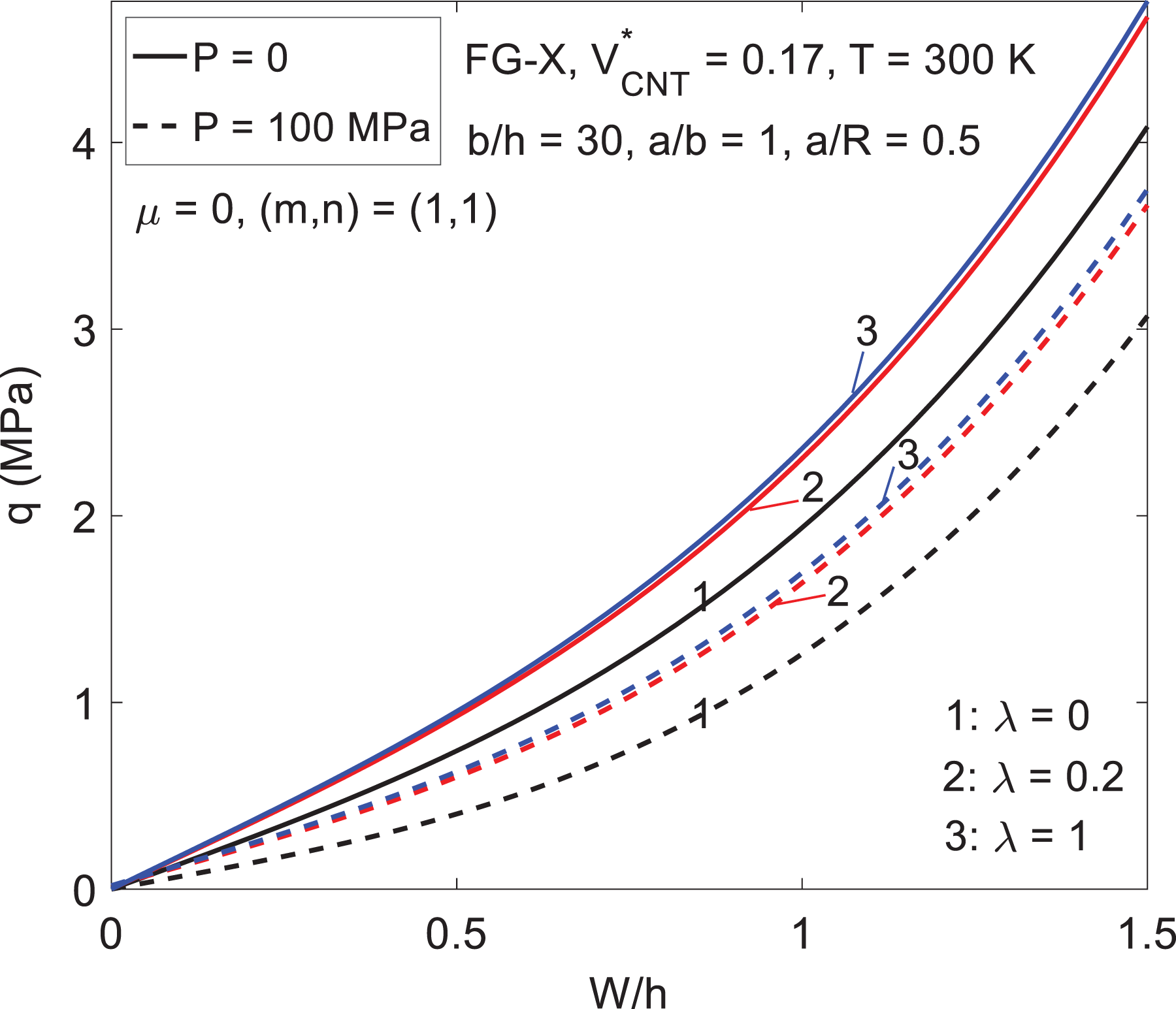
Effects of in-plane restraint of straight edges and preexisting axial load on the nonlinear response of CNTRC CPs subjected to external pressure.
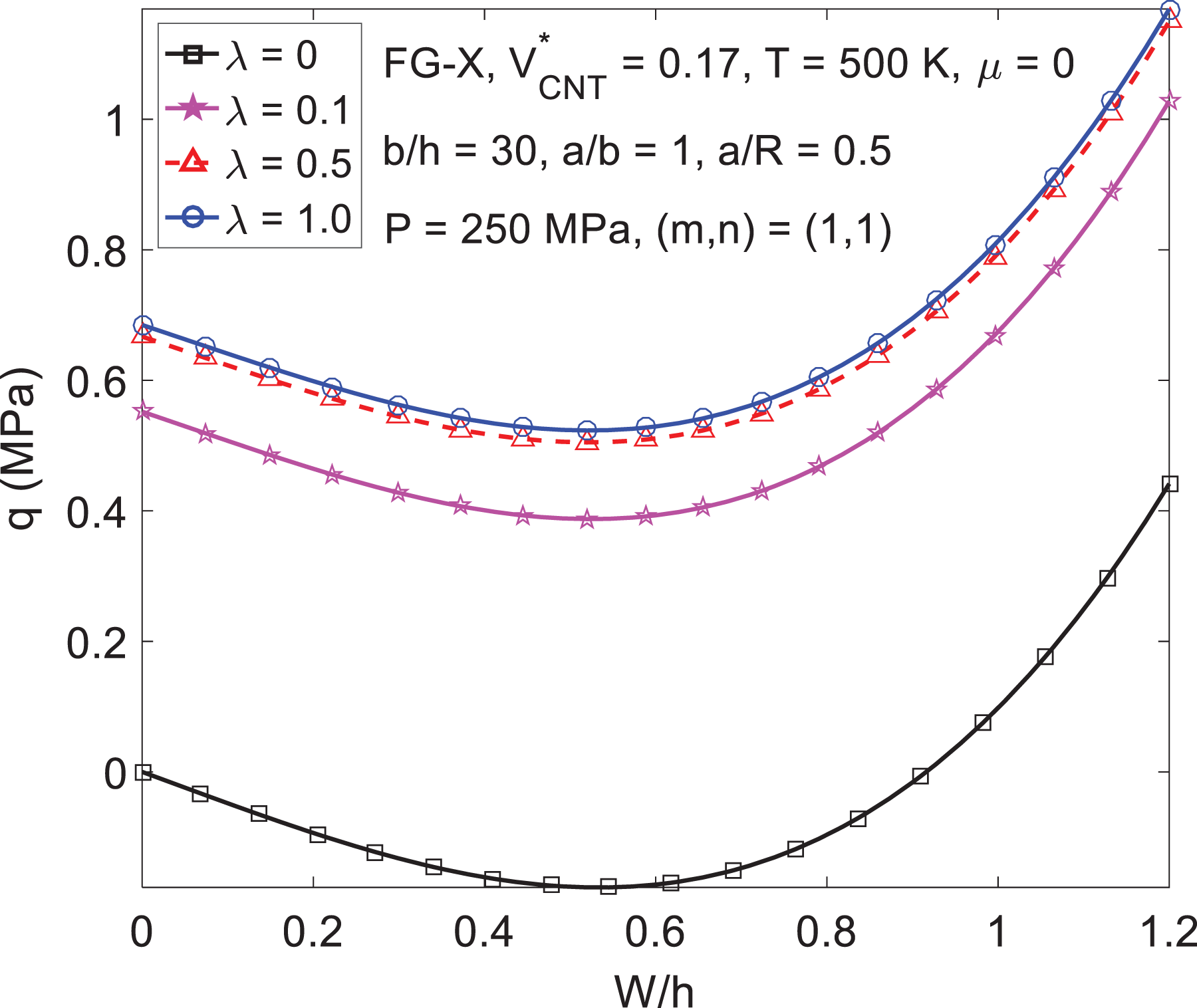
Effects of in-plane restraint of straight edges on the nonlinear response of CNTRC CPs exposed to elevated temperature and subjected to combined loads.
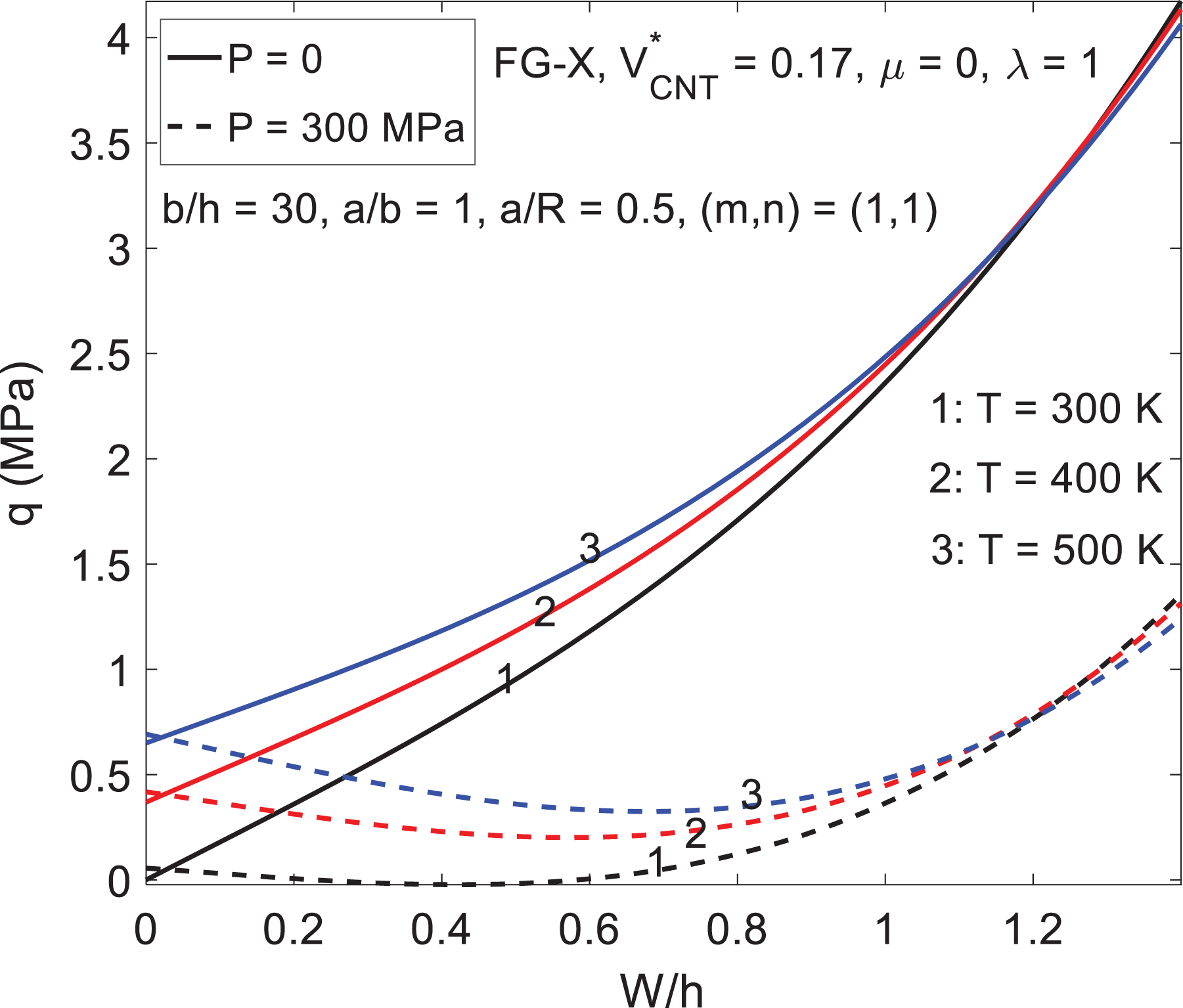
Effects of thermal environments and preexisting axial load on the nonlinear response of CNTRC CPs subjected to external pressure.
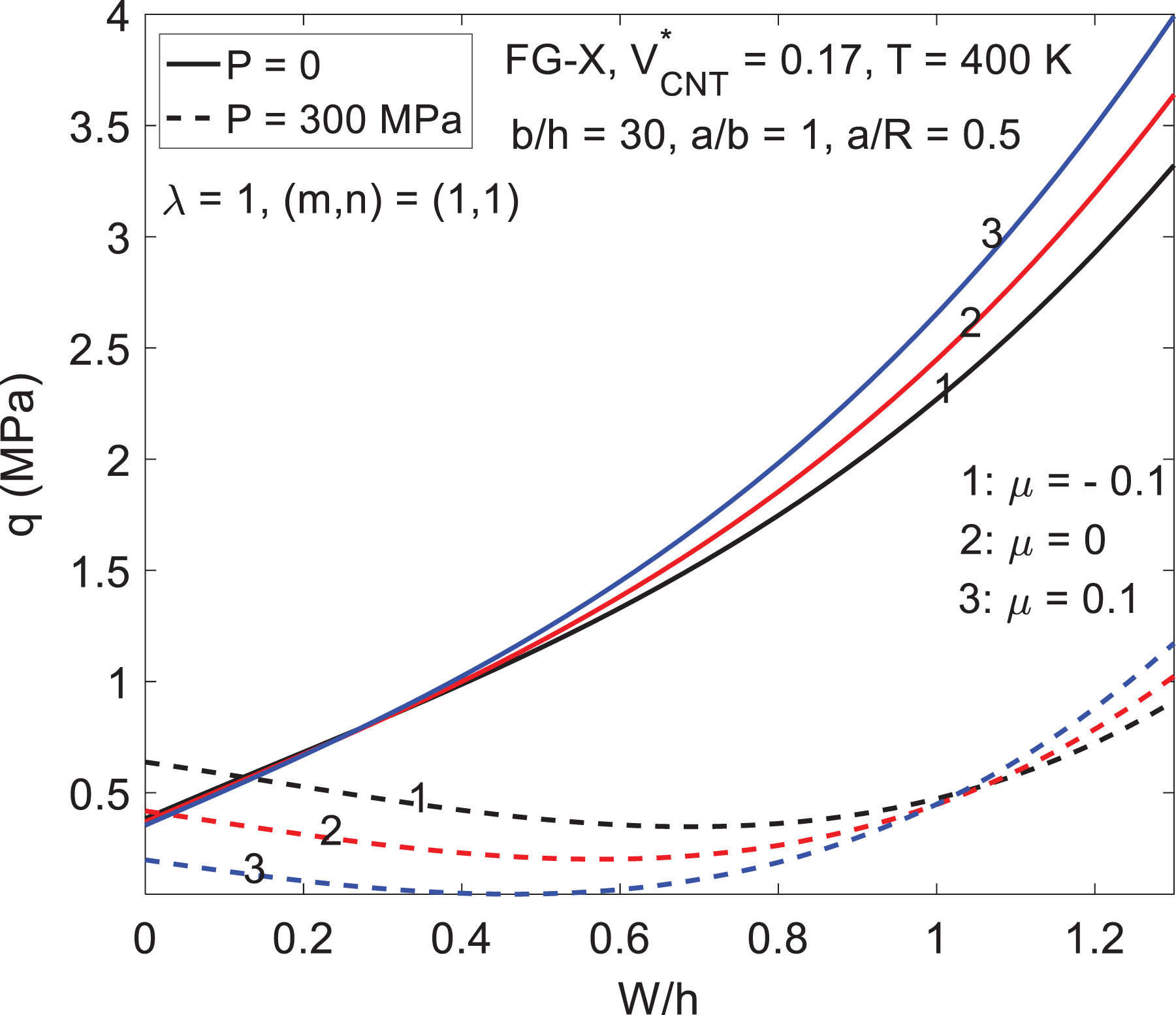
Effects of geometrical imperfection and preexisting axial load on the nonlinear response of CNTRC CPs exposed to elevated temperature and subjected to external pressure.
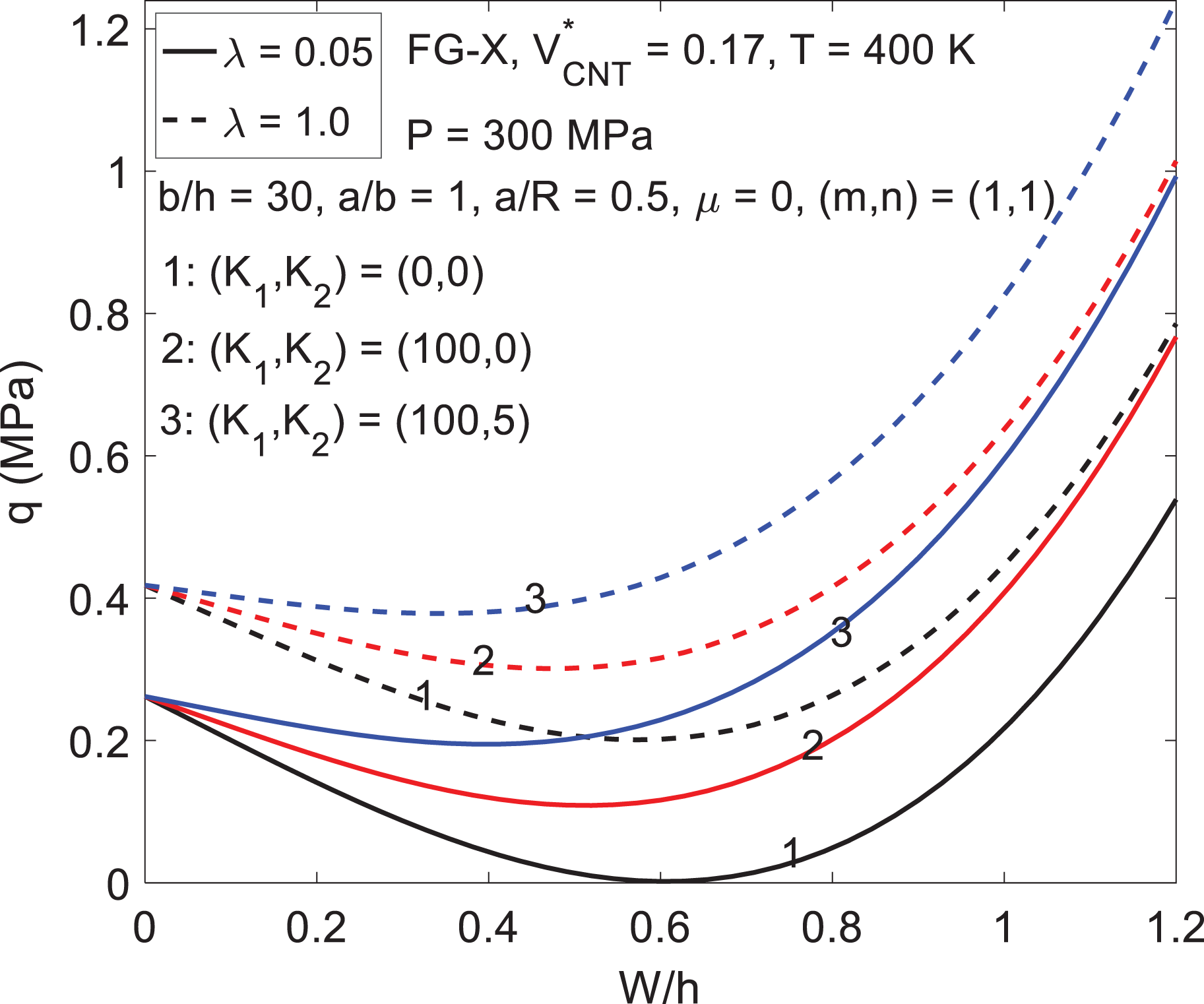
Effects of elastic foundations and in-plane restraint of unloaded edges on the nonlinear response of CNTRC CPs subjected to combined loads.
Next, the effects of tangential constraint of unloaded straight edges on the nonlinear response of axially precompressed CNTRC CPs exposed to elevated temperature (
Subsequently, Figure 7 considers the effects of geometrical imperfection on the nonlinear response of CNTRC CPs with immovable straight edges exposed to elevated temperature (
Initially pressurized CNTRC CP under axial compression
This subsection presents numerical illustrations for CNTRC CPs under preexisting lateral pressure and subjected to axial compression. Figure 9 gives the effects of preexisting lateral pressure on the nonlinear response of CNTRC CPs with all movable edges (λ = 0) subjected to axial compression in which positive and negative values of q represent external and internal lateral pressures, respectively. Evidently, in this situation of in-plane boundary condition, the CP exhibits bifurcation type buckling behavior under axial compressive load only (i.e. q = 0), and preexisting lateral pressure has sensitive effect on the behavior tendency of axially loaded CPs. Specifically, the CPs have no longer bifurcation type buckling behavior through preexisting lateral pressure, and the CPs are deflected outward (negative deflection) and inward (positive deflection) at the onset of axial compression due to preexisting internal and external pressures, respectively. Next, when straight edges are immovable (λ = 1), there is no bifurcation buckling response of axially loaded CPs for arbitrary value of lateral pressure q, as demonstrated in Figure 10. This figure also indicates that the CPs are deflected outward at the onset of axial compression due to internal pressures or small external pressures (q = 0 or q = 10 kPa in this example) and are deflected inward as preexisting external pressure is sufficiently large.
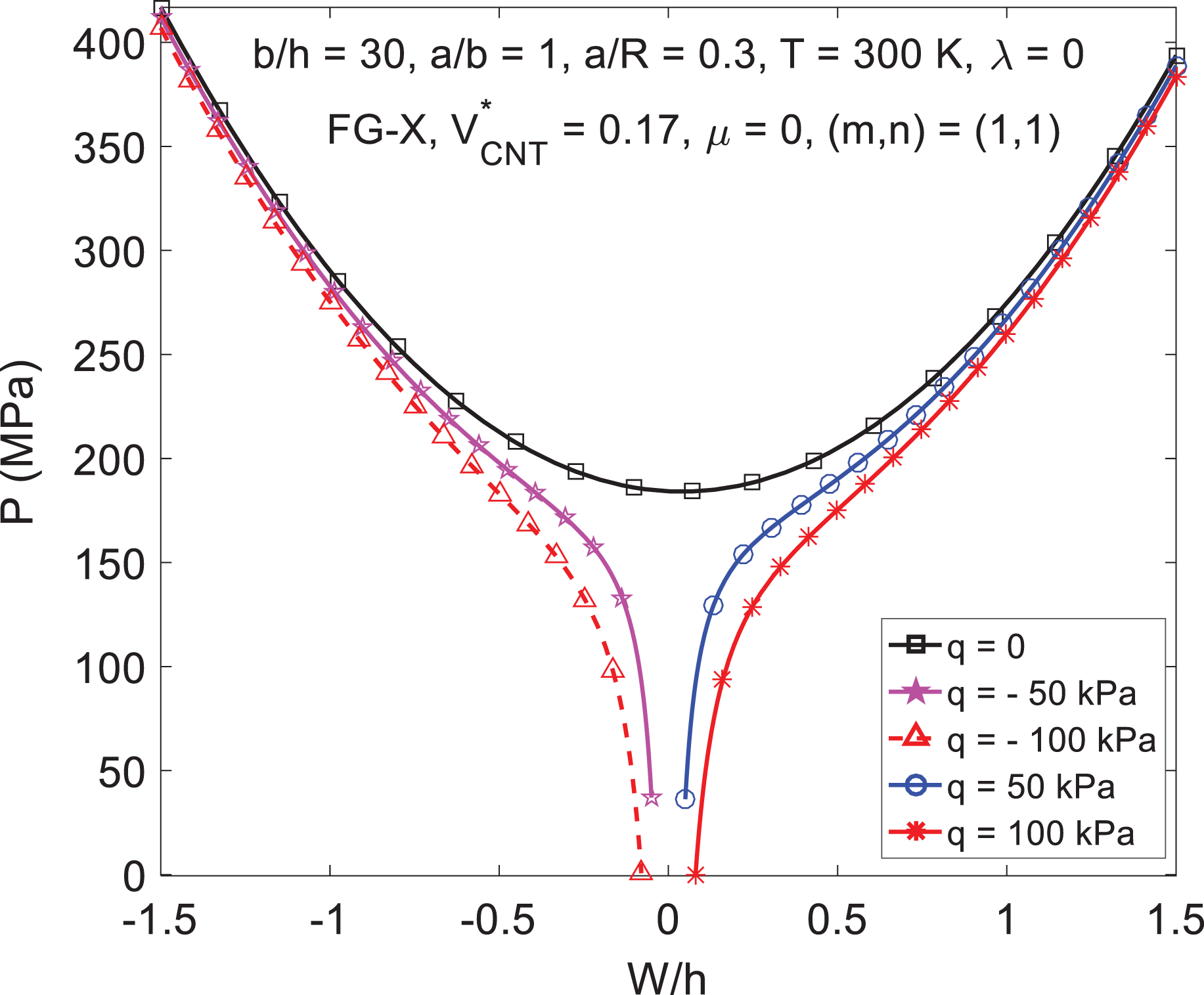
Effects of preexisting lateral pressure on the nonlinear response of CNTRC CPs with movable edges subjected to axial compression.
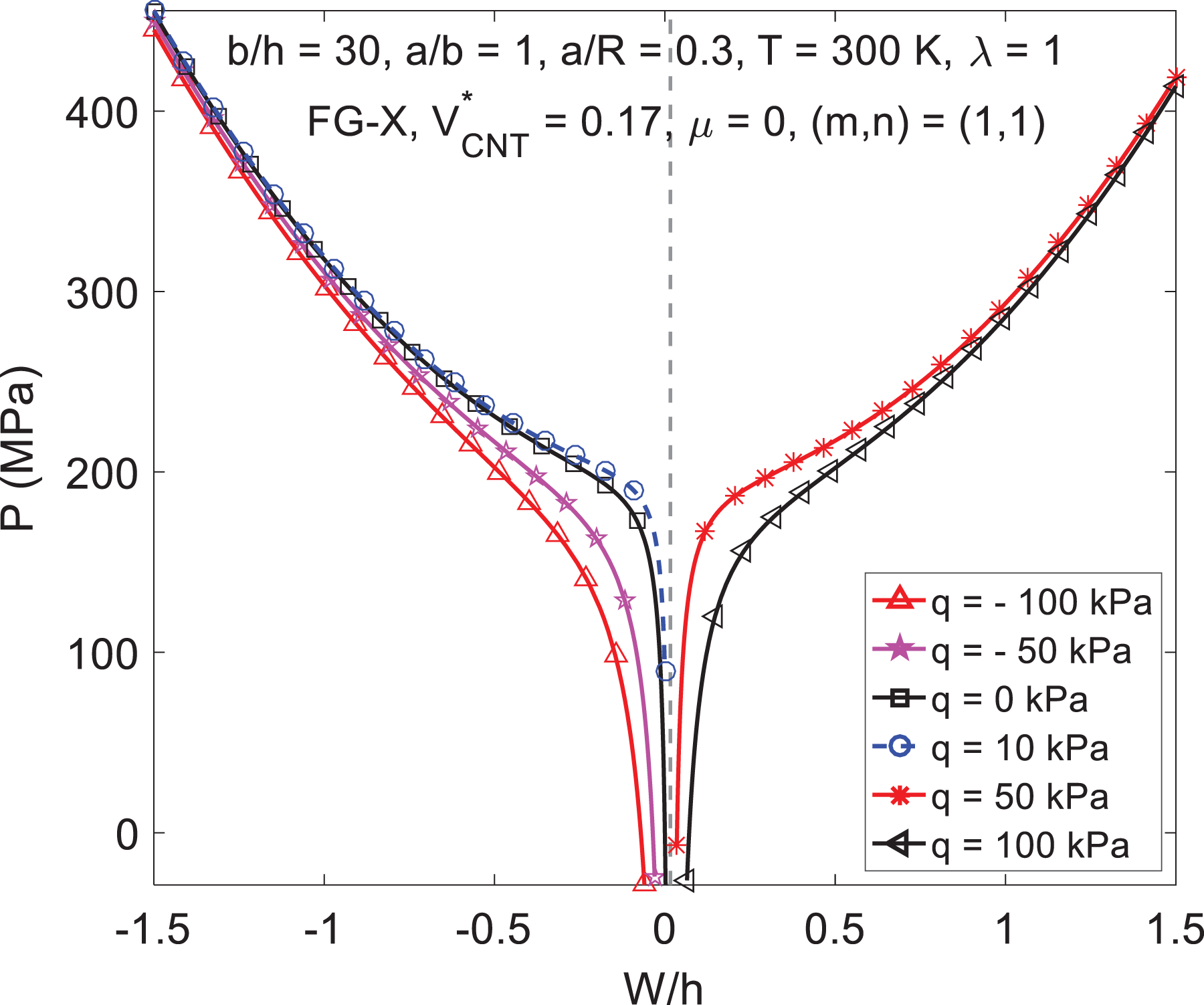
Effects of preexisting lateral pressure on the nonlinear response of CNTRC CPs with immovable straight edges subjected to axial compression.
Next, the effects of preexisting lateral pressure and tangential constraint of straight edges on the nonlinear response of CNTRC CPs subjected to axial compression are analyzed in Figure 11. For the CPs under axial load only (q = 0), the CPs are bifurcately buckled as λ = 0 (movable straight edges) and are monotonically deflected outward as λ ≠ 0 (restrained straight edges). Under action of preexisting external lateral pressure (q = 100 kPa), axially loaded CPs are immediately deflected inward with arbitrary degree of tangential constraint of straight edges, and axial load–deflection equilibrium paths become higher when the straight edges are more rigorously restrained (i.e. higher values of λ). Then, Figure 12 shows the effects of thermal environments and in-plane boundary condition on the nonlinear response of CNTRC CPs under combined loads. It is observed that the CPs are deflected inward and load–deflection paths are more slightly dropped as temperature is elevated for movable case of straight edges. As the straight edges are immovable, the CPs are deflected inward and outward at room and elevated temperatures, respectively, and load–deflection paths are sharply dropped as temperature becomes higher.
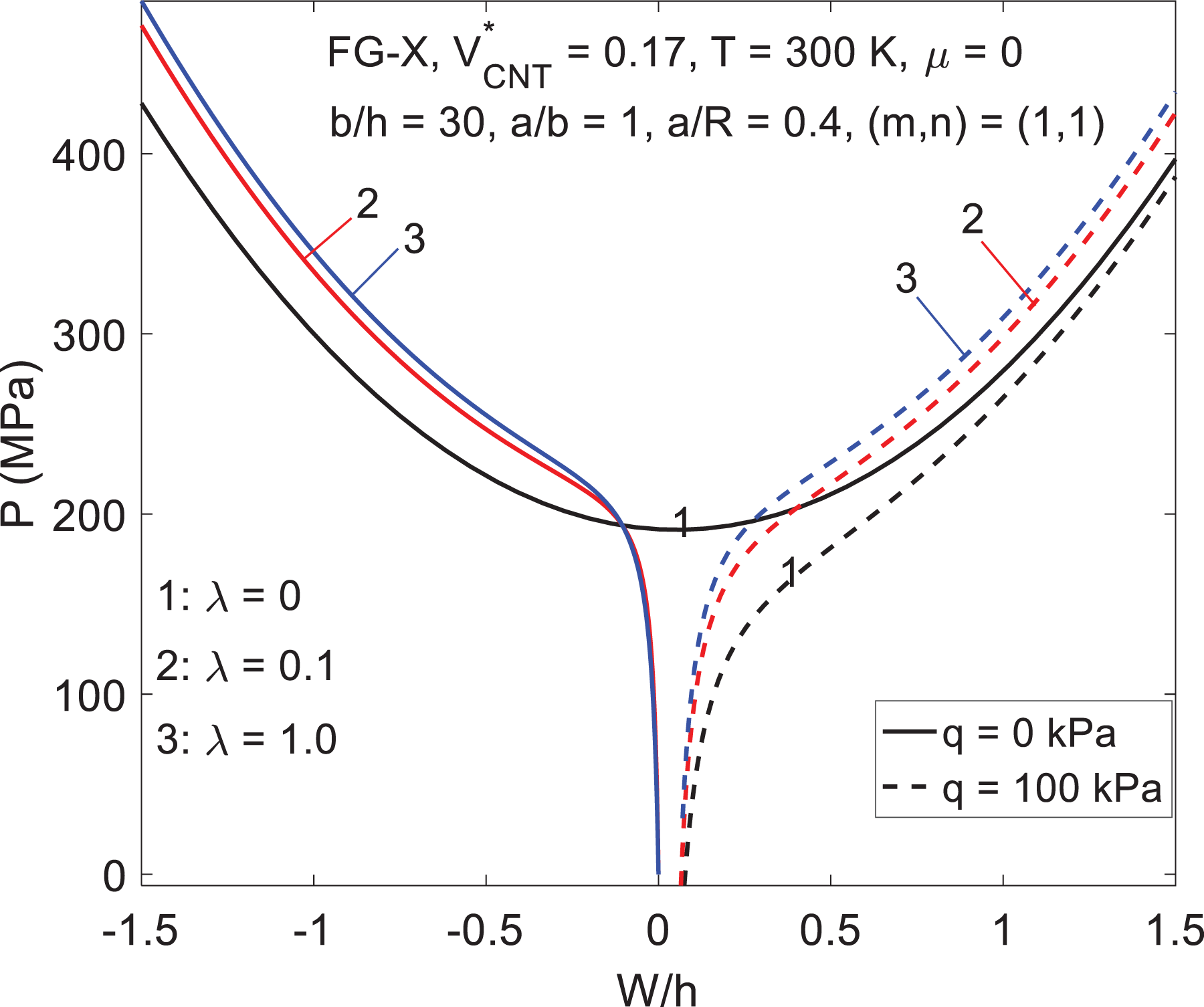
Effects of preexisting lateral pressure and tangential constraint of straight edges on the nonlinear response of CNTRC CPs subjected to axial compression.
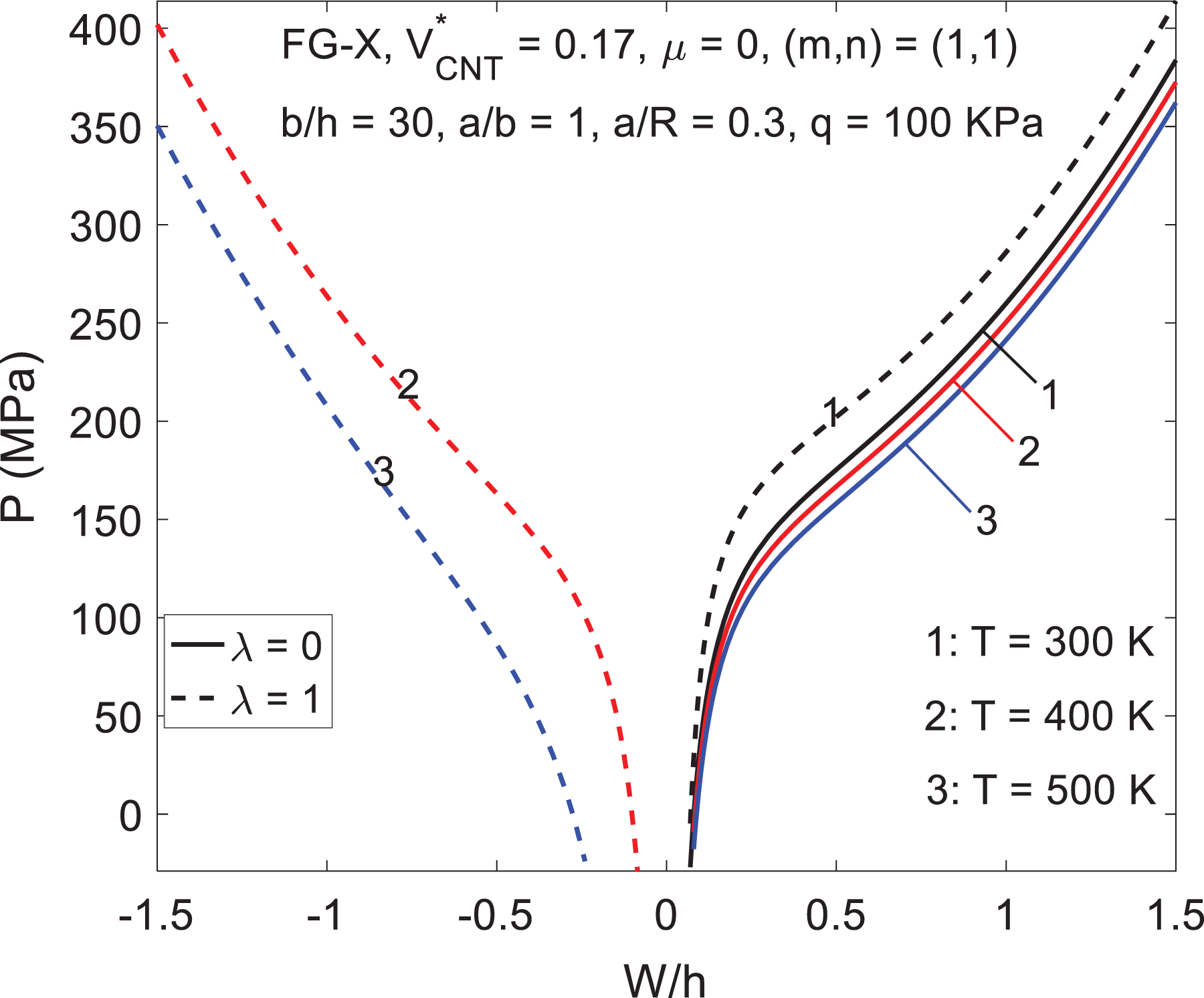
Effects of thermal environments and tangential constraint of straight edges on the nonlinear response of CNTRC CPs subjected to combined loads.
The effects of CNT volume fraction and elastic foundations on the nonlinear response of CNTRC CPs with movable edges subjected to combined loads at elevated temperature are illustrated in Figure 13. As expected, load–deflection equilibrium paths are enhanced due to the presence of elastic foundations and/or increase in volume percentage of CNTs. Finally, Figure 14 considers the effects of initial geometrical imperfection and a/R curvature ratio on the nonlinear response of CNTRC CPs with immovable straight edges exposed to thermal environment and subjected to axial load combined with preexisting external pressure. As shown, relatively shallow CP (a/R = 0.1) is deflected outward as μ = −0.1 (outward initial deviation) or μ = 0 (perfect geometry) and deflected inward as μ = 0.1 (inward initial deviation). In another behavior trend, deeper CP (a/R = 0.5) is deflected outward with arbitrary value of imperfection size μ. This suggests that interactive effects of initial imperfection and preexisting lateral pressure can change effective curvature of the CPs, although immovability of straight edges (and fictitious force resultant at these edges) essentially influence the behavior tendency of nanocomposite CPs.
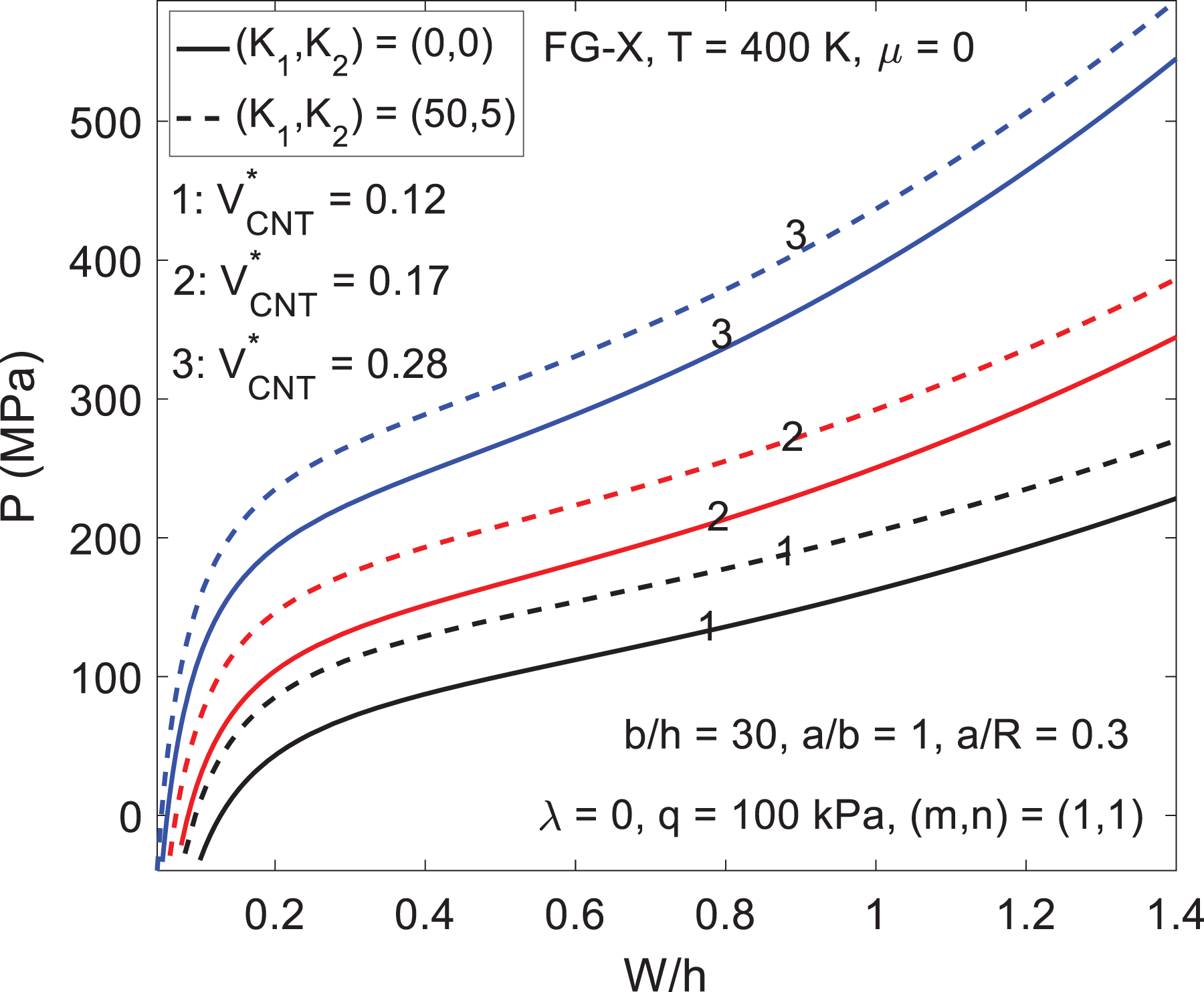
Effects of CNT volume fraction and elastic foundation on the nonlinear response of CNTRC CPs subjected to combined loads.
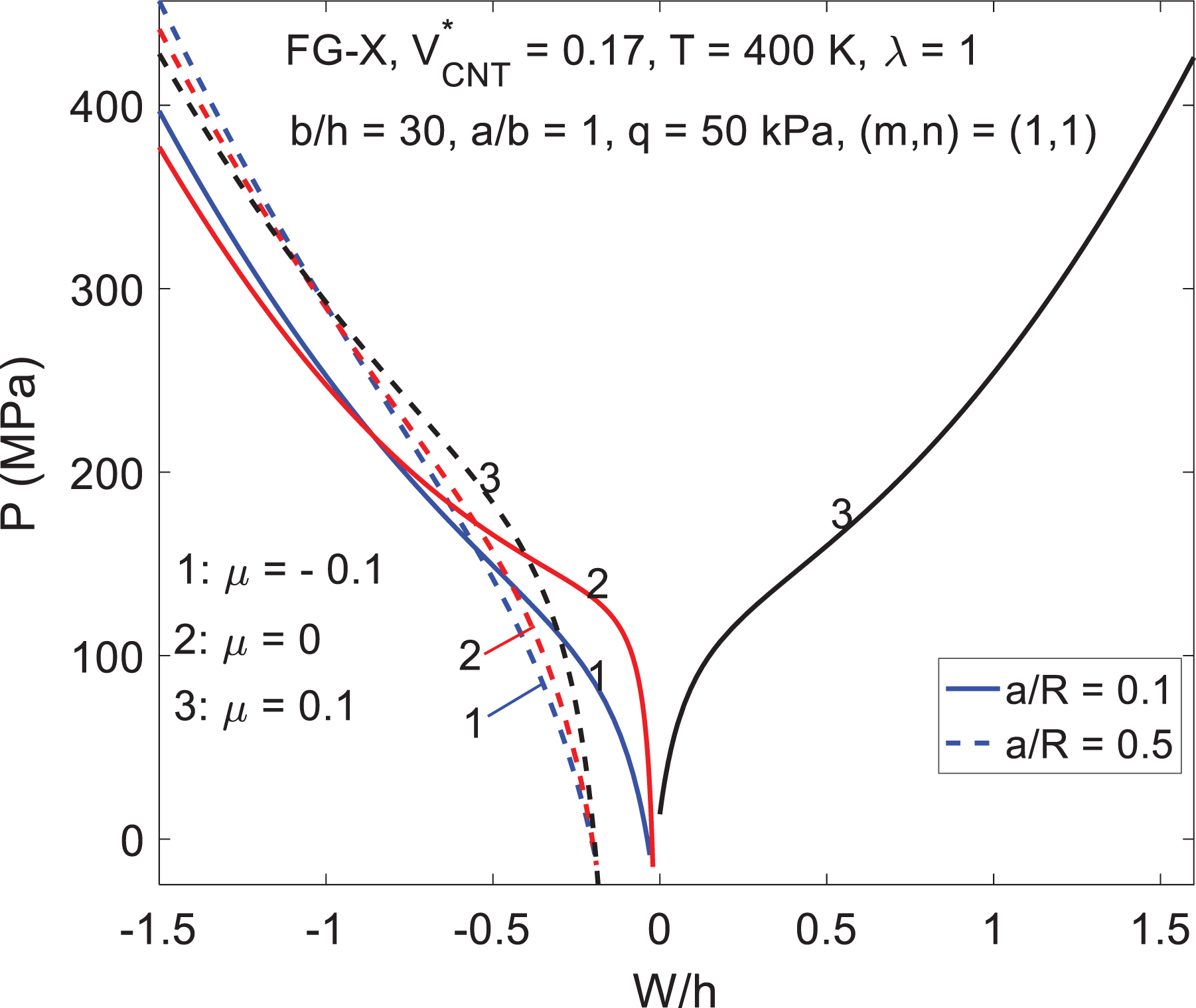
Effects of initial imperfection and a/R curvature ratio on the nonlinear response of CNTRC CPs subjected to combined loads. CNTRC: carbon nanotube–reinforced composite; CP: cylindrical panel.
Concluding remarks
Basing on an analytical approach, nonlinear stability of moderately thick CNTRC CPs with tangentially restrained unloaded straight edges resting on elastic foundations, exposed to thermal environments and subjected to combined loading conditions has been presented. The results reveal that bifurcation type buckling response of CNTRC CPs only occurs for some special cases of panel geometry, tangential constraint of straight edges, and combined thermomechanical loading condition. Tangential constraints of straight edges and preexisting lateral pressure have important influences on the behavior trend and load carrying capacity of CNTRC CPs under combined loads. The study indicates that the nonlinear response and direction of deflection of the CPs under combined loads depend on direction and value of lateral pressure, size of initial geometrical imperfection, curvature of CPs, and temperature condition. In addition, elastic foundations have beneficial effects on the load carrying capability and stability of postbuckling paths of the CPs. As a final remark, the behavior of CNTRC CPs with restrained straight edges subjected to combined thermomechanical loads is complex and, thus, this article may have contribution for a better understanding about the nonlinear stability of nanocomposite CPs under abovementioned conditions of loading and tangential constraint of edges.
Footnotes
Funding
The author(s) disclosed receipt of the following financial support for the research, authorship, and/or publication of this article: This research is funded by Vietnam National Foundation for Science and Technology Development (NAFOSTED) under grant number 107.02-2017.11.
