




Abstract
This study focused on understanding how (mis)match between a company's corporate social responsibility claims as indicated in their mission and the activities it actually undertakes to meet its CSR goals leads to consumers’ corporate hypocrisy and how consumers’ CSR-CA beliefs moderate the relationship between the two. Using the Moral Responsibility Theory of Corporate Sustainability as a framework, this research analyzed the difference in corporate hypocrisy between consumers with high versus low CSR-CA tradeoff beliefs. In addition, we examined the impact of consumers’ corporate hypocrisy on their negative word-of-mouth intention and how participants’ injunctive norm impacts the relationship between the two. A sample of 538 adult US consumers were recruited for an online experimental study. The study extends the findings of MCRS and also provides implications for apparel businesses.
The emphasis on sustainability in the apparel industry is now stronger than ever. Many apparel companies have special reports, marketing campaigns, and new product lines to show their commitment to corporate social responsibility (CSR) and thus create their niche in the market (Block, 2020). Although much of apparel companies’ CSR efforts are important and critical for overall sustainable development goals, are all of these CSR related marketing communications effective for apparel companies to keep consumers satisfied and supportive? Is communicating corporate CSR goals and related activities helping consumers evaluate corporations positively? The assumption is that it should, given many of today's consumers are thought to be supportive towards CSR initiatives and, in fact, think that CSR is something the companies should undertake, especially in the apparel industry (Block, 2020).
However, some recent studies raise caution against companies’ CSR communications. Research indicates that apparel companies’ CSR efforts are often viewed with skepticism and result in unfavorable evaluations of not only the CSR initiatives, but also the corporation in general (Bhaduri & Copeland, 2021). This skepticism may arise from lack of reliability of the source of information and/or weak message arguments (Hahn et al., 2009). Particularly, with regards to corporate communication, what companies say about CSR matters to consumers. For example, Jung et al. (2020) found that, consumers evaluated a corporation more favorably when CSR goals were clearly embedded in corporate mission, compared to taking CSR actions without any clear corporate CSR goals. Further, if what a company says and what it does fails to match, consumers form negative corporate perceptions, namely corporate hypocrisy, ultimately hurting CSR performance (Jung et al., 2020).
Perceived corporate hypocrisy is also thought to influence consumers’ trust and attitude towards the corporation negatively. When consumers perceive a corporation to be hypocritical, they may communicate their negative perceptions in various ways, including voice (i.e., negative world-of mouth) which is a proactive communication impacting others (Antonetti & Maklan, 2016). In this light, consumers’ negative WOM are more influential than their positive evaluations of the corporation (Vo et al., 2019). Research also indicates that consumers’ non-complaint behaviors such as negative WOM intentions are often influenced by their injunctive norm (Dick & Basu, 1994), especially in the context of CSR-related behaviors. Injunctive norms reflect individuals’ perceptions of what others approve/disapprove of and motivate action because of the social rewards and punishments associated with engaging, or not engaging, in the behavior. Therefore, it is important to understand if relationship between consumers’ perceived corporate hypocrisy and negative WOM intention is moderated by consumers’ level of injunctive norm.
In addition, studies indicate that today's consumers often support CSR initiatives that align with their personal values and beliefs (Schmeltz, 2017). Then, what should apparel companies know about consumer values and perceptions when it comes to CSR communications at a time when more consumers are urging them to be socially responsible? Literature suggests that a balanced approach toward CSR and corporate ability (CA) is important because some consumers believe that CSR activities may detract from companies’ core abilities (i.e., CSR-CA belief) (Sen & Bhattacharya, 2001). Therefore, as apparel companies are pressured to communicate their CSR goals and activities, they must consider what and how they say, and prepare for any potential pitfalls when their CSR claims became inconsistent with their CSR actions. However, limited literature is available, making it difficult for apparel companies to effectively communicate their CSR initiatives in a way that today's consumers would appreciate and properly evaluate. That is, the effectiveness of CSR messages and its role in consumers’ word-of-mouth intention is still in question, and this lack of understanding is particularly troublesome today when consumers demand more value- or morality-driven business practices.
Given limited understanding of how corporate CSR messages impact consumer responses, we aimed to examine the relationship between apparel companies’ CSR messages, and subsequent consumer evaluations and responses. Specifically, this study explored how CSR messages may create corporate hypocrisy and how such message and hypocrisy may affect consumers’ evaluation on the message depending on its (in)congruency with their pre-conceived notion of corporate ability (or CSA-CA trade off). That is because, not all CSR messages might work favorably for certain consumers because of other previous experiences or belief. The originality of this paper lies in its understanding of consumers’ beliefs in relation to perceived hypocrisy. Existing studies have either conceptually proposed the relation between perceived corporate hypocrisy and consumer responses (Christensen et al., 2020; Wagner et al., 2009) or have focused on how corporate actions (what the company says and what it actually does) lead to hypocrisy (Jung et al., 2020). This study, however, investigated whether consumers’ corporate hypocrisy perceptions differed even if the company presents the same talk and walk, depending on how consumers believe CSR-CA trade-off is important and their injunctive norms. The Moral Responsibility Theory of Corporate Sustainability (MRCS) provide theoretical background to the study. In the following sections, literature related to perceived corporate hypocrisy, CSA-CA trade-off belief, and injunctive norms are discussed related to consumers’ word-of-mouth intention, followed by research methods, data collection and analyses. Results are presented with in-depth discussion, and the study concludes with limitation and future research opportunities.
Theoretical Background
Moral Responsibility Theory of Corporate Sustainability
In this study, corporate social responsibility (CSR) is defined as the managerial obligation to take action to protect and improve both the welfare of society and the interest of organizations (Davis & Blomstrom, 1975). More recently, researchers suggest that the boundaries of CSR are broader by including community support, diversity, employee support, such as labor practices and product safety issues (Sen & Bhattacharya, 2001). Thus, within the realm of corporate sustainability, which emphasizes businesses’ role in triple bottom lines of social, environmental, and financial, CSR is now often used to include corporate responsibilities toward meeting all of the triple bottom lines (Sen & Bhattacharya, 2001). While many studies focus on which goals should be considered more important, recently, MRCS argued whether CSR is a discretionary (that is, an imperfect duty) or fundamental responsibility (that is, perfect duty) (Ha-Brookshire, 2015) should also be of concern to corporations.
MRCS theory posits that, if a corporation regards corporate sustainability as a perfect duty, its activities would be carefully planned and implemented all the time in all situations and circumstances, resulting in truly sustainable corporations. On the other hand, if a corporation views sustainability as an imperfect duty, its activities will vary from time to time and from activity to activity. If sustainability-related decisions undermine profit, the corporation may not give priority to sustainability over economic goals. Therefore, the outcomes of corporate sustainability will be limited and haphazard, resulting in an occasionally sustainable corporation. The theory also argues that, when corporations view sustainability as an imperfect duty, and they lack clear goals and structures to support sustainability, there might be inconsistency between their goals and activities, leading to corporate hypocrisy. MRCS can be applied to overall corporate sustainability activities and performance, including those of CSR.
Some corporations have CSR as a fundamental belief that is ingrained in their mission and undertake actions that align with their mission. However, others undertake such initiatives as sporadic/intermittent acts to maintain their niche in the market (Ha-Brookshire, 2015). Yet others consider CSR as a fundamental mission to fulfil but do little to achieve such mission. Recently, Jung and Ha-Brookshire (2017) found that, out of various corporate sustainability activities, U.S. consumers believe that employees’ working condition support, such as providing proper working environments, promoting fair treatment for workers, and prohibiting use of child/forced labor, is the highest level of duty that all companies should bear at all times in any circumstances. Furthermore, if a company explicitly claims CSR as its fundamental responsibility to achieve as U.S. consumers expect yet places more emphasis on economic gain over such CSR goals, consumers may perceive the company as pretending to be responsible (Jung et al., 2020). This perception of pretense is termed as corporate hypocrisy.
Hypothesis Development
Corporate Hypocrisy
Corporate hypocrisy refers to the belief that a corporation claims to be something that it is not (Cour & Kromann, 2011; Wagner et al., 2009). Research indicates that an individual may perceive hypocrisy when there is an incongruence between what is promised versus what actions are taken to fulfil that promise (Wagner et al., 2009). This is based on literature derived from human cognitive psychology which indicates that individuals have desire to keep congruency in their cognition, and when they are faced with incongruency, it leads to discomfort (Festinger, 1962). Applying the same concept to CSR, we posit that if consumers experience inconsistency between the brand's CSR messages and actions, they feel discomfort which, in turn, elicits unfavorable responses toward the brand. In this light, McGee (1998) demonstrated that corporations should consider if a CSR program is aligned with its overall goals as well as its culture, structure, and management process, which will ultimately reduce perceptions of corporate hypocrisy. In addition, MRCS argued that, to be truly sustainable, a corporation must view sustainability as a fundamental duty to fulfill, and its sustainability activities should be strictly planned and implemented all the time. These findings suggest that what corporations state in their mission should be consistent with what they do, as incongruence between the two may result in limited CSR outcomes as well as unfavorable stakeholder responses. In this regard, when consumers are faced with a gap between what a corporation claims in terms of CSR and what it actually performs, they may form corporate hypocrisy. That is, by definition of corporate hypocrisy, i.e., the belief that a corporation claims to be something that it is not, we hypothesize the following within the CSR context:
Consumers’ Beliefs About CSR-CA Tradeoff
By engaging in CSR initiatives, corporations may expect to build up positive corporate perceptions amongst their stakeholders. However, literature shows that all CSR initiatives do not equally work for increased positive evaluations toward the corporation, and the effects of CSR could be conditional on several factors (He & Li, 2011), one of which is consumers’ belief, namely CSR-CA tradeoff. Thus, corporate associations in relation to CSR initiatives are comprised of consumers’ beliefs about the relationship between CSR and a company's ability (CA) to make quality products/services (that is, CSR-CA tradeoff) (Sen & Bhattacharya, 2001). CA refers to a company's professional capability to produce and deliver its outputs such as quality products/services, whilst CSR reflects the level of corporation's commitment to its moral obligations that maximize its the positive influence towards social/environmental welfare (Sen & Bhattacharya, 2001). While some consumers believe that CSR reinforces corporate ability (CA) development, others believe that such CSR efforts detract from, rather than reinforce, corporate ability development in terms of corporate resources used (Sen & Bhattacharya, 2001).
Studies pointed that consumers are concerned about the tradeoff between CSR and CA, and the belief about this tradeoff can affect their responses. That is, when the consumers believe that CSR initiatives are fulfilled at the expense of CA so the corporation could not perform its full professional capabilities, they evaluate its CSR efforts negatively (He & Li, 2011). Sen and Bhattacharya (2001) also found that consumers’ beliefs on the tradeoff between CSR and CA played a critical role in their responses. The adverse effects became greater when consumers do not believe that the company's CSR initiatives are relevant to enhance its CA, particularly for corporations that offer high quality products/services. According to Carroll's (1991) pyramid of CSR, in the absence of its core CA responsibilities such as providing best products and improving the quality, consumers may have doubt corporations’ true motives in relation to their philanthropic activities. Therefore, it is important to understand the impact of consumers’ CSR-CA tradeoff belief on corporate CSR efforts, especially when more corporations are undertaking CSR efforts in a bid to create their niche in the market. However, little to no research can be found on the impact of CSR-CA trade-off belief on corporate hypocrisy perceptions, particularly how CSR-CA tradeoff may influence the relation between corporate CSR claim-activity mismatch (or match) and perceived corporate hypocrisy.
Based on research on CSR-CA belief and consumer perceptions in general, it can be expected that consumers who believe CSR detracts from CA would be suspicious in CSR activities per se, and thus when they find a mismatch, their negative response (hypocrisy perception) would be higher as it confirms their belief (CSR detracts CA). In this case, there are two possible mismatches: (a) when corporations undertake CSR activities without any strategic planning (that is CSR claim absent-CSR activity present), and (b) when corporations include CSR as a part of their fundamental mission, but do not undertake CSR activities to fulfil their mission (that is, CSR claim present-CSR activity absent). In both cases, when consumers are skeptical of the company's CSR initiatives, they tend to view that such initiatives come with a commercial cost as well as have ulterior commercial motives, and therefore, are more likely to form corporate hypocrisy. Thus, H2 is proposed as follows:
Impact of Consumers’ Perceived Corporate Hypocrisy on Word-of-Mouth Intention
Literature shows the negative consequences of consumers’ perceived corporate hypocrisy, such that when consumers perceive a corporation to be hypocritical in relation to their CSR efforts, it not only leads to negative perceptions about its CSR efforts, but also negatively affects their overall attitude toward the corporation, loyalty, and reputation (Cour & Kromann, 2011; Wagner et al., 2009). In other words, when consumers find misalignment between corporate CSR claim and CSR action, the negative perception can be formed toward the corporation in general, which may eventually deteriorate corporate performance.
More importantly, perceptions of hypocrisy are often related to corporate trust (or lack of), which is a critical factor for corporate relationship (Jung et al., 2020). When consumers perceive a corporation to be hypocritical, they may doubt the motives of CSR initiatives, and consequently question the sincerity and reliability of the CSR related actions, leading to a sense of skepticism and lack of trust in the corporation (Kim et al., 2015; Wagner et al., 2009). Consumers may express their negative perceptions in various ways, including voice (i.e., negative world-of mouth) (Antonetti & Maklan, 2016), exit (i.e., switching the brand) (Bansal et al., 2005), and/or third-party response (i.e., taking legal action) (Zeithaml et al., 1996). Particularly, given that voice response such as negative word-of-mouth (WOM) is a proactive expression impacting others (Solnick & Hemenway, 1992), and that consumers can spread out the influential words more rapidly and widely through social media, the determinants of consumers’ voice response become important for corporate relationships and ultimately performance.
Word-of-mouth (WOM) is one type of interpersonal communications that can occur among consumers about their experiences and perceptions about a company (Skarmeas & Leonidou, 2013). Research shows that consumers’ negative experiences and perceptions are more influential, carefully processed, and dominant in their evaluations toward the company than the positive experiences and perceptions, in that they tend to be strongly stored in consumer memories (Vo et al., 2019). Therefore, if consumers form corporate hypocrisy due to the mismatch between the firm's claim and activities related to CSR, their intention to engage in negative WOM about the corporation would increase. Thus, we hypothesize:
Impact of Injunctive Norm
People are largely affected by social power, such that they have the desire to fit in the society and/or groups’ expectations they belong to (Solomon, 2015). Particularly in the context of CSR-related behavior, social norms (i.e., group-based standards or rules regarding appropriate attitudes and behaviors) play a crucial role in shaping how individuals interpret and act in their social worlds. Literature indicates two types of norms: injunctive and descriptive (Smith et al., 2012). Injunctive norms reflect individuals’ perceptions of what others approve/disapprove of and motivate action because of the social rewards and punishments associated with engaging, or not engaging, in the behavior. Descriptive norms reflect individuals’ perceptions of whether other people actually engage in the normative behavior themselves, and motivate action by informing people about what is likely to be effective in a particular context (Smith et al., 2012). Both norms are relevant for understanding pro-social and pro-environmental behavior, and have been found to influence behaviors, such as recycling (Schultz, 1999), energy conservation (Gockeritz et al., 2010) and the like. However, researchers argue that injunctive norms are more powerful than descriptive norms in that the former can motivate behavior and behavioral changes across a range of contexts, while the latter tends to motivate behavior in the immediate context in which others’ behavior occurs or can be observed (Blanton et al., 2008). Thus, injunctive norm was the focus of this study.
Research also found that injunctive norm influences consumers’ brand loyalty and eventually their WOM intention (Dick & Basu, 1994). However, literature not just indicates the impact of injunctive norm on WOM intention, but it also indicates that, it can have differential impact on consumers’ (non)compliant behaviors, particularly in the form of voice responses (i.e., word-of-mouth). In the context of organizational behavior, the firm's climate (i.e., how supporting supervisors and coworkers were about reporting negative experiences) determines the extent of employees’ whistle blowing intentions (Mesmer-Magnus & Viswesvaran, 2005). Similarly, in the consumer-firm relationship, the pressure from the referent group(s) can affect consumers’ voice responses (WOM), when consumers gained the negative opinions toward the corporation. Therefore, this relationship between consumers’ perceived corporate hypocrisy and negative WOM intention could be even more amplified if consumers feel a high level of the injunctive norm (i.e., pressure), and thus this study hypothesized H4 as follows:
Method
Research Design
Given the critical role that CSR plays in consumers’ CSR expectations, a 2 (CSR claims: sustainability absent/ sustainability present) x 2 (CSR activity: sustainability absent / sustainability present) X 2 (CSR-CA belief: high/low) between-subjects experiment was designed. CSR claims and CSR activities were manipulated, while participants’ CSR-CA belief was measured and not manipulated.
Stimuli Development and Manipulation Check
First, each stimulus message was manipulated to incorporate the claim x activity treatment variance. Two levels of CSR claims were manipulated following MRCS. “CSR claim-present” was when a corporate claim indicated that CSR initiatives were strictly regulated and planned in all circumstances (e.g., “We are committed to being the most sustainable clothing business by helping people and planet, making sustainability a fundamental mission of our company”). Conversely, “CSR claim-absent” was when the claim focused on profit goals only with no mention of CSR (e.g., “We are committed to being the most successful clothing business by maintaining sales and profit in the market, making our financial goals a fundamental mission of our company”). Next, two levels of CSR activities were manipulated following Jung & Ha-Brookshire; (2017) findings which found that U.S. consumers considered support for working conditions as the highest level of duty. Therefore, “CSR activity-present” messages contained information that the corporation ensured proper working conditions (such as providing proper working environments, promoting fair treatment for workers, and prohibiting use of child/forced labor). A message was considered “CSR activity-absent” if a there was no mention of any CSR initiative undertaken by the company but only contained information about basic business functions focusing on regular CA (such as offering new styles for customers, providing better pricing, and maintaining customer service team). This resulted in four stimuli messages.
Further, following Thorson et al. (2012), to reduce the confounding effect of text contents and overall visual appearance of messages, two message versions were developed per treatment, altering the text (keeping the amount of text constant), color, and visual presentation of information. This was done because each media message is composed of an infinite number of attributes, and there are risks of the systematic effect of confounding variables (Thorson et al., 2012). Thus, in a study involving one single message representing a treatment condition, any conclusion(s) about the effect of manipulation must be restricted to the particular message, rather than categories of messages (Thorson et al., 2012). Since the focus of the study was to understand consumers’ responses to a group of messages (CSR claims and activities stated in the companies’ mission statements), multiple (two) but similar CSR messages were created for each treatment group to generalize study results to a wider population of messages. No other company information was incorporated to avoid confounding effect of the same. Thus, combining CSR claim, CSR activity and message variance, there were eight stimuli messages.
Manipulation check for CSR claim and CSR activity were conducted using 196 undergraduate students recruited from a major mid-Western university in 2019. For CSR claim, participants agreed that, for CSR claim-absent, financial success was the fundamental goal for the company, and for CSR claim-present, the respondents indicated that the goals of the company included sustainability goals (Chi-Sq = 50.4–54.63, p < .001). For CSR activity, participants agreed that the company's CSR activities focused on worker advancement/safety for the CSR activity-present case, and, for CSR activity-absent case, they thought that the company's activities focused on normal business functions to increase profitability such as sale of goods for messages (Chi-Sq = 53.66–45.83, p < .013). Thus, manipulations were deemed appropriate for the study.
Measurement
CSR-CA belief was measured using nine items (Sen & Bhattacharya, 2001) on a 7-point Likert-type scale. A higher composite score on the scale indicated participants’ belief that CSR initiatives detracted rather than reinforced CA development. Perceived corporate hypocrisy was measured using six items adapted from Wagner et al. (2009) on a 7-point Likert-type scale. A higher composite score indicated higher levels of perceived hypocrisy. Injunctive norm was measured using four items adapted from Smith e,t al. (2008) on a 7-points semantic differential scale. A higher composite score on this scale reflected participants’ perceptions that, according to significant others, they ought to purchase products from a sustainable company. Finally, negative WOM intention was measured by three items adapted from Zeithaml et al. (1996) on a 7-point semantic differential scale. See Table 1 for scale items and details about internal consistencies (Cronbach alpha).
Measures Used for the Study and Internal Consistencies.
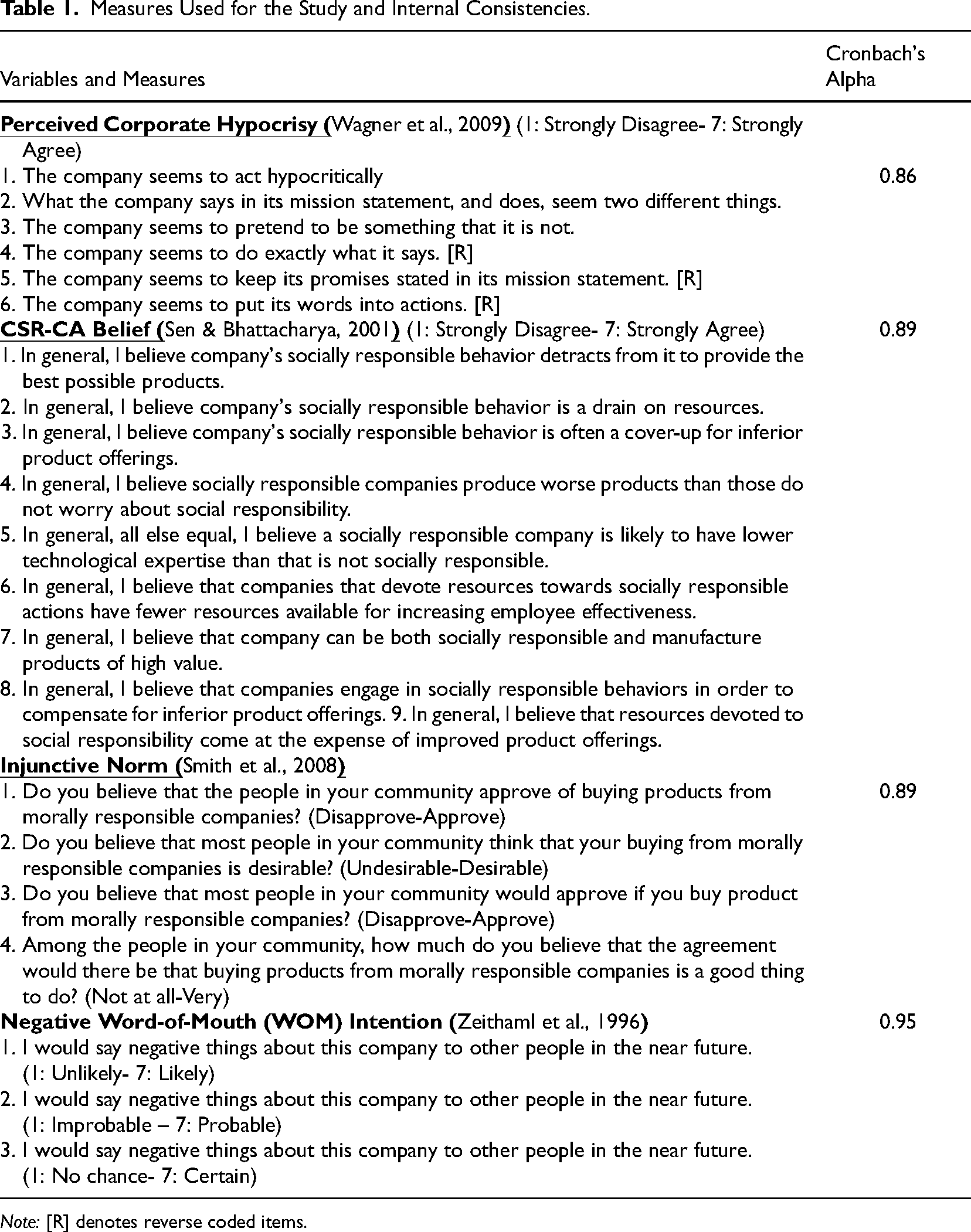
Note: [R] denotes reverse coded items.
Sample Selection, Procedure and Data Analyses
A sample of 538 adult U.S. consumers (controlling for equal gender distribution) was recruited online using a market-based research firm, Qualtrics in early 2019. Gender (male and female) was controlled to be equal to ensure generalizability of the study data to the majority of U.S. consumer groups. Participants completed demographic questions followed by CSR-CA beliefs and injunctive norms. Then they saw one randomly assigned message (out of the 8 stimuli messages) incorporating CSR claim and CSR activity, followed by questions about corporate hypocrisy and WOM intention. Participants answered two validity-check questions to indicate their appropriate level of attention to the survey (Bhaduri et al., 2017).
Before data analyses, data were subjected to independent samples t-tests to examine any difference in the two message versions used for incorporating message variance. Results indicated no difference in participants’ perceived corporate hypocrisy (t = -.104, p = 0.917), or WOM intention (t = 0.514, p = 0.215). This allowed us to merge data from the two message replication versions together. Final data analysis was conducted in two steps. First, ANOVA was conducted to test the effect of 2 CSR claims (presence/absence) x 2 CSR activity (presence/absence) x 2 CSR-CA belief (high/low) on perceived corporate hypocrisy. For ANOVA, participants were categorized into two groups (median split) based on their average CSR-CA belief scores to understand the difference in responses (if any) for participants belonging to high and low CSR-CA groups (Suri & Monroe, 2001). Of the 538 participants, 276 participants were categorized as having low (mean = 2.63, SD = 0.70), while 262 as high (mean = 4.71, SD = 0.93) CSR-CA belief (t = - 29.15, p < 0.001) (Suri & Monroe, 2001). In this light, high scoring group represented participants who believed CSR detracts from CA, while low scoring group believed CSR reinforces CA. Second, we employed PROCESS (Hayes, 2017) to assess the impact of perceived corporate hypocrisy on WOM intention, with the moderating effect of injunctive norm. PROCESS, a macro for SPSS, uses regression-based path analysis-based technique to test for multiple moderators and mediators using bootstrapped confidence intervals (bootstrapping). Bootstrapping was considered suitable for this study since it does not make any normality assumption on response distribution (as needed for causal approach to mediation) and does not require a large sample size (as needed for structural equation modeling), while providing high statistical power for the test (Hayes, 2017). Model 1, with one independent variable, one dependent variable and one moderator, was used for PROCESS. Injunctive norm was entered as a continuous variable since PROCESS allows for use of continuous variable as moderators.
Results
H1 posited that mismatch between a corporation's claim and its activities related to CSR activities increases consumers’ perceived corporate hypocrisy. After meeting homogeneity assumptions (Levene's statistic p = 0.06 to 0.45), three-way ANOVA results indicated that the interaction effect of CSR claim x activity was statistically significant (F [1, 530] = 4.24, p = 0.04). Specifically, highest corporate hypocrisy was observed in the CSR claim-absent/CSR activity-present case (mean = 3.70, S.D. = 1.10), followed by CSR claim-absent/CSR activity-absent (mean = 3.58, S.D. = 1.35), and CSR claim-present/CSR activity-absent (mean = 3.51, S.D. = 1.41). As expected, respondents formed the lowest level of corporate hypocrisy for CSR claim-present/CSR activity-present (mean = 3.19, S.D. = 1.16). Therefore, mismatch (compared to match) between CSR claims and CSR activities positively influenced (increased) corporate hypocrisy, supporting H1. In addition, CSR claims had a statistically significant main effect on consumers’ perceived hypocrisy (F [1, 530] = 7.31, p = 0.007). Corporate hypocrisy was higher for CSR claim-absent (mean = 3.64, S.D. = 1.23) than CSR claim-present (mean = 3.35, S.D. = 1.30) in the corporate mission. However, CSR activity, absent or present, on the other hand, did not have significant impact on perceived hypocrisy (F [1, 530] = 1.00, p = 0.32).
Second, H2 posited that the effect of mismatch between a corporation's CSR claim and its activities on consumers’ perceived corporate hypocrisy is moderated by consumers’ CSR-CA belief. Results indicated that CSR-CA belief moderated the CSR claim-CSR activity mismatch -and perceived hypocrisy relationship (three-way interaction effect of CSR-CA x CSR claim x CSR activity) (F [1, 530] = 7.28, p = 0.007, see Table 2). Upon further review, for mismatch conditions, the mean between participants with high and low CSR-CA belief was significantly different only for CSR claim-present/CS activity-absent (p <.001) but not for CSR claim-absent/CS activity-present (p = 0.06). In the CSR claim-present/CS activity-absent condition, participants in high CSR-CA belief group perceived higher corporate hypocrisy (mean = 3.58, S.D. = 1.08) than those in low group (mean = 3.45, S.D. = 1.61). However, for CSR claim-absent/CS activity-present, the means were similar for both high and low CSR-CA beliefs. Thus, H2 was partially supported.
Although not hypothesized, for the match conditions (CSR claim-absent/CS activity-absent and CSR claim-present/CS activity-present), the mean differences of hypocrisy between high and low CSR-CA belief were significantly different. For both cases, participants with high (compared to low) CSR-CA belief perceived higher corporate hypocrisy (p < .001). Hypocrisy was highest for CSR claim-absent/CS activity-absent for participants with high CSR-CA belief (mean = 3.80, S.D. = 1.21) and lowest for CSR claim-present/CS activity-present for participants with low CSR-CA belief (mean = 2.76, S.D. = 1.31) (See Figure 1 for group means).
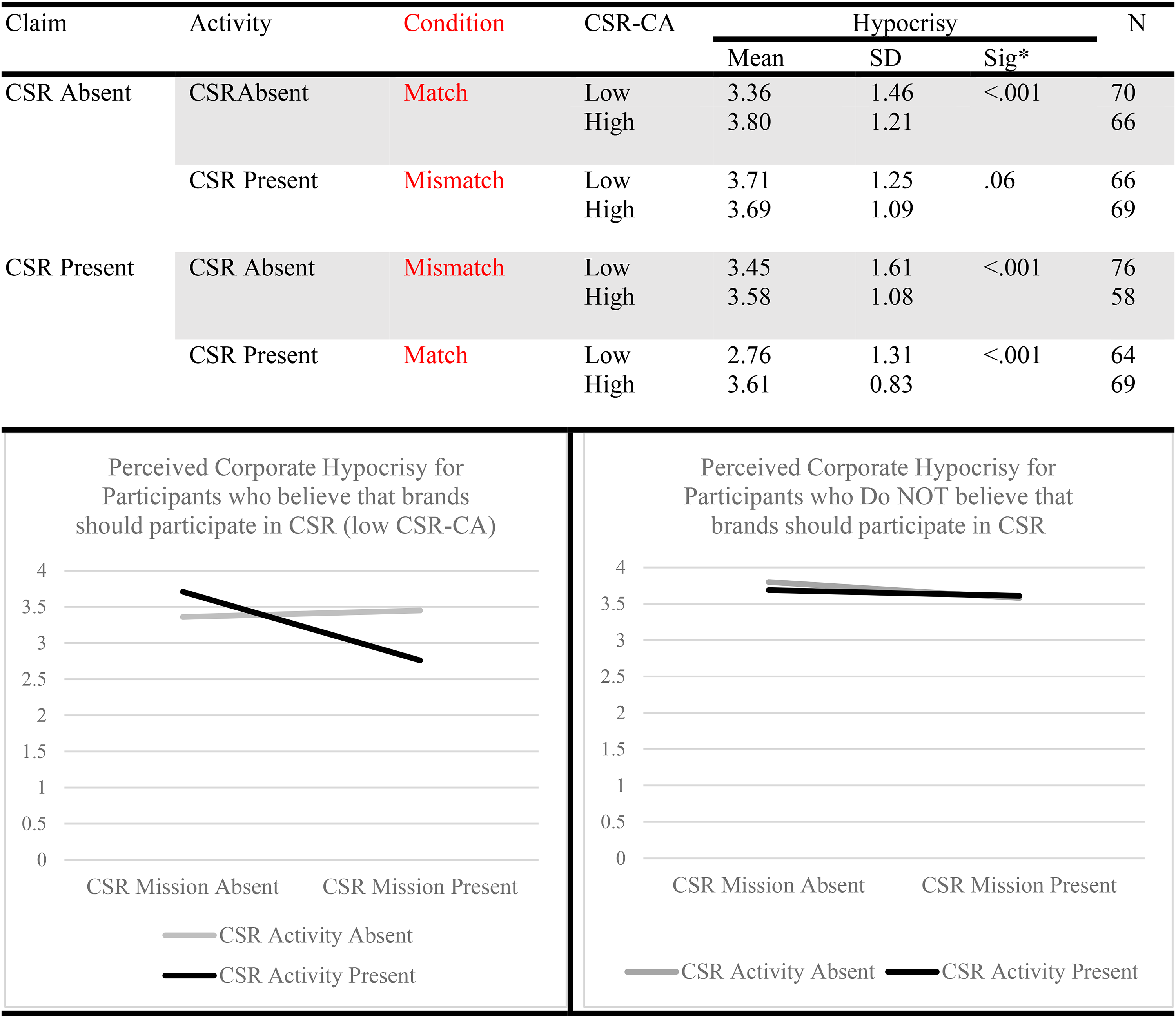
ANOVA group means of perceived corporate hypocrisy for claim X activity X CSR-CA belief.
In addition to the moderating effect, CSR-CA belief significantly impacted hypocrisy (F [1, 530] = 10.74, p = 0.001). That is, participants with higher CSR-CA belief perceived higher corporate hypocrisy (mean = 3.67, S.D. = 1.02) than those with lower CSR-CA belief (mean = 3.32, S.D. = 1.46). Figure 1 shows ANOVA mean differences for the three-way interaction.
H3 and H4 were tested through regression-based conditional process analyses using PROCESS macro. H3 posited that consumers’ perceived corporate hypocrisy positively influences their negative WOM intention about the corporation, while H4 posited that consumers’ injunctive norm moderates the effect of consumers’ perceived corporate hypocrisy on negative WOM intention. First, results indicated that corporate hypocrisy significantly influenced participants’ negative WOM intention (b = 0.376, p = .05, CI95 = 0.008, 0.759), supporting H3. Thus, higher the perception that a corporation is being hypocrite, higher was participants’ intention to speak negatively about the corporation to others. Second, there was a statistically significant interaction effect of corporate hypocrisy x injunctive norm (b = 0.065, p = .04, CI95 = 0.003, 0.126), indicating that injunctive norm moderated the relationship between hypocrisy and negative WOM intention. Thus, H4 was supported. This indicated that when the participants’ injunctive norm was higher (lower), their intention to talk negative about the corporation was higher (lower) when they perceived corporate hypocrisy. Figure 2 shows the moderation effect of injunctive norm on the relation between perceived corporate hypocrisy and negative WOM intention. Figure 3 shows the conceptual model and hypothesis test results of the study.
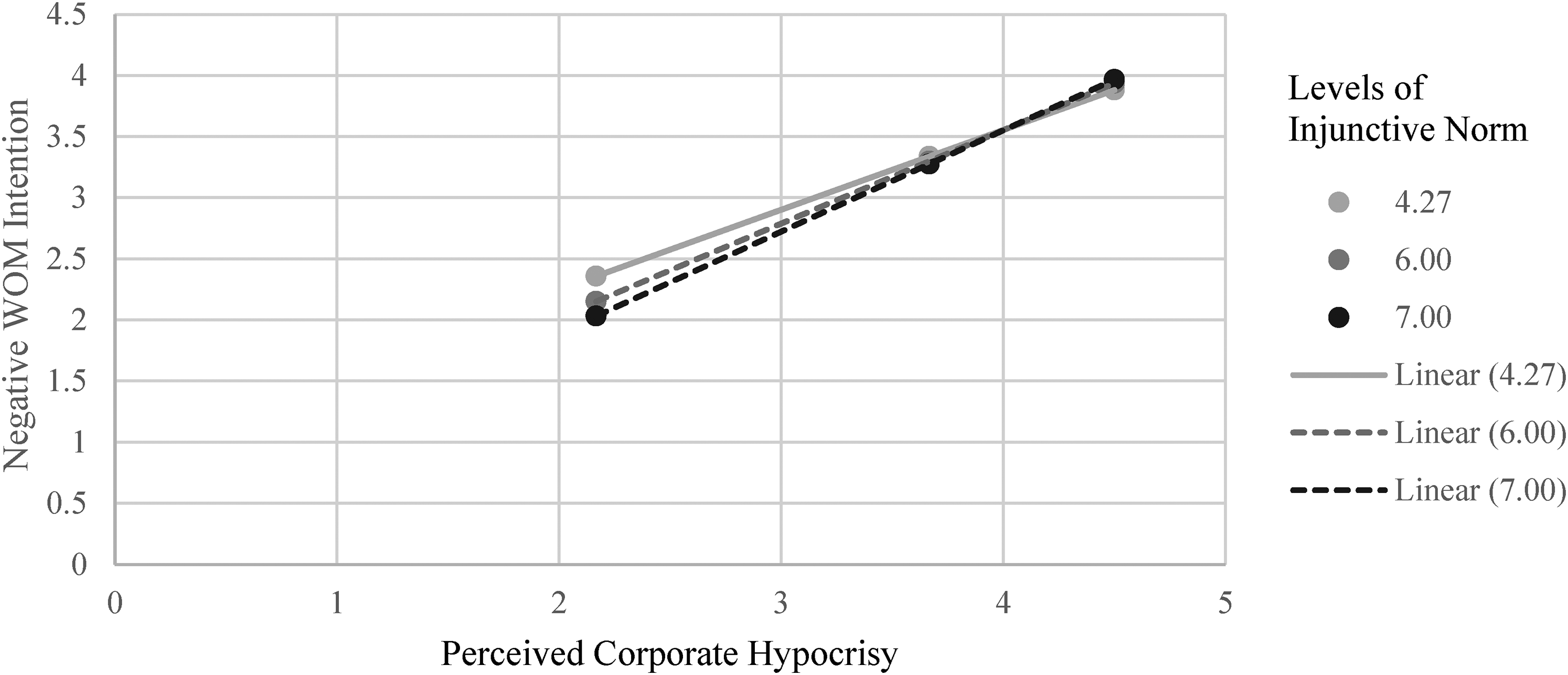
Moderating effect of injunctive norm in the relationship between perceived corporate hypocrisy and negative WOM intention (PROCESS rESULTS).
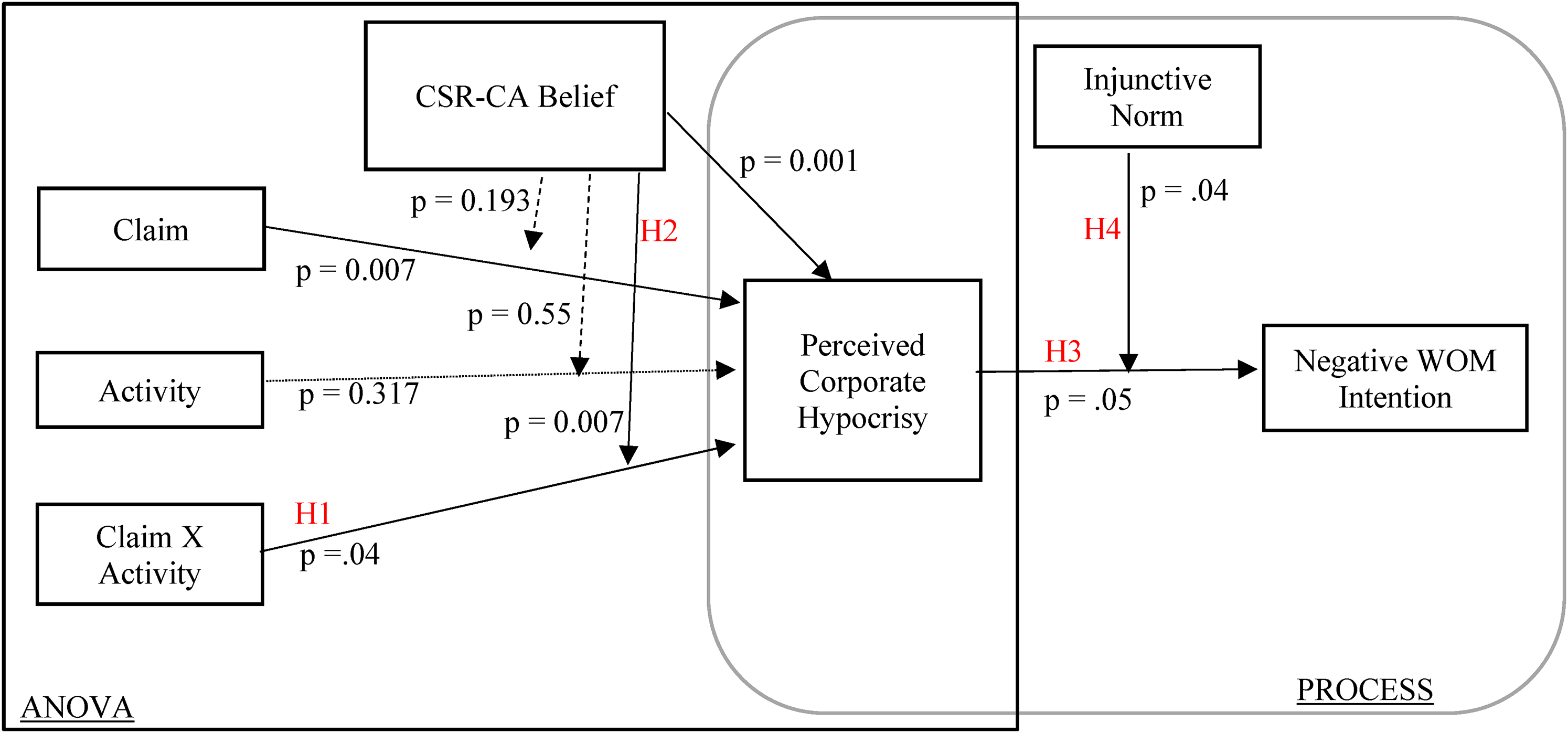
Conceptual model for the study.
Discussions and Implications
In this study, we focused on understanding how (mis)match between a corporation's CSR claims and activities leads to consumers’ corporate hypocrisy and how consumers’ CSR-CA beliefs moderate the relationship between the two. Particularly this research analyzed the difference in corporate hypocrisy between consumers with high and low CSR-CA beliefs. In addition, we examined the impact of consumers’ perceived corporate hypocrisy on their negative WOM intention and how participants’ injunctive norm impacts the relationship between the two.
The study has several key findings and therefore, theoretical and practical implications. First, irrespective of what CSR activities a corporation undertakes, whether a corporation mentions CSR claims in their mission significantly impacted participants’ hypocrisy perceptions. Even if the company only showcases CSR activities they undertake but does not mention CSR in its mission, participants’ corporate hypocrisy did not change. That is, participants perceived less hypocrisy when CSR is truly a fundamental mission of the corporation. This finding was consistent with Jung et al. (2020) in that the companies’ core CSR claim is critical for not creating consumers’ perceived hypocrisy regardless of ability or records of their CSR activities.
Second, when looking at the significant interaction effect of CSR claim x activity on corporate hypocrisy, participants perceived the highest level of corporate hypocrisy when there were no CSR claims in corporate mission but the companies boasted their CSR activities, while they perceived the lowest level of hypocrisy when both CSR claims and activities are discussed in the mission statements. Consistent with the findings in Jung et al.'s (2020) study, the actual CSR activities might not matter to participants much, unless such CSR activities are carefully planned and mentioned in the company's core mission statement. Indeed, undertaking CSR activities that are planned and aligned with corporate mission led consumers to perceive them as less hypocritical.
The above two findings have significant implications for industry professionals. Based on the study results, irrespective of what CSR activities corporations are actually able to undertake, corporate managers need to ensure that CSR initiatives are embedded into the core claims of the corporation as one of their fundamental goals. Undertaking CSR activities without embedding CSR as a corporate claim may be seen as sporadic and intermittent, and not a core value of the corporation, leading to unfavorable consumer evaluations. However, when corporations do embed CSR as a fundamental goal, they need to follow through and undertake activities that fulfil their CSR goals, to garner favorable consumer responses, or would risk negative evaluation.
The third finding from the study was that CSR-CA belief moderated the effect of CSR claim-CSR activity mismatch on corporate hypocrisy. Specifically, for the mismatch condition of CSR claim-present/CS activity-absent, participants who believed that CSR detracts from CA were able to reinforce their skepticism, thereby perceiving higher corporate hypocrisy than those who believed CSR reinforces CA. However, no statistical mean difference between high and low CSR-CA consumers was observed for the mismatch condition, CSR claim-absent/CS activity-present. In addition, for the match conditions (CSR claim-absent/CS activity-absent and CSR claim-present/CS activity-present), participants who believed that CSR detracts from CA perceived higher corporate hypocrisy than those who believed that CSR reinforces CA. All of these results suggest that brands’ sustainability-related messages and claims only matter when the consumers believe that the brands need to participate in CSR. That is, if the consumers do not believe CSR is important, then it does not matter whether the brands are talking about CSR or acting upon their CSR claims.
In addition, the participants’ CSR-CA belief had a significant impact on their corporate hypocrisy. Participants with higher CSR-CA belief resulted in a higher level of corporate hypocrisy. This finding is in line with the previous finding that consumers who believe that corporations trade off their CA development by participating in and contributing resources towards CSR activities generally evaluate a corporation more negatively. They are skeptical of the company's CSR initiatives, tend to view that such initiatives come with a commercial cost as well as have ulterior commercial motives, and therefore, are more likely to form corporate hypocrisy (Deng, 2012; Sen & Bhattacharya, 2001).
Thus, understanding consumers’ CSR-CA beliefs has important implications for practitioners. While market research suggests that consumers prefer corporations that undertake CSR initiatives, brands interested in engaging with consumers regarding their CSR initiatives must be aware that CSR messages and activities are only important for the consumers who already believe CSR is an important mission for companies to fulfil. An understanding the core consumers’ value would be critical before creating CSR-related communication strategies and investing in CSR related initiatives. Therefore, corporations undertaking CSR initiatives need to educate consumers as to how they are balancing such initiatives with their financial bottom-line. That being said, the study results also indicated that when there is mismatch between corporate CSR claim and activity, both high and low CSR-CA consumers perceived similar levels of corporate hypocrisy. This may further allude to the fact that embedding CSR as a fundamental goal of the corporation that is well thought out and strategic than intermittently undertaking CSR activities is important. By doing so, corporations are better able to formulate plans that benefit all their bottom lines.
Finally, results indicated that corporate hypocrisy significantly influences participants’ negative WOM intention. Thus, higher (lower) the perception that a corporation is hypocrite, higher (lower) was participants’ intention to speak negatively about the corporation to others. This finding is in line with the literature indicating that corporate hypocrisy negatively impacts consumers’ evaluations of and relationships with the corporation (Cour & Kromann, 2011; Wagner et al., 2009). However, the effect of corporate hypocrisy on negative WOM intention was moderated by participants’ injunctive norm. That is, when the participants’ injunctive norm was higher (lower), their intention to talk negatively about the corporation was higher (lower) when they perceived corporate hypocrisy.
This finding implies that when proactive management of negative WOM is critical in today's society when negative information can easily spread through social media. Therefore, watching out for consumers who have high injunctive norms would be critical for companies to limit negative publicity. Although it was beyond the scope of the study to investigate how businesses can segment consumers based on their injunctive norms and cater CSR initiatives to meet their needs, it may be worthwhile to focus on how social rewards and/or punishments associated with supporting corporate CSR initiatives would garner favorable responses from consumers with high injunctive norms. Overall, all of these results provide the strategies of integrated brand promotion and communication when it comes to CSR initiatives.
Overall, the findings support MRCS and reiterate that corporations indeed need to plan CSR as its fundamental goals which should be implemented and executed under all circumstances. While consumers now-a-days are interested in CSR efforts, they tend to evaluate a corporation less positively when CSR activities are without any strategic goal. The findings of the study support MRCS theory by indicating that companies may benefit from incorporating CSR as a fundamental responsibility that is embedded in their mission, rather than taking CSR actions without strategic corporate goals. In addition, it extends MRCS theory by incorporating consumers’ CSR-CA tradeoff belief as a moderator on the relation between CSR clam/activity mismatch and corporate hypocrisy. Further, the study also investigated the consequences of corporate hypocrisy and showed that it impacts consumers’ negative WOM intention, which is moderated by their injunctive norms.
Limitations and Scope for Future Research
The study has a few limitations, which provide opportunities for future research. First, generalization of study results should be made with caution since the study sample comprised of only U.S. consumers. Additional research including global consumers, from both developing and developed economies, may yield different results. Second, the stimuli materials did not include any company name to control for the effect of familiarity. While this enabled the researchers to strengthen internal validity, it was a compromise with external validity, given consumers most often engage with brands that are familiar to them. Therefore, future experiments using both familiar and unfamiliar apparel companies will beneficial. Third, this study focused on apparel companies in which the company's CSR claims and activities were manipulated. However, consumers’ expectations towards CSR goals and activities may differ by industry. Considering that the apparel industry is labor intensive (Kunz et al., 2016), it might be reasonable that consumers expected that apparel brands must provide good working conditions for employees as a fundamental responsibility. This might be different for other industries, such as food/restaurant, because other CSR goals and activities such as transparency or product origins may impact consumers’ health and safety directly than apparel would. Finally, as an indication of consumers’ intention, which has the power to predict behavior, this study measured negative WOM intention. While negative WOM is more impactful for influencing consumer behavior than positive WOM, literature indicates that consumers also take part in positive WOM to convey to their peers their positive corporate experiences. While it was beyond the scope of the study to measure positive WOM intention, future studies understanding the balance between positive and negative WOM would be useful.
Footnotes
Declaration of Conflicting Interests
The author(s) declared no potential conflicts of interest with respect to the research, authorship, and/or publication of this article.
Funding
The author(s) received no financial support for the research, authorship and/or publication of this article.
