




Abstract
Philanthropic activities have gained paramount importance in today’s world. The purpose of this paper is twofold. Firstly, the authors propose a model to comprehend the process of philanthropy (corporate as well as celebrity) in creating word of mouth intentions (hereafter WoM). Secondly, it attempts to explore the interaction effects of these philanthropies on WoM intentions. A structural equation model is tested in a sample of 400 FMCG consumers in Pakistan. The results confirm that both corporate and celebrity philanthropy directly and positively affect WoM intentions. However, their interaction effect is found to be insignificant on WoM intentions. This study has meaningful implications that involving philanthropic celebrities in corporate philanthropy-based advertisements may garner favorable consumers’ WoM intentions. It lies among the pioneering studies to empirically investigate the understudied model of corporate and celebrity philanthropy in order to understand the creation of WoM intentions.
Keywords
Introduction
Under the umbrella of corporate social responsibility, a great deal of attention has been paid to philanthropic activities and their effects on consumer behavior (Han et al., 2019). In times of such intense competition, firms tend to invest in philanthropic activities that may cause the spread of positive word of mouth (hereafter WoM) about the firm and/or its products/services (Basri et al., 2016). Along this vein, Gautier and Pache (2015) argued that corporate philanthropy may act as an important tool in creating positive WoM intentions among consumers. Similarly, Kim et al. (2011) and Siyal et al. (2019) argued that due to the propagation of corporate philanthropic activities through advertisements, firms may be able to garner favorable consumers’ responses regarding WoM intentions. Recently, it has been reported that consumers’ evaluations of firms are heavily influenced by their philanthropic engagements (Langan & Kumar, 2019). It is argued that the prevalent intense competition compels firms to engage and invest in philanthropic activities in order to build positive consumer perceptions (Bhattacharya & Sen, 2003). However, it has been noted that corporate philanthropy remains largely unexplored in the marketing literature (Plewa et al., 2015). Therefore, the first objective of this study is to investigate the impact of corporate philanthropy on WoM intentions.
In addition to firms’ philanthropic activities, there has been a recent proliferation of celebrities’ involvement in various philanthropic activities. For instance, (i) Michael Jordan who is known as a businessman and basketball player donated 2 million US dollars to the Hurricane Florence Relief Fund, (ii) the Yetunde Price Resource Centre that is run by Serena Williams (a famous tennis player) donated millions to violence prevention, education, and athletic engagements among the locals, and (iii) the famous Sports Leadership and Management Academy (SLAM) that is run by Pitbull (a famous rapper) finances opportunities to disadvantaged youth in Miami (Robbins, 2020). Likewise, celebrity philanthropy is also famous in the Asian context. For example, (i) Zindagi Trust that is run by the famous Pakistani singer Shahzad Roy, works for improving the education quality and making it available to every Pakistani and (ii) Shahid Afridi Foundation that is run by the famous cricketer Shahid Afridi, aims to provide basic healthcare, education, and sports facilities to the under privileged people of Pakistan (Salman, 2017), and (iii) the Yuvraj Singh Foundation that is run by the famous Indian cricketer, aims to create awareness about cancer and educating people about the deadly disease (Sachdeva, 2019). It sounds logical that the involvement of celebrities in philanthropic activities receives profound media publicity in social as well as conventional platforms (Hassid & Jeffreys, 2015). Along this vein, Ilicic and Baxter (2014) argued that celebrity philanthropy can be termed “celanthropy” and defined as the “perceived philanthropic activities of a celebrity.” Similarly, Yang et al. (2019) argued that celebrity philanthropy refers to the activities of celebrities that are undertaken for charitable purposes. Importantly, several scholars have argued that a firm’s engagements in philanthropic activities may create an added advantage of marketing campaigns if they engage such celebrities who are involved in philanthropic activities (Ilicic & Baxter, 2014; Ilicic & Webster, 2011, 2015; Wood & Burkhalter, 2014). The synergy of the two (corporate as well as celebrity philanthropy) may help in creating favorable consumer responses such as WoM intentions. In order to bolster their social character, firms tend to involve celebrities in their marketing campaigns who are actively engaged in philanthropic activities. The engagement of celebrity philanthropy in marketing campaigns may be due to the fact that it is viewed as a growing and highly mediatized phenomenon (Hassid & Jeffreys, 2015). Therefore, the second objective of this study is to investigate the impact of celebrity philanthropy on WoM intentions.
It is commonly understood that consumers tend to be enormously inspired by philanthropic actions and feel themselves psychologically associated with a philanthropic firm and/or philanthropic celebrity (Ilicic & Baxter, 2014; Wood & Burkhalter, 2014). This notion supports the social identity theory (SIT) proposed by Tajfel et al. (1979). This particular group/trait (in this case, philanthropy) becomes their identity and they tend to affiliate themselves with individuals and organizations who share a similar social identity (Cargile & Bolkan, 2013). Ambroise and Albert (2020) suggest that considering consumers’ relationships with both the brand and the celebrity may provide complementary information on the effects of celebrity endorsement. Therefore, firms’ philanthropic activities, bolstered by their engagement of philanthropic celebrities, may create favorable images in consumers’ minds. These positive and favorable images may induce positive feelings and emotions among consumers to remain connected and spread positive WoM about the firm having a socially responsible image (Fatma et al., 2018). However, there appears to be limited research on the role of corporate philanthropy and celebrity philanthropy in creating positive WoM intentions among consumers. Therefore, the authors intend to propose and validate a model to comprehend the process of philanthropy (corporate as well as celebrity) on creating WoM intentions. Taking into account the aforementioned arguments, the third objective of this study is to identify the interaction effects of corporate and celebrity philanthropy on WoM intentions.
Literature Review and Hypotheses Development
The research on corporate philanthropy has increased progressively in the past 40 years. Currently, corporate philanthropy is becoming an integral part of strategic marketing tools (Walker & Kent, 2013). It is defined as “the donations that are voluntarily given by a corporation in charity based causes” (Gautier & Pache, 2015, p. 344). In addition to this, corporate philanthropy can be defined as “voluntarily performed actions in which portion of the corporate resources is donated in societal causes” (Ricks & Williams, 2005, p. 147). It is understandable that different types of philanthropic activities push academics and marketing managers to evaluate consumers’ perceptions on how different types of corporate philanthropy shape corporate reputations in national as well as international contexts (Szőcs et al., 2016).
According to Nickel and Eikenberry (2009), philanthropic actions are preferred when there is a state of poverty, disease, or destruction of society. However, to achieve higher profits as well as to make a place in a consumer’s heart, one also needs to pay attention to other innovative aspects of corporate philanthropy (Wood & Burkhalter, 2014). Firms can elicit positive consumer responses by developing a solid relationship with the consumer through sustainable business practices (Abbas et al., 2018). In this regard, whenever philanthropic activities are performed, consumers tend to develop positive responses toward that firm (Khan et al., 2015; Shah & Khan, 2020, 2021). This is in line with the premise of social identity theory (SIT; Tajfel et al., 1979), where a person’s group membership determines the sense of identity which gives a sense of belonging to the social world. Corporate philanthropy has not gathered as much attention and interest as it deserves (Kim et al., 2011). Further investigation is needed to study its impact on WoM intentions. Based on this, the authors propose the first research hypothesis:
Undoubtedly, firms currently not only want to become socially responsible, but also attempt to advertise their corporate philanthropy in order to create positive feelings in consumers’ minds (Szőcs et al., 2016). For advertisements, they use celebrities. A celebrity can be defined as an individual who becomes famous in the general public because of their achievements. Celebrity endorsement is commonly used by marketers because consumers pay attention, believe in famous and recognizable people, who attract greater attention than a non-celebrity endorser (Erdogan, 1999). Celebrities are well-known, famous entities, resulting in long-term and more accessible representations in the memory (Erfgen et al., 2015; Roy et al., 2019). Presently, with the increasing popularity of reality television shows and numerous social media channels (e.g., YouTube, Facebook, and Twitter), the definition of a celebrity has been expanded. “Ordinary” people who feature on reality shows can become famous and be perceived as celebrities (Roy et al., 2019; Yang, 2018). Using a celebrity for brand endorsement thus seems somewhat paradoxical. When consumers compare themselves to celebrity endorsers, their emotional reactions may not necessarily depend on a celebrity’s status but rather on how consumers assess their situation. Celebrity involvement can also induce negative emotions among consumers. A consumer who believes that he or she is less successful or attractive than a celebrity is engaged in a process of contrast and can experience negative emotions (jealousy, decrease in self-esteem). Through endorsement, these negative emotions can be transferred to the brand and exert a negative influence on the consumer’s attitude toward it (Ambroise & Albert, 2020).
Tom et al. (1992) found that product and celebrity both have an influence on positive consumer feelings and perceptions. As argued by Arsena et al. (2014), when a celebrity is paired with a product that is associated with a cause of kindness (e.g., children’s charity, breast cancer awareness, etc.), the celebrity might be viewed as more caring and kind, that is why the matchup between celebrity, product, firm, and charity is important. More specifically, researchers like Ilicic and Webster (2015) started a relatively new line of research and stated that using celebrities who are engaged in marketable philanthropic activities is an attractive and effective way of grabbing consumers’ attention. They posited that firms that enlist celebrities in their advertisements have a competitive advantage to differentiate their brands from competitors.
Meanwhile, individuals admire firms’ donations, funding, and arranging local events or energy conservation along with other progressive steps, which may result in strong bonding and loyalty toward the companies involved (Maignan & Ferrell, 2001). When a celebrity is attached to a product/firm, it possesses a greater likelihood of positive WoM or positive consumer attitudes (Aw & Labrecque, 2020; Ilicic & Webster, 2015). However, this would be an interesting phenomenon for researchers if a celebrity is also involved in philanthropy (Ilicic & Baxter, 2014). Despite most research being published in the celebrity endorsement field, investigation on the impact of celebrity philanthropy on WoM intentions still appears to be understudied in the literature. Therefore, the authors present the second hypothesis of this study:
Philanthropic activities involve social aspects, which can be related to the environment, societal causes, corporate giving, and community development (García de Los Salmones et al., 2005). Previous scholars like Wang et al. (2013) showed the impact of corporate philanthropy on consumer responses (consumer feelings, emotions, and perceptions). Philanthropy affects consumer responses (i.e. WoM and/or purchase intentions, etc.). It has been argued that charitable contributions (by a firm or celebrity) may enable firms to mould consumer perceptions, which may lead to positive WoM (Brammer & Millington, 2006).
It is an important research question whether celebrities who are involved in charitable activities will add value in corporate philanthropy-based advertisements or not? When a celebrity endorses a product/brand, images of the celebrity and the product/brand occupy one’s memory and gradually become connected through the process of endorsement. Consequently, feelings and attitudes toward the celebrity are transferred to the endorsed product/brand through repeated exposure (Yang, 2018). Previous research has initiated the concept of celanthropy and argued that philanthropic celebrities create an impact on consumer attitudes (Ilicic & Baxter, 2014). Along this line, few scholars conceptualized a strategic fit between corporate philanthropy and celebrity philanthropy (Ilicic & Webster, 2011, 2015). Therefore, it is an important question for academics and marketing managers whether an interactive effect of corporate and celebrity philanthropy will create an impact on WoM intentions or not. The authors propose the following hypothesis:
Figure 1 shows the proposed model of this paper. This section introduces a framework for identifying consumer attitudes (WoM) toward philanthropy (corporate and celebrity). This is consistent with previous studies such as Zhou and Whitla (2013), who used a similar type of methodology (vignette).
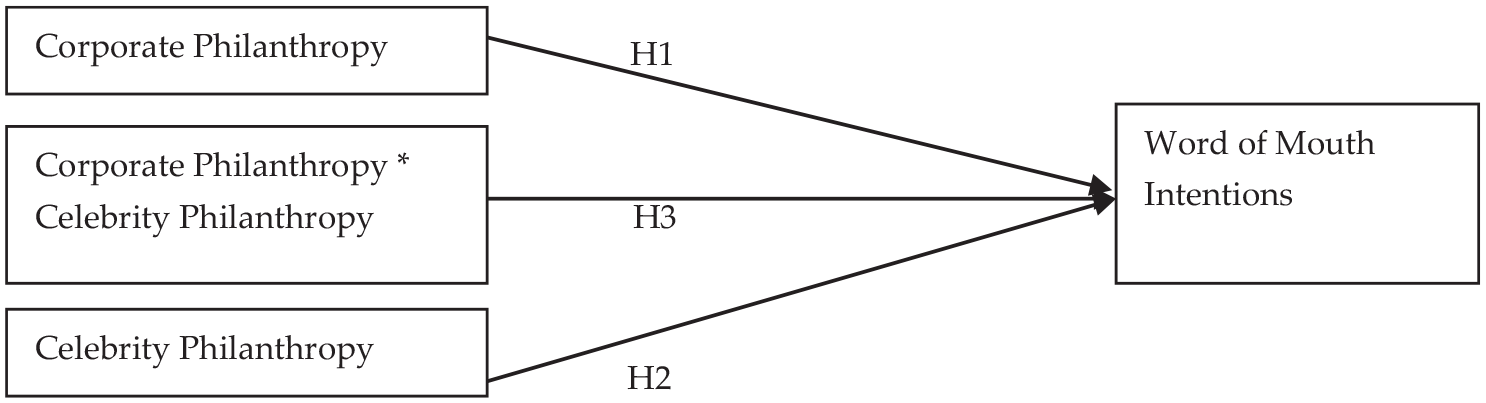
Theoretical framework.
Methodology
Measurements
All of the items were adapted and/or developed from the established literature. To measure the construct of corporate philanthropy, a 4-item scale was adapted from Garcia de los Salmones et al. (2005). In order to measure the construct of celebrity philanthropy, the authors developed a 4-item scale that was built on the basis of the idea of philanthropy from Carroll (1979) and Maignan and Ferrell (2001). A 3-item scale of WoM was derived from the established behavioral intention battery of Zeithaml et al. (1996). Minor changes were made to a few scales in order to make them more suitable for the specific requirements of this research. All of the items were measured on a 7-point Likert scale ranging from strongly disagree to strongly agree.
Sampling Design and Data Collection
In order to comply with the research objectives and evaluate the research hypotheses, the researchers designed a survey approach using a convenient sampling design. Respondents were asked to read a vignette related to a famous Pakistani cricketer (Sportsman) who owned a famous national charity foundation. Simultaneously, he was being used as a celebrity endorser in an anti-dandruff shampoo advertisement of a leading multinational company. The idea of selecting a sports celebrity was taken from the work of Ilicic and Baxter (2014) and Hassid and Jeffreys (2015), and this idea of a vignette-based survey was adapted from previous studies such as Zhou and Whitla (2013).
In Pakistan, corporate as well as celebrity philanthropies are eminent on a large scale. It is evident from the fact that Pakistan, as a nation, is known for its positive attitude toward charity and philanthropic activities. This notion is also supported by the recent corporate giving index (CGI) generated by the Charities Aid Foundation (CAF, 2018) that ranked Pakistan in the eighth position among countries donating money for charities. Almost all corporate sectors of the economy in Pakistan are involved in active philanthropy as well as engaging philanthropic celebrities in their marketing campaigns, and this trend is highly visible in the FMCG sector.
This vignette-based survey was completed by university students. It was assumed that students get to know about celebrity activities and corporate charity campaigns before other populations due to their specific age segment as well as their increased usage of social media. They also know about sustainability issues such as clean drinking water (water wells and hand pumps), natural disasters, educational scholarships for students, raising funds for hospitals, etc. A pre-test was conducted for all of the items, especially celebrity philanthropy, and reviewed by at least one external marketing expert who had several years of corporate and academic experience in the marketing field. This process was conducted in order to detect any unfamiliar and irrelevant terms that might disrupt the validity of the construct.
The respondents were students of higher education institutions in Lahore, which is the second-largest city in Pakistan. The students were approached based on a convenience sampling approach. A total of 420 survey questionnaires were distributed among the respondents and 418 were returned (response rate 99.52%). The higher response was due to the presence of a course instructor in the class who was requested to get the filled questionnaires from the students. However, it was mentioned in the disclaimer and also told to the students at the time of data collection that there are no risks associated while filling this survey as well as no response score selection can be treated as correct or wrong. Questionnaires were self-distributed and collected, which is why the response rate was high. After the initial screening of the data, a total of 400 valid surveys were included in the final sample size used for data analysis. Data were collected from male/female students of different age groups, who were enrolled in different undergraduate and postgraduate degree programs. From the perspective of respondents’ gender, 52.8% (211/400) were male, while 47.2% (189/400) were female. This gender ratio was consistent with the national gender ratio mentioned in census demographics in 1998 (i.e., 52.03% male, 47.97% female) (Pakistan Bureau of Statistics, 2017). Regarding age groups of respondents, 12.5% (50/400) were under 20 years of age, 66.3% (265/400) were between 20 and 25 years of age, while 21.3% (85/400) were between 25 and 30 years of age. From the perspective of students’ current enrolment in undergraduate and postgraduate programs; 52.3% (209/400) were enrolled in undergraduate programs, while 47.8% (191/400) were enrolled in postgraduate programs.
Assessment of Common Method Bias (CMB)
Since the authors used a paper-pencil-based survey method approach, the collected data could be susceptible to common method bias (Podsakoff et al., 2003). In order to critically control and assess common method bias, Podsakoff et al. (2003) recommended various procedural and statistical remedies. The authors of this research adapted a few procedural and statistical remedies in light of the recommendations of Podsakoff et al. (2003). Firstly, all of the items on the questionnaire were adapted from previous literature. Secondly, all the items were reviewed and pre-tested by experts to avoid irrelevant and unfamiliar terms. Thirdly, in the vignette-based questionnaire, stories were given to better understand the scenario. Fourthly, data were entered in Excel and later processed in SPSS. Fifthly, the respondents were from different universities. Finally, CMB was statistically tested in SPSS by applying Harman’s one-factor test for the whole model (Chang et al., 2010). An unrotated principal component factor analysis was performed; the total variance explained was found to be 41%, which was less than the majority of the variance. Consequently, CMB was not a concern in this study.
A structural equation modeling technique was applied to evaluate the measurement model and hypotheses testing. AMOS graphics, version 4.0 was used for path modeling and data analysis.
Findings
In order to assess the underlying patterns of the constructs and for data reduction, exploratory factor analysis (EFA) was carried out. EFA was conducted to check the dimensions of the constructs. The KMO value was found to be 0.846. This proposed model’s constructs accounted for 55.378% of the total variance, which was higher than the minimum recommended value of 50%. Promax rotation was applied in order to run EFA. According to Hair et al. (2011), item loadings of 0.30 for a sample size greater than 350 are considered significant. All of the item loadings in Table 1 were above the minimum threshold value of 0.30. The EFA item loading of CorpP4 was found to be 0.281; therefore, it was excluded from further data analysis.
Exploratory Factor Analysis.

The structural model was evaluated with the help of the R² value. R² values of 0.75, 0.50 or 0.25 for endogenous latent variables are considered as high, moderate or weak, respectively (Hair et al., 2011). However, in consumer behavior studies, lower R² values such as 0.20 can be considered satisfactory (Hair et al., 2011). The R² values obtained in this research were found to be satisfactory as they ranged from 0.35 to 0.7.
A first-order confirmatory factor analysis (CFA) was carried out with the constructs of corporate philanthropy, celebrity philanthropy, and WoM intentions, which showed the optimum results. For convergent validity, the researchers needed to examine the average variance extracted (AVE) and standardized lambda. Cronbach’s alpha values of .70 (above or near) are recommended for a construct’s reliability (Hair et al., 2011). The criterion of acceptable convergent validity is achieved when the standardized lambda is higher than 0.5 in every case. Meanwhile, the benchmark for convergent validity is the value of the AVE which should be more than 0.50 for each construct (Bagozzi & Yi, 2012) and in this research, the AVE of all three variables were found to be higher than 0.5. Composite reliability tells about the reliability of the construct. The value of composite reliability of every construct should be greater than 0.60 (minimum recommended value) to achieve construct reliability (Bagozzi & Yi, 2012), while values below 0.60 indicate a lack of reliability. The composite reliability of all constructs was found to be higher than 0.7, showing the strong reliability of the proposed framework. For reliability and validity results, see Tables 2 and 3.
Confirmatory Factor Analysis.

Convergent and Discriminant Reliability and Validity.

Bold values are the square root of AVE.
The hypothesized model and the observed data have a good fit between them if the model has a cut-off value above 0.90 for CFI, and below 0.08 for RMSEA (Hu & Bentler, 1999). Global goodness-of-fit (GOF) emphasizes theory testing in spite of theory building, Global GOF can be used to assess CB-SEM results (Anderson & Gerbing, 1988). Hu and Bentler (1999) suggested that there are many indices, out of which it may be sufficient to rely on two (RMSEA and CFI). One can satisfy all four indices, which are more stringent (Fan & Sivo, 2005). In this research, the CFI was found to be 0.956, which was greater than the minimum value of 0.95; the RMSEA was found to be 0.075, which was according to the specified limit of less than 0.08.
Two other goodness-of-fit indices are GFI and AGFI. The range of both the goodness-of-fit index (GFI) and adjusted goodness-of-fit index (AGFI) varied from 0.00 to 1.00 inclusively. The acceptance of an index depends upon the sample size. No cut-off criteria exist for the GFI and AGFI (Bagozzi & Yi, 2012). The GFI was 0.949, whereas the AGFI was 0.913. These GOF values were considered satisfactory according to the criteria set by Bagozzi and Yi (2012). The GOF indices of the research model are also shown in Table 3.
Thus, strong evidence was found regarding the convergent and discriminant validity as well as high internal consistency in the research model.
Table 4 shows the accepted and rejected relationships of the proposed model with the help of t-values. Hypothesis 1 shows the relationship (β = .31; t = 6.717) between corporate philanthropy and WoM intentions. Hence, hypothesis 1 was accepted showing a positive and significant relationship between corporate philanthropy and WoM intentions. The results also supported the relationship (β = .34; t = 7.177) of celebrity philanthropy with WoM intentions; hence, hypothesis 2 was also accepted. Hypothesis 3 showed an interaction effect (β = .04; t = 0.977) of corporate and celebrity philanthropy with WoM intentions, which was rejected.
Hypotheses Testing.

Shows interaction effect and all hypotheses were measured at 5% level of significance.
Discussion
This research extends the corpus of philanthropy-related consumer behavior literature in two ways. Proposal and validation of a consumer behavior model to understand the process of philanthropy (corporate as well as celebrity) in creating WoM intentions is the first key contribution of this research. Moreover, the investigation of the interaction effects of corporate and celebrity philanthropy on WoM intentions is the second key contribution of this study.
With respect to the first objective of this research, the role of corporate philanthropy in WoM intentions has been studied. None of the previous research explored corporate philanthropy as a stand-alone construct in order to understand WoM intentions within consumer behavior literature. Therefore, the present research adds novel insights into the specific relationship between corporate philanthropy and WoM intentions in this context. Along this vein, Szőcs et al. (2016), in their study in Egypt, argued that philanthropic activities have the ability to strengthen the consumer–firm relationship. Consistent with the aforementioned arguments, the present research confirms and validates that corporate philanthropy has a positive and significant impact on WoM intentions.
Similarly, with respect to the second objective of this research, the relationship between celebrity philanthropy and WoM intentions has received less scholarly attention in the consumer behavior literature. The authors appreciate the fact that celebrity philanthropy has boomed in recent decades and there have been research studies investigating the role of celebrity endorsement on outcome variables such as Jeffreys (2015) and Hassid and Jeffreys (2015) who argued that celebrity philanthropy is important because it attracts media publicity and therefore public attention. Many marketers are turning to celebrities (both traditional celebrities and new social media influencers such as vloggers) in order to spread awareness of their products in less intrusive and more trustworthy ways. At the same time, consumers are increasingly turning to social media channels to learn about new products (Aw & Labrecque, 2020). However, only limited studies have explored the relationship between celebrity philanthropy and consumer behavior (Ilicic & Baxter, 2014).
Based on the premise of social identity theory (SIT) (Tajfel et al., 1979), a person’s group membership determines their sense of identity which gives a sense of belonging to the social world. It further posits that a social group is a set of individuals who hold a common social identification or view themselves as members of the same social category (Stets & Burke, 2000). In this vein, marketing scholars have argued that individuals tend to develop a sense of attachment with a firm that shares a similar identity. In a similar vein, the current study establishes the understudied relationship between celebrity philanthropy and WoM intentions. The authors of this study argue that consumers affiliate themselves with a corporate entity, brand, or celebrity. Having a particular social identity means being at one with a certain group, being like others in the group, and seeing things from the group’s perspective (Stets & Burke, 2000; Tajfel et al., 1979). The current study contributes to this vein of research by establishing the understudied relationship between celebrity philanthropy and WoM intentions. In this study, consumers affiliate themselves with a corporate entity, brand, or celebrity. Moreover, these findings are also consistent with social identity theory as consumers tend to develop affiliations with firms having a similar identity.
With respect to the third objective of this research, the paper attempted to explore the interaction effect of corporate and celebrity philanthropy on WoM intentions. This relationship was found to be positive but insignificant. This study does add to the start of a debate in the marketing literature, whether a philanthropic celebrity can create a synergizing effect in corporate philanthropy-based advertisements for the creation of consumers’ WoM intentions on not. Although, no significant or positively reinforcing relationship between the constructs was found, it was evident that the relationship does not tend toward a negative, opposing relationship for two main reasons. In this regard, despite the insignificant relationship, it did report a weak, but measurably positive path coefficient between these constructs. The authors present two plausible reasons for this insignificant result. Firstly, the results are tentative and may be due to a consumer’s perception of the reputation of a celebrity. Secondly, it may be due to the misfit among the celebrity, philanthropy, and advertisement by the firm (Ilicic & Webster, 2011, 2015). The authors argue that there should be a match between corporate and celebrity philanthropy, so that they may synergize the effect. Moreover, the necessary alignment between celebrity personality and philanthropic activity must be established, otherwise, it may lead to negative consumers’ evaluations of the firm as well as the philanthropic activity.
Managerial Implications
This study provides important managerial implications for practitioners. It demonstrates that corporate and celebrity philanthropy alone play important roles in creating positive WoM intentions. Marketers must pay attention to corporate and celebrity philanthropy in designing marketing campaigns. The current study reveals that consumers tend to have positive perceptions about social events, and they tend to support, sponsor, and finance such activities. Furthermore, marketers should focus on donations and charities targeted at consumer and societal well-being and managing public affairs. The study also reveals that marketers should pay attention to consumers who seek their advice regarding products. On the other hand, consumers pay less attention to friends’ or relatives’ suggestions to give charity funds to a specific company. Thus, it can be argued that firms need to invest in philanthropic and altruistic endeavors that are targeted to solving social problems, consumers’ and overall societal well-being. These activities will create positive perceptions among consumers and in turn, may develop positive WoM intentions among other fellow consumers. Managers need to incorporate the different options available in the form of corporate as well as celebrity philanthropic activities in their marketing programs, which will not only enhance their corporate image but may also contribute toward customer relationship management. Similarly, not-for-profit organizations may use the same tactics in improving their donations by developing a strong corporate image among potential donors.
Limitations
The present research is not free of limitations. Being a case study with a single scenario/stimulus is a limitation. The model was tested on a student sample, which limits its generalizability. Further, a larger sample in a real setting survey might also be beneficial to obtain more generalizable results. Furthermore, communication platforms are undergoing a transition from physical to digital spaces in general and the youth prefer to communicate over social media (Verma & Yadav, 2021). Therefore, a focus on eWoM could be a future avenue of research in philanthropic-based advertisements (Ruiz-Mafe et al., 2020; Verma & Yadav, 2021). Moreover, future researchers could include celebrity characteristics, consumer scepticism toward corporate philanthropy, and negative celebrity philanthropy as moderators to better comprehend the impact of philanthropies on consumer attitudes. Future researchers need to study and understand concepts such as attitude toward charities, attitude toward celebrities (and also this particular celebrity and his/her personal brand and his/her charity), and attitude toward celebrity endorsers for in-depth knowledge and analysis of philanthropies and their effects on consumer behavior.
Footnotes
Declaration of Conflicting Interests
The author(s) declared no potential conflicts of interest with respect to the research, authorship, and/or publication of this article.
Funding
The author(s) received no financial support for the research, authorship, and/or publication of this article.
