




Abstract
History reveals that the pathway toward carceral feminism was fraught with contradictions. Feminist reform strategies that appeared progressive devolved into mandates contributing to the policies of mass incarceration; frameworks meant to disavow racist myths of violence inherent to communities of color fueled color-blind narratives that cloaked white, middle-class-defined social movement priorities; safety strategies protecting survivors of violence entrapped them into set options violating the right to self-determination. Today’s account of carceral feminism reveals well-intentioned choices leading to often ill-fated outcomes. As the critique of carceral feminism seeps into the discourse of the feminist anti-violence movement, a shift toward new values, policies, and practices holds the possibility of radical new directions. However, there is no reason to assume that this new pathway will be so straightforward. This article centers the dynamic of contradiction to synthesize insights of post-Marxist thought in application to contemporary anti-carceral feminist trends represented by transformative justice options. It also reflects on the recent ascendance of restorative justice and a renewed potential for carceral co-optation. The aim is to illuminate troubled areas of revision and radical alternatives and better navigate inevitable ethical and pragmatic tensions that may define future social movement trajectories.
For now feminists must dance with the devil—demanding that the existing criminal justice system protect women from violence even as we criticize and work toward the abolishment of that system.
Matsuda (1996, p. 41) Social movements right now are…fractal, practicing at a small scale what we most want to see at the universal level. No more growth or scaling up before actually learning through experience.
brown (2017, p. 22)
Now, almost a quarter of a century later, the contradictions of tying an emancipatory strategy to the most masculinist and repressive arm of the state resound throughout the anti-violence movement as well as academic and popular discourse. The term, carceral feminism (Bernstein, 2005, 2012), has since emerged to define a decades-long feminist movement by its reliance on the carceral system of police, prosecutors, courts, parole, probation, jails, and prisons for the protection of women. Feminist consciousness raising located primarily within civil society fueled contentious demands for change. Each agitation created a new set of relations, expertise, and demands for legislation criminalizing sexual assault and domestic violence; improved medical and mental health response; and specialized police units and courts dealing separately with sexual assault and domestic violence (Kim, 2013). As critical legal theorists Brown and Halley (2002) warned, success against the state paradoxically transforms social movement victors into unwitting agents of the state. With these forms of contentious politics, “once you win, you are the state” (p. 10).
An emancipatory trajectory that could now be identified as anti-carceral feminism 2 emerged to take force as a strident new social movement at the turn of the millennium. Defined by its rejection of the tenets of carceral feminism and the positive construction of a politic and set of practices currently identified as community accountability or transformative justice (Kim, 2018), these social movement impulses harken back to the anti-lynching campaigns of Wells (Giddings, 2008; Wells, 2007), the queer, black, anti-capitalist organizing of the Combahee River Collective (1983), the first appeals to intersectionality in response to the dominant white anti-violence movement by Crenshaw (1989, 1991), and silenced voices that stretch back to this nation’s genocidal inception.
Now, 20 years of persistent and unyielding critique, a modest proliferation of decentered and local transformative justice-related formations, and ubiquitous recognition of the extent and consequences of mass incarceration have begun to permeate the public consciousness and weaken the hegemonic power of carceral feminism. We appear to be at a crossroads in which the machinery of carceral buildup and its intrusions into every facet of social life have been momentarily slowed by the set of anti-carceral or abolitionist logics and formations, rising in its most contemporary form since the turn of the millennium. Each trajectory has been driven by the elusive vision of liberation—the former drawn to the lure of legitimacy, the attainment of resources, and the promise of systems change. The latter has been nurtured by unearthed legacies of resistance and collective practices of governance, creative leveraging of resources, and intentional strategies of solidarity.
The focus of this article is on the dynamic of contradiction. While progress appears to follow a linear course, it is the countervailing motion of contradiction that can predict that the very elements of success of the movement may also signal its future failures. The advance of carceral feminism can, in part, be explained not only by submission to or collusion with carceral forces but also by the paradoxes of reform politics. However, emancipatory politics and practices under the umbrella of community accountability and transformative justice face dilemmas, tensions, and contradictory pathways as well.
Employing the frame of contradictions, this article examines five historical phases: (1) the development of carceral feminism and the dynamics of paradox, (2) the oppositional rise of anti-carceral feminism and the transcendence of transformative justice as an alternative feminist frame, (3) the current rupture of the hegemony of carceral feminism within a larger context of a faltering carceral state, (4) the impending ascendance of restorative justice as a potential accommodation to the carceral state, and (5) the strategies of transformative justice used to navigate an uncertain future in the context of crisis. In this particular moment of counter-hegemonic promise, I argue that our understanding of the relationship of contradiction to success and failure is critical to emancipatory strategies if we wish to evade the failures of the past. It is with respect to a long legacy of theoretical and historical cautions that I write this piece.
Method
This conceptual article integrates theoretical and empirical scholarship addressing the political, economic, and social context in which the contemporary anti-violence movement and the coinciding carceral buildup have been operating from the 1970s. It also brings in historical data based on interviews of social movement leaders and archival data from my research on the formative years of the contemporary U.S. anti-domestic violence movement. It is my previous analysis of this historical data that first revealed the disjuncture between protest actions of these early leaders and the conservative outcomes of their initial demands (Kim, 2019). These findings motivated a broad analytical framework that highlights the significance of dilemmas, paradoxes, and contradictions. Finally, as a longtime participant in the development of the conventional anti-violence movement as well as an active proponent of anti-carceral strategies, I integrate my own reflections and experiences, making transparent my own engagement in these intellectual and material practices as well as to share my knowledge of current conversations and activities, many of which remain outside of documented scholarship.
On Contradiction
Insights into the importance of contradiction are not, of course, new knowledge. Marx’s (1977) assessment of liberal capitalism recognized this as a progressive stage of history that also carries the destructive elements of class antagonisms, falling profits, and internally driven crises. Mao (1965) wrote his essay on this very phenomenon to emphasize the centrality of contradiction as a dynamic ever driving the forward movement of history. While Marx and Mao point toward revolutionary triumph as an eventual and inevitable outcome of the dynamics of contradiction and their resolutions, other theoretical insights highlight contradictory dynamics that appear particularly relevant to the troubling conservatizing tendencies of contemporary times. Gramsci (1977) argues in his conception of civil society that under the conditions of ruling-class hegemony or domination, civil society, in fact, serves as a part of the state, supporting everyday, unwitting concessions to ruling-class interests even when antagonistic to working-class well-being. This emphasis on the participation of subaltern actors in ideologies, collaborations, and strategies that concede their values and interests to clearly oppositional dominant powers sheds light on the development of carceral feminism. Gramsci’s attention to the importance of subaltern struggle and the construction of alternative epistemologies and institutions also guides what I refer to as the realm of counter-hegemonic possibilities. The framework of contradiction suggests an analysis that complicates, on the one hand, a simple narrative of feminist co-optation to explain the development of carceral feminism. It further serves to remind us that radical movements are not immune to contested and puzzling pathways toward their intended liberatory ends. These cautions urge a more careful consideration not only of immediate but also intermediate and long-term outcomes of strategies pursued in the name of progress.
Indeed, what I name as contradiction points in a much less precise fashion to an overarching umbrella of dilemmas, tensions, and paradoxes that face every social movement. U.S. theories of social movements tend toward more unilinear logics of targets, claims, and tactics that prioritize instrumental dimensions of social movement strategies and the outcomes that result or fail to materialize, depending upon resources and political opportunities available (McAdam, Tarrow, & Tilly, 2001). Strategies labeled as reformist categorize one common social movement direction, targeting institutions of the state or another powerful set of nonstate institutions, not toward their demise, but toward the incorporation of the interests of those represented by the social movement that have been previously neglected or underserved.
The focus on contradiction shifts our attention to the more ambiguous arenas of social movements—the locations where struggle, paradox, and the failures of hindsight set forth an uncertain and contentious path into the future. It is the very nature of hegemonic power—its control over material conditions that shape possibility and its intrusions even into the world of imagination—that can delude those seeking social change into the illusion of strategic success, veiling the reality of grave concessions or even defeat. Despite the rather gloomy premise that a social movement or even a single strategy left unexamined can easily lead to damning outcomes, a reminder of lessons of the past may serve to better inform our strategies for the future.
The Rise of Anti-Carceral Feminism
The Paradoxes of Carceral Feminism
Today, the condemnations of and explanations for carceral feminism are familiar. Illuminating the spaces of contradiction informs us that the road to increasing criminalization has been steady, but the path has not always been straight. Underlying many of the conservatizing impulses of U.S. feminist social movements have been the contradictory outcomes of reformist protest strategies (Brown & Halley, 2002; Bumiller, 2008; Gottschalk, 2006; Kim, 2019). The advance of neoliberal logics of professionalization, individualized and rationalized services, and the criminalization of social problems molded collective and resistant forms of liberation into technologies of case management and crime control (Bumiller, 2008; Mehrotra, Kimball, & Wahab, 2016). However, the lingering ethos of feminist protest also masked the realities of its growing conservatism (Brown & Halley, 2002; Kim, 2019). Feminist reform strategies that demanded response from law enforcement were often initiated from an adversarial position but devolved into mandates contributing to the policies of mass incarceration (Goodmark, 2011; Kim, 2019). Frameworks meant to disavow racist myths of violence inherent to communities of color fueled color-blind narratives that cloaked white, middle-class-defined social movement priorities (Richie, 2012). Mandatory arrest was motivated, in part, by efforts to challenge the disproportionate arrest of men of color for battering and impunity reserved for white men (Kim, 2019). The every woman position, that is, the contention that every woman can be a victim of domestic violence or rape, was an attempt to divert from discriminatory discourses regarding inherent violence in black communities (Goodmark, 2011; Richie, 2012). Safety strategies protecting survivors of violence entrapped them into set options violating the right to self-determination (Bhattacharjee, 1997; Koyama, 2006).
What Matsuda (1996) soberly names the “dance with the devil” continues. However, the devastating impact of the contemporary regime of mass incarceration (Alexander, 2010; Garland, 2001), hyper-incarceration (Wacquant, 2009), and the dominance of the carceral state as demonstrated by the 5-fold rise in rates of incarceration in the United States since the early 1970s (Bonczar, 2003; Carson, 2012, 2018) have been increasingly difficult to ignore—even for those who have been staunch supporters of stronger crime control measures. What some anti-violence movement leaders have named a movement pivot (NoVo Foundation, 2015) describes today’s political moment, signaling a shift in movement direction from what has been an unquestioned reliance on law enforcement, whether wholehearted or begrudging, toward a reevaluation of and turn away from this pro-criminalization stance.
Anti-Carceral Feminism: Roots in Communities of Color
This pivot has been largely fueled by the experiences, analyses, and actions of people of color who have been the force behind a strident new anti-carceral feminism emerging at the turn of the millennium. Moving beyond critique, anti-carceral feminists have developed values and practices embedded in now familiar categories known as community-based responses to violence, community accountability, and transformative justice (Durazo, Bierria, & Kim, 2012; Creative Interventions, 2012; generationFIVE, 2007, 2017; Hayes & Kaba, 2018; Mingus, 2019). Central to these responses have been three features. The first is the understanding that interpersonal forms of violence are rooted in or are not separable from the structural violence of ableism, classism, racism, sexism, heterosexism, transphobia, xenophobia, ageism, Christian supremacy, and the multiple permutations of oppression that are ill-contained by the words available to us in the English language. A second feature has been the recognition of the carceral state as the primary institution perpetuating violence, largely targeting oppressed racial, class, gender, and other subjects, thereby motivating a commitment to locate politics and practice outside of the criminal justice system and the related institutions of immigration control and child welfare; along with this has been the project to recognize and challenge the “cops in our heads” (Sista II Sista, 2006) that can mimic punitive, retributive approaches. Third, we turn then to our own communities, however indecipherable, divided, imperfect, and embedded in violence, as the very sources for emancipatory legacies and futures (Durazo et al., 2012). As many of us engaged within these struggles know, the way forward is not always clear and is almost never easy.
The contemporary critique builds at the crossroads of racial justice, gender justice, disability justice, immigrant rights, queer and trans justice, and poor/working-class people’s struggles in the United States. In their most contemporary form, critical analysis of the intersection of interpersonal and state violence is largely attributed to three social movement organizations and the lived experiences of communities they represent. Together, Critical Resistance founded in 1998, generation-FIVE established in 2000, and INCITE! Women of Color Against Violence (INCITE!) created in 2000 generated reverberating political analyses and a groundswell of praxis that profoundly changed the social justice landscape particularly related to gender-based violence (Durazo et al., 2012).
Critical Resistance and INCITE! represent national social movement organizations, the former primarily addressing what Angela Davis coined as the prison–industrial complex (Davis & Barsamian, 1999) and advocating for prison abolition; the latter situated itself at the intersection of struggles against interpersonal and state violence, calling for a race/gender/sexuality/class analysis of gender-based violence and its tie to structural violence. Consisting of overlapping constituencies, these two organizations forged a joint Critical Resistance/INCITE! Statement (2003) that outlined the contributions of the prison abolitionist movement and anti-violence movement, respectively, while also providing a critique of the prison abolition movement’s focus on state violence against men of color and neglect of the history of law enforcement violence against women and girls of color (Ritchie, 2017). The statement further pointed to the prison abolitionist movement for its dismissal of the importance of sexual and domestic violence as a pervasive form of violence profoundly affecting women and girls of color and devastating communities of color. On the other hand, the anti-violence movement was criticized for its historic pro-criminalization stance and its failure to address the harms of survivors of violence in jails and prisons. The mutual critique clearly enumerated the limitations of each movement’s stance, thereby illuminating the critical gap left by the shortcomings of each. That gap defined a large portion of the current agenda of anti-carceral feminism, one that bridges social movement divides to forge a more transcendent anti-violence/anti-carceral politic and practice.
The clear articulation of a contemporary version of this political stance has since been firmly rooted in small, autonomous, local formations that tie nationally and internationally through largely decentralized and informal solidarity networks. While loosely unified under the categories of community accountability or transformative justice, they have been influenced by and generated through the intersecting work of primarily women or femme-identified people of color, indigenous people, lesbian–gay–bisexual–transgender–questioning–intersex–two-spirit+ (queer) people of color, people with disabilities, and immigrants (Kim, 2018).
Transformative justice today appears as a new set of strategies; however, those working toward these liberatory forms of justice acknowledge the current expression as a continuation of indigenous practices left unwritten, unrecognized, and largely erased by colonial and neocolonial histories. Transformative justice also finds its contemporary lineage in anti-carceral and, more specifically, abolitionist social movements largely initiated and driven by people of color. These values, frameworks, and practices have roots among indigenous, First Nations, or American Indian people, many of whom still practice ways of addressing harm and establishing justice that long precede the recent “discoveries” of transformative justice or restorative justice (Tuso & Flaherty, 2016). Rich legacies of collective responses to harm, healing, and community restoration are also represented in multiple ancestral lineages that make up the diverse histories of people now living in the United States. These histories inform the incomplete visions and uncharted road maps that constitute today’s transformative justice landscape (Hayes & Kaba, 2018).
Challenging the State, Challenging the Nonprofit
In its influential conference and book, The Revolution Will Not Be Funded, INCITE! (2006) coined the term nonprofit industrial complex to identify the ways in which nonprofit organizations participate in and replicate the oppressive practices of the state. Condemning not only pro-criminalization stances taken up by anti-violence organizations but also the neoliberal logic of funder-driven initiatives, competitive posturing in the nonprofit marketplace, and individualized service delivery, this critique established a wary relationship between those working within the nonprofit structure and outside of it (INCITE!, 2006). Indeed, many of those in agreement with the general skepticism regarding nonprofit structures have been employed within and have benefited from these institutions or rely upon academic institutions which operate within the sphere of state-run public or private profit-making institutions. Perhaps signaling a similar dance with the devil, INCITE! cautioned against the embeddedness of social justice organizations within the nonprofit structure and urged a critical analysis of this enduring relationship. This ambivalent stance between anti-carceral proponents and nonprofit organizational formations also shapes the fraught conditions underlying the advance of transformative justice.
The Mainstream Anti-Violence Movement and the Anti-Carceral Pivot
By the early 2010s, the radical vision and on-the-ground set of practices generated by those within this new social movement began to shake the foundations of the conventional anti-violence movement. Demands for trainings, conferences, and webinars about transformative justice, community accountability, and the possibilities of decarceration have increasingly occupied mainstream agendas. Seeking information and examples, the conventional anti-violence movement began to explore anti-carceral/abolitionist frameworks and transformative justice practices developed within these new social movements. While this anti-carceral movement has been largely led by people of color, mainstream entities are increasingly embracing these frameworks as their own. State sexual assault and domestic violence coalitions in California, Iowa, Washington, and Virginia, among others, have begun to champion anti-carceral policy positions, a sharp shift away from almost uniformly pro-criminalization positions of the past. They have also begun to explore intervention responses that expressly turn away from law enforcement and embrace the more collective community-based responses embodied by community accountability and transformative justice.
Policy platforms that either directly reject legislation that increases criminal penalties related to sexual or domestic violence or that, in a softer version, remain neutral or silent regarding these policies have now been adopted within a handful of state coalitions. Iowa offers an example of an explicit decarceration position. In April 2016, Iowa’s state legislature passed a mandatory minimum bill that stipulated that three-time convicted offenders of domestic violence “must serve 85% of their sentences prior to release, regardless of their conduct while imprisoned” (Goodmark, 2016, para. 1). While the bill was lauded by state legislators for its enhanced protections for domestic violence survivors, the Iowa Coalition Against Domestic Violence (ICADV) opposed the bill based upon the coalition’s reversal from prior pro-criminalization policies. In a statement issued in opposition, ICADV (2017) explained, We cannot support efforts that continue to prioritize a response to relationship violence that isn’t equipped to reduce violent behavior and does absolutely nothing for the vast majority of victims who do not, or cannot, seek safety or find justice in the criminal legal system. Prison punishes offenders—but it doesn’t make abusers less dangerous, which is a problem because 95% return to Iowa communities. (p. 1)
Feminist anti-violence practice has been more resistant to change. While the demand for panels and workshops on transformative justice and related topics has increased in recent years, this has not been enough to shift the landscape of sexual and domestic violence practice. Interventions that currently characterize the U.S. response to sexual and domestic violence and that have been disseminated globally have been heavily reliant upon an adversarial female-defined survivor and male-defined perpetrator binary with the latter subject to interventions firmly rooted in law enforcement. The increasing numbers of women arrested for domestic violence, in part, a result of mandatory arrest policies demanded by the anti-violence movement, have not changed the assumptions underlying feminist movement ideology (Hirschel, Buzawa, Pattavina, & Faggiani, 2007). Risk-averse and liability-focused nonprofit institutions have created another barrier to approaches that challenge the adversarial victim–perpetrator divide and warn against exposure of individualized survivors to the uncertainty of more collective, community-based engagement (Kim, 2013; Mehrotra et al., 2016).
The Advance of Restorative Justice and the Conditions for Carceral Co-Optation
With the growing critique of the U.S. carceral system, restorative justice has increasingly entered popular discourse. In a trajectory distinct from (and intersecting with) that of transformative justice, restorative justice now represents a wide range of disparate justice approaches and processes responding to conflict and harm. Restorative justice has complex origins, many of which draw from, or in some cases, appropriate diverse indigenous practices (Tuso & Flaherty, 2016) and faith traditions (Zehr, 1985).
Positioning itself in opposition to retributive or punitive forms of justice, restorative justice generally aims to (1) elevate the perspectives and voice of victims, (2) define accountability as a form of responsibility to harmed parties as opposed to punishment meted out by the state, and (3) leverage stakeholder and broader community relationships toward accountability and restoration for those impacted by harm (Silva & Lambert, 2015). While these goals intersect with those of transformative justice, contemporary practices of restorative justice tend to operate within the context of professionalized, law enforcement-involved programs in distinct contrast to transformative justice.
Response to the growing critique of the U.S. carceral system has cast a more favorable light on restorative justice as a more familiar, law enforcement-friendly, and still white-dominated alternative justice option. While its use is not yet widespread and, in the case of domestic and sexual violence, still actively discouraged or prohibited, years of restorative justice practice in indigenous communities and in diversionary juvenile justice contexts have resulted in examples well-documented in the academic literature. Some of these practices have begun to reach into the arena of domestic and sexual violence (Augusta-Scott, Harrison, & Singer, 2017; Koss, 2014; Mills, Barocas, & Ariel, 2013; Pennell & Burford, 2002).
A scan of U.S. domestic violence and/or sexual violence programs that claim to be restorative justice related reveals a small but growing list. A closer look at such promising “alternatives” to punitive carceral options also exposes the stark contrasts among programs taking on the rubric of restorative justice. For example, some avoid the exposure of survivors of violence to those who have directly committed harm through the use of unrelated proxies or surrogates. Portland’s Domestic Violence Safe Dialogue is one such restorative justice initiative in which panels of survivors of domestic violence share their experiences with participants of a 26-week batterer intervention program, none of those in the program being known by the participating panelists (Sottile, 2015). Others have incorporated direct face-to-face meetings such as the RESTORE program addressing sexual violence (Koss, 2014) or circles gathering family members to address domestic violence, bringing together harmed parties and those who have committed that harm (Mills et al., 2013; Pennell & Burford, 2002).
What most of these restorative justice programs share, however, is a collaborative tie to law enforcement, a fact often taken for granted or just as easily overlooked as the promise of restoration rather than retribution distracts attention from the carceral conditions that still bind many of these practices. While pitched as an alternative to the machinery of mass incarceration, restorative justice programs are often initiated from within or in close collaboration with the criminal legal system, leaving its assumptions, its personnel, and its program design within the logic and institutions of the carceral state. In practice, this means that these programs, in large part, leave the selection of cases and, likewise, their potential withdrawal from qualification, to prosecutors; failure to meet law enforcement standards may result in sentencing and incarceration; and a number of such programs are carried out entirely within the walls of jails and prisons. While the question of law enforcement engagement remains an active dialogue among at least a subsector of restorative justice proponents and practitioners (Kim, 2018), the prevailing tendency towards the assumed presence and even dominance of law enforcement and the equally facile amnesia regarding this very fact reflects the tendency of the restorative justice field to underplay, ignore, or even suppress the question of law enforcement involvement in what is otherwise characterized as the promising resolution to the carceral crisis.
In the arena of policy, policy makers once directed by the feminist anti-violence sector to stay firmly away from restorative justice interventions have begun to open doors to this possibility. For example, the Office of Violence Against Women (OVW) in the Department of Justice under the Obama regime held a national gathering on restorative justice in May 2016. The former interim director of OVW has since launched a restorative justice initiative addressing domestic violence in New York City. Coalition leaders in the state of Vermont have questioned legal mandates prohibiting restorative justice in the case of domestic violence put in place through prior legislation demanded by anti-violence advocates. In recent years, the coalition has reversed its position, now championing the potential merits of restorative justice. In 2018, Act 146 was passed by the Vermont General Assembly, establishing a Restorative Justice Study Committee that in December of that year made a public recommendation that restorative processes should be made available in the case of domestic violence, sexual violence, and stalking (Vermont Network Against Domestic and Sexual Violence, 2018).
The Perils of Legal Codification of Restorative Justice Alternatives
Despite the public recognition of restorative justice, legal integration remains limited and marginal to the overarching dominance of the retributive legal system. A recent study of U.S. restorative justice–based legislation revealed that as of March 2014, 32 states had legislation identifying restorative justice practices in the areas of criminal or juvenile justice (Silva & Lambert, 2015). According to the study, the definition of restorative justice and the specifics regarding implementation were often vague, and measures to include structural support for implementation were largely missing. Seventy-two percent of the statutes targeted juveniles.
On the federal level, policies with regard to the use of restorative justice in situations of gender-based violence have included soft openings such as state-sponsored convenings and funded research on restorative justice programs instituted firmly within the criminal legal system (Koss, 2014; Mills et al., 2013). More recently, feminist policy makers and legislators have been crafting the latest reauthorization of VAWA following its lapse in 2018. The house version (H.R. 1585) includes tentative language introducing “alternative justice,” wording that mitigates against narrower references to restorative justice and its presumptions of law enforcement involvement in attempt to codify a more flexible option for alternative justice.
However, social movement debates over codification of restorative justice or other alternative justice options reveal deeper tensions regarding reform strategies as opposed to those that challenge the legitimacy of the carceral state. While some proponents clearly see codification of alternative justice options as a progressive or even anti-carceral gain, others argue vigorously against what they view as naïve optimism over this level of engagement with the state, particularly state institutions tied to crime control. While legal codification may create a pathway to legitimacy and perhaps state and federal resources for restorative justice or broader alternative justice options, it can also serve as a dangerous entry point to a more facile co-optation by and ultimate control of alternative justice options by the very institutions undergirding the carceral state.
The dangers of co-optation are perhaps more evident in a recent proposal for a federally sponsored center on restorative justice. In June 2019, the National Institute of Justice sent a solicitation for the Establishment of a National Center on Restorative Justice (U.S. Department of Justice, OMB No. 1121-0329), proposed as a university-based research hub to “educate and train the next generation of juvenile and criminal justice leaders and support rigorous scientific research on the efficacy and effectiveness of restorative justice approaches” (p. 4). While this center is unlikely to focus on domestic or sexual violence in this iteration, it demonstrates early moves in setting the agenda and defining the future course for alternative forms of justice. Within this proposal, priorities are established within the explicit scope of the criminal justice system; the importance of scientific research is defined as “only the most rigorous research, such as randomized controlled trials” (p. 5), and the enticement of a US$3 million grant sets the groundwork for another new outpost of the carceral edifice in partnership with the university system.
As studies of carceral feminism remind us, historical evidence has amply warned that reform measures and the promise of progressive victories within the framework of law enforcement quickly succumb to the logics and institutions of the carceral state (Gottschalk, 2006; Kim, 2019). Employing the lessons of the contradictory and paradoxical course of reform, codification of restorative justice or alternative justice within VAWA does not necessarily indicate progress; rather, it may be the policy mechanism that corrals and contains a progressive impulse within the steely enclosure of the carceral state.
Divergent Pathways in a Moment of Hegemonic Rupture
A prominent divide between transformative justice and restorative justice remains the explicit inclusion or exclusion of the criminal legal system in these interventions to violence. The debates around the reauthorization of VAWA reflect just one contemporary expression of these differences. This is not to dismiss the intersections between these movements. Indeed, transformative justice owes much of the construction of underlying principles and practices to the depth and breadth of indigenous legacies and more recent nonindigenous restorative justice iterations. Many practitioners that identify with restorative justice practices have held or have adopted a more explicit anti-carceral or prison abolitionist stance, building restorative justice practices that clearly lie outside of the scope of law enforcement or other state institutions. In fact, restorative justice pioneer, Howard Zehr, in his 1985 writing introducing the phrase restorative justice, firmly warned against the co-optation of these approaches by systems of any kind. Advocating instead for its containment within community and faith institutions, his early caution appears aberrant in today’s restorative justice canon.
Figure 1 illustrates the current moment in a reductive but clarifying visual. The hegemonic dominance of the carceral state and, in turn, carceral feminism as a response and accommodation to the carceral state appear to be in a state of rupture, a result of ongoing anti-carceral critiques. Transformative justice has been developed in opposition to and outside of the carceral state, contributing to the critiques that have weakened the carceral hegemon. Anti-carceral practices have also built upon a set of liberatory, counter-hegemonic values, frameworks, practices, forms of economic organizing, modes of governance, and worldviews. While restorative justice intersects with transformative justice, it has also largely stood in collaboration with the carceral state. Restorative justice proponents have challenged the retributive focus of the criminal legal system, but their proposed solutions often offer diversionary options that still remain within the criminal legal system. These reform strategies can serve to resolve the crisis of the carceral state through carceral accommodation and repair rather than anti-carceral/abolitionist challenges and counter-hegemonic alternatives.
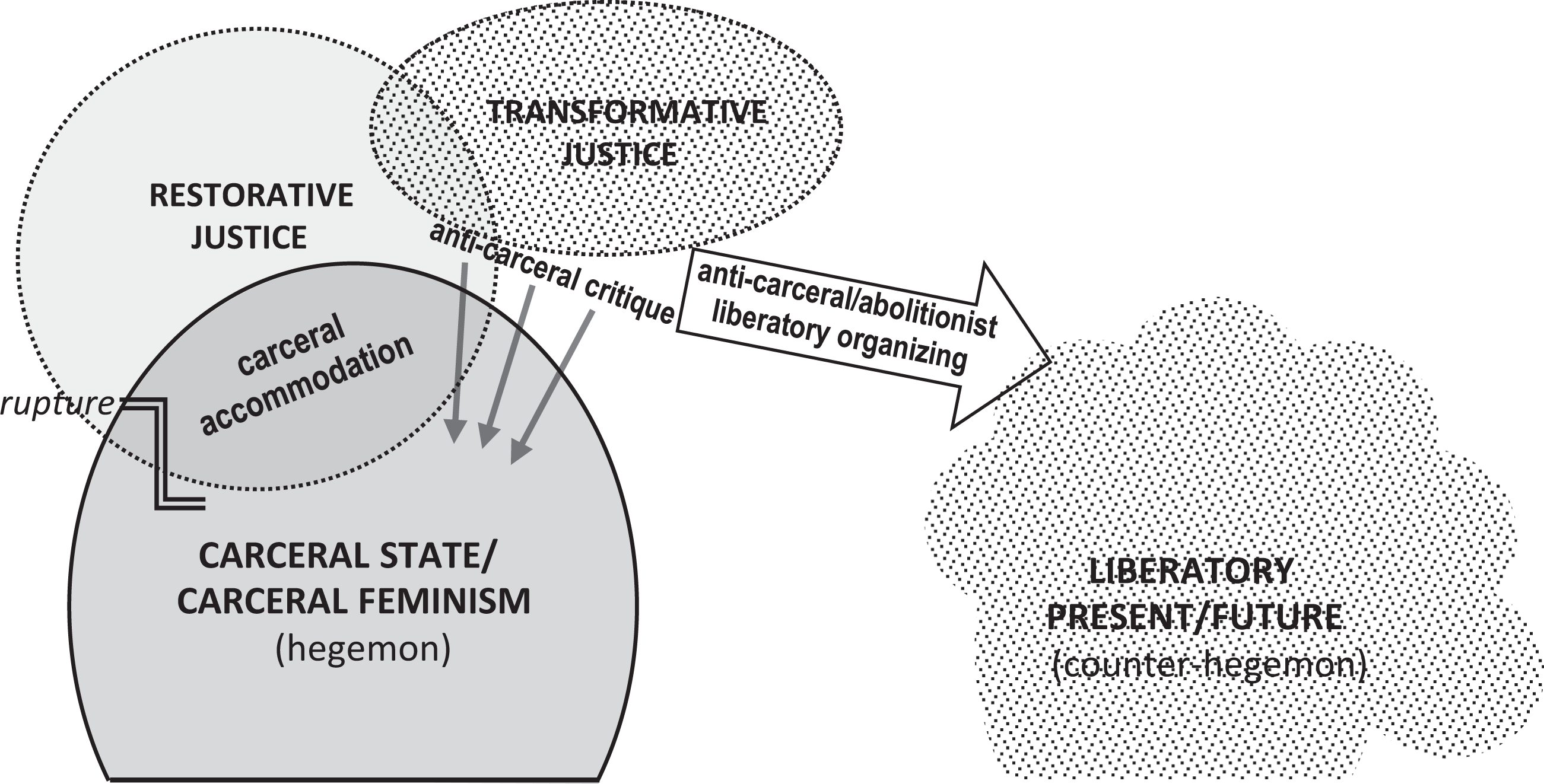
A rupture in carceral hegemony-restorative justice and carceral accommodation versus transformative justice and anti-carceral/abolitionist counter-hegemonic possibilities.
While it is important to acknowledge the exchanges, collaborations, and intersections between the transformative justice and restorative justice worlds, we can anticipate the public elevation of alternatives to criminalization as defined by restorative justice in contrast to transformative justice. The recent ascendance of restorative justice stands to overtake the position of transformative justice. While the latter has contributed most significantly to the current movement pivot, the rising prominence of restorative justice is the result of the appeal of an alternative option that, in general, does not rule out the carceral state and one that has historically been more open to conventionally identified practitioners who may be comfortable with and benefit from “systems-friendly” restorative justice approaches.
Transformative Justice and Counter-Hegemonic Possibilities
The Dilemma of the Local
Transformative justice responses continue to develop within historically marginalized populations and subaltern organizational formations, making these institutions and practices invisible to if not explicitly rejected by funders and policy makers; likewise, the criteria for funding and legitimacy in today’s neoliberal nonprofit and state-driven landscape collide with the politics and practices of transformative justice. Transformative justice remains locally driven, anti-state, and anti-institutional; therein lies its strength—and its possible limitations.
While restorative justice has been gaining institutional legitimacy, transformative justice remains subject to the advantages and constraints of its subaltern character. Transformative justice is not simply a method but is a flexible set of politics and practices committed to collective and community-based mobilization, nonpunitive practices of accountability, and a theory and practice of violence prevention and intervention that addresses the context of historic and systemic oppression.
Nurtured outside of nonprofit industries, state systems, and funder-driven initiatives, transformative justice has been developed primarily within voluntary structures or quasi-formal structures that might rely upon ties to fiscal sponsors, creative use of conventional 501(c)3 status, or, more recently, for-profit forms. While some organizational formations have leveraged the benefits of occasional funding, for the most part, transformative justice has remained fueled by long hours of volunteer labor, often supplied by women and femme-identified people of color. The disproportionate contributions of femme-identified, queer, and people of color with disabilities cannot be exaggerated nor can the movement’s reliance upon unpaid labor.
The organizations that have constructed the small bulwark now known as transformative justice have remained nimble but have continued to be under-resourced and, as recent history unfolds, appear to be fleeting. A number of organizations have closed—Communities Against Rape and Assault, Creative Interventions, Philly Stands Up, and Support New York. Given minimal infrastructure, limited resources, and approaches (politics, populations, issue areas, and methods) unappealing to most funding streams, these organizations are vulnerable to the short life spans of ephemera, the name also referring to small insects that fly for a single day only to expire by twilight.
As the seemingly impervious carceral edifice shows evidence of strain, new moments of political possibility open. The championing of restorative justice could signal the promise of a new alternative justice landscape; it could as well represent carceral adjustments that assuage new critics of mass incarceration while keeping that system intact. Can the forces behind community accountability and transformative justice sustain a more lasting social change under conditions of organizational precarity?
A scan of today’s transformative justice landscape reveals diverse strategies in which these principles and practices have been nurtured and sustained. These include (1) organizational adaptations, (2) collaborations across local spaces, and (3) new emergent strategies for envisioning and practicing transformative justice and other pathways to liberation.
Organizational Adaptation
Transformative justice has been nurtured in deliberately flexible organizational containers. They have taken a variety of shapes meant to hold the resources of time, place, people, ideas, and energy long enough to build another small piece of the transformative justice project but not so long that attention shifts from political intent to the demands of organizational longevity. Still operating within capitalism, this has not surprisingly involved some engagement with what some call the nonprofit industrial complex and, more recently, the for-profit world. The warnings of INCITE! (2006) have been heeded, not necessarily resulting in the evasion of all legal organizational forms but certainly in crafting an intentional and subversive engagement with them.
In a closer look, organizational demise may not necessarily indicate failure but may be a strategic result of a shared political commitment to avoid the construction of institutional forms that require the neoliberal demands of competitive positioning, visible evidence of organizational success, and proprietary ownership of products. Organizational demise has often been accompanied by intentionally retained websites replete with publicly accessible documentation without copyright or trademark, hence leaving traces not only symbolic but that materially sustain public access to information that seeds future work. While the reasons for dissolution or the factors supporting sustainability are beyond the scope of this article, some organizational examples suggest the leveraging of more conventional organizational formations and adaptations inside and outside of the nonprofit system as part of the repertoire of transformative justice organizations. To date, in no case have these organizations taken a form within the state.
For example, Creative Interventions was founded in 2004 as a nonprofit organization with the express purpose of piloting what was then a rudimentary model for what it called “community-based interventions to violence” (Creative Interventions, 2012). At that point in time, INCITE! and others had developed a critique of the direct service delivery model and on law enforcement for safety. However, an alternative approach, at that time antithetical to the system of existing interventions, was unavailable except for a very few cases, primarily practiced in indigenous communities. Creative Interventions, an affiliate of INCITE!, sought to move forward community accountability/transformative justice practice through a pilot implementation program and a documentation project. The former began with the collective principles formulated within INCITE! and generationFIVE and began piloting on-the-ground interventions to violence grounded in nonpunitive, non-carceral, and collective approaches to harm. The latter project collected stories from individuals who had already participated in a collective response to sexual or domestic violence without reliance upon either a direct service program or the state.
The nonprofit structure was intentionally time-limited in order to take advantage of a short funding timeline usually available for programs deemed to be innovative and to organize adequate resources intended to complete and document the pilot project as well as the public story collection project, StoryTelling & Organizing Project (STOP; Herzing & Otiveros, 2011). The organization’s close was planned at the organization’s founding and shared with staff and partners as part of the project plan. It intentionally clipped its fund-raising horizon at the end of the implementation and documentation in 2010. At the end of the pilot project, a 600-page tool kit documenting all of its findings and a “model” for one approach to such interventions was and continues to be available for public access on its website (Creative Interventions, 2012). STOP created a separate website for public dissemination of audio stories with transcriptions available (Herzing & Ontiveros, 2011). Creative Interventions exists as an occasional organizational container for additional trainings on the model and tools it developed in order to advance the larger project of transformative justice in local and national configurations but has since dismantled its nonprofit organizational form.
Other organizations have taken on various forms within nonprofit structures and outside of the nonprofit system. The Bay Area Transformative Justice Collective (BATJC), a volunteer organization outside of the nonprofit structure, started by Mia Mingus and held within a collective membership body, persists today both as a local Bay Area organizing project and as a national organizing model. BATJC has structurally developed through pods or intentional community formations consisting of people who are already in natural connection with each other but who work to strengthen their ability to share transformative justice–related values, skills, and strategies with the aim to prevent and intervene in child sexual abuse as part of a broader liberatory vision. They have made their study curricula, organizing tools, and strategies available locally and nationally, building the capacity across local spaces to practice transformative justice in more organic and sustainable forms not reliant upon formal organizational structures.
Just Practice has been established by a longtime social justice, harm reduction, and sex work activist. As the former director and founder of Youth Women’s Empowerment Project in Chicago, Shira Hassan found herself carrying out transformative justice interventions addressing sexual and domestic violence in multiple community settings. She established Just Practice as a for-profit entity with a collective of collaborators to advance transformative justice work through a more flexible organizational form, providing movement-oriented transformative justice trainings under the umbrella of a for-profit company. This structure takes advantage of the organizational flexibility of a small, for-profit organization and the offerings of very-low-cost or no-cost trainings balanced with revenue through organizations with funding for trainings. The founder continues her transformative justice interventions as volunteer labor and is building skills among a broader base of social justice activists through local and national trainings hosted by Just Practice in collaboration with individuals and organizations across the transformative justice landscape.
A newer formation, Spring Up, started a social enterprise to advance transformative justice in Miami that emerged through their work to develop these practices for the youth-oriented prison abolitionist organization, Dream Defenders. The founders, Nastassja (Stas) Schmiedt and Lea Roth, began their organizing work years earlier in response to violence on college campuses and the building of intersectional, liberatory coalitions in campus settings. The founders moved on to lead and participate in building queer, gender nonconforming, intersectional transformative justice politics and practices tied to activism among youth and young adults. They have prioritized an organizing approach that builds grassroots fellowships for youth, offering a flexible model of cohort development and deep political training through in-person and online modules that make creative use of youth engagement with social media. Spring Up is developing new relevant ways to organize and provide political education within the constraints of geographic distance, lack of access to transportation, and pressed schedules. They are prioritizing organizing strategies that transcend common conditions that challenge more conventional organizing tactics and strategies and that often leave marginalized youth without access.
Collaborations and Political Solidarity
Under the broader transformative justice umbrella, these organizations and others have worked in close relationship, leveraging the use of social media, national gatherings, and visits to each other’s programs and websites to build collectively. While funder dollars, when available, may occasionally support these collaborations, such initiatives have not been funder-driven and have been rarely funder-supported. Collaborations have been based upon political alignment and personal relationships built through shared commitment to the projects of transformative justice and prison abolition. The shared politics regarding not only relationships with the state but also relationships to the nonprofit sector have supported a strong sense of solidarity as well as a lack of competition. While each local formation has produced a unique approach to transformative justice, each contribution has been shared generously and is seen as part of a larger edifice necessary for the creation and sustenance of a project that has increasingly been named as transformative justice but which has been nondogmatic in its attachment to branding.
For those organizations that have closed purposefully or out of necessity due to lack of resources or life transitions of key stakeholders, many of those individuals who have constituted leadership and membership within these organizations have continued to make contributions from other organizational locations and scattered career trajectories. With each phase of organizational establishment and, in some cases, closure, new formations have arisen to build upon the successes of the past. Due to and despite the character of the contemporary development of transformative justice, its achievements have been impressive. However, the precarious nature of organizational capacity and life spans and, hence, that of the larger solidarity network is also vexing. The construction of what is currently identified as transformative justice has been creative, emergent, and remarkably resilient. At the same time, this political work has been slow, inconsistent, and, too often, on the edge of disappearance.
Emergent Strategies and the Turn to the Natural World
As social movements and, indeed, humankind seek new visions to steer us beyond the current context of crisis, a turn to small, local, and flexible formations has been ubiquitous. Informed and inspired by indigenous and feminist knowledge (brown, 2017; Escobar, 2018; Shiva, 2015) or the promise of entrepreneurial innovation (Brafman & Beckstrom, 2006), these visions of optimism are also sober responses to economic, institutional, and ecological crisis.
The metaphors and models of nature also serve as an alternative to the failing systems designed by the industrial world. While biological models for imagining social life are far from new, today’s social movements turn to images of biodiversity and an ode to the natural wisdom of fractals found throughout nature to conceptually and materially ground a moral and material foundation for our political lifeline forward (brown, 2017). Emergent strategies, according to brown’s treatise, “[build] complex patterns and systems of change through relatively small interactions” (p. 2) and rely fundamentally upon the building of “critical relationships” rather than “critical mass.” These small interactions tie emergent strategy to transformative justice as an orientation to conflict, relationships, and community. Her vision of transformative justice is based upon a natural world that understands human imperfections, common drives toward survival that can motivate abuse and harm, and her tenet that “nothing in nature is disposable” (p. 135). In the wake of radical critiques of state and nonprofit formations and the very real dissolution of these institutions under neoliberalism, the persistence of nature in the face of ongoing cataclysms serves as perhaps the only reliable source of wisdom.
It is not the short-lived insect but hardier species of fungi and dandelions that not only fuel brown’s insights but also have begun to animate new social movements imaginations here in the United States, rejecting the militarized language of organizing campaigns or the corporate discourse of logic models for more nature-inspired models of social change. In this expression of social movements, scaling up is critical, but we are directed to weeds rather than franchises.
Conclusion
How then can we make sense of this moment of hegemonic rupture and a fleeting opportunity for radical change? Transformative justice has in its short life span contributed to a pause in a once unyielding carceral feminist framework, a small reversal of pro-criminalization policies in a handful of states, and the slow construction of an archive of successful interruptions in harm through collective, transformative actions that challenge neoliberal logics. Organizational adaptation has drawn out the life span of containers, allowing for knowledge accumulation and disciplined documentation that have outlasted fleeting organizational forms. Collaborative problem-solving and skills-building nurtures the continuation of the transformative project.
The dilemma of the local in the context of capitalism is not unique to transformative justice. On the one hand, emergent social movement formations have been recognized as a characteristic defining a promising future, or our very survival. Nimble organizational forms, porous containers, networks built upon relationships rather than formal structures feel more resonant with the postmodern social, political, economic, and cultural climate. But on the other side of the beauty of starfish, spores, and viruses, biological forms evoked in current treatises on social movement innovation, lies precarity.
This article sharpens focus on the centrality of contradiction in the development of feminist social movements. It reminds us of the hegemonic dominance of the carceral state and its capacity to beckon accommodation or conjure disappearance out of every progressive impulse. What remains constant in the contemporary course of feminist anti-violence movements are the perils of reformist strategies—in the form of pro-criminalization demands or, in this moment of movement pivot, the appeal of restorative justice alternatives that still retain ties to the criminal legal system. Constant also is the precarity of anti-state, anti-institutional countermovements that have persisted and prevailed but face the ever-present threat of disappearance.
The feminist wisdom of emergent strategies urges a slowness but not a hesitation—a reflection on what feels connected and right rather than a reaction to what is going wrong. For those of us who have participated in collective processes to intervene in violence, we know that there is a balancing of reflection, compassion, trust, and action that can move human beings in conflict forward toward connection or spin them further into despair. It is true that this balance feels more like nature than the mechanics of machinery. The logic of fractals suggests that it is this wisdom found in the microworld of human connection in response to harm and violence that can be expanded into the wider world of organizations and efforts to scale-up. It may be that finding this rhythm and moving our collective footsteps forward will keep resonating and persisting even as containers fall away. The dance of ephemera may be a more suitable metaphor to counter a dance with the devil, but it will be very human efforts and strategies, in right relation with the natural world, that will be necessary as we move forward in this uncertain future. For feminists seeking freedom from violence, these directions forward may promise more lasting possibilities for liberation than our current pact with the most masculinist, repressive arm of the state.
Footnotes
Declaration of Conflicting Interests
The author(s) declared no potential conflicts of interest with respect to the research, authorship, and/or publication of this article.
Funding
The author(s) received no financial support for the research, authorship, and/or publication of this article.
