




Abstract
This article is concerned with the provision of intervention programs aimed at female victims/survivors of domestic abuse in the United Kingdom. Social workers, and other statutory professionals, are increasingly referring clients who have experienced abuse to these interventions, but there has been little debate about the aims and objectives of them or consideration of their effectiveness. This article includes a discussion of the key elements of the programs and criticisms of these types of interventions.
Introduction
This article examines different intervention programs that are currently being used in the United Kingdom, which are aimed specifically at female victims/survivors of domestic abuse. Social workers, and other statutory professionals, are increasingly referring clients who have experienced abuse to these programs as a way to provide support and advocacy for victims/survivors, but there has been little debate about the aims and objectives of such programs or consideration of their effectiveness. These programs are often run as groups with facilitators from specialist domestic violence services or, in some cases, take the form of self-help groups. This article will examine the context within which these programs have developed, before looking at the design and implementation of a number of examples. Of particular concern to this article is the lack of robust evidence on the effectiveness of these programs, and this will be discussed with reference to the evaluations that have been conducted.
As domestic violence service provision has expanded over recent decades, there has been an increase in different types of services aimed at providing support to women in different circumstances (Women’s Aid, 2011). Such services include outreach workers, Independent Domestic Violence Advocates, resettlement workers, and refuge staff providing services both within refuges and in the wider community. In addition, many service providers engage in wider training and awareness raising activities to address the issue of domestic violence within the wider community. While intervention programs for victims/survivors are a part of the current specialist service options, there are a number of questions and some concerns about their aims and objectives and how they are being utilized by other service providers. First, there is concern that some programs merely formalize the support that has always been provided by refuge and outreach advocates within the specialist domestic abuse sector (Cosgrove, Barron, & Harwin, 2008). Second, such programs are often based on either a psychoanalytic or educational model (Crespo & Arinero, 2010) which, some believe, individualizes the issue of domestic abuse by identifying the female victim as the “problem,” taking the focus away from the responsibility of the perpetrator (Stark, 2007). In this respect, there are concerns that women are then presented as responsible for mediating the behavior of perpetrators (Bjorkly, 2003; Kuijpers, van der Knaap, & Lodewijks, 2011). Third, there is some concern that statutory service providers are referring women to these programs in order to abdicate their own responsibility for supporting victims who come to their professional attention (Williamson & Hester, 2009), and as a form of surveillance. The issue of surveillance, expecting facilitators to report back to statutory services about women on the program, is particularly relevant where referrals are being made by children’s services and where the parenting of the abused woman becomes the focus of attention (Hester, 2011; Humphreys, Thiara, & Skamballis, 2011). This issue of the interaction between the interests of mothers and children will be addressed shortly. Finally, one of the greatest concerns relates to the training and expertise of those running programs. This differs across the United Kingdom but is a source of concern, particularly where safety issues need to be paramount (Cosgrove et al., 2008).
The introduction of victim/survivor programs raises questions about the long-term impact of domestic abuse and the role of victims in their own survival (Williamson and Abrahams, 2010). For many years, there has been a reluctance to focus on the victim of abuse as an active agent because of the message this portrays about the perpetrators lack of responsibility. However, failure to provide victims with the tools necessary to change their own lives has resulted in some women being unable to challenge and negotiate abusive behavior and make more positive choices about ending either the abuse they are experiencing or an abusive relationship. The proliferation of intervention programs is intended to empower women and thereby address concerns about repeat and serial domestic violence perpetrators (Association of Chief Police Officers, 2009). Domestic abuse, in the long run, erodes self-esteem and social skills, destroys family intimacy, damages growing children, reduces parenting skills and creates intense feelings of shame, guilt, isolation and loneliness. In stark contrast to abuse, support groups les s e n isolation and establish social bonds. (Cosgrove et al., 2008, pp. 12)
While engaging with a specialist support group can be a positive experience, as described in the quotation above, some domestic abuse service providers have struggled to reconcile their concerns about the wider political impact of focusing on the individual needs of abused women with their desire to address the impact abuse has on victims. This dilemma is rooted in historic developments within the wider domestic violence/abuse movement, particularly within the United Kingdom, which will be considered shortly.
This article will outline the historic context within which a growing number of victim/survivor programs have been developed in recent years. This includes examining the shift in service delivery from politically based feminist services to more therapeutic approaches based on individual needs. Second, this article will outline three programs currently available across the United Kingdom, including evaluations of their effectiveness, and highlight some of the positive and negative outcomes attributed to them. Finally, we will consider how intervention programs can be improved to address the political concerns raised earlier while ensuring that the needs of victims and survivors are being met and the key issue of ensuring basic standards within intervention programs is addressed.
This article is concerned specifically with intervention programs aimed at women victims/survivors of domestic violence and abuse. This article does not include programs aimed at male victims nor at perpetrator programs aimed at female perpetrators. While there are ongoing debates about domestic violence and gender (Hester, 2009), very few studies have looked at the actual clinical needs of male victims of abuse. This means that we know very little about the way in which domestic violence perpetrated by women manifests itself, whether there are common patterns of coercion and control (as there are in the case of female victims), nor whether the needs of male victims are the same as those of female victims. At the present time, the men’s advice line 1 is the National helpline resource available in the United Kingdom to male victims (and/or perpetrators) of abuse and for the professionals working with them.
Victim/Survivor Programs in Context
During the governmental debates in the United Kingdom in the 1970s, which resulted in the development of new legislation relating to marriage (Matrimonial Causes Act, 1973), concerns were raised (Dobash & Dobash, 1992) that the primary focus on the psychology of victims as “the problem” (Gayford, 1975) was counterproductive to challenging the gendered inequality which, some argued, causes and perpetuates domestic violence. Such approaches perpetuated the myth that female victims were themselves responsible for the abuse they experienced (Thapar-Björkert & Morgan, 2011). As a result of these fears, there has been a reluctance in many services to focus on the ways in which women as active agents could, and often do, have a role in challenging abuse.
In many places, a multiagency approach to domestic violence service provision has been adopted (Hague, Malos, & Dear, 1996), which is based on the holistic approach utilized in the Duluth community model (Shephard & Pence, 1999). This holistic approach includes explicit recognition of the role of the wider community in challenging perpetrators and their abusive behavior. Within such a context, the ability to provide appropriate services to victims becomes possible, as the focus of responsibility in this context does not shift from the perpetrator to the victim. During the mid-1990s, there were numerous debates (Dobash & Dobah, 1992) about whether concepts such as “the battered wife syndrome” (Walker, 1979), “learned helplessness” (Herman, 1992), and/or “post-traumatic stress disorder” (Gondolf, 1998) were useful to women experiencing abuse or if they again individualized the problem by shifting the wider social gaze from the responsibility of the perpetrator to that of the victim. More recently, authors (Humphreys et al., 2011) have identified the ways in which theories such as “readiness to change” can be used to explain not only the response to interventions from service users but also the responses of practitioners. Inherent within this focus is the assumption that it is not only service users whose attitudinal readiness is important but, especially in the domestic violence field, practitioners need to incorporate community-based models that are proportionate in their distribution of responsibility. In relation to interventions for female victims/survivors of domestic abuse, this change of focus is important as it recognizes the need for practitioners to consider the aims of such interventions in light of the wider practice context.
Mothers and Children
At the current time, there is still concern that in relation to their role as mothers, victims of domestic violence are still blamed for the abuse they, and their children, experience (Cosgrove et al., 2008; Hester, 2011; Humphreys et al., 2011). This gender problem within social work manifests itself in a lack of engagement of fathers within social work child protection practice both generally (Dugdale, 2012; O’Hagan, 1997) and in relation to men/fathers who are abusive to their female partners (Peled, 2000). It is in this context that professionals (social workers and health visitors in particular) may be referring women to victim/survivor programs as a way to exert pressure on women to leave an abusive relationship and/or as a form of surveillance (Humphreys & Absler, 2011). In a context where men/fathers are often difficult to engage, it is important to question whether some professionals might be making inappropriate referrals for their female clients because they are unable to work appropriately with the family member who may be causing the problem. In this context, it is not always clear whether professionals are aware of the objectives of victim/survivor programs and whether the women who are referred to such programs do so in a voluntary capacity or because children’s services make attendance a condition of child protection planning (Humphreys & Absler, 2011; Williamson & Hester, 2009). There are numerous evaluated, and nonevaluated, parenting programs which professionals utilize (Bell, 2007) and which may be useful to assist women (some of whom may have experienced domestic abuse) to gain new skills to assist in the parenting of their children. There is a difference however between an explicit aim of addressing parenting and one addressing the psychosocial needs of women as victims/survivors of domestic abuse. In this respect, there is some confusion about when practitioners are utilizing parenting programs and where they are referring women to domestic abuse support services (Williamson & Hester, 2009).
The following discussion will provide professionals with the information they require about the aims and objectives of victim/survivor programs, so that more informed referral decisions can be made in practice. In addition, we hope that by outlining the positive and negative contributions that these intervention programs offer, much better use of them can be made as part of a wider response to domestic violence that does not target or scrutinize the behavior of the nonabusing parent, through surveillance, at the expense of holding abusive partners/fathers responsible for their abusive behaviors (Hester, 2011; Humphreys et al., 2011).
Victim/Survivor Intervention Programs
The largest evaluation, in the United Kingdom, of a wide range of support services for victims/survivors of domestic and sexual violence was conducted by the Home Office as part of its Crime Reduction Program and Violence Against Women Initiative. The Home Office funded a number of different services and commissioned an evaluation of these pilots between 1998 and 2003. While comparing the findings of different types of evaluations of sometimes diverse interventions posed considerable difficulties, the evaluation of those services (Hester & Westmarland, 2005) identified some key issues that are particularly relevant in this article’s discussion of victim/survivor programs. The authors found that “individual work and groupwork [conducted by specialist advocates] both helped women become more self-aware and recognise their experiences as abuse; and groupwork was also useful to help women ‘move on’ with their lives” (Hester & Westmarland, 2005, p. 95). The evaluation was looking at a wide time period and a disparate range of services that included services to women who were making an initial approach and to women who had negotiated a range of services over time. In relation to dealing with the longer term impacts of abuse, the evaluation found that “once women have been able to deal with immediate issues and are ready to ‘move on’ they should be offered groupwork to enable them to deal with emotional issues arising from the domestic abuse and to meet other women with similar experiences. Groupwork should take a structured approach and preferably be at least ten weeks in length” (Hester & Westmarland, 2005, p. 96). Other reviews of different types of advocacy and interventions with women who have experienced abuse (Barner & Carney, 2011; Hester, Westmarland, Pearce, & Williamson, 2008) similarly identify the importance of providing women with the opportunity to explore the impact of their experiences. The Home Office evaluation was broad and as such it was difficult for the report authors to comment on the specific interventions and their effectiveness. As such, the rise in intervention programs such as the freedom program (FP), while generally supported by the conclusions of the report, was not an explicit recommendation.
The Power to Change Approach (Cosgrove et al., 2008) is a Europe-wide project that emerged following the proliferation of victim/survivor programs, particularly in the United Kingdom, in the mid-1990s. This project sought to identify the key elements required to ensure the quality of provision for victims/survivors in the development of intervention programs and provides templates for three specific intervention programs. Because this project provides a framework for intervention, rather than an intervention itself, it is not included in this article as a specific program. However, this approach provides specific guidance to those who are considering the implementation of interventions for victims/survivors of domestic abuse as well as useful checklists for those who might be referring their clients to such services as part of a wider statutory intervention.
Methodological Issues within Program Evaluations
At the present time, there are a number of different program interventions in the United Kingdom designed specifically for those who have experienced domestic violence and abuse as victims; this article will focus on three. While other programs exist, all three of these programs have undergone some form of evaluation and details about their program design and content are available for others to utilize.
It is important to recognize, however, that these evaluations are not longitudinal in nature, are often based on biased samples that do not adequately identify those who do, and do not, complete the program interventions, and often fail, due to a lack of funding for research and evaluation, to adequately measure appropriate outcomes. In this respect, there is a lack of robust evidence in this area, despite the widespread implementation of such programs at a local level. This article addresses some of the evidence that does exist, but recognizes the flaws within the methodological design of such evaluations. In relation to the evaluations of the three intervention programs discussed, the study design and sample size were as follows.
The evaluation of the Freedom Program (FP), Williamson and Abrahams (2010), was based on data from 27 respondents who completed the initial survey. Despite a pre- and postintervention design, only four women completed the post intervention survey, although some additional information was available from four additional women. The lack of follow-up data limits the conclusions that can be drawn from this research. In relation to the different roles of professionals, most of the 27 women have heard about the program from specialist domestic violence advocates, followed by social workers, and the police.
The evaluation of the Phoenix Program (PP), Williamson and Abrahams (2011), was based on data from 19 women who completed the presurvey at the beginning of Part 1 of the program, 7 women who completed a presurvey during Part 2 of the course, and 9 women who completed a postsurvey either at the end of Part 1 or 2 of the program.
Finally, the evaluation of the Pattern Changing Course, (McTiernan & Taragon, 2004), a questionnaire was sent to 76 of the 87 women who started the course between April 2001 and September 2004. Data were based on the responses received from 44 women (58%). Additional information was collected through a brief survey of practitioners and a focus group with service users.
Each of the following sections describes what the program offers, how it is delivered, and its main aims and objectives before looking at the evaluation outcomes. It is important to recognize that this is not an exhaustive list. There will be many specialist service providers, in the United Kingdom and elsewhere, offering their own programs developed with and alongside victims and survivors of domestic violence.
Intervention Programs for Victims/Survivors of Domestic Abuse
The following outlines the three programs that are the focus of this article. Due to the way the programs are organized direct comparison in terms of content and structure is difficult. However, some key themes are prevalent within all of the programs and these are outlined in Table 1. This table includes all of the available information on program content. Some programs are “owned” and marketed by specific providers, which means that more detailed content information is not always available.
Comparison Across the Three Intervention Programs.
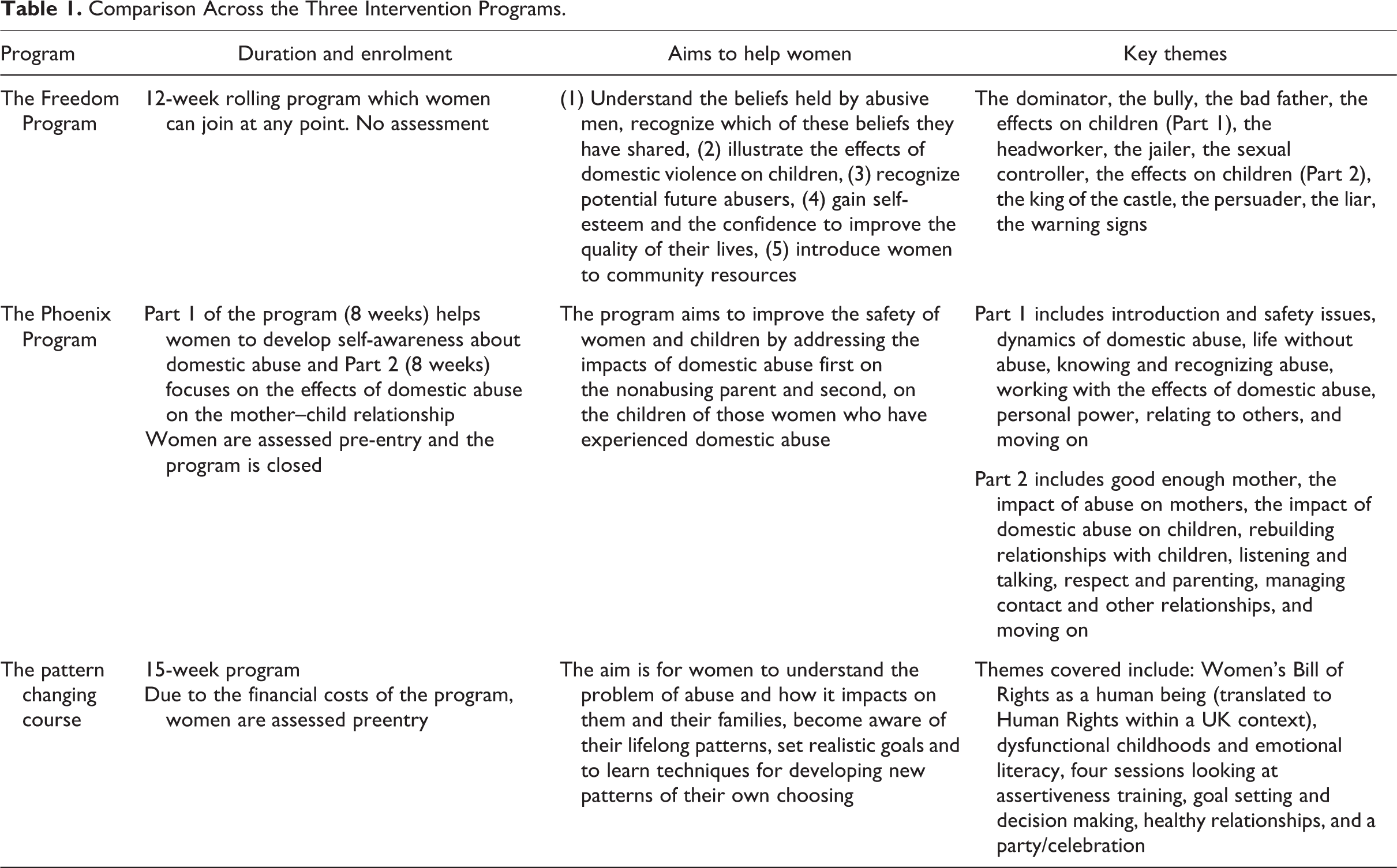
The most well-known specialist domestic violence intervention program for victims/survivors of domestic abuse in the United Kingdom is the FP. 2 The FP is designed as a 12-week rolling program to help victims of abuse to recognize the tactics of their abusive partners. 3 The FP is delivered across the United Kingdom by practitioners who have undergone training, by the program designer, and it is delivered to women alongside the publication “living with the dominator” (Craven, 2008). The proliferation of this program is a result of the marketing of this program to local domestic violence services and not based on methodologically rigorous evaluations of the program outcomes. The FP is fluid in that women can join the rolling program at any time, can take individual modules or the course as a whole more than once, and does not involve an assessment. During the 12-week course, participants are introduced to a number of specific concepts intended to highlight the ways in which abusive men exert control over their partners. These sessions are outlined in Table 1, but each focuses on the different ways in which control and abuse can be manifest in the behavior of the perpetrator. The final session is designed to help women identify potential warning signs in the development of future relationships. The aims of the FP are to (1) help women understand the beliefs held by abusive men and in so doing, recognize which of these beliefs they have shared, (2) illustrate the effects of domestic violence on children, (3) assist women to recognize potential future abusers, Mr. Wrong or Mr. Right, (4) help women gain self-esteem and the confidence to improve the quality of their lives, and (5) introduce women to community resources such as Women's Aid, the Police Domestic Violence Unit, The Rape and Sexual Abuse Centre, local Colleges, and so on. 4
The PP is an 8-week intervention designed to give women who have experienced domestic abuse the opportunity to make changes in their lives. The program recognizes that women may want to make changes for themselves, and also, if they are mothers, for their families. Part 1 of the program helps women to develop self-awareness about domestic abuse and Part 2 focuses on the effects of domestic abuse on the mother–child relationship. The program was designed over many years by practitioners based at “North Somerset Against Domestic Abuse” (NADA) and builds upon the general advocacy and support work provided by their parent organization, People Can in the South West of England. Feedback from domestic abuse survivors who have used NADA’s services and participated in the PP has played a central role in the program’s development. The program was designed alongside a booklet that was published in 2006 (Petkova & Howard, 2006) entitled “helping ourselves and our children recover from domestic abuse.” This booklet was the culmination of many years experience of working with women and children who had experienced domestic abuse. The specific sessions are outlined in Table 1. Part 2 of the PP was written and developed by a partnership including Child and Adolescent Mental Health Services (CAMHS), Children and Young Peoples’ Services, and NADA. The involvement of a number of children’s service providers in the development of Part 2 was not accidental. This aspect of the program was developed specifically to address the difficult area of domestic abuse and children. For practitioners in particular, there was a desire to provide women with information about the impact of abuse on children in order to assist them in making more positive choices as the nonabusing parent. While focusing on the needs of all women, the PP’s focus on the mother–child relationship in Part 2 of the program makes it almost unique in its approach that provides a resource for those women/mothers who have struggled to cope with the way in which their parenting might have been impacted by domestic abuse. This differs from a “traditional” parenting course because its initial focus remains domestic violence and abuse. Part 2 of the PP includes sessions covering the following themes: good enough mother; understanding the impact of abuse on us as mothers; the impact of domestic abuse on our children; rebuilding our relationships with our children; listening and talking; respect and parenting; managing contact and other relationships; and moving on. The PP is run by a staff with experience and skills in delivering domestic abuse services and training and includes domestic abuse survivors. Alongside the core team, survivors who have come through domestic abuse also “shadow” the trainers to gain experience and potentially make a positive contribution to the program by becoming trainers themselves. In terms of referral, unlike the FP, the PP involves a comprehensive interview/assessment with potential participants, which includes an opportunity to ensure that individual needs are being met. The PP also runs as a closed group.
The Pattern Changing Course has been provided by Devon Women’s Aid in Exeter in the South West of England since 2001 (McTiernan & Taragon, 2004). The program starts from the premise that women who have experienced domestic abuse have their own power which they can use to change their lives. The course was developed by Fallon and Goodman (1995; originally in the United States) and is based on women setting the goals they wish to achieve within the course, and learning the techniques necessary to achieve their aims. The facilitators are clear that their course is not “group therapy” in the traditional sense of the term, and where appropriate women who require more in-depth psychological input may be referred to specialist domestic violence counseling alongside attendance on the course. The program is 15 weeks long and as with other programs there are a series of sessions that cover specific topics.
Evaluations
This article has considered the aims and objectives of three specific intervention programs for victims/survivors of domestic violence as all three of these programs have undergone some form of evaluation. In relation to the methodological rigor of such evaluations, it is important to recognize that most program evaluations only include those participants who completed the program, which creates a bias in the response sample. In addition, many of the evaluations are based on monitoring data collected by the program facilitators which can have an impact on the results. However, despite these methodological concerns, the evaluations do provide some information about whether women report (either once or in a pre- and posttest design) positive changes on completion of the course and as such whether the programs are fulfilling their key aims and objectives.
Evaluation of FP
Despite being rolled out nationally, by individually trained practitioners from a range of professional backgrounds, there is little robust evidence about the effectiveness of the FP per se. Local evaluations of individual programs have been conducted in some areas that are primarily qualitative in nature and based on small samples. Despite these methodological issues, which are certainly not limited to the FP, the evaluations that have been conducted suggest that the program is successful from the participants’ perspective. In an evaluation of the FP in Deesside, 98.3% of participants rated the program as successful at its completion, 96.6% up to 6 months afterward, and 95% over 6 months postcompletion (Menti, 2005). This and other evaluations are not always clear however, on what success means for the intervention participants. This may therefore refer to women leaving an abusive partner, feeling more confident in themselves, or in the reduction or cessation of violence and abuse within the participants intimate relationships.
Barns and Abrahams (2008) found that of the women included in their research (which included an evaluation of a wider service provider who also ran a FP as part of its services), what they valued most from the FP was “identifying and understanding their experiences as abusive, and talking with others who have [had] similar experiences” (p. 3). Of improvements which they felt could be made, the respondents stated that there should be “more awareness of the difficulty of the FP process before women enrolled” and “more ongoing support for the women after they have left the programme” (p. 4). It is interesting that despite the political concerns raised in the introduction to this article about the consequences of focusing on the victim rather than the perpetrator, the authors found that engaging with the FP helped women on an individual level to stop blaming themselves for the abuse they had experienced. Women … spoke of how, through the workshops, they had come to realise that their relationship was abusive and that this understanding enabled them to break free of blaming themselves and to understand the process of how it had happened. (Hester et al., 2008, p. 14)
Examining a number of courses running under the auspices of a FP Network, Williamson and Abrahams (2010) found that all of the women who participated in their research reported positively on their experience of the program. Women who had engaged also reported much higher levels of confidence and self-esteem at the end of their participation compared to the beginning and in terms of what the women got from the program they stated: “feeling stronger about future relationships; had a better relationship with their children; felt more confident; and felt better able to spot the warning signs of an abusive relationship” (Ibid, 2010, pp. 3–4). Also of relevance from the Williamson and Abrahams research were the areas which women engaged on the FP identified as potential sources of conflict within their current and/or previous relationships. Respondents stated that they disagreed “often” with their current partner in relation to a range of issues, for example, sexual activities; women’s friends; and women going out socially without their partner. When talking specifically about previous partners, as opposed to current partners, additional areas of conflict emerged. These were relations with women’s relatives; partner’s neediness; partner’s jealousy; and partner’s alcohol or drug use. All of these key issues relate directly to women having independent social networks and how they balanced their own autonomy with the needs of their partner. In relation to dealing with disagreements with previous partners, 15 women said they would avoid the topic or change the subject and 17 (of the 22 respondents) said that they would normally give in to keep the peace (Authors own, 2010).
The impact of these findings on the wider debate about intervention programs for victims/survivors will be considered shortly; however, it is interesting that these areas of potential disagreement are similar to those areas of potential abuse covered within the content of the FP.
Evaluation of the PP
Williamson and Abrahams (2011) replicated their evaluation of a FP Network in an evaluation of the PP. They found similar results across the two evaluations (Williamson & Abrahams, 2010). The same areas of disagreement within relationships were identified by women engaging with the PP, as were the ways in which they had adapted to deal with them, namely giving in to keep the peace. The aim of the PP is to assist women to recognize abusive behavior and how it can impact on their, and their children’s, lives. Based on the findings of the evaluation, this aim was achieved. Women who had engaged with the PP reported higher levels of confidence and self-esteem at the end of the intervention compared to preintervention. The women also reported feeling happier and more content at the end of the program than at the beginning (Williamson & Abrahams, 2011). Of particular interest was the fact that the largest change in the measurement of well-being taken pre-and postintervention was that feelings of anger increased for the participating women. The development of these feelings may well reflect women’s move from blaming themselves to attributing blame for abuse onto the shoulders of perpetrators. This is important in relation to the wider theoretical debate about whether victim/survivor interventions increase a negative focus on the victims of abuse. From a practical perspective, however, this raises the key issue of safety and risk both for the women and their children, and the importance of adequate safety planning both within the program and within wider multiagency teams.
Evaluation of the Pattern Changing Course
The key findings from this evaluation showed an increase in confidence and self-esteem of the women who had engaged with the course. This increase also led to an increase in their feelings of empowerment. The authors of the evaluation also commented on the ability of the course to teach women victims/survivors practical techniques such as assertiveness, and the ability to identify abuse and the ability to say “no” which the women continued to use in their day-to-day lives. Women on the Pattern Changing course also gave positive feedback about being able to learn from other women in similar situations; and finally, they reported an improvement in relationships between themselves and their children (McTiernan & Taragon, 2004). As with other evaluation findings, for those who engaged with the program, the experience was deemed a positive one which led to greater confidence and self-esteem which had a positive impact on other areas of the women’s lives.
Discussion
There are a number of themes that run consistently in the three programs outlined previously. The primary purpose of each of the programs is to increase women’s capacity, whether through improving self-esteem or developing assertiveness skills, to recognize the signs of abuse and increase their ability to challenge it. As far as the evaluations of these programs can inform us, on this level, they appear to be successful, although as raised previously, little information is provided on how success is being defined and by whom. Women report positively on the interventions and describe feeling better about themselves and more confident as a result of their attendance.
In terms of the structure of the groups, they differ considerably. The FP is intended as an open course which women can engage with on a rolling basis. This is not the case on the PP where women are interviewed and assessed prior to starting a closed 8-week group. The evaluators of the Pattern Changing Course identify cost (to the funder) as preventing women from continuing to engage with the course beyond the 15-week program. Given the differences identified here, much more rigorous research needs to be conducted which can ascertain the benefits of different structures of groups specifically designed for women who have experienced abuse alongside greater exploration of what success means for the various service users and providers and how this can be more rigorously measured.
One of the main concerns raised within the introduction to this article referred to the fear that such programs are based on an education model that identifies the female victim as the problem, taking the focus away from the responsibility of the perpetrator. From women’s own accounts of participating in all of the evaluated programs, they value the space within which to clarify that the abuse they are experiencing is not their fault. This suggests that for those women who completed the programs, they did not feel they were being blamed for the abuse they had experienced and valued the space to consider the ways in which their experiences had had an impact on them.
One area of omission in the programs and evaluations outlined above is a lack of program content focused explicitly on the role of other practitioners (e.g., social workers or health visitors). Given many women will be signposted or referred to these programs from other agencies, it might be important to consider how this intervention sits with other service provision. In some areas, facilitators providing the programs may also be engaged with victims in their other professional capacity, yet there is little formal acknowledgment within the programs outlined above about the ways in which a wider community response would bring together a range of service responses. As such, these programs appear to be stand alone rather than as part of a wider community response to domestic abuse. One of the key considerations, therefore, is better collaboration between those practitioners who are referring women to these programs (as well as to other services) and program facilitators. The referral pathways into interventions, and the relationship that exists between those services providing interventions and other statutory and voluntary providers, need to be included explicitly within a more methodologically rigorous evaluation of such programs. None of the three evaluations discussed here adequately includes the perspectives of referral agencies and as such, the problems of ideological difference across agencies are difficult to explore further.
One of the main criticisms of programs, which can be bought off the shelf and run by any professional, is the concern that the program, whatever its success or reputation, is only as good as the facilitator who runs it (Cosgrove et al., 2008). It is important therefore to ensure that facilitators of programs are selected appropriately according to their skills, that they receive ongoing support, and that the programs they run are subject to ongoing monitoring. In this respect, it is important that local interagency groups play an active role in the commissioning of such services and that monitoring of practice takes place. None of the evaluations above outline the ongoing training and supervision of facilitators which is partly due to the scale of the evaluations. Those running intervention programs need appropriate training and ongoing support. This means that even if the program being used is available for free and that the running costs need to include adequate provision for training and support. Equally important is the provision of resources to ensure that program facilitators can engage with other agencies, so that other service providers understand what the program can and does not do. Only within this wider multiagency context can the concerns raised within the introduction, about the ways in which statutory practitioners might be abdicating their responsibilities through referral to such programs, be addressed. These programs are intended to offer support to women who are, or have, experienced domestic violence and abuse, they do not replace the provision of other services but should be used alongside them where appropriate. As was discussed earlier, in relation to the role of women victims/survivors as mothers, these programs are not a replacement for the parenting classes that some women may be referred to by practitioners as the aims and objectives are very specific to them as individuals. While all of the above-mentioned programs include sessions on the impact of domestic abuse on women as mothers and the impact on their children, this is not their primary function.
Conclusion
This article has examined three specific domestic abuse victim/survivor programs in order to ascertain the purpose of these programs and, through evaluations where they exist, ascertain whether they are a useful tool for women experiencing abuse. The findings of the evaluations included in this article indicate that they increase women’s self-esteem and confidence which in turn assists women in being more aware of their abusive situations. This is not the same thing as assisting women in being safe. All of the programs discussed in this article could gain added credibility from taking advantage of the guidance provided by the power to change approach (Cosgrove et al., 2008). This approach brings together practical solutions to the problems which some have identified as criticisms of such programs. This approach addresses issues of risk and safety alongside helping women to deal with specific emotions such as fear, guilt, and most importantly anger. Most of the programs address assertiveness and within those themes address how women deal with the anger they might feel as a result of the realization that they have been subjected to abuse and the impact this has had. We would argue, on the basis of the evaluations above, that a more explicit recognition of anger needs to be included within all programs to address the potential risk which can be associated with it. Included in this recognition is the way in which women who begin to display anger at the way they have been treated by an abusive partner may inadvertently be perceived by professionals as “difficult” or an “unworthy victim” as a result of that anger (Stark, 2007). To conclude, it is important to recognize that despite the lack of robust evidence relating to the effectiveness of these programs, the consistent feedback from participants is that all of these programs are valuable and have a positive impact on women’s lives. Women value the opportunity to explore with other women their experiences of abuse and to begin to challenge, in a safe environment, the behavior of both perpetrators and society’s responses to it. In addition, such programs allow women to recognize the wide-ranging impacts abuse can have on women’s self-esteem, confidence, and (mental) health, and to provide practical tools which women can use to overcome these issues. As such, they are an important part of a range of specialist services which women who have experienced abuse need in order to ensure their safety and well-being. Finally, the authors of this article would suggest the need for much more rigorous evaluation of individual interventions and programs aimed at survivors of abuse as a whole. Only with the amalgamation of data from individual groups, alongside consideration of specific outcomes and different perspectives of “success,” will we ascertain the true effectiveness of such services for survivors.
Footnotes
Declaration of Conflicting Interests
The author(s) declared no potential conflicts of interest with respect to the research, authorship, and/or publication of this article.
Funding
The author(s) received no financial support for the research, authorship, and/or publication of this article.