




Abstract
This article aimed to explore the complications and complexities of mothering in the contexts of domestic violence. Through interviews with nine women who had mothered in domestic violence, it was found that women do attempt to protect children from physical and emotional harm; however, the climate of fear, power, and control present in domestic violence limits protection, and women try pleasing their partners to prevent violence. This article argues the hostility of this environment needs to be acknowledged in constructions of protection and gender needs to be central in understandings of mothering in domestic violence.
Introduction
Domestic violence reflects what Johnson (2011) has termed intimate terrorism or a pattern of violent coercive control. This form of interpersonal violence is much more likely to be perpetrated by men and involves more frequent and more injurious violence that has debilitating psychological consequences (Johnson, Leone, & Xu, 2014). It is within the space of feminist research into domestic violence that significant differences have been exposed in women’s and men’s experiences of interpersonal violence in terms of frequency, severity, and dynamics of abuse (DeKeseredy & Dragiewicz, 2014). Feminists have also identified a host of gendered control tactics such as physical and/or sexual violence as well as economic, emotional, social (constant monitoring), and spiritual abuse, the use of children and pets, and threats and intimidation (DeKeseredy, 2011).
While important insights into the gendered dimensions of domestic violence have been gained, researchers and practitioners from various disciplines have also raised the question of children’s safety and well-being (Casanueva, Martin, Runyan, Barth, & Bradley, 2008; Douglas & Walsh, 2010; Mullender et al., 2002). Much of the professional gaze has looked to the mother in terms of how she provides for her child’s well-being, forms an attachment with her child, and protects her child from harm in domestic violence contexts (Levendosky & Graham-Bermann, 2001; Lieberman & Van Horn, 2005). Some studies have focused on the strengths and capabilities of women parenting in domestic violence, arguing that we should not assume that being a victim automatically diminishes parenting ability. Other studies report that mother–child relationships in domestic violence are characterized by insecurity, disturbed bonding, negative emotions, and lack of caring and emotional responsiveness (Buchbinder, 2004; Casanueva et al., 2008).
Lapierre (2010a) argues that the question of maternal parenting in the contexts of domestic violence has potentially created arguments about “adequate or not” mothering: Hence, that recognition for men’s violence and how it complicates mothering has not received adequate attention. Similarly, Humphreys and Absler (2011) argue that in child protection contexts women are often considered primarily responsible for providing a safe environment for children and for ending the violence for the sake of the children, regardless of the man’s responsibility in perpetrating the abuse. This article aims to explore the complications and complexities of mothering in the contexts of domestic violence by examining women’s understandings and lived experiences of maternal protectiveness to highlight the hostility of this environment in which they are often positioned as responsible.
Literature Review
Maternal protection in domestic violence has predominantly received attention from feminist researchers and practitioners and is therefore not well understood more broadly. Concerns have been expressed by the public and by child protection workers that women in domestic violence are unprotective, limiting dialogue and exploration about maternal protectiveness in highly volatile contexts (Douglas & Walsh, 2010; Mandel, 2010).
There are a number of recent studies that have specifically focused on the concept of protection in the contexts of domestic violence. Haight, Shim, Linn, and Swinford (2007) interviewed 17 women involved in the child welfare system in the United States to explore their strategies for protecting and supporting their children. They reported that mothers try to protect children’s physical and psychological well-being during episodes of domestic violence. This can include women physically separating their children from the violence, calling a third party for assistance, signaling with their children to warn them away from impending violence, trying to calm the partner or restraining themselves from arguing, and by using reassuring and supportive strategies such as expressing love and reassurance. Haight et al. (2007) also identified mothers’ decisions to limit truth-telling to their children as an example of protection so that the facts of abuse would not traumatize children further or cause distress. Instilling hope was another protective strategy identified whereby mothers encouraged their children not to dwell on the abuse and tried to socialize them to avoid violence by naming it as wrong. Haight et al.’s (2007) findings were significant because they showed protection beyond the understandings of staying or leaving a violent relationship.
Similarly, Lapierre’s (2010a) research has been significant in highlighting maternal protectiveness and central in investigating women’s experiences of mothering in the context of domestic violence. He interviewed 26 women in the United Kingdom and argues based on his findings that despite the hostile environment of domestic violence, women consistently aimed for what constitutes good mothering, that is, putting children first, and trying to protect, provide, and care for them. Similar to Haight et al. (2007), Lapierre (2010a) reported protection in terms of women trying to prevent children from being exposed to violence, trying to respond to children’s emotional needs after witnessing violence, and not leaving children alone with partners. In addition, Lapierre’s (2010a) research exposed the risks present in domestic violence contexts because in spite of their efforts at protection, women also felt a significant loss of control over their mothering because of the impact of violence on their physical and mental health and the increased difficulties of caring for their children. Furthermore, Lapierre (2010b) argues mothering is made more difficult when men intentionally and specifically targeted mothering as part of their violent strategies, revealing the hostility and dangers of mothering in domestic violence.
The protection strategies identified by Haight et al. (2007) and Lapierre (2010a, 2010b) have also been confirmed by Peled and Gil’s (2011) research in Israel. Peled and Gil (2011) identified maternal protection in domestic violence as creating a buffer between the children’s world and the violent world. They reported examples of women trying to create a violence-free reality for their children; attempting to prevent the abuse from adversely impacting their mothering; trying to preserve their partner’s image as a father in the eyes of their children; and shielding children from any exposure to violence. Peled and Gil (2011) argue that women try to be mothers as if they were not abused, that is, not living in domestic violence, and hence they try to separate the worlds of mothering and domestic violence. In Australia, Buchanan, Power, and Verity (2013) argue from their study in South Australia of 16 mother–infant relationships that domestic violence not only creates acute fear but also generates a climate of fear and this impacts how mothers protect their children. In forming relationships with their babies in the contexts of domestic violence, Buchanan et al. (2013) highlight that women often think, feel, and act protectively often in a constant process comprising subtle, planned strategies and, therefore, recommend further investigation into the complexities and nuances of maternal protection.
The studies outlined earlier identify a variety of ways women protect children in domestic violence and are significant because they challenge and broaden how protection is thought about and constructed both in the more general public realm and within domestic violence and child protection services. Feminist domestic violence researchers have argued that studies that focus on and identify protection in a variety of ways are important for highlighting women’s capacity to mother and maintain their parenting abilities under adverse conditions (Humphreys, Thiara, & Skamballis, 2011; Radford & Hester, 2001). This article reports a study that aimed to explore mother’s perceptions and experiences of protection in the contexts of domestic violence for the purpose of bringing the complexity of maternal protectiveness to the forefront in such contexts.
Methodology
This qualitative study was based on a feminist social constructivist perspective for two reasons. First, feminism is about making women’s lives and their location in wider gender power relations visible: Hence, the study aimed to make sense of protection for mothers experiencing domestic violence. Second, social constructionism emphasizes the place of language in the construction of social reality, that is, it was women’s own perceptions and stories we aimed to use to examine the concept of protection (McCann & Kim, 2013; Ramazanoglu with Holland, 2002; Sarantakos, 2005 ). Through a focus on mothers’ understandings and experiences of maternal protectiveness, the study placed the voices of participants at the center of analysis. To this end, we drew on a relational empowerment methodology that looked to create a communicative space, based in caring, to enhance individuals’ abilities to clarify their feelings and thoughts (VanderPlaat, 1998). Principles of relational empowerment encapsulate the view that knowledge creation needs to be based on emotional authenticity between researchers and researched that can be voiced through a communication of care. In this study, to facilitate this emotional authenticity, we utilized skills of empathetic listening, attended to emotions, and followed the narratives of women to build relationships in the interview setting.
We used a semistructured guide during the interviews enabling us to talk with women not only about their experiences of mothering in the contexts of domestic violence but also to encourage women to respond to our specific questions. Interview question areas included demographic factors such as current age, age during domestic violence, and length of time living in domestic violence and questions exploring experiences of physical, sexual, emotional, social, and financial abuse and the nature of the relationship between mothers and children. The impact of domestic violence on the mother–child relationship, and on maternal protectiveness in particular, was specifically explored. We asked for examples of maternal protectiveness and perceived barriers to maternal protectiveness in the context of domestic violence. Interviews were digitally recorded and fully transcribed.
Nine women who mothered in domestic violence were recruited through the South Australian Coalition of Domestic Violence Services. Women who saw the information sheets detailing the study and were interested contacted the researchers directly via e-mail or telephone or gave verbal consent for their social worker to give the researchers their contact details. All the women had left the relationship at the time of interview and six no longer had contact with their ex-partners. Three women continued to have contact because of access arrangements for their children. Half the women were currently working at the time of interview and the other half were receiving social security payments such as sole-parent pension, unemployment benefits, or study allowances. The cultural backgrounds of the women were primarily Anglo-Saxon, identifying as Australian, with only two participants identifying other backgrounds (see Table 1 below for participant characteristics). Interviews were held at participants’ homes or office spaces and pseudonyms have been used throughout this article. Ethics approval was obtained from the Human Research Ethics Committee, University of South Australia.
Participant Characteristics.
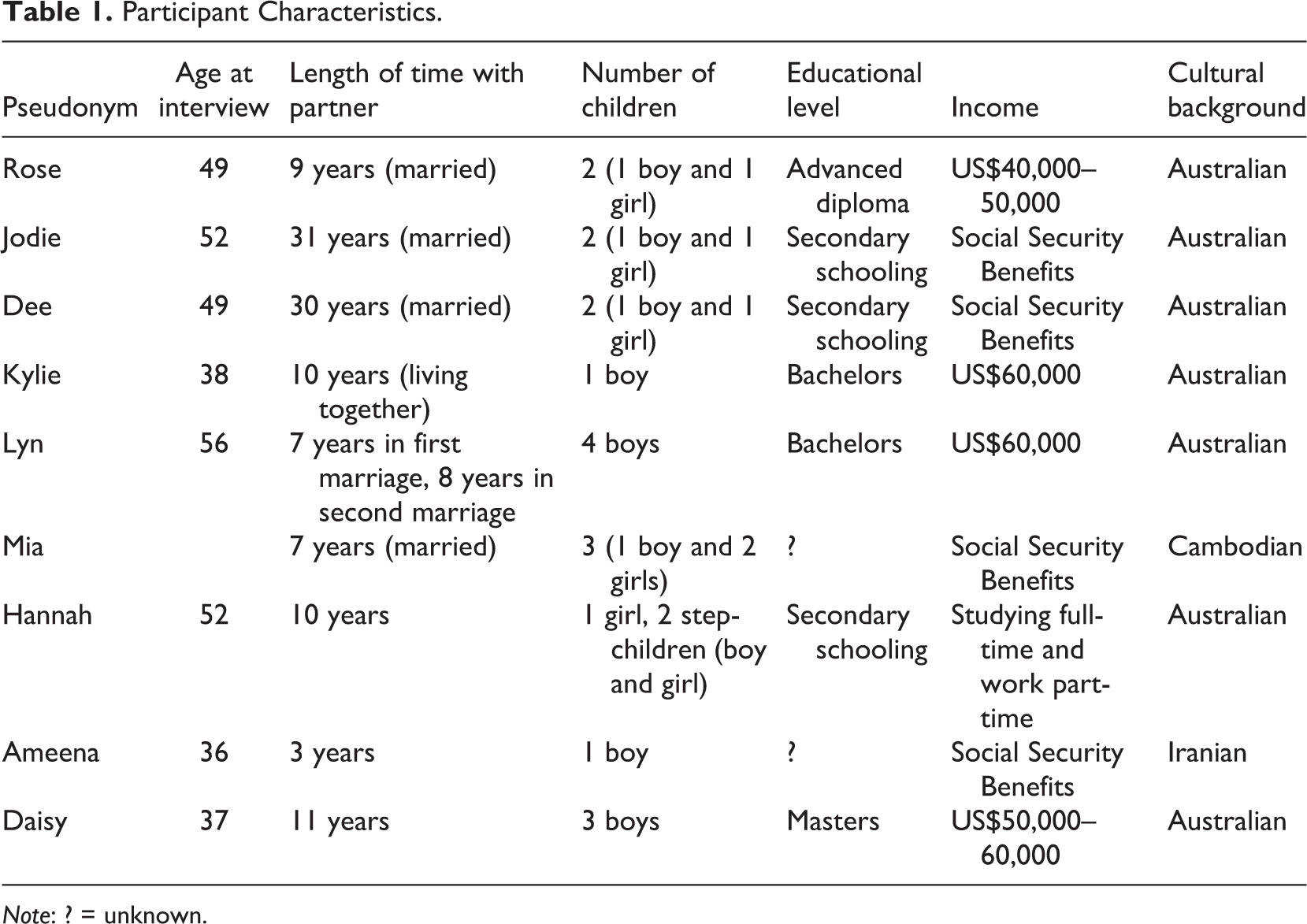
Note: ? = unknown.
The interview transcripts were subjected to theoretical thematic analysis where key themes are identified to provide a rich account of the entire data set (Braun & Clarke, 2006). Thematic analysis involved an initial coding of the main themes, also known as axial coding, followed by more detailed selective coding of specific subthemes and the relationships between them (Sarantakos, 2005). Attention was specifically directed to similarities and differences between participant accounts of protection. Thematic analysis was informed by a feminist perspective that attended inductively to lived experiences of women as well as to the wider gender power relations evident in domestic violence relationships, and sought to present a diversity of constructions of maternal protection (Braun & Clarke, 2006).
The limitations of the study come from the small sample size and hence the ability to generalize is problematic. In addition, all women interviewed had left their relationships and hence this study was based on women’s recollections of mothering experiences. We did not ask or probe for details about child protection situations because our focus was on what the women were saying about mothering and protection.
Findings
Analysis revealed that protection was constructed by the women along a continuum. The most dominant themes are presented first and then the more nuanced themes follow. Thus, more obvious and overt forms such as preventing physical harm of children were located at one end, with more subtle and convert ways at the other, such as emotional protection through creating routines for children to prevent the escalation of violence. However, analysis also showed that some women were aware of the limitations of their protection and raised concern about how domestic violence impacts their children’s lives as they grow into adulthood. Finally, analysis also showed that the women constructed protection as trying to please their partners to prevent violence and maintaining the image of a good father to protect their children from confusion, disappointment, and trauma resulting from domestic violence.
A Continuum of Protection
All the women described examples or relayed stories where they acted protectively toward their children to prevent their partners from either physically assaulting the children or perpetrating long bouts of verbal abuse such as “yelling,” “ranting,” and “putting children down.” However, while this might have been somewhat successful, in most cases the children were not protected from witnessing the violence and abuse that was subsequently perpetrated on their mothers. For example, Daisy described how she tried to protect her children from enduring both physical and verbal abuse. I think I just tried to head him off or keep it under wraps…I would usually get in between…he was actually really indiscriminate in who he went for…and so I would make sure it was me because he flung my kids across the floor once with a backhand…and sometime it was like everybody get to your rooms and then I would stand in the hallway to keep him from getting further down the hallway. He liked to shout and he didn’t like it if you went away, he wanted to continue shouting at you to make you feel like shit and so he would restrain me usually, he would pin me to a wall so he could just continue shouting at me for however long until he ran out of steam until I was screaming and crying and had a puddle on the floor. (Daisy) I think 90% of the time you just had to try and keep the peace, you had to try and keep the house clean and then you had to try and keep the kids quiet…cause when everything was okay then he would be okay but as soon as some minor thing went wrong that’s when he would start flaring up…he could not stand it the kids were crying or if they were upset about anything because anything like that would send him off…I tried to make sure that they weren’t bothering him in any way and so that was mainly what I had to do (Dee, 2013). Because he was never consistent, so some days he’d be really lovely with (names her son) and cuddle and kiss and play, and then other days “Get away from me you little shit”. So for me it was about trying to protect him in going “Alright well my partner is not in a great mood so maybe you and mummy will go to the playground”…I would never say that to my partner that’s why we were going to playground, because that would just infuriate him more. Yeah, so it’s, I find those ones hard to get words around because it’s, you know there’s anguish, there’s anxiety, there’s sadness, there’s vigilance, all that kind of stuff around it (Kylie, 2013).
The above extracts point to a high level of monitoring by the women and their capacities to predict and then avoid violence on the part of their partners. Half of the women spoke about protection in terms of providing for their children materially and emotionally, and trying to create normality and consistency in their lives through routines. For example, Mia spoke about how she worked hard to save money to buy her children nice things and would focus on playing with her children even when she felt extremely sad. And my kids, they like new dress, but I say no, it’s expensive, but I know that they like it, they like Dora, they like Tinkerbelle. But I never buy in full amount, the full price.… the more that I feel lonely, the more that I feel sad, the more that I tell myself to be strong…like when I feel very upset and I take them outside, like up the mountain or park. Sometimes I feel very sad, but I try to take them there and play with them. Or sometimes like I go to the beach and play with them. I still wake up in the morning dress up them, and me, and go out with them. (Mia)
The Limits of Protection
All the women identified there were limits in how they could protect their children in the context of domestic violence. However, they constructed these limits in three different ways. First, most of the women spoke about how the trauma of abuse had impacted them mentally and emotionally, and hence they remembered the times when they just felt so overwhelmed with the domestic violence that they could not protect their children. I oscillated between fierce protectiveness and desolate hopelessness where I felt like I was such a hopeless mother that I didn’t even deserve to have them…hopeless because I couldn’t protect them, because I was living in absolute terror all the time and desperation all the time, we never had enough to eat, we were unhealthy, unwell, I was massively depressed and if I showed the slightest frustration or anxiety that would trigger an enormous conflict. (Daisy) I know I used to constantly beg the children just to do as they’re told and stay in their rooms and unfortunately when I knew he was sort of worked up cause he would abuse me constantly over the phone and what not and you knew that if everything was not as it should be and in its right place when he gets home you know it was going to go crazy and you always had to beg the kids to tidy things up and put things back and be hidden in their bedrooms and not dare be out of their rooms when he came home. I suppose I used to suffer anxiety and I used to get pretty worked up…But unfortunately you do start taking it out on the kids. I used to yell and scream at them because I knew what was about to happen the minute he pulled in that driveway…I used to be on edge constantly. (Jodie) I sometimes think that’s it’s not good to say that I made the mistake and this son I don’t like him because to be honest I really sometimes I don’t like it…I just stuck here you know and this is just very hard. (Ameena) The domestic violence created confusion for my children. My middle boy has an attachment issue, and he experienced so much trauma in those early years, he was a very clingy baby but he also doesn’t trust me…he was very anxious, very over reactive and that made him of course really distressed and frustrated…like my littlest didn’t sleep in his own bed still he was 10, he would sleep with me, and then I found out just a few years ago that when he was at his dad’s he slept with my eldest boy, my eldest boy shared protection to some detriment to be honest. (Daisy) And instead of following my instincts that I don’t want to bring children up in that situation and so I was angry at myself, that I made those choices, that I knew what he was like, I was angry at myself, very angry and it is hard to admit that you made a mistake…admitting you made that mistake, you haven’t done the right thing by your children. (Rose)
Thus, even though the women could construct protectiveness in the contexts of domestic violence, they also expressed some awareness about their limitations as mothers in such contexts. Moreover, all of the women spoke about feeling guilt and ambivalence about their decisions while living with violence. What was particularly evident in the women’s accounts of limits of protection was the speaking of self-blame, that is, women constructed responsibility for not protecting with themselves. The focus on their responsibility as mothers to protect obscures the effects of domestic violence on self-worth, self-esteem, and mental health, particularly as shown by Rose.
Pleasing Him to Protect Children
In telling stories about protection and strategies to cope with violence, all the women spoke about their attempts to “please” their partner as a way to prevent domestic violence. The women gave detailed accounts of how they constantly felt like they were balancing their children’s emotional and physical needs on one hand, and their partners’ on the other. The women spoke about how they used this balancing act as a way to protect themselves and their children from their partners’ potential abuse. My little boy was running around the house, as they do when they’re 2 and knocked over his coffee and he just went ballistic and he started smashing the door, and my son was petrified, and I just picked him up and ran out of the house. And I went outside and tried to reassure him and calm him down…And then he came back out and he was like “You need to teach him”…He was really insecure about my relationship with my son and would always say things like ‘oh you love him more than me” and in front of my son maybe because he wasn’t his. (Kylie) When you’ve got a husband who is extremely lazy and believes that it is all about him and his needs need to be met…after a while you think, I’m not your mother—but you still continue to do those things for him…because I wanted that lovely, peaceful, happy life for my children, about half an hour before he’d come home, I’d say “He’s going to be home soon, when he comes in, don’t say anything, don’t pounce on him and ask him to do this or the other, just leave him for a while and then I’ll ask or you can ask him.” So I wanted them to be protected, from his anger. (Lyn) Jealousy sort of thing, we’ve got children you have to put them first, you have to devote a lot of time to them…the violence got more and more yeah so it was constant cause children when they’re little they need you all the time and I believe he became jealous of the kids cause they were getting a lot more attention. (Jodie) At the dinner table he would treat me like a child. I never used to eat many vegetables and he was well how can you expect the kids to eat vegetables and just look at me like you better eat those vegetables and the kids never said a word and as soon as dinner was finished, they would get up and one had to do the dishes, even my daughter who was 4 years old, and I when I think about it, why didn’t I stop it, it was because I was too scared, scared of the wrath, the ranting and the raving and glaring…that could go on all night and escalate with his drinking…another time I went to read a book to my daughter because I always read to her at night. And “What are you doing? You’re not going in and read to her, she’s bloody 4, she can read to herself.” She couldn’t read but, “She doesn’t need you sitting there reading.” So I’d come out and I’d do the right thing to keep the peace. So now I live with that guilt of if only I’d have just stuck up for her and I think probably the first 6 months she wet the bed, because she’d eaten half a watermelon, she didn’t wet the bed before, but because I went in there to, “She can change her own sheets.” And I wasn’t even allowed to go in there and change the sheets for her; she had to do it herself. It was kind of – in fact she still says to me, “Why did you stay there mum?” (Hannah)
Protecting Him for Children
Four of the women spoke about trying to preserve their partners’ image as a father in the eyes of their children as a protection strategy. Some women spoke about preserving their partners’ image as a way of not disappointing their children. However, as Lyn explains, her effort to limit truth-telling when her children were younger has created confusion and tensions for her children as adults. My son had grown up, wanting desperately to have a relationship with his dad, wanted desperately for his father to approve of him—which he didn’t, he was always telling him, he was going to be a no-hoper, he wouldn’t amount to anything, he was never going to make it in the army—because he’d joined the cadets…he’s just going to be a bum on the streets. So here’s a child who’s desperate for his father to love him and accept him and a mother who’s trying to encourage that…but he was a drinker and I used to be really frightened…when I left him I decided to make a new application for the court, for him, when he had access, to not drink.… Because I’d come to the realization, that if something happened to my children, through his alcohol addiction, it would be my fault, because I allowed them to go with him, so I put in that clause. But his response to that was, I’m not going to change my life for anybody, not even those boys. So as a consequence, there were times, when he would rock up drunk, driving and I wouldn’t allow them to go… now as adults he says “But your mother wouldn’t let me” – my sons believed that…. there was always something that I had to apologize for. And my children were all brought up, that family is family and I really instilled in them they should be able to have a relationship with their dad and with me. It wasn’t me trying to stop them, from that relationship, it was me trying to protect them. He never hurt the kids but now I start talk something like it’s better than that mum and dad loves you, and you are a kid, don’t say anything bad about mum and dad, it’s…family, and then now when my first daughter, she doesn’t like her dad, but she’s still let her dad hug her, kiss her. (Mia) After separation, my children had to go between homes but then demand I be both a protector and a soft safe place for them to fall and also fix their father. They wanted me to fix that stuff too in another house that I was no longer a part of. I kept being responsible for all of it all the time and I just felt inadequate all the time. (Daisy) Okay I have problem, that’s my problem let this baby be happy. Every Wednesday or Saturday he loves to stay with his dad because they have a farm and he can run and make mess, let him be happy, I don’t want to make it a big challenge, just going there, see this baby’s always crying oh daddy, daddy calling his dad. We can see later if he likes his dad. (Ameena) Even my son he doesn’t blame me now for leaving, he knows what it’s like to be with his dad all the time and he knows the different moods and different patterns he constantly goes through. I have explained to them it’s in a way it’s not totally his fault because he does have a mental problem the problem is also that he won’t himself get help for it and they do understand that. My daughter still tries to have a relationship with her dad…they still love their dad and they realize because he has a problem they can’t always have that relationship that they’d love to have as a father…They don’t actually talk about the things that actually went on back then I think they themselves want to block a lot of stuff out but they do have an understanding of it. (Dee)
Discussion
Aspects of the women’s stories of protection in this study resonated with the findings of previous research about mothering in domestic violence contexts. Similar to Haight et al. (2007) and Lapierre (2010a), the women constructed protection in terms of both physical and psychological or emotional strategies, including separating the children from the violence, taking the abuse physically themselves, and reassuring and supporting their children after abusive episodes. Furthermore, the women’s stories also confirmed Lapierre’s (2010a) argument that women in domestic violence do strive to be “good mothers,” that is, the women gave examples of trying to create stability and normality in children’s routines and providing materially for their children such as getting them to school, picking them up from school, buying them nice clothes, and providing their favorite toys and DVDs. Finally, the women’s stories also showed similar narratives to the findings of Peled and Gil (2011), that is, women at times attempted to separate mothering and domestic violence but also constructed protection as something they thought, felt, and acted continually (Buchanan, Power, & Verity, 2013). This was because they saw protection as part being a mother and feared that their children would be physically or psychologically damaged by living with domestic violence. However, our research also identifies some additional protective strategies that have potentially problematic consequences for both women and their children in terms of sustaining the cycle of violence.
Like other feminist researchers, we explored protection to highlight women’s strengths, capacities, and abilities to mother in highly volatile situations. However, from our findings, we argue that understanding how women protect and cope cannot sit outside the context of gender power relations, which are most stark in domestic violence, because this contaminates and shapes protection in unique ways. Domestic violence is terror in the home, whereby an adult (mostly a man) exerts power, control, and domination through creating a climate of fear (Johnson, 2011; Yodanis, 2004). It is within this context that women seek to protect but, as some of the women’s accounts demonstrate, these efforts can also protect their abusive partners because fear dominates this space. The women’s stories of balancing their partners’ physical and emotional needs with their children’s, preserving his image as a good father, and trying to please him are protection strategies borne of a climate of fear. Thus, while these strategies might function as immediate ways of protecting women and children from violence, they also protect the perpetrator from the reality of his actions. Examining women’s protection strategies therefore not only recognizes the impossible task and expectations of mothering in the contexts of domestic violence, but exposes how protection can serve the interests of the abusive partner. Women’s wishes to protect their children therefore may be compromised because the dynamics of power, control, and fear frame and inform it. Moreover, protection in domestic violence is not only about keeping children safe from physical and psychological harm, but can provide a further opportunity for abusive partners to reinforce and maintain the climate of terror. As such, some forms of maternal protection can be in the service of male interests, needs, and image, obscuring and at the same time preserving the very fabric of gendered power dynamics in domestic violence.
Discourses of motherhood are so gendered and deeply embedded in everyday life that they can become invisible through the arrangements of work and family life (McNay, 1992; Lorber, 2010). We argue examining protection in the context of domestic violence provides the opportunity to expose how gender expectations operate and position women and men in the everyday life, and how potentially dangerous these can be for women and children. For example, the women’s stories showed many examples of trying to live up to societal expectations of mothering, and feeling guilt about the limitations on their abilities to protect children in domestic violence. Mother blaming has been found to be particularly strong in domestic violence contexts because it occurs within the micro worlds of families and households and has resonances within the macro social order and discourses (Weisz & Wiersma, 2011). We examined maternal protectiveness not to reinforce mother blaming and the continuation of focusing on women’s behavior in domestic violence but to expose and highlight the impact of gender relations on protection. We argue that gender needs to be central in discussions of protection because it exposes power relations, fear, and how mothering discourses become dominant and fathering discourses become silent in this space. Looking at mothering and noticing the absence of fathering discourses in the contexts of domestic violence is potentially powerful because such discourses expose how mothering is located in a societal context organized by gender and prevailing gender belief systems, which position women as responsible for their children and imposes upon them particular expectations, which are different from men’s (Krane & Davies, 2002; Lapierre, 2010a).
Expecting women to protect their children in domestic violence contexts is complex because it is informed by discourses of motherhood that position the mother–child dynamics as the ultimate paradigm of natural caring relationships (McNay, 1992). As feminist researchers, we are aware of the impacts of domestic violence and we use our feminist lens to highlight responsibility of perpetrators; however, listening to the stories of women’s awareness of their limitations in protection, the expectations and associated judgments that come from discourses of motherhood are seductive, that is, we acknowledge it was difficult to hear stories of abuse that children endured. We acknowledge like others (Humphreys & Absler, 2011; Lapierre, 2010a) that in exploring protection in the contexts of domestic violence it is easy to slip into “adequate or not” mothering. Domestic violence has been seen to create pain, fear, and suffering for children, which can be long lasting and devastating, and include physical, developmental, psychological, and behavioral effects, and the impact of trauma and developmental regression (Bromfield, Lamont, Parker, & Horsfall, 2010). However, it is also known that protective factors, including a strong relationship with the mother, mediate the effects of domestic violence on children (Gewirtz & Edleson 2007; Holt, Buckley, & Whelan, 2008; Laing, 2000). We argue examining women’s protection in the contexts of domestic violence creates a bind because in doing so, as researchers, we too enter into and engage with discourses of motherhood and risk preserving the fabric of gender power relations. But if we can explore protection to expose the climate of fear, control, and power that is domestic violence, then we can shift the focus onto the difficulties and tensions women experience in these contexts. We can also show how these difficulties and tensions come from fear, which then protects and continues to serve the interests of the abuser. Our findings, therefore, show that once we move past the more obvious and overt ways of understanding protection, only then do we begin to gain insight into how women navigate the fear and battle the contradictions that frame domestic violence. Attempting to enable relationships between children and fathers and negotiate and balance partners and children’s needs are some of the most clear cut examples of this. Featherstone (1999) argues that a fuller discussion of the complexities of mothering, particularly in the contexts where children are in danger, is needed. We argue, that attention to maternal protectiveness in domestic violence provides this opportunity but only if it moves beyond notions of adequate or not mothering to reach layers of complexity that expose the fear and gender power relations embedded in these experiences and how both mothering and fathering discourses play out in this space.
Conclusion
Domestic violence complicates women’s mothering yet places high expectations on women in such contexts. Within social work and child protection contexts, if we continue to examine maternal protectiveness as adequate or not mothering, we reinforce gender power relations within mothering discourses, and ultimately, in domestic violence contexts. We also fail to appreciate the pressure on women to mother in ways that meet gendered societal expectations and the demands of abusive partners. The challenge for social work is to examine maternal protectiveness critically as a way to expose and utilize women’s strengths and capacities but at the same time not replicate mother blaming in this journey; and simultaneously expose how power is exercised by perpetrators of domestic violence and how this power is gendered. To reach the complexities of maternal protectiveness that we argue requires a perspective that reveals how gender is central to constructions of protection. Within this context, the complexity of maternal protectiveness, as illustrated in this article, deserves attention in social work research, theory, policy, and practice.
Footnotes
Declaration of Conflicting Interests
The author(s) declared no potential conflicts of interest with respect to the research, authorship, and/or publication of this article.
Funding
The author(s) received no financial support for the research, authorship, and/or publication of this article.