




Abstract
Domestic violence (DV) is a serious problem that reinforces patriarchy and interlocking systems of oppression. Yet, as a form of gender-based violence, DV has long been implicated in essentialist discourses that produce cultural Others, primarily through a deficit lens. Similarly, the field of international development was founded upon a discursive binary between groups labeled “traditional” and an idealized portrait of Western modernity. Drawing on feminist and postcolonial scholarship, this study employed critical discourse analysis (CDA) to investigate how culture was constructed in 26 development research reports funded by international organizations that examined DV in Nepal. The analysis revealed that references to tradition and social change, and discourses of violence as endemic to place, sustained essentializing formulations of Nepali culture. Nevertheless, some passages in the documents inserted evidence that unsettled this essentialist narrative. These findings suggest that researchers, policymakers, and practitioners should develop a reflexive anti-essentialist stance, promote collaboration and leadership in research by diverse stakeholders in developing countries, seek to understand local strategies and resources that are being used to address social problems such as DV, and document the impacts of recent and transnational processes on social problems within developing countries.
Keywords
Domestic violence (DV) is a serious problem that causes physical, psychological, and economic harms to survivors and future generations and reinforces patriarchy and intersecting systems of oppression (Devries et al., 2013; Loxton et al., 2017; Postmus et al., 2020; Richie, 2012; Vu et al., 2016). Undergirding these layered harms are complex discourses about the nature and causes of DV. Intersectional, postcolonial, and transnational feminist scholars have long argued that dominant discourses of gender-based violence (GBV) produce culturally essentialist depictions of groups constructed as outsiders to the West 1 (Burman et al., 2004; Chowdhury, 2011; Mohanty, 1991; Montoya & Rolandsen Augustín, 2013). In the context of international development practice, an array of tropes have been deployed that collapse diverse cultures in developing countries under the label “traditional,” as differentiated from the “modern” West (Bernstein, 1971; Escobar, 1995/2012). Such discourses construct and maintain binaries that in turn are used to justify development frameworks and practices that both maintain hierarchical global social relations such as colonization (Spivak, 2010) and obscure the historical, structural, and contemporary impacts of these hierarchies (McMichael, 2012).
Not only have essentializing discourses of culture produced racialized cultural Others through a perpetual deficit lens (Park, 2005), but they constrain understandings of how to address pressing social issues such as DV (Burman et al., 2004). In the field of international development, the ways in which donors and policy makers define social issues impact how such issues are addressed in countries like Nepal, where international development policy and projects have deeply influenced the construction of social problems and solutions (Pigg, 1993; Shrestha, 1995; Tamang, 2009).
To explore the implications of these dominant constructions, in this study, we used critical discourse analysis (CDA) to investigate how culture was constituted in internationally funded research reports that examined DV in Nepal across two decades. The following questions guided the analyses:
How is culture constructed in international development research documents about domestic violence in Nepal? How do discourses of culture in international development influence what can be known about domestic violence in Nepal?
By examining constructions of culture, this study contributes to scholarly understanding of whether recent international development efforts continue to use essentializing depictions of culture in low-income countries, and the impacts of current framings of culture on knowledge—and knowledge building—about social problems in these settings. The study also sheds light on the implications of these discursive constructions for research, policy making, and practice in relation to DV in particular. DV, or gharelu hiṅsā in Nepali, is an important issue for this study because of the increased attention accorded it as a form of GBV in Nepal (Colombini et al., 2016; Office of the Prime Minister and Council of Ministers, 2009; Sahavagi et al., 2015). Additionally, DV provides an important prism through which to explore constructions of culture because of the divergent ways it has been constructed: as deeply cultural in some instances, and as resistant to cultural explanations in others (Narayan, 1997). To situate the study, we first discuss various ways cultural essentialism has been evidenced in discourses about GBV as well as in international development, followed by a description of the historical, political, and cultural context of Nepal.
Cultural Essentialism in Gender-Based Violence and International Development Discourse
Cultural essentialism has been identified both within discourses of GBV and in the field of international development. As described by transnational and postcolonial feminists, cultural essentialism is evidenced in discourses of GBV when binaries are drawn between the West and perceived cultural outsiders to the West; when the culture of groups constructed as outsiders to the West is represented as unchanging and monolithic; and when violence is portrayed as central to cultural identity (Mohanty, 1991; Montoya & Rolandsen Augustín, 2013; Narayan, 1998; Piedalue, 2017). Cultural essentialist discourses thus preclude analysis of how violence and patriarchy are contested from within groups. Because culturally essentialist binaries represent groups as separate and contained within themselves, they preclude analyses of colonization, and other transnational social, political, and economic relationships (Narayan, 1998). Such binaries have enabled formulations of the West as the purveyor of universal values that transcend culture and as “progressive, democratic, civilized, and feminist,” in contrast to groups who are portrayed as deeply cultural and designated as “backward, barbaric, primitive, and misogynist” (Volpp, 2011, p. 92). Portrayals of some groups as inherently violent, or predisposed to violence, have been amplified by similarly essentialist, pejorative representations of the “violent geographies” of localities, places, and regions that have been Othered (Springer, 2011, p. 94).
International development comprises a complex web of institutions that include financial institutions, bilateral and multilateral government institutions, international non-governmental organizations (INGOs), and contracted research organizations and individuals. Additionally, international development work depends on intricate networks of government, non-government organizations (NGOs), and local research institutions operating within developing countries. Similar to discourses of GBV and culture described by feminist scholars, the field of international development was founded on discourses of difference between the West and countries labeled as “developing.” As international development institutions expanded their reach after World War II, their mission was bolstered by an evolutionary heuristic that located societies on a development ladder from “traditional” to “modern.” From this perspective, the highest levels of social evolution were believed to be found in Western societies, while those societies considered to be traditional (also called “primitive”; “unchanging,” “virtually untouched”) were portrayed as in need of development (Bernstein, 1971; Crewe & Harrison, 2002; Parsons, 1964). Societies were depicted as historically separate from one another; in consequence, the impacts of colonization and slavery went unrecognized (McMichael, 2012). Cultural norms and structures constructed as traditional within developing countries were largely viewed as a barrier to development and their loss was portrayed as necessary to ensure the development process (Crewe & Harrison, 2002; Parsons, 1964).
The culturally essentialist discourses found in both international development and discourses of GBV are maintained through assumptions and practices related to knowledge production. These include assessments of non-Western groups normed on the experiences of privileged women in Western countries. This norming occurs, for example, when the level of gendered oppression in a society is analyzed through Western concepts such as the sexual division of labor or by counting the number of women who wear veils, rather than through situated explorations of the meanings of gender roles, labor, or clothing within specific contexts (Mohanty, 1991). It reproduces what Alexander and Mohanty (2010) call “hierarchies of place and space” (p. 31), in which academies in the West are constructed as the only places capable of producing and disseminating knowledge about places constructed as completely separate (and fetishized) “elsewheres” (p. 41).
In the development field, the privileging of Western experts and ways of knowing has occurred through the promotion of theory and research methods in which “development was to be measured by the yardstick of Western progress” (Escobar, 1995/2012, p. 83). Emphasis on the technical nature of economic and social problems enabled the construction of these problems through discourses that abstracted them from larger historical, cultural, institutional, and political contexts (Mosse, 2014). By forwarding paradigms assumed to be universal, such as humanism and economic rationality, Western development professionals saw themselves as promoting ideas that transcended culture (Crewe & Harrison, 2002; Fujikura, 1996; Pigg, 1997). Such formulations have enabled the valuing and prioritization of Western expertise, with being white as a largely unacknowledged signifier of expertise (Pailey, 2020), over locally contextualized knowledge about development issues (Escobar, 1995/2012; Koch, 2020).
Since its early years, new models for international development have arisen. These have included participatory approaches that seek to elicit local knowledge and control over the development process (Mosse, 2014), as well as rights-based models which emphasize rights over charity and aim to increase opportunities for participation of members of marginalized groups through activism and advocacy (Uvin, 2007). Participatory approaches to gender equality, particularly those based on solidarity models, have, in some circumstances, been found to improve women's relative positioning in their families and broader communities (Kabeer, 2011). Women's human rights approaches have been leveraged to forge transnational relationships to address violence, and to increase the visibility of DV as an issue that should be addressed by governments, NGOs, and society at large (Chowdhury, 2011; Weldon & Htun, 2013). Yet, ethnographic explorations have also revealed that in some participatory projects, local knowledge has been treated as only relevant at the local level, in contrast to international knowledge that is viewed as universally applicable (Pigg, 1997). Particularly when employed by and for Western audiences, the women's human rights framework has, at times, continued to be employed by relatively powerful actors in ways that reinforce colonial narratives of the need for outsiders to save women in developing countries from their own cultures (Abu-Lughod, 2011; Chowdhury, 2011; Spivak, 2010).
Given the long-standing and tenacious influence of cultural essentialism in discourses of GBV and international development, there is a need to explore the extent to which international development knowledge continues to be shaped by cultural essentialist formulations, and how such formulations influence the international knowledge base about DV in a country with deep ties to international development. Before turning to the present study, we briefly outline these ties in Nepal as well as their influence on understandings of social problems. We describe increased attention brought to the issue of DV in the country and contextualize this study by pointing to the cultural diversity that exists in Nepal.
Nepal Context
Nepal is an important site for the present study because of both the substantial influence of international development in the construction of social problems (Pigg, 1993; Tamang, 2009), and the increased recognition in Nepal of DV as a form of GBV and as a human rights issue (Colombini et al., 2016; Office of the Prime Minister and Council of Ministers, 2009). In 1951, Nepali King Tribhuvan reversed the isolationist policies of the previous century, paving the way for successive decades of development (Tamang, 2009). In 1971, Nepal was designated by the United Nations as a “least-developed country” (LDC): one of 25 countries to be provided with preferential treatment related to trade, aid, and support for participation in the UN system (Committee for Development Policy and UN Department of Economic and Social Affairs, 2018). Because Nepal is one of a handful of the LDCs that was never colonized by a Western power, it has often been considered an ideal setting (a “laboratory,” a “blank slate,” a “convenient guilt-free platform”) to test development ideas (Fujikura, 1996, p. 271; Pigg, 1993, p. 47). As a result, foreign aid has consistently accounted for a large proportion of the Nepal government's budget (Pradhan & Zellmann, 2018; Tamang, 2009).
Aside from their intended programming, international development efforts in Nepal have had far-reaching effects on how social problems have been constructed. During the Panchayat era (1962–1990), international development funding supported the consolidation of power by Nepal's repressive single-party government, which extended its reach over rural areas and Indigenous groups in part through the construction of a “homogenized agency-less ‘Nepali woman’” in need of development by the state (Pigg 1993, Tamang 2009, p. 65). After the 1990 People's Movement led to multi-party democracy, foreign aid was increasingly channeled through local NGOs (Tamang, 2009). Whether funneled through the government or NGO networks, international development funding has supported the professionalization of development, strengthening the divisions between urban elite groups who are well-represented as job holders in development organizations and those groups who are positioned as target groups for development (Pigg, 1993, 1997; Shrestha, 1995). At the same time, political parties have forwarded development discourses to garner support (Tamang, 2009). Alongside development projects, and even in places not reached by them, development discourses have taken hold in the general population, resulting in the construction of some groups in Nepal as “developed”—often through proximity to Western training and education—while others are constructed through the lens of “backwardness” and as “underdeveloped” (Pigg, 1993, p. 53; Shrestha, 1995, p. 268).
In addition to Nepal's long relationship with international development, the country's increased attention to the issue of DV makes it an important context for this study. In 2009, Nepal passed the Domestic Violence Act, which criminalized physical, sexual, mental, and economic violence between household members (Nepal Law Commission, 2009). The government also declared 2010 as the year to end GBV, including DV (Office of the Prime Minister and Council of Ministers, 2009). Leading up to these policies were years of women's rights advocacy calling for the government to live up to its commitments as a signatory to the Convention for the Elimination of All forms of Discrimination Against Women (CEDAW), leading to changes in gender discriminatory laws related to property rights, marriage, and divorce (Sahavagi et al., 2015). Gender discrimination and DV were also condemned by Maoist insurgents in Nepal's 10-year civil war (1996–2006) (Tamang, 2009) and the interim constitution of 2006 framed GBV as a human rights issue, leading to increased government policy and research on the topic (Colombini et al., 2016).
Before examining constructions of culture in Nepali development literature, it is important to note that Nepal is a culturally diverse country. A report commissioned by the United Nations Educational, Scientific and Cultural Organization (UNESCO) estimated that over 90 languages are spoken in Nepal (Toba et al., 2005) and in 2011, the census reported that 123 languages are spoken as a mother tongue (Yadava, 2014). Though according to the national census, most Nepalis are Hindu, the population also comprises followers of Buddhism, Islam, Kirat, Christianity, and other religions (Dahal, 2014). In addition, a variety of groups identify themselves, and are identified by the government, through distinctions that include differences in ethnic and political identities, as well as experiences of stratification related to geography, class, and caste 2 (Dahal, 2014, Toba et al., 2005; Yadava, 2014).
Methods
This study employed a critical discourse analysis (CDA) approach to examine discourses related to culture in internationally funded research reports that examined DV in Nepal. CDA enables examination of the ways in which power is enacted through language (Gee, 2014; Willey-Sthapit et al., 2022). An advantage of this approach is that it can provide an overall picture of how discourses of culture impact knowledge about DV in Nepal.
Sampling
The research reports of development organizations have played an important role in spearheading and contextualizing DV, evaluating programs, and providing policy recommendations. Reports supported by international organizations serve as the basis for other international development materials such as literature reviews as well as organizational policies and programming related to DV in Nepal. To construct the sample for this study, our aim was to identify research reports that were either conducted or funded by international organizations and that addressed the topic of DV in Nepal. Because English is a major language in which outward-facing development reports are produced, we sought reports that were written in English.
Documents were identified through three different searches. First, major donor organizations contributing funding for work on issues related to violence and gender were found through Nepal's Development and Cooperation Report (Ministry of Finance, 2016), which identified top donors by ministry and sector. The websites of these organizations were then perused, resulting in the identification of five documents. Second, a keyword search was conducted in the United Nation's (UN) Information Centre online repository of documents in Nepal. This on-line repository is accessible upon email request and includes documents (e.g., official statements, policy briefs, and research studies) authored by branches of the United Nations as well as other large international organizations, such as the United States Agency for International Development (USAID). Eleven documents were identified through this search. Third, citations of the identified studies were perused to identify additional documents, yielding 17 documents. Eight reports were found using multiple methods. A Google keyword search was also conducted but resulted in no additional studies. In all searches, the keyword “Nepal” was used alongside the following terms: “domestic violence,” “intimate partner violence,” “spouse abuse,” “family violence,” “wife abuse,” “wife-beating,” “gender-based violence,” “violence against women.” The final sample comprised 26 documents published in the 20-year span between 1997 and 2016. The 1997 study is credited as being the first to address GBV in Nepal (Deuba & Rana, 2001; Saathi, 2010).
Studies were included in the sample if they met the following criteria: (1) research reports with a description of study methodology, (2) research components beyond a literature review, (3) in-depth discussion of DV, (4) research was conducted in Nepal and described specificities related to Nepal, (5) the study was either conducted or funded by one or more international development organizations as evidenced in the cover page, copyright and/or acknowledgements; and (6) the report was written in English and available on-line. Publications about Nepalis living abroad as well as about Bhutanese refugees living in Nepal were excluded. The latter were excluded because they have been largely treated as separate and temporary residents by the Nepal government (e.g., kept in refugee camps rather than integrated into Nepali society) and out of respect for the fact that many seek to maintain claims to their homeland by identifying as Bhutanese (Gautam & Mishra, 2019).
Sample Description
The final sample included a diverse body of research reports, encompassing a variety of authoring organizations, topics, and methods. Twenty-two studies were conducted in Nepal and four were conducted across multiple countries in South Asia including Nepal. Eighteen studies examined violence against women (VAW) or GBV and discussed instantiations of these within families. Eight studies examined intimate partner violence or DV, which could include violence from a spouse or other family members. Five studies were quantitative, 10 were qualitative, and 11 were mixed methods (Table 1).
Sample Description.
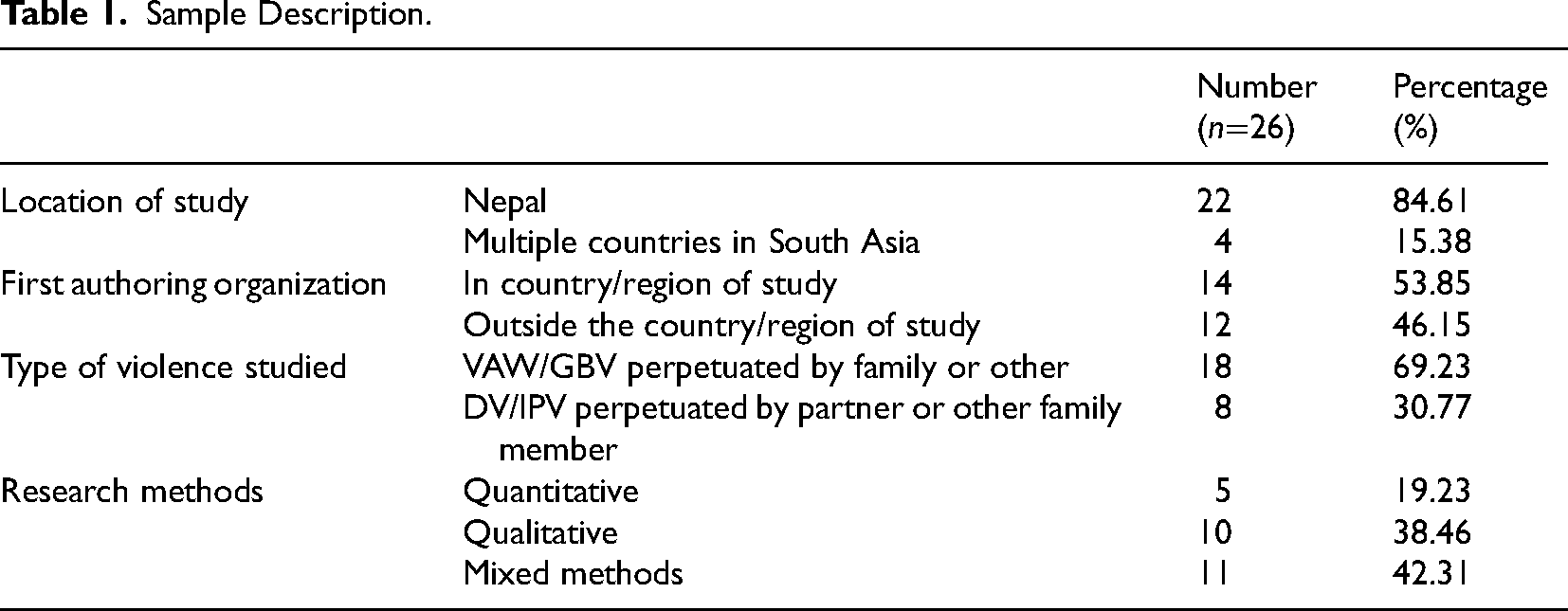
While 14 reports were authored by Nepali and South Asian organizations about their own region and 12 were authored by organizations from outside of the region of study, the reality of leadership in each study is more complex. Four reports drew on Nepal's Demographic and Health Survey, for which the measurements and data collection processes were largely designed by the US Agency for International Development (USAID), which seeks to collect comparable data across multiple country contexts (USAID, n.d.). In one case, an outside organization hired a Nepali consultant to conduct the research. In another, an outside organization summarized research conducted by researchers representing a Nepali organization. In a third, an external author wrote up the findings of a study conducted by a Nepali organization. The insider or outsider status of authoring organizations was determined based on who was listed as first author on the title page and the location of the organization of the first author represented. In all the studies, Nepali researchers, practitioners, or community members had important roles to play in the production of the document—as first authors, study designers, research assistants, and/or as key informants.
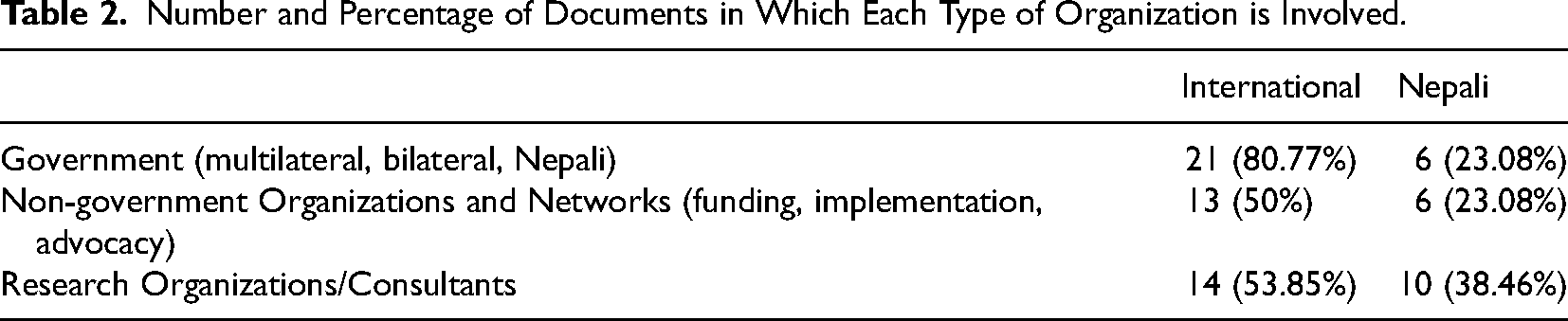
The studies in the sample were conducted by diverse types of organizations, including multi-lateral government organizations such as branches of the United Nations, bilateral government organizations such as USAID and UKAID, and Nepali government organizations such as the Ministry of Health and Population (MOHP). INGOs included those involved in funding projects, such as the Asia Foundation, and those primarily involved in advocacy, such as Amnesty International. Nepali NGOs included those that worked on specific issues such as Burn Violence Survivors (BVS)-Nepal, GBV such as Saathi, and those that addressed human rights more generally, such as Advocacy Forum-Nepal. Research entities included organizations that provided research expertise, including consultants and universities. Although some of these organizations could also be classified as non-profits, they were categorized separately due to the research-oriented role that they play. Finally, although government organizations and NGOs are separated in this table, the reality is more complex since at times consultants that elsewhere identified as employees of NGOs were hired by branches of the Nepali government to take leading roles in research (Table 2).
Number and Percentage of Documents in Which Each Type of Organization is Involved.
Analytic Procedure
The analytic procedure was shaped by a CDA approach to the documents (Gee, 2014). Descriptive summaries were created to capture the documents as narrative wholes (Hollway & Jefferson, 2000). These summaries included the contexts described for the research, research questions, the concepts, definitions, and conceptualizations of gender-based and domestic violence in the document, the methods used, and the conclusions drawn. References to culture were noted through an initial reading of the documents. These included statements about social norms and practices, traditions, customs, and approaches to diversity. Additionally, we noted how discussions of culture corresponded with references to time (e.g., tradition, modernity, social change), place, and groups of people. It is important here to note that merely talking about historical violence or patriarchy was not coded as essentialist. Instead, essentialism was found when such discussions used binaries or generalizations that precluded the examination of issues such as diversity, past contestations of violence in Nepal, and the ways in which violence may be perpetuated by modern systems.
After creating descriptive summaries, emergent categories related to culture, time, place, and groups of people were used to code each document in the qualitative software program Dedoose (Dedoose Version 8.2.14, 2019). The coded excerpts were then used to develop targeted summaries of dominant discourses related to culture. Disconfirming evidence was sought in the form of counter discourses and evidence within the documents that contradicted emerging dominant discourses (Maxwell, 2013). In addition to within-case descriptive and targeted summaries, information about each document was summarized in an Excel spreadsheet to facilitate cross-case analysis. Hypotheses were developed to explain similarities and differences between documents and multiple matrices were used to organize and check emerging findings across the sample (Miles et al., 2014). These included analyses of whether publication date, methodologies used, and authorship related to cultural essentialism in the reports.
Memos were used to track decisions related to study operations, codes, and analysis and to reflect on how the authors’ positionalities and theoretical perspectives influenced the research process (Birks & Mills, 2011; Maxwell, 2013). All the authors identify as cisgender women and are employed in Western academic institutions, including three in the United States and one in New Zealand. We have each engaged with different forms of international research, two of us in Nepal. Three of us are white and one is Nepali. One author's experiences of having lived and worked in Nepal and being married into a Nepali (Newar) family helped to sensitize her to discussions of culture that were simplistic or missed important elements of social life in Nepal. Another brings her experiences as Indigenous Nepali, with ongoing ties to Nepal, and deep understanding of the historical and current political and social terrain within the country. Nepal Studies scholars and development workers located in Nepal and the United States were consulted to guide understandings of development institutions, cultural nuances in the reports, and the alignment of intentions and impacts in writing this paper. The first author presented this paper at the Annual Kathmandu Conference on Nepal and the Himalayas, where she received positive feedback as well as helpful input on the framing of the paper as well as additional information regarding the experiences of conducting research in Nepal's development sector.
Findings
The analysis surfaced three discursive themes in relation to cultural essentialism. The first theme was characterized by binaries drawn in relation to time, wherein present-day GBV in Nepal and South Asia was portrayed as a carryover from a traditional patriarchal past, and social change was celebrated and characterized as the result of recent events and modern institutions. Second, discourses linking culture, violence, and place portrayed Nepal and the surrounding region as particularly prone to GBV, including DV. Third, important disruptions to cultural essentialist discourses of time and place were evident in this body of literature. Though these were not centered, they represent cracks in essentialist narratives and point to how such narratives limit international knowledge of DV in Nepal. Below, we present each discursive theme, the forms it took, where it surfaced, and how it influenced international knowledge about DV in Nepal.
Entrenched: Violence as a Carryover from a Traditional Patriarchal Past
Cultural essentialism was evidenced when patriarchy and violence in Nepal and South Asia were portrayed as carryovers from the deep past, and when gender equity and non-violence were associated with recent events and modern institutions. Twelve documents attached the following words and phrases to descriptions of Nepali or South Asian culture: “deep-rooted,” “entrenched,” “ingrained,” “archaic,” “ancient,” “since time immemorial,” and “traditional Nepali patriarchy.” For example, UNIFEM South Asia Regional Office (2003) stated, “In South Asia, the culture of patriarchy is deeply entrenched and gender biases are perpetuated by men and women, as part of the social order” (p. 50).
Seven documents used the phrases “still,” “persist,” and “continue” to locate traditional tolerance for violence in the present. Framing present-day violence through the idea of persistence suggests just two potential outcomes: either the violence associated with traditional culture continued or decreased. For example, one report contained the heading, “Why is Violence against Women and Girls in South Asia so Persistent?” (Solotaroff & Pande, 2014, p. xxviii) and repeatedly use the term persistence to describe the presence of violence and unequal gender norms in South Asia. The assumption that the violence and gender inequality that exist today are carryovers from the past supports the association between violence and tradition and precludes analysis of how modern practices may also influence violence.
In contrast, gender equality and the non-acceptance of violence were represented in 19 reports as signs of change brought about by cosmopolitan actors and modern institutions. This progress narrative was not, by itself, culturally essentialist, but became so when connected to discourses of entrenchment of traditional norms or when a binary was set up between culture in Nepal, South Asia, or all low-income countries and modernity. For example, one report stated, “Whilst gender equality has been on the international agenda for some time, it has not been readily accepted by many developing world cultures, in spite of their governments’ legal and moral commitments to modern gender values” (Pradhan et al., 2011, p. 53).
In two instances, empirical evidence contradicting the polarization between the patriarchal past and modern gender equality was presented but not addressed. For example, in a study of the impacts of a literacy program, evidence of women's social action was set aside and the report instead highlighted the persistence of local patriarchy and the need for international development. In this study, between 25% and 50% of Nepali women reported that they had heard or witnessed cases of wife beating and a similar proportion reported participating in a social action against DV in the previous year (Burchfield et al., 2002, p. 112). However, the authors presented these findings as “women's continuous resistance in acknowledging the problem of DV in their communities” (Burchfield et al., 2002, p. 111) and as “a lack of social action” (p. 118) attributed to “the fact that economic and religious factors still play an important part in women's social actions despite their participation in integrated literacy programs” (p. 118).
In a country as diverse as Nepal, it is important to ask whose culture was the object of reference when traditional culture was mentioned in these documents. Although most of the reports mentioned Nepal's cultural diversity, descriptions of culture were often attributed to Hindu and/or high-caste groups or to norms and family structures linked to these groups. Indigenous groups in Nepal were described in five documents as having less rigid gender norms as compared with the dominant group (Amnesty International, 2014; OPMCM, 2012; Pradhan et al., 2011; Rana & Deuba, 2001; UN RCHCO, 2013), but these descriptions were peripheral to the prevailing progress narrative. Discourses that portray tradition as static until recently, and which draw a contrast between traditional culture that perpetuates DV in Nepal and acultural gender equitable modernity, limit what can be known about DV in Nepal. Where DV is presupposed to be a remnant of traditional culture, it becomes difficult to consider how patriarchy and DV might have been contested from within the country prior to modern interventions as well as the ways in which modern and recent trends might exacerbate DV.
Although there were many documents that evidenced cultural essentialist discourses related to time, there were nine documents that did not. Five of these were reports based on nationally Demographic Health Survey data. As brief chapters in larger reports, these provided little context in general, including little discussion of cultural context. Beyond this, no clear pattern emerged as to which of these nine documents used essentialist constructions of time and which did not. Alternatives to constructing DV through references to a deep cultural past were to provide more recent and specific historical contexts such as the impact of Nepal's civil war, examples of women's rights advocacy, government and international policies, and current global rates of DV.
Unrelenting: Particularity of Violence in Place
Connected to and amplifying conceptualizations of violence in Nepal and South Asia as being the result of traditional cultural practices were discourses that linked culture, violence, and place. These included cultural essentialist discourses of place that linked violence within a place to the deep past, that portrayed widespread violence as particular to the region, and that portrayed DV as a uniform and unrelenting experience of all women. Although 17 documents in the sample used the terms “widespread,” “epidemic,” “infested,” “rampant,” and/or “pervasive” to point to the prevalence of DV in the regions of study, only three linked such descriptions of violence to the deep past. For example, one report characterized South Asia as “a sub-continent infested with deeply entrenched gender inequalities and VAW” (Raab, 2011, p. 5).
While 16 documents in the sample consistently described diverse attitudes and actions of family and community members to address GBV, in a small subset of four documents, words such as “constant” and “unrelenting,” painted a picture of violence that was not only everywhere in a region but that also never stopped. For example, Solotaroff and Pande (2014) stated: Violence against women and girls in South Asia is particular by virtue of its unrelenting pervasiveness throughout a woman's life—from childhood through adolescence, adulthood, and eventually to old age. It is a persistent part of their lives, throughout their lives. (p. 27)
The use of the words “efficiency” and “conspiracy” in two documents suggested that all families, communities, and institutional actors within Nepal or South Asia intentionally worked together to perpetrate and support violence. When describing Nepal as a context for their research, Burchfield et al. (2002) wrote: “The conspiracy of silence surrounding domestic violence makes it an invisible epidemic” (100).
In two separate documents, the use of the singular “woman” reinforced the sense that all women in Nepal experienced violence and patriarchy in the same way. For example, one report that linked a very short period of rest after giving birth to violence, stated, “After seven days the woman begins all her daily work such as agricultural labour, fetching firewood, water, cooking, etc. This denies much needed rest to the woman. In Nepali society a woman's worth is considered only in terms of the work she is able to do to run the household” (ICRW, 2014, p. 8). This statement suggests the blanket devaluation of all women in Nepal, an idea that is belied by a common longstanding idea in Nepal that the post-partem period should be a time of rest, bonding with the baby, and receiving nutritious food and care for the person who gave birth (Willey, 2021). Discourses that did not allow for the diverse experiences related to DV that exist in Nepal and South Asia, made it difficult to understand how individuals and families contested violence in their day to day lives, including the strengths, resources, and strategies upon which they drew to prevent or challenge such violence.
Although only a small subset of six documents that used the cultural essentialist formulations of place described in this section, it is notable that each of these reports were authored by organizations that were outsiders to the region of study. Furthermore, most of these were funded by powerful organizations likely to have influence over funding priorities and international perspectives on Nepal such as the World Bank (Solotaroff & Pande, 2014), USAID (Burchfield et al., 2002), and the United Nations Population Fund (UNFPA) (ICRW, 2014). Thus, even though this highly problematic discourse was only evidenced in a small number of reports, its reach and influence on development programming could be relatively large.
Unsettled: Contesting Essentialized Depictions of Nepali Culture
To this point, we have described how discourses of time, place, and culture reinforce cultural essentialist ideas about Nepal and South Asia. Yet glimpses of counter-narratives were also identified in the texts. Objections to cultural essentialist discourses of time and place were evident in three ways: by drawing attention to (1) Nepali traditional practices, norms, and structures that either have been, or could be, used to counter DV, (2) the existence of patriarchy within developed countries, and (3) international or recent contexts that have contributed to violence. As important as these insertions were, they were often limited to short phrases at the perimeters of the dominant discourse of culture in the documents, rather than centered for deeper examination.
Four documents, all first authored by Nepali organizations, pointed to traditional structures or practices that either have been, or should be, employed to counteract DV. These included using traditional channels of communication such as non-formal education systems and folk songs as well as the roles that traditional healers and strong Nepali family structures and community members play to counteract DV (BVS-Nepal, 2011; Deuba & Rana, 2001; Saathi, 1997). One report mentioned a traditional practice that could be reclaimed in new ways: In many places in Nepal, widows have been expected to forego wearing red clothing and tika (a red mark on the forehead) after the death of their husband, and they may face blame, discrimination, and violence from their husbands’ families. During the Maoist insurgency, in what was called the red tika movement, women whose husbands had died or gone missing continued to wear symbols of their married status (red tikas and red clothing) to contest the idea that they were broken having lost a spouse (Advocacy Forum & ICTJ, 2010).
Five documents, four of which were first authored by Nepali or South Asian organizations, observed that patriarchy existed in other parts of the world, including in developed countries (Crea, 2012; Deuba & Rana, 2001; Nanda et al., 2012; OPMCM, 2012; Saathi, 1997). For example, Deuba and Rana (2001) wrote: “A third approach to examining the causation of family violence uses a macro-level analysis to emphasize the ‘structural violence’ considered endemic against women in Western society” (p. 3).
Finally, 20 documents provided evidence that troubled a Nepali-traditional versus global modern binary by discussing at least one global and/or recent historical shift that has contributed to DV in Nepal. These included Nepal's civil war, in which the U.S. and India supported the government as part of the “global war on terror” (Advocacy Forum & ICTJ, 2010; HURDEC, 2007; Hawkes et al. 2013), increasing migration and the breakdown of community life (Advocacy Forum & ICTJ, 2010; UN RCHCO, 2013; UNIFEM, 2003), DV in the context of love marriages 3 (MAHR, 1998; Pradhan et al., 2011; Amnesty International, 2014; Tuladhar et al., 2013), the promotion of gendered stereotypes by the media (UNIFEM, 2003; OPMCM, 2012), and the influences of new technology on DV (OPMCM, 2012). Crea (2012) expressly linked patriarchy to modern ideologies, stating: “Several years of activism by women's rights groups in South Asia to challenge patriarchy and its various avatars in capitalism, nationalism, fundamentalism, and others has resulted in some significant social transformation and law reform” (p. 19).
Although most documents emphasized the positive roles that international organizations have played to address GBV, including DV, it is notable that several critiques were also leveled at such projects. These included critiques of the short-term nature of development programming (Saathi, 2010; MOHP, 2013), the uneven presence (Saathi, 2010) and silo effects (Raab, 2011) of development programs, and negative impacts related to the mechanization of agriculture, structural adjustment policies, and contraceptives programs (UNIFEM, 2003). Saathi (1997), credited as the first study of VAW in Nepal, concluded their report with a challenge to development actors, saying: Most development programmes, even programmes for advocacy of women's rights and health, overlook VAW & G (Violence against women and girls) as an issue of any consequence. Therefore, this research should be utilised as a resource to highlight the issue and recognise it as one deserving attention, especially if commitment to empowering Nepalese women and developing the country is serious and not just tokenism. (p. 48)
Discussion
Grey literature research reports of social service, advocacy, and research organizations in Nepal have played a central role in contextualizing and spearheading attention to issues such as DV (see, e.g., Saathi, 1997; Sahavagi et al., 2015). Reports of research funded by international organizations also play an important role in shaping international understandings of DV in Nepal, as well as the agendas of international donors and policymakers. This study sought to examine how culture was constructed in international development research documents about DV in Nepal and, further, how such constructions influenced what can be known about DV in Nepal. This analysis revealed that culturally essentialist discourses related to time were present in most documents while those that described experiences of DV as monolithic within Nepal were less often present. Cultural essentialist discourses were also contested in important ways that highlight the limits of cultural essentialism for making sense of DV.
Essentialist discourses were found in most of the documents in relation to discussions of Nepal's deep patriarchal cultural past and explanations of present-day violence as carryovers from this past. This reflects a discourse in which the deep past is presented as being static until recently. It precludes analysis of the ways in which diverse identity groups have historically approached gender in Nepal (Tamang, 2009). The idea of contemporary violence as a remnant of past tradition found in some of the documents reflects a continuing discourse of development that constructs traditional culture through a deficit lens and proposes development and modernization as the primary solution (Bernstein, 1971; Crewe & Harrison, 2002). While it is important to recognize patriarchy and violence when and wherever they occur, the use of this development discourse precludes understanding of the ways in which recent events and modern institutions may at times exacerbate DV. For example, Tamang (2002, 2009) has described how development projects of the single-party Panchayat government, supported by foreign aid, initially normalized women's primary role as being in the private sphere and extended the power of the dominant religious and ethnic group to regulate family life among Indigenous groups in Nepal. At the same time, highlighting the complexity of past and contemporary influences on violence, the idea that DV is only a carryover from a traditional past was contested by numerous discussions within the documents themselves.
Often, cultural essentialist discourses become evident through the drawing of explicit binaries, including binaries between the West and those designated as outsiders to the West (Mohanty, 1991; Montoya & Agustín, 2013) or between countries considered to be developed and those considered to be developing (Bernstein, 1971; Escobar, 1995/2012). In the body of research reports analyzed here, explicit binaries drawn between Nepal (or low-income countries) and the West (or high-income countries) were present but relatively rare. While this could be a sign of movement away from colonial discourses among development organizations, a more proximal explanation for this finding is that reports were focused on a specific geographic area (like Nepal or South Asia) and were not intended to compare different countries and regions. Interestingly, such comparisons, though relatively rare in this body of documents, provided an opportunity to contest essentialist depictions of Nepal by highlighting the problem of patriarchy and violence as one that extends across cultures (including the West) and across levels of economic development. Similarly, analyses of the transnational contexts that influenced DV in Nepal, such as the breakdown of community life through increasing labor migration (Advocacy Forum & ICTJ, 2010; UN RCHCO, 2013; UNIFEM, 2003), unsettled binaries between locations and cultures.
Although rare, some documents, all authored by outside organizations, depicted experiences of DV as a uniform and unrelenting experience. Such discourses constructed all women as victims of continuous violence, and precluded understanding of the strengths and strategies used by survivors, family members, community members, and activists to challenge DV in Nepal. Such discourses were written and funded by powerful international organizations that may have a great deal of influence on how outsiders understand issues of DV and culture in Nepal, and the types of programming that might be funded as a result.
It is noteworthy that Nepali organizations were often actively involved in research conducted and supported by international organizations. Such involvement, especially authorship, appeared to add nuance to discussions of culture. The presence of Nepali authorship could be reflective of larger changes in international development policies, including increased recognition of the importance of local knowledge in development programing (Pigg, 1997). Nonetheless, even though development practices have shifted away from top-down approaches and toward recognizing local knowledge, and participatory and rights-based practices (Pigg, 1997; Mosse, 2014; Uvin, 2007; Yadav, 2019), such practices have not fully resulted in a shift away from cultural essentialist discourses in the research reports produced and supported by international organizations in Nepal. Nor was there evidence of any significant movement away from cultural essentialism in this body of literature across two decades. This finding reflects Pigg's (1997) observation that even if local knowledge is incorporated in practice, this does not mean that such knowledge is recognized at the international level. Similarly, though many documents used a human rights frame to make sense of DV, this study's findings support previous observations that human rights frameworks do not necessarily ameliorate essentialist discourses of culture and violence (Abu-Lughod, 2011; Chowdhury, 2011).
Limitations
Some key limitations should be kept in mind when interpreting these findings. First, there are a variety of ways in which a CDA study can be approached. For example, this study examined discourses of culture through words and phrases tying Nepali culture to time and place. Another set of discourses that could be examined were those that tied specific forms of violence to place and culture, variously called “culture-specific” or “harmful traditional practices.” Capturing the nuances of the discourse of “harmful traditional practices,” which reflects language in the UN Declaration on the Elimination of Violence Against Women (1993), and which has successfully been used to lobby policies to address such practices in Nepal, would require a separate, preferably multi-level, analysis.
A second limitation of this study is that we sought only to describe explicit discourses. Implicit discourse operates through a combination of what is stated and what is left unstated but might be assumed in the minds of the authors and/or readers of a text (Fairclough, 2015). For example, policymakers and researchers who have never been to Nepal and do not take an anti-essentialist stance might read an ahistorical patriarchal cultural past even where this is not explicitly stated as part of a progress narrative. Similarly, someone with limited on the ground experience might—as we saw in this sample—assume monolithic experiences of DV in Nepal even when there was evidence of diverse beliefs, norms, actions, and experiences. Conversely, authors familiar with Nepal might take these diverse experiences for granted. Focused on understanding DV, its causes, and impacts, they may not feel a need to explicitly challenge cultural essentialist ideas for the sake of external audiences.
Given the diverse authoring and supporting organizations that comprised this sample, a third limitation of this study was that it was not possible to understand the specific processes by which each document was produced or to trace the various pressures, concerns, and commitments, from inside and outside the region, that contributed its final form. As such, it is difficult to make definitive claims about the role that authorship played vis a vis discourses of culture in these documents. Further contributing to this complexity, when the first author presented this study at a social sciences conference in Kathmandu, one of the scholars who had worked in a Nepali research organization shared that donors often only decide whether they will attach their names to a research report once local organizations have completed it. Thus, this sample is comprised only of those documents to which donors have decided to attach their names.
Finally, concerned as this study was with how Nepali culture was constructed in reports about DV oriented to outside audiences such as international policy makers and donors, the sample comprised English language documents. However, limiting the sample to English language documents might have resulted in the overrepresentation of English-speaking donor organizations in the sample. It is possible that reports written in other languages might convey different discourses related to culture.
Implications
The findings of this study have important implications for researchers, policy makers, and practitioners concerned with the production, circulation, and use of knowledge related to DV in Nepal, as well as for the fields of international social work and development more generally. The limitations on knowledge that are imposed by culturally essentialist discourse warrant underlining the importance of recognizing diversity, strengths, privilege and oppression, transnational realities, and genuine dialogue toward generating effective actions to address DV and other social issues.
First, in relation to DV in Nepal, it is important that researchers recognize local resources, strengths, and strategies already being used to counter DV. This is not about idealizing Nepali culture, another common form of cultural essentialism. Rather, attentiveness to resources and strategies entails recognizing the myriad negotiations and contestations taking place across intersecting relations of privilege and oppression, including heteropatriarchy, class, caste, ethnicity, and nationality (Nagar, 2021). For example, research in India has highlighted ways in which service providers addressing GBV have theorized and resisted multiple forms of systemic oppression simultaneously, including anti-Muslim culturalist discourse within the country; the violence of patriarchy, poverty, caste, and uneven development; class hierarchies within and among development organizations; and community and state violence (Piedalue 2017; Sangtin Writers & Nagar, 2006). Recognizing strengths may also include examining both past and present actions taken to address DV. For example, in a separate study conducted by the first author, one Nepali government provider described his perspective that community-level interventions against DV have always existed but have changed over time. In his view, whereas in the past male community leaders primarily took it upon themselves to challenge DV in the community, this work has increasingly been taken up by community-based women's groups.
Local strengths should not be identified a priori by international actors but through dialogue with those working to challenge DV. Dialogue is important because even where international and local actors agree that DV is wrong and should be addressed using a women's rights model, interpretations of this model differ. Some international organizations emphasize an individualized model to address human rights and DV, such as criminal punishment or women's increased participation in cash economies as the path towards gender equality (Grewal, 1999; Solotaroff & Pande, 2014). However, women's movements in Nepal and South Asia have often emphasized the necessity of pursuing a full range of rights that include economic and social rights whether or not women are employed in cash economies (Gooneskara, 2003; Willey, 2021).
Second, it is important for researchers to listen for and seek to understand the specific contexts—historical, recent, local, national, and transnational—that impact DV in Nepal. Doing so requires a frame of reference that is “location specific but not necessarily location bound” (Alexander & Mohanty, 2010, p. 27). For example, several documents in the study described perceptions that increasing labor migration may have resulted in increased breakdown in community life which have exacerbated DV (Advocacy Forum & ICTJ, 2010; UN RCHCO, 2013; UNIFEM, 2003). Such transnational realities cannot be comprehended in development frameworks that view countries as separate from one another (McMichael, 2012). Even today, the internationally influential ecological model which is promoted by the World Health Organization continues to exclude global contexts (and globalization processes) when theorizing VAW (Fulu & Miedema, 2015; WHO, n.d.).
Third, cultural essentialism is a problem not only because it reinforces existing social relationships of privilege and oppression across countries and cultural groups, but because the framing of social problems such as DV directly impacts which avenues of action are enabled and which are foreclosed in DV policy and practice (Burman et al., 2004; Volpp, 2011). On one hand, essentialist discourses that reject all critiques of patriarchy and GBV equate to “ceding the ground of culture or religion to conservative interpretations,” in which religion and culture are used as a justification for patriarchal violence (Narayan 1998; Piedalue 2017, p. 572). On the other hand, when entire groups are constructed through the deficit lens that frames patriarchy and DV as central to cultural identity (Narayan, 1998), the only avenue of action that becomes available is to reject the culture entirely. When held by relatively powerful outside actors, this is an untenable and deeply colonizing position, which legitimates the rising claims of fundamentalist actors that the West seeks to impose its values on non-Western countries (Thapa, 2023). Such a stance also prevents the development of respectful alliances with activists within a given country or group who wish to resist norms and practices that allow for violence while building on cultural resources that challenge it (Piedalue, 2017). When DV policymakers and practitioners take a reflexive anti-essentialist stance, that is, when we recognize that patriarchy and DV are problems in all societies; that diversity that exists within all countries and communities; and that individuals, family members, community groups, and activists are already challenging DV from within, many potential avenues open up for building respectful alliances toward effective action.
Although this study focused centrally on cultural essentialism related to DV in Nepal, it also has implications for the fields of international social work and development more generally. International organizations play a critical role not only in funding or otherwise supporting social programs but in producing knowledge about social issues in low-income countries. Transnational feminists have asserted the importance of learning from those most impacted by social issues and oppressive systems, as well as from the analyses of those involved in social movements in specific contexts (Alexander & Mohanty, 2010; Chowdhury, 2011, Nagar & Geiger, 2014). We emphasize again that this should not result in the essentialization of the “local”: it is essentialist to suggest that any Nepali person or group, especially the highly educated persons from Nepal's urban centers who have been disproportionately represented among development professionals (Pigg, 1993; Shrestha, 1995), can represent all of Nepal. “Local” should instead be understood as a relative and contested term. A researcher may be local to the country but not to the community in which research is conducted. Nonetheless, Nepali scholars played important roles in producing the research reports examined in this study, including bringing nuance to discussions of culture. This underscores the importance of international social work and development researchers, policymakers, and practitioners continuing to build relationships with those whose experience is relatively closer to the location and issue of study. As Mosse (2014) has argued, relationships forged through participatory processes of knowledge development not only improve the outcomes of programs but also support local actors to cultivate relationships that increase their standing in relation to government and international actors.
Conclusion
An anti-essentialist reflexive stance means reconsidering not only whose knowledge is valued but also which interpretive frameworks are recognized in the research process (Medina, 2011; Willey-Sthapit, 2023). The ways in which culturally essentialist discourses were contested within this body of reports have implications for researchers aiming to interpret and communicate knowledge about social problems in low-income countries. No matter how close or far the researcher is from the problem, it is important to question—and avoid using—discourses that deny the existence of diversity. In any country, this entails recognizing linguistic, ethnic, and geographic diversity; diverse experiences of privilege and oppression; and the diverse experiences, norms, beliefs and actions of individuals and families. Researchers, development professionals, and internationally oriented social workers should similarly deconstruct what Narayan (2000) called the “package picture” of culture: frameworks and narratives that construct cultural groups as monolithic and self-contained. Additionally, a reflexive anti-essentialist lens involves calling into question nation-centered narratives that idealize Western and high-income countries and preclude reflection on the ways in which transnational realities such as colonialism, imperialism, migration policies, trade agreements, and development projects, shape contemporary social issues. As international social work and development researchers, policy makers, and practitioners increasingly commit, at least rhetorically, to decolonial and participatory practices, it is imperative that conceptual paradigms prevailing in these fields encourage critical reflection on the assumptions undergirding the research in order to create space for genuine exchanges toward the development of more grounded knowledge and action.
Footnotes
Declaration of Conflicting Interests
The authors declared no potential conflicts of interest with respect to the research, authorship, and/or publication of this article.
Funding
The authors disclosed receipt of the following financial support for the research and/or authorship of this article: This research was supported by the TL1 Multidisciplinary Predoctoral Clinical Research Traineeship offered by the National Institute of Health and the University of Washington Institute for Translational Health Sciences.
