




Abstract
Empowerment-based self-defense (ESD) training is an effective intervention for the prevention of violence, can increase feelings of self-efficacy and confidence, can reduce levels of depression and anxiety, and is protective against traumatic stress symptoms, thereby reducing the harm of violence as well as its prevalence. Like other interventions developed from empowerment theory, ESD challenges the prevailing cultural narrative of weak, passive victims and strong, invulnerable perpetrators and instead helps students to discover and maximize their own strengths. The embodied empowerment it teaches can also be a powerful healing factor. ESD explicitly does not blame survivors for any violence they experience, instead it teaches individuals multiple options for confronting violence and affirms that defenders do the best they can with the tools they have at any given moment. Social workers are encouraged to explore ESD and consider adding it to their repertoire of interventions.
Keywords
Feminist movements and the social work profession alike are concerned with power. Feminism examines and attempts to remediate injustice, oppression, and privilege and to bring about the equitable redistribution of power and resources. Social work focuses on the liberation of the systematically disempowered. Social work’s empowerment theory asserts that “the capacity of people to improve their lives is determined by their ability to control their environment, namely, having power” (Hasenfeld, 1987 in Busch & Valentine, 2000, p. 83). One important intervention that empowers individuals of targeted social identities and their broader communities is the teaching of empowerment-based self-defense (ESD). The goal of this piece is to draw social workers’ attention to the many ways in which ESD can address the root problems of unequal power, prevent violence, and help survivors of violence and other trauma to survive, heal, and thrive. Feminist empowerment theory challenges us to recognize and address structural oppression. The common conception of “self-defense” is that it is primarily concerned with physical fighting techniques. Given this understanding, it is hardly surprising that feminists have critiqued self-defense as a limited intervention at best and victim-blaming at worst. However, one of the defining characteristics of ESD is that it is concerned with the social context(s) of violence. Gutierrez states that:
The process of empowerment occurs on the individual, interpersonal, and institutional levels, where the person develops a sense of personal power, an ability to affect others, and an ability to work with others to changes social institutions. (1990, p. 150)
ESD curricula contain both preventative and reactive components. The preventative components educate participants about the precursors of physical violence within various social milieu and dispel the myth of the “stranger lurking in the bushes”—or more broadly, the idea that violence erupts without a social context. Awareness and communication exercises provide tools for prevention, which can interrupt perpetrator behavior before physical violence results. Drills of physical strikes and movement exercises then provide the confidence that participants will be able to effectively defend themselves if violence does erupt. ESD provides a space for participants to practice using both their physical power and their interpersonal power and to experience themselves as powerful.
Implicit in both empowerment theory and ESD is a radical reexamination of the status quo. ESD has the potential to “effect change” at the group level by challenging the embedded narrative that casts women (and other oppressed identities that are socially constructed as “weak” or “victimized”) as inherently and unequivocally physically vulnerable. Interventions based on empowerment theory are more likely to create real, sustainable change than many others. For example, a prominent prevention model intended to address sexual assault in the United States today is bystander intervention education (BIE). BIE encourages bystanders to interrupt potentially violent situations on behalf of others at risk of harm. While bystander intervention is certainly part of the solution, reliance on BIE and the exclusion of empowerment models further a narrative in which potential victims are helpless and in need of saving by a heroic other. Empowerment-based interventions send the message that the targeted are capable of defending themselves.
Arising in an ESD class, the newfound awareness of one’s own verbal, social, emotional, and physical power brings the confidence to resist the narrative of the inherent weakness of women and other victims and insurmountable strength of men and other perpetrators at both the personal and the political levels. As those whose identities are socially constructed as weak realize that they and their classmates have many strengths, they become empowered.
Violence of All Types is About Power
The ability to inflict physical, verbal, emotional, and other types of violence arises within complex systems of power and privilege, including sexism, racism, classism, and many others. Feminists and social workers have been key voices insisting that those who are targeted by perpetrators of violence are not suffering from individual deficits or poor choices but are, in fact, caught within structures of oppression and violence without the power or resources to escape. The survivor of intimate partner violence who believes her perpetrator’s assertions that she is nothing without him, the gay college student who never presses charges against the sexual assailant who threatens to out him, and the disenfranchised communities of color who destroy property in their own communities, rather than in adjacent wealthy communities, all are attempting to manage the realities of lacking sufficient personal and institutional power to improve (or, if necessary, remove themselves from) their life situations.
Yet at the same time, and paradoxically, those targeted for violence do possess power of many kinds—power that is too easily dismissed, devalued, and disappeared within the sexist and racist power structures that dominate public and private discourse. For example, experts believe women successfully resist at least 75% of all attempted sexual assaults (Bart & O’Brien, 1993; Gordon & Riger, 1989; Ullman, 1997). And survivors of intimate partner violence similarly employ many different active and creative self-protective strategies both to resist and to escape the violence of their partners (Campbell, Rose, Kub, & Nedd, 1998; Cook, Woolard, & McCollum, 2004; Gondolf, 1988; Hollander, 2005; Jones, 1994).
Still the belief persists, even among feminists, that those with more physical strength and institutional power (e.g., men) will always be able to overpower those with less (e.g., women). This narrative is so deeply rooted in our culture that it can be difficult to see. Yet those of us who teach and practice ESD know that this is a fallacy—that, no matter a man’s strength, he has vulnerable targets on his body. And that no matter a woman’s frailty, she has strong natural weapons. Those strong natural weapons, when applied to the vulnerable targets, can have devastating effects for the would-be assailant. We know it because people tell us about it, over and over again. Even untrained, women are capable of defending themselves.
Consider just a few of such representative anecdotes:
My best friend’s boyfriend pushed me onto a bed and started “playfully” tickling me. He was DRUNK and I was too but I was frightened when he got on top of me. I was disgusted, yelled “Get OFF ME!” and slapped him. He called me some name and stumbled out of the room. (Hollander, 2004, p. 218) While gazing at the chateau across the street, I was surrounded by 6 or 7 adolescent males who started bumping into me, grabbing at my clothes, saying vile things. When I felt a hand going under my skirt, I reached back, grabbed the offending wrist, twisted the guy’s arm, threw my glass of water in his face, and kneed him in the groin. To this day, I have no idea where that ninja maneuver came from, as I’ve never had any proper self-defense training. The adrenaline, I suppose. (Schorn, 2014.) Last weekend, I was walking home at 2 am when I was harassed by a guy I thought of as a friend who told me he was walking me home. My project in your [self-defense] class was about working on my ability to stop freezing in dangerous situations. When this person grabbed me and wouldn’t let go, for the first time in my life, I didn’t freeze and what we learned in class just suddenly came out. Like muscle memory. I just blurted out NO really really loudly like we practiced in class and pulled in while kneeing him. He let go and I was able to get away. (Mattingly, personal communication, October 28, 2014.)
What is ESD?
Feminist ESD, informed by social work’s empowerment theory, goes by many names in the community and in the academic literature, where it may be referred to as risk reduction, primary prevention, self-protective practices, assertiveness training, rape avoidance, BIE, self-defense, women’s self-defense, personal safety education, or other terms. One national, accrediting body defines ESD as a program that, regardless of length, engages participants in exploring the cultural contexts of violence (including gender socialization) and that teaches many types of skills, not just physical strikes (e.g., assertiveness, boundary setting, risk assessment, and intervening on behalf of others; National Women’s Martial Arts Federation, 2014). Expanding the definition of violence to include low-level verbal intrusions, insults, and harassment provides strategies for intervention in situations before they become physically harmful.
Importantly, ESD instructors make a point of underscoring that victims are never to blame for an attack against them. The National Women’s Martial Arts Federation, one of the leaders of the ESD movement, states explicitly in its core competencies, “Whatever a woman’s decision in a given self-defense situation, whatever action she does or does not take, she is not at fault. A woman’s decision to survive the best way she can must be respected. Self-defense classes should not be used as judgment against a victim/survivor.” (National Women’s Martial Arts Federation, 2014).
When it comes to program content for ESD, Thompson (2014) identifies four major themes differentiating this approach from other types of self-defense or martial arts classes: “placing violence in a social context, holding perpetrators responsible for violence, centering embodiment, and offering a comprehensive self-defense toolbox” (p. 352). This framing requires the inclusion of evidence-based information about risks, which vary based on one’s social identity. To appropriately place violence in its lived social context, ESD for women therefore expends significant effort dealing with tools, strategies, and techniques for responding to violence from acquaintances and intimates.
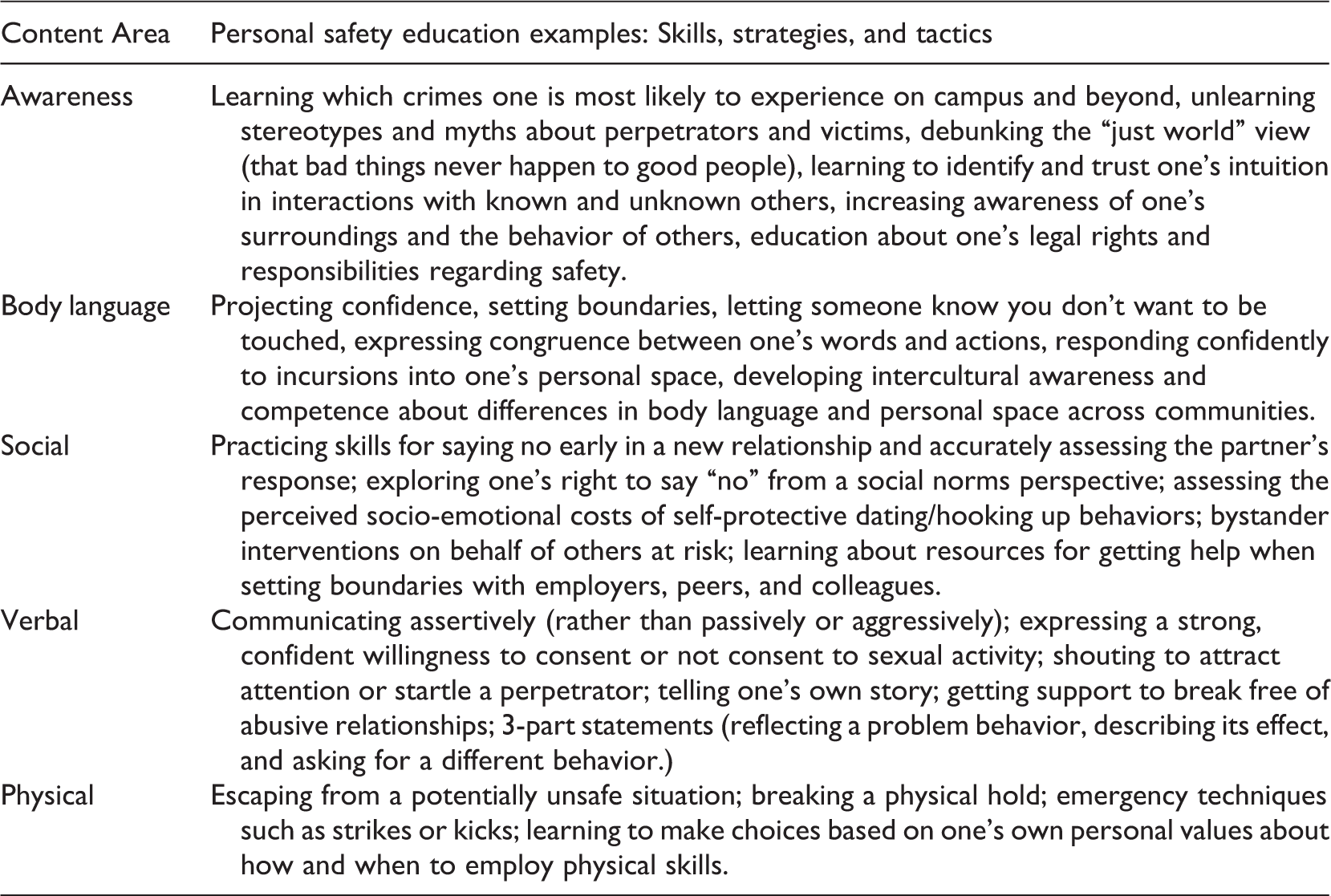
The following chart (Mattingly, 2012) further delineates the diverse skills, strategies, and tactics practiced within an ESD program.
Evidence for Prevention and Empowerment
The violence prevention evidence for ESD is powerful. Many researchers have found that self-defense training increases individual protective factors, limits and corrects for risk factors, and specifically prevents victimization (Hollander, 2014; Sarnquist et al., 2014; Senn, Gee, & Thake, 2011; Sinclair et al., 2013; Thompson, 2014). The types of self-protective actions taught in self-defense reduce the probability of rape completion significantly—more than 80% compared to nonresistance while not significantly increasing the risk of serious injury to the defender (Kleck & Tark, 2005). Dr. Judith Herman recommends self-defense in the newest edition of her foundational work Trauma and Recovery, in which she notes that self-defense training can empower survivors to “face their world more confidently” (1997, p. 198).
A 2015 study published in the New England Journal of Medicine demonstrated remarkable prevention outcomes for ESD. This randomized controlled trial of first-year female students at three colleges resulted in a decrease in completed rapes of 46% after a 12-hour ESD training program. Effects persisted after a year for the group given resistance training, without a booster session. These outcomes are “a rare success” in the rape prevention field, which tends to study attitudinal change in participants immediately posttraining, rather than actual prevention outcomes (The New York Times, June 10, 2015). Similarly, rigorous trials of prevention outcomes for ESD and all sexual assault prevention programs should be conducted.
Self-defense training has been labeled “one of the most promising interventions to prevent violence against women, particularly sexual assault committed by strangers or acquaintances” (Hollander, 2009, p. 575). Additionally, self-defense has been empirically proven to decrease a number of psychological attributes that are associated with victimization (Brecklin, 2008; Ozer & Bandura, 1990; Sochting, Fairbrother, & Koch, 2004; Ullman, 2007). ESD programs may increase assertiveness, perceived control, self-efficacy, risk avoidance behaviors, confidence, and self-esteem and may also lower anxiety and fear (Brecklin, 2008; Hollander, 2004). Importantly, low self-esteem and low assertiveness have been found to be predictive of victimization (Brecklin & Ullman, 2005).
Moreover, there is reason to believe that taking an ESD course can be protective against the lingering effects of trauma for those who do experience physical or sexual assault. Traumatic stress is often defined as resulting from an experience where a person’s coping mechanisms were overwhelmed. ESD works to both expand a student’s toolbox of potential responses and to enhance their feeling of self-efficacy. Both of these factors contribute to an expansion of actual and perceived ability to cope with adverse events.
In the lived experience of its educators, students, and practitioners, ESD is effective in preventing violence before it occurs, responding to attempted violence in the moment and recovering from violence and preventing its recurrence (primary, secondary, and tertiary prevention). The high school student encouraged to practice affirmative consent skills before he leaves for college, the young woman who recognizes controlling behavior in her partner early on and breaks things off before they become abusive, and the survivor of sexual assault who regains a sense of self-efficacy by practicing powerful physical skills all benefit from the practice of ESD.
How Do Social Workers Incorporate ESD in Their Practice?
Social workers employ ESD at both the micro-level and the macro level, with clients, communities, and for themselves as practitioners. Within interpersonal practice, ESD offers an empowering alternative and complementary pathway to prevention and healing for many populations and may be integrated into consciousness raising and skill-building sessions for at-risk social identities [including but not limited to women, youth, lesbian, gay, bisexual, transgender, and queer (LGBTQ) people, immigrants, sex workers, and survivors of child sexual abuse].
At the macro level, social workers are engaged in policy formation and reform to institute ESD as a standard of practice for communities at risk of violence, including college students in the United States, residents of group homes, women, and children. As the interest in and funding of violence prevention increases, social workers invested in empowerment theory are called on to understand and disseminate the significant research evidence for ESD’s prevention capacity. Finally, social workers may want to experience an ESD course themselves as one element of self-reflective practice. As practitioners of a profession in which women are disproportionately represented and rates of workplace violence can be high (especially for those of us who do home visits), ESD can provide immediate personal benefit. Personal experience with ESD can ensure confidence in our referrals, and any such exploration of our own beliefs about power, agency, gender, violence, recovery, and prevention are of enormous benefit to our clients. Social workers may seek referrals to local accredited ESD practitioners through the National Women’s Martial Arts Federation (NWMAF) site at http://nwmaf.org/find-a-self-defense-instructor.
Training in ESD can also assist social workers in the application of empowerment theory. For example, even the well-meaning practitioner can unintentionally, even subtly, convey victim-blaming attitudes. Compare the following approaches to a client who has left an abusive marriage and taken an ESD workshop:
Listen, it’s not your fault that you hooked up with an abusive partner, and even married him, you didn’t know any better! But now that you have this handout about abusive red flags from an ESD workshop, you’re never going to make that mistake again, right? Because now you know what to watch for! And anyway if someone tried that again with you, you’d simply pop him in the nose, right?
We do the very best we can at each moment of our lives, given the information, tools, and help we have at the time. I trust you did the right thing when your ex-chose to abuse you, and I trust you to decide for yourself the best way to take care of yourself now and in the future. This ESD training sounds like it provided you with some new tools, was there anything you learned that seemed especially helpful?
Social worker A’s disempowering approach lectures the survivor, tells her what she should have done in the past and had better do in the future. She grievously underestimates the complexity of the abuser’s control by suggesting victims “simply” punch perpetrators. Social worker B’s empowering approach honors the client’s past choices, affirms the perpetrator’s responsibility for violence, and invites the survivor to share her own experience of ESD.
Limitations
Some feminists have raised concerns in recent years about nonempowering approaches to self-defense, noting they may blame the victims of violence and hold them (not perpetrators) responsible for ending violence and abuse. They fear any self-defense training places the onus on targeted individuals to change their behavior when it is the perpetrators who are responsible for the problem. As there currently is no credentialing or licensure requirement, there is nothing to stop people with very little training or grounding in empowerment principles from calling themselves self-defense instructors. Many self-defense classes are little more than introductions to various martial arts, with an exclusive emphasis on physical fighting techniques and warnings about “stranger danger.” Such an approach includes no awareness of the larger social context or realities of interpersonal violence and may run the gamut from nonharming to ineffective, to disempowering, to retraumatizing.
Additionally, even the best ESD courses are not indicated for everyone at every stage of their lives or recovery from violence. For example, trauma survivors who are in the earliest stages of recovery may find some approaches to be triggering and harmful, even while those in later stages or with different windows of tolerance find the experience to be healing. Social workers and other mental health professionals should exercise professional judgment in making referrals while assisting clients to determine for themselves if and when to participate in ESD.
Conclusion
Too often, approaches to social work have been accused of enforcing societal inequity rather than empowering targeted communities to stand against it. ESD training provides an opportunity for social workers to lead the charge of challenging and thereby undermining power imbalances. ESD empowers directly by developing and accessing the inherent power within the targeted, marginalized, and disempowered individual at risk of victimization by perpetrators of violence. It is an ideal intervention for incorporation within social work practice. “…[A]n empowerment approach to self-defense training contributes to the anti-violence movement in multiple ways: providing a pathway to increase women’s and girls’ safety and their potential for becoming powerful and effective social changes agents…and offering comprehensive options to recognize, prevent, and interrupt violence” (Thompson, 2014, p. 351). Dr. Charlene Senn, the lead author of the NEJM article in which ESD cut rapes of college students by 46%, asserts: “We can make ending sexual violence everyone’s business through bystander intervention…At the same time, we need to support survivors and give women the tools they need to fight back. If we know we can actually reduce the number of rapes women are experiencing, it would be unethical not to do it” (June 12, 2015; emphasis ours) (Mangan, 2015).
Footnotes
Declaration of Conflicting Interests
The author(s) declared no potential conflicts of interest with respect to the research, authorship, and/or publication of this article.
Funding
The author(s) received no financial support for the research, authorship, and/or publication of this article.