




Abstract
The health of Canadians is already impacted by climate change due to wildfire smoke, heat domes, floods, droughts, and the changing distribution of vector borne disease. The healthcare sector contributes to climate change, accounting for approximately 4.6% of annual greenhouse gas emissions in Canada. Healthcare teams have a responsibility and opportunity to reduce harm by limiting emissions and waste, and engaging the public in understanding the planetary health links between clean air and water, a stable climate, a healthy planet and human health. Transformation of Canadian healthcare to a low carbon, climate resilient system will be enhanced by physician engagement and leadership. Cornerstones to physician participation include knowledge of the anthropogenic etiology of the climate crisis, the human health impacts, and the contribution providing healthcare makes to the climate crisis. Integration of climate change knowledge into the Canadian Radiology educational curricula is essential to position radiologists to lead transformative change in mitigation and adaptation of the healthcare system to the climate crisis. This statement is intended to provide guidelines to optimize education and research for current and future Canadian radiologists, and builds on existing planetary healthcare education publications and the Canadian Association of Radiologists Statement on Environmental Sustainability in Medical Imaging.
This is a visual representation of the abstract.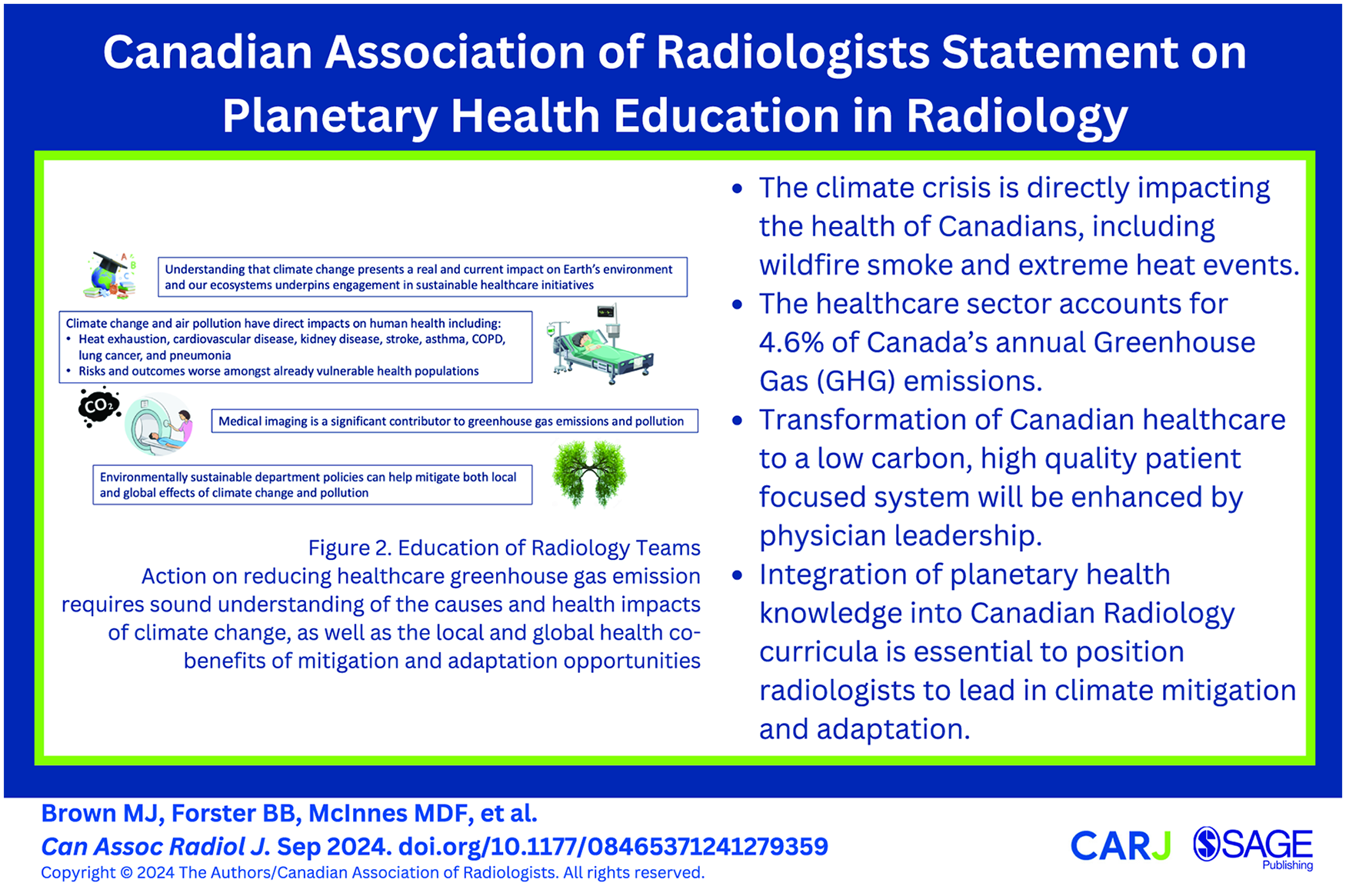
“Climate change is recognized as the greatest threat to health in the 21st century. Academic health institutions have a distinct responsibility to educate, train and prepare health professionals to respond to and advocate for the health needs of society, from the individual to the population level, and from a local to a global level”
Introduction
Climate change threatens healthcare systems and impacts human health directly and indirectly. 1 The health of Canadians is already directly impacted by poor air quality due to wildfire smoke, heat domes, storms, floods, drought leading to crop loss, and changing distribution of vector borne disease. 2 Indirect impacts to physical and mental health occur through climate related population displacement and migration, reduced access to potable water, food insecurity, and increased interpersonal and international violence. 1 The Lancet Countdown on health and climate change has called climate change the greatest health threat facing the world, and the greatest opportunity to redefine social and environmental determinants of health. 3
The healthcare sector contributes significantly to climate change, accounting for 5% to 8.5% of greenhouse gas emissions globally, and 4.6% of Canadian emissions. 4 Moreover, medical imaging is estimated to contribute approximately 0.8% of annual global greenhouse gas emissions, making radiology a critical field to consider in sustainability endeavours. 5 The Canadian Federal government has committed to delivering a climate-resilient, low carbon healthcare system as a signatory to Alliance for Transformative Action on Climate and Health (ATACH) led by the World Health Organization (WHO), and co-chairs the Climate-Resilient Health Systems Working Group of the ATACH.6,7 Transformation of Canadian healthcare to a low carbon, climate resilient system will require physician engagement and leadership. Integration of climate change knowledge into Canadian Radiology curricula is essential to position radiologists to lead transformative change in mitigation and adaptation of the healthcare system to the climate crisis.8-11
A recent review highlighted the importance of Planetary Health concepts in the 2025 CanMEDS physician competency framework update. 8 Planetary Health is defined as “a solutions-oriented, transdisciplinary field and social movement focused on analyzing and addressing the impacts of human disruptions to Earth’s natural systems on human health and all life on Earth” (Figure 1). 12 Planetary healthcare encompasses reducing the impact of healthcare on the environment and the impact of the climate emergency on patient care. 13 As climate disruptions increase, the need to incorporate the understanding of complex adaptive systems to physician leadership and quality improvement innovation is identified for CanMEDS 2025. 9 This is particularly relevant to radiology education given the large energy requirements for medical imaging equipment and data servers, and the substantial waste generated in the delivery of diagnostic and interventional radiology services.14,15
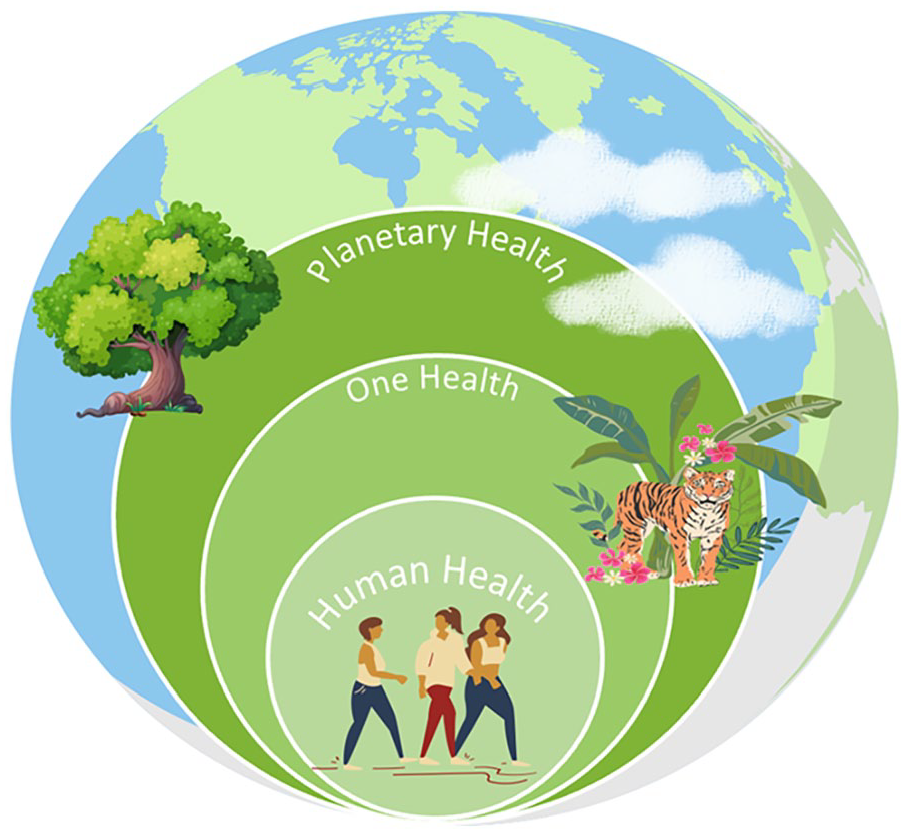
Planetary Health. 12
This statement is centred on planetary health education for Canadian diagnostic and interventional radiology trainees, including medical students, residents, and fellows. It is intended to provide guidelines to optimize education and research in Planetary Health for current and future Canadian radiologists. The statement is loosely structured on the Planetary Health Education Framework proposed by the Planetary Health Alliance and the Education for Sustainable Healthcare: A curriculum for the UK and builds on the CAR statement on Environmental Sustainability in Medical Imaging.16-18
Education
Education of radiologists and trainees on the health harms of the climate crisis and co-benefits of reducing emissions and waste will be foundational in preparing radiologists for emerging threats to health and provision of health care (Figure 2).11,19 Environmental and economic stewardship requires limiting waste of energy and single use plastics, as well as reducing low value imaging through interdisciplinary engagement with referring physicians, patients, and hospital administration. 20 Adaptation and resiliency requires trainees acquire literacy around the impact climate change will have on imaging services from changing patterns of disease and challenges to infrastructure integrity due to extreme weather events. 21
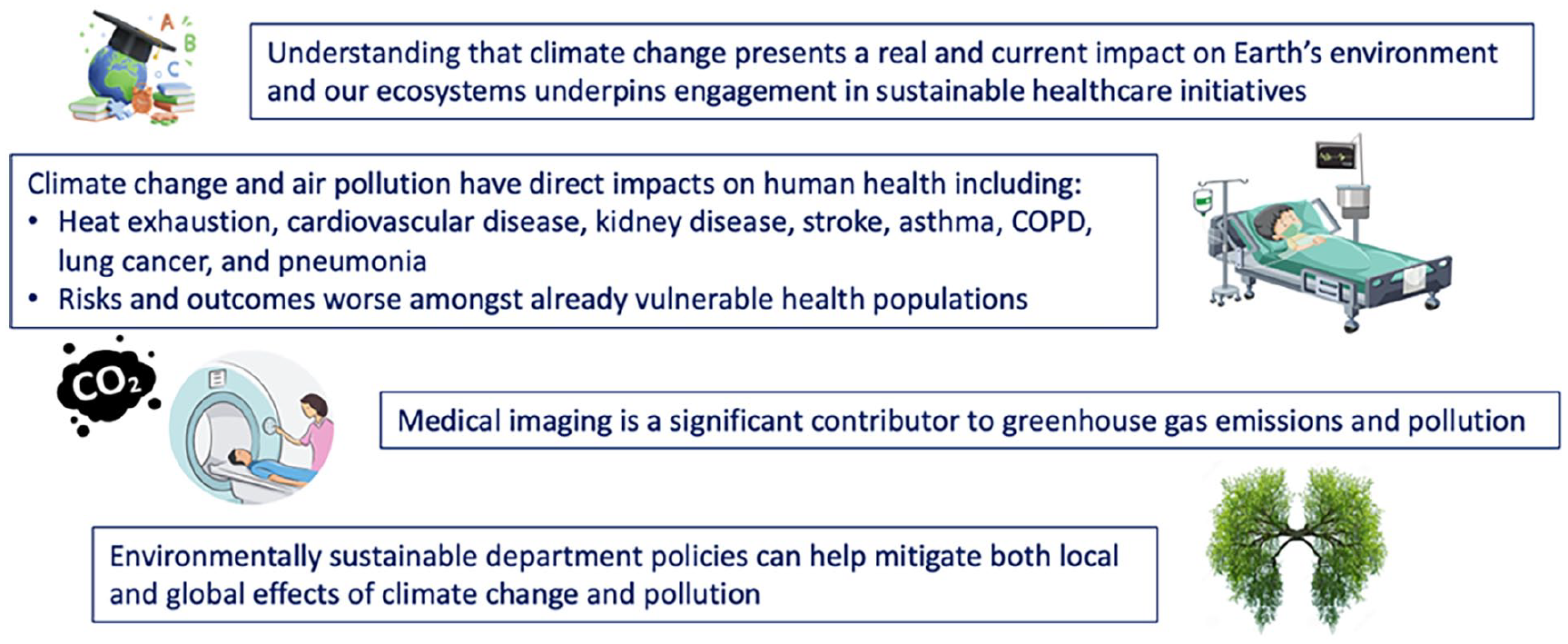
Education of radiology teams.
1.1 Medical Schools to Integrate Learning on Planetary Health and Climate Change Throughout the Curriculum
Medical professionals must understand the health harms of the climate crisis and the co-benefits to local and global health of reducing greenhouse gas emissions. Efforts to mitigate the climate impact of providing healthcare will require that future providers understand the contribution healthcare itself makes to environmental degradation.11,22,23
1.2 Radiology Residency Programs to Educate on Planetary Health and the Environmental Impact of Radiology
Radiologists should be well versed in the changing patterns of disease, including vector borne disease, cardiovascular disease, cancer incidence and survivorship related to climate disruptions and environmental exposures. Radiologists should be aware of the potential impact of climate related environmental exposures on imaging demand, including poor air quality due to wildfire smoke, heat-related illness, and extreme weather events, which will be essential in workforce and infrastructure planning. These topics could be included in half-day didactic programs that align with CanMEDS competencies.8,10 Radiology trainees and radiologists should also develop an understanding of the environmental impacts of providing radiology services including large energy requirements to power imaging equipment, water and energy requirements for data centres and radiology artificial intelligence (AI) tools, and generation of medical and non-medical waste.24-26
1.3 Radiology Residency Programs to Engage in Collaborative Efforts in Sustainable Radiology
The imaging and intervention community and training programs can optimize provincial and national contributions toward environmental sustainability through sharing of ideas, recognizing that we share many similar challenges. Cross-institutional and interdisciplinary sharing of Planetary Health resources will encourage curricular innovation and research with defined outcomes. 27 A record of departmental initiatives, funded faculty positions and action in low carbon, sustainable healthcare should be available to medical students when selecting residency program. Alignment of academic radiology programs with a Director of Planetary Health suggested for Canadian Faculties of Medicine would promote engagement and collaboration within and between departments. 28
1.4 Local, Provincial, and National Radiology Meetings and Conferences to Include Sustainability Content and Virtual Access
Inclusion of sustainability content in Radiology Residency curricula and departmental Continuing Professional Development (CPD) activities will ensure future and practicing radiologists are aware of the impacts of their practice on the environment, ways to minimize associated environmental harms, and options to advocate at a system level for more sustainable solutions and practices. To reduce the greenhouse emissions of educational and scientific meetings, collaboration with attendees and sponsors is required to encourage virtual participation with online engagement opportunities, accreditation, and promotion.
1.5 The Canadian Association of Radiology to Develop an Environmental Sustainability in Radiology Certificate
The Canadian Association of Radiologists (CAR) online teaching platform, RAD Academy, provides Continuing Medical Education (CME) courses to its members. Formal curricular content on Sustainable Radiology could include testable objectives on core concepts including the anthropogenic cause of the climate crisis, the health effects of climate change, the responsibility of healthcare providers to engage in reducing the impact of providing healthcare and specific actions radiologists can take personally and professionally.8,23 The RAD Academy platform could be harnessed to create an Environmental Sustainability in Radiology Certificate upon completion of relevant modules, attendance of virtual lectures, and a personal reflection.
1.6 Royal College of Physicians and Surgeons of Canada and Academic Radiology Department Leadership to Develop Planetary Health Concepts Within the CanMEDS Competencies
Physician competencies around Planetary Health include minimizing the impact of healthcare on the climate crisis and the impact of the climate crisis on human health and patient care. 8 Lifelong learning and continuous quality improvement as climate change impacts evolve will be supported by inclusion of sustainable radiology in CanMEDS competencies. 29 Radiologists, as consultants, play a central role in engaging and educating allied healthcare teams in the appropriate use of imaging tests, as outlined in a framework for sustainable healthcare. 13 Reducing low value exams limits waste of imaging resources and associated emissions from patient travel and data storage. Equally important is to ensure medically necessary imaging is performed within appropriate benchmarks, as delays in care may lead to more advanced disease presentations requiring more resource intensive healthcare. 13
1.7 Radiology Residency Programs to Collaborate on Design of a Canadian Radiology Fellowship in Sustainable Imaging
The relationship between human health and the environment is complex, with rapidly evolving knowledge and research about the impacts of the climate crisis on health and the contribution healthcare makes to emissions and waste. Canadian radiologists will require expertise in specific Canadian health challenges of the climate crisis, including poor air quality due to wildfire smoke, changing geography of vector borne disease, and disaster response to extreme weather events. A Canadian Radiology Fellowship in Sustainable Imaging would provide critical knowledge and leadership skills to ensure future radiologists are engaged in the health system transformation at the intersection of climate and health policy development, problem solving and action.
Research and Sustainable Quality Improvement
The integration of sustainability-focused leadership roles within residency and fellowship programs is valuable in engaging learners and radiology programs in sustainability-related research and quality improvement (QI).
2.1 The CAR Sustainable Radiology Committee to Conduct a Needs Assessment Survey of Current Trainees to Guide Education Curriculum Development
Prior to planning a sustainable radiology engagement and education program, a needs assessment survey should be conducted with trainees. This could include evaluation of current knowledge around climate and health, the contribution that imaging services make to facility emissions and waste, and what barriers may exist to trainee engagement.
2.2 Radiology Residency Programs to Identify a Sustainability Lead for Research and Quality Improvement
Formal identification of “sustainability champion” leadership roles for radiologists to provide mentorship for trainees would acknowledge program sustainability efforts and encourage trainee-led initiatives. 28 Sustainable quality improvement is a cornerstone to transformative low carbon sustainable healthcare. 29 Guidance and support for trainee publication of QI initiatives will foster individual and program growth. 30 Such collaboration between trainees and radiology program administration would be valuable to facilitate funding, protected time, and formal supervision.
2.3 The CAR and Academic Radiology Programs to Create a National Database of Sustainable Imaging Quality Improvement Projects, Research Opportunities, and Shared Resources
Creating a national database for sustainable imaging quality improvement projects would facilitate knowledge sharing and collaboration amongst radiologists and trainees, while improving efficiency by preventing duplication of efforts. Key steps to implementation would include a centralized platform, collaboration with multiple stakeholders across Canada including Choosing Wisely Canada, and monitoring usage to ensure high quality projects and continuous improvement.29,30
2.4 Radiology Research Days to Include Sustainability Topics
Attending research days broadens trainees’ understanding of current controversies and issues affecting their practice in a particular medical specialty. Including sustainability content on research days highlights the climate crisis as an area of concern within the professional scope of the radiologist and encourages trainees to take an active role in research and publication.28-30
2.5 Radiology Research on the Environmental Impacts of Artificial Intelligence
Given the increasingly important role of AI in healthcare and radiology, it is important to consider the environmental impact of AI development and applications. Training AI models on thousands of medical images for 100 hours produces the carbon emissions of an average European citizen in a single day. 31 Meanwhile, the potential environmental benefits of their applications can be immense. One example is deep-learning reconstruction of magnetic resonance imaging, which allows images to be taken over a shorter time and with lower-strength magnets, thereby significantly reducing the carbon footprint of imaging machines in a scalable way.32,33 Since radiology is thought to contribute to 0.8% of global carbon emissions, fostering research on the environmental implications of AI could highlight new ways to advance sustainability in radiology. 5
Trainee Interest Groups
While progress has been made in education about the climate crisis in some domains of healthcare, there is a need for greater involvement from radiology trainees.
3.1 Radiology Residency Programs to Establish Green Teams With Emphasis on Cross-Disciplinary Collaboration
At the trainee level, creating “green teams” can establish a foundation for advocating sustainable healthcare and fostering collaboration across disciplines. These student-led teams can serve as platforms for residents and medical students to plan and engage in initiatives, including and not limited to, sustainability workshops, energy conservation campaigns, planetary health awareness day, and community engagement.
3.2 Radiology Residency Programs and Medical Schools to Create Funded Opportunities for Student-Led Planetary Health Initiatives
Barriers to engagement of healthcare providers in low-carbon, low waste projects include lack of time and project funding.34,35 Providing seconded time and project funding for students to engage with low carbon healthcare, such as grants and research fellowships, will support trainee-led learning.
Stakeholder Engagement
Radiology residency programs should encourage trainee engagement with stakeholders in low carbon, high quality healthcare. Through broad engagement, radiology leaders can demonstrate a commitment to reducing the carbon footprint of radiology while inspiring stakeholders to take action alongside clinical healthcare providers.
4.1 Radiology Residency Programs to Encourage Resident Engagement With Vendors
The supply chain (Scope 3) accounts for 60% to 80% of healthcare greenhouse gas emissions. 13 Encouraging limited trainee engagement with vendors of medical imaging equipment and supplies, where directly related to environmental sustainability and within university and post-graduate trainee guidelines, ensures vendors benefit from a variety of perspectives, and future radiologists have the opportunity to contribute to development of sustainable medical imaging technology. 20
4.2 Radiology Residency Programs to Support Student-Led Sustainable Quality Improvement With Patient Stakeholders
Promoting trainee engagement with the public through patient education initiatives helps to spread awareness about the carbon footprint of radiology and efforts being made to reduce environmental impact of imaging services. 36 This outreach can provide valuable insight to the public about the various considerations made prior to ordering imaging, including how the environment may factor into this decision-making process. As with any successful environmental initiative, garnering public interest through outreach and education is essential.
4.3 Radiology Residency Programs to Include Indigenous Health Education
Respect for the knowledge and culture of Indigenous Peoples who have lived in harmony with nature since time immemorial is fundamental to addressing climate change. 37 The health of Indigenous populations is disproportionately impacted by the climate crisis. 37 The Government of Canada includes addressing anti-indigenous racism in healthcare as a national priority. 38 Incorporation of anti-racism components through each CanMEDS competency is proposed for CanMEDS 2025. 39 Engagement with Indigenous communities would allow trainees to learn about the specific challenges these communities face, including vulnerabilities due to systemic racism, social and environmental determinants of health.
4.4 Radiology Residency Programs to Encourage Engagement of Trainees in Global Health Equity Initiatives
Climate change inequitably impacts those who have contributed the least greenhouse gas emissions within and between countries, including those vulnerable due to social and environmental determinants of health.39,40 Participation in the global radiology community in a two-way flow of information to learn from resourceful, safe practices in the global south and ensure a global supportive idea sharing community is developed is essential in ensuring fair and equitable access to care and global health. 41
Conclusion
Radiologists are well positioned within the healthcare system to lead transformative change to low-carbon, high quality, climate resilient healthcare.42,43 Providing trainees with sound understanding of the anthropogenic etiology of the climate crisis, the impacts on human health, the contribution providing healthcare makes to the climate crisis and the risks to stability of the healthcare system due to extreme weather events will equip future radiologists to lead mitigation and adaptation efforts. Academic radiology departments have a responsibility to provide leadership in environmentally sustainable radiology, including dedicated time and project funding, to enable incorporation of sustainability concepts throughout Diagnostic Radiology CanMEDS competencies.
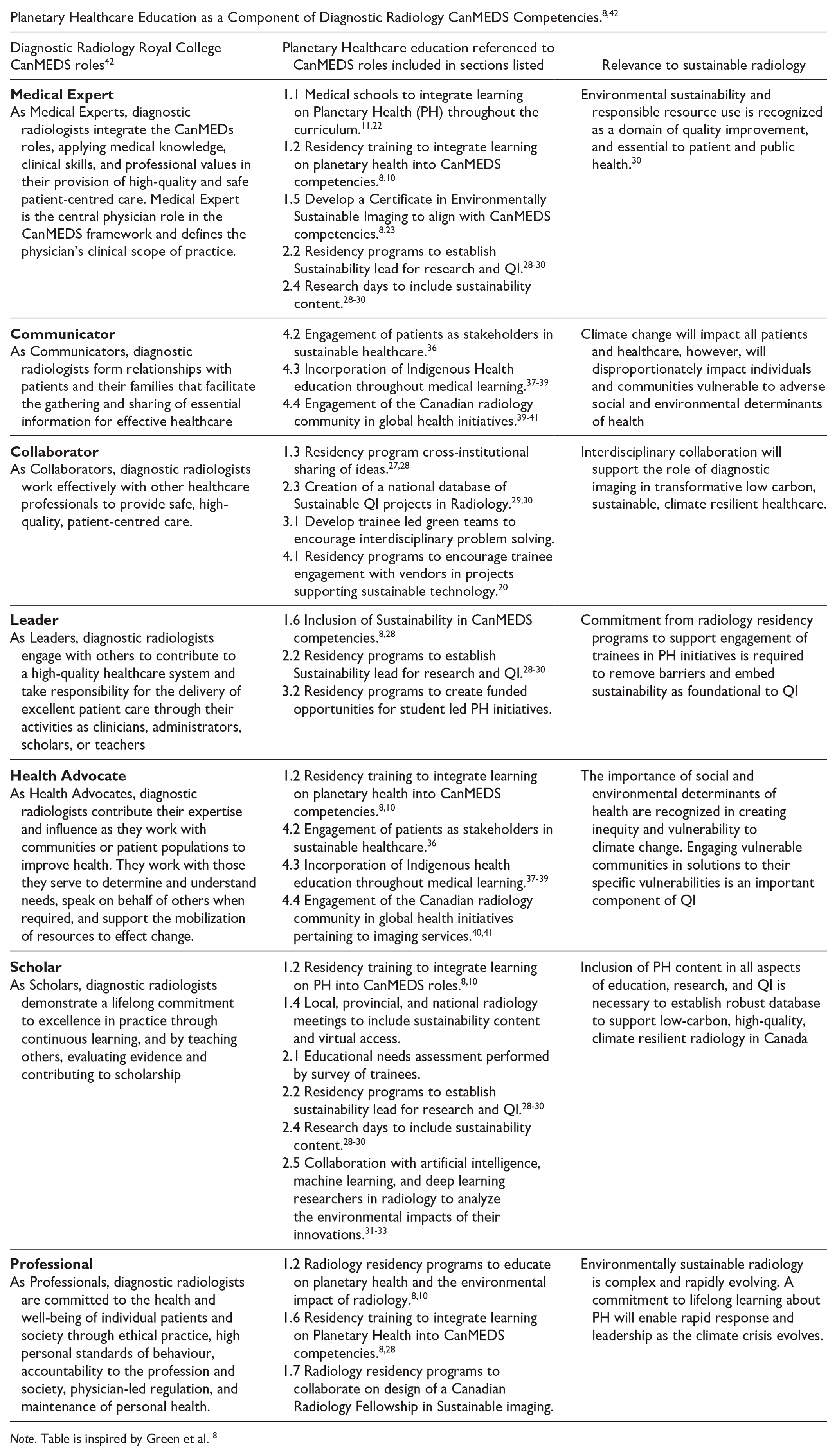
Note. Table is inspired by Green et al. 8
Footnotes
Declaration of Conflicting Interests
The author(s) declared the following potential conflicts of interest with respect to the research, authorship, and/or publication of this article: MJB: Co-Chair CAR Environmental Sustainability Working Group; Co-Chair BC Cancer Planetary Health Unit; Member, AUR Sustainability Committee; Member, Canadian Association of Physicians for the Environment. KH: Co-Chair CAR Environmental Sustainability Working Group; Chair, ISMRM Environmental Sustainability Working Group; Deputy Lead Sustainability Joint Department of Medical Imaging.
Funding
The author(s) received no financial support for the research, authorship, and/or publication of this article.
