



Abstract
Medical imaging, including MRI, CT, and nuclear medicine play a critical role in healthcare but also imposes significant environmental burdens due to high energy consumption and waste production. Of the diagnostic modalities, MRI is the most energy-intensive modality, consuming up to 60 kWh per scan, followed by CT, which ranges from 1.0 to 11.4 kWh per scan. Lifecycle analyses show that operational energy use far exceeds manufacturing emissions, highlighting the need for energy-saving strategies. Implementing standby and power-off modes, optimizing scan protocols, and using AI-driven efficiency improvements can significantly reduce unnecessary energy use. Additionally, sustainable infrastructure, such as variable-flow cooling systems and strategic equipment placement, can further minimize environmental impact. Nuclear medicine, while relatively lower in energy consumption, relies on energy-intensive radioisotope production, often requiring fossil fuel-powered reactors and extensive transport logistics. Contrast agents in MRI and CT pose contamination risks in wastewater, as they are inadequately removed via conventional treatment plants methods. This results in the accumulation of gadolinium and iodinated byproducts in drinking water sources, posing potential human and ecological risks. Nuclear medicine radioisotopes, including Tc-99, also contribute to long-term contamination concerns. Strategies to mitigate these impacts include urine recycling, contrast separation, and advanced wastewater treatment. Sustainable practices in medical imaging require a multi-pronged approach, combining operational efficiency, renewable energy adoption, and stricter waste management protocols. Future efforts may also focus on promoting low-field MRI, AI-driven scan optimization, and alternative contrast agents, ensuring that radiology departments balance diagnostic efficacy with environmental responsibility.
Introduction
Magnetic resonance imaging (MRI), computer tomography (CT), and nuclear medicine are key imaging modalities in modern medical imaging departments; however, there can be significant environmental impact costs of these modalities driven by energy consumption and waste generation.1,2 Knowledge of this environmental impact and potential mitigation strategies is important to maximize benefits while minimizing their environmental footprint.
Energy Use and Associated Greenhouse Gas Emissions by Imaging Modality
MRI and CT
MRI and CT have outsized contributions to a radiology department’s operational greenhouse gas emissions, accounting for 41% and 34% respectively of a large Canadian department’s annual emissions in one review. 3 MRI and CT systems both require significant energy consumption throughout their lifecycle. MRI systems generally consume substantially more energy than CT.4 -7
Lifecycle analyses reveal that the operational phase over a long period dominates the environmental impact of MRI and CT. Production of an MRI scanner has greater emissions and a greater environmental impact than production of a CT scanner. One study determined that fossil fuel consumption for MRI production is 2.73 million MJ for MRI and 2.03 million MJ for CT. 4 However, as a proportion of overall energy use, the operational costs for MRI is significantly more than its production costs, whereas for CT the environmental impact across production and usage varies and can be more balanced.4,5
Although there is currently a need for more data on energy consumption when scanning, one analysis demonstrates a 3 T MRI utilized 23.6 kWh per scan compared to 17.0 kWh per scan for 1.5 T and only 1.22 kWh per scan for a CT. 7 However, these figures widely vary from 1.0 to 11.4 kWh per scan for CT and 17.0 to 60 kWh per scan for MRI.4,7,8 This depends on machines and their age, region of scanning, volume of imaging, institutional protocols, and a plethora of other factors. When considering only typical abdominal examinations and both the production and utilization phases of a modality, the average emissions were 1.15 kg CO2 for ultrasound, 6.61 kg CO2 for CT, and 19.72 kg CO2 for MRI. 4
On a national level this energy use by CT and MRI is much more significant. Based on Canadian data of 2.21 million MRI scans on a mix of 1.5 and 3 T scanners and 6.39 million CT scans using the above energy use per scan from the Heye et al study, this could equate to 15.7 thousand MWh from MRI and 7.7 thousand MWh from CT scans annually without considering energy use during downtime.7,9,10
Despite the different energy profiles of CT and MRI, strategies to minimize the environmental footprint for both modalities have significant overlap.
Nuclear Medicine
Nuclear medicine, including PET/CT and SPECT has varying environmental impact, with limited data on production, delivery, and installation. 11 The operational phase is the main contributor to the carbon footprint, with PET/CT and SPECT systems consuming considerable energy. 12 Radioisotope production also relies on energy-intensive nuclear reactors and particle accelerators, typically powered by fossil fuels, leading to substantial greenhouse gas (GHG) emissions. 13 Daily transport of radioisotopes with short half-lives adds to this impact.
While on-site isotope production could reduce emissions, it is often not practical or cost-effective. Additionally, scanning equipment requires energy-intensive cooling and HVAC systems, further contributing to energy consumption. 14
Environmental Impact of Contrast Media
The impact of CT, MRI, and nuclear medicine has recently posed concern due to the environmental contamination from their contrast agents. More specifically, there are significant ecological risks associated with the production and use of these contrast agents, as well as their waterbody contamination.
Production of Contrast
Gadolinium-based contrast agents (GBCAs) used in MRI have a relatively low environmental impact compared to other rare earth elements (REEs). 15 There is no current literature on the environmental impact of gadolinium contrast media manufacturing beyond the extraction of Gadolinium.
While there has been considerable research on the contamination of iodinated contrast media (ICM) from CT use, there is limited literature available on the environmental impact of ICM production itself. 16
Nuclear medicine, while overall greener than both CT and MRI, involves the use of nuclear reactors for radionuclide production, which emit an average of 66 g of carbon dioxide equivalent per kWh (gCO2 e/kWh) emissions over their lifetime due to power plant operations and uranium mining. 17
Waterbody Contamination
GBCAs used in MRI are not effectively removed during wastewater treatment. Due to their high stability and water solubility, GBCAs are not sufficiently degraded by WWTPs.18 -25 In fact, current wastewater treatment increases Gd concentration by a maximum of 1.8-fold, resulting in high concentrations in drinking water.23,24 This poses significant health risks, as Gd3+ is far more toxic than chelated GBCAs and can have serious effects on both humans and aquatic organisms.25 -27 Human digestive fluids may destabilize GBCAs, potentially posing health risks.23,25 Additionally, water contamination effects may be exacerbated by rising ocean temperatures. 26
ICMs also remain in wastewater following treatment, with concentrations as high as 100 μg/L in the environment.28 -30 Disinfection with chlorine or chloramine leads to the formation of cytotoxic and genotoxic iodinated disinfection byproducts (IDBPs), such as iodinated trihalomethanes (I-THMs), with iopamidol producing the highest levels of these IDBPs.31 -34
Radioactive waste in nuclear medicine, from both isotope production and patient waste, poses environmental risks, especially through water contamination. Tc-99, a commonly used soluble radionuclide, exemplifies this risk. 35 Incidents like those at the Hanford Nuclear Plant highlight the need for strict disposal protocols. 36 While hospitals manage most waste, outpatient procedures with long-lived radionuclides shift some responsibility to patients as they excrete isotopes after the scans. As radiotheranostics grows at an annual rate of 34% (2022-2032), the potential for increased water contamination rises. 37
Mitigation Strategies in Radiology to Reduce Energy Consumption, Contrast Contamination, Reliance on Finite Resources
Mitigating Energy Consumption: MRI and CT
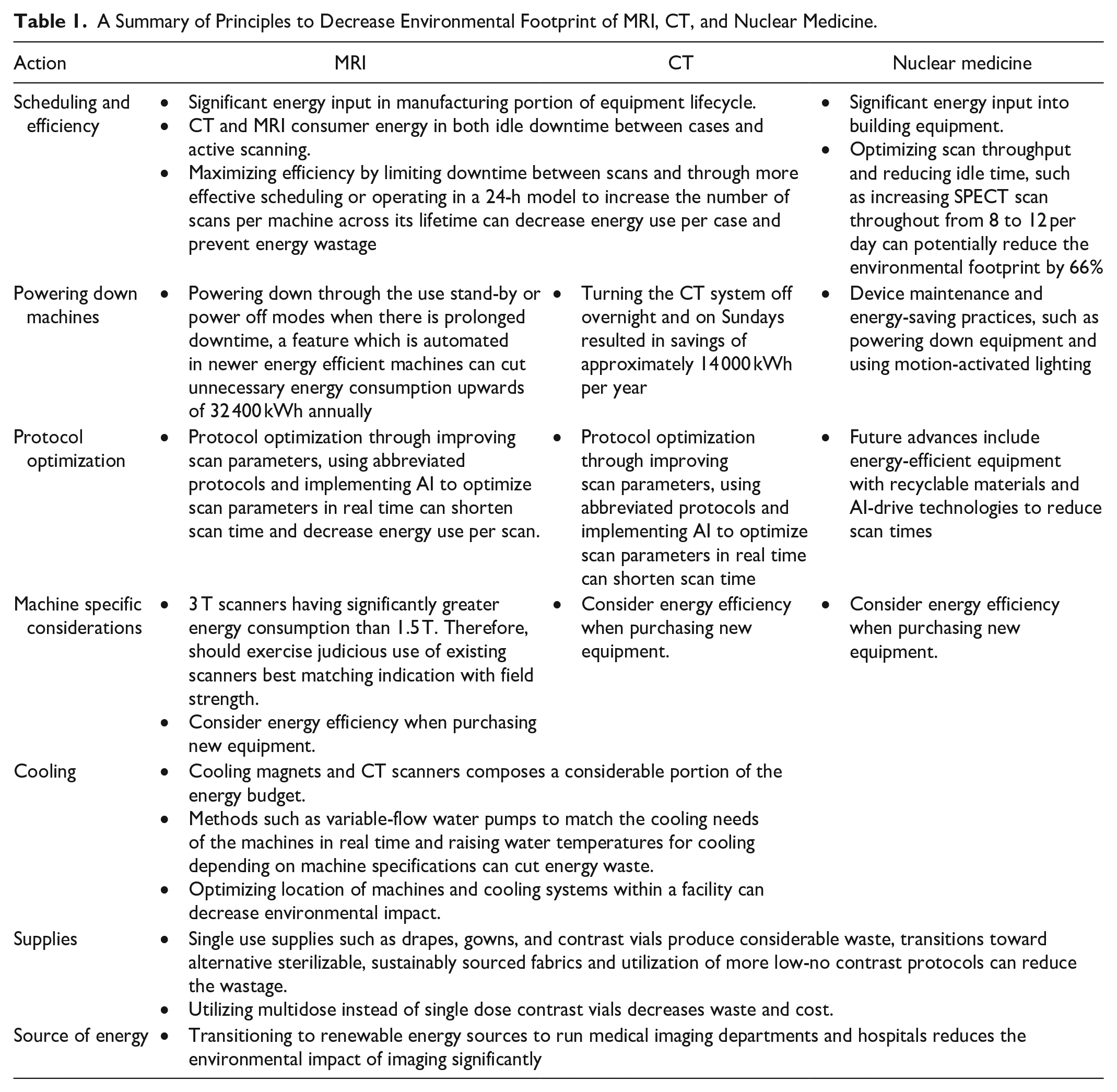
There are several mitigation strategies which can be used to decrease environmental impact in MRI, CT, and nuclear medicine. Some of these are highlighted in Table 1 and Figure 1.
A Summary of Principles to Decrease Environmental Footprint of MRI, CT, and Nuclear Medicine.
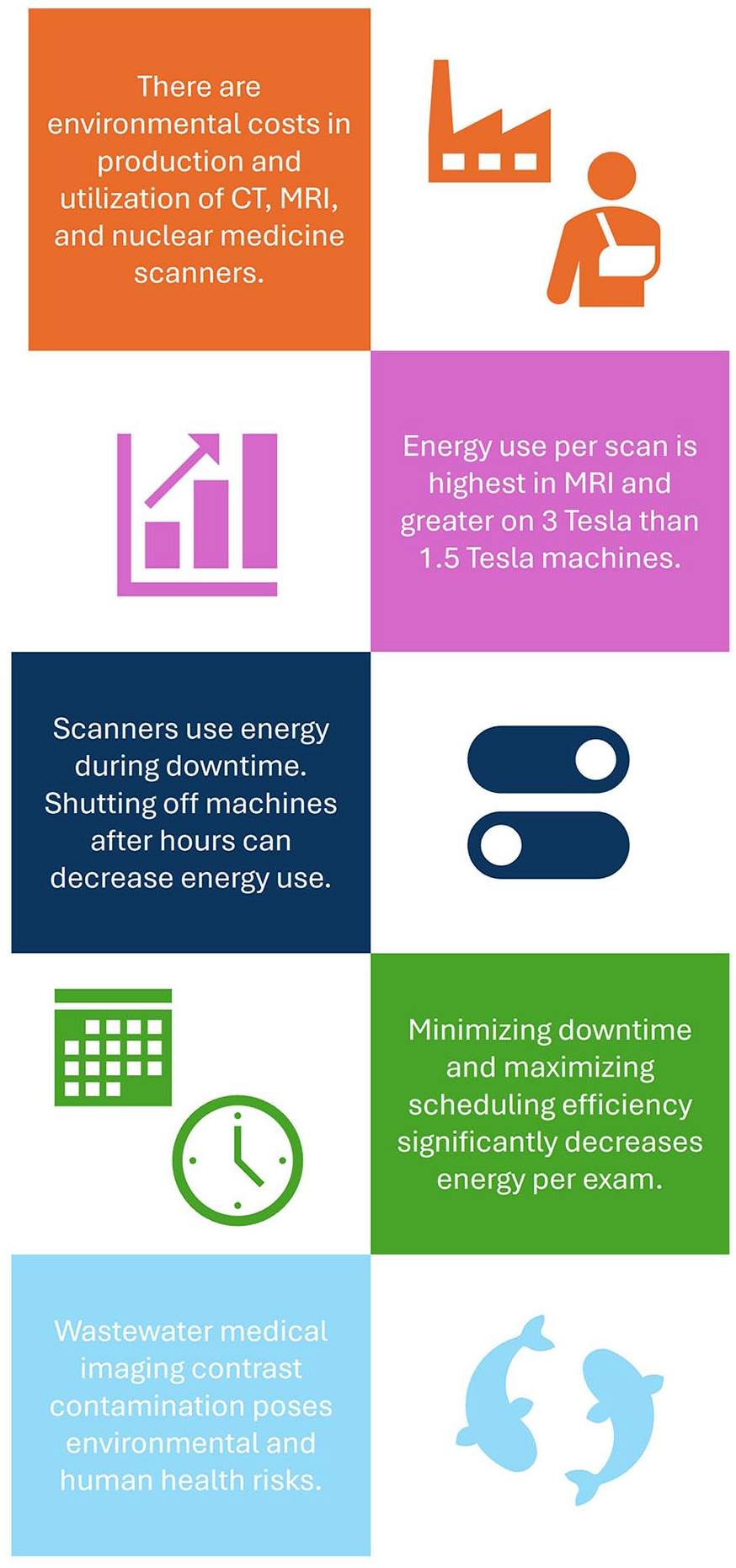
Infographic highlighting key take home points including energy use, wastewater contamination, and mitigation strategies.
Major inefficiencies in energy consumptions for both MRI and CT arise from idle usage, as scanners are often kept on overnight and between scans.6,38 Therefore, a small fraction of energy consumption is spent on the actual scan itself. Maximizing scans during operations by limiting downtime between scans through more effective scheduling or operating in a 24-hour model to increase the number of scans per machine across its lifetime can prevent energy wastage.4,7,8,38 During operations, powering down machines through the use stand-by or power off modes when there is prolonged downtime, a feature which is automated in newer energy efficient machines can cut unnecessary energy consumption upwards of 32 400 kWh annually for MRI machines.5,7,39 One study found that turning the CT system off overnight and on Sundays resulted in savings of approximately 14 000 kWh per year. 38
One of the key factors in energy consumption in MRI is field strength with 3 T scanners having significantly greater energy consumption than 1.5 T and lower field strength systems.6,40 Therefore, departments should exercise judicious use of existing scanners best matching indication with field strength. Additionally, when acquiring a new scanner, consideration should be given to what field strength is needed as a complement to already existing scanners in a health region.
Furthermore, protocol optimization through improving MRI and CT scan parameters, using abbreviated protocols and implementing AI to optimize scan parameters in real time can shorten scan time, improving efficiency and increasing number of exams performed while the scanners are operational.41 -43 These strategies offer simple to implement solutions which can often reduce energy consumption and improve environmental impact without hardware updates. Minimizing energy use per scan both decreases operational costs and environmental impact.
On a larger scale, technological innovations and industrial interventions offer additional paths to improving sustainability of imaging practices. Cooling MRI magnets and CT components compose a considerable portion of the energy budget of imaging departments.7,8,38 Various methods such as variable-flow water pumps to match the cooling needs of the machines in real time and raising water temperatures for cooling depending on machine specifications can cut energy waste. 8 Architectural designs, such as placing imaging suites in naturally cooler areas of the building can encourage passive cooling and reduce energy expenditure. 7 In addition to cooling systems, prolonging the lifespan of the machines themselves can result in further cooling benefits. Apart from purchasing more environmentally friendly machines, retrofitting and refurbishing older hardware avoids the energy intensive production costs of new machines, and can improve their energy efficiency.
Beyond energy usage, materials management and waste reduction strategies can be implemented to reduce environmental impact of MRI and CT. Single use supplies such as drapes, gowns, and contrast vials produce considerable waste and transitions toward alternative sterilizable, sustainably sourced fabrics and utilization of more low-no contrast protocols can reduce the wastage.5,44,45 Simply optimizing inventory to reduce overstocking and subsequent wastage will reduce the environmental burden of necessary single-use supplies. Beyond hospital walls, addressing the source of energy production can result in the most transformative change toward the path to sustainability. 46 Some hospital systems have relied upon solar panels, wind turbines and geothermal energy sources to achieve either close to, or complete carbon net neutrality. 47 Transitioning to renewable energy sources to run medical imaging departments and hospitals reduces the environmental impact of imaging significantly.
The path to sustainability in medical imaging requires collaboration among clinicians, administrators, policy makers, and manufacturers. Initiatives such as Image Wisely and the American College of Radiologists (ACR) Appropriateness Criteria can be referred to by clinicians to reduce the burden of unnecessary imaging while reaching the same clinical goals.48,49 Furthermore, such guidelines can emphasize using lower impact modalities like ultrasound and X-ray over MRI and CT, where appropriate to achieve the same diagnostic goals.6,50 In terms of purchasing equipment, vendor sustainability certificates like Energy Star can be sought after. 51 Frameworks such as the EU’s Ecodesign for Sustainable Products Regulation mandates environmental standards imaging products must adhere to throughout their lifecycle. 52 Such frameworks can be expanded and products that follow the mandate can be preferred. Looking in advance, portable low field MRI systems below 1.0 T often find great usage in resource limited environments. Helium is a limited resource and transitioning to low helium MRI units can provide both cost and environmental savings.53,54 Guidelines in the future can provide clarity on the expanded use of such products, which are more sustainable for the environment and convenient to utilize in specific settings.40,55
Mitigating Energy Consumption: Nuclear Medicine
Mitigating nuclear medicine’s environmental impact involves technological, operational, and policy changes. Optimizing scan throughput and reducing idle time, such as increasing SPECT scan throughout from 8 to 12 per day can potentially reduce the environmental footprint by 66%. 56 Device maintenance and energy-saving practices, such as powering down equipment and using motion-activated lighting are also important considerations.38,57,58 Future advances include energy-efficient equipment with recyclable materials and AI-drive technologies to reduce scan times. 59
Practice models are greatly changing in the post-COVID landscape. With the increasing prevalence of AI and remote scanning and reading, imaging is set to become more efficient and fast-paced. These innovations will greatly increase the utilization of scanners and volume of imaging, addressing many of the environmental concerns. Ultimately, embodying environmental concerns in decision making at every level, will result in a path to sustainability.
Mitigating Contrast Contamination
Some strategies to limit wastewater contamination are highlighted in Table 2.
Mitigation Strategies for Reducing Contrast Contamination.
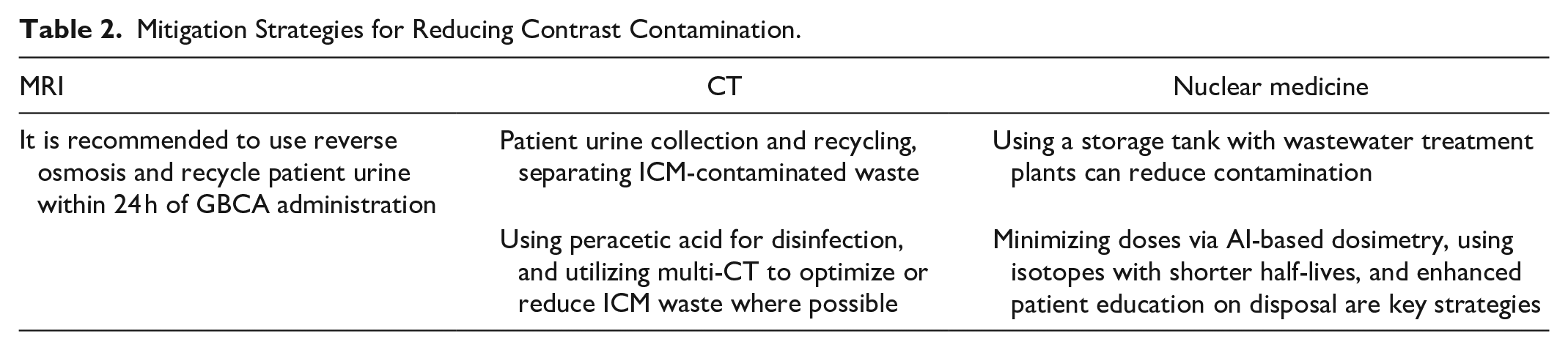
To mitigate the effects of MR contrast contamination, it is recommended to use reverse osmosis and recycle patient urine within 24 hours of GBCA administration.15,16,21,27
Mitigation strategies for CT contrast contamination include patient urine collection and recycling, separating ICM-contaminated waste, using peracetic acid for disinfection, and utilizing multi-CT to optimize or reduce ICM waste where possible.29,30,34,60
Radionuclides from nuclear medicine are also insufficiently treated in water purification, and using a storage tank with wastewater treatment plants can reduce contamination.61 -63 It is also recommended to use radiopharmaceuticals that produce less radioactive waste and prevent cross-contamination with other waste. 64
For radioisotopes, minimizing doses via AI-based dosimetry, using isotopes with shorter half-lives, and enhanced patient education on disposal are key strategies. 65
Diagnostic Medical Imaging has a significant environmental impact from multiple fronts including energy use and associated greenhouse gas emissions during operation and waste generation including waterbody contamination. Both knowledge of this impact and implementation of mitigation strategies is needed to move towards environmentally sustainable net zero medical imaging departments. 1 There is currently more research needed on many of these topics, but some of the mitigation strategies listed above are simple and implementation should not be delayed.
Footnotes
Declaration of Conflicting Interests
The author(s) declared no potential conflicts of interest with respect to the research, authorship, and/or publication of this article.
Funding
The author(s) received no financial support for the research, authorship, and/or publication of this article.
