




Abstract
Despite the increase in life expectancy and the intensification of research with older populations, little is known about the relation between adult learning and engagement in social, civic, and political participation experiences. In this study, we interviewed 18 older adults involved in a diversity of contexts, from senior universities to civic associations or political organizations to explore whether and how these were perceived as learning experiences. Our findings reinforce the vision of social, civic, and political participation as learning experiences with a strong intergenerational component, where teaching and learning coexist. Participants recognize gains in a variety of knowledge and skills, from the more technical to the more interpersonal/social and political. Previous educational background and the lack of learning opportunities in old age are recognized as barriers to participation. Therefore, social, civic, and political participation clearly seems to transcend the strictly feel good and/or recreational perspective, emerging as valid adult education experiences.
Introduction
Social, civic, and political participation is a phenomenon whose complexity and breadth has been emphasized by both participation and lifelong learning theories, given the growing diversity of its forms and meanings (Ekman & Amnå, 2012; Verba, 1967) and the fact that it “combines individual and institutionalized learning” (Jarvis, 2004, p. 64). However, most studies have focused on younger age groups and adults of active age (Jenkins & Mostafa, 2015; Serrat et al., 2016; Withnall, 2010). As such, there is a relative indifference toward people who belong to more advanced age groups and who remain involved in their communities (Serrat et al., 2020), in particular with regard to the learning potential that could result from involvement in these participatory experiences (Jenkins, 2011; Narushima et al., 2018; Serrat et al., 2016).
Although the growing demographics of older people bring diverse challenges and opportunities, research is still scarce, particularly in the field of adult education (Boulton-Lewis, 2010; Withnall, 2010; Yamashita et al., 2017). Not only are educational opportunities for older people still potentially unchallenging considering the interests of older learners and clearly insufficient both exclusively and in intergenerational activities (Withnall, 2010), but there are still relatively few studies on adult education for older people, “where the elderly themselves are asked about learning and education” (Boulton-Lewis, 2010, p. 225), and even fewer consider the huge diversity that characterizes people belonging to these age groups, including their social and cultural circumstances (Goerres, 2009). In this sense, our goal was to explore the perceived relation between engagement of older adults in social, civic, and political participation and learning, considering the historical and political context of the current generation of people over 60 in Portugal, who have experienced transition to democracy during their youth or early adulthood.
Lifelong Learning in Old Age
The benefits of education in general, and adult education in particular, are now unquestionable. Nevertheless, as Melo (2012) said, the right to education has not been guaranteed “for all and throughout all life” (p. 374), in an explicit reference to adult persons, more specifically to those who, due to socio-political circumstances, did not have access to the school during childhood or youth.
Jenkins (2011) and Yamashita et al. (2017) point out that the non-vocational benefits of lifelong learning have been rarely studied, particularly in comparison with the study of adult education aimed at people of working age. Narushima et al. (2018) warn that “In many countries, adults over the age of 65 are often excluded from adult learning statistics as they are assumed to be the post-work generation.” (p. 653). Also, a Recommendation of the Portuguese National Board of Education underlies that “official statistics, national and international, tend to ‘eliminate’ over a fifth of the population, about 2 million citizens over 64” (Canário et al., 2019, p. 6), that is, the “statistical insignificance” of older adults “becomes inversely proportional to its growing ‘social significance’” (p. 6). An example of this selective data collection is PIAAC, the Programme for the International Assessment of Adult Competencies, promoted by the OECD (Organisation for Economic Co-operation and Development). PIAAC “is a programme of assessment and analysis of adult skills” (OECD, 2021), in which a survey is carried out with data collected from 40 countries. In this questionnaire, people aged between 16 and 65 are interviewed. Data such as those of PIAAC have been used as a reference for international adult learning policymaking, leaving out the entire group of people over 65 years of age. This demonstrates how the concern expressed by Withnall (2010) is still valid, when she stated that “in spite of some recognition of the supposed value of learning in later life and some good intentions, older people still barely feature in educational thinking, and indeed nonvocational adult education has largely taken a back seat in the current drive to improve the skills of the workforce” (p. 106).
This invisibility of adult participation in educational experiences is increased by the fact that it occurs mainly in non-formal learning contexts, which are still understudied (Jenkins, 2011; Schuller et al., 2004) and undervalued (Canário, 2006). It should be emphasized that contexts of nonformal education, such as those that include civic and political participation, are contexts where “people learn with and through experience” favoring ongoing processes of learning (Canário, 2006, p. 198).
Therefore, the study of the educational needs of older adults is a pressing need for research, in order to sustain the definition of educational policies appropriate to those characteristics of older learners (Withnall, 2010). It is important to bear in mind that older adults compose a very diverse group, whose old age experiences are strongly influenced by their life paths (Goerres, 2009). Older learners are a dynamic and constantly evolving age group, bringing increased demands for education policies based on a “lifelong learning” perspective (Withnall, 2010), which reinforces the need to study the involvement of older people in learning experiences.
The COVID-19 pandemic generated diversified strategies to meet educational needs (Waller et al., 2020), including those of older people, but has also revealed the potential and risks of online learning (Adedoyin & Soykan, 2020). There is evidence that this forced transition to online formats reinforced the isolation and loneliness of many older people (Seifert, 2020), as age is a major exclusion factor in terms of access to technology (Käpplinger & Lichte, 2020). However, there is also evidence of the ability of many older people to switch to online activities, with significant development of skills, particularly digital skills (Talmage et al., 2020).
Benefits of Involvement in Learning Experiences in Old Age
The contexts that older people identify as learning contexts are very diverse, ranging from the more formally organized activities to informal learning experiences (Withnall, 2010), and seem to generate numerous advantages (Boulton-Lewis, 2010). Health benefits have been mentioned as one of the greatest returns of involvement in educational experiences in old age, both in terms of mental health (Boulton-Lewis, 2010; Narushima et al., 2018), health perceptions (Lassen, 2015), and physical health (Yamashita et al., 2017). Well-being has also been recognized as an advantage (Jenkins, 2011; Narushima et al., 2018), mainly in non-formal learning contexts (Jenkins & Mostafa, 2015), as well as pleasure and self-fulfillment (Boulton-Lewis, 2010). The development of social capital, related to the widening of social relations, is highlighted by older people themselves as benefit of participation in learning contexts (Boulton-Lewis, 2010; Withnall, 2010). Participation in educational activities is also a way for people to stay active (World Health Organization [WHO], 2002), helping retired people to structure their time (Jones & Symon, 2001). Personal development and intellectual stimulation (Lamb & Brady, 2005), knowledge acquisition, and skills development are also achievements evidenced in the literature, as well as an increase in awareness of the surrounding environment (Withnall, 2010). In studies developed with more diverse samples of older people involved in educational activities, there is evidence that those involved in community activities report better health conditions and are more available to work and to care (Lido et al., 2016).
Therefore, the lack of educational opportunities is a significant obstacle to the development of older people (Boulton-Lewis, 2010), given their well-documented contribution to quality of life in old age (WHO, 2002), namely when considering the potential for learning from the involvement of older people in experiences of social, civic, or political participation (Findsen & Formosa, 2011).
Learning Potential in Contexts of Social, Civic, and Political Participation in Old Age
The educational potential of involvement in social, civic, and political participation experiences has been highlighted by several studies with people from different age groups (e.g., Bilon, 2020; Schuller et al., 2004; Malafai et al., 2016). Nevertheless, as Preston (2004) noted, “the relationship between adult education, civic participation and community activity is complex” (p. 155), and, given that social capital interferes with the (non-)involvement in social, civic, and political contexts (Putnam, 2000), “we must see different types of civic participation as joint (but related) products of adult education” (Preston, 2004, p. 156).
In fact, the definition of social, civic, and political participation has been under intense reanalysis: contrary to the popular idea of a deficit of participation, it seems that Verba was right when stating, back in 1967, that participation—always involving consideration of “who participates, about what and how”—was “in an acute crisis” as all these layers were being redefined at the same time, since “new people want to participate, in relation to new issues and in new ways” (p. 54). This recognition led Ekman and Amnå (2012) to propose a broader typology of social, civic, and political participation that expands beyond more conventional forms of participation (e.g., engagement in political parties) to include emerging and non-conventional forms of participation (e.g., activist protests, off- and online), but also individual (e.g., attentiveness to political issues) and collective actions (e.g., voluntary work).
Regarding older people, there are already studies that highlight the learning potential underlying experiences of social, civic, and political participation. Studies on volunteering initiatives in urban contexts (Yamashita et al., 2017), political organizations (Serrat et al., 2016), local democratic initiatives (Schugurensky & Myers, 2008), or other community-based activities (Cook, 2011) illustrate the learning that results from social, civic, and political participation in old age. Findsen and Formosa (2011) go further by stating that involvement in these nonformal education contexts “is likely to be the most plentiful form of learning in older adulthood as long as social relationships are maintained post-paid work” (p. 24). Indeed, learning appears to emerge both as a motivation and as a result of social, civic, or political engagement in old age. The possibility of personal development (Okun & Schultz, 2003) and the willingness to learn more relates to the involvement of older people in civic and political initiatives (Petriwskyj et al., 2014). The maintenance of thinking skills is recognized by older people as a concern and being involved with the surrounding community is one of the strategies for maintaining these skills (Niechcial et al., 2019). Involvement with the surrounding community and the desire to stay informed about what is happening around them are relevant factors for the civic and political involvement of older people, resulting in relevant learning (Lido et al., 2016; Serrat et al., 2016).
Generativity (Erikson et al., 1986) has also been pointed out as having a strong relationship with participation in old age, namely in its potential to support intergenerational learning (Adler et al., 2007; Yamashita et al., 2017). Kleiber and Nimrod (2008) argue that “generativity and civic involvement proved to be more often extensions of activities begun prior to retirement, though clearly retirement had the effect of ‘bumping up’ attention to such activities in both amount of time invested and in asking that they be intrinsically rewarding as well” (p. 84).
Social, political, and instrumental learning has also emerged as a result of political participation in old age (Serrat et al., 2016). In this sense, the promotion of community-based learning activities has been advocated as a powerful strategy for building more inclusive societies (Narushima et al., 2018).
The study of experiences of social, civic, and political participation in old age is a relevant focus for research, considering the potential it may have for aging with higher quality in increasingly aging societies (Serrat et al., 2020). The same is true for the benefits of lifelong learning for people of more advanced age groups (Yamashita et al., 2017). In addition, some studies are also beginning to show evidence of the learning potential of involvement in social, civic, and political initiatives for adults (Bilon, 2020). Therefore, it is of particular relevance to understand the learning potential that involvement in social, civic, and political participation experiences has for older people, considering the growing demographics of these more advanced age groups. Portugal is an interesting example for two main reasons; first, it has one of the highest rates of aging in Europe (aging index in 2020 was already 165.1%) (Pordata, 2021), a tendency that is becoming more widespread; second, the levels of participation in adult education are quite low, like in other Southern European countries (Zarifis, 2021), making the study of informal experiences even more relevant. In this paper, our goal was to explore the experiences of social, civic, and political participation of older people and their perceived potential as learning experiences.
Methods
In order to seek the relation between experiences of social, civic, and political participation and learning in old age, we carried out a qualitative study (Lessard-Hébert et al., 2012). We developed this study in Portugal, where people over 60 years grew up under a dictatorship with extremely low opportunities for both education and participation. We conducted 16 semistructured interviews with 18 people. The interviewees cumulatively met the following criteria: retirees; over 60 years old; and actively involved in social, civic, or political organizations.
We presented the objectives of the study to all participants and assured the confidentiality of the data, the anonymity of the participants, and their right to stop participating in the study at any time. These elements are contained in the declaration of informed consent signed by each participant and the first author at the beginning of each interview. The study was approved by the common ethics committee of the Porto Hospital Center and the Institute of Biomedical Sciences Abel Salazar, University of Porto.
The central topics of the interviews were the experiences of social, civic, or political participation of the interviewees, at the current moment of their lives and throughout their life course, as well as the relationship between learning/skills development and this participation.
Participants
After contacts with privileged informants, other relevant actors were indicated for the continuation of this study, so the strategy to identify participants was based on the “snowball” method (Morgan, 2008). Table 1 presents the sociodemographic characterization of the participants, and the type of organizations in which they were involved and their roles.
Characterization of Participants
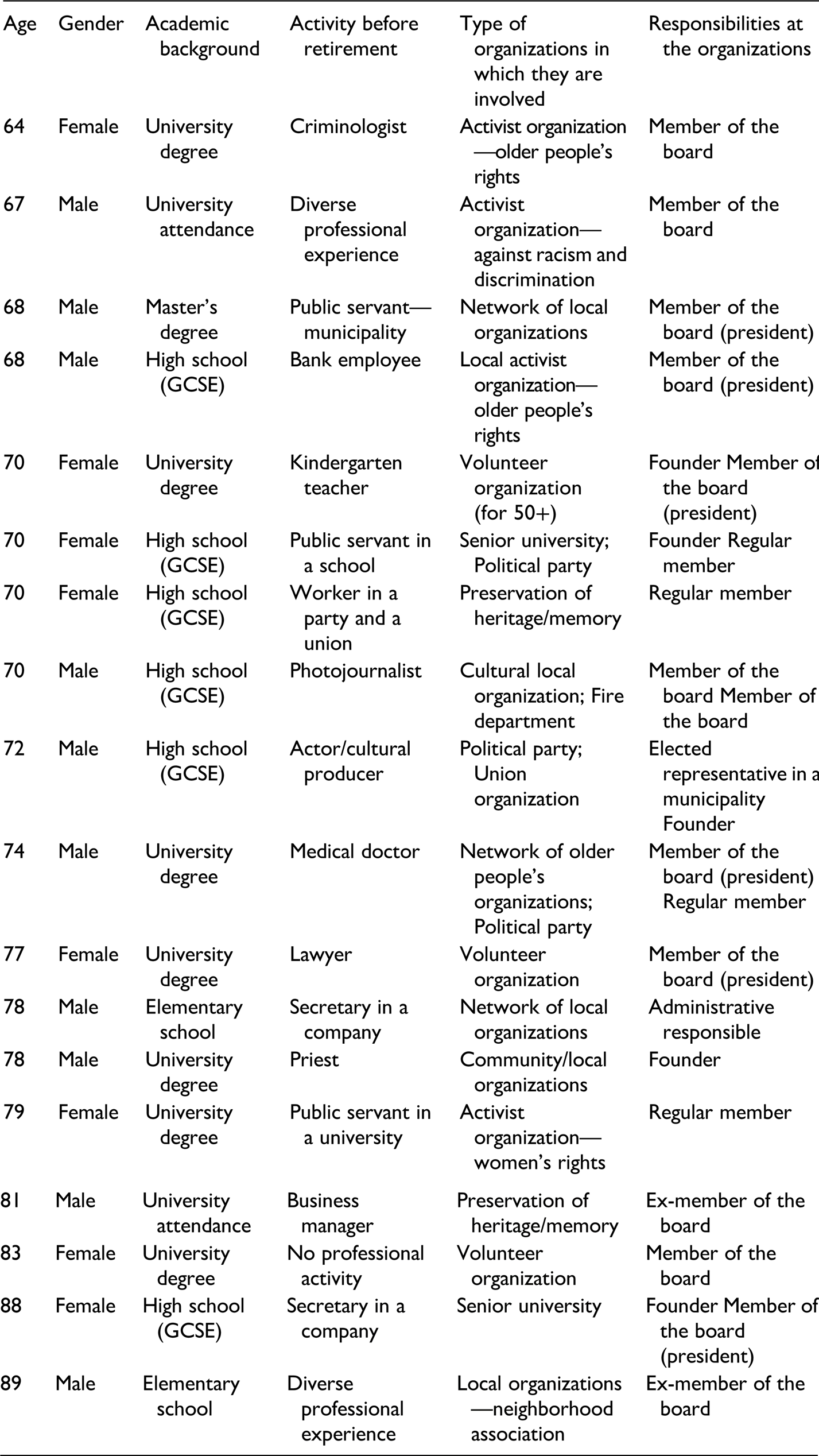
The academic qualifications of the participants in this study are relatively high, considering the academic qualifications of people belonging to this age group in Portugal (52.8% of the population over 65 in Portugal in 2019 completed only four years of schooling and 20% did not complete any degree, according to data from Pordata, 2021). This results from the fact that the participants in this study are mainly current or former members of the board of the organizations in which they participate (see Table 1). Although there are relatively few studies on the characterization of people involved in civil society organizations in Portugal, the available data show that people involved on the boards of these organizations tend to have higher academic qualifications than the general population of the same age group (Delicado et al., 2002).
Data Analysis
Considering the large volume of data collected, as well as the need to analyze it in a more flexible way without losing its richness, complexity, and details, we decided that thematic analysis, as presented by Braun and Clarke (2006), would be the most appropriate strategy for the analysis and discussion of these data, in close coordination with theory. In this sense, the six stages proposed by these authors for the development of thematic analysis were followed: after the transcription and reading of all the interviews, we organized the information into initial codes, which gave rise to the first subjects that allowed the aggregation of relevant information resulting from the interviews. Then we collaboratively reviewed the themes, the definition, and the naming of each theme. This whole process of analysis was supported by a theoretical device that supported reflection and decision-making regarding the themes and sub-themes that emerged from this analysis. This article covers the last stage of the thematic analysis, that is, the production of the final report of the analysis, which was reviewed and approved by all the authors.
In order to enhance the rigor of the study, data analysis was discussed by more than one researcher (“observer triangulation”) and who jointly decided on the analysis (“peer debriefing”). In addition, throughout the process, researchers kept a record of data analysis procedures (“audit trail”) and proactively reflected on whether their views were interfering with the research (“reflexivity”) (Lietz & Zayas, 2010).
Findings
Throughout the interviews, learning and educational experiences emerged in the participants’ discourse related to their social, civic, and political participation. We identified three main themes in relation to learning/educational experiences:
learning emerges as a driver for social, civic, and political participation; educational opportunities of participants can be barriers to social, civic, and political participation in old age; learning emerges as a result/impact of this participation.
Each of these themes will be explored, as well as the sub-themes in which they unfold. The thematic map presented in Figure 1 represents this interface between themes and subthemes.
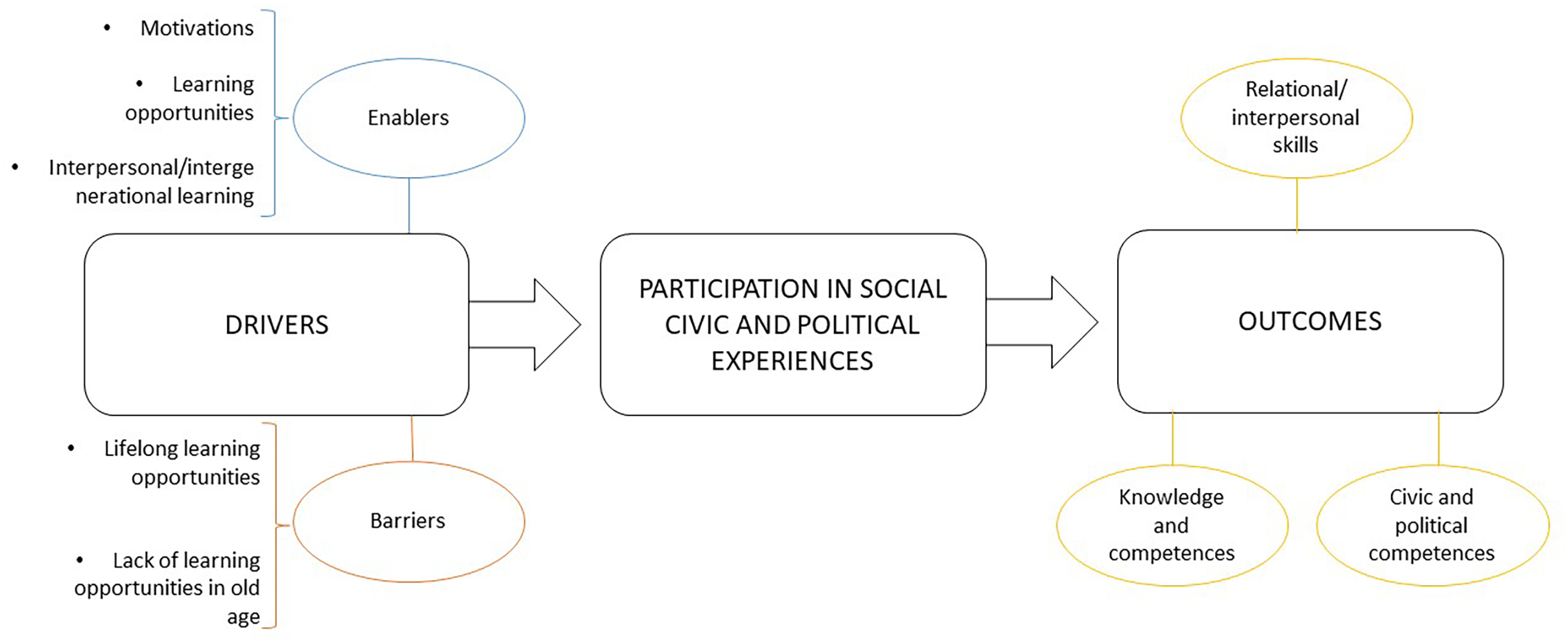
Thematic map—drivers and outcomes of participation
Learning as Enabler of Social, Civic, and Political Participation
For the participants in this study, the willingness to learn more in general, or on some specific topic appears as a relevant motivation to get involved in social, civic, or political participation initiatives. The awareness that there is much to learn and that these can be stimulating contexts to enhance learning emerges as a trigger for participation: I got involved in several processes for some time, but I thought this would be interesting because we never know everything. (female, 70, senior university)
Participants recognize the contexts in which they are involved as settings for learning, recognizing them as significant learning opportunities for their lives and which also contribute to their development: Here we are always learning! Always learning! (male, 81, preservation of heritage/memory organization)
Some interviewees indicated that involvement in these initiatives forces them to learn more, because they are discovering interests and/or learning needs that arise from this involvement. Because of this, they develop strategies to acquire this knowledge. These strategies may involve an individual, autonomous search for more information on the topic(s) of their interest, through reading books, newspapers, participating in conferences or other forums, or even investing in formal education contexts: Obviously, after this, I had to complete a bachelor's degree and a master's degree. (male, 68, network of local organizations)
Experiences of social, civic, and political participation are also identified by those involved in this study as opportunities for learning with others. Awareness of the need to learn more about different subjects and this availability leads people to recognize that they have a lot to learn from others, considering that they have knowledge, experiences, concerns, and world views that are different from their own: We learn a lot from others, who have ideas, who present proposals that we, a priori, never thought of. (…) We learn a lot from this. (male, 70, local organization)
The potential for collective construction of these contexts is also highlighted by several participants in this study: Where did I learn? With them, from them! In this participation, in these sundry actions that always were coherent with my principles… (…) Collective construction. (male, 68, older people's rights organization)
The potential and importance of intergenerational learning is particularly reinforced when people are involved in contexts where they necessarily interact with people of other generations, particularly younger people. The recognition or acceptance that younger people can contribute to their learning is identified by several participants as a relevant feature in old age: I learned a lot from all the people I worked with there. (…) In this case, it was with people substantially younger than I. And older people must be humble and stop thinking, “I am older, I know better”, because that is not true, because sometimes I am older and I do not know anything [about some topic]. (…) And so you have to have humility and the willingness to learn. And if you do, it is very good! (female, 79, other activist organization)
Learning Opportunities as Barriers to Social, Civic, and Political Participation in Old Age
For participants in this study, the educational opportunities people have throughout their lives seem to influence how they engage in social, civic, and political participation in old age. The lack of opportunities to invest in skills development at earlier stages in the life cycle is identified as a difficult barrier to overcome when people want to be involved in these kinds of initiatives in old age. For some respondents, this is most evident among people with lower levels of literacy: If there's a chance for people to update their skills, they should update them throughout their lives… If they have this chance, when they are older, things won't be as complicated. (female, 64, older people's rights organization)
However, it was also mentioned by other participants that in these contexts it is often more difficult to mobilize people with higher levels of literacy and/or who throughout their lives have had more recognized status in their communities. They explained this situation by the fact that people may not identify with the structures that exist in their communities, or with some difficulty they may have in starting a new task, in a new context, where the status and/or recognition they had previously now had less relevance. Sometimes there are people who have had leadership roles in their professional life, (…), but then they want to go [to these organisations] and have a big role right away (…) And there are other people there, and people also have to go there to collaborate (…) and sometimes people do not agree with that, that a voluntary organisation is different, isn't it? (female, 77, volunteer organization)
In any case, education has been recognized as a relevant factor in boosting participation. Therefore, the lack of an education that promotes and instigates participation has been mentioned as a barrier to this involvement, including at this stage of the life cycle: Of course, education is always the key. (…) This participation has to be enhanced by education from the beginning. (male, 67, other activist organization)
In this sense, the lack of learning opportunities in old age is seen as a barrier. It has therefore been reinforced by different people that it is essential to invest in lifelong learning, which implies not leaving old age out of the life cycle. Promoting people's literacy at different levels helps them to be better informed and therefore less vulnerable: Lifelong learning is very important. It promotes literacy, which is essential to fight against poverty, for people who are sick to understand the treatments. Because when people have less ability to look for information on their own, they are much more vulnerable to the news… (…) And they can be more easily manipulated. (male, 74, older people rights organization)
Learning as Result/Impact of Participation
A variety of learning outcomes were identified in the interviews as resulting from the social, civic, or political participation of the participants. When asked about the benefits that result from this involvement, respondents often highlighted the learning they undertook in these contexts. This learning is also mentioned as one of the strong reasons why they remain involved in these initiatives.
Among the learning outcomes identified, relational/interpersonal skills emerged with more emphasis. The participants mentioned that in these contexts they develop teamwork and collective construction skills. The existence of common objectives among the members of these organizations is a relevant factor of mobilization, reinforcing the commitment among the group members. In order to achieve common objectives, this mobilization necessarily involves managing expectations, ceding to and respecting the opinions of others, and the diversity brought by the various members that make up the group. In many situations, the relationships that are established in these contexts between its members in the course of their social, civic, or political activities result in friendships, or at least in the establishment of relationships with people that become meaningful to the day-to-day life of the participants: I keep learning every day (…) I learn from what they say, from their experience. My learning results from the opportunity to talk to them. (male, 78, local organization)
The participants also mentioned throughout the interviews that their participation in these contexts resulted in the acquisition of concrete knowledge and skills that relate directly to the activity in which they were involved. Some people highlighted the acquisition of instrumental skills related to bureaucratic or financial issues, for example, which, although not the ones that mobilize them the most, turned out to be indispensable for the fulfillment of the tasks arising from their participation. I had to learn about the functioning of a municipal assembly. I was elected for public service for the first time now (…) And there is learning here (…), bureaucratic, technical, processual, all those things, the rules and procedures that I had to learn… (male, 72, political party)
For some of the people interviewed, the work they proposed to do in the context of their social, civic, or political participation required a theoretical or conceptual extension of some issues related to the activities they are carrying out. Awareness of the need to invest in the study of certain themes is also relevant to the participants, highlighting the commitment and seriousness with which they faced this participation: [I had to learn] about development, and about project design. Evaluation of projects, planning of projects, this is all a kind of work that is new to me. (…) this opened learning perspectives to other things that I never thought I would have to know at 70 years of age… (female, 70, volunteer organization)
The development of other skills, such as digital, artistic, or cultural skills, was also mentioned by participants as a result of this involvement. In or from these contexts, interviewees had the opportunity to undertake training or to participate in activities that contributed to the development of these skills: Here at the association, we had introductory classes in internet or whatever. (…) We had classes… (…) (male, 89, local organization)
The development of civic and political competences was also highlighted by the participants in this study as a result of their involvement in these contexts. They pointed out that their social, civic, or political participation allowed them to access and have contact with other situations and therefore get to know contexts and people whose ways of life they did not know, or at least did not have close access to. Knowledge about the surrounding situation often results from the fact that they have had to learn, at this stage of their lives, to relate to people who live in situations that are different from their own, or simply from encountering these situations more closely. We learn to have a more correct perception of the world… Sometimes, the world is not what we thought it to be. I learned about many different situations, I met several political and cultural personalities, a lot of poverty, etc.… We only learn that from the contact with other situations. (male, 68, older people's rights organization)
It means not remaining indifferent to what is happening around us. (male, 89, local organization)
Participation in these contexts also brings about greater political and civic awareness of issues relating to one's own rights and those of others, on the one hand, and greater awareness of how the structures of society operate and how they are influenced politically, on the other. Retirees must be led by other retirees! It does not make any sense any other way…. (…) We learn, because problems arise and we have to deal with them… Today, the expectation of a retiree is very different from 30 years ago. Which does not mean that the old problems were solved. They are not. (male, 74, older people's rights organization)
Discussion
The focus of this study was to understand how the social, civic, and political involvement of older Portuguese people can relate to the educational dimension that underlies these experiences of participation. Three major themes emerged from the thematic analysis where these two dimensions—social, civic, and political participation and education—are related. Learning emerges as a driver (either positive or negative) for social, civic, and political participation, and also as a result/impact of this participation. It is therefore possible to highlight educational opportunities, or their absence, as possible barriers to participation in old age. These results are especially relevant considering that we are dealing with the Portuguese context, in which people aged over 60 experienced a profound democratic transition. Thus, the data must be framed in this broader political context, considering the changes in access to education and actual opportunities for social, civic, and political participation. The possibility to learn more emerges in this study explicitly as a motivation for social, civic, and political participation of older people, which is consistent with previous studies in this field (Petriwskyj et al., 2014). The interviewees recognize these experiences of participation as opportunities for learning and skills development, which they highlight as being significant for their life and personal development, reinforcing previous studies that pointed in this direction (Boulton-Lewis, 2010; Narushima et al., 2018). The participation experiences were identified by the participants as challenging, as they arouse their curiosity and the will to know more and look for new learning strategies.
Social, civic, and political participation is emphasized in this study as a key interpersonal learning opportunity for older people. Interviewees reinforce that through this participation they have the opportunity to contact and learn from other people, addressing both the intragenerational and intergenerational potential of this learning. Intergenerational learning deserves some emphasis, because the association with the idea of generativity, although present in our data, is less clear. In this study, intergenerational learning is highlighted by the participants as an opportunity for them to learn from younger generations. Participants expressed curiosity and willingness to access younger generations’ knowledge and worldviews. This may be an interesting issue for further exploration, as there is some tendency to strengthen the potential for intergenerational transmission from older people to younger people in studies on civic and political participation in old age. The potential for intergenerational transmission from the youngest to the oldest, which reinforces the role of older people as learners, is probably being neglected in the study of participation experiences with potential for intergenerational contact.
The relationship between social, civic, and political participation in old age and educational issues emerged as well, as our data indicate that learning opportunities, or the lack thereof, can be barriers to participation in old age. As has been highlighted in the literature, our study also states that the educational opportunities people have throughout their lives influence their engagement in social, civic, and political participation in old age (Adler et al., 2007; Barnes et al., 2012; Schugurensky & Myers, 2008).
On the one hand, the lack of educational opportunities in previous stages of the life cycle appears as a barrier to participation in old age. The lack of involvement in contexts that foster civic and citizen education throughout people's lives, from school to nonformal educational settings, is reinforced by participants as a barrier to participation in old age. It is important to reinforce that Portugal lived for 48 years under a dictatorship that ended only in 1974, after a military coup. It means that Portuguese citizens who are now 65 years or older grew up and were educated in a very repressive period, in which civic and political participation was not stimulated, but rather violently repressed. In addition, universal access to formal education has been a progressive achievement over the last decades, which is also reflected in the general academic levels of the Portuguese population, which are still relatively low, especially among the older generations. The data available allow us to understand that the academic level of the older population has been increasing significantly over the last 20 years (in 1998 the percentage of people aged 65 or over without formal education was 57.3% and decreased to 20% in 2019, while secondary and post-secondary education was at 1.7% and increased to 5.3% in 2019) (Pordata, 2021). This evolution may have a positive impact on the civic and political participation of older populations, as some studies have pointed out that higher educational backgrounds seem to be a predictor of higher participation in old age (Adler et al., 2007).
However, the political and historical framework of this study can indeed have a significant impact on the link between participation and learning, both because of participants’ political awareness of the struggles against the dictatorship and because of their lifelong literacy experiences, which often occurred outside formal educational settings.
The social, civic, and political participation of the interviewees results in diverse learning that they themselves highlight as benefits of this involvement and are therefore factors of continuity in these contexts. In this sense, relational/interpersonal skills emerged as significant learning. This learning relates to the development of teamwork skills, strengthened by the existence of common goals, which ultimately reinforce people's commitment to these contexts and to their members. This result is consistent with previous studies in which relational/interpersonal learnings were identified as a result of older people's involvement in volunteer activities (Narushima, 2005) and also in political organizations (Serrat et al., 2016).
This participation also results in knowledge and skills on specific subjects. Included in this knowledge and skills are instrumental skills which are more linked to practical and technical skills on specific topics and which have been referred to in literature as resulting from this participation, either in voluntary contexts (Narushima, 2005), in local democratic contexts (Schugurensky & Myers, 2008), or in political organizations (Serrat et al., 2016). However, this study also highlighted relevant knowledge and skills that resulted from training or educational programs intentionally promoted by the organizations of which the people interviewed are part (such as cultural visits, meetings for thematic political discussions, painting or computer classes). The stimulation of educational programs, more or less structured, within organizations, was valued by the participants as an added value, motivating them to remain involved.
Theoretical and conceptual knowledge was highlighted by the participants as a result of their social, civic, or political involvement. Their involvement in these organizations has awakened the need to broaden their knowledge on the themes underlying this participation, which has led the participants to invest in their study (either more autonomously or by integrating more structured educational contexts). This need for the further study could be an indicator of the level of commitment that older people appear to experience.
Civic and political competences were also highlighted in this study as a result of social, civic, and political participation in old age, which is consistent with previous studies (Findsen & Formosa, 2011; Schugurensky & Myers, 2008; Serrat et al., 2016). In our study, these civic and political skills are manifested in three major ways. On the one hand, involvement in these organizations allows participants to have a more in-depth and thorough knowledge of the surrounding situation, thus giving them access to circumstances they did not know or at least did not have direct contact with. In addition, through this involvement, people realize that they have become more aware of their own rights and the rights of others, thus strengthening their willingness to mobilize to defend and argue for them. Finally, this participation enables the participants to gain more structural knowledge about society and the way in which different structures are interrelated/connected and how they impact on people's daily life.
On the whole, this study reinforces the intimate links between social, civic, and political participation and learning in old age. The lack of educational opportunities in old age emerges clearly as a barrier to more active and informed participation by older people. The concern expressed by participants about the lack of learning, reflection, debate, and skills development settings aimed at older people and/or proactively including them, highlights the importance they recognize to lifelong education. Participants in the study reinforce the advantages of learning at this stage of the life cycle, which are in line with those mentioned in previous studies about education in old age (Boulton-Lewis, 2010; Withnall, 2010). Furthermore, they highlight a diversity positive learning outcomes of participation.
Conclusions and Implications for Policies and Practices
In old age—as in other stages of the life cycle—social, civic, and political participation takes place in different ways and in different contexts, with different consequences in people's lives. One of those consequences is learning, which is transversal to social, civic, and political participation in old age, as happens at other stages of the life cycle, namely at civic and political level. In addition, learning, and more specifically learning from other people, is a motivation for involvement in civic and political activities and for remaining involved.
For all these reasons, it is important to continue studying the social, civic, and political participation of older people and their potential for learning and skills development. Further knowledge on how participation and learning relate to each other in old age, considering the historical and political context, and their theoretical exploration will contribute to improving the practices of public and private, local, national, and international organizations to enhance the role of older people as citizens. In addition, ensuring the universal right to quality education for all without age discrimination should be a priority. To this end, it is essential to understand the contexts and approaches most suitable for this right to be guaranteed to older people, taking their history, characteristics, needs, interests, and potential into account.
The lack of educational opportunities in old age is reported in this study as a barrier to more active and informed participation by older people, and this may exacerbate the potential for vulnerability associated with old age. In a context of growing demographic aging—to which the COVID-19 pandemic brought additional challenges, not only unveiling agism but also reinforcing the need for change in policy and practices regarding old age and aging—it is time to advocate for a growing commitment to Freire's “transformative education” (1975), enabling older people to continue to develop their capacity to read and transform the world.
Footnotes
Acknowledgments
The authors would like to thank all the participants for their contribution to this study.
Declaration of Conflicting Interests
The author(s) declared no potential conflicts of interest with respect to the research, authorship, and/or publication of this article.
Funding
The author(s) disclosed receipt of the following financial support for the research, authorship, and/or publication of this article: This work was funded by the Portuguese Foundation for Science and Technology (FCT) and by the European Social Fund, under the Human Capital Operational Programme (POCH) from Portugal 2020 Programme [grant no. SFRH/BD/132328/2017]. It was supported also by the Portuguese Government, through the FCT, under CINTESIS multiannual funding [grants no. UIDB/04255/2020 and UIDP/04255/2020]; CIIE's multi-annual funding [grants no. UIDB/00167/2020 and UIDP/00167/2020]; IS.UP's multi-annual funding [grants no. UIDB/00727/2020 and UIDP/00727/2020]; CES's multi-annual funding [grants no. UIDB/50012/2020 and UIDP/50012/2020].
