




Abstract
Civic, Social and Political Education (CSPE) is a mandatory junior cycle subject in Irish second-level schools. Its concept-based syllabus accords teachers significant freedom in choosing instructional content for the subject. This study used a survey of 223 CSPE teachers to identify: (1) differences in the teaching of the subject based on teacher gender; and (2) the nature of these differences. Responses were analysed by statistical and thematic analysis. While very few differences emerged, there were indications of some distinctions in two areas. Female teachers were more likely to see the potential of CSPE to promote politics to encourage social responsibility and were more likely to promote greater student participation. Male teachers, on the other hand, focused on teaching a less defined citizenship and seemed to place less emphasis on areas that encourage student participation, such as mock elections, involvement in student council and other school-based activities. Limitations and recommendations are discussed.
Keywords
Introduction
Citizenship education has been shown to have many benefits. It can expose students to facts they would not otherwise encounter, thus creating awareness of what is happening in the world around them (Niemi and Junn, 1993), encourage engagement in political activities, such as writing to elected representatives and signing petitions (Manning and Edwards, 2014; Saha, 2000) and help to overcome poor political engagement caused by a lack of family political socialisation (Neundorf et al., 2016). However, citizenship education does not in itself confer automatic benefits. The factors that make citizenship education effective include a focus on the local community (Galston, 2004; Torney-Purta and Richardson, 2003; Westheimer, 2015), giving students input in discussion and decision-making, such as school governance (Biesta et al., 2009; Galston, 2004) and linking citizenship to students’ own practice. Furthermore, Biesta et al. (2009) stated that contact with other adults in areas such as sport and leisure activities also impacts how young people learn about citizenship because they view such areas as relevant to them and because they are issues over which they have some control. Young people's ability to have a say and to relate in a democratic manner with adults are important elements in developing their citizenship competences (Biesta and Lawy, 2006). Merry (2020), however, cautioned that the places where students learn citizenship, such as home and school, are too focused on rules, and thus contain an inherent power imbalance.
In Ireland, citizenship education has been provided since 1997 by Civic, Social and Political Education (CSPE), a mandatory three-year stand-alone subject taught at junior cycle in post-primary schools. From 2000–2019, CSPE was formally assessed at the end of the third year of junior cycle by a terminal examination and action project for the Junior Certificate Programme (JCP). The syllabus was innovative, as it focused on seven key concepts rather than prescribed content (NCCA, 1996). From 2016, the JCP began to be replaced by a Junior Cycle Profile of Achievement (JCPA). In CSPE, this has led to the CSPE exam and action project being replaced by a class-based assessment (NCCA, 2015). The seven key concepts have been replaced by 37 learning outcomes completed over three strands. While the learning outcomes approach has retained the concept emphasis, these learning outcomes have become more defined in the new specification. The ability to choose the content to be covered allows wide scope to teachers of CSPE in relation to what they teach.
Research into CSPE has focused on issues such as attitudes to CSPE (Duggan, 2015; Gleeson and Munnelly, 2003; Murphy, 2003; Redmond and Butler, 2004), the nature of CSPE action projects (Wilson, 2015) and identity and diversity (Fass and Ross, 2012). Although some studies have looked at gender, these have focused on the gender of the students rather than the teachers (Nugent, 2006; O'Brien, 2022; Tormey and Gleeson, 2012). Cosgrove et al. (2011) found some teacher gender-based differences in the teaching of citizenship education. While Irish female CSPE teachers were less confident in their abilities than female teachers in other countries, they had significantly higher student participation in class, used assessment more, and had a greater number of in-class citizenship education activities. With this exception, there has been little examination of how differences in teacher gender may impact the teaching of CSPE.
The current study was conducted at a time of transition: third-year students were the final cohort to take the JCP, whereas the first- and second-year cohorts were preparing for the JCPA.
Review of Literature
Gender differences among teachers
Social Role Theory says that while the gender roles of men as agentic and women as communal may appear to be natural, they have their origins in the division of labour (Eagly and Wood, 2012). Because these roles are shared, people realise that others will approve of behaviour consistent with the role and disapprove of behaviour inconsistent with the role. Physical or biological differences do not inhibit people's ability to teach, thereby somewhat neutralising the role of gender for teachers. Drudy (2008), however, noted that teaching is seen as more suited to a woman's nature, and may therefore be more associated with the female gender role. Ireland, in common with most OECD and EU countries, has a gender imbalance in secondary teaching in favour of females (Drudy, 2008). Data from the Central Statistics Office (CSO) show how the percentage of female teachers in the post-primary sector rose from 62% to 71% in the period 2006–2015, whereas the percentage of male teachers in the same sector fell from 38% to 29% (CSO, 2019).
Much research into the differences between male and female teachers focuses on whether the lack of male teachers negatively impacts students’ academic outcomes, especially boys. The gender of the teacher has been found to have little bearing on student achievement (Cho, 2012; Lahelma, 2000; Sabbe and Aelterman, 2007; Sansone, 2017; Split et al., 2012). Moving beyond achievement, research has identified several characteristics of good teachers, including being a good listener; making the subject interesting; having high expectations and creating a positive learning environment (Sansone, 2017); being competent, relaxed and friendly; teaching well and using a variety of methods (Lahelma, 2000); and promoting a fair and quality classroom environment (Carrington et al., 2007). The gender of the teacher was not a factor in any of these studies.
However, some distinctions between female and male teachers have been identified. Sabbe and Aelterman (2007) found that female teachers report higher job satisfaction levels, opt at an earlier stage for teaching as a career choice and focus less on salary than their male colleagues. The research into male second-level teachers is limited, but some studies suggest that male teachers consciously bring a stereotypical masculinity to their occupation. They tend to stress what defines themselves as male and adopt an overtly masculine approach to their teaching, particularly if their subject is seen as feminine (McCormack and Brownhill, 2014; Roulston and Mills, 2000). Even within teaching, some areas are viewed as more suited to the female role. Mannix-McNamara et al. (2011), for instance, found that gender stereotypes and a lack of confidence discourage male teachers from teaching relationship and sexuality education.
While teacher gender appears to have no impact on achievement, or on what it means to be a good teacher, it may have some bearing on the classroom experience. Cho (2012) suggested that teacher gender may influence student attitudes, and this has the potential to affect young people's experience of citizenship.
Gender differences in political interest and social awareness
There is evidence of gender differences in politics, one of the central aspects of CSPE. These differences encompass political interest, knowledge, efficacy and participation, with males showing higher levels in all of these areas.
Men have been shown to have greater interest in political matters (Bernstein, 2005), but there are differences even within this sphere. Politics is frequently understood to refer to the national or international level; the local level is often discounted. Some studies have suggested that women's political interest is concentrated on local politics (Arnot et al., 1996; Coffé, 2013; Hayes and Bean, 1993), whereas men are more likely to be interested in a broader politics that incorporates both national and global issues (Bernstein, 2005; Dow, 2009). Other studies, however, have found that teachers focus on local rather than national or global issues because of factors other than gender, such as students’ socio-economic status (Wood, 2014) or academic ability (Osler, 2011). Political interest as expressed on social media also shows gender differences. Women's political activism tends to entail private actions, such as boycotting, signing petitions, fundraising, and humanitarian and social activism, whereas men tend to express their political interest through involvement with political parties and demonstrations (Brandtzaeg, 2017; Coffé and Bolzendahl, 2010). Men use social media for information seeking and to post information, whereas for women it is a source of social interaction; women, for example, are more likely to comment on others’ posts rather than posting their own (Bode, 2017; Brandtzaeg, 2017). Differences are also evident in the way in which politics is presented. A political career presented in a communal manner, rather than one focused on power and conflict, is more attractive to women (Schneider et al., 2015). Furthermore, the reasons for women's interest in politics include social compassion, morality and improving their rights (Eagly and Diekman, 2006). Similarly, Schmid (2012) identified gender differences in the origins of interest in political and social issues: for young males, political interest promotes their social responsibility; inversely, for young females, social responsibility encourages their political interest.
Political knowledge has also been found to be higher amongst men (Frazer and MacDonald, 2003). Factors that contribute to the development of such political knowledge also show gender differences. For men it includes debating, partisanship and political parties, whereas for women it involves engaging in communal and civic activities (Wolak and McDevitt, 2011). In addition to political knowledge, there are differences in political efficacy. Political efficacy is developed by website use, a focus on local issues and political deliberation in class (Pasek et al., 2008). Male adolescents have a greater sense of internal political efficacy, which is not affected by family politicisation or socialisation experiences (Murphy, 2017).
Daily accessing of political websites, discussing politics with family and friends, debating, self-confidence, running for student government and mock trials—all of which men are more likely to experience—increase one's likelihood of running for office (Fox and Lawless, 2014). Similarly, Bernstein (2005) traced men's greater political engagement to greater political interest, participation in discussions and information seeking. While interest in social issues engages women in politics (Eagly and Diekman, 2006; Wolak and McDevitt, 2011), such interest alone does not determine whether women will become involved in politics. Women are more likely to consider improving their community by working for a charity, whereas men are more likely to do so by running for political office (Fox and Lawless, 2014). However, gender differences have been identified even in volunteering. Women tend to volunteer in areas associated with caring tasks and are less likely to hold leadership positions (Wilson, 2000). Yet, these differences are not definitive: in North America, females are more likely to volunteer, whereas in Europe there is no gender difference. Moreover, Schlozman et al. (1995) found gender similarities rather than differences in political and voluntary activities, and in the fulfilment gained from participating in them.
Some evidence points to women being more compassionate (Eagly et al., 2004) and thus more suited to caring careers. Cullen and Murphy (2017) outlined how women's organisations used political agency during the austerity period in Ireland. Their actions were political, but they were motivated by a desire to promote and protect social and care issues, such as opposing child benefit cuts and supporting home-help workers. However, while females may value social responsibility, this does not necessarily imply adopting leadership roles. De Piccoli and Rollero (2009) found that only women who actively participate in politics see themselves as capable of leading, whereas non-political women were seen as caring, with no requirement for leadership competences.
Schools are not the only factor influencing how students learn citizenship; other areas in society, such as the home, community, leisure pursuits, government, media and advertising also play a role (Biesta and Lawy, 2006). The teaching of CSPE, however, has the potential to influence how young people think about social and political issues and may shape their outlook as citizens. Some gender differences in approaches to political and social issues have the potential to translate into different views of citizenship and how to educate students for citizenship. If men have an agentic approach to the teaching of CSPE, and women have a communal approach, this may impact whether teachers emphasise politics or social issues. Consequently, CSPE teachers’ ability to choose the content taught in the subject has the potential to deliver very different visions of CSPE. It is therefore possible that students encounter a primarily socially responsible or primarily political experience of CSPE, depending on the gender of the teacher.
Although gender differences in teachers and in approaches to politics and social responsibility have been outlined, little research has been undertaken concerning differences in teaching CSPE based on the gender of the teacher. To investigate the role of teacher gender on the teaching of CSPE, the following research questions, based on analysis of the aforementioned literature, were devised:
Does the gender of the teacher lead to differences in how CSPE is taught? If there are differences, what are they?
Methodology
The data collected for this paper were part of a larger study that examined differences amongst teachers of CSPE. This paper reports only on differences in teaching the subject based on teacher gender.
The data were collected by means of a self-completion survey comprising 23 closed and six open questions. The closed questions were analysed by statistical tests, and the open questions were analysed by thematic analysis. The inclusion of qualitative questions allowed for detailed data capturing of multiple facets of the same phenomenon to be collected in a single instance (Creswell and Plano-Clark, 2018).
The first 12 questions aimed to identify teachers’ perspectives on, and attitudes towards, CSPE. Some of these questions were taken from the International Association for the Evaluation of Educational Achievement (IEA) International Study of Civic Education Teacher Questionnaire (IEA, 1999). Participant responses were given on a five-point Likert scale, ranging from strongly agree to strongly disagree. Any response bias of the Likert scale was avoided by reversing two questions. A further 11 closed questions were designed to identify teacher and school practices in teaching CSPE. In the analysis of these, one question was subdivided into the type and focus of the action project. Finally, the six open questions allowed respondents to provide more detailed answers and to include relevant information not asked in the closed questions. Two of these questions were designed to elicit a reaction of agreement or disagreement.
Ethics approval was granted prior to distributing the survey. All surveys contained a covering letter that informed respondents of the purpose of the research. By completing the survey, respondents gave their consent for the data to be used. All responses were anonymous. The questionnaire was piloted amongst six teachers (non-sample) to check for reliability. This led to two questions being removed from the questionnaire, while a third question was rephrased.
The sampling method was quota sampling, based on the school type. The aim was to collect responses similar to the different school types: co-educational, single-sex female and single-sex male. The quota also aimed to achieve a similar number of Delivering Equality of Opportunity in Schools (DEIS) and fee-paying schools. To achieve the quota, the survey was distributed initially by post to the CSPE co-ordinator in selected schools. Given the low response rate, an online version of the survey was created and distributed by Survey Monkey. The online survey was emailed to school secretaries in 450 schools, who were asked to forward it to the CSPE co-ordinator. Finally, the Association of CSPE Teachers (ACT), the CSPE teachers’ subject association, forwarded a link to all members of the association. The response to the online survey was much better than to the postal surveys. The surveys were distributed in October 2018 and responses were collected by the end of November 2018. Two hundred and twenty-three responses had been received by that date. To avoid errors in inputting information into SPSS and NVivo, all paper survey responses were entered manually into Survey Monkey.
Internal consistency reliability was achieved by Cronbach's alpha testing in SPSS. The result for the attitude questions appeared low (α = 0.60). As deletion of items would have led to only a small change in the score, all items were kept. The attitude questions were analysed by independent-samples t-tests. Questions relating to teachers’ practice and the schools’ contribution to citizenship were analysed by chi-squared statistical tests. The open questions were coded using NVivo 12 software and were analysed by thematic analysis. Analysis of extracts are reported later in the Findings section.
Findings
Table 1 shows how teacher gender was 30.5% (N = 68) male and 69.5% (N = 155) female. The actual breakdown between male and female post-primary teachers in 2019 was 71% female and 29% male (CSO, 2019).
Comparison of actual percentages with survey respondents.

Statistical tests
Attitude scale
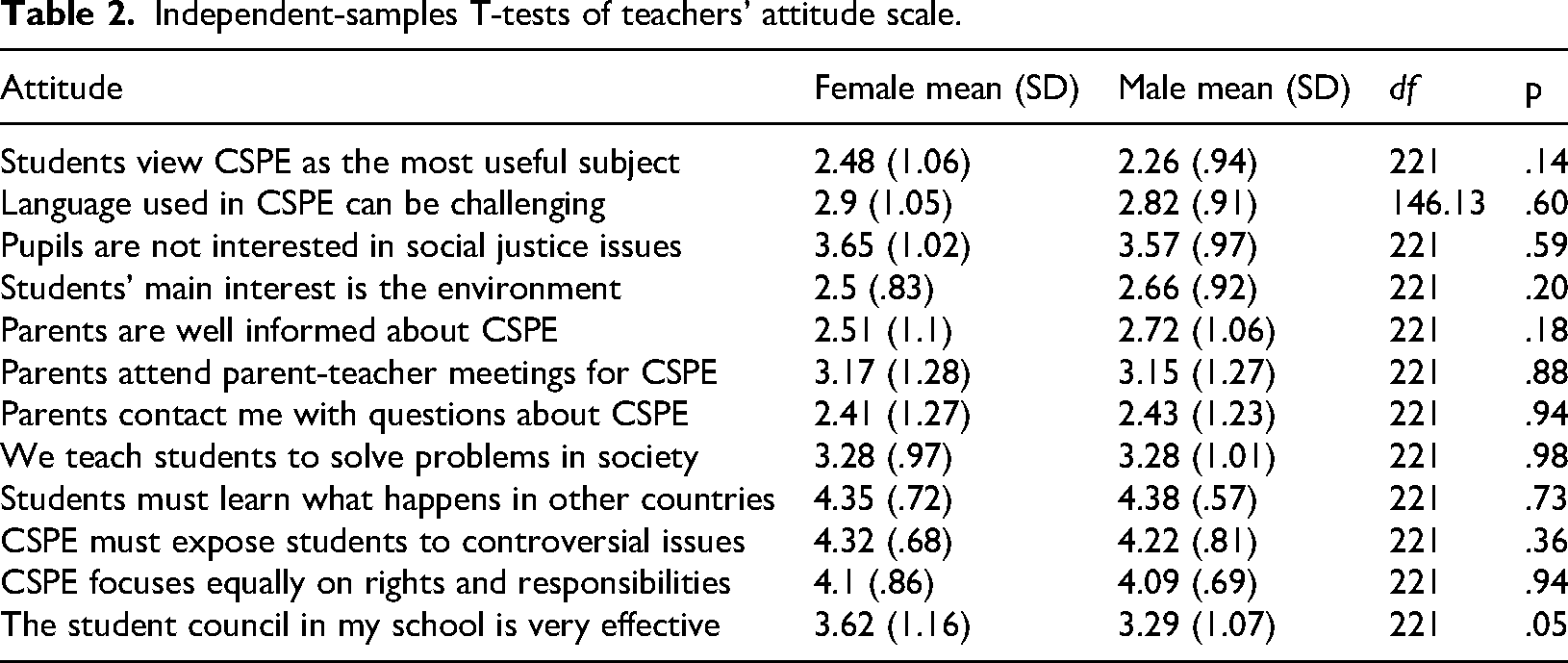
To measure their attitudes towards the teaching of CSPE, respondents were asked to rate twelve statements on a five-point Likert scale, ranging from strongly agree to strongly disagree. The Shapiro-Wilk test of normality was conducted to determine whether to conduct parametric or non-parametric testing on the attitude scale (Pallant, 2007). The test found a significance level of 0.23, which indicates normal distribution. Independent-samples t-tests were conducted to compare the attitudes of male and female CSPE teachers. While there was no significant difference in overall attitude, there was a significant difference in the scores for males (M = 3.29, SD = 1.07) and females (M = 3.62, SD = 1.16) for attitude 12, ‘the student council in my school is effective’, t(221) = −1.97, p = 0.05, indicating that significantly more female teachers viewed their student council as very effective. The magnitude of the difference in means was small (eta squared = 0.02). None of the other attitudes were statistically significant (Table 2).
Independent-samples T-tests of teachers’ attitude scale.
Teacher and school practice
Twelve chi-square tests of independence were performed on the closed questions designed to examine the relationship between teacher gender and teacher and school practice in CSPE teaching. One of the eleven questions on the type and focus of the action projects was subdivided for analysis. Two tests showed significant associations. The relation between teacher gender and choice of guest speaker was significant: χ2(3, N = 205) = 10.76, p = 0.01. The effect size was measured by Cramér's V, and was determined to be a medium effect of .23 (Cohen, 1988). Women and men were equally likely (20%) to say a garda (police officer) would be an appropriate guest speaker. Men were more likely (21.7%) than women (12%) to say community leader. Men were more likely (21.7%) than women (9.7%) to opt for a politician. Women, however, were more likely (60%) than men (36.7%) to choose a representative of an NGO as guest speaker. In relation to help from home, the chi-squared test also showed a significant relation between teacher gender and view of help from home: χ2(3, N = 218) = 14.6, p = 0.001. More female teachers (46%) than male teachers (23.1%) thought students received no help from home, while 62% of male teachers and 48% of female teachers thought there was a little help from home. More male teachers (15%) than female teachers (7%) thought that there was a lot of help from home. No male teachers (0%) thought there was too much help from home, as opposed to 1% for female teachers. The effect size was measured by Cramér's V, and was a medium effect of .26 (Cohen, 1988). One finding, ‘where students learn most’, was almost significant with a p value of .051 (Table 3).
Significant chi square test results of teacher practice based on teacher gender.
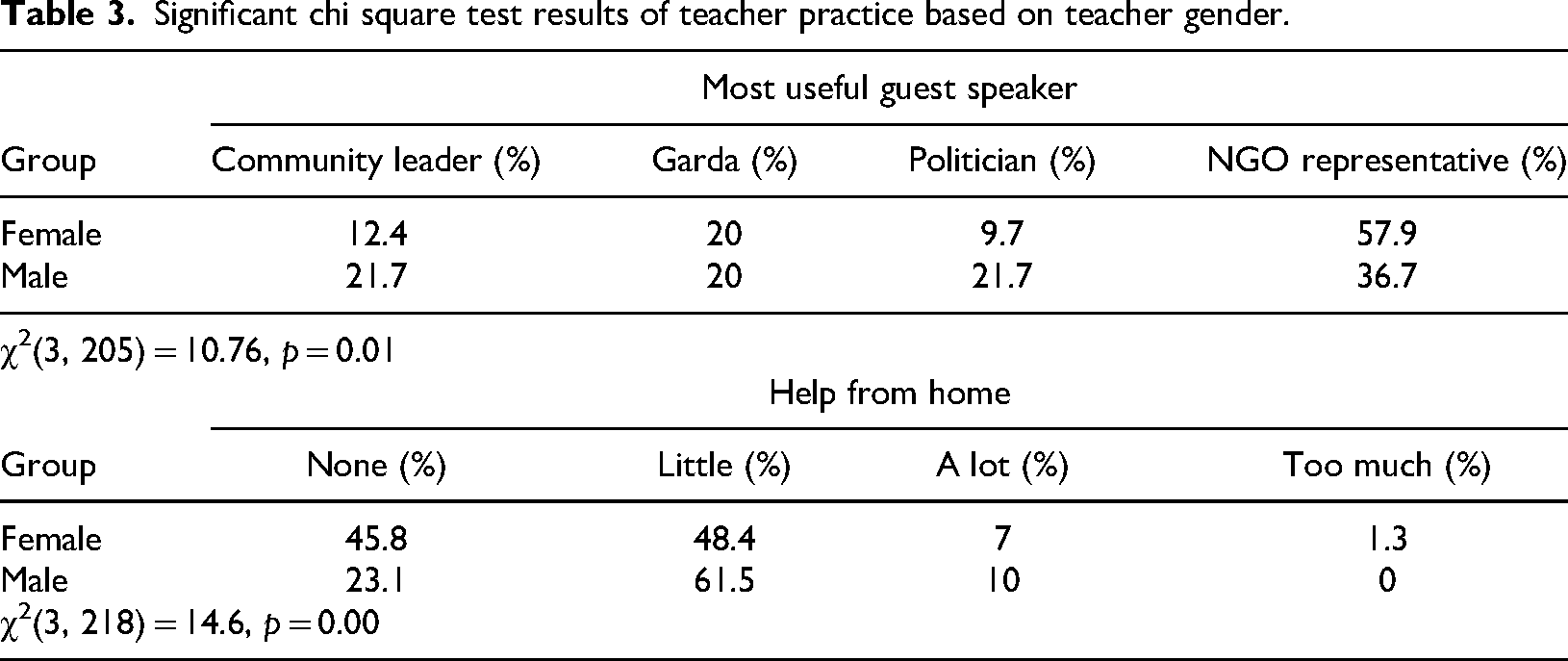
These results show that only two of the twelve tests were dependent on teacher gender. Female teachers were significantly more likely to view an NGO representative as the most desirable guest speaker and were significantly more likely to say that students received no help from home. In both instances, the gender of the teacher played a moderate role in the way respondents answered the question.
Thematic analysis
The response rate to the open-ended questions was high, with 206 respondents answering some or all of these questions. The breakdown of responses to these questions was 74% (N = 152) female and 26% (N = 54) male. Responses such as yes, no, agree and disagree were not included in the thematic analysis. All other responses were analysed using Braun and Clarke's (2006) six-phase method of conducting thematic analysis. Following this, three major themes emerged: the challenges of teaching CSPE, social responsibility and politics (Table 4).
Coding references from the thematic analysis based on teacher gender.
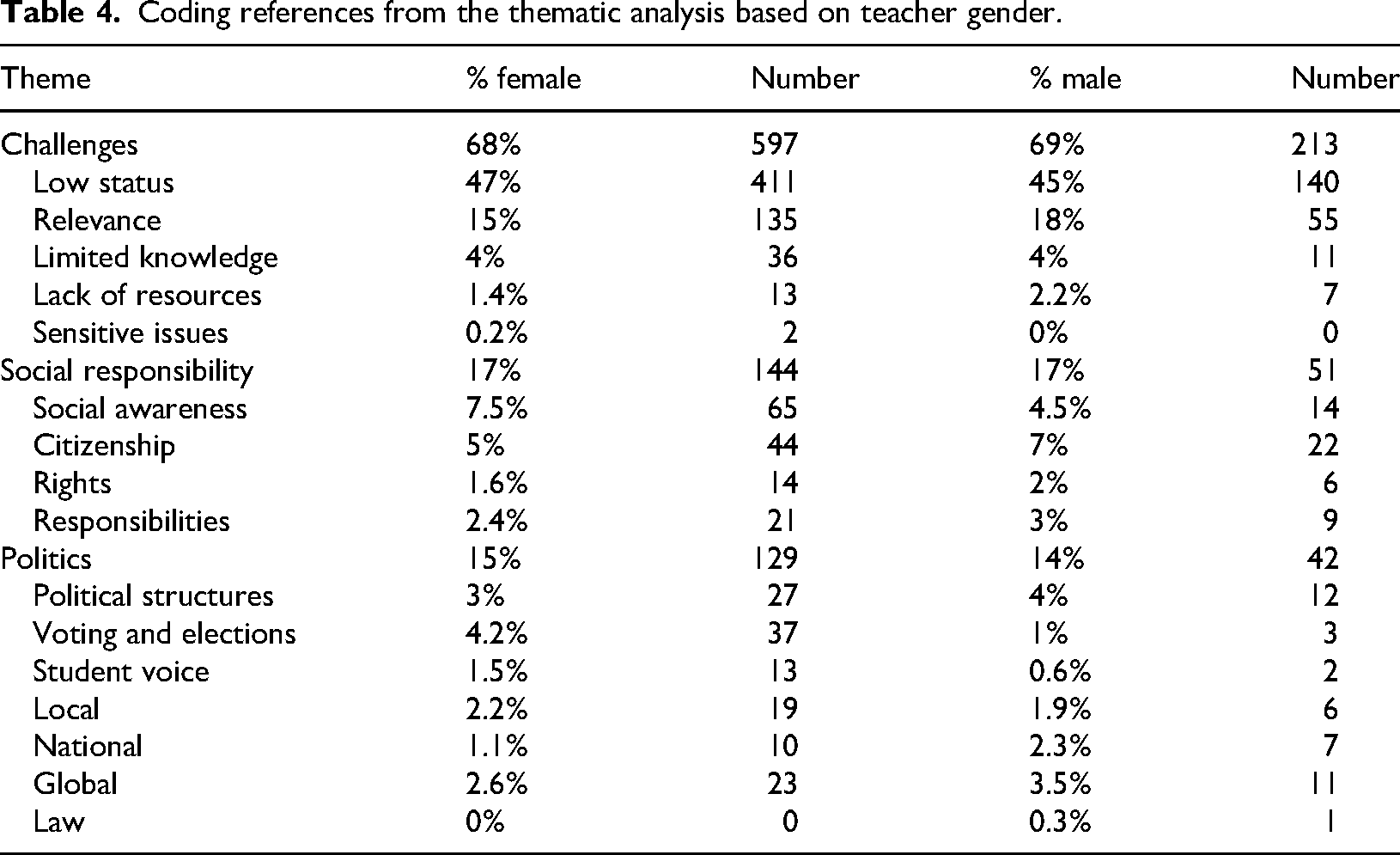
The challenges of teaching CSPE was the dominant theme. Coded references to these challenges showed that 68% of female teachers and 69% of male teachers identified it as the main theme, indicating no difference between genders. There were several subthemes to the challenges of teaching CSPE: low status, relevance, lack of knowledge from outside school, lack of resources and sensitive issues. Low status showed a 47% female to 45% male divide. There were some further subthemes relating to low status, each of which showed a similar division between male and female teachers. These included a general reference to low status, as well as contributory factors such as the roles played by school management and the Department of Education and Skills, teacher allocation and lack of class contact, and concerns about the lack of state certified assessment, with only the role of school management referenced more amongst female teachers (4.1%) than male teachers (2.6%). Male teachers (18%) were more likely than female teachers (15%) to mention the challenge of making the content relevant for pupils. More male teachers (5.2%) than female teachers (3.7%) felt that this challenge encompassed the role of the teacher. Limited knowledge or incorrect information coming from settings external to the school was referenced equally by female and male teachers (4%). Lack of resources was more likely to be mentioned by male teachers (2.2%) than by female teachers (1.4%), but as this came to only 20 coded references it was small. Sensitive issues was mentioned only by female teachers, but this challenge was only coded twice and is not reliable.
While the challenges featured in similar proportions among teachers regardless of their gender, some small differences were noted. Female teachers tended to be more concerned by school management's role in the lack of status accorded to CSPE, while male teachers were more likely to identify as challenges the struggle to make CSPE relevant to students, the role of the teacher in overcoming this, and a lack of resources.
Moving beyond the coding percentages, deeper analysis identified further differences in the responses. Female teachers elaborated much more on what they meant by ‘social awareness’, naming specific social issues, outlining the practical applications of social awareness and referring to socio-economic status, cultural differences and sexuality. Female teachers suggested increasing social awareness by using documentaries, action projects, school activities such as the Green Flag Award, and charity and voluntary work. The following quote is indicative of some of these suggestions:
[there should be] … more action-based research projects… make fundraising for charity compulsory.
Additionally, female teachers were more likely to indicate that increasing knowledge was important as it helped to develop the ability to question critically. The implications of such criticality and increased knowledge were viewed as increased social awareness and less acceptance of injustice.
Male respondents, in contrast, were less specific in their replies and used verbs such as ‘creating’, ‘developing’ and ‘exploring social awareness’, identifying no particular issue. Although they emphasised citizenship more than social awareness, just what citizenship involved was not clearly developed and lacked the concrete examples provided by the female teachers.
Female respondents frequently used words such as ‘interest’ and ‘engagement’, whereas male respondents were more likely to use ‘educate’, ‘exposure’ or ‘making relevant’. As with social awareness, female respondents were more likely to outline specific political issues. Female teachers seemed to place greater emphasis on teaching how to vote, with many giving practical examples, such as conducting mock elections. Male teachers did not mention mock elections as a method of teaching about voting. While many male teachers referred to the Irish presidential election and Donald Trump as political topics taught, their references indicated a more didactic approach. Female teachers also referenced Donald Trump and the presidential election, but these responses tended to give greater detail on the overall context. The following example from a female teacher indicates greater in-depth coverage of the topic: By taking time in the last few weeks to research thoroughly the presidential candidates and consider the key elements of the role and the most desirable and requisite traits, my students were engaged and informed when holding a mock election.
Both genders outlined the difficulty of making elections relevant, as the pupils’ young age meant that could not yet vote. Female respondents seemed to give greater consideration as to how to overcome this, by using mock elections, encouraging family voting and voter registration and, especially, student council elections. They seemed to place greater value on the potential of the student council as a way for their students to experience democracy, in both election to and functioning of the council. In addition to the student council, female teachers made greater links between CSPE and extra-curricular activities.
Female teachers were more likely to reference student voice and to outline specific examples of it, while male respondents referred to student voice in a more abstract fashion. Female respondents suggested developing students’ political voice as a means to promote social awareness and responsibility. Examples of how student voice worked in the classroom were clearer with female teachers, as the following quote demonstrates: Students have a say in guest speakers they want to invite and are active in organising fundraising events in school.
Female teachers were more likely to mention the practical applications of politics, such as organising actions in the community. The choice of local politics as a method of generating interest and providing an entry point were more likely to be referenced by female teachers. Male teachers, however, also noted the benefits of local issues for teaching CSPE, as can be seen from the following example: They spend a lot of time at school and if the narrative can be broadened to include local issues to begin with, if the school creates and maintains links with the community it can develop student interest and knowledge.
While male teachers were more likely to refer to global and national issues, they did not specify what this entailed in their teaching.
Discussion
The two aims of this study were (1) to investigate differences between female and male teachers in teaching CSPE and (2) to identify the nature of these differences. The findings overwhelmingly identified similarities between male and female CSPE teachers, but only three statistically significant differences. These differences are related to the view of effective student councils, the type of guest speaker chosen and the impact of knowledge from outside school. The thematic analysis backed up the statistical analysis, as here too the findings were similar regardless of gender. While the same themes emerged in both groups in almost identical numbers, differences emerged in some sub-themes. The differences relate to two interlinked areas: the purpose of CSPE teaching and student participation.
The purpose of CSPE
The findings mirror some of the features associated with female political and social behaviour referenced in the literature. Female teachers placed greater emphasis on promoting social awareness, supporting previous findings (Brandtzaeg, 2017; Eagly and Diekman, 2006). Female teachers, for instance, were more likely to have an NGO representative as a guest speaker, as opposed to a police officer or political or community representative. While there were no differences in their references to politics, analysis of the responses appears to show that female teachers view the aim of politics as improving society, indicating that they have a more communal view of what politics should entail (Schneider et al., 2015). Unlike in previous studies, there were no real differences in references to local and community politics (Arnot et al., 1996; Bode, 2017; Coffé, 2013; Dow, 2009; Hayes and Bean, 1993; Wolak and McDevitt, 2011). Female teachers emphasised the importance of engaging pupils, increasing knowledge, developing critical thinking, and voting and elections as means to increase social responsibility.
Female teachers seemed to have greater faith in what education for citizenship could achieve and how to achieve it. The pupils’ wider schooling was referenced more by female teachers, with greater emphasis on cross-curricular learning and extra-curricular activities supporting their pupils’ learning. Female teachers were more likely to view the student council as very effective. They articulated clearer and more specific objectives of their teaching, and as such provided a definite motivation for teaching CSPE, indicating greater faith in the role of the teacher in developing student attitudes. The statistical analysis showed that they felt there was less help from home, suggesting that they viewed their role as CSPE teachers to be more important for developing students’ citizenship. Although Cosgrove et al. (2011) found that female teachers of CSPE have less confidence in teaching CSPE, these findings suggest that they have a definite focus. The approach of female teachers, as it emerged in the analysis, suggests that they focus on voting and practise this with mock elections, engage pupils through the use of actual local social issues and develop the critical thinking skills of students so that they are encouraged to become more socially responsible. This approach indicates confidence in the power of education to effect change.
In line with previous research, the features of male teaching were harder to define. While responses were mostly similar regardless of gender, a less clear picture emerges of what being a male teacher of CSPE entails. Unlike previous findings (Coffé and Bolzendahl, 2010), there were no references to demonstrations, membership in political parties or information-seeking (Bode, 2017; Brandtzaeg, 2017). It is possible that these were viewed as personal actions rather than elements to be taught. Similarly, and unlike the conclusions reached by Wolak and McDevitt (2011), the use of debating showed no differences between male and female teachers. In line with previous findings, global and national politics were mentioned more frequently by male teachers (Bernstein, 2005; Dow, 2009), although these numbers were small. Male teachers placed less emphasis on social awareness but were more likely to refer to citizenship, and they used a broader range of representatives as guest speakers. Although small, this distinction was indicative of an interpretation of CSPE that focused on citizenship rather than teaching about social awareness. Citizenship, however, was not really defined; some ideas of what it entails were mentioned but were not developed or clarified, and the verbs used were vaguer and not supported by examples.
More male teachers were concerned about making the subject relevant, whereas there are indications that female teachers were less concerned by this issue. For instance, female teachers were more likely to take on the challenge of teaching about voting to students who do not yet have the right to vote. They were more likely to refer to elections and voting and used mock elections and student council elections to practise voting. Male teachers identified the challenge of teaching about voting but made no reference as to how they overcame it.
Student participation
There is some evidence that female teachers are more likely than male teachers to promote greater student participation in CSPE classes. In the thematic analysis, female teachers were more likely to refer to student voice. Similarly, they viewed student councils as more effective and were more likely to refer to student decision making in class decisions. More references were made to whole school involvement in activities such as the Green Flag Award and student councils. Such involvement has been found to increase the likelihood of later political activism (Fox and Lawless, 2014). Similarly, it supports Biesta and Lawy's (2006) view that having a say is important in developing young people's citizenship. These findings support Cosgrove et al.'s (2011) findings that female teachers are more likely to promote student participation and citizenship education activities in class. Female teachers’ greater confidence in student councils, allowing greater student input into decisions and providing the experience of mock elections, indicate that greater student participation is a more common feature in female CSPE teachers’ classrooms.
Male teachers were less likely to refer to student voice or representative bodies. However, in the practical application of student voice—such as choosing the guest speaker—there was no difference between genders, indicating similar thinking among teachers of both genders. Similarly, mock trials, which have been identified as increasing the likelihood of political involvement, were not referenced by either male or female teachers, while the key concept of law was very rarely mentioned, supporting Wilson's (2015) findings.
Conclusion
This paper set out to investigate the differences between male and female teachers of CSPE. Its findings provide insight into teachers’ views of teaching CSPE. Although differences were identified, there was a great deal of commonality within the themes and challenges and in the areas of social responsibility and politics. In line with previous research on differences related to the gender of teachers, there are no substantial differences between male and female teachers in their teaching of, and attitudes towards, CSPE. This is a positive finding, as it demonstrates that the teaching of the subject does not vary substantially based on the teachers’ gender. Yet, interestingly, some indications of differences in approach exist: female teachers focused more specifically on social awareness and the use of politics to promote social awareness, while male teachers taught a more general, less defined citizenship. Additionally, while the differences between local, national and global focus were referenced by small numbers, these differences are still relevant. Another difference is that female teachers placed greater emphasis on student participation, an assertion supported by the fact that female teachers provided significant examples as to how they incorporate this in their teaching.
Limitations and recommendations for future research
The principal limitation of data gathered by self-reported surveys is how such data feature espoused theory rather than theory-in-use (Argyris and Schön, 1974). A case study or ethnographic research could better identify whether the espoused theory reflects theory-in-use. Additionally, there are differences in the level of detail provided by male and female teachers in their responses to the open-ended questions. Qualitative interviews could tease out teachers’ viewpoints in more detail and would further our understanding of the areas of difference identified in this study. Such interviews would be especially helpful in eliciting more detailed responses from male respondents.
This study has identified some differences between male and female teachers of CSPE in relation to social awareness and citizenship. These could be further examined through a more detailed analysis of the nature of the distinction between these two areas and how that distinction plays out in practice. This could also include analysis of the differences in the local, national and global politics emphasised by teachers and why these differences exist. In addition, female teachers of CSPE make more references to student participation. A more detailed study is warranted to examine what the identified areas of difference entail, how these differences play out in classroom teaching and school decision-making and how they ultimately influence pupils.
Footnotes
Acknowlegement
The data were collected as part a research degree at the University of Exeter.
Declaration of Conflicting Interests
The author(s) declared no potential conflicts of interest with respect to the research, authorship, and/or publication of this article.
Funding
The author(s) received no financial support for the research, authorship, and/or publication of this article
