




Abstract
Through civic education and social interactions at school, students are able to develop more or less political knowledge and trust in political institutions. Both precede intended electoral participation. However, it is disputed whether the relationship between political knowledge, trust, and intended participation is consistent across countries. We analyze data from the International Civic and Citizenship Education Study 2016 that consist of representative subsamples for 14-year-old students (N = 14,567) in Bulgaria, Croatia, Denmark, and Germany (North Rhine-Westphalia). A structural equation model approach reveals that both political knowledge and trust in political institutions contribute to explaining variation in adolescents’ intended electoral participation. The effect of political knowledge is partly mediated by trust, which in turn is negatively associated with political knowledge in Bulgaria and Croatia and positively in Denmark and Germany (NRW). These results are discussed in the light of country-specific differences in the political context of civic education.
Keywords
Introduction
Voting—the main characteristic of representative democracies—is the most basic form of political participation (Theocharis and van Deth, 2018) and can be regarded as fundamental for the persistence and legitimacy of representative democracies. Young people’s non-voting behavior may negatively and permanently impact future voter turnouts (Franklin, 2004) and has been discussed as an indicator of the deconsolidation of democracies (Foa and Mounk, 2016). It is therefore essential to understand how the intention to participate in elections develops during adolescence and to analyze the role that civic education might play in this development. Schools provide an adaptable setting in which adolescents can be supported to develop political attitudes and skills that enable them to shape a democratic society as citizens. In a broad sense, civic education can be understood as activities “which aim, by equipping learners with knowledge, skills and understanding and developing their attitudes and behaviour, to empower them to exercise and defend their democratic rights and responsibilities in society, to value diversity and to play an active part in democratic life, with a view to the promotion and protection of democracy and the rule of law.”
Based on this definition, it is an objective of civic education to foster students’ intentions to participate in democratic elections. The extent to which “schools engage students” (Sampermans et al., 2018) can be analyzed considering cognitive learning opportunities at school and related outcomes; however, social experiences with relevance for political socialization must also be taken into account.
A less direct route to political participation at school might be to examine the impact schools have on the development of political trust. Integration into the political system can be considered as one central function of schooling (Fend, 2009); therefore, both political trust and participation may be regarded as legitimate educational aims. Early literature in this field often described trust in institutions and (legal) political participation as two sides of the same coin, or presented trust as a precondition for participation (for an overview, see Gabriel, 2017). In contrast, some authors suggested that distrust and political dissatisfaction are also drivers for participation; instead of leading to non-engagement, they can foster a shift from conventional to more unconventional or non-institutional forms of participation (Norris, 1999) or to voting choices favoring challenger or protest parties (Bélanger, 2017; Citrin and Luks, 2001). Since then, theoretical approaches and empirical evidence have drawn a rather complex and inconsistent picture of the relationship between political trust and participation in different countries (Dalton, 2004; Gabriel, 2017; Hooghe and Marien, 2013). However, coherent evidence was found in support of the assumption that citizens with more trust in political institutions have a higher disposition to vote, with particularly stable findings for European countries (Bäck and Christensen, 2016; Hooghe and Marien, 2013; Katsanidou and Eder, 2018). Additionally, students who have greater trust in political institutions express a higher likelihood to develop intentions to vote and to participate in political organizations within their communities in the future (Torney-Purta et al., 2004).
Schooling provides cognitive, affective and experience based opportunities for citizenship learning. As we will explain below, these can affect the formation of civic knowledge, institutional trust and ultimately intended political participation. However, the relationship between knowledge and institutional trust seems to differ across political systems (Lauglo, 2013). While some scholars focus on the relationship between political knowledge and political trust and others focus on the relationship between trust and participation, the question to what extent these two relationships are interconnected is rarely addressed (Christensen, 2018). Yet this interrelation seems to be of crucial importance to determining how civic education and social interactions at school function as drivers of intended political participation. Therefore, we will focus on three consecutive questions: how do civic learning and social interactions at school influence the formation of civic knowledge and trust in political institutions? To what extent do civic knowledge and trust explain variance in adolescents’ intended participation? And, is the relationship between political knowledge, trust, and intended political participation in adolescents consistent across different countries?
Background
The actual voting behavior of adolescents cannot be assessed as they are usually not legally entitled to vote in most elections. Instead, studies exploring political socialization, such as the IEA comparative civic education studies (Civic Education Study [CivEd] 1999; International Civic and Citizenship Education Study [ICCS] 2009, 2016), often investigate adolescents’ behavioral intentions. Voting intentions are an antecedent of voting behavior (Glasford, 2008). Students with higher levels of political knowledge (Schulz et al., 2018a) and more exposure to experience-based civic education (Kiess, 2022) are more likely to intend to participate politically by voting. Further, trust in political institutions is related to intended electoral participation, but the relationship is not straightforward and depends on the political context of a given educational system (Torney-Purta et al., 2004). In the following section, we will show that schools foster adolescents’ intentions regarding political participation by providing three sets of opportunities: to develop political knowledge and the cognitive ability to evaluate political processes and issues; to experience democratic processes in a real-world context in extracurricular activities; and to interact with peers and adults in an institutionalized context which, in turn, impacts trust in political institutions. Additionally, we will describe the differing contexts of these opportunities in several educational systems.
Schools as facilitators of intentions to participate politically
Cognitive-evaluative aspects of civic education at school
From a legal perspective, the equality of citizens regarding their fundamental political rights to participate is not affected by differences in the levels of their political knowledge. Empirically, however, political knowledge does influence the likelihood of political participation. An understanding of fundamental political processes is needed to embrace opportunities for participation, even the fundamental ones such as voting. Further, to be able to make effective and informed political choices in accordance with personal values and interests (Lau et al., 2014), people need knowledge about political structures, processes, actors, and issues (Delli Carpini and Keeter, 1996). Citizens with greater political knowledge are also more likely to participate by voting (Delli Carpini and Keeter, 1996: 226–227). This finding extends to the voting intentions of students (Schulz et al., 2018a). Knowledge can therefore be regarded as the key to fully realizing individuals’ fundamental rights in a representative democracy; more knowledgeable people may be more likely to understand the importance their vote carries.
The cognitive-evaluative aspects of political learning are aspects that directly foster civic competencies such as political knowledge which, in turn, impact intended participation. Knowledge gained in classes on civic education allows learners to assess political processes more critically (Pontes et al., 2019). From this perspective, it can be argued that it is the role of schools to provide equal access to basic civic education for all emerging citizens. However, analyzes of studies such as ICCS show that education systems have varying degrees of success in supporting students with acquiring political knowledge (Hahn-Laudenberg and Abs, 2017). Deimel et al. (2020) showed that schools often fail to offer equal access to learning opportunities such as an open classroom climate which are relevant for political knowledge as well as for political participation. An open classroom climate in particular fosters the development of political knowledge; this is a consistent finding over time and across different educational systems, as revealed in CivEd 1999 and ICCS 2009 (Knowles et al., 2018) and ICCS 2016 (Schulz et al., 2018a). In the context of this study, we expect to find a positive relationship between an open classroom climate and political knowledge. However, as shown in the next section, additional voluntary learning opportunities seem to be equally important when explaining differences in the outcomes of civic education and social interactions at school.
Experience-based civic education at school
Learning can occur through collaboration and mutual exchange with peers (Lave and Wenger, 1991), which can be promoted in open classrooms as well as during extracurricular activities (Scheerens, 2009). It may be assumed that these activities have direct effects on intentions to participate politically (Kiess, 2022). By working together toward a common goal and dealing with conflicts or differences, students may acquire “political skills, attitudes, and realistic expectations about the political process” (Dassonneville et al., 2012: 141). While student council activities in particular resemble actual processes in representative democracies, students also work toward shared goals in other collaborative activities. Learning experiences that occur through participation in a school context may be transferred to more complex and distal societal contexts. Keating and Janmaat (2016) show positive relationships between participation in school-based civic activities, voting intentions, and actual electoral participation. Experience-based civic education therefore seems to be one central aspect of political socialization at school, both directly, by generalizing participative behaviors, and indirectly, by stimulating political knowledge (Schulz et al., 2018a) and by cooperating with others within the constraints of a given social system (Kiess, 2022). Given these arguments, we would expect to see a positive effect of civic activities at school on intended electoral participation, political knowledge, and trust in political institutions. While political knowledge helps to reflect on the quality of participatory experiences, cooperation with others in a fixed institutional framework stimulates institutional trust.
Trust as an affective-evaluative outcome of social interactions at school
According to the critical citizen theory of Norris (2017), people with high levels of trust in political institutions should be more likely to vote. Trust in political institutions is a specific aspect of political support and relevant for the persistence and development of political systems (Norris, 2017). Also, trust in political institutions encompasses the belief that people or institutions will not work against one’s interests even if they have the chance to do so (Flanagan, 2013: 169). Different scholars have argued that trust in political institutions is transmitted from generation to generation, while others argue that individuals award trust critically (e.g. Schoon and Cheng, 2011). Individuals who grant trust critically based on their political knowledge are able to foster democratic development and may be called critical citizens (Norris, 1999). Based on the current state of research, it can be assumed that multiple avenues for the development of trust interact, of which some are more affective and others more evaluative.
There is empirical evidence regarding the critical bestowal of trust even among adolescents. In countries with lower levels of corruption, knowledgeable students are much more likely to trust political institutions than less knowledgeable students. In countries with higher levels of corruption, knowledgeable students are less likely to trust these institutions (Lauglo, 2013). Similar results have been found in the ICCS 2016 data (Hahn-Laudenberg and Abs, 2020; Ziemes et al., 2017). This means that students may be regarded as critical citizens who withhold political support and thereby influence the political system if they are equipped with the necessary political competencies. However, critical evaluation is not the only source of trust in political institutions among students.
Students tend to generalize social experiences from their immediate context to the political level. The theory of social capital explains that people who experience their surroundings as trustworthy will also bestow trust on people in general and thereby strengthen democratic societies (Coleman, 1988; Putnam, 1993). If students find their surroundings supportive and experience positive relationships, they may be more likely to trust institutions. The connection between positive social experiences and trust in other people is well documented (Flanagan, 2013: 161–195). Schools are institutions that are controlled or supervised by the state and therefore represent the state. The experience that especially younger adolescents have with institutionalized socialization is assumed to be limited and to take place primarily at school (van Deth et al., 2011). The social climate in schools can therefore be relevant for the bestowal of trust in political institutions. Indeed, Ziemes et al. (2020) show that students’ perceptions of student–student and student–teacher interactions predict trust in political institutions. Further, Sampermans et al. (2018) show that interpersonal relationships at school complement formal teaching practices in fostering a school climate in which students develop intentions for political participation.
Trust in political institutions is relevant for the persistence of political systems through participation. Although analyzes of pooled samples from multiple countries make this connection explicit (Kiess, 2022; Norris, 1999), the predictors of pooled analyzes are often very small, most likely because international variance is ignored. As argued earlier, activities of critical citizens depend upon the individuals’ political knowledge within the constraints of a given political system. Country-specific analyzes can reveal that the relationship between trust in political institutions and political participation is not uniform between countries, but international country-specific analyzes of this issue are rare (e.g. Dalton, 2004: 176).
Given the preceding arguments, we would expect students’ trust in political institutions to be influenced by their political knowledge, positively so in political contexts where less corruption is prevalent, and negatively in contexts with higher corruption. Further, trust as a generalized social experience may be influenced by students’ experiences of social interactions with students and teachers at their school, within and outside of context of civic activities.
In total, schools are not merely institutions that encourage the transmission of knowledge. They provide opportunities for building civic competence and democratic culture that complement the learners’ experience of political socialization at home (Deimel et al., 2020). Ideally, civic education should emphasize young people’s role as political agents who are able to develop political engagement based on their own interests and opinions (Jerome and Kisby, 2019). However, civic education is not standardized across countries, and differences in its outcomes need to be discussed with system-level characteristics in mind.
The context of civic education in different European countries
An education system usually serves various functions within the interplay of social structures. One basic function is to promote reflective participation in a political and social environment, which is paramount to maintaining a democratic system (Fend, 2009). However, education systems differ significantly in their implementation of civic education in their respective contexts.
Kankaraš and Moors (2014: 396) argue that the generalizability of the results of international large-scale assessments is limited due to differences in regional characteristics. Results of such assessments in neighboring countries seem to be less affected by cultural differences. For this reason, we restricted our analysis to education systems from Europe because the region has already developed a common understanding of citizenship education (Abs, 2021). Next, we selected a subsample of four countries from the ICCS 2016 data set. The countries represent parts of Europe that were marked by different histories of democracy after the Second World War. While in western Europe, democracy developed in times of strong economic growth after 1945, in eastern Europe, the establishment of liberal democracies occurred against the backdrop of economic crises from their very beginning in 1989. In countries of eastern Europe, persistently low levels of political participation were observed compared to established democracies in western Europe (Hooghe and Quintelier, 2014). After the transition from authoritarian regimes, political trust increased briefly until the mid-1990s and then declined, reflecting “the post-honeymoon disillusionment rather than the emergence of a more critical citizenry” (Catterberg, 2006: 31). The declining trust in eastern Europe may be related to lower political performance characterized by a lack of good governance and high levels of corruption. This, in turn, might negatively impact political participation (Hooghe and Quintelier, 2014). In 2020, the democracy index (EIU, 2021), which analyzes the electoral process and pluralism, the functioning of government, political participation, political culture, and civil liberties, described a decline in these categories in almost all eastern European countries over the past 15 years. Analyses show that in post-communist countries, these aspects of democratic performance seem to matter more for the formation of political trust than for economic performance (Závecz, 2017). Indications suggest that younger age cohorts tend to reproduce the patterns of low participation, and that generational replacement will not solve this problem (Hooghe and Quintelier, 2014).
As stated above, it is critical to understand how the adaptable school setting fosters adolescents’ intentions to participate politically in different countries. We decided to select two south-eastern and two north-western European democracies for comparison and drew on the ICCS 2016 subsamples of Bulgaria, Croatia, Denmark, and Germany. In the EIU’s 2021 democracy index, Bulgaria and Croatia are labeled as “flawed democracies,” and Germany and Denmark as “full democracies.”
The cognitive, affective, and behavioral outcomes of civic education found in ICCS 2016 varied greatly among these four countries (Schulz et al., 2018a). Compared to all European education systems participating in ICCS 2016, Bulgarian students showed an average level of intention to participate in elections and an average level of trust in political institutions, but their level of political knowledge was the lowest. In Croatia, students had higher scores on the scale on intended electoral participation than students in any other Eastern European country in the ICCS 2016 sample. Further, their average political knowledge was among the highest among eastern European countries. But compared to other European countries, Croatian students had below-average levels of trust in political institutions. In Denmark, students on average surpassed the international mean in each of these three dimensions and had the highest average political knowledge. In Germany (NRW), students exhibited the highest average level of trust but the lowest average level of political knowledge in the group of western European countries. Further, in the European subsample of ICCS 2016, the average level of intention to participate in elections was the lowest among students in Germany (NRW). We thus chose a sample that contrasts a well-performing country with a country that does perform not so well when examining outcomes of civic education (see also Schulz et al., 2018a).
Curricular content and goals of education are the result of educational politics, which differ between the four educational systems. Regulations on civic education are decided at national level in Denmark, Bulgaria, and Croatia, but by each of the federal states in Germany. In Germany, the most populous federal state, North Rhine-Westphalia (NRW) participated in ICCS 2016 rather than Germany as a whole.
Petrova (2021: 19) states that in Bulgaria, the “social mission of civic education is to harmonize the relationship between the individual and the state and to promote the successful integration of young people in society.” In secondary education, civic education is not a separate subject but is conceptualized as a cross-curricular topic embedded within a multitude of subjects and educational levels with a strong focus on practical and extracurricular activities. However, Petrova (2021: 22) also describes a lack of implementation of civic education due to time constraints and teachers’ qualifications and sees a continuing need for the “development of the school as a democratic institution that encourages open discussion and students” civic initiative’. Dimitrov (2011: 12) labels civic education in Bulgaria as being “state-orchestrated” and disputes that teachers are accountable for the underdeveloped civic competencies of adolescents. The author argues that one-sided ideological claims seem to hinder the transformative potential of civic education in Bulgaria: “Civic education has fallen victim to the biased nationalist-patriotic discourse [. . .] instead of forming a civic discourse” (Dimitrov, 2011: 18).
In Croatia, civic education has been the subject of several curricular reforms in the past decades, none of which have been regarded as successfully implemented because of ongoing ideological tensions within Croatian society (Kekez et al., 2017). Authoritarian-populist and religious-conservative currents especially seem to have influenced recent developments of teaching materials, aiming to remove “controversial, critical, economic and political issues that may lead to questioning and conflicting with the prevailing social-political and economic dogmas” (Beroš and Pongračić, 2018: 89). During the data collection period of ICCS 2016, civic education was implemented as a cross-curricular topic, but without proper teacher education, allocation of resources, or useful guidelines. Within this context, Kekez et al. (2017: 27) state that educational aims such as critical thinking and the development of skills for participatory citizenship “keep being neglected.” Drawing on official information, civic education in Croatia seems to rely strongly on activity-based education (European Commission/EACEA/Eurydice, 2017).
In Denmark, civic education is integrated as a cross-curricular topic in different subjects and project-oriented teaching practices and, from grade eight onward, implemented as a specialized subject. Bruun (2021: 50) describes that the aims of this subject are “to develop students” competences to take an active part in democratic society and to promote critical thinking and core personal values’. Mostly, it is taught by specialized teachers. Civic education is also subject to an ideological discourse. Bruun (2021) is critical of the fact that a neo-liberal point of view, which sees citizens as characterized by accumulated self-interest and competitiveness, has gained more traction in recent discourses on Danish civic education. In this understanding, “the idealization of the deliberative and/or communitarian citizen is counter-productive” (Bruun, 2021: 57). On the other hand, Denmark has a strong tradition of education that aims to develop a sense of citizenship within the community.
In Germany (NRW), civic education is integrated as a cross-curricular topic as well as being taught as an integrated or separate subject in secondary education, depending on the school track (Schulz et al., 2018a). In German civic education, critical thinking and reasoned political judgments are a firmly established aim of civic education curricula (European Commission/EACEA/Eurydice, 2017: 62; Hedtke, 2020). This strong emphasis can be related to the “Beutelsbach consensus” (Reinhardt, 2016), which was established as a guideline over 40 years ago to prevent indoctrination in German civic education. However, to what extent this policy is implemented in schools and whether all students have sufficient access to civic education is a matter of debate. While there are specialized teachers, in many instances civic education is taught in integrated subjects by teachers without a proper qualification, particularly so in the lower academic tracks (Manzel et al., 2017). In addition, recent curricular reforms have strengthened the economic aspects of social studies. Some scholars suggest that the reform implies a paradigm shift which endangers the core values of critical reasoning and multi-perspectivity (Hedtke, 2019).
In these varying contexts, some differences and similarities between the four countries can be identified. First of all, while civic education seems to be implemented as an overarching topic in secondary education in each of the four countries, it is taught as a separate subject only in Denmark and Germany (NRW). In these two countries, there is also a higher emphasis on specializing teachers for civic education, even in light of the aforementioned limited implementation in Germany (NRW). Further, critical thinking and multi-perspectivity seems to be more firmly established in Denmark and Germany (NRW) as compared to Bulgaria and Croatia.
Hypotheses
Based on the issues relating to the formation of intentions to participate politically and the varying outcomes and contexts of civic education in four European countries, we derive three hypotheses:
Method
Sample
ICCS 2016 is a large-scale assessment study investigating how well students in 24 education systems are prepared to take on their roles as active citizens. In the study’s target grade, students are on average 13.5 years old, which is usually grade 8. Data were collected between February and June 2016. A stratified two-step approach was used for sampling. Using this approach ensures that the results can be generalized to all students in the target grade in the respective education system. Full documentation of ICCS 2016 sampling procedures is provided in the relevant section of the ICCS 2016 technical report (Weber, 2018). In the present study, we analyzed a subsample of ICCS 2016, comprising a total of N = 13,610 students in Bulgaria, Croatia, Denmark, and Germany (NRW). Table 1 reports the number of participants and estimated populations in each of the four countries.
Descriptive statistics: Dependent and independent variables, number of cases, and total estimated population per country.
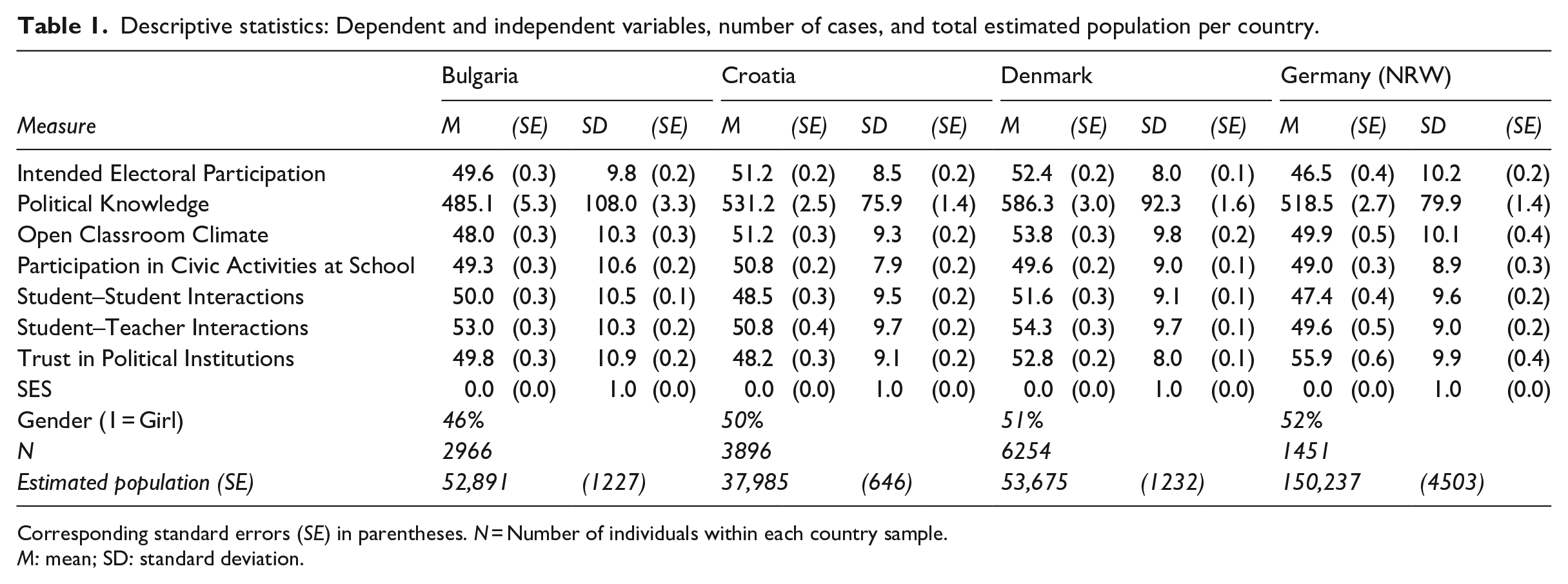
Corresponding standard errors (SE) in parentheses. N = Number of individuals within each country sample.
M: mean; SD: standard deviation.
Measures
Intended electoral participation
Intended electoral participation is the main dependent variable. In ICCS 2016, intended electoral participation was measured using three items related to voting in national and local elections and to researching information about candidates before elections. The students indicated on a four-point Likert scale (ranging from “I would certainly do this” to “I would certainly not do this”) how likely they were to engage in these activities as adults. The scale employed in ICCS 2016 was equated to the one used in ICCS 2009 to ensure comparability over time, resulting in a mean of 51 scale points and a standard deviation of 10 scale points in the international dataset of ICCS 2016 (compared to 50 scale points in ICCS 2009, see Schulz et al., 2018a: 98). Higher scale values indicate a stronger probability of answering the items in a positive way. Unless stated otherwise, each of the following scaled scores are standardized to a mean of 50 scale points and a standard deviation of 10 scale points in the international ICCS 2016 data set. Full documentation of all scales and indices is provided in the ICCS 2016 technical report (Schulz et al., 2018b).
Trust in political institutions
As outlined above, trust in political institution is both a result of political socialization at school and a relevant factor in the decision to participate in elections or not. This scale depicts the trust students have in political institutions. It contains a total of six items which refer to the executive, legislative, and judiciary powers in the democratic state: for example, the national government, the national parliament, and the courts of justice. Students rated their trust in these institutions on a four-point Likert scale (ranging from “completely” to “not at all”).
Political knowledge
The ICCS 2016 cognitive test was administered to assess participants’ political knowledge. A rotated booklet design was used and each student responded to 32 or 33 items (of 88 items in total). A one-dimensional scale was constructed and internationally scaled to a mean of 500 (corresponding to the international mean of ICCS 2009) and a standard deviation of 100. Higher scores indicated a stronger probability of responding correctly to more difficult items. In the ICCS data set, political knowledge is not assessed with a single-point measure but with five plausible values. Statistical analyzes with plausible values require the use of multiple imputation (Khorramdel et al., 2020). Full documentation of the ICCS knowledge test is provided by Schulz et al. (2018a, 2018b).
Open classroom climate
The measure regarding open classroom climate is a central variable regarding the discursive quality of civic education. In ICCS 2016, participants rated on a four-point Likert scale (ranging from “never” to “often”) six items related to their perception of the atmosphere in class while discussing political or social issues (e.g. “students express opinions in class even when their opinions are different from most of the other students”).
Participation in civic activities at school
Participation in civic activities at school is one of the central independent variables in our model, especially given the strong emphasis on extracurricular activities as part of civic education in Bulgaria and Croatia. The scale covered six school-based civic activities involving participation in extracurricular activities (e.g. voting for a class representative or school committee). Students stated how recently they had been involved such activities (“within the past 12 months,” “more than a year ago,” “never”).
Student–student relationships at school
From a social capital perspective, social relations at school are of particular relevance for the formation of institutional trust. One aspect of these relations is covered by the scale on student−student relations at school. The participants rated three items related to their perception of student–student relationships at school on a four-point Likert scale ranging from “strongly agree” to “strongly disagree” (e.g. “most students at my school treat each other with respect”).
Student–teacher relationships at school
The second scale that covers social relationships at school examines how students rated their relationships with teachers at their school. They were presented with five statements regarding their perceptions (e.g. “most of my teachers listen to what I have to say”) on a four-point Likert scale ranging from “strongly agree” to “strongly disagree.”
Socioeconomic status (SES)
In ICCS 2016, three indices were used to operationalize the students’ SES (Schulz et al., 2018a: 65): the highest-ranking occupation of parents, the highest level of education attained by parents, and the self-reported number of books at home. Using principal component analysis, one integrating factor was extracted. The index of SES was standardized within each country to a mean of 0 and a standard deviation of 1. Differences in students’ intended electoral participation have been described to be related to socioeconomic differences (e.g. Deimel et al., 2020). According to the different focus of the research questions, we included this measure as control variable. As it is scaled in relation to the mean SES of students within the observed educational system, it is suitable for comparing models in different societal contexts.
Gender
The survey retrieved a dichotomous indicator of students’ gender (1 = girl, 2 = boy) as a standard measure to control for demographic differences of the outcome variables.
Descriptive statistics of each of the measures are reported in Table 1 and correlations between continuous measures in Table 2.
Correlations of continuous measures, grouped by country.
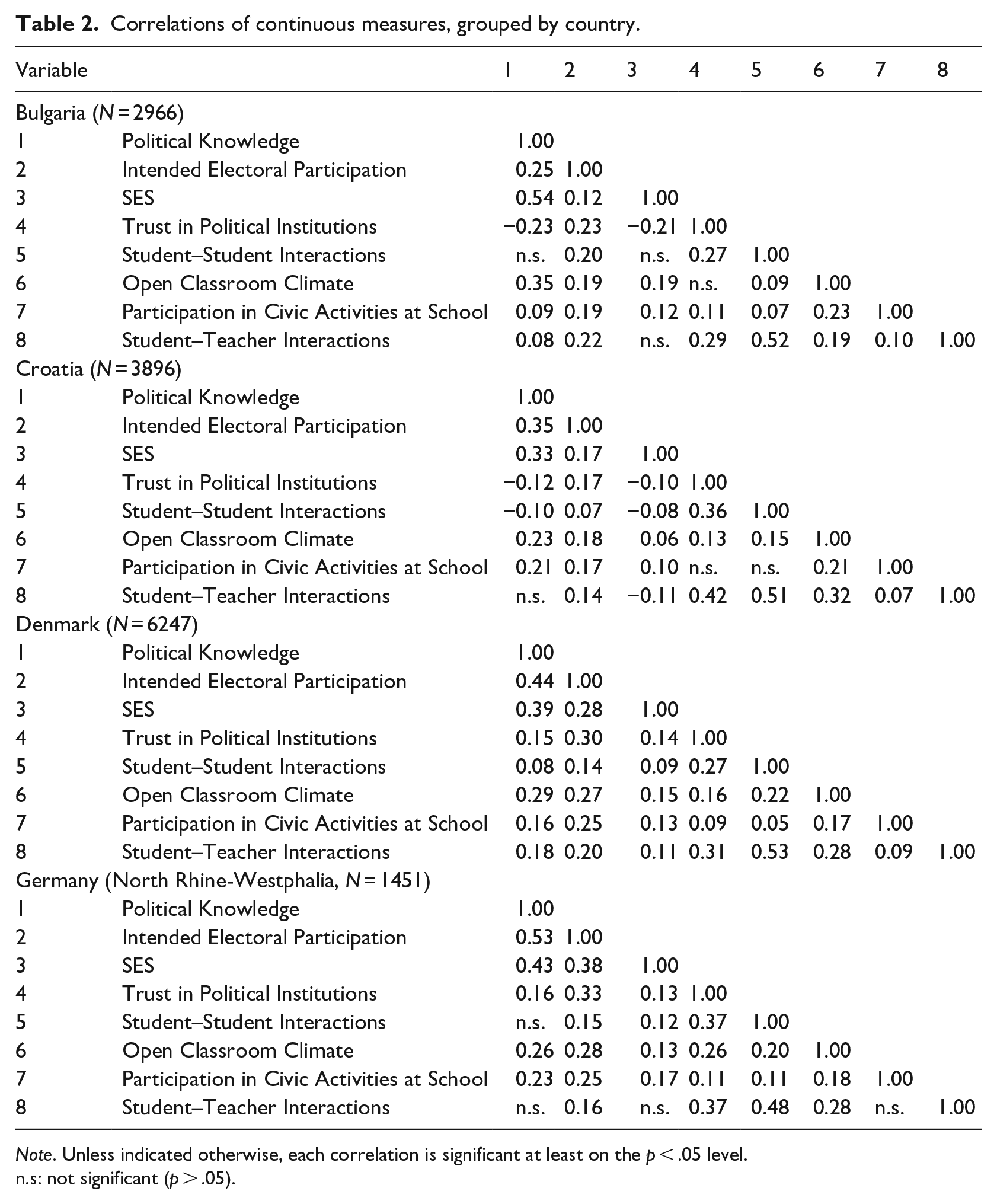
Note. Unless indicated otherwise, each correlation is significant at least on the p < .05 level.
n.s: not significant (p > .05).
Analytical procedure
All analyzes were processed in Mplus 8.1 (Muthén and Muthén, 2017) and prepared with the MplusAutomation package (Hallquist and Wiley, 2018) in R 4.1 (R Core Team, 2020).
The sample characteristics must be taken into account for each of the analyzes. The complex sample design creates two issues. The first issue relates to disproportionate sampling, which results in unequal selection probabilities of participants, and clustered data, which results in non-independence of the participants (Hahs-Vaughn et al., 2011). The selection probability is reflected by survey weights, which are larger for students with a lower selection probability. We applied the survey weights provided with the ICCS 2016 data set (Köhler et al., 2018) to prevent biased estimates in favor of students with higher selection probabilities.
The second issue is the nestedness of the sample (students as part of a classroom), which means that observed units are not independent from each other. This results in inaccurate variance estimation of statistical procedures, especially in the underestimation of standard errors. According to Hahs-Vaughn et al. (2011), there are two options for circumventing this effect. The first is multilevel modeling (Raudenbush and Bryk, 2002). The second is an approach that only analyzes a single-level model but corrects the variance estimation for the effect of non-independence (for a discussion about implementation in applied research, please see Asparouhov, 2005; Asparouhov and Muthén, 2006; Hahs-Vaughn et al., 2011). To determine if a multilevel approach was suitable, we conducted a preliminary basic two-level analysis of the dependent variable. This involved evaluating the classroom-level variance of the measure of intended electoral participation as indicated by its intraclass correlation (ICC; see Raudenbush and Bryk, 2002). In Bulgaria (ICC = 0.07), Croatia (ICC = 0.02), and Denmark (ICC = 0.08), only marginal variance in intended electoral participation was related to the clustering of the sample. Germany (NRW) was the only country in the sample with notable classroom-level variance (ICC = 0.16). We therefore utilized a single-level approach with the “Type = COMPLEX” option in Mplus 8.1 for non-biased variance estimation (Muthén and Muthén, 2017).
The theoretical foundation as well as the empirical relationships between the measures indicate that a structural equation model (SEM) is a suitable approach as it can examine a set of dependence relationships simultaneously and expresses these relationships similar to a series of multiple regression equations (Hair et al., 2019). These relationships also allow for estimations of mediating effects, which denote effects of variables that intervene between two other related variables. Another advantage of a SEM approach is that it is possible to determine the fit between the assumed model and the empirical data through an evaluation of model fit measures. We evaluate a combination of the comparative fit index (CFI), the standardized root mean squared residual (SRMR), and the root mean squared error of approximation (RMSEA). A cut-off value close to 0.95 for CFI, a cut-off value close to 0.08 for SRMR, and a cut-off value close to 0.06 for RMSEA would indicate a relatively good fit between the hypothesized model and the observed data (Hu and Bentler, 1999).
Results
As described earlier, we integrated the scaled scores of intended electoral participation, trust in political institutions, participation in civic activities at school, open classroom climate, social relationships at school, civic knowledge, and the control measures of SES and gender into a structural equation model (Figure 1). We estimated the coefficients and fit values for each country separately and evaluated the model along our proposed hypotheses. The reported regression coefficients are fully standardized. By standardization, the scale of the variables is removed, therefore their relative size can be compared across measures. Regression coefficients are shown in the alphabetical order of the education systems under investigation: Bulgaria, Croatia, Denmark and Germany (NRW).
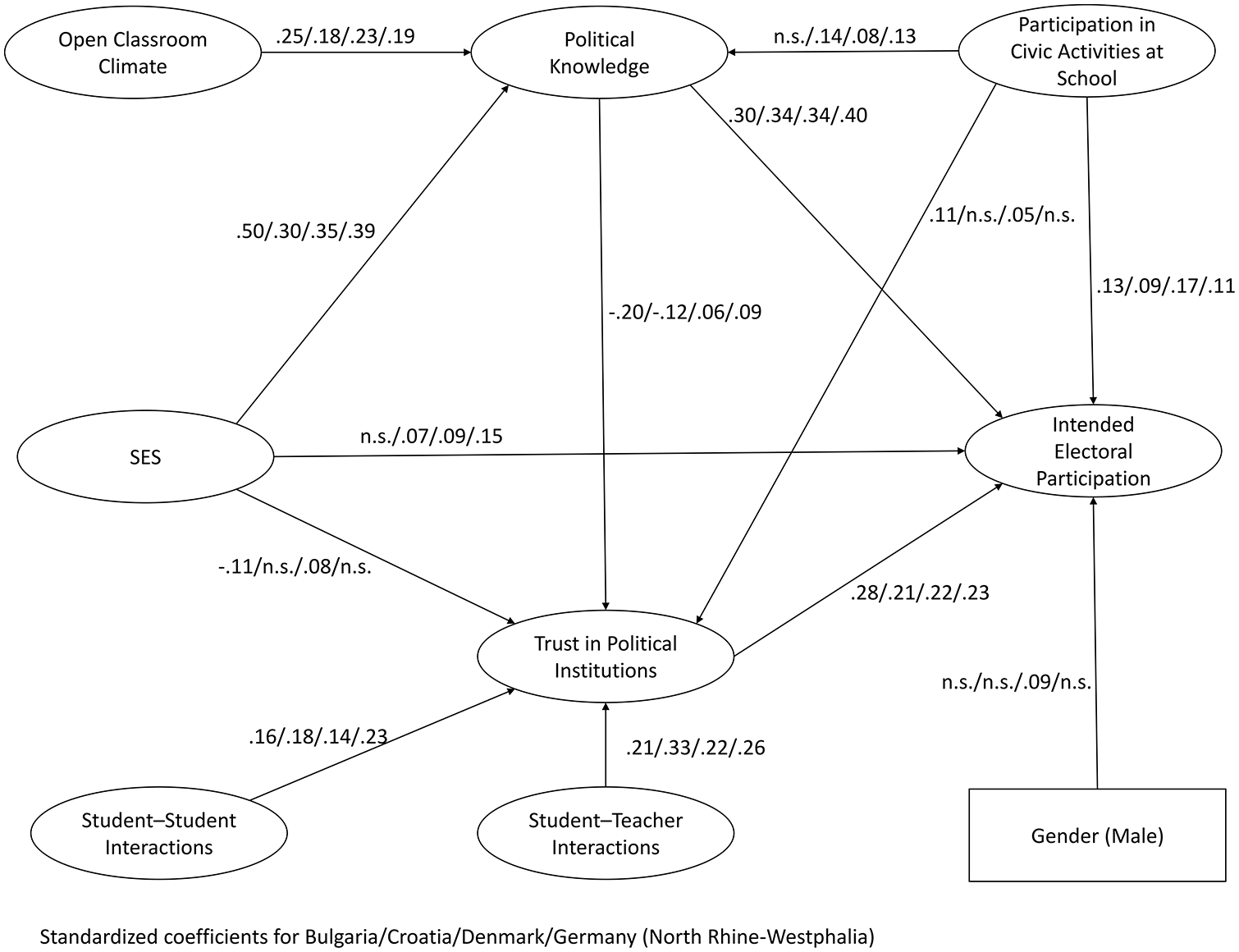
Path model of political knowledge and trust in political institutions as predictors of intended electoral participation.
As expected, trust in political institutions was especially influenced by social relationships at school. Student–student relationships had a small to medium effect (β = 0.14–0.23) and student–teacher relationships a medium effect (β = 0.21–0.26) in Bulgaria, Denmark and Germany (NRW) respectively, and a large effect in Croatia (β = 0.33). However, controlling for the other variables, participation in activities at school only had a small additional effect on trust in Bulgaria (β = 0.11) and Denmark (β = 0.05), and did not have a significant effect in Croatia and Germany (NRW).
In sum, H1 can be accepted with the following caveats. The adaptable setting of an open classroom climate, social interactions, and civic activities at school are positively related to political knowledge and trust in political institutions. However, participation in civic activities at school played only a minor role in each of the observed models.
The models presented an acceptable fit with the data (see Table 3). In each of the four countries, the cut-off values proposed by Hu and Bentler (1999) are exceeded, with two exceptions: the RMSEA in Bulgaria was slightly higher than expected for a model with good fit (0.07 vs 0.06), and the CFI in Croatia was slightly lower (0.94 vs 0.95). The models estimated for Denmark and Germany (NRW) show a good fit across all evaluated parameters.
Fit statistics and explained variance by country.
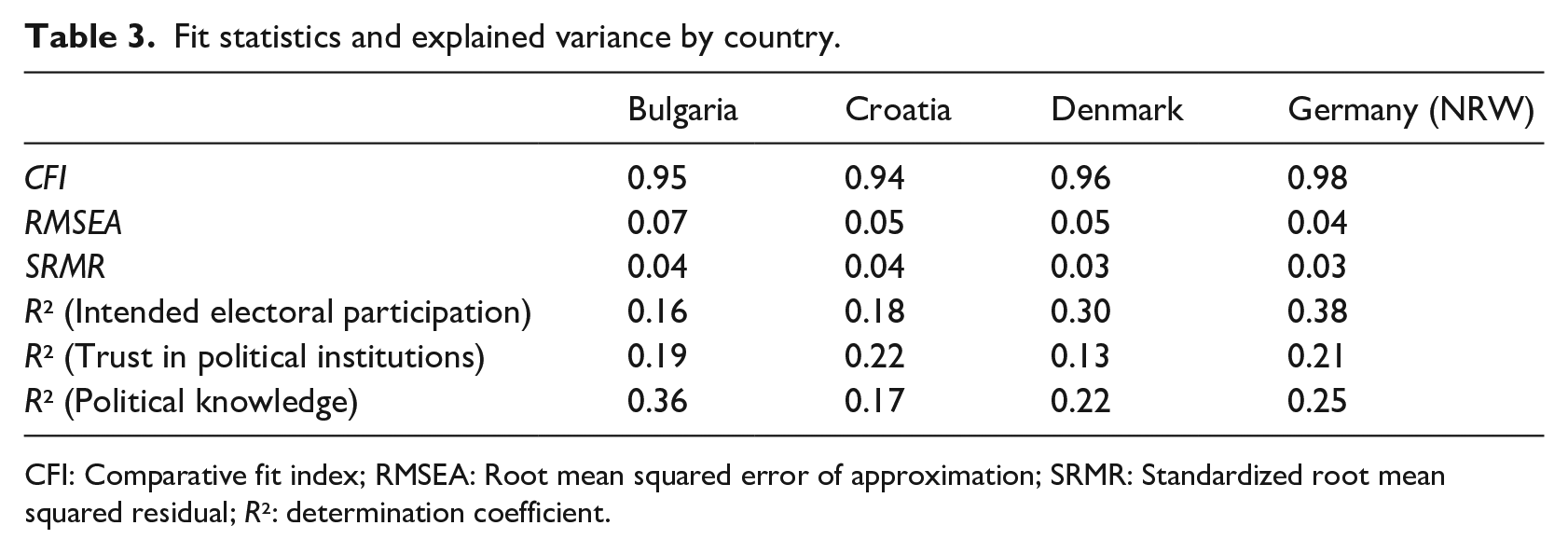
CFI: Comparative fit index; RMSEA: Root mean squared error of approximation; SRMR: Standardized root mean squared residual; R²: determination coefficient.
A similar pattern can be observed when examining the variance of intended electoral participation as explained by the models. In Bulgaria and Croatia, according to Cohen (1988): 412–413), a moderate amount of variance was explained (R² = 0.16–0.18). In Denmark and Germany (NRW), a large amount of variance was explained (R² = 0.30–0.38).
Overall, the analysis revealed interesting results. The adaptable setting in schools facilitates political knowledge and trust in political institutions, which in turn are both positively related to students’ intended electoral participation. However, participation in civic activities at school played only a minor role in predicting this relationship. Additionally, students with greater political knowledge are more likely to participate politically, even in Bulgaria and Croatia when considering their relatively lower trust. While satisfactory, the relative predictive power of the model when examining the cases of Bulgaria and Croatia must be discussed. Also, the rather strong effect of students’ SES is rather worrying and leaves open questions.
Discussion
In total, schooling provided cognitive as well as affective and experience based opportunities for citizenship learning (H1) that foster intended electoral participation (H2). The effect of political knowledge on the mediator variable trust in political institutions was found to be negative in Bulgaria and Croatia and positive in Denmark and Germany (NRW). The effect of political knowledge on intended electoral participation was partly mediated by trust in political institutions, and the total effect was positive in each of the four countries (H3). Albeit the effect of the partial mediation was found to rather small; political knowledge and trust in political institutions contributed to explaining variation in intended electoral participation relatively independently of each other. Thus, there seems to be a relatively stable pattern in how intended electoral participation is shaped in adolescents across different educational systems. However, country specific differences in the broader political context and delivery of civic education have to be taken into account when interpreting these results, as we will show below.
In line with H1, the adaptable setting of an open classroom climate, social interactions, and civic activities at school were observed to be relevant for developing skills and attitudes that facilitate intended electoral participation. However, controlling for all other variables, students’ experience of school-based democratic activities generally was less adequate for predicting variations in students’ political knowledge and their trust in political institutions when compared to an open classroom climate and social interactions at school. While the results are largely in line with previous research (e.g. Schulz et al., 2018a; Ziemes et al., 2020), it has to be noted that the impact of participation in civic activities at school on the development of the skills and attitudes required for political participation seems to be lower than expected. Especially in Bulgaria and Croatia, where civic education relies more strongly on these active learning opportunities, a conceptual reconsideration might be appropriate to shift the focus away from experience-based civic education.
As assumed by H2, students with greater knowledge, higher levels of trust in political institutions, and more experience of participation at school were more likely to state an intention to participate in elections. Given that knowledge is considered to be key in developing intentions to participate politically (Schulz et al., 2018a), the strong effect of political knowledge on the dependent variable in each of the compared models was to be expected. This is also true for the moderately positive association between institutional trust and students’ intended electoral participation as observed in previous studies (Torney-Purta et al., 2004). While still being positively connected, experiences of student activities again was of lesser importance in direct comparison.
As expected by H3, the effect of political knowledge on intended electoral participation was partly mediated by trust in political institutions, and the direction of the mediation varied between the two north-western and the two south-eastern European democracies. However, the magnitude of the relationship between political knowledge and trust in political institutions was lower than expected. In Denmark and Germany (NRW), the positive connection between political knowledge and trust was rather small when controlling for the other measures. This could indicate that students’ trust in political institutions is not purely the result of an evaluative process but also of interpersonal relationships at school, as indicated by the measures of social interactions. If students feel that they are treated fairly and with respect, they seem to award trust in the political system. This is also true for Croatia and Bulgaria. In Croatia, trust in political institutions is more closely connected with student–teacher relations. Lastly, the negative relationship between knowledge and trust in Bulgaria and Croatia cannot negate the strong positive direct effect of political knowledge on intended electoral participation. Students in Bulgaria and Croatia who are more knowledgeable are still interested in taking part in elections even despite their relatively lower levels of trust in political institutions. Given the content of the ICCS data set, we are unable to judge what parties and policies they would prefer when given the chance to vote.
A simplistic conclusion to draw from our findings would be in line with Torney-Purta et al. (2004), who found similar results: trust is a prerequisite for political participation and could be fostered especially in the context of “unstable” (Torney-Purta et al., 2004: 400) democracies. However, this conclusion might be a fallacy because it does not question the legitimacy of a political system. In countries with a lower democracy index (EIU, 2021) where civil liberties and the functioning of the electoral process are endangered, civic education might reproduce a “flawed democracy” (EIU, 2021) in the long run if it promotes unreflective, uncritical support of the political system. Indeed, the aims of civic education must be adjusted to the larger social context. While in democracies the very value of growing politically active citizens might be undisputed in and as of itself, aiming to grow “critical citizens” (Norris, 1999) might safeguard political rights and put pressure on political institutions to enhance democratic performance. The question is then whether it is legitimate to concentrate on the development of trust and participation, or if knowledge and critical reasoning should be the first objective of civic education. Ideally, neither should be neglected in the development of curricula and the delivery of civic education. A closer comparative examination of national curricula might be needed to assess the extent to which the development of critical reasoning is hindered in different countries. Additionally, there is strong evidence of the prevalence of inequalities in political socialization, as political knowledge was affected by students’ SES. Deimel et al. (2020) have shown that students with lower SES have lesser access to civic education. This raises the question whether a civic education that focuses on personal responsibility and participation in politics can be adequate in north-western European countries (and elsewhere) as it may not be able to reduce these inequalities in the long term.
During our analysis, we became aware of the benefits and limitations of large-scale assessments. If studies are based on data from single countries, an overgeneralization of results might occur, for example regarding the positive relationship between civic education and trust. At the same time, important phenomena might be overlooked when relatively stable statistical models incorporate pooled data from several countries without distinguishing between them. This caveat is especially important because we observed that the models analyzed in Bulgaria and Croatia had a relatively lower model fit and lower explanatory power. This means that the postulated model seems to work well in Denmark and Germany (NRW). In these two countries, larger amounts of variation in intended electoral participation could be explained by variables that refer to schooling, which may be related to a combination of two reasons: the implemented approach of civic education, and measurement issues regarding the construct of intended electoral participation. Denmark and Germany (NRW) were the two education systems with higher levels of professionalization in civic education—indicated by the implementation of specialized subjects taught by specialist teachers—so intentions to vote may be more closely related to curricular contents. Additionally, intentions to vote may be subject to social desirability (Hooghe and Wilkenfeld, 2008); the discrepancy between actual voter turnout at the last legislative election prior to ICCS 2016 and the percentage of students who stated an intention to vote seems to be larger in Bulgaria and Croatia (Deimel and Hahn-Laudenberg, 2017; Schulz et al., 2018a; 26). Moreover, there are some indications that response styles for attitude measurements depend on the cultural context. Especially in north-western European countries such as Denmark and Germany (NRW), an extreme response style—i.e. the tendency to choose the top or bottom end of a rating scale that measures attitudes—seems to be less prevalent (Ainley and Ainley, 2019; Harzing, 2006). In consequence, the construct’s variance might be more systematically predictable in Denmark and Germany (NRW) than in Bulgaria and Croatia. Further research might determine if the pattern of differing explanatory power is replicable in countries with similar educational and political contexts.
Lastly, if the national context in which civic education is embedded is ignored, it would be easy to conclude that the stability of a political system is a desirable aim of civic education in itself. An overgeneralization of the results of international large-scale assessments of civic education might offer policymakers “legitimate” reasons to establish civic education curricula that do not foster but harm the enforcement of political rights and individual freedoms inherent in democratic systems. Therefore, future research should take contextual effects into consideration. This can be achieved by comparing and contrasting smaller groups of countries that share relevant characteristics. However, a future replication of these results might be challenged, because of school closures that were prevalent in many countries during the COVID-19 pandemic. Students had fewer opportunities to interact and collaborate directly with their peers. Given the importance of social interactions for promoting intended electoral participation, similar model might not hold when analyzing data that were gathered during the pandemic because interactions with students and with teachers would have been limited or of different quality.
Overall, while it seems adequate for education to foster political knowledge and encourage support of the political system (Fend, 2009), incorporating questions regarding public moral issues might enrich the yield of civic education (Jerome and Kisby, 2019). If young people are encouraged to identify and oppose injustice, democratic structures might be strengthened in the future. Given the rise in populistic movements, which has also been observable in Denmark and Germany in recent years, civic education that aims to engage adolescents as critical citizens might be more important than ever.
Footnotes
Declaration of conflicting interests
The author(s) declared no potential conflicts of interest with respect to the research, authorship, and/or publication of this article.
Funding
The author(s) received no financial support for the research, authorship, and/or publication of this article.
