



Abstract
Differences in democratic traditions and socioeconomic development of various countries leave a mark on the extent of involvement in work for voluntary organizations. The author makes an attempt to check whether these differences have an effect on the determinants of such kind of involvement. Socioeconomic status, social capital, civic engagement, and political participation were considered as determinants. Multiple linear regressions based on the data of the third and sixth rounds of European Social Survey (ESS-3 and ESS-6) were used to clarify configurations of the factors’ effect. The analysis has shown that socioeconomic factors and main components of social capital proved insignificant. Instead, the behavioral components of civic engagement and political participation turned out to be the most influential and distributed among most European countries. The influence of participation in social activities on the involvement in work for voluntary or charitable organizations is rather inherent in European societies with stable democracy and developed economy.
Keywords
Introduction
Social experience of people’s existence within a certain type of institutional organization of the society determines the corresponding type of civic culture reflected in specific values, norms, and behavior. It is the specificity of institutional space that determines national differences in the levels of civic engagement and in the membership in voluntary or charitable organizations in particular. The above differences not only consist in the extent of involvement of a certain country’s population in voluntary associations but also stratify the factors of this involvement. Defining such factors in the context of cross-cultural peculiarities remains rather crucial.
Among a great number of theoretical approaches, which explain the factors of membership, there are several ones singled out in the present-day empirical investigations. The adherents of socioeconomic approach think that the economic status is a stimulus of participation in a voluntary organization. The above status is traditionally defined as a derivative of income, employment, educational background, and so on. Sociological surveys have certified a considerable effect of such factors as education (a higher level of membership is recorded among more educated people), employment (a higher level of membership is recorded among the employed than unemployed), and extent of employment (fully employed people are more disposed to membership than partially employed ones; Curtis, Grabb, & Baer, 1992; Moyser & Parry, 1997; Scott, 1957). High correlation is observed between gross domestic product (GDP) of a certain country and level of participation in voluntary and human rights protection organizations (Lane, 2006). High socioeconomic status ensures free time habits and competence for effective involvement in voluntary organizations. However, the effect of this factor among other factors in each country calls into question its universality and permanency.
The theory of social capital asserts that activities in voluntary organizations are determined by accumulated social resource, that is, by staying in informal networks and by trust in people and social institutions. Membership density in associations is connected first of all with the degree of interindividual trust between citizens and with their perception of the extent of reciprocity and favor (Putnam, Leonardi, & Raffaella, 1993). Time of residence in a certain territory, regular contacts with friends, relatives, neighbors favor taking roots by an individual in social structure (Fahmy, 2006; Tam Cho & Rudolph, 2008) . It is the disposition to social interaction at the place of residence that makes an individual able to reach mutual understanding with like-minded persons. The ability to interact in the process of joining a voluntary organization determines cooperative habits that favor the formation of horizontal networks of civil society. However, it is a paradox that empirical investigations in some countries often reveal a weak correlation between the model of social capital (especially when it concerns a factor of trust) and membership in voluntary associations (Howard & Gilbert, 2008; Li, Pickles, & Savage, 2005; Pattie, Seyd, & Whiteley, 2003; Wollebaek & Selle, 2002). It is evident that the effect of social capital also manifests itself under certain circumstances.
These circumstances indicate expediency of cross-cultural comparisons. Different regional traditions of social interaction even in the same country, which have been demonstrated by R. Putnam, point to the existence of culturological factors. Under these conditions, the value differences, along with religious, institutional, and structural ones, are fixed empirically in international investigations (Curtis, Baer, & Grabb, 2001; Schofer & Fourcade-Gourinchas, 2001; Wallace, Pichler, & Haerpfer, 2012).
Instead, the experience of political participation, which favors mastering habits of social interaction in organizational work, remains a stable factor of membership in voluntary associations (Diamond, 1999; Erickson & Nosanchuk, 1990; Hooghe, 2003; McFarland & Thomas, 2006; Sampson, McAdam, MacIndoe, & Weffer-Elizondo, 2005; Sobieraj & White, 2004; Somma, 2010; Verba & Nie, 1972). The integral conception of combining individual and collective forms of civic engagement was embodied in Civic Voluntarism Model, which had been formulated by S. Verba with colleagues, where resources, motivation, and mobilization became the factors (Verba, Schlozman, & Brady, 1995). These three factors reinforce each other and give their owners cumulative political advantages.
Allowing for the existence of relationship between individual and collective forms of civic engagement, the author proposes to consider membership in voluntary associations as civic practices. The conception of civic practices represents the whole complex of reproduced, permanent, and sustainable actions. They are realizations of aspirations of the active part of transitional society to make sociopolitical transformations (Reznik, 2011). Citizens inform government about their interests just owing to such behavior. In this respect, civic practices are systematic, reproducible, and permanent actions of different social subjects (individuals and groups) in public sphere, which are a form of realization of their own interests and provide existence, reproduction, and transformation of social and political institutions. In the process of institutionalization of public sphere (Habermas, 1991; Taylor, 1997) as an informal network for exchange of information and viewpoints, its subjects acquire the habit of forming and announcing their opinions, thus producing the civic practices. Therewith, different traditions of social order stipulate differences in determination of civic practices. Under conditions of high level of social differentiation in a society, the socioeconomic factor comes to the foreground, because education, money, time expenditures, and so on, prove to be indispensable. However, the socioeconomic factor is not so decisive in the countries of total prosperity. There appear other factors of particular importance, such as social capital, religious practices, and experience of civic engagement. At the same time, if in stable democratic societies the involvement in voluntary associations may be determined by nonpolitical factors, in transitional society the civic engagement of organizational character is mainly combined with political participation. Thus, differences in democratic traditions and socioeconomic development of different countries leave a mark on the sequence of factors of the first type.
The author in his analysis proposes to compare the extent of influence of determinants of involvement in voluntary associations, which are described in the above approaches, among different European countries. Thus, the article aims to find out the configuration of effect of the factors of involvement in work for voluntary associations in the context of differences of political and socioeconomic development of various European countries.
Therefore, the two main hypotheses are as follows:
Data and Method
In terms of methodology, the study of civic practices requires comparative or monitoring researches, because one can fix sustainability and reproducibility of practical actions only if the effect of long-term behavioral tendencies of certain groups that fall regularly within the sample is being observed. Another method to differ civic practices from occasional phenomena is the analysis of their factors. Besides, establishing factors’ hierarchy and its comparison in dynamics also allows one to ascertain the character of reproducibility and stability of the stimuli of civic practices. In this case, cross-cultural comparison is an auxiliary tool for revealing specificity of membership in voluntary associations.
The empirical base is formed by the array of the third and sixth rounds of international comparative project European Social Survey (ESS) held in 2006-2007 and 2012-2013. The survey of population in European countries by the most essential sociological indices is conducted every 2 years in all countries following a single program and a sample that represents adult population of European countries. In 2003, they organized an international consortium in Europe with the aim to conduct a new monitoring project called European Social Survey (www.europeansocialsurvey.org). Its first poll was carried out in 2002, and it plans to conduct regular polls every second year in the future. In the next rounds of research, the project was joined not only by other EU countries but also by Albania, Kosovo, Iceland, Israel, Norway, Russia, Switzerland, Turkey, and Ukraine.
The ESS is one of the best as to methodological substantiation among the present-day international comparative projects based on the highest methodological standards of modern empirical sociological studies. This makes it possible to expect a high quality of data collected by all national research groups and guarantees the highest possibility for real, comparative analysis of these data. In each national study, a sampled population is people of the age of 15 and older. Each research team had to ensure an effective sample size—no less than 1,500 respondents for countries with a population more than two million, and 800 respondents for countries with a population less than two million. In each country, taking into account their specific sample design, they evaluated a design effect as a basis for defining sample size: The sample should ensure the same representation as a simple random sample of 1,500 (or 800 if the country’s population is not sufficiently large). Then, using the preliminary estimation of the response rate (the proportion of respondents in a planned sample, which could be actually found and which would agree for an interview), they defined the necessary sample size and constructed the sample design (Golovakha, Gorbachyk, & Panina, 2006).
The ESS questionnaire consists of the core (stable monitoring part) being repeated in all rounds of the survey and two to three blocks of questions (each block contains approximately 50 questions) related to a certain aspect included into only one wave. The core of the questionnaire includes indicators of trust in the major institutions, interest in politics and political activity, social and political orientations, attitude to the main social and moral values, social capital and social exclusion, well-being, and security. In addition, the monitoring part includes basic social and demographic information, such as number of family members, educational background, employment and job, nationality, ethnic and religious affiliation, living conditions of family, and so on.
The data were weighed following a standard procedure (design weights) for percentages in cross-tabulations. Processing and statistical analysis of the data have been performed using the program package SPSS.
The method of multiple linear regressions was used for revealing the factors of involvement in work for voluntary or charitable organizations in European countries. This method permits one to study more accurately the influence of various factors on the dependent variable with an ordinal scale. The method of stepwise entering of the model’s factors is used to construct the multiple linear regressions. But in this case, construction of certain tables of regression equations for a greater number of countries could create difficulties for comparative analysis and increase considerably the paper volume. Thus, the method of automatic entering of the model’s factors was used for the sake of convenience and obviousness, because a less number of coefficients permit us to arrange them more densely in one table. For statistical accuracy of the results’ interpretation, the author supposes that the factor in which the significance of the equation coefficient is maximal (p ≤ .001) should be considered influential.
The ordinal variable applied in ESS-3 and ESS-6 was used as the dependent one: “In the past 12 months, how often did you get involved in work for voluntary or charitable organizations?”; it was measured by a 6-point scale with possible variants of the answer “1 = At least once a week; 2 = At least once a month; 3 = At least once every 3 months; 4 = At least once every 6 months; 5 = Less often; 6 = Never.”
As independent variables used in ESS-3 array (see Appendix A in more detail), the following factors have been distinguished: (a) socioeconomic status (education, paid work, satisfaction with household’s income), (b) social capital (trust in others; meeting socially with friends, relatives, or work colleagues; the number of people with whom one can discuss intimate and personal matters), (c) civic engagement (participation in social activities, help others not counting family/work/voluntary organizations, help or attending activities organized in the local area), (d) religious practices, (e) index of political participation, and (f) control variable—the respondent’s age.
As independent variables used in ESS-6 array (see Appendix B in more detail), the following factors have been distinguished: (a) socioeconomic status (education, paid work, satisfaction with household’s income), (b) social capital (trust in others; meeting socially with friends, relatives, or work colleagues; the number of people with whom one can discuss intimate and personal matters), (c) civic engagement (participation in social activities), (d) religious practices, (e) index of political participation, and (f) control variable—the respondent’s age.
Results
Frequency distribution of the involvement in work for voluntary or charitable organizations in each European country evidences for availability of differences according to the level of social development (see Table 1). The highest frequency is mainly present in West and North European countries: Austria, Switzerland, Germany, Denmark, France, Great Britain, the Netherlands, Norway, and Finland. The lowest frequency was observed in postsocialist countries (Bulgaria, Estonia, Hungary, Latvia, Poland, Russian Federation, Slovakia, and Ukraine).
Responses of Population of European Countries to the Question “In the Past 12 Months, How Often Did You Get Involved in Work for Voluntary or Charitable Organizations?” (2006/2007), %.

In the survey of 2012/2013 (ESS-6), the above-mentioned differences were reproduced in general (see Table 2): The highest frequency of the involvement in work for voluntary or charitable organizations was also present mainly in developed countries of Europe: the Netherlands, Switzerland, Germany, Denmark, Great Britain, and Norway. The lowest frequency was observed in postsocialist countries (Albania, Bulgaria, Czech Republic, Lithuania, Estonia, Poland, Russia, Slovakia, Ukraine, and Kosovo); Portugal and Cyprus have joined these countries.
Responses of Population of European Countries to the Question “In the Past 12 Months, How Often Did You Get Involved in Work for Voluntary or Charitable Organizations?” (2012/2013), %.

Such arrangement of countries is also observed when taking into account only those which took part at least once in the work for voluntary or charitable organizations. The results of ESS-3 show that about a half or more of population have an experience of at least once-only involvement in the horizontal networks of civil society in Norway, Austria, Switzerland, the Netherlands, Finland, and Ireland. In postsocialist countries (except for Slovenia, Romania, and Latvia) and Portugal, a share of one and more involvements varies within about 24% and below. The results of ESS-6 represent in total previous arrangements: A share of those who were involved at least once in the work for voluntary or charitable organizations equals about a half and above of the population of such countries as Norway, Germany, Switzerland, the Netherlands, Iceland, Finland, Spain, and Ireland. Instead, a share of about 30% and below was also reproduced in postsocialist countries. If the dynamics is taken into consideration, population of Spain, Slovakia, Sweden, and Russian Federation has demonstrated an increasing involvement in the work for voluntary or charitable organizations.
The setting of equations of multiple linear regressions in European countries according to results of ESS-3 has revealed differences in the influence of all factors (determination coefficient adjusted R2) on the dependent ordinal variable of involvement in the work for voluntary or charitable organizations (see Tables 3 and 4). Rather satisfactory values (about .4 and above) are those of adjusted R2 indices in Austria, Portugal, Hungary, and Ukraine. This figure was the highest in Ukraine—.529, that is, share of influence of all factors that may be explained on the basis of multiple regressions is 52.9%. Instead, the lowest figures have been fixed in Bulgaria and Poland, where multiple regressions explain the influence of factors, selected for analysis, within 15.4% and 17.1%, respectively.
Determinants of Involvement in Work for Voluntary or Charitable Organizations in European Countries (Austria–Hungary), 2006/2007.

Note. Entries are standardized β coefficients with t-values in parentheses.
p ≤ .05. **p ≤ .01. ***p ≤ .001.
Determinants of Involvement in Work for Voluntary or Charitable Organizations in European Countries (Ireland–Ukraine), 2006/2007.
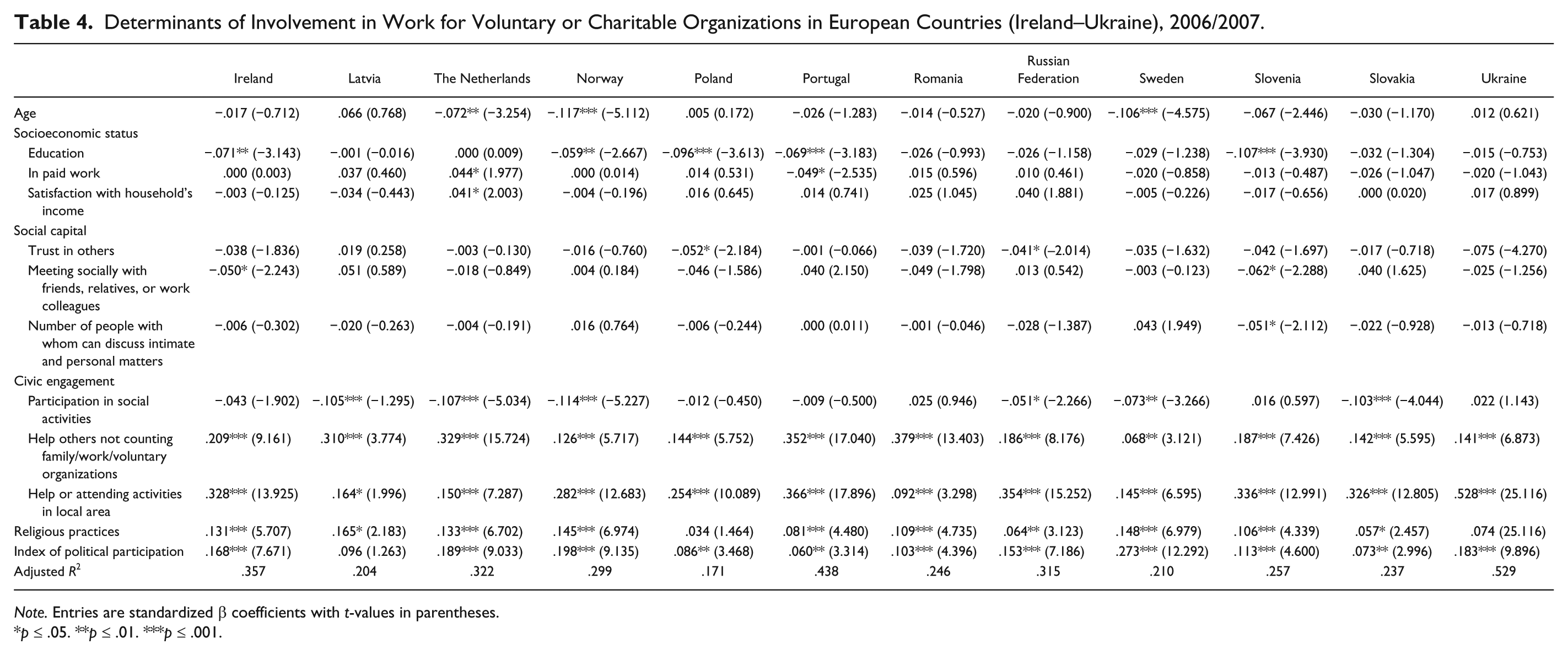
Note. Entries are standardized β coefficients with t-values in parentheses.
p ≤ .05. **p ≤ .01. ***p ≤ .001.
The factors of civic engagement (help others not counting family/work/voluntary organizations, help or attending activities organized in the local area) and political participation are the most distributed and influential among the vast majority of European countries. The factor “help or attending activities in the local area” is the biggest among all predictors, which presented equations in most European countries. Only in Belgium, Finland, and Sweden, the factor of political participation proved the most influential one. The influence of the above factors appeared to be mainly similar for Austria and France. Instead, the factor “help others not counting family/work/voluntary organizations” was the most influential for the Netherlands and Spain.
Participation in social activities and religious practices has become less distributed factors of involvement in voluntary organizations. The low level or absence of the effect of participation in social activities on the involvement in voluntary organizations was mainly fixed (not allowing for such cases in Spain, Ireland, and Portugal) in postsocialist countries (Bulgaria, Estonia, Hungary, Latvia, Poland, Russia, Slovenia, and Ukraine). Such a tendency is also traced in respect of religious practices, when attending religious services has a weak effect or even no effect on the involvement in voluntary organizations in Bulgaria, Cyprus, Estonia, Hungary, Latvia, Poland, Portugal, Russia, Slovakia, and Ukraine.
Among the factors included in the regression model, such independent variables as paid work, satisfaction with income (except for Belgium), and trust in people have no statistically significant effect on the involvement in work for voluntary or charitable organizations. The factor of age proved influential mainly in developed countries (Spain, France, the Netherlands, Norway, and Sweden). Educational background turned out to be influential in Cyprus, Spain, Poland, Portugal, and Slovenia.
The absence of some indices of civic engagement in the data array of ESS-6 (help others not counting family/work/voluntary organizations, help or attending activities in the local area and political participation) has decreased essentially the adjusted R2 index (see Tables 5 and 6), especially for Switzerland, Bulgaria, and Ukraine. As a result, effect of political participation was prevalent. Participation in social activities and religious practices proved something less but also rather prevailing factors. The low level or the absence of the effect of participation in social activities on the involvement in voluntary organizations was fixed in Bulgtaaria, Switzerland, Czech Republic, Iceland, Poland, Russian Federation, and Ukraine. Attending religious services has a weak effect or even no effect on the involvement in voluntary organizations in Bulgaria, Switzerland, Estonia, and Poland.
Determinants of Involvement in Work for Voluntary or Charitable Organizations in European Countries (Albania–Ireland), 2012/2013.

Note. Entries are standardized β coefficients with t-values in parentheses.
p ≤ .05. **p ≤ .01. ***p ≤ .001.
Determinants of Involvement in Work for Voluntary or Charitable Organizations in European Countries (Israel–Kosovo), 2012/2013.

Note. Entries are standardized β coefficients with t-values in parentheses.
p ≤ .05. **p ≤ .01. ***p ≤ .001.
Besides, indices of social capital proved insignificant in most countries. The factor of trust in others has manifested itself only for Great Britain, Italy, Lithuania, and Slovakia. The factor “meeting socially with friends, relatives, or work colleagues” was significant only for Czech Republic and Israel.
The low level or the absence of the effect of participation in social activities on the involvement in voluntary organizations has been mainly fixed (except for Switzerland and Iceland) in postsocialist countries (Bulgaria, Czech Republic, Hungary, Estonia, Iceland, Poland, Russian Federation, and Ukraine). In contrast to the previous case (ESS-3), results of ESS-6 show that attending religious services has an influence on the involvement in work for voluntary organizations in most European countries (the absence of this effect was fixed in Bulgaria and Switzerland). At the same time, effect of the index of discussion of intimate and personal problems on the involvement in voluntary organizations was fixed in Slovenia and Slovakia.
Moreover, the socioeconomic index (availability of paid work) proved insignificant. In the same way, the index of satisfaction with the household’s income has not manifested any effect on the involvement in work for voluntary organizations in most countries (effect of this factor has been fixed only in Belgium and Russian Federation). The factor of educational background was significant in Lithuania, Poland, and Slovakia. The control variable of age has displayed its effect on the membership in voluntary organizations in Albania, Belgium, Estonia, Spain, Norway, and Slovakia.
Conclusion
The major advantage of international comparative investigations consists in preventing the reproduction of casual social phenomena, which are usually caused by a special situation in a certain society. The comparison of the factors’ effect on a certain phenomenon permits one to fix permanent stimuli, which are present at least in similar geographical environment and pretend to embrace general identity that has been formed under similar conditions of political and economic development. Due to comparative investigations, the most prevailing (among European countries) determinants of involvement in the work for voluntary organizations could be revealed.
In general, we can state that Hypothesis 1 has been confirmed. The verification of effect of the sets of predictors which represent the above theoretical approaches has revealed in general the advantage of such factors as civic engagement and political participation. The dynamics of reproduction and sequence of the effect of these predictors, as well as essential decrease of adjusted R2 indices when some of them are absent confirm that membership in voluntary organizations belongs to the phenomenon of civic practices. The behavioral potential is common for these factors. Combining of civic engagement and political participation provides active social subjects (both individual and group ones) with resources and skills necessary for searching successful examples of civil behavior capable of becoming decisive in the functioning of civil society. Civic practices are structured by forms of involvement, which in turn determine the expediency of individual or collective method of defending interests. The analysis has proved that involvement in social activities and civic engagement in European countries creates the basis for informal networks of social interaction; owing to this interaction, subjects acquire skills to form and promulgate their views, to exchange information and produce in this way civic practices. Thus, civic practices become a social resource for obtaining desirable social positions and benefits, increasing chances in stratificational rivalry, and directing the process of political institutionalization of society.
However, the author’s supposition that the effect of other factors related to the involvement in voluntary organizations depends on political traditions and socioeconomic development of the society has not obtained precise confirmation as a result of analysis of two comparative studies. It may only be asserted that the low level or absence of effect of the factor of participation in social activities on the involvement in voluntary organizations was mainly present in postsocialist countries. Thus, nonpolitical behavioral factors of involvement in voluntary organizations are more inherent in countries with stable democracy and developed economy. The results of regressions on the basis of ESS-3 concerning the effect of religious practices have inclined to the conclusion that the absence of the effect of attending religious services was mainly fixed in postsocialist countries. However, the results of regressions on the basis of ESS-6 have demonstrated that such a tendency was reproduced only in several countries. The analysis has also shown that socioeconomic factors and components of social capital as a whole do not influence the frequency of involvement in work for voluntary or charitable organizations. Their inconsiderable influence was registered only in some countries.
The author’s decision to use the method of automatic entering of the model’s factors for building multiple linear regressions caused certain restrictions. For example, the optimal determination models have not been revealed. However, the use of stepwise procedures would make it possible to remove the less significant predictors and to clarify the hierarchy of influence of the rest independent variables. For more detailed analysis of the determinants of involvement in work for voluntary associations, it would be advisable to focus on a limited number of countries. It would allow using more flexible procedures (forward, backward, stepwise) and building separate tables for each country.
Footnotes
Appendix A
Appendix B
Declaration of Conflicting Interests
The author(s) declared no potential conflicts of interest with respect to the research, authorship, and/or publication of this article.
Funding
The author(s) received no financial support for the research and/or authorship of this article.