




Abstract
The Antarctic Circumpolar Current (ACC) flows through the Drake Passage (DP), influencing global oceanic circulation and climate. However, there is a notable gap in understanding ecological responses to variability in ACC strength and to terrigenous flux driven by the melting of the Patagonian Ice Sheet (PIS). Hence, this research aims to assess the palaeoecological changes at the DP over the last 200 ka. The palaeoecological changes are reconstructed using planktic and benthic foraminifera abundance at International Ocean Discovery Programme Site U1544. Before that the age model was constrained using sortable silt plus fine sand size fraction (SSFS; 10–125 µm), along with a couple of 14C ages and a diatom biomarker (Hemidiscus karstenii) and compared with published-dated SSFS data from the DP and LR04 benthic stacks. Neogloboquadrina pachyderma was the dominant species during Marine Isotope Stage (MIS) 6 and 4, and bottom water was relatively oxic during MIS 6, as indicated by a higher abundance of Cibicides spp. The deglaciation is marked by a higher abundance of Turborotalita quinqueloba, suggesting reduced salinity due to the melting of PIS. The bottom water was suboxic during deglaciation, as indicated by peaks in Melonis spp. and Fursenkoina spp. The interglacial MIS 5 and 3 have enhanced primary productivity and marked the higher abundance of planktic foraminifera Globigerina spp. along with other warm water species and benthic foraminifera, Uvigerina spp. This study suggests that ACC and PIS melting control ecological variability at DP.
Keywords
INTRODUCTION
The Antarctic Circumpolar Current (ACC), the largest oceanic current on Earth, plays a crucial role in regulating global ocean circulation and climate dynamics. As the ACC flows through the Drake Passage (DP), it serves as a key pathway connecting the Southern Ocean (SO) to the rest of the world’s oceans, influencing global oceanic circulation and climatic conditions (Lamy et al., 2015; McCave et al., 2014). The ACC strength increased during warm periods, connecting surface-to-deep-sea ventilation, and was modulated by climate forcing in the Central South Pacific (CSP; Lamy et al., 2024). Datta et al. (2025) suggested that well-ventilated conditions in the Southeastern Pacific (SEP) appear to have influenced benthic foraminiferal productivity in the SEP. Well-ventilated conditions linked to ACC strength and the sortable silt-size fraction (SS, 10–63 µm) emerged as a powerful tool for investigating past ocean current strengths. This technique leverages the relationship between sediment grain size and flow velocity to provide insights into past and current speeds and sediment transport processes (McCave et al., 1995). In the context of the DP, sortable silt plus fine sand (SSFS, 10–125 µm) is used as a proxy to assess ACC flow strength during various glacial-interglacial cycles (Wu et al., 2021). Despite advances in grain-size analysis and the development of various climate proxies, there remains a notable gap in understanding ecological changes in the DP in response to ACC strength variability and terrigenous flux, driven by Patagonian Ice Sheet (PIS) melting. Most recent studies have focused on ACC reconstruction (Illing et al., 2025; Rigalleau et al., 2025), but not on assessing ecological variability at the DP. Planktic and benthic foraminifera are ideal proxies for assessing ecological variability under various scenarios (Mahanta et al., 2025; Vats et al., 2020). Datta et al. (2025) suggested that PIS expansion and contraction control nutrient flux and the extent of ACC in the SEP, which might have a greater influence on the DP. Hence, this research aims to assess palaeoecological changes at the DP and the roles of PIS and ACC across several glacial-interglacial cycles over the last 200 ka.
STUDY AREA
The International Ocean Discovery Programme (IODP) Expedition 383, Site U1544, is located on the upper continental slope along the southwestern margin of Chile, at 55°32.2ʹS, 71°35.6ʹW. The site lies at a water depth of ~2090 m and is ~59 km from the western entrance to the Beagle Channel in Tierra del Fuego (Figure 1; Lamy et al., 2021). Located upstream from the DP, Site U1544 sits within the current trajectory of the Cape Horn Current (CHC) and marks a northern branch of the ACC (Lamy et al., 2021).
IODP Expedition 383, Site U1544, along with other sediment cores nearby, U1542 (Lamy et al., 2021), PS97/093-2 (Toyos et al., 2020), PS97/085-3 (Wu et al., 2021), PS75/034-2 (Ho et al., 2012); ACC (Antarctic Circumpolar Current), CHC (Cape Horn Current), HC (Humboldt Current). White lines are three major oceanographic fronts (Subantarctic Front, SAF; Polar Front, PF; and Southern ACC Front, SACCF), Map created using Ocean Data View (version 5.7.1; Schlitzer, 2022).
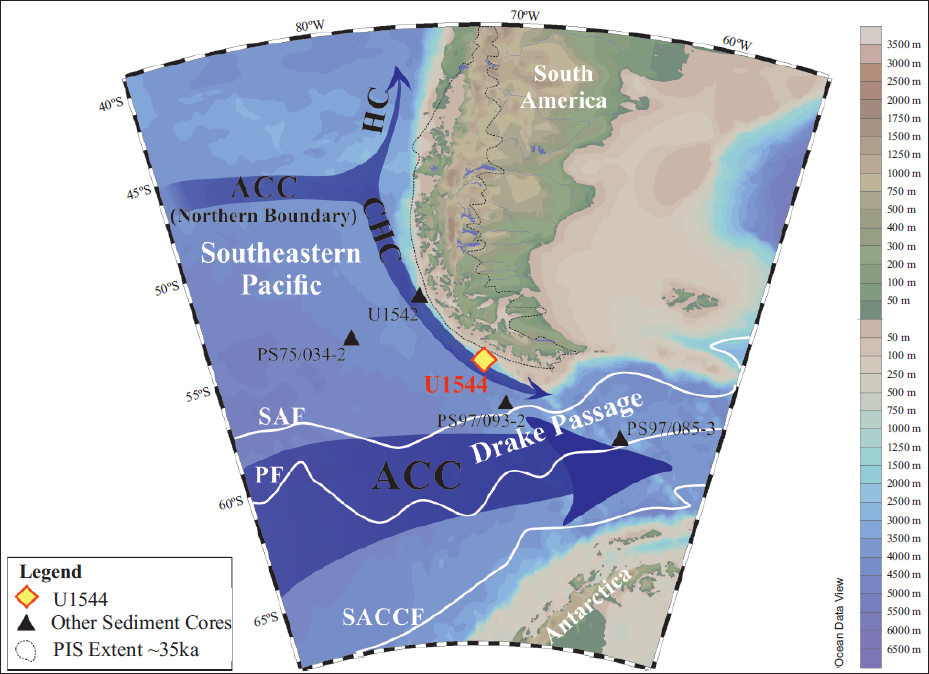
The site is north of the current Sub-Antarctic Front (SAF), and there is a sudden increase in the continental slope, which may cause downslope movement of coarser material (Lamy et al., 2021). The sediment from the Patagonian Andes, transported by glaciers, was deposited at this site, along with sediments from fjords, narrow shelves, and the ACC current.
METHODS
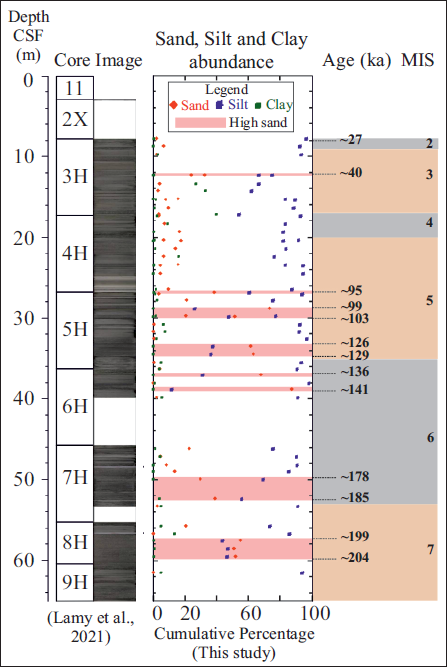
Fifty-two samples of Site U1544 covering a composite sea floor (CSF) depth of ~62 m were analysed. These samples were freeze-dried, and a known weight of dry samples was used in the analysis. The lithology of the studied samples consists of silty clay and sand (Figure 2). Frequent lithological changes and distortions in sediment boundaries are observed at Site U1544. The microbiota observed in the silty layer has rare nannofossil oozes. The sand size mainly varies from medium to fine-grained (Lamy et al., 2021).
Lithology and core image (Lamy et al., 2021) of the studied sediment core samples from Site U1544. Samples with high sand proportions are listed on the right, along with Age (ka) and Marine Isotope Stage (MIS).
Microfossil analysis
Approximately 15–20 g of dry samples were processed following Datta et al. (2025). The sand-size (>63 µm) samples were further dry-sieved using a 125 µm sieve, and ~300 total counts of planktic foraminifera, benthic foraminifera, larger radiolarians, larger diatoms and the rest of the other particles were counted. Planktic foraminifera were identified to the genus and species level following Kennett and Srinivasan (1983) and Schiebel and Hemleben (2017). Benthic foraminifera abundance was relatively low and was identified at the genus level following Holbourn et al. (2013). Benthic foraminifera data of six core catcher samples were taken from Lamy et al. (2021), which have ~100 or more counts from a large sample fraction. In addition, large-sized diatom and radiolarian (>125 µm) specimens present in the sample were also counted.
Grain size analysis
Approximately 1 g of sediment was made authigenic carbonate- and organic matter-free and used for grain-size analysis using a Laser Particle Size Analyser (LPSA; Horiba, LA-950V2) at IIT Bhubaneswar following the methods described in Singh et al. (2023). This data has been used for the SSFS calculation (Wu et al., 2021).
Age model
Due to the lack of enough marker species, the biostratigraphy of core sediments recovered from Site U1544 is not well established by the shipboard science party (Lamy et al., 2021). The last occurrence (LO) of the diatom Hemidiscus karstenii provided the only age-control point at 190 ka (Crosta et al., 2020). This study constrains the chronology through two 14C dates of mixed planktonic foraminifera (Plate 1; Table 1). 14C (AMS) dating was conducted at the Inter-University Accelerator Centre (IUAC), New Delhi, India (Kumar et al., 2022). The obtained 14C ages were calibrated using the Marine20 in CALIB 8.2 (Stuiver & Reimer, 1993). A reservoir age correction (∇R) of 974 years was applied, based on Wu et al. (2021), and calibrated ages are presented in Table 1.
14C ages of selected top samples.

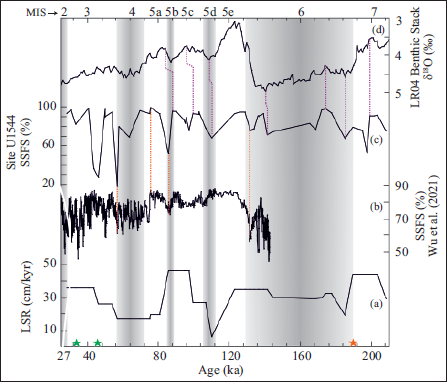
The age model is further refined using SSFS (10–125 µm) data of Site U1544 (Figure 3c) and comparing them with the dated SSFS record of Wu et al. (2021) (Figure 3b), and LR04 benthic stack (Lisiecki & Raymo, 2005; Figure 3a). Wu et al. (2021) SSFS age model is based on 14C dates, a palaeomagnetic excursion, and the correlation of the relative palaeointensity stack of core PS97/085-3 with high-resolution X-ray fluorescence core scanning ln (Ca/Ti). The age model of Site U1544 was developed and refined using Analyseries 2.0.8 (Paillard et al., 1996), considering SSFS data of Wu et al. (2021) and LR04 benthic stack (Lisiecki & Raymo, 2005) as references, 14C and LO of diatom H. karstenii ages as pointers (Figure 3). The interpolated age model shows that the studied samples cover ~208 ka, and the average temporal resolution is ~ 4 kyr (Figure 3).
Age model for Site U1544 from Drake Passage. The sortable silt plus fine sand (SSFS (%)) is compared with LR04 benthic stack δ18O (‰) (Lisiecki & Raymo, 2005). Green stars indicate 14C dates, and the red star is the last occurrence of the diatom Hemidiscus karstenii at 190 ka. Grey bars indicate glacial and stadial intervals.
RESULTS
Grain size characterisation
The grain-size data show that the silt-size fractions dominate in the studied depth interval (Figure 2). However, a significantly higher abundance of sand was occasionally found between ~204 and 199 ka, ~185 and 178 ka, and ~141 and 95 ka. During that period, silt content declined (Figure 2). The drilling site lies at a water depth of ~2090 m. At such depths, the dominance of sand-size particles is usually not expected in authigenic carbonate and organic-matter-free samples. Hence, the medium- to coarse-grain sand fraction in the sample may be slumped from the nearby South American continental shelf, mostly during interglacials, but may not be synchronous with the global glacial-interglacial cycle. However, SSFS percentage abundance shows most dips at glacials (MIS 6 and 4) and stadials (MIS 5d and 5b), and most peaks at interglacials (MIS 5 and 3) and interstadials (MIS 5e, 5c, 5a) (Figure 3c).
Microbiota and other particles distribution
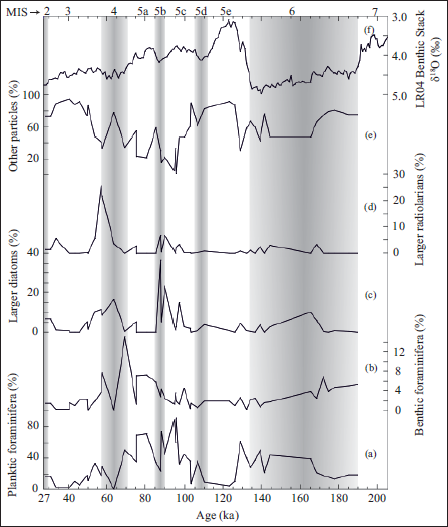
The abundance of different microbiota, that is, planktic foraminifera, benthic foraminifera, larger diatoms, larger radiolarians and other particles (including detrital) at the Site U1544, varied from 0.78 to 92 (%), 0.26 to 9.65 (%), 0 to 36.17 (%), 0 to 25.79 (%), and 0 to 100% respectively (Figures 4a–4e). There is a uniform trend for other particles (%) from ~190 ka to ~110 ka with minor fluctuations. However, after 100 ka, there is a sudden drop at ~95 ka and then subsequently increased up to ~27 ka with a maximum peak of ~95% at ~40 ka (Figure 4e). The planktic foraminiferal abundance and other particles (%) show an opposite trend throughout the studied interval (Figure 4a and 4e). The benthic foraminifera abundance is relatively low (<7%) in the majority of samples except for a peak at MIS 4 (Figure 4b). The larger diatom and radiolarian abundances are relatively low, except for a few isolated peaks during MIS 5 and MIS 4 (Figures 4c and 4d).
Temporal variations of microbiota at Site U1544. Percentage abundance (a) planktic foraminifera (b) benthic foraminifera, (c) larger diatoms, (d) larger radiolarians, (e) other particles (f) LR04 benthic stack (‰, Lisiecki & Raymo, 2005). Grey bars indicate glacial and stadial intervals.
Planktic foraminifera
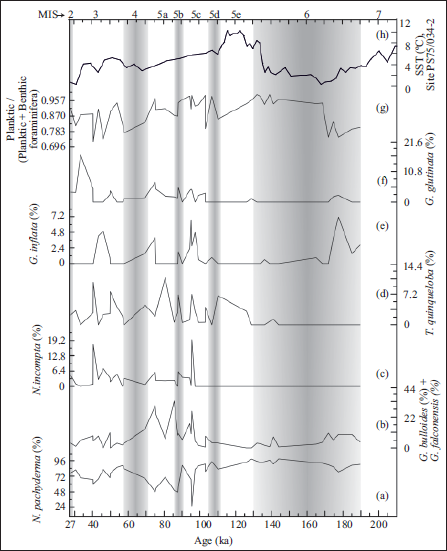
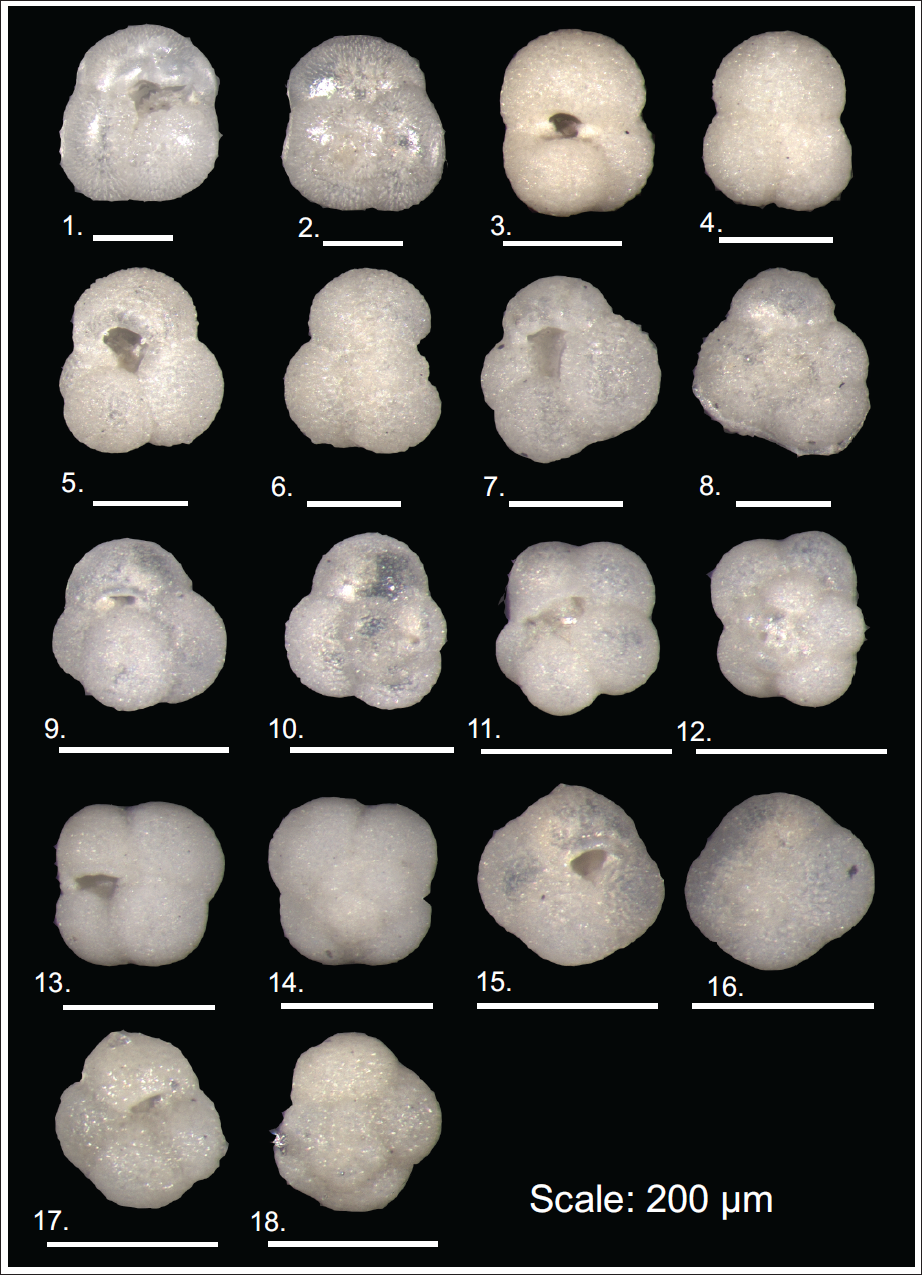
Planktic foraminifera abundance shows a glacial-interglacial variability in the last 200 ka (Figure 4a). Neogloboquadrina pachyderma has the highest abundance among the planktic foraminifera, ranging between 25 and 99%, and shows abundance during MIS 6, 5b, and 4 and has a gentle declining trend at MIS 3 (Figure 5a). Globigerina spp. (Globigerina bulloides and Globigerina falconensis) have abundance between 0 and 33% (Figure 5b), and show increased abundance during MIS 5. Neogloboquadrina incompta, Globigerinita glutinata, Turborotalita quinqueloba, and Globoconella inflata (Plate 1) show maximum abundance up to ~20%, ~17%, ~11%, and ~7%, respectively, in different intervals and show peaks during MIS 5 and 3 (Figures 5c–5f).
Temporal variation of (a–f) major planktic foraminiferal species and (g) per gram of planktic foraminifera divided by summation of per gram planktic and benthic foraminifera at Site U1544 (h) sea surface temperature (SST) at Site PS75/034-2 (Ho et al., 2012) over the last ~200 ka. Grey bars indicate glacial and stadial intervals.
Benthic foraminifera
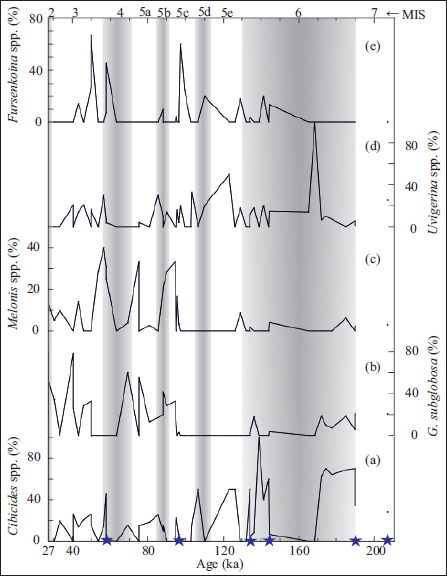
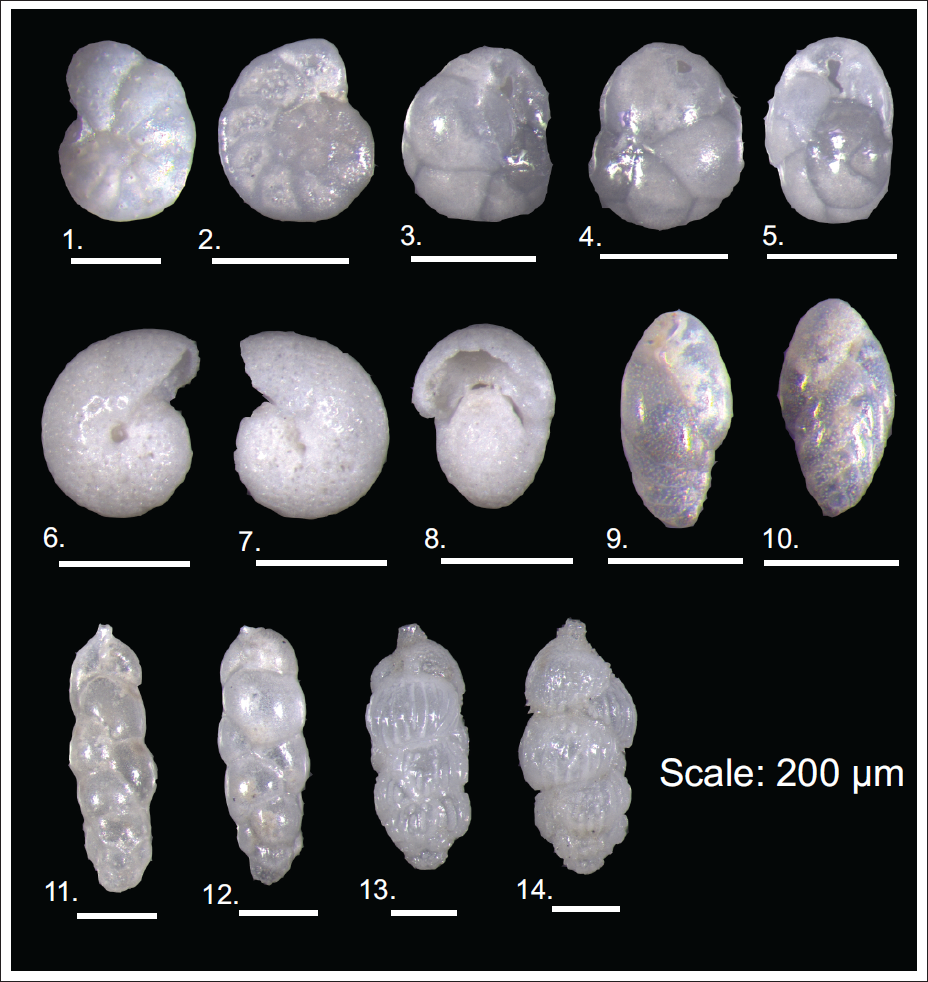
Benthic foraminifera are less abundant during the studied period, as suggested by the planktic/planktic+benthic foraminifera ratio (Figure 5g). The major species found at this Site are Cibicides spp., Fursenkoina spp., Globocassidulina subglobosa, Melonis spp., and Uvigerina spp. (Plate 2) suggesting fluctuation between oxic and suboxic conditions during the glacial-interglacial intervals (Figure 6). Globocassidulina subglobosa has relatively higher abundance during the interglacial MIS 5a and 3, and suboxic species Melonis spp., and Fursenkoina spp. during the deglaciation or transition to glaciation, except for MIS 5c (Figures 6b, 6c and 6e). Uvigerina spp. shows relatively higher abundance, with fluctuations during the interglacial MIS 5 and 3, except for a peak during MIS 6 (Figure 6d).
Temporal variations of major benthic foraminiferal species at Site U1544. Grey bars indicate glacial and stadial intervals. Blue stars denote core catcher sample data from Lamy et al. (2021).
(1) Globoconella inflata (apertural view); (2) Globoconella inflata (side view); (3,5) Globigerina bulloides (apertural view); (4,6) Globigerina bulloides (side view); (7) Globigerina falconensis (apertural view); (8) Globigerina falconensis (side view); (9) Globigerinita glutinata (apertural view); (10) Globigerinita glutinata (side view); (11) Turborotalita quinqueloba (apertural view); (12) Turborotalita quinqueloba (side view); (13) Neogloboquadrina incompta (apertural view); (14) Neogloboquadrina incompta (side view); (15,17) Neogloboquadrina pachyderma (apertural view); (16,18) Neogloboquadrina pachyderma (side view). Scale: 200 µm.
(1) Cibicides mundulus (spiral view); (2) Cibicides mundulus (umbilical view); (3,4) Glocassidulina subglobosa (side view); (5) Glocassidulina subglobosa (apertural view); (6,7) Melonis pompilioides (side view); (8) Melonis pompilioides (apertural view); (9) Fursenkoina sp. (apertural view); (10) Fursenkoina sp. (side view); (11–12) Uvigerina sp. (side view); (13–14) Uvigerina peregrina (side view). Scale: 200 µm.
DISCUSSION
Palaeoecological changes at Drake Passage
The distribution of microbiota, especially planktic foraminifera in the studied sediment core samples, reflects significant ecological variability at the DP between glacial and interglacial intervals. Neogloboquadrina pachyderma is a cold-water species that serves as a proxy for cooler sea surface temperature (SST; Kucera, 2007; Rashid et al., 2023). Globigerina spp. serves as a proxy for upwelling intensity and higher palaeoproductivity (Kucera, 2007). Globigerina falconensis, in particular, shows maximum fluxes in near-shore areas, likely responding to coastal upwelling processes (Ortiz & Mix, 1992). Turborotalita quinqueloba is a subpolar species thriving at the sea-ice edge or ice-free area and is a proxy to infer ice-free surface water with seasonally elevated primary productivity (Vermassen et al., 2023). Higher abundance of T. quinqueloba also suggests reduced salinity due to coastal water influx (Vats et al., 2020). Neogloboquadrina incompta is a subtropical species linked with the southward shift of the subtropical front in the SEP Ocean (Oliva et al., 2024). Globoconella inflata is a deep-dwelling planktic foraminifera found more abundantly in phytoplankton-rich productive water and also lives favourably at the depth of the thermocline (Cléroux et al., 2007; Das et al., 2024; Martínez-García et al., 2023). Globigerinita glutinata is an opportunistic planktic foraminifera and suggests greater nutrient availability in the SEP Ocean (Oliva et al., 2024).
During glacials and stadials (e.g., MIS 6, MIS 5d, MIS 5b, MIS 4) cooler SST prevailed at DP, marked by higher abundance of N. pachyderma. (Figures 5a). ACC strength was weaker during that period marked by relatively lower SSFS content (Figure 3), which is associated with ice sheets and sea ice formation. The onset of interglacials and interstadials (e.g., MIS 5e, MIS 5c, MIS 5a and MIS 3) are associated with ice sheets and sea ice melting, and relatively higher SSFS content, which suggests strengthening of the ACC (Figure 3; Datta et al., 2025; Wu et al., 2021). This enhanced ACC supports upwelling along the South American coast, marked by increased abundance of high-productivity species such as Globigerina spp., T. quinqueloba, G. glutinata, and higher Planktic/(Planktic+Benthic) foraminifera values (Figure 5; Oliva et al., 2024; Vats et al., 2020). The melting of PIS increased continental runoff from the nearby South American continent, thereby enhancing primary productivity at DP and leading to a higher abundance of T. quinqueloba and G. glutinata (Figures 5d and 5f). Occasionally, higher coarse-grained sediment inflow was observed during interglacial MIS 5, MIS 7 and at the start and end of MIS 6 (Figure 2). Overall, planktic foraminifera abundance declined during the period of higher coarse-grained sediment occurrence. The rise in SST during interglacials further supports the subtropical species N. incompta, and shoals thermocline marked by G. inflata (Figures 5c, 5e, and 5h). Melonis spp., and Fursenkoina spp. are well-established suboxic species, whereas Uvigerina spp. suggest higher primary productivity in the CSP and SEP (Datta et al., 2025; Mahanta et al., 2025). The abundance of suboxic species Melonis spp., Fursenkoina spp. and Uvigerina spp. during the deglaciation also supports higher productivity and continental runoff, marked by the increased abundance of other particles, which comprises detrital (Figures 4 and 6). The peaks of G. subglobosa and Cibicides spp. during MIS 5 and 3 suggest the intervals of stronger ACC in the SEP Ocean and better oxygenated bottom water conditions at the DP, which is complemented by the SSFS (Figures 3 and 6; Mahanta et al., 2025). However, the intermittent high peaks of Uvigerina spp. during MIS 5 and 3 marks the higher primary productivity, which suppressed the oxic benthic foraminifera Cibicides spp. abundance at DP (Figure 6). The alternative higher abundance of Cibicides spp. and Uvigerina spp. during MIS 6, suggest alternate low and high productivity and ACC strength at the DP (Figures 6a and 6d), which is also supported by higher coarse-grained continental influx (Figure 2). The reduction in productivity at DP, in addition to stronger ACC, may have caused the sustenance of oxic bottom water conditions at the DP (Datta et al., 2025). In general, diatoms and radiolarians show maximum abundance in the sediment <100 µm; however, this study observed abundance of larger diatoms and radiolarians (>125 µm) during MIS 5b and 4, which suggests enhanced siliceous productivity and reduced calcareous productivity at the DP during the stadial and glacial period (Figure 4).
CONCLUSION
The multiproxy record from the DP Site U1544 shows higher ACC strength during the interglacial MIS 5 and 3. The melting of PIS and sea ice increased productivity at DP, which is marked by higher continental influx, an increased abundance of high-productivity indicators, planktic foraminifera Globigerina spp. and T. quinqueloba, and high-productivity indicator benthic foraminifera Uvigerina spp. The glacial conditions of MIS 6 are marked by a higher abundance of cold water planktic foraminifera N. pachyderma. The abundance of benthic foraminifera Cibicides spp marks the decline in productivity during MIS 6 at DP, and a low abundance of G. subglobosa marks a reduction in ACC. Overall, this study suggests ecological changes at DP with glacial-interglacial as well as stadial-interstadial variabilities, which are further modulated by PIS melting and cause higher coarse-grained sediment influx.
Footnotes
Acknowledgements
The International Ocean Discovery Programme is thankfully acknowledged for providing core samples to RKS. RKS and SD acknowledge the financial support by DST-SERB (CRG/2020/000396) and ESSO-NCPOR (RP-277). SKD, NM and SR acknowledge DST - INSPIRE Fellowship (IF180859, IF190584, and IF200111, respectively). SSM, PG, NA, BS and SD acknowledge IIT Bhubaneswar for the infrastructure facility and financial support. Authors are also thankful to the IUAC for extending the 14C AMS facility funded by the Ministry of Earth Science (MoES), Govt. of India, with reference numbers MoES/16/07/11(i)-RDEAS and MoES/P.O.(Seismic)8(09)-Geochron/2012. We are grateful to Editor-in-Chief Prof. Mukund Sharma for the kind invitation to publish in the PSI Platinum Jubilee Issue and to both anonymous reviewers for their constructive suggestions.
Data Availability Statement
Data is available and will be shared on request.
Declaration of Conflicting Interests
The authors declared no potential conflicts of interest with respect to the research, authorship and/or publication of this article.
Funding
The authors disclosed receipt of the following financial support for the research, authorship and/or publication of this article: ANRF (SERB): CRG/2020/000396; DST INSPIRE: IF180859, IF190584, and IF200111; ESSO-National Centre for Polar and Ocean Research, Goa: RP-277.
