




Abstract
The Late Quaternary variability of the Indian monsoonal winds, both the southwest monsoon (SWM) and the northeast monsoon (NEM), has affected the hydrography of the Andaman Sea region through precipitation and river discharge. The Indian monsoon strength variability has been frequently linked to factors like Northern Hemisphere cooling, sunspot cycle, and glacial-interglacial intervals, besides various other forcing factors, including the shifting position of the Intertropical Convergence Zone (ITCZ), El Niño Southern Oscillation, and Indian Ocean Dipole. The palaeomonsoon proxies have been mainly directed to understand the Wind Strength variability resulting in upwelling in the Arabian Sea or precipitation records from land-based sections. The article addresses an intriguing question about the relationship between Wind Strength Record and the resulting river discharge and precipitation record in the Andaman Sea region. The distinctive feature of the Andaman Sea water masses is the seasonal variations in the inventory of river water discharge, which affects the surface ocean salinity besides local precipitation in the region. Here, we used water mass-sensitive, and depth-stratified planktic foraminiferal assemblages from deep-sea sediment core SK 234-60 in the Andaman Sea region to reconstruct the variability of the Indian monsoonal precipitation during the late Quaternary. The wide distribution of planktic foraminiferal assemblages and their oxygen isotope analysis in deep-sea sediment cores helps to understand the precipitation and water mass conditions, as the temperature, salinity, nutrients, and trophic conditions are primarily affected by river discharge into the Andaman Sea, besides local precipitation. A detailed faunal census counts data for water mass-sensitive planktic foraminifera from the core SK 234-60 raised from the Andaman Sea has been interpreted. The depth-stratified assemblages include mixed layer dwelling (MLD) species, thermocline dweller species (TDS), and upwelling indicator species (UIS), which reflect productivity. During the late Quaternary, we observed six intervals of strengthening of the SWM mode designated here as Southwest Monsoon Mode Increase (SWMMI-1-6), suggested by the higher relative abundance of MLD and very low abundance of Thermocline Dwellers. We have also noticed six intervals of decreased Southwest Monsoon Mode, which is designated here as Southwest Monsoon Mode Decrease (SWMMD-1-6) during the last 25 KyBP. An increase in Northeast Monsoon Mode is abbreviated here as NEMMI, and a decrease in Northeast Monsoon Mode is abbreviated as NEMMD. An interesting finding is the sudden increase in the population of MLD planktic foraminifera just after all four volcanic ash layers from Barren Island during the last 25 KyBP, which might have affected the local rainfall in the Andaman Sea region.
INTRODUCTION
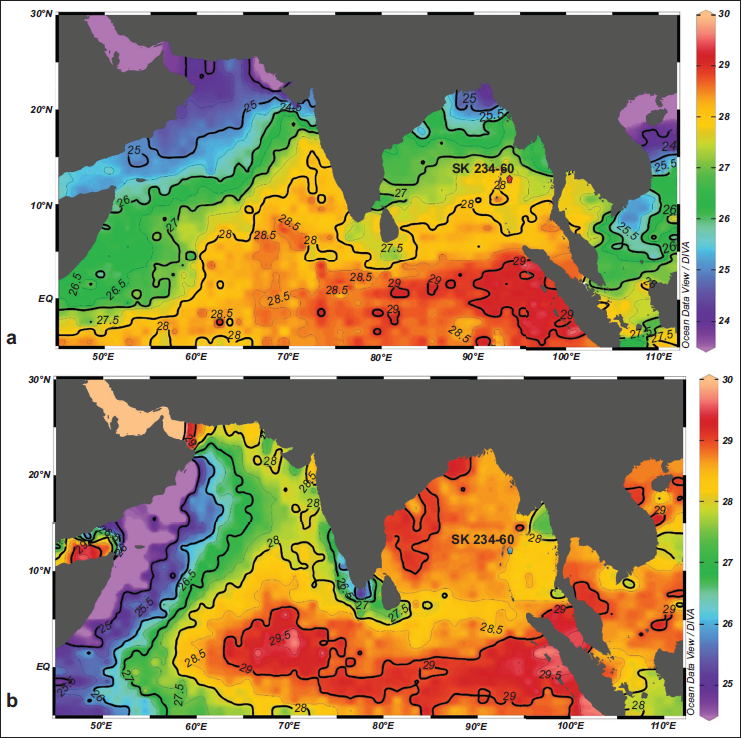
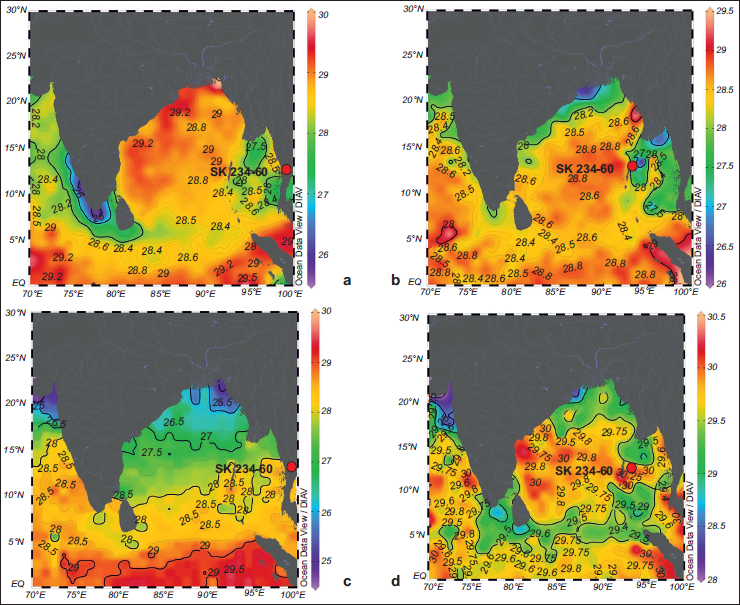
With a growing population and demand for fresh water, more intensive research has been focused on understanding the monsoonal precipitation and its variation in the recent past. In the last few decades, much focus has been on understanding the various forcing factors involved in the mechanism of monsoonal precipitation. Most of the Indian rivers survive due to the huge amount of water they receive from Monsoon rainfall. As the world is much concerned with the availability of fresh water due to the growing needs of the population, studies about the paleo precipitation have gained significance as they help to understand the causative factor behind the strengthening and weakening of the Monsoon in the geological past (Singh et al., 2007). In the Indian subcontinent, the availability of fresh water depends on monsoonal precipitation and rain-fed rivers. The impact of global climate change on the future water resources needs a better understanding of the changing mean state of the Indian Monsoon, termed as Monsoon Mode by Singh et al. (2016). There are two main aspects of studying palaeomonsoon from the climate archives. One type of record comes from marine sediments, which indicate both the monsoonal wind strength and salinity changes due to precipitation (Singh et al., 2016), while the other type of record comes from land-based sections, which preserve the precipitation record (Ronay et al., 2019). The precipitation records are patchy showing enough spatial variation and depend on the location from which the archives have been retrieved (Wang et al., 2022). The civilisations have always preferred to develop along the river valleys. Old civilisations like the Indus Valley civilisation in the western part of the Indian subcontinent and the Mesopotamian civilisation thrived along the perennial water resources. Most of the rivers in the Indian Subcontinent depend on the monsoon rains for water, besides a small contribution from snow-melt from the Himalayan glaciers. It is believed that the shifting of the mean state of the Monsoon (Monsoon Mode) led to the decline in civilisations like the Indus Valley civilisation, which collapsed around 4.2 KyBP (Before Present, fixed at 1950 AD). Based on the marine sedimentary record, Staubwasser et al. (2003) attributed such events to the weakening of the SWM precipitation. Such knowledge about past civilisations further motivates scientists to comprehend the linkage between the strength of monsoon winds and the resulting precipitation. Amongst many factors affecting the Monsoon, sea surface temperature is of prime importance as it contributes to regional precipitation (Stansfield & Reed, 2023). The Sea surface temperature (SST) in the Indian Ocean during January and August has been shown in Figure 1.
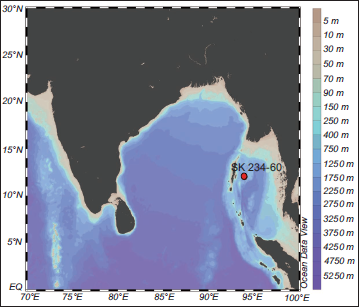
Bathymetry of the Andaman Sea and Bay of Bengal. Data from the World Ocean Atlas 2023 (Reagan et al., 2024), visualized using Ocean Data View (Schlitzer, 2023).
MONSOON MODES
As the Indian Monsoon, consisting of SWM and NEMs, is an annual phenomenon, detecting the past monsoon changes is marred by a major constraint of time averaging of the sample. It is impossible to detect the nature of a particular Monsoon in a specific year from sediment archives, as a particular sediment sample might have arrested several annual cycles of monsoons. Realising this, Singh et al. (2016) coined the terms Southwest Monsoon Mode (SWMM) and Northeast Monsoon Mode (NEMM) to designate the long-term mean state of the dominant monsoon. In this article, we have also used the terms SWMM-I and SWMM-D to indicate increased and decreased strength of the Southwest Monsoon Mode and NEMM-I and NEMM-D to indicate increased and decreased strength of the NEMM.
PALAEOMONSOONAL STUDIES
Various workers suggest that the water discharge from the multiple river systems to the Bay of Bengal (Ota et al., 2019) and the Eastern Arabian Sea (Santhikrishnan et al., 2024) has considerable spatial and temporal variability. The Late Quaternary variability of the Indian Monsoonal Mean State (SWMM and NEMM) is responsible for changing monsoonal precipitation. The causative factors for such variations have been Northern Hemisphere cooling (Gupta et al., 2003; Hong et al., 2019), Sunspot cycles (Gupta et al., 2005), and glacial-interglacial events (Saraswat et al., 2013; Zhisheng et al., 2011). The precipitation intensity linked with monsoonal wind modes has not been studied much in the catchment regions where rivers are draining.
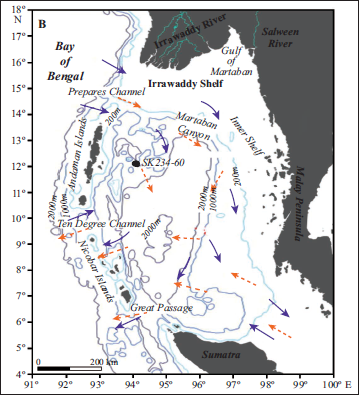
In this study, we tried to understand the monsoonal precipitation linked with both SWMM and NEMM from the Andaman Sea region. The Andaman Sea is a shallow marginal sea (Figure 2) with limited connectivity with the adjoining oceans (Fathima & Saraswat, 2023) and connected to the Bay of Bengal (BoB) in the west through three primary channels (Figure 3) and several minor passages. These are Southern Channel (SC; -68°N, 1200–1500 m deep) also known as the Great Passage, the middle channel (MC also known as Ten-degree Channel in the center,800 meters deep) which separates Andaman from Nicobar Islands, and the Preparis Channel or northern channel (NC;15°N, 400–500 m deep) (Chatterjee et al., 2017). The distinctive feature of the Andaman Sea water masses is the seasonal variations in river water discharge, which affects the surface ocean water salinity in addition to upwelling and downwelling in response to the Indian Monsoon (Chatterjee et al., 2017).
The connection between the Andaman Sea and the Bay of Bengal (BoB) is shown through three primary channels and several minor passages. These are the Southern Channel (SC; 6°N), also known as the Great Passage, the middle channel (MC, also known as the Ten-degree Channel in the centre) which separates Andaman from Nicobar Islands, and the Preparis Channel or northern channel (NC;15°N) (Chatterjee et al., 2017). Also shown are Monsoonal currents: Blue arrow (Southwest Monsoon), Orange arrow (North-east Monsoon) (After Cao et al., 2015).
The Andaman Sea is a marginal basin with a multiphase opening history, and the pelagic sediments accumulating at the ocean floor supposedly should have recorded the early history of the basin. Studies have revealed that the opening histories range from Miocene to Pliocene (Curray, 2005). This basin appears relatively stagnant so far as the dynamic exchange of water from this basin to adjoining seas is concerned. Thus, the pelagic sediments deposited throughout the geological past contain relatively undisturbed records of Indian monsoonal precipitation and freshwater influx in the AS basin, However, during the geological past (from the Late Miocene onwards), the basin must have responded to significant sea level changes due to glacial and interglacial events affecting its multiple connectivity to BOB, and the changing mean state of the Indian monsoon. There can be intriguing questions about the response of the Andaman Sea to variations in the hydrographic conditions of the BoB to which it is connected. AS is also affected by variability in the rainfall and river discharge from the surrounding areas. Our investigations reveal that in the AS basin sediments, the tropical planktic foraminiferal species show their dominance. Carbonate Compensation Depth (CCD) in the AS has remained around ~4.0 ± 0.6 km below MSL (Sijinkumar et al., 2022; Zhang et al., 2023). The distribution of planktic foraminifers in the Andaman Sea is affected by changing sea surface temperature variations, surface salinity, variability in the season of monsoonal wind-induced upwelling, and fluctuations in sea level. In this study, we used relative abundances of depth-stratified planktic foraminiferal assemblages to infer the plausible linkage between the Indian monsoon and precipitation in the Andaman Sea.
Oceanographic setup of the studied area
Monsoonal winds, precipitation, and massive river runoff into the Arabian Sea and the Bay of Bengal influence the Indian Ocean region. Due to monsoonal discharge of the rivers draining into the above two basins, the sea surface salinity of the Indian Ocean Region varies during different seasons (Singh et al., 2016).
The Andaman Sea is situated in the north-east Indian Ocean (IO) at the eastern margin of the Bay of Bengal BOB) and is affected by changes in the hydrographic conditions of the IO. This basin appears relatively stagnant so far as the dynamic exchange of water from this basin to adjoining seas is concerned. The bathymetry of AS varies from north to south, rapidly, with a maximum water depth of over 4,000 meters in the northeastern part of the AS and ~100 meters or less near coastal areas of Myanmar, Thailand, and the Andaman & Nicobar Islands (Cao et al., 2015).
The general circulation of the northern Bay of Bengal and the Andaman Sea is influenced by remote forcing from the Equatorial Indian Ocean. The influencing mechanism involves reflected Rossby waves (Potemra et al., 1991) and coastal trapped Kelvin waves along the Sumatra coast (McCreary et al., 1993), which propagate across the Andaman Sea and the eastern boundary of the Bay of Bengal (Vinayachandran et al., 1996). Local coastal winds and reflected Rossby waves, rather than reversing seasonal monsoon winds, are reported to be responsible for the intra-seasonal coastal current in the Andaman Sea (Suwannathatsa et al., 2012).
During the SWMM, the Andaman Sea circulation is marked by surface water entering the Andaman Sea through surface currents flowing from the Bay of Bengal (Figure 3) (Brown, 2007). The Irrawaddy shelf features a significant submarine canyon system, specifically the Martaban Canyon, located along the northern margin of the Andaman Sea.
This area is influenced by gravity-driven mass flows and turbidity currents, facilitating sediment redistribution (Rao et al., 2005). The southeastern Andaman Sea exhibits stable and continuous sedimentation (Colin et al., 1999).
Consequently, the southeastern continental slope of the Andaman Sea serves as an important place to study the linkage between monsoonal precipitation and Indian Monsoonal modes, whose signatures must have been preserved in the pelagic sediments. Wyrtki (1973) identified ocean water productivity in the Andaman Sea owing to the prevailing upwelling during the winter monsoon (NE Monsoon).
In the Andaman Sea, after 200 meters of depth, the temperature drops to around 13°C; at 500–600 meters, it drops to 9°C; the overall thickness of the thermocline is around 150 meters in the Andaman Sea (Saidova, 2008).
The surface salinity in the Andaman Sea varies during different seasons due to the supply of fresh water discharged from the Irrawaddy and Salween River systems and the BoB through the Preparis channel (Figure 4).
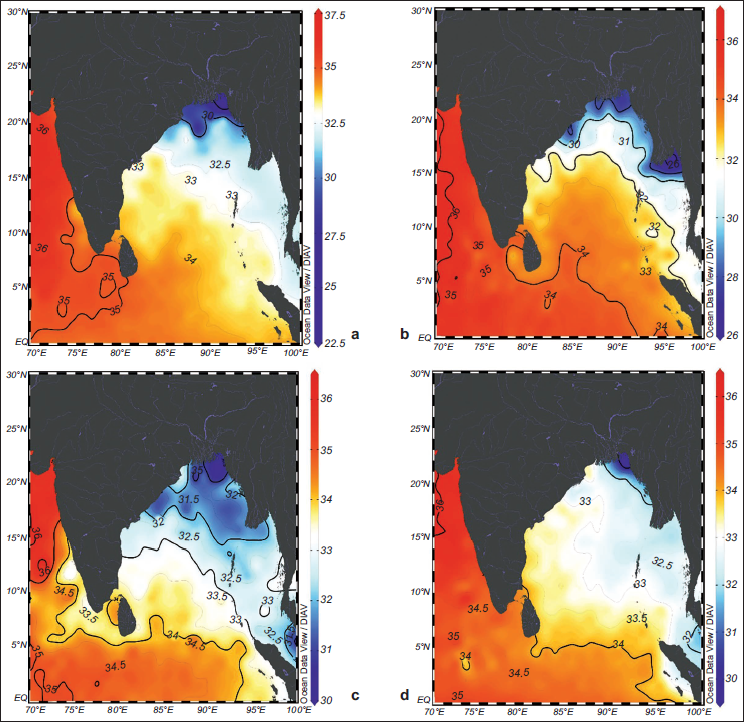
The surface salinity is primarily influenced by rainwater discharge and river runoff during the Indian Monsoonal precipitation. It affects the stratification in the Andaman Sea water column. The sea surface temperature in the Andaman Sea also varies during different seasons (Figure 5). This is related to changing monsoonal precipitation intensity and the change in the supply of freshwater runoff from the river system, and from the BoB through the Preparis channel.
MATERIALS AND METHODOLOGY
In this study, a 4.0 m long marine sediment core (SK-234-60) was raised from the Andaman Sea at N12˚50’46” and E 94˚05’18” from a water depth of 2.0 km during expedition number 234 of R/V Sagar Kanya. The core comprises grey to very dark grey silty clays and seven discrete tephra layers originating from the active Barren Island volcano (Awasthi et al., 2010; Ray et al., 2013). The core is located far from the submarine base of the volcano and is well shielded from direct slides or slumps that may occur on the volcano’s flanks (Awasthi et al., 2010). The core was split into two halves; one half was used for establishing the chronology of the sediment core. The chronology of this sediment core, SK 234-60, was reported by Awasthi et al. (2014) by using radiocarbon dating of the surface dweller planktic foraminiferal species. Dating was carried out by an Accelerated Mass Spectrometer (AMS) at the University of Arizona, USA. All the AMS dates were converted into calendar years of age using the Marine-09 calibration curve (Reimer et al., 2009). Details of dating methods are reported by Awasthi et al. (2014). The oxygen-stable isotopic analysis of these cores was published by Kumar et al. (2018). Planktic foraminiferal tests deposited with the sediments/tephra were separated from sub-samples at a 2 cm interval for census counting. Samples were soaked in distilled water overnight and wet-washed using a 63-µm sieve. The core was studied at every 2 cm interval down to 200 cm. Sample processing was carried out at the wet lab, University of Delhi. For relative abundance studies, foraminifers were separated from the sediments by shaking with distilled water and 1/2cc of 30% H2O2 to oxidise any organic material present in the sediment sample. They were then warmed at 60°C–80°C for an hour, after which foraminifera were separated from the sediments by wet sieving. The >150 µm size fraction was chosen for census counts of planktic foraminifera since this size fraction is widely used in most of the paleoclimatic studies (Imbrie & Kipp, 1971; Wells et al., 1994) at the Micropalaeontology and Palaeoceanography Lab, University of Delhi, and Department of Geology, Utkal University, Bhubaneshwar. Samples were split into suitable aliquots to get 300 or more individuals; each individual was identified up to species level following the taxonomy of Kennett and Srinivasan (1983), Bolli and Saunders (1985), and Schiebel and Hemleben (2017) for identification of the taxa at the species level. Percentages of each individual were calculated, and the relative abundance curves were plotted for key species.
We have revised the Ash layers’ chronology for those that erupted during the last 25 KyBP (four volcanic eruptions occurred during the last 25 kyBP). The chronology for volcanic eruption observed in this core SK234-60 was given by Awasthi et al. (2010), based on bulk sediments by dating carbonates from the sediment using the conventional Beta counting method. We have revised the ages using calendar year ages (derived from AMS dates of surface dweller planktic foraminifera) for those ash layers.
PRINCIPAL COMPONENT OF PLANKTIC FORAMINIFERAL POPULATION
Q-mode principal component analysis (PCA) was conducted on planktic foraminiferal assemblages derived from the Andaman Sea to identify dominant environmental signals over the past 25 KyBP. This analysis was performed using PAST software (version 4.03), applying a criterion where only foraminiferal taxa with an average percentage of ≥1% were considered, following the methodological framework established by Schmiedl et al. (1997). The identification of significant loadings (≥0.5) was based on the criteria outlined by Backhaus et al. (2008), ensuring that only the most influential environmental factors were highlighted in the dataset.
RESULTS
Planktic foraminiferal quantitative analysis
The Planktic Foraminifera (PF) in the Andaman Sea region is dominantly constituted of warm tropical water assemblages. In the present study, we observed the dominance of five individual species Pulleniatina obliquiloculata (Pu.obliquiloculata), Neogloboquadrina dutertrei (N.dutertrei), Globigerinoides ruber (Gs.ruber), Globigerna bulloides (Gg.bulloides), Globigerinita glutinata (Ga. glutinata), which together constitute 80%–90% of total assemblages of PF (Figure 6).
Distribution of planktic foraminifera (number/gram) species Gs. ruber, Pu. obliquiloculata, Ga. glutinata, N. dutretrei and Gg. bulloides in the Andaman Sea (Location of the studied core has been shown on the biogeographic map of Frerichs, 1971).
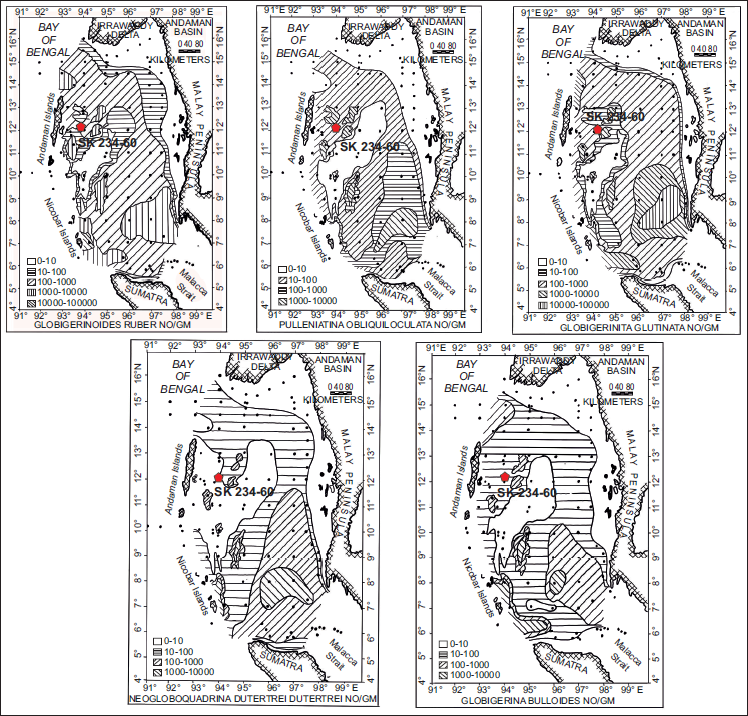
These species live at different depths in the ocean water; Gs. Ruber is a warm, mixed-layer Oligotrophic species, while Pu. obliquiloculata, along with N. dutertrei, is a thermocline dweller, and Gg. bulloides and Ga. glutinata are considered upwelling indicator species in the tropics as their abundance is productivity-controlled (Anderson et al., 2002; Curry et al., 1992; Gupta et al., 2003; Sinha et al., 2006; Sinha & Singh, 2007a, 2007b; Singh et al., 2016; Srivastava et al., 2016). Depth-wise, they are mixed-layer dwellers, but latitudinally, they prefer cold water conditions. The PF at the studied site in the Andaman Sea (AS) show significant variability in its relative abundance. The variation might be a response to changes that occurred due to variability in the Indian monsoonal wind strength affecting the upper ocean water column, and also with changing surface salinity, sea surface temperature, shoaling and deepening of water mass, and local productivity due to upwelling along the coastal regions. In the present study, we analysed the relative abundance of water mass-sensitive PF species and grouped them according to their preferred habitat.
Mixed layer planktic foraminiferal records (MLD)
The Warm Mixed layer PF genus Globigerinoides consists of all species that prefer to flourish in warm, well-stratified, non-upwelling conditions (Anderson et al., 2002; Curry et al., 1992; Gupta et al., 2003; Sinha et al., 2006; Sinha & Singh, 2007a, 2007b; Singh et al., 2016; Srivastava et al., 2016).
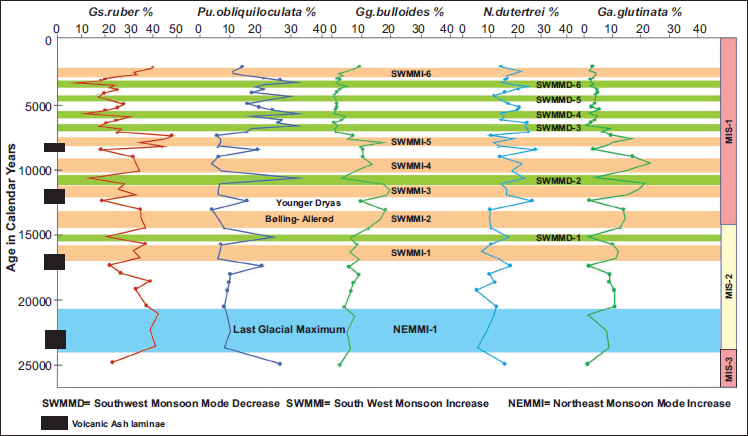
Warm Mixed layer PF species Globigerinoides ruber is an oligotrophic species; it flourishes in no-nutrient or very low-nutrient conditions (Anderson et al., 2002; Curry et al., 1992; Gupta et al., 2003; Sinha et al., 2006; Sinha & Singh, 2007a, 2007b; Singh et al., 2016). In this study, we have observed the variation in the abundance of Gs. ruber from the highest value of 50% to the lowest 10% during the last 25 KyBP (Figure 7). Its higher abundance in the Andaman Sea suggests a well-stratified water column. We have observed significant fluctuations in the relative abundance of Gs. ruber, which suggests changing conditions of the surface mixed layer due to variations in the strength of SWMM-I and Southwest Monsoon mode decrease (SWMM-D). Other warm mixed layer dwellers like Gs. sacculifer, Gs. conglobatus, Gs. triloba and Gs. quardilobatus are showing similar trends. We have correlated the MLD group with other water mass-sensitive PF species and observed that during the Last Glacial Maximum (LGM), higher average values of MLD occur, and post-LGM till the Younger Dryas (YD), several events of higher and lower relative abundance are observed. During the middle to early part of the late Holocene, MLD shows no change in its relative abundance, but in the later part of the late Holocene, MLD shows a rapid rise in its relative abundance (Figure 8).
Relative abundance of water mass sensitive planktic foraminiferal species Gs. ruber, Pu. obliquiloculata, Gg. bulloides, N. dutretrei and Ga. glutinata, in the Andaman sea. Southwest Monsoon Mode Increase (SWMMI-1-6) and Southwest Monsoon Mode Decrease (SWMMD-1-6) are shown in the figure along with Northeast Monsoon Mode Increase (NEMMI-1). Pulleniatina Maximum events have been shown as PMaxE-1 to 6.
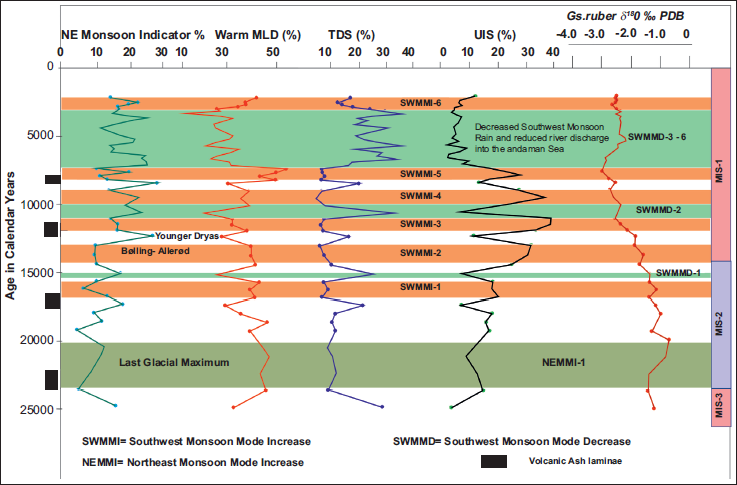
Relative abundance records of depth-stratified planktic foraminiferal groups and stable isotope records in the Andaman Sea, including warm Mixed Layer Dweller Species (MLD), Thermocline Dweller Species (TDS), Upwelling Indicator Species (UIS), NE monsoon indicator species, and δ18O records of Gs. ruber (isotope data from Kumar et al., 2018). Intervals of Southwest Monsoon Mode Increase (SWMMI-1-6), Southwest Monsoon Mode Decrease (SWMMD-1-6), and Northeast Monsoon Mode Increase (NEMMI-I) have been shown.
Thermocline dweller planktic foraminiferal records (TDS)
Thermocline Dweller Planktic foraminiferal species (TDS) dwell below the photic zone. In this present study, we have taken tropical water thermocline dwellers like Pu. obliquiloculata, Gr. menardii and Gr. tumida as TDS.
Pulleniatina obliquiloculata is abundant in the sediments of the Andaman Sea (Frerichs, 1971). Frerichs (1971) reported a higher abundance of this species in the sediments of the southeastern corner of the sea, on the Andaman Nicobar Ridge in the vicinity of the Nicobar Islands and the South Preparis Channel, which connects BoB with the Andaman Sea. Globorotalia menardii and Gr. tumida are not very frequent in the AS but show their continuous presence.
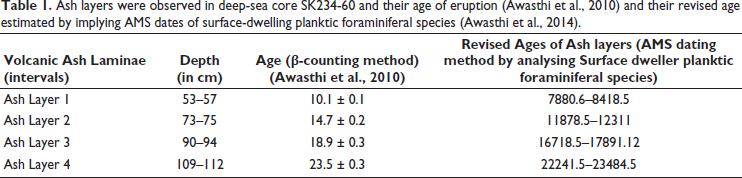
We observed a significant fluctuation in the relative abundance of Pu. obliquiloculata during the last 25 ky. Their relative abundance varies from ~2% to 40%. Pu. obliquiloculata flourished when the mixed layer was thin due to the shoaling of the thermocline, increasing the accommodation space of this species’ environmental niche (Chaisson & Ravelo, 2000). Nearly six intervals of increase in the relative abundance of Pu. obliquiloculata have been marked (Figure 7). These higher abundance intervals (more than 30%) of Pu. obliquiloculata (Pulleniatina Maximum Events) mostly occurred during the Middle to early part of the Late Holocene (Figure 7) at the studied site, which might be linked with shoaling of the thermocline and weak monsoonal precipitation. Six such Pulleniatina Maximum Events (PMaxE) were observed during that 25 KyBP, and they coincide with a very low abundance of Gs. ruber, prefers a thick mixed layer. During LGM, we have noticed when Pu. obliquiloculata shows no significant fluctuation but low relative abundance (Figure 7). This might be linked with a deepening of thermocline (DOT) and reduced sea surface salinity during LGM due to weak rainfall (Yan et al., 2016). We have also observed a significant fall in the relative abundance (<5%) of Pu. obliquiloculata (five such Pulleniatina Minimum Events), occurred after LGM to YD and during the Early Holocene (Figure 7). The TDS group shows similar trends (Figure 8). We have noticed that all the Pulleniatina Minimum Events coincided with the barren Island volcanic eruption. It is a matter of future investigation if there is any correlation between volcanic eruption (Table 1) and related paleoclimatic change in this Andaman Sea region and its effect on the diversity of Planktic foraminiferal species.
Ash layers were observed in deep-sea core SK234-60 and their age of eruption (Awasthi et al., 2010) and their revised age estimated by implying AMS dates of surface-dwelling planktic foraminiferal species (Awasthi et al., 2014).
Upwelling indicator species
During coastal upwelling in the tropical ocean, Globigerina bulloides and Globigerinita glutinata show their higher relative abundance (Anderson et al., 2002; Curry et al., 1992; Gupta et al., 2003; Sinha et al., 2006; Sinha & Singh, 2007a, 2007b; Singh et al., 2016, Shrivastav et al., 2016). This is due to an increase in nutrient supply and cold-water conditions. Globigerina bulloides and Globigerinita glutinata are abundant in Andaman Sea (Frerichs, 1971). Frerichs (1971) reported 100–1000 individuals per gram of the sample in the studied area. In this study, we observed variation in the relative abundance of Ga. glutinata, which varies from 23% to 0.6%.
During LGM, no major change in the population of Ga. glutinata occurred. We have noticed that major fluctuations occurred post-LGM deglaciation to the YD and also during the Early Holocene. Ga. glutinata shows very low (<5%) relative abundance during the Middle to Late Holocene (Figure 7). This might be related to weak SWMM. In upwelling areas, Ga. glutinata prefers to proliferate in the marginal regions of an upwelling centre and encircle Gg. bulloides, which is present at the centre of the upwelling zone (Brock, 1992; Hilbrecht, 1996).
Globigerina bulloides is also very abundant in the AS, particularly sediments of the south-eastern sea sector, and near the Preparis Channel and the Great Passage (Frerich, 1971). However, in this study, we did not observe much abundance of Gg. bulloides, we have observed maximum abundance (~19%) just after YD and volcanic eruption at Barren Island in the Andaman Sea, indicative of the return of Strong SWMM after a weak SWMM during YD. More studies are required from the Andaman Sea and adjacent areas in the BoB to examine the effect of volcanic eruption on planktic foraminiferal distribution and local rainfall. This low abundance of Gg. bulloides in comparison to Ga. glutinata suggest that the studied site might be away from the possible upwelling centre, but we need more data to confirm this interpretation. Gg. bulloides show very little abundance (<2%) during the Middle to late Holocene. The higher relative abundance peaks of both UIS (Globigerina bulloides and Ga. glutinata) match the low relative abundance of Pu. Obliquiloculata. This suggests a thin mixed layer and shoaling of the thermocline.
Neogloboquadrina dutertrei
N. dutertrei is a thermocline dweller species. It is considered an indicator of the strengthening of NEMM in the Arabian Sea (Ishikawa & Oda, 2007; Singh et al., 2016). N. dutertrei is abundant (~20%) in the Andaman Sea (Frerich, 1971), especially in the south-eastern sector and near the Nicobar Islands and the South Preparis Channel. Near the present study site, Frerich (1971) reported 10–100 individuals per gram of the sample. We observed several intervals with a higher relative abundance of N. dutertrei (more than 20%). These intervals are coeval with a higher abundance of Pu. obliquiloculata and lower values of MLD (Figure 7) suggest the shoaling of the thermocline and a thin mixed layer due to less precipitation and low freshwater river discharge. However, during LGM (23-19 KyBP), we have noticed the increasing trend (Figure 7) in both N. dutertrei and Gs. ruber this might be related to strengthening the NE monsoonal wind mode stratification of upper ocean water and the deepening of the thermocline.
PLANKTIC FORAMINIFERAL PRINCIPAL COMPONENTS ANALYSIS
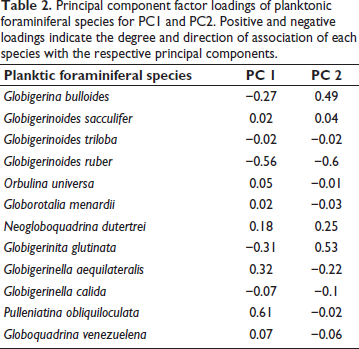
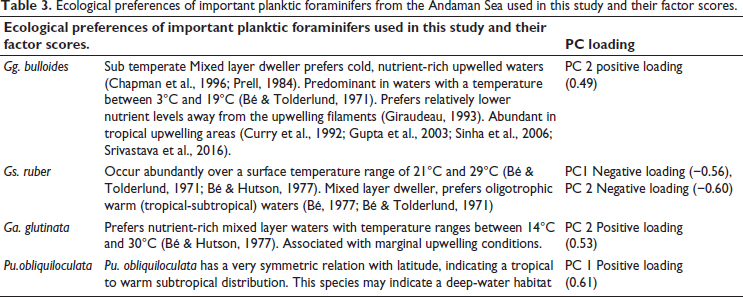
We have carried out PCA for water mass sensitive planktic foraminiferal species (Tables 2 and 3) for the deep-sea core SK 234-60 from the Andaman Sea. We have identified dominant environmental signals from the Andaman Sea, which suggest thermal stratification in the Andaman Sea during intense monsoonal precipitation.
Principal component factor loadings of planktonic foraminiferal species for PC1 and PC2. Positive and negative loadings indicate the degree and direction of association of each species with the respective principal components.
Ecological preferences of important planktic foraminifers from the Andaman Sea used in this study and their factor scores.
Principal Component 1 (PC1): surface water runoff and thermal stratification
PC1 primarily indicates the extent of thermal stratification in the ocean, which is influenced by changes in surface water runoff and monsoonal wind intensity in the Andaman Sea. Negative PC1 values signify periods of high thermal stratification when strong monsoonal winds induce precipitation, resulting in significant freshwater input. This influx of freshwater creates a low-salinity surface layer, which reduces vertical mixing between surface and deeper waters. The consequent heat trapping in the upper ocean heightens thermal stratification, affecting the ecology of planktic foraminiferal assemblages. The strong correlation of negative PC1 values with Globigerinoides ruber, a warm surface-water species, implies that these conditions are associated with periods of intense monsoonal precipitation and enhanced stratification.
The positive PC1 values represent periods of weak thermal stratification due to diminished surface water runoff. During weaker monsoon wind modes, freshwater river runoff is reduced, allowing for greater vertical mixing between the surface and deeper ocean layers. This weak stratification enhances deep-water ventilation (Shoaling of the thermocline) and alters oceanic chemistry by facilitating the exchange of nutrients and dissolved gases. The positive PC1 loadings associated with Pulleniatina obliquiloculata indicate that such conditions were characterised by weak monsoons, decreased freshwater input, and increased vertical mixing. The palaeoceanographic implications of PC1 suggest that it serves as a robust proxy for monsoon strength and surface runoff, where negative values denote periods of intense monsoons, high freshwater influx, and pronounced stratification, while positive values correspond to weak monsoons, reduced freshwater influx, and lower stratification levels.
Principal Component 2 (PC2): eutrophic conditions and nutrient availability
PC2 primarily reflects nutrient availability in the surface waters and the balance between eutrophic and oligotrophic conditions. Positive PC2 values indicate eutrophic conditions, supporting increased primary productivity. The results show a strong association of elevated PC2 with Globigerina bulloides and Globigerina glutinata in the Andaman Sea; both the UIS are adapted to nutrient-rich environments, suggesting that high PC2 values might have corresponded to enhanced phytoplankton productivity in the AS. This increased nutrient supply can originate from various sources, including continental runoff and seasonal upwelling due to monsoonal winds.
In contrast, negative PC2 values represent oligotrophic conditions characterised by lower nutrient availability and reduced biological productivity. The strong negative loading of PC2 with Globigerinoides ruber, a species typically found in warm, nutrient-poor waters, suggests that periods of negative PC2 values correspond to environments with limited nutrient supply. These conditions are likely linked to weaker hydrodynamic processes that restrict the vertical transport of nutrients or increased thermal stratification that inhibits nutrient mixing from deeper layers. As a palaeoceanographic proxy, PC2 provides insight into historical fluctuations in oceanic productivity, where positive values indicate phases of high nutrient influx and elevated primary productivity. In contrast, negative values suggest nutrient-depleted, oligotrophic conditions with constrained productivity.
DISCUSSION
In this study, we have correlated the MLD with the thermocline dweller group (TDS) along with the upwelling indicator species (UIS) and NE monsoon indicator species (Figure 8), and we have observed the change in water mass condition in the Andaman Sea during the last 25 KyBP.
During the Last Glacial Maximum
The relative abundance of TDS was very low (<10%), but UIS shows increasing trends with no significant change in their relative abundance. MLD (~42%). At the same time, the NE monsoon indicator species shows an increasing trend, and this might be the reason for the decrease in the population of TDS due to the deepening of the thermocline and the shrinkage of the ecological niche of TDS. The high relative abundance of MLD and N. dutertrei might be due to the enhanced NE monsoon mode (NEMMI-1). Curry et al. (1992) identified time-series fluxes of tropical planktic foraminiferal species during non-upwelling periods in the Arabian Sea. The relative abundance of MLD groups of planktic foraminiferal species increased during the non-upwelling NE monsoon season, and a warm mixed layer developed with the nutrients entrained by convective mixing (Conan & Brummer, 2000). Sirocko et al. (1993, 1996) also reported a similar NEMMI around LGM based on low dolomite flux at core 74 KL from the upwelling region of the western Arabian Sea. Tiwari et al. (2005) reported the strengthening of the Northeast monsoon from the Equatorial Indian Ocean just after the LGM based on δ18O analysis of PF.
Stable isotope records (Kumar et al., 2018) of water mass sensitive PF species like warm mixed layer species Gs. ruber (MLD) and Gs. sacculifer (MLD) and Gr. menardii, which are thermocline-dwelling species, showed positive excursion in δ18O records, which suggests an increase in salinity during the LGM. This increase in salinity might also be due to the isolation of the Andaman Sea (AS) during LGM due to a decrease in sea levels and the restrictions of the surface water supply from the Bay of Bengal into AS via the Pari Pass.
Post LGM deglacial interval (19-12.5 KyBP)
After the LGM, we observed intervals Southwest Monsoon Mode Increase (SWMMI-1 and SWMMI-2) of high relative abundance of MLD and a very low abundance of TDS (less than 5%), especially that of Pu. obliquiloculata (Pulleniatina Minimum Events) that might be linked with intense SW monsoonal wind-induced precipitation, resulting in significant freshwater input during 16-12 kyBP. This influx of freshwater creates a low-salinity surface layer, which reduces vertical mixing between surface and deeper waters and deepens the thermocline. This high influx of fresh water comes through the Irrawaddy and Salwan rivers from the east and BoB through the Preparis Channel (Awasthi et al., 2014).
These events (SWMMI-1 and SWMMI-2) also show a higher relative abundance of UIS (Figure 8). Both Gg. bulloides and Ga. glutinata (UIS) are adapted to nutrient-rich environments; values might have corresponded to enhance phytoplankton productivity in the AS. The SWMMI-1 and SWMMI-2 are bridged by a decrease in SWMM termed as SWMMD-1 Figure 7). This increased nutrient supply might have originated from various sources, including continental runoff and seasonal upwelling due to strong SW monsoonal winds. PC analysis (PC2) of PF species also suggests the same trends.
Singh et al. (2016) reported the intensification of SW monsoonal winds during the Late Deglacial (~16-12 KyBP) based on increasing relative abundance of upwelling indicator species Globigerina bulloides and very low abundance of MLD (Gs.ruber). This strong SW monsoonal wind-induced upwelling led to mixing surface and thermocline waters in the Western Arabian Sea. Sirocko et al. (1993) observed a decreased supply of dolomite content from the Oman side to the Western Arabian Sea at ~16 KyBP, and they linked this to enhanced SWM during the Late deglacial interval. Govil and Naidu (2010) reported a strong SWM during 16-12 kaBP based on the δ18O record (negative excursion) of water mass-sensitive PF species Gs. ruber from the eastern Arabian Sea (EAS). These records from the Arabian Sea are in good accordance with records from the Andaman Sea. From BoB, Kudrass et al. (2001) reported the negative excursion in δ18O values of Gs. ruber during the late deglacial interval, and they suggested that this could be due to high runoff from the Ganga-Brahmaputra river system because of intense SW monsoonal precipitation in the river drainage system.
During Bølling–Allerød (14.6-12.9 KyBP), the MLD group of PF shows higher relative abundance along with the increase in UIS abundance. At the same time, TDS and N. dutretri showed decreasing trends in their relative abundance. This suggests the intensification of the Southwest monsoonal winds mode (SWMMI-2) and a connection to the North Atlantic warming events.
Younger Dryas (YD)
Planktic foraminiferal relative abundance records during YD (12.9-11.9 KyBP) suggest the weak SWMM and NEMM. The higher relative abundance of TDS suggests the shoaling of the thermocline during YD due to less fresh water from the river system and minimal rainfall.
Monsoonal wind modes during the Holocene
The Holocene Epoch is divided into three subdivisions (GTS, 2024): Early (Greenlandian Stage), Middle (Northgrippian Stage), and Late Holocene (Meghalayan Stage).
During the Early Holocene (11.7-8.3 KyBP), we have observed the higher relative abundance of MLD and UIS, which suggests the supply of freshwater from the river system in addition to monsoonal precipitation. This leads to a low-salinity surface layer in the Andaman Sea, which reduces vertical mixing between surface and deeper waters. This condition favours Gs. Ruber, a warm surface-water oligotrophic species living in a well-stratified water column. It implies that these conditions are associated with periods of intense monsoonal precipitation, SWMMI-3 and SWMMI-4 bridged by a week SW Monsoon phase, SWMMD-2, and deepening of the thermocline suggested by low abundance of TDS (PMEs).
Fahu et al. (2008) observed the Abrupt Holocene changes of the Asian monsoon, suggesting the humid condition during the Early Holocene based on Lake sediments from the Minqin Basin, NW China. Bookhagen et al. (2005, 2006) observed the substantive enhancement of sediment flux in Himalayan rivers due to intensified Indian summer monsoon mode-induced precipitation. They found a close link between the Indian summer monsoon, fluvial alleviation, and incision. Bookhagen et al. (2006) recorded the interval of down-valley alleviation up to 120 meters during the Early Holocene.
During the Middle (8.3-4.2 KyBP) to Late Holocene (4.2 KyBP to Recent), we have observed a very high relative (>35%) abundance of TDS. We have observed at least four intervals of higher relative abundance Pu. obliquiloculata and marked them as Pulleniatina Maximum Event. This Pulleniatina Maximum Event suggests the periods of weaker monsoonal wind modes and reduced freshwater river runoff (Sijinkumar et al., 2011). It allows for more vertical mixing between the surface and deeper ocean layers. This weak stratification enhances shoaling of the thermocline and increases the surface salinity. The PC analysis (positive PC1) of planktic foraminiferal species loadings associated with Pulleniatina obliquiloculata also indicated that higher abundance records are characterised by weak monsoons (Sijinkumar et al., 2011), decreased freshwater input, and shoaling of the thermocline. Singh et al. (2016) reported the period of enhanced NEM winds during the Middle to early part of the Late Holocene from the Western Arabian Sea and marked this event as NEMMI-2 based on the higher relative abundance of N. dutertrei and an increase in the relative abundance of other thermocline dweller species along the Globigerinoides group of species, however such event was not recorded in AS. At around 7.8 KyBP and 2.5 KyBP, there are intervals of enhanced SWMM termed SWMMI-5 and SWMMI-6, respectively. The enhanced SWMM is bridged by decreased SWMM identified at SWMMD 3 (7.0 KyBP-6.6 KyBP), SWMMD-4 (6.1 KyBP to 5.4 KyBP), SWMMD-5 (4.9 KYBP to 4.3 KyBP), and SWMMD-6 (3.6 KyBP to 3.4 KyBP).
CONCLUSIONS
A linkage between Monsoon Mode (wind strength during SW and NE Monsoon) and the changing hydrography of upper water columns in the Andaman Sea has been established with the help of the relative abundance of depth-stratified planktic foraminiferal species. The results show one interval of increased NEMMI-I around 23-19 KyBP. The faunal and isotopic data combined indicate high runoff from the Irrawaddy River into the Andaman Sea after the LGM.
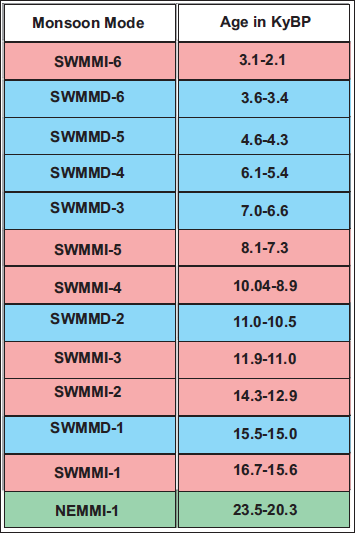
After the LGM, six intervals of strengthening of SWMMI-1-6 during the last 25 KyBP have been detected. These intervals are SWMMI-1 (16.7 KyBP to 15.6 KyBP); SWMMI-2 (14.3 KyBP to 12.9 KyBP); SWMMI-3 (11.9 KyBP to 11.0 KyBP); SWMMI-4 (10.04 KyBP to 8.9 KyBP), SWMMI-5 (8.1 KyBP to 7.3 KyBP) and SWMMI-6 (3.1 KyBP to 2.1 KyBP). Such intervals of enhanced Southwest Monsoon modes are bridged by decreased strength of SWMM occurring at SWMMD-1 (15.5 KyBP to 15.0 KyBP); SWMMD-2 (11.0 KyBP to 10.5 KyBP); SWMMD 3 (7.0 KyBP to 6.6 KyBP); SWMMD-4 (6.1 KyBP to 5.4 KyBP); SWMMD-5 (4.9 KYBP to 4.3 KyBP); and SWMMD-6 (3.6 KyBP to 3.4 KyBP) (Figure 9). We have observed a good correlation between Western Arabian Sea monsoonal wind-induced upwelling and precipitation over the Andaman Sea. Only during the Middle to late Holocene, the western Arabian Sea recorded the strengthening of NEMMI. However, in the Andaman Sea, we have observed the shoaling of the thermocline due to no fresh water supply, which suggests no rainfall due to weakening of the Indian monsoon wind modes. Volcanic eruption from Barren Island during the last 25 KyBP (four events) might have affected the local rainfall in the Andaman Sea region; more studies are required to confirm this. The PMEs in the Andaman Sea might have also been related to Volcanic eruptions from Barren Island, but more data will be required to confirm this.
Summary of Southwest Monsoon Mode Increase and Decrease with ages in Ky BP. One event of the Northeast Monsoon Mode Increase has also been given.
Footnotes
Acknowledgement
AKS thanks Prof. Mukund Sharma for inviting the authors to contribute a manuscript for the Platinum Jubilee volume of the Palaeontological Society of India and also thanks Late Prof. R. Ramesh for providing the core and other infrastructural support. AKS and DKS thank the Delhi School of Climate Change and Sustainability and the Department of Geology for infrastructural support. KB and DC thank the Department of Geology for its assistance. PKN and KRM thank Utkal University for providing necessary facilities. AS acknowledges the Department of Geology, MLSU, for logistical support. AKS conceived the research problem and wrote the manuscript. AS carried out the PCA analysis. PKN and KRM conducted planktic foraminiferal census counting, while KB and DC provided technical assistance. DKS helped draft the manuscript and offered constructive suggestions.
Declaration of Conflicting Interests
The authors declared no potential conflicts of interest with respect to the research, authorship and/or publication of this article.
Funding
The authors disclosed receipt of the following financial support for the research, authorship and/or publication of this article: This research was supported by the Ministry of Earth Science Palaeoclimate Programme, Government of India (Sanction No. MoES/CCR/Paleo-4/2019).
