




Abstract
The Earth’s climate has many rhythms and pulses and behaves differently on longer and shorter scales depending on the changing boundary conditions. Contrasting climatic shifts on short time scales often characterise the long-term mean state of the Climate. The Tropical Pacific Mean State climate has been alternatively dominated by El Niño-like and La Niña-like conditions. Long-term El Niño-like conditions have been termed permanent El Niño, El Niño State, or El Padre (EP), spanning several thousand years. The Western Pacific Warm Pool (WPWP) responds to EP conditions by changing upper ocean hydrography. We used depth-stratified planktic foraminiferal relative abundance to characterise the changing hydrography of the WPWP over the last 6 million years and its impact on the variability of the strength of the Leeuwin Current (LC) in the Eastern Indian Ocean, which the WPWP influences via the Indonesian throughflow (ITF). Six EP events centred around 6.2-6.0 Ma, 3.6 Ma, 2.8 Ma, 2.3-2.3 Ma, 1.8 Ma and 0.4 Ma have been detected. These EP events are bridged by La Niña State-1 (6.0-4.2 Ma), La Niña State-2 (3.0 Ma), La Niña State-3 (2.6-2.0 Ma) and La Niña State-4 (1.4-1.0 Ma) events. The effect of the EP event in the Eastern Indian Ocean has been transmitted through the ITF, affecting the strength of the LC. The most influential EP events affecting the Eastern Indian Ocean have been EP-3, EP-4, EP-5 and EP-6. In general, the Eastern Indian Ocean responds to the EP events with a general reduction in the strength of the LC.
INTRODUCTION
The Late Neogene-Quaternary interval (late Messinian to Holocene), spanning approximately 6.5 million years, has witnessed many remarkable climate changes on a global scale that have impacted regional climates worldwide. Such spectacular climate changes have been driven by various factors, including the opening and closing of ocean gateways, greenhouse forcing, orbital forcing and the reorganisation of world ocean circulation. Some of such key events attributed to plate tectonics have been the Closing of the Indonesian Seaway and the resultant aridification of East Africa (Cane & Molnar, 2001; Srinivasan & Sinha, 1998); Messinian Salinity Crisis (MSC, 5.97–5.33 Ma) due to closing of the strait of Gibraltar (Adams et al., 1977; Bertini et al., 2024; Garcia-Castellanos & Villaseñor, 2011; Ruggieri et al., 1967), the closing of Central American seaway and onset and later intensification of Northern Hemisphere Glaciation (Bailey et al., 2013; Haug & Tiedemann, 1998; Maslin et al., 1996; Mudelsee & Raymo, 2005; Ravelo et al., 2004; Teschner et al., 2016; Zhong et al., 2024). Other notable events attributed to orbital forcing, greenhouse forcing and ocean circulation reorganisation have been Dansgaard-Oeschger cycles (Dansgaard et al., 1983), Heinrich Events (Heinrich, 1988), Bond events (Bond et al., 2001), Younger Dryas (Mangerud, 2021) and Bølling–Allerød Interstadials (Weaver et al., 2003), etc. The ocean circulation and climate of the Indian Ocean were significantly affected by the gradual closing of the Indonesian Seaway (Cane & Molnar, 2001; Srinivasan & Sinha, 2000). The Eastern Indian Ocean, in particular, is most affected as the Indonesian throughflow (ITF) supplies water for the Warm poleward flowing Leeuwin Current (LC), which flows off the coast of Western Australia (Bull & Sebille, 2016; Kundu & McCreary, 1986; Singh & Sinha, 2022). The Eastern Indian Ocean has been affected by global events involving the Late Neogene-Quaternary. Sinha and Singh (2008) and Singh and Sinha (2022) observed a significant faunal turnover in the Eastern Indian Ocean during Northern Hemisphere glaciation. The Eastern Indian Ocean is mainly influenced by its immediate neighbourhood, the Western Equatorial Pacific. It has been a key player in modulating Eastern Indian Ocean circulation and climate in the recent geological past (Gallegher et al., 2009). The Western Equatorial Pacific includes a large Western Pacific Warm Pool (WPWP) from which the Eastern Indian Ocean derives its waters in the form of the upper limb of the Great Ocean conveyor belt (Broecker, 1987, 1992; Guo et al., 2023). The WPWP is one end of the trans-tropical Pacific Seesaw of Thermocline due to the El Niño and La Niña phases (Widlansky et al., 2015).
Modern el Niño Southern Oscillation (ENSO)
ENSO is a phenomenon depicting coupled ocean (El Niño) and atmosphere (Southern Oscillation) interaction occurring every three to seven years (low frequency) and two to three years quasi-biennial (Ren & Wang, 2003). Recent severe El Niño events have significantly impacted the global climate by transferring heat and altering the Hadley Circulation (Feng et al., 2023). The ENSO has a profound influence on the oceanographic and climatic conditions of the Indian Ocean in numerous ways (Kasera & Minocha, 2025; Nair et al., 2018). ENSO has been found to influence the Indian Monsoon. However, there are debates centred on understanding the mechanism of this influence, due to many factors affecting the Indian Monsoon. Several modern ocean circulation studies have established that the El Niño and La Niña events strongly influence the ITF, which connects the WPWP to the Indian Ocean. All such studies agree in general that the ITF geostrophic transport is stronger during La Niña events and weaker during El Niño events (Feng et al., 2018).
Our study aims to understand how the long-term changes in the hydrography of the WPWP, which is influenced by ENSO events, affect the ITF and the strength of the LC. Our purpose in this paper extends beyond WPWP and uses variability of hydrographic conditions in WPWP as a proxy for El Niño conditions. It is established that during El Niño, the WPWP strength weakens and spreads eastward (Feng et al., 2018).
The LC responds to the ENSO signals, which propagate from the WPWP through the ITF north of the western Australian coast. Higher coastal sea levels are transmitted during La Niña years, resulting in a stronger LC and lower sea level during El Niño years, resulting in a weaker LC (Feng et al., 2003; Pattiaratchi & Buchan, 1991).
El Niño variations on a longer time scale
The impact of El Niño on the Eastern Indian Ocean circulation, particularly the strength of the LC during the Quaternary, was documented by Sinha et al. (2006), who identified two important events termed as PL-1 and PL-2 Events of weakening of the LC and attributed the events to occurrence of strong El Niño events at 2.2 and 1.83Ma. Interestingly, De Vleeschouwer et al. (2018) also observed the PL-1 and PL-2 events of Sinha et al. (2006) of weakening of the LC and associated upwelling at the western Australian margin. Though the El Niño-Southern Oscillation (ENSO), a coupled ocean-atmospheric phenomenon, occurs quasi-periodically every 5-7 years, there are claims of having permanent El Niño-like conditions in the Early Pliocene (Fedorov et al., 2006; Wara et al., 2005). These studies revealed that during 5-3 Ma, the average global temperatures were higher, and there were permanent El Niño-like conditions. Wara et al. (2005) estimated the west-to-east sea surface temperature difference across the equatorial Pacific to be 1.5 ± 0.9°C, much like during a modern El Niño event. However, Watanabe et al. (2011) refuted such claims based on oxygen isotopic studies of the corals from the Philippines in the Western Tropical Pacific. These authors believed that the studies of Fedorov et al. (2006) and Wara et al. (2005) had coarse resolution not sufficient to resolve ENSO variability, while the coral records had high-resolution variability (35-year, monthly resolved PWP Porites corals in the Philippines). They also analysed the oxygen isotopic composition of modern corals in an El Niño situation. They applied the Huttonian Principle of ‘Present is the key to the past’. However, both groups agreed that a globally high average temperature marked the Pliocene warm period. Our study also aims to address the debates around the existence of such ‘permanent El Nino-like conditions’.
Importance of El Niño in Global Climate
ENSO has an active and passive role (Liu et al., 2023) in the Global Climate Inventory. Studies are now being conducted to understand variability in El Niño under a global warming scenario. At the same time, some of the past abrupt climate changes have also been attributed to El Niño. Clement et al. (2001) attributed the abrupt climate cooling at Younger Dryas to the outcome of orbitally driven changes in the tropical Pacific induced by El Niño. However, other mechanisms to explain the Younger Dryas cooling events hold firm ground, for example, freshening of the North Atlantic by an outburst of hypothetical Lake Agassiz (Teller, 2013). El Niño influences the climate over the largest Ocean and adjoining Islands. The Walker Circulation is coupled with the variability of the El Niño and affects the large Hadley Cell by strengthening during La Niña or weakening during El Niño. Studies show that during El Niño conditions, a weakening of the Walker cells was correlated with a strengthening of the Northern Hemisphere Hadley cell and a weakening of the Southern Hemisphere Hadley Cell (Gastineau et al., 2009). Thus, El Niño variability has global consequences as Hadley cells transport heat to the higher latitudes and play an active role in the tropical-to-pole connection.
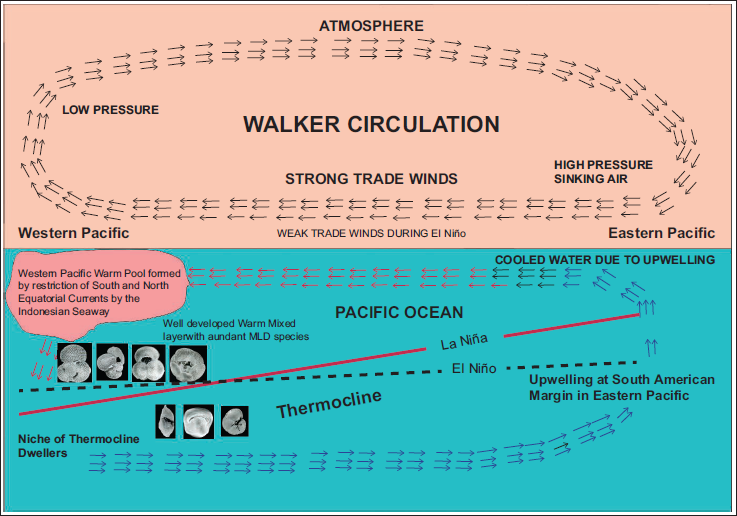
Another aspect of El Niño is the sudden heat release to the global climate system. During the neutral phase or La Niña conditions, the Western Pacific tolerates increasing heat by transferring it to deeper layers, suppressing the thermocline. This creates an inclined upper surface of the thermocline from the Eastern to the Western Pacific (Figure 1). The WPWP maintains a high temperature throughout the neutral or La Niña phase, acting as a heat engine driving Walker Circulation and heavy precipitation in the Western Pacific (Figure 1). During El Niño, the Warm Pool starts spreading towards the east, and the East-West Thermal gradient is decreased, causing the trade winds to weaken, thus fading Walker circulation. At the same time, due to the large surface area now being warmed, the heat dissipates into the atmosphere, causing a massive inventory of heat to be released, soon to spread across the globe. Thus, El Niño has great implications for controlling the global climate in various ways.
Conceptual diagram showing two mean states of the Pacific Ocean. During La Niña State, there is a well-developed water mass stratification in the Western Pacific Warm Pool, and the thermocline is depressed. Under such conditions, the niche of Mixed layer Dweller species is expanded, causing their abundance, while the thermocline dwellers’ population shrinks. The Thermocline depth shows a tilt from eastern to western Pacific, drawn in red colour. The reverse situation occurs during El Niño State (El Padre) when the Warm Pool spreads eastward with weak Walker circulation and thermocline shoals in the Warm Pool region, causing thermocline species abundance and reduced population of mixed-layer dweller species. The thermocline during El Niño (El Padre) is shown by the broken black line.
Constraints in understanding seasonal/short-term changes on a longer time scale
Time averaging in the samples for paleoclimatic studies is a constraint when resolving seasonal (interannual) or quasi-periodic multi-annual variations because a particular sample may contain sediments/microfossils of different ages spanning a few hundred years and may contain several cycles of such short-term changes. Similar problems are encountered while studying paleo-monsoonal variations. To resolve such issues, one needs to have a multi-proxy approach, which sometimes may resolve the problems but sometimes may put the scientific community at a crossroads, just like having a permanent El Niño (Wara et al., 2005; Fedorov et al., 2006, based on Alkenone, Isotope, Mg/Ca foraminifera), or not having a permanent El Niño (Watanabe et al., 2011, based on coral isotope records) during the Pliocene. As technically, El Niño is a phenomenon occurring every three to seven years (low frequency) and two to three years quasi-biennial (Ren & Wang, 2003), one cannot expect the geological samples to resolve individual El Niño or La Niña years as one sample may contain several such cycles. The same approach is used for paleomonsoonal studies, where a dominant SW Monsoon Mode or NE Monsoon Mode is interpreted rather than discussing every monsoon (occurring every year) (Singh et al., 2016). Keeping this in view, various workers used ‘El Niño State’/‘El Niño-like conditions’ to describe its prolonged (permanent) nature (Fedorov et al., 2006; Haywood et al., 2007; Wara et al., 2005; Watanabe et al., 2011). We have used here El Padre (EP) for ‘El Niño State’ (Ford et al., 2015; Shukla et al., 2009) and ‘La Niña State’ to describe the long-term changes in WPWP based on the relative abundance of the depth-stratified planktic foraminiferal assemblages.
Origin of the Western Pacific Warm Pool
The WPWP is crucial in modulating the global climate and defining equator-to-pole thermal gradients. The temperature of the WPWP is the driver of Walker Circulation. Studies have been conducted about the origin of the warm pool, and various dates have been proposed based on an understanding of the water flow restriction through the Indonesian seaway. The temperatures of the WPWP are critical since they also modulate the polar amplification because the WPWP represents the end member with the warmest SSTs for shaping energy budgets (Collins et al., 2010; Liu et al., 2022). Various proxies have been used to determine the temperature variations in the WPWP, including the U37K′ proxy, the foraminiferal Mg/Ca-based proxy and the TEX86 proxy. However, no conclusive consensus has emerged regarding the thermal evolution of the WPWP. Contrasting results were obtained from ODP Sites 806 (0°19.1′N, 159°21.7′E) and 1143 (9°21.72′N, 113°17.11′E), both located in the WPWP region. The TEX86 proxy revealed a long-term cooling (Liu et al., 2022; O’Brien et al., 2014; Zhang et al., 2021), while marine carbonate-based approaches (e.g., Mg/Ca and ∇47) suggested the WPWP was thermally stable since the Pliocene (~5 Ma) (Meinicke et al., 2021; Wara et al., 2005). Thus, the thermal structure and variations in the WPWP have become controversial. Chaisson and Ravelo (2000) tried to resolve such controversy by insisting on faunal (planktic foraminifera) counts. Based on the fact that variation in the relative abundance of individual species is not only dependent on species’ interaction with the physical ambiance, but also on interaction with species in overlapping, adjacent niches (Ricklefs, 1979), Chaisson (1995) preferred to document variations in faunal counts by grouping the species occupying similar habitats. The tropical oceans at low latitudes particularly depict the above conditions where the species diversity of planktic foraminifera is high, and due to low seasonality, the upper ocean is well stratified throughout the year (Chaisson, 1995). Chaisson (1995) grouped the species into three groups: (a) mixed-layer dwellers, (b) thermocline dwellers and (c) deep dwellers. Based on the isotopic depth stratification, the above three groups were termed by Douglas and Savin (1978) as (a) surface dwellers, (b) intermediate dwellers.
Considering the above and many other studies, our approach is to interpret the thermal evolution of the WPWP and relate it to ENSO based on the relative abundance of the depth-stratified planktic foraminiferal assemblages. We used relative abundance variations of (a) Mixed layer Group and (b) Thermocline Group.
Basic premises, hypothesis and selection of cores
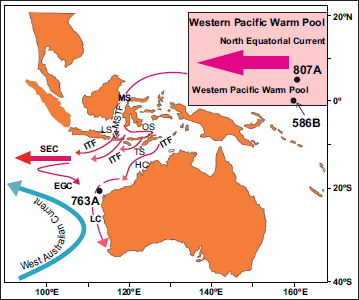
El Niño is a phenomenon that affects the entire Pacific Ocean by allowing the WPWP to spread over the entire tropical Pacific. Additionally, it results in the shoaling of the thermocline in the Western Pacific, reduction in the ITF, and weakening of the LC (Godfrey & Weaver, 1991; Sinha et al., 2006; Weaver, 1990). Thus, we selected one core in the WPWP (DSDP Hole 586B) and one core in the Eastern Indian Ocean (ODP Hole 763A), which is influenced by the ITF (Figure 2), whose detailed planktic foraminiferal biostratigraphy was available (Sinha & Singh, 2008; Srinivasan & Sinha, 1991, 1992).
Location map and oceanographic setup of the studied DSDP Site 586, ODP Sites 807 and 763. The DSDP Site 586 and ODP Site 807 lie in the Western Pacific Warm Pool, while ODP Site 763 lies in the path of the southward-flowing Leeuwin Current. Leeuwin Current is fed by Indonesian throughflow and Eastern Gyral Current (EGC). The blue line with an arrow shows the cold current, and the red lines with an arrow indicate warm currents. LC = Leeuwin Current; HC = Holloway Current; ITF = Indonesian Throughflow, LS = Lombok Strait, OS = Ombai Strait, TS = Timor Strait, MS = Makassar Strait, MSTF = Makassar Strait Throughflow (Modified after Singh and Sinha, 2022).
Modern ocean circulation studies have generally agreed that during La Niña, the Thermocline in the WPWP is well-defined and depressed with the development of a well-stratified water column and warm mixed layer (Figure 1). During El Niño Events, the thermocline in the WPWP shoals. At the same time, it deepens in the eastern Pacific. This causes a seesaw-like up and down of the thermocline in the trans-tropical Pacific (Widlansky et al., 2015). The planktic foraminifera, besides their spatial latitudinal provincialism, are also depth Stratified (Gasperi & Kennett, 1992; Keller, 1985; Stainbank et al., 2019), and paleoceanographers have used their depth stratification to understand the structure of the upper water column (Chaisson & Ravelo, 2000; Srinivasan & Sinha, 2000). During the shoaling of the thermocline in El Niño conditions, one would expect a larger population of Thermocline Dwellers at site 586B due to the vertical expansion of their niche, and during La Niña conditions, a smaller abundance of thermocline dwellers when the water column is stratified. During the well-stratified water column, the Mixed layer oligotrophic species will proliferate, and during the shoaling of the thermocline, the oligotrophic mixed layer species should decline at site 586 B. The Eastern Indian Ocean generally responds to El Niño and La Niña conditions by reducing and enhancing the LC’s strength (Feng et al., 2003; Pattiaratchi & Buchan, 1991).
Considering the debates regarding whether or not Permanent El Niño conditions existed in the Pliocene Warm Period and the importance of El Niño in Global Climate, we investigated the variability of El Niño during the last 6 million years, which includes the WPWP (Site 586B). As mentioned earlier, the debates have mostly been centred around the data generated either from foraminiferal stable isotope, Mg/Ca, or stable isotopes of Corals; we feel that some strong third proxy, that is foraminiferal census counts, should be used to document the variability of El Niño during the last 6 million years. The faunal response to the changing upper ocean hydrography has been a reliable tool. It can be used as an additional tool to support/negate the results obtained from geochemical analyses. The time averaging of the samples introduces inherent errors in stable isotope results or Mg/Ca results, and such errors can be avoided when analysing significant changes in water mass-sensitive or depth-stratified assemblages (Sinha et al., 2006).
MATERIALS AND METHODS
The Planktic foraminiferal census counts for DSDP Hole 586B were taken from Srinivasan and Sinha (1998). The processed samples using standard IODP protocols were split into 300 or more individuals using a micro splitter for census counting. Individual species were identified using a taxonomy of Kennett and Srinivasan (1983) and Bolli and Saunders (1985). The number of individuals of each planktic foraminiferal species was converted into a percentage of the total assemblage. The species were grouped into the Mixed layer Dweller Group and Thermocline Dweller Group based on the depth stratification data from Keller (1985), Gasperi and Kennett (1992), Srinivasan and Sinha (2000) and Stainbank et al. (2019). The Mixed Layer group at both sites includes Globigerinoides ruber, Globigerinoides quadrilobatus, Globigerinoides sacculifer, Globigerinoides triloba and Dentoglobigerina altispira. The Thermocline Dweller Group at both sites includes Pulleniatina primalis, Pulleniatina praecursor, Pulleniatina obliquiloculata, Pulleniatina spectabilis (only at 586B), Globorotalia menardii and Globorotalia tumida. Temporal resolution in this study is 100 Ka.
Age Model for DSDP Hole 586B and ODP Hole 763A
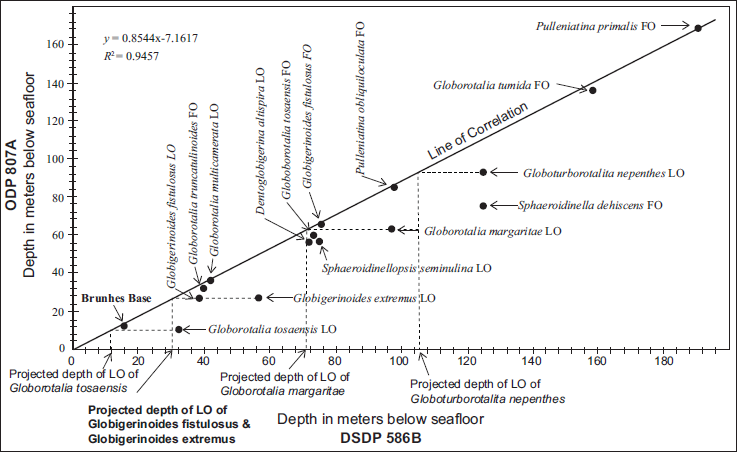
Palaeoceanographic studies of the deep-sea core require a robust time framework to fix the timing of the Paleoceanographic events. The detailed planktic foraminiferal biostratigraphy integrated with magnetochronology developed the age model for both Holes for the last 6 million years. For DSDP Hole 586B (00°29.84’S; 158°29.89’E detailed planktic foraminiferal biostratigraphy by Srinivasan and Sinha (1991, 1992) was taken as base data. As the only available paleomagnetic event at this Hole is the base of Brunhes (Barton & Bloemendal, 1986), we graphically correlated (using Shaw Plot, Shaw, 1964) with a nearby ODP Hole 807A (3°36.42’N, 156°37.49’E) situated in the same water mass in WPWP for which a detailed planktic foraminiferal biochronology was available (Figure 3) (Kaushik et al., 2020). The Line of correlation using planktic foraminiferal events yielded a good correlation (R2 = 0.9457). The depth of a few planktic foraminiferal events was corrected by linear extrapolation. The absolute ages of planktic foraminiferal events determined at ODP Hole 807A (Kaushik et al., 2020) were used to determine the absolute ages of planktic foraminiferal events at DSDP Site 586 B. The age data points vs. depth were linearly extrapolated to get the depth vs. age of all the samples for which the census counting was done for DSDP site 586B. For ODP Hole 763A, a detailed planktic foraminiferal biostratigraphy integrated with magnetostratigraphy is available (Sinha & Singh 2008), with modified numerical ages of paleomagnetic chrons from (Singh & Sinha, 2022).
Shaw plot of Planktic foraminiferal events between ODP Hole 807A and DSDP Hole 586B, Western Equatorial Pacific. The Line of Correlation (LOC) has been positioned by linear regression (R2 = 0.9457) and palaeontologists’ assessment of the species’ preference for water mass. Depth of Last Occurrence (LO) of Globorotalia tosaensis, Globigerinoides extremus, Globorotalia margaritae and Globoturborotalia nepenthes have been corrected at Site 586B, assuming that the LOC represents a true correlation (R2 = 0.9457). The First Occurrence (FO) falling towards the right of LOC represents a maximum range of species at Site 586B, and thus, they have not been corrected. The new set of depths has been assigned ages after linear extrapolation between ODP Site 807A and DSDP Site 586B following Kaushik et al., 2020).
RESULTS
Relative abundance of depth-stratified planktic foraminiferal assemblages at DSDP Hole 586B (Western Equatorial Pacific) and ODP Hole 763A, Eastern Indian Ocean
The relative abundance of depth-stratified planktic foraminiferal species has been plotted against age at the Holes DSDP Site 586B (Western Equatorial Pacific) and ODP Hole 763A (Eastern Indian Ocean). The record of Thermocline Dwellers shows several intervals of enhanced abundance at DSDP Hole 586B designated as EP events, shown in Figure 4. These events are centred around 6 Ma (EP-1), 3.6 Ma (EP-2), 2.8 Ma (EP-3), 2.2 Ma (EP-4), 1.83 Ma (EP-5) and 0.45-0.35 Ma (EP-6). These intervals are bridged by the low relative abundance of the thermocline dwellers and the high abundance of mixed-layer dwellers.
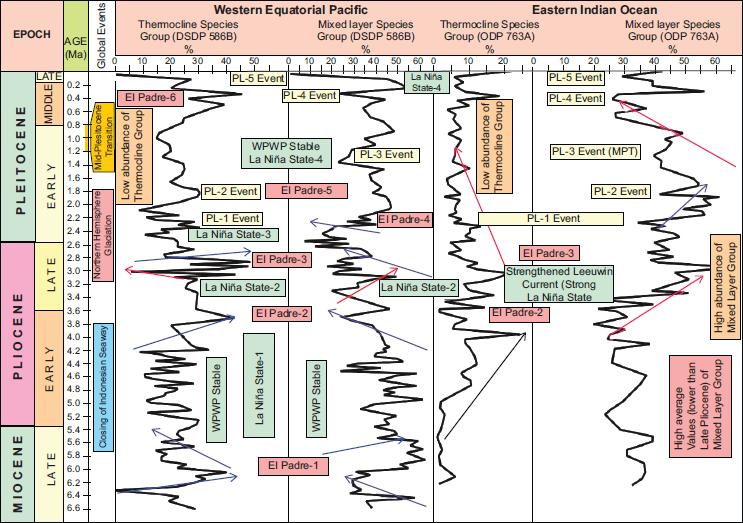
At ODP Hole 763A, significant trends in Thermocline and Mixed layer Dwellers have been observed. From 6 Ma to 3.9 Ma, there is a general increase in the relative abundance of the thermocline dwellers and a low abundance of the Mixed Layer Group. This roughly corresponds to EP-1 and EP-2 observed in the Western Equatorial Pacific. From 3.6 Ma onwards, a remarkable increasing trend is observed in the Mixed Layer Group till 1.83 Ma. During this interval, the Thermocline dwellers show a generally low abundance. From 1.83 Ma onwards, the Mixed layer group shows an overall decreasing trend with intermittent peaks of low abundance bridged by gradual increasing trends. The Thermocline dwellers show low abundance throughout this interval, with small peaks of high abundance at 3.9 Ma, 3.3 Ma, 3.0 Ma, 0.4 Ma and 0.04 Ma.
DISCUSSION
Earth’s climate has responded to changing boundary conditions during the Late Neogene -Quaternary. Starting with the MSC due to the restricted connectivity between the Atlantic and the Mediterranean as a result of tectonic uplift of the Gibraltar arc seaway (Garcia-Castellanos & Villaseñor 2011) followed by major tectonic events like closing of the tropical seaways including closing of Indonesian Seaway in Early Pliocene (Srinivasan & Sinha, 1998) and resulting East African aridification (Cane & Molnar, 2001) and Closing of the Central American Seaway in Late Pliocene (Haug & Tiedemann, 1998) and resulting Northern Hemisphere Glaciations. Though conflicting views on the tectonic and climate connectivity exist, there is consensus on significant changes in Earth’s climate through proxy records. Another aspect of long-term climate change has been the Earth acquiring a ‘mean state’ of climate during which contrasting climate events of short durations occur. The most common examples are the Glacial and Interglacial Stages, which contain several small episodes of interstadials and stadials, respectively. Singh et al. (2016) used the term Monsoon Mode to describe the mean state of the Indian Monsoon, dominated by either Southwest or Northeast monsoons, termed as Southwest Monsoon Mode and Northeast Monsoon Mode, respectively. In addition, the proxy-based research has shown that during the Pliocene, the climate of the Earth has also acquired ‘permanent El Niño-like conditions’ (Fedorov et al., 2006; Molnar & Cane, 2002; Wara et al., 2005), termed as ‘El Niño State’ or ‘El Padre’ (Ford et al., 2015; Shukla et al., 2009). This term describes the prolonged mean state of the ocean-atmosphere system (Brierley et al., 2009). Such conditions differ from the modern, intermittent El Niño, a quasi-periodic phenomenon due to ocean-atmosphere coupling occurring every four to seven years (Philander, 1990). Gallagher et al. (2024) used ‘El Niño-like’ and ‘La Niña-like’ terms, each spanning a few million years, to depict climate mean states occurring for the last 35 million years against global sea levels and the state of ITF. Researchers have used various proxies to understand the long-term mean state of the tropical Pacific. Such ‘mean states’ are resolvable by investigating the oceanic microfossil records, as the biotic community (species groups) takes longer to populate/decline in response to favourable/unfavourable conditions in its ecological niche.
The relative abundance of the Mixed layer Group and the Thermocline Group has been plotted against time for DSDP Hole 586B and ODP Hole 763A (Figure 4). Here we have used the terms EP for ‘El Niño State’ and ‘La Niña State’ to describe the mean state of the WPWP based on the premise that during ‘El Padre’ the thermocline in the WPWP shoals and the population of the Thermocline Group increases considerably as compared to the Mixed Layer Group that shows a decline in its relative abundance. Reverse conditions described as ‘La Niña State’ are interpreted based on decreased relative abundance of the Thermocline group and increased abundance of the Mixed layer group due to a well-stratified water column in the WPWP with a thick Mixed Layer and depressed thermocline. The above premises were also used to understand changing hydrography of the upper ocean water column in the tropical Pacific by Chaisson and Ravelo (2000) and in the Eastern Indian Ocean by Sinha et al. (2006). In grouping the Mixed layer and Thermocline assemblage, we have used the same set of species for DSDP Hole 586B (WPWP) and ODP Hole 763A (Eastern Indian Ocean).
Our data shows that during the Late Miocene, ~6.2-6 Ma, a strong El Niño State is indicated by a remarkable increase in the Thermocline Group and a decline in the Mixed layer group at DSDP Hole 586 B. We term it as EP-1. Chaisson (1995) also observed a decline in the Thermocline Group during 6.5 to 4.5 Ma at a nearby ODP Hole 806 (0°19.11’N, 159°21.68’E), though his faunal counts were done at very low resolution (one sample per core) while our resolution is far better (six samples per core). Gallagher et al. (2024) in their Figure 6 showed an ‘El Niño-like’ condition from 9.5 to 6.5 million years. Development of a proto–WPWP was also envisaged by Gallagher et al. (2024) from 9.5 to 6.5 Ma, probably due to the initial restriction of passage of Pacific waters to the Indian Ocean through the Indonesian Seaway. Our Eastern Indian Ocean data shows no significant trend in the relative abundance of both groups during this interval. Holbourn et al. (2018) also concluded that the Late Miocene witnessed an EP situation, though the period was cool with low atmospheric pCO2 levels. This was intriguing as the decoupling between climate warmth (EP) and atmospheric pCO2 variations raised questions on the linkage between warm climates and the role of pCO2 as a controlling factor in different mean states (Holbourn et al., 2018; LaRiviere et al., 2012; Ruddiman, 2010).
After 6 Ma and till 4.2 Ma in the Early Pliocene, there is a significant decline in the Thermocline Group at DSDP Hole 586 B. During this interval, the mixed layer group showed a high abundance. This is interpreted as the establishment of a well-developed WPWP with strong water mass thermal stratification and has been termed as La Niña State-1. Interestingly, this duration is represented by an increase in the abundance of the Thermocline Group in the Eastern Indian Ocean, and the Mixed Layer group continues to have higher values without any significant trend as recorded in the Late Miocene. We consider this a stable WPWP (La Niña State) phase. Srinivasan and Sinha (1998), based on the biogeographic distribution of planktic foraminiferal species Pulleniatina spectabilis, from DSDP Hole 586B and other tropical Pacific Sites and comparison with Indian Ocean site 214, interpreted the closing of the Indonesian seaway between 5.6 and 4.2 Ma. Later, these authors (Srinivasan & Sinha, 2000) based on stable oxygen and carbon isotope analyses of Pulleniatina spectabilis and its comparison with isotopic values of D. altispira and Gs. Sacculifer (Mixed layer Dwellers) concluded that Pu. spectabilis was a thermocline dweller, and the Indonesian Seas restricted the passage of thermocline waters from the Pacific to the Indian Ocean, while the surface water continued to flow. The Eastern Indian Ocean record of depth-stratified assemblage shows a high abundance of the Mixed layer group. However, the gradual increase in the thermocline group in the later part of this interval (6-4.2) Ma indicates a gradual deepening of the Indonesian gateway sills with time, allowing thermocline waters from the WPWP to pass through the Indonesian seas.
Around 3.6 Ma near the Early-Late Pliocene boundary, we observe a surge in the relative abundance of the Thermocline Group at DSDP Hole 586 B. This is consistent with a reduction in the mixed layer group, indicating shoaling of the thermocline in the WPWP. We term this EP-2 in our faunal proxy record for prolonged El Niño. In the Eastern Indian Ocean, this event is marked by reduced thermocline dwellers, indicating less supply of thermocline waters to the LC. However, the LC also derives its water from the Eastern Gyral Current (EGC) in the Indian Ocean, which might also be responsible for supplying more thermocline waters as a result of shoaling of the thermocline in the Indian Ocean (Podder et al., 2021).
A drastic change in faunal trend is observed after 3.6 Ma in both regions. The WPWP faunal data shows a sharp reduction in the relative abundance of thermocline dwellers, indicative of a strong La Niña State. The thermocline dwellers reduce from ~45% to ~5%. We have termed this La Niña State-2 (at 3.0 Ma). During this interval, the mixed layer group also showed a remarkable increase from 20% to 50%, indicating a well-stratified upper ocean in the WPWP. In the Eastern Indian Ocean, the thermocline dwellers continue the same abundance through a slow increase, but the Mixed layer group shows a significant increasing trend from 20% to ~55 %. This La Niña State-2 with a well-developed WPWP was possibly responsible for strengthening the warm LC with a stratified water column, favouring the growth of Mixed Layer Dwellers in the Eastern Indian Ocean. It has been observed in modern oceans that during strong La Niña events, the WPWP becomes stronger, causing an increase in ITF and the strength of the LC (Zinke et al., 2014). Rickaby and Halloran (2005) also observed this La Niña-like condition during the Pliocene Warmth based on isotopic analyses of planktic foraminifera. This event is intriguing as this whole interval (5-3 Ma) was termed a ‘permanent El Niño-like condition’ (Fedorov et al., 2006; Wara et al., 2005). Thus, interpretations from our faunal count suggest that the ‘permanent El Nino like condition’ described by Fedorov et al. (2006) and Wara et al. (2005) was interrupted by a brief La Niña State (3.0 Ma) during the Pliocene Warmth.
Followed by La Niña Stat -2 is EP State-3, as recorded by a drastic increase in the relative abundance of the Thermocline Group at DSDP Hole 586 B. This is a very short but distinct interval in which the Mixed layer group decreases drastically in number from ~50% to 15 %. In the Eastern Indian Ocean, this interval is marked by a decrease in the relative abundance of thermocline and Mixed layer dwellers. However, the latter maintains a higher average value, indicating only a mild reduction in the strength of the LC. EP-3 occurs roughly at 2.8 Ma. Based on our record, we see that the permanent El Niño-like conditions of Fedorov et al. (2006) and Wara et al. (2005) seem to be our combined EP-2 and EP-3, with an intermittent La Niña State-2, as also reported by Rickaby and Halloran (2005). De Vleeschouwer et al. (2018) also observed an unusually short glaciation interrupting the warm Pliocene around 3.3 Ma (Marine Isotope Stage (MIS) M2). Thus, we conclude that the Pliocene’s so-called ‘Permanent El Nino Like Condition’ was not continuous and witnessed a contrasting climate of a La Nina-like state.
From 2.6 Ma to 2 Ma, there is a remarkable decline in the relative abundance of Thermocline dwellers at DSDP Hole 586 B, defining a strong La Niña-like condition. This is a long-term decline from values close to 50% to 15%, termed La Nina State-3. This long-term trend is, however, bridged by a short EP-4 event at 2.2 Ma, indicated by high values of thermocline dwellers ~30%. This EP event (EP-4) at 2.2 Ma is recorded in Eastern Indian Ocean ODP Hole 763A as PL-1 Event (Sinha et al., 2006). This is marked by a low abundance of mixed-layer species and a moderate increase in Thermocline Dwellers. Sinha et al. (2006) identified this event based on the abundance of upwelling indicator species at 2.2 Ma. The explanation given by Sinha et al. (2006) was based on the fact that in the modern ocean, the LC suppresses any upwelling to occur at the west Australian Margin despite equatorward wind. Whenever the LC has become weak due to El Niño-like conditions, the upwelling dominates at this margin, causing upwelling indicator species to increase their abundance. The same explanation is given for the PL-2 event (1.83 Ma) in the Eastern Indian Ocean. De Vleeschouwer et al. (2018) also noted the PL-1 and PL-2 events of Sinha et al. (2006) but attributed the events to a lowered sea level caused by the glacial event (MIS M2 glacial event). Though Sinha et al. (2006) interpretation of an El Niño-like event weakening the LC and causing increased upwelling was based on logic and understanding of the factors that control the strength of the LC, those interpretations are verified in this study by noticing an increase in Thermocline Dwellers in WPWP (EP-4 and EP-5) corresponding to Pl-1 and PL-2 events, respectively. The PL-3 event of upwelling in the Eastern Indian Ocean is not matched with any El Niño event recorded from WPWP Hole DSDP 586 B. Sinha et al. (2006) interpreted the PL-3 event as a glacial event, as they recorded an increased abundance of temperate planktic foraminiferal species, Globoconella group. These glacial events probably lowered the sea level, causing diminishing strength of the LC due to reduced ITF, and during these three events, upwelling indicator species dominated. However, the last EP event (EP-6) at 0.4 Ma, marked by a significant increase in the relative abundance of Thermocline Dwellers at DSDP Hole 586 B from 15% to 45%, coincides with the PL-4 (0.4 Ma) event recorded in the Eastern Indian Ocean. Thus, the PL-4 event of reduced strength of LC in the Eastern Indian Ocean was a combination of lowered sea level due to a glacial event and an El Niño event. In the Eastern Indian Ocean, this is coeval with a reduced abundance of the Mixed Layer Group declining from ~40 to ~20%. The last significant event observed is the PL-5 event in the Eastern Indian Ocean, which is indicated by decreased abundance of Mixed layer Dwellers and Thermocline in the Eastern Indian Ocean and low abundance of Thermocline dwellers and high abundance of Mixed layer group in the Western Pacific Shole 586 B, indicating a stable WPWP.
Stable isotope record
DSDP 586B
Whitman and Berger (1992) provide a brief inventory of oceanographic changes in the Western Equatorial Pacific DSDP Site 586, during the past 6 million years inferred from oxygen isotopic analyses of planktic and benthic foraminifera. These authors analysed planktic foraminiferal species Globigerinoides sacculifer and Pulleniatina, benthic foraminiferal species Cibicidoides wuellerstorfi, and Oridorsalis umbonatus. They noted three intervals of decrease in δ18O values in planktic foraminifera at 4.0 Ma, an increase at 3.4 Ma, and a decrease at 2.8 Ma. A comparison of benthic and planktic isotopic records showed that at 4.0 Ma, the surface waters warmed in the Western Pacific. At the same time, there was no change in bottom water temperatures, as revealed by no change in benthic isotopic values. In our faunal record at DSDP 586 B, this event marks the La Niña State-1 and corroborates with isotopic data of a warm, well-stratified Mixed layer. The next important isotopic event is recorded at ~3.4 Ma, which shows high values of δ18O of planktic foraminifera and cooling of surface waters. However, this record is not mirrored by benthic isotope values showing bottom water warming, as there is no change in benthic foraminifera isotopic values. This event is almost comparable to our EP-2 when the WPWP cooled due to the shoaling of the thermocline. A minor difference in chronology is expected as our data is based on recent paleomagnetic stratigraphic calibration. The last isotopic enrichment occurred in planktic and benthic foraminifera around 2.8 Ma. This is matched by our faunal data showing the EP-3 event when WPWP cooled due to shoaling of the thermocline. Thus, our faunal data is in large agreement with the oxygen isotopic record at DSDP Site 586B provided by Whitman and Berger (1992).
ODP 763A
Sinha et al. (2006) analysed planktic foraminiferal δ18O and δ13C of Mixed Layer and Thermocline dwellers at ODP 763A. The δ18O record of shallow surface dweller Globigerinoides sacculifer constantly shows a decline throughout the Early Pliocene, indicating that surface waters became warmer after the beginning of the Pliocene and remained warm during the entire Early Pliocene. Our faunal data shows nearly 30% of the mixed layer group during the early Pliocene period, indicating a well-stratified water column in the eastern Indian Ocean. The biological productivity would be low during the intervals represented by a well-stratified water column differentiated into a mixed layer and a thermocline. Thus, less 12C will be used by the surface planktons, making δ13C gradually lower with increasing water column stratification. In the present work, this interval is described as La Niña State-1. There can be alternate explanations other than WPWP variability for the strengthened LC and well-stratified water column during the Early Pliocene. Earlier studies have shown that during the Early Pliocene, 5 to 3 million years ago, globally averaged temperatures were substantially higher than they are today, even though the external factors determining climate were essentially the same (Fedorov et al., 2006). These authors summarised this early Pliocene warming as the Pliocene paradox because the intensity of sunlight incident on the Earth, the global geography, and the atmospheric concentration of carbon di oxide were essentially what they are today but surface temperatures in high latitudes were so much higher that continental glaciers were absent from the northern hemisphere and sea levels were approximately 25 meters higher than today (Crowley, 1996; Dowsett et al., 2005; Raymo et al., 1996). The WPWP must have shared this higher sea level, strengthening the LC and nullifying the effect of a permanent El Niño-like Condition (EP) during the Early Pliocene as Fedorov et al. (2006) described.
In general, the Late Pliocene and Pleistocene isotopic and faunal record is distinguished by high amplitude of fluctuations from average values, in contrast to low amplitude of fluctuations in the latest Miocene and early Pliocene, indicating alternation of extreme conditions in surface water palaeoceanography. The warming episode of the early Pliocene with well-stratified oligotrophic surface waters seems to have continued in the early part of the Late Pliocene, exhibiting low average values of δ18O of the surface dweller Globigerinoides sacculifer and Gs. ruber. From ~ 2.1 Ma onwards, there is clear evidence of gradual cooling of the thermocline waters as revealed from the gradual shift in the δ18O record of the thermocline dweller Globorotalia menardii. This cooling of thermocline waters is also accompanied by cooling surface waters, suggested by a stepwise increase in the δ18O record of the surface dwellers Gs. sacculifer and Gs. ruber. Overall average values of δ18O are higher in the late Pliocene and Pleistocene, indicating calmer surface waters during this interval.
De Vleeschouwer et al. (2018) presented an isotopic record for Site U1463 in the Eastern Indian Ocean. These authors also observed that the LC remained sufficiently strong during MIS M2 (3.3 Ma) to suppress an upwelling-induced surface cooling or increase in salinity. However, a temporary reduction in the LC noticed by De Vleeschouwer et al. (2018) at U 1463 was correlated to a ∼0.5‰ _increase in δ18Osacculifer, identified in Early Pleistocene strata at Site 763A by Sinha et al. (2006). These authors denoted these events as PL-1 (2.22 Ma) and PL-2 (1.83 Ma) events (EP-4 and EP-5 in this work), reporting evidence for upwelling at these times. Though De Vleeschouwer et al. (2001) agreed with the interpretation of Sinha et al. (2006), the causative factors proposed by Vleeschouwer et al. differed. Sinha et al. (2006) associated the PL-1 and PL-2 events with weakening of heat transport through the ITF due to lowering sea level as a result of prolonged El Niño but De Vleeschouwer et al. (2018) postulate an eustatic sea level fall as the originator of the observed paleoceanographic change across the MIS M2 glacial event.
CONCLUSIONS
WPWP has responded to long-term changes in the mean state of the Tropical Pacific climate modulated by prolonged El Niño and La Niña events. Such long duration means state of climate have been variously termed ‘El Niño Like’ events; ‘permanent El Niño events’ ‘permanent El Niño like conditions’ and ‘El Padre’ events by various workers who generally agreed that such prolonged events are different from intermittent El Niño events occurring quasi periodically every four to seven years.
The WPWP experienced a shoaling of the thermocline during such EP events, indicated by proliferation in thermocline-dwelling planktic foraminifera and reduced abundance of the Mixed Layer species group due to loss of water mass stratification and thinning of the Mixed Layer. A 6-million-year planktic foraminiferal census record from DSDP Hole 586B situated in WPWP shows Six EP events centred around 6.2-6.0 Ma (EP-1), 3.6 Ma (EP-2), 2.8 Ma (EP-3), 2.3-2.3 Ma (EP-4), 1.83 Ma (EP-5) and 0.4 Ma (EP-6). These EP events are bridged by La Niña State-1 (6.0-4.2 Ma), La Niña State-2 (3.0 Ma), La Niña State-3 (2.6-2.0 Ma) and La Niña State-4 (1.4-1.0 Ma) events.
The effect of the EP event in the Eastern Indian Ocean has been transmitted through the ITF, affecting the strength of the LC. The most influential EP events affecting the Eastern Indian Ocean have been EP-4, EP-5 and EP-6. In general, the Eastern Indian Ocean responds to the EP events by reducing the strength of the LC.
Our data reveals that the ‘permanent El Nino-like conditions’, in the Pliocene described earlier, are interrupted by a brief La Nina-like state.
Footnotes
Acknowledgements
AKS and DKS thank the Department of Geology and the Delhi School of Climate Change and Sustainability, IoE, for infrastructural support.
DKS also thanks Professor Mukund Sharma for inviting us to contribute a manuscript for the Platinum Jubilee volume of the society.
DC and KB thank the Department of Geology, University of Delhi, for logistical support.
Author’s Contribution
AKS and DKS conceived the research problem.
DKS made faunal counts.
AKS and DKS wrote the manuscript.
DC and KB helped make the figures, and provided other diverse technical assistance.
Declaration of Conflicting Interests
The authors declared no potential conflicts of interest with respect to the research, authorship and/or publication of this article.
Funding
The authors disclosed receipt of the following financial support for the research, authorship and/or publication of this article: This research was funded through the Palaeoclimate programme of the Ministry of Earth Sciences, Government of India (Sanction No. MoES/CCR/Paleo-4/2019).
