




Abstract
The Benguela Upwelling System (BUS) is one of the world’s major coastal upwelling zones, playing a critical role in regional marine productivity and global climate modulation due to its influence on interoceanic exchanges between the Indian and Atlantic Oceans. This study presents a comprehensive million-year palaeoceanographic reconstruction of the southern BUS by examining planktic foraminiferal assemblages and stable oxygen isotopes from Ocean Drilling Programme (ODP) Hole 1085A, located in the mid-Cape Basin of the southeastern Atlantic. Our multiproxy analysis—including dominant species Neogloboquadrina pachyderma (Dex), Globigerina inflata and the Agulhas Leakage Fauna (ALF)—reveals three distinct phases of upwelling evolution: latest Early Pleistocene intense and sustained upwelling (1000–800 kyr), middle Pleistocene transition with marked oligotrophic events and system reorganisation (800–400 kyr), and the development of pronounced glacial–interglacial cyclicity in the Late Pleistocene (400 kyr-present). Results indicate that the latest Early Pleistocene upwelling was both more intense and stable than in later periods, coinciding with the dominance of obliquity-driven climate cycles. The middle Pleistocene records show dramatic shifts, including the near-collapse of upwelling and the northward migration of oceanic fronts during the mid-Pleistocene transition. In the Late Pleistocene, upwelling intensity tracks glacial cycles, with intensified activity during glacials and reduced Agulhas Leakage indicative of complex interplay between trade winds, oceanic fronts and global ice volume. We demonstrate that interoceanic exchange via the Agulhas Leakage, tightly coupled to upwelling variability and larger-scale climate processes, has profoundly shaped the evolution of the BUS and its role in the Atlantic Meridional Overturning Circulation over the past million years.
Keywords
INTRODUCTION
The upwelling of cold, nutrient-rich waters driven by eastern boundary currents plays a crucial role in marine biological productivity and global climate dynamics. Among the four major upwelling systems—California, Canary, Humboldt and Benguela—the Benguela Upwelling System (BUS), located in the southeastern Atlantic along Africa’s southwest coast, is particularly significant. It is influenced by warm waters from the central Atlantic through the Angola Current and from the Indian Ocean through the Agulhas leakage, highlighting its key role in interocean exchange between the Indian and Atlantic Oceans. Studies have shown that the BUS, through interoceanic exchange, directly impacts the strength of the Atlantic Meridional Overturning Circulation (AMOC) (Beal et al., 2011; Caley et al., 2014; Martínez-Méndez et al., 2010; Peeters et al., 2004). Understanding the evolution and interplay of Benguela upwelling and interoceanic exchange between the Indian and Atlantic Oceans is essential for assessing their role in global climate change.
Over the past one million years, Earth’s climate has undergone significant changes, particularly during the mid-Pleistocene transition (MPT), when glacial–interglacial cycles shifted from occurring every 41,000 years to every 100,000 years (Pisias & Moore, 1981). This shift began around 1.2 million years ago (Clark et al., 2006), though some studies suggest it may have started closer to 0.9 million years ago (Berger & Jansen, 1994; Mudelsee & Schulz, 1997; Raymo et al., 1997). Interestingly, this change occurred without significant changes in Earth’s orbital forcing (Tabor & Poulsen, 2016), suggesting that the climate system had become more sensitive to variations in orbital forcing. One possible explanation is a gradual decline in atmospheric CO2 levels (Legrain et al., 2023; Raymo, 1997). However, due to the lack of CO2 records before ~0.8 million years ago—when the oldest Antarctic ice cores begin (Bartoli et al., 2011; Hönisch et al., 2009; Lüthi et al., 2008)—the full extent of this decline remains uncertain. Some studies even challenge the hypothesis of long-term CO2 reduction over the past 1.2 million years (Ma) (Hoogakker et al., 2006), suggesting that even minor CO2 variations, coupled with climate sensitivity and feedback mechanisms such as ice-albedo effects, could have contributed to glacial intensification. However, few studies have explored the evolution of the southern BUS over the past 500 ka (Chen et al., 2002; Giraudeau et al., 2001; Little et al., 1997; Peeters et al., 2004; Schmidt, 1992; West et al., 2004). The present study uniquely extends this record to 1 million years (Ma), providing new insights into the long-term interplay between upwelling dynamics and interoceanic exchange. Given its sensitivity to both wind-driven upwelling and interoceanic heat and salt transport, the BUS provides an ideal setting to assess how large-scale climatic reorganisations—such as the MPT—manifest in regional ocean circulation. As passive surface dwellers, planktic foraminifera are responsive to shifts in surface oceanic hydrography, making their fossil record a powerful proxy for reconstructing past ocean circulation, upwelling intensity and interoceanic exchange. The Benguela Current (BC) is driven by the prevailing South-Easterly trade winds of the South Atlantic Ocean, causing intense upwelling of cold water. At the same time, the position of the subtropical front (STF) governs the influx of warm, saline Indian Ocean waters into the region. This study reconstructs the evolution of the southern BUS over the past one million years using multiproxy evidence from Ocean Drilling Programme (ODP) Hole 1085A, with a focus on how changes in upwelling intensity and Agulhas Leakage reflect broader shifts in global climate forcing.
OCEANOGRAPHIC SETUP OF THE STUDY AREA
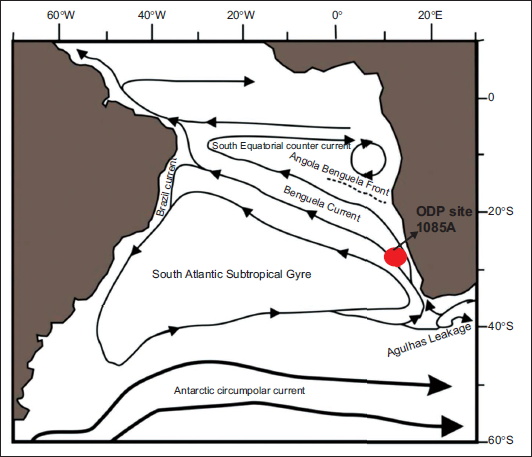
ODP Hole 1085A (Leg 175; Figure 1) is located approximately 445 km off the west coast of South Africa (29°22.47′S, 13°59.41′E) at a water depth of 1,713 m in the mid-Cape Basin of the south eastern Atlantic. The detailed oceanographic features of the southeastern Atlantic Ocean are described in several reviews (Nelson & Hutchings, 1983; Shannon, 1985; Shannon & Nelson, 1996) and are summarised in Figure 1. The BC is the dominant oceanographic feature in the southeastern Atlantic and is driven by the SE trade winds. Seasonal advection of warm, saline tropical and subtropical waters derived from the Agulhas Leakage modifies sea-surface temperatures along the southern Benguela margin. It facilitates biotic exchange with the Indian Ocean. The BC is the equatorward flow of cool surface waters along the southwestern coast of Africa, from 34°S (Cape Town) to 23°S (Walvis Bay), where it diverges from the coast. Inside the shelf break, along the entire coastline, a component of the BC moves equatorward, forming the Benguela Coastal Current (BCC). Well-oxygenated, low-salinity Antarctic Intermediate Waters (AAIW) flowing equatorward along the slope off Namibia and South Africa penetrate from about 400 m onto the outer shelf and contribute to the overall high nutrient content of the upwelled waters (Flynn et al., 2020). The upwelling of cool, nutrient-rich water along the southwestern coast of Africa supports exceptionally high surface-water biological productivity in the Benguela region (Berger & Wefer, 1996, 2002).
Surface circulation in the southeastern Atlantic (after Berger & Wefer, 2002; Dingle & Giraudeau, 1993; Lutjeharms & Stockton, 1987; Shannon, 1985), ODP site 1085A located at 23.374°S, 13.562°E and 1713.2 m water depth and shown as red dot.
MATERIALS AND METHODS
Detailed planktic foraminiferal investigations were conducted on 137 deep-sea core samples from Hole 1085A (Leg 175), spanning the past 1 million years, to reconstruct the variability in Benguela upwelling and interoceanic exchange. A fraction of >150 µm was chosen for census counting as it gives maximum climatic information in the least time (Imbrie & Kipp, 1971) and is the size fraction now adopted by many major paleoclimatic studies (Wells et al., 1994). A microsplitter was used to separate an aliquot of 300 or more planktic foraminiferal individuals. Each individual was identified to the species level following taxonomic studies by Kennett and Srinivasan (1983) and Bolli et al. (1985), which were mounted on assemblage slides. At the studied site, the planktic foraminiferal assemblage contains a mixture of subpolar, temperate and tropical species. The cold-water species are mainly from the South Atlantic Current, while the warm-water species are derived from the Agulhas Leakage. Following Peeters et al. (2004), the planktic foraminiferal species were grouped as Agulhas Leakage Fauna (ALF), including Globigerinoides ruber, Gs. sacculifer, Gs. quadrilobatus and other tropical planktic foraminiferal species such as Ga. glutinata, Orbulina universa, Globigerinella siphonifera and Globorotalia scitula for estimating the influx of warmer Indian Ocean water into the southeast Atlantic. Grouping of fauna from the same ecological niche has helped provide meaningful interpretations because variation in the relative abundance of individual species is not only dependent on species interactions with the physical environment, but also on interactions with species in overlapping or adjacent niches (Ricklefs, 1979).
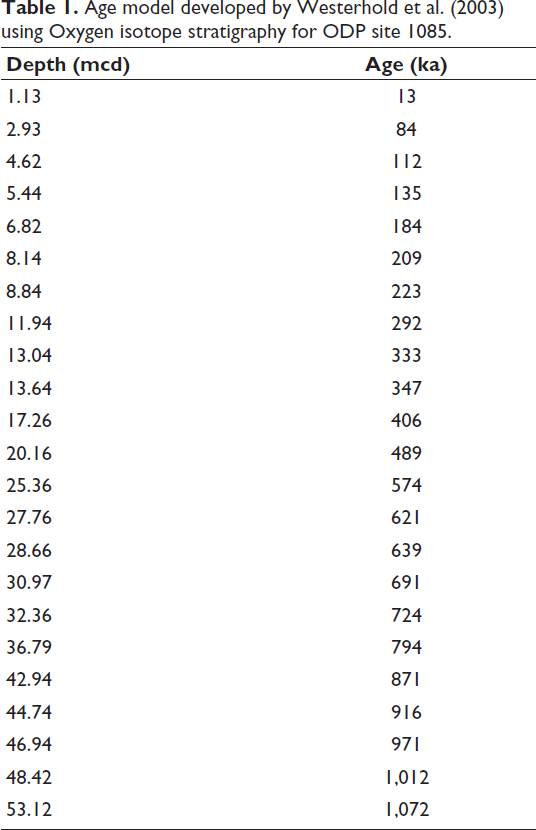
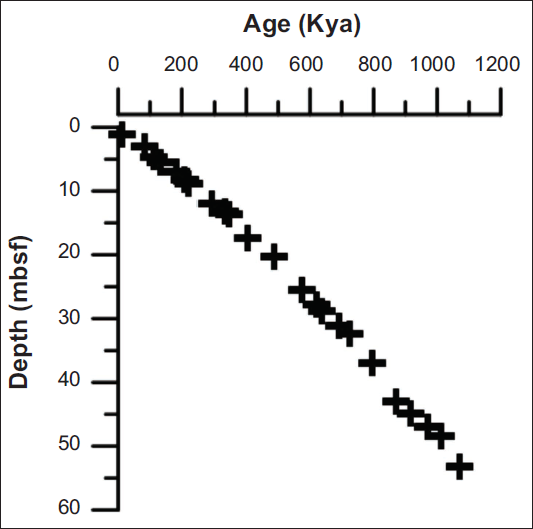
The age model developed by Westerhold et al. (2003), which astronomically calibrates the benthic δ18O record to obliquity using the La931,1 solution (Laskar et al., 1993; Figure 2 and Table 1), has been employed in the present study.
Age model developed by Westerhold et al. (2003) using Oxygen isotope stratigraphy for ODP site 1085.
Depth vs Age plot at ODP site 1085A based on oxygen isotope stratigraphy developed by Westerhold et al. (2003).
STABLE ISOTOPE ANALYSES
About 25–30 clean specimens of Globigerina inflata, a thermocline dweller species (Aze et al., 2011) and O. universa (a temperate-subtropical-tropical species that prefers to dwell within the photic zone between the surface mixed layer and the shallow thermocline) were picked from the >150 µ size fraction of each sample. Specimens were cleaned in an ultrasonic bath to remove detritus. Stable oxygen isotope ratios of thermocline-dwelling planktic foraminiferal species G. inflata and mixed-layer dweller O. universa were determined to study past variability in thermocline temperature and mixed-layer depth, respectively (Cléroux et al., 2013; Lee et al., 2008). Stable isotope analysis was carried out on a ThermoFisher Scientific MAT 253 isotopic ratio mass spectrometer fitted with a Kiel device at the Physical Research Laboratory, Ahmedabad. The typical value of external precision for δ18O for daily measurements is ±0.1‰, and for the year-long measurements, it is ±0.2‰. Oxygen isotope data are reported in δ notation relative to the Vienna Pee Dee Belemnite (VPDB) standard. Reproducibility of δ18O was ± 0.1 ‰ for the internal standard.
PRINCIPAL COMPONENT ANALYSIS
Planktic foraminiferal assemblages were subjected to Q-mode Principal Component Analysis (PCA) using the PAST software, version 4.03. Following Schmiedl and Mackensen (1997), planktic foraminiferal taxa with average percentages of ≥ 1% were used for the statistical analysis. Loadings ≥ 0.5 were defined as significant (Davis, 2002). Based on the screen plot (which plots the variances against the number of the principal component), two factors were retained that accounted for 93.22% of the total variance.
RESULTS
Trends in Major Planktic Foraminiferal Species
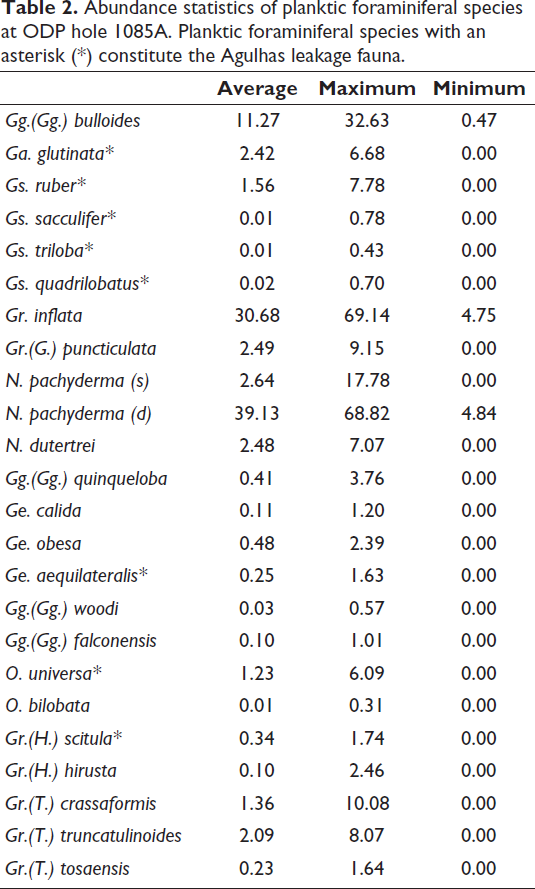
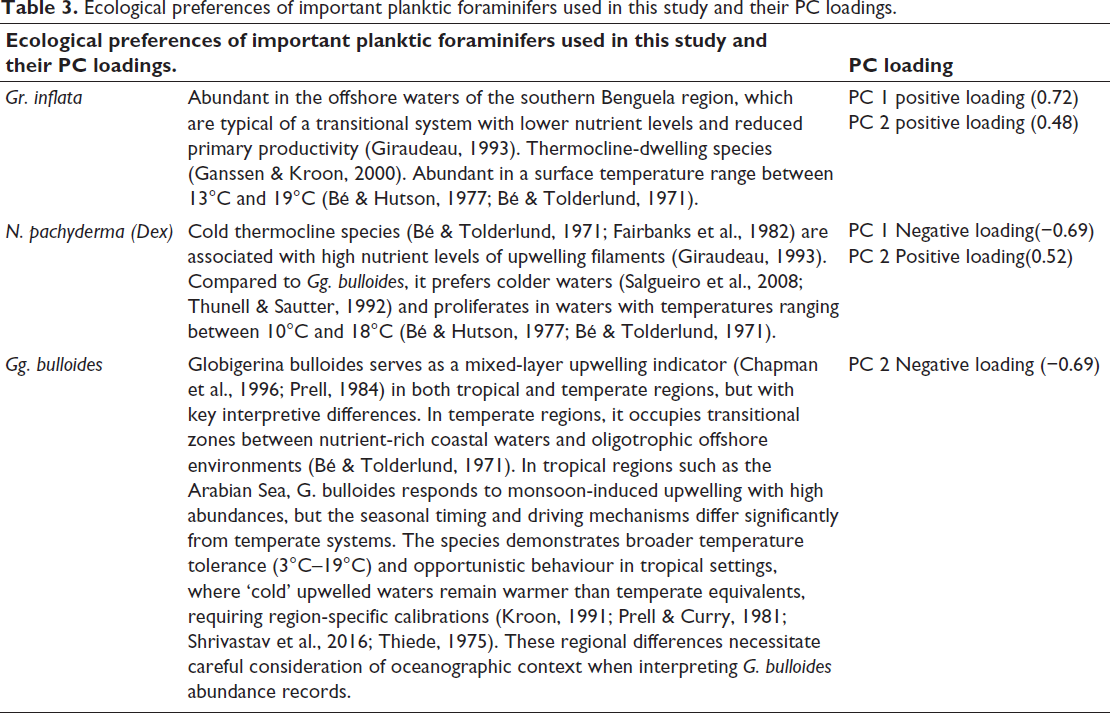
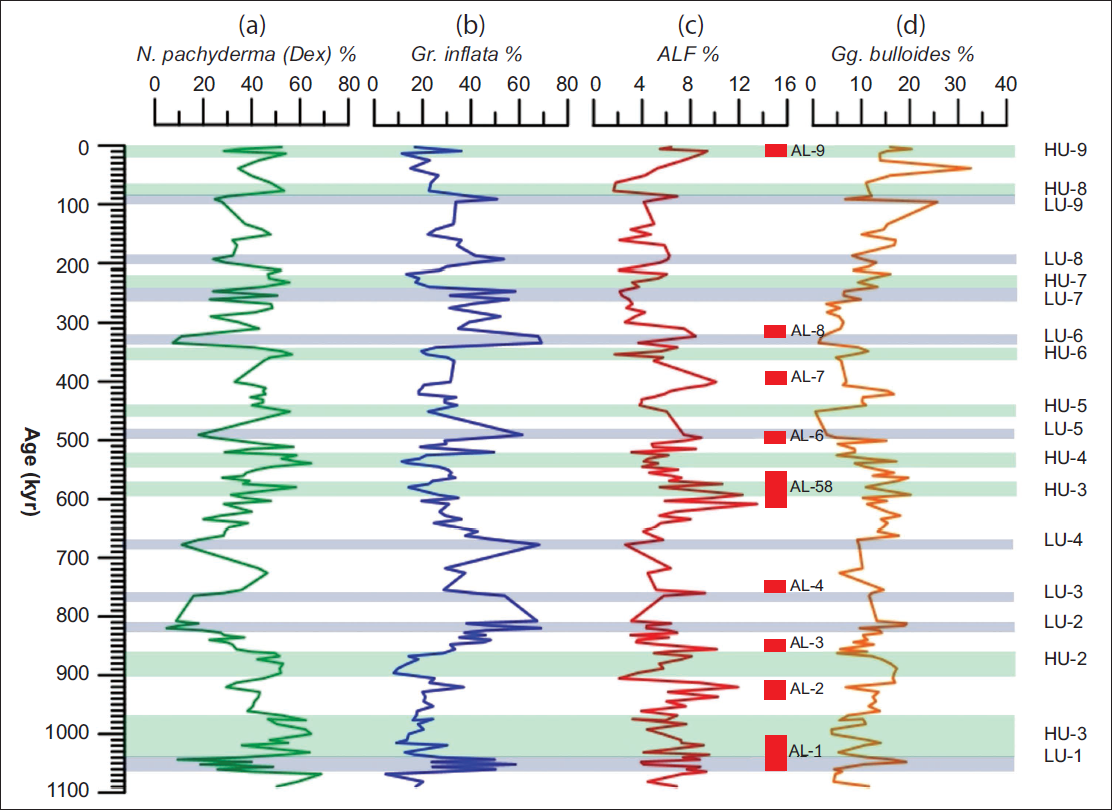
The planktic foraminiferal assemblages at ODP Hole 1085A are fundamentally controlled by thermal stratification and nutrient availability within the upper water column (Chaisson & Ravelo, 1997), serving as sensitive indicators of palaeoceanographic conditions. Three dominant species—Neogloboquadrina pachyderma (Dex), Gr. inflata and Gg. bulloides—together with the ALF collectively represent approximately 85% of the total foraminiferal assemblage (Table 2), providing a comprehensive framework for reconstructing upwelling variability and interoceanic exchange. The ecological preferences and environmental interpretations of these key species during the Holocene are well-established through previous investigations (Giraudeau, 1993; Kemle-von Mücke & Oberhänsli, 1999; Little et al., 1997; Oberhänsli et al., 1992; Peeters et al., 2004; Ufkes et al., 1998; West et al., 2004) and are summarised in Table 3. The temporal variations in the relative abundances of these water mass-sensitive species are illustrated in Figure 3.
Abundance statistics of planktic foraminiferal species at ODP hole 1085A. Planktic foraminiferal species with an asterisk (*) constitute the Agulhas leakage fauna.
Ecological preferences of important planktic foraminifers used in this study and their PC loadings.
Proxy data from ODP hole 1085A. (a) Relative abundance of N. pachyderma (Dex) (green), (b) Relative abundance of Gr. inflata (blue), (c) Relative abundance of Agulhas leakage fauna (red), (d) Relative abundance of Gg. bulloides (orange). The light green shaded region represents peak upwelling events numbered as HU-1 to HU-9, while the light grey shaded region represents weak upwelling events as LU-1 to LU-9. The red bar represents the interval of peak Agulhas leakage and is numbered as AL-1 to AL-9.
N. pachyderma (Dex)-Upwelling intensity proxy
N. pachyderma (Dex) serves as the primary indicator of high nutrient, eutrophic conditions and represents a robust proxy for reconstructing past upwelling intensity. This cold thermocline species (Bé & Tolderlund, 1971; Fairbanks et al., 1982) is associated with high nutrient levels of upwelling filaments (Giraudeau, 1993) and demonstrates remarkable variability throughout the record. Relative abundances fluctuate substantially, ranging from 4.84% to 68.82%, with a mean value of 39.13% (Table 2).
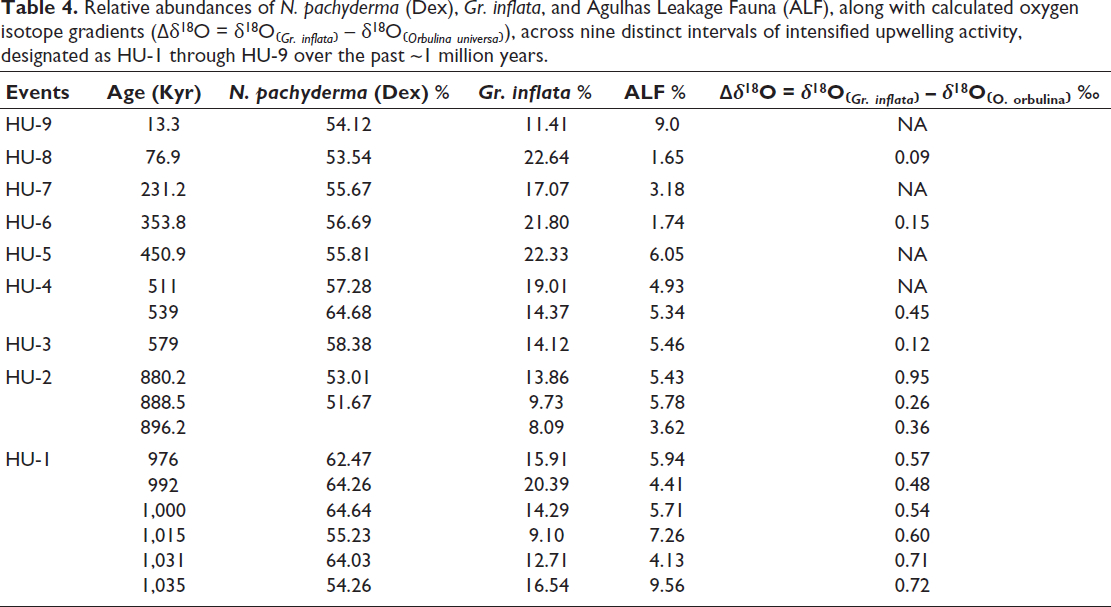
The temporal distribution reveals nine distinct intervals of intensified upwelling activity, designated as HU-1 through HU-9 (Figure 3a). The most pronounced upwelling event occurred during HU-1, while significant declines in upwelling intensity were recorded at approximately 334 kyr (7.4%) and 819 kyr (4.8%). The species exhibits a complex long-term pattern characterised by a prolonged decreasing trend from 1035 kyr (54.26%) to 819 kyr (4.8%), followed by two distinct recovery phases: the first from 677 kyr (11.1%) to 539 kyr (64.68%) and the second from 334 kyr (7.4%) to 231 kyr (55.67%). Detailed abundance data for these high upwelling events are presented in Table 4.
Relative abundances of N. pachyderma (Dex), Gr. inflata, and Agulhas Leakage Fauna (ALF), along with calculated oxygen isotope gradients (∇δ18O = δ18O₍ Gr. inflata ₎ – δ18O₍ Orbulina universa ₎), across nine distinct intervals of intensified upwelling activity, designated as HU-1 through HU-9 over the past ~1 million years.
Gr. inflata-Oligotrophic conditions indicator
As an oligotrophic indicator species, Gr. inflata provides critical insights into episodes of reduced surface productivity and transitional oceanographic conditions. This thermocline-dwelling species (Ganssen & Kroon, 2000) is particularly abundant in the offshore waters of the southern Benguela region, which are typical of transitional systems characterised by lower nutrient levels and reduced primary productivity (Giraudeau, 1993). The species shows extensive variability, ranging from 4.75% to 69.14% with an average abundance of 30.68% (Table 2).
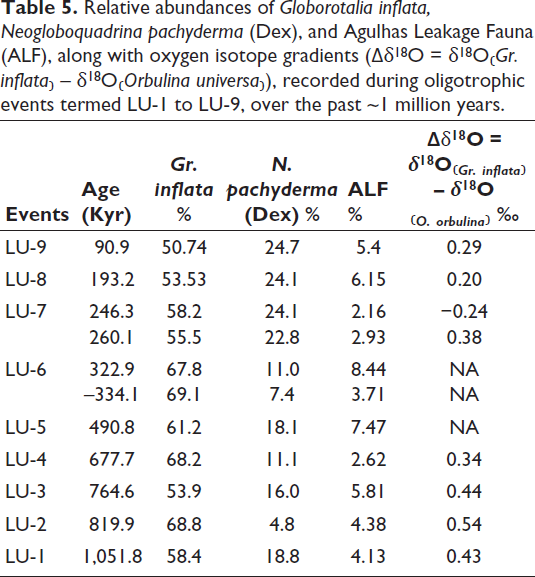
Nine distinct intervals of elevated Gr. inflata abundance, termed LU-1 to LU-9, represent periods of oligotrophic events (Figure 3b). The highest peaks were observed at 819 kyr (68.8%), 677.7 kyr (68.2%) and during the 322.9–334.1 kyr interval (67.8% and 69.1%). The temporal evolution shows a gradual increase from 1035 kyr (16.54%) to 819 kyr (68.8%), followed by two declining phases from 677 kyr (68.2%) to 539 kyr (14.37%) and from 334 kyr (69.1%) to 231 kyr (17.07%). These trends demonstrate a clear inverse relationship with N. pachyderma (Dex) abundance patterns, confirming their complementary roles as upwelling proxies. Complete data for these oligotrophic events are documented in Table 5.
Relative abundances of Globorotalia inflata, Neogloboquadrina pachyderma (Dex), and Agulhas Leakage Fauna (ALF), along with oxygen isotope gradients (∇δ18O = δ18O₍Gr. inflata₎ – δ18O₍Orbulina universa₎), recorded during oligotrophic events termed LU-1 to LU-9, over the past ~1 million years.
Agulhas Leakage Fauna-interoceanic exchange proxy
The ALF assemblage, comprising warm-water species including Gs ruber, Gs. sacculifer, Gs. quadrilobatus, Ga. glutinata, O. universa, G. siphonifera and G. scitula serve as a quantitative measure of interoceanic exchange between the Indian and Atlantic Oceans following the grouping approach of Peeters et al. (2004). ALF percentages range from 1.65% to 13.50%, with a mean abundance of 5.83% (Table 2), reflecting the variable intensity of warm, saline water transfer from the Indian Ocean.
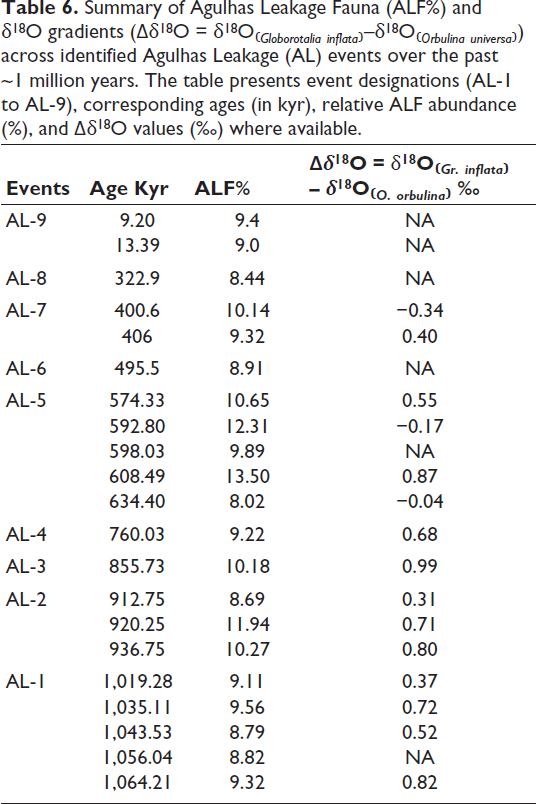
Nine prominent peaks in ALF abundance, designated AL-1 through AL-9, document major episodes of enhanced Agulhas Leakage (Figure 3c). The highest recorded value (13.50%) occurred at 608.49 kyr, with other significant peaks observed at 592.8 kyr (12.31%), 920.25 kyr (11.94%), 936.7 kyr (10.27%), 855.73 kyr (10.18%), 400.6 kyr (10.14%) and 9.2 kyr (9.4%). These intervals represent critical periods when the transfer of Indian Ocean waters into the southeastern Atlantic was substantially enhanced, potentially influencing the upwelling intensity and AMOC. Comprehensive data for all Agulhas Leakage events are presented in Table 6.
Summary of Agulhas Leakage Fauna (ALF%) and δ18O gradients (∇δ18O = δ18O₍ Globorotalia inflata ₎–δ18O₍ Orbulina universa ₎) across identified Agulhas Leakage (AL) events over the past ~1 million years. The table presents event designations (AL-1 to AL-9), corresponding ages (in kyr), relative ALF abundance (%), and ∇δ18O values (‰) where available.
Gg. bulloides-mixed-layer dynamics
Gg. bulloides, a mixed-layer dwelling species associated with upwelled, nutrient-rich waters (Chapman et al., 1996; Prell, 1984), provides insights into past changes in surface-water mixing and mixed-layer thickness. This species demonstrates considerable temporal variability, ranging from 0.47% to 32.63% with an average abundance of 11.27% (Table 2). The species prefers cold, nutrient-rich upwelled waters and is predominant in waters with temperatures between 3°C and 19°C (Bé & Tolderlund, 1971). However, it tolerates relatively lower nutrient levels away from upwelling filaments compared to N. pachyderma (Dex) (Giraudeau, 1993).
Notable peak abundances were recorded at 38.64 kyr (32.63%) and 95.76 kyr (25.71%) (Figure 3d). A significant long-term increasing trend in Gg. bulloides abundance is evident from 334.1 kyr (~1%) to 38.64 kyr (~30%), suggesting a gradual intensification of surface-water mixing and enhanced nutrient delivery to the mixed layer over this extended period.
Principal Component Analysis
The PCA successfully reduced the dimensionality of the foraminiferal dataset, with the first two principal components (PC1 and PC2) accounting for approximately 93.22% of the total variance in the assemblage data. This high-variance explanation demonstrates that two primary modes of variability can effectively capture the major oceanographic processes affecting ODP Hole 1085A.
PC1 is fundamentally controlled by the productivity gradient in the southeastern Atlantic, primarily influenced by the oligotrophic species Gr. inflata, which exhibits strong positive loadings (0.72) (Table 3). In contrast, the eutrophic species N. pachyderma (Dex) contributes weaker negative loadings (−0.69), creating a clear separation between high-productivity upwelling conditions and low-productivity oligotrophic environments. The temporal variation in PC1 scores closely mirrors the abundance patterns of Gr. inflata, confirming its role as the primary driver of this component.
PC2 reflects variations in water column structure, particularly thermocline depth and shoaling events. This component shows positive associations with thermocline-dwelling species (Gr. inflata, with a loading of 0.48, and N. pachyderma (Dex), with a loading of 0.52) and negative associations with the mixed-layer species Gg. bulloides (loading −0.69) (Table 3). The PC2 time series exhibits a clear inverse relationship with the relative abundance of Gg. bulloides, indicating that higher PC2 values correspond to shoaling thermocline conditions with reduced mixed-layer influence.
Stable Oxygen isotope records
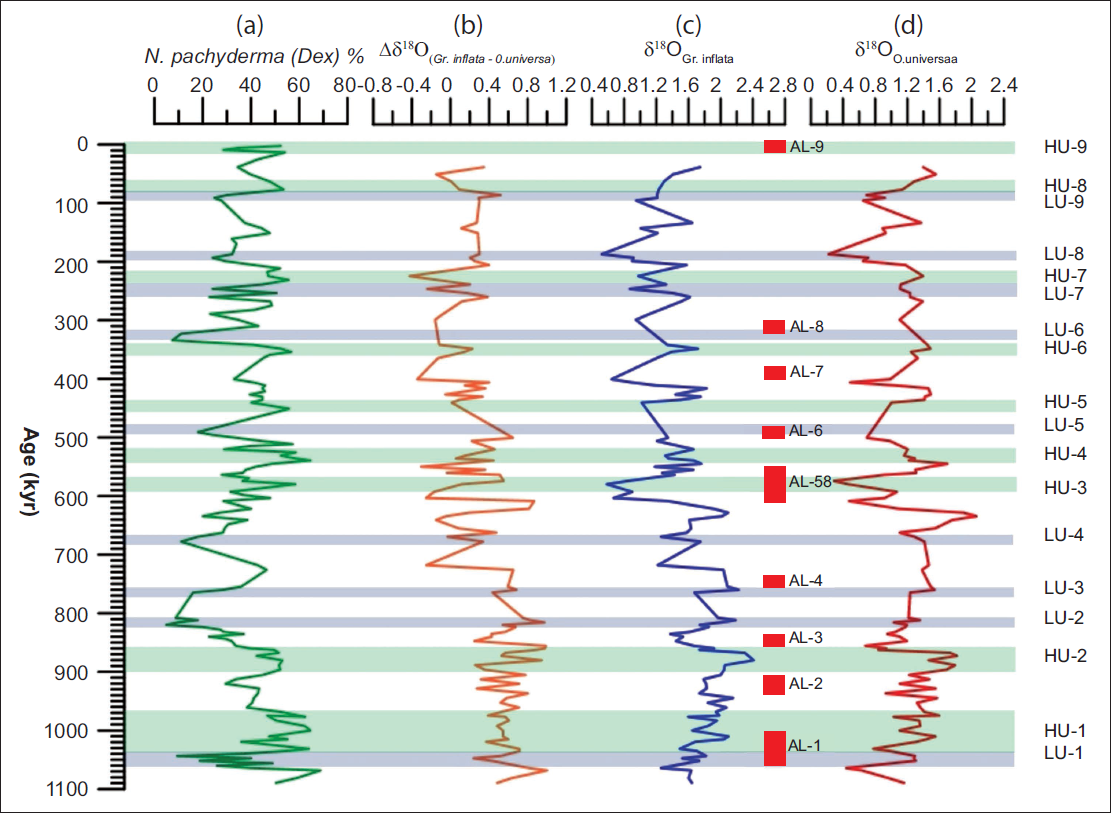
The stable oxygen isotope records of O. universa and Gr. inflata, along with their isotopic offset (∇δ18O = δ18O₍ Gr. inflata ₎ – δ18O₍ O. universa ₎), reveal significant temporal variability in water column thermal structure over the past ~1 million years (Figure 4b–4d). The δ18O offset between these species ranges from approximately 1.0‰ to −0.42‰ throughout the studied interval, providing insights into thermocline development and water mass stratification. A progressive enrichment in δ18O values is observed for both species during the early portion of the record (Figure 4c and 4d). Gr. inflata values increase from 1,051 kyr (1.73‰) to 880.2 kyr (2.41‰), while O. universa shows a similar trend from 1,051 kyr (1.30‰) to 888.5 kyr (1.79‰). This concurrent enrichment in heavier oxygen isotopes for both thermocline and mixed-layer dwelling species resulted in relatively static ∇δ18O values during the 1,051-880 kyr interval, suggesting stable water column thermal structure during this period.
Proxy data from ODP site 1085A. (a) Relative abundance of N. pachyderma (Dex) (green), (b) δ18O₍Gr. inflata₎ – δ18O₍O. universa₎ (Orange) (c) δ18O₍Gr. inflata₎ (blue) (d) δ18O₍O. universa₎ (Red). The light green shaded region represents peak upwelling events numbered as HU-1 to HU-9, while the light grey shaded region represents weak upwelling events as LU-1 to LU-9. The red bar represents the interval of peak Agulhas leakage and is numbered as AL-1 to AL-9.
DISCUSSION
Upwelling variability and interoceanic exchange over the past million years
The comprehensive one-million-year record from ODP Hole 1085A reveals a fundamental transformation in the behaviour of the southern BUS that parallels the global reorganisation of Earth’s climate system during the Pleistocene Epoch. The record demonstrates three distinct phases of upwelling (a) latest Early Pleistocene (1,000-800 kyr), intense and sustained upwelling, (b) middle Pleistocene reorganisation and marked oligotrophic evets (800-400 kyr) and (c) Late Pleistocene glacial–interglacial cyclicity (400 kyr-present), each reflecting different forcing mechanisms that have shaped regional oceanographic processes over geological timescales.
Latest Early Pleistocene upwelling maxima (1,000-800 kyr): unprecedented intensity and stability
The Early Pleistocene portion of the record is characterised by intense and sustained upwelling events, with the HU-1 event (976–1,035 kyr) representing intense and sustained upwelling conditions documented in the entire one-million-year record. During this event, N. pachyderma (Dex) abundances reached 64.68% at 1,000 kyr, values that are unprecedented in the modern ocean system and suggest that the latest Early Pleistocene created optimal configurations for coastal upwelling that have not been replicated during subsequent climate evolution. The sustained nature of HU-1, persisting for nearly 60,000 years, indicates that the latest Early Pleistocene climate stability allowed the upwelling system to maintain extreme states for extended periods without the rapid transitions that characterise later intervals. This latest Early Pleistocene upwelling intensity correlates with the final stages of the obliquity-driven climate cycles, dominated by global ice volume variations (Lisiecki & Raymo, 2005). The coexistence of intense upwelling with high ALF abundances (4.13%–12.71%) during HU-1 indicates that the circulation system could accommodate both processes simultaneously, suggesting robust regional pressure gradients and current systems that maintained strong coastal upwelling despite the injection of warm Indian Ocean waters. This relationship implies that the latest Early Pleistocene boundary conditions created circulation patterns fundamentally different from those observed during later periods. The concurrent δ18O enrichment in both Gr. inflata (1.73‰–2.41‰) and O. universa (1.30‰–1.79‰) from 1,051 kyr to 880 kyr documents regional cooling that parallels global ice volume increase. However, the maintenance of relatively stable ∇δ18O values suggests that the regional thermal structure was preserved even as absolute temperatures changed, indicating that feedback mechanisms were operating during this period. Schefuß et al. (2005) made a similar inference at the ODP Hole 1077 (Angola basin, eastern tropical Atlantic) based on the increase in the eolian flux of plant waxes due to a change in the trade wind system in response to the growth of global ice volume at ~900 kyr. A recent study by Mohanty et al. (2024) reconstructing the history of the SBUS since ~6.1 Ma from ODP Site 1087 indicates a reduction in upwelling after 2 Ma, with the SBUS achieving its modern state by ~1 Ma, characterised by marginal upwelling influence as the main upwelling cells shifted northward. This northward shift of upwelling cells around 2 Ma, intensifying after 1.5 Ma, suggests that ODP Hole 1085A might have experienced increasingly marginal or filament-influenced upwelling rather than direct coastal upwelling in the later part of the record.
Middle Pleistocene transition and extreme oligotrophic states (800-400 kyr)
The transition from the latest Early Pleistocene stability to the middle Pleistocene variability represents one of the most dramatic oceanographic reorganisations documented in the paleoclimate record. The most extreme example is the Oligotrophic Event (LU-2 at 819.9 kyr), where Gr. inflata abundance reached 68.8% while N. pachyderma (dextral) dropped to just 4.8%. This represents a near-complete collapse of the coastal upwelling system, suggesting that middle Pleistocene (800-400 kyr) climate boundary conditions could create alternative stable states for southeastern Atlantic circulation. The correlation of LU-2 with the MPT (Clark et al., 2006; Mudelsee & Schulz, 1997) provides insights into the mechanisms driving this climatic reorganisation. We observe a higher abundance of planktic foraminiferal species N. pachyderma (Dex) at 725 Kyr (Figure 3a and 3c) along with a lower abundance of ALF; this indicates the possible equatorward migration of the subpolar front, which affected the faunal assemblage at the studied site. Similar northward migration of the Antarctic polar front has been reported from the southeast Indian Ocean by Singh and Sinha (2021). Sinha et al. (2006) recorded weakening of the Leeuwin current due to strengthening of the West Australian current at 680 kyr (PL-3 event) at ODP Site 763A. Kemp et al. (2010) inferred a minimum northward migration of the polar front up to 7 degrees latitude based on the occurrence of a laminated diatom mat deposit at ODP 1091, 1093 and 1094 at 900 kyr. The intensification of upwelling activity during the Pliocene-Pleistocene transition, as suggested by Marlow et al. (2000) from a site underlying the BUS, was associated with a ~10°C cooling since 3.2 million years ago (Ma) and an increase in wind-driven upwelling, which would have profoundly impacted the thermocline structure. These long-term changes are likely tied to the overall cooling trend of the Pleistocene, the growth of large Northern Hemisphere ice sheets and associated modifications to atmospheric circulation patterns, such as the Hadley Cell and oceanic frontal systems, including the Subtropical Convergence (Etourneau et al., 2009; Mohanty et al., 2024).
Late Pleistocene Glacial-interglacial cyclicity (400 kyr-present): systematic climate-ocean interactions
The last 400,000 years document the development of systematic relationships between upwelling intensity and glacial–interglacial cycles, showing increasingly predictable responses to orbital forcing as the 100,000-year cycle became established (Lisiecki & Raymo, 2005). The high upwelling events HU-6 through HU-9 show strong correspondence with glacial periods, while interglacial periods are characterised by enhanced Gr. inflata abundances and reduced upwelling intensity.
HU-6 (353.8 kyr) occurs during Marine Isotope Stage (MIS) 10, which shows N. pachyderma (Dex) abundance of 56.69% accompanied by elevated Gr. inflata (21.80%) and reduced ALF (1.74%). This combination suggests that under a glacial climate, intense but localised upwelling occurred, with reduced interoceanic exchange limiting the influence of warm Indian Ocean waters. This pattern of stronger glacial upwelling is consistent with findings across the broader BUS. For instance, Little et al. (1997) observed high abundances of the cold-water planktonic foraminifer Neogloboquadrina pachyderma sinistral during periods of increased upwelling intensity in the Namibian sector, particularly during MIS 3 and 2. Similarly, studies by Schmiedl and Mackensen (1997) using benthic foraminifera in the eastern South Atlantic indicated enhanced fluxes of organic matter to the seafloor during MIS 8, 10 and 12, attributed to an increase and lateral extension of coastal upwelling. Bergh (2024) also noted that over the last 200 kyr, glacial periods have generally exhibited enhanced primary productivity and upwelling conditions in both the Northern Benguela Region (NBR) and the southern Benguela region (SBR). Oberhänsli (1991) suggested that during MIS 2-4, middle stage 6, and stage 12, DSDP Site 532 on the Walvis Ridge was beneath the coastal branch of the BC due to intensified upwelling. The primary driver for this intensified upwelling during the glacial interval is thought to be stronger and more zonally persistent southeast trade winds, resulting from steeper latitudinal temperature gradients (Etourneau et al., 2009; Little et al., 1997; Schmiedl & Mackensen, 1997; West et al., 2004). This pattern indicates that the BUS, which influences Hole 1085A, was significantly more vigorous during glacials, likely driven by intensified equatorward trade winds and a steeper thermal gradient between the poles and the equator, a phenomenon observed in other major eastern boundary upwelling systems globally (Abrantes, 1991; Bergh, 2024; Bin Shaari et al., 2013; Diester-Haass et al., 1992; Jakob et al., 2016; Portilho-Ramos et al., 2019).
The most recent upwelling event, HU-9 (13.3 kyr), occurs during the Younger Dryas to early Holocene transition and shows unique characteristics, showing upwelling along with enhanced interoceanic exchange as reflected by high N. pachyderma (Dex) abundance (54.12%), accompanied by low Gr. inflata (11.41%) and elevated ALF (9.0%).
Variability in Interoceanic Exchange
The exchange of water between the Indian and Atlantic Oceans, predominantly facilitated by Agulhas Leakage around the southern tip of Africa, has played a dynamic role in global ocean circulation and climate regulation over the past one million years (Biastoch & Böning, 2013; Biastoch et al., 2009). Proxy data from ODP Site 1085A, specifically the relative abundance of ALF, provides a robust means of reconstructing past fluctuations in this interoceanic exchange. The ALF record from ODP Hole 1085A (Figure 3c) reveals pronounced variability that generally follows a glacial–interglacial rhythm, with nine distinct peaks (AL-1 through AL-9) corresponding to periods of significantly elevated Agulhas Leakage. These peaks are interpreted as intervals of intensified exchange and enhanced connectivity between the Indian and Atlantic basins during warmer climatic phases.
This pattern of increased interglacial leakage is consistent with a range of regional studies. For instance, Peeters et al. (2004) documented vigorous exchange between the Indian and Atlantic Oceans at the terminations of the last five glacial periods, attributing these events to increased Agulhas Leakage. Similarly, Caley et al. (2012) and Petrick et al. (2015) identified Agulhas Leakage as a key driver of Quaternary climate variability, with important implications for the AMOC.
Of particular note is the AL-5 event, which represents the most intense interoceanic exchange in the entire million-year record, with ALF abundance peaking at 13.5% at 608.49 kyr. This event coincides with MIS 15, recognised as one of the warmest and most stable interglacial periods. The observed relationship between Agulhas Leakage and interglacial conditions lends support to the salt advection hypothesis, while also highlighting the complexity of the feedback mechanisms involved. Enhanced Agulhas Leakage not only supplies salt to the North Atlantic, facilitating deep-water formation, but also transports heat from the Indian Ocean to the Atlantic Ocean, thereby influencing global heat distribution and atmospheric circulation (Biastoch et al., 2009). The occurrence of maximum leakage during interglacials suggests that the efficiency of interoceanic exchange is modulated by specific configurations of Southern Ocean circulation and the position of the STF.
The variability in Agulhas Leakage is closely linked to several climatic and oceanographic controls. The latitudinal position of the STF is widely regarded as a primary factor: a southward displacement of the STF, often associated with a poleward shift in westerly winds, expands the oceanic gateway south of Africa and promotes increased leakage. Conversely, a northward shift of the STF restricts leakage (Bard & Rickaby, 2009; Beal et al., 2011). Palaeoceanographic reconstructions indicate that during glacial periods, the STF was frequently displaced northward, resulting in reduced Agulhas Leakage. The ALF record from ODP Hole 1085A, which shows lower leakage during glacial intervals, supports this interpretation. Reduced Agulhas Leakage during glacial maxima would have limited the supply of warm, saline water to the South Atlantic, potentially contributing to a weakened or shoaled AMOC—a phenomenon widely documented for glacial maxima and stadial events such as Heinrich events (Dyez et al., 2014; Marino et al., 2013; Nirmal et al., 2023). Cartagena-Sierra et al. (2021), analysing IODP Site U1475 on the Agulhas Plateau, found that the STF was positioned further south during the mid-Pleistocene Interim State (MPIS, MIS 23–12), but reached its northernmost extent during MIS 34-24 and MIS 10. Notably, only the most extreme northward STF migrations were associated with substantially reduced Agulhas Leakage, indicating a complex relationship in which STF position is a key, but not exclusive, modulator; shifts in westerly winds also exert a significant influence. Indeed, Biastoch et al. (2009) demonstrated through modelling that a poleward shift in Southern Hemisphere westerlies can enhance Agulhas Leakage.
The strength of the Agulhas Current itself, modulated by upstream conditions in the Indian Ocean (e.g., the Indian Ocean Dipole and Indonesian Throughflow), further impacts the volume of leakage. The ALF record from Site 1085A indicates consistently high values during several interglacials over the past million years, including those preceding and during the MPT, specifically AL-1 to AL-5. This suggests that robust interoceanic exchange was a recurring feature, even amidst the climatic reorganisations of the MPT. Multiproxy reconstructions by Martínez-Méndez et al. (2010) further underscore the complexity of leakage dynamics, revealing contrasting surface hydrography in the Agulhas Corridor over the last 345,000 years.
The climatic significance of Agulhas Leakage is primarily attributed to its role in delivering warm, saline Indian Ocean water to the South Atlantic, which is considered a critical source for the upper limb of the AMOC. Enhanced leakage is hypothesised to strengthen the AMOC by increasing buoyancy in North Atlantic deep-water formation regions (Gordon et al., 1992). Several studies have proposed that increased Agulhas Leakage during glacial terminations may have facilitated the rapid resumption of the AMOC and the transition to interglacial climates. The AL-7 event at ODP Site 1085A, occurring during the MIS 11 interglacial, is consistent with this hypothesis, suggesting periods of intensified AMOC potentially driven by greater salt and heat transfer from the Indian Ocean. For example, Koutsodendris et al. (2014) documented exceptional Agulhas Leakage at the end of MIS 11c, positing that it may have prolonged interglacial warmth in Europe via an AMOC teleconnection. Similarly, Marino et al. (2013) identified recurrent, high-amplitude salinity oscillations in the Agulhas Leakage region during the penultimate glacial–interglacial cycle, linking strengthened salt leakage to abrupt changes in North Atlantic climate and AMOC and suggesting that leakage acted as a source of negative buoyancy aiding AMOC recovery.
Late Pleistocene leakage events (AL-7 through AL-9) exhibit systematic relationships with glacial–interglacial cycles, with enhanced leakage generally occurring during interglacial periods. The most recent major leakage event, AL-9 (9.20 kyr), occurred during the early Holocene, with ALF abundance reaching 9.4%.
Oxygen isotope gradients associated with leakage events provide further insight into the underlying oceanographic mechanisms. ∇δ18O values during major leakage events range from −0.34‰ to 0.99‰, indicating significant variability in the thermal structure of the water column. Large positive values suggest that enhanced leakage can occur while maintaining strong thermal stratification. In contrast, negative values during certain events indicate that intense leakage may disrupt thermal stratification through increased vertical mixing.
CONCLUSIONS
This study presents a continuous, million-year reconstruction of the southern BUS dynamics and interoceanic exchange, utilising planktic foraminiferal assemblages and stable oxygen isotopes from ODP Hole 1085A. The results reveal that the BUS has experienced profound changes that closely parallel global climatic reorganisations of the Pleistocene. The latest Early Pleistocene (1,000-800 kyr) was characterised by intense and sustained upwelling, driven by stable obliquity-paced climate conditions and robust regional circulation, allowing both strong upwelling and significant Agulhas Leakage. In contrast, the middle Pleistocene (800-400 kyr) marked a phase of reorganisation, highlighted by extreme oligotrophic events and evidence of upwelling system collapse during the MPT. This period coincided with the shift from 41,000-year to 100,000-year glacial cycles, regional oceanic front migrations and increased climate variability. The Late Pleistocene (last 400 kyr) developed predictable glacial–interglacial cyclicity, with upwelling intensifying during glacial maxima due to stronger southeast trade winds and thermal gradients, while Agulhas Leakage—and thus interoceanic exchange—peaked in interglacials, actively modulating AMOC strength. Our comprehensive record confirms that the BUS functions as a sensitive component of the climate system, directly linking regional upwelling, global ice volume, wind patterns, oceanic front positions and the efficiency of heat and salt transfer between oceans. These findings highlight the intricate mechanisms that drive long-term marine productivity and climate feedbacks, demonstrating the continued importance of the Benguela System and interoceanic exchanges in past and present climate change scenarios.
Footnotes
Acknowledgements
AS would like to thank the Department of Geology, Mohanlal Sukhadia University, Udaipur and the Ministry of Human Resource Development, Government of India, for supporting this project under the RUSA 2.0 R&I scheme. DKS and AKS thank the Palaeoclimate Programme of the Ministry of Earth Sciences, Government of India (Sanction No. MoES/CCR/Paleo-4/2019). DC thank the Department of Geology, University of Delhi, for logistical support. DKS thanks the Ocean Drilling Programme for providing the core samples. We all thank the Late. Professor R. Ramesh, PRL, Ahmedabad, for providing a stable isotope analytical facility for this study.
Declaration of Conflicting Interests
The authors declared no potential conflicts of interest with respect to the research, authorship and/or publication of this article.
Funding
The authors disclosed receipt of the following financial support for the research, authorship and/or publication of this article: The present work has been funded by the Ministry of Human Resource Development, Government of India, for supporting this project under the RUSA 2.0 R&I scheme and Palaeoclimate Programme of the Ministry of Earth Sciences, Government of India (Sanction No. MoES/CCR/Paleo-4/2019).
