




Abstract
After being recovered from the Central Indian Ocean, core ABP-06, Station II, underwent a thorough micropaleontological analysis. Forty well-preserved radiolarian species were discovered and recorded from a total of 40 sediment samples. Each species’ taxonomy and vertical distribution of the core are thoroughly described in the paper. Two radiolarian biozones—the Buccinosphaera invaginata Zone and the Collosphaera tuberosa Zone—have been identified based on the evolutionary boundaries, morphotypic appearances and disappearances, and abundance patterns of important species. These zones help to refine the Neogene-Quaternary stratigraphy in the area and represent important biostratigraphic boundaries within the core. Four reworked species were found in addition to the primary tropical assemblage, indicating sedimentary reworking from the Miocene to Pliocene intervals: Acrosphaera spinosa echinoides, Heliodiscus echiniscus, Spongaster pentas and Spongaster berminghamii. Additionally, the presence of Stylodictya validispina, a recognised cold-water taxon, and Tetrapyle octacantha, an indication of upwelling conditions, shows evidence of paleoceanographic variability, including the effect of cooler bottom waters and episodes of nutrient-rich upwelling. According to the biostratigraphic data of the radiolarian assemblage, the section under study is of Upper Quaternary age, with an estimated range of 0.18–0.5 million years. The Central Indian Ocean radiolarian biozones NR1 and NR2 are biostratigraphically similar to the Globorotalia truncatulinoides (N23) zone of planktonic foraminifera.
INTRODUCTION
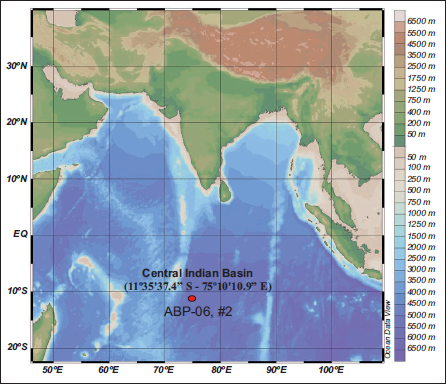
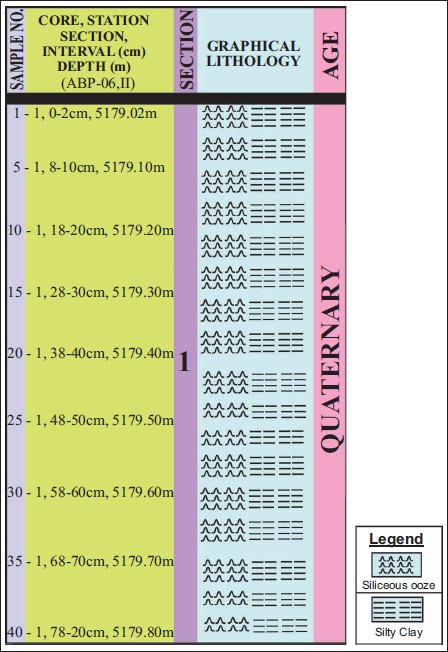
The study on late Cenozoic Radiolaria in the Central Indian Ocean is very scanty. The core ABP-06, Station II, is located between Latitude 11°35.374’ S and Longitude 75°10.109’ E, and samples were collected at a depth of 5179 m (Figure 1). Lithologically, the core consists of fine-grained clayey material, mainly siliceous ooze, with off white lensoid patches (Figure 2). Riedel originally laid the fundamental foundation for the natural classification of radiolarians in 1957. A significant turning point in micropaleontological study was reached 10 years later when Nigrini (1967) provided the first evidence of radiolarian dispersion in pelagic sediments from the Indian Ocean. Our knowledge of Neogene radiolarian biostratigraphy in the low-latitude Indian Ocean zones has been dramatically enhanced by later research. Riedel and Sanfilippo (1974), Sanfilippo and Riedel (1974), Gupta (1988, 1991), Johnson et al. (1989), Haslett et al. (1995, 2004), Nigrini (1971), Caulet (1979, 1986), Johnson and Nigrini (1980, 1982), and, more recently, Pandey et al. (2016), are important contributors in this field. Morley (1989) contributed important insights into the palaeoceanographic history of the southern Indian Ocean. Extensive research on radiolarian taxonomy and the development of biostratigraphic zones within the Indian Ocean was conducted by Sharma and Sharma (1988, 1989), Gupta and Srinivasan (1992), Nigrini (1974, 1991), and Gupta et al. (2002). To strengthen the link between radiolarian data and meteorological interpretations, Gupta (2003) examined how changes in radiolarian assemblages at the orbital scale affected the severity of the Indian summer monsoon. Furthermore, Rogers and De Deckker (2011) used radiolarians as paleoenvironmental proxies to reconstruct oceanographic and climatic conditions in the Indian Ocean throughout the past 40,000 years.
. Litho-column showing age, position of the sample, and depth of the core ABP-06.
MATERIALS AND METHODS
The core ABP-06, Station II, Section I, is 80 cm thick, and 40 samples (from ABP-06, II, 00-02, 5179 m to ABP-06, II, 78-80) of depth 5179.80 m were used to carry out this study. Each sample is taken at an interval of 2 cm. About 3–4 gm of the sample is soaked in water and an added disaggregating agent, that is, hydrogen peroxide (H2O2), to oxidise organic debris and facilitate physical disintegration. The samples are then boiled for an additional 4–5 hours and subsequently washed with water through a 63-micron mesh stainless-steel sieve, followed by drying. Dry residual sediment is sprinkled over the slide and covered with a cover slip using Canada balsam as a mounting medium. Four strewn slides are prepared for each sample for taxonomy and identification. The picked slide was also prepared for the precise marking of zones. For an accurate study, approximately 1000 radiolarian taxa were taken from the total radiolarian population of each sample.
TAXONOMY
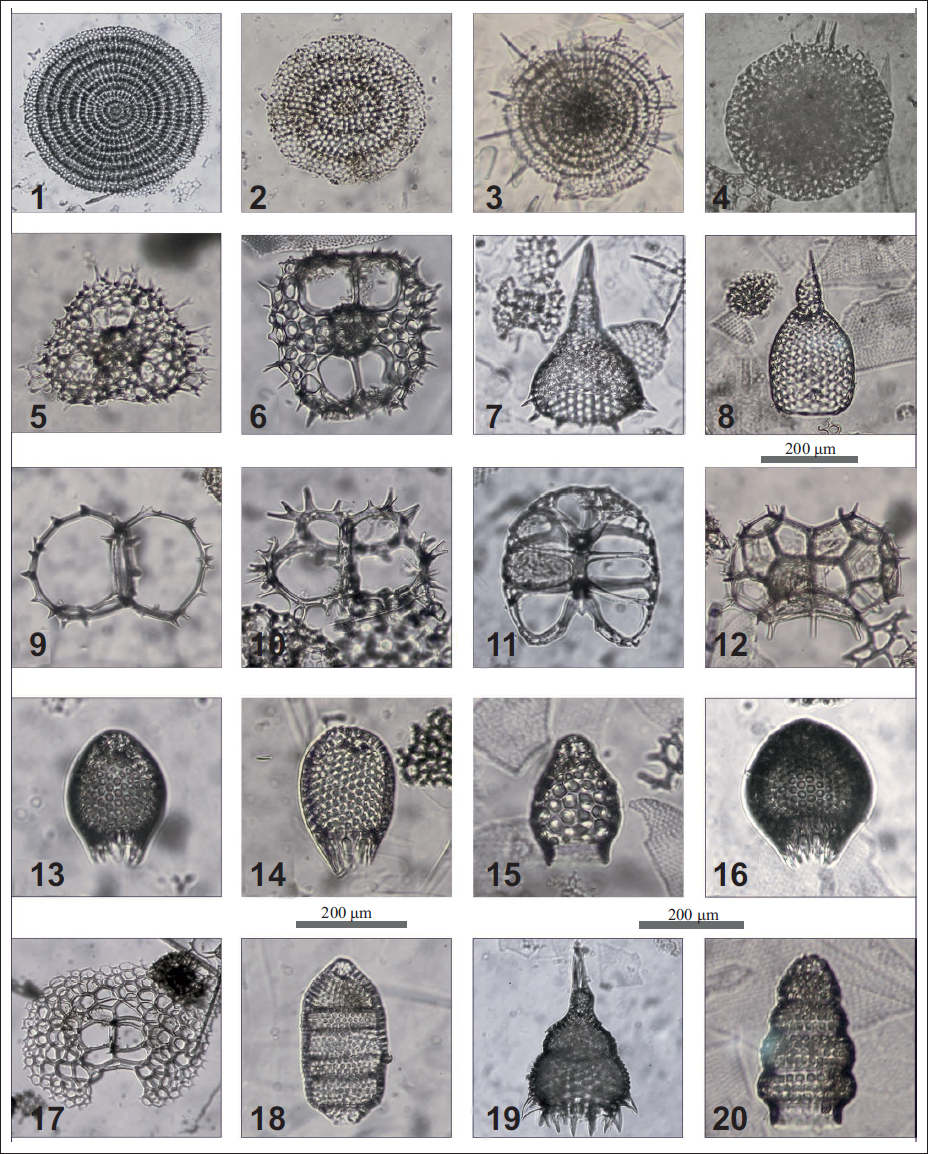
The present study follows the classification proposed by Riedel (1967) and Sanfilippo and Riedel (1980) for the subclass Radiolaria. Distribution, abundance, and remarks are mentioned in each of the identified taxa. Semi-quantitative estimates of radiolarian abundance are designated as: Phylum: Sarcodina Hertwig and Lesser, 1874 Class: Actinopoda Calkins, 1909 Sub-class: Radiolaria Müller, 1858 Order: Polycystina Ehrenberg, 1838 emend Riedel, 1967 Sub-order: Spumellaria Ehrenberg, 1875 Family: Collosphaeridae Müller, 1858 Genus: Acrosphaera Haeckel, 1881 (Plate 1, Figure 1)
1887 Acrosphaera collina-Haeckel, p. 101, Plate 8, Figure 2.
1979 Acrosphaera collina-Haeckel, Bjørklund and Goll, p. 1308, Plate 1, Figures 14–17.
Distribution: The species A. collina was identified as a tropical radiolarian by Strelkov and Reshetnjak (1971), who classified it within warm-water regions. Later, Bjørklund and Goll (1979) confirmed its presence in the equatorial Pacific Ocean, further supporting its association with low-latitude, tropical marine environments.
Remarks: No remarks.
Abundance: Very rare to rare.
Age: Quaternary (mikrotax.org)
(Plate 1, Figure 2)
1887 Xanthiosphaera lappacea-Haeckel, p. 120, Plate 8, Figures 10 and 11.
1980 Acrosphaera lappacea-Haeckel, Johnson and Nigrini, Plates 1 and 2, Figure 3b.
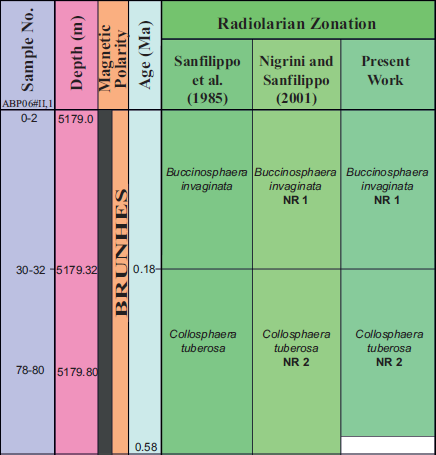
Biozonations of the core ABP-06, Station II, Section 1, showing comparison of zones (Berggren et al., 1985).
Distribution: Nigrini (1967) observed scanty distribution of A. lappacea in low-latitude areas.
Remarks: No remarks.
Abundance: Very rare to few.
Age: Quaternary (mikrotax.org)
(Plate 1, Figure 3)
1887 Acrosphaera spinosa echinoides-Haeckel, Plate 1, Figures 7, 10–13; Plate 4, Figures 1–4, 7, 8.
1979 Acrosphaera spinosa echinoides-Haeckel, Bjørklund and Goll, p. 1311, Plate 1, Figures 7, 10–13.
Distribution: Haeckel (1887) reported A. s. spinosa from the south-east corner of the Pacific.
Remarks: Based on morphological similarities, Riedel and Sanfilippo (1971) proposed A. s. echinoides as a junior synonym of Polysolenia sp. According to Bjørklund and Goll (1979), the last stratigraphic occurrence of this taxon occurred in the Lower Pliocene, within the Stichocorys peregrina zone, and is a reworked species in more recent sedimentary records, suggesting that it was redeposited from older strata into newer sedimentary layers.
Abundance: Very rare to few.
Range: Miocene to Pliocene (mikrotax.org).
(Plate 1, Figure 4)
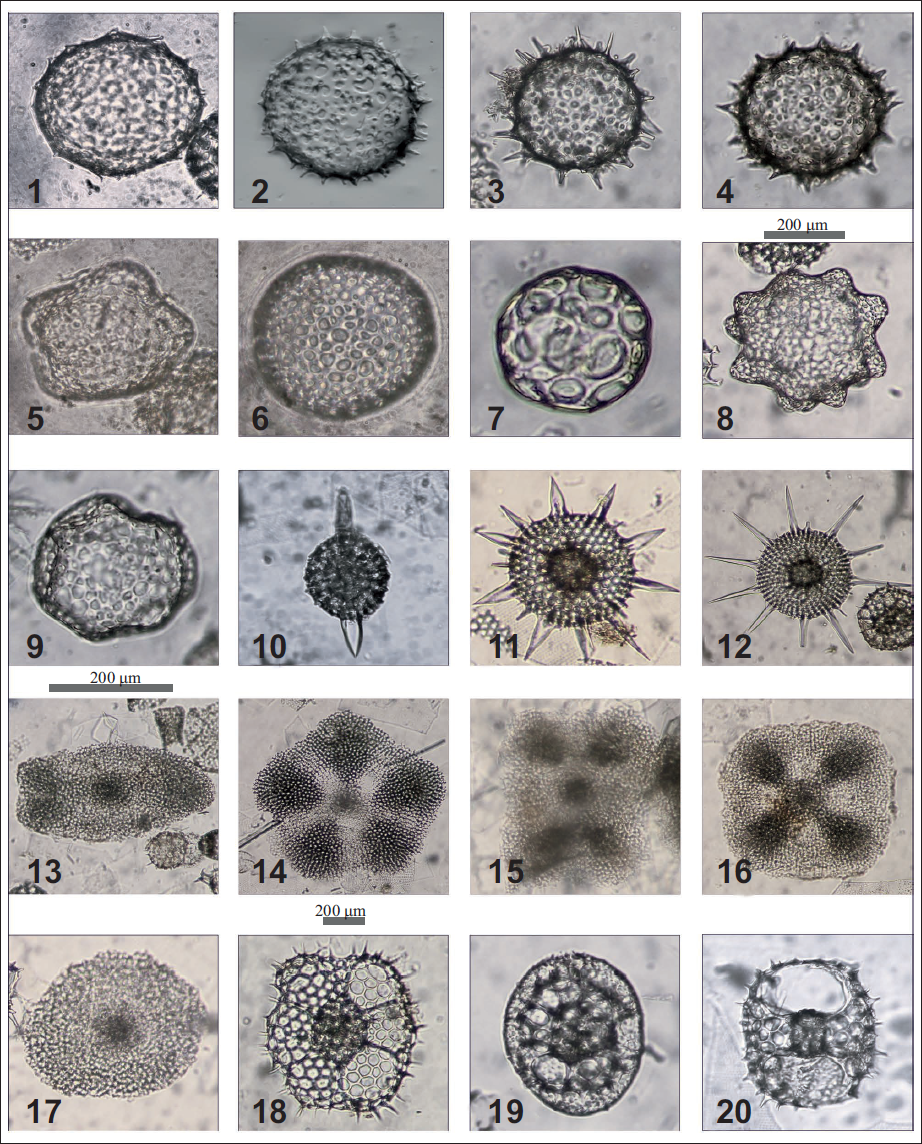
Plate 1. 1. Acrosphaera collina-Haeckel, focused on surface; 2. Acrosphaera lappacea Haeckel, focused on the periphery; 3. Acrosphaera spinosa echinoides (Haeckel), focused on spines; 4. Acrosphaera spinosa spinosa (Haeckel), focused on spines; 5. Buccinosphaera invaginata Haeckel, focused on surface; 6. Collosphaera sp., focused on surface; 7. Collosphaera macropora Popofsky, focused on surface; 8. Collosphaera orthoconus (Haeckel), focused on the periphery; 9. Collosphaera tuberosa Haeckel, focused on surface; 10. Stylatractus sp. Hays, focused on surface; 11. Heliodiscus asteriscus Haeckel, focused on surface; 12. Heliodiscus echiniscus Haeckel, focused on surface; 13. Spongaster berminghamii Campbell and Clark, focused on the surface; 14. Spongaster pentas Riedel and Sanfilippo, focused on surface; 15. Spongaster tetras Ehrenberg irregularis Nigrini, focused on surface; 16. Spongaster tetras tetras Ehrenberg focused on the surface; 17. Spongodiscus ambus Sanfilippo and Riedal, focused on surface; 18. Larcospira quadrangula Haeckel group, focused on surface; 19. Larcopyle buetschlii Dreyer, focused on surface; 20. Tetrapyle octacantha Müller, focused on the surface.
1862 Collosphaera spinosa-Haeckel, p. 536, Plate 34, Figures 12 and 13.
1979 Acrosphaera spinosa spinosa-Haeckel, Bjørklund and Goll, p. 1308, Plate 1, Figures 8 and 9.
Distribution: Nigrini (1967) showed a sparse presence of A. s. spinosa in low and middle latitudes, and Bjørklund and Goll (1979) reported it from the equatorial Pacific region.
Remarks: Thin spines are present over a conical base, which are shorter than those of the A. spinosa echinoides.
Abundance: Rare to few.
Age: Quaternary (mikrotax.org)
Genus: Buccinosphaera-Haeckel, 1887 (Plate 1, Figure 5)
PLATE 2. 1. Stylodictya validispina Jӧrgensen, focused on surface; 2. Circodiscus ellipticus (Stoehr), focused on surface; 3. Stylochlamydium asteriscus Haeckel, focused on surface; 4. Spongopyle osculosa Dreyer, focused on the periphery; 5. Hexaplye dodecantha Haeckel, focused on surface; 6. Octopyle stenozona Haeckel, focused on surface; 7. Anthocyrtidium ophirense (Ehrenberg), focused on shell outline; 8. Anthocyrtidium zanguebaricum (Ehrenberg), focused on shell outline; 9. Giraffospyris angulata (Haeckel), focused on surface; 10. Giraffospyris circumflexa Goll, focused on spines; 11. Liriospyris reticulata (Ehrenberg), focused on surface; 12. Lophospyris pentagona pentagona (Ehrenberg) emend. Goll, focused on the surface; 13 Carpocanistrum spp., focused on pores; 14. Carpocanistrum sp A., focused on surface; 15. Carpocanarium papillosum (Ehrenberg), focused on pores; 16. Carpocanopsis cristata, focused on pores; 17. Nephrospyris renilla renilla, focused on surface; 18. Eucyrtidium acuminatum (Ehrenberg), focused on the periphery; 19. Lamprocyclas maritalis maritalis Haeckel, focused on shell outline; 20. Botryostrobus auritus/australis (Ehrenberg), focused on shell outline.
1887 Buccinosphaera invaginata-Haeckel, p. 99, Plate 5, Figure 11.
2001 Buccinosphaera invaginata-Haeckel, Nigrini and Sanfilippo, p. 169.
Distribution: Its wide yet selective range is demonstrated by the fact that Buccinosphaera invaginata has been reported from several oceanic regions. Bjørklund and Goll (1979) and Knoll and Johnson (1975) both noted that it was found in the middle and equatorial Pacific Ocean. Furthermore, the western Indian Ocean was added to its known range by Johnson and Nigrini (1980). Nevertheless, Nigrini and Sanfilippo (2001) observed that B. invaginata is more uncommon in areas below 30° latitude, indicating a predilection for mid- to low-latitude habitats where ecological or oceanographic factors constrain its abundance.
Remarks: Its first morphotypic appearance makes the base of the youngest Quaternary zone of Buccinosphaera invaginata. Haslett (2004) reported FAD at 0.13–0.19 Ma in the Indian Ocean.
Abundance: Very rare to rare.
Age: Uppermost Quaternary (Sanfilippo et al., 1985).
Genus: Collosphaera Müller, 1855 (Plate 1, Figure 6)
Description: Large, single, thick shell with smooth surface, rounded to sub-rounded pores.
Distribution: Collosphaera sp. reported in the Central Indian Ocean.
Remarks: Showed its presence for the first time in the region.
Abundance: Very rare to rare.
Age: Quaternary (Blueford,1984).
(Plate 1, Figure 7)
1917 C. macropora-Popofsky, p. 247, Plate 14, Figure 2a–2e.
1980 C. macropora-Popofsky, Johnson & Nigrini, p. 119, 147, text-Figure 4a, Plate 1, Figure 7, Plate 4, Figure 15.
Distribution: Johnson and Nigrini (1980, 1982) and Munir et. al (2020) observed the rare occurrence of C. macropora in the Indian Ocean.
Remarks: No remarks.
Abundance: Very rare to rare.
Age: Quaternary (mikrotax.org)
(Plate 1, Figure 8)
1887 C. orthoconus n. sp.-Haeckel, p. 221, Plate 12, Figure 2.
1979 C. orthoconus-(Haeckel) Bjørklund and Goll, p. 1317.
Distribution: Alexandrovich (1989) documented the presence of C. orthoconus in the eastern equatorial Pacific.
Remark: C. orthoconus is restricted to the base of C. tuberosa (Knoll & Johnson, 1975).
Abundance: Very rare to rare.
Range: Miocene-Pliocene (mikrotax.org)
(Plate 1, Figure 9)
1887 Collosphaera tuberosa-Haeckel, p. 97.
2001 Collosphaera tuberosa-Haeckel, Nigrini and Sanfilippo, p. 209.
Distribution: Bjørklund and Goll (1979) and Johnson and Nigrini (1980, 1982) reported C. tuberosa from the Pacific and the Indian Ocean, respectively.
Remarks: Nigrini and Sanfilippo (2001) showed its morphotypic first appearance as synchronous with the lower limit of the Collosphaera tuberosa zone.
Abundance: Very rare to rare.
Range: Late Quaternary-Recent (Sanfilippo et al., 1985).
Family: Actinommidae (Haeckel) Sanfilippo and Riedel, 1980 Genus: Stylatractus Haeckel, 1887
(Plate 1, Figure 10)
1965 Stylatractus sp-Hays, p. 167, Plate 1, Figure 6.
Description: The authors included those specimens that have one longer, cylindroconical, non-bladed, and the other smaller, bladed polar spine.
Distribution: Stylatractus sp. showed its occurrence in the Central Indian Ocean
Remarks: Similar to what is described by Hays (1965).
Abundance: Very rare.
Age:
Family: Phacodiscidae Haeckel, 1881 Genus: Heliodiscus (Haeckel) Nigrini, 1967
(Plate 1, Figure 11)
1887 Heliodiscus asteriscus-Haeckel, p. 445, Plate 33, Figure 8.
2025 Heliodiscus asteriscus-Haeckel, Sharma et al., p. 386, Plate 1, Figure 8.
Distribution: Johnson and Nigrini (1980, 1982) and Nigrini and Lombari (1984) reported H. asteriscus from North of 48°S in the Indian Ocean.
Remarks: Morley (1977) considered H. asteriscus and H. echiniscus as morphological variants of a single species.
Abundance: Very rare to few.
Age: Early Quaternary (mikrotax.org)
(Plate 1, Figures 12)
1887 Heliodiscus echiniscus-Haeckel, p. 448, Plate 34, Figure 5.
1983 Heliodiscus echiniscus-Haeckel, Benson, p. 504; 2020, Sharma and Soreingam, p. 204, Plate 1, Figure 11.
Distribution: Nigrini (1967) showed a sparse distribution of H. echiniscus in low latitudes, and Johnson and Nigrini (1980, 1982) in the Indian Ocean.
Remarks: Morley (1977) considered H. asteriscus and H. echiniscus as morphological variants of a single species.
Abundance: Very rare to few.
Age: Quaternary (mikrotax.org)
Family: Spongodiscidae (Haeckel) Riedel, 1967 Genus: Spongaster Ehrenberg, 1860 (Plate 1, Figure 13)
1944 Spongasteriscus (Spongasterisculus) berminghami n. sp.-Campbell and Clark, p. 30, Plate 5, Figures 1 and 2.
1978 Spongaster berminghami-(Campbell and Clark), Riedel and Sanfilippo, p. 73, Plate 2. Figures 14–16.
Distribution: S. berminghamii is found in Late Miocene to Early Pliocene assemblages at a latitude lower than 40°.
Remarks: S. berminghami is a reworked taxon.
Abundance: Very rare.
Range: Late miocene to early pliocene (Sanfilippo et al., 1985).
(Plate 1, Figure 14)
1970 Spongaster pentas-Riedel and Sanfilippo, p. 523, Plate 15, Figure 3.
1984 Spongaster pentas-Riedel and Sanfilippo, Nigrini & Lombari, pp. S65–S66, Plate 9, Figure 2.
Distribution: Sanfilippo et al. (1985) reported the occurrence of S. pentas in the middle Pliocene of lower than 40°, except DSDP Site 206, near New Zealand.
Remarks: S. pentas evolved from S. berminghami and is a reworked species (Sanfilippo et al., 1985).
Abundance: Very rare.
Age: Middle Pliocene (Sanfilippo et al., 1985).
(Plate 1, Figure 15)
1967 Spongaster tetras Ehrenberg irregularis-Nigrini, p. 43, Plate 5, Figure 2.
2020 Spongaster tetras Ehrenberg irregularis-Nigrini, Sharma and Soreingam, p. 206, Plate 1, Figure 8.
Distribution: Haeckel (1887) found S. tetras irregularis exclusively in middle latitudes. Johnson and Nigrini (1980) observed its presence in the western Indian Ocean.
Remarks: S. tetras irregularis is a useful member of the middle latitude (mikrotax.org)
Abundance: Very rare to rare.
Range: Early Miocene to Late Pliocene (mikrotax.org)
(Plate 1, Figure 16)
1861 Spongaster tetras-Ehrenberg, p. 833.
1967 Spongaster tetras tetras-Ehrenberg, Nigrini, p. 41, Plate 5, Figure 1a and 1b.
Distribution: Johnson and Nigrini (1980, 1982) reported it in the Indian Ocean.
Remarks: No remarks
Abundance: Rare to few.
Range: Pliocene-Recent (Sanfilippo et al., 1985).
Genus: Spongodiscus Ehrenberg 1854
(Plate 1, Figure 17)
1974 Songodiscus ambus-Sanfilippo and Riedel, p. 1024, Plate 1, Figures 12–14.
1984 Spongodiscus ambus-Sanfilippo & Riedel, Nigrini & Lombari, pp. S67–S68, Plate 9, Figure 3a–3c.
Distribution: Sanfilippo and Riedel (1974) reported this species in the western Indian Ocean.
Remarks: No remarks.
Abundance: Very rare to rare.
Age: Lower Pliocene (Sanfilippo & Riedel, 1974).
Genus: Stylodictya (Ehrenberg) Kozlova, 1972
(Plate 2, Figure 1)
1905 Stylodictya validispina-Jӧrgensen, p. 119, Plate 10, Figure 40a and 40b.
1991 Stylodictya validispina –Jӧrgensen, Takahashi, p. 81, Plate 19, Figure 11.
Distribution: Nigrini and Lombari (1984) reported it from Miocene sections of tropical and temperate regions.
Remarks: Sachs (1973) and Robertson (1975) considered it a cold-water species.
Abundance: Very rare to few.
Age: Early Miocene (Nigrini & Lombari, 1984).
Genus (Plate 2, Figure 2)
1880 Trematodiscus ellipticus-Stöhr, p. 108, Plate 4, Figure 16.
1975 Circodiscus ellipticus-Petrushevskaya, Plate 6, Figures 1–6.
Distribution: Chen and Tan (1996) showed its presence in the South China Sea (15°N).
Remarks: No remarks.
Abundance: Very rare to rare.
Age: Late Miocene (Abelmann, 1990).
Genus: Stylochlamydium Haeckel, 1887
(Plate 2, Figure 3)
1887 Stylochlamydium (Stylochlamys) asteriscus n. sp.-Haeckel p. 514, Plate 41, Figure 10.
1979 Stylochlamydium asteriscus-Haeckel, Nigrini & Moore, pp. S113–S114, Plate 14, Figure 5; 1984, Nigrini & Lombari, pp. S75–S76, Plate 10, Figure 4.
Distribution: Benson (1983) reported it in the Southern Ocean.
Remarks: Similar to what is described by Nigrini and Moore (1979).
Abundance: Very rare to few.
Age: Quaternary (mikrotax.org).
Genus: Spongopyle Dreyer, 1889
(Plate 2, Figure 4)
1889 Spongopyle (Spongopylarium) osculosa n. sp.-Dreyer, pp. 118–119, Figures 99 and 100.
1990 Spongopyle osculosa-Dreyer, Abelmann, p. 693, Plate 3, Figure 11.
Distribution: Riedel (1958) and Benson (1966) reported it as cosmopolitan.
Remarks: No remarks.
Abundance: Very rare to rare.
Age: Quaternary (mikrotax.org).
Family: Pyloniidae Haeckel, 1881 Genus: Hexapyle Haeckel, 1887
(Plate 2, Figure 5)
1887 Hexapyle dodecantha-Haeckel, p. 569; Plate 48, Figure 16.
1981 Hexapyle dodecantha-Haeckel, Takahashi & Honjo, p. 150, Plate 6, Figure 3.
Distribution: Haeckel (1887) and Benson (1966) reported H. dodecantha in the central Pacific and tropical regions, respectively.
Remarks: Similar to what is described by Takahashi and Honjo (1981).
Abundance: Very rare to rare.
Age: Quaternary (mikrotax.org).
Genus: Octopyle Haeckel, 1881
(Plate 2, Figure 6)
1887 Octopyle stenozona-Haeckel, p. 652, Plate 9, Figure 11.
2024 Octopyle stenozona-Haeckel, Sharma et al., p. 222, Figures 3 and 19.
Distribution: Benson (1966) and Gupta (1999) reported O. stenozona from the tropical region and the Indian Ocean.
Remarks: Very similar to what is described by Haeckel (1887).
Abundance: Rare to Few.
Age: Quaternary (mikrotax.org).
Genus: Tetrapyle Müller, 1858
(Plate 1, Figure 20)
1858 Tetrapyle octacantha-Müller, p. 33, Plate 2, Figures 12 and 13, Plate 3, Figures 1–12
1987 Tetrapyle octacantha-Müller, Dworetzky & Morley, Plate 2, Figure 1
Distribution: Sachs (1973) and Robertson (1975) considered T. octacantha as a tropical to temperate species. Nigrini and Lombari (1984) and Johnson and Nigrini (1982) observed both reworked and upwelled taxa.
Remark: Very similar to what is described by Müller (1858).
Abundance: Few.
Age: Quaternary (mikrotax.org).
Family: Litheliidae Haeckel, 1862 Genus: Larcopyle (Plate 1, Figure 19)
1889 Larcopyle buetschlii-Dreyer, pp. 124–125, Figure 70.
1984 Larcopyle buetschlii-Dreyer, Nigrini & Lombari, pp. S89–S90, Plate 13, Figure 1a and 1b.
Distribution: Benson (1966) considered cosmopolitan and upwelled taxa.
Remarks: No remarks.
Abundance: Very rare to rare.
Age: Quaternary (mikrotax.org).
Genus
(Plate 1, Figure 18)
1887 Larcospira (Larcospirema) quadrangula-Haeckel, p. 696, Plate 49, Figure 3.
1984 Larcospira quadrangula-Haeckel, Nigrini & Lombari, pp. S93–S94, Plate 13, Figure 3a–3c.
Distribution: Haeckel (1887) reported this species from the central Pacific.
Remarks: No remarks.
Abundance: Very rare to few.
Age: Quaternary (mikrotax.org).
Family
Genus: Giraffospyris (Plate 2, Figure 9)
1887 Eucoronis angulata-Haeckel, p. 978, Plate 82, Figure 3.
1969 Giraffospyris angulata-(Haeckel), Goll, p. 331, Plate 59, Figures 4, 6, 7 and 9.
Distribution: G. angulata occurs in tropical latitudes (Nigrini & Lombari, 1984).
Remarks: No remarks.
Abundance: Very rare to few.
Range: Late Miocene to Recent (Goll, 1972).
(Plate 2, Figure 10)
1969 Giraffospyris circumflexa-Goll, p. 332, Plate 60, Figures 1–4, text-Figure 2.
1984 Giraffospyris circumflexa-Goll, Nigrini & Lombari, pp. N43–N44, Plate 19, Figure 2.
Distribution: Nigrini and Lombari (1984) showed its abundance in tropical latitudes.
Remarks: No remarks.
Abundance: Very rare to few.
Range: Miocene to recent (Mikrotax.org).
Genus: Liriospyris (Plate 2, Figure 11)
1872 Dictyospyris reticulata-Ehrenberg, p. 307.
1968 Liriospyris reticulata-(Ehrenberg), Goll, p. 1429, Plate 176, Figures 9, 11 and 13.
Distribution: Nigrini (1967) observed the presence of L. reticulata in the Indian Ocean and its absence in the middle latitudes.
Remarks: No remarks.
Abundance: Very rare to few.
Range: Middle Miocene-Quaternary (Goll, 1968).
Genus: Lophospyris (Plate 2, Figure 12)
1872 Ceratospyris pentagona-Ehrenberg, p. 303, 69.
1976 Lophospyris pentagona pentagona-(Ehrenberg), Goll, pp. 384, 398, Plate 10, Figures 1–7; Plate 11, Figures 1–3 and 5.
Distribution: Nigrini (1967) observed a sparse presence of L. p. pentagona in the western tropics and its absence in the middle latitudes.
Remarks: Nigrini (1967) and Goll (1976) considered it a cosmopolitan species.
Abundance: Very rare to rare.
Range: Miocene to Quaternary (mikrotax.org).
Genus
(Plate 2, Figure 17)
1887 Nephrospyris (Nephrodictyum) renilla n. sp.-Haeckel, p. 1101, Plate 90, Figures 9 and 10.
1980 Nephrospyris renilla renilla-Haeckel, Goll p. 437, Plate 5, Figure 2.
Distribution: Boltovskoy (1998) considered N. r. renilla as cosmopolitan.
Remarks: N. renilla renilla is an extant species (mikrotax.org).
Abundance: Very rare.
Age: Quaternary (Mikrotax.org).
Family Genus (Plate 2, Figure 13)
1887 Carpocanium petalospyris-Haeckel, p. 1283, Plate 52, Figure 19.
1971 Carpocanistrum spp.-Riedel and Sanfilippo, p. 1596, Plate 1G, Figures 1–6, 8–13; Plate 2F, Figures 5 and 6, Plate 3D, Figures 1, 2, 6, 7, 9.
Distribution: Nigrini (1970) reported C. spp from the tropical Pacific, while Johnson and Nigrini (1980, 1982) reported from the Indian Ocean.
Remarks: No remarks.
Abundance: Very rare to few.
Age: Quaternary (Microtax.org).
(Plate 2, Figure 14)
1966 Carpocanium sp.-Benson, pp. 438–439, Plate 29, Figures 11 and 12.
1983 Carpocanistrum sp. A-Benson, p. 501.
Distribution: Carpocanistrum sp. is reported from the North Equatorial Current by Nigrini (1968).
Remarks: No remarks.
Abundance: Very rare to few.
Age: Quaternary (Microtax.org).
Genus (Plate 2, Figure 15)
1872 Carpocanarium papillosum-Ehrenberg, pp. 310–311; 1873, Plate 7, Figure 10
1958 Dictyocephalus papillosus-(Ehrenberg) Riedel, pp. 236–238; Plate 3, Figure 10; text-Figure 8.
Distribution: Riedel (1958) observed C. papillosus as a cosmopolitan species.
Remarks: No remarks
Abundance: Rare to few.
Age: Quaternary (mikrotax.org).
(Plate 2, Figure 16)
1908 Sethocorys cristata n. sp.-Carnevale, p. 31, Plate 4, Figure 18, Plate 4, Figure 19.
1971 Carpocanopsis cristatum-(Carnevale) Riedel and Sanfilippo, p. 1597, Plate 1g, Figure 16, Plate 2g, Figures 1–7.
Distribution: Kamikuri (2022) reported C. cristata in the Indian, Pacific, and Atlantic Oceans.
Remarks: No remarks.
Abundance: Very rare to rare.
Range: Lower Miocene to Upper Pliocene (mikrotax.org).
Family: Theoperidae (Haeckel) Riedel, 1967 Genus: Eucyrtidium (Plate 2, Figure 18)
1844 Lithocampe acuminatum-Ehrenberg, p. 84.
1970 Eucyrtidium acuminatum-(Ehrenberg) Nigrini, Plate 4, Figure 1.
Distribution: Nigrini (1967) observed the presence of E. acuminatum in the Indian Ocean.
Remarks: E. acuminatum is an extant species (mikrotax.org).
Abundance: Very rare to few.
Range: Early Palaeocene to recent (mikrotax.org).
Family: Pterocoryidae (Haeckel, 1881) Riedel, 1967 Genus: Anthocyrtidium (Plate 2, Figure 7)
1872 Anthocyrtis ophirensis-(Ehrenberg), p. 301
1967 Anthocyrtidium ophirense-(Ehrenberg), Nigrini, p. 56, Plate 6, Figure 3.
Distribution: Nigrini (1967,1970) observed A. ophirense as a typical tropical species present in the Indian Ocean.
Remarks: No remarks.
Abundance: Very rare to few.
Age: Quaternary (mikrotax.org).
(Plate 2, Figure 8)
1872 Anthocyrtis zanguebarica-Ehrenberg, Plate 301.
1967 Anthocyrtidium zanguebaricum-Nigrini, p. 58, Plate 6, Figure 4.
Distribution: Nigrini (1967) reported in both low and middle latitudes.
Remarks: No remarks.
Abundance: Very rare to few.
Age: Quaternary (mikrotax.org).
Genus: Lamprocyclas (Plate 2, Figure 19)
1887 Lamprocyclas (Lamprocyclia) maritalis n. sp.-Haeckel, p. 1390, Plate 74, Figures 13 and 14.
1967 Lamprocyclas maritalis maritalis-Haeckel, Nigrini, pp. 74–76, Plate 7, Figure 5.
Distribution: L. m. maritalis showed its presence in low latitudes beyond 35°S (Nigrini, 1967).
Remarks: Nigrini (1967) and Johnson and Nigrini (1980, 1982) observed L. m. maritalis presence is rare in both low and middle latitudes.
Abundance: Very rare to rare.
Range: Early Miocene to Late Pliocene (mikrotax.org).
Family: Artostrobiidae (Riedel) Foreman, 1973 Genus: Botryostrobus (Plate 2, Figure 20)
1844 Lithocampe aurita n. sp.-Ehrenberg, p. 84.
1977 Botryostrobus auritus-australis-(Ehrenberg), Nigrini, pp. 246, 248, Plate 1, Figures 2–5.
Distribution: Popofsky (1913) reported B. auritus-australis from the tropical western Indian and central Pacific Oceans.
Remarks: No remarks.
Abundance: Very rare to few.
Age: Quaternary (mikrotax.org).
BIOSTRATIGRAPHY
The radiolarian assemblage of ABP-06, Section II, has typical tropical taxa. Two radiolarian biozones (Figure 3) are established based on morphotypic and evolutionary limits, consistent appearance, and common occurrence of stratigraphically important taxa. The two biozones, namely Buccinosphaera invaginata and Collosphaera tuberosa, are as follows:
Buccinosphaera invaginata Range-Zone (Nigrini, 1971) (=NR1)
Nigrini (1971) described the range zone of Buccinosphaera invaginata as its base coincides with the upper limit of Collosphaera tuberosa zone and is of Uppermost Quaternary age. Haslett (2004) reported FAD of B. invaginata from 0.13 to 0.19 Ma in the Indian Ocean. In the studied core, the base of Buccinosphaera invaginata zone is marked at sample no. ABP-06, II, 1, 30-32, depth 5179.32 m. while top at ABP-06, II, 1, 00-02, depth 5179 m and occurs as rare. This zone has other important taxa like Acrosphaera spinosa spinosa, Botrystrobus auritus/australis, Giraffospyris circumflexa, Larcospira quadrangula, Octopyle stenozona, Tetrapyle octacantha, and Stylodictya validspina. The age of the B. invaginata zone is marked at 0.18 Ma; however, Haslett (2004) at 0.19 Ma, and equivalent to the NR1 zone.
Collosphaera tuberosa Interval-Zone (=NR2/NR3)
Nigrini (1971) defined the top of this zone by the first appearance of Buccinosphaera invaginata, which coincides with the lower limit of the B. invaginata zone.
The top of Collosphaera tuberosa is marked with the sample number. ABP-06, II, 1, 30-32, depth 5179.32 m, while the base of it could not be marked as more samples are required for further study. Stratigraphically, significant species are present-Acrosphaera spinosa spinosa, Botryostrobus auritus/australis, Carpocanistrum spp., Giraffospyris angulata, Giraffospyris circumflexa,, Heliodiscus asteriscus,, Larcospyris quadrangula, Octapyle stenozona, Spongaster tetras tetras, Stylodictya validspina and Tetrapyle octacantha.
Further, the Collosphaera tuberosa zone is divided into two zones, namely Collosphaera tuberosa zone (Nigrini & Sanfilippo, 2001) and Stylatractus universus zone (Nigrini & Sanfilippo, 2001). The top of the Collosphaera tuberosa zone is marked at sample no. ABP-06, II, 1, 30-32, depth 5179.32 m; however, the base could not be marked as Stylatractus universus is totally absent in the core.
One important upwelled and one cold-water taxa are present: Tetrapyle octacantha and Stylodictya validspina, which are present in very rare to a few numbers. The presence of these species indicates that this region has an upwelling zone and is influenced by cold bottom water.
REWORKING
Within the core samples, four reworked radiolarian species have been found, each with varied stratigraphic importance and abundance levels. Although they are extant, Spongaster pentas,, which is typical of the middle Pliocene, and Spongaster berminghami, which originally spanned the Late Miocene to early Pliocene, are highly uncommon, indicating little reworking from their respective stratigraphic periods. Acrosphaera spinosa echinoides, which first emerged in the Early Miocene, and Heliodiscus echiniscus, which is known to span from the Miocene to Pliocene, are more uniformly dispersed across the core. A wider range of sedimentary reworking and potential mixing from earlier deposits is indicated by the abundance of these two species, which vary from extremely rare to a few.
A COMPARISON: PLANKTONIC FORAMINIFERAL BIOSTRATIGRAPHY
In the studied section, an integrated proposed radiolarian biozonal scheme is compared with the foraminiferal zonal scheme of McGowran (1974). It is observed that the Buccinosphaera invaginata and Collosphaera tuberosa zone are equivalent to the planktonic foraminifera Globorotalia truncatulinoides zone. The NR1 and NR2 radiolarian zones are further equivalent to N23 of the G. truncatulinoides zone. The zonal boundary of C. tuberosa is marked at 0.5 Ma, while that of G. truncatulinoides is at 0.6 Ma (Figure 3).
CONCLUSIONS
A total of 26 species of Spumellarians and 14 species of Nassellarians have been identified and systematically described from core ABP-06, Station II, Section I, located in the Central Indian Ocean. Based on the radiolarian assemblages, two distinct biozones have been established, reflecting a tropical marine environment.
In addition to the primary assemblage, four reworked species—dating from the Miocene to Pliocene—are present throughout the core, indicating sedimentary mixing and possible reworking from older geological intervals. The presence of one species typically associated with upwelling systems and cold-water conditions suggests that the region currently experiences, or has historically experienced, upwelling activity and the influence of colder bottom waters.
Biostratigraphic analysis indicates that this section corresponds to the Upper Quaternary, with an estimated age range of approximately 0.18–0.5 million years. This time interval aligns with radiolarian zones NR1 and NR2. Furthermore, these radiolarian zones are biostratigraphically equivalent to the Globorotalia truncatulinoides zones established for planktonic foraminifera, providing a valuable correlation between siliceous and calcareous microfossil records in the region.
Footnotes
Acknowledgements
GKS is grateful to Director NCAOR for attending the scientific cruise of RV Akademik Boris Petrov and collecting the samples in the Central Indian Ocean. We are also thankful to Dr D.V. Lazarus for the identification of specific taxa. Deeksha Bohra is grateful to the Government of Uttarakhand for partly providing the fellowship to carry out this work. Thankfully acknowledged to the Head, Department of Geology, Kumaun University, and Prof. Sharma is also thankful to the Head, Department of Geology, University of Delhi, Delhi, for providing the research facilities.
Author’s Contribution
All three authors have contributed to this research work in some way or another.
Data Availability Statement
All the data was generated in the Marine Micropaleontology Lab of the Department of Geology, Kumaun University, Nainital.
Declaration of Conflicting Interests
The authors declared no potential conflicts of interest with respect to the research, authorship and/or publication of this article.
Ethical Approval and Informed Consent Statements
All three authors have consented to participate in publishing this research paper, and this article does not contain any studies with human or animal participants.
Funding
The authors disclosed receipt of the following financial support for the research, authorship, and/or publication of this article: One of the authors (Mrs D. Bohra) got partial support in the form of a fellowship to carry out this work.
Supplemental Material

References
Supplementary Material
Please find the following supplemental material available below.
For Open Access articles published under a Creative Commons License, all supplemental material carries the same license as the article it is associated with.
For non-Open Access articles published, all supplemental material carries a non-exclusive license, and permission requests for re-use of supplemental material or any part of supplemental material shall be sent directly to the copyright owner as specified in the copyright notice associated with the article.
