




Abstract
The Lower Member of the Himmatnagar Sandstone Formation is exposed to the south of Sapteshwar between Sapteshwar and Kadoli in Sabarkantha District, North Gujarat, India. This sedimentary succession is approximately 17.5 metres thick and is rich in ichnofossils. The Lower Member primarily comprises a well-exposed sandstone sequence representing a shallow marine succession. The lower part of the Lower Member in the study area is characterised by the prevalence of Cruziana ichnofacies, indicating a middle to upper shoreface setting. This zone encompasses nine ichnotaxa, including Cochlichnus isp., Gyrochorte comosa, Laevicyclus mongraensis, Lockeia gigantus, Palaeophycus bolbitermilus, Palaeophycus tubularis, Phoebichnus minor, Thalassinoides horizontalis and Thalassinoides suevicus. Conversely, the upper part of the Lower Member comprises three ichnotaxa: Arenicolites isp., Monocraterion isp. and Skolithos linearis, which belong to the Skolithos ichnofacies suggesting upper shoreface to foreshore conditions of paleoenvironment.
INTRODUCTION
The Himmatnagar Sandstone Formation, earlier referred to as Ahmednagar Sandstone by Middlemiss (1921), was subsequently called Himmatnagar Sandstone by Gupta and Mukherjee (Merh, 1995). Exposures of these formations encompass an area of approximately 700 square kilometres, with a significant presence mainly in the Sabarkantha District of Gujarat State. The strata of this formation are visible along the banks of the Sabarmati River and its tributary, the Hathmati River (Bhatt et al., 2016). The Himmatnagar Sandstone Formation is divided into two members: Lower Member and Upper Member (Bhatt et al., 2016). Deccan basalts and recent alluvium overlie the outcrops of the Himmatnagar Sandstone, whereas, at the northeastern corner, it overlies the Precambrian Idar Granite (Bhatt et al., 2016; Merh, 1995). As per Middlemiss (1921), the rocks of the Himmatnagar Sandstone Formation date back to the Mesozoic era, spanning the Neocomian to Albian ages, which correspond to the early to middle Cretaceous period. Weichselia and Matonidium, two extinct fern genera with recognized stratigraphic significance (Merh, 1995), support the assignment of a Lower Cretaceous age to the Lower Member of the Himmatnagar Sandstone Formation. Specifically, Weichselia reticulata is considered a more reliable index fossil than Matonidium (Desai, 1989) ranging from the Neocomian to Cenomanian (Edwards, 1933), further confirming the Lower Cretaceous age of the sequence. The Lower Cretaceous age of the sequence is determined by the abundance of plant fossils found in various horizons of the Lower Member of these rocks (Bhatt et al., 2016). The Himmatnagar Sandstone Formation is recognized as subsequent to the Dhrangadhra Sandstone Group and corresponds to several other formations, including the Wadhwan Sandstone Group of Saurashtra, Songir Sandstone Formation of Vadodara, Bhuj Formation of Kachchh, Nimar Sandstone Formation of the Nimar Valley (M.P.) and the Barmer Sandstone Formation of West Rajasthan (Bhatt et al., 2016). The formation rests on a weathered granite-gneiss basement to the north and east of Himmatnagar. The sandstones identified in Himmatnagar exhibit a composition that ranges from siliceous to ferruginous, characterized by sand grains that are predominantly subrounded to rounded in morphology (Bhatt et al., 2016). The current study of the Himmatnagar Sandstone Formation represents a significant advancement in understanding the Lower Member of this formation in Western India’s Early Cretaceous depositional environments. The ichnological record preserved within the Lower Member of the Himmatnagar Sandstone Formation provides an invaluable complement to the sedimentological data, offering unique insights into the benthic ecology of the Cretaceous coastal system. The trace fossil assemblages identified within the formation are attributed to the Cruziana and Skolithos ichnofacies defined by Seilacher in 1967. This rich ichnological assemblage suggests a complex benthic ecosystem adapted to varying substrate conditions and energy regimes. In conclusion, the present investigation represents a critical step in unravelling the depositional history of the Himmatnagar Sandstone Formation. By synthesising historical research with new ichnological data, this study promises to enhance our understanding of Early Cretaceous environments in Western India, contributing valuable insights to the fields of sedimentology and ichnology.
GEOLOGICAL LOCATION AND STRATIGRAPHY
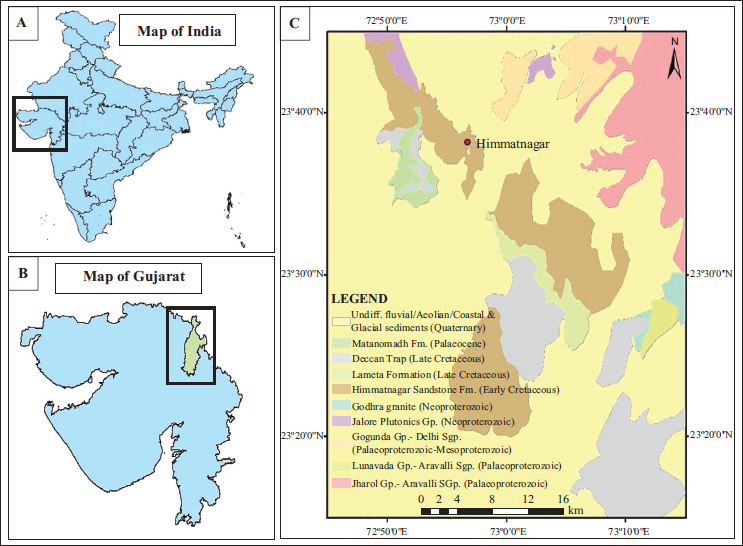
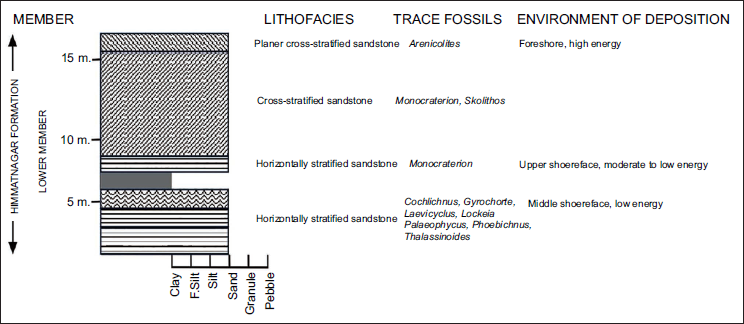
The study is carried out in the northern part of the Gujarat State and encompasses the Lower Member of the Himmatnagar Sandstone Formation. The study area is located approximately 30 km away in the NW direction from Himmatnagar Town and 5 km North of Kadoli of the Sabarkantha District, near the Sapteshwar temple (Figure 1). The study area, is located at 73°10’00”E, 23°40’00”N and 72°50’00”E, 23°20’00”N, covers the Lower Member of the Himmatnagar Sandstone Formation, which has a thickness of 17.5 metres, with sandstone being the dominant rock type (Table 1). The Mesozoic rocks exposed in the area span from Neocomian to Albian, representing the early to middle Cretaceous, and are overlain by the Deccan Traps. The Himmatnagar Sandstone Formation primarily exhibits a horizontal to sub-horizontal orientation, visible in stream and river sections, below thin alluvium cover. These rocks of the Lower Member of the study area include argillaceous sandstone, gritty sandstone, fine-grained sandstone and ferruginous sandstone. The unconformable junction between the Lower Member and Upper Member is visible at a few exposures near Sapteshwar, and the unconformity on the Upper Member is also visible. Fossil wood is preserved in the upper part of the Lower Member.
Lithological representation depicting the distribution of lithofacies, trace fossils and their environment of deposition.
SYSTEMATICS
The trace fossils identified in the study area pertain to the Lower Member of the Himmatnagar Sandstone Formation. Twelve ichnospecies as of 10 ichnogenera have been recorded from the study area, which belongs to the Cruziana and Skolithos ichnofacies. The trace fossils of the Cruziana ichnofacies belong to the lower part of the Lower Member, while the trace fossils of the Skolithos ichnofacies belong to the upper part. The trace fossils of the Cruziana ichnofacies are preserved in fine-grained sandstone and ferruginous sandstone (tidal partings) in the lower part. In contrast, the trace fossils of the Skolithos ichnofacies are found in the upper part of the argillaceous sandstone and gritty sandstone. These names adhere to the binomial system of nomenclature. The systematic ichnology briefly discusses with their ethology, morphology and trophic regime.
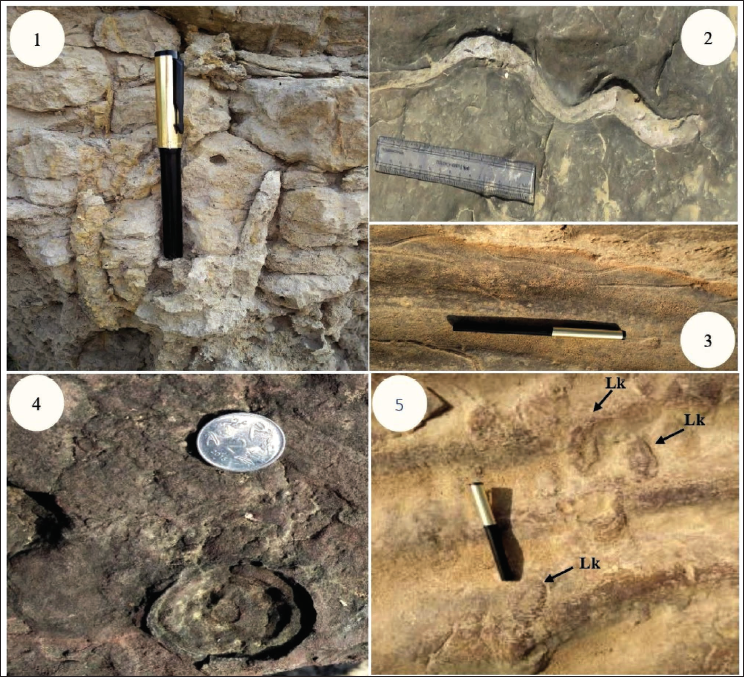
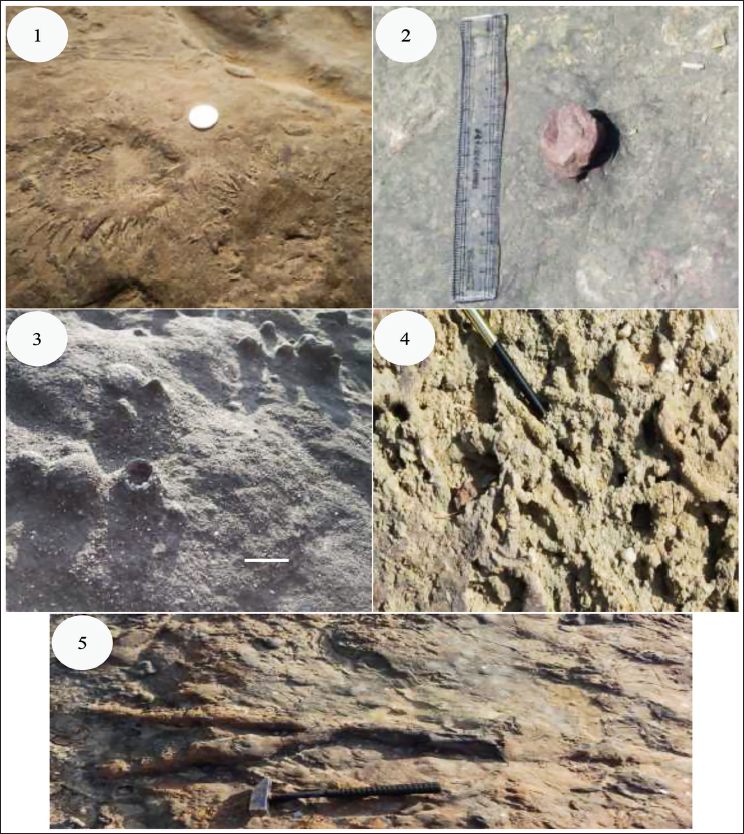
Trace fossils from the Lower Member of the Himmatnagar Sandstone Formation. (1) Arenicolites isp. in the argillaceous sandstone near Sapteshwar. Scale: 13 cm., (2) Cochlichnus isp. occurring in ferruginous sandstone near Sapteshwar. Scale: 15 cm, (3)
Gyrochorte comosa
occurring in ferruginous sandstone near Sapteshwar. Scale: 13 cm. (4)
Laevicyclus mongraensis
occurring in ferruginous sandstone near Sapteshwar. Scale: 2.4 cm. and (5)
Lockeia gigantus
(Lk ) occurring in ferruginous sandstone near Sapteshwar. Scale: 13 cm.
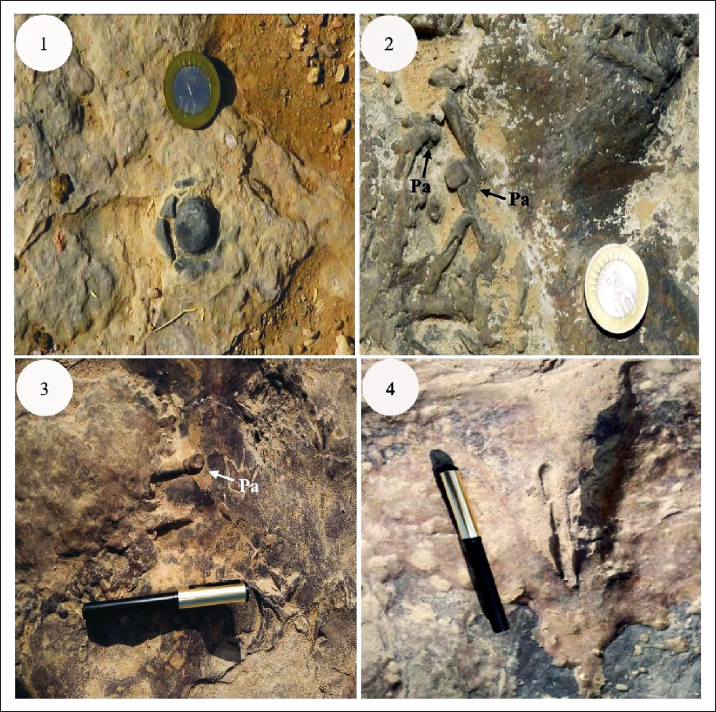
Trace fossils from the Lower Member of the Himmatnagar Sandstone Formation. (1) Monocraterion isp. occurring in ferruginous sandstone near Sapteshwar. Scale: 2.7 cm., (2) and (3) Palaeophycus bolbitermilus (Pa) occurring in ferruginous sandstone near Sapteshwar. Scale: 2.7 and 13 cm respectively and (4)
Palaeophycus tubularis
occurring in ferruginous sandstone near Sapteshwar. Scale: 13 cm.
Trace fossils from the Lower Member of the Himmatnagar Sandstone Formation. (1)
Phoebichnus minor
occurring in ferruginous sandstone near Sapteshwar. Scale: 2.4 cm, (2)
Skolithos linearis
in the lower part of the Lower Member in ferruginous sandstone. Scale: 15 cm, (3)
Skolithos linearis
in the bioturbated upper part of the Lower Member in gritty sandstone. Scale: 1 cm, (4)
Thalassinoides horizontalis
occurring in ferruginous sandstone near Sapteshwar, Scale: 13 cm and (5)
Thalassinoides suevicus
occurring in ferruginous sandstone near Sapteshwar, Scale: 29 cm.
DISCUSSION
Earlier studies have interpreted the Himmatnagar Sandstone Formation as indicative of a fluvial to deltaic environment. More recent research, however, has proposed that the formation represents a foreshore-to-shoreface setting. The current study, based on the analysis of trace fossils, provides further evidence supporting the interpretation of the depositional environment. The findings presented here further corroborate the interpretation of the study area’s depositional environment as transitioning from the foreshore to the middle shoreface.
CONCLUSION
The study shows that the Lower Member of the Himmatnagar Sandstone Formation is highly bioturbated and yields 12 ichnospecies among 10 ichnogenera. The occurrence of vertically oriented ‘I’ and ‘U’ shaped burrows of the Arenicolites, Monocraterion and Skolithos signifies Skolithos ichnofacies, providing evidence of the characteristic high-energy conditions typically associated with upper shoreface and foreshore settings. The presence of horizontal structures such as Cochlichnus, Gyrochorte, Laevicyclus, Lockeia, Palaeophycus, Phoebichnus, Thalassinoides are the characteristic members of the Cruziana ichnofacies. Their presence suggests the prevalence of medium to low energy conditions, indicative of middle to upper shoreface setting. The identified ichnogenera reflect five ethological aspects: domichnia, fodinichnia, pascichnia, cubichnia and repichnia. Based on the analysis of lithofacies such as horizontally stratified sandstone, planar cross-stratified sandstone and cross-stratified sandstone, along with the identification of Cruziana and Skolithos ichnofacies, it can be inferred that the depositional environment corresponds to a transition from the middle shoreface to the upper shoreface and foreshore. The Cruziana ichnofacies are found in horizontally stratified sandstone, which forms in lower energy settings, supporting the interpretation of middle to upper shoreface, where sediment deposition occurs under current influence. In contrast, the Skolithos ichnofacies, which thrive in higher energy environments like the middle shoreface, further corroborate this interpretation. In contrast, the Skolithos ichnofacies are found in cross-stratified sandstone and planer cross-stratified sandstone, which form in high-energy settings, supporting the interpretation of upper shoreface to foreshore, where sediment deposition occurs under wave influence.
Footnotes
Acknowledgements
The authors would like to extend their sincere gratitude to J. J. Vora, the Principal of M. G. Science Institute, Ahmedabad, for his invaluable support in providing essential infrastructure. Furthermore, the authors wish to acknowledge the constructive feedback received from two anonymous reviewers as well as from Professor Mukund Sharma, the editor, both of which greatly enhanced the quality of this manuscript.
Declaration of Conflicting Interests
The authors declared no potential conflicts of interest with respect to the research, authorship and/or publication of this article.
Funding
The authors received no financial support for the research, authorship and/or publication of this article.
