




Abstract
Detailed sedimentological and biostratigraphic studies on the Infra-Cambrian-Cambrian Marwar Supergroup in the key well BGW-A (depth-interval 481–1123 m) in Bikaner–Nagaur Basin have provided a fresh geological insight for depositional facies, reservoir properties and precise age of the different lithounits of this Infra-Cambrian-Cambrian sequence of the well. Jodhpur Formation (1123–1103 m), the lowermost lithounit of the sequence with heavy oil reservoir in this well and Lophosphaeridium-Leiosphaeridia rich acritarch assemblage of Early Ediacaran (635–590 Ma), mainly comprises reddish brown to ash-grey coarse to medium grained sandstones and grey shale. Lithological features and associated acritarch flora suggest a littoral to marginal marine environment for the Jodhpur Formation in a foreshore depositional set-up. The succeeding Bilara Formation in this well (1103–1086 m) mainly includes finely laminated bioturbated dolostones and thin black shales, and is marked by the Lophosphaeridium and Vandalosphaeridium-rich assemblage, indicating Late Ediacaran (550–541 Ma) age with inner neritic depositional environment in a supra-tidal set-up. The overlying depth interval of 1086–920 m is represented by the Hanseran Evaporite Formation and characterised by interbedded dolostone, anhydrite/halite and reddish-brown mottled claystone. This lithounit is marked by the Dictyotidium, Asteridium, Comasphaeridium and Annulum-dominated acritarch assemblages of Early Cambrian, indicative of an inner neritic depositional environment. The reddish-brown sandstone mainly represents the overlying Nagaur Formation (920–727 m) and intercalated siltstones/shales with poor microfossil contents. It is inferred to be of the upper Early Cambrian age. Upper Carbonate Formation (727–481 m), the youngest lithounit of the Marwar Supergroup, includes a thick succession of dolostone and dolomitic limestone. Lower (727–634 m) and middle (634–574 m) parts of this unit are marked by the Cristallinium and Cymatiosphaera dominated acritarch assemblage of Middle Cambrian, while the upper part (574–481 m) of this lithounit shows the notable presence of Late Cambrian-Tremadocian marker acritarch taxa, like Buedingiisphaeridium papillatum, Striatotheca rarirrugulata and Dorsennidium minutum, suggesting a similar age. Petrographic and SEM studies reveal that the sandstones in the Jodhpur Formation show moderate-to-good intergranular porosity. However, Bilara and Hanseran Evaporite formations showed tightness of the sandstone/siltstone reservoirs, which are cemented mainly by anhydrite, giving rise to destruction of the porosity. Nagaur Formation also has very poor porosity, while moderate intercrystalline porosity is observed in the Upper Carbonate Formation. Associated grey shales/siltstones of Jodhpur and Bilara formations in this well have moderate-to-rich sapropelic organic matters, with TAI varying from 2.50 to 2.60, and were in the generative oil window during Permian to Jurassic with local hydrocarbon migrations.
INTRODUCTION
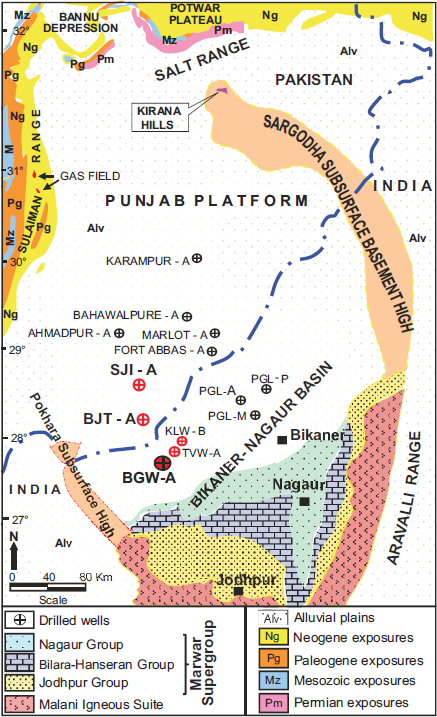
The discovery of heavy crude oil from the Infra-Cambrian Marwar Supergroup, mainly from the sandstones of Jodhpur Formation in Bhagewala-A well (BGW-A) in Bikaner–Nagaur Basin (Figure 1), has opened a new exploration frontier for the integrated geoscientific studies on this succession for the accelerated exploration strategies. The ONGC Ltd. first initiated the concerted and integrated hydrocarbon exploration activities and later followed by Oil India Ltd. since late fifties of the last century with the drilling of several exploratory wells which have shown the presence of a thick succession of mixed carbonate siliciclastic Precambrian-Cambrian (Infra-Cambrian) sedimentary rocks of about 1050–1200 m thickness. This Infra-Cambrian succession is mainly covered by the Upper Paleozoic (Permian), and Jurassic to Paleogene (Eocene-Oligocene) sediments with several unconformities, and has been classed as the Marwar Supergroup (Das Gupta & Balgauda, 1994) since it has the lithological similarities with the outcropping Marwar Supergroup (Figure 2). However, no commercial discoveries were made, although minor oil/gas shows were observed from the Tertiary sediments in some exploratory wells. However, Oil India Ltd. has discovered the heavy oil in BGW-A, Taverewala-A (TVW-A) and Kalarewala-A (KLW-B) wells at multiple stratigraphic levels from the sediments of the Infra-Cambrian Marwar Supergroup (Figures 1 and 2).
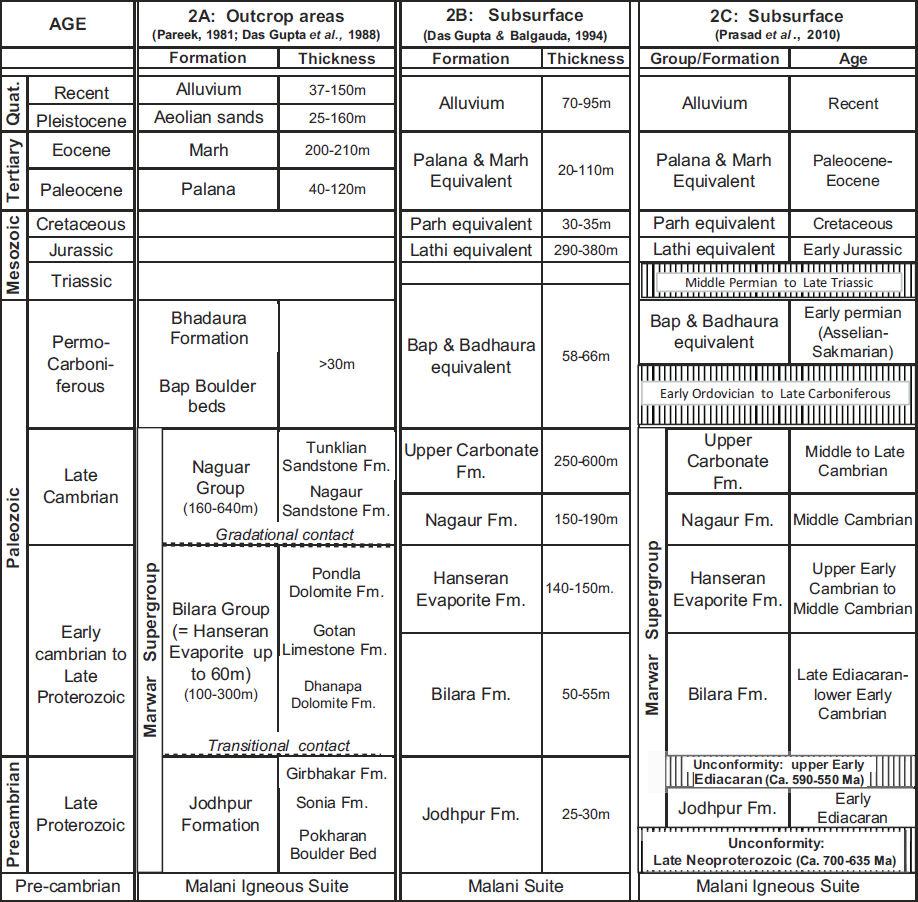
Generalised lithostratigraphy of Bikaner–Nagaur Basin (after Pareek, 1981; Das Gupta et al., 1988; Das Gupta & Bulgauda, 1994, Prasad et al., 2009), with special reference to Marwar Supergroup.
The discovery of heavy crude oil of about 7 bbl of viscous and 17.6° API gravity (Peters et al., 1995) from Jodhpur Sandstone of Marwar Supergroup in well BGW-A has opened a new hydrocarbon play in this Infra-Cambrian-Cambrian succession of the Bikaner–Nagaur Basin. In addition, heavy oil is shown at four stratigraphic levels, namely Bilara, Hanseran Evaporite and Upper Carbonate formations (Figures 1 and 8), have provided fresh impetus to accelerate exploration activities in the Bikaner–Nagaur Basin on the Marwar Supergroup to assess its hydrocarbon potential. Nevertheless, reservoir properties of the main crude oil-bearing sandstones of Jodhpur Formation, and succeeding lithounits of Bilara, Hanseran, Nagaur and Upper Carbonate formations of Marwar Supergroup, which have also shown the presence of heavy crude oil, are not adequately evaluated, and poorly understood due to lack of availability of the conventional cores. Additionally, the precise geological age of the different lithounits of this Infra-Cambrian-Cambrian succession is also poorly constrained due to their unfossiliferous nature or the absence of age-diagnostic mega- and microfossils and broadly assigned Late Precambrian-Early Cambrian age as this succession is sandwiched between the precisely dated Middle to Late Neoproterozoic (ca.780–700 Ma) Malani Igneous Suite and Early Permian (ca. 300–280 Ma) Bap/Badhaura Formation (Figure 2).
In this work, detailed sedimentological and acritarch-based biostratigraphic studies have been carried out on the heavy crude oil-bearing different lithounits of the Marwar Supergroup in well BGW-A (Figure 1) to assess the lithological characteristics and reservoir properties of Jodhpur, Bilara, Hanseran Evaporite, Nagaur and Upper Carbonate formations. Detailed biostratigraphic studies on this sedimentary succession have also been undertaken to infer the age and depositional environment of the above lithounits through acritarch and associated organic-walled microfossils data. This work provides the factual lithological and reservoir properties of the different lithounits of the Marwar Supergroup for the first time through the study of conventional drill cores taken at different stratigraphic levels of this succession in the key well of BGW-A (Figure 8). Additionally, precise and authentic age inference is also inferred through the record of global age marker microfossils (acritarchs and associated organic-walled microfossils) from various conventional cores and cutting samples available from this Infra-Cambrian-Cambrian succession in this well (Figure 8).
GEOLOGICAL SETTING AND LITHOSTRATIGRAPHY
Bikaner–Nagaur Basin is located in the western part of Rajasthan, mainly covering the Bikaner, Nagaur and Jodhpur districts. It represents the south-eastern flank of the north-westerly dipping Indian Platform (Figure 1). This basin opens up towards the northwest, and extends from the Aravallis in the southeast to the north and northwestern side up to the Salt Range-Sulaiman province of the Punjab Platform in Pakistan, covering the master Indus Basin that existed during the Late Neoproterozoic-Paleozoic period (Figure 1). This basin is separated from the Jaisalmer Basin in the southwest by NW-SE trending Pokharan Subsurface High, and bounded by the NW-SE trending Sargodha subsurface basement high towards the north-eastern and north sides (Figure 1). About 600–1200 m thick succession of Late Neoproterozoic-Early Paleozoic (Cambrian) mixed carbonate siliciclastic sedimentary rocks has been recognised in the outcrop areas of this basin which are deposited over the Malani Igneous Suite (Figure 1), and are grouped/named as the Marwar Supergroup (Das Gupta et al., 1988; Khan, 1971). In the outcrop areas, the Marwar Supergroup is divided into Jodhpur, Bilara and Nagaur groups, further subdivided into several formations (Figure 2A). The above lithounits are also recognised in the subsurface, along with an additional succeeding lithounit of Upper Carbonate Formations/Group (Figure 2B). In the subsurface sections, these lithounits become thicker towards the northwest side near the depocentre of the basin as revealed by the geological data obtained from the number of drilled exploratory wells (Figures 1 and 2). A regional cross-section of the western Rajasthan and Punjab Platform of Pakistan (northern Middle Indus Shelf) reveals that the Infra-Cambrian-Cambrian package of Marwar Supergroup is restricted to the east of the Indus River (Figure 1), which may be the basin limit for the Late Neoproterozoic-Early Paleozoic evaporitic sea of the Western Rajasthan as opined by Das Gupta et al. (1988), Das Gupta, (1996) and Das Gupta & Balgauda (1994).
In the outcrop areas, various lithounits of the Marwar Supergroup rest unconformably over the Malani Igneous Suite of Middle to Late Neoproterozoic (Rb/Sr age 780–700 Ma) age. This succession is subdivided into Jodhpur, Bilara, Hanseran Evaporite and Nagaur groups, and unconformably overlain by the Early Permian Lower Gondwanic sediments of Bap/Bhadaura formations (Figure 2A). In the outcrops, the Jodhpur Group is further subdivided into Pokharan Boulder Beds, Sonia and Girbhakar formations, the Bilara Group into the Dhanapa, Gotan and Pondalo formations, and the Nagaur Group into Nagaur and Tunklian formations (Das Gupta et al., 1988; Pareek, 1981, 1984) (Figure 2A). While in the subsurface sections, the Marwar Supergroup is subdivided into Jodhpur, Bilara, Hanseran Evaporite, Nagaur and Upper Carbonate formations, instead into the groups (Figure 2B) since lithological/facies variations are not so prominent (Das Gupta & Bulgauda, 1994). A generalised lithostratigraphy of the Bikaner–Nagaur Basin, outlined by different workers in outcrop areas and subsurface sections, is summarised in Figure 2.
Biostratigraphic studies on the outcropping Marwar Supergroup are somewhat scanty. Khan (1973) recorded Cambrian brachiopod Orthis from the Sonia Formation of the Jodhpur Group; however, without illustrations and descriptions, it is thus considered a doubtful record by many workers (for details see Kumar & Pandey, 2008). Recently, Raghav et al. (2005) recorded medusoidal Ediacaran fossil Marsonia artiyansis from the Sonia Sandstone of Jodhpur Group, in addition to the trace fossils, like Planolites sp., Skolithos sp. and algal mats from the brownish shales of the above formation exposed at Artiya Kalan and Dhoru near Jodhpur. They broadly assigned a Late Neoproterozoic (Ediacaran) age for the Sonia Sandstone Formation of the Jodhpur Group. Kumar and Ahmad (2016) also recorded problematic trace fossils (Algal mould and casts of filamentous branched tubes) of Ediacaran aspect from the Jodhpur sandstone from the Dulmera area in Bikaner district. Rich algal stromatolitic structures, like Collenia, Colloniella, Conocollenia, Cryptozoons and Stratifera of Late Neoproterozoic aspect were recorded from the Dhanappa Formation of Bilara Group (Burman, 1980; Maithy, 1984). Kumar and Pandey (2008) recorded trilobite trace fossils of Cruziana, Dimorphichnus and Rusophycus from the Nagaur Sandstone Formation and inferred an Early Cambrian age for this formation. Invertebrate megafossils or other biogenic structures are not reported so far from the Hanseran Evaporite and Upper Carbonate formations, as these lithounits are not exposed in outcrops, and are encountered in the subsurface sections only (Figures 2B and 2C).
An assessment of the above biostratigraphic works on the Marwar Supergroup has indicated that the records of explicit and age diagnostic mega/macro and microfossils of animal or botanical affinities are lacking, resulting in the inconclusive age assignment for the different lithounits of this Infra-Cambrian-Cambrian succession. Additionally, lithological/sedimentological characters and reservoir properties of the heavy oil-bearing different lithounits of the Marwar Supergroup have not been adequately assessed so far in the subsurface sections or outcrop areas.
In this work, detailed lithological/sedimentological, petrographic and scanning electron microscopy (SEM)studies on the different lithounits of Marwar Supergroup in BGW-A well of Bikaner–Nagaur Basin (Figure 1) are carried out on the available drill core and cutting samples to assess the sedimentological characteristics, reservoir properties and depositional environment of different lithounits of this Infra-Cambrian-Cambrian succession which has shown the occurrences of heavy liquid hydrocarbons at multiple stratigraphic levels in Jodhpur, Bilara, Hanseran and Upper Carbonate formations (Figure 8). Additionally, detailed biostratigraphic studies, based on acritarch and associated organic-walled microfossils, have been carried out for the precise age inference of the above-mentioned lithounits of the Marwar Supergroup along with interpretation of their depositional environment based on documented organic-walled microfossils (acritarchs).
MATERIALS AND METHODS
Three conventional cores, namely CC-1 (942.0–951.0 m), CC-2 (970.0–979.0 m) and CC-3 (1115–1121.5 m), cored from the Jodhpur Formation (CC-3) and the Hanseran Evaporite Formation (CC-2 and CC-1) of Marwar Supergroup in well BGW-A, and preserved in the Oil India Core Library at Jodhpur, are systematically logged with megascopic descriptions matching with the Electric Logs. Laboratory studies at KDMIPE (ONGC), Dehradun, include detailed logging of the above cores for megascopic and microscopic studies, lithological interpretation of electrical logs and documentation of sedimentological structures, in addition to the petrographic and SEM analysis for assessing the reservoir properties of different lithounits of the Marwar Supergroup (Figures 3–7 and 9–14).
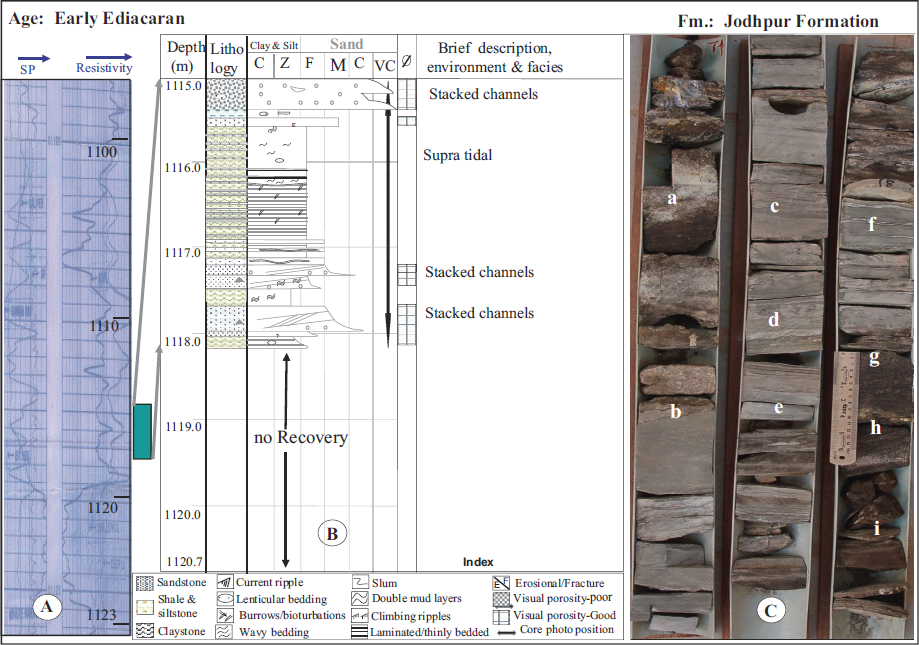
A, B, C. Detailed core log of the conventional core CC-3 (depth-int. 1115–1121.5 m, rec.52.0%), cored in the lower part of Jodhpur Formation in BGW-A well; (A) electrical log showing the serrated and cylindrical log motifs along the cored depth-interval of Jodhpur Formation, (B) detailed litholog of the core (CC-3: 1115–1121.5 m), (C) whole core photographs showing the gross lithological features, alphabets a-i marked on the whole core photograph in Figure 3C refers to enlarged lithological/sedimentological features in Figure 4.
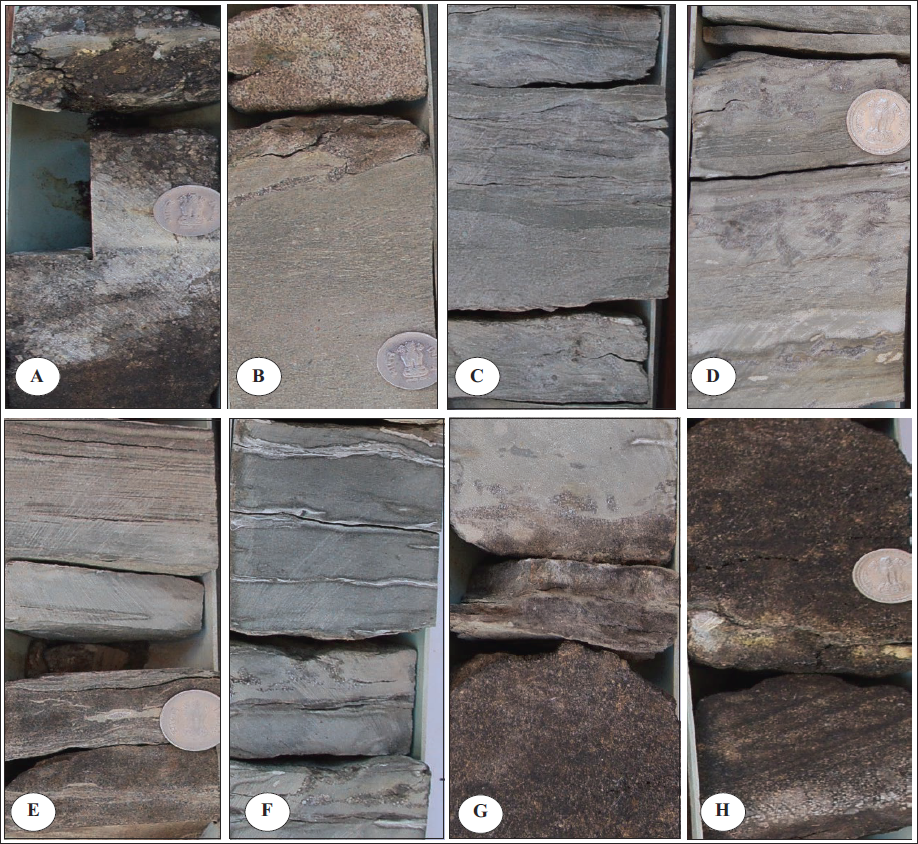
A–H. Enlarged view of the different core segments of CC-3 (depth-int.1115.0–1121.5 m), enlarged core segment positions shown in the figure. 3C of Jodhpur Formation in well BGW-A, showing detailed lithological characters; (A) heavy crude oil stained sandstone, (B) coarse sandstone at the top occurring over the dirty white claystone with sharp contact, (C) dirty white siltstone/claystone, (D) dirty white siltstone with layers of anhydrite/salt, (E) lower part of the core representing reddish brown crude oil stained sandstone, while upper part represents thinly laminated whitish brown claystone, (F) greyish white claystone with very thin horizontal partings of anhydrite, (G) oil-stained ferruginous sandstone at bottom and claystone at the top, (H) heavy crude oil-stained ferruginous sandstone with cross-stratifications.
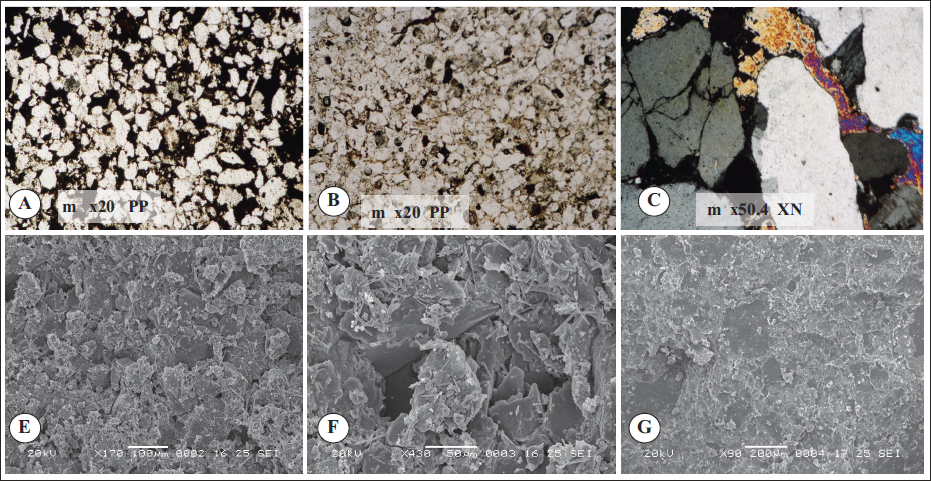
A–F. Photomicrographs of CC-3 (depth-int. 1115–1121.5 m) in well BGW-A, showing detailed textural and reservoir characteristics of Jodhpur Formation (Girbhakar Member); (A) fine grained quartz arenite with sub angular quartz grains, abundant pyrite and carbonaceous matter, (B) fine grained moderately sorted quartz arenite with sub rounded grains of quartz, feldspar micas and has moderate intergranular porosity, (C) sub rounded quartz, feldspar grains cemented by anhydrite, (D) SEM micrograph showing good intergranular porosity, (E) enlarged view of the photo in 5d showing intergranular porosity, needle of anhydrite minerals, (F) general fabric of the sandstone showing detrital grains floating in cements giving rise to loss of porosity.
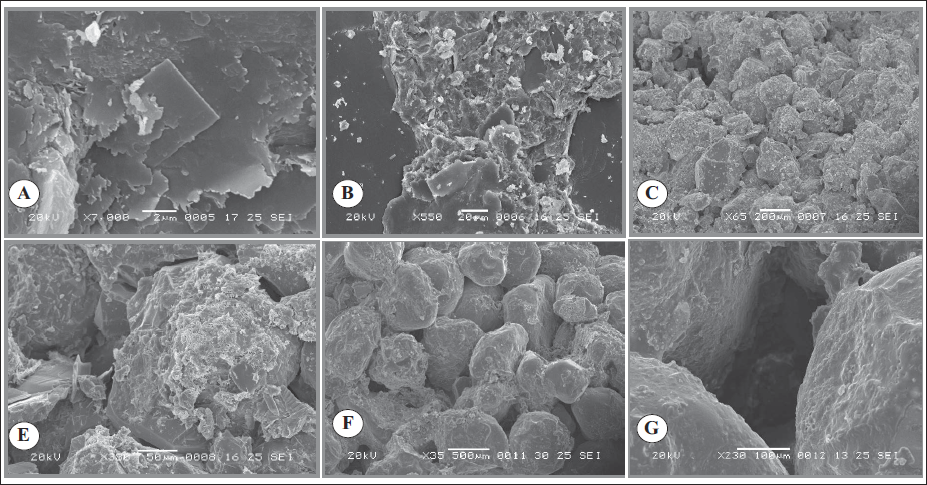
A–F. SEM photomicrographs images of CC-3 (depth-int. 1115.0–1121.5 m) of Jodhpur Formation (Girbhakar Member) in BGW-A well; (A) dolomite rhomb in association with adjoining clays, (B) intergranular pore totally occluded due to presence of clay and patchy dolomite crystals, (C) general fabric of sandstone showing good intergranular porosity, (D) enlarged view showing over growth on quartz grain and local clay on the surface, (E) another view of quartz arenite with very good intergranular porosity, (F) enlarged view of the earlier photo showing cleaner pore throats and intergranular porosity.
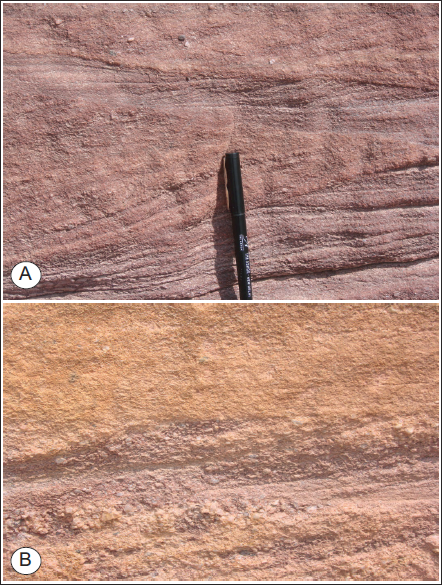
A–B. (A) Outcrop exposure of Jodhpur Formation (Girbhakar Sandstone Member) from the outskirts of Jodhpur city, showing low-angle cross-bedding in sandstone, (B) outcrop exposure of Jodhpur Formation (Girbhakar Sandstone Member) from the outskirts of Jodhpur city, showing sandstone at the top and pebbly bed at the bottom.
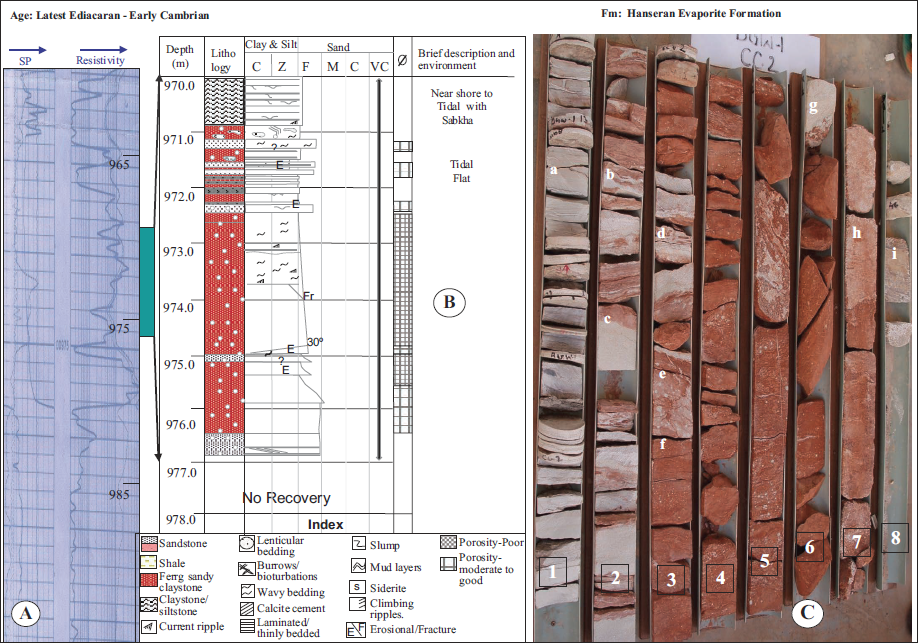
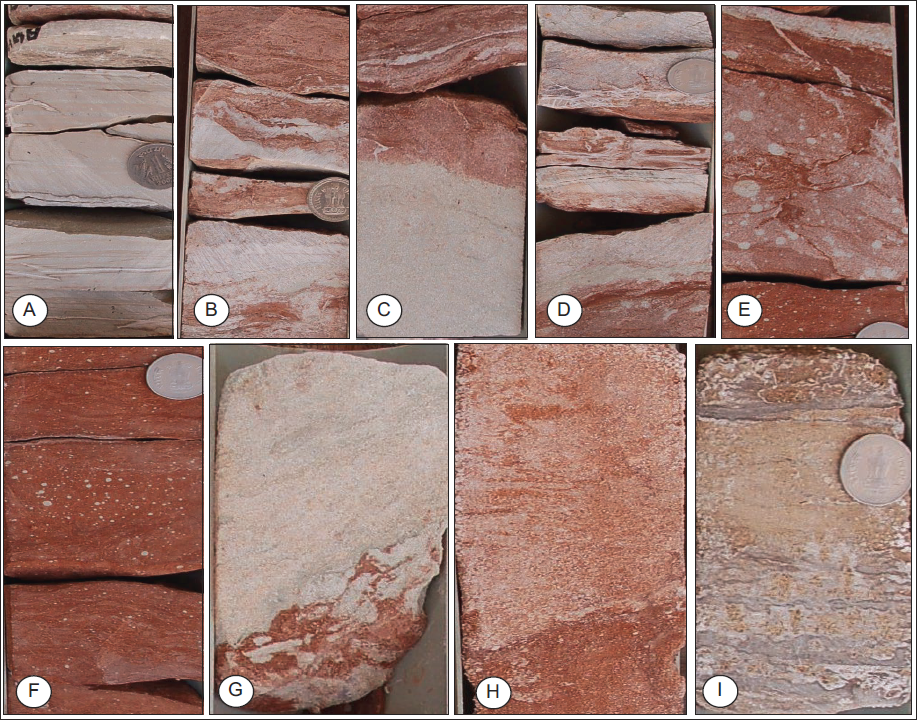
A–I. Enlarged view of the core segments of CC-2 (positions in Figure 10C) in well BGW-A, showing various lithological characters of Hanseran Evaporite Formation; (A) dirty white claystone with horizontal partings of anhydrite, (B) sandstone with thick and wavy laminae of anhydrite, (C) dirty white sandstone at bottom, and ferruginous claystone with thin partings of anhydrite in the top part, (D) claystone with number of anhydrite laminations, (E) red ferruginous mottled sandstone with incline laminations and partings of anhydrite, (F) red ferruginous claystone with mottling effect of anhydrite, (G) top part representing massive while the bottom part shows needles of anhydrite, (H) anhydrite occurring as dispersed with thin clay partings, (I) horizontal halite layers within sandstone.
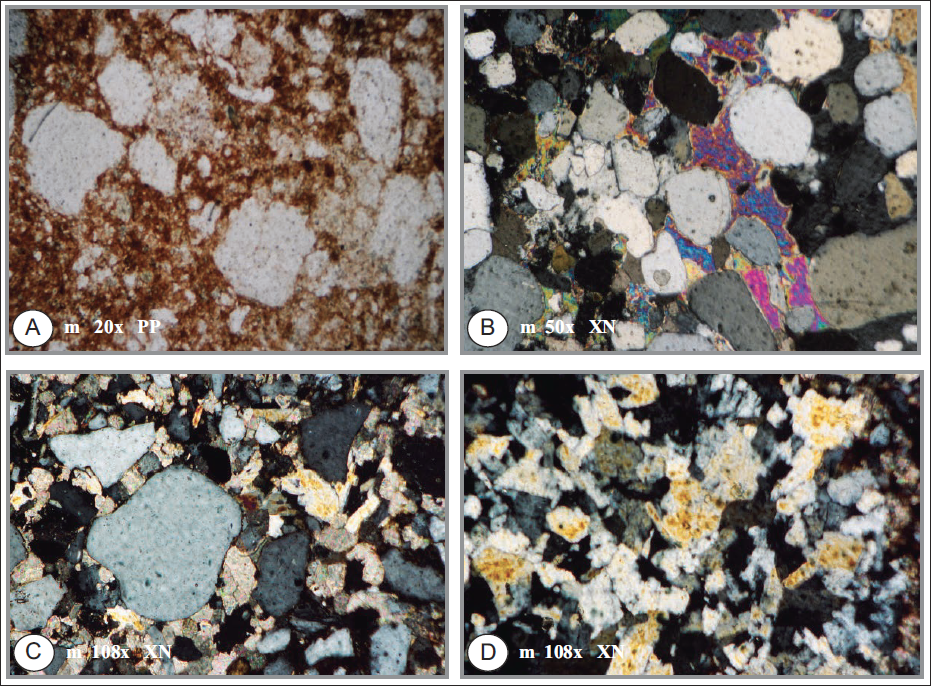
A–D. Photomicrographs of CC-2 (depth-int. 970.0–979.0 m), showing detailed textural and reservoir characters of Hanseran Evaporite Formation in BGW-A well; (A) medium to coarse grained poorly sorted quartz floating in micritic matrix, small rhombs of calcite are also scattered within the matrix, (B) medium grained quartz with sub rounded to rounded grains, cemented by anhydrite cement, (C) enlarged view showing sub rounded grain of quartz with spray calcite and patchy anhydrite cements, (D) sub-angular grains cemented by anhydrite cements, quartz and feldspar grains are cemented by anhydrite.
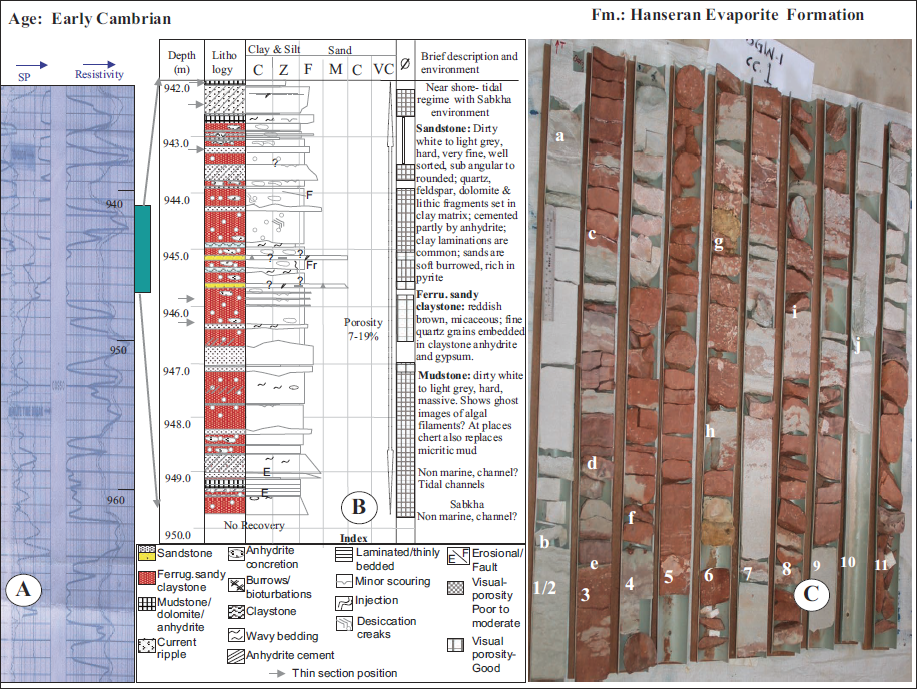
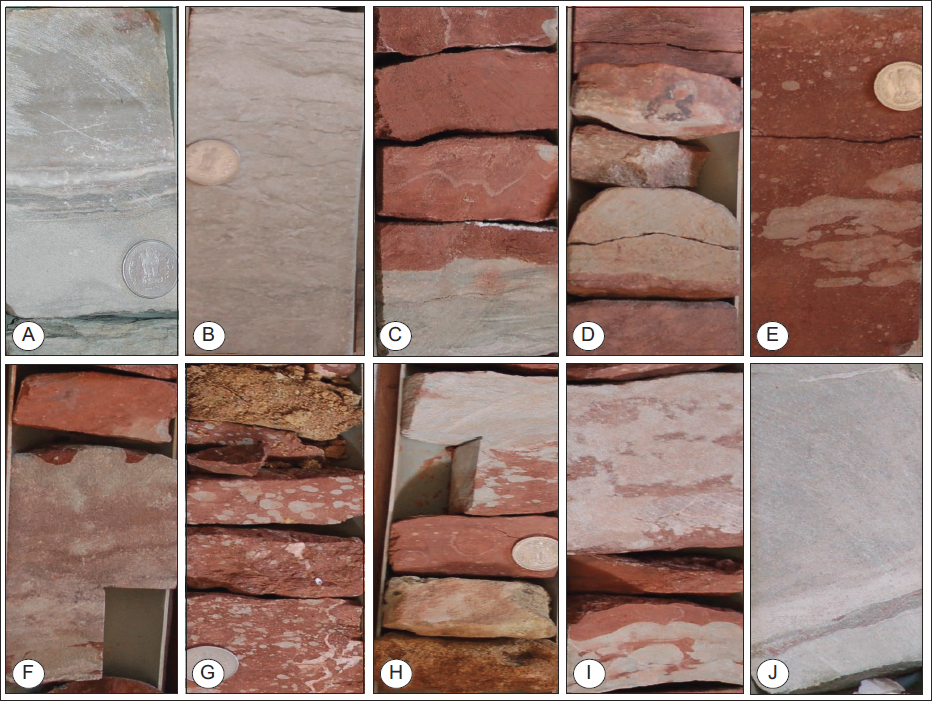
A–J. Enlarged view of the core segments of CC-1 (depth-int. 942.0–951.0 m), (enlarged view positions of core shown in Figure 12C: A–J) of the upper part of Hanseran Evaporite Formation in BGW-A; (A) showing parallel to discontinuous laminated mudstone and siltstones cemented with anhydrite, towards bottom laminations are wavy, (B) well sorted fine sandstone with wavy lamination, bifurcated lamination and minor scouring surfaces, (C) greyish white claystone at bottom followed by reddish claystone at top, (D) variegated claystone, (E) fine sandstone with anhydrite lenses, (F) fine sandstone with patchy anhydrite, (G) bioturbated ferruginous sandstone, (H) ferruginous sandstone with anhydrite cement in the top, (I) ferruginous sandstone with irregular anhydrite layers, (J) gypsum/anhydrite cemented sandstone.
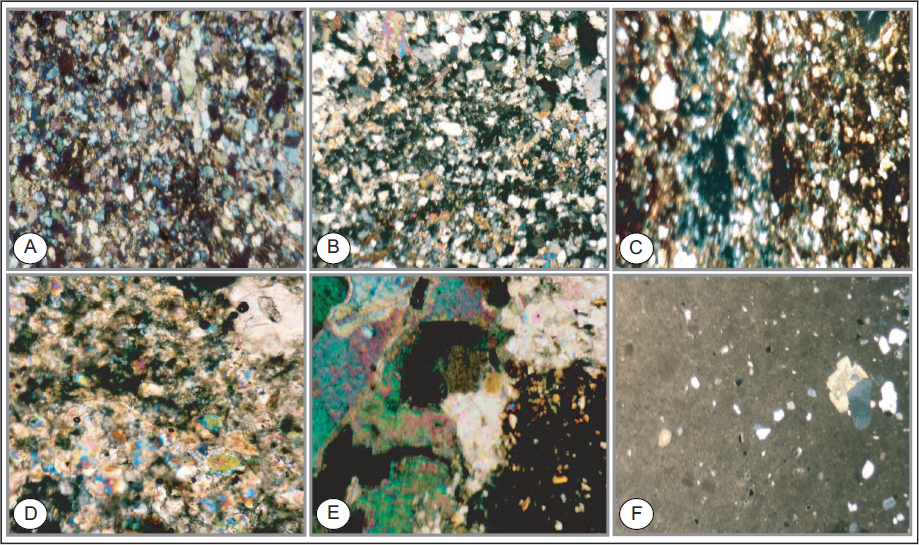
A–F. Photomicrograph showing detailed textural and reservoir characteristics of CC-1, representing the upper part of Hanseran Evaporite Formation in BGW-A well; (A) fine grained quartz arenite with anhydrite cement as pore fill, black opaque and mica flakes, (B) fine grained sandstone cemented by anhydrite cement, (C) fine grained sandstone with sub rounded grains of quartz and carbonaceous matter, (D) Sub angular grains of quartz cemented by abundant anhydrite cements, (E) subrounded grains of quartz cemented by anhydrite, (F) scattered grains of quartz floating in micritic material.
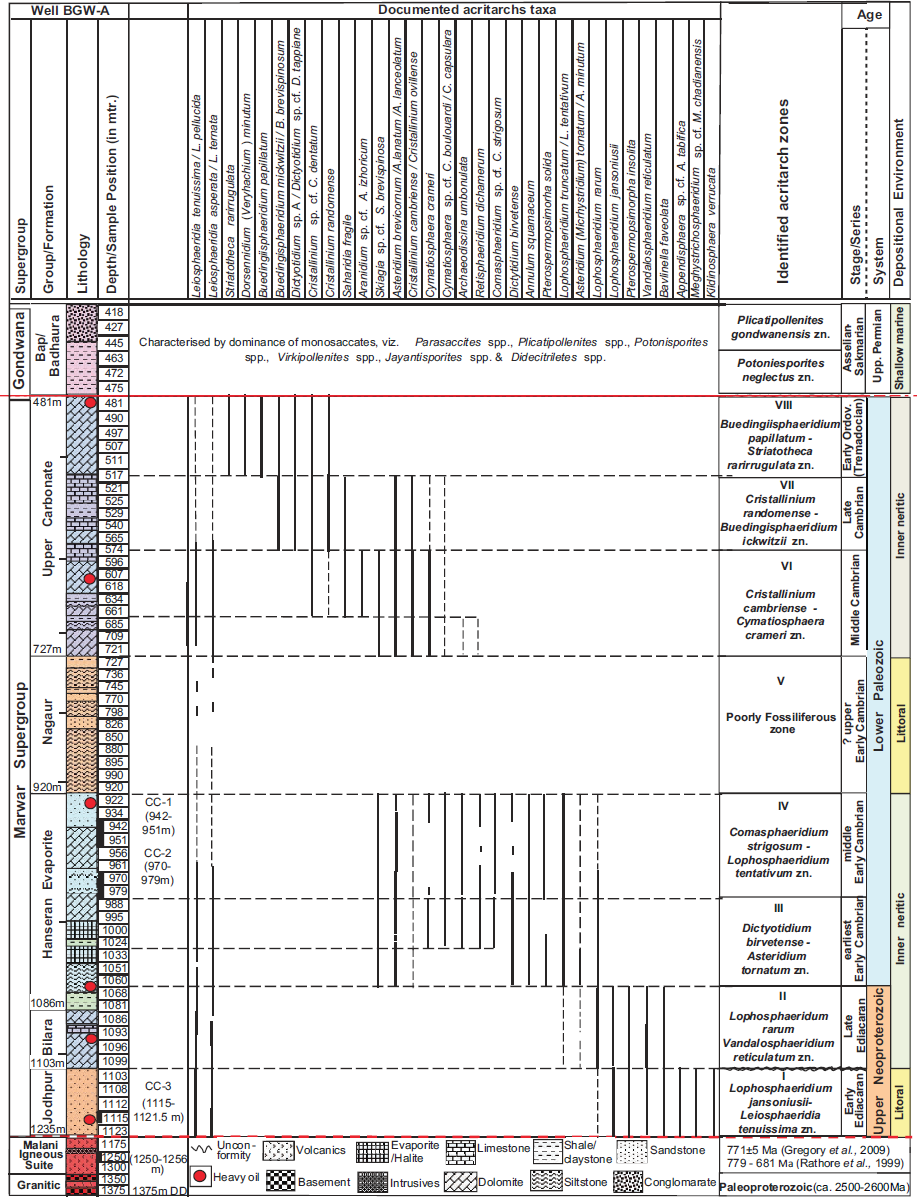
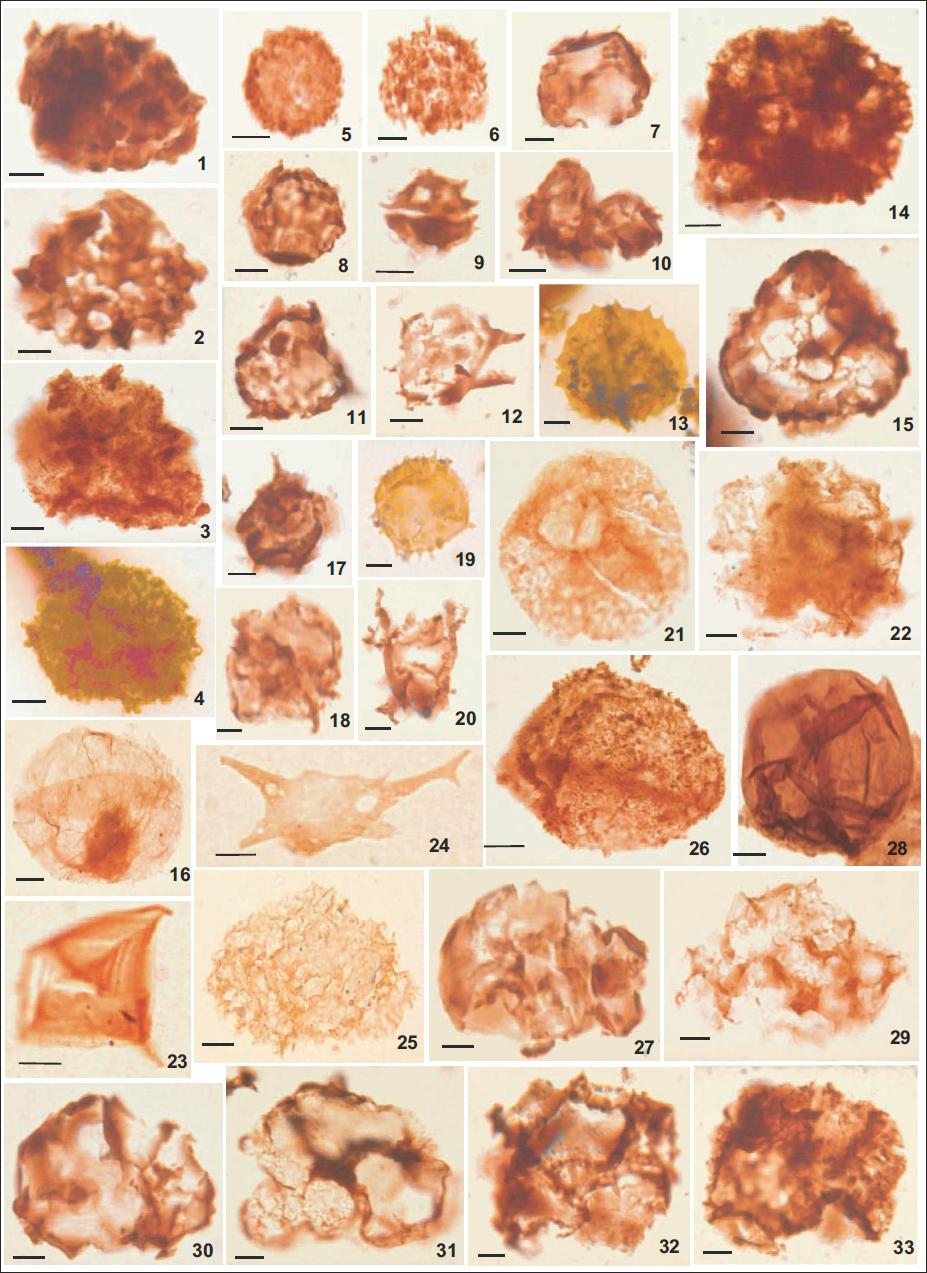
Biostratigraphic studies include the documentation of age-potential acritarch taxa from the different lithounits of Marwar Supergroup, encountered from 481 to 1123 m depth interval in well BGW-A, with illustration of important and age-marker acritarch taxa through photomicrographs (Plate 1: Figures 1–19; Plate 2: Figures 1–24; Plate 3: Figures 1–33). Stratigraphic distributions of important acritarch taxa are presented through frequency distribution (Figure 8). Acritarch zones are demarcated based on the abundance of nominated taxa in the zone, and first (FODs) and last (LODs) occurrence datums of age marker taxa with interpretation of precise age and depositional environment of different lithounits of the Marwar Supergroup (Figure 8).
The term “Infra-Cambrian” is informally used in this work for the Late Neoproterozoic (Ediacaran) and Early Cambrian (Pre-trilobite) succession only. Infra-Cambrian-Cambrian succession is used here for the Marwar Supergroup as the upper age limit of this succession extends up to Late Cambrian-Tremadocian (Figures 2C and 8). Chronostratigraphic time scale and absolute age, referred to in the text, are taken from the GTS (Geological Time Scale, 2004) outlined by Gradstein et al. (2004a, 2004b).
SEDIMENTOLOGICAL AND BIOSTRATIGRAPHIC STUDIES
Sedimentological studies include megascopic and microscopic studies of the above-mentioned three cores of BGW-A (Figures 3, 9 and 12) for the identification of lithology, microfacies and assessment of the reservoir properties of the different lithounits of Marwar Supergroup. Various textural and mineralogical attributes of individual cores, observed through petrographic and SEM studies, are also illustrated by photomicrographs (Figures 3–7 and 9–14). Biostratigraphic studies include the acritarch based detailed palynological study of the above-mentioned conventional cores and cutting samples of different lithounits of Marwar Supergroup for interpretation of precise geological age and depositional environment of the various lithounits of this sequence (Figure 8; Plate 1: Figures 1–19; Plate 2: Figures 1–24; Plate 3: Figures 1–33). Important and age marker acritarch taxa and associated organic-walled microfossils are documented and illustrated through photomicrographs.
Jodhpur Formation (Depth-int. 1123–1103 m)
Megascopic and petrographic studies
CC-3 (depth-int. 1115–1121.5 m): This core has been taken at the base of Jodhpur Formation (1105–1123 m) in well BGW-A, and mostly soaked with the heavy crude oil as it represents the main pay-zone in this well (Figure 3). This conventional core, which essentially represents the Jodhpur Formation, is characterised by the dirty white to light grey, very coarse grained, massive to thickly bedded sandstone in lower part, thinly laminated alternations of siltstone and shale in the middle part, and poorly sorted, very coarse grained to gritty sandstone in the upper part (Figures 3 and 4). This core depth interval also shows thin lenses and laminations of anhydrite (Figure 5F). The core interval represents a depositional architecture of two to three stacked channels at the bottom and the topmost part with shallow marine tidal flats in the middle.
Petrographic analysis of the above core of Jodhpur Formation in this well shows sandstones comprising coarse to fine-grained and moderately sorted framework grains, and with occasional siliceous, volcano-clastic rock fragments (Figure 5). Presence of cross-bedding in outcrop (Figure 7) and small-scale cross-laminations in the core (Figures 4C, 4D and 4F), and presence of the shallow marine phytoplanktons, mainly the leiosphaerids (Figure 8; Plate 1:Figures 1–11) suggest that the sediments of Jodhpur Formation were deposited in foreshore complex of supra to inter tidal regime. The sandstones predominantly comprise quartz with little matrix and occasional iron cement. The sandstone, therefore, can be classified mainly as quartz arenite. The reservoir characteristics for Jodhpur Formation are observed to be good with clean pore throats as revealed by the petrographic and SEM (Scanning Electron Microscope) studies of the various core segments of CC-3 (1115–1121.5 m). The sandstones are characterised by moderate-to-good intergranular porosity, varying from 14% to 23% (visual estimation, Figure 6), and are saturated with oil (Figures 4A, 4G and 4H).
Microfossil (Palynological) studies
Microfossil contents, age and depositional environment: The intercalated shales, siltstones and claystones within the sandstones of CC-3 (1115–1121.5 m) and cutting samples from the depth-interval 1105–1123 m, representing the Jodhpur Formation in BGW-A well, yielded moderate occurrence of acritarchs and associated organic-walled microfossils (Figure 8; Plate 1: Figures 1–11). Important acritarch taxa recorded from this lithounit are Leiosphaeridia tenuissima (Plate 1: Figure 1), L. asperata (Plate 1: Figure 2), L. ternata. (Plate 1: Figure 7), L. jacutica (Plate 1: Figure 8), Lophosphaeridium jansoniusii (Plate 1: Figures 3–5), L rarum (Plate 1: Figure 6), Vandalosphaeridium reticulatum, Pterospermopsimorpha insolita and Bavlinella faveolata together with the rare occurrence of Appendisphaera sp. cf. A. tabifica (Plate 1: Figure 9) Meghystrichosphaeridium sp. cf. M. chadianensis (Plate 1: Figure 10) and Kildinosphaera verrucata (Plate 1: Figure 11). In general, the assemblage shows the dominance of Leiosphaeridia tenuissima and Lophosphaeridium jansoniusii, representing the Lophosphaeridium jansoniusii—Lophosphaeridium. tenuissima zone (Figure 8).
Recorded acritarch assemblage of Jodhpur Formation chiefly compares with the Early Ediacaran assemblages earlier recorded from the Lower Ediacaran successions from East and West European platforms (Golovenok & Belova, 1983; Knoll & Ohta, 1988; Knoll, 1992; Vidal, 1976a; Vidal & Knoll, 1983). However, the presence of Meghystrichosphaeridium sp. cf. M. chadianensis and Appendisphaera sp. cf. A. tabifica and the absence of typical ECAP (Ediacaran Complex Acanthomorphs Palynoflora) assemblage of upper Early Ediacaran (= Middle Ediacaran; 590–550 Ma), suggest that the Jodhpur assemblage predates the ECAP assemblage of upper Early Ediacaran (ca. 590–550 Ma), and belongs to the lower Early Ediacaran (635–590 Ma) age, and broadly compares with the Tianzhushania spinosa zone of lower Early Ediacaran previously recognised from northern India (Tiwari & Knoll, 1994) and South China (Liu et al., 2014). The glacial boulder bed at the base of Jodhpur Formation (Pokharan Boulder Bed) in the outcrop areas is broadly correlatable with the basal Early Ediacaran Marinoan/Varanger glacial tillites (ca. 635–600 Ma), and corroborates the present age inference of lower Early Ediacaran (ca. 635–590 Ma) for this formation (Figure 8).
The radiometric age estimates for Malani Igneous Suite are 745 ± 10 Ma (Crawford & Compston, 1970), 779–681 Ma (Rathore et al., 1999), 771 ± 5 Ma (Gregory et al., 2009) and 770–750 Ma (Torsvik et al., 2001), over which the sediments of Jodhpur Formation correspond to L. jansoniusii-L. tenuissima zone of Early Ediacaran rests, suggesting the average absolute age of ca. 780–700 Ma for the Malani Igneous Suite. Above absolute dating indicates that the sediments of Jodhpur Formation (ca. 635–590 Ma) were deposited over the Malani Igneous Suite after a non-depositional gap of about 65 Ma of Late Cryogenian (ca. 780–635 Ma) of Late Neoproterozoic (Figures 8 and 15).
Bio-chronostratigraphic framework for the Infracambrian (Early Ediacaran to Early Cambrian) and Middle Late Cambrian-Tremadocian Marwar Supergroup of Bikaner–Nagaur Basin, and its correlation with Infracambrian (early Ediacaran- Early Cambrian) and Cambrian, Ordovician-Silurian successions of Salt Range/Punjab Plains (Pakistan), Chambal Basin (East Rajasthan), Madhubani Group (Ganga Basin), and Blaini-Krol-Tal Sequence (Nigalidhar Syncline & Mussoorie syncline- Garhwal Lesser Himalaya). A: Salt Range-Kirana Hills/Punjab Plains- lithostratigraphy and age based on the works of Dolan et al. (1987), Pongue and Hussain (1986), Pongue et al. (1991) and Riaz et al. (2003); B: Bikaner–Nagaur Basin- lithostratigraphy and age based on the works of Pareek (1981, 1984), Das Gupta et al. (1988), Das Gupta and Balgauda (1994), Das Gupta (1996), Prasad et al. (2010) & through the present work, C: Chambal Basin - lithostratigraphy after Prasad, Balmiki (1984), Sastri and Moitra (1984), and age after Prasad et al. (2021); D: Ganga Basin- lithostratigraphy and age after Prasad and Asher (2001); E: Nigalidhar Syncline &/Mussoorie Syncline-Garhwal Lesser Himalaya - lithostratigraphy and age based on the works of Azmi et al. (1981), Azmi and Joshi (1983), Tripathi et al. (1984), Mathur and Joshi (1989) & Singh et al. (2019).
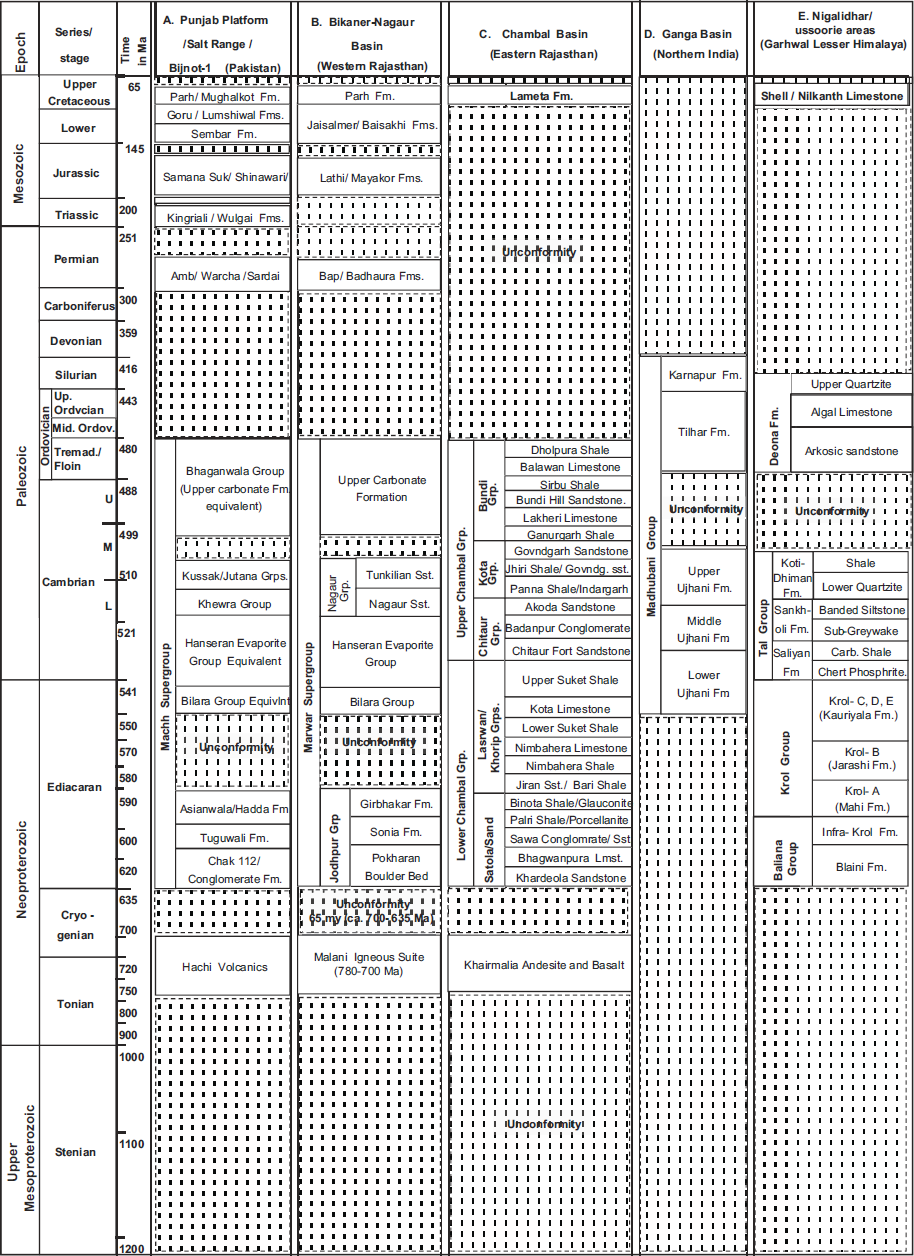
PLATE 1. Photomicrographs of the selected Early and Late Ediacaran acritarch taxa recorded from the Jodhpur and Bilara Formations in BGW-A well. Figures 1–11 are from the Jodhpur Formation, and Figures 12–19 are from the Bilara Formation. Stratigraphic position (depth-interval in mts.), and microscope coordinates of the illustrated taxa are mentioned against each specimen. Scale Bar on the specimens = 10µm. (1) Leiosphaeridia tenuissima Eisenack, 1958; CC-3 (1115–21 m), coord. 99 × 60.2; (2) Leiosphaeridia asperata (Naumiva) Lindgrain, 1959; 1105 m, coord. 96.5 × 56; (3, 4, 5) Lophosphaerisium jansoniusii Salujha, Rehman and Arora, 1971; (3) a bacterial-infected specimen of L. jansoniusii, CC-3 (1115–21 m), coord. 99 × 44; (4) a single specimen of L. jansoniusii, 1108 m, coord. 95 × 36; (5) a colony of L. jansoniusii, CC-3 (1115–21 m), coord. 91 × 31; (6) A specimen of bacterial-infected Lophosphaeridium rarum Timofeev, 1958; 1123 m, coord. 98 × 53; (7) Leiosphaeridia ternata Mikhailova and Jankuaskas, 1989; CC-3 (1115–21 m), coord. 97.5 × 32; (8) Leiosphaeridia jacutica Mikhailova and Jankuaskas, 1989; 1111, coord. 96.5 × 48.5; (9)? Appendisphaera sp. cf. A. tabifica (Moczydlowaska et al., 1993) Moczydlowaska, 2005; CC-3 (1115–21 m), coord. 99 × 59; (10). Meghystrichosphaeridium sp. cf. M. chadianensis (Chen and Liu, 1986) Zhang, Yin, Xiao and Knoll, 1998; 1123 m, coord. 98 × 50; (11) Kildinosphaera verrucata Vidal in Vidal and Siedlecka, 1983; CC-3 (1115–21 m), coord. 97.5 × 31; (12) Lophosphaeridium rarum Timofeev, 1958; 1081 m, coord. 101 × 51; (13) Lophosphaeridium. jansoniusii, Salujha, Rehman and Arora, 1971; 1099 m, coord. 103.5 × 40.5; (14) Lophosphaeridium truncatum Volkova, 1969; 1099 m, coord.106 × 65; (15) Vandalosphaeridium reticulatum (Vidal, 1976) Vidal, 1981; 1099 m, coord. 95.5 × 58; (16) Leiosphaeridia jacutica Mikhailova and Jankuaskas, 1989; 1099 m; coord. 108.5 × 66.5; (17) Lophosphaeridium tentativum Volkova, 1968; 1081 m; coord. 101 × 51; (18) Bavlinella faveolata (Schepeleva, 1963) Vidal, 1976; 1081 m; coord. 103 × 61; (19) Favasosphaeridium favosum Timofeev, 1966; 1099 m, coord. 101 × 64.
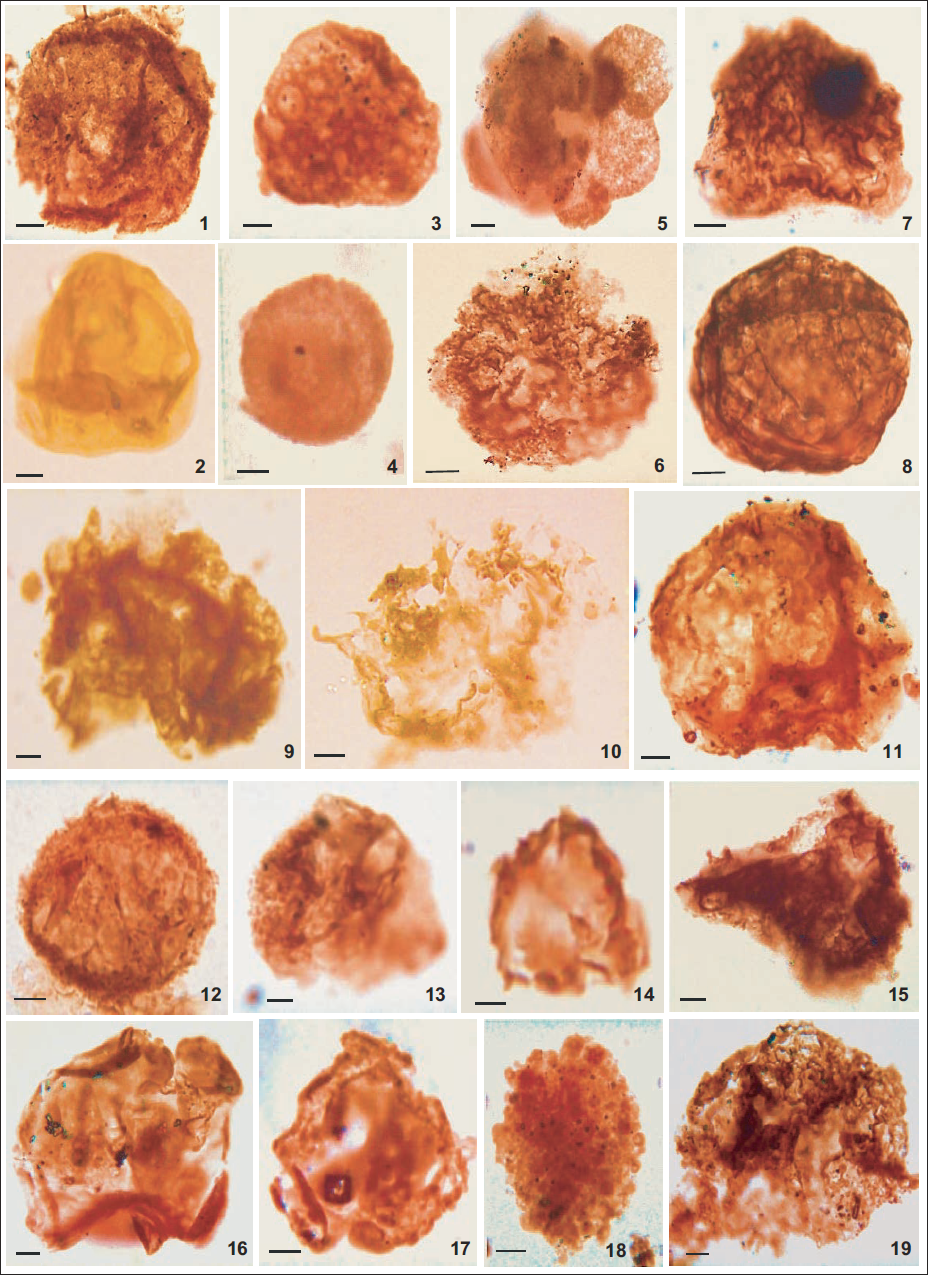
PLATE 2. Important Early Cambrian acritarch taxa from the Hanseran Evaporite Formation in BGW-A well. Stratigraphic position (depth-interval in mtr.), and microscope coordinates of the illustrated taxa are mentioned against each specimen. Scale Bar on the specimens = 10 µm. (1, 2) Lophosphaeridium tentativum Volkova, 1968; (1) CC-2 (970–979 m), coord. 108 × 41.5; (2) CC-2 (970–979 m), coord. 101.5 × 67.5; (3) Vandalosphaeridium reticulatum (Vidal, 1976) Vidal, 1981; 1051 m, coord. 104 × 28; (4) Synsphaeridium sorediforme (Timofeev, 1959) Eisenack, 1965; 1024 m, coord. 96.5 × 48.5; (5, 7) Cymatiosphaera boulouardii Deunff, 1961; (5) 1024 m, coord. 101 × 40; (7) 1024 m, coord. 100 × 52; (6, 14, 15) Cristallinium cambriense (Slavikova,1968) Vanguestaine, 1978; (6) 1060 m, coord. 93.5 × 57; (14) 970 m, coord. 98 × 37; (15) 1051 m, coord. 102 × 57; (8) Cymatiosphaera sp. cf. C. crameri Slavikova, 1968; 1024 m, coord. 98.5 × 60.5; (9, 18) Dictyotidium birvetense Paskeviciene in Volkova, 1979; (9) 1060 m, coord. 96 × 71; (18) CC-2 (970–979 m), coord. 96.5 × 63; (10, 11, 12) Asteridium (Micrhystridium) tornatum (Volkova, 1968) Mocdlowska, 1991; (10) 1060 m, coord. 100 × 28; (11) 1060 m, coord. 101 × 34; (12) 1024 m, coord. 95.5 × 56.5; (13) Cristallinium sp. cf. C. ovillense (Cramer & Diez, 1972) Martin in Martin and Dean, 1981; 1051 m, coord. 107 × 48; (16) Comasphaeridium strigosum (Yankauskas in Yankauskas and Posti,1976) Downie, 1982; CC-2 (970–979 m), coord. 105 × 68; (17) Cymatiosphaera sp. cf. C. ovillensis Cramer and Diez, 1972; 1024 m, coord. 94.5 × 38; (19, 20) Annulum squamaceum (Volkova, 1968) Martin in Martin and Dean, 1993; (19) 1051 m, coord. 98 × 50; (20) specimen of A. squamaceum in Figure 19 enlarged to show the well-defined dense central body and well-developed granulated and matted outer corona or flange; (21) Retisphaeridium. dichamerum Staplin, Jansonius and pocock, 1965; 1024 m, coord. 101 × 38.1; (22) Annulum sp. cf. A. squamaceum (Volkova, 1968) Martin in Martin and Dean, 1993; 1051 m, coord. 104 × 60; (23) Cymatiosphaera capsulara Yankauskas in Yankauskas and Posti, 1976; 1024 m; coord. 98.5 × 60.5; (24) Pterospermella solida (Volkova, 1968) Volkova in Volkova et al., 1979; 1051; coord. 104 × 60.5.
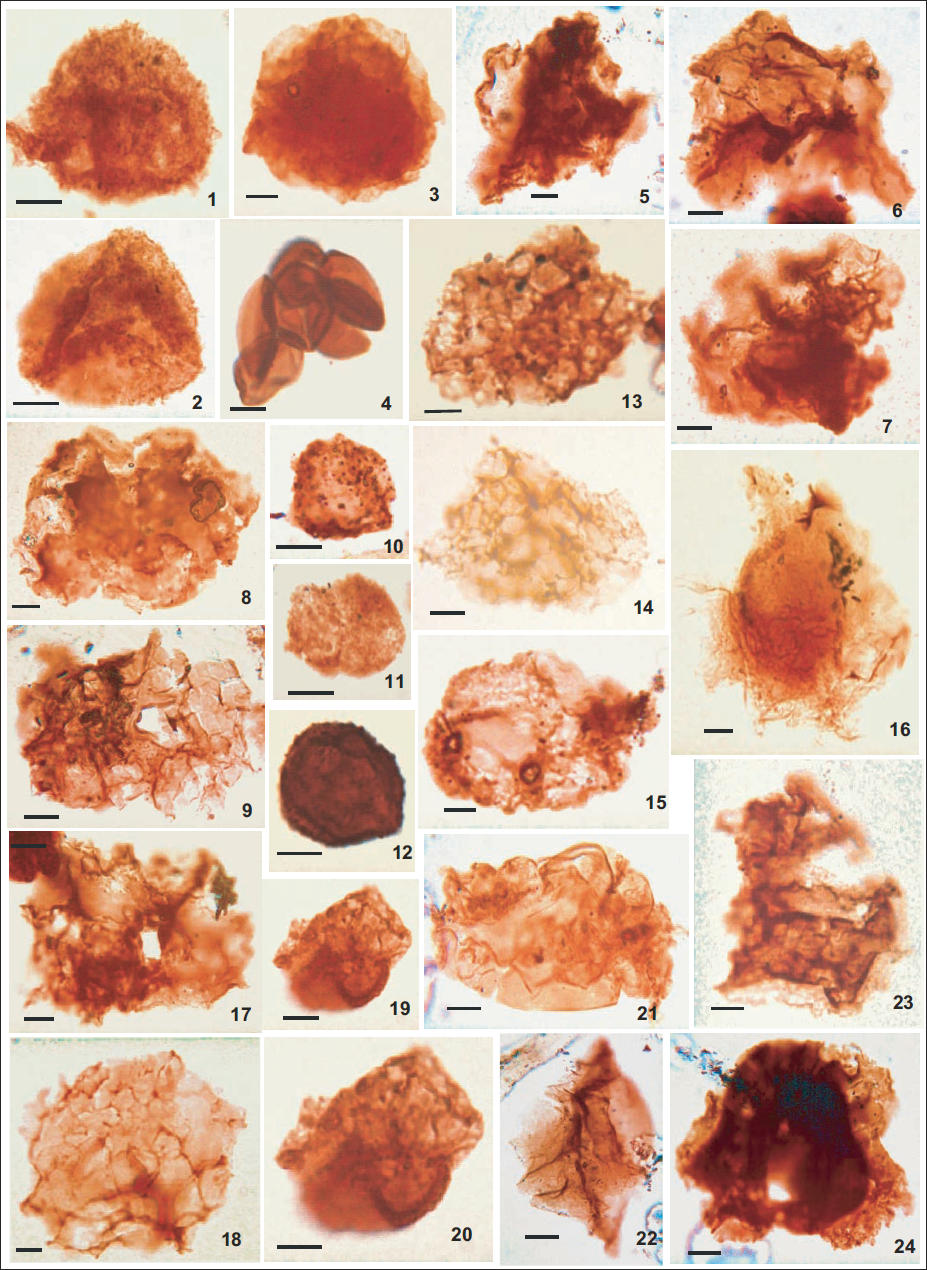
PLATE 3. Important Middle and Late Cambrian-Tremadocian acritarch taxa from the Upper Carbonate Formation in BGW-A well. Stratigraphic position (depth-interval in mtr.), and microscope coordinates of the illustrated taxa are mentioned against each specimen. Scale Bar on the specimens = 10 µm. (1, 2) Buedingiisphaeridium mickwitzii (Timofeev, 1959) Sarjeant and Stancliffe, 1994; (1). 517 m, coord. 110 × 5; (2) 574 m, coord. 108 × 70; (3, 4) Buedingiisphaeridium papillatum Piskun, 1976; (3) 517 m, coord. 98.5 × 39.5; (4) 517 m, 98.5 × 39.5; (5) Asteridium tornatum (Volkova, 1968) Moczydlowska, 1991; 517 m, coord. 101.5 × 45; (6) Asteridium lanatum (Volkova, 1969) Moczydlowska, 1991; 517 m, coord. 99 × 56; (7, 8) Asteridium spinosum (Volkova, 1969) Moczydlowska, 1991; (7) 565 m, coord. 100 × 28; (8) 565 m, coord. 93 × 56.5; (9, 10) Asteridium minutum Downie, 1982; (9) 565 m, coord. 95 × 57; Figure 10. 565 m, coord. 100 × 28; (11) Buedingiisphaeridium brevispinosum Uutela and Tynni, 1991; 574 m, coord. 95 × 57; (12) Skiagia sp. cf. S. brevispinosa Downie, 1982, 574 m; coord. 106 × 29; (13) Asteridium lanceolatum Vanguestaine, 1974, 574 m; coord. 99.5 × 40; (14) Cristallinium. randomense Martin in Martin and Dean, 1981; 574 m, coord. 106.5 × 66; (15) Dictyotidium sp. cf. D. tappaniae Playford and Wikander, 2006; 574 m, coord. 107 × 50.5; (16) Archaeodiscina umbonulata Volkova, 1968; 661 m, coord. 93 × 44; (17, 18) Filisphaeridium (Baltisphaeridium) brevicornum Yankauskas, 1976; (17) 565 m, coord. 93 × 56.5; (18) 565 m, coord. 100 × 28.5; (19) Asteridium dissimilare Volkova, 1969, 1991; 481 m, coord. 108.5 × 41; (20) Aranidium sp. cf. A. izhoricum Yankauskas, 1975; 574 m; coord. 106.5 × 29; (21) Saharidia fragile (Downie, 1958) Combaz, 1967; 661 m, coord.97 × 28; (22) Cymatiosphaera crameri Slavikova, 1968; 634 m, Coord. 94.5 × 29; (23) Striatotheca rarirrugulata (Cramer, Kanes, Diez and Christopher, 1974) Eisenack, Cramer and Diez, 1976; 490 m; coord. 96.5 × 57, specimen showing a tetragonal vesicle with a stout process at each vesicle corners, and vesicle surface with striated stripes arranged in fan-like fashion parallel to the vesicle sides; (24) Dorsenidium minutum (Downie, 1958) Sarjeant and Stancliffe, 1994; 481 m; coord. 103 × 39.5; (25) Cristallinium sp. cf. C. ovillense (Cramer and Diez, 1972) Martin and Dean, 1981; 574 m; coord. 105 × 27; (26) Cristallinium sp. cf. C. cambriense (Slavikova, 1968) Vanguestaine, 1978; 529 m; coord. 100 × 49; (27, 31) Cristallinium cambriense (Slavikova, 1968) Vanguestaine, 1978; (27) 565 m; coord. 109 × 69; (31) 634 m; coord. 105 × 40; (28) Leiosphaeridia pellucida Salujha, Rehman and Arora, 1971; 565 m; coord. 107.5 × 41; (29, 30) Cristallinium dentatum Li, 1987; (29) 661 m, coord. 100 × 29; (30) 565 m; coord. 109 × 69; (32, 33) Cristallinium randomense Martin in Martin and Dean, 1981; (32) 517 m; coord. 103 × 39; 33) 481 m; coord. 97 × 36.5.
Depositional Environment: The abundant occurrence of leiosphaerids is broadly suggestive of a littoral (intertidal) environment. However, the abundant occurrence of ornamented sphaeromorphs (Lophosphaeridium spp.) indicates a marginal marine environment of supra- to intertidal (foreshore) depositional set-up (Figure 8).
Bilara Formation (depth-int. 1103–1086 m)
Megascopic and petrographic studies
Cutting samples from depth-int. 1103–1086 m: Mixed carbonate-siliciclastic succession succeeds the Jodhpur Formation, having the alternating sequence of calcareous and argillaceous rocks from 1086 to 1103 m depth interval in well BGW-A. This subsurface succession is equated mainly with the outcropping of the Bilara Formation. Coring was not done within the above-mentioned depth interval covering the Bilara Formation. However, megascopic and petrographic studies on the cutting samples of this lithounit indicated that the limestones are mainly represented by finely laminated and bioturbated dolostone, with thin lamination of anhydrite and grey to black shales (Figure 8). Dolomitic limestone is generally tight and has very poor porosity. The depositional facies of grey shale with anhydrite and dolomite indicate an evaporitic supratidal and sabkha environment.
Microfossil (Palynological) studies
Microfossil contents, age and depositional environment: The grey to black shales and limestones of Bilara Formation in BGW-A well (1103–1086 m) yielded moderate occurrence of acritarchs. Important taxa documented are the Lophosphaeridium rarum (Plate 1: Figure 12), L. truncatum (Plate 1: Figure 14), L. tentativum (Plate 1: Figure 17), Vandalosphaeridium reticulatum (Plate 1: Figure 15) and Pterospermopsimorpha insolita. Taxa, like Leiosphaeridia tenuissima, L. jacutica (Plate 1: Figure 16), L. pellucida, Lophosphaeridium jansoniusii, Bavlinella faveolata (Plate 1: Figure 18) and Favasosphaeridium favosum (Plate 1: Figure 19), continue to occur from the underlying Jodhpur Formation (Figure 8). Documented acritarch assemblage shows the overall dominance of Lophosphaeridium rarum and Vandalosphaeridium reticulatum, and represents the Lophosphaeridium rarum -Vandalosphaeridium reticulatum zone (Figure 8).
Dominance of Lophosphaeridium rarum, and the first occurrences of Lophosphaeridium tentativum, L. truncatum, Asteridium tornatum and A. minutum in the basal part of this formation, whose first occurrences during Late Ediacaran are now globally well-established (Sergeev, 2009), indicates Late Ediacaran (ca. 550–541 Ma) age for the Bilara Formation (Figure 8). The Bilara assemblage broadly compares with the worldwide known Late Ediacaran acritarch assemblages, mainly recorded from the east and west European platforms (Knoll & Swett, 1987; Volkova, 1968; Volkova et al., 1979; Vidal, 1976, 1981a; Vidal & Knoll, 1983; Vorob´eva et al., 2009). Absence of upper Early Ediacaran (=Middle Ediacaran) marker ECAP (Ediacaran Complex Acanthomorph Palynoflora) microfossils further confirms the Late Ediacaran (ca 550–541 Ma) age inference for the Bilara Formation, and also indicates a non-depositional gap of upper Early Ediacaran period (ca. 590–550 Ma) in between Bilara and underlying Jodhpur Formations (Figures 8 and 15).
The abundant occurrence of tiny acanthomorphs (Asteridium spp.) in association with ornamented sphaeromorphs (Lophosphaeridium spp.) is suggestive of an inner neritic environment in inner shelf depositional set-up.
Hanseran Evaporite Formation (depth-int. 1086–920 m)
A thick succession (≈ 166 m) of interbedded reddish brown mottled shale/claystone, siltstone and sandstone associated with thick laminations/partings of halite and anhydrite is encountered from 1086 to 920 m above the Bilara Formation (1103–1086 m) in BGW-A well (Figure 8). Lower portion of this lithounit (1086–1051 m) mainly comprises of interbedded reddish brown mottled shale/claystone and siltstone, whereas middle part (1051–975 m) is characterised by the halite/ (evaporite), anhydrite and dolomitic limestone and fine-grained sandstone with two thick beds of halite at 1051–1032 m and 1026–998 m (Figure 8). The upper part of this formation (975–920 m) is marked by the interbedded succession of siltstone, dolostone/dolomitic limestone and fine-grained sandstone (Figure 8). The overall facies characteristics indicate shallowing up intertidal-supratidal sabkha depositional set-up.
Megascopic and petrographic studies
CC-2 (depth-int. 970–979 m): This core is in the middle part of Hanseran Evaporite Formation. The lower part (977–979 m) of the CC-2 (Figure 9; Boxes 7 and 8) represents white to greyish white halite and anhydrite associated with red claystone (Figures 9C and 10G–10I). The middle part of this core (973–977 m) is represented by ferruginous reddish brown to maroon, mottled sandy claystone with thin laminations of anhydrite (Figure 9; Boxes 3–6). In the upper part of CC-2 (770–973 m), this core is represented by greyish white and red ferruginous sandy claystone, and is associated with anhydrite and gypsum layers and shows localised moderate to good visual porosity of approximately 8%–17% (Figures 9B and 9C; Boxes 1 and 2; Figures 10 and 11).
CC-1 (depth-int. 942–951 m): This core is taken in the uppermost part of the Hanseran Evaporite Formation (Figure 8), and represents the alternating thick beds/laminations of red claystone, gypsum/anhydrite and sandstone (Figure 12). The lower part of the core (948.5–949.5 m) shows red claystone and gypsum/ anhydrite layers (Figure 12C; Boxes 9–11; Figure 13). The middle part of this core (944.25–948.5 m) is represented by the alternating succession of red ferruginous claystone and anhydrite/ gypsum (Figures 12C–G, H, I; Boxes 3–8; Figures 13C–13H). Upper part of this core (942–944.25 m) is mainly arenaceous, and the sandstones are dirty white to light grey, hard, compact, very fine to fine grained, well sorted. Sub-angular to rounded, quartz, feldspar, mica, dolomite and lithic fragments are set in the clay matrix (Figure 13). Intervening sandstones are associated with anhydrite/gypsum beds with minor sandy claystone (Figures 12CA, B, C; Boxes 1–3; Figures 13A and 13B). Claystone is moderately hard and compact with occasional mica. Fine quartz grains are dispersed in claystone and leached spots are common. Fractures are filled with anhydrite and gypsum cement. The sands are soft, bioturbated, rich in pyrite and partially cemented by anhydrite (Figure 14).
The study of above conventional cores within Hanseran Evaporite Formation (CC-1, CC-2) showed the general tightness of the sandstone/siltstone reservoirs with moderate visual porosity (7%–19%). Sandstones/siltstone are mostly cemented by anhydrite/gypsum. Compaction of the sediments is also moderate to high. Calcite cementation is the last diagenetic phase, and has corroded both the detrital grains and earlier formed silica cements (Figures 12B, 12C, 13 and 14).
Microfossil (Palynological) studies
Microfossil contents, age and depositional environment: Hanseran Evaporite Formation, covering the depth interval from 1086 to 920 m in BGW-A, yielded the characteristic acritarchs of Early Cambrian age (Figure 8; Plate 2: Figures 1–24). Cutting samples of siltstones and shales from the lower and middle parts of the Hanseran Evaporite Formation (1086–979 m) in this borehole yielded a lower Early Cambrian acritarch assemblage having the abundant occurrence of Dictyotidium birvetense (Plate 2: Figures 9 and 18) and Asteridium (Micrhystridium) tornatum (Plate 2: Figures 10–12). In addition, other important Early Cambrian marker taxa, like Cristallinium cambriense (Plate 2: Figures 6 and 15), C. ovillense (Plate 2: Figure 13), Annulum squamaceum (Plate 2: Figures 19 and 20), Archaeodiscina umbonulata, Asteridium lanatum, Cymatiosphaera boulouardii (Plate 2: Figures 5 and 7), C. crameri (Plate 2: Figure 8), C. ovillensis (Plate 2: Figure 17), C. capsulara (Plate 2: Figure 23), Pterospermella solida (Plate 2: Figure 24) and Retisphaeridium dichamerum (Plate 2: Figure 21) also show their consistent presence. The above documented acritarch taxa from the lower and middle parts of the Hanseran Evaporite Formation (1086–979 m) represent the Dictyotidium birvetense - Asteridium tornatum zone (Figure 8). Among these, C. crameri, C. boulouardi, C. capsulara, Archaeodiscina umbonulata and R. dichamerum appear in the middle part of this zone at 1024 m, and taxa, like Lophosphaeridium jansoniusii, Synsphaeridium sorediforme (Plate 2: Figure 4), Leiosphaeridia tenuissima, L. ternata. L. pellucida, continues to occur from the underlying Bilara Formation.
The occurrence of Lower Early Cambrian marker acritarch taxa, like Dictyotidium birvetense, Annulum squamaceum, Lophosphaeridium truncatum and Asteridium tornatum, along with other acritarch taxa (Plate 2: Figures 1–24) strongly suggests an earliest Early Cambrian (Terreneuvian) age for the lower and middle parts of this formation. This assemblage is mainly comparable with the known basal Early Cambrian acritarch assemblages previously recorded from east and west European platforms (Sergeev, 1992; Vidal, 1981a, 1981b; Volkova, 1968, 1985; Volkova et al., 1979), Spitsbergen (Knoll & Swett, 1987), Northwest Wales (Young et al., 1994) and Lubline Slope of Polland (Molyneux et al., 1996).
Upper part of the Hanseran Evaporite Formation (979–920 m) is also marked by the acritarch taxa that are recorded from the underlying lower and middle parts of this lithounit. However, siltstone and shale/claystone laminations of CC-2 (970–979 m) yielded the typical middle Early Cambrian acritarch taxa, like Cristallinium cambriense (Plate 2: Figures 14 and 15), Comasphaeridium strigosum (Plate 2: Figure 16), Lophosphaeridium tentativum (Plate 2: Figures 1 and 2) and show their common occurrence along with consistent presence of Dictyotidium birvetense (Plate 2: Figure 18), Cymatiosphaera capsulara (Plate 2: Figure 23), Pterospermella solida (Plate 2: Figure 24), Retisphaeridium dichamerum (Plate 2: Figure 21) and Cymatiosphaera crameri (Plate 2: Figure 8), and represent the Comasphaeridium strigosum—Lophosphaeridium tentativum zone (Figure 8). Record of last occurrence datums (LOD) of Dictyotidium birvetense, Comasphaeridium strigosum, Annulum squamaceum, Retisphaeridium dichamerum, Cymatiosphaera capsulara and C. boulouardii very close to the upper boundary of the Hanseran Evaporite Formation at 920 m (Figure 8), evidently suggest middle Early Cambrian (probably Stage 3 of Series 2) age for the upper part of this formation (Figure 8). This assemblage compares well with the known mid. Early Cambrian acritarch assemblages were earlier recorded from the European Platform (Vidal, 1981a, 1981b; Volkova, 1968, 1985; Volkova et al., 1979), Northwest Wales (Young et al., 1994), and Lubline Slope of Poland (Molyneux et al., 1996).
Abundant occurrence of herkomorphs, namely Cristallinium spp., Dictyotidium spp. and Cymatiosphaera spp., and the presence of corresponding lithology of limestone with associated halite is suggestive of an inner neritic depositional environment in supra-tidal to intertidal set-up.
Nagaur Formation (depth-int. 920–727 m)
Megascopic and petrographic studies
Cutting samples from depth-int. 920–727 m: This interval is represented by red brown ferruginous sandstones and siltstone succession with intercalations of mottled shale and claystone, conformably resting on the carbonate-anhydrite succession of Hanseran Evaporite Formation in well BGW-A, is correlated with the outcropping Nagaur Formation (Figure 8). In this well, conventional coring (CC) has not been taken within the Nagaur Formation encountered from 920 to 727 m. However, megascopic studies on the cutting samples have shown that the lower part of this lithounit (920–850 m) in this borehole comprises thick succession of dark brown siltstone, whereas upper part (850–727 m) includes the alternating succession of red brown to maroon sandstone, siltstone, shale and mottled claystone (Figure 8). Petrographic studies show that this lithounit has moderate to poor visual porosity.
Microfossil (Palynological) studies
Microfossil contents, age and depositional environment: Microfossil (acritarch) and associated organic-walled microfossils) contents in the Nagaur Formation in BGW-A (920–727 m) are very poor with sporadic occurrence of some long ranging and non-age diagnostic acritarchs in the claystones/siltstones referable to various species of Leiosphaeridia. However, an upper Early Cambrian age is inferred for this lithounit since the underlying Hanseran Evaporite Formation is precisely dated lower to middle Early Cambrian based on the occurrence of age marker acritarch taxa (Figure 8). This age interpretation for the Nagaur Formation is fairly similar to the earlier assigned age of Early Cambrian through the record of trilobite trace fossils of Cruziana, Dimorphichnus and Rusophycus (Kumar & Pandey, 2008).
The rare occurrence of only the leiosphaerids and the absence of marine acritarchs (acanthomorphs), suggests a littoral to marginal marine environment of deposition for the Nagaur Formation.
Upper Carbonate Formation (depth-int. 727–481 m)
Megascopic and petrographic studies
Cutting samples from depth-int. 727–481 m: An additional thick succession (250–600 m) of carbonate rocks, comprising predominantly the dolostones and dolomitic limestones, overlies the siliciclastic rocks of Nagaur Formation in the subsurface sections of Bikaner–Nagaur Basin. This carbonate sequence is encountered in a number of exploratory boreholes and is not exposed in the outcrop areas of the basin (Figure 1). Das Gupta (1988) named it the Upper Carbonate Formation (Figure 2), which is about 236 m (727–481 m) thick in BGW-A (Figure 8) and about 370 m (870–1240 m) in KLW-2 borehole (Figure 1). Coring has not been done in this lithounit of the BGW-A, however, megascopic, petrographic studies on the cutting samples have revealed its characteristic sedimentological and reservoir properties.
The lower part of this lithounit in well BGW-A (depth interval 727–634 m) essentially comprises interbedded dolostones, reddish brown to grey siltstones and claystones. It largely resembles the underlying Nagaur Formation and probably represents the transition zone between the underlying siliciclastic Nagaur Formation and the overlying carbonate sequence (Figure 8). While the middle part (634–574 m) of this lithounit is represented by the fine-grained laminated dolostones (Figure 8), both parts show intercrystalline and fractured porosity. The upper part of this lithounit (574–481 m) is represented by massive, fine to medium-grained dolostone and dolomitic limestone, and occasionally spherical lithoclasts are present within the matrix of the finely crystalline limestone that shows moderate intergranular and intercrystalline fractured porosity. This lithounit indicates minor heavy oil at two stratigraphic levels, the lower one at 618–621 m depth, while the upper one at 481–485 m depth (Figure 8).
Microfossil (Palynological) studies
Microfossil contents, age and depositional environment: Lower and middle parts of the Upper Carbonate Formation (727–574 m) in well BGW-A are characterised by the abundant occurrence of Cristallinium cambriense (Plate 3: Figure 31) and Cymatiosphaera crameri (Plate 3: Figure 22) along with the consistent yet significant presence of Cristallinium randomense (Plate 3: Figure 14), Cristallinium sp. cf. C. dentatum (Plate 3: Figure 29), Skiagia sp. cf. S. brevispinosa (Plate 3: Figure 12) and Saharidia fragile (Plate 3: Figure 21), and embody the Cristallinium cambriense - Cymatiosphaera crameri zone (Figure 8). Taxa, like Asteridium tornatum (Plate 3: Figure 5), A. minutum (Plate 3: Figures 9 and 10), A. lanceolatum (Plate 3: Figure 13), A. lanatum (Plate 3: Figure 6), A. spinosum and A. brevicornum continue to occur from the underlying Early Cambrian Hanseran Evaporite Formation (Figure 8). Dominance of the above mentioned taxa in the nominated zone together with the moderate presence of above listed taxa, and record of the last occurrence datums of Archaeodiscina umbonulata (Plate 3: Figure 16), Aranidium sp. cf. A. izhoricum (Plate 3: Figure 20) and Retisphaeridium dichamerum close to the upper boundary of this zone at 574 m, whose restricted occurrence in Middle Cambrian is well-known (Downie, 1984; Molyneux et al., 1996), categorically suggest Middle Cambrian age for the lower and middle parts of the Upper Carbonate Formation (Figure 8).
Upper part of the Upper Carbonate Formation (574–517 m) is marked by the dominant occurrence of acritarch taxa, like Cristallinium randomense (Plate 3: Figure 32), Buedingiisphaeridium mickwitzii (Plate 3: Figure 2), B. brevispinosum (Plate 3: Figure 11) and Asteridium spinosum (Plate 3: Figures 7 and 8), and represents the Cristallinium randomense - Buedingiisphaeridium mickwitzii zone (Figure 8). Dominant occurrence of the above-mentioned exclusive Late Cambrian taxa in association with consistent occurrence of other Late Cambrian marker taxa, like Saharidia fragile (Plate 3: Figure 21), Cristallinium sp. cf. C. dentatum (Plate 3: Figure 30), and Dictyotidium sp. cf. D. tappaniae (Plate 3: Figure 15) that show their first occurrence at the base of this zone (574 m), strongly suggests Late Cambrian age for the upper part of Upper Carbonate Formation (Figure 8). This assemblage broadly compares with the Late Cambrian Maentwrog and Ffestiniog formations of St. Tudwal Peninsula Gwynedd, northwest Wales (Young et al., 1984) and other European Late Cambrian sites (Downie, 1984; Molyneux et al., 1996).
Uppermost part of the Upper Carbonate Formation (517–481 m) in BGW-A show the common occurrence of globally established latest Cambrian-Tremadocian marker taxa, such as Buedingisphaeridium pappilatum (Plate 3: Figure 4), Striatotheca rarirrugulata (Plate 3: Figure 23) and Dorsenidium (Veryhachium) minutum (Plate 3: Figure 24). Their presence in the uppermost part of this lithounit is significant that first appear at 517 m depth, representing the Buedingisphaeridium pappilatum - Striatotheca rarirrugulata zone (Figure 8). Other Late Cambrian marker taxa, like Buedingiisphaeridium mickwitzii (Plate 3: Figure 2), B. brevispinosum (Plate 3: Figure 11), Cristallinium sp. cf. C. dentatum (Plate 3: Figures 29 and 30), Dictyotidium sp. cf. D. tappaniae (Plate 3: Figure 15) and Cristallinium randomense (Plate 3: Figure 33), show their continuation in this part also, and disappear close to the upper boundary of this formation at 481 m in BGW-A (Figure 8). The occurrence of the above-listed Late Cambrian and Early Ordovician (Tremadocian) marker acritarch taxa strongly indicates a latest Cambrian-Tremadocian age for the uppermost part of the Upper Carbonate Formation (517–481 m) in BGW-A and other boreholes (Figure 8). The fresh age inference of Middle to Late Cambrian-Tremadocian for this carbonate sequence (727–481 m), representing the uppermost lithounit of Marwar supergroup (Figure 8), unequivocally suggests Tremadocian (ca. 588–480 Ma) of Early Ordovician as the upper age limits for the Marwar Supergroup (Figures 8 and 15), which till now, considered Early Cambrian as its upper age limit.
Depositional Environment: The presence of acanthomorphs and herkomorphs in abundance and the common occurrence of micrhystrids suggests an inner neritic (inner shelf) depositional environment. The source-rock evaluation of the Marwar Supergroup suggests that the organic matter (OM) in Jodhpur, Bilara, Hanseran and Upper carbonate formations are primarily sapropelic, comprising mainly algal matter (filamentous algae- Siphonophycus spp. and acritarchs). Moreover, shales/siltstones in the Jodhpur and Bilara Formations are rich in organic matter compared to the Hanseran Evaporite, Nagaur and Upper Carbonate formations, with thermal alteration index (TAI) varying from 2.50 to 2.6. These sediments (Jodhpur & Bilara formations) were in the oil generative window during the Permian to Jurassic Periods and are thought to have generated the liquid hydrocarbon in deeper parts of the basin with local hydrocarbon migration within the sandstone/ siltstone reservoir of the Jodhpur Formation.
Post-Marwar Upper Paleozoic–Mesozoic successions
The Infra-Cambrian (Early Ediacaran to Late Cambrian-Tremadocian) Marwar Supergroup in well BGW-A of the Bikaner–Nagaur Basin is unconformably succeeded by the Early Permian siliciclastic sedimentary succession. Its lower part is represented by about 36 m (481–445 m) thick reddish brown and grey calcareous claystone, siltstone and coarse-grained sandstones. While, upper part is represented by about 445–418 m thick monotonous sandstone (Figure 8). These two lithounits recorded characteristics of Lower Permian marker spore-pollen microfossils. Important taxa included the Parasaccites spp., Plicatipollenites spp., Potonieisporites spp., Virkipollenites spp., Jayantisporites spp., Diverisaccus spp., Crucisaccites spp. and Didecitriletes spp. The lower part, representing claystone/siltstone and conglomerate succession, is represented by the established Potonieisporites neglectus zone of Asselian-Sakmarian age. In contrast, the upper part with the monotonous sandstone is marked by the Plicatipollenites gondwanensis zone of Sakmarian age of Early Permian (Figure 8). Both the above-mentioned Early Permian lithounits in this well also included the abundant occurrence of shallow marine leiosphaerids, suggesting shallow marine depositional environment (Figure 8). Similar spore-pollen assemblages of Early Permian (Asselian-Sakmarian) aspects were also recorded earlier from the outcropping Bap and Bhadaura formations by Venkatachala and Rawat (1984). In addition, invertebrate (lamellibranchs, brachiopods) megafossils of Eurodesma sp., Lingula sp., Streptoryhncus sp., Neospirifer sp, Syringothyrus sp. and Pleurotomaria sp. of Asselian-Sakmarian (Early Permian) age were also recorded from the outcropping type sections of Bap and Bhadaura Formations (Dickins & Sah, 1977; Rao et al., 1977). Thus, the two Early Permian lithounits which unconformably rest on the Infra-Cambrian Marwar Supergroup in BGW-A and other exploratory wells in Bikaner–Nagaur Basin are correlated with outcropping Bap and Bhadaura formations and assigned to these two Early Permian lithounits (Figure 8). A non-depositional hiatus of about 180 Ma is inferred between the Infra-Cambrian (ca. 635–480 Ma) Marwar Supergroup and overlying Bap/Bhadaura formations of Early Permian (ca. 300–290 Ma) in the subsurface based on the above documented microfossils of acritarchs and spore-pollen (Figures 8 and 15).
Bap-Bhadaura succession in well BGW-A is also unconformably succeeded by the red claystone and ferruginous sandstone succession from 418 m to 125 m of Jurassic-Cretaceous age referable to Lathi (418–400 m) and Parh (400–125 m) formations which in turn overlain by the dark grey claystone and yellow sandstone-siltstone sequence from 125 m to the surface (00.00 m) of Cenozoic age referable to Marh and Palana formations (Figures 8 and 15).
DISCUSSION
Present integrated lithological, petrographic and SEM studies on the subsurface sedimentary succession of Marwar Supergroup in well BGW-A have provided the detailed and in depth information about the depositional facies, sedimentological characteristics, reservoir properties and depositional environment of the different lithounits of this Infra-Cambrian-Cambrian to Late Cambrian-Early Ordovician (Tremadocian) succession of the Bikaner–Nagaur Basin, especially the heavy crude oil bearing sandstone reservoir of the Jodhpur Formation. The studies on the succeeding lithounits of Bilara, Hanseran Evaporite and Upper Carbonate formations in this well, which have shown the heavy oil occurrences/indications at multiple stratigraphic levels (Figure 8), have also shed some light on their reservoir properties (Figures 3–14). Additionally, precise age inference has been ascertained for different lithounits of this Infra-Cambrian-Cambrian succession through fresh acritarch-based biostratigraphic studies, which, till now, are broadly dated Late Precambrian-Early Cambrian due to lack or paucity of recognisable and age-marker mega- and macrofossils (Figure 8). Determination of precise age for different lithounits of Marwar Supergroup becomes very necessary in the light of hydrocarbon occurrences at four stratigraphic levels within the Marwar Supergroup to ascertain the time of generation of heavy crude oil through Time Temperature Index (TTI) and sediment burial depth. In addition, this study has also provided the precise age of Asselian-Sakmarian (Early Permian) for the overlying Bap/Badhaura sediments encountered in this well from 481 to 418 m depth (Figure 8). Sedimentological studies on the cuttings and three conventional cores, namely CC-3 (1115–1121.5 m, Jodhpur Formation), CC-2 (970–979 m, lower part of Hanseran Evaporite Formation) and CC-1 (941–951 m, Upper part of Hanseran Evaporite Formation) in BGW-A have revealed the detailed account of various sedimentary features, like lithological characters, petrographic properties and reservoir characteristics of different lithounits of the Marwar Supergroup as detailed earlier.
As stated above, sediments of Jodhpur Formation (1123–1105 m) in well BGW-A are mainly characterised by the quartz arenite, which is coarse to fine-grained, moderately sorted and moderately-rounded grains, containing occasional siliceous and volcano-clastic rock fragments. Reservoir properties of the heavy oil-bearing sandstones of Jodhpur Formation in this well observed to be very good as the sandstones are characterised by moderate to good intergranular porosity (Figures 5 and 6), and comprise the main reservoir rocks from 1115 to 1122 m (Figure 8) with main pay-zone which produced the non-biodegraded (Peters et al., 1995) 7bbl of viscous and 17.6° API gravity heavy crude-oil during production testing.
The Jodhpur Formation (1123–1103 m) in this well, whose age is still debatable, is now precisely dated as Early Ediacaran (ca. 635–590 Ma) through the record of Early Ediacaran age marker acritarch taxa as mentioned earlier (Figure 8; Plate 1: Figures 1–11). Earlier records of Ediacaran (Late Neoproterozoic) medusoidal megafossil of Marsonia artiyansis and invertebrate trace-fossils of Planolites sp. and Skolithos sp. from outcropping Jodhpur Formation by Raghav et al. (2005), which were doubted and rejected by Kumar and Pandey (2009), appear genuine and broadly corroborative with the present age inference of Early Ediacaran for this lithounit based on freshly documented acritarch taxa from the well BGW-A (Figures 8 and 15). Recent record of microbial mat structures, like Arumberia banksi and Rameshia rampurensis along with body fossils of Aspidella sp., cf. Hiemalora sp. and Beltanelliformis minuta of Ediacaran aspect from the exposures of Jodhpur Formation by Kumar and Pandey (2009) also broadly corroborate the present age inference. However, the present acritarch based biostratigraphic study has provided much precise age of lower Early Ediacaran (635–590 Ma) for the Jodhpur Formation (Figure 8; Plate 1: Figures 1–11) which predates the well-established upper Early Ediacaran (ca. 590–550 Ma) ECAP (Ediacaran Complex Acanthomorph Palynomorphs) palynoflora as the associated acritarch assemblage of this formation lacks the presence of distinctive upper Early Ediacaran (ca. 590–550 Ma) ECAP microfossil assemblage (Figure 15). Acritarch evidence is more reliable and authentic because these are acid-resistant, organic-walled microorganisms, preserved in situ in the sediments without any alteration in their morphology during deposition or acid maceration. The sediments of Jodhpur Formation, which occur from 1123 to 1103 m in BGW-A, observed to be represented by the upper part of this formation corresponding to the Girbhakar Sandstone Member as the fluvio-glacial pebbles and boulders corresponding to the Pokharan Boulder Bed, occurring in the basal part of Jodhpur Formation (Sonia Member) in the outcrop areas, are not encountered in the studied well BGW-A (Figure 8).
The succeeding lithounit of the Bilara Formation is very poorly developed and very thin (≈ 17 m thick; depth-int. 1103–1086 m) in BGW-A (Figure 8), and is represented by dolomitic limestone, finely laminated and bioturbated dolostone with very thin laminations of anhydrite. However, limestone and bioturbated dolostone of the Bilara Formation have also shown minor occurrences of heavy crude oil at 1086–1090 m depth interval, although these carbonate rocks are tight, with very poor porosity.
Dominance of Lophosphaeridium rarum and Vandalosphaeridium reticulatum and the first occurrence of Lophosphaeridium tentativum, L. truncatum, Asteridium tornatum and A. minutum in the basal part of the Bilara Formation, whose first occurrence during Late Ediacaran is now globally well-established (Sergeev, 2009), positively suggests post-ECAP Late Ediacaran (ca. 550–541 Ma) age for this carbonate lithounit (Figure 8). As stated above, the absence of upper Early Ediacaran (590–550 Ma) marker ECAP (Ediacaran Complex Acanthomorph Palynoflora) microfossils like Appendisphaera, Cavaspina, Gyalosphaeridium, Sinosphaera and Tanarium corroborates the Late Ediacaran age inference for the Bilara Formation. The absence of upper Early Ediacaran ECAP palynoflora also indicates a non-depositional gap of the upper Early Ediacaran (ca. 590–550 Ma) period in between the Bilara and underlying Jodhpur formations (Figures 8 and 15).
A very thick succession (≈166 m) of Hanseran Evaporite Formation conformably succeeds the Bilara Formation in well BGW-A, and is encountered in the depth interval 1086–920 m (Figure 8). This lithounit is only recognised in the subsurface sections only in the number of exploratory wells, and not exposed in the outcrop areas (Figure 1). This formation has also shown the heavy oil occurrences at two stratigraphic levels. The first one is in the siltstone/sandstone layers at the lower part from 1065 to 1068 m depth, while the second is indicated in the upper part of this formation within the sandstone layers at 922–926 m depth (Figure 8). Moreover, these rocks demonstrated the general tightness of the sandstone/siltstone reservoirs, as revealed by the petrographic and SEM studies of the core segments of this lithounit.
Acritarch data from the Hanseran Evaporite formation is very rich and diversified. The occurrence of Early Cambrian marker acritarch taxa (Plate 2: Figures 1–24) corresponding to the Dictyotidium birvetense - Asteridium tornatum zone (earliest Early Cambrian; Terreneuvian) in the lower part (1060–979 m) and Comasphaeridium strigosum - Lophosphaeridium tentativum zone (mid Early Cambrian) in the upper part (979–920 m) chiefly indicated an Early Cambrian age for this formation (Figure 8). However, the above-mentioned nominated zone marking Early Cambrian taxa along with other Early Cambrian marker taxa, like Cristallinium cambriense, Pterospermella solida and Skiagia sp. cf. S. brevispinosa, first appear about 26 m above (at 1060 m depth) from the Bilara and Hanseran Evaporite formations contact (1086 m depth) within the lower part of Hanseran Evaporite Formation. The appearance of the above basal Early Cambrian marker acritarch taxa at 1060 m depth in this well suggests the Precambrian-Cambrian boundary within the lower part of the Hanseran Evaporite Formation at 1060 m. It suggests the latest Ediacaran-basal-Early Cambrian to mid-Cambrian. Early Cambrian age for the Hanseran Evaporite Formation (Figure 8).
As stated earlier, reddish brown siltstone and ferruginous sandstones with intercalations of mottled shale and claystone comprise the Nagaur Formation in BGW-A borehole, which occurs from 920–727 m depth interval, and conformably rests over the carbonate-halite/anhydrite succession of Hanseran Evaporite Formation (Figure 8). Microfossil contents (acritarch and associated organic-walled microfossils) in the Nagaur Formation in BGW-A (920–727 m) are very poor, with sporadic occurrence of some long-ranging and non-age-diagnostic acritarchs which are assignable to various species of Leiosphaeridia. However, an upper Early Cambrian age is inferred for this formation as the underlying Hanseran Evaporite Formation is precisely dated lower to middle Early Cambrian based on the occurrence of age marker acritarch taxa (Figure 8). The upper Early Cambrian age inference for the Nagaur Formation is fairly similar to the earlier assigned age of Early Cambrian for this formation through the record of trilobite trace-fossils of Cruziana, Dimorphichnus, Monomorphichnus, Skolithos and Rusophycus by Kumar and Pandey (2008, 2010).
A thick succession (~246 m; 727–481 m depth-interval) of dolostone and dolomitic limestone with thin layers of siltstone and shale overlies the Nagaur Formation in this well, and recognised only in the subsurface sections as revealed by the geological data obtained from the number of drilled exploratory wells, and named as the Upper Carbonate Formation (Figure 8). As stated earlier, lower part of this lithounit in well BGW-A (depth-int. 727–634 m) essentially comprises the interbedded dolostones, reddish brown to grey siltstones and claystones, while the fine grained laminated dolostones represent middle part (634–574 m), and both the parts show intercrystalline and fractured porosity. The upper part of this lithounit (574–481 m) is represented by the massive fine to medium-grained dolostone and dolomitic limestone, and shows moderate intergranular, intercrystalline and fractured porosity. This lithounit indicates that minor heavy oil hydrocarbon is present at two stratigraphic levels, the lower one at 618–621 m depth and the upper one at 481–485 m depth (Figure 8).
Lower and middle parts of this formation (727–574 m) in BGW-A are marked by the Middle Cambrian acritarch assemblage of Cristallinium cambriense- Cymatiosphaera crameri zone with dominant occurrence of the nominated zonal taxa. The Upper part of the Upper Carbonate Formation (574–517 m) is marked by the dominant occurrence of acritarch taxa, like Cristallinium randomense (Plate 3: Figure 32), Buedingiisphaeridium mickwitzii (Plate 3: Figure 2) and B. brevispinosum (Plate 3: Figure 11), and represents the Cristallinium randomense - Buedingiisphaeridium mickwitzii zone of Late Cambrian (Figure 8).
It is important to note that the uppermost part of Upper Carbonate Formation (517–481 m) in well BGW-A also shows the consistent occurrence of globally established latest Cambrian-Tremadocian marker taxa, like Buedingisphaeridium pappilatum (Plate 3: Figure 4), Striatotheca rarirrugulata (Plate 3: Figure 23) and Dorsenidium (Veryhachium) minutum (Plate 3: Figure 24). These taxa first appear at 517 m depth in this well, representing the Buedingiisphaeridium pappilatum- Striatotheca rarirrugulata zone (Figure 8). Other Late Cambrian marker taxa, like Buedingiisphaeridium mickwitzii (Plate 3: Figure 2), B. brevispinosum (Plate 3: Figure 11), Cristallinium sp. cf. C. dentatum (Plate 3: Figure 30), Dictyotidium sp. cf. D. tappaniae (Plate 3: Figure 15) and Cristallinium randomense (Plate 3: Figure 33), also show their continuation in this part, and disappear close to the upper boundary of this formation at 481 m in this in this well (Figure 8). The occurrence of these Late Cambrian and Early Ordovician (Tremadocian) marker taxa strongly indicates a latest Cambrian-Tremadocian age for the uppermost part of the Upper Carbonate Formation (517–481 m) in well BGW-A (Figure 8). Thus, the above records extend the upper age limit for the Marwar Supergroup up to Tremadocian of Early Ordovician (Figures 8 and 15). The upper age limit for the Marwar Supergroup was earlier stated as Early Cambrian since arenaceous rocks of the Nagaur Group (Tunklian Sandstone Formation) are being treated as the youngest lithounit of this succession.
Algal carbonate rocks corresponding to the Upper Carbonate Formation of Middle to Late Cambrian- Tremadocian are not recognised in the outcrop areas so far, and documented only in the subsurface sections of the Bikaner–Nagaur Basin as revealed by the geological and biostratigraphic data obtained from the number of drilled wells (Figures 1, 2 and 8). Nevertheless, it is worth noting that a small algal dolostone outcrop is identified by Das Gupta (1977) at the southern fringe of the Bikaner–Nagaur Basin with E-W strike contrary to the NE-SW strike of the typical Bilara Limestone. According to Das Gupta (1977), it might not be correlated with the Bilara Formation of the type area, as the typical Bilara dolostones are dark grey to black slaty limestone. While, limestones which are exposed at the southern fringe of the basin are with algal bands, and observed to be younger in age than the Bilara Formation of type area, and thus Das Gupta (1977) informally named this exposure as the Phalodi Formation. Lukose and Mishra (1973), as quoted by Das Gupta (1977) on page no. 228, recorded the post-Cambrian acritarchs, such as Deunffia sp., Micrhystridium sp., Granomarginata sp., Lophosphaeridium spp. and Leiosphaeridia spp. Thus, it is surmised that the subcropping Middle to Late Cambrian-Tremadocian Upper Carbonate Formation rocks are also thinly represented in the outcrop areas of the Bikaner–Nagaur Basin.
The Upper Carbonate Formation of latest Cambrian-Tremadocian age, representing the youngest lithounit of Marwar Supergroup, abruptly succeeded by a characteristic Early Permian (Asselian-Sakmarian; 300–290 Ma) spore-pollen assemblage of Potonieisporites and Parasaccites zones which is comparable with the similar spore-pollen assemblage of the outcropping Bap-Badhaura formations (Figure 8). This biostratigraphic setting reveals the presence of a major non-depositional unconformity of about 180 Ma in BGW-A and other well sections in the Bikaner–Nagaur Basin between the Infra-Cambrian/Cambrian to Tremadocian (ca. 635 Ma–480 Ma) Marwar Supergroup and overlying Bap/Bhadaura formations of Early Permian (Asselian-Sakmarian; ca. 300–290 Ma) age (Figure 15). In addition, Early Permian spore-pollen assemblages of Bap/Badhaura formations are in turn succeeded by an Early Jurassic (Hettengian to Bajocian) spore-pollen assemblage of Classopollis classoides zone of Lathi Formation (Lukose, 1972). The record of Early Jurassic (Liassic) palynoflora immediately above the Early Permian reveals the presence of another major unconformity of about 90 my (ca. 290–200 Ma) between Bap/Bhadaura and overlying Lathi formations (Figure 15), suggesting the absence of Middle and Late Permian and entire Triassic sediments in the Bikaner–Nagaur Basin.
A regional and interbasinal correlation of subsurface Marwar Supergroup has indicated that the Infra-Cambrian (Ediacaran to Early Cambrian)-Cambrian-Tremadocian succession of the western Rajasthan closely correlates with the mixed carbonate siliciclastic succession of the Machh Group of Pakistan which are well exposed in Salt Range and Kirana Hills, and also encountered in Bijnot-1 and Suji-1 wells as both the regions are the part of the major Punjab Platform of the Upper Indus Basin (Figures 1 and 15). The Infra-Cambrian and Cambrian successions in both regions rest unconformably over the Malani and Hachi volcanics, respectively. They are represented by the Jodhpur, Bilara, Hanseran Evaporite, Nagaur and Upper Carbonate Formations in the Bikaner–Nagaur Basin and their equivalent sedimentary succession in the Salt Range (Figure 15). These sedimentary rocks are also recognised in the well Bijnot-1 in Pakistan (Sheikh et al., 2003). In both areas, Infra-Cambrian-Cambrian successions are unconformably capped by the Early Permian marine Bap/Bhadaura lithounits or their equivalent rocks (Figure 15).
Recent biostratigraphic and geological studies by Prasad and Asher (2016, 2021) on the purported Vindhyan succession in adjoining Chambal Valley in Eastern Rajasthan have revealed that these mixed carbonate-siliciclastic sedimentary rocks are of Ediacaran-Cambrian age, as these rocks recorded a distinctive Early Ediacaran ECAP (Ediacaran Complex Acanthomorphs Palynoflora) palyno-assemblage and Early to Late Cambrian acanthomorphic and herkomorphic acritarchs. Purported Vindhyan succession of the Chambal Valley is certainly much younger than the typical Vindhyan succession of the Son Valley, which is Late Palaeoproterozoic-Early Mesoproterozoic to Late Ediacaran in age (Figure 15). Infra-Cambrian-Cambrian succession of the Chambal Valley has now been classed as the Chambal Supergroup, which is broadly correlatable with the Infra-Cambrian-Cambrian succession of the Marwar Supergroup of Bikaner–Nagaur Basin (Figure 15). Likewise, Madhubani Group of the Pre-Unconformity Sequence (Ganga Supergroup) of Ganga Basin, which till recently considered as the northern continuation of the latest Paleoproterozoic/Early Mesoproterozoic to Neoproterozoic Vindhyans of Son valley (Shukla et al., 1994), has now been precisely dated Late Ediacaran (ca. 550 Ma) to Late Silurian (ca. 416 Ma) based on record of acritarchs of similar age (Figure 15), and represents the Late Neoproterozoic-Early Paleozoic succession in the subsurface sections of Ganga Basin (Prasad & Asher, 2001; Prasad et al., 2002). Thus, the Madhubani Group of the Ganga Basin is also broadly correlatable with the Infra-Cambrian-Cambrian succession of the Marwar Supergroup (Figure 15). Similarly, Blaini-Krol-Tal Sequence and associated sedimentary successions of the Nigalidhar and Mussoorie area of Garhwal Lesser Himalaya, which are dated Ealy Ediacaran (ca. 635 Ma) to Early Cambrian (ca. 510 Ma) based on conodonts (Azmi et al., 1981; Azmi & Joshi, 1983), brachiopods (Kumar et al., 1987a; Tripathi et al., 1984) and trilobites (Kumar et al., 1987b; Mathur & Joshi, 1989), have recently been dated Early Ediacaran to Ordovician-?Silurian, based on the record of trilobite trace fossils of similar age (Singh et al., 2019). Thus, the Blaini-Krol-Tal Sequence and associated sedimentary successions of the Nigalidhar and Mussoorie area of the Garhwal Lesser Himalaya are also broadly correlatable with the Marwar Supergroup of the Bikaner–Nagaur Basin (Figure 15).
CONCLUSIONS
Biostratigraphic (acritarchs) data from the well BGW-A suggest the Marwar Supergroup’s age ranges from Late Neoproterozoic (lower Early Ediacaran; ca. 635 Ma) to Late Cambrian-Tremadocian (ca. 480 Ma).
The Jodhpur Formation (1123–1103 m) in BGW-A of lower Early Ediacaran age represents the lowermost lithounit of Marwar Supergroup. Its main heavy crude oil reservoir shows good reservoir properties, as its sandstones show moderate to good intergranular porosity (~14%–23%).
Dolomitic Limestones of the overlying Bilara Formation in well BGW-A (1103–1068 m) of Late Ediacaran age (ca. 550–541 Ma), with bioturbated dolostones, thinly laminated anhydrite and grey to black claystone/shale, indicate deposition in an evaporite supratidal, sabkha environment. The dolomite shows the tightness of the reservoir.
Overlying carbonate succession in this well, with interbedded thick halite/anhydrite and sandstone/siltstone of Hanseran Evaporite Formation of latest Ediacaran-Early Cambrian age, showed general tightness of the sandstone/siltstone reservoirs, which are cemented mainly by anhydrite and gypsum, giving rise to destruction of the porosity. Compaction of the sediments is also high, and calcite cementation is in the last diagenetic phase. Hydrocarbon shows are, however, observed within this tight siltstone/sandstone at lower and upper stratigraphic levels.
The reddish-brown siltstone and ferruginous sandstones of the Nagaur Formation in BGW-A well, which occur in the 920–727 m depth, have shown poor to moderate porosity and lack hydrocarbon shows. A tentative age of upper Early Cambrian is inferred for the Nagaur Formation, as the overlying Upper Carbonate Formation is precisely dated Middle to Late Cambrian-Tremadocian in age based on the occurrence of marker acritarch taxa.
Lower (depth-int. 727–634 m) and middle (634–574 m) parts of the Upper Carbonate Formation in well BGW-A largely comprise the interbedded dolostones, reddish brown to grey siltstones and claystones, and both the parts show intercrystalline and fractured porosity. Upper part of this lithounit (574–481 m), with massive fine to medium grained dolostone and dolomitic limestone, shows moderate intergranular and intercrystalline fractured porosity. This lithounit has indicated minor heavy oil at two stratigraphic levels, the lower one at 618–621 m depth, and upper one at the 481–485 m depth. This formation is dated Middle to Late Cambrian-Tremadocian based on the record of distinctive acritarchs of similar age.
The Late Neoproterozoic (Ediacaran)-Early Paleozoic (Cambrian-Early Ordovician) assemblages (ca.635–480 Ma) of the Marwar Supergroup are directly succeeded by the Early Permian (Asselian-Sakmarian) spore-pollen assemblages (ca. 300–290 Ma) of Bap/Badhaura formations (481–418 m), suggesting a major non-depositional gap of about 180 Ma between the above-mentioned two successions that span from Early Ordovician to Late Carboniferous.
In this well, an Early Permian assemblage (Asselian-Sakmarian) is succeeded by an Early Jurassic (ca. 200–180 Ma) assemblage belonging to the Lathi Formation (418–400 m). This finding indicates the presence of another non-depositional hiatus between Bap/Badhaura and the Early Jurassic (Lathi Formation) that spans about 90 Ma.
Grey to black shales/siltstones within Bilara and Jodhpur formations in well BGW-A observed to be with moderate to rich sapropelic organic matters that appear to be the main source rocks for the generation of hydrocarbon in the Marwar Supergroup.
Footnotes
Acknowledgements
Authors are thankful to Shri B. N. Talukdar Director (Expl. & Dev.), Oil India Ltd. for permission to publish this article. Authors are thankful to Project Manager (Rajasthan Project, Jodhpur) and Shri S.K. Jaina, Chief Geologist, Oil India Ltd. for providing laboratory facilities in Core Library of Oil India at Jodhpur for study of core samples and providing cutting samples for the present studies. Authors are grateful to Shri P.K. Bhowmick, ED-Head of Institute, KDMIPE, Dehradun, and Shri Harindar Upadhyay, Dy. G.M. (Geology) for their constant guidance and laboratory facilities during the course of this study. Authors are also grateful to two anonymous potential reviewers who have critically reviewed the manuscript and offering the fruitful suggestions.
Authors’ Statements
This research work on the Marwar Supergroup, Bikaner–Nagaur Basin is the original contribution, and equally contributed by all the three authors (Bijai Prasad, S. Mahanti and S. Prabhakaran).
All the three authors have given the full consent for its publication.
Authors agree with terms and conditions of the journal, Journal of the Palaeontological Society of India for the publication of our article entitled, “Depositional set-up, age and reservoir properties of the heavy oil bearing subsurface infracambrian—Cambrian sedimentary succession of the Marwar Supergroup, Bikaner–Nagaur basin (Western Rajasthan), India.
Declaration of Conflicting Interest
The authors declared that there is no potential conflicts of interest regarding the research, authorship and publication of this article.
Funding
The authors received no financial support for the research, authorship and/or publication of this article.
