



Abstract
The Sillakudi Formation is a sandstone-dominated succession bounded by unconformities. It represents the oldest unit of the Ariyalur Group deposited during the Campanian under fully established passive margin depositional conditions. The present study is an attempt to interpret the depositional palaeoenvironment of Sillakudi Formation based on its trace fossil content, supported by sedimentological evidences. Detailed sedimentological and ichnological observations were undertaken in multiple traverses and spot locations across the Sillakudi Formation. The Sillakudi Formation is subdivided into four facies associations, each represented by a distinct ichnology and environment of deposition. Unit 1 comprises conglomerates grading upwards into pebbly sandstones almost devoid of trace fossils except a few Planolites isp. indicating a high-energy foreshore-to-shoreface environment. Unit 2 consists of glauconitic sandstones with Ophiomorpha nodosa, O. annulata, Thalassinoides isp. and Skolithos linearis, belonging to the Skolithos ichnofacies indicating deposition in shoreface to offshore transition environments. Unit 3 comprises pebbly to very coarse-grained massive sandstones, characterised by an almost monospecific Skolithos ichnofacies indicating rapid colonisation of beds in a delta-front associated debris flows and calcareous sandstones alternating with claystones containing a diverse Cruziana ichnofacies with an ichnoassemblage comprising of Trichichnus isp., Scolicia prisca var. laminites, S. ?prisca, S. vertebralis, Palaeophycus tubularis, Planolites beverleyensis, P. montanus, Taenidium isp., Thalassinoides suevicus, Ophiomorpha isp., Chondrites isp. and Phycodes isp., pointing towards deposition in calmer, possibly dysoxic outer shelf prodeltaic environments. Unit 4 has pebbly to gritty cross-bedded sandstones exhibiting the development of networks of Thalassinoides isp. and Ophiomorpha isp., indicating shallow sub-tidal to intertidal conditions of deposition. The overall succession is interpreted to show initial deepening followed by shallowing.
Introduction
The Cauvery Basin is a pericratonic rift basin situated in the southernmost part of the East Continental Margin of India (Gaina et al., 2007; Lal et al., 2009; Powell et al., 1988; Sinha et al., 2015). The depositional history of the basin is dominated by two phases—syn-rift followed by post-rift phase. The Uttatur and Trichinopoly Groups (Aptian to Santonian) represent the early post-rift phase during which the passive margin had begun to develop. During the deposition of the overlying Ariyalur Group (Campanian to Maastrichtian), passive margin depositional conditions were fully established. The Sillakudi Formation is Campanian in age and represents the oldest unit of the Ariyalur Group (Banerji, 1972; Sundaram et al., 2001; Tewari et al., 1996). It is a sandstone-dominated succession reported to have been deposited in inner shelf settings (Nagendra et al., 2011; Tewari et al., 1996). Its boundaries with the underlying Trichinopoly Group and overlying Kallankurichchi Formation are unconformable. Nagendra et al. (2011) briefly mentioned deepening followed by a relative sea level fall leading to inner shelf conditions towards the end of the Sillakudi Formation.
Trace fossils have been known to improve the interpretation of sedimentary facies (e.g., Buatois & Mángano, 2011). They have proved to be excellent environmental indicators in formations constituting the Cretaceous succession of the Cauvery Basin (Nagendra et al., 2010; Paranjape et al., 2014, 2015, 2016; Muthuvairavasamy et al., 2021). Chiplonkar and Ghare (1977) and Ghare (1985) studied borings on the invertebrate fossils from the Ariyalur Group. However, these studies are not specific to the Sillakudi Formation.
The present study attempts to decipher the changes in the depositional environment of the Sillakudi Formation by integrating ichnological and sedimentological evidence.
Traverses and Methodology
The Sillakudi Formation, though having a wide area of exposure, due to low dips and overlying soil/alluvium, the exposures are patchy. The traverse between Varagur and Pudur exposes a relatively continuous succession and ichnological and sedimentological observations have been compiled with data added from other locales, their stratigraphic positions being approximated with the help of the regional strike (Figure 1A). The Varagur–Pudur traverse is considered a reference for the litholog shown in Figure 1B.
(A) Location map of Sillakudi Formation, Ariaylur Group along with the locations studied. (B) Litholog of the Varagur-Pudur traverse representing the Sillakudi Formation along with Units identified and interpretation.
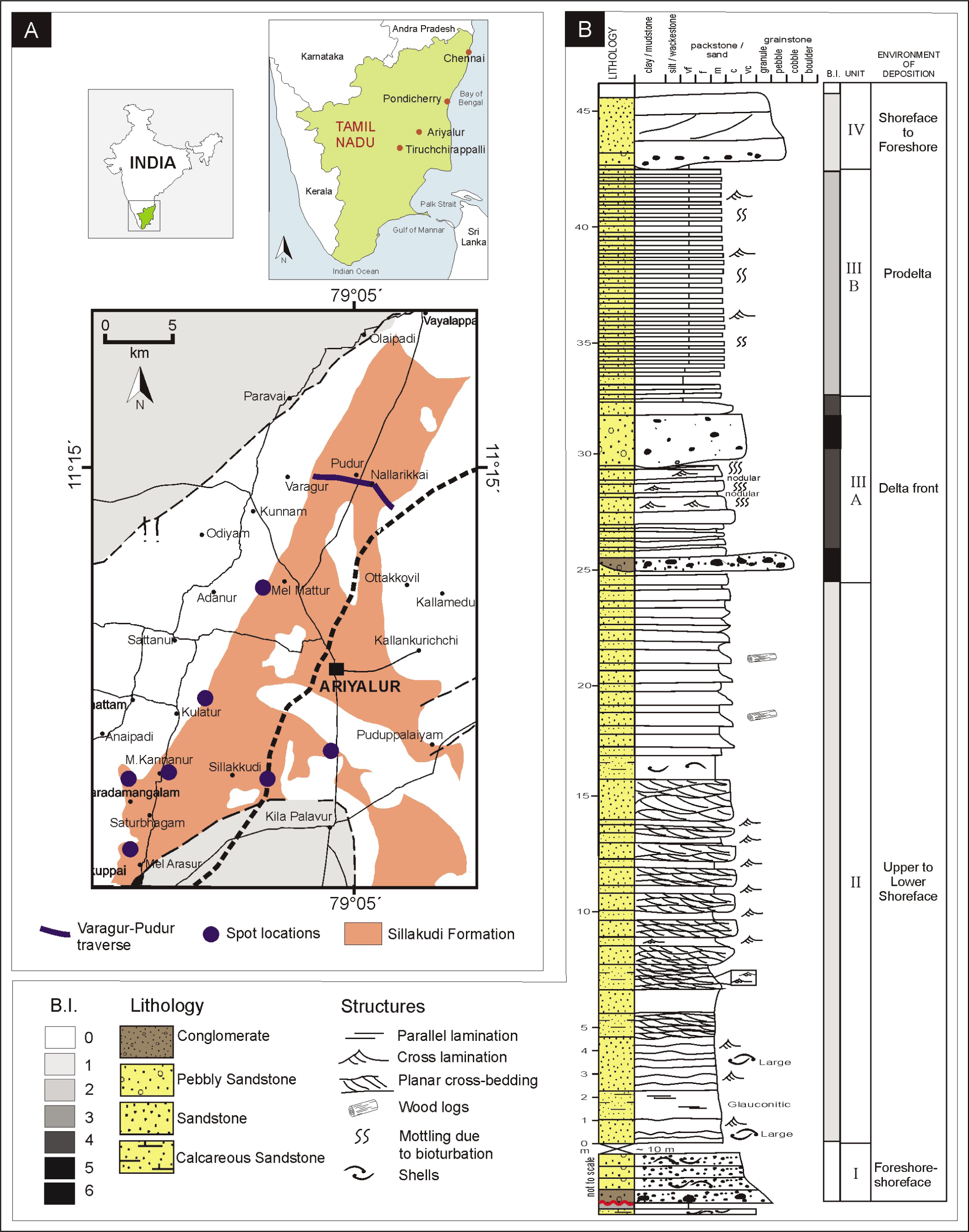
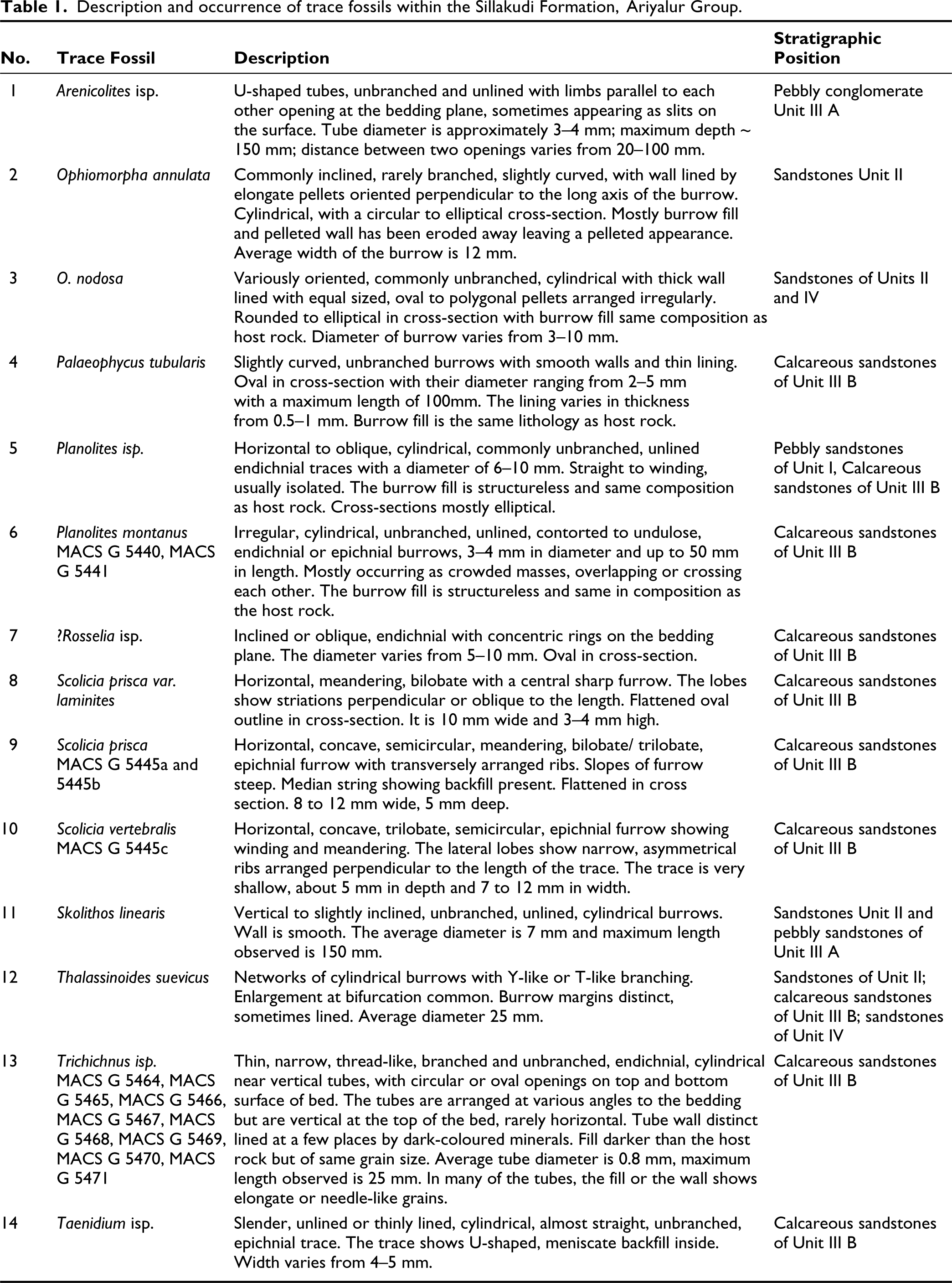
Facies description and bed-by-bed logging were done based on lithological characteristics, such as composition, sedimentary structures, bed/unit thicknesses, bed/unit contacts, bed/unit geometry, textures (i.e., grain size, sorting and roundness), trends of grain size variation, body and trace fossil content, bioturbation index (BI), etc. While studying the trace fossils, their orientation, primary identification, ethological character, abundance in a lithounit/facies, diversity, etc., were taken into account. The BI was determined in the field as per the scheme suggested by Taylor and Goldring (1993). A short description of the trace fossils encountered is given in Table 1.
Description and occurrence of trace fossils within the Sillakudi Formation, Ariyalur Group.
Depositional Units
The Sillakudi Formation can be subdivided into four litho-units. The sedimentological characters, ichnology and environmental interpretations of these units are discussed in this section.
Unit I: Conglomerates Grading into Pebbly Sandstones
Distribution: Typically exposed at Varagur-Pudur traverse, Kannanur village tank and near Saturbhagam.
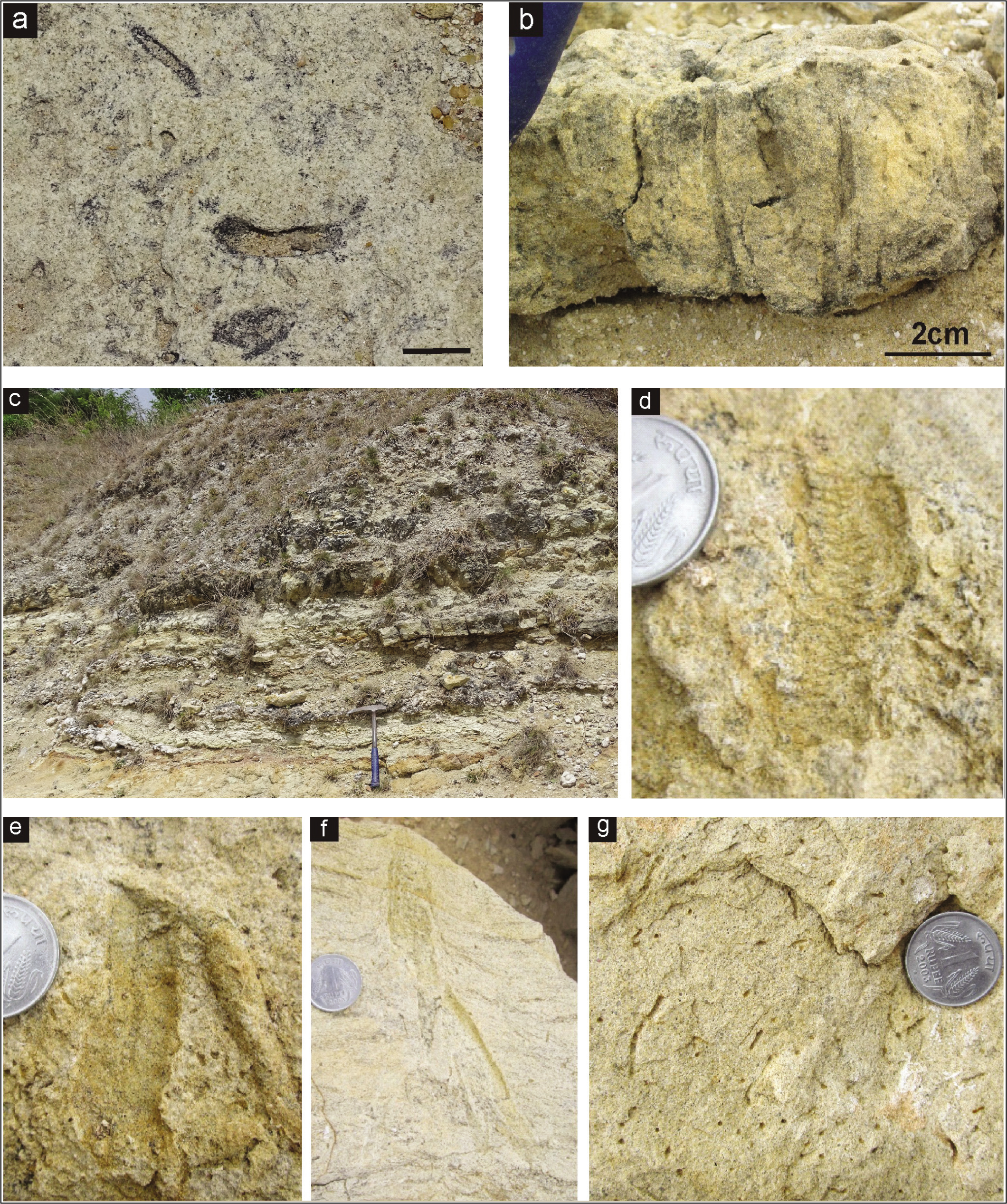
Sedimentary features: This unit consists of a conglomeratic bed at the base of the Sillakudi Formation unconformably overlying the Trichinopoly Group (Plate 1a). The conglomerate is normally graded to massive, clast supported in the lower part and matrix supported in the upper part. The clasts are ill-sorted, dominantly of pebble grade, sub-rounded to rounded, composed of basement fragments as well as limestones and sandstones of older formations (Plate 1b). The matrix is non-calcareous and composed of gravel or coarse-grained sands. The conglomerate grades laterally and vertically (upwards) into pebbly and gritty sandstones (Plate 1d). These sandstones show normal grading and low-angle cross-bedding at certain places. Both the conglomerate and sandstones are tabular and laterally extensive showing considerable continuity along the strike. The unit is estimated to be around 2–5 m thick.
(a) Contact (yellow line) between the Trichinopoly Groups (below) and the Sillakudi Formation (above); (b) Ill-sorted conglomerates (Unit I); (c) Fossils associated with conglomerate and pebbly sandstones (Unit I); (d) Gritty sandstones (Unit I); (e) Planolites isp. from sandstones (Unit I); (f) Medium and coarse sandstone alternations (Unit II) (diameter of coin 2.4 cm).
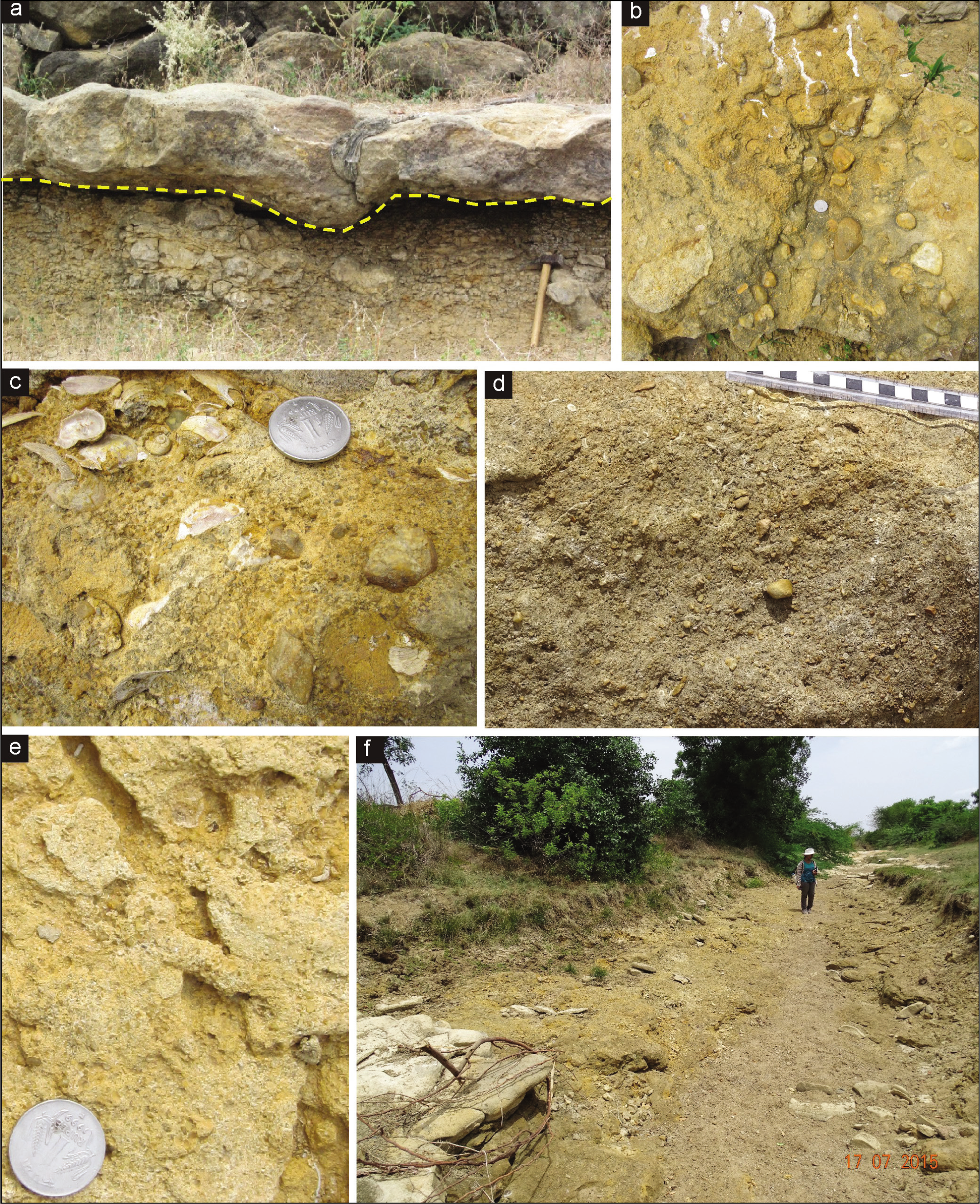
The fossil content (Plate 1c) includes bivalves, gastropods, fossil wood, echinoids, ammonites, echinoid spines, etc., their abundance decreasing upwards.
Ichnology: Except for a few Planolites isp. (Plate 1e), no other trace fossils have been identified.
Interpretations: The widespread extent, pebbly to gravelly nature and abundant fossil debris including fossil wood indicate deposition in a high-energy environment along a palaeo-shoreline. The conglomerate in the basal part is interpreted to be a product of accumulation on a pebbly beach (foreshore) (Hart & Plint, 1995; Reading, 1996). In contrast, the upward fining grain size and the presence of cross-bedding within the succession indicate a shoreface environment (Reading, 1996). The well-sorted nature of the sandstones is a result of winnowing due to constant wave action. The coarse-grained nature of the sediment and their constant reworking along the shoreline may have led to the poor preservation of trace fossils.
Unit II: Alternations of Medium and Coarse Sandstones
Distribution: Typically exposed Varagur-Pudur traverse, Kannanur village tank.
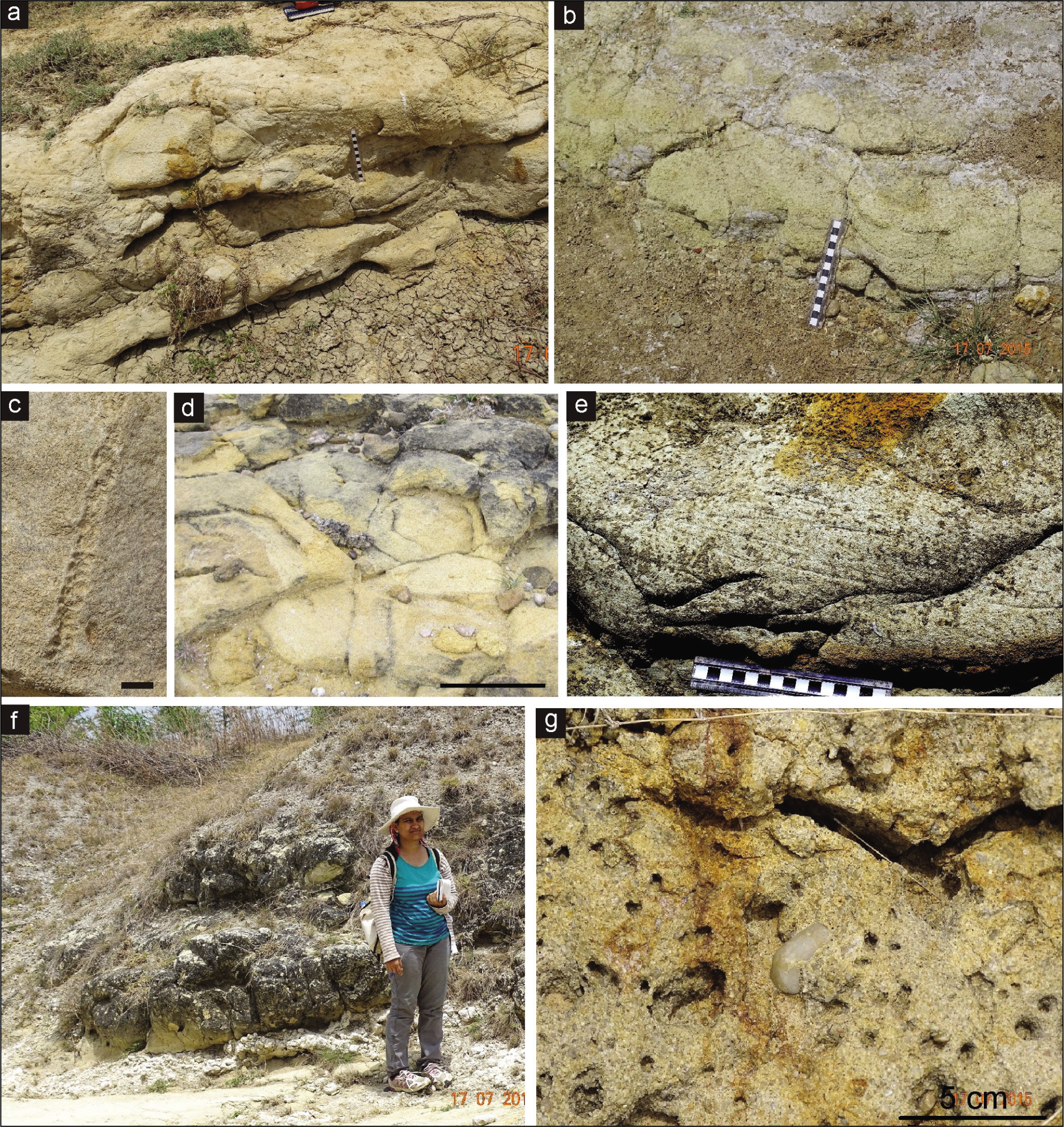
Sedimentary features: This unit comprises a ~25 m thick succession of alternating glauconitic, medium and coarse-grained sandstones (Plate 1f). The medium-grained sandstones are argillaceous wacke, while the coarse-grained sandstones are well-sorted arenitic (Plate 2b). Bed geometry varies from tabular to wedge-shaped, laterally extending for tens of meters. The beds are thicker in the lower part (~1.5 m each) and thinner up-section (60–70 cm for arenites, and 30–40 cm for wackes). The sandstones show cross-stratification as well as internal, small ripple cross-lamination. Bounding surfaces of the large, cross-bedded units are undulatory to wavy (Plate 2a), while the cross-laminated sets have planar bounding surfaces (Plate 2e). Entire shells of bivalves (including large inoceramids), fragmentary bivalves of varying sizes and fossil wood are common.
(a) Large cross-bedding in sandstones (Unit II); (b) Clayey medium-grained sandstones (Unit II); (c) Ophiomorpha nodosa (bar scale = 1cm) and (d) Thalassinoides isp. from sandstones of Unit II (bar scale = 10cm); (e) ripple cross-laminations in sandstones of Unit II; (f) pebbly to very coarse-grained massive sandstones (Unit IIIA); and (g) massive sandstones with pebbles floating displaying paired opening of Arenicolites (Unit IIIA).
In the upper part of the unit (17–25 m in lithology) alternations of arenites and muddy wackes continue but these have sharp planar bases in comparison to the commonly wavy bases in the lower part. These alternations are less fossiliferous, with smaller size inoceramids and common broken fragments of larger inoceramids, as compared to the earlier unit and with the occasional presence of fossil wood.
Ichnology: Trace fossils within these beds show a low abundance and diversity (B.I. 1–2). ichnoassemblage comprises Ophiomorpha nodosa (Plate 2c), O. annulata, Thalassinoides isp., (Plate 2d) and rare Skolithos linearis and Arenicolites isp. Ophiomorpha burrows are vertically oriented, whereas Thalassinoides burrows are variously oriented. The trace fossil assemblage represents the Skolithos ichnofacies
Interpretation: The dominance of crustacean burrows and the presence of ripple bedded units show similarities to modern day intertidal/ upper shoreface environments where wave action accompanied with tidal action is the principal factor governing deposition (Buatois & Mángano, 2011). The low diversity can be attributed to the constant reworking of sediment hindering colonisation of fauna other than those which are able to cope with the water energy. The muddy components in the medium-grained sandstone support the intermittent prevalence of lower shoreface to offshore transition environments, close to or below the fair-weather wave base (Reading, 1996). Therefore, the depositional environment is interpreted to fluctuate between intertidal to sub-tidal conditions around the shoreface.
In the upper part of the unit, the depositional environment may not have varied much, but the presence of sharp-based sandstones could possibly indicate deposition above the storm wave base.
Unit III: A. Pebbly Sandstones
Distribution: Varagur-Pudur traverse.
Sedimentary features: This unit is dominated by massive pebbly to very coarse-grained sandstones (Plate 2f) and thinner bedded, well-sorted, ripple laminated sandstones alternating with finer muddy sandstones. The massive sandstones have cobbles floating within a massive gravelly to coarse-grained sandy matrix (Plate 2g). The average thickness of beds is more than 50 cm. Each younger bed slightly erodes the older, underlying bed. The body fossils are rare and occur as fragments of molluscs.
Ichnology: The massive sandstone beds show a monospecific colonisation of vertical or U-shaped burrows, Skolithos isp. and Arenicolites isp. (Plate 3a and b) In most exposures, ichno-diversity is low, but abundance is high (B.I. 5–6). The ripple laminated and interbedded muddy sandstones are locally mottled.
Interpretation: Low trace fossil diversity but high abundance in massive pebbly sandstones indicates rapid colonisation and sudden availability of nutrients made available due to instantaneous deposition of an event bed (Gurav et al., 2015). Lack of grading, ill-sorting, sheeted nature but erosional bases, point towards deposition through gravity-induced debris flows (Shanmugam, 2006).
Precise environmental interpretation for the ripple-laminated sandstones is difficult. As they are closely associated with the debris flow deposits, these beds could be identified as products of turbidity currents. However, suspension sedimentation, later reworked by bottom currents is also possible. Intense bioturbation indicates a pause/slack in sedimentation giving ample time for organisms to rework these sediments. This association is interpreted to represent debris flow with turbidites deposited on slopes or products of hyperpycnal plumes on the delta front.
Unit III: B. Calcareous Sandstones and Claystones
Distribution: Typically exposed at Sillakkudi/Mettal railway cutting and Varagur-Pudur traverse.
Sedimentary features: The unit is represented by thinly bedded, sometimes sandy, clay stone alternating with medium-grained calcareous sandstones (Plate 3c). The calcareous sandstones beds (average thickness 30–40 cm) are well sorted, sharp-based, massive and display feeble cross-lamination in the upper part. The sandy claystones (average thickness 20–30 cm) are unfossiliferous, thinly bedded and occasionally exhibit parallel laminations.
Ichnology: The sandstones contain a diverse trace fossil assemblage comprising of Trichichnus isp. (Plate 3g), Scolicia prisca var. laminites, S. prisca (Plate 3e), S. vertebralis (Plate 3d), Palaeophycus tubularis (Plate 4a), Planolites beverleyensis, P. montanus (Plate 4b), Taenidium isp., Thalassinoides suevicus, Ophiomorpha isp., Chondrites isp. and Phycodes isp. (Plate 3f). The sandy claystones are highly mottled.
(a) Arenicolites isp. appearing as slits on the eroded rock surface (Unit IIIA); (b) Skolithos isp. in the sandstones of Unit IIIA; (c) claystones alternating with medium-grained calcareous sandstones (Unit IIIB); (d) Scolicia vertebralis; (e) Scolicia prisca; (f) Phycodes isp.; and (g) Trichichnus isp. from the calcareous sandstones of Unit IIIB (diameter of coin 2.4 cm).
Interpretation: Abundance of Trichichnus and the minor presence of Chondrites points towards deposition in poorly oxygenated conditions at or below the redox boundary. Similarly, the abundant development of Scolicia which is commonly associated with deepwater turbiditic sediments and an overall ichnoassemblage dominated by fodinichnia with rare domichnia point towards a distal Cruziana ichnofacies. Buatois and Mángano (2011) have attributed a similar ichnoassemblage to unconfined open-slope and slope-fan fringe deposits on topographically high depositional gradients available in the basin.
The sandy claystones indicate deposition through suspension settling on the slope or basin floor.
The alternations of these two facies indicate deposition in slope-fan fringes or prodelta.
Unit IV: Cross-Bedded Sandstones
Distribution: Varagur-Pudur traverse, Nallarikkai-Ottakovil railway station traverse
Sedimentary features: This unit constitutes pebbly to gritty, cross-bedded sandstones. The lower parts are pebbly sandstones with clasts composed of basement rocks. These beds have a basal scoured surface with the earlier unit. The middle part of the association is represented by tabular, cross-bedded calcareous sandstones containing imbricate fragments of bivalves and gastropods (Plate 4d); while the topmost is ripple cross-laminated (Plate 4e). All beds are fossiliferous and normal graded. However, the increase in the average grain-size of the sandy matrix up-section indicates coarsening-up of the succession.
(a) Palaeophycus tubularis; (b) Planolites beverleyensis, from the calcareous sandstones of Unit IIIB; (c) Thalassinoides isp. from the sandstones of Unit IV; (d) cross-bedded calcareous sandstones containing fossil fragments of bivalves and gastropods from Unit IV; and (e) topmost part of Unit IV showing ripple cross-lamination (diameter of coin 2.4 cm).
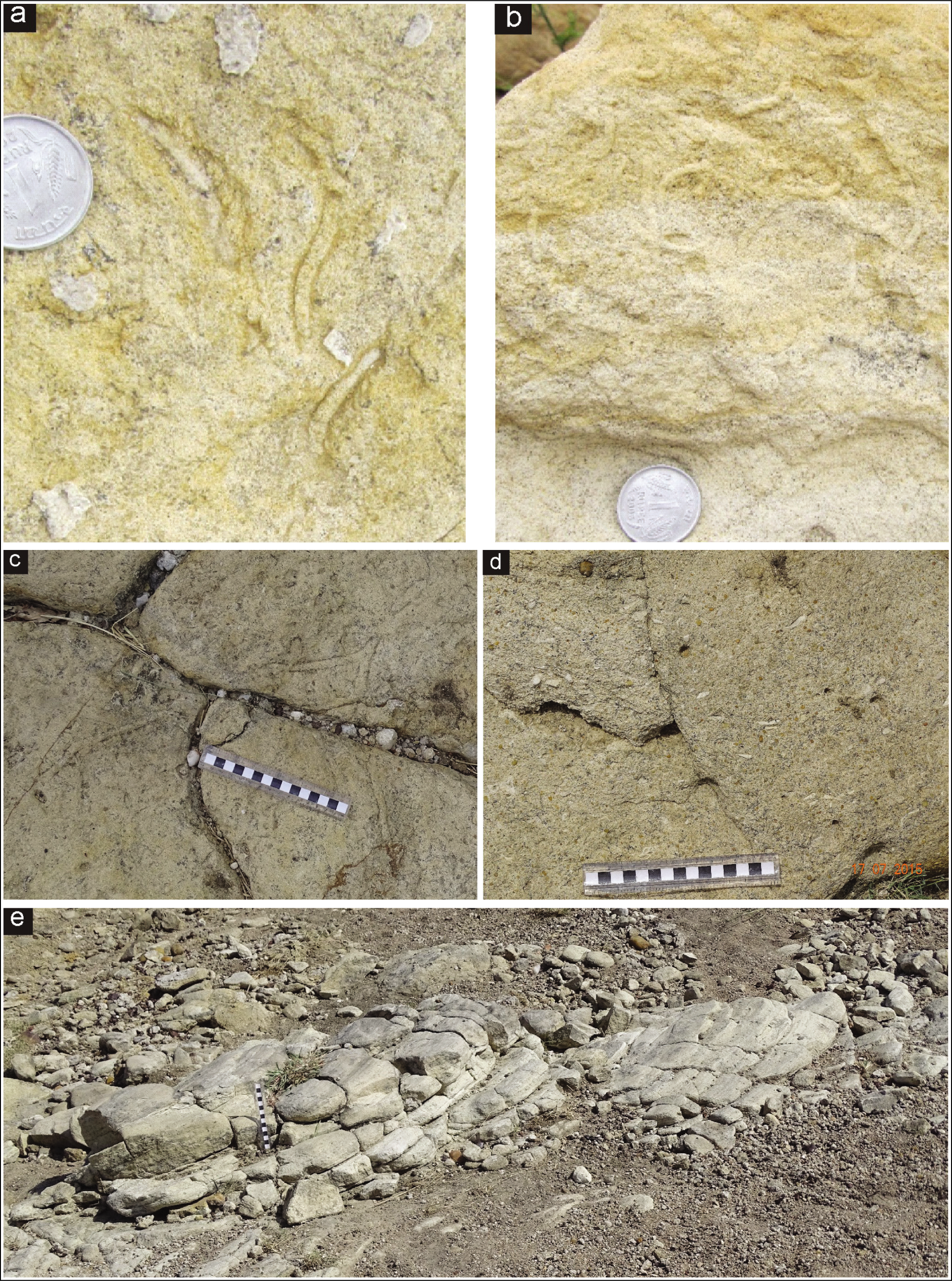
Ichnology: The ichnoassemblage comprises of networks of Thalassinoides isp. (Plate 4c) and Ophiomorpha isp. Vertical burrows increase in abundance up-section.
Interpretation: The lowermost normal-graded beds with lags are interpreted as tempestites deposited by storm action (Reading, 1996). The lack of finer clastics within these beds possibly indicates deposition above the fair-weather wave base on the lower shoreface. The sedimentary characters and the increasing presence of vertical burrows in the overlying beds indicate a decrease in food availability and deposition in high-energy, wave-dominated settings (Buatois & Mángano, 2011). The overall coarse lithology indicates transport by high-capacity discharges from close by sediment source. These cross-bedded units indicate deposition in foreshore to upper shoreface settings.
Conclusion
Unit I comprising of conglomerates fining up-section into gritty sandstones is interpreted to have been deposited in foreshore to shoreface settings. The linear extent of this unit all along the contact indicates deposition along strandlines rather than in offshore areas. The paucity of trace fossils except a few Planolites isp. has restricted the ability to assign ichnofacies to this unit. The water depth increases in Units II and III. Unit II consisting of glauconitic, alternating medium to coarse sandstone beds with ripple cross-lamination and planar cross-stratification. It displays vertical burrows belonging to the Skolithos ichnofacies, indicating constant reworking of sediment hindering colonisation by other faunal elements, and have been deposited in shoreface to offshore transition environments. Unit III is interpreted to be deposited in the distal-most environments associated with a delta front and prodelta, closer to the outer shelf or slope. The delta front is represented by massive pebbly to very coarse-grained debris flow sandstones, with almost monospecific colonisation by organisms belonging to the Skolithos ichnofacies indicating rapid colonisation of event beds. In contrast, the prodelta is represented by calcareous sandstones alternating with claystones consisting of the most diverse ichnoassemblage of Cruziana ichnofacies, pointing towards deposition in calmer, possibly dysoxic environments.
A shallowing of the environment is seen in Unit IV where pebbly to gritty cross-bedded sandstones exhibit networks of Thalassinoides isp. and Ophiomorpha isp., indicating shallow sub-tidal conditions.
On the basis of these observations, a rapid deepening of the basin is noticeable from the base of Unit I till the lower half of unit II, with the onlap of a basinal facies onto a comparatively shallower one. These two units show an upward decrease in grain size and a retrogradational stacking pattern. The upper half of Unit II is interpreted as an aggrading sequence. The transition from a distalfacies to deltaic and shoreface in Units III and IV is indicative of a subsequent regression and a shallowing trend.
Footnotes
Acknowledgements
Our sincere thanks are due to the Agharkar Research Institute for housing the type specimens. The authors are thankful to the Council of Scientific and Industrial Research, New Delhi (SRF to A.R.P) for their financial support. The authors thank Prof. Franz Fürsich and Prof. Bhawani Singh Desai for their constructive reviews.
Declaration of Conflicting Interests
The authors declared no potential conflicts of interest with respect to the research, authorship and/or publication of this article.
Funding
The authors received no financial support for the research, authorship and/or publication of this article.