




Abstract
An isolated rodent lower molar is being reported from Mohand II locality (gastropod/otolith locality) of the Siwalik Group exposed in the Mohand area, along the Saharanpur–Dehradun road. The fossils yielding mudstone units from the Siwalik Group exposed in the Doon Valley, Mohand, in the western Himalayan region. The occurrence of this murine mouse lineage, Parapelomys, is consistent with the late Miocene age based on palaeomagnetic reversal stratigraphy. The fossil represents a species apparently more primitive and older than the type species of the genus Parapelomys robertsi. The find documents the geographic range of this mouse lineage 500 km southeast of the type area for the species in the Potwar Plateau, Pakistan. The associated fauna comprises gastropods, ostracods, cyprinid fish and crocodiles in our collection.
Introduction
The terrestrial Siwalik deposits of the Indian subcontinent accumulated during Neogene time as a clastic wedge thousands of metres thick. Their biostratigraphic record has developed over two centuries, with significant advances made in the last 50 years. The stratigraphic and biotic record has been intensely studied in northern Pakistan, especially in the Potwar Plateau, where the classical rock bodies, Kamlial, Chinji, Nagri and Dhok Pathan formations, were named. Together, the strata span much of Neogene time and they contain a record of many subtropical, South Asian mammalian clades—ones distinct from mammalian groups elsewhere.
Murine rodents (rats and mice) are one such group. Modern Rodentia are usually small size, essentially herbivore mammals, that characteristically gnaw with one pair of enlarged, continually growing rootless incisors. Mice in general are specialized for rapid reproduction, large populations and short life spans. Murine mice appear to have originated in the Indian subcontinent in the late early Miocene (Flynn et al., 2020). Their history is becoming well documented not only in the Potwar Plateau and northern India but also in Sindh, Pakistan (Wessels, 2009) and recently in Kutch, western India (Tapar and Pasuda, Bhandari et al., 2021; Patnaik et al., 2022). Modern Murines are a highly diverse mammalian group with nearly 600 species distributed among 130 genera (Musser & Carleton, 2005); species identifications and formal systematics may be recognised among their dental elements (molars), which fossilise readily and can reflect diet.
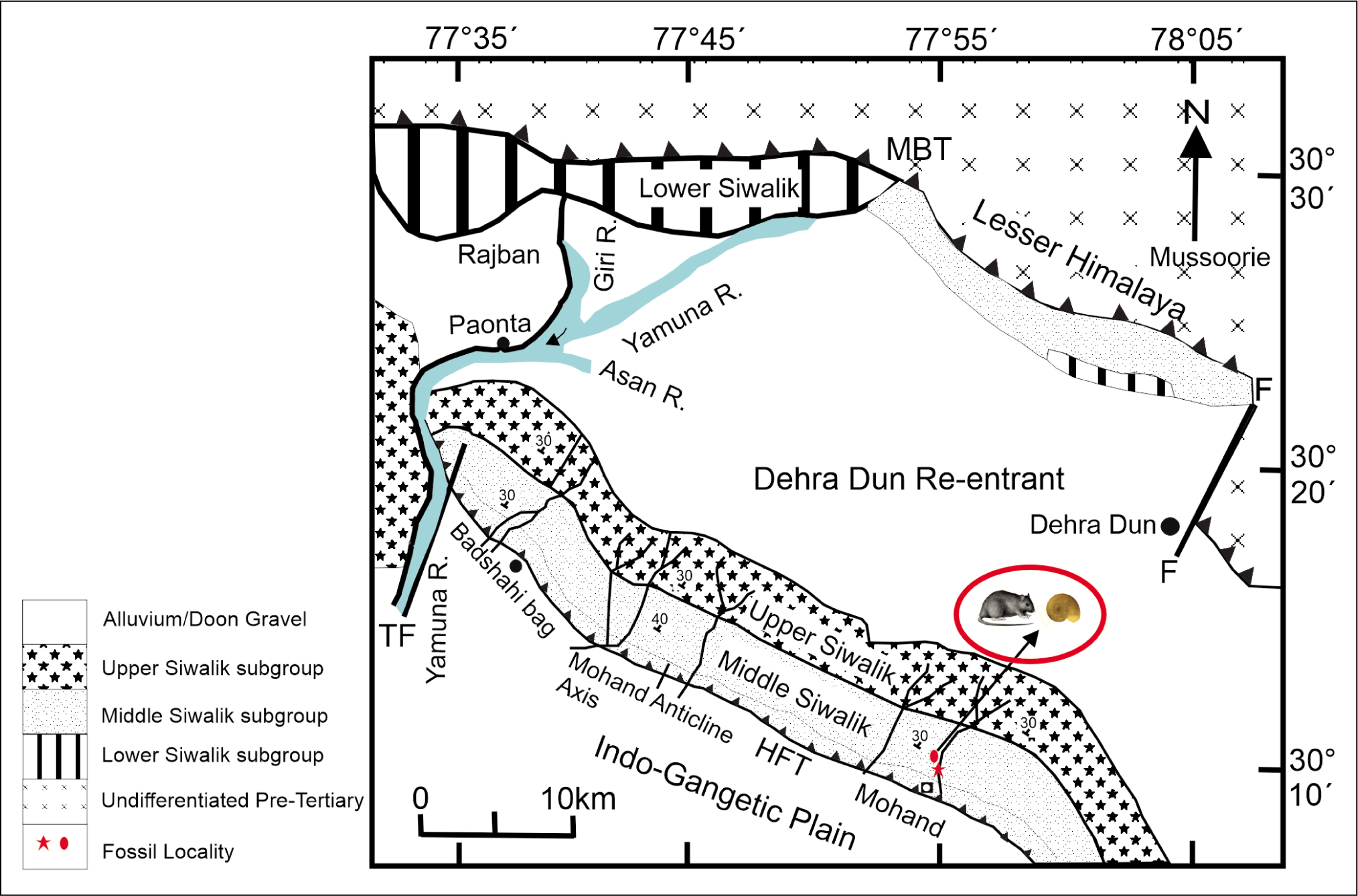
Here, we describe an isolated molar of the genus Parapelomys from a late Siwalik horizon from the Mohand area (Figures 1 and 2); GPS location of the exposure site is N 30013.251’ and E 077055.708’ at present elevation of 564 m above the mean sea level. Other fossils collected include scales, teeth, otoliths and vertebrae of fish, mostly cyprinids, in association with crocodilians and large numbers of molluscs, charophytes and ostracods.
Geological map showing fossil locality of Mohand 2, Siwailk (outer western Himalaya); black arrow indicates rodent bearing locality (Gastropod/otolith locality).
Fossil localities 1, 2 in Mohand region of Doon valley including gastropod/otolith locality (Mohand 2, Siwalik, Outer Himalaya).
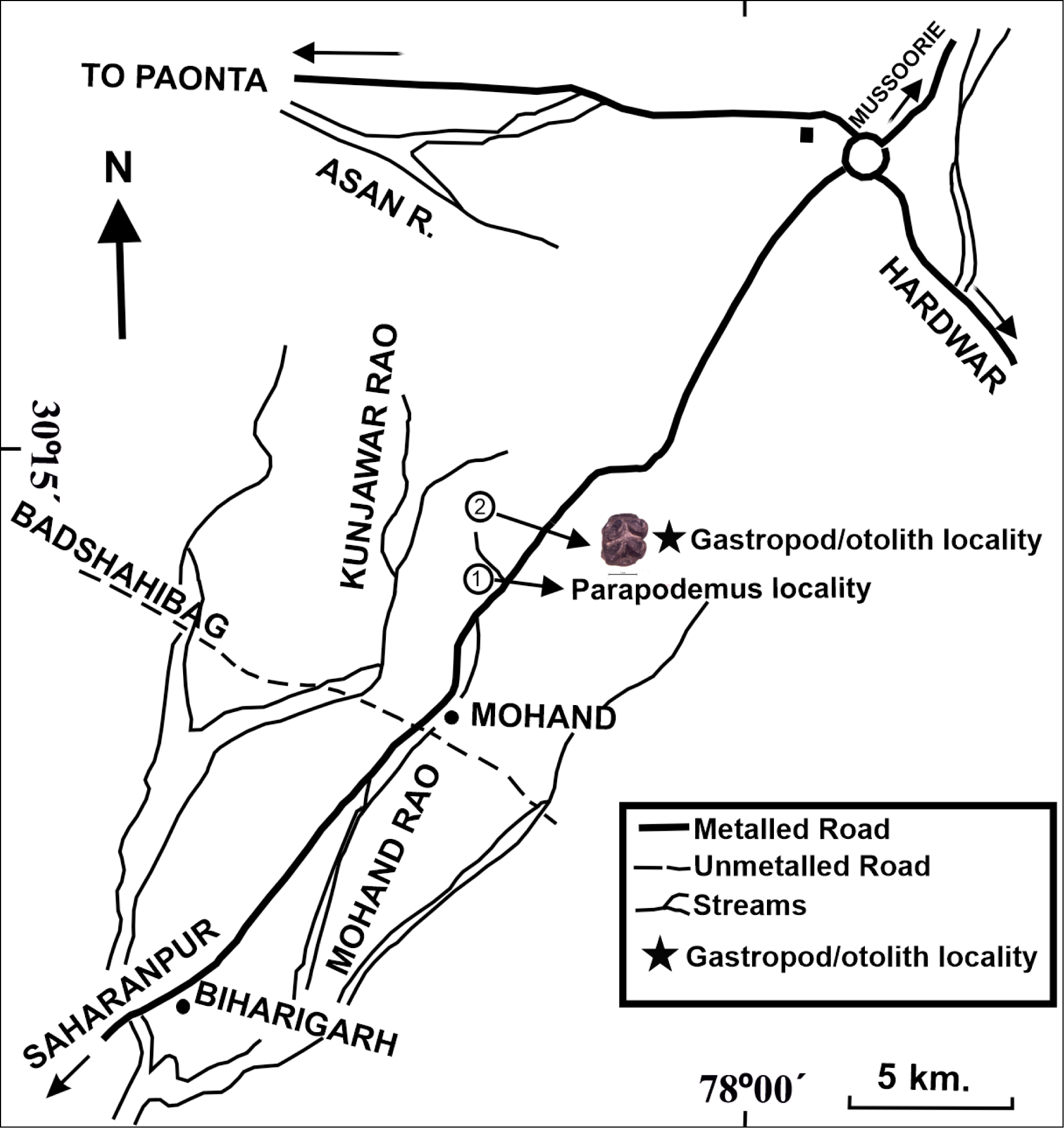
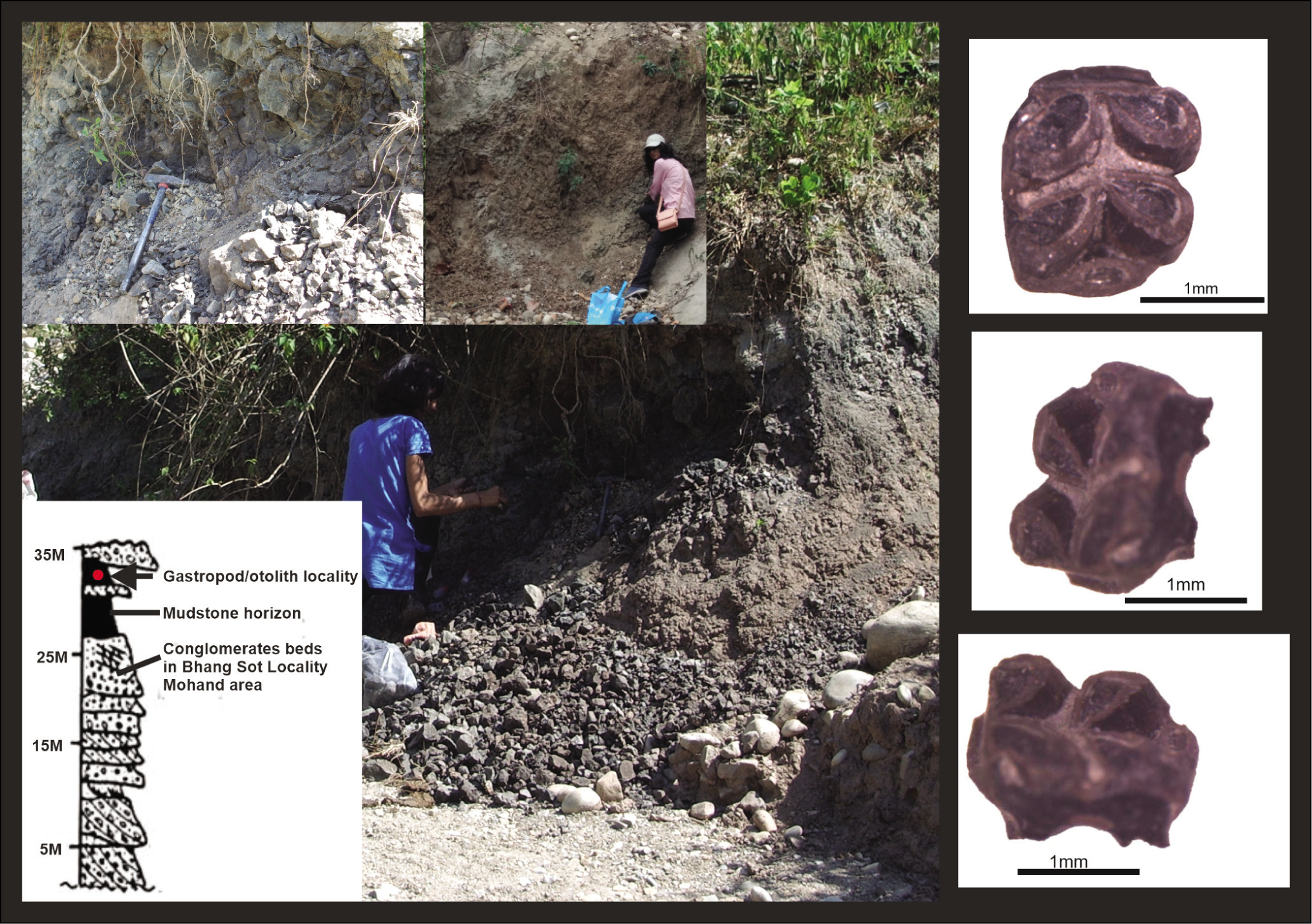
The fossil locality of Mohand Rao (stream) is approximately 21 km towards Mohand from Dehradun and is very close to the Dehradun–Saharanpur Road. This site is designated Mohand II, in distinction from nearby locality Mohand I published previously (Tiwari & Bhandari, 2014). The Mohand II gastropod/otolith locality has three successive fossil-yielding mudstone units. The lowest is a dark grey package wherein we found thin-shelled ostracods. The middle unit, red to grayish in colour, yielded a few otoliths. The uppermost greenish mudstone is nodular in nature and yielded innumerable gastropods shells, opercula and charophytes (Bhandari et al., 2014). The Mohand II gastropod/otolith locality also produced the rodent described here (Figure 3) from the dark grey mudstone lowermost unit.
Field photographs of gastropod/otolith locality with the litholog of fossiliferous section and rodent molar (BSIP/42250) from Mohand.
Geology of the Area
The Dehradun sub-basin has the thickest multi-storey complex in the central part of the Himalayan foreland basin between the Ganga and Yamuna rivers. The Middle and Upper Siwalik subgroups comprise the Mohand ridge on the southern flank of the Dehradun re-entrant. The Mohand ridge is separated from the Lesser Himalaya northwards by a structurally controlled depression known as the Doon Valley. In Mohand, the Middle and Upper Siwalik subgroups consist of sandstone-mudstone, sandstone and conglomerate sandstone alternations deposited mainly under braided river environments (Kumar, 1993; Kumar et al., 2004). In the Mohand Rao section, Sangode et al. (1999) applied magnetic polarity zonation to date the section to span chrons C4An to C3n.4n, about 9.1 Ma to 5.2 Ma (late Miocene) on the present time scale. Kumar et al. (2004) and Kumaravel et al. (2005) carried out sedimentological and rock magnetic studies. Detailed study of the section has revealed that the fossil-yielding mudstone horizon is not exposed in westerly streams in the Mohand region; it lies high (~1760 m) in the local section with varying thickness of 0.2 to 2 m (at places 10 m thick) as has been elaborated by Kumar et al. (2004). The fossiliferous horizon is a mudstone unit of grey colour varying from darker to lighter shades, and is over and underlain, respectively, by medium-grained sandstone plus conglomerate horizons and by relatively more indurated sandstone beds. The detailed geology of the section is published in excursion guides by Tandon et al. (1988) and Kumar et al. (1991). The Mohand Neogene freshwater gastropods were recorded from the ‘gastropod/otolith locality’ by Bhandari et al. (2014). This is stratigraphically above a rodent fossil locality (Mohand I) that has produced Parapodemus sp. (Tiwari & Bhandari, 2014). About 500 m away the new locality, Mohand II produces the murid Parapelomys sp. (Figure 3) and suggests an age greater than the 5 Ma estimate of Kumar et al. (2003) and Kumar et al. (2004). We interpret the sequence to represent a tectonically quiescent period of low sedimentation rate and low energy deposition on a fluvial floodplain. This was followed by a coarsening upward cycle of Siwalik sedimentation. The fossiliferous mudstone horizon is high (~1760 m) in the local Siwalik section of Sangode et al. (1999).
Methodology
Samples were processed with a mixture of water with added 10% formic acid solution, by washing and sieving with different size meshes (four sieves of 10 to 60 ASTM nos). Samples were dried under direct sunlight for two days to remove the moisture, and then crushed with the help of mortar and pestle. The crushed material was soaked in water, and we added 10% of Formic acid for disintegration for 1 day. The disaggregated material was sifted through four sizes of sieves (10, 20, 40 and 60). The washed and sieved samples were dried in sunlight and by an oven. After drying, samples were picked by microscope (LEICA—EZ4HD). We collected the microfossils, measured them and photographed them with the help of a digital microscope (LEICA S8AP0) with an attached camera.
Systematic Palaeontology
Family Muridae Illiger, 1811
Subfamily Murinae Illiger, 1811
Genus Parapelomys Jacobs, 1978
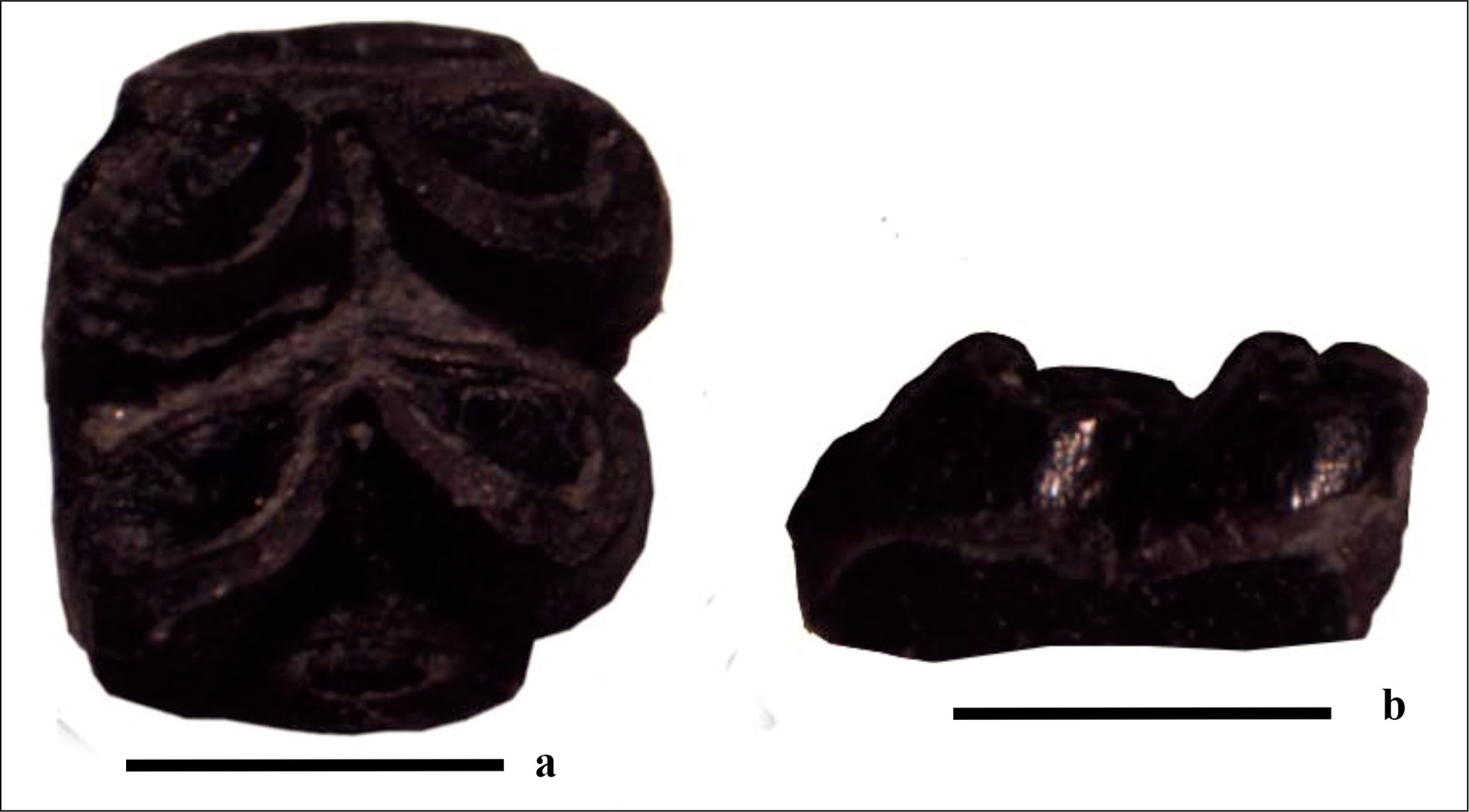
Parapelomys sp. Figure 4 (a, b)
Parapelomys sp. isolated rodent molar (BSIP/42250) from Mohand Siwalik. (a) Occlusal view, anterior is upward. (b) Lingual view. Scale bars a–b = 1 mm.
Remarks
This specimen exhibits the large-basined grinding cusps of Parapelomys and represents a murine almost as large as P. robertsi, the type species of the genus. It differs, presumably primitively, in that the molar is not nearly as wide as it is long as in P. robertsi. This fossil also approaches the morphology observed in Golunda but the Golunda m2 is square in outline, the large cusps are D-shaped, and the posterior cingulum of Golunda is reduced to a small, round cusp.
Discussion
Murinae diversified in the Indian subcontinent by the early late Miocene (Flynn et al., 2020). By this time the living murine tribes had emerged, and the Siwalik fossil record preserves early members of the tribes Murini and Arvicanthini, represented by the genera Progonomys and Karnimata. The Karnimata group includes the origin of the genus Parapelomys (Jacobs, 1978).
Parapelomys is previously reported from the Siwaliks exposed near Ladhyani village in the Haritalyangar area, Himachal Pradesh by Tiwari (1996), who illustrated a broken upper first molar. His specimen dates to about 8.9 Ma (Patnaik, 2013) and shows a more primitive status than that of the Mohand specimen. The earliest appearance of Parapelomys on the Potwar Plateau in Pakistan is at locality Y24, about 8.1 Ma (Jacobs & Flynn, 2005).
Jacobs (1978) recognised and named P. robertsi for a large collection of murine teeth from the late Miocene site DP13 on the Potwar Plateau of northern Pakistan. The type locality dates to about 6.5 Ma (Barry et al., 2002). Specimen BSIP 42250 resembles the type material of P. robertsi, except that it is relatively narrower. That condition, length greater than width, is primitive for murines; P. robertsi is progressive in squaring of m2. While morphological affinity of BSIP 42250 lies with P. robertsi, we recognise this important difference from the type species and designate the fossil simply as Parapelomys sp. We use sp because it is only M2 and primitive.
The less derived status of the Mohand specimen suggests a greater age than that of the type series of P. robertsi. We estimate ~7 Ma. This is somewhat older than the age suggested by Sangode et al. (1999) for their section 500 m away. This minor difference highlights the need for more work in the area.
Conclusion
We report a murine mouse and associated biota from the Mohand II Siwalik locality (Outer Himalaya). We record for the first time Parapelomys sp. from the area. The age estimate for the grey mudstone unit (about 7 Ma) is consistent with the findings of Sangode et al. (1999) but somewhat greater. The site falls in the topmost Middle Siwaliks at about the 1,760 m level. The murine fossil suggests that the age may be greater than the approximate magnetic correlation: the less derived condition of BSIP 42250 suggests an age greater than that of the hypodigm of P. robertsi (which is 6.5 Ma). This age estimate for Parapelomys from Mohand II appears to be younger than that previously estimated for the murine Parapodemus sp. from the nearby but stratigraphically older Mohand I locality.
The fossils suggest that a spell of tectonic quiescence in the hinterland plausibly allowed low-energy sedimentation for the late Miocene Siwaliks. The abundant biota (charophytes, ostracodes, gastropods) from Mohand II locality indicates freshwater depositional environment and sluggish, lentic water in the basin.
The fossil charophtyes, ostracodes, fishes, crocodiles and the Mohand rodent indicate adjacent palaeocommunities (aquatic and terrestrial).
Parapelomys sp. represents an herbivore in the terrestrial palaeocommunity, of 50 to 100 g body mass, large for a mouse. There is great potential for developing the rodent representation of Mohand.
Footnotes
Acknowledgements
AB thanks Dr. Vandana Prasad, Director of BSIP for constant encouragement and for providing the necessary research facilities. We are grateful to the Director, BSIP, Lucknow who supported the publication of this research work (BSIP/RDCC/Publication 75/2023). AB is grateful to Dr. B.N. Tiwari for his valuable advice, encouragement and fruitful discussions on the Geology of Siwaliks. AB is also thankful to Dr. Rohtash Kumar for his affirmative suggestions in sedimentary Geology. Sincere thanks to Dr. S.S. K. Pillai for his support in providing me microscope facilities (Leica S8AP0 Sterozoom microscope) for photography of rodent molar at Gondwana Lab of BSIP, Lucknow (India). The authors are thankful to the reviewers of this manuscript for valuable comments and constructive suggestions for improving the quality of the manuscript. And, special thanks to editors for publication of this research work.
Declaration of Conflicting Interests
The authors declared no potential conflicts of interest with respect to the research, authorship and/or publication of this article.
Funding
The authors received no financial support for the research, authorship and/or publication of this article.