




Abstract
The present work elucidates palynofloral records from the Lipak Formation (late Devonian– early Carboniferous) of the Spiti Basin. The study has been carried out from three different sections of Spiti and Pin valleys to look for the signatures of terrestrial plants in the Tethyan realm and assess the relative palynodating of the studied sediments. The recovered palynoassemblage from the exposures of Lipak Formation, near Takche Locality, Spiti Valley, mainly comprises spores and has the dominance of Verrucosisporites, Dictyotriletes, Lophozonotriletes, Convolutispora followed by subordinate occurrences of Rugospora, Cymbosporites and Knoxisporites along with reworked pollen grain Plicatipollenites. The recovered palynoassemblage of Lipak Formation exposure at Guling Village of Pin Valley comprises Spelaeotriletes, Tricidarisporites, Calamospora, Callumispora and reworked pollen grains. The reworked pollen grains are characterised by the dominance of Faunipollenites, Scheuringipollenites and Parasaccites and followed by subordinate occurrences of the Densipollenites, Striatopodocarpites, Platysaccus, Alisporites, Striomonosaccites, Chordasporites and Verticipollenites pollen grains. The exposure of this Formation near Muth Village of Pin Valley is found to be palynologically barren. The recovered palynoflora is correlated with palynofloral records of the Tethyan realm of India and palynofloral records from coeval sequences worldwide. The recovered palynocomposition shows a close resemblance to Retispora lepidophyta–Verrucosisporites nitidus (LN) and Vallatisporites verrucosus–Retusotriletes incohatus (VI) Assemblage zones of Western Europe and Cordylosporites–Verrucosisporites Biozone of Argentina which indicates that studied section of the Lipak Formation is upper Famennian to early Tournaisian age. The recovered reworked palynomorphs belong to the Permian age, which may be deposited in the Lipak Formation through stratigraphic leakage. Palynomorphs include spores of affinities of Zygopteridiales, Marattiales, Botryopteridales, Equisetales/Noeggerathiales/Sphenophyllales group of plants. In contrast, palaeobotanical affinities of pollen grains are linked with the Filicales, Cordaitales and Glossopteridales group of plants.
Introduction
In India, Devonian–Carboniferous exposures are only constrained in the Tethyan realm of the Himalayan region. Sequences of the Tethyan realm are sandwiched between the Higher Himalayas and the Trans Himalayas and are known for substantial marine fossil records. These exposures are well exposed in the Kashmir, Zanskar–Spiti–Kinnaur and Kumaon basins. In contrast to faunal records, the floral record from the Devonian strata is almost nil. However, well-diversified early Carboniferous macrofloras have been reported from Spiti as well as Kashmir regions of Tethyan Himalaya (Cleal et al., 2016; Gothan & Sahni, 1937; Høeg et al., 1955; Pal, 1978; Pal & Chaloner, 1979; Pant & Srivastava, 1995; Singh et al., 1982; Singh et al., 2013).
Spiti Basin is an important sub-basin of the master Tethyan Basin. It lies in the distal part of Himachal Pradesh State in the Northwestern Himalayas. It is commonly known as a cold desert. Over the period, many stratigraphical, sedimentological and palaeontological studies related to the Devonian–Carboniferous periods have been carried out by various workers (Bhargava, 2008; Bhargava & Bassi, 1998; Draganits et al., 2002, 2003; Ganai et al., 2018; Garzanti et al., 1996; Shanker et al., 1993; Singh et al., 2017; Srikantia, 1981; Srikantia & Bhargava, 1998, 2021; Stoliczka, 1865; Vannay, 1993; and references therein) but no attention has been paid for palynological studies of the Devonian period from the entire Indian Tethyan realm, though the region has worldwide geological implications. The predominance of marine deposits in the Spiti Basin might have hindered looking for terrestrial floral records.
Several number of palynological studies have been carried out from Devonian–Carboniferous strata of the world and is continuously being updated for high-resolution palynostratigraphy and correlation of contemporary strata across the globe, especially from South America (Brazil: Loboziak et al., 2000; Melo & Loboziak, 2003; Muro et al., 2020; Playford et al., 2012; Souza et al., 2003, 2015; and references therein), Argentina (Césari & Perez Loinaze, 2021; Gutiérrez & Balarino, 2018; Loinaze, 2005; Loinaze et al., 2014; Noetinger & Di Pasquo, 2011; Pineda et al., 2021; Rubinstein et al., 2017; and references therein), South Africa (Streel & Theron, 1999), Europe (Avchimovitch, 1992; Avchimovitch et al., 1988, 1993; Clayton et al., 1977, 1978; Filipiak, 2004; Higgs et al., 2000; Maziane et al., 1999; Streel et al., 1987; and references therein), Australia (Playford & Satterthwait, 1986), Turkey (Higgs et al., 2002) and China (Guo et al., 2022; Liu et al., 2019; Peng et al., 2022; Wellman et al., 2012; Xu et al., 2022; and references therein).
Compared to the works mentioned above, Devonian–Carboniferous palynological studies from the Indian subcontinent are far too meagre. More precisely, Devonian palynostratigraphic studies are absent. However, only two palynological studies have been done from early Carboniferous sequences of Tethyan Himalaya—pioneer palynostratigraphic work from India is done by Khanna and Tewari (1983) from Spiti Valley, and the other is by Agnihotri et al. (2018) from Kashmir Valley. More recently, Gupta et al. (2022) conducted a late Carboniferous palynological study from Spiti Valley.
The present palynological study is the first attempt to record palynomorphs from the sequences of the Lipak Formation, exposed near the Takche locality towards the Losar village of Spiti Valley, at Guling, and near Muth villages of Pin Valley, India. This Formation is known for the predominance of marine fossils and has a contentious age assessment ranging from Givetian to Tournaisian. The present attempt has been made for palynological content, age and palynostratigraphic assessment of the Lipak Formation. Palynoassemblage recorded from three sections has yielded spores and woody fragments. The recovered palynoassemblage is corroborated with known records of early Carboniferous palynomorphs from the Tethyan realm of India and also with late Devonian–early Carboniferous palynomorph records of Argentina, Western Ghana, South Tibet, southeastern Turkey, Poland, West-Central Montana, USA, Iran and East Greenland. This study elucidates the palynostratigraphic status of the Lipak Formation. Recovered palynomorphs exhibit botanical affinities with Zygopteridales, Marattiales, Botryopteridales and Equisetales/Noeggerathiales/Sphenophyllales group of plants. In contrast, reworked pollen grains in the assemblage have botanical affinities with Filicales, Cordaitales and Glossopteridales group of plants.
Geological Setting
Spiti Basin is a northward part of the Himachal Pradesh state, which occupies a central place in the Western Himalayas following the general Himalayan trend of NW–SE extension. It contains well-exposed sedimentary sequences of Neoproterozoic to Cretaceous ages (Figure 1). It is one of the largest marine basins among the Himalayan Tethys basins. These metasedimentary rocks of the Tethys Himalaya are considered to represent the deformed remnants of the northern continental margin of the Indian subcontinent, which are sandwiched between high-grade gneisses of the Greater Himalayan Zone across the South Tibetan Detachment System from the south (Bhargava & Bassi, 1998; Vannay & Grasemann, 1998; Vannay et al., 2004) and Indus–Tsangpo Suture Zone (ITSZ) in North. ITSZ separates rocks of the Indian and Eurasian plates (Valdiya, 1989).
Geological map of the study area (after Bagati, 1991). HP: Himachal Pradesh State.
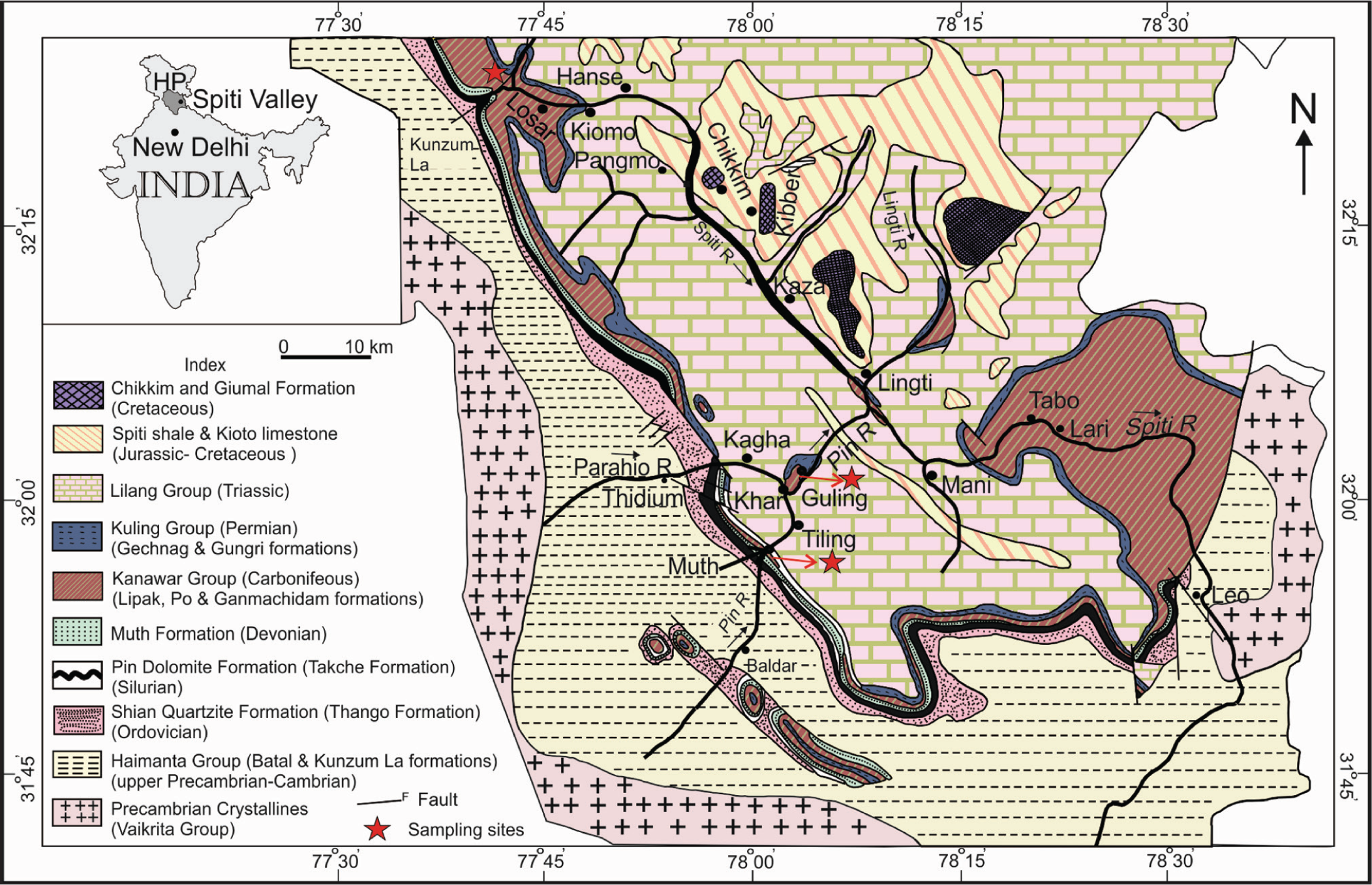
Devonian and Carboniferous sequences of Spiti Basin have been grouped under the Kanawar group, which includes Muth, Lipak, Po and Ganmachidam formations, in stratigraphical order (Bhargava, 2008) (Table 1). Lipak Formation (Givetian to Tournaisian) in Spiti Basin is exposed in and around Losar, Guling and Muth villages. Lipak Formation is sandwiched between the underlying Muth Formation (early to middle Devonian) and the overlying Po Formation (Visean-Serpukhovian) in Spiti Valley. In contrast, in Pin and Parahio valleys, it directly overlies Gechnag Formation (Early Permian). In both Pin and Parahio valleys, Po and Ganmachidam formations are absent (Bhargava, 2008).
Palaeozoic Stratigraphy of Spiti Basin.
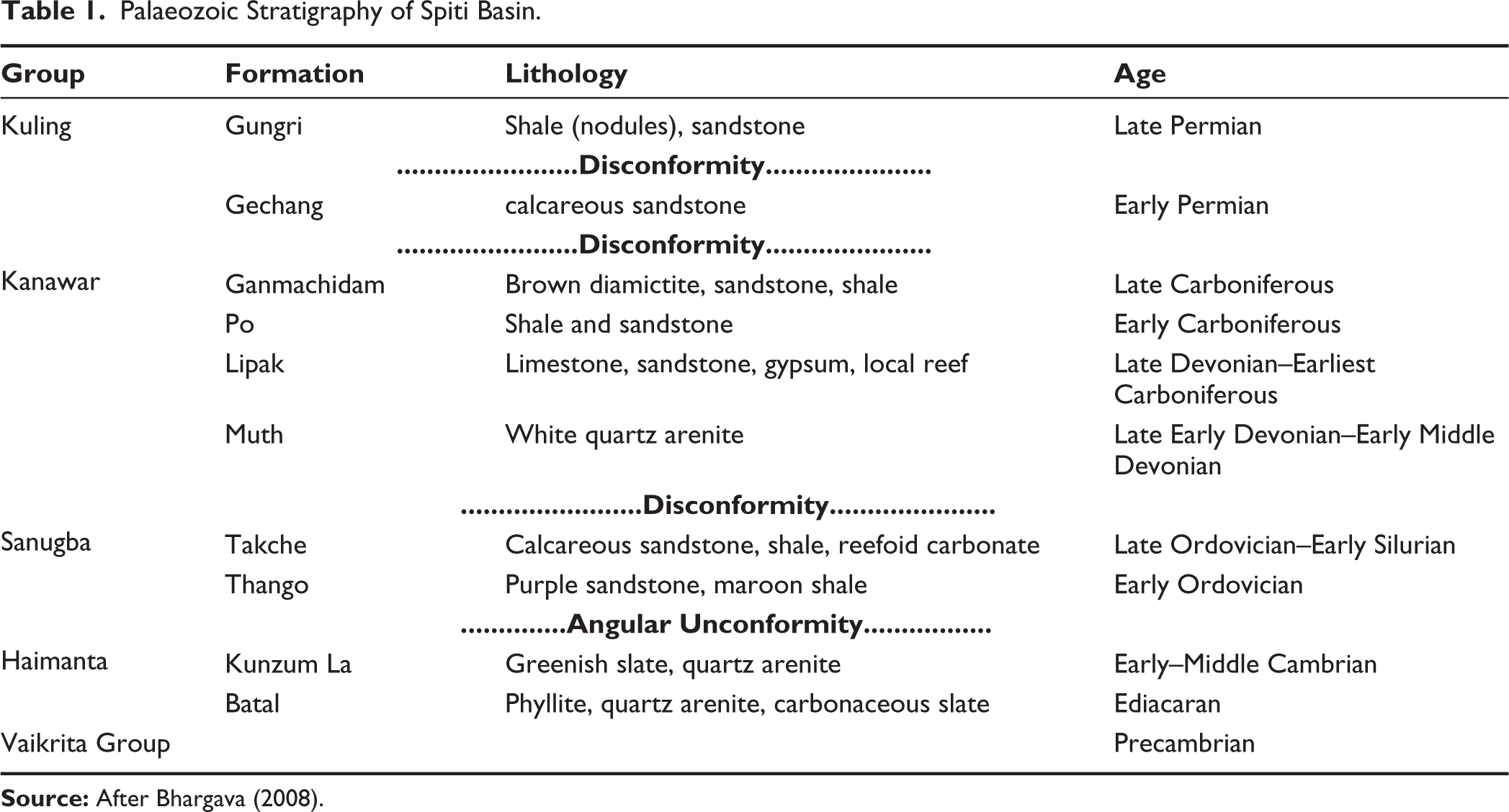
No single type locality is ascertained for Lipak Formation. The lower part of the Lipak Formation is best exposed near Muth village, Pin Valley, whereas its upper part is best represented near Po and Losar villages, Spiti Valley. The thick sequence of the Lipak Formation is well exposed in the Lipak Valley of the Spiti region and exhibits extensive facies variations. The lower part of the Lipak Formation is characterised by a dolomitic limestone-sandstone sequence and limestone-shale intercalations in the upper part. Black limestone is the most conspicuous lithology of this Formation. Due to its dark carbonate-rich contrasting lithology between the underlying white Muth Formation and the overlying shale-dominated Po Formation, it is easily identifiable from a distance in fully developed sections (Bhargava, 2008).
Bhargava (2008) stated that Lipak Formation is characterised by several shoaling cycles, fluctuating from low to high energy environment in a subtidal to the intertidal zone. Coral build-ups specify the limited platform environment. The main sedimentary structures encountered in the Lipak Formation are low-angled truncations, ripple marks and cross beddings. Draganits et al. (2002) proposed that the lower part of the Formation was deposited in a shallow marine setting in the Pin Valley section based on sedimentary structures, sequence stratigraphy, lithofacies and conodonts.
Age of the Lipak Formation
The age of the Lipak Formation has always been debatable. A late Devonian to early Carboniferous age was assigned, based on diverse brachiopod fauna and Tentaculites (Fuchs, 1982; Hayden, 1904), whereas Reed (1911) considered a late Middle to Late Devonian age, based on fossils collected by Hayden and von Krafft in Lipak Valley in 1901. Chatterji (1967) stated a late middle or early late Devonian to early Carboniferous age in Lipak Valley. Vannay (1993) assigned the Tournaisian age owing to the Tournaisian conodont from the upper horizon of the Formation, whereas Garzanti et al. (1996) reported the late Famennian conodont from the basal horizon of the Formation in Pin Valley and assigned to late Famennian age. Moreover, Bhargava and Bassi (1998) reported Devonian and Carboniferous corals, Lithostrontian, hexagonorids and thamnoporids from about 80 m above the base in the Takche section. They delineated the existing Devonian–Carboniferous boundary within a stratigraphic thickness of about 3.5 m and stated that closing of this boundary exists the hardgrounds. Therefore, the late Devonian to early Carboniferous age is assigned to Lipak Formation. Moreover, Draganits et al. (2002) reported Givetian conodonts, Icriodus and Bipennatus, from basal part and Famennian and early Tournaisian conodonts namely Clydagnathus gilwernensis, Hindeodus cristulus, Mitrella-taxis sp. cf. M. cornella, Polygnathus communis and Pseudopolygnathus primus from the upper part of Lipak Formation; Givetian to Tournaisian age is assigned and stated that significant part of Givetian, whole Frasnian and little bit of Famennian is missing so no record of Kellwasser events in Indian Himalaya, whereas Bhargava (2008) considered continuous deposition for these time intervals.
Material and Methods
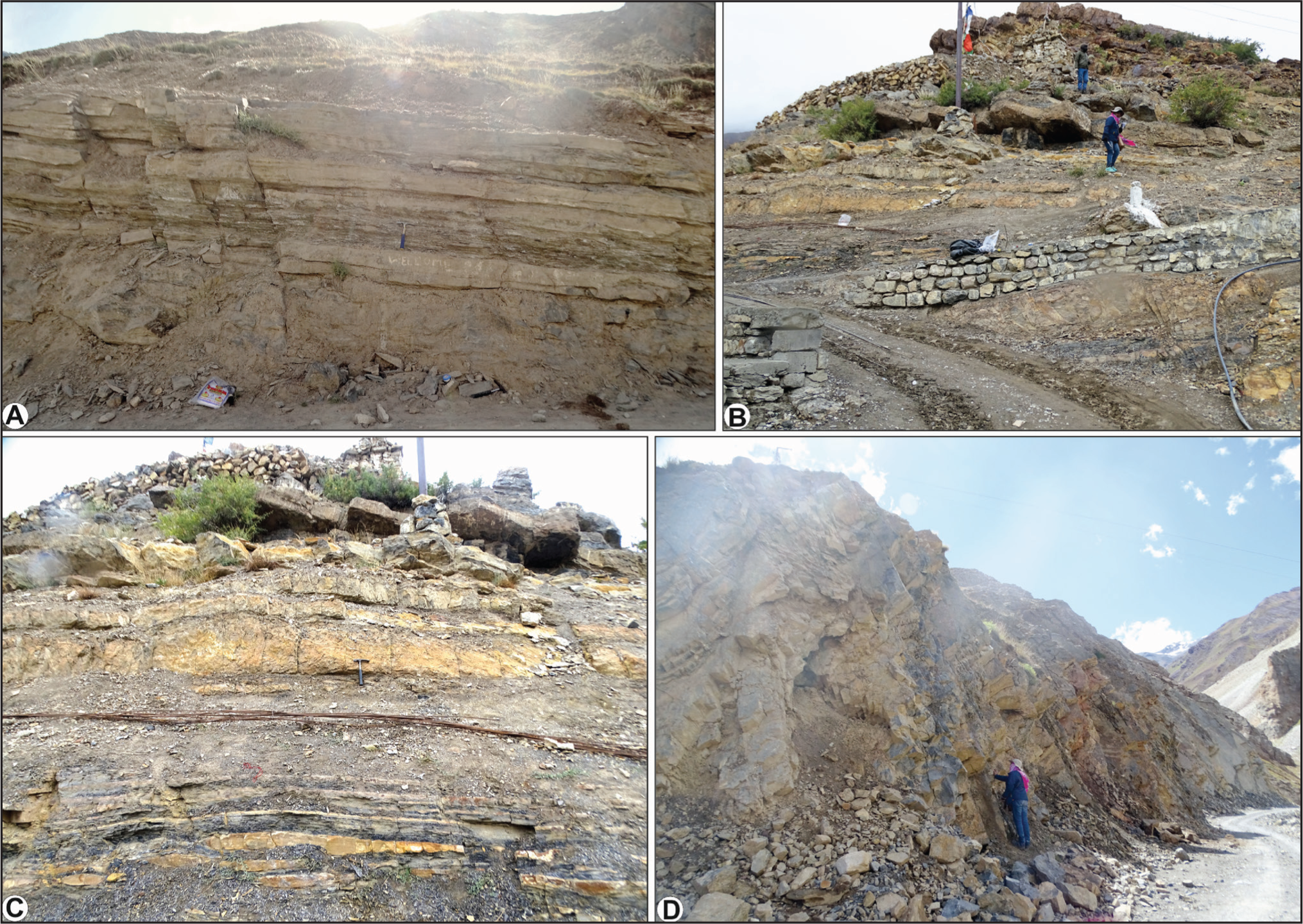
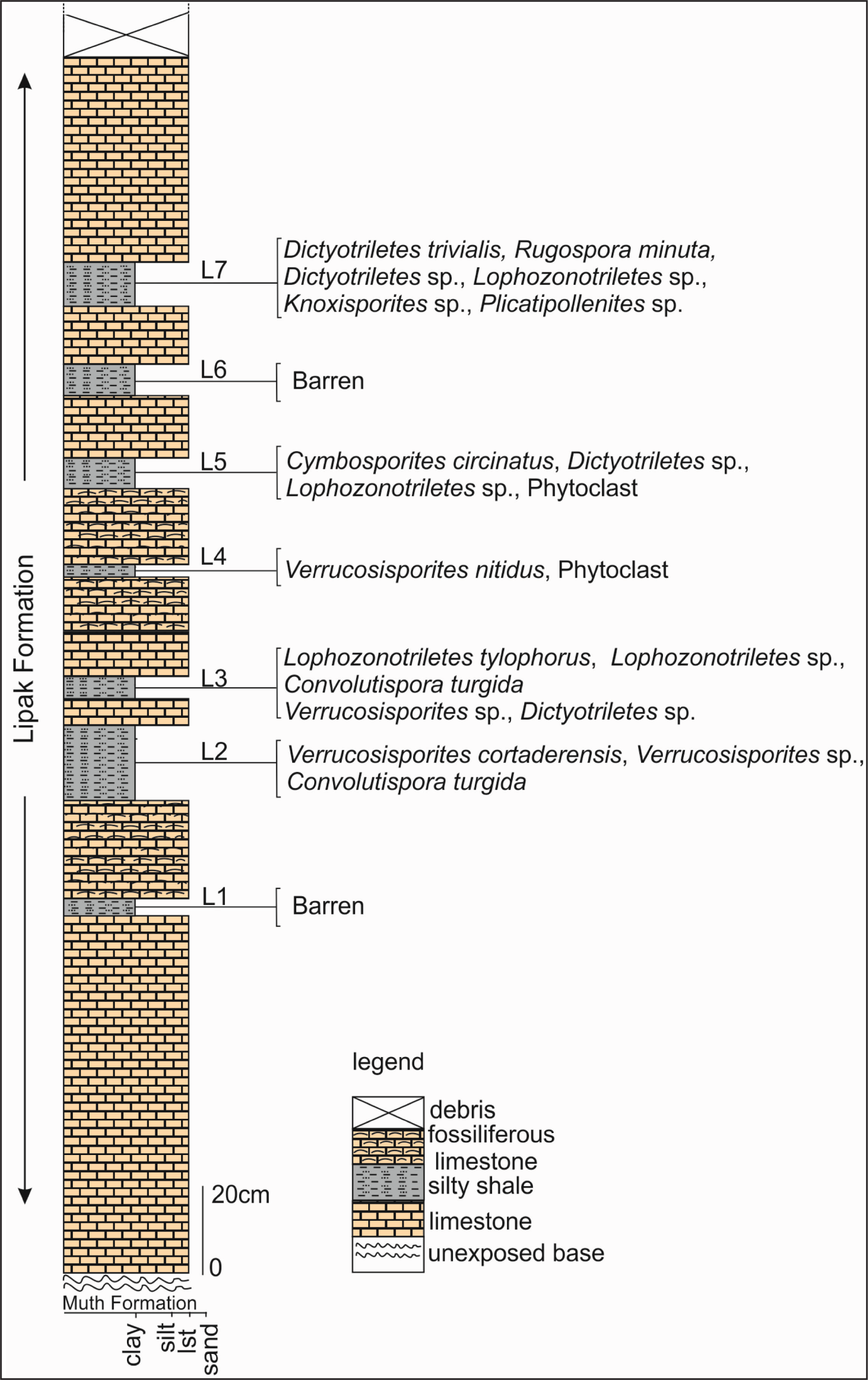
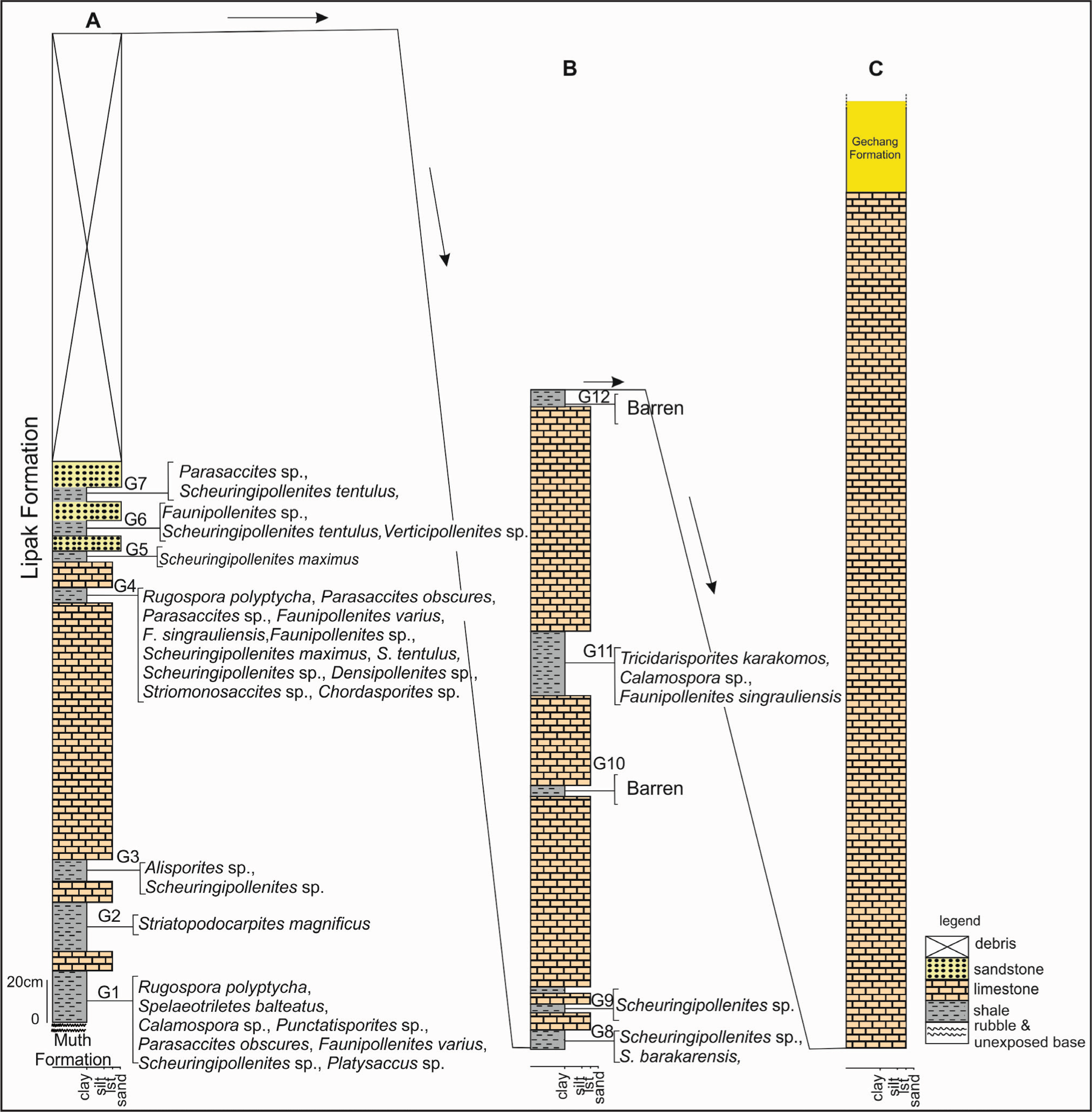
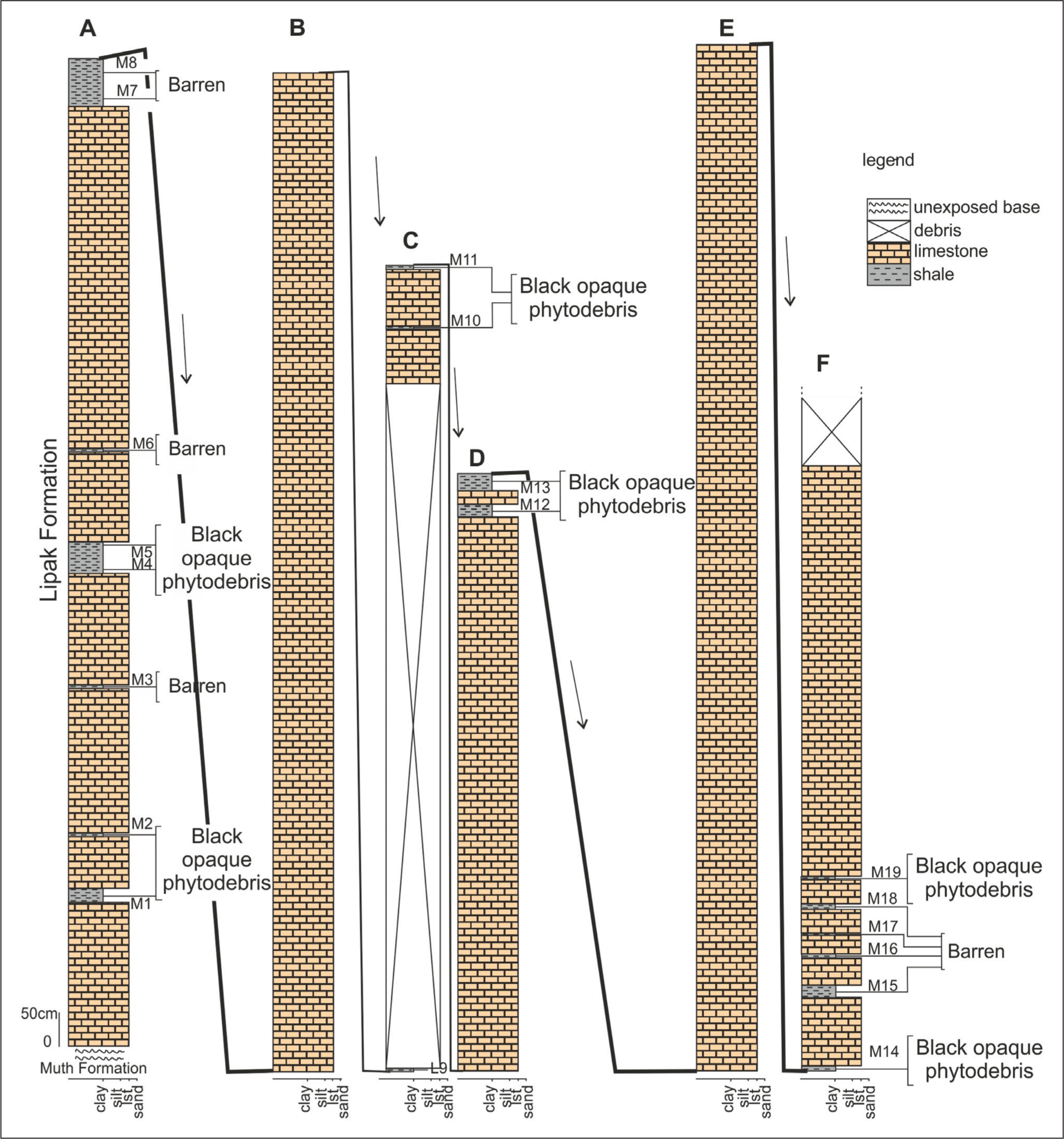
The present study deals with the analysis of fossil pollen and spores, which were obtained from three sections of the Lipak Formation of Spiti and Pin valleys (Figure 1). Of the three sections, seven palynological samples were collected (L1 to L7), from an outcrop of grey silty shales with intercalation of limestone which is exposed about 2 km away from Takche locality, Spiti Valley, on right side of the road towards the Losar village (32°26’ 50.2’’ N, 77°42’ 48.2’’E) (Figure 2A). Out of seven samples, five samples were found to be productive, whereas two samples were palynologically barren (Figure 3). Twelve samples (G1–G12) were collected from an outcrop of grey silty shales with intercalation of limestone and sandstone which is exposed at Guling Village, Pin Valley, on the right side of the road towards the Muth village (32°02’ 45.65’’ N, 77°05’ 24.13’’E) (Figures 2B and 2C). Out of 12 samples, 10 samples were found to be produ-ctive, whereas 2 samples were palynologically barren (Figure 4). Nineteen samples (M1-M19) were collected from an outcrop of shale unit which intercalated with limestone, exposed near Muth Village (Figure 2D), Pin Valley (31°57’ 31.31’’ N, 78°01’ 43.40’’E). All samples were palynologically barren (Figure 5).
Photograph of the studied sections of Lipak Formation in Spiti Basin: (A) Section exposed near the Takche Locality towards Losar village, Spiti Valley; (B, C) Section exposed at Guling Village, Pin Valley; (D) Section exposed near Muth Village, Pin Valley.
The litholog of the studied section of Lipak Formation near Takche locality, Spiti Valley, along with sample positions and recovered palynomorphs.
Litholog of the studied section of Lipak Formation at Guling Village, Pin Valley, along with sample positions and recovered palynomorphs.
Lithologs of the studied section of Lipak Formation near Muth Village, Pin Valley, along with sample positions and recovered palynomorphs. Parts A, B, C, D, E and F of litholog are in stratigraphical order.
A standard maceration technique was used for sample preparation. To remove fine debris attached to the outer surface of samples, samples were washed with distilled water and each dried sample of about 10–20 g was crushed into small pieces of about 2–5 mm in size using mortar and pestle. The mortar and pestle were cleaned to prevent contamination between each sample preparation. Grounded samples were put in clean plastic jars and treated with hydrochloric acid (35% concentration) for 2 days todissolve carbonates. Then, samples were washed with water, and hydrofluoric acid (40% concentration) was used to dissolve silica. Samples were stirred twice or thrice a day until the maximum dissolution of rocks occurred. This process was done till the complete digestion of rock and, in this period, hydrofluoric acid was added twice or thrice to accelerate the chemical reaction. After complete digestion, the macerate was washed repeatedly with water to remove the acid content. After that, samples were again treated with nitric acid (HNO3) for 3–4 days to oxidise the organic and humic residue, and fresh HNO3 was frequently added to enhance the reaction. Subsequently, macerated material was passed through 15 and 20 μm sieves with distilled water to obtain the final residue. This residue is again treated with a potassium hydroxide (KOH, 5–10%) solution for a minute to clear the palynomorphs. Again, hydrochloric acid (HCl) was used to prevent organic residue from coagulation. Finally, macerated samples were washed using ASTM 600-mesh sieves (15 and 20 μm). Samples were continuously examined under a microscope before further treatment to avoid over-treatment.
Polyvinyl alcohol solution was used as a stick material to stick pollen and spores, smeared over cover-glasses, and kept for drying at room temperature. Later, when the cover glasses were completely dried, Canada balsam was used as a mounting material to permanently mount the cover slip over the glass slide and put it in the oven for drying the next day. For each sample, 15–20 slides were prepared depending on yield. Permanent slides were examined under a high-power stereoscopic binocular microscope, and microphotographs of palynomorphs were taken at 40X and 100X magnification using a DP26 camera and CELL-A software. The taxonomic identification of recovered palynomorphs was made by consulting pertinent literature and illustrations earlier published in India and abroad. The taxonomy used is per fossil genera and fossil species as defined in the International Code of Botanical Nomenclature. Studied slides are deposited in the repository of BSIP (slide numbers 17195–17230) vide statement number 1606.
Palynofloristics of Lipak Formation
The palynofloristics of Lipak Formation have been carried out from three outcrop sections of Spiti and Pin valleys.
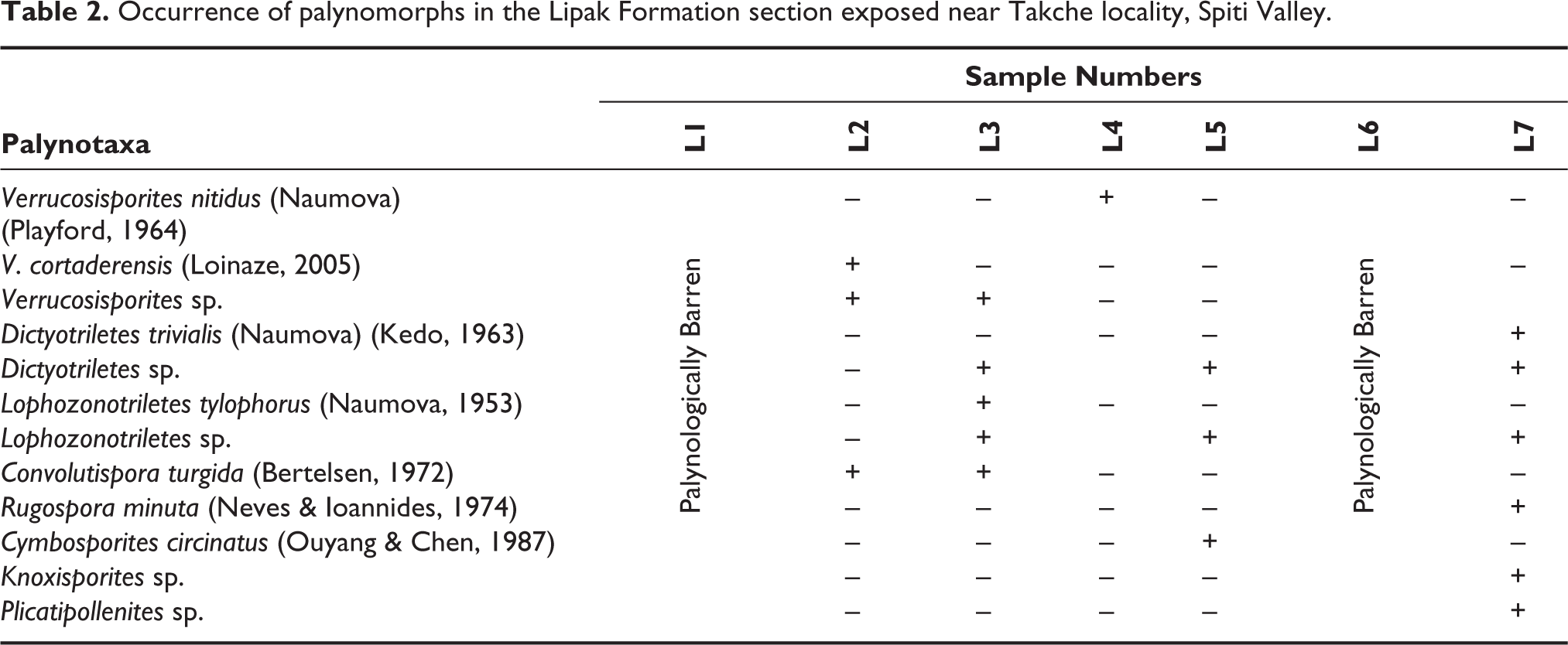
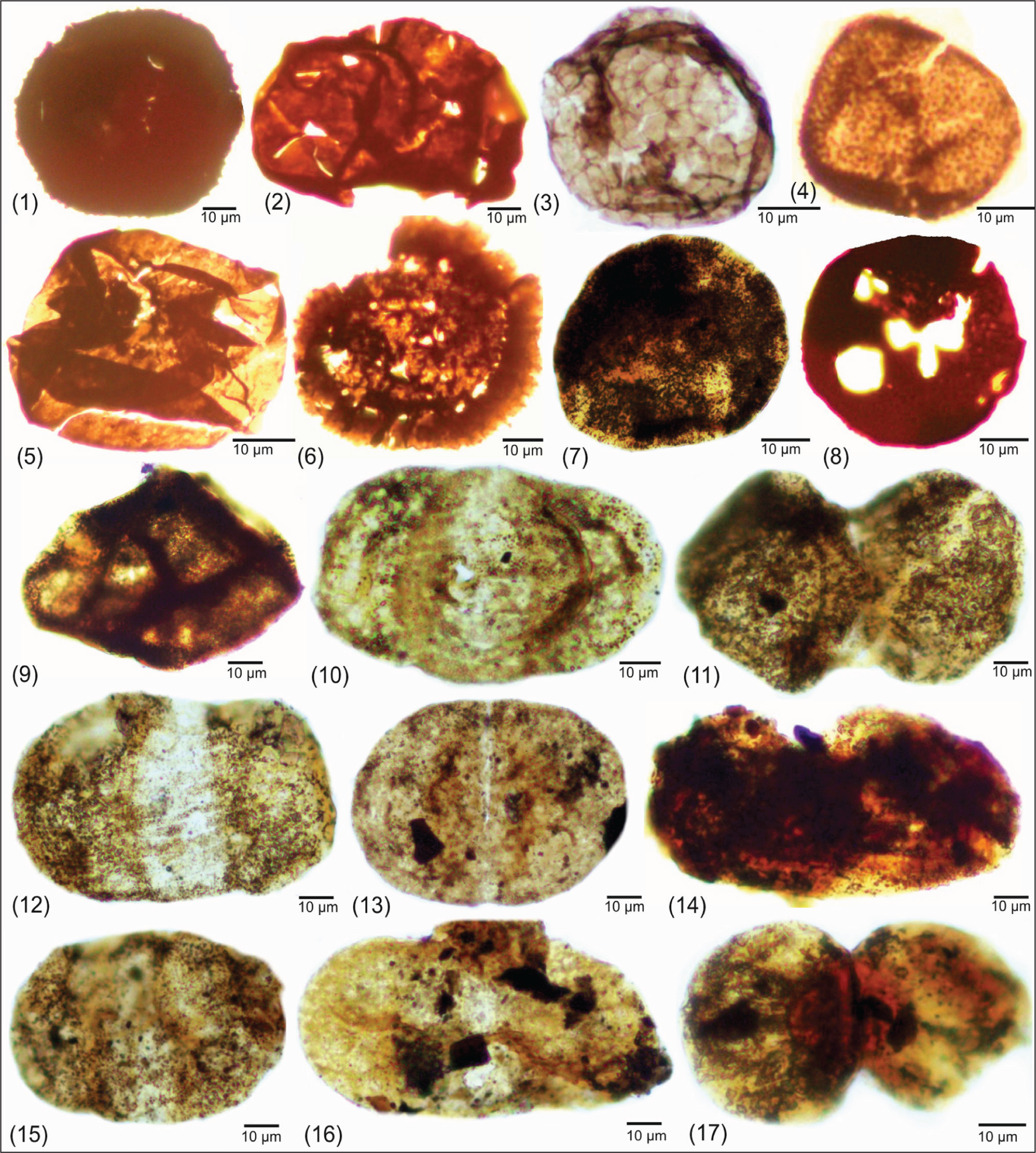
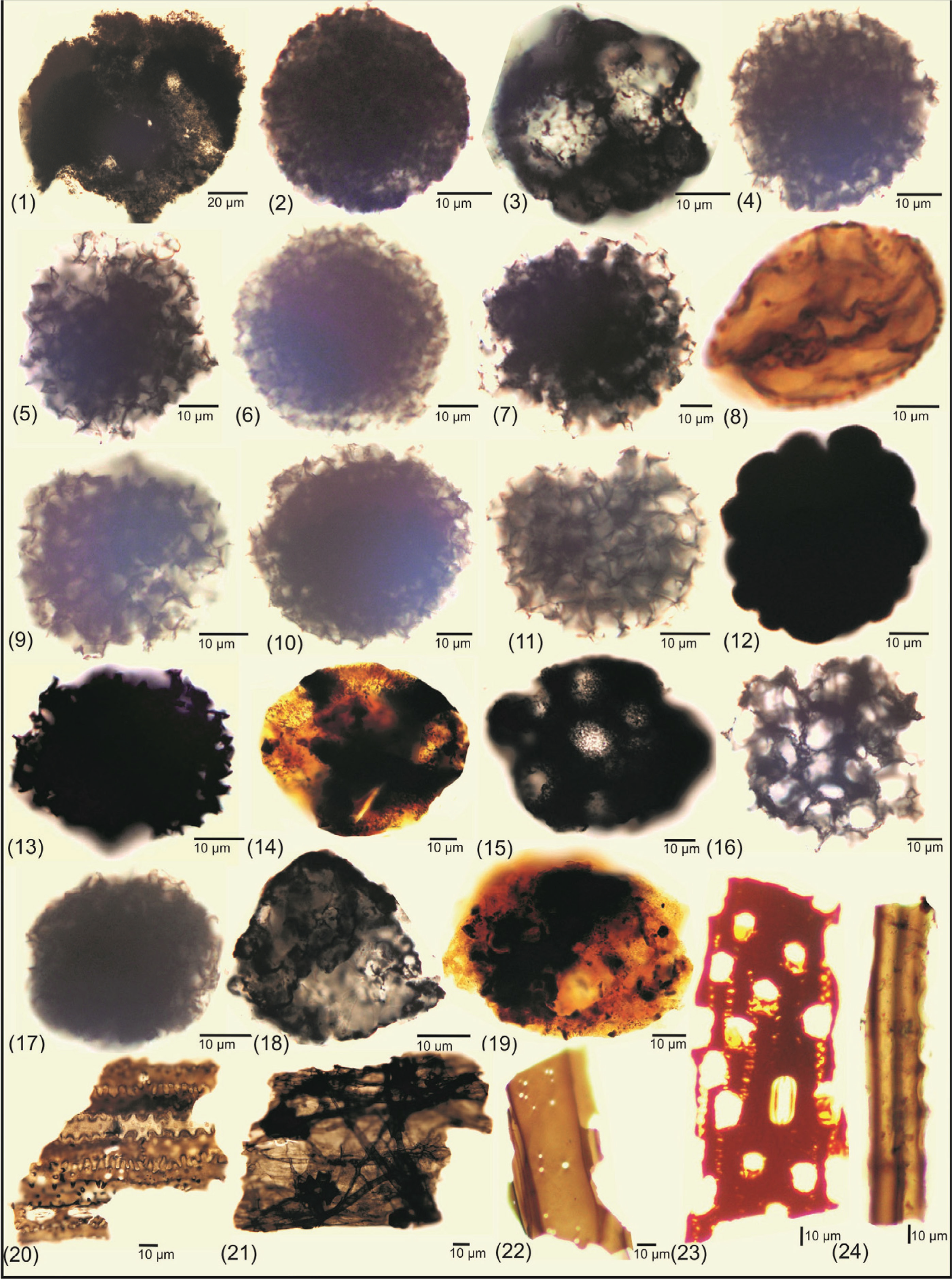
Seven samples (L1–L7) were collected from a section of Lipak Formation which is exposed near the Takche locality towards the Losar Village, Spiti Valley. Out of seven samples, only five samples have yielded palynomorphs. The recovered palynoassemblage comprises 13 genera and 8 species. Some phytoclasts have also been observed. Palynocomposition of this Formation mainly consists of spores and has dominance of Verrucosis-porites nitidus, V. cortaderensis, Verrucosisporites sp., Dictyotriletes trivialis, Dictyotriletes sp., Lophozonotriletes tylophorus, Lophozonotriletes sp., followed by subordinate occurrences Convolutispora turgida, Rugospora minuta, Cymbosporites circinatus, Knoxisporites sp. and reworked occurrences of monosaccate pollen grain Plicatipollenites sp. The occurrence of recovered spores is shown in Table 2, and their stratigraphic distribution is shown in Figure 3. Photomicrographs of recovered palynomorphs are shown in Plate 1.
Occurrence of palynomorphs in the Lipak Formation section exposed near Takche locality, Spiti Valley.
Photomicrographs of palynomorphs recorded from the studied section of Lipak Formation near Takche locality, Spiti Valley. 1) Verrucosisporites sp., BSIP Slide No., 17195, H31; 2) Verrucosisporites cortaderensis Loinaze 2005, BSIP Slide No., 17196, F28/4; 3) Verrucosisporites sp., BSIP Slide No., 17196, M19/4; 4) Lophozonotriletes sp., BSIP Slide No., 17198, H23; 5) Dictyotriletes sp., BSIP Slide No., 17200, B18; 6) Lophozonotriletes tylophorus Naumova 1953, BSIP Slide No., 17201, P36; 7) Dictyotriletes sp., BSIP Slide No., 17202, F42; 8) Cymbosporites circinatus Ouyang and Chen 1987, BSIP Slide No., 17206, D38; 9) Dictyotriletes sp., BSIP Slide No., 17207, H37/4; 10) Lophozonotriletes sp., BSIP Slide No., 17207, S42; 11) Dictyotriletes sp., BSIP Slide No., 17210, T51/4; 12) Verrucosisporites nitidus (Naumova) Playford 1964, BSIP Slide No., 17203, W41/4; 13) Dictyotriletes trivialis Naumova Kedo 1963, BSIP Slide No., 17211, M33/3; 14) Plicatipollenites sp., BSIP Slide No., 17213, X39/4; 15) Knoxisporites sp., BSIP Slide No., 17213, G30; 16) Unidentified, BSIP Slide No., 17199, F27/4; 17) Rugospora minuta Neves and Ioannides 1974, BSIP Slide No., 17212, J33; 18) Convolutispora turgida Bertelsen 1972, BSIP Slide No., 17197, J26; 19) Unidentified, BSIP Slide No., 17204, T34/2; 20) Phytoclast, BSIP Slide No., 17208, N36/4; 21) Phytoclast, BSIP Slide No., 17205, Q31/3; 22) Tracheid, BSIP Slide No., 17205, C54/2; 23) Tracheid, BSIP Slide No., 17207, E41; 24) Tracheid, BSIP Slide No., 17209, K23/2.
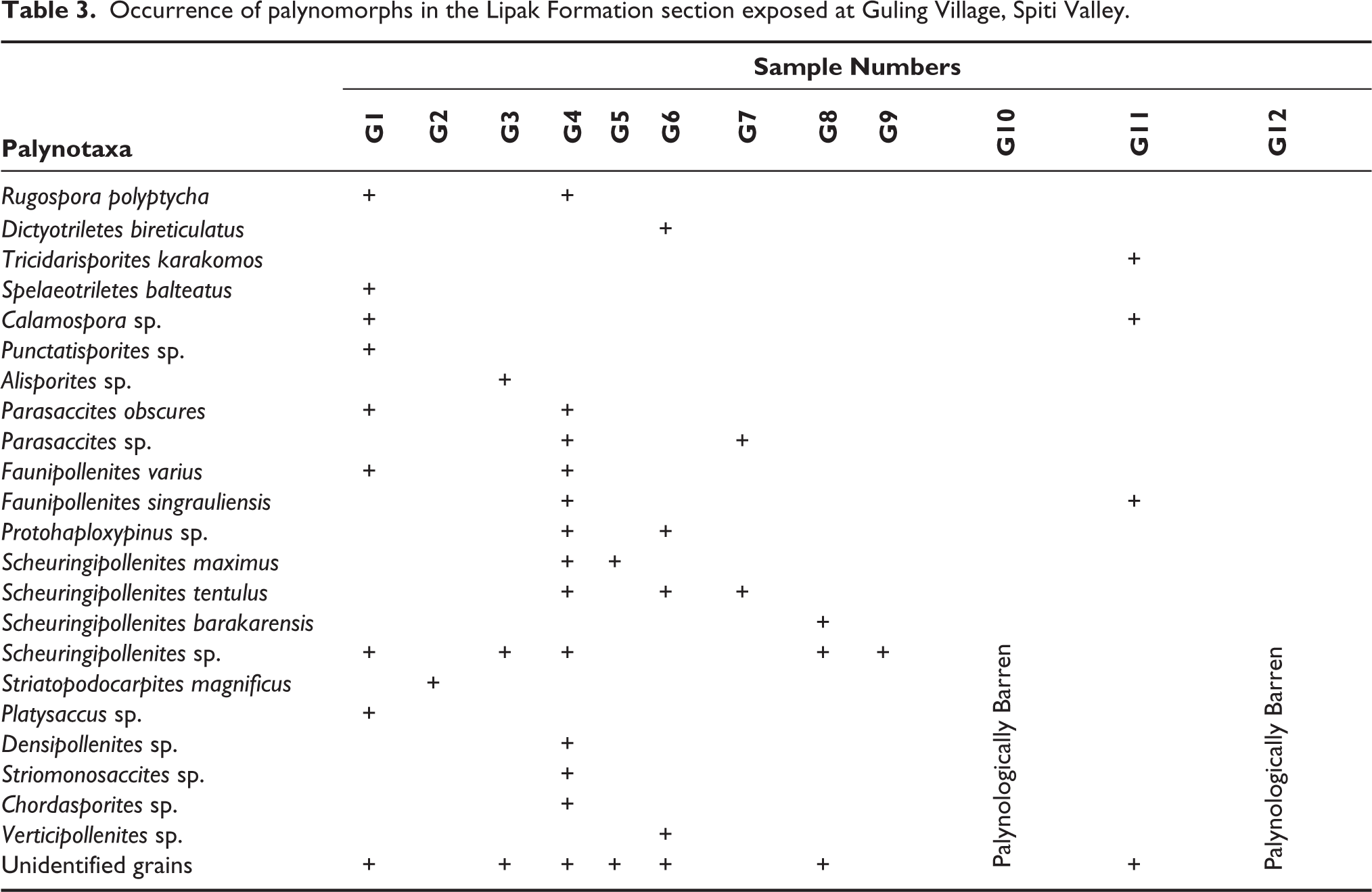
Twelve samples (G1–G12) were collected from a section of Lipak Formation which is exposed at Guling village, Pin Valley; 10 samples have yielded palynomorphs with a considerable amount of reworked palynomorphs. The identified characteristic spores of Devonian and earliest Carboniferous are Rugospora polyptycha, Dictyotriletes bireticulatus, Tricidarisporites karakomos, Spelaeotriletes balteatus, Calamospora sp. and Callumispora sp. (Punctatisporites). Reworked pollen grains are characterised by pollen grains in having dominance of Parasaccites obscures, Parasaccites (Cannanoropollis) sp., Faunipollenites (Protohaploxypinus) varius, F. singrauliensis, Faunipollenites sp., Scheuringipollenites maximus, S. tentulus, S. barakarensis, Scheuringipollenites sp., and followed by subdominance of Densipollenites sp., Striatopodocarpites magnificus, Platysaccus sp., Alisporites sp., Striomonosaccites sp., Chordasporites sp. and Verticipollenites sp. The occurrences of recovered palynomorphs are shown in Table 3, and their stratigraphical distribution is given in Figure 4. Photomicrographs of recovered palynomorphs are shown in Plates 2 and 3.
Occurrence of palynomorphs in the Lipak Formation section exposed at Guling Village, Spiti Valley.
Photomicrographs of palynomorphs recorded from the studied section of Lipak Formation at Guling Village, Pin Valley. 1) Spelaeotriletes balteatus (Playford 1963) Higgs 1975, BSIP Slide No., 17214, U26/1; 2) Rugospora polyptycha Neves and Ioannides 1974, BSIP Slide No., 17215, M24/4; 3) Dictyotriletes bireticulatus Potonié and Kremp 1954, BSIP Slide No., 17227, M16; 4) Tricidarisporites karakomos Hashemi and Playford 2005, BSIP Slide No., 17230, H39/3; 5) Calamospora sp., BSIP Slide No., 17229, Q22/4; 6) Parasaccites obscures Tiwari 1965, BSIP Slide No., 17214, S23/4; 7) Parasaccites sp., BSIP Slide No., 17228, U37; 8) Callumispora sp., BSIP Slide No., 17217, V24; 9) Densipollenites sp., BSIP Slide No., 17222, R19/1; 10) Striatopodocarpites magnificus Bharadwaj and Salujha 1964, BSIP Slide No., 17218, O29; 11) Verticipollenites sp. BSIP Slide No., 17225, E45; 12) Faunipollenites varius Bharadwaj 1962, BSIP Slide No., 17222, Y43/1; 13) Faunipollenites singrauliensis Sinha 1972, BSIP Slide No., 17229, N22; 14) Faunipollenites sp., BSIP Slide No., 17226, D43/1; 15) Alisporites sp., BSIP Slide No., 17219, M41; 16) Chordasporites sp., BSIP Slide No., 17220, L31/3; 17) Platysaccus sp. BSIP Slide No., 17215, E28/4.
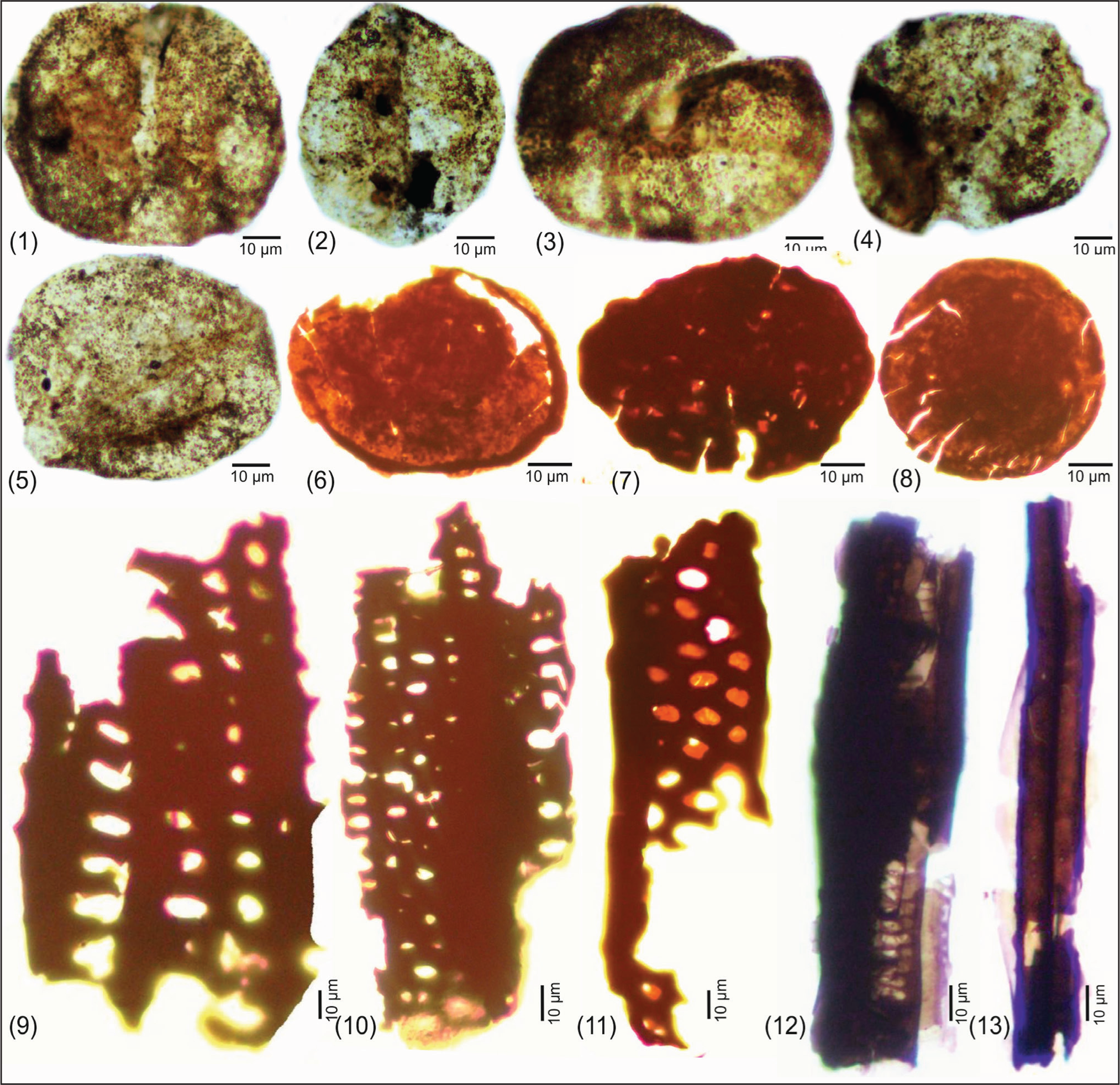
Photomicrographs of palynomorphs recorded from the studied section of Lipak Formation at Guling Village, Pin Valley.1) Scheuringipollenites maximus (Hart) Tiwari 1973, BSIP Slide No., 17221, J28/2; 2) Scheuringipollenites tentulus Tiwari 1973, BSIP Slide No., 17221, P22; 3) Scheuringipollenites barakarensis (Hart) Tiwari, 1973, BSIP Slide No., 17223, U26/3; 4) Scheuringipollenites sp., BSIP Slide No., 17221, T23; 5) Striomonosaccites sp., BSIP Slide No., 17220, M31; 6) Unidentified grain, BSIP Slide No., 17230, R37/1; 7) Unidentified grain, BSIP Slide No., 17224, O25; 8) Unidentified grain, BSIP Slide No., 17230, W32/1; 9) Tracheid, BSIP Slide No., 17214, O33/1; 10) Tracheid, BSIP Slide No., 17214, L27; 11) Tracheid, BSIP Slide No., 17215, W30; 12) Tracheid, BSIP Slide No., 17216, N17/3; 13) Tracheid, BSIP Slide No., 17216, O36/2.
Nineteen samples (M1–M19), collected from a section of Lipak Formation, exposed near Muth village, Pin Valley, were found palynologically barren. However, some have yielded few phytoclasts and dark black opaque debris (Figure 5). These recovered black opaque debris clasts are broken and unidentifiable.
The diversity and frequencies of these recovered palynomorphs are relatively low in abundance compared to Late Palaeozoic Permian formations of the Gondwana sequences of Peninsular India. The leading cause of low retrieval of palynomorphs is the long antiquity of tectonic instabilities and diagenesis in the Tethyan Himalaya that has critically affected both the qualitative and quantitative preservation of palynomorphs. Further, the predominance of marine depositional settings is also one of the main reasons for the low yield of palynomorphs in the Tethyan realm. The diagenetic effect has led to palynomorph maturation, turning them charred, broken and dark black. Overmaturation and dark colour hampers the exact identification of palynomorphs. Therefore, some palynotaxa in the present study have only been identified up to a generic level. Furthermore, in some cases, it has been difficult to categorise the definite palynozonation of studied sequences because many of the index palynotaxa, which are marker taxa for that particular zone, are either absent or have overlapping ranges in the zonal schemes of the present study.
Botanical Affinities
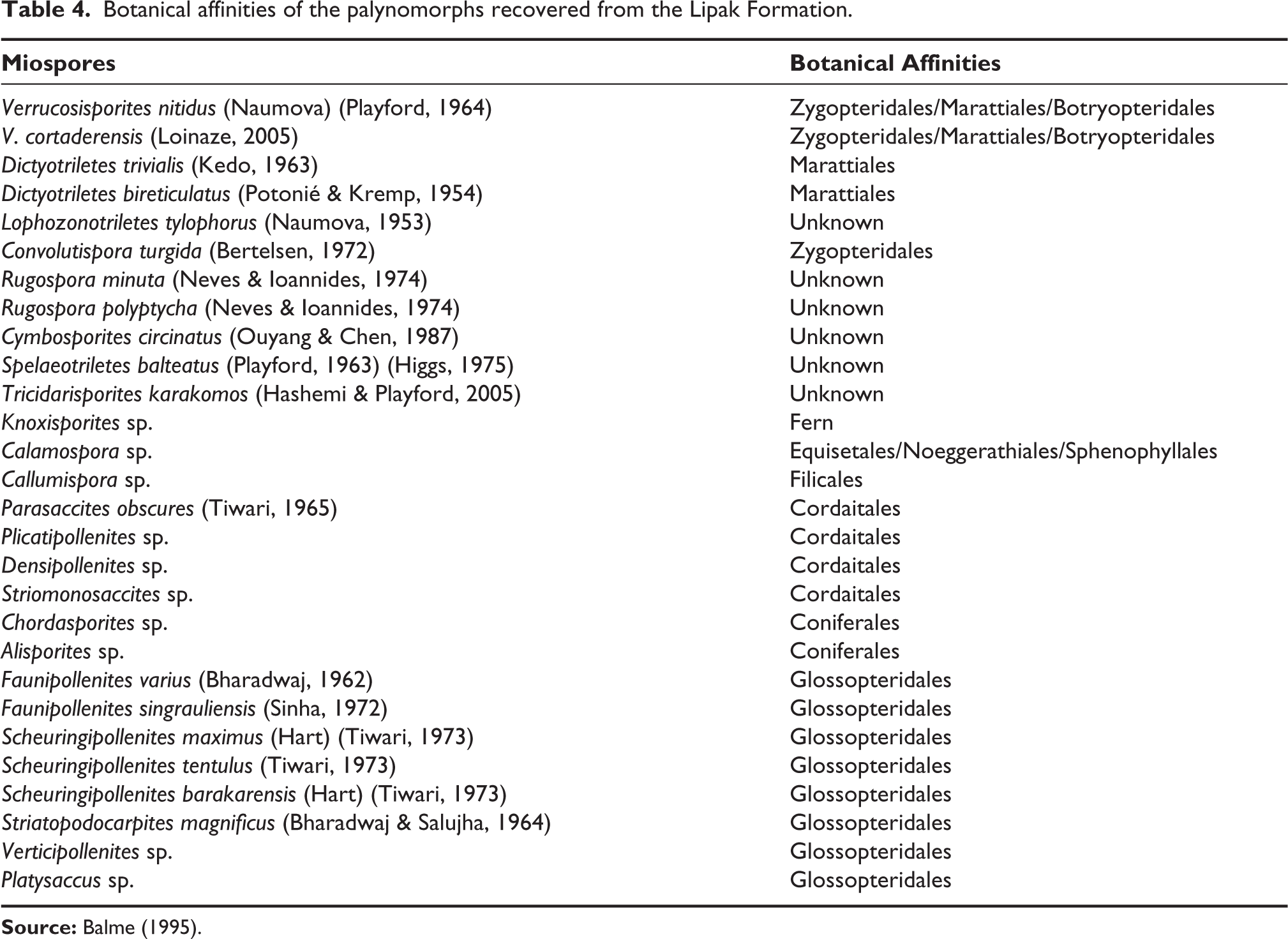
Spores primarily originate from reproductive structures of pteridophytes and other lower plants; their diversification and abundance are closely related to dispersal, climate and depositional conditions. The recovered palynological assemblage of the Lipak Formation includes spores of Zygopteridales, Marattiales, Botryopteridales, Equisetales/Noeggerathiales/Sphenophyllales group of plants. In contrast, reworked pollen grains in the assemblage have palaeobotanical affinities with the Filicales, Cordaitales and Glossopteridales group of plants. Botanical affinities of recovered palynomorphs are shown in Table 4.
Botanical affinities of the palynomorphs recovered from the Lipak Formation.
Biostratigraphical Correlation
Correlation Within the Tethyan Basin Sequences of India
Recovered miospores in the present study are of stratigraphic importance and are considered for correlation within the Tethyan realm and other regions of the globe. Devonian and Carboniferous sequences of the Indian subcontinent are only constrained in the Tethyan realm. Barring the present study, no palynofloral record is available for the late Devonian period from India. Two palynofloral studies pertaining to early Carboniferous sequences are hitherto available from the entire Tethyan Basin of India, namely, Po Formation, Spiti Valley (Khanna & Tiwari, 1983) and Fenestella Shale Formation, Kashmir (Agnihotri et al., 2018). Khanna and Tiwari (1983) reported distinctive set of palynotaxa in which about half of palynotaxa like Apiculiretusispora, Phyllothecotriletes, Hymenozonotriletes, Dibolisporites, Knoxisporites, Cristatisporites, Retispora, Leiotriletes, Lycospora, Retusotriletes, Densosporites and Cingulatisporites range from late Devonian to early Carboniferous age whereas one-third of palynotaxa like Raistrickia, Corbulispora, Schulzospora, Simozonotriletes, Tripartites, Vallatisporites and Microreticulatisporites made their appearance at the Devonian–Carboniferous transition and extend up to lower Carboniferous. They also observed some typical late Devonian palynotaxa like Ancyrospora, Hystrichosporites and Emphanisporites, along with the above early Carboniferous palynoassemblage. Except for one palynotaxa, that is, Knoxisporites, none of the other palynotaxa of the Po Formation is recorded from the presently studied section of the Lipak Formation.
Global Correlation
The recovered palynomorphs of the Lipak Formation can be correlated with Devonian and Carboniferous palynocompositions of the Zorritas Formation, Argentina. This Formation is characterised by occurrences of both terrestrial and marine palynomorphs (Rubinstein et al., 2017). The terrestrial palynoassemblage of the Zorritas Formation shows a limited resemblance with present palynoassemblage in having common palynotaxa, namely Rugospora, Verrucosisporites, Lophozonotriletes and Knoxisporites.
Atta-Peters (1996) and Atta-Peters and Anan-Yorke (2003) have reported abundant and diverse Devonian–Carboniferous spores from the Takoradi Shale Formation, Western Ghana. The palynocomposition of the Takoradi Shale Formation belongs to the LE, LN, VI palynozones of Western Europe (Higgs et al., 1988), and based on these palynozonations, the latest Devonian–earliest Carboniferous age has been assigned to Takoradi Shale Formation. The present palynocomposition of the Lipak Formation has some common palynotaxa, namely Dictyotriletes trivialis, Verrucosisporites nitidus and Knoxisporites.
The miospore assemblage of the Lipak Formation can also be correlated with the palynoassemblage of late Devonian–early Carboniferous sediment of the Zhangdong and Yali formations, South Tibet. Liu et al. (2019) described three late Devonian–early Carboniferous palynozones within the Zhangdong and Yali formations: (a) Retispora lepidophyta–Verrucosisporites nitidus; (b) Vallatisporites vallatus–Foveosporites pellucidus and (c) Rugospora polyptycha–Tricidarisporites arcuatus. Retispora lepidophyta–Verrucosisporites nitidus Biozone is characterised by the abundance of Verrucosisporites nitidus, Acinosporites eumammillatus and Retispora lepidophyta. Second biozone Vallatisporites vallatus–Foveosporites pellucidus is characterised by first occurrence of Vallatisporites vallatus and most of the palynotaxa of the previous biozone disappear, excluding Verrucosisporites nitidus, Retusotriletes incohatus and Geminospora punctata in this biozone. Rugospora polyptycha–Tricidarisporites arcuatus is marked with the first appearance of the distinctive species, namely Rugospora polyptycha, Tricidarisporites arcuatus, and Convolutispora vermiform, whereas species of the older biozones do not persist in this biozone. More recently, Peng et al. (2022) described Devonian–Carboniferous palynoassemblage from the Yali section, South Tibet, China. They described Retispora lepidophyta–Verrucosisporites irregularis and Retispora lepidophyta–Vallatisporites vallatus palynoassemblages zones and marked the Devonian–Carboniferous transition within the lower limestone unit of Yali Formation. The palynocomposition of the Yali Formation can be correlated with the palynocomposition of the Lipak Formation, Spiti Basin. The comparable palynofloral elements are namely Verrucosisporites, Cymbosporites, Dictyotriletes, Knoxisporites and Lophozonotriletes.
The palynoflora of Lipak Formation has resemblance with the palynoassemblage of the late Devonian–early Carboniferous subsurface sediments of Wutong Formation, that is, from CSDP-2 Borehole, Southern Yellow Sea, China (Guo et al., 2022) which is characterised by the maximum abundance of spores. Based on the distribution of palynomorphs, three palynoassemblages are defined. The assemblage of the lower member is of the late Famennian age and is characterised by Aneurospora asthenolabrata–Geminospora lemurata palynoassemblage. The assemblage of the middle member is of the latest Famennian age and has Cymbosporites circinatus–Asperispora acuta palynoassemblage whereas palynoassemblage of the upper member of the Formation is characterised by Auroraspora macra–Lophozonotriletes involutus Assemblage of Tournaisian age. Palynotaxa of middle and upper palynoassemblages show resemblance with palynotaxa of the present study; common palynomorphs are Cymbosporites circinatus, Dictyotriletes, Knoxisporites and Lophozonotriletes.
Higgs et al. (2002) defined late Devonian (late Famennian) palynoassemblage from the Yiginli Formation and early Carboniferous palynoassemblage from the Kӧprülü Formation of southeastern Turkey. They suggested them to be correlatable with the late Famennian–early Carboniferous biozonations of Western Europe. Both formations’ recovered palynotaxa show limited resemblance with the palynoassemblage of the Lipak Formation. The common palynomorphs are Verrucosisporites nitidus, Dictyotriletes trivialis and Knoxisporites.
Filipiak (2004) described palynostratigraphy based on the subsurface samples of three boreholes—Bolechowice IG 1, Zarȩby IG 2 and GaIȩzice IG 3 of late Devonian and lower Carboniferous successions in the Holy Cross Mountains, central Poland. The palynocomposition of these boreholes was categorised under 13 palynozones from Famennian to Viséan age. Some common palynotaxa of the Lipak Formation and these boreholes are Verrucosisporites, Rugospora, Lophozonotriletes and Knoxisporites.
Di Pasquo et al. (2017) described palynoassemblage of the late Devonian–early Carboniferous period from the upper Three Forks, Sappington, and lower Lodgepole formations in West–Central Montana, USA. Sporadic occurrences of palynomorphs have characterised three Forks Formation but have diverse occurrences of phytoplanktons of middle Devonian age having long stratigraphic range. Sappington Formation is characterised by well-preserved latest Devonian and earliest Carboniferous palynotaxa and shows limited resemblance with the palynoassemblage of the Lipak Formation. The common characteristic palynotaxa are Verrucosisporites nitidus, Dictyotriletes trivialis, Lophozonotriletes and Knoxisporites.
Taherian et al. (2021) recovered diverse and well-preserved palynomorphs from the Padeha, Khoshyeilagh and Mobarak formations in Khoshyeilagh, northeastern Alborz, Iran. The recovered palynocomposition is characterised by five local biozones (Verrucosisporites bulliferus–Teichertospora torquate, Rugospora flexuosa– Apiculiretusispora fructicosa, Retispora lepidophyta–Indotriradites explanatus, Retispora lepidophyta–Verrucosisporites nitidus and Tumulispora varia–Retusotriletes incohatus Assemblage biozones) and this palynocomposition also allows us to correlate with the biozones of Europe, Canada, USA, and thus, upper Devonian and lowermost Carboniferous age is assigned. The palynocomposition of the Khoshyeilagh and Mobarak formations shows limited resemblance with the palynotaxa of the Lipak Formation in having Verrucosisporites, Convolutispora, Rugospora and Knoxisporites.
Marshall (2021) described Devonian–Carboniferous palynomorphs from the lake sediments of the East Greenland Devonian Basin. The recovered palynocomposition shows two palynozones; the lower lake sediments zone is characterised by the Retispora lepidophyta–Verrucosisporites nitidus Palynozone of latest Devonian age, whereas upper lake sediments zone is characterised by Vallatisporites verrucosus–Retusotriletes incohatus Palynozone of the early Carboniferous age. The palynocomposition of East Greenland Devonian Basin’s palynocomposition resembles the Lipak Formation. The common palynotaxa are Verrucosisporites, Convoluti-spora, Rugospora and Knoxisporites.
Discussion
Devonian sequences have a long exploratory history for their importance in understanding many geological and palaeontological aspects in both terrestrial as well as in marine environments (Algeo & Scheckler, 1998; Cohen et al., 2013). The Devonian period is also critical to comprehend mega and micro plants’ evolution (Traverse, 2007 and references therein). It has been considered the time for the advent and diversification of initial forests (Cleal, 2021; Giesen & Berry, 2013). Furthermore, the diversification continued during the entire Devonian period, and substantial changes occurred in plants and their dispersed spores/pollens at the end of the Devonian. An increased diversity in palynoflora during Devonian period, mainly in response to proliferation of spores belongs to the densospore group, such as Densosporites sp., Cristatisporites sp., Indotriradites sp. and Vallatisporites sp. reticulate group including Dictyotriletes sp., Knoxi-sporites sp. and Cordylosporites sp. apiculate form bearing Anapiculatisporites sp., baculite bearing form Raistrickia sp. verrucate forms Verrucosisporites sp. and convolute form Convolutispora sp.
In India, Devonian sequences are restricted to the extra peninsular region of the Indian subcontinent, that is, in the Tethyan realm. Palaeobotanical studies of the Devonian period are hitherto unavailable from the entire Tethyan realm. In the Tethyan realm of the Spiti Basin, the Devonian strata include the Muth and Lipak formations; no such palynofloral study has been carried out for both formations. As discussed above, the age of the Lipak Formation has always been debatable.
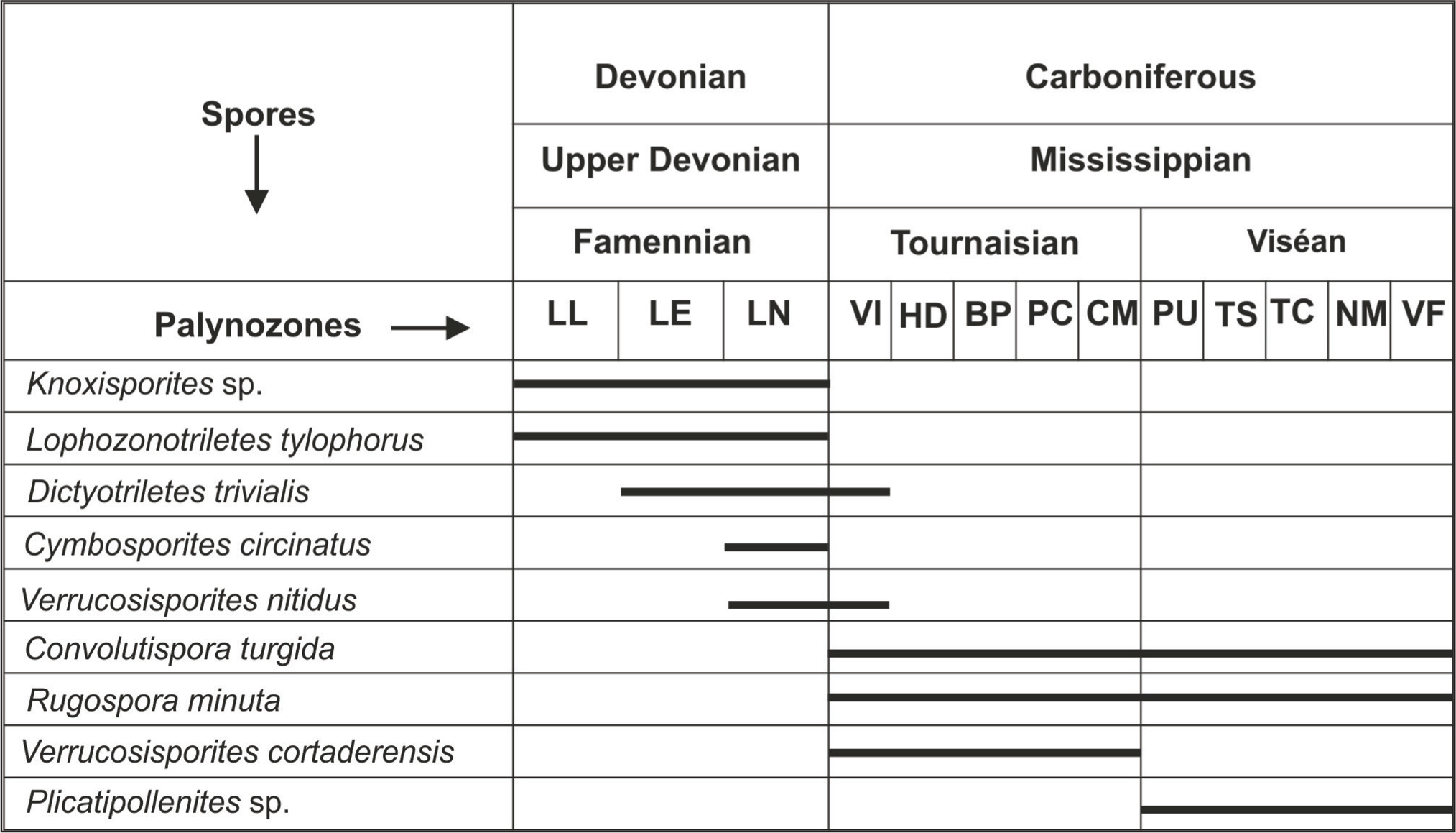
The present contribution aims to assess the palynostratigraphic status and age of the Lipak Formation of the Spiti Basin, and it has yielded the first record of palynological content from the sediments of the Lipak Formation. Recovered palynocomposition has been taxonomically analysed to obtain biostratigraphic and paleoenvironmental inferences, and subsequently, palynoflora has been compared with coeval assemblages of other regions of the globe. Moreover, the distribution of spores in the studied sections is erratic in relative abundance and diversity. A large part of the Lipak Formation miospore assemblage is composed of morphologically simple forms with poor biostratigraphic resolution. The biozonations along the Devonian–Carboniferous boundary are mainly derived from biostratigraphic investigations of continuous settings in Eastern and Western Europe (Higgs et al., 1988; Kaiser et al., 2015; Streel, 2009). The palynofloral transition of late Famennian to Carboniferous is defined by four miospore Interval zones namely, Retispora lepidophyta–Knoxisporites literatus (LL) Zone, Retispora lepidophyta–Indotriradites explanatus (LE) Zone and Retispora lepidophyta–Verrucosisporites nitidus (LN) Zone and Vallatis-porites vallatus–Retusotriletes incohatus (VI) Zone is of early Tournaisian age (Figure 6).
Interval zone chart of late Devonian and earliest Carboniferous palynomorphs of Lipak Formation based on palynozonations of Western Europe (Higgs et al., 1988; Streel et al., 1987).
However, palynoassemblage of the Lipak Formation consists of many diverse index species of Devonian and Carboniferous periods that support a partial correlation with Western Europe zonations (Higgs et al. 1988; Streel et al., 1987). The palynotaxa of Retispora lepidophyta–Verrucosisporites nitidus (LN) Assemblage zone occurs in the studied section of the Lipak Formation. The lower boundary of this assemblage zone is defined by FO (First Occurrence) of Verrucosisporites nitidus, and its first appearance from this zone matched with the main extinction event Hangenberg Event in Germany (Higgs & Streel, 1994; Streel, 2009) and its upper limit is defined by LO (Last Occurrence) of species such as Knoxisporites sp. cf. K. literatus. Retispora lepidophyta is not recovered from this studied section; this may result from poor preservation or scarcity of this spore-producing vegetation. Retispora lepidophyta first appeared in the basal Strunian Stage, which correlates to the Upper expansa conodont Zone, and it is the characteristic miospore of the latest Devonian on a global scale which characterises the base of the latest Famennian and completely extinct approximately at Devonian–Carboniferous boundary (Prestianni et al., 2016 and references therein). Moreover, Verrucosisporites nitidus has also been found in the Lipak Formation, and it did not appear earlier than Tournaisian age in Vallatisporites verrucosus–Retusotriletes incohatus (VI) zone. FO of early Carboniferous miospores characterises the lower boundary of this biozone. The key species are absent in this section, and LO of Verrucosisporites nitidus characterises its upper boundary. The recovered assemblage is comparable with LN and VI biozones of Europe (Higgs et al., 1988; Higgs et al., 2002; Maziane et al., 1999; Streel et al., 1987) (Figure 6). Thus, both zones, Retispora lepidophyta–Verrucosisporites nitidus (LN) and Vallatisporites verrucosus–Retusotriletes incohatus (VI) may be distinguished tentatively in the Lipak Formation and upper Famennian to early Tournaisian age is suggested for the Lipak Formation. Further, Loinaze (2005) described a new lower Carboniferous trilete spore, that is, Verrucosisporites cortaderensis from the Cortaderas Formation of the Rio Blanco basin, Western Argentina and this species is grouped under Cordylosporites-Verrucosisporites Biozone. Since most key terrestrial miospore taxa were absent in this biozone and based on stratigraphical potential of Verrucosisporites nitidus and Verrucosisporites cortaderensis, an upper Famennian to early Tournaisian age is suggested for the studied section of the Lipak Formation.
Based on palaeobotanical evidence, such as parental plant affinities of recovered palynoflora define the constituent’s Zygopteridiales, Marattiales and Botryopteridales vegetation. There is a paucity of Devonian floral records though Early Carboniferous flora is well-diversified in the Tethyan realm of the Indian subcontinent (Cleal et al., 2016; Gothan & Sahni, 1937; Singh et al., 2013; and references therein). This lack of macrofloral and synchronous miofloral records from the Devonian period of the Indian subcontinent makes it challenging to draw a conclusive vegetation scenario in the region of the Tethyan realm. However, the relative abundance of the present studied palynotaxa, previously defined marine macrofossils such as brachiopods, conodonts and corals, and lithological evidence such as several silty shales, shale layers and thick limestone layers, it can be envisaged that depositional settings include rivers, sandy tidal flats and a shallow marine environment.
As it is known that dispersed palynomorphs originated from land vegetation and are transported to place of deposition by fluviatile or marine currents in much the same manner as the mineral detritus material is transported. The post-depositional erosion of sediments in which palynomorphs had been preserved may rework the sediments and deposit the same palynomorphs in the horizons of stratigraphically different ages. Most commonly reworked palynomorphs are found in the stratigraphically younger deposits. These reworked palynomorphs indicate transgressive and regressive intervals independent of lithology, which makes it an important tool in identifying sedimentological cycles that are not exhibited by changes in rock sequences. Moreover, the population of reworked palynomorphs provides important evidence of the source of detritus and its transportation direction (Eshet et al., 1988).
The abundance of Permian palynomorphs characterises palynocomposition of the Lipak Formation at Guling village. The recovered palynocomposition have an abundance of reworked palynomorphs, namely Scheuringipollenites maximus, Protohaploxypinus amplus (Faunipollenites varius) and Striatopodocarpites. These palynotaxa first appeared during the Moscovian time. One possible explanation of the occurrence of younger palynomorphs in the older sequence is that these palynomorphs might have been transported into the Lipak Formation by stratigraphic leakage via joints and fissures of karstified rocks, that is, limestone. In the Pin and Parahio valleys, the Carboniferous period is characterised by non-deposition. Thus, Carboniferous deposits of the Po and Ganmachidam formations are missing, and the Gechang Formation of the Permian age overlies Lipak Formation. Therefore, the source of reworked palynomorphs might have been the sediments of the early Permian age. The recovered reworked pollen grains have botanical affinities of Cordaitales, Glossopteridales and Filicopsidales group of plants.
Phytoclasts and dark black opaque debris characterise the palynocomposition of the Lipak Formation near Muth village. These recovered black opaque debris clasts are broken and unidentifiable. The shallow marine and limestone-dominated depositional setting of the Lipak Formation could be the reason for being palynologically barren. Moreover, either no vegetation existed in the surrounding area of the Lipak Formation, or palynomorphs of surrounding vegetations were thermally matured and charred due to the long antiquity of tectonic instabilities and diagenesis that affect the quality and quantity of palynomorphs in the assemblage.
Conclusion
The present study shows miofloral remains in the Lipak Formation, Spiti Valley, Tethyan Himalayas. It is the first record of palynomorphs from the late Devonian and earliest Carboniferous Lipak Formation. It is also the first record from the entire Tethyan realm of India. Palynoassemblage of the Lipak Formation, Spiti Valley, is characterised by diverse spore assemblage and sporadic occurrence of the reworked pollen grain. Recovered palynoassemblage of Lipak Formation has been correlated with the late Devonian and earliest Carboniferous palynozones, namely Retispora lepidophyta–Verrucosisporites nitidus (LN), and Vallatisporites verrucosus–Retusotriletes incohatus (VI) Assemblage zones of Western Europe and Cordylosporites–Verrucosisporites Biozone of Argentina. Based on these correlations, an upper Famennian to early Tournaisian age is suggested for the studied section of the Lipak Formation. There is no megafloral record from this Formation, but botanical affinities of recovered palynomorphs define constituents’ vegetation belonging to Zygopteridiales, Marattiales and Botryopteridales plant groups. This suggests that these plants were present around the Spiti Basin of the Tethyan realm during the late Devonian and earliest Carboniferous times.
Lipak Formation exposure of Pin Valley is characterised by an abundance of late Carboniferous–Permian palynomorphs, namely Scheuringipollenites, Protohaploxypinus (Faunipollenites) and Striatopodocarpites. It indicates the reworking of palynomorphs of younger horizons. These palynomorphs were transported into sediments of the Lipak Formation by the stratigraphic leakage. This stratigraphic leakage was probably due to discontinuity, as evidenced by the absence of Carboniferous rocks. These reworked pollen grains show botanical affinities with the Cordaitales, Glossopteridales, Filicopsidales group of plants. This suggests that these groups’ plants were present around the study area.
Occurrences of terrestrial palynomorphs in shale beds of limestone-dominated Lipak Formation suggest shallow depositional regime during the deposition of shale with the influx of terrestrial matter. The study also puts forward the possibility of studying the Devonian and Carboniferous sequences of the Tethyan realm for the palynofloral implications.
Footnotes
Acknowledgements
The authors are grateful to Dr Vandana Prasad, Director, Birbal Sahni Institute of Palaeosciences for providing the necessary facilities and permission to publish the paper (RDCC/2022-2023/81). The authors are also thankful to the manuscript’s reviewers whose comments and suggestions have improved the quality of the paper. This article is a contribution towards the special volume of JPSI for Indian Colloquium of Micropalaeontology and Stratigraphy—2022 and the authors acknowledge the support of handling editor Dr Rajani Panchang.
Declaration of Conflicting Interests
The authors declared no potential conflicts of interest with respect to the research, authorship and/or publication of this article.
Funding
AS, SG and KJ Singh acknowledge the financial support from SERB, Department of Science and Technology, Government of India, as a sponsored project (SERB/2016/006042) to carry out this work.