




Abstract
In the northwest Himalayas, the Cambrian sequences forming part of the Tethyan Himalayan Zone are well preserved in the Zanskar and Spiti regions. In the present work, we critically examine the geologic, stratigraphic and biostratigraphic aspects of the Cambrian Kunzam La Formation exposed in the Zanskar (i.e., in the Niri-Tsarap Chu and Kurgiakh valleys) and Spiti regions (i.e., in Chandra, Parahio, Pin and Sumna valleys sections). Although the Kunzam La Formation is extensively developed, none of the sections from Zanskar to the Spiti regions preserves its complete succession. The present work reveals the presence of a fault in each studied section, which has eliminated different stratigraphic portions of the Kunzam La Formation. Therefore, based on overall lithologic characteristics, biostratigraphic parameters and local preservation state, this formation is re-classified into three formal members: the Chandra, Parahio and Purni. We also present lithostratigraphic and biostratigraphic correlations of the Kunzam La Formation from the Zanskar to Spiti regions, which validate our lithostratigraphic division.
Introduction
The Cambrian deposits in the northern margin of the Indian plate are considered to belong to a passive margin (Brookfield, 1987) or passive to active tectonic margin setting (Garzanti et al., 1986) related to the Cambro–Ordovician Kurgiakh orogeny (Myrow et al., 2016; Srikantia et al., 1976). The northern margin of the Indian plate during the Cambrian period constituted a part of the Gondwanan realm (Hughes, 2016; Singh et al., 2020). In recent years, the revision of previously known Cambrian trilobite fauna of the Himalayas and its assignment to a broad biostratigraphic and geochronological framework have revived global interest in the Cambrian sediments of the Himalayas (Hughes, 2016; Jell & Hughes, 1997; Peng et al., 2009; Singh & Bhargava, 2020).
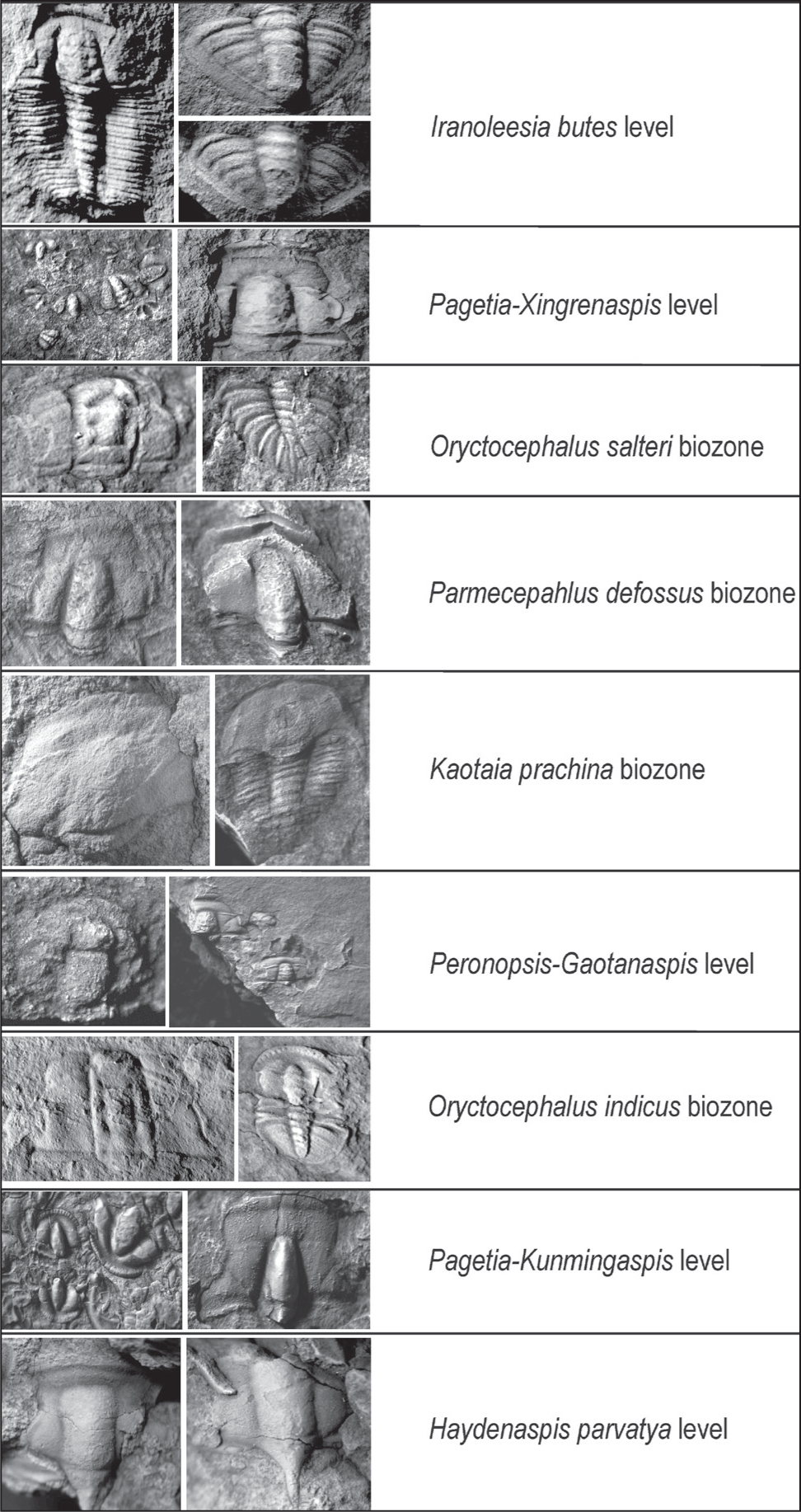
The Cambrian in the Parahio Valley (Spiti) and along the Purni–Phuktal section (Zanskar) measures ~1,300–1,400 m; these are the only well-studied sections in the Tethyan Himalaya, yet there is a glaring disparity in the biostratigraphic records (Peng et al., 2009; Singh & Bhargava, 2020). In the Parahio Valley, out of the ~1,360 m thick Kunzam La Formation, nearly 900 m of the strata (~78 m from the base of the section to ~1,010 m up in the section) contains nine trilobite biozones and levels spanning late Cambrian Series 2 (Stage 4) to the middle part of Wuliuan (Miaolingian), that is, (a) Haydenaspis parvartya level, (b) Pagetia–Kunmingaspis level, (c) Oryctocephalus indicus biozone, (d) Peronopsis–Gaotanaspis level (e) Kaotaia prachina biozone, (f) Parmecephalus defossus biozone, (g) Oryctocephalus salteri biozone, (h) Pagetia–Xingrenaspis level and (i) Iranoleesia butes level (Peng et al., 2009; Singh et al., 2016a, 2016b, 2017a, 2017b, 2021, Singh & Bhargava, 2020). On the other hand, the ~1,320 m thick Kunzam La Formation in the Purni–Phuktal section (Zanskar region) contains only Sudanomocarina sinindica biozone (uppermost Wuliuan, Miaolingian) in the uppermost part of the Kunzam La Formation. Peng et al. (2009) inferred the Sudanomocarina sinindica biozone to lie stratigraphically above the Spiti region’s Iranoleesia butes level. Based on this estimation, the Cambrian of the Zanskar and the Spiti regions were correlated (Hughes, 2016; Peng et al., 2009). These authors, however, did not explain the absence of other trilobite biozones and levels of the Spiti in the Zanskar region despite more or less identical lithofacies and thicknesses of the Kunzam La Formation in both areas. Attempts of biostratigraphic correlation were also made by Popov et al. (2015) and Gilbert et al. (2016) based on brachiopod and small shelly fauna; however, these fossil groups show the long biostratigraphic range within the Kunzam La Formation, hence least useful for correlation purpose.
The above-mentioned problems prompted us to investigate the Cambrian of the Zanskar region in detail. Besides, the palaeontologic and stratigraphic data collected during the last ten years from the Chandra, Parahio, Pin and Sumna valleys of the Spiti region are used herein to present a detailed lithostratigraphic correlation of the Kunzam La Formation from Zanskar to the Spiti regions.
Our study demonstrates that faults in all the studied sections punctuate the Cambrian Kunzam La Formation from Zanskar to the Spiti regions. In contrast, the previous workers assumed an undisturbed/continuous sequence of the Cambrian from Zanskar to the Spiti regions.
This work aims to provide a comprehensive picture of the Kunzam La Formation from Zanskar and the Spiti regions and to present their precise correlations. Extensively developed Kunzam La Formation is divided into three formal members, the Chandra, Parahio and Purni, based on overall lithologic characteristics, biostratigraphic parameters and local preservation state.
Geological Setting of Zanskar–Spiti Regions
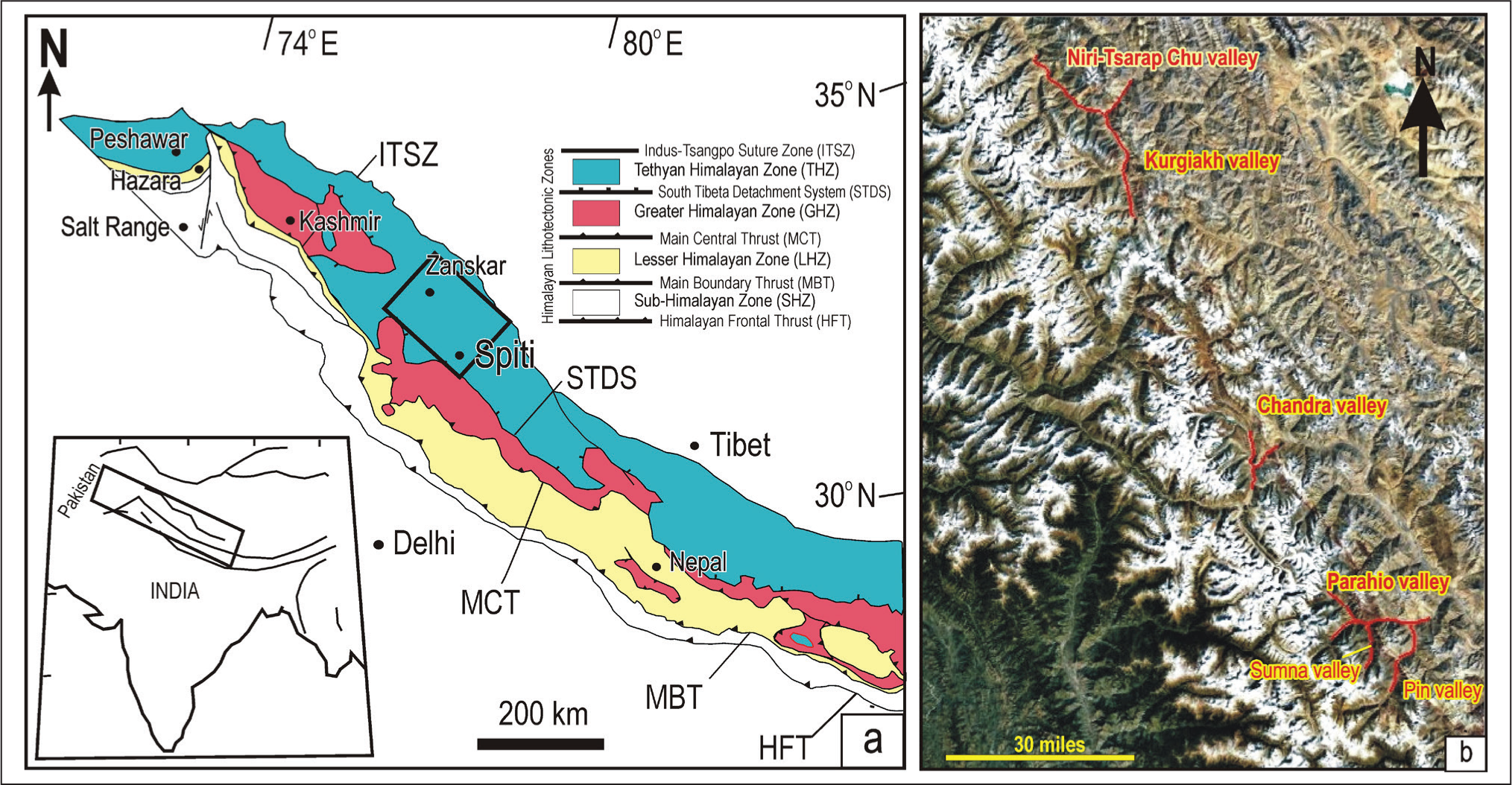
The low-grade Neoproterozoic to Cretaceous/Eocene marine sedimentary successions of the Tethyan Himalayan Fold-thrust belt (Bhargava & Bassi, 1998; Corfield & Searle, 2000; Searle, 1986; Singh & Bhargava, 2020; Steck et al., 1993; Wiesmayr & Grasemann, 2002), exposed within the Spiti–Zanskar regions, are bounded to the south by the high-grade gneisses of the Greater Himalaya across the ‘South Tibetan Detachment System’, a NE-dipping normal fault system (Figure 1a; Burg et al., 1984; Searle, 1986; Vannay & Grasemann, 1998; Vannay et al., 2004; Wyss et al., 1999). The northern boundary of this belt is the south-dipping Cenozoic Greater Counter Thrust, which marks the Indus–Tsangpo Suture Zone (ITSZ), separating rocks of the Indian and Eurasian plates to the south and north, respectively (Figure 1a; Srikantia, 1981; Thakur, 1980; Webb et al., 2011; Yin & Harrison, 2000; Yin & Yang, 1999). The Cambrian sequence from Zanskar to the Spiti is well exposed in the Niri-Tsarap Chu Valley, the Kurgiakh Valley, the Baralacha La Pass, the Chandra Valley, the Parahio Valley, the Sumna Valley and the Pin Valley (Figure 1b).
(a) Lithotectonic subdivisions of the Himalaya and the location of the Zanskar-Spiti regions (in black box); (b) Google earth image showing the location of the Niri-Tsarap Chu and Kurgiakh valleys (of Zanskar region) and, Chandra valley (eastern Lahaul region) and Parahio, Sumna and Pin valleys (of Spiti region).
Stratigraphic Nomenclatures of Cambrian Strata in Zanskar–Spiti Regions
The Cambrian rocks of the Zanskar region were first studied by Lydekker (1883) and the Spiti region by Hayden (1904). In the Zanskar region, the formal lithostratigraphic nomenclatures of Cambrian strata were provided by Nanda and Singh (1977), Srikantia et al. (1976, 1980) and Gaetani et al. (1986) and in the Spiti region by Srikantia (1981). More recently, Draganits (2000) used the term Parahio Formation instead of Kunzam La Formation while working in the Chamba and Spiti regions. Later on, a few workers adopted this concept in the Parahio (Spiti) and Kurgiakh valleys (Zanskar) (Gilbert et al., 2016; Hughes, 2016; Myrow et al., 2006a, 2006b, Peng et al., 2009; Popov et al., 2015). The multiple stratigraphic nomenclatures exist for the Cambrian deposits in the Zanskar and the Spiti regions (Table 1; Garzanti et al., 1986; Hayden, 1904; Myrow et al., 2006a; Nanda & Singh, 1976; Srikantia et al., 1976, 1980; Srikantia, 1981; Srikantia & Bhargava, 2018, 2020; and present work).
Lithostratigraphic nomenclature of Cambrian successions in the Zanskar and Spiti regions.
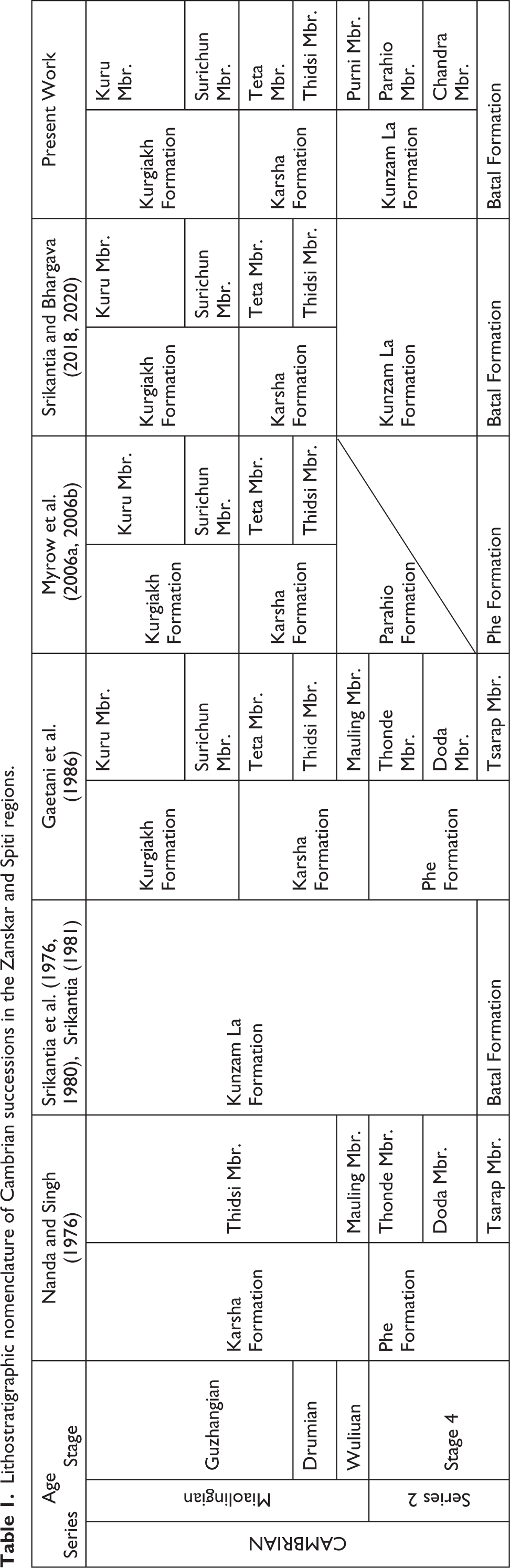
The Cambrian rocks of the Zanskar-Spiti regions, placed under the Haimanta Group, comprise the Batal, Kunzam La, Karsha and Kurgiakh formations (see for latest review Srikantia & Bhargava, 2018, 2020). The Batal Formation is a siliciclastic succession, while the Kunzam La Formation is a siliciclastic–carbonate succession that contains trilobites, brachiopods, small shelly fauna and abundant trace fossils. The Karsha Formation is dominantly a dolostone-rich succession, and the overlying Kurgiakh Formation is a shallow marine siliciclastic succession. Both the Karsha and Kurgiakh Formations are well preserved in the Zanskar (yielded trilobites of Guzhangian age by Peng et al., 2009) and to some extent in the Lahaul, but are absent in the Spiti Valley. Their absence in the Spiti Valley is attributed to extensive erosion pertaining to the post-Kurgiakh orogeny and pre-Ordovician transgression.
The Kunzam La Formation is the only Cambrian formational unit well-developed and preserved from Zanskar to the Spiti regions, including the Baralacha La sector (Lahaul). However, detailed palaeontological and sedimentological inputs on this formation are only available in the Parahio Valley (Myrow et al., 2006a; Peng et al., 2009; Singh et al., 2016a; Singh & Bhargava, 2020), and the biostratigraphic correlation from Zanskar to the Spiti regions is poorly understood (Peng et al., 2009; Singh & Bhargava, 2020).
In recent years, new biostratigraphic data from the Chandra, Sumna and Pin valleys of the Lahaul and Spiti region has helped in deciphering the age of the Kunzam La Formation in these valleys and its correlation with the biostratigraphically well-constrained Parahio Valley section (Kaur et al., 2019, 2021; Singh et al., 2017b, 2019, 2020, 2021; Singla et al., 2021, 2022). It is noteworthy that the fossiliferous part of the Kunzam La Formation is well preserved in the Parahio and Sumna valleys; in other valleys, this part is either completely omitted.
The general assumption that the Cambrian rocks exposed in the Parahio Valley represent the entire Kunzam La Formation is false; only a part of the Kunzam La Formation is preserved in the Parahio Valley. Indeed, the Parahio Valley section preserved the highly fossiliferous part of the Kunzam La Formation and yielded nine trilobite zones and levels representing a time span of 510 Ma–505 Ma (Peng et al., 2009; Singh & Bhargava, 2020). Since the paleontological work in the Chandra, Sumna and Pin valleys was not attempted by previous workers and all studies were confined to the Parahio Valley.
Due to the last 10 years’ rigours geological fieldwork in the Chandra (type section of the Kunzam La Formation), Parahio, Sumna and Pin valleys (Spiti), the Niri-Tsarap Chu and the Kurgiakh valleys (Zanskar), a detailed investigation of the Kunzam La Formation and its lithological properties and fossil contents helped in understanding its regional extent. Based on these studies, it is concluded that none of the sections from Zanskar to the Spiti region show complete preservation of the Kunzam La Formation. This is because either the section is cut by a fault in the base/middle part or the top is eroded prior to the Cambro–Ordovician angular discordance.
Revised Classification of the Kunzam LA Formation
The term Kunzam La Formation was first used by Srikantia et al. (1976) for the Cambrian successions in the Zanskar, Chandra Valley (Lahaul) and Spiti regions (Srikantia et al., 1976; Srikantia, 1981; Srikantia & Bhargava, 2018, 2020). While Myrow et al. (2006a) proposed the Parahio Valley as the type section and used the term ‘Parahio Formation’, which was rejected elsewhere (Srikantia & Bhargava, 2018, 2020). Our Chandra and Parahio valleys data suggest that both sections are incomplete.
In the Chandra Valley (Lahaul), near the Kunzam La Pass, Srikantia (1981) divided the Kunzam La Formation into five informal members, namely A, B, C, D and E. Lithologically, the lowermost exposed part of the Kunzam La Formation comprises (a) a thick succession of bedded to massive flaggy-quartzite intercalated with thin pyritous slate and lacking bioturbation (Member A), (b) interbedded thick fine to medium-grained sandstone-siltstone and pyritous shale (red and grey) alternations (Member B). These rocks are followed upward dominantly by (c) flaggy quartzite with shale (grey to black) (Member C); (d) a thick succession of thickly bedded flaggy quartzite with olive-green calcareous slate (black to grey) containing worm burrows (Member D); (e) pale pink and brown quartzite, shale, siltstone and thin lenticular interbedded limestone, and these show cyclic sedimentation, where a few cycles are capped by thin to thick dolomite beds (Member-E). Body fossils have not been recorded from these rocks in the Chandra Valley (Srikantia, 1981); however, the E-Member yielded trilobite and brachiopod fauna in the Parahio Valley section (Hayden, 1904; Peng et al., 2009).
We observed that these typical informal members A–E are not preserved in all the studied sections from Zanskar to Spiti. Moreover, Srikantia (1981) did not recognise a fault within the type section near Kunzam La Pass, resulting in the omission of a thick fossiliferous section (discussed later) of the Kunzam La Formation, which is well preserved in the Parahio and Sumna valleys.
We critically examined the lithologic, biostratigraphic and geologic aspects of the Kunzam La Formation from the Niri-Tsarap Chu Valley (Zanskar) in the northwest to the Pin Valley (Spiti) in the south-east, which allowed us to re-classify the Cambrian Kunzam La Formation in the Zanskar–Spiti regions (Table 1). The extensively developed Kunzam La Formation is herein divided into three formal members, namely (a) Chandra Member (= comprising informal members A–C, Srikantia, 1981), and this member is well preserved in the Chandra Valley (northern Lahaul), the interior of Sumna and Pin valleys (Spiti region), (b) Parahio Member comprising informal Member D and up to the first red-weathered dolostone bed in the Kunzam La Formation (= the lower part of the informal Member E, Srikantia, 1981), and this member is well preserved in the classical sections in the Parahio and Sumna valleys; (c) Purni Member (= comprising the upper part of the informal Member E, Srikantia 1981) is well preserved in the Purni–Phuktal section (Niri Tsarap Chu Valley) and Khey locality in the Kurgiakh Valley (Zanskar region), and also incompletely preserved in the Chandra (eastern Lahaul), Parahio and Sumna valleys (Spiti region). A detailed description of these members is given below:
Chandra Member
Name: Chandra Member.
Derivation of name: Named after the Chandra Valley (Lahaul-Spiti).
Type locality: Chandra Valley.
Type section: exposed 2 km ahead of Batal locality to the Himalayan campsite on the Chandra Lake road (Kaur et al., 2019), 32°25′59.44″N, 77°36′46.11″E.
Definition: The Chandra Member comprises ~1,400 m thick succession of bedded to massive flaggy-quartzite, thin slate (pyritous), fine to medium-grained sandstone-siltstone, shale (red and grey) and quartzite with shale (grey to black). The lower boundary of this member is the lower contact of the Kunzam La Formation. The upper boundary is characterised by the appearance of thin to thick beds of micaceous sandstone (grey to green); the latter forms the lower part of the Parahio Member.
Biostratigraphy: Uncertain as body fossils are not re-corded, but the trace fossil associations are represented by Treptichnus pedum, Monomorphichnus and Psammichnites (Kaur et al., 2021).
Age: Cambrian Series 2 (Stage 4).
Depositional environment: The presence of dominant pyritic shale and microbial mats in the Chandra Member indicates the introduction of colloidal iron into the basin, which was reduced to pyrite by the microbial. The abundance of flaggy quartzite indicates rapid deposition and filling of the basin in a shallow-water setting.
Other reference sections: Interior of the Sumna and Pin valleys (Spiti region).
Parahio Member
Name: Parahio Member.
Derivation of name: Named after the Parahio Valley (Spiti).
Type locality: Parahio Valley.
Type section: ~1.5 km northwest of the Maopo (locally known as Chidim) encamping ground in the Parahio Valley, 32°2′40.45″N, 77°54′39.43″E.
Definition: The Parahio Member comprises ~750–900 m thick succession of thickly bedded flaggy quartzite, olive-green calcareous slate (black to grey), trough- and hummocky cross-bedded sandstone, sandstone–siltstone-shale intercalations and exhibiting upward shoaling cycles. The lower boundary of this member is gradational with the underlying Chandra Member and marked by the presence of micaceous sandstone (gray to green). The appearance of red-weathered dolostone of the overlying Purni Member characterises the upper boundary.
Biostratigraphy: Body fossils of trilobites, brachiopods, and small shelly fauna are known, which range from Cambrian Series 2 (Stage 4) to median Wuliuan (Miaolingian) (Gilbert et al., 2016; Peng et al., 2009; Popov et al., 2015; Singh et al., 2015, 2016a, 2017b, Singh and Bhargava, 2020) and abundant trace fossils of Psammichnites and others indicating Cruziana ichnofacies are known (Hughes et al., 2013; Peng et al., 2009).
Trilobite: Haydenaspis parvartya level, Pagetia–Kunmingaspis level, Oryctocephalus indicus biozone, Peronopsis–Gaotanaspis biozone, Kaotaia prachina biozone, Parmece-phalus defossus biozone, Oryctocephalus salteri biozone, Pagetia-Xingernaspis level and Iranoleesia butes level.
Brachiopods: Eohadrotreta haydeni biozone (from float), L. parahioensis biozone, H. timchristiorum biozone, A. teres level and P. sumnaensis level (Popov et al., 2015)
Age: Cambrian Series 2 (Stage 4)-median Wuliuan (Miaolingian).
Otherreferencesections: Sumna Valley section.
Depositional environment: The Parahio Member typically shows cyclic sedimentation and shallowing-upward cycles, which indicate that accommodation space was filled more rapidly. Myrow et al. (2006a, 2006b) inferred switching of deltaic lobe in shallow-water marine setting for the deposition of this member.
Purni Member
Name: Purni Member.
Derivation of name: Named after Purni village in the Niri-Tsarap Chu Valley (Zanskar).
Type locality: Niri-Tsarap Chu Valley.
Type section: from ~100 m ahead of Purni–Khangsar village to Purni–Phuktal bridge in the Niri-Tsarap Chu Valley (Zanskar), 33°14′31.82″N, 77°9′38.97″E.
Definition: The Purni Member comprises ~500–600 m succession of thickly bedded flaggy quartzite, olive-green calcareous slate (black to grey), amalgamated sandstone and dolostone beds exhibiting upward shoaling cycles. The lower boundary of this member is marked by the presence of the first red-weathered dolostone with gradational contact with the underlying Parahio Member. The appearance of a massive dolostone of the overlying Karsha Formation characterises the upper boundary.
Biostratigraphy: Body fossils of trilobite Sudanomocarina sinindica biozone of Wuliuan (Miaolingian) (Kumar, 1996; Peng et al., 2009; Shah et al., 1996) and trace fossils (Parcha & Singh, 2010; Singh, 2009).
Trilobite: Sudanomocarina sinindica, Proasaphiscus simoni, Eosoptychoparia sp.
Brachopod: Hadrotreta timchristiorum and Acrothele ? sp.
Age: late Wuliuan (Miaolingian).
Depositional environment: This member contains dolostone beds and shale–siltstone–sandstone successions. The origin of dolostone beds is not yet established, whether they are early diagenetic, syn-sedimentary/late-diagenetic or post-sedimentary. Cyclic sedimentation shows rapid deposition and is interpreted to have been deposited in a deltaic setting (Myrow et al., 2006a, 2006b).
Other reference sections: Khey locality in the Kurgiakh Valley (Zanskar), and partially preserved in Parahio and Sumna valleys.
Lithologic Details, Biostratigraphic and Geologic aspects of the Kunzam La Formation in Different Sections from Zanskar to the Spiti Regions
Lithologic details, biostratigraphic and geologic aspects of the Kunzam La Formation recorded at Purni–Phuktal (Zanskar), Batal-Chandra Tal (Chandra Valley, Lahaul), the Parahio Valley (Spiti), the Sumna Valley (Spiti) and the Pin Valley (Spiti) sections are furnished in the sequel. Each section is traversed by a fault, which has variously eliminated portions of the Kunzam La Formation.
Purni–Phuktal (Niri-Tsarap Chu Valley, Zanskar)
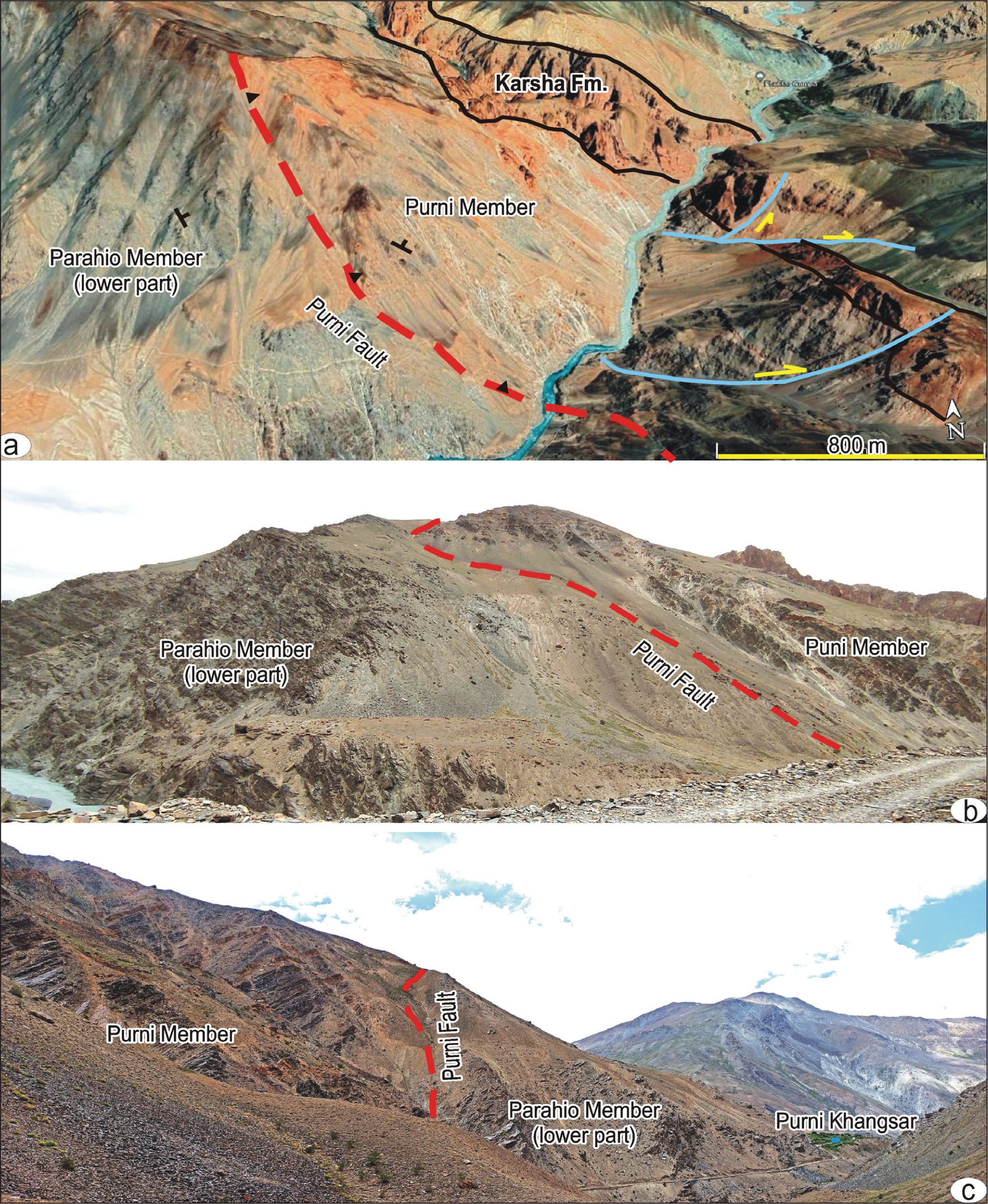
The Purni–Phuktal section lies in the Niri-Tsarap Chu Valley in south-eastern Zanskar (Myrow et al., 2006b; Nanda & Singh, 1977; Srikantia et al., 1980). The Cambrian rocks exposed in this section comprise the Kunzam La and Karsha formations. The Kunzam La Formation, exposed between Purni village and the Purni–Phuktal bridge, comprises shale, siltstone, sandstone, quartzite and dolostone bands (Figure 2) and measures ~888 m (Figure 8). A fault (named herein as Purni fault)-induced crushed zone of ~120 m separates the lower ~288 m from the upper ~600 m of the sequence. The lower part of this succession, exposed at Purni, constituted of minor shale-siltstone and dominantly sandstone beds, is characterised by trace fossil Psammichnites gigas circularis and Psammichnites gigas gigas (Verma et al., 2023) and bedding features like ball and pillow structures, low angle lamination and flaser bedding. Lithologically and faunastically the sequence is similar to the lower part of the Parahio Member in the Spiti region, which also contains Psammichnites gigas circularis (Hughes et al., 2013). Nanda and Singh (1976) classified this sequence under the Phe/Batal Formation. The Phe or Batal Formation is an unfossiliferous sequence; thus, trace fossil Psammichnites gigas circularis and Psammichnites gigas gigas negates, such a placement. In the Himalayan Cambrian sections, Psammichnites are considered to mark the late part of the Cambrian Series 2, Stage 4 (Hughes et al., 2013; Kaur et al., 2021). The abundance of trace fossils, including Psammichnites gigas circularis, SE of Purni indicates that the rocks exposed SE of Purni are also part of the fossiliferous Psammichnites gigas circularis bearing Parahio Member of the Kunzam La Formation. North of the Purni village, up to 100 m ahead of the Purni–Khangsar, dominantly sandstone of the Parahio Member containing well preserved Psammichnites gigas circularis crops out (Verma et al., 2023).
Ahead of Purni–Khangsar (~100 m), the Purni fault, a high-angle normal fault, juxtaposes ~600 m thick section of shale, siltstone, sandstone and dolostone of the Purni Member as a hanging wall over a dominant sandstone sequence of the Parahio Member (Figure 2a–c). A ~800 m thick sequence of shale, siltstone and sandstone bearing trilobites of the Cambrian Series 2 (Stage 4) to Wuliuan (Miaolingian) that forms fossiliferous part of the Parahio Member in the Spiti region has been eliminated along this fault. Trilobite and brachiopod fauna of Wuliuan (Miaolingian) in the uppermost part of the Purni Member belongs to Sudanomocarina sinindica level; it occurs near the Phuktal bridge approximately 80 m below the contact of the Kunzam La Formation with the overlying Karsha Formation (Peng et al., 2009; Verma et al., 2023).
(a) Google Earth image showing the Niri-Tsarap Chu Valley of the Zanskar region and the Purni Fault (red dashed line) between the Parahio and Purni members of the Kunzam La Formation. The small scale faults (in blue lines) and the thick (orange colour) Karsha Formation resting over of the Kunzam La Formation, (b) Field photograph showing the right bank of the Niri-Tsarap Chu river and the high angle faulted contact between the lower part of the Parahio Member (in footwall) and the Purni Member on hanging wall, as a result the fossiliferous nearly ~700 m of the Parahio Member is omitted along Purni fault; (c) Field photograph showing the left bank of the Niri-Tsarap Chu river and the faulted contact between the lower part of Parahio Member and the Purni Member.
Batal-Chandra Tal Section (Chandra Valley, Lahaul and Spiti)
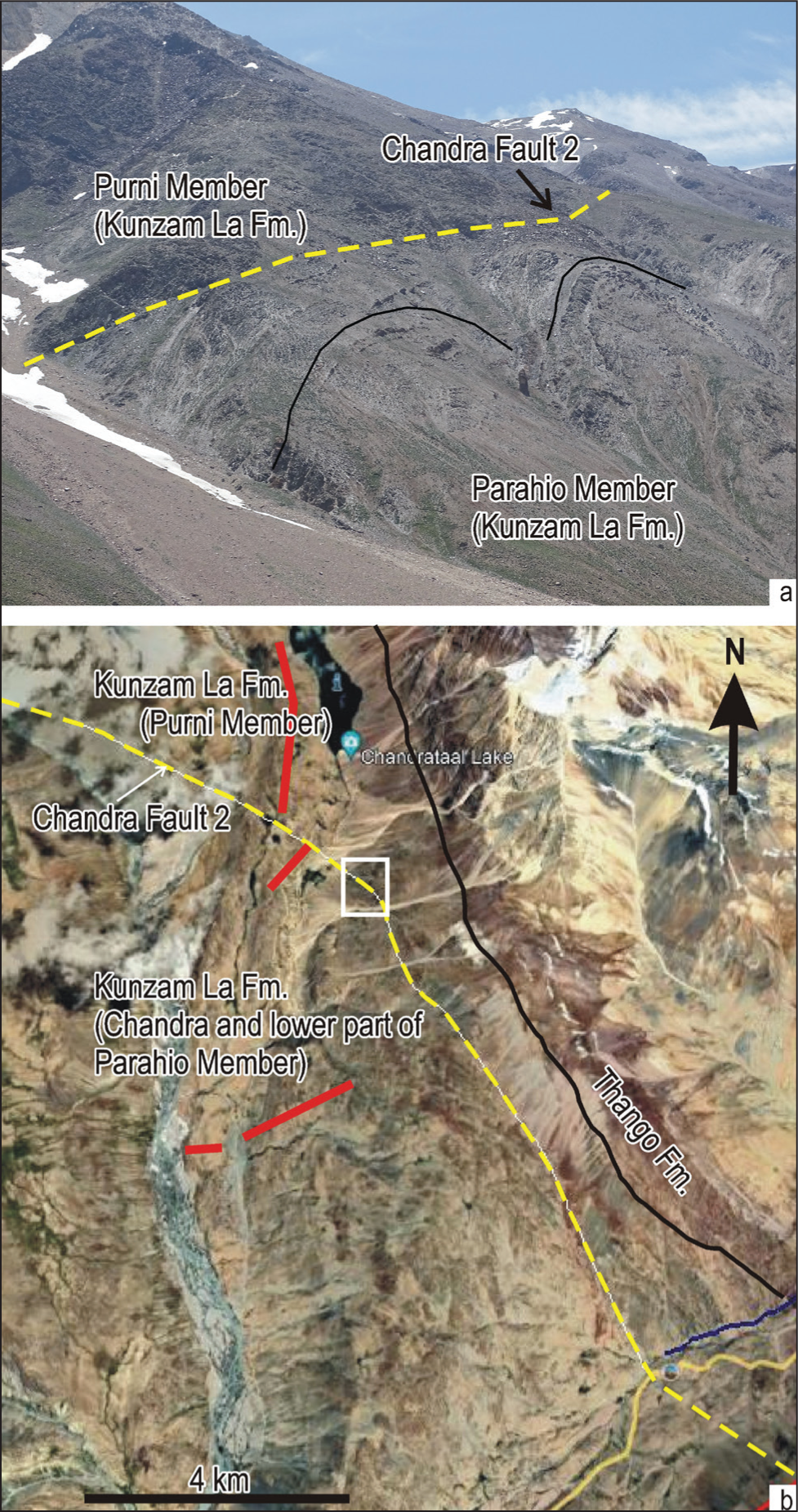
In this section, the lower part of the Kunzam La Formation, that is, the Chandra Member and the lower part of the Parahio Member, is continuously exposed from ~2 km ahead of the Batal Bridge to near the Chandra Lake, where a fault, named Chandra fault 2—an ancillary of the Chandra fault (Bhargava, 1990), places the rocks of the Chandra and lower part of the Parahio Member against the Purni Member (Figure 3a and b). The rocks of the Parahio Member are folded immediately below the fault contact. In this section, the fossiliferous middle to upper parts of the Parahio Member and the lower part of the Purni Member are omitted along this fault (Figure 3a and b). Along this section, too, the fossiliferous rocks of the Parahio Member, which are well preserved in the Parahio Valley section, have been eliminated along Chandra fault 2 (Figure 3a and b).
(a) Field photograph showing the ancillary of the Chandra fault (dashed yellow line) and the contact between the Purni Member and the folded rocks of the Parahio Member; (b) Google Earth image showing the extent of the ancillary of the Chandra fault (yellow dashed line), red lines indicates the measured part of the Kunzam La Formation; white box indicate the location of field photograph.
Parahio Valley Section (Spiti Region)
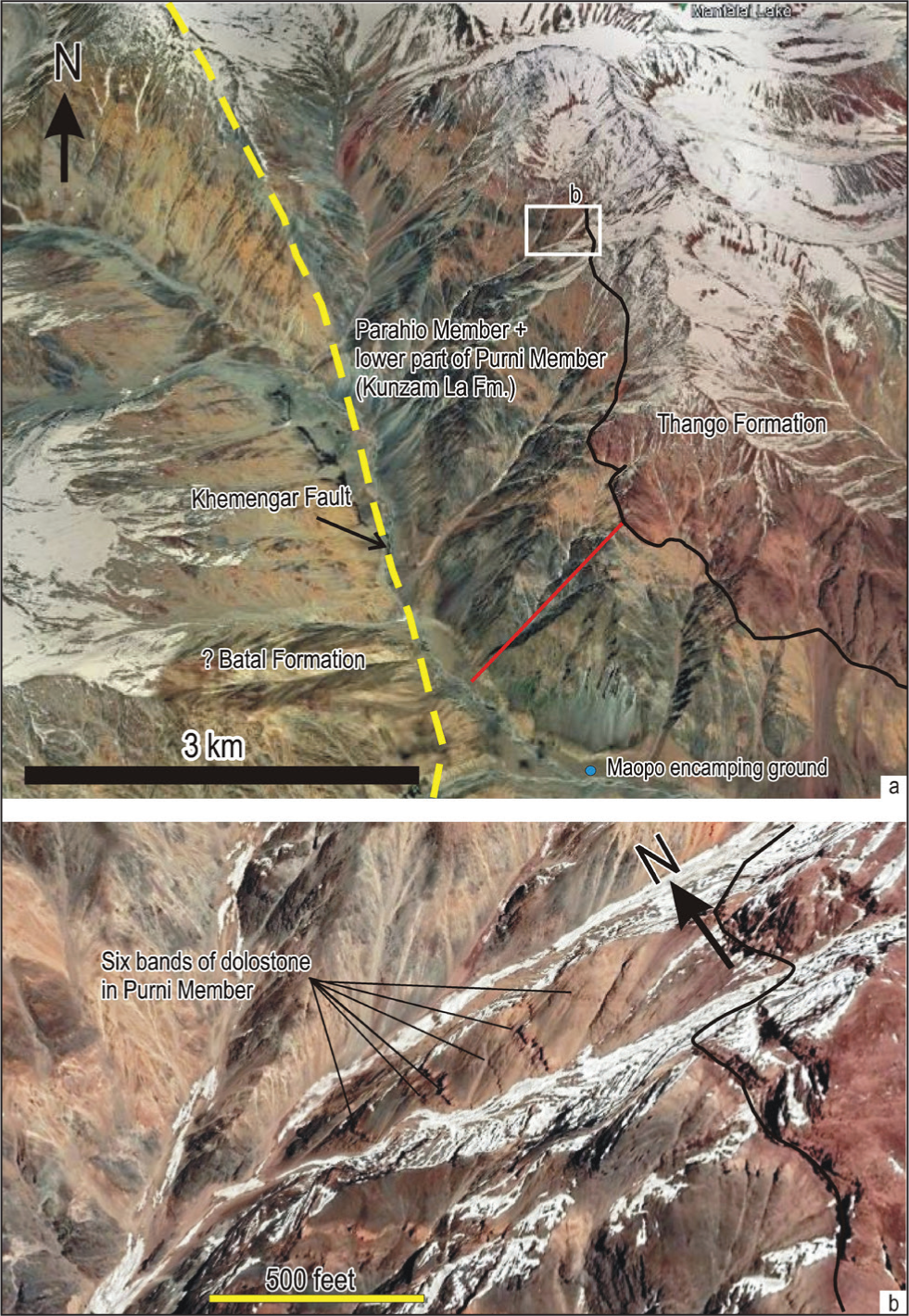
In the Parahio Valley, the sequence, including the Chandra Member, has been eliminated by the Khemangar fault (Figure 4b). The rocks west of the Khemangar fault are generally classified as the Batal Formation. However, the precise characterisation of these rocks needs reappraisal, particularly upstream of the Khemangar khad (brook). The sequence exposed in the Parahio Valley section contains the well-preserved Parahio Member and the lowermost part of the Purni Member (Figure 4b). The lower part of the Parahio Member contains Psammichnites gigas circularis and upward, followed by traces of Psammichnites gigas gigas, and the middle-upper part of the Parahio Member contains all the known trilobite biozone/levels in the Parahio Valley. Along the Parahio Valley section, the uppermost part of the Purni Member was largely eroded before the Ordovician transgression-post-Kurgiakh orogeny. Only two to three bands of red-weathered dolostone are preserved along the Parahio Valley section. Comprehensive work is warranted northwest of the Parahio Valley in the high reaches below the Thango Formation. Nearly six to seven red-weathered dolostone beds are preserved in this part, which may prove to be important biotopes (Figure 4a).
(a) Google earth image of the Parahio Valley, showing the Cambrian Kunzam La and Ordovician Thango formations. Here Kunzam La Formation is represented by the Parahio Member and lower part of the Purni Member which rest over the Batal Formation along the Khemangar fault (yellow dashed line). The red line indicates the classical Parahio Valley section (Peng et al., 2009); (b) Google earth image showing the rocks lying north-west of the Parahio Valley section (marked as b in Figure 4a) showing the six dolostone bands in the Purni Member, while only two bands are preserved in the classical Parahio Valley section.
Sumna Valley (Spiti Region)
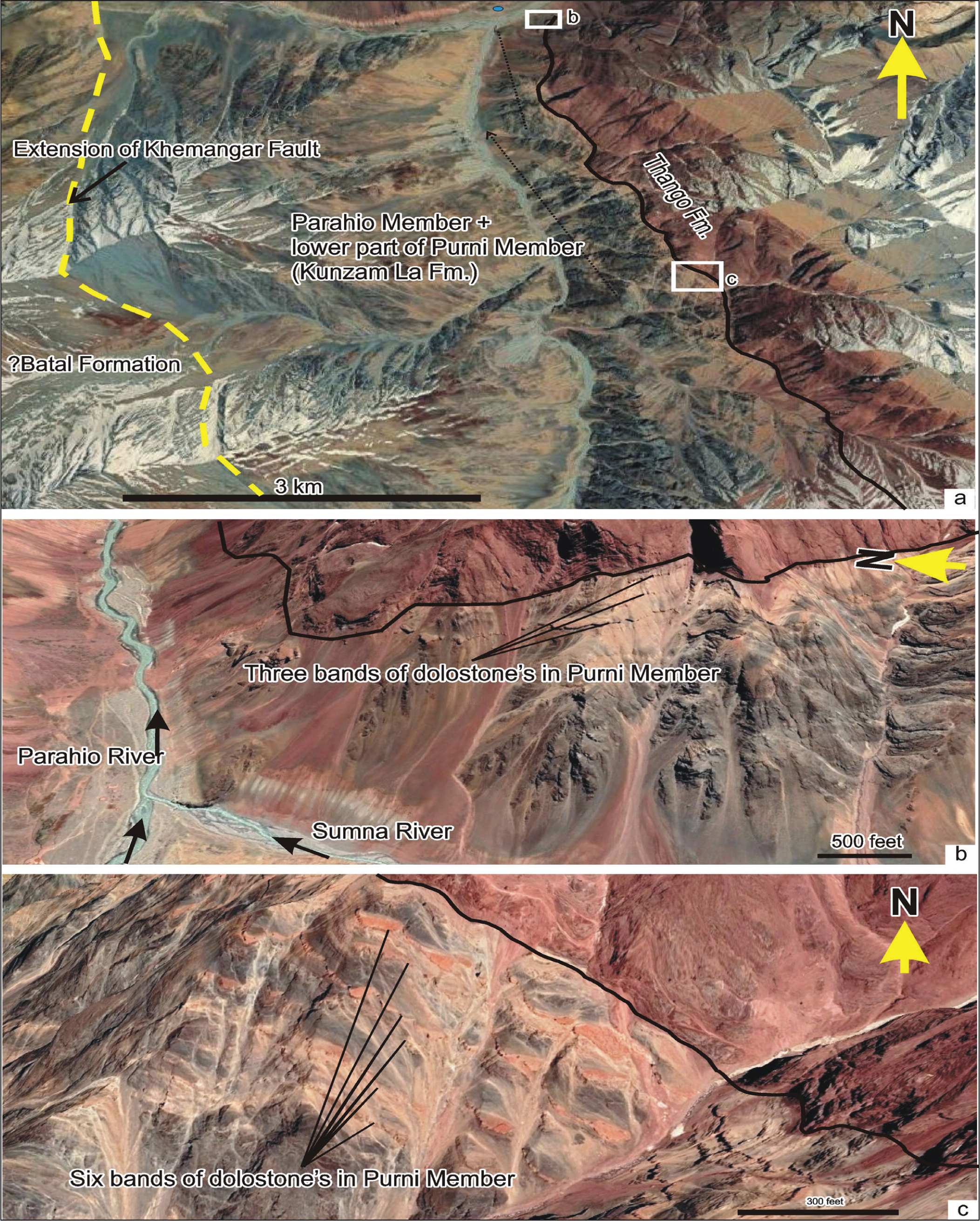
Along this valley, the fossiliferous part of the Parahio Member and a small part of the Purni Member are exposed on the right bank of the N-S-oriented Sumna River (Figure 5a–5c). Near the juncture of the Parahio and Sumna rivers, only a small part of the Purni Member is preserved, containing only two dolostone bands (Figure 5b), but in the extreme, south-east six dolostone bands are well pre-served below the angular Cambro–Ordovician boundary (Figure 5c). The Khemangar fault further extends deep inside the Sumna Valley, where it juxtaposes the Batal Formation and the lower part of the Parahio Member of Kunzam La Formation (Figure 5a).
(a) Google earth image of the Sumna Valley (Spiti) showing the extension of Khemangar fault (yellow dashed line), and rocks of the Batal, Kunzam La and Thango formations. The Kunzam La Formation here is represented by the Parahio Member and lower part of the Purni Member; (b) Google earth image showing the confluence of Parahio and Sumna River (at location b in box) of Figure 5a and the three bands of dolostone in the Purni Member (Kunzam La Formation); (c) Google earth image showing the six bands of dolostone in the Purni Member (Kunzam La Formation) at location c (in box) of Figure 5a.
Pin Valley (Spiti Region)
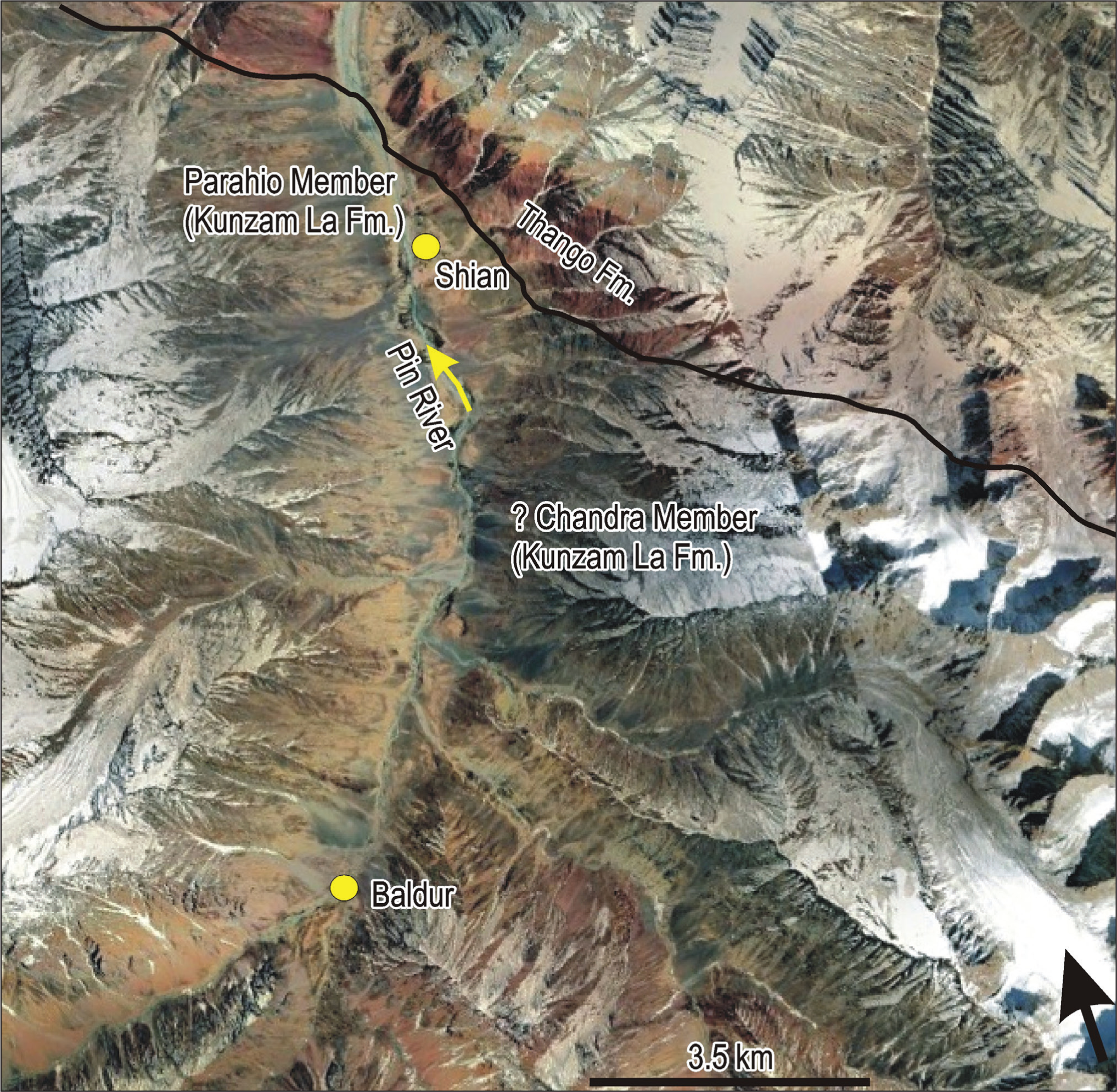
In the Pin Valley, a thick succession of the Cambrian Kunzam La Formation is preserved between the Mud and Baldur localities. We investigated the Kunzam La Formation only along the Shian section in the Pin Valley (Figure 6). However, south of Shian, a thick succession of the Kunzam La Formation is well exposed. In the Shian section, the trilobite Oryctocephalus indicus and Bhargavia prakritika are known, which indicate the Oryctocephalus indicus and Katoia prachina biozones (Singh et al., 2017b) of the Parahio Member of the Kunzam La Formation. The occurrence of Oryctocephalus indicus and Bhargavia prakritika immediately below the Cambro–Ordovician angular unconformity in the Shian section (Pin Valley) indicates that the upper fossiliferous part, that is, Paramecephalus defossus biozone to Iranoleesia butes levels of the Parahio Member and the entire Purni Member of the Kunzam La Formation, eroded prior to the deposition of the Ordovician Thango Formation (Figure 6; Singh et al., 2017b). The rocks of the Kunzam La Formation exposed between the Shian and Baldur localities need further appraisal, as there is a possibility that the Chandra Member may be well preserved there.
Google earth image of the Pin Valley showing the rocks of the Kunzam La and Thango formations. The Kunzam La Formation along the Shian section comprises lower-middle part of the Parahio Member. The rocks between Shian and Baldur need reappraisal and may contain Chandra Member. The upper part of the Parahio Member and the entire Purni Member eroded below the Cambro-Ordovician angular discordance (shown by black line).
Biostratigraphic Aspects
The dolostone beds occur only in the uppermost ~600 m of the Kunzam La Formation (Figure 7), and so far, all known trilobite biozones/levels in the Spiti region are known to occur ~200 m lower than the first dolostone bed (Figures 7 and 8). However, in the Zanskar region, trilobite biozone S. sinindica, which is younger than the youngest level in the Spiti, is known to be nearly 430 m above the first dolostone bed in the Purni–Phuktal section. Peng et al. (2009) suggested this biozone stratigraphically lies immediately above the Iranoleesia butes level of the Spiti. This inference tends to indicate that the 430 m of rocks in the Purni–Phuktal section of the Zanskar region below the S. sinindica biozone should contain a few of the other trilobite biozones/levels, which are known from the Spiti region. Our studies indicated that this 430-m interval is barren of trilobite fossils and is part of the Purni Member rather than the Parahio Member. The biostratigraphic correlation of the S. sinindica biozone and Iranoleesia butes level and associated disputes are discussed in the sequel under biostratigraphic correlation.
Representative Trilobite Fauna from various level and biozone in the Spiti region.
Myrow et al. (2006b) stated that there is no direct evidence that the dolostone beds in the Kunzam La Formation are continuous between the Zanskar and the Spiti regions. Moreover, they stated that in the Zanskar region, the dolomitisation of the carbonate beds extended to a deeper stratigraphic level in the Kunzam La Formation. We differ with this view, as the dolostone beds in the upper part of the Kunzam La Formation are extremely well-sorted, massive and homogenous and represent deposits of the shallow marine environment. We consider that dolomitisation in the upper ~600 m of the Kunzam La Formation is possibly associated with the change in sea-water chemistry during the Cambrian Period, and it is continuous from Zanskar to the Spiti region. The dolostone beds in the Zanskar region are known to be associated with the facies of nearshore or fluvial settings and represent a relatively low and uniform energy environment (Myrow et al., 2006b). However, the trilobite fauna containing the Kunzam La Formation rocks in the Spiti region is interpreted to signify an extremely high rate of sedimentation (30.4 cm/1,000 yrs.) (Myrow et al., 2006a). Such a sedimentation rate looks unlikely in the Zanskar region, where 10–12 dolostone beds occur in the upper ~600 m of the Kunzam La Formation. We thus infer that the 10–12 beds of dolostone in the 600 m thick upper part of the Kunzam La Formation in the Purni–Phuktal section (Myrow et al., 2006b), in which the trilobite biozone Sudanomocarina sinindica occurs at 500–520 m from the base of the section (Peng et al., 2009), cannot yield the trilobite biozones/levels of the Spiti region. In the Spiti region, the first dolostone layer stratigraphically occurs some ~200 m above the Iranoleesia butes level, which is the youngest level of trilobite in the Spiti region. The dolostone-bearing succession of the Kunzam La Formation, which is well preserved in the Purni–Phuktal section (Zanskar), mostly eroded in the Spiti region prior to the Ordovician Thango transgression (Figure 8).
Lithologic, geologic and biostratigraphic correlation of the Kunzam La Formation from Zanskar to the Spiti regions.
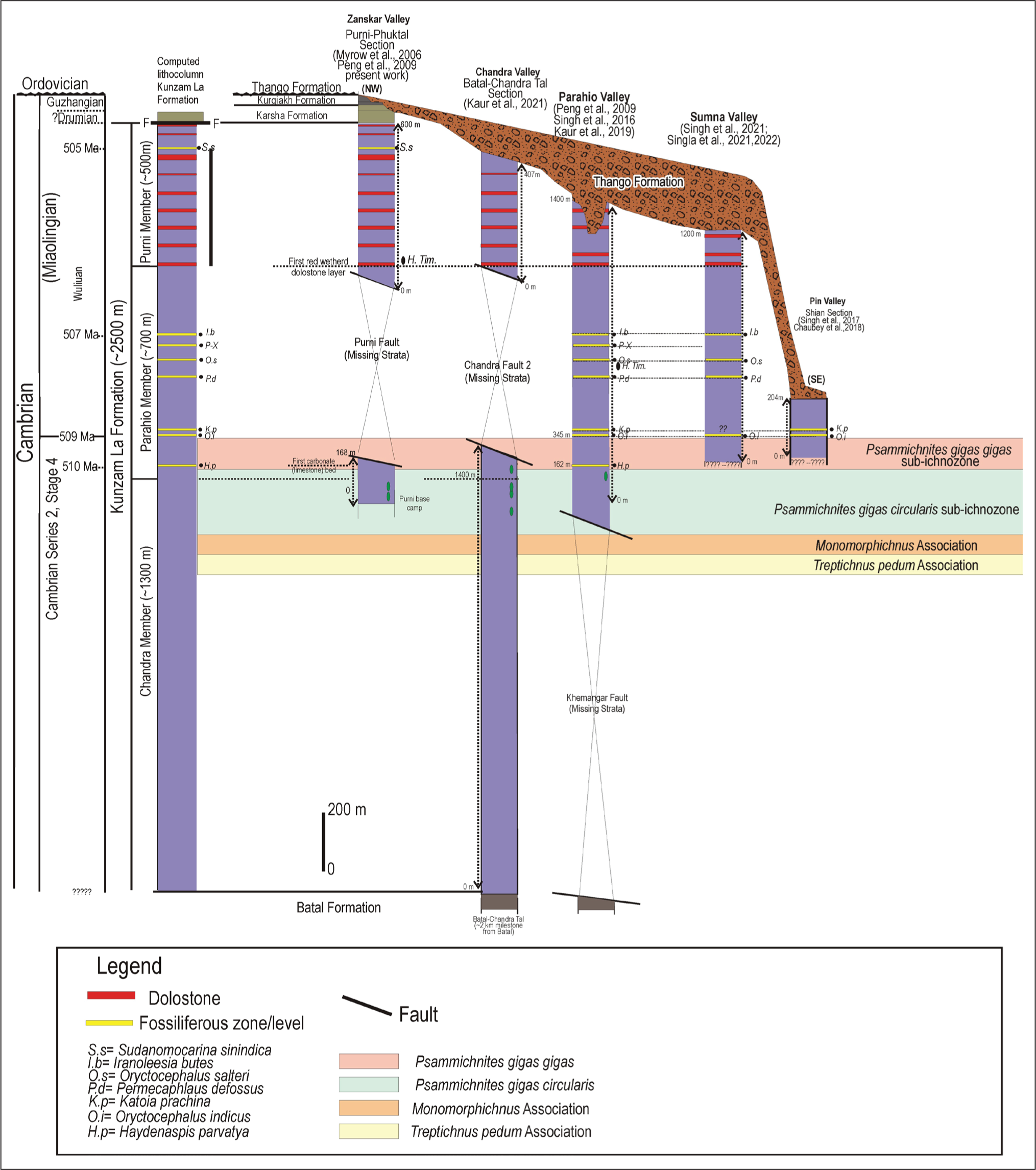
We consider the first red-weathered dolostone bed in the Kunzam La Formation of the Zanskar and the Spiti regions as a marker bed that defines the base of the Purni Member.
The number of preserved red-weathered dolostone layers from Zanskar to the Spiti regions mainly depends on the level of erosion of the Kunzam La Formation prior to the Ordovician transgression. In the Parahio Valley, near the Thango village, a ~150 m deep incised valley within the Kunzam La Formation is recorded (Hayden, 1904; Myrow et al., 2006a), and as a result, only two red-weathered dolostone layers remain preserved in the upper part of the Kunzam La Formation in the Parahio Valley section (Figures 4 and 8). Similarly, northwest of the Maopo encamping ground in the Parahio Valley has four to five red-weathered dolostone layers (Figures 4 and 8). In this valley, all trilobite biozones/levels (Peng et al., 2009) are known to occur well below the first red-weathered dolostone layer. Even the youngest trilobite level known from this valley, that is, Iranoleesia butes level, lies nearly ~200 m below the first red-weathered dolostone layer in the section.
Similarly, in the adjacent Sumna Valley, seven to eight red-weathered dolostone layers are preserved below the Cambro–Ordovician discordance (Figures 5 and 8). In the Pin Valley, these red-weathered dolostone layers have been eroded (Figures 6 and 8).
In the Zanskar region, along the Purni–Phuktal section (Figures 2 and 8), 10–12 red-weathered dolostone layers are present in the upper part of the Kunzam La Formation. The only recorded trilobite biozone, that is, Sudanomocarina sinindica in the Kunzam La Formation from the Purni–Phuktal section in the Zanskar region, is known to occur above the eighth red-weathered dolostone beds. This biozone is not known in the Spiti region.
Conclusion
Overall, from the Zanskar to the Spiti regions, the lower part of the Kunzam La Formation is best exposed in the Chandra Valley (Lahaul) and probably also in Pin Valley (Spiti), while the middle part is best exposed in the Parahio and Sumna valleys (Spiti), and the uppermost part is best preserved in the Niri-Tsarap Chu and Kurgiakh valleys of the Zanskar region (Figure 8). Thus, none of the sections shows the complete preservation of the Kunzam La Formation (Figure 8). The lithostratigraphic, geologic and biostratigraphic correlations of the Kunzam La Formation in the Zanskar and Spiti regions suggest the Purni Member, the uppermost part of the Kunzam La Formation, is well preserved in the Zanskar region at two localities, that is, the Purni–Phuktal (Niri-Tsarap Chu Valley) and Khey in the Kurgiakh Valley. The Chandra Member of the Kunzam La Formation is confirmed only in the Chandra Valley. Though rocks of the Chandra Member also appear in the Pin Valley and deep inside the Sumna Valley, these have not been worked on in detail and need reappraisal. The Parahio and Sumna valleys in the Spiti regions show well preserved Parahio Member; the middle-upper part of this member yielded all the trilobite biozones/levels known in the Spiti region. The Purni Member in the Zanskar region yielded poorly defined trilobite biozone. The sequence equivalent of the Karsha and the Kurgiakh formations has not been recognised in the Spiti region.
Footnotes
Acknowledgements
Birendra P. Singh is thankful to the UGC for providing the grant (No. F.20-1/2012(BSR)/20-8(12)/2012(BSR) to support the work in Spiti Himalaya. O. N. Bhargava is grateful to INSA for providing the support (INSA/ SP/SS/ 2022/482). Vishal Verma is thankful to the University Grant Commission (UGC-NFSC) for providing the Junior Research Fellowship (JRF-UGC-NFSC: UGC Ref. 2572/(CSIR-UGC NET June 2019).
Declaration of Conflicting Interests
The authors declared no potential conflicts of interest with respect to the research, authorship and/or publication of this article.
Funding
The authors received no financial support for the research, authorship and/or publication of this article.