




Abstract
This article highlights the changing face of the Lesser Himalayan geology and the evolution of geological theories and methodologies, showcasing how contemporary research has built upon or challenged earlier ideas and has witnessed significant advancements in our understanding of the geological processes that shape this region. The contributions of the initial stalwarts of the pre- and post-independence, and later bold sceptics, but their concepts failed, and the recent developments are concisely summarised in this article.
INTRODUCTION
Medlicott (1864) was the first geologist to build a stratigraphic sequence of the Lesser Himalayan formations and provide a regional distribution of the rocks and their correlation. The ‘Blaini Conglomerate’ (Boulder Bed), correlated with the Talchir glaciation of the peninsula and the Permian Conglomerate of Spiti Valley, formed the datum horizon. The black shale sequence above the Blaini Boulder Bed was correlated with the Permian Shale of Spiti, the Krol limestone with the Triassic Lilang Series, and the overlying dark shales with the Jurassic Spiti black shales. Similarly, the ‘Quartzite sequence’ of the Jaunsar Series below the Blaini Boulder Bed was correlated with the Devonian Muth Quartzite, and a lower Palaeozoic age was proposed for the underlying Simla Series. McMahon (1885) presented geological history of Himalaya.
Initially, not much was stated concerning the structural setup (Oldham, 1918a, 1918b; Medlicott 1879). Later, Pilgrim and West (1928), Auden (1934) and West (1939) introduced the Alpine concept of thrust tectonics in the Shimla Himalaya.
EVOLVING CONCEPTS
Pre-independence—the initial stalwarts
Holland (1908) advocated a Cambrian/Precambrian age for the Blaini Boulder Bed due to the absence of fossils. However, subsequent workers preferred the stratigraphic scheme proposed by Medlicott (1864). All quartzitic, conglomeratic, and carbonate sequences were assigned Devonian, Upper Carboniferous/Permian and Triassic ages, respectively. Many individuals took local traverses; in this write-up, we are confining ourselves to the work that had a regional impact.
McMahon (1877) commented on the nature of the Blaini Group. He (1882, 1885) mapped and classified the rocks of the Dalhousie and Chamba areas, adhering to Medlicott’s classification. Oldham (1883, 1887) surveyed large parts of Jaunsar-Bawar and proposed the term Jaunsar Series to the rocks of that area. The quartzitic sequence in the Tons Valley was identified as the Jaunsar. His scheme of stratigraphic order in ascending order commences with (a) the Jutogh beds, (b) Hornblende schist (Prospect Hill beds), (c) Limestone, (d) Garnetiferous quartz and mica schist, (e) Carbonaceous garnetiferous schist (Jakko beds), (f) Black carbonaceous limestone, (g) Blaini Limestone, (h) Blaini boulder bed, (i) Bleach slates and (j) Blaini boulder bed. He identified a conglomerate overlying the Deoban Limestone, designated as the Mandhali. He (1888) presented a correlation of the pre-Tertiary sedimentary sequences.
McMahon (1895) made contribution to the Jammu geology. Pilgrim and West (1928) classified the ‘Simla’ rocks in stratigraphic order, recognised a new horizon, and named Chail. They assigned an Archaean (?) age to the Jutogh Series, followed by an unconformity by the Chail and Jaunsar Series of the Purana age, along with another unconformity by the Simla Series (Infra-Blaini), and the Kakarhatti and Naldera limestones forming part of the Simla Series of the Lower Palaeozoic age. The stratigraphic level of the Shali Limestone and Shales was kept in abeyance. The Simla Series was followed by the Blaini Conglomerate, Blaini Limestone, Infra-Krol Beds, Krol Sandstone and Krol Series (limestone and shale, Red shale, and Massive blue limestone). The Subathu Series (Shale, limestone, carbonaceous beds and basal laterite) of the Middle Eocene followed along an unconformity. Another plane of unconformity separated the Subathu Series from the Uppermost Subathu Beds (purple sandstone and grit) of the Upper Oligocene age. With yet another unconformity, the Dagshai Series rested over the Uppermost Subathu Beds.
Since the Mandhali Conglomerate, overlying the Deoban Limestone, was correlated with the Blaini, and the Deoban was correlated with the infra-Blaini Naldera Limestone.
Pilgrim and West (1928) recognised three thrusts: Jaunsar, Chail and Jutogh. Recumbent folding explained the inverted grade of metamorphism in the Jutogh rocks. In a traverse, these authors could recognise the Jutogh Thrust at Narkanda. Astonishingly, they mapped such vast terrain with remarkable accuracy. Subsequently, all low-grade metamorphosed rocks were designated as Chail.
Auden (1934) established a new standard in mapping. He divided the Jaunsar ‘Series’ into the Mandhali, Chandpur and Nagthat, the Krol Series into A, B, C, D and E; mapped and divided the Tal Series into lower and upper subdivisions. He classified the Simla Series into Chaossa and Domher types. The occurrence of the Subathu outcrops in windows at Solan and Anji, and below the Pachmunda ‘Syncline’ on the subthrust of the north-easterly dipping Krol Thrust, was cited as the clinching evidence for the Krol sequence to be a thrust sheet. In the Tons Valley at Siyasu, the northern limb of the Jaunsar ‘Syncline’ with the overlying Krol-Tal sequences, rests over the Simla Series with Subathu cover along a southern dipping Tons Thrust. He concluded that the Tons Thrust is the northern component of the Krol Thrust. Auden (1948) mentioned a window in the Beas Gorge in the Larji area.
West (1939) mapped and described the Shali Rocks with outliers of the Madhan Slates and the Subathu Series exposed as a tectonic window, below the Chail Series along the Shali Thrust. Berthelsen (1951) indicated the existence of a window. Gneiss at Jhakheri marked its northeastern limit.
Post-independence
During the Second World War, there was a lull in the mapping activity of the Geological Survey of India. Except for mineral and engineering geology investigations, no mapping was undertaken. The mapping commenced in full force in the 50s and the 60s. Publications of Pilgrim and West (1928), Auden (1934) and West (1939) were almost bibles for us. Any discordant view or doubt on their work was viewed as blasphemy and impertinence of the youth. Many workers from the Geological Survey of India, Oil and Natural Gas Commission (now Corporation) and universities made forays in the Lesser Himalaya (see Bhargava, 1981 for detailed references). In the present article, only those who had made an impact are mentioned.
Bold sceptics, but their failed concepts
Initially, a few challenged the concepts of Pilgrim and West (1928), Auden (1934) and West (1939). Fuchs (1967) more or less followed Pilgrim and West (1928). Our comments on some of these are italicised.
Raina (1953) was possibly the first to cast doubts; he extended the mapping of Auden (1934) in the area north of the Gambhar River. He concluded that the Tons Thrust does not extend further north and the Infra-Krol is a facies variant of the Simla ‘Slates’. His report was referred to Dr Auden, who commented,
No geologist’s work is sacrosanct, and certainly I have no objection to Mr Raina’s re-interpretation, should this be found to be correct, and my original interpretation to be wrong. The question, of course, revolves around which is correct…. Let Mr Raina continue to question the correlations and tectonics of his predecessors, but let him be prepared to criticise his own tentative views and not be too dogmatic. The facies variation is only between co-eval formations; on the contrary between the Simla ‘Slates’ and the Infra-Krol represent two time intervals separated by the Blaini sequence. Raina’s presumption was faulty at the very outset.
Valdiya (1970) considered the Simla Slate a flysch deposit of the Precambrian age, a concept that did not stand the test of time. He (1977) considered the Basantpur rocks younger than the Shali Group, but strangely, the overlying Chhaosa (Simla Group) older than the Shali Group. The detailed classification and stratigraphic position of the Simla Group were already published (Srikantia & Sharma, 1976).
Rupke (1968) regarded the Blaini as turbiditic facies of the Nagthat Formation, while Valdiya (1973) distinguished the Blaini over the Simla ‘Slates’ and those over the Nagthat, designating them as the Blaini ‘S’ and Blaini ‘N’ respectively. He considered the former as Precambrian, a part of the Precambrian Simla Flysch, and the latter of the Devonian age. The Blaini Formation over the Simla Group and the one over the Nagthat Formation are the same. It rests over six different formations along an unconformity and could be part neither of the Simla Group nor the Nagthat Formation. (Bhargava & Bhattacharyya, 1975)
Based on the discovery of Linoproductus, Valdiya (1980) assigned a probable Late Carboniferous or Early Permian age to the Krol sequence. Linoproductus proved spurious and the Carboniferous age became redundant.
Ranga Rao (1968) concluded that the Krol Belt is autochthonous. He seems to have overlooked the Subathu Formation occurring in an antiform between the Pachmunda and Krol synforms, and emerging below the doubly plunging Pachmunda Synform.
Valdiya (1975) divided the Tal Formation into the Jogira, Masket and Bansi Members. He renamed the Boulder Slate Sequence (Bijni Formation), which had yielded Permian fossils (Ganesan, 1972), as the Jogira Member and assigned a Permian age to the Tal Formation, though his Bansi Member contained Cretaceous fossils.
Bhargava (1972) described a structure resembling the tadpole nest. The structure turned out to be Bergaueria.
LATER SYSTEMATIC WORK
We (S. V. Srikantia and ONB), while writing the Memoir 106, Geological Survey of India in 1969, prompted by Late B. B. Nadgir and Dr D. K. Ray, developed serious doubts regarding the Palaeozoic and Mesozoic age of the Simla–Jaunsar–Blaini–Krol, but we were confronted by the article of Ghosh and Srivastava (1962). We could not pluck up enough courage to discard the microfloristic data and some other fossil evidence. This was meticulously and convincingly done by Singh (1981), later validated by the discovery of SSF (Azmi et al., 1981; Juyal, 1979). It invalidated all previous palaeontological data.
Valdiya (1969), using stromatolites, assigned Riphean (Mesoproterozoic) age to the Calc Series of Pithoragarh, Tejam and the Shali Group. This was a singular contribution to the stratigraphic scheme of the Lesser Himalaya. These belts were delinked from the Krol succession.
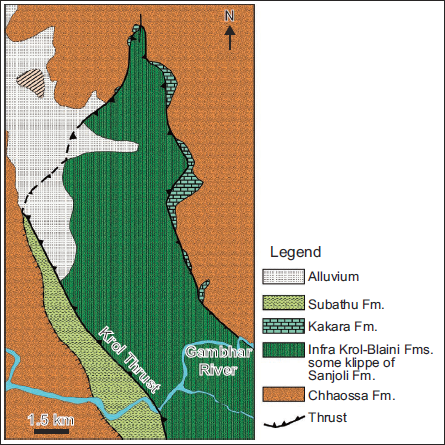
Bhargava and Srikantia (1967) remapped north of the Gambhar River. The Krol Thrust with the Blaini–Infra–Krol on its back extends north of the Gambhar River. The thrust demarcates the contact with the underlying Simla Group with outliers of a newly discovered Palaeocene horizon named Kakara Formation (Srikantia & Bhargava, 1967). The Krol Thrust, along with the Blaini–Infra–Krol sediments, is folded in a synform with its closure north of the Gambhar (Figure 1). The Giri Thrust truncates the eastern component of the Krol Thrust, which reappears near Lugasan in the Giri Valley (Bhargava, 1976).
Closure of the Outer Krol Belt north of the Gambhar (modified after Bhargava, 1972).
The Jaunsar Thrust tectonically overlaps the Krol Thrust, though in small stretches, the Krol Thrust reappears, finally, to be concealed under the Jaunsar Thrust Sheet. Thus, the Jaunsar Thrust continues across the Jamuna and not the Krol Thrust and the Tons Thrust is the counterpart of the Jaunsar Thrust and not of the Krol Thrust (Bhargava, 1972, 1976). It becomes evident that the Krol Belt occupies two different tectonic levels: the Outer Krol Belt over the Simla Group of the Solan area, and the Inner Krol Belt over the Jaunsar Group riding over the Outer Krol Belt. The Tons Thrust and the Deoban Group are folded in an antiform and extend in the Garhwal Himalaya, north of Tiuni.
The Blaini Formation occurring over the Simla Group, and also forming the basal part of the Outer Krol Belt, implies that initially, the Blaini-Krol sequence was deposited over the Simla Group. Later, it slipped into its basement and occurred as a superficial nappe. Similarly, the Mandhali Formation and the overlying sequence of the Inner Krol Belt, deposited over the Deoban Group, also moved out as a superficial nappe from NE to rest over the Simla-Subathu and the Outer Krol Belt.
The Deoban Group, with its profuse development of stromatolites, regarded as ‘Riphean’ (Mesoproterozoic), was correlated with the Shali Group. The unconformable underlying sequence with the basic volcanic, mapped Jaunsar by Oldham (1988) and designated Tuini Formation (Bhargava, 1972); renamed Dharagad (Ganesan & Thussu, 1978), was correlated with the Sundernagar Group.
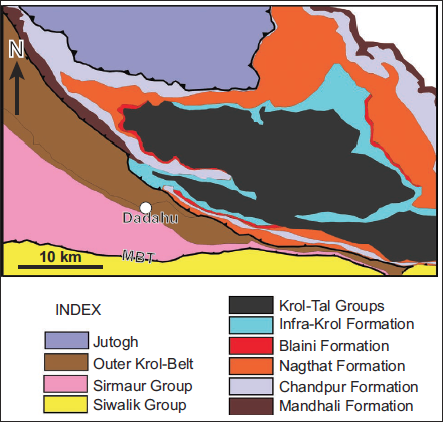
During this mapping assignment, the subdivisions of the Jaunsar Group, namely, Mandhali, Chandpur and Nagthat formations, were extended northwest from where Auden (1934) had left off. The Nagthat Formation, parallel to the western closure of the Nigalidhar Syncline, also wraps around due to its overturned northern limb. The underlying Chandpur Formation follows the same pattern and merges with the Chail Series of Pilgrim and West (1928). The mapping established the Chail Series as undifferentiated Jaunsar Group (Bhargava, 1972; Figure 2).
Srikantia and Sharma (1971, 1976) mapped the area north of the Outer Krol Belt. They found the Tattapani traps to rest over the Shali sequence, which in turn is nonconformably succeeded by a conglomerate (Boi Conglomerate), ‘Chail Series’ (Pilgrim & West, 1928; West, 1939) passes into the Simla ‘Slates’ and the ‘Jaunsar’. These units were renamed, Basantpur, Chhaosa and Sanjauli, and classified under the Simla Group, which rests over the Shali Group.
The sequence below the Shali Group with the Mandi volcanics was designated as the Sundernagar Group. The Shali Group and the volcanics were assigned a Precambrian age; the volcanics were previously correlated with the Permian Panjal Traps. The later mapping revealed that the Mandi volcanics and Tattapani occupy different stratigraphic levels; the former is of Palaeoproterozoic age and the latter of Neoproterozoic age.
The Chail ‘Series’ in the map of Pilgrim and West (1928) and West (1939) was shown at two tectonic levels: (a) above the Jaunsar Series in the type area and its extension, and (b) below the Simla Series in the Tattapani area of the Sutlej Valley. The former was found to be the undifferentiated Jaunsar Group, and the latter formed part of the Simla Group. The term Chail thus lost its status (Srikantia & Bhargava, 1985).
Two parallel sequences emerged (Table 1).
Pre-Krol comparative stratigraphy of the Inner and Outer Krol Belt.
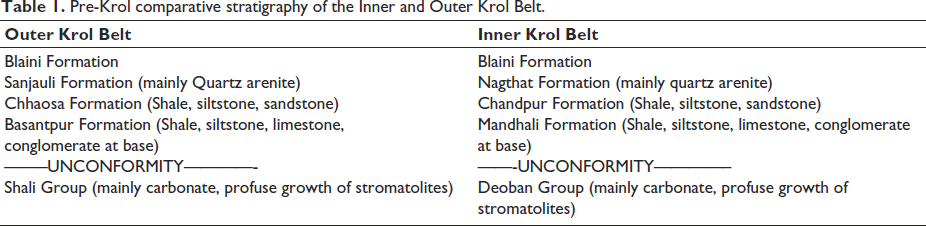
The Basantpur, Chhaosa and Sanjauli Formations, constituting the Simla Group, and the Mandhali, Chandpur and Nagthat Formations, forming the Jaunsar Group, having comparable lithostratigraphy, occur between the Mesoproterozoic Carbonates and the Blaini Formation, and were correlated. The correlation has been proved by isotopic dating (Bhargava et al., 2021). It proved a major breakthrough in the stratigraphic setup of the Lesser Himalaya.
The Blaini Formation is deposited over six different formations of the Simla and Jaunsar Groups, denoting a regional unconformity. Diamictites in the Blaini Formation occur at two stratigraphic levels. Bhargava and Bhattacharyya (1975) reviewed all the divergent evidence and concluded a glacio-marine origin, though other views persist (Tangri & Singh, 1982).
The window of the Ediacaran Chilar Formation within the Palaeoproterozoic Dharagad Group in the Tons Valley provided evidence of the Late Cambrian Kurgiakh orogeny in the Lesser Himalaya (Bhargava et al., 2011a).
The discovery of Small Shelly Fauna (Azmi et al., 1981; Braiser & Singh, 1987; Juyal, 1979) and ichnofossils of trilobites in the Tal Group (Bhargava, 1984) tended to support the view of Singh (1980) that the Krol Group represents a Precambrian age. The report of Redlichia from the Tal (Kumar et al., 1987) clinched the age controversy. Subsequently, several articles on trilobite trace fossils appeared (for details, see Bhargava and Singh, 2022). In recent years, sediments containing the Ordovician trace fossil assemblage have been found in the ‘Tal Group’ with an angular discordance with the underlying early Cambrian sediments (Singh et al., 2019), signifying the Kurgiakh Orogeny. Rb-Sr Precambrian age of the Bandal Gneissic Complex (Bhanot et al., 1976) was revealing and infused fresh thinking.
The mapping of the Rampur (Bhargava et al., 1972) and the Larji windows (Sharma, 1977) was concluded. The Jeori-Wangtu-Bandal considered intrusive in the Rampur Group was interpreted as its basement with a palaeosol intervening between the basement complex and the Rampur Group (Bhargava, 1980; Bhargava et al., 2011b). The radiometric dating has confirmed this contention; the age of the complex is 1860 Ma (Miller et al., 2000), whereas the volcanics of the Rampur Group have yielded an age of 1800 Ma (Miller et al., 2001). The thrust sheet over the Rampur Group was named the Kulu Thrust Sheet.
Three thrust sheets, the Kulu, Jutogh and Vaikrita, have been identified in the Himachal Himalaya. The Kulu forms the lowest thrust sheet; it encloses the basement as mylonitic gneiss. It extends from Jammu to Arunachal Pradesh. Occupying a higher tectonic level is the Jutogh Thrust. Though it extends to Uttarakhand, it has not been delineated. The presence of upright cross-bedding contradicted the interpretation of a regional recumbent fold in the Jutogh Thrust Sheet (Bhargava & Srikantia, 2014; Pilgrim & West, 1928). The 490 Ma age of the garnet in the Jutogh Group establishes a Lower Palaeozoic metamorphic event, attendant to the Kurgiakh Orogeny (Bhargava et al., 2016).
Above the Jutogh Thrust is the Vaikrita Thrust Sheet, which extends to the Higher Himalaya and forms the basement of the Tethyan sequence. This thrust sheet is universally present throughout the Himalaya, though designated by different names. Each of the thrust sheets encloses granites of a specific age. The Kulu Thrust Sheet has tectonic slivers of the basement complex, the Jutogh Thrust Sheet of the Tonian granite, and the Vaikrita Thrust Sheet contains granites of the Lower Palaeozoic age, which are regarded to manifest significant pre-Himalayan tectonic events (Bhargava et al., 2021).
NE-SW-oriented folds in the Larji Window (Sharma, 1977) are evidence of pre-Himalayan deformation (Bhargava & Singh, 2022). In the Chamba sector, the classification of McMahon (1877) was upheld, but assigned Cryogenian and Ediacaran ages to the Manjir and Katarigali Formations. The equivalent of the Panjal Trap was located over the Permian Salooni Formation.
CONCLUSIONS
We marvel at the mapping acumen and insight of old stalwarts who laid the foundation of the geology of the Lesser Himalaya. With the benefit of their maps and detailed descriptions, we, with broader coverage, were able to improve the edifice of the Lesser Himalaya. Bhargava et al. (2021) summarised the state of the art until 2020. Geology is a vibrant and dynamic science that continuously evolves with the addition of data/knowledge. Our contributions are just another step in the unending ladder of geosciences. There are miles to go.
Footnotes
Acknowledgements
We are thankful to Prof. Mukund Sharma for inviting us to write this article.
Declaration of Conflicting Interests
The authors declared no potential conflicts of interest with respect to the research, authorship and/or publication of this article.
Funding
The authors disclosed receipt of the following financial support for the research, authorship and/or publication of this article: ONB acknowledge INSA for providing the financial support (SP/SS/2022/482).
