




Abstract
Background:
Tanzania has a double burden of malnutrition, including a high prevalence of undernutrition and an increasing prevalence of overweight and obesity among adolescents. Schools present a valuable opportunity to reach a large section of the country’s adolescent population with nutrition-oriented interventions.
Objective:
The objective of this study was to assess the current state of adolescent school nutrition interventions in Dodoma, Tanzania, with emphasis on 3 potential school-based nutrition interventions, school vegetable gardens, school meals, and education (on nutrition, agriculture, and water, sanitation, and hygiene).
Methods:
Focus group discussions were conducted with several regional and district-level governmental stakeholders, including health, education, and agricultural officers. Ten public secondary schools were visited, and interviews with school administrators, teachers, students, and parents were conducted.
Results:
All stakeholders interviewed supported interventions to improve school-based nutrition, including school gardens, school feeding, and nutrition education. All 10 schools visited had some experience providing school meals, but parents’ contributions were essential for the program’s sustainability. Most schools visited had land available for a school garden program, but water availability could be challenging during certain times of the year. The teachers interviewed expressed that the curriculum on nutrition education was highly theoretical and did not allow students to practice the knowledge and skills they learned in the classroom.
Conclusions:
The current school-based approach to tackling the double burden of adolescent malnutrition in Dodoma is localized and ad hoc. To leverage the potential of schools as a platform for nutrition interventions, integrated and policy-mandated interventions are needed.
Keywords
Introduction
Despite Tanzania’s significant progress in recent years in reducing malnutrition, the nutrition situation in Tanzania is still severe. Approximately one-third of women aged 15 to 49 years are deficient in iron, vitamin A, and iodine; two-fifths of women are anemic; and 1 in 10 women are undernourished. 1 In 2013, 29% of Tanzanian households were under food deficit. 2 Further, much of the diet in Tanzania consists of starchy foods, including maize, cassava, rice, wheat, and sweet potatoes, contributing to an overall poor-quality diet. Tanzania has a double burden of malnutrition, where 34% of children younger than 5 years are stunted, 5% are acutely malnourished, and 4% are overweight. 3 Malnutrition, especially stunting, is an intergenerational problem where malnourished children often develop into malnourished adolescents. Undernourished women are more likely to give birth to infants with low birthweight, thus transferring undernutrition from one generation to the next.
Sub-Saharan Africa (SSA), where adolescents make up 23% of the population, is lagging in many areas of adolescent health, including adolescent nutrition. 4 The double burden of malnutrition is a severe challenge among adolescents in Tanzania. Among adolescent girls in Tanzania, specifically, 18.0% are underweight, and 47.3% are anemic. 5 In the meantime, Tanzania is faced with a rapidly rising burden of adolescent overnutrition, with the prevalence of overweight and obesity in adolescent girls aged 15 to 19 years increasing from 5.7% in 1996 to 10.6% in 2015. 5,6 Limited data among Tanzanian adolescent boys also indicate a significant burden of malnutrition, with 13% to 17% of urban adolescent boys being overweight or obese, 7,8 and approximately 10% having underweight or iron deficiency. 8,9
Adolescence is a unique transitional life stage from childhood to adulthood when crucial physical, mental, and social developments occur. 10 Adolescents have historically been neglected in health and nutrition programming, with few surveillance, research, or intervention efforts specifically targeting this age group, especially in SSA. 11 The enrollment rate of secondary schools in Tanzania has been steadily increasing in recent years; in 2019, 32% of children were enrolled in secondary schools, a marked increase from 1997 when less than 6% were enrolled in secondary schools. 12 Schools represent a vital space to provide nutritious meals, build nutrition-related skills, and establish healthy eating habits that adolescents can take into their communities. 2 The ongoing pandemic of the coronavirus disease 2019 (COVID-19) may also exacerbate the high burden of malnutrition among adolescents in SSA due to school closures and disruptions to existing school nutrition programs such as school feeding. 13,14 School-based programs targeting adolescents, especially during and after the COVID-19 pandemic, can have lasting health and educational benefits on current adolescent health and the health of future generations.
The objective of this situation analysis was to assess the current state of adolescent school-based nutrition interventions in Dodoma, Tanzania, with an emphasis on 3 particularly promising interventions, including school gardens, school meals, and nutrition education. We aimed to provide governmental and nongovernmental organizations with evidence for the strategic design of interventions and policies that respond to the urgent needs of tackling the double burden of adolescent malnutrition in Tanzania.
Methods
A situation analysis of adolescent school nutrition was conducted in January 2020 in Dodoma Region, Tanzania. Dodoma, where the capital city of Tanzania is located, is a highly food-insecure region with a stunting prevalence of 56% for children younger than 5 years. 1,3 The semiarid climate with a long dry season and short wet season can cause domestic food supply shortages, contributing to the poor nutritional status of Tanzanian adolescents (Figure 1).
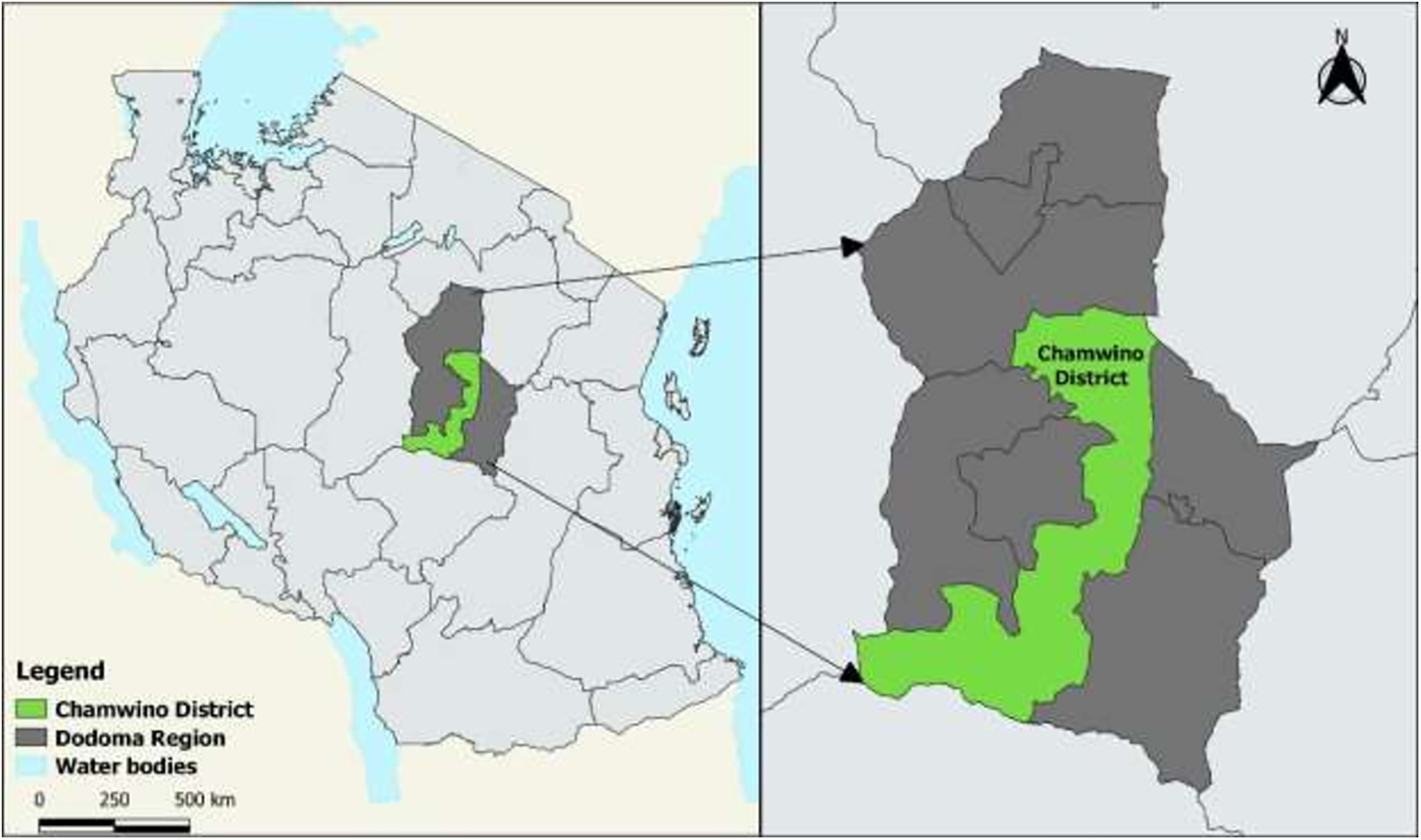
Map of the Dodoma region and the Chamwino District of Tanzania.
Prior to arriving in Dodoma, we conducted extensive reviews of academic literature and governmental policies (eg, the Tanzania National Accelerated Investment Agenda for Adolescent Health & Wellbeing) to understand the current state of school nutrition programs in low- and middle-income countries, especially in Tanzania. We also reviewed the best practices, practical considerations for developing and implementing these programs, and innovative solutions to address potential challenges.
A meeting with governmental stakeholders was held on January 14, 2020, at the University of Dodoma. We interviewed several regional and district-level governmental stakeholders, including health, education, and agricultural officers, about current regional practices and policies related to school nutrition. To further understand the status of school nutrition programs, we also visited secondary schools in Dodoma. We conducted in-depth interviews and focus group discussions with key school-level stakeholders, including school administrators, teachers, students, and parents. We developed guides for the interviews and focus group discussions (Supplemental data). We also examined the feasibility of introducing school-based interventions, including school feeding, school gardens, and education on agriculture, nutrition, and water, sanitation, and hygiene (WASH). We visited 10 public, nonboarding secondary schools, all located in the Chamwino District, a predominantly rural district with a high level of food insecurity. At each school, we interviewed the school headmaster or headteacher, 1 to 2 biology teachers, and had a focus group discussion with approximately 5 or 6 students from grades 8 and 9 (14-15 years old). At one of the schools, we also had a focus group discussion with approximately 10 parents. The interviews were conducted in either English or Swahili, and we worked with local guides who were fluent in both languages.
Results
Governmental Stakeholder Meeting
School feeding
All governmental stakeholders interviewed agreed to the importance of school feeding programs that provides at least 1 meal a day but noted that few schools currently implemented a program. They mentioned that where such programs exist, they are primarily run using monetary and in-kind contributions by parents, with additional materials such as cooking oil procured from local markets. The stakeholders mentioned potential difficulty sustaining the project, as it was not in the Tanzania government’s current plan or budget to fund school feeding programs in secondary schools. Previous school feeding programs organized by the World Food Programme had to be discontinued because project funding was exhausted without consensus between schools and parents about sustaining the program through parental contributions. They suggested that a centralized kitchen model that serves multiple schools, as used in large urban centers, would not be feasible in the Dodoma region as most schools were far from one another. They also suggested that menus for school feeding programs should ideally be decided locally and supplemented with animal-source foods such as meat and milk.
School gardens
The governmental stakeholders suggested that to sustain an effective school garden intervention, considerations should be given to the availability of water, the school’s willingness, and the presence of agricultural expertise. They mentioned that the garden should aim to grow crops able to produce all year round and that in the Dodoma region, many crops such as beans, maize, millets, cabbage, and potatoes could be grown. They suggested that gardening be done after school hours and that school student clubs could be leveraged to make the intervention work. A particular challenge would be the lack of water for irrigation throughout the year. Thus, the gardening activities would be more feasible in schools close to water sources and that water harvesting during the rainy season would be necessary for a successful intervention.
School nutrition education
The stakeholders noted that nutrition was taught as a subject in secondary schools, whereas topics on WASH were taught from primary to secondary school. They suggested that many schools had mandatory clubs such as biology and nutrition, which could be tapped into to deliver additional information and materials regarding nutrition and good WASH practices. They also mentioned that recently a national guideline regarding special education on menstrual hygiene had been issued. While they agreed that there was a possibility to enhance education related to nutrition, WASH, and menstruation, the lack of adequate washrooms, sanitary pads, or limited education on these issues represented a critical constraint.
School Visits
General characteristics
All 10 schools we visited were located in the rural area of the Chamwino District. All were located far from the urban area without good roads to access them. The 10 schools varied in size, ranging from 220 students in total to 1033 students in total. The number of classes (“streams” in the Tanzanian education system) within a grade (“form” in the Tanzanian education system) varies from 2 to 5 classes. The number of students per class is relatively more stable, with most schools having 40 to 50 students in each class.
School feeding
Eight of the 10 schools visited had some experience with providing school meals. Two schools had an ongoing school lunch program for all students, and 3 schools had discontinued the lunch program in the past 2 years. The remaining 3 schools did not provide school lunches to all students. However, they provided a mid-morning porridge to all students, or lunch to a subset of students (eg, students staying in the hostel, or grade 11 students preparing for the national examination). In all schools, the administrators and teachers stated that providing lunch would increase school attendance, improve attention and school performance, and reduce school dropouts. The interviewed students also expressed a generally favorable opinion toward having a school lunch program.
Where provided, the school lunch was usually the first meal for the students in the day. The lunch usually consisted of ugali (a traditional Tanzanian staple dish made with maize flour and water), which was occasionally supplemented with beans or vegetables (eg, Chinese spinach). In some schools, makande (a dish made from polished maize and beans) or rice and beans were also provided occasionally to bring some variety into the diet. None of the schools visited provided fruits as part of the meal. The meal was usually cooked on-site using firewood as fuel, and by a cook hired from the local village. Although some schools had designated a room as the kitchen, the room was usually in poor condition and were lacking in hygienic conditions (eg, lack of roofing). In other schools, cooking was done outdoors in the open. The staple foods used to prepare the meals, including maize, rice, and beans, were not fortified with micronutrients, but ingredients bought from the local markets such as salt and cooking oil were usually fortified.
Financing was the biggest challenge for establishing and sustaining school feeding programs. Lack of funding was the primary reason for discontinuing the program in schools where it previously existed. Unlike the school feeding programs in many other countries funded wholly or partly by the government, meal programs for secondary schools in Tanzania did not typically receive financial support from national, regional, or local governments. Further, there was a near consensus among the school administrators and teachers that the national government was unlikely to finance the school feeding programs in secondary schools in the near future. Instead, the programs were primarily funded by parents through monetary contributions or in-kind contributions, which generally consisted of a combination of maize and beans. In schools where gardening was practiced, the produce from the gardens might also be used to supplement the meal program.
This reliance on parents’ contribution led to instability of the school feeding programs in several schools, as they were unable to convince all parents to make monetary or in-kind contributions to the program each year. The interviews with teachers and school administrators revealed that some parents were unable to contribute as they were poor. Since most of the students’ families practiced agriculture, this lack of ability to contribute was more pervasive in years of drought. However, the more commonly stated reason for the lack of parental contributions was the lack of awareness among parents regarding the importance of adolescent nutrition. The headmaster of one school that had managed to continue its lunch program for many years stressed the importance of transparency and accountability of usage of the contribution. None of the schools had a formal monitoring committee that accounted for the accumulated contribution. As a result, parents might be wary of contributing to schools due to a lack of trust in the proper usage of the contribution.
School gardens
All 10 schools visited had some land potentially available to be used for a school gardening program. The area of available land ranged from 1 to 30 acres. Three schools had a school garden program that they planned to continue. Two schools used to have a school garden but had discontinued in recent years for various reasons. The challenges mostly stemmed from the lack of financial resources to purchase water from the local village or purchase irrigation equipment to support gardening activities. Several other challenges were also mentioned, including the lack of fences to protect the garden from animals, and the fact that some teachers lived far away from the school, which hampered the teachers’ availability to stay after school to monitor the gardens.
Based on the existing school gardens, various vegetables and fruits could be grown, including Chinese spinach, cabbage, cassava, onions, potatoes, tomatoes, and bananas. Schools that already had a school garden program did not find it challenging to engage students in gardening activities. In schools where a school garden was not available, the students also expressed keen interest in gardening. One headmaster said, “Most students love gardening because that is what they do at home with their parents.”
Schools tended to dedicate different amounts of time and time slots to school garden activities. Some schools had the students conduct gardening activities every day with 30 min/d, while some assigned it to be 2 to 3 d/wk with 1 to 3 h/d. Regardless of the specific time assignments, it appeared highly feasible to find time after school (between 2:30
Among schools with gardening programs, students maintained the gardens under the guidance of the teachers on duty. Involvement with agricultural extension workers was rare and often informal, and as expressed by a teacher, “agricultural extension workers’ supports would be nice to have, but not absolutely necessary.” Schools appeared to have the capacity to maintain gardens and grow common crops (eg, maize and sunflowers) without relying on external expertise. Tools for gardening did not appear to be an issue of concern, as many parents were willing to let the students bring tools from home to be used at school.
School nutrition education
Meetings with school stakeholders revealed that all students learned from a standard curriculum issued by the Tanzanian government. Most teachers we interviewed responded that students learned about nutrition in biology during grade 9. A few schools had a dedicated health teacher, while most schools only relied on the biology teacher to teach these subjects. The curriculum covered a range of topics, including macronutrients and essential micronutrients, different food groups, and the composition of a balanced diet. The governmental stakeholders and school-level stakeholders agreed on several issues. However, they diverged on the quality of education. The governmental stakeholders stated that nutrition education was high quality, while most teachers thought that the coverage of nutrition in the curriculum was brief and not in-depth. The teachers also expressed that the curriculum was highly theoretical and did not place adequate emphasis on practical skills or competencies. As one teacher pointed out, “The students learn about the topics but not in a way that is highly applicable to their lives and useful once they leave school.” The teachers also repeatedly expressed frustrations with the disconnect between the nutrition lessons students were learning in the classrooms and the practical challenges of adopting a healthy diet, given the constrained resources in the communities. As one teacher pointed out, “The students and their families cannot afford to buy the foods we teach them to eat.”
One school reported that they invited local health officials 2 to 3 times per year to conduct seminars on health and well-being. The teachers at this school expressed that the students were engaged in these seminars and appreciated the opportunity to learn more about health and well-being. All interviewed teachers at the 10 schools agreed that further reinforcing the knowledge and skills around nutrition, agriculture, and WASH through extracurricular activities would be beneficial.
Regarding education on agriculture, most teachers responded that students learned about topics such as soil management in chemistry and animal keeping in geography. However, they also emphasized that the curriculum was highly theoretical and did not allow students to practice the agricultural knowledge and skills they learned from the classrooms. In contrast, the schools that had gardens expressed that they were able to provide more practical education through the gardening program.
The status of WASH education was mixed as well. Students learned about personal hygiene and how to keep their food clean and safe in biology class. However, resource constraints made applying these skills difficult; none of the schools we visited had hand soap in the washrooms, and most did not have running water available. Many teachers did say that they would informally discuss the importance of personal hygiene with their students outside the classroom. However, these informal conversations targeted specific students who demonstrated poor personal hygiene on a case-by-case basis.
Discussion
This situation analysis provided an informative snapshot of the current nutritional context in rural Tanzanian schools. We report a shared willingness among various stakeholders to improve students’ access to high-quality school feeding, school gardens, and education on nutrition, agriculture, and WASH. We reveal several practical challenges that will hamper the implementation of school-based nutrition interventions such as lack of funding for school feeding programs and lack of water and resources for school garden programs.
The past 2 decades have seen an increasing number of countries starting school feeding programs to provide meals to school-going children and adolescents to improve nutrition and education. 13 School feeding programs have become popular because they leverage the existing school system and allow the government or the implementing agency to provide food to children and adolescents at a common location. School feeding has traditionally been used as a social safety net measure to incentivize families to send their children (especially girls and children from disadvantaged socioeconomic backgrounds) to school and keep them in school for education. 15 School feeding programs also achieve multiple objectives at the intersection of nutrition and education, as compelling evidence indicates the benefit of quality nutrition on educational outcomes. School feeding programs can improve school attendance, retention, and learning and improved gender equality through increased girls’ enrollment and reduced dropout rates. 15 -20 However, countries continue to prioritize feeding in primary schools and tend to provide less support for school feeding programs in secondary schools for adolescents.
In the rural Tanzanian schools visited, every school had at present or sometime in the past operated a school feeding program. For the schools that had to stop their programs, funding was the most significant barrier to sustainability. All schools expressed a desire to put one in place if a more sustainable supply model could be implemented. In the schools we visited that did have a sustainable school feeding program, their success may be attributable to several factors, including the championship of school leaders, close engagements with families and communities, and high accountability and transparency regarding the use of financial and in-kind contributions. Prior studies have examined the challenges in implementing such programs through a national lens. An evaluation of a school-based feeding program in Ghana reported that the challenges faced by schools included a shortage of water, adequate space to prepare and store foods, and the quantity of food supplied to meet the nutritional needs of the student population. 21 While water shortage and the lack of adequate kitchen structures also presented challenges for school feeding programs in Tanzania, most of the school stakeholders we interviewed did not consider the space for food storage a challenge. The concern around food adequacy was not raised in our study either as the students’ diets are so sparse that any school feeding program was better than none. Future studies should also assess the potential impacts of other contextual factors such as school location (urban/rural) and school size on the sustainability of school feeding programs and other school-based interventions.
Other school feeding programs have also incorporated a higher degree of government involvement to facilitate cross-sector collaboration and address some of the concerns raised in our study. A school feeding program in Kenya transitioned away from the World Food Programme funding in the late 2000s. The government collaborated with international stakeholders to take more ownership of the program. 22 As a result, the government facilitated coordination between schools and local farmers to purchase and supply foods, helping the local agriculture economy and students’ access to nutrition. However, this remained a challenge for students in rural communities, as many farmers would have to travel long distances to deliver their crops. Stakeholders in the present study remained doubtful that the government would take ownership of such programs in the near future.
Growing food at schools provides the double benefit of educating students on agricultural production and supplying modest crops to contribute to school feeding programs. 23,24 Several of the schools we visited had already implemented school gardens, and stakeholders from schools without school gardens were also interested in establishing a garden. They expressed that certain aspects of the school gardening program would be easier to implement than others. For example, schools had adequate land for gardening, and students could bring tools from home. However, some schools expressed concerns about water access and the potential for animals to consume the garden produce while unprotected. Another study documented teachers’ and administrators’ perceptions of school gardening programs in South Africa. 25 Nongovernmental organizations played an integral role in funding and supporting these programs. The teachers and administrators expressed many similar benefits and concerns, as in our study. For example, they felt that the gardens were an excellent forum in which to practice real-life skills that students could take with them into their communities. However, they also felt that the program would not be sustainable without the support from the nongovernmental organizations. They felt that teachers alone could not support the full work of maintaining the garden and that the funding for the supplies could not be generated through other means. One solution to overcome these concerns would involve local agricultural extension workers to teach students and help maintain the gardens.
We found that students already receive school education related to nutrition, agriculture, and WASH. The main concern raised was that the curriculum lacked practical, skills-based lessons that students could take with them into their communities. Teachers also acknowledged that education alone would not solve the nutritional challenges students faced as they lacked access to the foods needed to maintain a healthy diet. School districts in other communities have attempted to examine and improve the existing nutrition, agriculture, and WASH curriculum. A systematic review of school-based nutrition programs focusing on nutrition education showed that the most effective programs at modifying behavior among students focused on skill-building related to areas such as food preparation and storage. 26 This review also suggested that these interventions were most effective when paired with other interventions such as enhanced school feeding programs. Notably, this review included studies that were conducted in the United States and European countries. A recent study by Gelli et al 27 in Malawi found that community-based early childhood development centers for preschoolers were effective in building community and parent capacity for nutrition and agriculture, which in turn improved nutrient intakes, dietary diversity, and anthropometric measures (even for younger siblings in the same household). This study again shows the potential of schools (or preschools) as outstanding platforms for delivering nutritional and educational interventions capable of reaching not only the children themselves but also other household and community members.
Although many of the studies focused on students in low-income communities who face similar challenges in Tanzania, the settings and challenges differ in meaningful ways, including the climate and the availability of alternative food sources for low-income students. Another qualitative study of teachers’ perceptions of the nutrition curriculum in South Africa showed that teachers shared many of the same thoughts on the value and purpose of nutrition education. 28 The study took place in a similarly resource-constrained community that taught nutrition education as part of its nationally mandated curriculum. The teachers varied in their perception of the comprehensiveness of the curriculum. The teachers expressed that their main goal was to impart knowledge that could be used in the long term and that the secondary goal was to teach students skills that they could use in the immediate future. They acknowledged the resource constraints facing their student populations and expressed that the information would be valuable to students in the future even if they could not apply the lessons of obtaining a healthy, balanced diet in the present. This study, similar to our situational analysis, suggests that teachers perceive a strong nutrition curriculum that combines practical skills and theoretical knowledge to confer the greatest benefits to students.
To address the double burden of malnutrition in Tanzania and other SSA countries, school-based nutrition interventions among adolescents must focus not only on the existing burden of undernutrition but also on the emerging risk of overweight and obesity. Double-duty action is an emerging concept that refers to interventional programs that aim to address malnutrition in all its forms in a more holistic manner. 29 School-based interventions are promising candidates of double-duty actions. For example, school feeding menus can be designed to provide sufficient micronutrients and calories to prevent undernutrition while restricting intakes of sugar, salt, and saturated fat to prevent overnutrition. 29 Further work is needed to better understand how various school-based interventions can be reimagined as double-duty interventions.
Schools present a promising yet underutilized platform to reach a large section of the adolescent population, with high feasibility of implementing nutrition-sensitive interventions. We conclude that there currently exists an ad hoc and localized approach to tackling the double burden of adolescent malnutrition in Tanzania. There is an urgent need to engage with policymakers and nongovernmental partners to design and implement integrated, school-based programs that combine various interventions to leverage the tremendous potential of schools to confer long-lasting benefits on the adolescents themselves and their future families.
Supplemental Material
Supplemental Material, sj-docx-1-fnb-10.1177_03795721211020715 - School-Based Nutrition Programs for Adolescents in Dodoma, Tanzania: A Situation Analysis
Supplemental Material, sj-docx-1-fnb-10.1177_03795721211020715 for School-Based Nutrition Programs for Adolescents in Dodoma, Tanzania: A Situation Analysis by Colette Rector, Nadhira Nuraini Afifa, Varun Gupta, Abbas Ismail, Dominic Mosha, Leonard K. Katalambula, Said Vuai, Tara Young, Elena C. Hemler, Dongqing Wang and Wafaie W. Fawzi in Food and Nutrition Bulletin
Footnotes
Authors’ Note
All authors contributed to conception and design of the research. CR, NNA, VG, and DW contributed to acquisition of the data. All authors contributed to interpretation of the data. CR, NNA, VG, and DW drafted the manuscript. All authors critically revised the manuscript. All authors gave final approval and agreed to be accountable for all aspects of the work ensuring integrity and accuracy.
Acknowledgments
The authors thank Remmy Andrew, Athuman Matindo, and Medard Andrew Nguma for their assistance with school visits.
Declaration of Conflicting Interests
The author(s) declared no potential conflicts of interest with respect to the research, authorship, and/or publication of this article.
Funding
The author(s) disclosed receipt of the following financial support for the research, authorship, and/or publication of this article: This work was supported by the program of “Walker Study Group: Improving Public Health through Nutrition & Agriculture” of the Departments of Nutrition and Global Health and Population at Harvard T.H. Chan School of Public Health, and the Center for Public Leadership at John F. Kennedy School of Government.

Supplemental Material
Supplemental material for this article is available online.
References
Supplementary Material
Please find the following supplemental material available below.
For Open Access articles published under a Creative Commons License, all supplemental material carries the same license as the article it is associated with.
For non-Open Access articles published, all supplemental material carries a non-exclusive license, and permission requests for re-use of supplemental material or any part of supplemental material shall be sent directly to the copyright owner as specified in the copyright notice associated with the article.
