




Abstract
Effective governance is essential for effective nutrition program implementation. There are additional challenges in launching multisector plans to enhance nutritional status. The present study compares the challenges and opportunities in Ethiopia and Nepal in designing and implementing a multisector plan for nutrition. A semi-quantitative questionnaire with open-ended questions was used to solicit information from senior national-level policy officials and other key stakeholders. The nature of the major nutrition problems in each country was similar; these include malnutrition (particularly stunting), food insecurity, and micronutrient malnutrition. The main challenges identified included the need for more specificity in the roles of agencies/individuals in program implementation, more effective mechanisms for linking national to subnational officials, methods for creating awareness of the plans, and a dedicated line item in the budgets of each agency. The level of enthusiasm was high in both countries. Respondents in both countries highlighted the need to identify a “champion” at the highest level who would keep the momentum for the respective plans alive.
Introduction
There has been an increased focus on nutrition policies and programs globally since the world food price crisis of 2007 to 2008. More recently, the spotlight on nutrition has been reinforced by the sustainable development goals. This renewed emphasis has been manifested in terms of 2 major programmatic thrusts: a focus on scaling up a defined set of evidence-based nutrition-specific actions, on the one hand, and broader so-called nutrition-sensitive investments in multiple sectors at once. Governments that have embraced the prioritization of nutrition typically seek to combine nutrition-specific and sensitive investments within complex multisector approaches. This principle was endorsed at the second International Conference on Nutrition in 2014 noting that, “it is well-established that nutrition objectives can only be achieved through a multi-sectoral response. This requires different sectors and stakeholders working together in a more coherent and collaborative manner to address malnutrition in all its forms.” 1 (p3)
Among numerous low-income countries that have made major commitments to improving nutrition through multisector action, Ethiopia and Nepal stand out as early adopters of such principles. Both governments developed national strategies and plans of action in the past 5 years 2,3 ; however, the budgetary allocations to implement these strategies have been an on-going challenge.
Ethiopia has a National Nutrition Strategy 2 and National Nutrition Plans (NNPs) of 2008 and 2013. 4,5 In addition, the Government of Ethiopia (GOE) has established a National Nutrition Coordinating Body (NNCB) chaired by the Minister of Health with representation of each ministry with a nutrition portfolio. Nepal has some structures that mirror those in Ethiopia. The Government of Nepal launched a national Nutrition Assessment and Gap Analysis process in 2008 (following the publication of the first influential Lancet series on nutrition), which involved extensive consultation leading to a formal report. 6 This led to a strengthening of the nutrition focus of Nepal’s National Planning Commission (NPC), which chaired the process of developing a Multi-Sector Nutrition Plan (MSNP) covering the period 2013 to 2017. 2 The National Planning Committee, chaired by the Minister of Finance, has continuing oversight responsibility for rollout of the MSNP nationwide.
Although these developments on paper represent critical first steps in tackling malnutrition, integrating actions across multiple sectors of activity can be challenging. In Nepal, for example, the start-up of actions at the local level has been a gradual process. A particularly difficult area is the identification of ways to decentralize programs to the local levels. The process of designing and implementing complex programs to accelerate gains in nutrition has many dimensions, including technical, logistical, political, economic, and social. As yet, there is little empirical evidence of best practice for scaling up nutrition programs. 7
The aim of this article is to provide research on challenges and opportunities in implementing a multisector program to improve nutrition. In doing so, the article compares data from 2 different countries, Ethiopia and Nepal. It is based on on-going research in Ethiopia and Nepal that assesses the theoretical and pragmatic challenges involved in designing and implementing multisector actions for nutrition. The current article presents results from interviews with key stakeholders in both countries involved in national-level discussions on multisector nutrition policy design and subsequent program implementation. A total of 50 semi-structured interviews (Ethiopia and Nepal combined) provide insights into the way national governments and their development partners approached the creation, formal ratification, and implementation of these complex policy instruments aimed at improving nutrition in countries that still carry very high burdens of undernutrition. The first section describes the study methods and approach used to generating data; the next presents aggregated and disaggregated results from such stakeholder’s interviews, including interpretation of key results. The final section distills the findings in terms of policy-relevant conclusions and next steps for research needed to flesh out guidance on best practice.
Design and Methods of the Study
This study was based on semi-structured key informant interviews with individuals purposefully selected for their involvement in (and/or deep knowledge of) the policy landscape in Ethiopia or Nepal. The specific individuals to be interviewed were identified by government and other partners involved in the development of the multisector nutrition plans. Interviews were conducted at the national and subnational levels. This article focuses on the national-level results from Ethiopia and Nepal. The methods are discussed in more detail in this issue (Webb et al., 2016). 8,9 A total of 24 interviews were conducted at the national level in Ethiopia and 26 interviews in Nepal. The sectors in which such individuals work included, but were not limited to, health, agriculture, education, finance and economic development, gender, child nutrition, youth affairs, and social protection. People were selected based largely on the seniority of position held and on active engagement in the process leading up to government endorsement and implementation of multisector nutrition policies and plans. As such, interviewees included stakeholders from the government, academic institutions, United Nations (UN) agencies, bilateral donors (US Agency for International Development, Department for International Development, Canadian International Development Agency), and nongovernmental bodies or programs (eg, Save the Children, Micronutrient Initiative, Alive & Thrive and Food and Nutrition Technical Assistance 3). Interviews were conducted in ways to maintain the anonymity of respondents, and only aggregate (deidentified) data are reported. The number of interviews conducted reflected the range of institutions involved in design and implementation of the multisector nutrition plan; this guided the number of interviews conducted at the national level.
It is worth emphasizing that the responses represent the perceptions and opinions of key stakeholders. There is no attempt in the analyses to identify a “right” answer. However, by better understanding the lens through which different constituents view the multisector nutrition planning process, policy makers may be able to more effectively respond to challenges and opportunities involved in the design and implementation of the multisector nutrition plans.
The questions ultimately included in the surveys were based on protocols reported in the literature and pretesting at the national level. The questions were open-ended, and answers were coded within categories. For example, comments such as “not enough food” or “too little food” were clustered within the food insecurity category. An interview guide was also developed. Using this interview guide, the questions asked were clustered into 4 domains: (1) the nature of the nutrition problems to be addressed by multisector action; (2) decision-making and ownership of the process; (3) policy and program design; and (4) challenges in implementing multisector actions. The results are reported according to these 4 major domains, although categories 3 and 4 are combined in presenting the analysis. The domains were arrived at after discussions with the principal researchers in each country and analysis of the pretesting data. Some of interview data were entered directly on to computers, whereas others involved a “pen and paper” approach. For those interviews conducted with pen and paper, the interview data were entered into the computer database on the same day the interview was conducted.
Results
The data were analyzed and summarized within each of the 4 domains.
Domain 1: Nature of the Nutrition Problem
Respondents in both Ethiopia and Nepal identified the same set of 3 major problems to be tackled via multisector programming. In Ethiopia, these were (in order of priority) food insecurity (27%), undernutrition/malnutrition (30%), and widespread and/or severe micronutrient deficiencies (20%). In Nepal, the problems identified were malnutrition (45%), micronutrient deficiencies (33%), and food insecurity (22%). When pushed to specify the highest nutrition problem of concern to policy makers, a majority (>60%) of respondents in both countries identified child stunting. This likely reflects the increased focus since the 2 Lancet publications on stunting, especially in children less than 2 years of age. Since 2008, stunting has largely replaced underweight as the indicator of choice for international development goals and policy agendas. The questions used in the survey not only identified the major nutrition problems but probed further to ascertain the underlying causes of malnutrition.
Although there was consistency in reporting priority nutrition-relevant issues across the 2 countries, individual respondent narratives caution against viewing Ethiopia or Nepal through a single lens. There was frequently a more nuanced response to questions about malnutrition than a single word, like stunting, can capture. Consider the following 2 quotes: There are huge variations in nutritional status in accordance with geography and economy. (Government Official, Kathmandu, Nepal) Ethiopia is not one country when it comes to nutrition; policy officials and program implementers need to understand the diversity of problems and causes within the country. This will lead to a more meaningful approach to solving the distinct problems. (Academic researcher, Addis Ababa, Ethiopia)
Domain II: Decision-Making and Ownership
A body of literature suggests that the sustainability of nutrition interventions depends on the process of developing and implementation of strategies to be “country owned.” 7,10,11 As a result, a number of questions in this study sought to ascertain the process of plan formulation and the extent to which such processes may have affected a sense of national ownership or exclusion.
Two answers dominated the discussions in Ethiopia. First, 32% of respondents indicated that the involvement of many different parts of government was instrumental in developing and launching the 2013 NNP, that is, the plan was widely deemed to be legitimate because of broad consultation and engagement of all sectors having a role to play in nutrition. Second, 26% of those interviewed emphasized that the role of international nongovernmental organizations (INGOs) was essential, both in terms of securing buy-in from civil society and in ensuring adequate technical input into decision-making.
Once again, Nepal’s experience was similar, but the magnitude of responses differed. In Nepal, 92% of individuals stated that the NPC was an effective champion for nutrition and reached out to all line ministries to play a role in formulating and implementing the MSNP. A number of respondents identified the chair of the NPC as a key player in the whole process, using his authority and charisma in equal measure to promote a cause in which he strongly believed. This also presents a challenge as the chair of the NPC rotates and does not guarantee this same level of enthusiasm for nutrition. The second main response in Nepal also related to the role of civil society. Roughly 32% of respondents credited INGOs, specifically Helen Keller International, with having played an important role in supporting the NPC in generating multisector buy-in and in rallying civil society around the government’s plan.
Further probing identified specific activities or events that were instrumental in moving policy negotiations forward. In Ethiopia, for example, 2 responses dominated: on one hand, 47% of those interviewed argued that the creation of a formal multi-institutional technical working group was critical to marshalling necessary evidence and ensuring adherence to a defined time line. This technical group was created specifically to provide input in the multisector plan. Another 29% stressed a large government-sponsored workshop in 2010 was important in raising political awareness of the problems associated with stunting, the 1000-Day agenda (promoting a multisector focus on preventing stunting from conception to a child’s second birthday and to the evidence base relating to possible solutions). As noted by one of the workshop participants, The 1000 days [agenda] had a big positive influence in giving visibility to nutrition-sensitive development. (NGO representative, Addis Ababa, Ethiopia)
However, there were some ownership issues that needed to be addressed in the context of plan implementation. First, although enthusiastic about the NNP and the way in which it was developed, roughly a third of Ethiopian respondents said that there needs to be more direct involvement of the Ministry of Agriculture (MOA) in fleshing out what a plan on paper needs to look like on the ground. Indeed, 36% of all the respondents suggested that MOA is inadequately equipped to tackle nutrition and still needs to be convinced that it is the role of agriculture to support nutrition goals. Additionally, 42% of those interviewed still felt that rollout of the plan would have to be led by the MoH and that there was a danger that the earlier collaborative multisector approach to plan formulation would drop away during implementation.
In Nepal, different perspectives were expressed on the activities and events that influenced the development of the MSNP. Unlike Ethiopia, 44% of respondents in Nepal stated that the MoH was unlikely to launch multisector activities for nutrition without the sustained involvement of other stakeholders, including numerous other parts of government. This was seen to be due to Moth’s fairly narrow focus on targeted nutrition-specific actions, such as vitamin supplement distribution and breastfeeding promotion. Indeed, 20% of the interviewees reported that an earlier Joint Nutrition Support Programme (JNSP), developed by WHO with funding from the Government of Italy (1985-1990), did not succeed because it was too grounded in MoH and not institutionalized across other ministries (despite adequate funding and the ostensible involvement of other ministries). The final evaluation of JNSP was critical, in large part, because the program was unsuccessful in reaching the district and community level. When asked why the new MSNP will be different, a striking 72% of individuals stressed that all agencies were involved in the design and implementation of the plan. Another 36% observed that the MSNP was not a top-down initiative; importantly, there are critical roles at the district and village levels in discussing priority actions and in making local commitments to nutrition goals. The roles of the myriad of actors involved in implementation vary by agency and job category, creating a challenge in identifying the specific roles of individuals, which can also vary by district and village. However, the optimism about the viability of the MSNP is captured in the following 2 quotes: Ownership is more in this plan [MSNP] than previous ones. (Donor, Kathmandu, Nepal) It [the MSNP] is a collective effort. These (past) efforts that contributed towards nutrition were vertical but now the efforts are coordinated with well defined goals and defined activities. (Government Official, Kathmandu, Nepal)
Domain III: Program Design, Implementation, and Challenges
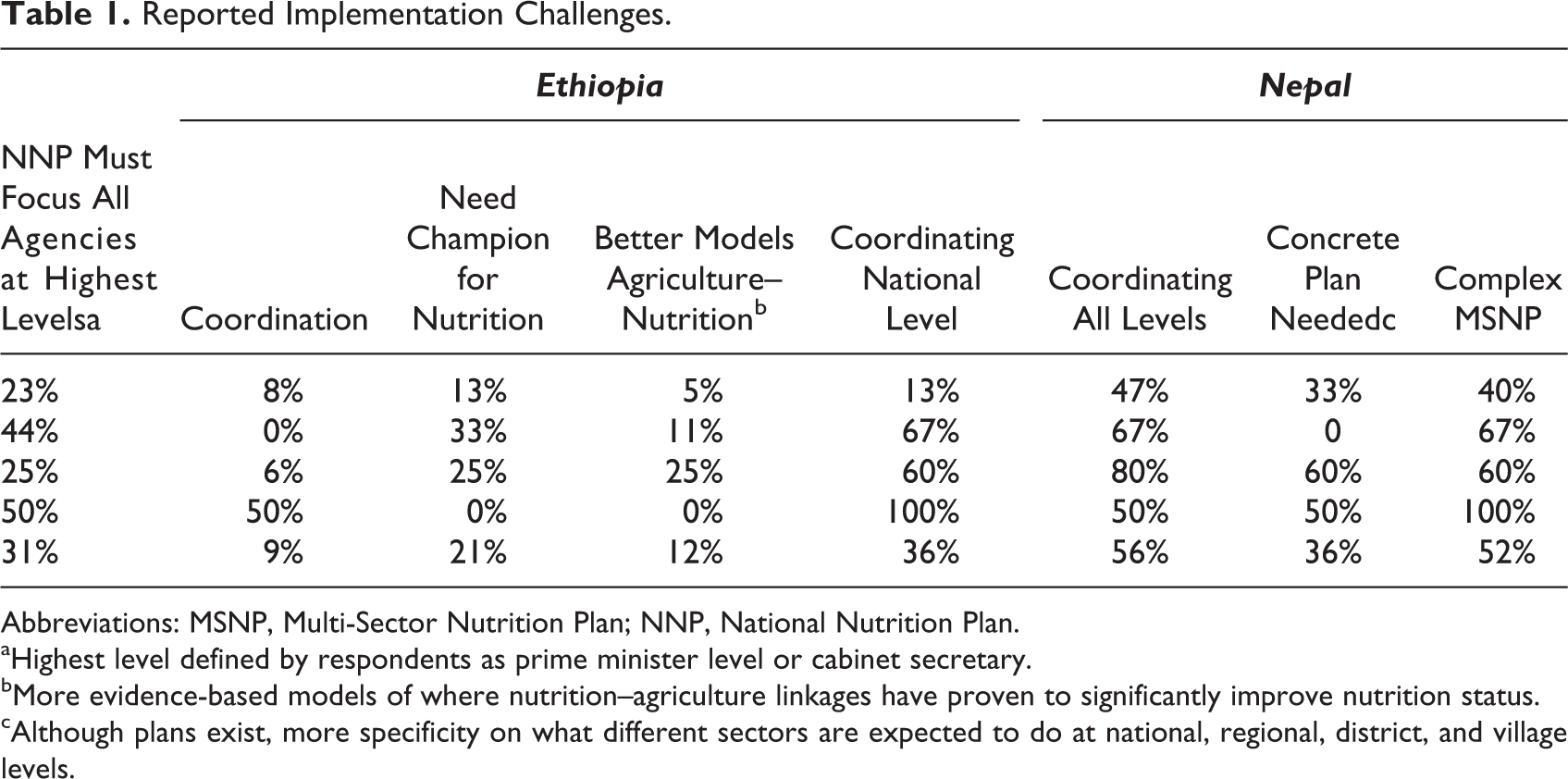
Optimism does not mean that those interviewed were blind to potential challenges. Table 1 summarizes major challenges identified, disaggregated by respondent groups in both countries.
Reported Implementation Challenges.
Abbreviations: MSNP, Multi-Sector Nutrition Plan; NNP, National Nutrition Plan.
aHighest level defined by respondents as prime minister level or cabinet secretary.
bMore evidence-based models of where nutrition–agriculture linkages have proven to significantly improve nutrition status.
cAlthough plans exist, more specificity on what different sectors are expected to do at national, regional, district, and village levels.
Effective coordination is identified as a major concern in both countries, although the relative magnitude varies. In Nepal, a majority (56%) flagged the need for strong coordination at all levels—national, regional, district, and village—without it they argued that plan implementation would be in jeopardy. An additional 36% stressed that cross-sectoral coordination was crucial at the national policy-maker level, in part to sustain commitment and to changing business practices: Ministries are used to working in silos; the MSNP is a new way of working but there needs to be a willingness to come together. (Government Official Kathmandu, Nepal)
A further challenge to implementation identified in Nepal (by 36% of respondents) was the need for concrete action strategies outlining the steps for each sector, whereas 52% highlighted the need for clear guidance regarding responsibilities given the complexity of the MSNP. In essence, respondents were asking for a formulaic approach—step by step—for translating the multisector plans into action. Finally, there was a desire articulated to have nutrition as a focus of all agencies (31%). It was clear from the composite of responses that a work plan with a defined budget and responsibilities for specific tasks for individuals/agencies was being sought. The essence of these concerns related to a need for leadership for the NNP, not just multistakeholder buy-in.
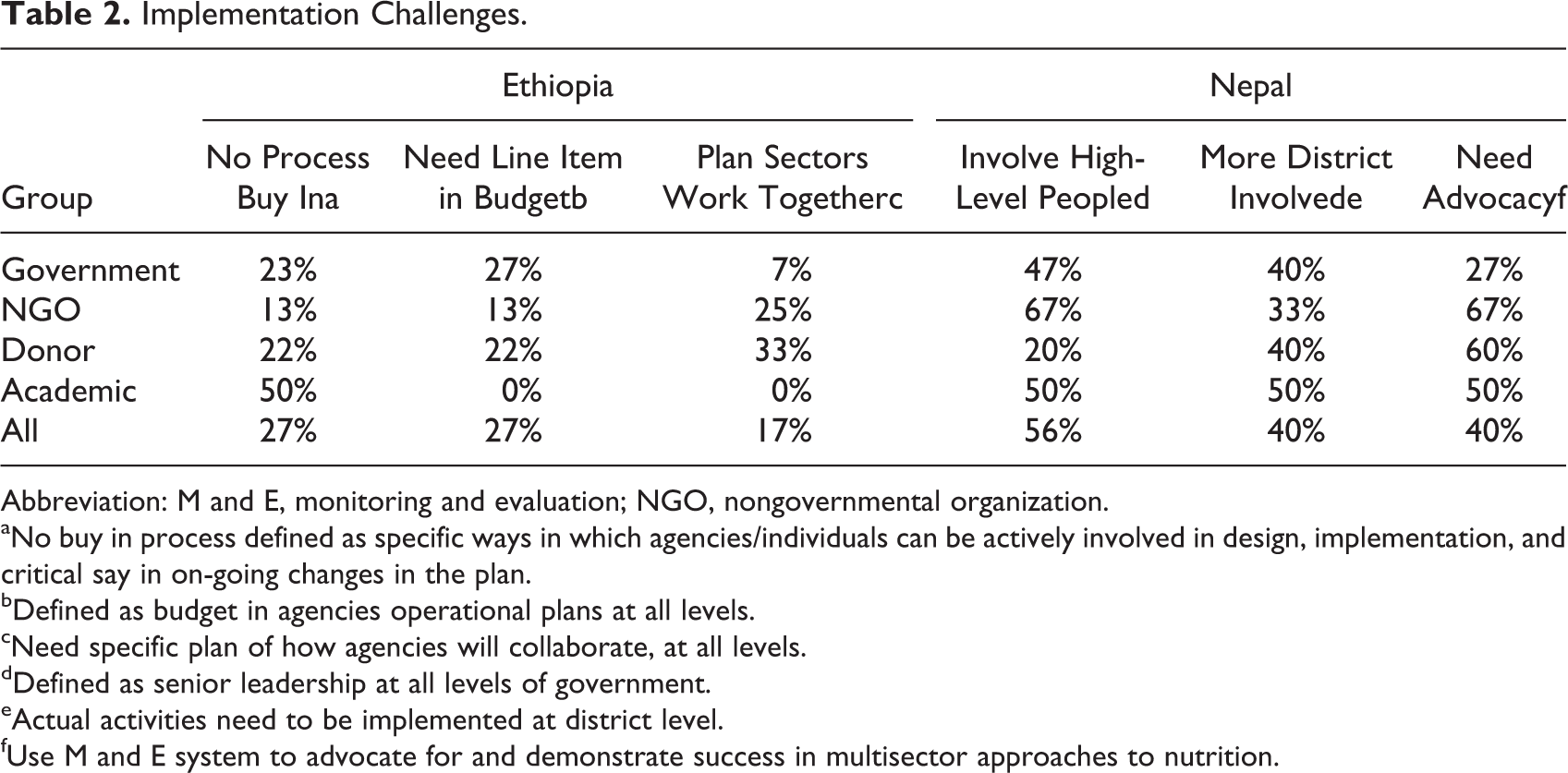
At the time of writing, the NNPs in both Ethiopia and Nepal are in the early stages of rollout. As such, it is too soon to determine how effectively they will be scaled up, their impacts, and their sustainability. However, it is not too early to consider current implementation challenges. Thus, respondents were asked about the main headaches going forward. As shown in Table 2, the main issues identified were (1) calls for a clearer mechanism through which all sectors can continue to be part of the process (27%), (2) the need for a defined line items for nutrition in the budget for each ministry (27%), and (3) a specific plan for how to implement the multisector approach within each agency (17%).
Implementation Challenges.
Abbreviation: M and E, monitoring and evaluation; NGO, nongovernmental organization.
aNo buy in process defined as specific ways in which agencies/individuals can be actively involved in design, implementation, and critical say in on-going changes in the plan.
bDefined as budget in agencies operational plans at all levels.
cNeed specific plan of how agencies will collaborate, at all levels.
dDefined as senior leadership at all levels of government.
eActual activities need to be implemented at district level.
fUse M and E system to advocate for and demonstrate success in multisector approaches to nutrition.
There were also 3 issues that dominated responses in Nepal: (1) need for continued involvement of high-level officials (56%)—sustained political engagement, (2) active district-level involvement in designing local nutrition actions and overseeing their implementation (40%), and (3) the need for advocacy relating to nutrition (40%). Here again, the focus on high-level officials and need for advocacy both reflect the concern that leadership and broad support are both needed to keep nutrition high on the agenda. This plea for continuity in implementation is further complicated by the regular turnover of individuals in senior political posts.
As noted above, apparently simple majority responses can mask a diversity of agendas. For example, in Ethiopia, the call for buy-in across all ministerial sectors was identified as a concern by 23% of government officials but only by 13% of the NGO respondents. Whereas in Nepal, 67% of NGOs and 60% of donors identified the need for advocacy on nutrition that was matched by only 27% of government officials. Since the lead implementers of nutrition plans in Ethiopia and Nepal are government officials, it is important to understand such differences in opinion and varied perceptions in what is most important to achieve success in coming years. Only in Nepal, the following question was asked: “What would success of the plan look like?” One view dominated the responses with 56% stressing that continued active involvement of all stakeholders would be the most important metric of effective action. In other words, the success of multisector actions appears to be gauged by many people in terms of the process—sustained multisectoriality in approaches to service and resource delivery is deemed by many to be the goal, and this in itself will support accelerated gains in nutrition outcomes. Ethiopia has made strides in this direction using a cadre of what is called the development army for service delivery. Such a view represents a testable hypothesis going forward.
Discussion and Conclusions
Ethiopia and Nepal are 2 countries that have launched multisector nutrition plans to address food security and nutrition issues in their respective countries. Although these countries are different in many ways, surprisingly, the respondents at the national level share many commonalities on the issues they identified as critical for the effective design, implementation, and sustainability of the multisector plans.
There are clearly numerous challenges identified in the process of implementing national multisector plans for nutrition. The overriding concerns among this sample of stakeholders are (a) committed leadership, (b) effective coordination across sectors, and (c) sustained engagement across a wide range of stakeholders.
There are grounds for optimism given the broad understanding of such critical factors in “nutrition governance.” For example, the National Nutrition Coordinating Body (NNCB) in Ethiopia, with higher level government officials and parliamentarians, renewed the national commitment to end hunger and undernutrition in Ethiopia by 2030—the ambitious “Seqota” declaration. 12 This represents a continued policy commitment to nutrition. In addition, the GOE recently launched its second, 5-year Growth and Transformation Plan, which includes stunting as an indicator and an emphasis on multisector approaches to improving nutrition.
Similarly, after the MSNP was ratified, Nepal’s Government met the representatives of UN agencies, other development partners, civil society, and private sector businesses to sign a Declaration of Commitment for an Accelerated Improvement in Maternal and Child Nutrition. This Declaration represented a public acknowledgment across multiple cross-sectors of the need for a sustained collaborative effort to achieve improved maternal and child nutrition. To support awareness and information sharing regarding such commitments, the NPC supported the creation in 2015 of an online “Nepal Nutrition and Food Security Portal” to serve as an “open access ‘One-Stop-Shop’ for all the resources, information, and updates related to nutrition.” (http://www.nnfsp.gov.np/AboutPortal.aspx). Importantly, the portal makes it clear that “the determinants of nutrition and food security are multisectoral, and hence, various government and nongovernment sectors are responsible to provide multipronged responses.”
The major nutrition problems that were identified as affecting both countries are similar. There is a palpable level of enthusiasm expressed for the nutrition plans. Unlike some earlier efforts to address malnutrition, the current plans used a more participatory process for development, and this, in part, has helped develop a shared sense of ownership for the plans.
A genuine commitment is needed in all sectors to ensure the successful executive of the plans. To that end, most respondents highlighted the imperative need to engage cross-sector collaborations or as some noted “road maps” that will guide implementation. These road maps are needed at all levels of government, and particularly, flagged is the huge gap in our understanding of action plans at the district levels that effectively knit together sectors in a consolidated effort to improve nutrition.
Not surprisingly, both countries stressed the need for capacity development at the individual and institutional level. This focus must go well beyond the technical issues and involve factors such as advocacy, communication, and monitoring and evaluation (M and E) capacities. The M and E capacity was not only viewed as critical in the understanding of areas of success of the plans but also in providing data for the periodic redesign of the approaches. Currently, an M and E system for multisector plans does not exist. At this juncture, with the initial launch of plans in place, it is critical that each country identify the resources—human, institutional, and budgetary—to develop a credible M and E system. Additionally, validated metrics of leadership, capacity, commitment, and engagement need to be tested and reported as part of the international research agenda focused on better measuring nutrition governance.
Without a doubt, good governance, with all its elements, is essential for success of policies and programs. The new nutrition agenda presents some particular challenges in the governance arena; in that, the multisector approach requires some untested approaches. In essence, the theories put forth for a multisector strategy and need evidence of effective implementation—at all levels. What data in this article highlight is that a “business as usual” model is unlikely to ensure success, without bold new directions to translate plans into action. The former director general of the UN, Kofi Annan, noted that “good governance is perhaps the single most important factor in eradicating poverty and promoting development.” 13 Indeed change is occurring.
The New Partnership for Africa’s Development (NEPAD) involves 20 members who have committed to a peer-review mechanism to reverse what African leaders have described as “lack of accountability, political authoritarianism, state failure, and corruption to embrace and consolidate democracy as well as effect sound and transparent economic management.” 14 The initial call to action by NEPAD acknowledged that capacity in Africa is weak, and additionally, public institutions have, by and large, been a failure. As noted by 1 researcher, “constitutes the most important advance in African development policy during the past four decades.” 15
Another example is the African Nutrition Leadership Programme that has focused attention on both individual and organizational leadership capabilities stressing tailor-made, needs-based approaches for implementation of nutrition-related interventions. 16 The recent calls for a data revolution, supporting improved knowledge of how nutrition is improving on the ground (and why) as well as greater transparency and accountability for nutrition action, should also apply to metrics of nutrition governance. 17 What is being done by whom and how in the name of nutrition is part of the empirical knowledge needed to define and share best practices, as all governments seek to improve nutrition in the context of the sustainable development goals.
It is an exciting time for nutrition. Ethiopia and Nepal reflect this renewed enthusiasm in nutrition. In order to maintain the enthusiasm and momentum for nutrition, concerted efforts must be made to ensure that the NNPs, indeed, become more than plans on paper. As implementation continues, it is critical that effective programs and services reach even the most marginalized and/or rural populations. The success of the ambitious plans will be achieving nutrition for all.
Footnotes
Declaration of Conflicting Interests
The author(s) declared no potential conflicts of interest with respect to the research, authorship, and/or publication of this article.
Funding
The author(s) received no financial support for the research, authorship, and/or publication of this article.