




Abstract
Background:
Global commitments to nutrition have supported calls for better evidence to support effective investments at national level. However, too little attention has so far been paid to the role of governance in achieving impacts.
Objective:
This article explores the ways by which the commitment and capabilities of policy implementers affect collaborative efforts for achieving nutrition goals.
Methods:
Over 1370 structured interviews were held with government and nongovernment officials over 3 years in 21 districts. Coded responses supported quantitative analysis of stakeholders’ knowledge, attitudes, and practices regarding policy implementation.
Results:
Stakeholder commitment was already high in 2013 when a new national policy was adopted, but capabilities were weak. Only one-third of interviewed respondents had any nutrition training. Rollout of training focusing on districts targeted for early implementation of multisector programming. This raised levels of nutrition training among interviewed respondents to 57% in 2015, which raised demand for technical information to support actions. Better understanding of the complexity of cross-sector work led to calls for higher budgets and more effective cross-sectoral collaboration.
Conclusion:
Nepal offers an example of effective efforts to improve nutrition governance across sectors at all levels of administration. The promotion of awareness, capacity, and new ways of working shows promise. Trainings, information sharing, and management support led to growing willingness among civil servants to engage across sectors. Structured surveys offer a viable way to track change across institutions and sectors.
Introduction
The idea that “good governance matters for development” 1 has held sway for decades in the political economy and macroeconomic literature. 2 The argument has been that “the quality of the bureaucracy is an important determinant of economic growth,” 3 and that “good governance is needed to coordinate interventions, adequately invest in nutrition and set up accountability mechanisms.” 4 As a result, there is growing interest in understanding and measuring governance—a topic that Gisselquist and Niño-Zarazúa referred to as “one of the major topics in contemporary studies of development policy.” 5
Two of the major challenges to generating policy-relevant findings on this topic has been (1) to precisely determine what to measure and (2) where in the political and civil service arenas to measure it. The United Nations has called on governments to “strengthen nutrition governance,” but has been unable to offer details on how, because of a lack of empirical evidence on what to recommend. 6,7 Rasul and Roggery pointed out that the literature on the effectiveness of public administration “is almost devoid of concrete evidence linking practices in civil service organizations to public goods outcomes.” 3 Pelletier et al similarly argued that there is still a lack of “integrative analysis of the political and institutional dynamics associated with…nutrition policy in developing countries.” 8 While Gillespie et al noted that despite a critical need for information on “commitment and capacity at various political and bureaucratic levels at which decisions are made and resources allocated…the research base is limited to a handful of studies.” 9
It is arguably the heterogeneous nature of large organizations (like governments) that makes the study of policy implementation and institutional governance so difficult. Hill points out that assuming that all people working within governments hold common views and have similar behaviors “glosses over the heterogeneous nature of most bureaucracies, which typically range from reform-minded segments with analytical strength, such as ministries of finance and central banks, to patronage-based sector and infrastructure departments.” 10 In other words, if governments and their development partners are to learn how to enhance governance for nutrition, we need to know how stakeholders think and act across different sectors of activity and at different levels of administrative authority.
The purpose of this article is 2-fold: first, to determine (1) how actors involved in nutrition policy implementation understand their own roles, (2) what they see as major impediments or opportunities, and (3) what they believe would help them achieve meaningful impacts in nutrition. The second purpose is to measure differences in responses to such questions by levels of governance, sector of activity, and over time. The overall aim is to better understand how governments can better support the nutrition agenda by strengthening individuals’ and institutions’ commitments, capabilities, and collaboration in the process of policy implementation.
Methods
Study Design
This study uses a mixed method design, drawing on theory and research methods based in the political economy and behavioral economics literature. It uses data collected through interviews with respondents working in government offices and civil society organizations that have defined responsibilities in implementing Nepal’s Multisector Nutrition Plan (MSNP). Adopted by the Government of Nepal in 2012, the MSNP is a comprehensive multisectoral framework for integrating nutrition sensitive and nutrition-specific actions across ministries and development partners. 11
The results presented here derive from an ongoing study that is planned to continue until 2020. Between 2013 and 2015, a total of 1371 civil servants and field-level service providers were interviewed. Each respondent has a defined role or responsibility for management, coordination, or implementation of activities supporting national nutrition goals as laid out in the MSNP document. The sample selection was therefore based on systematically identifying responsible individuals (office holders) at 4 levels of subnational governance (district, ilaka, Village Development Committee [VDC], and ward levels) across 8 sectors of activity (see Table 1 for details).
Distribution of Respondents by Sector and Level of Administration, Across 3 Years of Surveys (2013-2015).
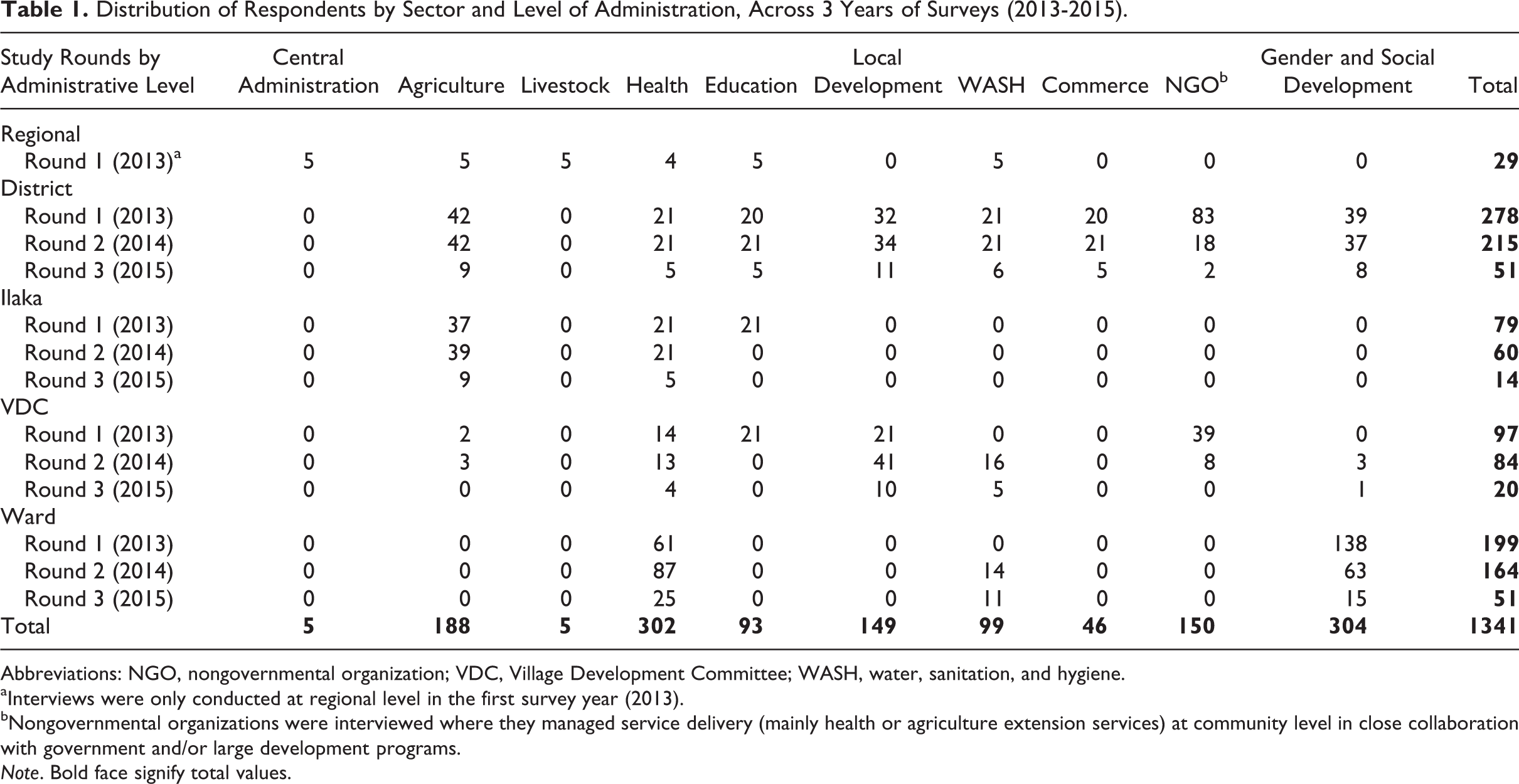
Abbreviations: NGO, nongovernmental organization; VDC, Village Development Committee; WASH, water, sanitation, and hygiene.
aInterviews were only conducted at regional level in the first survey year (2013).
bNongovernmental organizations were interviewed where they managed service delivery (mainly health or agriculture extension services) at community level in close collaboration with government and/or large development programs. Note. Bold face signify total values.
The specific geographic location of the offices and organizations in which interviews were conducted was guided by the systematic random sampling used to frame a related but separate observational cohort study in 21 of Nepal’s 75 districts. That study was set up using a stratified random sampling to include sites from each of 3 agroecological zones (details of study design published elsewhere). 12 Roughly 4500 children younger than 5 years have been followed through an annual panel survey at household level. The governance data derive from a parallel repeat cross-sectional panel survey using the same geographic sampling frame as the household study.
The goal of the governance research is to capture the views of civil servants and service providers to trace what Exworthy called “the influence of each organization’s practices and culture upon the policy process.” 13 In other words, respondents were chosen for being part of the process, based on the institutions in which they work, in the course of which they would be expected to have had exposure to the “mechanisms at work.” 14 The aim is to determine if and how agents of policy implementation (as opposed to national-level policy formulation) think and behave, and to see if this changes over time in the context of government promotion of cross-sectoral plans for nutrition.
Three survey rounds are reported here. The first round, conducted in early summer of 2013, sought to gain an understanding of nutrition governance issues from a broad set of open-ended questions used to promote a rich dialogue on respondents’ perceptions, concerns, and understanding of nutrition issues and policies. This 2013 survey was administered by highly trained enumerators using a checklist of questions that were framed by research gaps on governance articulated by previous publications, including Garrett and Natalicchio, 7 Gillespie et al, 9 Pelletier et al, 15 and Britto et al. 16 Those research topics were validated for Nepal through interactions with 26 senior policymakers, academics, and donors in Kathmandu through extended conversations. The questions specifically elicited information on respondents’ knowledge regarding nutrition problems and solutions, constraints to accessing human, technical, and financial resources needed for them to undertake work effectively, degrees of commitments to nutrition as a professional priority, the perceived value of enhanced collaboration and coordination across sectors to achieve nutrition goals, and incentives or disincentives to working with colleagues and field-level partners in other sectors.
Questions were grouped into 3 broad topical categories that draw on findings of the World Health Organization’s (WHO) 2012 landscape analysis on countries’ readiness to accelerate actions for nutrition, 17 and its 2013 global nutrition policy review. 18 These are (1) commitment to nutrition (Do policies and instruments exist? Are civil servants outside the health sector willing to adopt nutrition as a core responsibility? and Are institutional management structures able to accommodate the inclusion of nutrition in annual work plans?), (2) capability to implement pronutrition policies and programs (adequate budgetary, technical, and human resources to do the jobs required), and (3) collaboration (management support for cross-sectoral engagement toward common goals, coordination mechanisms, institutional incentives for the adoption of jointly owned goals).
This article explores these 3 themes through interviewee responses by sector and by level of governance responsibility (ie, working close to, vs remote from, field-level activities). Different results are emphasized from one survey to the next, but no attempt is made in this particular article to measure change in response rates over time.
Data Sources
Williams and Siddique argued that one of the most challenging issues plaguing research in this area is how to generate “the data used to quantify governance.” 19 This study uses the World Bank’s definition of governance as “the institutional capability of public organizations to provide public goods and services demanded by the citizens in an effective…manner.” 20 Such a definition can be measured using different methodologies at different scales. At a national level, analysts have proposed metrics such as corruption indices, government electoral stability, investment profiles, and country-level indicators of democratic accountability. 20,21 At an institutional level, Fox et al propose tracking budgetary commitments. 22 Studies that have adopted this approach are presented elsewhere in this volume. But fiscal resource allocation tells us little about the factors influencing the choices and behaviors of individuals who collectively populate institutions.
Hence the value of stakeholder interviews. Lapping et al, for example, reported that discussions with provincial-level officials in Vietnam uncovered widespread dissatisfaction with their limited role in determining national nutrition priorities. 23 Pelletier et al also reported individual views on policy processes from 12 countries. 8 However, Lapping et al had a sample size of just 51 respondents across 8 provinces, whereas Pelletier et al had 18 respondents. 24 In other words, while important insights can be garnered from in-depth conversations, the extent to which these reflect broader consensus in such countries is not known and care is needed in generalizing such findings.
The present study therefore goes beyond qualitative assessments using small samples to large surveys using structured questions that are more readily comparable and quantifiable. In the first governance survey (2013), a total of 682 respondents were interviewed. In the second survey (2014, in the same season), enumerators returned to the same offices as in the previous year to interview whomever was the current office holder responsible for nutrition activities and policy coordination. In some cases, this was the same individual, whereas in other cases, it was a new respondent because of the government’s long-established policy of rotation that sees civil servants change geographic location and professional responsibilities every few years.
In the second survey, 523 individuals were interviewed—a smaller number than in 2013 because the initial survey had included a wider array of key informants, some of whom were only peripherally involved in policy implementation (such as members of local chambers of commerce, regional-level bureaucrats, and some nongovernmental organization staff). The latter had been interviewed to gain a broad understanding of site-specific contextual realities relating to politics, history, localized shocks, and ethnic or cultural dimensions relevant to nutrition.
The third survey (in 2015) was hampered by a devastating earthquake that killed almost 9000 people and injured and displaced many more. Political uncertainties surrounding the adoption of a new constitution also led to travel disruptions and heightened security risks. Both problems forced a curtailment of the regular survey such that only 136 respondents were interviewed. The number of respondents, therefore, varies according to year of data collection.
Interviews were conducted by pairs of researchers, one of whom led the interview while the other captured information by hand. Based on input from the 2013 survey, the second and third rounds used structured questionnaires (pretested in the field each year prior to finalization) based on precoded Likert scale responses and administered using electronic tablets. Significance tests were conducted using SAS version 9.4 and STATA SE 14.
The study was approved by Tufts University’s Social and Behavioral and Economic Research Institutional Review Board and by the Nepal Health Research Council. Written consent for interviews was obtained in accordance with the approved protocol from all research participants.
Study Limitations
A study of this kind faces many challenges. First, since there is no “natural” population-based universe from which to sample respondents, statistical representativeness cannot be assessed in any conventional way. We adopted a “comprehensive” sampling approach that included a focal point for nutrition actions within key government sectors identified in the national plan (MSNP), and at each level of functional government administration at subnational level.
Second, while household panel surveys return to the same family and typically interview the same individuals in that family over multiple years, this survey (which uses the office-holder’s department as the unit of observation) has to accommodate the reality that civil servants rotate office and function on a fairly regular basis—hence different individuals may be the focal point for nutrition from one year to the next. This means that change over time in key measures of governance have to be interpreted not as change in individuals’ characteristics but as change in the functional responsibilities, activities, resource levels, and capacities of the offices in which they work.
Third, it is important to note that Nepal’s multisector plan was designed in such a way as to wrap around and incorporate various elements of existing national services (such as community-level health work and agricultural extension), and the training and input delivery activities of various ongoing and planned multisector initiatives that involve partnerships between government and development partners. In other words, the changing policy context considered here includes a rapidly changing landscape of policy instruments (programming) used to improve nutrition at scale. This means that one cannot attribute improved capabilities or commitment only to the MSNP and certainly not to any of the growing number of nutrition programs being implemented across the country from 2012 onward. Any documented changes reflect overall improvements in the ability of government and its partner to engage in pronutrition activities.
Results
The following sections present results from the 3 rounds of data collection, grouped analytically into the 3 key domains of commitment, capability, and collaboration.
Commitment
Commitment can be understood as “willingness to act” in the sense of adopting nutrition as a core professional responsibility and accepting a personal role in implementing relevant policies and programs. Willingness also implies acknowledging that business as usual will not suffice; necessary resources must be dedicated to nutrition and cooperation across sectors (information sharing, joint activities, mutual support) has to become standard operating procedure if it has not done so already. Thus, in the surveys reported here, measures of commitment focused on (1) acknowledgment that nutrition is a national policy priority (in which the respondent has a role to play), (2) willingness to take on additional responsibilities to achieve common nutrition goals, (3) wanting to be more engaged in, and consulted on, nutrition policy issues, and (4) belief that upper management will be supportive of a commitment to nutrition goals regardless of the sector of activity.
In the first round of data collection (2013), more than two-thirds of the total 682 respondents stated that they felt that nutrition was not receiving sufficient attention from the government. Over 61% of the total asserted that nutrition should be a more important policy priority than it had been in the past and also that greater budgetary resources should be committed to supporting such a priority. Nearly all of the respondents (more than 98%) stated that they personally wished to be more involved in professional discussions about nutrition problems and in planning appropriate solutions. Importantly, when asked if they felt that they would be able to cope with any additional workload associated with new nutrition responsibilities, every single interviewee responded affirmatively, despite the fact that 95% of the 682 (2013) respondents were still unaware that the government was about to roll out its new multisector plan of action for nutrition.
Although such pronutrition responses were found in all sectors, there was variability across line ministries. For example, 71% of those interviewed from the livestock sector and 82% of respondents from the nonanimal agriculture sector acknowledged that more attention and resources should be focused on nutrition. That compared to 90% among those in the education and water, sanitation, and hygiene (WASH) sectors. The level was roughly 75% for people working in departments of local development and health.
Interestingly, the sectors least likely to report that they felt sufficiently consulted in the process of government planning for nutrition were local development and WASH—in both sectors only 27% of respondents felt adequately engaged. Not surprisingly, over two-thirds of health sector professionals did feel that they were involved in decision-making around nutrition.
The challenge (and opportunity) for governments like that of Nepal is to respond to the expressed desired among nonhealth professionals to be more included in national priority setting for nutrition. Indeed, most interviewees in 2013 noted that if the government required them to prioritize nutrition, most civil servants would commit the necessary time and effort to achieving defined goals.
That said, there were some who felt that genuine commitment would be difficult to secure without appropriate incentives. Roughly 23% of respondents working in sectors other than health (which has traditionally “owned” nutrition at government level) believed that a mandatory mechanism would be required to ensure appropriate dedication of time and resources to nutrition. Thus, when individuals reported their own commitment to nutrition, the response was overwhelmingly positive; but when the same individuals talked about the commitment of other professionals there was about a sense that civil servants in nonhealth sectors would need added encouragement.
Other suggestions for promoting commitments to nutrition included financial allowances for time spent on new responsibilities, adequate capacity building, and promotion of joint responsibility (across ministries) for common goals. For the latter approaches, there was no statistically significance difference between responses from the health sector versus other sectors.
There were also differences in response to the question about the need for incentives according to the type of job held (level of administrative responsibility). In the first survey round of 2013, more than half (up to 62%) of the officials working at regional level (overseeing an aggregation of multiple districts) argued that support for nutrition should be promoted using fiscal benefits, such as monetary allowances, or through sharing dedicated budgets for nutrition across line ministries. More than 40% of respondents employed at the district level (1 level below the region) argued that to make cross-sectoral action for nutrition work, there would have to be a mandatory mechanism applied throughout government; indeed, only 32% of the entire 2013 sample (682 respondents) noted that their work environment was supportive enough to help them achieve their defined responsibilities.
In 2014 (the second survey round, involving 523 individuals), the share of respondents stating that they personally felt motivated in their workplace was roughly 60%. However, this ranged from 36% among workers at the frontline level (service providers working at ward level) to 73% among professionals higher up in the administrative chain (including professionals employed at the VDC, ilaka, or district levels). That service providers reported a lower than average (albeit still high) level of motivation is likely due to the large number of female community health volunteers (FCHVs) who have a heavy workload relating to health and nutrition at the village level despite limited remuneration or technical resources to support their work.
Indeed, Table 2 shows that compared to higher echelon civil servants (working at VDC, ilaka, and districts levels), service providers at ward level were significantly (P < .05) less likely to agree with the proposition that field workers are sufficiently motivated to take on more responsibilities relating to nutrition. This is arguably due to the high workload and limited rewards, and in part because 2013 respondents at ward level were less likely to agree that they have adequate commitment from colleagues in other sectors to help them achieve nutrition goals (which was also a statistically significant [P = .0022] between ward level respondents and those at higher levels of administration). This does not mean that most field level workers sense a lack of commitment or motivation among their colleagues; over 80% of them agreed with the statement that commitment and motivation were adequate. But it does suggest that an important minority of professionals and volunteers working directly with communities require more support in their work, not just more responsibility.
Responses to the Question: “Do You Feel that Field Workers Responsible for Implementing Their Responsibilities Are Sufficiently Motivated to Be Effective?” by Level of Administrative Authority, 2014.
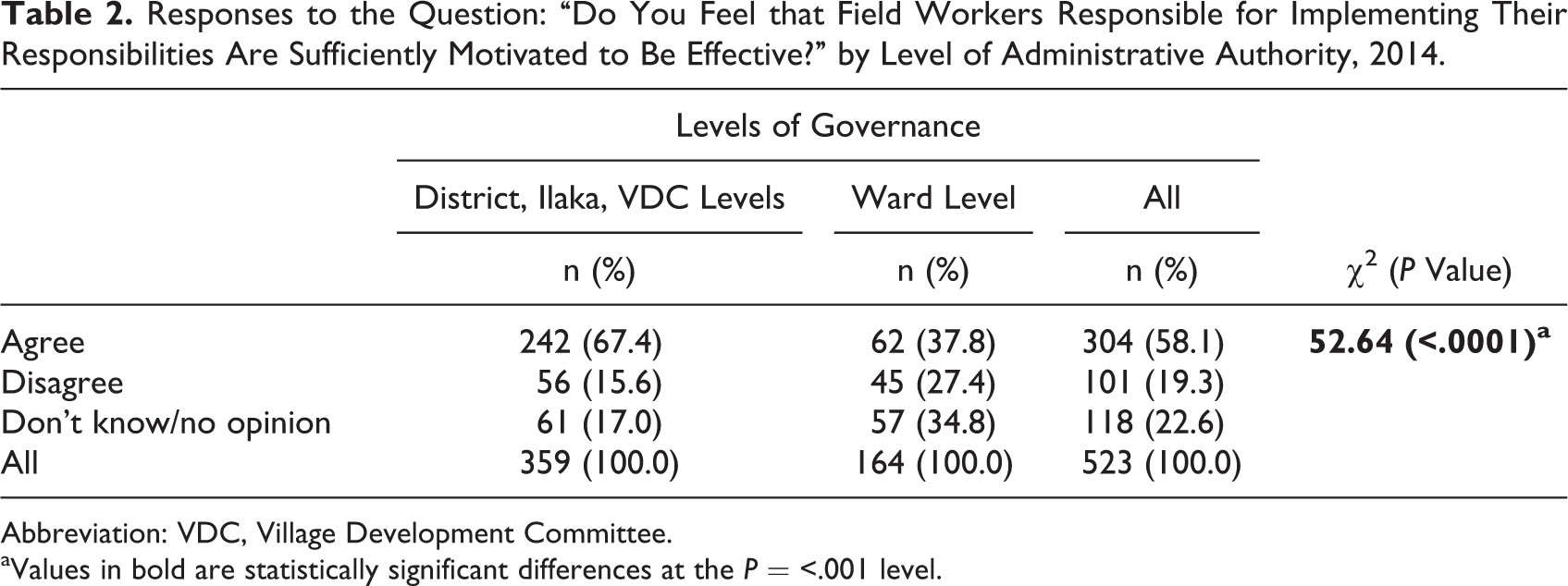
Abbreviation: VDC, Village Development Committee.
aValues in bold are statistically significant differences at the P = <.001 level.
Capability
Gillespie et al pointed out that “‘inadequate capacity’ is frequently cited in evaluations as a major reason for program failure.” 25 The same is true for policy failure. For governance to be effective, willingness to act must be matched by access to relevant technical information, financial resources, and human resources. In their assessment of capacity and resources available for nutrition policy implementation in India, Bangladesh, and Pakistan, van den Bold et al reported inadequate capacity at all levels, “from policymakers to extension workers to communities.” 26
Because Nepal’s Nutrition Assessment and Gap Analysis of 2009 characterized national-, district-, and community-level capacity as “inadequate,” 27 the MSNP focused not only on upgrading the capacity of health, agriculture, and other sector workers through training but also on establishing new district-level coordination mechanisms. 11 The first order of business was “in-service training of existing sectoral workers.” 28 This was rolled out in pilot districts through sensitization meetings and training workshops. In 2013, just 40% of the 682 first survey respondents reported having had any form of nutrition training during their career; this ranged from almost 50% among ward level service providers to only 26% at district level and down to 10% at regional level. Reference to “training” included 1-day technical workshops as well as higher level courses. The sectors least likely to report having any nutrition training in the past 3 years were WASH, local development, education, agriculture, gender, and social development (all below 15%). Those with the highest nutrition training background among its professionals worked in the health sector (46%).
While a graduate-level program in public nutrition started at Tribhuvan University in 2014, that form of capacity enhancement can only involve a small number of students and it takes time to build up a cadre of degree-educated professionals. Thus, the MSNP’s early emphasis was on training stakeholders at district to ward levels in 6 pilot districts, as well as a close engagement with development partners to roll out nutrition training in the 25 districts targeted for multisector programming under the Suaahara program. 29
In 2015 (the third survey of 136 individuals), only 44% of respondents stated that colleagues with whom they work have the insight, skills, and appropriate training to be effective collaborators in nutrition. Roughly 50% of ward-level service providers noted that their colleagues were adequately trained, but this fell to 41% among higher echelon civil servants. The group of respondents with the highest confidence in the abilities of close colleagues (in terms of nutrition training) was FCHVs (with 33% responding positively). Overall, such results suggest a continued need for human capacity development at all levels of governance.
Individuals who had attended recent training reported high rates of satisfaction, and this seems to have generated demand for access to better technical information on nutrition that they can use in their work. The share of respondents reporting that decisions for nutrition actions were based on strong technical evidence was only 55% in 2013. However, in 2015, all interviewees (100%) at all levels of administrative responsibility claimed to know where and how to obtain the technical information that they might need to facilitate work on nutrition.
At the same time, greater technical awareness appears to be associated with a realization that existing budgets may not be sufficient to meet new goals. For example, in 2014 (the second round involving 523 respondents), only one-fourth of respondents believed that their own department or office had sufficient financial resources to meet their own responsibilities for tackling nutrition. Importantly, although roughly 55% of higher level officials acknowledged sufficient finances to meet department or office needs, less than 10% of field-level service providers agreed. An ever greater disparity appeared at the personal level, that is, only 7% of field-level workers reported that they could access the budgetary resources necessary to work effectively, compared to 70% of higher level civil servants reporting adequate budgets. Thus, resources allocated by central government to support MSNP activities at subnational level need to be disbursed transparently and according to both need and absorptive capacity. As Pomeroy et al recently observed for Nepal, “ministries need to reduce delays in the release of funds, and they need to address procurement delays to give implementation-level staff enough time to spend these funds effectively.” 30
Collaboration
A third critical category of governance is collaboration across sectors, among colleagues and between levels of administration. A recent 6-country review of organizational hurdles to effective nutrition governance concluded that collaboration is “an elusive goal, as it requires articulating diverse approaches and interests across different government sectors, ministries and nongovernmental actors.” 31 Indeed, in its global landscaping analysis of governments’ readiness to implement nutrition policies, the WHO concluded that one of the greatest hurdles to nutrition governance is “ineffective coordination across sectors and among institutions having diverse responsibilities for implementing integrated nutrition policies and progams.” 18
The proportion of respondents reporting effective cross-sectoral collaboration in 2014 (the second survey year involving 523 respondents) was approximately 46%—it was 53% among higher level civil servants but only 32% among ward-level service providers. In other words, roughly half of the interviewees did not believe that cross-sector collaboration was adequate to achieve progress in nutrition. This was in part due to the widely held perception that other offices and departments with which respondents need to collaborate were insufficiently staffed. That view was reported by an average of 16% of respondents across all levels of administration. But it was also due to the more positive sense that more effort to achieve collaboration was needed and possible.
Most (99%) of respondents in the third survey year (2015) involving 136 individuals noted that seeking to collaborate with colleagues in other sectors is something that they want to do and that they feel is part of their job description. Given that view, it is not surprising that 100% of those interviewed in 2015 argued that regular meetings were needed among colleagues across sectors to discuss nutrition problems and solutions; and 100% also felt that similar meetings were necessary within sectors. Importantly, almost 80% of the 2015 sample felt that they could rely on adequate support from supervisors and upper management to pursue greater collaborative efforts for nutrition. However, this was divided into 85% of higher level civil servants and only 73% of ward-level workers.
The divide in responses between field-level and upper-level administration was even sharper in relation to certain key topics that characterize effective collaboration. For example, Table 3 highlights that while 50% of the 136 respondents interviewed in 2015 felt that cross-sector sharing of information on nutrition remains far too limited, that view was held by 60% of higher level civil servants compared to 37% of field-level service providers (the remaining 3% reporting “don’t know” or “no opinion”). Similarly, fewer field workers (45%) than higher level civil servants (74%) agreed that more stakeholders needed to be included in discussion about how to address nutrition issues.
Responses to Questions on Collaboration Across Sectors and Among Colleagues, by Administrative Level of Respondent, 2015.
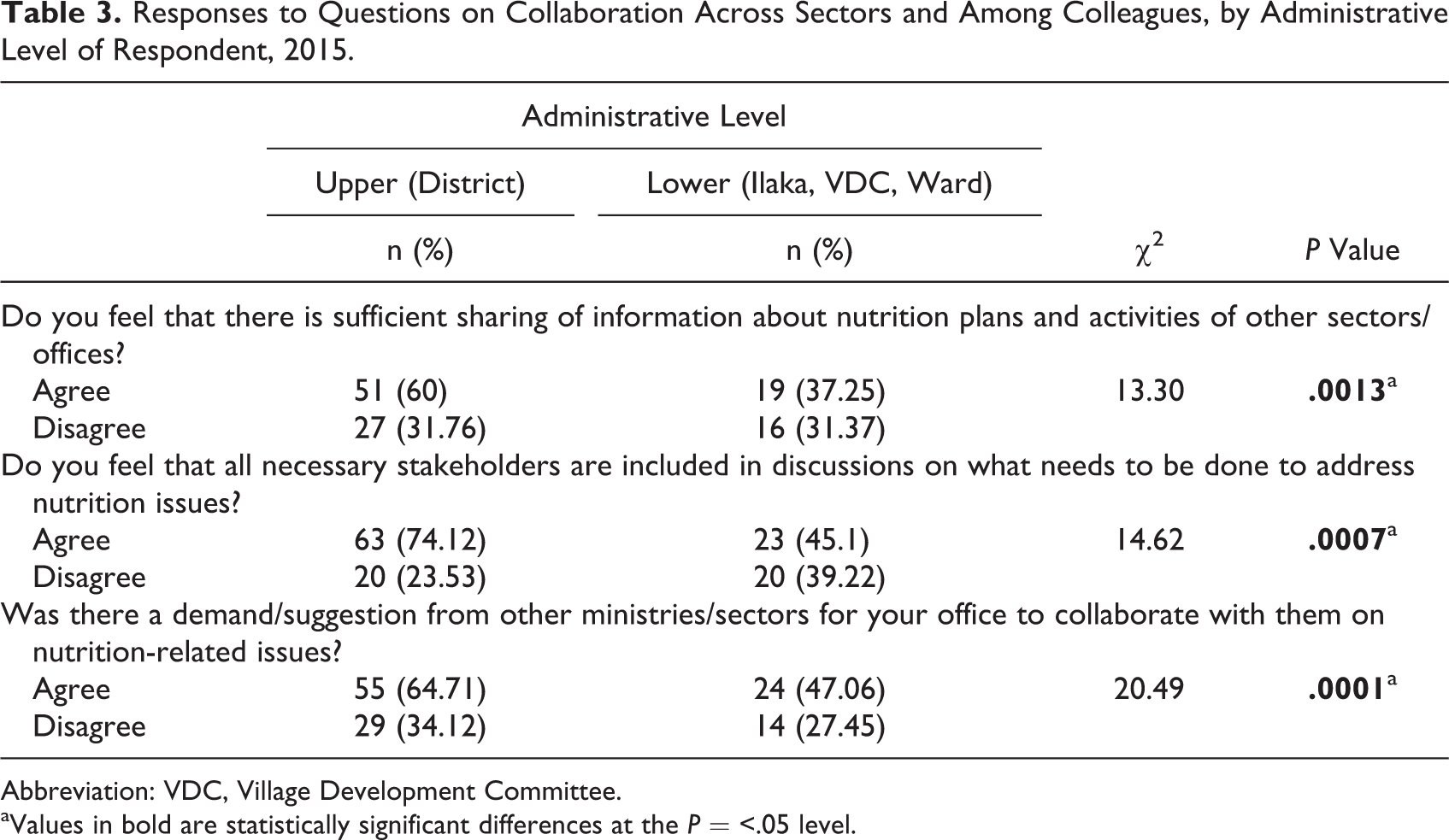
Abbreviation: VDC, Village Development Committee.
aValues in bold are statistically significant differences at the P = <.05 level.
Such differences in responses should be interpreted not as disassociation or disinterest in collaboration at the field level, but rather as a different starting point: at the field level, most service providers already communicate regularly and quite effectively, and all relevant stakeholders come together to solve problems at the community and ward levels. Thus, the call for “more” collaboration—information sharing, meetings, and mutual support—at higher levels of administration suggests greater awareness of the importance of nutrition and of the best ways to tackle problems in effective cross-sector ways. There are many more calls among subnational civil servants for specificity on their roles in nutrition actions, and for greater attention to specific responsibilities in their annual performance reviews. At the field level, the calls are more focused on access to budgets and technical information.
Overall, professionals across Nepal believe that they should be empowered to work collaboratively to achieve improved nutrition. Commitment is not the main problem. But to get there, they need access to greater levels of fiscal, human, and institutional resources—capabilities to act. As the government of Nepal moves in coming years to learn from the pilot experiences and expand the MSNP to the rest of the country, it is possible for it to address each of these issues in ways that achieve a positive transformation of subnational governance not only for nutrition but also for the development agenda more broadly.
Conclusions
Governance has been identified as an element critical to successful nutrition policymaking. 4,9,15 The key to effective governance is ensuring appropriate training, information, resources, and support for civil servants and other professionals to provide high-quality services across the spectrum of sector-specific activities and to promoting an efficient dovetailing of actions across sectors and levels of government. However, the ways to achieve this remain poorly understood.
It has been argued that the main challenge for implementing multisector policies for nutrition is that their inherent complexity demands “a high level of quality and performance, coordination and convergence in the face of varying and limited management and technical capacity [and] poor governance environments.” 18 In other words, even the best designed policies do not implement themselves. The challenge to governments is to build adequate commitment, capability, and collaboration to support ambitious national goals.
This analysis demonstrates that commitment to achieving improved nutrition is strong at all the levels of governance and across most sectors of activity. There is, however, variability across sectors and between levels of authority. As the implementers of policy gain greater understanding of what is required of them to achieve nutrition goals, they also gain new insights into the real challenges. There is support from managers and supervisors to reach across sectors, but most respondents also feel constrained, particularly by a lack of financial resources for nutrition, a lack of appropriate training, and an increasing lack of clarity over the division of labor and lead roles and responsibilities for various actions highlighted in multisector plans. While there is consistent reporting of greater and more effective collaboration among colleagues in the field (VDC and ward level) than further up the governance chain, everyone agrees on the need for shared ownership of responsibilities for nutrition. This includes generating mutual support (resource sharing) for actions that cut across line ministries, joint target setting, shared reporting of monitoring activities, joint advocacy, and cross-training (in practical skills relating to other sectors, not their own).
The institutional environment in which people work is not universally conducive to effective multisector collaboration. There is stronger support for mandatory mechanisms for collaboration among respondents in nonhealth sectors, suggesting that professionals wanting to do more “for nutrition” but outside of health ministry work feel that their management support systems, peer interests, and incentives are not always aligned to facilitate cross-sectoral agendas. These are largely administrative and policy process challenges that can be overcome.
According to Gilson, much policy process research has been criticized for “providing a weak basis for generalization of its findings and, therefore, offering limited value for policy-makers.” 32 This study suggests that it is both possible to undertake more structured and systematized research on governance of the policy process and provides useful information and guidance. It represents a step toward the generation of replicable empirical evidence on the challenges, constraints, and opportunities facing governments around the world as they move from the design of plans on paper to the scaling-up of complex nutrition actions nationwide. Such important investments must be based on as much rigorous empirical evidence as possible.
Footnotes
Acknowledgments
The authors gratefully acknowledge the support of Maura Mack, Ahmed Kablan, Cheryl Jackson, Ellen Harris, Jennifer (Vern) Long, Saharah Moon Chapotin, Shanda Steimer, Rob Bertram, and Beth Dunford. An ongoing invaluable partnership with the Government of Nepal is also acknowledged, particularly through the unfailing support of Atma Ram Pandey, Chet Raj Pant, Madhu Kumar Marasini, Raj Kumar Pokharel, Krishna Paudel, Giriraj Subedi, Praveen Mishra, and Rajendra Pant. Individual partners who have also been instrumental in the success of the Nutrition Lab’s work in Nepal, include Sharad Onta, Madhu Dixit Devkota, Keith West Jr, Rolf Klemm, Kalpana Tiwari, Deepak Thapa, Ramesh Kant Adhikari, Devendra Gauchan, Hari Koirala, Debendra Adhikari, Pooja Pandey, Peter Oyloe, Sriju Sharma, and KC Anushree. Finally, this work could not have been achieved without the unstinting dedication of the Boston-based Nutrition Innovation Lab’s program manager, Elizabeth Marino-Costello, as well as Ranjita Shrestha and Rachel Warnock.
Declaration of Conflicting Interests
The author(s) declared no potential conflicts of interest with respect to the research, authorship, and/or publication of this article.
Funding
The author(s) disclosed receipt of the following financial support for the research, authorship, and/or publication of this article: Support for this study was provided by the Feed the Future Innovation Lab for Nutrition, which is funded by the United States Agency for International Development (USAID).