




Abstract
Background:
There is growing recognition that “nutrition-sensitive” development is necessary to ensure nutrition security and reduce malnutrition. While agriculture has the potential to be a strong driver of malnutrition reduction and serves as the main source of livelihood for approximately two-thirds of East Africa’s population, its potential to reduce malnutrition is currently not being realized.
Objective:
Leveraging Agriculture for Nutrition in East Africa is a research study based in Ethiopia, Kenya, and Uganda that seeks to understand the enabling environment necessary for optimizing the contribution of the food and agriculture sector to nutrition outcomes. Its objectives were to explore stakeholder perceptions of nutrition–agriculture linkages, of political and institutional challenges and opportunities, of evidence that is available and influential for policy making, and of key issues with regard to capacity.
Methods:
Open-ended and semistructured interviews were conducted with 53 stakeholders from government, civil society, donors, United Nations organizations, private sector, and research/academic institutions in Ethiopia, Kenya, and Uganda in 2014.
Results:
Although policy opportunities and contexts are different between the 3 countries, stakeholders identified similar barriers to greater action, including a narrow focus on solely market-oriented and staple crop production, a lack of clarity and incentives within the agriculture sector about improving nutrition and how to translate policy into action, and lack of capacity in human and financial resources. Many actions to improve the nutrition sensitivity of agriculture were mentioned, including crop diversification, value chain activities and improved market access, nutrition education, and reduction in time and labor costs to women.
Conclusion:
Many opportunities exist to strengthen the impact of agriculture on nutrition in East Africa, but stronger formulation and implementation of policies will require adequate human resources, funds, timely data on the context, sector alignment on priority actions, and alignment on a framework or indicators for accountability.
Introduction
Nearly half of all under-five child deaths are attributed to undernutrition (approximately 3 million children per year), 1 with the highest burden in sub-Saharan Africa and South Asia. Undernutrition (note 1), particularly in the first 1000 days from conception to 2 years old, is a risk factor for death from common infections such as diarrhea and pneumonia, irreversible growth retardation and cognitive and mental impairment, and increased risk of obesity and chronic diseases. 2
Sub-Saharan Africa’s progress in reducing undernutrition has fallen behind other regions over the last decade. Stunting prevalence in the region for children under 5 years of age is 42%, compared to a global prevalence of 24%. 3 Of the 3 countries in this review, Ethiopia’s stunting rates are above the regional average at 44%, despite the country’s significant progress in reducing stunting from 51% in 2000. Wasting rates have remained high, at 10% in 2011. 4 Both Kenya and Uganda have a stunting prevalence below the regional average, at 35% and 33%, respectively. 3 However, stunting rates for Kenya have stagnated with a range of 30% to 35% over the last decade. 3 Stunting in Uganda has shown a downward trend, from levels of nearly 40% in 2000, 3 while wasting has remained at around 4%. In sub-Saharan Africa, rates of child overweight are similar to those in Latin America (approximately 8%) and are growing at a faster rate than other regions. 2,5
All 3 countries have experienced economic growth in the last 5 years, particularly Ethiopia where the economy is one of the top performers in the region with 11% growth over the last decade. 6 Agriculture plays a key role in this economic development and accounts for between 22% and 47% of Gross Domestic Product (GDP). 7 -9 Approximately two-thirds of the populations in each of the Leveraging Agriculture for Nutrition in East Africa (LANEA) study countries depend on agriculture for their livelihood. 7 -9 There is potential for agriculture to contribute significantly to accelerating the decline in undernutrition in sub-Saharan Africa, but this is not currently being realized. 10 This is due to a number of factors, such as the threats to agricultural productivity from climate-related events such as drought and flooding, 11 the decreasing contribution of agriculture to the economy, 6,11 and disconnects between agriculture and nutrition. Moreover, nonfood factors such as women’s disempowerment, poor sanitation, and inadequate health services may also prevent agriculture from positively impacting nutrition outcomes (note 2). 10,12
Leveraging Agriculture for Nutrition in East Africa
There is a growing acknowledgment that “nutrition-sensitive” approaches (including those involving agriculture) that complement “nutrition-specific” interventions are required to achieve nutrition security and reduce undernutrition (note 3). There is an overarching need to create an “enabling environment” built on “policies and processes to sustain momentum” in reducing undernutrition. 13 Gillespie et al 13 identified three core domains as key to generating change: politics and governance; knowledge, perceptions, and evidence; and capacity and resources.
Leveraging Agriculture for Nutrition in East Africa (LANEA) is a research study conducted in Ethiopia, Kenya, and Uganda that seeks to better understand the enabling environment necessary to impact nutrition through the food and agriculture sector. The three study countries selected for the study are all members of the Scaling Up Nutrition (SUN) movement (note 4).
LANEA is a collaboration between the International Food Policy Research Institute (IFPRI) and the Food and Agriculture Organization (FAO) of the United Nations in Ethiopia, Kenya and Uganda. The study followed the same objectives and process as the Leveraging Agriculture for Nutrition in South Asia (LANSA) research consortium in India, Bangladesh, and Pakistan in a related article by van den Bold et al. 14 Both LANEA and LANSA interviewed stakeholders thought to be influential in agriculture, food, and nutrition policy to investigate the potential of agriculture to contribute to reducing malnutrition. This regional review highlights key findings from interviews and workshops undertaken from October 2013 to July 2014 in East Africa for LANEA. Further detailed evidence is captured in the LANEA country reports for Ethiopia, Kenya, and Uganda. 15 An article by Gillespie et al 16 compares the findings from both LANEA and LANSA’s research on the enabling environment for nutrition-sensitive agriculture in East Africa and South Asia.
Objectives and Methodology
Drawing on the domains mentioned earlier (from Gillespie et al 13 ), the LANEA study’s objectives were to explore stakeholder perceptions of nutrition–agriculture linkages, political and institutional challenges and opportunities; evidence that is available and influential for policy-making; and key issues with regard to capacity development to scale up nutrition in the food and agriculture sector.
Potential interviewees were identified through previous stakeholder mapping exercises as well as consultation with FAO and other expert groups and committees involved in the agriculture, nutrition, and health arenas. LANEA consultants used purposive sampling to select interviewees who were likely to generate useful, appropriate, and in-depth data and who were available to be interviewed. The final list included 19 stakeholders in both Ethiopia and Uganda, and 15 in Kenya, from government, civil society, donors, private sector, and research/academic institutions, a total of 53 interviewees (Table 1).
Number and Background of Interviewees in Study Countries.a
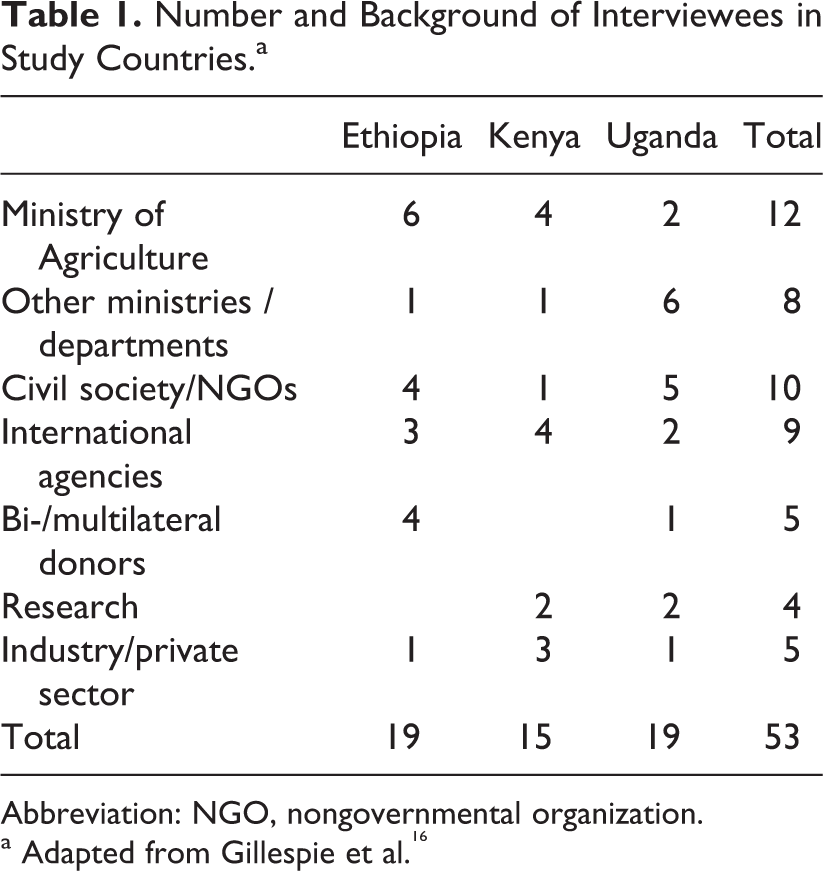
Abbreviation: NGO, nongovernmental organization.
a Adapted from Gillespie et al. 16
The interviews were open-ended and semistructured. LANEA consultants used the same interview tool as the LANSA study, which has three specific areas: the political and institutional context of agriculture and nutrition, knowledge and evidence, and capacity and resources. Informed consent (written and/or oral) was obtained from the study participants before the interview took place, with the understanding that data findings would be anonymized. Where possible, interviews were recorded and transcribed, and/or interview notes were written up. This information was then coded in an Excel matrix using categories representing the three themes. Data analysis and write up was based on information captured in the matrix.
Results
Findings from the LANEA stakeholder interviews are discussed in 3 main sections: (1) political context (note 5), (2) knowledge and evidence (note 6); and (3) capacity and resources (note 7), corresponding with the structure of the interview tool that was used in the study.
Political context
Perceptions of agriculture and nutrition linkages and how to improve them
A fundamental objective of the LANEA study was to investigate the perceptions and understanding of stakeholders as to how agriculture and nutrition are linked, perceptions of how the agriculture and the broader agri-food system can become more nutrition sensitive, and what might be preventing this (Table 2).
Perceptions of Key Factors Preventing Nutrition From being Prioritized in Agriculture.a
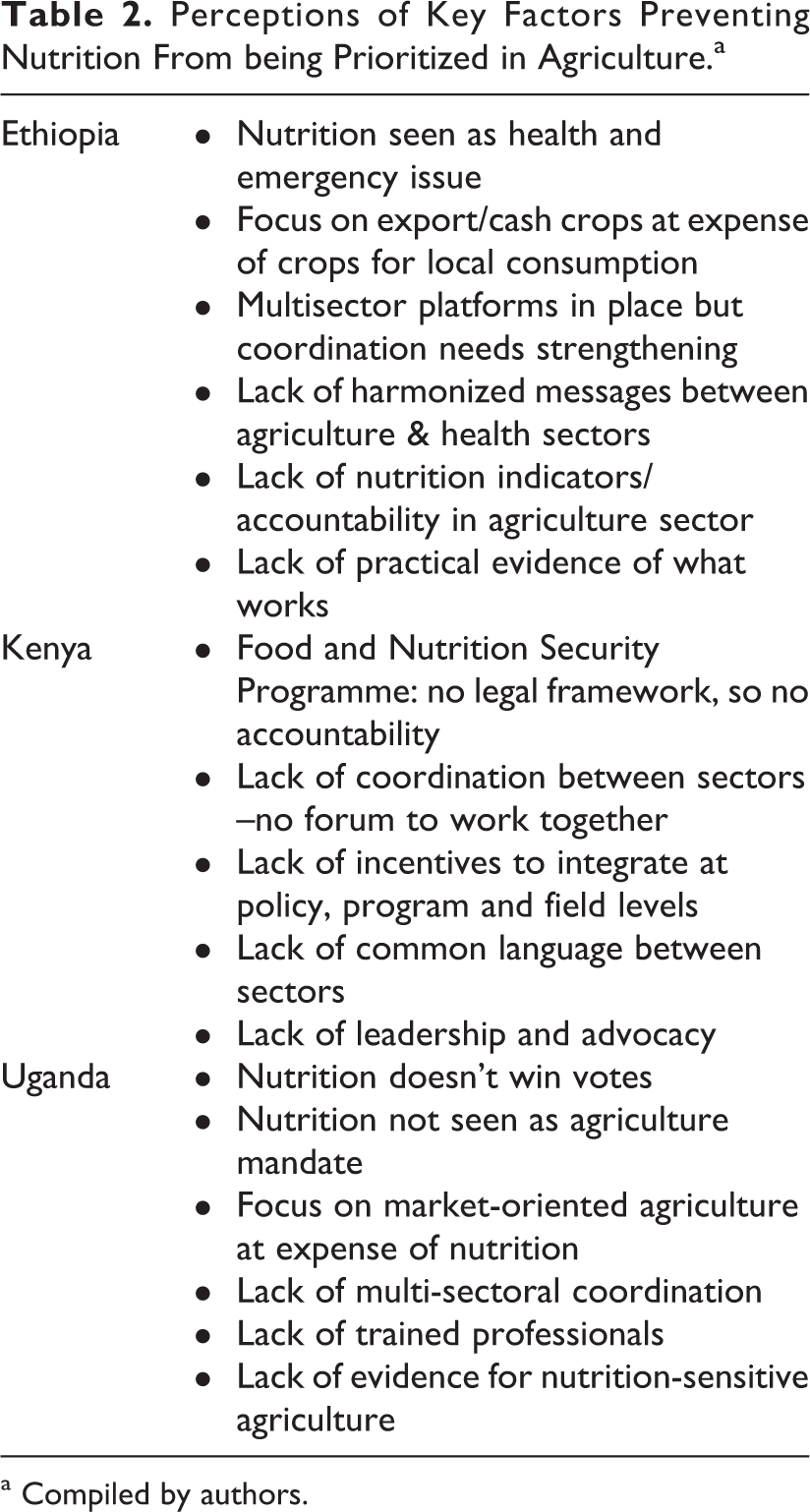
a Compiled by authors.
The majority of participants (more than 50% in all 3 study countries) identified pathways from agricultural production to nutrition through household food production, income generation, education, and (to a lesser extent) through women’s empowerment. Most stakeholders referred to just one of these pathways, while others appreciated the synergies between them. This was particularly evident in Ethiopia where over two-thirds of respondents mentioned one or more pathways, although there was a desire to find out which had the most impact: “We don’t know exactly which one affects. Is it the income, the diversity, the women empowerment or the value chain that affects nutritional outcomes?” (nongovernmental organization [NGO] stakeholder, Ethiopia). A donor agency interviewee in Uganda pointed out, however, that pathways and interventions to impact nutrition through agriculture depend in part on regional differences: Some regions have food available but lack education on food utilization, while other regions have an absence of food and limited land. This would make some pathways and interventions more relevant than others depending on the region. In Ethiopia and Uganda, respondents commented that the evidence should be specific to the livelihood under discussion “because there are more than 250 different livelihoods in the country” (Donor representative, Ethiopia). Workshop participants also said that in order to effectively impact nutrition, the agriculture sector must address regional, seasonal, and gender disparities in vulnerability to malnutrition.
The most common understanding among stakeholders was that agriculture provided both food and income. Participants particularly from the agriculture sector highlighted the importance of nutrient provision through foods cultivated and consumed by households, a link described directly by one Ethiopian respondent: “agriculture is the mother of nutrition … nutrition is food” (Donor agency, Ethiopia). A participant pointed to the need to “start with crop diversification,” saying that the major crops produced are “not sufficient to meet nutrient needs” (Government representative, Uganda). This was echoed by several other civil society participants in Uganda and Kenya who brought up the importance of both diet diversity and biodiversity for nutrition. Stakeholders described perceptions that an increase in agricultural productivity of nutritious foods would ensure consumption of diversified diets and affect nutritional outcomes: “if farmers produce nutritious food, households will consume a nutritious diet” (NGO representative, Ethiopia).
Even in rural areas, however, farming households do not produce enough food themselves to meet their needs (United Nations agency representative, Uganda). Agriculture as a livelihood was cited by interviewees as providing an important income source that can affect the types of foods consumed in the household. However, participants recognized that increasing either food production or income is not sufficient to improve nutrition status: education or behavior change communication (BCC) was cited as an important factor in encouraging dietary diversity. As pointed out by one Ugandan stakeholder, “also what we need to do is to change the behaviour of people … so that they get the information on how important adequate nutrition is and then because of that knowledge they change their priorities to invest, into adequate nutrition. So use agriculture to get income and harvest income into nutrition” (Government representative, Uganda). In Kenya, nutrition messages had to relate not only to promoting consumption of healthy fruits and vegetables but also to limiting highly processed foods due to the issues of both undernutrition and the increasing health burden of overweight and obesity in the country (NGO representative, Kenya). Community partnerships were also described as important, for example the need to engage communities in “dialogue” and “brainstorming” solutions, “being sensitive to cultural values that people have practiced for many years” (Ministry of Gender, Labour and Social Development (MoGLSD), interviewee, Uganda).
A few interviewees in Kenya and Ethiopia raised the point that food prices also affect consumption patterns. One interviewee from the Ministry of Agriculture (MoA) (Ethiopia) said that improving production and productivity of small animals, such as poultry, and lifting taxes related to animal feeds, would bring down the price and make animal source foods more affordable for households. Lowering the price would increase consumption. Workshop and interview participants in Uganda and Kenya recognized agriculture’s impact on nutrition along the value chain, including processing, postharvest practices, food quality and safety, and marketing. A United Nations agency participant suggested that by including a “nutrition lens across the value chain,” agriculture “can influence nutrition outcomes” (NGO representative, Kenya).
Over half of interviewees stressed the importance of women’s empowerment pathways as a key to influencing children’s nutritional status. Gender was described as “a very important bridge” between agriculture and nutrition (MoA official, Uganda). The common perception across government, donor agencies, and NGOs was that when women control the resources (including land, seeds, and inputs), they are more likely to use them for household consumption thereby improving nutritional outcomes. “Empowering and targeting women will have an effect on the nutritional status of children. When women control the resources, they are more likely to use it for family consumption and that will improve the nutritional outcomes” (Ministry of Health [MoH] official, Ethiopia). Many participants in Uganda agreed that improving nutrition through agriculture requires empowering women and scaling up approaches that address gender inequality and women’s role as caregivers. In Kenya, participants from the Ministry of Public Health and sanitation (MoPHs) and several NGOs referred to women’s empowerment and women’s contributions in agriculture being important for nutrition, and they made a connection between technologies to save women’s time and energy, and women’s ability to care for their children.
When asked for their ideas on how to make agriculture more nutrition sensitive, participants responded from both a policy perspective as well as with suggestions related to practical programs and approaches, including private sector involvement in value chains in food production. Food and nutrition security is routinely mentioned within agriculture policies; almost a third of interviewees, including workshop participants, discussed the need to make the role of agriculture more explicit in nutrition action plans in all three countries and to strengthen intersectoral co-ordination. Across the board, interviewees discussed a general lack of knowledge in the agriculture sector of what nutrition integration entails and what specifically agriculture can do for nutrition other than increase productivity. According to one respondent, “the MoA has signed the National Nutrition Plan (NNP), but what it should do in practical terms has not been clearly spelled out” (MoA, Ethiopia). Several stakeholders reflected that the MoA’s primary objective has been to increase production, improve cash crop productivity, and contribute to poverty reduction and economic growth, assuming the nutrition situation in Ethiopia will subsequently improve. One participant in Kenya reflected that the MoA’s mandate is to increase crop and livestock production; for them to go beyond this and incorporate nutrition, especially when they don’t understand exactly what to do, is difficult.
Stakeholders most commonly cited agricultural diversification and focusing on increased production of foods of high nutritional value such as African leafy vegetables, small animals such as poultry, fish, dairy products, and eggs as strategies to improve the impact of agriculture on nutrition. “Nutrition sensitivity could be improved by promoting production of nutritious foods over and above the cash generating foods” (Office of the Prime Minister [OPM] representative, Uganda). Scaling up production and promotion of biofortified crops such as iron-rich beans (Uganda), orange-fleshed sweet potatoes (Uganda and Kenya), and quality protein maize (Ethiopia) was discussed, with respondents highlighting the government’s potential role in promoting these crops. Increasing agricultural diversity required management of other factors, such as water, credit for agricultural resources, and farm labor to improve land productivity (Uganda workshop participants); seeds and pest management (Kenya); and climate change and nutrient-deficient soils (Ethiopia workshop participants). Workshop participants in Uganda also said that the commodity zoning should be targeted more clearly toward fostering crop and diet diversity. One interviewee in Uganda suggested that providing agricultural subsidies could make foods more affordable.
Along with crop and livestock production, interviewees from across the spectrum of United Nation, civil society, and the private sector in Uganda and Kenya described improving farmer access to markets and stronger market infrastructure as a factor in promoting linkages between agriculture production and utilization. Other recommendations were for postproduction strategies including minimizing wasteful food processing that removes nutritional value, for example in maize, and storing and preserving food hygienically.
As mentioned earlier, nutrition education and promotion are perceived in all countries as an important complement to productive activities to improve consumption. Government participants in Uganda said that agriculture extension could reinforce nutrition messages and educate farmers on the utilization of diverse crops and livestock for nutrition. Agriculture and health sectors could harmonize messages that are being given to households: “Two extension workers go to the community and tell conflicting messages, the DAs to sell, and the Health Extension Workers (HEWs) to feed the child” (NGO representative, Ethiopia). In Uganda, such harmonization is facilitated by training materials: 2 Ministry of Agriculture Animal Industries and Fisheries (MAAIF) interviewees mentioned a draft manual on community nutrition for agriculture extension workers that includes behavior change messages related to improving nutrition. A MoGLSD interviewee also referred to the National Handbook for Community Development Officers (CDOs) and Stakeholders in Community Development Work (MoGLSD, 2013) that is nutrition oriented. He said, “In most cases where they have used CDOs … the projects have been successful,” as they come from the community and can “mobilize and prepare people.” In Kenya, both MoA and MoPHS study participants shared the example of a United States Agency for International Development (USAID)-funded agriculture–nutrition training manual (Republic of Kenya 2013) that was developed by collaboration between the 2 ministries with support from the NGO African Medical Research and Education Foundation (AMREF). The manual is meant to be used by both agriculture and health community-level workers, and it provides information on food handling and preservation, food preparation and hygiene, meal planning, energy-efficient cooking methods to retain nutrients, nutrition in the life cycle, and value addition. A MoPHS participant shared that it had been disseminated in 33 counties with AMREF facilitating training-of-trainers (TOTs); however, several NGO participants reported that dissemination has been weak. Workshop attendees in Uganda recommended prioritizing the involvement of the agricultural private sector in improving nutrition, suggesting the use of a social marketing perspective and demand creation for nutritious foods.
When asked about potential negative effects of agriculture, nearly 50% of respondents in all 3 countries tended to focus on the balance between export and local consumption affecting local availability and prices of food (“we produce oil seeds mainly for export and the local consumption is being neglected.” [Donor organization representative, Ethiopia]). Nearly half of respondents perceived that promotion of cash crops for export was affecting local availability of land for food and prices of food, for example, “if more coffee is produced at the expense of certain cereals, you are increasing the price of cereals in the market and the same is true for khat.” (note 8, Donor representative, Ethiopia). Some interventions have increased the cost of farming by “increasing import duties and taxes on agricultural inputs,” resulting in “higher prices for nutrient-rich foods.” (Private sector, Uganda).
A few respondents from all 3 countries registered concern that by placing burdens on caregivers’ time, agricultural programs can negatively impact child nutrition. In Ethiopia, a donor participant noted the potential negative impact of irrigation via increasing water-borne illnesses. Other environmental impacts on nutrition such as nutrient-deficient soils and climate change were also mentioned (eg, “the agriculture sector in Ethiopia is the one that takes the lion’s share of the greenhouse gases resulting from natural resource degradation and from the methane gas being produced by the livestock population. This might negatively affect nutrition because of the resulting effect on the environment” (MoA official, Ethiopia).
Policy and politics: Barriers and facilitators to nutrition-sensitive agriculture
Table 3 shows the policies and networks within LANEA study countries with potential to impact agriculture–nutrition linkages. These are the major policies and networks that were noted frequently in interviews and which have the largest scope for impact. The only study country where the majority of stakeholders (10 of 19) felt that nutrition was being sufficiently considered in the agriculture sector was Ethiopia, although this was noted as a recent development with nutrition indicators only just being included in revised policies and programs. Both Ethiopia and Kenya have development blueprints for the country’s projected economic growth (the Growth and Transformation Plan [GTP] and Vision 2030, respectively), to which all other sectoral policies including agriculture need to align. In Kenya, however, nutrition is implied but not specifically mentioned in government policies targeting the agriculture sector. In Uganda, the Ugandan Nutrition Action Plan, a ministerial policy document, integrates sectors around a nutrition goal, and government participants from MoH and MAAIF highlighted the creation of nutrition units within their ministries.
Policies and Networks Within LANEA Study Countries With Potential to Impact Agriculture–Nutrition Linkages.a
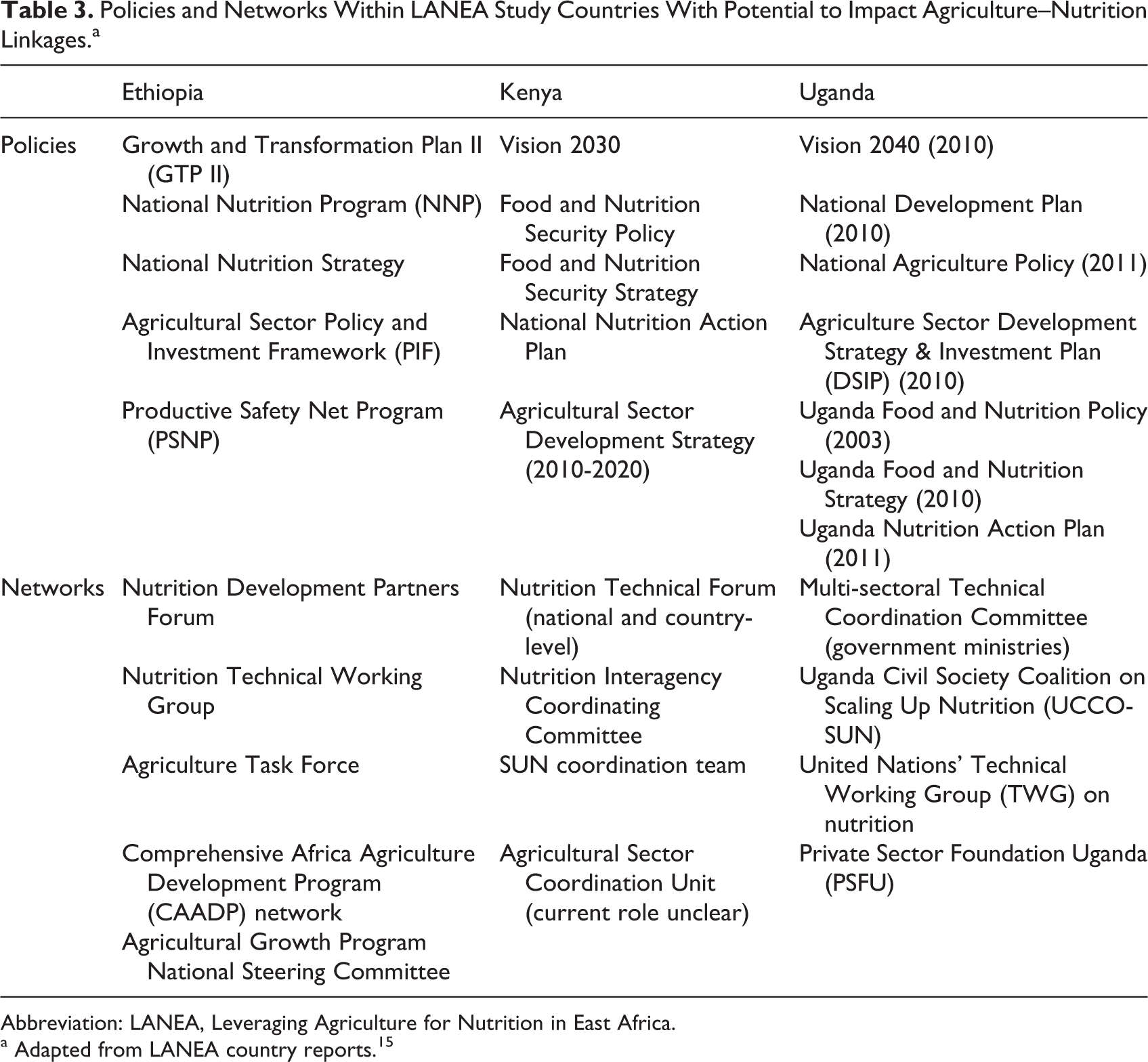
Abbreviation: LANEA, Leveraging Agriculture for Nutrition in East Africa.
a Adapted from LANEA country reports. 15
Stakeholders in all 3 countries described numerous barriers and opportunities for integrating nutrition within the agriculture sector, ranging from issues of collaboration and incentives to challenges with measurement and funding. One key barrier was that agricultural policies prioritized market access, value addition, and the commercialization of agriculture, over consideration of food and nutrition security. Over half of Ugandan participants (12 of 19 from government, donor, and civil society organizations) felt that market-oriented production was at the expense of nutrition. “Household nutrition is neglected … [It is only] what is left after the market that is available for household food consumption.” (OPM representative). An MAAIF interviewee said that “the zoning approach [to agriculture development] has disregarded nutritious crops,” and a donor agency related that some regions have a high prevalence of malnutrition despite being major food producers, indicating a missing link between agriculture and nutrition outcomes. The focus within the agriculture sector was on quantity rather than quality, such as increased yields of staple crops like maize, rice, and wheat “to keep the nation fed” (Ministry of Agriculture representative, Kenya), or the creation of cash crops such as tobacco (Uganda) and coffee and khat (Ethiopia). In Ethiopia, one stakeholder described the training of Development Agents (DAs) or agriculture extension agents, as “to promote market oriented production, and pushing farmers to mono-crop i.e. maize or wheat, and not promoting dietary diversity.” (NGO representative).
Another challenge is that nutrition is typically considered the mandate of the health sector, with study participants from across sectors expressing the view that nutrition is seen as a medical issue (with micronutrient supplements and fortified foods “considered as medicines,” [MoH representative, Ethiopia]). This leads to difficulties in collaboration between sectors toward a common goal of improving nutrition. In Kenya, implementation of the Food and Nutrition Security Plan (FNSP) “falls under two ministries with distinct mandates”—agriculture more entrepreneurial and health more focused on treatment (with each sector undertaking its own independent activities). Similarly, Ugandan stakeholders (particularly in donor organizations and NGOs) spoke of “silo-working” with competition for limited resources between sectors and a lack of coordination at both national and district levels (Donor representatives, Uganda). Lack of nutrition indicators in other sectors, lack of monitoring and evaluation systems and accountability (workshop participants from United Nations agencies and NGOs, Uganda), and lack of a supportive legal framework to create a multisectoral approach (in Uganda and Kenya) were further barriers highlighted by stakeholders. One stakeholder said, agriculture indicators “can’t check for reductions in stunting, rather they will check on number of households without food or food diversification.” (Ministry of Agriculture, Ethiopia)
Policies are seen to be driven by vote-winning issues, and nutrition is rarely viewed as a vote-winner in politics. In Uganda, “decisions are politically driven and influenced by the level of political support that can be gained.” (OPM, Uganda). Malnutrition’s lack of visibility makes it difficult to address, and less politically appealing than investing in more ‘tangible’ programs such as building roads or schools where results can be immediately seen (NGO participant, Ethiopia; Ministry of Agriculture representative, Uganda). This is particularly challenging for policy makers who are often looking for quick impact and inexpensive solutions. A related constraint mentioned by numerous stakeholders is the lack of evidence and knowledge regarding what these solutions may be. Officials can create policies that call for integration broadly, but, as interviewees particularly from Ethiopia and Uganda highlighted, the “how” (operational) part is often missing from such plans. Stakeholders described the need to encourage research institutions in the agriculture and health sectors to work closely with academic institutions in order to fill the knowledge and evidence gap in agriculture–nutrition linkages. As one Ugandan government interviewee explained, the commitment to nutrition exists, but “translating that commitment into action is where the gap lies.”
Yet there are signs that the situation is changing. Nutrition was no longer “stuck in a no-man’s land” (as one government participant from Ethiopia described it), with global momentum creating national action. At the policy level, study participants from across institutions in Ethiopia, Kenya, and Uganda described their country’s signing up to the SUN movement as evidence of a commitment to address nutrition. In Ethiopia and Kenya, SUN membership was cited as a catalyst for the launch of multisector platforms such as the revised NNP in Ethiopia, signed by 9 key ministries including agriculture, health, education, and industry, and Kenya’s similar initiative, the Nutrition Interagency Coordinating Committee. In Uganda, international momentum, driven in part by the SUN movement, led to the past (current at the time of the interviews) Prime Minister, Amana Mbabazi, making commitments at a global level to reduce malnutrition and to coordinate nutrition through the OPM. Individual leadership is seen as an important facilitator, with “nutrition champions,” such as Ethiopia’s First Lady, Roman Tesfeye, driving forward the agenda.
The African Union (AU) and the Comprehensive Africa Agriculture Development Programme (CAADP) investment plan process (an AU-led initiative to address policy and capacity issues across the entire African continent) are cited as other key facilitators to nutrition-sensitive agriculture. However, one Ugandan government participant urged caution regarding agriculture’s integration of nutrition, saying that the country’s Agriculture Sector Development Strategy and Investment Plan (DSIP) has “a small chapter concerning food and nutrition, perhaps for the sake of making the CAADP people happy.”
Current initiatives to improve nutrition-sensitive agriculture
There are various actions being taken to leverage agriculture to improve nutrition in the LANEA study countries. In Kenya, stakeholders described a range of programs and projects carried out by government ministries, research institutes, civil society, and United Nations agencies. These include involving farmers in school feeding programs, training agriculture extension workers on nutrition-sensitive agriculture, and focusing on nutrition across the value chain. Initiatives such as the MoA program, Njaa Marufuku Kenya (translated as “Eliminate Hunger in Kenya”) and World Food Program (WFP/FAO’s) Purchase for Progress link farmers to schools to provide locally sourced nutritious school meals, while increasing crop and livestock productivity and farmer training. An agriculture–nutrition training manual collaboratively developed by MoA and MoPHS in Kenya (with donor support) aims to train both agriculture and community health workers on issues such as food safety, meal planning, and value addition, although dissemination was reportedly weak. In Uganda, other initiatives to address the knowledge and training gap highlighted by stakeholders include nutrition training in Farmer Field Schools and for agricultural extension workers. However, the reach of many trainings and programs was often reportedly small due to capacity issues, a problem commonly raised by participants (recorded both in interviews and workshop findings). This was being addressed in part by high donor interest in agriculture–nutrition linkages and commitment to provide technical expertise and build government capacity at all levels, from systemic to the community level (see more on capacity below).
Stakeholders in all countries spoke of increased action to “nutritionalize” existing agricultural programs and policies, such as the distribution of improved crop varieties and livestock in food assistance programs (Karamoja region, Uganda), and changes to Ethiopia’s Productive Safety Net Program (PSNP), cited by numerous participants (donors and United Nations agencies, in particular). Since 2014, the PSNP, which provides food and cash transfers to households in exchange for labor on public work projects, has included nutrition indicators such as BCC to promote dietary diversity, planting fruit trees in place of other species, and exempting pregnant women from the public work. Stakeholders identified further opportunities to sensitize other programs, including promoting value addition through marketing and increased income from milk production among Arid and Semi-Arid Land communities (Ministry of Livestock representative, Kenya).
Such actions were supported by research institutes in all 3 countries through on-going research into biodiversity for improved food and nutrition, such as forgotten or “orphan” vegetable crops and biofortified crops such as Orange Fleshed Sweet Potatoes (OFSP). The private sector, too, was seen to have a role to play, although only by a minority of participants. Private sector and donor participants in Ethiopia described initiatives to use companies to produce complementary and supplementary foods using local ingredients from smallholder farmers, which are distributed by HEWs. However, scale is often a key issue, in both the public and the private sector. In Kenya, most of the projects mentioned by stakeholders are operating at small scale, often on single crops.
Participants in all LANEA study countries highlighted the need for action on ownership and coordination of nutrition-sensitive agriculture, between sectors, and from the ministry level to on-the-ground implementation by agriculture and HEWs. Membership of SUN had provided the impetus for the formation of multisectoral platforms, but a common theme among participants was that accountability structures and processes were not robust enough. Moves to address this were cited as using existing government documents with stated indicators to push for greater accountability, such as Ethiopia’s GTP which aims to reduce stunting to 36% by 2015. “We used it [the GTP indicator] to influence the MoA because it says this will be achieved by implementing the NNP [National Nutrition Policy]” (NGO representative, Ethiopia).
Policy formulation processes and influences, and opportunities for input
What influences nutrition and agriculture policies? And what opportunities did stakeholders identify to influence the policy making process? In all 3 countries, participants were aware of the formal policy formulation and consultation process and the main actors in agriculture policy, perceived to be the government and technocrats/experts within it, donor organizations and the research sector. Interactions between these groups in the form of “advocacy, information exchange and cross-sector dialogue for nutrition” (MAAIF representative, Ethiopia) are key to influencing policy decisions.
The global community’s prioritization of nutrition-sensitive agriculture was perceived to have influenced donor interest in such initiatives, which in turn had an effect on policy making. Participants from government ministries and civil society organizations shared the viewpoint that financial resources drive actions and decisions on nutrition-relevant policy. Donors themselves recognized their role in promoting policies that integrate agriculture and nutrition, while a civil society interviewee claimed that “Policies are driven by donors … and money influences decision-making” (NGO representative, Uganda).
The United Nations agencies and government stakeholders (particularly in Ethiopia and Uganda) cited the importance of evidence from the Lancet series (2013) and IFPRI reports as reference material for policy-makers on leveraging agriculture for nutrition outcomes. Other influential research includes The Cost of Hunger (note 9) studies, describing the social and economic effects of child undernutrition in terms of productivity and education. Yet there were contrasting beliefs in how important evidence is for shaping policy and practice between Ethiopian and Ugandan stakeholders. A donor agency interviewee compared the importance of evidence in Ethiopian society with a country like Brazil where “buy-in” from the population “is sufficient to influence policy,” whereas in Uganda, “there is no incentive to use research: it all depends on individual interest and attitude” (Government representative, Uganda), although this view was refuted by a participant from the Uganda Bureau of Statistics (UBOS) who said that “accurate and timely data influence a lot of decision-making and policy.” Research-based evidence on nutrition-sensitive agriculture also appears to be an important influence on policy making in Kenya, with the majority of participants mentioning the key role of research institutes and universities in linking agriculture and nutrition.
Current momentum to scale up nutrition through agriculture policies owes much to initiatives already mentioned, such as the SUN movement and CAADP. Yet institutional arrangements—where nutrition is placed within the government (often within the MoH or within Home Economics units in the Ministry of Agriculture)—affect its influence on policy makers. Despite high level engagement and being “housed” in the OPM, the nutrition team lacks influence on policy decisions without its own budget. In Kenya, the recent transition to devolved government (through the Devolved Government Act 2012) was widely blamed for delaying the implementation of the FNSP since counties now need to align their strategies to the national food policy. Efforts to build knowledge on nutrition-sensitive agriculture through trainings to politicians and ministry officials (in Ethiopia and Uganda) and through community mobilization at district and local levels via action research (Civil society representative, Uganda) were seen as other opportunities to influence policy making.
Knowledge and Evidence
Availability of data and evidence
Inasmuch as data and evidence influence policy and programmes, the availability of data is important. Respondents in the 3 countries described data as available from Demographic and Health Surveys (DHS), agricultural monitoring systems, and food security early warning systems. However, data from these sources is not necessarily frequent, timely, complete, or integrated enough to understand the nature of the linkages or gaps between agriculture and nutrition. “Data are available—largely UDHS data, but it comes once every 4 years, and its focus is on the health side of nutrition” (Research institute representative, Uganda). Another respondent in Ethiopia (from an international organization) noted that “we don’t know what we actually eat.” Several respondents talked about limitations in available data—that it was inaccurate and late, and/or “does not disaggregate sufficiently to regional or district level. Research also needs to be contextualized to a district local environment” (International Organization representative, Uganda). Workshop participants in Uganda said that needs assessments are necessary to understand community needs and to allow community demand to drive interventions. They also discussed the importance of understanding adoption and market demand for nutritious products such as orange-fleshed sweet potato.
One gap is the lack of linked or integrated data between agriculture and nutrition. The Ethiopia DHS, for example, found that the regions producing a crop surplus also have the highest levels of stunting in the country, yet the survey does not explain which factors are responsible. “How it happened and what makes those differences whether it is due to health interventions, agricultural interventions or which one … we don’t know” (International Organization representative, Ethiopia). Others noted the challenge that agriculture and health sectors are collecting data on their own and do not typically work together. A MAAIF stakeholder in Uganda gave the example of food security early warning system data collection that is on-going every 6 months, but that is not harmonized with the health sector, and suggested food and nutrition monitoring systems that are integrated, routinely collected, and use improved technology. Sometimes, it may be possible to link data, but there is a lack of capacity to do so: “There is a need to triangulate data from the Development Agents and Health Extension Workers with nutrition indicators. The Community-based Nutrition (CBN) programme and the Productive Safety Net Programme (PSNP) also bring lots of information every year and so do the food security programmes. The evidence might be there but analysis and interpretation needs to be improved” (MoH official, Ethiopia).
Respondents in Uganda and Kenya felt that it would be useful to improve specific kinds of evidence, such as that on diet diversity in households, communities, and regions; women’s empowerment in agriculture; how household income influences nutrition; and the strength of community development work in community mobilization. In Ethiopia and Kenya, respondents described a lack of evidence of successful integrated programs and lack of concrete, practical information on how best to implement nutrition-sensitive agriculture programs and policies.
Another respondent also described a gap in disseminating information: “we cannot use [evidence] when we don’t know [of] its existence” (Civil society representative, Uganda). A MoPHS participant stated that the majority of research results lie on shelves and are never disseminated. In Kenya, it was reported, for instance, that research results generated by the Kenya Agricultural Research Institute (KARI) are rarely used by the Ministry of Agriculture for extension services. It was also reported that NGOs often design programs without the knowledge of agricultural research findings and recommendations in their areas of programming.
Evidence most appropriate for influencing policy
One interviewee stated “without evidence, it’s difficult to convince donors and policy makers on the effectiveness of and role of agriculture for improved nutrition” (Private sector, Kenya). So what kind of evidence is needed? Several respondents in Ethiopia and Uganda also suggested that simply revealing and communicating the status quo more clearly could shake assumptions and inspire interest: for example, the fact that some regions with the highest cash crop production also had the highest levels of stunting. “We have regions that produce the highest volume of food but suffer significant malnutrition. Case in point is Bushenyi. The evidence that some regions can have increased food production and yet remain malnourished is big evidence that malnutrition has not been tackled through increased food production alone” (MoGLSD official, Uganda).
Multiple respondents and workshop participants in all 3 countries reported a lack of sufficient indicators that would support cross-sector work and pointed to the need for a common monitoring and evaluation plan with a common set of indicators. In Ethiopia, participants said that including nutrition indicators in agriculture programs would help to hold accountable those responsible for the integration. So far, no consensus has been reached regarding which indicators to include and how and by whom the information should be collected. Developing consensus on this could help to strengthen the evidence base and lead to stronger action. An NGO participant stated, “what gets measured gets done,” underscoring the need for good indicators. “Indicators are still poor despite investments in agriculture, education, and health” (MoGLSD, Uganda).
Influential evidence needs to relate not only to nutrition objectives but also to the food and agriculture sector’s objectives related to increasing productivity for smallholder farmers.
The importance of highlighting economic benefits of addressing undernutrition (and/or the economic losses due to inaction) was emphasized by some. One NGO representative in Ethiopia stated that “We need to come up with evidence that shows the economic impact and return, and the productivity impact and return. I have been able to influence policy if I say ‘this is what we did and how we did it and this is the cost—very cheap’ … Bring the evidence, show the policy component of it and tell them how to do it within the existing government system and try to change it … bit by bit.” Another stated that “The mainstreaming of nutrition has to fit within the vision of the sector and be embedded within their system, like on the promotion of perennial crops and fruit trees … we should not expect them to do what the MoH does for it is not their area of interest” (NGO representative, Ethiopia).
Evaluations from national programs, such as PSNP in Ethiopia, were thought to provide credible and relevant evidence. National research institutes, such as KARI, can also impact policy decisions through their research. A civil society participant in Uganda said that “case studies and real life stories” help to incentivize policy.
Capacity and Resources
Another objective of the interviews was to analyze the perceptions regarding individual, organization, and structural capacity that needed to be in place in order for the agriculture/agri-food sector to become more nutrition sensitive. One private sector interviewee from Kenya stressed the need to align recommendations with reality, building capacity to provide relevant solutions for nutrition. Systemic capacity gaps relate to a lack of vertical (national to local) and horizontal (across sectors) integration. These were noted in all 3 countries. Ethiopia MoA stakeholders and others, including workshop participants, discussed the challenge of coordinating nutrition within the different MoA departments and from federal to kebele levels. Participants in Ethiopia and Uganda suggested there is also potential to learn about coordination mechanisms, governance structures, and funding from other successful programs such as interventions for HIV/AIDS, malaria, and polio. Lessons learned from those programs may apply to agriculture–nutrition integration. A Kenya MoA interviewee pointed to the “weak link between county and national government when it comes to nutrition issues,” while a United Nations participant described the need to “align county priorities with national priorities” and coordinate between these levels, as well as a “plan of convergence … to work out the policy implementation” (MoA representative, Kenya).
Numerous stakeholders in Uganda and Kenya described the large capacity gap in terms of human resources, with one NGO participant pointing to the “shortage of qualified personnel in agriculture and nutrition at every level: national, district, and local communities.” The NGO and government stakeholders in Uganda voiced this when speaking about agriculture extension workers, community health workers, academic institutions, and national and district government personnel. A MAAIF stakeholder described his office as “overstretched,” saying that sometimes there are good ideas but no staff to put them into action (Uganda). Furthermore, a government stakeholder said that extension capacity is low, “reaching less than 20% of farmers,” and a UCCO SUN participant shared the perspective that motivation among extensionists varies, and they face challenges covering large and hard-to-reach areas and may even be experiencing malnutrition within their own households. Clarity on whose capacity needs to be built is also an issue: A MoPHS interviewee (Kenya) expressed the challenge to building capacity when it is unclear who should be involved in nutrition-sensitive activities—whether these activities should be carried out by all front line workers or by a certain group.
Even given sufficient numbers, there are perceived gaps in nutrition knowledge and skills of staff at all levels from field workers to policy makers. By building knowledge on nutrition–agriculture integration, organizations will be better able to implement integrated programs: “You can’t implement what you don’t understand” (United Nations representative, Kenya). Specifically, if the scope of agricultural programs is to broaden beyond production and marketing to include consumption, extension workers need further training and capacity building. Several stakeholders described existing capacity development tools, such as the Uganda National Handbook for Community Development Officers and Stakeholders in Community Development Work (MoGLSD, 2013), mentioned earlier, that includes training on food and nutrition. In Kenya, a MoA participant said that 12 000 front line staff at the subcounty level have been trained on basic nutrition knowledge, including gardening and food preparation, and a MoPHS participant described upcoming capacity-building training to strengthen their Community Health Engagement Workers (CHEW’s) nutrition knowledge. Two NGO participants (Kenya) cited a Training of Trainers (TOTs) conducted by the FAO on nutrition and food security as an example of capacity building that included nutrition-sensitive agriculture topics.
Workshop participants in Ethiopia pointed out that individuals representing the different ministries in the intersectoral meetings need to have an incentive to their multisectoral work—their work needs to be recognized and measured in their performance monitoring. A participant from the Empowering New Generations to Improve Nutrition and Economic Opportunities (ENGINE) project described that the enabling environment needs to be supported for the DAs, especially when asking them to do sensitizations that are outside their scope of work. In Kenya, Renewed Efforts Against Child Hunger and undernutrition (REACH) and United Nations participants said that it is hard to make an agriculture extension worker into a nutrition worker or change the mandates of these different community workers.
Financial capacity is also problematic; largely unfunded mandates are a major constraint to implementation in all 3 countries. In Uganda, several participants mentioned the lack of budget allocation to nutrition even within the OPM, with one interviewee saying, “Staff have salaries, but no money to implement activities.” A UCCO SUN participant said that the plans to address nutrition within CAADP and DSIP frameworks exist, but the financial resources to put the plans into action do not. Budgeting is the challenge, and “budget allocations by the government [need to be] consistent with the program priorities,” according to several stakeholders. They cite that nutrition is underfunded in all sectors. Respondents stated that many nutrition programmes are primarily funded by donors, usually with support from the national government. Workshop participants in Kenya said that advocacy for nutrition-sensitive approaches needs to be strengthened at national and county levels in order to mobilize resources so that these activities will be reflected in county budget plans.
What are the budget lines needed for? The specific items brought up by participants were for staff, training, and data. A MAAIF participant (Uganda) said that producing training manuals is costly, and a UBOS interviewee also stated that data are costly and it takes both time and money to run surveys and collect data.
Along with capacity of staff working within the government ministries, participants highlighted the need for capacity development of civil society and the private sector in order to better include nutrition concerns in agricultural interventions, programs, and approaches. Another area mentioned by several stakeholders and workshop participants in Ethiopia and Kenya was building the capacity of academic and research institutions. A representative from an academic institution in Ethiopia reported that some universities are revising agriculture curriculum to include nutrition, and there is a need to expand these efforts to other agricultural universities and colleges. The United Nations agency interviewees in Kenya also pointed out that the capacity within educational institutions needs to be developed to include university courses that link agriculture and nutrition, as well as including nutrition and agriculture in school curriculum at lower levels. A participant from Global Alliance for Improved Nutrition (GAIN) described current capacity-building activities around research in Kenya, including support from Cornell University to build Kenyan researchers capacity to carry out integrated research. An interviewee from Alliance for a Green Revolution in Africa (AGRA) described their capacity-building activities, training researchers, and scientists.
Conclusion and Recommendations
We conclude by highlighting several specific challenges which consistently emerged from discussions in all 3 countries.
Most stakeholders focused on the kinds of food produced as a pathway to nutrition, as well as the aspect of livelihoods and income generation. The focus within the agriculture sector has historically been, and often continues to be, on increasing production and productivity of cash crops as an engine of economic growth. There is a lack of clarity on what to do differently, and how to measure and be accountable to progress. However, most stakeholders did, in fact, have general suggestions about what agriculture could do to increase nutrition sensitivity: the majority focused on producing more nutrient-dense foods, and others also talked about increasing market access, improving postharvest processing, incorporating nutrition education, and better aligning of health and agricultural extension workers on BCC messages (the use of some training manuals could be scaled up, such as those noted in Kenya and Uganda). Respondents also talked about the need to avoid harm such as adding to women’s time burdens, environmental degradation, and neglect of food security by focusing on export production. Taken together, many of these ideas reflect established key recommendations for improving nutrition through agriculture. 17
In terms of political and institutional challenges and opportunities, most stakeholders did not feel nutrition is sufficiently addressed in the agriculture sector. A slim majority in Ethiopia did, although this was based on the inclusion of nutrition indicators in revised policies. There are high-level policies in all 3 countries where more could be done than is currently being done—including both commitments and implementation. Membership of SUN had provided the impetus for the formation of multisectoral platforms, but a common theme among participants was that accountability structures and processes were not robust enough.
Data availability is a major challenge that hampers accountability. There is a pervasive data disconnect in that surveys rarely include both nutrition/health and food security/agricultural indicators, rendering it difficult to link underlying causes from nonhealth factors to nutrition outcomes. Furthermore, no consensus has been reached regarding a common monitoring and evaluation plan across sectors, or which indicators to include in the agriculture sector, and how and by whom the information should be collected.
Lack of capacity in terms of budgets, human resources, knowledge/training of staff, and government structures is perceived as a significant set of challenges for linking agriculture and nutrition effectively. Even those that include nutrition goals or indicators on paper may not be implemented due to major gaps in capacity.
These discussions with stakeholders suggest several key recommendations, as follows:
Establish greater communication and clarity about how agricultural programs and policies can take many of the steps (identified by the stakeholders interviewed) to improve the nutrition sensitivity of agriculture (noted above). This may require greater incentives for agriculture professionals to incorporate nutrition, including accountability to explicit objectives. Accountability requires timely and appropriate information on how agriculture is affecting nutrition outcomes.
Improve data streams to link nutrition/health and food security/agricultural indicators in national data collection, as well as quality and timeliness of data. Develop consensus on which indicators to include, and how and by whom the information should be collected and reported. This would strengthen clarity and accountability, and it would strengthen the evidence base, leading to more concerted and more informed action. Human resources are lacking at all levels, particularly in Uganda and Kenya. Numbers of staff and training and education needs to be strengthened with regard to agriculture’s linkages to nutrition. There are some efforts to fill knowledge gaps on agriculture–nutrition linkages among extension agents using new training manuals. These should be scaled up, along with including nutrition and agriculture in school curriculum at university and lower levels. To paraphrase 1 participant, adequate staff are needed to match recommendations for agriculture–nutrition actions with reality. Systemic capacity, including vertical and horizontal linkages, is challenging in all 3 countries, but there are examples of platforms (eg, HIV/AIDS) that may be worth emulating for implementation of national policies related to nutrition. Adequate funding is needed to implement policy, build staff capacity, and collect data for surveillance and program M&E. Budget lines and increased funds are needed to ensure that these are possible.
Footnotes
Acknowledgments
We would like to thank Charlotte Dufour (FAO, Rome) for her contributions to the LANEA study, and FAO country officers, Eleni Asmare (Ethiopia), Anne Chele (Kenya), and Beatrice Okello (Uganda) for their role in supporting the LANEA country consultants in setting up interviews with stakeholders and in arranging the LANEA workshops. Many thanks to the LANEA country consultants, Mesfin Beyero (Ethiopia), Margaret Wagah (Kenya) and Richard Semakula (Uganda) for their work in conducting the research interviews and the subsequent analysis and coding of the data, and for writing the LANEA country reports 15 that provided a primary source for this paper. Thanks also to Amanda Lewis for her editing of the LANEA reports. Finally, thanks are extended to the 53 participants who generously gave their time to be interviewed about agriculture and nutrition. The data from these country studies have also been drawn upon in a 6-country synthesis that includes South Asia countries, Bangladesh, India, and Pakistan. 16
Authors’ Contributions
Mesfin Beyero, Margaret Wagah, and Richard Semakula carried out the interviews in Ethiopia, Kenya, and Uganda, respectively. Stuart Gillespie set up the LANEA study, led on development of design and methodology, provided guidance on structure and content, and undertook reviews and revisions to drafts of this article.
Author’s Note
All are partners of the Leveraging Agriculture for Nutrition in East Africa (LANEA) research project.
Declaration of Conflicting Interests
The author(s) declared no potential conflicts of interest with respect to the research, authorship, and/or publication of this article.
Funding
The author(s) disclosed receipt of the following financial support for the research, authorship, and/or publication of this article: This work was undertaken as part of, and funded by, the CGIAR Research Program on Agriculture for Nutrition and Health (A4NH).