



Abstract
Background:
Renewed efforts by the Nigerian government to address malnutrition have led to nutrition actions by several sectors, including the agriculture sector. However, the success of these actions depends on the characteristics of the stakeholders involved, including their relationships and coordination.
Objective:
This article reports a 2015 study of nutrition-sensitive agricultural stakeholders in Nigeria that assessed what the stakeholders do, where they work and how they are organized to improve nutrition. The study provides a baseline for assessing progress and measuring stakeholder and coordination changes in the Nigerian nutrition-sensitive agriculture landscape.
Methods:
Semi-structured interviews (n = 17) and focus group discussions (n = 2) were held with federal, state, and local government level stakeholders; reviews of stakeholder program documents were also conducted.
Results:
The study identified 7 groups of nutrition-sensitive agriculture stakeholders and several coordination challenges. Political leadership, advocacy and provision of material and human resource support by nongovernmental organizations, and donor interest and funding have been vital for mobilizing nutrition-sensitive agriculture. Still, although stakeholders frequently highlighted that nutrition was an important consideration in their interventions, nutrition goals and activities and/or indicators to measure outcomes were not regularly communicated. Also, while coordination mechanisms existed, there appeared to be minimal actual cross-sectoral partnerships because of inadequate trust, competition, and conflicts over institutional turf and mandates.
Conclusions:
Needed enablers for improving nutrition-sensitive agriculture in Nigeria included improved stakeholder nutrition literacy, as well as enhanced stakeholder engagement facilitated by role definition, clarification, and consensus. Exploring different approaches to coordination may also be necessary.
Introduction
The characteristics of stakeholders, such as their knowledge, beliefs, motives, interests and values, are critical in decision-making and action. 1 These characteristics can influence what stakeholders perceive to be problems, how they define issues, their preferred solutions, and their chosen method of implementing solutions. 2 -4 Even when stakeholders are strongly motivated to address a problem and are aware of best practices for solving that problem, their decisions and actions are often determined by extraneous factors like their perceptions of the cultural, political, social and economic environment, the position of authority, opinions of revered colleagues, and international pressure. 3,5,6 Indeed, interactions between stakeholders have been reported to enable or hinder the decisions and actions of stakeholders and the functioning of the system to which they belong and its capacity to adapt to contextual changes. 7 Coordination of stakeholders to achieve common goals has been highlighted as a necessary action for enabling change. 8 -10 For nutrition, specifically, lack of adequate stakeholder engagement and coordination has been repeatedly shown to be a significant limiting factor for achieving progress in addressing malnutrition. 8 -12
Effective stakeholder engagement can build trust, improve productivity, minimize mistakes and ineffectiveness, increase intervention scale and coverage, and increase donor interest and support. 13,14 Engagement can occur at about 5 different levels, ranging from information sharing to empowerment, depending on the perceived influence that a stakeholder has over the success of an intervention (higher perceived influence requires higher levels of engagement). 13 Coordination has been defined as mobilizing people, activities, and material resources to work together to achieve a common goal. Like stakeholder engagement, it fosters trust, advocacy, and resource mobilization, strengthens capacity, and increases efficiency and synergy. 8 -10
The nutrition-sensitive agriculture (NSA) literature highlights 2 types of approaches for coordinating nutrition—an integration approach or a colocation approach. 15,16 In an integration approach, a single program is designed with roles for different ministries. There is a need for a lead ministry to oversee the program activities of the other ministries involved and coordinate plans, funds’ disbursement, monitoring, reporting, and accounting. 17 With a colocation approach, nutrition programs are not implemented as multisectoral activities but as sectoral, within the same geographic location. 15 Each sector independently designs and implements its program, addressing one or more of the causes of malnutrition, using its structures and leadership. It is helpful but not compulsory to have a lead coordinating body. 17 The colocation approach has been reported to be a more effective approach in the context of certain countries. 15,18,19
Findings from several countries 16,20 -25 emphasize that context, including stakeholder characteristics and interactions, can be a significant effect modifier for any of the pathways through which agriculture can improve nutrition. While there are generally accepted NSA pathways that should be addressed in the context of each country, actions that can realistically be taken and actions that end up implemented depend on stakeholder attributes such as leadership, knowledge, resources, and willingness to act. 22
In Nigeria, the agricultural sector traditionally focused on food production and job and wealth creation and was typically not overtly involved in promoting improved nutrition despite its fundamental relevance. 26 At the end of 2014, an Agricultural Sector Food Security and Nutrition Strategy (AFSNS) 27 was drafted to guide the design and implementation of actions that will improve nutrition in the agriculture sector (NSA). This AFSNS includes 8 priority areas and 101 potential outputs, and mentions more than 20 stakeholders that the Federal Ministry of Agriculture and Rural Development (FMARD) would need to collaborate with to achieve the AFSNS objectives. Therefore, implementing the AFSNS requires a paradigm shift and coordination involving many stakeholders, including those already working to improve nutrition in Nigeria.
Given the role that stakeholders can play in enabling or hindering action, it is necessary to understand who the stakeholders for NSA in Nigeria are, what they do, where they work, how they are organized to improve nutrition, and existing coordination mechanisms. This understanding will allow FMARD to leverage existing actions and improve coherence, consistency, synergy, scale, impact, and accountability among stakeholders. A study to contribute to such an understanding was conducted in 2015. However, the report of this study was not widely disseminated.
The AFSNS was formally launched in 2017, but implementation has been limited to date, prompting new calls and planning for an analysis of stakeholders and bottlenecks to implementation. Indeed, these calls resonate with a global need to understand the relationship between contextual factors and the success and failure of NSA implementation. 16 To prevent duplication of efforts and provide a baseline to compare changes over time and persistent gaps, this article summarizes the findings from the 2015 study of stakeholders and interventions promoting improved nutrition through agriculture in Nigeria. The study also identified coordination approaches, challenges, and opportunities.
Methods
Study Context and Design
In 2011, Nigeria was described as having a “nutrition-agriculture paradox” in which food security at aggregate levels is in marked contrast with high levels of undernutrition among women and children. More paradoxical was that families working in the agriculture sector often had the worst undernutrition. 28 Actions to increase agricultural production in Nigeria were intensified beginning in 2011. Federal Ministry of Agriculture and Rural Development, through the Agricultural Transformation Agenda (ATA) 2011-2015, increased access to inputs, credit, and farmer education while ensuring harvest demand and supporting agricultural research and development. Federal Ministry of Agriculture and Rural Development further committed to improving nutrition in Nigeria. The Honourable Minister of Agriculture and Rural Development (2011-2015) appointed a Senior Advisor on Food Security and Nutrition and encouraged the formation of a Nutrition Transformation Value Chain (NTVC) to promote greater nutrition sensitivity of agricultural policies, programs, and value chains. The NTVC was a multisectoral technical working group and successfully facilitated the drafting of the AFSNS.
Still, despite the commitment to improving nutrition, FMARD’s historically passive role in addressing nutrition meant that the focus on building nutrition-sensitive agricultural systems required an evidence base from which action could spring; as well as a situation analysis of relevant ongoing efforts that could be used to guide the contextualization of future activity. The cross-sectional mapping of stakeholders, interventions, and coordination mechanisms reported in this article was conducted as part of the situation analysis. Methods used for the study included document reviews, key informant interviews, and focus group discussions (FGDs). The proposal for the study was reviewed and approved by the Office of the Honourable Minister of Agriculture in Nigeria.
Data Collection
The study used snowball sampling to determine stakeholders (organizations) promoting nutrition through agriculture in Nigeria. In-depth interviews were conducted with federal, state, and local government area (LGA) level key informants, and FGDs were held with federal level key informants. As part of the interviews, each key informant was asked to mention organizations linking agriculture to nutrition and identify a key informant within the organizations mentioned. Subsequently, the websites of mentioned organizations were visited and information about their programs and activities was retrieved. Where possible, interviews were held with key informants in the identified organizations to obtain further information about the interventions, enablers, and challenges of implementing NSA in Nigeria. The organizations’ program documents were also collected. Additional stakeholders were then identified through the analysis of websites and documents. Further to identifying stakeholders and interventions, key informants were asked about stakeholder networking and coordination and the opportunities and challenges for coordination.
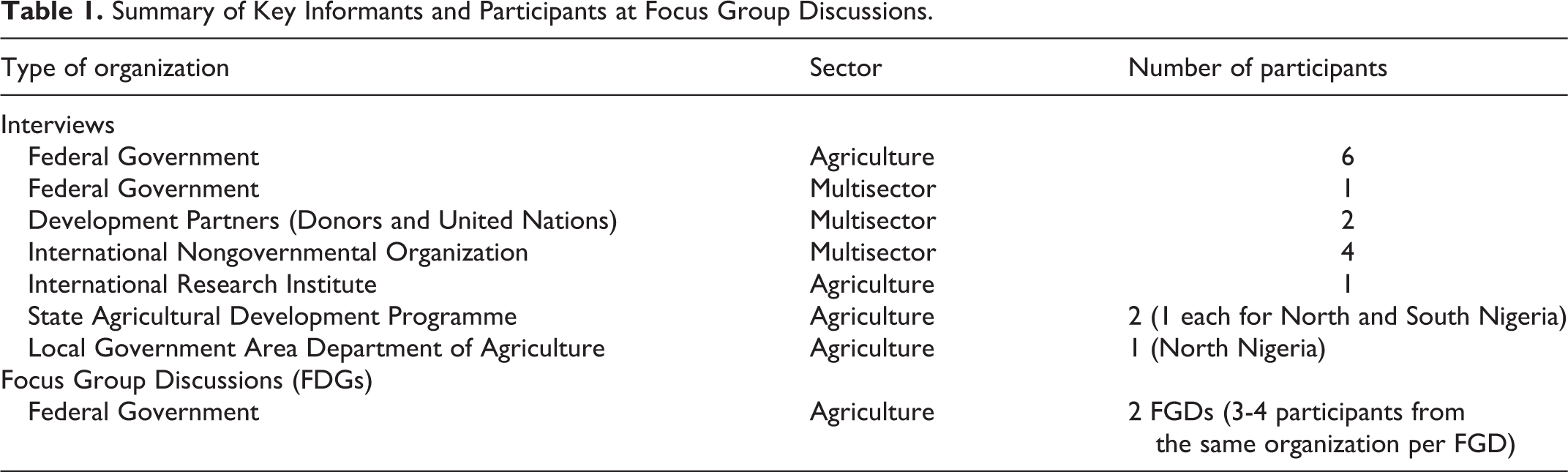
Content was retrieved from 16 websites between February and April 2015 (Supplemental Material 1) and 25 program documents 27,29 -52 were reviewed. Seventeen key informants were interviewed, and 2 FGDs with a combined total of 7 participants were conducted. Across the 24 participants for both interviews and FGDs, just 6 were not in managerial or directorship positions. Table 1 summarizes the organizations of the participants. Interviews and FGDs for the study were conducted between February and March 2015 in collaboration with the Federal Department of Agriculture at FMARD. The study was conducted in adherence to the Declaration of Helsinki principles. Consent for interviews and FGDs was obtained at both organizational and individual levels. Starting with FMARD, organizations were approached for interviews with relevant program staff. Oral informed consent was then obtained from all key informants and participants at FGDs. Consent was obtained separately for participation in the study and audio recording of interviews/FGDs. Consent for both participation and audio recording was obtained for 12 interviews and the 2 FGDs. For 5 interviews, key informants consented to participate but not to be audio recorded; detailed notes were therefore taken at these interviews.
Summary of Key Informants and Participants at Focus Group Discussions.
Data Analysis
Interviews were transcribed, and transcripts and interview notes (where there were no transcripts) were analyzed according to study objectives. Content analysis of documentation about programs and activities was conducted to identify agriculture-linked-to-nutrition interventions. Interventions were considered nutrition-sensitive if they included activities to address the underlying causes of malnutrition (food, health, and care) or the immediate causes of malnutrition (dietary intake and disease). All analyses (interviews, FGDs, websites, and documents) were guided using templates that were developed a priori based on the study’s objectives. Key themes around stakeholders’ NSA interests, relationships, coordination, challenges, and other characteristics were subsequently identified. Findings from the study and ensuing recommendations were presented at a December 2015 meeting of nutrition focal persons from multisectoral government ministries, departments and agencies (MDAs), some of whom had been participants in the study. Presented recommendations centered around actions to improve stakeholder engagement and colocation as a coordination approach. The findings and recommendations were discussed at the meeting and participants’ reactions were documented.
Results
Stakeholders and Interventions Linking Agriculture to Nutrition in Nigeria
Seven groups of stakeholders with agricultural interventions that had nutrition-sensitivity potential were identified: government MDAs, international nonprofit organizations (INGOs), Nigerian nongovernmental organizations (NGOs) and other organizations, the United Nations (UN) system, bilateral agencies, research organizations, and funding organizations.
Government MDAs
The primary government MDAs involved in promoting improved nutrition through agriculture were several FMARD departments, the National Programme on Food Security (NPFS), National Agricultural Research Institutes (NARIs), the Fadama III Project, and Agricultural Development Programmes/Authorities (ADPs/ADAs) in every state of the country and the Federal Capital Territory (FCT), Abuja. Federal Ministry of Agriculture and Rural Development departments included the Departments of Agriculture (trees and crops), Fisheries, Livestock, Rural Development, Agricultural Extension, and Strategic Reserve. Within the Federal Department of Agriculture, a Nutrition Unit had been formed out of another unit to integrate nutrition into all agricultural value chains. Key nutrition-related activities within MDAs included appointment and training of nutrition desk officers at federal, state, and LGA levels; promotion of value chains of nutrient-dense commodities; delivery of nutrition education to farming families; and research to increase the nutrient content of crops and development of nutritious products from local foods. The state ADPs were the primary extension and agricultural development arm of FMARD, and the ADP system had mechanisms through which village extension agents (VEAs) received and transferred innovations and modern technologies to farming families.
Some key informants were not entirely sure what activities were being conducted in their department concerning nutrition. It appeared that part of the ignorance was because the departments were not doing anything explicit yet. The AFSNS was still in its infancy and reports of some officers suggested that their nutrition activities were assumed rather than manifest. These officers equated their department’s work to produce a particular food or promote food security as improving nutrition. Except for NPFS, the Extension Department, and the Nutrition Unit in the Agriculture Department, other departments and agencies had not gone beyond the planning stage to implement nutrition-sensitive interventions.
International non-profit organizations
Several INGOs were implementing agriculture linked to nutrition interventions in Nigeria. The scale and scope of these activities and how they were related to existing governmental structures usually depended on each organization’s missions and objectives.
Nigerian NGOs and other organizations
Very few Nigerian NGOs, private, or research organizations were identified. This does not mean that they did not exist; it just means that they were unknown or not readily recalled as stakeholders at the federal level where sampling and most interviews occurred. It appeared probable that Nigerian organizations promoting nutrition through agriculture conducted most of their activities at the state and LGA levels and were thus known only to relevant individuals working at these levels. It also appeared that Nigerian organizations’ implementation of nutrition-sensitive agricultural interventions was linked to extrinsic factors (such as donor funding) and was therefore inconsistent.
United Nations system
The central UN system funds, programs, and specialized agencies involved in promoting nutrition through agriculture in Nigeria were the Food and Agriculture Organization, International Fund for Agricultural Development (IFAD), World Bank, and United Nations Children’s Fund (UNICEF). All these organizations worked through the federal government and FMARD and lent their support to the implementation and success of the ATA. Food and Agriculture Organization, IFAD, and the World Bank supported agriculture interventions with increasing integration of nutrition. United Nations Children’s Fund primarily focused on nutrition interventions without any agricultural components, but plans were underway to promote the use of biofortified crops in infant and young child feeding.
Bilateral agencies
The primary bilateral agencies involved in NSA were the UK Department for International Development (DFID)—now the Foreign, Commonwealth and Development Office—and the United States Agency for International Development (USAID). Both organizations planned and implemented NSA interventions through the help of implementing partners and funded NSA projects of other organizations.
Research organizations
The major research organizations working to improve nutrition through agriculture in Nigeria were the International Institute of Tropical Agriculture (IITA), HarvestPlus, International Potato Centre (CIP), and the International Food Policy Research Institute. All these research organizations worked in partnership with relevant NARIs. HarvestPlus, CIP, and IITA developed bio-fortified staple crops (such as vitamin A maize and vitamin A cassava) and helped transfer the technologies to smallholder farmers. International Institute of Tropical Agriculture also developed improved plant breeding and soil, crop, pest management, and postharvest processing and storage techniques, focusing on transferring the technologies, particularly to smallholder farmers. International Institute of Tropical Agriculture generally had several projects to improve agricultural production and yield in Nigeria, but not all projects had explicit nutrition objectives and/or actions.
Funding organizations
In addition to the World Bank, DFID, and USAID already mentioned, the European Union (EU) through the European Commission’s Humanitarian Aid and Civil Protection department, African Development Bank, and Bill and Melinda Gates Foundation were significant sources of funding for NSA interventions. These organizations also shaped how the issue was addressed and facilitated new knowledge about effective methods through requests for proposals that required innovation and ingenuity.
Supplemental Material 2 describes the relevant activities of the identified stakeholders in greater detail and summarizes interventions ongoing in 2015. Overall, efforts to link agriculture to nutrition were underdeveloped. Many of the identified interventions mentioned improved food security as a goal and some mentioned improved nutrition, but specific nutrition aims, tools, and activities were generally not mentioned. Instead, many stakeholders considered improved nutrition to be a foregone conclusion of increased food production, market access, and/or incomes.
Even for programs that had clearly defined nutrition goals and activities, there were hardly any mentions of indicators to measure progress or determine success. The components of the interventions also varied in the degree to which they linked agriculture and nutrition. Some interventions were primarily nutrition-focused but included agricultural components to achieve nutrition objectives. Other interventions were mainly agriculture-focused but included nutrition components to enhance impact. No intervention appeared to integrate agriculture and nutrition fully, such that objectives, components, expected impact, and indicators all included agriculture and nutrition considerations. In several cases, the objectives of the interventions did not explicitly include nutrition, yet improved nutrition was an anticipated impact of the intervention. Further, the implementation of federal government-led interventions varied from state to state and from one LGA to another within states because of the varying extent of interest and political will at these levels.
Coordination of Nutrition Activities Within the Agriculture Sector
Three different coordination mechanisms for nutrition activities within the agricultural sector in Nigeria were assessed: coordination among FMARD MDAs; coordination between FMARD and state and LGA level MDAs for agriculture; and coordination among FMARD, MDAs in other sectors, INGOs, donors, and other organizations.
Coordination among FMARD departments and agencies (intrasectoral horizontal coordination)
Key informants stated that some coordination exists among the different departments in FMARD and with FMARD agencies. Coordination appeared to exist mainly around joint meetings. Generally, interviewed MDAs could provide some information about the nutrition activities conducted by other departments, and some even reported having shared projects. The departments also reported working closely with NARIs who developed technology that was transferred to farmers. However, coordination among departments was far from perfect, as they were informed but not necessarily involved. There were, in fact, duplications of efforts identified. Several departments mentioned developing training manuals that would be used to train extension agents and farmers about nutrition through them.
Similarly, 2 different departments claimed ownership of Home Grown School Feeding Programmes planned by FMARD. Further, information sharing was not universal. For instance, 2 heads of departments (Directors) reported not knowing what was being done about nutrition in other departments, even though their department also conducted nutrition activities or had oversight functions. In the words of one of them: “If you want me to be very frank with you, coordination is very poor in terms of information, awareness, sensitization about the nutrition value chain in FMARD.”
Coordination between FMARD MDAs and state and LGA agriculture MDAs (intrasectoral vertical coordination)
State Ministries of Agriculture and Rural Development (SMARD) had departments like those at the federal level. However, instead of an Agriculture Extension Department, the state ADP conducted the extension activities of SMARD. The functions of the other departments, such as Agriculture, Fisheries, and Livestock, involved increasing agricultural participation and production by creating enabling policy environments and programs. These departments carried out their functions by working with the Department of Agriculture in each LGA. The LGA Department of Agriculture had officers assigned to carry out activities related to one or more departments at the state level. Like the ADPs had VEAs who delivered extension services, including nutrition education, to farming families, the LGAs’ department of agriculture also had extension services officers who performed comparable roles. In addition to SMARD, there were also FMARD offices in each of the states and the FCT. These offices had officers representing departments and agencies at the federal level, for example, NPFS Director and ATA Director. The role of these officers was to serve as liaison officers between the federal level and the state level. To ensure that programs and activities received political support at the state level and facilitated appropriate budgetary allocations, state Commissioners for Agriculture and Rural Development were involved in the ATA and AFSNS through the National Council of Agriculture and Rural Development. National Council of Agriculture and Rural Development was the highest policy-making body for agriculture in Nigeria. It comprised the Honourable Minister for Agriculture and Rural Development, the Minister of State, and all Honourable Commissioners for Agriculture, Rural Development, and Cooperatives. Still, apart from the ADP system that had historically involved nutrition activities, very little was going on in nutrition outside of the federal level MDAs.
Coordination between FMARD and other sectors (multisectoral horizontal coordination)
There was limited collaboration between actors in the agricultural and other sectors. The nutrition sector in Nigeria was reported to have its nerve center in the Federal Ministry of Health (FMOH) Department of Family Health and the National Primary Health Care Development Agency (NPHCDA). However, except for Action Against Hunger (ACF), whose exact NSA interventions were not identified, none of the organizations implementing NSA activities mentioned FMOH or NPHCDA or any other primarily nutrition-focused organization as partners (Supplemental Material 2).
The inadequate sectoral alignment in nutrition-sensitive agricultural interventions in Nigeria began from the intervention design stage. The draft AFSNS produced by FMARD highlighted comprehensive plans to ensure that agriculture in Nigeria is made nutrition-sensitive and included a strategy framework that highlighted objectives and institutional roles. For nearly all the objectives and actions listed, FMARD was assigned the responsibility of the lead agency, even for actions that were already being implemented by other federal ministries and agencies. The multisectoral National Plan of Action on Food and Nutrition, produced by the National Planning Commission, explicitly assigned some of the actions to other MDAs. These MDAs implemented the activities independently of FMARD and the agriculture sector in general.
In addition, key informants reported that multisectoral coordination between FMARD and other ministries was traditionally poor and limited to joint attendance at meetings. The establishment of the NTVC was mentioned and was considered to have improved coordination. In addition to FMARD’s Directors of Agriculture, Fisheries, Livestock, Extension, and Planning & Coordination, and the Nutrition Desk Officer, the NTVC includes representatives of FMOH, Federal Ministry of Education, Federal Ministry of Women Affairs, UNICEF, Helen Keller International, Save the Children International, Global Alliance for Improved Nutrition, Africare Nigeria, among others. The NTVC was successfully involved in drafting the AFSNS itself, and had held several meetings and workshops to advance a nutrition agenda in the agricultural sector in Nigeria. Key informants were optimistic about the new opportunities for multisectoral coordination. However, they mentioned that such coordination was still challenging because it was unwieldy, time-consuming, required a very committed department/agency to drive it, adequate funding in all involved organizations, and required regular meetings. Moreover, key informants expressed concerns about the lack of such interministerial structures at the state and LGA level; and about the ability of the NTVC to make a significant impact in driving the implementation of the AFSNS if states were not interested and/or willing to act.
In addition to the NTVC, a National Committee on Food and Nutrition (NCFN) drew membership from institutions/organizations comparable to that in the NTVC, including FMARD. However, a significant difference was that while the NTVC members were mainly bureaucratic policymakers who were career civil servants in the relevant ministries, membership of the NCFN was made up of appointed (political) policymakers. National Committee on Food and Nutrition also included Heads of Department from leading university departments of nutrition in the country, the Director Generals of the National Agency for Food and Drug Administration and Control and the Standards Organization of Nigeria, the Executive Director of NPHCDA, and the President of the Nutrition Society of Nigeria. The NCFN had its Secretariat in the National Planning Commission (now Ministry of Finance, Budget and National Planning) and was mandated to coordinate and provide leadership for multisectoral action to reduce malnutrition in Nigeria. National Committee on Food and Nutrition had coordination but not implementation functions and was expected to influence action at the state and LGA levels through corresponding State Committees on Food and Nutrition and Local Government Committees on Food and Nutrition (LGCFN). The SCFN and LGCFN were expected to have their Secretariats in the State Planning Commission and the Office of the LGA Vice Chairman, respectively.
Factors That Enable Nutrition-Sensitive Agriculture Interventions in Nigeria
Key informants mentioned several factors that encouraged nutrition-sensitive agricultural interventions. Firstly, strong political leadership, evidenced by the interest and leadership for food and nutrition security shown by the then Honourable Minister of Agriculture, Dr Akinwumi Adesina, which led to the ATA and AFSNS; was a consistent, supportive factor mentioned. Next was the advocacy and provision of material and human resource support by INGOs and donor interest and funding. Several INGOs conducted advocacy to encourage the government to mainstream nutrition into agricultural policies and plans. These INGOs and some donors further facilitated the deliberation of the pertinent issues by sponsoring meetings and workshops. Some key informants highlighted how their knowledge about and interest in implementing NSA interventions was stimulated through participation in meetings and workshops of stakeholders already implementing such interventions. In general, meetings of all relevant stakeholders were considered an enabling factor.
Another perceived enabling factor was that government institutional arrangements existed that could be used to implement and coordinate NSA interventions. The key informants gave examples of structures that could be leveraged, including the National Programme for Food Security and ADP system, which had a wealth of experience in implementing nutrition-linked agriculture interventions, were universal to states, and had endured political, administrative, and donor changes. Availability of lessons from the experience of other countries that have been successful in instituting NSA was further considered enabling.
Challenges to Nutrition-Sensitive Agricultural Interventions in Nigeria
The study’s key informants stressed several challenges that hamper the ability to design and implement NSA. Mainly, NSA interventions were yet to be harmonized across departments and agencies in FMARD and across relevant sectors, so there was duplication of efforts. Under ATA, many of the production departments and food value chains were asked to include nutrition considerations in their activities. In a bid to do so, there were undertakings in several departments and units—such as the development of nutrition training materials for farmers—which aimed to achieve the same purpose. However, since decisions were often taken in silos (without interaction with others), the actions of departments and units were mostly unknown to each other, so there was little collaboration to leverage each other’s efforts and achieve synergy. It was reported that there was suspicion and lack of trust among stakeholders at all levels, partly due to rivalry and competition, resulting in information hoarding, narrow-focused interventions and institutional turf battles, which further exacerbated silos.
Funding challenges were also considered substantial. These challenges included excessive dependence on donors and the federal government for funds and other inputs, reduced budgetary allocations and delays in disbursement of budgetary allocations for agriculture interventions at the federal level, partial disbursement of budgetary allocations, inadequate funding for nutrition activities, inadequate and lack of budgetary allocations for agriculture interventions at the state and LGA levels, respectively; and lack of counterpart funding at the state/LGA level even when donors or the federal government were able to contribute some funding. Key informants highlighted general indifference and/or lack of cooperation at the state and LGA levels. States and LGAs in Nigeria have autonomy about whether to act on an issue, the type of action, and the degree of action. Thus, it does not matter how laudable an intervention is; if the states and LGAs do not actively commit to it, nothing meaningful can be accomplished and/or sustained.
Inadequate human resources at federal, state, and LGA levels, in terms of number, capacity, and distribution of available human resources, were another major challenge. It was repeatedly pointed out that the number of personnel available at different levels was inadequate to get the job done. For instance, although the ADP structure intends one VEA for 1000 farming families, the reality is that some VEAs had to handle 10 000 to 20 000 farming families due to an insufficient number of VEAs. One of the state ADPs reported having 170 000 farming families but only 70 VEAs, rather than the 170 expected. Yet state governments were not recruiting new staff because of budget constraints.
Moreover, the VEAs received messages about many topics and so had to contend with delivering a lot of information even when they were covering only the intended number of farming families. Regarding the capacity of available human resources, some key informants admitted that they did not have the knowledge or training to plan for and/or implement nutrition-sensitive activities. In contrast, they had been mandated to do so.
Coordination challenges were additionally emphasized. For intrasectoral horizontal coordination, nutrition activities were fairly new to almost all the departments and agencies, and even the NTVC was only recently established. Hence, there had also been little shared understanding among the various departments on which to base coordination. The key informants emphasized that although coordination mechanisms existed, very little coordination occurs in practice. For intrasectoral vertical coordination, federal level key informants expressed difficulty getting states to cooperate and support programs and activities and highlighted little to no support for multisectoral action at the state and LGA levels. Whereas multisectoral coordination often received focus (even if only verbally) at the federal level, the situation was perceived to be different at the lower levels. Thus, even when states and LGAs decided to implement multisectoral interventions designed at the federal level, the interventions were poorly executed.
On the other hand, state-level key informants perceived that federal level actors needed to respect existing coordination structures rather than often bypassing the state offices to go to the VEAs directly. State-level key informants also perceived that federal stakeholders sometimes hindered the execution of planned activities by restricting information. In addition, state-level informants reported that it was challenging coordinating activities with the LGA departments of agriculture because they were not adequately funded by their LGAs. Hence, even when the LGA officers were invited to meetings and training, they often could not attend. The poor coordination between the state and LGA levels was perceived to be manifest in a lack of relationship between the VEAs of the ADPs and the LGA extension agents. Although they had similar roles, each extension agent group was reported to do their work in isolation. Key informants confirmed the poor LGA funding at that level. It was highlighted that LGA extension agents often could not get much done because there were no funds for transportation to visit farming families. The LGA level likewise confirmed that coordination between their level and the state level was poor. Instances were recounted where the LGA officers received information from community leaders about the state officers conducting activities in the communities without involving the LGA or asking for their input.
Regarding multisectoral coordination structures, it was reported that the NCFN had been inactive for several years because of human resource capacity gaps within the National Planning Commission, leading to an inability to convene meetings and facilitate coordination of nutrition activities. Moreover, there had also been challenges with getting funding to conduct the activities of the NCFN. Key informants further highlighted that it was not clear whether many of the SCFN and LGCFN were functional and that the common state of inactivity reported challenged the basic notion of the existence of these coordination mechanisms.
Stakeholders’ Reactions to Study Findings
Participants who reviewed the findings and subsequent recommendations from the study agreed with the findings and emphasized the need for better stakeholder coordination. However, the participants discounted colocation as a potential coordination approach for Nigeria, highlighting that a concentration of stakeholders in some geographic locations will mean neglect of other areas. Participants also perceived that colocation could lead to reduced funding for each implementing organization because they would be expected to leverage the activities of others rather than directly implementing all activities.
Discussion
This study aimed to identify the stakeholders, interventions, and coordination mechanisms for NSA in Nigeria to facilitate improved coherence, consistency, synergy, scale, impact, and accountability among stakeholders. The study’s main findings were that a considerable number of active stakeholders with agricultural interventions had the potential to address nutrition. However, nutrition potential was yet to be harnessed/maximized, evidenced by inadequate inclusion of nutrition objectives, activities and indicators in the interventions. Existing interventions differed across states and LGAs, and coordination within the agriculture sector and between this sector and other sectors was limited. Inadequate/ineffective political will, information sharing, trust, funding, and human resources at all levels of government were significant challenges to the implementation and coordination of NSA.
The findings from this study are not peculiar to Nigeria. The limited nutrition sensitivity of agricultural interventions has been previously documented. 24,53,54 The identified implementation and coordination challenges are also similar to what has been reported in other countries in Africa and Asia. 20 -25 In fact, these reported experiences from other countries indicate that the currently limited implementation of the AFSNS is not surprising given the situation with stakeholder NSA approaches, relationships, and coordination in 2015. Reviewing the findings of our study in the light of the lessons learned from these other countries, 20 -25 some of which have implemented successful NSA interventions, 25 suggests several actions that can improve the enabling environment for NSA in Nigeria.
First, there is a need to address and improve nutrition literacy among NSA stakeholders. 20,21,55 The limited inclusion of nutrition objectives, activities, and indicators in agricultural interventions and the perception among stakeholders that improved food security will automatically lead to improved nutrition highlights a need for NSA stakeholders to better understand what NSA is and how to achieve it. As part of nutrition literacy activities, it would be necessary to ensure that stakeholders reach a consensus around a common conceptual framework of the links between agriculture and nutrition and subsequently agree on the roles of different stakeholders in addressing these links. 22,23
Next, intrasectoral (horizontal and vertical) and multisectoral coordination must improve among stakeholders. Previous reports have documented that the agriculture, nutrition, and health sectors will need to work closely together on intervention design, implementation, and evaluation if agriculture is to have a meaningful and lasting impact on nutrition and health. 20 -25,56 The findings of our study emphasize the need to improve the relationship between FMARD MDAs and all actors in the agricultural sector as well as multisectoral coordination. The role definition already mentioned is essential for improving coordination. 24 However, role definition must protect sectoral interests and autonomy to be effective. 15 Given that institutional turf battles and duplication of efforts were emphasized as critical challenges to implementing nutrition-sensitive action, improving coordination may require FMARD to take a supportive rather than lead role for actions already being implemented by other MDAs.
Further, the multisectoral activities included in the AFSNS and the responsibility of lead agency assigned to FMARD 27 indicate that the AFSNS implicitly assumes an integration approach to coordination. However, an integrated approach has been reported to be ineffective for nutrition interventions in contexts like Nigeria, where MDAs have a sectoral mandate, resource allocation is done through MDAs, and the technical expertise of implementing officers is sectoral. 9,10,15 -18 Colocation has been suggested as a viable alternative to integration in such situations, 15 -18 but will need to be contextually tested. 16 Nevertheless, the resistance to colocation by participants who reviewed the study’s findings emphasizes a need for increased stakeholder engagement, dialogue, and consensus.
Stakeholder engagement is more effective when centered on a stakeholder engagement plan that articulates the purpose of engagement and the extent to which each group of stakeholders is to be engaged at every stage of an intervention. 13,14 Engagement can occur at about 5 different levels: (1) information sharing (little opportunity to receive stakeholder feedback), (2) consultation (stakeholders proffer opinions for consideration in decision-making), (3) participation (stakeholders participate in decision making), (4) negotiation/partnerships (stakeholders combine expertise and resources to achieve a common goal), and (5) empowerment (stakeholders can make operational decisions and own intervention). The extent to which a stakeholder should be engaged depends on the perceived level of their influence over the success of an intervention. 13 For instance, state and LGA stakeholders who are crucial to implementing an intervention can be engaged at the level of empowerment. In contrast, stakeholders such as NGOs who work independently in the intervention location can be engaged at the level of consultation. Furthermore, FMARD MDAs that are not directly involved in an intervention can be engaged in information sharing. The intervention stage can also influence the level of engagement that is done. For example, FMARD can engage FMOH at the level of participation at an intervention design stage but only at the level of information sharing in the implementation stage. Effective stakeholder engagement requires time and resources that must be adequately budgeted for. Higher levels of engagement should also be budgeted for and conducted before lower levels. 13,14
Regarding the capacity of stakeholders (especially government MDAs) to implement NSA interventions, lessons from other countries indicate that partnerships between government and NGOs can address both shortages in the number of human resources and knowledge and skill gaps. 25 Other authors have emphasized the need to build capacity among personnel at multiple levels (top-, mid-, and bottom-levels) and through in-service as well as preservice trainings. 55
Our study had several strengths but also some limitations. One strength is that data were collected using multiple approaches (document gathering and review, interviews, and FGDs) and were triangulated. Another strength is that key informants across various types of organizations and levels of government were interviewed, increasing the ability of the study to identify a comprehensive list of relevant stakeholders. Thirdly, data saturation was reached regarding the enablers and challenges of NSA in Nigeria as the same issues were emphasized by the different data sources and interviewees.
Limitations of the study include the small number of key informants interviewed and the small number of organizations and states/LGAs from which informants were recruited. As reported in the study, it is possible that some relevant stakeholders and interventions were missed due to the small sample size of interviewees. Secondly, some organizations and individuals declined to grant interviews. This refusal could have created a potential situation in which the findings from the study were systematically biased because of unidentified systematic differences between the characteristics of those who consented to be interviewed versus those who did not consent. Moreover, some interviewees were reluctant to respond to questions about interventions and organizational activities (reflecting the information hoarding identified as an NSA challenge). These limitations led to incomplete information mapping (Supplemental Material 2) and an inability to completely separate situations in which information about interventions (e.g., nutrition activities) simply did not exist, from situations in which information existed but was not obtained in the course of data collection.
Conclusion
Several groups of stakeholders were involved in implementing NSA interventions in Nigeria in 2015. These groups are government MDAs, INGOs, Nigerian NGOs and other organizations, the UN system, bilateral agencies, research organizations, and funding organizations. In the descriptions accessible for nearly all NSA interventions identified, the nutrition goals and activities and/or indicators to measure outcomes were not clearly communicated. Also, there appeared to be minimal cross-sectoral partnerships formed. Previous literature indicates that multisectoral collaboration between the agriculture, nutrition, and health sectors is necessary for agricultural interventions to have any meaningful impact on nutrition. Our study found that multisectoral collaboration was challenging because of mistrust, rivalry, and battles over institutional turf. The AFSNS developed to guide NSA interventions across the country assumed an integration approach to coordination. Yet, evidence from other countries suggests that a colocation approach will be more effective in the Nigerian context.
Addressing challenges with NSA stakeholder relationships and coordination in Nigeria requires improved nutrition literacy among stakeholders and stakeholder engagement facilitated by role definition, clarification, and consensus. Stakeholder engagement needs to occur at several levels depending on the influence each stakeholder has over the success of various components of interventions. Effective engagement will foster trust among stakeholders, increase productivity, and minimize inefficiencies.
Supplemental Material
Supplemental Material, sj-pdf-1-fnb-10.1177_03795721221119249 - Stakeholders, Relationships, and Coordination: 2015 Baseline Study of Needed Enablers for Bridging Agriculture-Nutrition Gaps in Nigeria
Supplemental Material, sj-pdf-1-fnb-10.1177_03795721221119249 for Stakeholders, Relationships, and Coordination: 2015 Baseline Study of Needed Enablers for Bridging Agriculture-Nutrition Gaps in Nigeria by Olutayo Adeyemi, Victor Ajieroh, Larry Umunna, Francis Aminu and Adeyinka Onabolu in Food and Nutrition Bulletin
Footnotes
Acknowledgments
The original study was conceptualized and/or designed by Victor Ajieroh, Larry Ummuna, Francis Aminu, and Olutayo Adeyemi. Data collection and analysis were performed by Olutayo Adeyemi. The development of the manuscript from the original research was undertaken by Adeyinka Onabolu, Victor Ajieroh, and Olutayo Adeyemi. All authors commented on previous versions of the manuscript and approved the final manuscript.
Declaration of Conflicting Interests
The author(s) declared no potential conflicts of interest with respect to the research, authorship, and/or publication of this article.
Funding
The author(s) disclosed receipt of the following financial support for the research, authorship, and/or publication of this article: The Bill and Melinda Gates Foundation provided financial support for the research and publication of this article.

Supplemental Material
Supplemental material for this article is available online.
References
Supplementary Material
Please find the following supplemental material available below.
For Open Access articles published under a Creative Commons License, all supplemental material carries the same license as the article it is associated with.
For non-Open Access articles published, all supplemental material carries a non-exclusive license, and permission requests for re-use of supplemental material or any part of supplemental material shall be sent directly to the copyright owner as specified in the copyright notice associated with the article.
