



Abstract
Background:
Achieving meaningful malnutrition reductions in Nigeria and other high-burden countries requires sustained improvements in diets, mediated through nutrition-sensitive agriculture and food systems. Yet, the capacity to design, plan, implement, and monitor such nutrition-sensitive systems is very limited, including within agricultural extension services delivery. Understanding existing capacity of actors required to implement nutrition change is crucial for effective capacity development.
Objective:
This study assessed the nutrition capacity of agriculture extension agents (AEAs) in Nigeria and the capacity of their organizations and the institutions within which they operate.
Methods:
The study assessed 31 extension training materials for inclusion of recommendations for nutrition-sensitive agriculture. Structured interviews and focus group discussions were conducted with 23 extension agents and were coded and analyzed for major themes.
Results:
Training materials hardly included nutrition objectives and or nutrition-related services to be delivered. Some nutrition-related services were being delivered, including promotion of biofortified crops and nutrient-dense crops and animals, home gardening, food safety, and dietary diversification. However, these services were limited, and service delivery was unstructured, nonuniform, and inconsistent. Numbers of AEAs are quite inadequate while available AEAs had high workloads, are poorly motivated, and had limited funding, supervision, and logistics capacity to perform roles. Physical security was also a challenge for service delivery. Further, complementary activities in other sectors that were necessary for adequate delivery of nutrition-sensitive agriculture did not always exist.
Conclusion:
Extensive development of nutrition capacities of extension agents appears unlikely to achieve nutrition-related changes if limiting institutional and organizational capacity deficits are not addressed.
Plain Language Title:
Capacity of Agriculture Extension Agents in Nigeria to Deliver Nutrition Services.
Plain Language Summary:
Reducing the significant burden of malnutrition in Nigeria requires increased availability and consumption of foods that are nutritious and free from harmful substances. To produce such foods, farmers need adequate nutrition and food safety knowledge and skills. The production of such food will also need to support nutrition in other ways, including increased women’s empowerment. Extension agents traditionally support farmers to adopt new methods of food production and/or processing that support increased food yields. These agents can also be used to deliver services that will address nutrition if they have the necessary knowledge and skills. This study assessed the capacity of agriculture extension agents in Nigeria to deliver nutrition services, in order to determine how to increase their capacity to deliver these services. The results from the study are that the extension agents do not have sufficient knowledge and skills to deliver nutrition services, and that their organizations and the wider context in which they work do not have the capacity to enable them to deliver nutrition services effectively. For instance, the organizations do not have sufficient numbers of staff and do not provide current staff with adequate means of transportation to visit farmers. Insecurity is high and so extension agents are unable to visit farmers frequently because of the potential threats to their lives. The study concludes that effectively using extension agents to deliver nutrition services will require not just training of the extension agents but also improvements in organizational capacity and contextual factors.
Keywords
Introduction
The necessity for food systems, including agricultural production systems, that prioritize the achievement of optimal nutrition outcomes has become increasingly obvious. 1 -3 Recent evidence shows that traditional, heavily health sector-dependent approaches to reducing malnutrition will have crucial but limited impacts without investments in actions in other sectors, including the agriculture sector. 4 Agriculture can address the underlying causes of malnutrition—food insecurity, inadequate access to health services and sanitary environments, and inadequate care—by improving agricultural production, lowering food prices, increasing incomes from agriculture dependent livelihoods, improving diversity of available foods, increasing dietary diversity and access to quality diets, empowering women, improving the effectiveness and coverage of nutrition-specific interventions, among other activities. Agricultural practices that address nutrition in such multidimensional ways are referred to as nutrition-sensitive agriculture. 1,5,6
In recognition that nutrition-sensitive agriculture is crucial for reducing malnutrition in Nigeria, the Federal Ministry of Agriculture and Rural Development (FMARD) developed the Nigerian Agricultural Sector Food Security and Nutrition Strategy 2016-2025 (AFSNS). 7 The overall objective of the AFSNS is to improve the food and nutrition security of all Nigerians while empowering women and promoting resilience of the most vulnerable through sustainable nutrition-sensitive agricultural livelihoods. The Strategy has 8 priority areas, 37 subcomponents, and 101 outputs. 7 An assessment of the readiness of the Nigerian agriculture sector to implement nutrition-sensitive agriculture found that both institutional and individual capacity were weak, despite strong interest and willingness to act. 8
Federal Ministry of Agriculture and Rural Development consequently commenced capacity development efforts to address these capacity gaps. Trainings were conducted at both federal and state levels using a training of trainers’ approach. A 5-day federal level training was conducted with 17 participants, and 2 state level trainings for 3 days each, with a total of 53 participants from 19 states. Many participants at the trainings had received little to no prior nutrition training. Although the trainings significantly increased their knowledge, large knowledge gaps remained and the ability of participants to implement nutrition-sensitive agriculture appeared inadequate. 9 Previous authors 10 reported that training is inefficient when contextually defined competencies required of participants have not been articulated apriori. Mucha and Tharaney 11 highlight the need for a systematic approach to nutrition capacity building, including the development of a Nutrition Workforce Strategy and Implementation Plan.
The first steps in the development of such a workforce strategy are the identification of the cadres of workers whose capacity need to be increased, as well as their job descriptions, roles, responsibilities, and accountability mechanisms. Other steps include identifying the nutrition intervention areas the worker would be expected to act, as well as competency standards expected of the workers. 11 -13 All these steps require a nutrition capacity needs assessment to establish existing roles, knowledge, skills, and other characteristics of targeted cadres for capacity building. 11,13,14
In most African countries, agriculture extension agents (AEAs) form part of a critical cadre of workers whose nutrition capacity need to be built. 11,15 -17 Agricultural extension includes several general characteristics—governance structures, capacity, management, and advisory methods—that can be modified by stakeholders based on production systems, institutional linkages, policy environments, and other contextual factors. 18 Traditionally, the roles of AEAs focused on linking food producers to research institutes to promote the adoption of innovative agricultural practices. However, with changing contextual factors in and across countries, there have been continuous modifications to the characteristics of agricultural extension and to the roles of AEAs. 18,19 The incorporation of nutrition services into agricultural extension and the role of AEAs is one such modification. 15,16 There are at least 9 nutrition competence domains that may be required by AEAs to perform nutrition roles, 20 depending on the specific extension role of the AEA. 21,22 Other (non-nutrition-specific) competency domains are also required. 17,21,22 Building effective nutrition-sensitive agricultural extension services necessitates an understanding of the contextual roles played by AEAs and gaps in competencies and capacities required to successfully deliver essential nutrition services. 11 -13
Given the urgent need to implement the AFSNS and reduce malnutrition, as well as the gaps in necessary capacity, a study was conducted from October to December 2018 to assess the nutrition capacity needs of agricultural extension services in Nigeria.
The specific objectives of the study were to: Describe the roles, responsibilities, and routine activities of AEAs in Nigeria Identify nutrition knowledge gaps and capacity needs of AEAs Discuss potential mechanisms to integrate nutrition into agricultural extension training and service delivery in Nigeria
The findings from this study were expected to contribute to the development of an Agricultural Sector Nutrition Workforce Strategy. However, progress on the Workforce Strategy has been delayed by unavailability/lack of qualified local consultants to support its development, exacerbated by the COVID-19 pandemic that precluded ready use of international consultants. Nevertheless, less systematic nutrition capacity building of AEAs occurred from 2018 to date, 9 and there are now plans to re-assess the nutrition capacity of AEAs in 2023 and complete activities to develop the Workforce Strategy. This paper reports the study of the nutrition capacity of AEAs that was conducted in 2018, in order to provide a baseline for further capacity assessments and facilitate future study of the evolution of nutrition-sensitive agriculture extension services in Nigeria. The reported learnings may also be useful to other African countries working to integrate nutrition into agriculture.
Methods
Study Design and Population
The study was conducted using a cross-sectional design. The study population was public AEAs in Nigeria. Because the study required identifying the routine activities of the extension agents, public AEAs were only eligible to be included in the study if they were currently implementing agricultural activities. Previous reports 23 -25 indicate that not all extension agents are able to conduct any routine activities because of organizational constraints.
Conceptual Frameworks Guiding Capacity Assessment
The study was guided by 2 frameworks. Nutrition capacity was assessed around the guiding principles/recommendations for making agriculture nutrition sensitive. 26 Capacity was conceptualized according to Potter and Brough, 27 who posited that there are 9 distinct but interrelated components of capacity which form a 4-tier hierarchy of needs. These 4 tiers are (1) structures systems and roles; (2) staff and facilities (infrastructure); (3) skills; and (4) tools; and reflect the need for capacity at individual, organizational, and institutional/systemic levels. Individual level capacity includes the attitudes, level of knowledge, skills, tools, and experience of the people who make up an organization, as well as their ability to relate to the functions they are expected to perform and their roles and responsibilities. Organizational capacity includes the structure, policies, and processes that influence the delivery of organizational mandate by personnel and the effectiveness of an organization. It encompasses personnel recruitment, development and retention, and the allocation of material resources. Institutional/systemic capacity involves the frameworks that establish the mandates of different organizations, their working relationships, and coordination. It also includes the power relations among organizations. 27 -29 Our study therefore assessed the ability of agricultural extension personnel, organizations, and relevant institutions to deliver the recommendations for making agriculture nutrition sensitive.
Data Collection
The study used a mixed methods approach and data were collected using 3 tools. Firstly, a review of guidance and existing extension documents in Nigeria was conducted from October to November 2018. The objective of the review was to assess the content of training that was available to AEAs and the integration of nutrition into this content. Reviewed documents were obtained from stakeholders in the federal and state ministries of agriculture, as well as State Agricultural Development Programme (SADP) offices. A total of 31 documents (Supplemental Material 1) were reviewed. The documents included guidance/training on production and/or processing of specific agricultural commodities; farmers’ registration and progress record; and agricultural extension in general. The commodities covered by the documents included cassava, rice, maize, soybeans, tomatoes, yam, sorghum, potatoes, groundnut, sesame, ginger, poultry, and sheep and goats. The documents were developed by several organizations, including FMARD; Synergos and Technoserve; USAID MARKETS II Project; Nigeria Incentive-based Risk Sharing for Agricultural Lending; National Agricultural Extension and Research Liaison Services (NAERLS); International Institute of Tropical Agriculture; and National Universities Commission.
Data from the reviewed documents were extracted into a Microsoft Excel template developed a priori. The template was based on the recommendations for integrating nutrition into agriculture. 26 The information extracted thus included objectives; topics covered; services expected to be delivered; inclusion of information dissemination/education in service delivery; target population for services; inclusion of nutrition objectives and activities; considerations for gender, vulnerable populations, food safety, environmental sustainability; and multisectoral engagement; and contact points for service delivery.
The second and third data collection tools were a self-administered, structured interview of AEAs and series of focus group discussions (FGDs) with AEAs. The interviews and FGDs sampled AEAs from 3 states—Benue and Kogi States in North Central Nigeria and Kaduna State in North West Nigeria. These states form the initial states for a Bill and Melinda Gates Foundation (BMGF) funded State Partnership for Agriculture programme implemented by Synergos that works to improve local agricultural systems and make them nutrition- and gender-sensitive, with the overall goal of improving livelihoods and well-being of smallholder Nigerian farmers. Key AEAs from these states, including zonal and state heads of agricultural extension services, the head of women-in-agriculture (WIA) unit of the SADP, as well as state, zonal, and local government authority (LGA) agriculture extension officers, were invited to a stakeholder consultation. Participants were selected based on their positions. Six positions from each state were invited, all of whom attended the consultation. An additional 5 persons comprising FMARD, NAERLS, and nongovernmental organization (NGO) personnel based in one or another of the 3 states also attended. The consultation took place for 3 days in December 2018. A total of 23 people working in agricultural extension services participated in the consultation across the states. The interviews and FGDs were conducted as part of this stakeholder consultation.
Interviews included 4 sections addressing the respondent’s sociodemographic information, current extension service structure, extension capacity development, and nutrition training. Eight FGDs were conducted around 4 topics and were facilitated using 1 of 4 FGD guides (1 guide per topic). The topics of the FGDs were existing extension service training mechanisms in Nigeria; nutrition education in agriculture extension services delivery; perceptions about pathways through which agriculture influences nutrition; and suggestions for implementing the AFSNS through extension services. All interviews and FGDs were conducted in English Language, which is the official language in Nigeria, and FGDs were audio recorded.
Data Analysis
Interview data from close-ended questions were analyzed in SPSS 20, while data from open-ended questions were entered into a matrix on Microsoft excel and analyzed for key themes. Audio recordings of the FGDs were transcribed verbatim and were coded using a codebook developed a priori based on the objectives of the study. Thematic analysis was then conducted for the data extracted from documents and FGD transcripts and key themes around the study’s objectives were identified.
Approval for the study was received from the Federal Ministry of Agriculture and Rural Development and the study was conducted in accordance with the principles of the Declaration of Helsinki.
Results
Review of Guidance and Existing Extension Documents
The reviewed documents generally focused on teaching good agricultural practices to farmers across the supply chain for various commodities. The primary objectives across the documents included increasing yield, minimizing losses, ensuring product quality, and increasing income. The specified target audience of the reviewed documents were generally AEAs and/or farmers, smallholder farmers, women, and youth (18 to 29 years old). Targeting of vulnerable groups was not always clear but was frequently implied. Nine of the 31 documents specified services that were expected to be delivered following training and 7 of the documents included information dissemination services to be provided to communities or households. None of the documents specified the frequency or duration with which information will be provided to households. Four of the documents mentioned nutrition considerations in their objectives. The nutrition considerations were to use biofortified varieties of cassava to enhance vitamin A content and reduce micronutrient deficiencies among women and children, or to improve processing and facilitate improved nutrition. Overall, 11 documents explicitly mentioned nutrition, including 8 documents that had nutrition or nutrition-related services. The nutrition/nutrition-related services included services targeted at increasing food availability, processing, and/or safety or services involving nutrition education. The 3 documents that mentioned nutrition, but did not include relevant services, had statements that encouraged farmers to invest in the nutrition of their households.
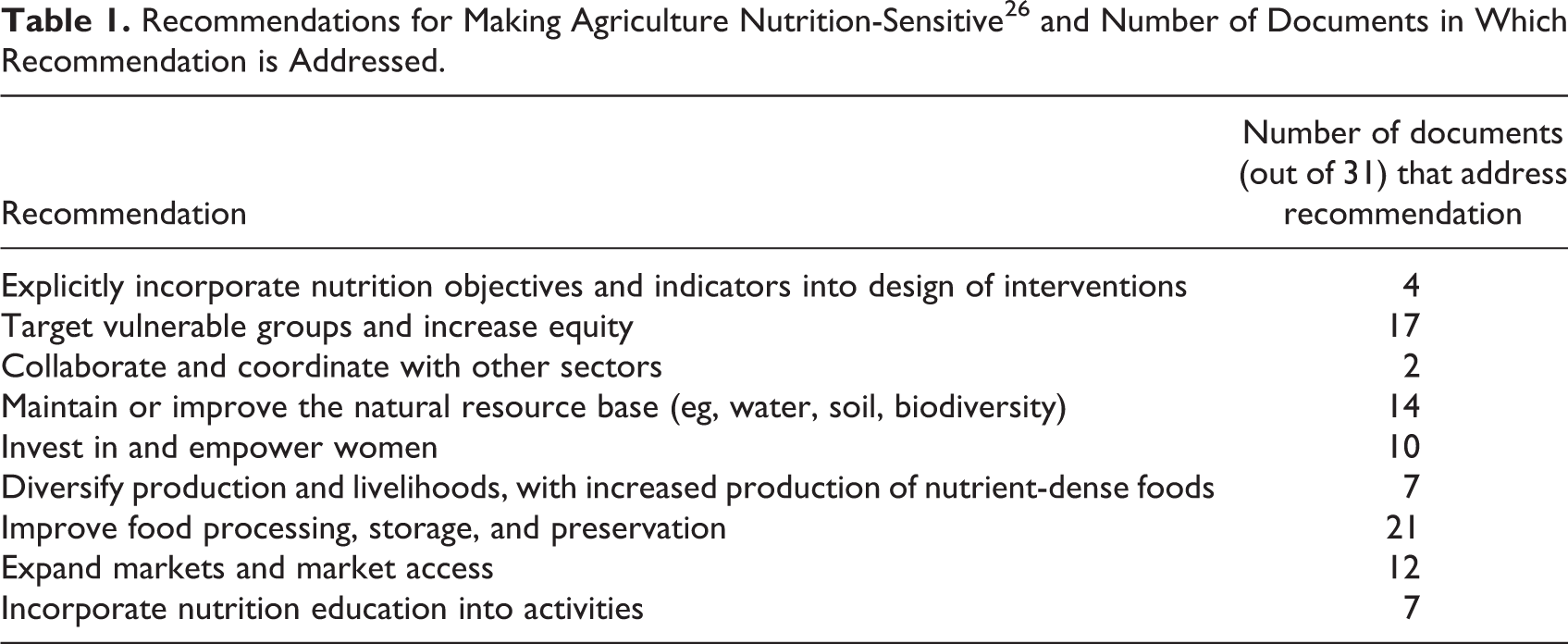
Of the 31 documents, just 7 promoted production diversification, for example, the intercropping of cassava with other crops such as pepper, okra, beans, groundnut, and melon. Eight of the documents explicitly promoted food safety, such as reduction of toxic cyanide compounds in cassava; safe application of fertilizer and other agrochemicals; storage methods to reduce contamination by pests; and ensuring food safety during processing. Ten of documents incorporated gender considerations. For instance, in 3 documents, it was highlighted that farmer selection for training should include 50% female, 30% between 18 to 29 years old. In some documents, the inclusion of gender considerations was implied but not explicit. For example, inclusion of pictures/images that suggest female participation in production, harvesting, or processing activities, or in one document, the inclusion of a case study about a successful female rice farmer who engages in mechanized agriculture. Fourteen documents explicitly considered natural resources management, such as environmental conservation, water management, and soil management. The use of fertilizer was mentioned in most of the reviewed documents; where it was not linked to conservation of soil nutrients but rather to just improved yields, the document was not classified as including environmental sustainability considerations. Although, 12 of the documents incorporated considerations related to markets and market access, it was not clear that these considerations were targeted at vulnerable groups, according to recommendations. 26
Only 2 of the 31 reviewed documents referred to linkages with another sector. One document mentioned basic principles of good manufacturing practices and identified needed approvals from regulatory agencies. The second document stated involvement of other sectors in food production and processing. Table 1 summarizes the incorporation of nutrition-sensitive agriculture recommendations into the documents, and Supplemental Material 1 highlights which documents features which recommendation.
Recommendations for Making Agriculture Nutrition-Sensitive 26 and Number of Documents in Which Recommendation is Addressed.
Structured Interviews
Results from close-ended questions are highlighted with the number of respondents selecting a particular response, and main themes are highlighted for open-ended questions. Twelve of the surveyed extension workers were female and 11 were male, and all 23 had received tertiary education. The average age of respondents was 50 years old (ranging from 35 to 62 years old), and the average number of years in service was 23 years (ranging from 4 to 33 years). The respondents were generally involved in agricultural extension services delivery.
Regarding current extension service structures, AEAs had contact with both men and women in households (22 respondents), and contact was generally made with households at the preplanting, planting, harvest, processing, and storage stages of agricultural value chains (AEAs contact with households during each of these stages was reported by 17 to 20 respondents). Contact with households during the markets or trade stage was less frequently reported (8 respondents). Meetings between households and AEAs generally took place on the farm (20 respondents), at demonstration plots (18 respondents), at community halls or other meeting venues (18 respondents), and at houses (15 respondents). Agriculture extension agents were reported to routinely conduct community and household visits (13 respondents). However, 22 out of the 23 respondents reported that the number of extension workers in their state were insufficient to conduct extension services. Nearly all (22) respondents expressed that extension workers had opportunities to meet. Still, the frequency of the meetings was variable with 13 respondents highlighting that meetings held more than once a month while other respondents reported that meetings were less frequent and sometimes only occurred a few times in a year. The objectives of meetings were to share information and lessons learned (20 respondents), plan activities (18 respondents), and collate reports (6 respondents). Contact lists of AEAs exist and communication with AEAs occurs via mobile phone (20 respondents) and emails (5 respondents), in addition to physical meetings.
Regarding extension capacity development, 20 respondents had received extension services training, with 12 reporting that training was received while completing their education as well as on the job. Five respondents had received extension training only as part of education, but had received other on-the-job training, and 3 respondents had received just on-the-job extension training. When asked about the sponsors of on-the-job training, 11 respondents had received training sponsored by the government, while 19 had received training sponsored by donors and/or NGOs. Trainings were generally short trainings of 2 to 3 days in length (17 respondents). Nevertheless, only 12 respondents reported receiving any training in the 3 years preceding the interviews. Twenty (20) respondents reported that there is a process for disseminating training information to other colleagues.
Nineteen respondents reported ever receiving any training that included nutrition, and 17 of these stated that nutrition training is also incorporated into agriculture extension services. Incorporation was done by including nutrition messages into public awareness and advocacy activities, workshops, meetings with farmers, and food demonstrations; promoting breastfeeding; promoting production and consumption of nutrient-dense crops and animals; and encouraging home gardens. A few respondents mentioned that nutrition is not always incorporated into extension services, while some mentioned that nutrition is incorporated into extension but did not mention how the inclusion is achieved.
Eleven respondents noted that nutrition messages are being disseminated as part of active nutrition-related projects or services. These ongoing projects and services included promotion of orange-fleshed sweet potatoes, vitamin A biofortified cassava, and/or soya beans; use of organic fertilizers; distribution of improved vegetable seeds; establishment of demonstration farms for vegetable production; and training of cooks implementing school feeding program to plant, harvest, and use vegetables.
Focus Group Discussions
Several themes around the nutrition capacity of extension services, and implications for implementing the AFSNS, recurred across the FGDs: Roles, responsibilities, and routine activities of AEAs—AEAs routinely receive training from various research institutes across the country to address emergent needs of farmers, especially rural farmers. Training is also received through development partners. Training is first received by subject matter specialists and AEAs at state level. These officers then cascade the training, in zones across their state, to AEAs who liaise with farmers. The AEAs conduct training and visits to farmer groups or cooperatives in form of farmer field/business schools. Training and visits to individual farmers used to occur regularly but hardly happens anymore because of limited resources. Agriculture extension agents organize farmer self-help group meetings and appoint contact farmers who work with farmers who were absent at farmer field schools. In addition to teaching farmers about good agricultural practices, productivity enhancing approaches to food production, and record keeping, AEAs provide information about available government and NGO assistance/services. Extension messages are also sometimes disseminated using mass media, especially the radio. There is a phone service (Nigerian Agricultural Question and Answer Service provided through the NAERLS, Zaria) that enables farmers to call and discuss with AEAs, but the services comes at a fee and most farmers are unable to pay for extension services. The WIA unit of the SADPs are primarily responsible for providing nutrition education to farm households. Women-in-agriculture works with AEAs to ensure that nutrition messages are incorporated into service delivery. Messages generally focus on production and dietary diversification, food safety, and increasing the self-efficacy of farm households in nutritious meal preparation (through food demonstrations). In addition to the AEAs employed by the SADP, LGAs independently employ other AEAs. The SADP sometimes trains the AEAs of the LGAs with the SADP AEAs, to ensure that information delivered to farmers is consistent. Agriculture extension agents further support the establishment of school farms and provide nutrition education to school children, which provides another entry point into households. Inadequate individual capacity—There are inadequate job aids to support the delivery of extension services in general and nutrition-sensitive extension services in particular. Focus group discussion participants highlighted that there was no explicit curriculum to guide delivery of nutrition-sensitive agriculture. Existing service delivery relied on individual research in addition to information derived from meetings, and so service delivery was not consistent across AEAs and communities. The need for relevant equipment, including electronic devices, to effectively carry out and monitor services was likewise emphasized. Indeed, there is a need for logistics capacity, including regularly fueled motorcycles or bicycles, to deliver extension services to communities as well as to supervise and monitor extension delivery. In the absence of logistics capacity, AEAs deliver services to communities within easy commute of their offices when there is little or no support for logistics, leading to systematic marginalization of farmers in service delivery for many parts of each state. Inadequate organizational capacity—There is a need for additional staff to deliver services; the government has not been recruiting AEAs and existing staff are retiring, resulting in inadequate numbers of staff. Also, population growth has increased the demand for extension services. The gap in the supply of AEAs means that many farmers are not at all reached with extension services in a year or are reached just once in a year. In addition to increasing the numbers of AEAs, both new and existing AEAs need to be more actively trained to understand and implement the AFSNS. Previously, AEAs received training from various agricultural researchers fortnightly. However, training now occurs much less frequently and may only happen once a year or not at all in some SADPs, due to inadequate funding and logistics. Inadequate institutional capacity—Nutrition is a new focus for the agricultural sector. Necessary relevant offices/officers to facilitate bureaucratic and operational processes across all levels of government are yet to be in place. There are platforms for convening AEAs. For instance, annually, there is a national Research-Extension-Farmer-Input Linkages System conference where AEAs from all 36 states and the federal capital territory (FCT) in Nigeria converge to review extension service delivery, exchange ideas, and identify solutions to problems. Also, annual meetings conducted for the Agricultural Performance Survey led by NAERLS till date provide an opportunity to bring together a limited number of extension workers from all 36 states and the FCT. Other trainings that have brought extension workers together, especially Directors of Extension Services from all 36 states and FCT, include trainings organized by the Agricultural and Rural Management Training Institute and International Food Policy Research Institute. However, extension workers of some states are not always able to attend such national meetings when they are organized, if their states are unable to fund their travel. The agricultural extension system requires sufficient allocation and release of government budget to be meaningfully operational. Reliance on donor funding leads to projects not being sustainable and limited reach and effectiveness. Additional challenges to institutional capacity include that NGOs and donors sometimes go directly to communities to intervene without going through the SADP, which makes coordination and monitoring and evaluation more difficult. Moreover, for multisectoral activities, limited capacity in necessary sectors can be a limiting factor for the achievement of the AFSNS. For instance, limited availability of and/or access to health or environment services can limit collaboration between agriculture and these sectors and can make referral systems between the sectors impracticable. Public AEAs delivered extension services for both government and donor/NGO funded projects—The SADP provided a platform for the implementation of interventions, regardless of who was initiating or funding the intervention. Thus, inadequate numbers of AEAs and/or inadequate logistics capacity was detrimental for all agricultural development. Agriculture extension agents are not sufficiently motivated and incentivized to deliver services—AEAs were disincentivized from delivering services because they often had to use their own income for transportation to communities. Not only was this a demotivating for service delivery, but it was also unsustainable. Agriculture extension agents further reported poor pay, and in some states, salaries are not paid regularly, further disincentivizing AEAs. Frequent changes in agricultural policy focus weakens capacity to effectively deliver extension services—Changes in political administrations often led to changes in agricultural policy thrusts, which would then require changes in the extension service delivery and create demand for new capacity building. Physical insecurity seriously constrained delivery of extension services—The FGD participants highlighted that extension services can only take place effectively when communities are safe for AEAs to visit. Other perceived challenges to achieving the outputs of the AFSNS include inadequate market access; limited storage facilities for farmers, which causes them to sell their produce immediately after harvest regardless of how unprofitable prices are; low participation of women producers along the value chain; poor infrastructure, including roads and electricity; previous negative experiences of farmers in accessing government services, including limited availability/stockouts of subsidized production inputs; and high poverty among farming households which limits dietary diversity even when production diversity is achieved, because the farmer tries to earn as much income as possible. Suggestions for AFSNS activities and outputs that can be readily incorporated into current extension delivery included—systematically integrating nutrition education into every stage of food value chains, targeting both women and men; advocacy to political leaders at all levels of government and traditional leaders to encourage nutrition-sensitive agriculture and increased production of nutrient-dense foods; supporting farmers to approach farming as a business; promoting actions that increase the nutrient content of foods produced/processed; facilitating increased food storage and/or processing to support stability of food supply; increased promotion of production and dietary diversification; support for irrigation to facilitate year-round food production; supporting viable seed systems; engaging traditional/religious institutions to address cultural barriers and social norms that limit women’s participation; and facilitating liaisons between farmers and other (nonagricultural) sectors to achieve the multisectoral components of the AFSNS.
Discussion
The aim of this study was to identify the roles, responsibilities, and routine activities of AEAs; potential mechanisms for integrating nutrition into agricultural extension training and service delivery; and nutrition capacity needs of AEAs. The overall goal of the study is to support a nutrition capacity development strategy for AEAs in Nigeria. The study found that the extension services system delivers training directly to farming households; have structures and platforms for extension training and service delivery; and there is some integration of nutrition services in extension delivery. Nevertheless, there are inadequate numbers of AEAs; training of AEAs is not uniform; nutrition services are integrated in an ad hoc manner and inconsistently delivered; and organizational and institutional capacity gaps limit the effectiveness of individual capacity, regardless of how extensive that capacity is.
One strength of this study is that it addresses a research gap by providing information about the capacity, quality, and performance of nutrition-sensitive agriculture extension services in Nigeria. 15 Another strength of the study is that it triangulates findings from multiple methods—document review, interviews, and FGDs, rather than relying on one method. The study further assesses capacity at organizational and systemic levels, and not just individual levels, as has been done by other authors.30, 31 Nevertheless, the study has a number of limitations. First, the number of states from which AEAs were interviewed were few—3 out of the 36 states in Nigeria. Second, the number of participants interviewed in each state were not many and were primarily senior-level officers, which may not be representative of AEAs in the included states. Moreover, the data were collected under the auspices of a donor-funded project which may have resulted in biased responses from participants. For instance, participants may have exaggerated or minimized the challenges faced by AEAs in Nigeria based on their assumptions or perceptions about how findings will be used and the potential benefits that would accrue to them from use of the findings.
Still, the findings of this study were similar to reports from other studies for other aspects of extension services in Nigeria. A 2012 needs assessment of the capacity of FMARD to achieve an Agricultural Transformation Agenda was conducted at policy processes, organizational, and individual levels. 23 Among other findings, this assessment reported that there was low quantity and quality of extension workers, and extension workers required training and capacity strengthening to be effective. Likewise, a 2015 study of nutrition-sensitive agriculture stakeholders 24 reported limited numbers of AEAs. Another study conducted to assess the readiness for nutrition-sensitive agriculture in Nigeria found that individual, organizational, and systemic nutrition capacity was limited for all cadres of agricultural workers and not just AEAs. 8 A global study of nutrition-sensitive agriculture extension services 15 likewise reported limited nutrition capacity at individual and systemic level.
In our review of the content of extension training materials in Nigeria, vis-à-vis the recommendations for making agriculture nutrition sensitive, the nutrition-sensitive actions most frequently integrated were improvements in food processing, targeting of vulnerable groups, and supporting environmental sustainability. However, the perception of participants in the structured interviews and FGDs was that nutrition education was the most common nutrition-sensitive action in the extension services system. This difference between the documents and participants’ perceptions could be due to a limited understanding of what nutrition-sensitive agriculture means among the participants, again reflecting already highlighted inadequate individual capacity. Babu et al 23 comparably found that even when states and LGAs choose to implement national strategies, they often do not have adequate knowledge or training to do so, and implementation is poorly done. In fact, a study of extension and advisory services in Nigeria found that some states have reportedly not trained their extension agents in 30 years. 25 Extension agents in Nigeria have been noted to be limited in technical expertise as well as capacity for policy planning, implementation, and evaluation. 23
Another important finding from our research in relation to individual capacity is that different individual roles exist even among AEAs, and the capacity requirements based on these roles are different. Comparable findings have previously been reported by Fanzo et al, 15 who identified 4 categories of extension workers in the agriculture sector. Some skills needed by actors in the agricultural sector will depend on the level at which an actor functions, and the role of the actor. However, there are other skills that are required by all actors. These common skills have been referred to as core competencies or cross-cutting capacities and include the capacity to engage stakeholders; assess a situation; formulate strategies; adapt and innovate; communicate and negotiate; facilitate; budget, manage, and implement; coordinate and supervise; and be gender-sensitive. Role-specific competencies include technical competencies as well as managerial and leadership competencies. 17,21,22,28,32 Leadership has particularly been shown to be very crucial for achieving nutrition-sensitive agriculture. 33 The role-specific competencies can only be defined when roles have been articulated and agreed upon. It is therefore necessary that nutrition role definition occurs for all relevant types of AEAs in the Nigerian system, followed by a development and articulation of nutrition, management, and leadership competencies that would be required to perform each role. 11 The nutrition roles for AEAs then needs to be embedded in a national framework for agricultural extension services delivery that can be used by all actors, including government, local, and international NGOs, and private sector. 18
Apart from knowledge, skills, and experience, the attitudes and behavior of individual AEAs are also important for competence and capacity, and must be addressed. 27,28 As indicated by the participants in our study, AEAs have some autonomy over how they deliver extension services and what tools they use for specific extension visits. The attitudes and beliefs of AEAs can therefore affect service delivery even when roles are adequately defined and capacities have been sufficiently developed to fulfill these roles. 34,35 A multicountry study, including Nigeria, has reported that, different from organizationally defined categories of AEAs, additional categories exist based on the extension objectives that are prioritized by individual AEAs and which may be different from their organizational priorities. Capacity development of AEAs therefore needs to consider how to harness individual priorities and autonomy for effective service delivery. 36
Furthermore, tools, equipment, job aids, and consumables are all necessary for implementation of nutrition-sensitive agriculture by AEAs. Agriculture extension agents must have adequate nutrition-sensitive training manuals, standard operating procedures, and other job aids for communicating with target audience. Materials for conducting demonstrations must be available, workers also require regularly fueled vehicles for transportation, funded mobile phones for communication, networked computers for conducting research and transmitting information, among other equipment. Without the necessary tools and equipment, workers will be of limited use regardless of how well trained they are. 15,27,37,38
At the organizational level, the workload of AEAs is high, partly due to the limited numbers of personnel, but also due to the myriad roles that AEAs are expected to perform. As highlighted by the participants in our study, extension agents are often expected to be able to address all farmer concerns, including production, harvesting, storage, marketing, legal, and other issues, 17,21 and they are already disincentivized. According to the SADP structure, an AEA is expected to work with 1000 farming families. In practice, however, AEAs are compelled to work with sometimes up to 10 000 farming families as a result of too few agents. 23,24,38,39 It has been estimated that there are about 7000 government AEAs (28% female) and an unknown number of private sector agents in Nigeria. 25 Challenges for adequate personnel numbers include limited recruitments, even as existing staff continuously retire. For example, some states have reportedly not recruited new SADP extension agents in 25 to 30 years. 25 In addition to the inadequate personnel, there is further high turnover of staff which makes a challenge for building and retaining adequate capacity. 25 Given that AEAs are increasingly asked to take on new roles or modify approaches to service delivery, 15,18 increasing their workload by adding nutrition services will not motivate them or incentivize them to deliver. There is a need to identify short and long-term ways of increasing the numbers of AEAs, as well as ensuring that the workload of AEAs is realistic and achievable. 17,21
Furthermore, there is a need for adequate supervisory capacity. The participants in our study highlighted challenges with supervision that are like the challenges faced for extension services delivery. Adequate supervision means that supervisors must have more nutrition knowledge and skills than the staff they supervise, and there must be clear reporting lines and monitoring systems. 21 The development of supervisory capacity and achievement of successful coaching by supervisors requires management support. 22 Infrastructure for performing roles and responsibilities, including physical premises and office space, must similarly be addressed. 23
At the institutional/systems level, it is necessary to ensure physical security of the locations where extension agents work. Several authors have shown that insecurity is a threat to extension services in Nigeria as well as other countries. 40 -42 It is also important to improve vertical coordination from federal to community level and ensure that the delivery of nutrition services by the agriculture extension system is achieved universally across the country. Among other actions, this will require that the various national platforms and processes for engaging AEAs are harnessed and maximized for nutrition integration. Accountability and rewards systems would also need to be established for AEAs performance of nutrition roles and AEAs must be made to feel valued for the contributions that they make. 12 There is considerable opportunity for AEAs to perform nutrition roles at the community level, because there are serious gaps in service delivery at this level by both health and agriculture extension workers and thus little duplication of roles. 21 Nonetheless, for multisector actors to be effective, their roles and responsibilities must be clearly defined and regularly communicated to the various actors and each sector must have the capacity to perform their roles. There needs to be harmonized orientation and detailed implementation guidelines for the relevant sectors. Further, human resources need to be strengthened in institutions responsible for coordination and there must be a mechanism for engaging high-level decision makers to address bottlenecks. 15,17,43,44
Capacity components become more technical and relatively easier to address as one moves form the institutional level to the individual level. The time necessary to implement change also decreases moving from institutional to individual level. 27,30 Capacity development across the levels and tiers should be planned iteratively. Improvements at one tier should continuously be harnessed to improve other tiers. Capacity needs must also be met for all tiers and there needs to be an alignment in the nutrition capacity strengthening commitment of all relevant stakeholders—including government, development partners, and NGOs. 12,28 Such capacity development can and should leverage on any quick wins in the short term but must ultimately be planned incrementally over a long period. Indeed, “the most precious resource for capacity development is time.” 28 (p.28)
Conclusion
Agriculture extension agents are routinely involved in promoting good agricultural practices among farming households across all stages of agricultural value chains, and they work with both male and female farmers. Agriculture extension agents recognize nutrition as a relevant service in agriculture extension delivery but do not have the capacity to provide adequate nutrition services. Existing nutrition services delivered by AEAs include promotion of biofortified crops and nutrient-dense crops and animals, home gardening, food safety, and dietary diversification. Nutrition is not systematically, uniformly, or consistently included in extension services delivery. Nutrition is also inadequately integrated in extension training materials, and there is little to no nutrition training of AEAs. Apart from the challenges with individual capacity of AEAs, serious organizational and systemic challenges limit the effectiveness of the extension service system in Nigeria in general and consequently the ability of this system to deliver nutrition services. Agriculture extension agents have a high workload, are poorly motivated, and have limited funding and logistics capacity to perform their roles. Complementary activities in other sectors that are necessary for adequate delivery of nutrition-sensitive agriculture do not always exist.
Thus, though it is clearly recognized that reducing malnutrition in Nigeria and other high-burden countries requires agriculture needs to support improved nutrition, capacity development of the agriculture sector is indispensable for improved nutrition to be achieved through agricultural activities. To be effective, this capacity development must involve significant changes to organizational and systemic level capacity, and not merely efforts targeted at the individual capacity of AEAs or other agricultural actors. Improved physical security, supportive and stable agricultural policy environment, increased workforce, and logistics support are fundamental to promote effective nutrition-sensitive extension services.
Supplemental Material
Supplemental Material, sj-pdf-1-fnb-10.1177_03795721231158417 - Nutrition Capacity Assessment of Agriculture Extension Services in Nigeria
Supplemental Material, sj-pdf-1-fnb-10.1177_03795721231158417 for Nutrition Capacity Assessment of Agriculture Extension Services in Nigeria by Olutayo Adeyemi, Victor Adejoh, Olufolakemi Anjorin, Oluwaseun Ariyo, Babatunde Makanjuola, Mawuli Sablah and Adeyinka Onabolu in Food and Nutrition Bulletin
Footnotes
Acknowledgments
The study was conceptualized and/or designed by Victor Adejoh, Olutayo Adeyemi, Adeyinka Onabolu, and Mawuli Sablah. Data collection and/or analysis was conducted by Victor Adejoh, Olutayo Adeyemi, Olufolakemi Anjorin, Oluwaseun Ariyo, and Babatunde Makanjuola. All authors reviewed previous versions of the manuscript and approved the final manuscript.
Declaration of Conflicting Interests
The author(s) declared no potential conflicts of interest with respect to the research, authorship, and/or publication of this article.
Funding
The author(s) disclosed receipt of the following financial support for the research, authorship, and/or publication of this article: The State Partnership for Agriculture (SPA) programme, through which the study reported in this article was conducted, was funded by the Bill and Melinda Gates Foundation (BMGF). BMGF also provided financial support for the publication of this article.

Supplemental Material
Supplemental material for this article is available online.
References
Supplementary Material
Please find the following supplemental material available below.
For Open Access articles published under a Creative Commons License, all supplemental material carries the same license as the article it is associated with.
For non-Open Access articles published, all supplemental material carries a non-exclusive license, and permission requests for re-use of supplemental material or any part of supplemental material shall be sent directly to the copyright owner as specified in the copyright notice associated with the article.
