




Abstract
An increasing number of battery-electric vehicles (BEVs) have bidirectional charging technology that provides new benefits to motorists, homeowners, and power grid operators. A web-based survey investigates the willingness of over 300 Americans to pay for added bidirectional charging features, namely, vehicle-to-load (V2L), vehicle-to-home (V2H), and vehicle-to-grid (V2G) technologies, along with their expected use frequency. Summary statistics suggest that Americans are willing to pay (WTP) an average of $280 and $776 on top of the price of a new car for V2L and V2H, respectively. About 51.3% would let their power company discharge their vehicle via V2G during grid emergencies if compensated and guaranteed a minimum battery level. Interval regression and ordered probit equations explain how demographics, travel patterns, and attitudinal variables affect the response variables, including WTP for bidirectional charging features and expected reliance on technology. The statistically and practically significant relationships suggest that adults over 34 have lower WTP values for V2L and V2H, and those in households with more vehicles plan on more bi-directional charging, as expected. The findings have implications for policymakers, manufacturers, and stakeholders involved in the BEV ecosystem, informing their decision-making processes related to integrating and commercializing bidirectional charging technologies. These models may even help power grid planners understand who is likely to adopt V2G technology, enabling them to aggregate and shift BEV loads to help manage the grid in parallel and isolation.
Keywords
Rapid transition away from fossil fuels for electricity and transportation will help the world avoid some of the climate crisis’ most negative impacts ( 1 ). However, electrified mobility may lead to significant load growth that could strain power grid infrastructure if left unaddressed ( 2 , 3 ). Several power companies are designing new electricity rates and managed charging pilots ( 4 – 6 ) to incentivize drivers to shift charging to off-peak hours, which could lower grid operating costs, reduce the growth in net peak demand, and avoid curtailment of variable renewables ( 2 , 3 ). In addition to managing electric vehicle (EV) charging’s impact on the grid through unidirectional (V1G) smart-charging tools (like demand management), there is growing interest among researchers and practitioners to develop bidirectional-capable vehicles and charging equipment that allows EVs’ stored energy to serve external loads (i.e., vehicle-to-everything [V2X]).
Similar to distributed stationary storage systems, bidirectional EVs are distributed energy banks on wheels that can smart charge (V1G) and temporarily send power back to the grid or other external load through vehicle-to-grid (V2G) technology. Bidirectional charging of EVs could serve many different grid resource use cases, including peak shaving, energy arbitrage, renewable ramping support, and local distribution system supply balancing ( 2 ). BEVs might also discharge energy to buildings (V2B) or homes (V2H) in parallel to the grid or when disconnected from the grid. V2B and V2H do not export power back to the grid and are a behind-the-meter V2X application. V2B can lower electric bills by reducing peak demand costs ($/kW) that industrial and commercial customers often pay. V2H, when paired with rooftop solar and a home energy management system, can reduce a household’s reliance on the power grid for electricity by storing excess solar energy in the EV and discharging the EV when the home’s electricity demand increases. V2H systems can provide backup power during grid outages when an automatic switch islands the home at the main grid connection point. Vehicle-to-load (V2L) is the most basic version of bidirectional charging, as it does not require a bidirectional charger. Instead, vehicles usually have standard AC power outlets or special DC–AC adapters that attach to the charging port. V2L can power computers, fridges, lighting, and construction tools. Figure 1 illustrates the different V2X use cases for a single-family house ( 7 ).
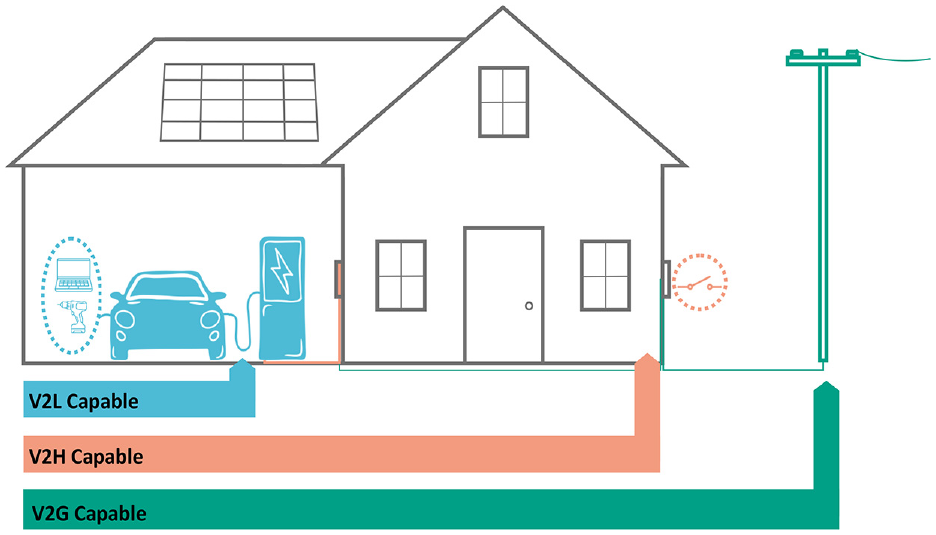
Illustration of vehicle-to-everything (V2X) features for single-family house.
A growing number of automakers, like Tesla, Volkswagen, and General Motors, are planning bidirectional charging capabilities, from V2L to V2G, and several charging equipment companies have announced bidirectional charging technology (e.g., Emporia’s V2X, Wallbox’s Quasar 2, and Nuvve), which through cyber-physical system management tools can automatically charge and discharge an EV’s energy to lower electricity costs. Table 1 lists the make and model of EVs that support V2X at the time of publication.
List of Vehicles Supporting Vehicle-to-Everything (V2X) by Feature Type
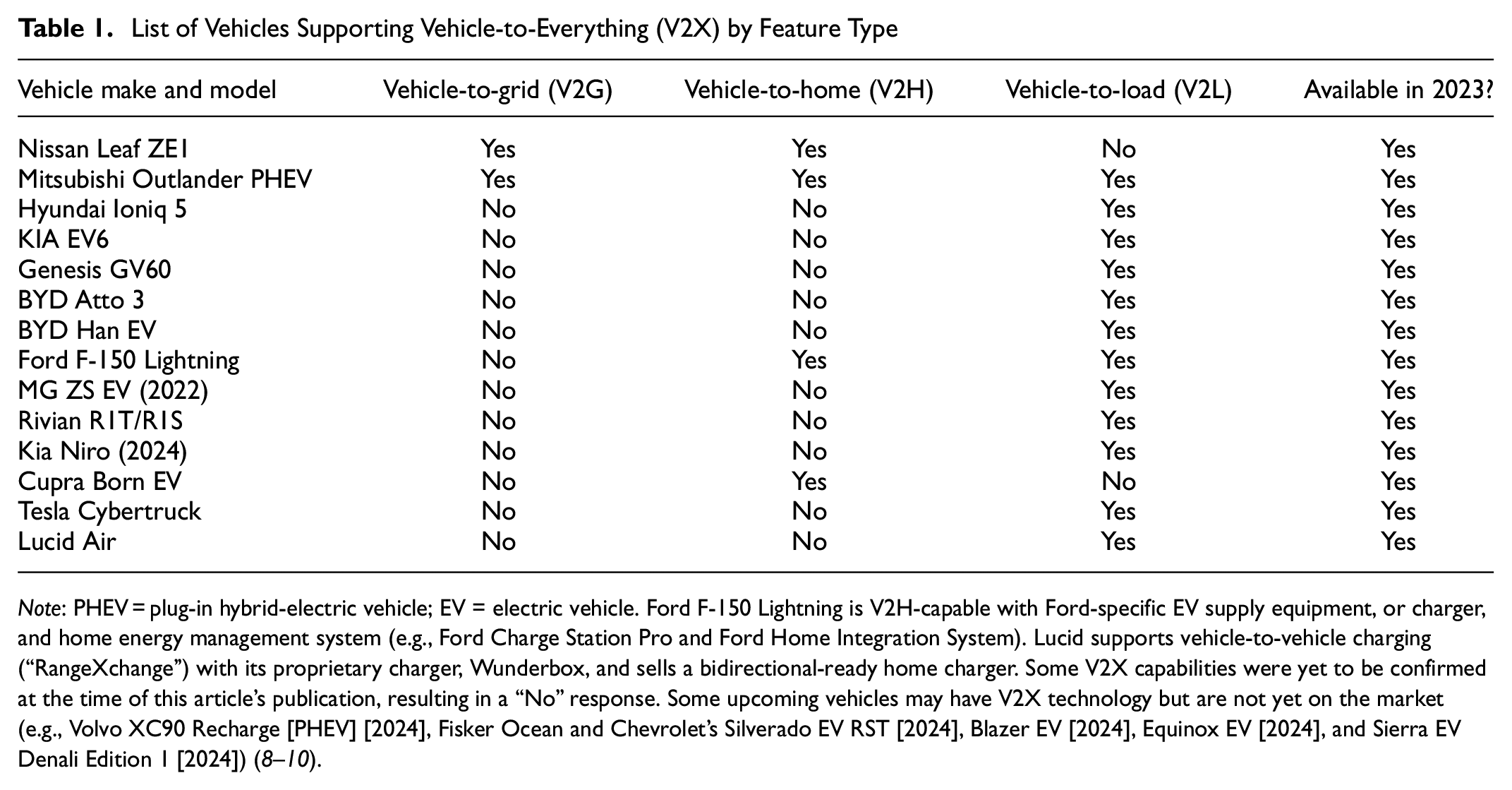
Note: PHEV = plug-in hybrid-electric vehicle; EV = electric vehicle. Ford F-150 Lightning is V2H-capable with Ford-specific EV supply equipment, or charger, and home energy management system (e.g., Ford Charge Station Pro and Ford Home Integration System). Lucid supports vehicle-to-vehicle charging (“RangeXchange”) with its proprietary charger, Wunderbox, and sells a bidirectional-ready home charger. Some V2X capabilities were yet to be confirmed at the time of this article’s publication, resulting in a “No” response. Some upcoming vehicles may have V2X technology but are not yet on the market (e.g., Volvo XC90 Recharge [PHEV] [2024], Fisker Ocean and Chevrolet’s Silverado EV RST [2024], Blazer EV [2024], Equinox EV [2024], and Sierra EV Denali Edition 1 [2024]) ( 8 – 10 ).
At the same time, California’s Senate Bill 233, authored by Senator Nancy Skinner, initially proposed requiring model-year 2030 EVs, specifically light-duty motor vehicles and school buses, sold in the state to be bidirectional capable ( 11 ). The bill, as amended September 1, 2023, would require the State Energy Resources Conservation and Development Commission (the Commission), State Air Resources Board, and the state Public Utilities Commission to establish a workgroup to study the challenges and opportunities of requiring bidirectional-capable BEVs and bidirectional charging equipment, interoperability requirements, and the effects of new requirements by vehicle weight class and other state goals and programs. The bill would provide the Commission, in consultation with the other state agencies, the authority to require bidirectional capabilities from any BEV by weight class ( 12 ). Legislative action may accelerate automaker plans to develop and refine bidirectional charging features.
Sovacool et al.’s systematic review of 197 peer-reviewed articles on V2G from 2015 to 2017 found that 2.1% of articles contained an analysis of consumer attitudes, like social acceptance of V2G technologies ( 13 ). Even then, early literature assumed BEV drivers would sign contracts with inflexible terms, like required plug-in time to get an annual incentive ( 14 ). Although consumer opinion surveys tell respondents they might sell electricity back to the grid with V2G, Parsons et al. found that those willing to charge a future EV with a V2G contract had an implicit discount of annual V2G cash payments (over a 10-year lifespan) of 41%, meaning they valued immediate benefits more than future revenues from V2G. The authors ascribe this high discount rate to either people’s mistrust of power companies or the high uncertainty in future electricity savings with V2G ( 14 ). Thus, it may be beneficial to focus on consumer willingness to participate in V2G primarily for grid emergency support—although less frequent, it has a higher per-event payment. This study seeks to address the question of whether American consumers will let their local power companies discharge their EV’s stored energy to help the power grid during critical times in the year.
Further, there is no peer-reviewed article, to the best of the authors’ knowledge, that estimates consumer WTP for other bidirectional charging features, like V2L and V2H, both of which are bidirectional features that directly benefit the consumer and not the power grid, per se.
This paper proceeds as follows. We summarize key literature on bidirectional charging in the next section, followed by sections that explain the survey design, present summary statistics, modeling specifications, and the results and conclusions for policy makers, automakers, and power companies.
Consumer Surveys on Bidirectional Charging
Parsons et al. ( 14 ), Geske and Schumann ( 15 ), and Lee et al. ( 16 ) conducted web-based surveys of Americans in 2009 (n = 3,029), Germans in 2013 (n = 611), and South Koreans in 2016 (n = 1,007), respectively, to understand people’s sensitivity and willingness to accept V2G contract terms. Drivers heavily discounted any potential V2G revenue because of the inconvenience of the minimum plug-in time of their future EV and the inherent uncertainty with selling power back to the grid ( 14 ). Parsons et al. ( 14 ) and Lee et al. ( 16 ) suggest that power companies eliminate rigid contracts, provide cash payments up front for V2G participation, and compensate EV owners as they discharge power to the grid. Motorists were found to highly value flexibility and preserving the vehicle’s purpose of mobility over V2G revenue ( 14 ).
Parsons et al. estimated that the cost of lowering the guaranteed minimum range after V2G from 175 to 75 mi was equivalent to increasing an EV’s purchase price by about $5,160 (in 2023 U.S. dollars) ( 14 ). Raising the contractual minimum plug-in time from 5 to 10 h a day was equal to an increase of $1,810 in the purchase price. Lee et al. estimated that 17.8% rejected V2G under every condition owing to concerns over contract terms, but of those willing to accept V2G the minimum yearly compensation required was $133 ( 16 ). Geske and Schumann found that although 57% were generally willing to participate in V2G (i.e., use this feature), they were not entirely unconcerned about V2G ( 15 ). Almost 64% of respondents were concerned about battery life with more frequent battery cycling, 56% anticipated they might not be able to plan their trips well enough, and 56% feared inadequate battery levels at the start of each trip.
Kester et al. studied perceptions of V2G through eight focus groups across five Nordic countries (n = 61 participants) in 2016 to 2017 ( 17 ). Responses indicated that drivers were not very familiar with this topic but would allow V2G if given sufficient compensation for battery degradation and information about when vehicles would be discharged to avoid disruptions to mobility. Participants in Iceland and Sweden suggested a guaranteed minimum battery level to ensure unplanned trips can be met. Other participants remarked that future EVs may be bidirectional capable so that power companies could use V2G to manage the grid (i.e., not a consumer technology choice, but an innate part of the EV ecosystem).
Through a choice experiment measuring willingness to provide demand-side flexibility to the power grid, Kubli et al. tested the willingness to accept V2G of German-speaking Swiss residents in 2016 who either owned an EV or intended to buy one in the next 3 years (n = 300) ( 18 ). Four choices ranged from no V2G to a “super flex” charging option with a minimum range level of 40% and unlimited battery access when the EV is plugged in (two intermediate choices were 60% range level and a maximum of three discharging cycles per 24 h versus 80% range level and at most one discharging cycle per 24 h). Over a set of eight choices, the attribute levels varied for monthly power costs, V2G contract duration (in years), and grid feedstock mix. The study found that the acceptability of V2G declined sharply after guaranteed charging levels (or minimum range) fell below 60%. Further, the relative importance of contract duration and charging choices was less than the monthly charging costs and electricity mix. The survey employed a screening question to ensure that respondents either owned or intended to buy at least one load-shifting technology (e.g., EVs, heat pumps, or a joint solar and battery system), to reflect a sample with less concern about ceding control over their home’s energy-consuming devices.
A bidirectional charging station company surveyed over 2,000 drivers in the United Kingdom in February 2023 and found that 49% were more likely to buy an EV if it could partially power their home or the grid ( 19 ). If bidirectional features increase EV ownership, which would help decarbonize transportation and mitigate climate change’s effects, then research is needed to measure how much consumers would pay for these bidirectional features. Since there is hardly any research on the WTP for bidirectional charging technology and its expected use, this timely study fills this gap. Although bidirectional charging may be hard for the average person to understand, this study aims to reduce the burden of choosing an unknown bidirectional feature by framing the question as an additional purchase on top of a more established procedure—a new vehicle purchase. Second, although the number of EV owners (or lessees) and advanced home energy adopters (e.g., rooftop solar, smart thermostat, demand response participants) is small, it is advantageous to understand the early preferences of consumers to inform policy makers and manufacturers ( 18 ) and to better forecast the economic benefits of V2X adoption. Initial studies could unveil how preferences change over time as deployment and understanding becomes more widespread. However, forecasts of future trends should be taken with a measure of caution, considering the unfamiliarity among consumers and the uncertainty of market maturity beyond early adopters.
Survey Design and Data Processing
We conducted an Internet-based survey in the United States that ran from late November to early December 2022. A randomized sample was collected by a survey distribution company, with the aim of being representative of the U.S. population at large in gender, age, educational attainment, and region within the country. Respondents had to be at least 18 years old and were invited to complete two survey sections: a survey on unidirectional smart charging (also called V1G), and bidirectional charging (most often abbreviated to V2G). The first section asked about respondent and household background (including the presence of an EV), mobility patterns, importance of V1G benefits, interest in V1G programs, preferred charging style, opinions on the clean-energy transition, and minimum opt-out fees for a supplier-managed charging program. The results of the V1G section are covered in Dean and Kockelman ( 20 ).
The survey employed a screening question and two within-survey data quality checks nestled among multiple Likert-type questions, one in each section, to ensure reasonable responses. The sample included 1,394 complete responses; however, only n = 1,050 respondents answered the first half and 311 completely answered the optional 21-question V2G section, which is the focus of this study. Having excluded respondents that selected “other: ________” and wrote in a response equivalent to “unsure” the smallest sample size was n = 307.
Bidirectional Charging Concepts
The survey described bidirectional charging concepts after respondents opted into the section on V2G, as shown in Figure 2. This introductory text explains the difference between bidirectional charging features, namely V2L, V2H, and V2G. Additional text was provided to respondents in subsequent questions to avoid confusion with the acronyms. The V2G survey questions are provided in the Appendix.
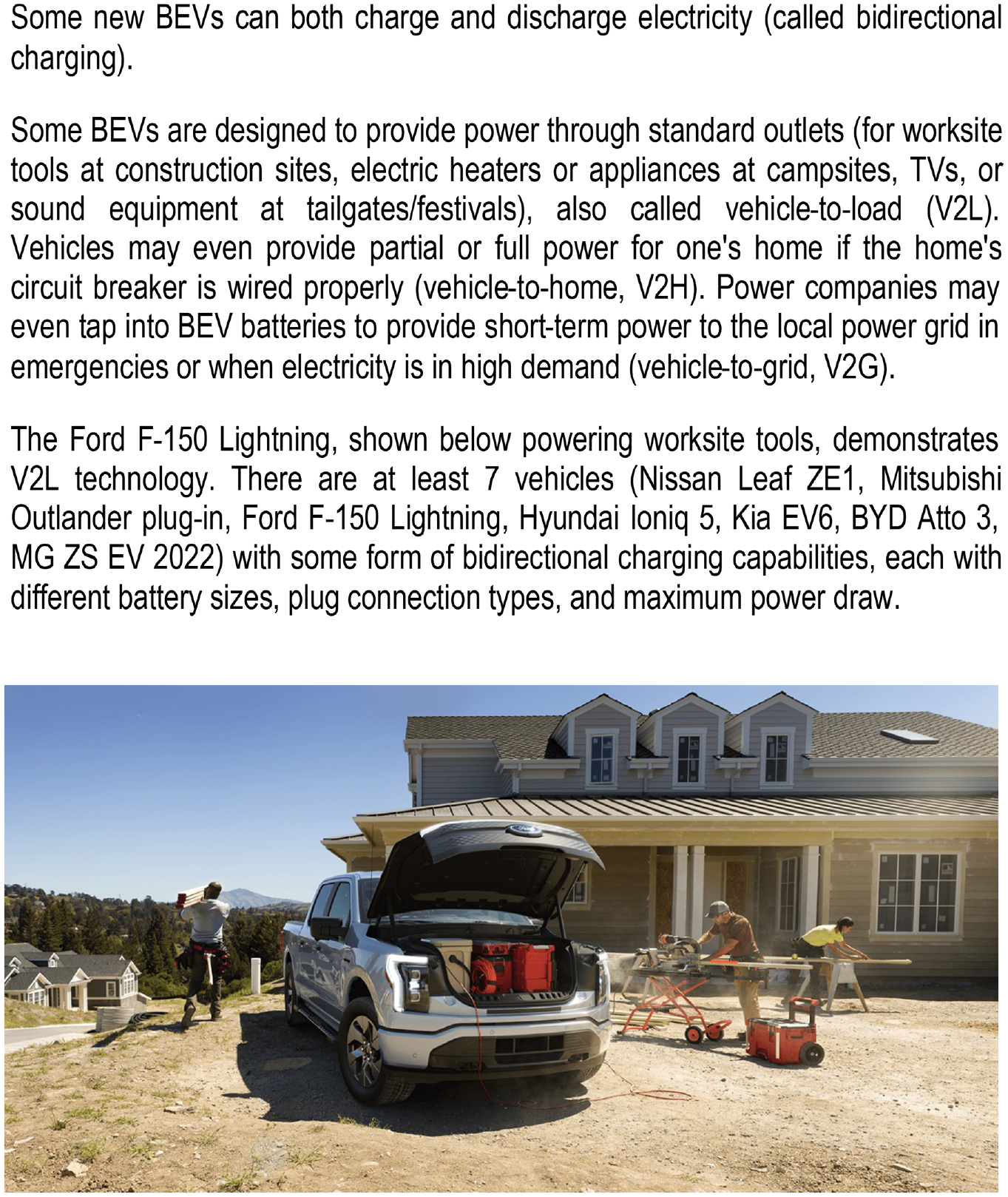
Survey’s introductory text on bidirectional charging.
The bidirectional charging section was separated into the following key survey sections:
Section A: Importance of bidirectional charging benefits to the respondent (5-point Likert-type scale: “not at all important” to “extremely important”); prior knowledge of bidirectional charging (5-point Likert-type scale: “no knowledge” to “extremely knowledgeable.”
Section B: WTP to add V2L technology (right-censored interval data); expected frequency of using V2L technology (6-point ordinal scale).
Section C: WTP to add V2H equipment (right-censored interval data); expected frequency of using V2H equipment (6-point ordinal scale).
Section D: Expected frequency of local power company using BEV’s V2G technology (6-point ordinal scale); expected participation in supplier-managed V2G.
Section E: Expected participation in V2G under different conditions (5-point Likert-type scale: “extremely unlikely” to “extremely likely.”
The intervals used in survey Section B (WTP to add V2L technology) ranged from $ 0 to more than $1,250, in increments of $250. The manufacturer’s suggested retail price of the Hyundai Ioniq V2L connector that attaches to the vehicle’s charging port is over $600, although third-party sites have lower prices ( 22 ). The intervals used in survey Section C (WTP to add V2H equipment) ranged from $ 0 to more than $5,000, in increments of $1,000. Purchase of the Ford F-150 Lightning’s home energy management system sold through their partner, Sunrun, costs $3,895 pre-tax (in 2023 U.S. dollars), whereas the premium for bidirectional chargers might be between $621 and $930 ( 23 , 24 ).
Survey Section D (expected frequency of local power companies using BEV’s V2G technology and expected participation in supplier-managed V2G) relied on a narrow set of attributes, informed from the literature. Parsons et al. found respondents disregarded bidirectional charging within contracts, and the authors suggested moving away from V2G contracts with both minimum plug-in time and guaranteed minimum range to a pay-as-you-provide service model ( 14 ). Unlike Geske and Schumann ( 15 ), who extended Parsons et al.’s ( 14 ) contract terms, Lee et al. examined the acceptance of V2G with a narrow set of conditions: plug-in time of 1 h when notified by the power company and an expectation of four V2G requests per month ( 16 ). This study similarly evaluates a narrow set of conditions and moves away from strict restrictions, like minimum plug-in time for each work day.
We studied the use of V2G during power grid emergencies and not for energy arbitrage. Respondents were told they could receive $ 0.70/mi discharged during V2G events. This value was based on an average BEV’s driving efficiency of 2.9 mi/kWh and was equivalent to $2,000/MWh, which is less than or equal to all wholesale energy scarcity pricing caps in North America ( 25 ). Similar to Geske and Schumann’s study, the minimum guaranteed range of 50 mi was based on the average miles an American travels in a day (40 mi) ( 15 ) plus an additional buffer of 10 mi ( 26 ). As V2G is used only during power grid emergencies, the additional charge–discharge cycles were conservatively estimated to be 1% over a vehicle’s lifespan ( 27 ). Further questions in survey Section E explored the acceptance of a supplier-managed V2G scheme under different conditions, such as battery degradation covered by a battery warranty. As of October 2023, only Nissan (using Fermata Energy’s FE-15 charger [ 24 ]) and Mitsubishi cover V2G.
Data Set Statistics
Our survey was online, anonymous, and designed to be representative of U.S. national-level demographic attributes. The respondents who voluntarily completed the 21 questions covering bidirectional charging, may have been more interested in this research topic than the respondents who completed only the first section (see [ 20 ]), but were otherwise similar to the pool of the larger data set (± a few percentage points). Table 2 summarizes the key characteristics of Dean and Kockelman’s data set ( 20 ), this study’s data set, and comparable U.S.-level data, some of which were used as covariates in the models. Although the sample is nearly representative of the general population across key variables, the results are population weighted.
Characteristics of Respondents Compared to U.S.-Level Data
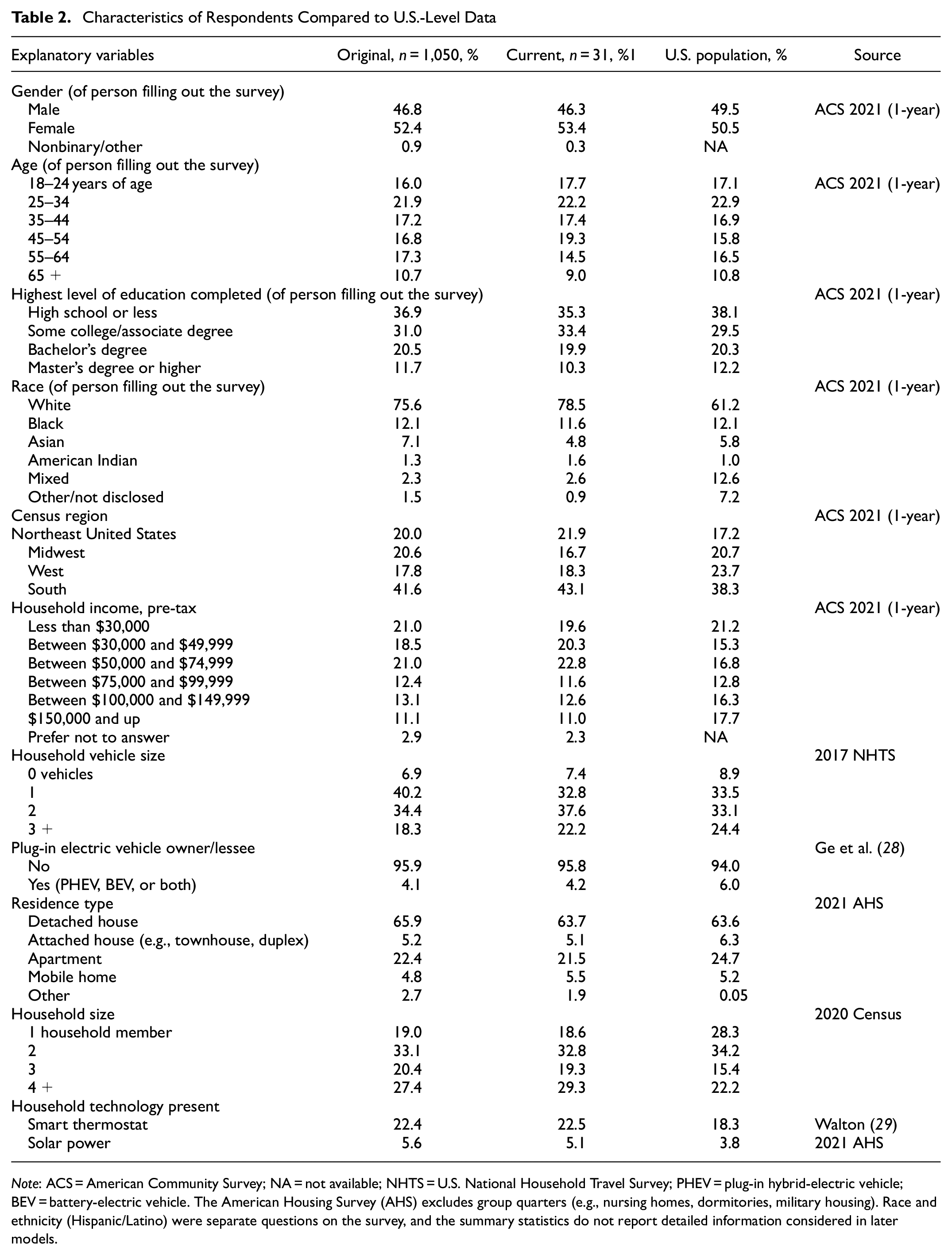
Note: ACS = American Community Survey; NA = not available; NHTS = U.S. National Household Travel Survey; PHEV = plug-in hybrid-electric vehicle; BEV = battery-electric vehicle. The American Housing Survey (AHS) excludes group quarters (e.g., nursing homes, dormitories, military housing). Race and ethnicity (Hispanic/Latino) were separate questions on the survey, and the summary statistics do not report detailed information considered in later models.
The survey sample was population-weighted using iterative poststratification to match the marginal distributions of the sample to national-level population margins (with gender levels [male, female, nonbinary], age levels [18 to 24, 25 to 34, 35 to 44, 45 to 54, 55 to 64, 65+], highest education [high school, some college/associate’s degree, bachelor’s degree, master’s degree/doctorate], and U.S. census region [Northeast, Midwest, South, West]). This paper uses the term “people” when reporting population-corrected results instead of “respondent.”
The average American is willing to spend $280 and $776 for V2L technology and V2H home energy system equipment, respectively, on their next BEV purchase. In contrast, 58.4% of people would not pay more than $250 to add V2L technology, 32.5% were not willing to spend any money at all to add it, and 35.6% would not pay extra for V2H equipment. As expected, the average WTP increased with the size of the bidirectional charging feature, although there was less appetite for V2H.
If Americans had a BEV with V2L technology or V2H equipment, around 21.3% and 14.3% expected to use V2L and V2H, respectively, as often as once a month. On the other hand, a larger share of people did not expect to use V2L or V2H at all (33.1% and 37.5%, respectively). If people with V2G-capable BEVs could opt into a power company program to slightly discharge power back to the grid during emergencies (with appropriate compensation for the subsequent reduced vehicle range and a guaranteed minimum battery level), only 12.7% would definitely participate, however, a larger share (41.1%) would probably participate.
One question told respondents to assume they primarily drove a BEV and allowed their power company to do V1G smart charging (i.e., interrupt or stagger charging) and slightly discharge energy during power emergencies for a quarterly reward on top of compensation for the reduced range per event. The measured outcome was the expected frequency that their power company would slightly discharge their BEV’s battery to support the electrical grid. The ordinal responses ranged from never, once a year, once a quarter, at least once a month, at least once a week, and more than once a week. The largest group (40.8%) said they did not expect their local power company would access their BEV’s battery, whereas about a quarter of people (25.4%) expected their utility company to use V2G once a year, and 21.1% expected V2G use at least once every 3 months.
Exploratory Findings of V2G for Infrequent Emergency Power Grid Support
Figure 3 shows the likelihood that a person would allow their local power company to discharge their future BEV, at most twice a year with advanced warning by a method of their choice (e.g., app notification, text message, email, or phone call) with the option to opt-out if the timing is inconvenient. This supplier-managed V2G scheme would probably be used only during critical peak hours in the year when power grids are operating with reserve generators and have deployed other emergency response measures, like demand response (DR). Most people reported being likely to participate in supplier-managed V2G (68.8%) when compensated for the unlikely event of battery loss; however, power companies may have difficulty measuring and verifying event-specific battery loss. If battery warranties covered battery loss from discharging, then another majority of people (54.5%) would be likely to provide V2G grid resources on request. If warranties do not cover V2G battery loss, a similar share of people would potentially participate if only 5% of the battery was drained (provided the battery level does not drop below 75%). If power companies guaranteed a 50% battery level (with a maximum draw of 10%), more people would probably not participate (46.0%) than participate, similar to findings from Kubli et al. ( 18 ). These two variables indicated that lower minimum range levels and taking more power led to a fall in stated participation. Although the last scenario in Figure 3 is unlikely, it shows the need for addressing battery loss when designing a supplier-managed V2G program, otherwise 63.7% of people would not take part.
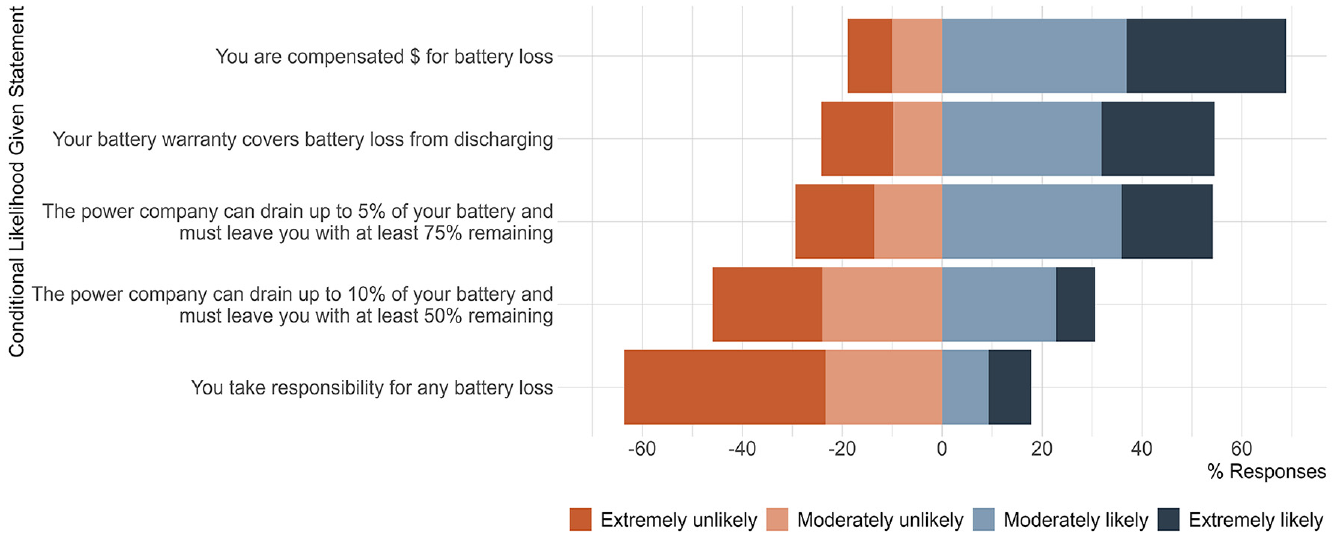
Likelihood of letting power company discharge battery-electric vehicle given certain conditions.
Model Specification
A model was developed to understand the multivariate correlation between the explanatory- variables and response variables, including WTP for bidirectional charging technology and the expected reliance on or use of this technology.
An interval regression (IR) model estimated the WTP to add bidirectional charging technology. Respondents were asked to choose the respective WTP interval (e.g., another $500 to $750 to add V2L technology), with values scaled based on cost estimates from the authors’ correspondence with BEV technology experts. V2L responses ranged from $ 0, <$250, $250 to 500, $500 to 750, $750 to 1,000, $1,000 to 1,250, >$1,250; V2H responses ranged from $ 0, <$1,000, $1,000 to 2,000, $2,000 to 3,000, $3,000 to 4,000, $4,000 to 5,000, >$5,000. Thus, the response variable is right-censored interval data. IR reflects all boundaries as known values (i.e.,

where
j denotes one observation from the set of all observations (
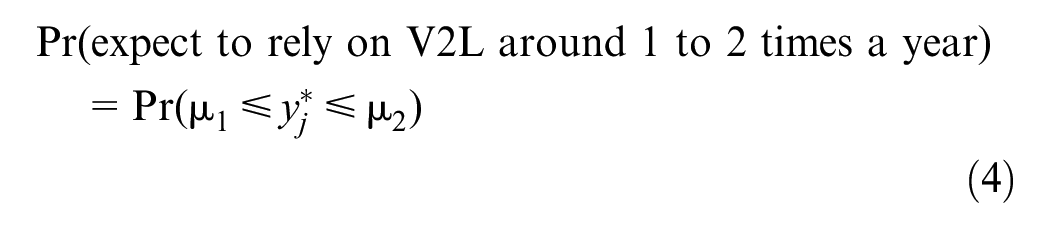
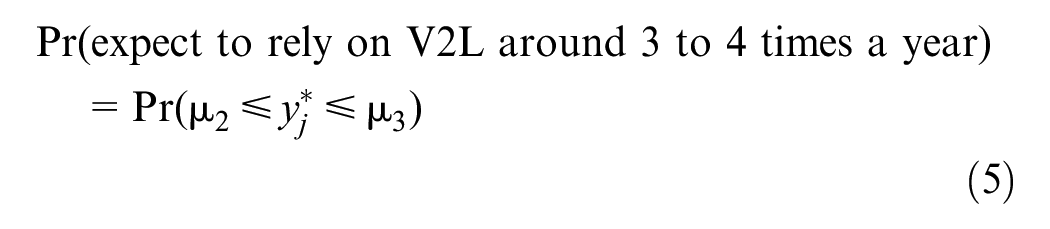
An ordered probit (OP) model estimated the respondent’s expected frequency of relying on V2L and V2H and their expectations of how frequently their local power company would access their BEV to support the electrical grid (i.e., slightly discharge using V2G). OP is formulated as

where
j denotes one observation from the set of all observations (
The number of thresholds is one less than the binned categories (




A subset of explanatory variables was first included when estimating the models. In subsequent steps, the covariates with the lowest statistical significance were removed using likelihood ratio tests, except for some variables like gender and race, as such covariates may offer statistical significance in future studies. In addition to statistical significance, practical significance values were computed to reflect the importance of covariates on the dependent variable. The authors checked for multicollinearity using variance inflation factors, with the highest value being under 2.4.
Model Results
Willingness to Pay for Bidirectional Features
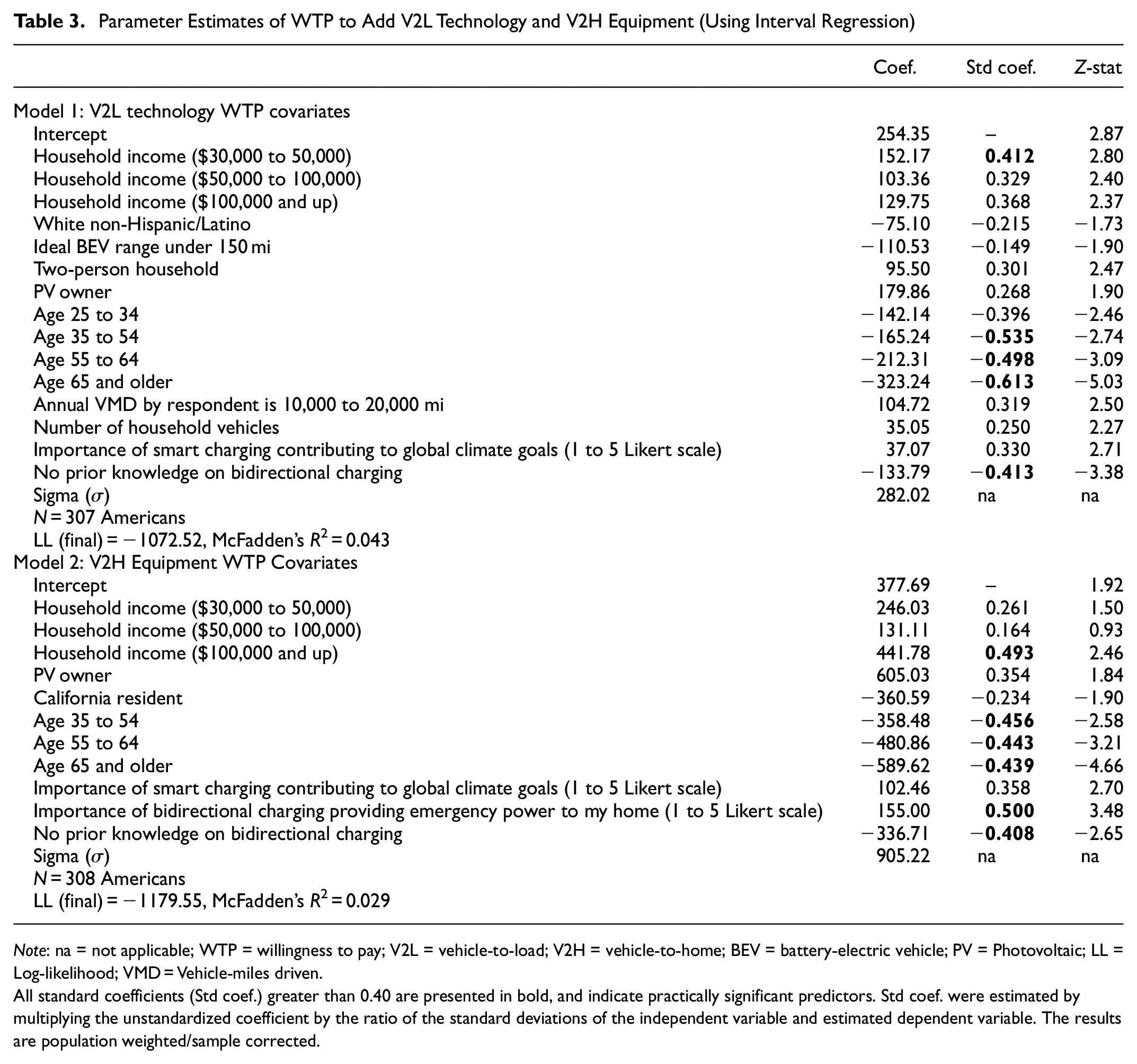
Table 3 summarizes the IR model estimates of Americans’ WTP for adding V2L technology and V2H equipment to their next BEV purchase. The final model includes household-level information (household income, photovoltaic system [PV], household size, number of vehicles), respondent-level characteristics (race, age, residence location), driving patterns, and knowledge of and attitudes toward V1G and V2G capabilities. Gender was initially included in these models but as it was not statistically significant at the 20% level it was removed. Different age and household income groups were tested, with the reference level set to ages 18 to 24 and a household pre-tax income of $30,000 or less, respectively. To account for differences in preferences toward V2G capabilities of individuals who were already knowledgeable about this concept and those who were not, an indicator variable accounting for prior knowledge of bidirectional charging (including V2L, V2H, and V2G) was added. The indicator variable was statistically significant for both WTP models, indicating a $134 and $337 (V2L and V2H, respectively) difference between individuals with and without knowledge of V2G before the survey.
Parameter Estimates of WTP to Add V2L Technology and V2H Equipment (Using Interval Regression)
Note: na = not applicable; WTP = willingness to pay; V2L = vehicle-to-load; V2H = vehicle-to-home; BEV = battery-electric vehicle; PV = Photovoltaic; LL = Log-likelihood; VMD = Vehicle-miles driven.
All standard coefficients (Std coef.) greater than 0.40 are presented in bold, and indicate practically significant predictors. Std coef. were estimated by multiplying the unstandardized coefficient by the ratio of the standard deviations of the independent variable and estimated dependent variable. The results are population weighted/sample corrected.
Two-person households, those owning PV systems, those with an annual income of over $30,000, and those with a respondent driving between 10,000 and 20,000 mi a year (all other predictors held constant) tend to be WTP more to add V2L technology. White, non-Hispanic adults 25 years or older, and those who would buy a BEV with a range of 50 to 150 mi if making a BEV purchase (all other predictors held constant) were estimated to place a lower value on adding V2L technology to a future BEV purchase. Those unwilling to buy long-range BEVs were associated with a lower WTP for V2L (i.e., V2L should be a low-cost add-on to new BEVs).
The cost of buying and installing V2H systems depends on the type of home-charging equipment, the amperage of the home’s electrical panel, construction costs (i.e., trenching or adjustment to existing utility connections), and the cost of an additional home energy system. In this study, we asked respondents to state their WTP for this new system. The survey informed respondents that upgrading a home’s electrical system may cost $1,000 to $3,000, but they were to exclude any electrical upgrade costs in their WTP estimate.
Young adults (aged 18 to 34), those assigning greater importance to smart charging’s contribution to global climate goals and bidirectional charging’s potential to provide emergency power to their home, those with household incomes above $100,000, and those owning PV systems were all estimated to have higher WTP for V2H equipment (all other predictors held constant). As an example, a person meeting all these attributes was estimated to be willing to pay, on average, $1,682, which is less than half (43.2%) of the hardware purchase price of Ford’s F-150 Lightning V2H system (30, 31). California residents and adults 35 years or older were estimated to place a lower value on adding a V2H system to their next BEV purchase.
Expected Frequency of Using V2L and V2H
Table 4 summarizes the OP model estimates of Americans’ expected frequency of relying on V2L technology and V2H equipment, respectively. Older, well-educated adults (aged 55 and up with at least a master’s degree) with no knowledge of bidirectional charging before this survey tended to expect to use V2L less often, assuming they primarily drove a V2L-capable BEV. African-American adults, those having higher perceived importance of smart charging’s ability to reduce power plant air pollution, and those with more household vehicles (everything else held constant) were estimated to expect to rely on V2L more frequently.
Parameter Estimates for OP Model of Expected Reliance on V2L Technology and V2H Equipment
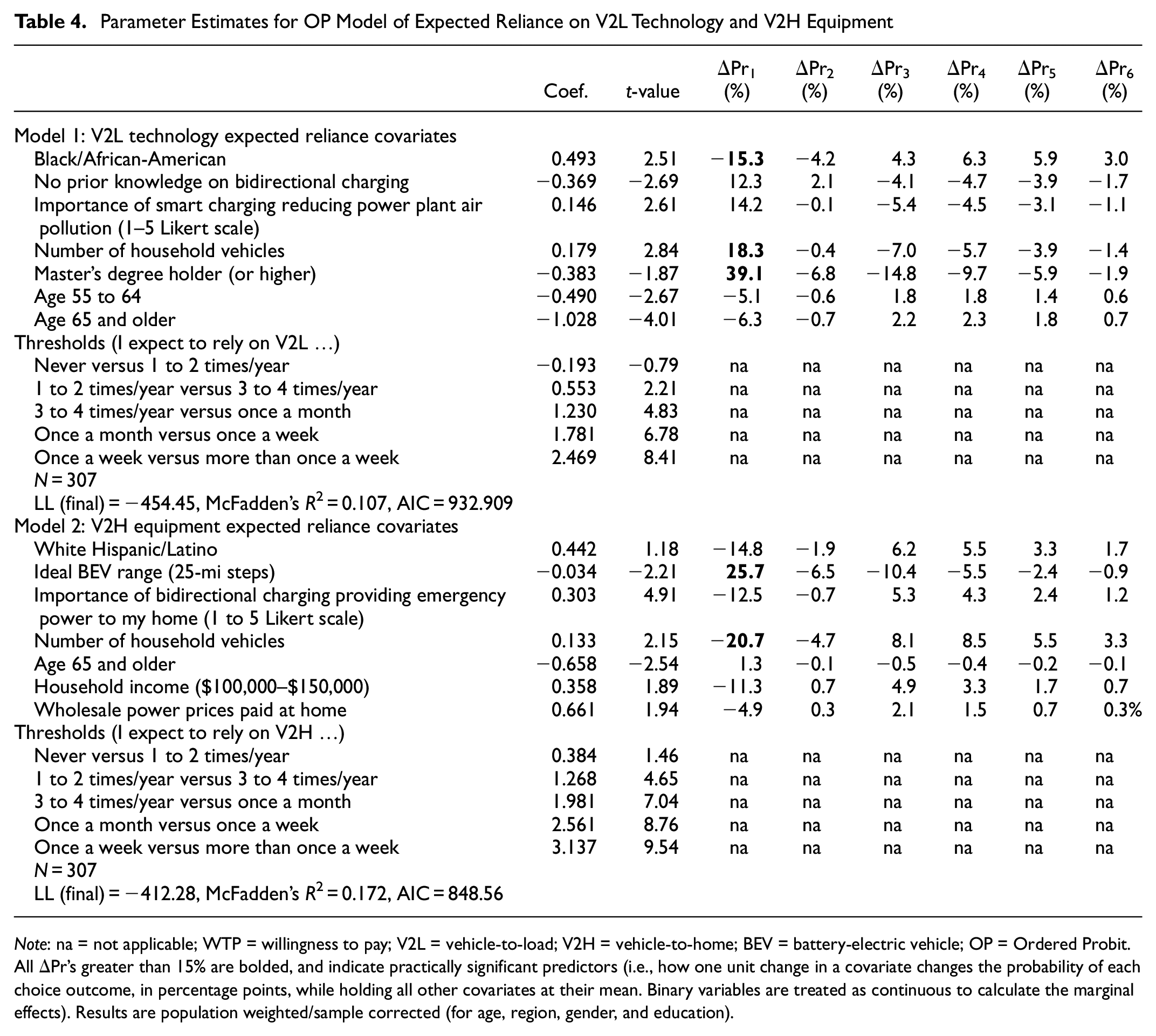
Note: na = not applicable; WTP = willingness to pay; V2L = vehicle-to-load; V2H = vehicle-to-home; BEV = battery-electric vehicle; OP = Ordered Probit.
All ΔPr’s greater than 15% are bolded, and indicate practically significant predictors (i.e., how one unit change in a covariate changes the probability of each choice outcome, in percentage points, while holding all other covariates at their mean. Binary variables are treated as continuous to calculate the marginal effects). Results are population weighted/sample corrected (for age, region, gender, and education).
White Hispanic adults, those having higher perceived importance of bidirectional charging’s potential to provide emergency power to their home, having access to more household vehicles, and whose household pre-tax income was between $100,000 and $150,000 were more likely to rely on V2H to manage their home’s power demands, including lowering their charging bill (all other predictors held constant). Older adults (age 65 and up), customers not paying wholesale-indexed residential electricity prices, and those preferring a long-range BEV if faced with a BEV purchase decision were less likely to rely on V2H (all other predictors held constant), assuming they primarily drove a BEV and had V2H equipment. PV ownership was initially included in the model because a V2H system could charge a vehicle with excess solar generation and discharge energy in the evening to reduce a home’s electric bill. However, this covariate was removed owing to a lack of statistical significance (t-stat of 0.63).
Expected Frequency of Power Company Using V2G
Table 5 reports the OP model for a research question on using a BEV to support the power grid. Although V2G could be used to buy energy at low prices and sell stored energy back to the grid at high prices (i.e., energy arbitrage) or to offer ancillary services, like grid frequency support, it is expected that personal BEVs might only discharge power back to the grid during grid emergencies, at least in the foreseeable future. The regularity with which local power companies might call on personal BEVs to provide power would depend on several factors, including short- and long-term grid resource adequacy, extreme weather, planned and unplanned power grid outages (of generators and transmission lines), and the ability of local power companies to manage a BEV V2G program, with or without the help of a third-party grid aggregator. In this study, respondents were given the information provided in Figure 4, before being asked whether they would participate in supplier-managed (or utility-controlled) bidirectional charging during grid emergencies.
Parameter Estimates for OP Model of Expected Participation in Supplier-Managed Charging (SMC) –V2G During Power Grid Emergencies
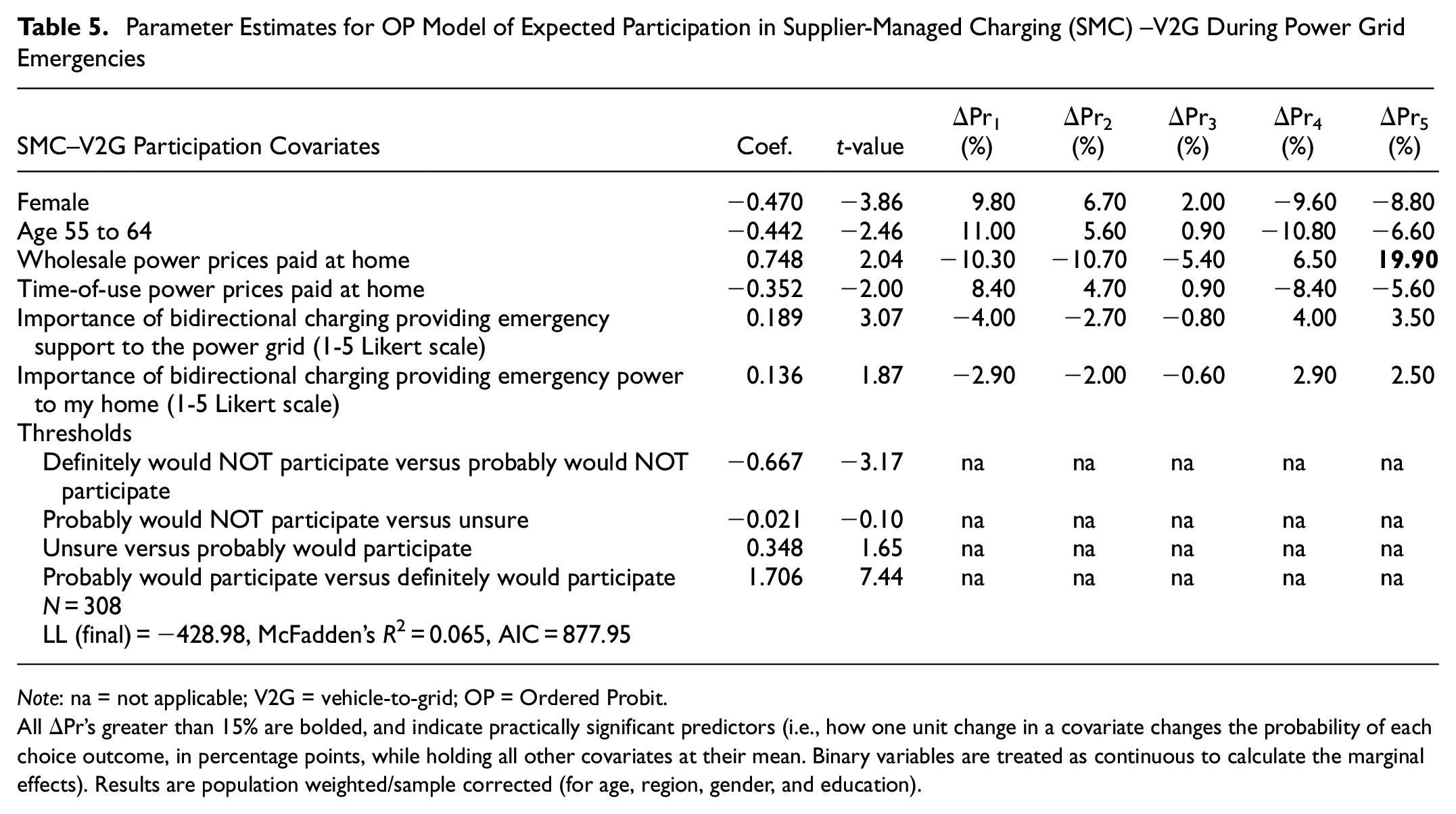
Note: na = not applicable; V2G = vehicle-to-grid; OP = Ordered Probit.
All ΔPr’s greater than 15% are bolded, and indicate practically significant predictors (i.e., how one unit change in a covariate changes the probability of each choice outcome, in percentage points, while holding all other covariates at their mean. Binary variables are treated as continuous to calculate the marginal effects). Results are population weighted/sample corrected (for age, region, gender, and education).
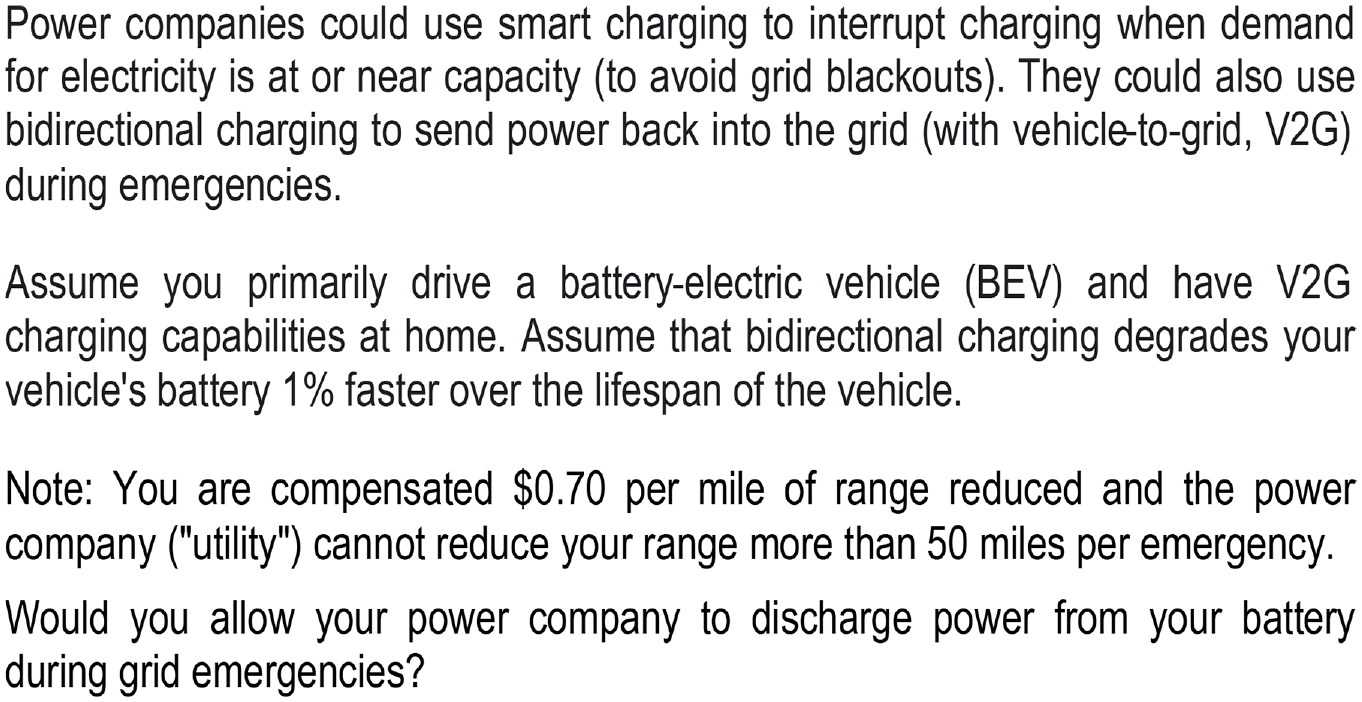
Survey’s explanatory text on expected frequency of vehicle-to-grid-necessitating events.
The results indicated that male adults, customers paying wholesale-indexed residential electricity prices, and those having a higher perceived importance of bidirectional charging’s ability to provide emergency power to their home and the grid were more likely to participate in a supplier-managed V2G program during grid emergencies (all other predictors held constant), provided that the power company compensates them $ 0.70/mi of reduced range and guarantees a minimum range of 50 mi remaining. Older adults (age 55 to 64) who pay time-of-use residential electricity prices (everything else held constant) were less likely to participate in a supplier-managed V2G program during grid emergencies.
Discussion
Knowledge of V2X Topics
The average respondent had no prior knowledge of bidirectional charging (69.8%), and only 20.9% were slightly knowledgeable. Geske and Schumann found that in 2013, 87.7% of their German sample was unfamiliar with V2G, and whereas 11.3% had heard of it, they had little to no knowledge about it ( 15 ). Lee et al.’s 2016 sample of South Koreans found that 15% had some knowledge of V2G ( 16 ). Lastly, a 2023 survey of British drivers found that 46% were unaware of bidirectional charging, and 30% were only slightly aware ( 19 ). Although knowledge of this new technology is low, this study found that a larger share of Americans in late 2022 had some prior knowledge of bidirectional charging than preceding peer-reviewed studies.
Interpretation of Select Model Results
The model estimating the expected use of V2L technology found that having higher perceived importance of smart charging’s (V1G) ability to reduce power plant air pollution had a positive association with use. Although this study did not identify the specific use cases (i.e., external loads) that V2L would serve, this statistically significant covariate may explain an unobserved desire to substitute portable generators with zero-emission, on-site V2G electricity. For reference, a new, portable gasoline-fueled generator running for an hour with an average load of 1.8 kW can emit the equivalent amount of pollution as an average 2019 passenger car driving 150 mi (older generators emit higher particulate matter) ( 32 , 33 ).
Households with more vehicles were associated with a higher expected reliance on V2H to provide backup power or lower their electric bill. Households with more vehicles could compensate for increased vehicle downtime as a result of V2H by carpooling or having household members drive a vehicle that was usually reserved for another member. On the other hand, without implying causality, people expecting to use their V2H system more regularly already had sufficient flexibility to meet unplanned V2H needs through additional household vehicles. Furthermore, the model found long-range BEVs were associated with less frequent V2H use. Although increased battery range could ensure more hours of backup power, those wanting long-range BEVs might expect to drive their vehicle more often or have range anxiety, which may not overlap with the expectation of using a BEV for emergency home power. These hypotheses are not unlike the compensatory effects discussed in Libertson’s supplier-managed V1G experiments ( 34 ).
The average American was willing to spend $776 to add V2H home energy system equipment to their next BEV purchase, not including installation or any electrical upgrades. Assuming the average cost experienced by a residential customer during a single 1-h summer afternoon outage is $5 (in 2023 U.S. dollars) (34), and the average WTP is the true purchase price, a simple but imperfect payback period estimate suggests the average American expects at least 155 h of blackouts over the V2H equipment’s lifetime. The average U.S. household faces nearly 2 h of power outages during the year, excluding major events (5.8 h otherwise), suggesting that either the cost of this technology must be lower or Lawton et al.’s short-term hourly cost for power outages is too low ( 35 ). Although Lawton et al.’s estimate correctly omits hours-long outage costs (i.e., no spoiled food, limited interruption to work, no human health impacts from cold/heat), their work does not account for a higher share of working Americans with postpandemic telework privileges ( 35 ).
People residing in areas of the country with total power outages lasting longer than the average residential customer may have selected a higher WTP for V2H equipment; however, this study did not directly ask respondents how frequently they experienced power outages because of accuracy concerns (e.g., respondents away from their house/asleep during the event and recall bias). Instead, the survey asked respondents to select the frequency with which they believed their power company would slightly discharge their future BEV to support the grid. A large share (40.8%) said they would never expect their power company to rely on V2G to support the grid. The survey did not follow up this response to understand whether this was because the respondent historically had had reliable electricity or believed their local power company might be slow to innovate.
Future Work and Limitations
Surveys are important tools for understanding consumer interest in new technologies, and their accuracy depends on eliciting responses from a representative target population. This study estimated WTP and the expected use of emerging technology on a population that is still learning about EVs. Responses came from an optional second-half section of a nationally representative survey targeted at U.S. adults ( 20 ). As a result, there may be bias in who opted into this survey. For example, respondents may have agreed to answer additional questions because they were highly interested (or conversely highly disinterested) in this technology, perceived a higher payout for answering more questions, or were flexible in their time when taking the survey (or some combination of these and other factors). The authors cannot identify the motivation of these respondents to determine whether this opt-in method added additional bias. Subsequent work might use these survey questions as the primary study to investigate whether this exploratory study’s data are of similar quality.
This paper presents stated preference experimental results that may not hold up over time. However, they are currently valuable for informing policy and technological development. Although this paper provides a critical look into consumer interest in bidirectional vehicle charging technology during a period of high growth in EV adoption (10% of U.S. light-duty vehicles sold are hybrid-electric or plug-in electric), the sample size was small and bidirectional charging technology is very new (69.8% had no prior knowledge of V2G). V2H technology interest and adoption is likely to be concentrated in areas of high electricity prices and solar irradiance or where power is unreliable. For example, future research may survey island residents (e.g., Puerto Rico) or wildfire-prone regions of California, which have a recent history of public safety power shutoffs.
It is worth noting that the study did not observe respondent’s knowledge about or experience with related clean energy and resilience technology subsidies (e.g., rooftop solar and behind-the-meter battery systems) was not observed in this survey. Research could test whether these factors contributed to a statistically significant difference in the WTP for V2H technology. In the future, the transition from net metering to net billing solar policies might create conditions in which price signals incentivize V2H systems with a behind-the-meter battery storage system (BSS) to make charging more affordable at off-peak prices and incentivize discharging the BSS during the net peak. Research should similarly study the influence of residential solar rules on the adoption of V2H systems.
Our survey presented V2G only through the lens of serving as a grid resource in emergencies, which would be controlled by the local power company. Although each survey question was presented as a pay-as-you-supply V2G DR compensation scheme, some regions may allow third-party companies to pool BEV resources to coordinate V2G (i.e., a virtual power plant [VPP]) and participate in the wholesale power market (i.e., discharge electricity when prices spike to make money). As a result, WTP may be biased high since the respondents were not told to consider the potential revenue from participating in a VPP. Additional work is necessary to understand opinions and acceptance of flexible V2G schemes to make money and to understand the trust in and perceptions of third-party companies versus traditional power companies.
In this exploratory work, the questions did not vary the value of V2G attributes (e.g., battery degradation, minimum battery levels, per-mile compensation for reduced range, or frequency of V2G for DR requests). Behavioral responses are likely to change with different values ( 14 ), and this study could not measure the rate of change in outcome variables, namely willingness to participate, with a change in attribute values. Another limitation related to Figure 3’s statements is not measuring how participation acceptance in V2G for DR varied by time of day and day of the week. Although the statements in Figure 3 were intended to gather generalizable participation data, the findings may not be appropriate in all cases. Future work could collect more detailed data and borrow survey questions from DR literature.
Lastly, residential installation of EV charging infrastructure is biased toward homeowners and those living in detached homes. V2H can provide backup power or reduce a household’s electric bill when integrated with a home energy management system and rooftop solar. Thus, it may be hard for respondents who live in apartments, condos, townhomes, or rent detached houses to envision a future in which they are homeowners, which may have resulted in low use- and WTP values. Research could ask renters to state their WTP more on rent for a property that has V2H.
Conclusions
This study estimates IR and OP models to understand the impacts of demographics, travel characteristics, and preferences in relation to bidirectional charging benefits on Americans’ WTP and expected use of bidirectional charging technologies and equipment.
Population-weighted summary statistics suggest that roughly a third of Americans do not yet see a value in adding V2L technology to a future BEV purchase and would not buy additional V2H equipment to provide emergency power to the home during grid outages. If V2L technology is a feature on all BEVs and Americans primarily drive a BEV, 21% expect to rely on this feature to charge auxiliary loads at recreational, work, and home locations. The average WTP for V2L technology and V2H home energy systems (not including any electrical panel upgrades) is estimated at $286 and $793, respectively. On average, power outages in the U.S. mainland are infrequent and short, and only 14.3% of Americans expect to rely on V2H as often as once a month. Locational variables, like climate change mitigation policies, vegetation clearing practices, and challenging terrain, influence power outage frequency and duration but are unobserved in the model estimating the respondent’s expected use of a future V2H system. Even if power companies could use BEVs to provide emergency power to the grid (assuming compensation for reduced range and minimum range requirements), only 12.7% expected their local power company to use their future BEV’s battery at least monthly. Perhaps because of the perceived rarity of events necessitating V2G use, 53.8% of Americans state they would definitely or probably opt into an emergency V2G program.
Older adults (aged 35 and up) and those who did not know of bidirectional charging before this survey express lower WTP for V2L and V2H, whereas households making over $30,000, with PV at their home and who believe smart charging’s (V1G) contribution to global climate goals was of high importance had a higher WTP to add these technologies to their future BEV purchase. Assuming BEVs have these technologies, households with more vehicles were estimated to use these features more frequently. In contrast, adults over 65 are estimated to use these features less often. Finally, those with wholesale-indexed residential electricity prices are more likely to frequently use V2H and more willing to participate in a supplier-managed V2G emergency program.
This study provides a timely analysis of Americans’ perceptions of bidirectional charging features through WTP and use measurements. The knowledge of which covariates have statistical and practical significance sheds light on who might be early adopters of this technology, which is of interest to automakers, policymakers, and local power companies. The relatively low WTP values indicate a need to lower the costs of V2L and V2H equipment and/or the need for awareness campaigns on the part of automakers to show the value of these technologies. This study found that 37.5% of Americans would not expect to use a V2H system, assuming they had one, a finding that could help forecast the long-term adoption of V2H technology. As the policy landscape changes with PV net metering and the cost of BEVs and battery storage systems declines, future work should revisit these questions to understand whether Americans have shifted their views on a vehicle–home integrated system and whether these data are of similar quality to a nationally representative sample in which V2X is the primary survey focus. Lastly, this study suggests that if compensated at $ 0.70/mi of reduced range with a guaranteed minimum battery level of 50 mi, over half of Americans would opt into a utility-controlled V2G plan to provide emergency grid support to prevent major grid outages arising from electricity demand exceeding the supply generated.
Supplemental Material
sj-docx-1-trr-10.1177_03611981241253608 – Supplemental material for Assessing Public Opinions of and Interest in Bidirectional Electric Vehicle Charging Technologies: A U.S. Perspective
Supplemental material, sj-docx-1-trr-10.1177_03611981241253608 for Assessing Public Opinions of and Interest in Bidirectional Electric Vehicle Charging Technologies: A U.S. Perspective by Matthew D. Dean and Kara M. Kockelman in Transportation Research Record
Footnotes
Acknowledgements
The authors acknowledge Balasubramanian Sambasivam of The University of Texas at Austin, Saagar Pateder of Boston Consulting Group, and Cameron Freberg of Austin Energy for their helpful comments and insights on the survey design. The authors are grateful for the reviewer comments, which greatly improved the presentation of this work.
Author Contributions
The authors confirm contribution to the paper as follows: study conception and design: M.D. Dean, K.M. Kockelman; data collection: M.D. Dean; analysis and interpretation of results: M.D. Dean; draft manuscript preparation: M.D. Dean, K.M. Kockelman. All authors reviewed the results and approved the final version of the manuscript.
Declaration of Conflicting Interests
The authors declared no potential conflicts of interest with respect to the research, authorship, and/or publication of this article.
Funding
The authors disclosed receipt of the following financial support for the research, authorship, and/or publication of this article: The first author was supported by the National Science Foundation Graduate Research Fellowship Program under Grant No. DGE-1610403 during part of this project. Any opinions, findings, and conclusions or recommendations expressed in this material are those of the authors and do not necessarily reflect the views of the National Science Foundation. This research was also funded by the 2022–2023 Energy Seed Grant Program from the Energy Institute at The University of Texas at Austin.

Supplemental Material
Supplemental material for this article is available online.
References
Supplementary Material
Please find the following supplemental material available below.
For Open Access articles published under a Creative Commons License, all supplemental material carries the same license as the article it is associated with.
For non-Open Access articles published, all supplemental material carries a non-exclusive license, and permission requests for re-use of supplemental material or any part of supplemental material shall be sent directly to the copyright owner as specified in the copyright notice associated with the article.
